
Articles | Volume 19, issue 2
https://doi.org/10.5194/gmd-19-661-2026
© Author(s) 2026. This work is distributed under
the Creative Commons Attribution 4.0 License.
the Creative Commons Attribution 4.0 License.
https://doi.org/10.5194/gmd-19-661-2026
© Author(s) 2026. This work is distributed under
the Creative Commons Attribution 4.0 License.
the Creative Commons Attribution 4.0 License.
Model description paper
| 
22 Jan 2026
Model description paper |
| 22 Jan 2026
| 22 Jan 2026
IPSL-Perm-LandN: improving the IPSL Earth System Model to represent permafrost carbon-nitrogen interactions
Rémi Gaillard
CORRESPONDING AUTHOR

Laboratoire de Géologie, Ecole Normale Supérieure, CNRS, Institut Pierre-Simon Laplace, Université Paris Sciences et Lettres, Paris, France
now at: Faculty of Environment, Science and Economy, University of Exeter, Exeter, UK
Patricia Cadule
Laboratoire de Météorologie Dynamique, Institut Pierre-Simon Laplace, CNRS, École Normale Supérieure, Université PSL, Sorbonne Université, École Polytechnique, Paris, France
Philippe Peylin
Laboratoire des Sciences du Climat et de l’Environnement, LSCE/IPSL, CEA-CNRS-UVSQ, Université Paris-Saclay, Gif-sur-Yvette, France
Nicolas Vuichard
Laboratoire des Sciences du Climat et de l’Environnement, LSCE/IPSL, CEA-CNRS-UVSQ, Université Paris-Saclay, Gif-sur-Yvette, France
Bertrand Guenet
Laboratoire de Géologie, Ecole Normale Supérieure, CNRS, Institut Pierre-Simon Laplace, Université Paris Sciences et Lettres, Paris, France
Related authors
No articles found.
Anna Kirchner, Efrén López-Blanco, Vladislav Bastrikov, Sebastiaan Luyssaert, Philippe Peylin, and Anne Sofie Lansø
Biogeosciences, 23, 6521–6555, https://doi.org/10.5194/bg-23-6521-2026, https://doi.org/10.5194/bg-23-6521-2026, 2026
Short summary
Short summary
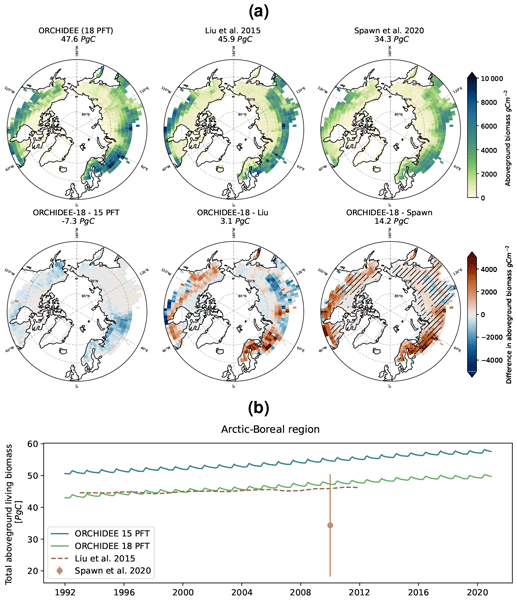
Shrubs need to be represented in climate models, because they shape the response of high-latitude regions to climate change. We added three shrub types to the ORCHIDEE (Organising Carbon and Hydrology In Dynamic Ecosystems) land surface model using Arctic observations. Including shrubs reduces simulated biomass and carbon uptake, improving model agreement with measurements. This is a simple, observation-based approach and an important step towards better representations of shrubs and their climate change response in models.
Yue Zhou, Maria Costanza Andrenelli, Quentin Beauclaire, Eyal Ben-Dor, Sara Bergante, Javier Bravo-García, David de la Fuente Blanco, Asa Gholizadeh, David Čejka, Sabine Chabrillat, Bernard Heinesch, Laura Hernandez Mateo, Kevin Kuehl, Bernard Longdoz, Carlos Lozano Fondón, Petr Maca, Robert Milewski, Stefano Monaco, Dimitra Palantza, Francesco Palazzi, Maria Fantappiè, Roberta Farina, Marmar Sabetizadeh, Benjamin Sanchez, Inés Santín, Jonti Evan Shepherd, Judit Torres, Marta Gómez-Giménez, Bas van Wesemael, and Bertrand Guenet
EGUsphere, https://doi.org/10.5194/egusphere-2026-4735, https://doi.org/10.5194/egusphere-2026-4735, 2026
This preprint is open for discussion and under review for SOIL (SOIL).
Short summary
Short summary
Modelling changes in soil carbon stocks often relies on field measurements, such as temperature, rainfall and plant growth, but these data are not widely available across large areas. Using 16 long-term experiments data across Europe, we tested how model results changed when field measurements were replaced with satellite-based and other spatial data. Overall, spatial data produced reliable estimates of soil carbon change, supporting their use in large-scale assessments.
Colin Jones, Isaline Bossert, Donovan P. Dennis, Hazel A. Jeffery, Chris D. Jones, Torben Koenigk, Sina Loriani, Benjamin Sanderson, Roland Séférian, Klaus Wyser, Shuting Yang, Manabu Abe, Sebastian Bathiany, Pascale Braconnot, Victor Brovkin, Friedrich A. Burger, Patrica Cadule, Frederic S. Castruccio, Gokhan Danabasoglu, Andrea Dittus, Jonathan F. Donges, Friederike Fröb, Thomas L. Frölicher, Goran Georgievski, Chuncheng Guo, Aixue Hu, Peter Lawrence, Paul Lerner, José Licón-Saláiz, Bette Otto-Bliesner, Anastasia Romanou, Elena Shevliakova, Yona Silvy, Didier Swingedouw, Jerry Tjiputra, Jeremy Walton, Andy Wiltshire, Ricarda Winkelmann, Richard Wood, Tokuta Yokohata, and Tilo Ziehn
Geosci. Model Dev., 19, 6941–6966, https://doi.org/10.5194/gmd-19-6941-2026, https://doi.org/10.5194/gmd-19-6941-2026, 2026
Short summary
Short summary
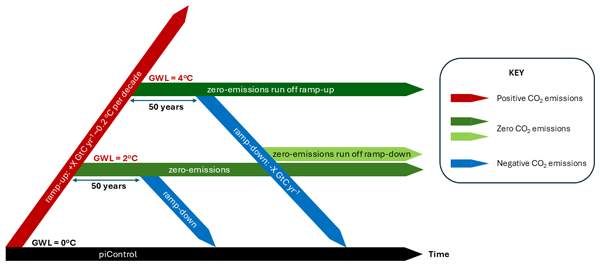
We introduce a new Earth system model experiment protocol to help researchers understand how Earth might respond to positive, zero, and negative carbon emissions. This protocol enables different models to be compared following similar warming and cooling rates. Researchers use the models to explore how the Earth reacts to different climate futures, including the risk of tipping points being exceeded and whether changes can be reversed. The results will support improved long-term climate policy.
Pierre Friedlingstein, Michael O'Sullivan, Matthew W. Jones, Robbie M. Andrew, Dorothee C. E. Bakker, Judith Hauck, Peter Landschützer, Corinne Le Quéré, Hongmei Li, Ingrid T. Luijkx, Glen P. Peters, Wouter Peters, Julia Pongratz, Clemens Schwingshackl, Stephen Sitch, Josep G. Canadell, Philippe Ciais, Kjetil Aas, Simone R. Alin, Peter Anthoni, Leticia Barbero, Nicholas R. Bates, Nicolas Bellouin, Alice Benoit-Cattin, Carla F. Berghoff, Raffaele Bernardello, Laurent Bopp, Ida Bagus Mandhara Brasika, Matthew A. Chamberlain, Naveen Chandra, Frédéric Chevallier, Louise P. Chini, Nathan O. Collier, Thomas H. Colligan, Margot Cronin, Laique M. Djeutchouang, Xinyu Dou, Matt P. Enright, Kazutaka Enyo, Michael Erb, Wiley Evans, Richard A. Feely, Liang Feng, Daniel J. Ford, Adrianna Foster, Filippa Fransner, Thomas Gasser, Marion Gehlen, Thanos Gkritzalis, Jefferson Goncalves De Souza, Giacomo Grassi, Luke Gregor, Nicolas Gruber, Bertrand Guenet, Özgür Gürses, Kirsty Harrington, Ian Harris, Jens Heinke, George C. Hurtt, Yosuke Iida, Tatiana Ilyina, Akihiko Ito, Andrew R. Jacobson, Atul K. Jain, Tereza Jarníková, Annika Jersild, Fei Jiang, Steve D. Jones, Etsushi Kato, Ralph F. Keeling, Kees Klein Goldewijk, Jürgen Knauer, Yawen Kong, Jan Ivar Korsbakken, Charles Koven, Taro Kunimitsu, Xin Lan, Junjie Liu, Zhiqiang Liu, Zhu Liu, Claire Lo Monaco, Lei Ma, Gregg Marland, Patrick C. McGuire, Galen A. McKinley, Joe R. Melton, Natalie Monacci, Erwan Monier, Eric J. Morgan, David R. Munro, Jens D. Müller, Shin-Ichiro Nakaoka, Lorna R. Nayagam, Yosuke Niwa, Tobias Nutzel, Are Olsen, Abdirahman M. Omar, Naiqing Pan, Sudhanshu Pandey, Denis Pierrot, Zhangcai Qin, Pierre Regnier, Gregor Rehder, Laure Resplandy, Alizée Roobaert, Thais M. Rosan, Christian Rödenbeck, Jörg Schwinger, Ingunn Skjelvan, T. Luke Smallman, Victoria Spada, Mohanan G. Sreeush, Qing Sun, Adrienne J. Sutton, Colm Sweeney, Didier Swingedouw, Roland Séférian, Shintaro Takao, Hiroaki Tatebe, Hanqin Tian, Xiangjun Tian, Bronte Tilbrook, Hiroyuki Tsujino, Francesco Tubiello, Erik van Ooijen, Guido R. van der Werf, Sebastiaan J. van de Velde, Anthony P. Walker, Rik Wanninkhof, Xiaojuan Yang, Wenping Yuan, Xu Yue, and Jiye Zeng
Earth Syst. Sci. Data, 18, 3211–3288, https://doi.org/10.5194/essd-18-3211-2026, https://doi.org/10.5194/essd-18-3211-2026, 2026
Short summary
Short summary
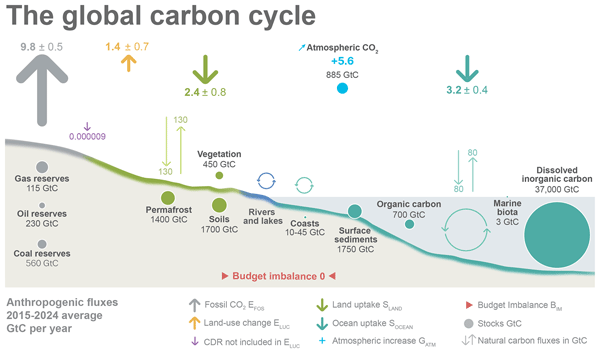
The Global Carbon Budget 2025 describes the methodology, main results, and datasets used to quantify the anthropogenic emissions of carbon dioxide (CO2) and their partitioning among the atmosphere, land ecosystems, and the ocean over the historical period (1750–2025). These living datasets are updated every year to provide the highest transparency and traceability in the reporting of CO2, the key driver of climate change.
Natalie Douglas, Simon Beylat, Tristan Quaife, Philippe Peylin, Nina Raoult, and Ross Bannister
EGUsphere, https://doi.org/10.5194/egusphere-2026-132, https://doi.org/10.5194/egusphere-2026-132, 2026
Short summary
Short summary
This study investigates a statistical method, called 4DEnVar, to calibrate uncertain land surface model parameters against observations. This method is easy to use but can lead to unphysical parameter values. The study explores the causes of this while proposing a simple way to overcome the problem. We show that the 4DEnVar method exhibits considerable versatility by applying the method to two different land surface models, under different settings, to calibrate photosynthetic parameters.

Jon Cranko Page, Martin G. De Kauwe, Andy J. Pitman, Isaac R. Towers, Gabriele Arduini, Martin J. Best, Craig R. Ferguson, Jürgen Knauer, Hyungjun Kim, David M. Lawrence, Tomoko Nitta, Keith W. Oleson, Catherine Ottlé, Anna Ukkola, Nicholas Vuichard, Xiaoni Wang-Faivre, and Gab Abramowitz
Biogeosciences, 23, 263–282, https://doi.org/10.5194/bg-23-263-2026, https://doi.org/10.5194/bg-23-263-2026, 2026
Short summary
Short summary
This paper used a large dataset of observations, machine learning predictions, and computer model simulations to test how well land surface models represent the water, energy, and carbon cycles. We found that the models work well under "normal" weather but do not meet performance expectations during coinciding extreme conditions. Since these extremes are relatively rare, targeted model improvements could deliver major performance gains.
Cheng Gong, Yan Wang, Hanqin Tian, Sian Kou-Giesbrecht, Nicolas Vuichard, and Sönke Zaehle
Atmos. Chem. Phys., 25, 17009–17025, https://doi.org/10.5194/acp-25-17009-2025, https://doi.org/10.5194/acp-25-17009-2025, 2025
Short summary
Short summary
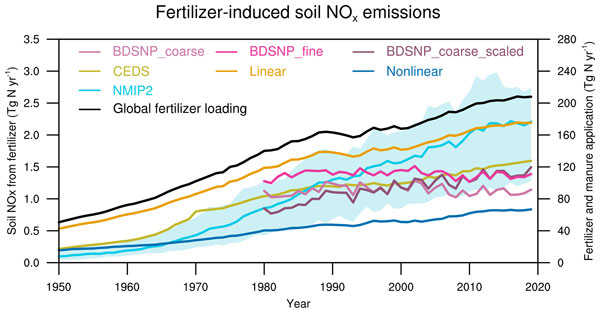
Our results showed substantially varied fertilizer-induced soil NOx emissions in 2019 from 0.84 to 2.2 Tg N yr-1 globally. Such variations further lead to 0.1 to 3.3 ppbv summertime ozone enhancement in agricultural hotspot regions and 6.7 ppbv to 16.6 ppbv reductions in global methane concentrations.
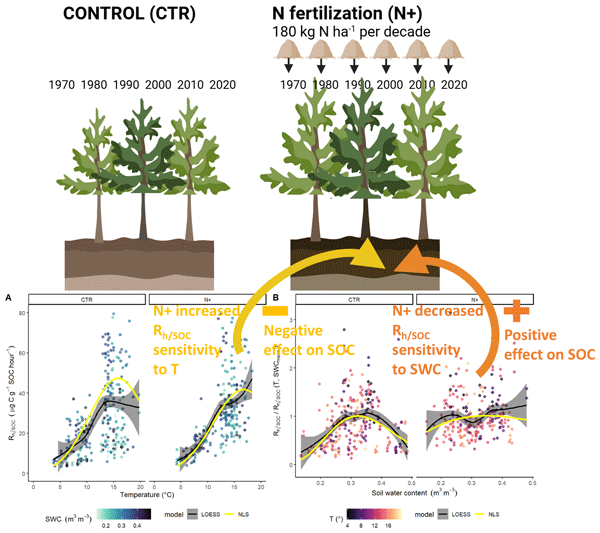
Boris Ťupek, Aleksi Lehtonen, Stefano Manzoni, Elisa Bruni, Petr Baldrian, Etienne Richy, Bartosz Adamczyk, Bertrand Guenet, and Raisa Mäkipää
Biogeosciences, 22, 5497–5510, https://doi.org/10.5194/bg-22-5497-2025, https://doi.org/10.5194/bg-22-5497-2025, 2025
Short summary
Short summary
We explored soil microbial respiration (Rh) kinetics of low-dose and long-term N fertilization in N-limited boreal forest in connection with CH4 and N2O fluxes and soil and tree C sinks. The insights show that N fertilization affects C retention in boreal forest soils by modifying Rh sensitivities to soil temperature and moisture. The key findings reveal that N-enriched soils exhibited reduced sensitivity of Rh to moisture, which contributed to enhanced soil C sequestration on an annual level.
Elodie Salmon, Bertrand Guenet, and Agnès Ducharne
EGUsphere, https://doi.org/10.5194/egusphere-2025-3511, https://doi.org/10.5194/egusphere-2025-3511, 2025
Short summary
Short summary
Soil organic carbon stockage is a key process to mitigate climate change and is intertwined with soil temperature and moisture and of other secondary soil properties. This study shows the significance of secondary drivers in the relationship between soil moisture and microbial efficiency in soil organic carbon degradation. Using empirical relationships in a global ecosystem model enhanced significantly the heterogeneous spatial pattern of soil organic carbon stock and carbon dioxide fluxes.
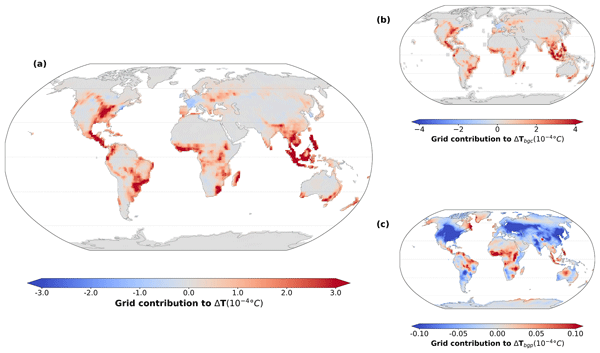
Amali A. Amali, Clemens Schwingshackl, Akihiko Ito, Alina Barbu, Christine Delire, Daniele Peano, David M. Lawrence, David Wårlind, Eddy Robertson, Edouard L. Davin, Elena Shevliakova, Ian N. Harman, Nicolas Vuichard, Paul A. Miller, Peter J. Lawrence, Tilo Ziehn, Tomohiro Hajima, Victor Brovkin, Yanwu Zhang, Vivek K. Arora, and Julia Pongratz
Earth Syst. Dynam., 16, 803–840, https://doi.org/10.5194/esd-16-803-2025, https://doi.org/10.5194/esd-16-803-2025, 2025
Short summary
Short summary
Our study explored the impact of anthropogenic land-use change (LUC) on climate dynamics, focusing on biogeophysical (BGP) and biogeochemical (BGC) effects using data from the Land Use Model Intercomparison Project (LUMIP) and the Coupled Model Intercomparison Project Phase 6 (CMIP6). We found that LUC-induced carbon emissions contribute to a BGC warming of 0.21 °C, with BGC effects dominating globally over BGP effects, which show regional variability. Our findings highlight discrepancies in model simulations and emphasize the need for improved representations of LUC processes.
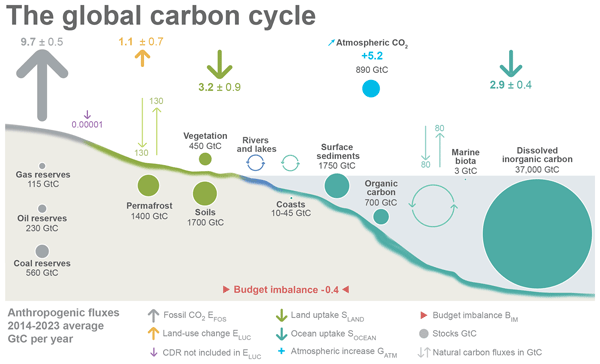
Pierre Friedlingstein, Michael O'Sullivan, Matthew W. Jones, Robbie M. Andrew, Judith Hauck, Peter Landschützer, Corinne Le Quéré, Hongmei Li, Ingrid T. Luijkx, Are Olsen, Glen P. Peters, Wouter Peters, Julia Pongratz, Clemens Schwingshackl, Stephen Sitch, Josep G. Canadell, Philippe Ciais, Robert B. Jackson, Simone R. Alin, Almut Arneth, Vivek Arora, Nicholas R. Bates, Meike Becker, Nicolas Bellouin, Carla F. Berghoff, Henry C. Bittig, Laurent Bopp, Patricia Cadule, Katie Campbell, Matthew A. Chamberlain, Naveen Chandra, Frédéric Chevallier, Louise P. Chini, Thomas Colligan, Jeanne Decayeux, Laique M. Djeutchouang, Xinyu Dou, Carolina Duran Rojas, Kazutaka Enyo, Wiley Evans, Amanda R. Fay, Richard A. Feely, Daniel J. Ford, Adrianna Foster, Thomas Gasser, Marion Gehlen, Thanos Gkritzalis, Giacomo Grassi, Luke Gregor, Nicolas Gruber, Özgür Gürses, Ian Harris, Matthew Hefner, Jens Heinke, George C. Hurtt, Yosuke Iida, Tatiana Ilyina, Andrew R. Jacobson, Atul K. Jain, Tereza Jarníková, Annika Jersild, Fei Jiang, Zhe Jin, Etsushi Kato, Ralph F. Keeling, Kees Klein Goldewijk, Jürgen Knauer, Jan Ivar Korsbakken, Xin Lan, Siv K. Lauvset, Nathalie Lefèvre, Zhu Liu, Junjie Liu, Lei Ma, Shamil Maksyutov, Gregg Marland, Nicolas Mayot, Patrick C. McGuire, Nicolas Metzl, Natalie M. Monacci, Eric J. Morgan, Shin-Ichiro Nakaoka, Craig Neill, Yosuke Niwa, Tobias Nützel, Lea Olivier, Tsuneo Ono, Paul I. Palmer, Denis Pierrot, Zhangcai Qin, Laure Resplandy, Alizée Roobaert, Thais M. Rosan, Christian Rödenbeck, Jörg Schwinger, T. Luke Smallman, Stephen M. Smith, Reinel Sospedra-Alfonso, Tobias Steinhoff, Qing Sun, Adrienne J. Sutton, Roland Séférian, Shintaro Takao, Hiroaki Tatebe, Hanqin Tian, Bronte Tilbrook, Olivier Torres, Etienne Tourigny, Hiroyuki Tsujino, Francesco Tubiello, Guido van der Werf, Rik Wanninkhof, Xuhui Wang, Dongxu Yang, Xiaojuan Yang, Zhen Yu, Wenping Yuan, Xu Yue, Sönke Zaehle, Ning Zeng, and Jiye Zeng
Earth Syst. Sci. Data, 17, 965–1039, https://doi.org/10.5194/essd-17-965-2025, https://doi.org/10.5194/essd-17-965-2025, 2025
Short summary
Short summary
The Global Carbon Budget 2024 describes the methodology, main results, and datasets used to quantify the anthropogenic emissions of carbon dioxide (CO2) and their partitioning among the atmosphere, land ecosystems, and the ocean over the historical period (1750–2024). These living datasets are updated every year to provide the highest transparency and traceability in the reporting of CO2, the key driver of climate change.
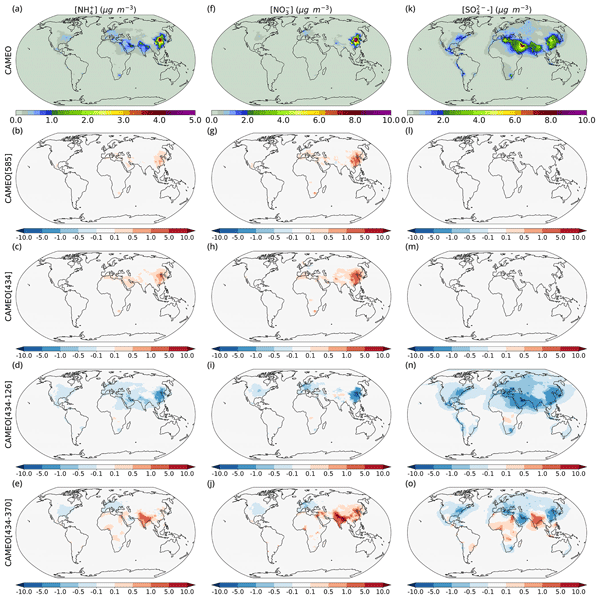
Maureen Beaudor, Didier Hauglustaine, Juliette Lathière, Martin Van Damme, Lieven Clarisse, and Nicolas Vuichard
Atmos. Chem. Phys., 25, 2017–2046, https://doi.org/10.5194/acp-25-2017-2025, https://doi.org/10.5194/acp-25-2017-2025, 2025
Short summary
Short summary
Agriculture is the biggest ammonia (NH3) source, impacting air quality, climate, and ecosystems. Because of food demand, NH3 emissions are projected to rise by 2100. Using a global model, we analyzed the impact of present and future NH3 emissions generated from a land model. Our results show improved ammonia patterns compared to a reference inventory. Future scenarios predict up to 70 % increase in global NH3 burden, with significant changes in radiative forcing that can greatly elevate N2O.
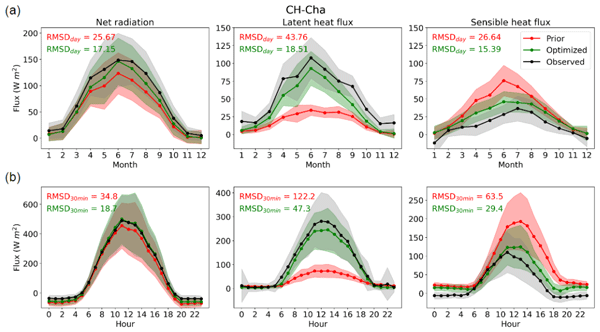
Luis-Enrique Olivera-Guerra, Catherine Ottlé, Nina Raoult, and Philippe Peylin
Hydrol. Earth Syst. Sci., 29, 261–290, https://doi.org/10.5194/hess-29-261-2025, https://doi.org/10.5194/hess-29-261-2025, 2025
Short summary
Short summary
We assimilate the recent ESA-CCI land surface temperature (LST) product to optimize parameters of a land surface model (ORCHIDEE). We test different assimilation strategies to evaluate the best strategy over various in situ stations across Europe. We also provide advice on how to assimilate this LST product to better simulate LST and surface energy fluxes. Finally, we demonstrate the effectiveness of this optimization, which is essential to better simulate future projections.
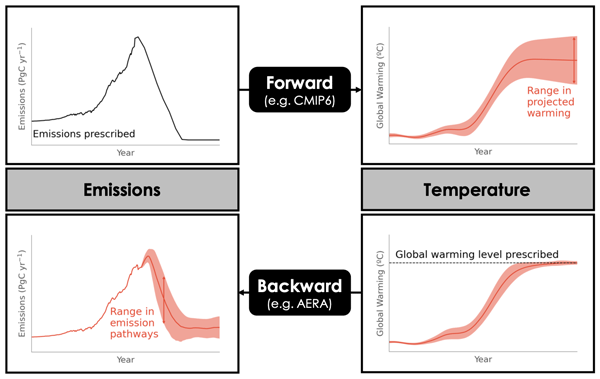
Yona Silvy, Thomas L. Frölicher, Jens Terhaar, Fortunat Joos, Friedrich A. Burger, Fabrice Lacroix, Myles Allen, Raffaele Bernardello, Laurent Bopp, Victor Brovkin, Jonathan R. Buzan, Patricia Cadule, Martin Dix, John Dunne, Pierre Friedlingstein, Goran Georgievski, Tomohiro Hajima, Stuart Jenkins, Michio Kawamiya, Nancy Y. Kiang, Vladimir Lapin, Donghyun Lee, Paul Lerner, Nadine Mengis, Estela A. Monteiro, David Paynter, Glen P. Peters, Anastasia Romanou, Jörg Schwinger, Sarah Sparrow, Eric Stofferahn, Jerry Tjiputra, Etienne Tourigny, and Tilo Ziehn
Earth Syst. Dynam., 15, 1591–1628, https://doi.org/10.5194/esd-15-1591-2024, https://doi.org/10.5194/esd-15-1591-2024, 2024
Short summary
Short summary
The adaptive emission reduction approach is applied with Earth system models to generate temperature stabilization simulations. These simulations provide compatible emission pathways and budgets for a given warming level, uncovering uncertainty ranges previously missing in the Coupled Model Intercomparison Project scenarios. These target-based emission-driven simulations offer a more coherent assessment across models for studying both the carbon cycle and its impacts under climate stabilization.
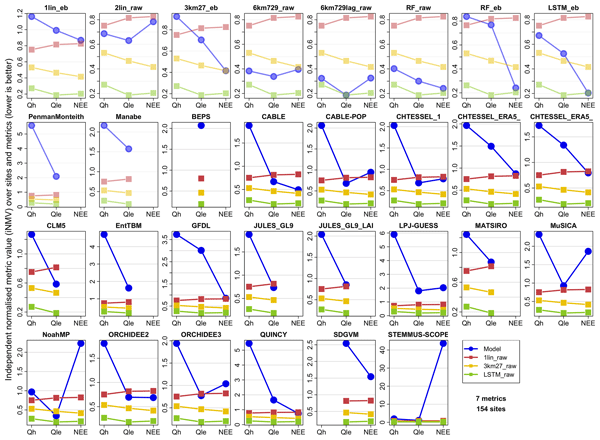
Gab Abramowitz, Anna Ukkola, Sanaa Hobeichi, Jon Cranko Page, Mathew Lipson, Martin G. De Kauwe, Samuel Green, Claire Brenner, Jonathan Frame, Grey Nearing, Martyn Clark, Martin Best, Peter Anthoni, Gabriele Arduini, Souhail Boussetta, Silvia Caldararu, Kyeungwoo Cho, Matthias Cuntz, David Fairbairn, Craig R. Ferguson, Hyungjun Kim, Yeonjoo Kim, Jürgen Knauer, David Lawrence, Xiangzhong Luo, Sergey Malyshev, Tomoko Nitta, Jerome Ogee, Keith Oleson, Catherine Ottlé, Phillipe Peylin, Patricia de Rosnay, Heather Rumbold, Bob Su, Nicolas Vuichard, Anthony P. Walker, Xiaoni Wang-Faivre, Yunfei Wang, and Yijian Zeng
Biogeosciences, 21, 5517–5538, https://doi.org/10.5194/bg-21-5517-2024, https://doi.org/10.5194/bg-21-5517-2024, 2024
Short summary
Short summary
This paper evaluates land models – computer-based models that simulate ecosystem dynamics; land carbon, water, and energy cycles; and the role of land in the climate system. It uses machine learning and AI approaches to show that, despite the complexity of land models, they do not perform nearly as well as they could given the amount of information they are provided with about the prediction problem.
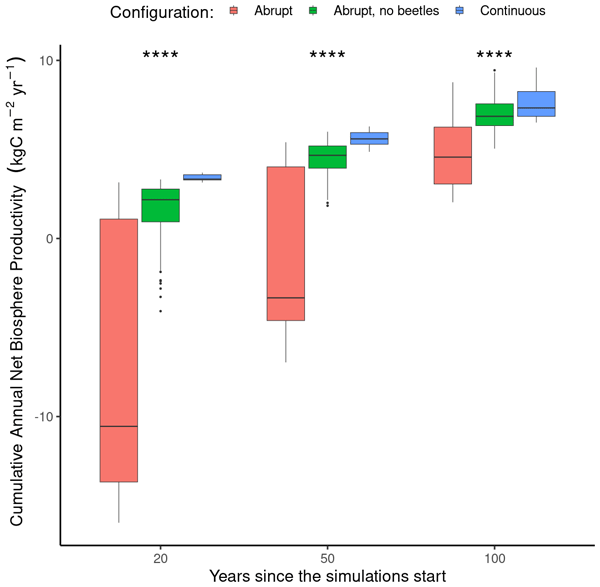
Guillaume Marie, Jina Jeong, Hervé Jactel, Gunnar Petter, Maxime Cailleret, Matthew J. McGrath, Vladislav Bastrikov, Josefine Ghattas, Bertrand Guenet, Anne Sofie Lansø, Kim Naudts, Aude Valade, Chao Yue, and Sebastiaan Luyssaert
Geosci. Model Dev., 17, 8023–8047, https://doi.org/10.5194/gmd-17-8023-2024, https://doi.org/10.5194/gmd-17-8023-2024, 2024
Short summary
Short summary
This research looks at how climate change influences forests, and particularly how altered wind and insect activities could make forests emit instead of absorb carbon. We have updated a land surface model called ORCHIDEE to better examine the effect of bark beetles on forest health. Our findings suggest that sudden events, such as insect outbreaks, can dramatically affect carbon storage, offering crucial insights into tackling climate change.
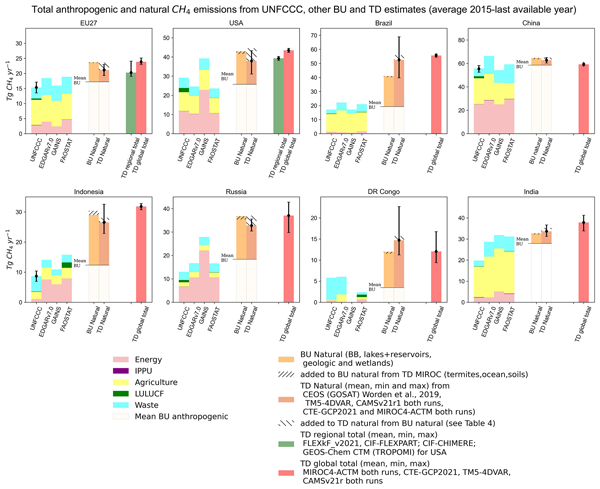
Ana Maria Roxana Petrescu, Glen P. Peters, Richard Engelen, Sander Houweling, Dominik Brunner, Aki Tsuruta, Bradley Matthews, Prabir K. Patra, Dmitry Belikov, Rona L. Thompson, Lena Höglund-Isaksson, Wenxin Zhang, Arjo J. Segers, Giuseppe Etiope, Giancarlo Ciotoli, Philippe Peylin, Frédéric Chevallier, Tuula Aalto, Robbie M. Andrew, David Bastviken, Antoine Berchet, Grégoire Broquet, Giulia Conchedda, Stijn N. C. Dellaert, Hugo Denier van der Gon, Johannes Gütschow, Jean-Matthieu Haussaire, Ronny Lauerwald, Tiina Markkanen, Jacob C. A. van Peet, Isabelle Pison, Pierre Regnier, Espen Solum, Marko Scholze, Maria Tenkanen, Francesco N. Tubiello, Guido R. van der Werf, and John R. Worden
Earth Syst. Sci. Data, 16, 4325–4350, https://doi.org/10.5194/essd-16-4325-2024, https://doi.org/10.5194/essd-16-4325-2024, 2024
Short summary
Short summary
This study provides an overview of data availability from observation- and inventory-based CH4 emission estimates. It systematically compares them and provides recommendations for robust comparisons, aiming to steadily engage more parties in using observational methods to complement their UNFCCC submissions. Anticipating improvements in atmospheric modelling and observations, future developments need to resolve knowledge gaps in both approaches and to better quantify remaining uncertainty.
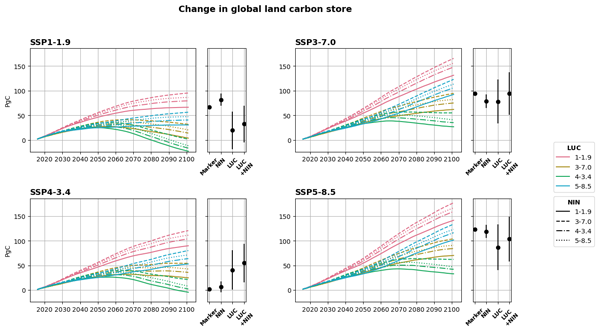
Jaime A. Riano Sanchez, Nicolas Vuichard, and Philippe Peylin
Earth Syst. Dynam., 15, 1227–1253, https://doi.org/10.5194/esd-15-1227-2024, https://doi.org/10.5194/esd-15-1227-2024, 2024
Short summary
Short summary
We quantify the projected change in land carbon store (CLCS) for different socioeconomic scenarios (SSPs). Using factorial simulations of a land surface model, we estimate the CLCS uncertainties associated with land use change (LUC) and nitrogen (N) deposition trajectories. Our study highlights the need for delivering additional LUC and N deposition trajectories from integrated assessment models for each SSP in order to accurately assess their impacts on the carbon cycle and climate.
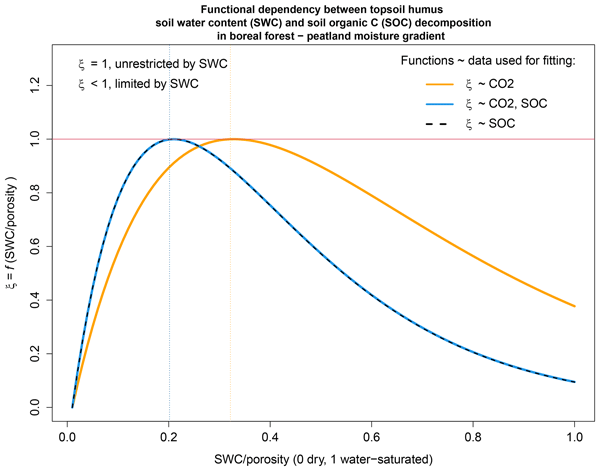
Boris Ťupek, Aleksi Lehtonen, Alla Yurova, Rose Abramoff, Bertrand Guenet, Elisa Bruni, Samuli Launiainen, Mikko Peltoniemi, Shoji Hashimoto, Xianglin Tian, Juha Heikkinen, Kari Minkkinen, and Raisa Mäkipää
Geosci. Model Dev., 17, 5349–5367, https://doi.org/10.5194/gmd-17-5349-2024, https://doi.org/10.5194/gmd-17-5349-2024, 2024
Short summary
Short summary
Updating the Yasso07 soil C model's dependency on decomposition with a hump-shaped Ricker moisture function improved modelled soil organic C (SOC) stocks in a catena of mineral and organic soils in boreal forest. The Ricker function, set to peak at a rate of 1 and calibrated against SOC and CO2 data using a Bayesian approach, showed a maximum in well-drained soils. Using SOC and CO2 data together with the moisture only from the topsoil humus was crucial for accurate model estimates.
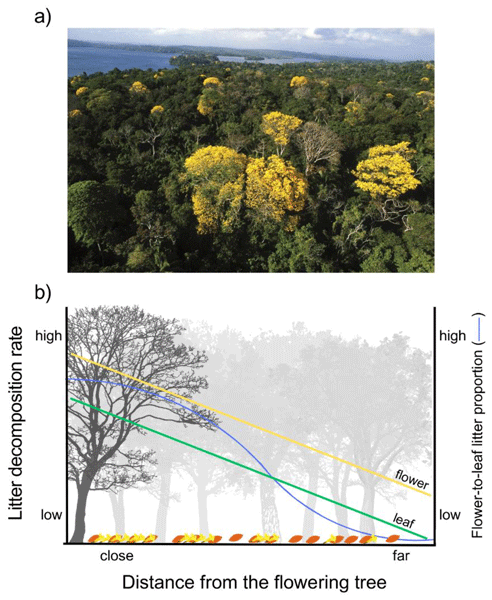
Mery Ingrid Guimarães de Alencar, Rafael D. Guariento, Bertrand Guenet, Luciana S. Carneiro, Eduardo L. Voigt, and Adriano Caliman
Biogeosciences, 21, 3165–3182, https://doi.org/10.5194/bg-21-3165-2024, https://doi.org/10.5194/bg-21-3165-2024, 2024
Short summary
Short summary
Flowers are ephemeral organs for reproduction, and their litter is functionally different from leaf litter. Flowers can affect decomposition and interact with leaf litter, influencing decomposition non-additively. We show that mixing flower and leaf litter from the Tabebuia aurea tree creates reciprocal synergistic effects on decomposition in both terrestrial and aquatic environments. We highlight that flower litter input can generate biogeochemical hotspots in terrestrial ecosystems.

Hanqin Tian, Naiqing Pan, Rona L. Thompson, Josep G. Canadell, Parvadha Suntharalingam, Pierre Regnier, Eric A. Davidson, Michael Prather, Philippe Ciais, Marilena Muntean, Shufen Pan, Wilfried Winiwarter, Sönke Zaehle, Feng Zhou, Robert B. Jackson, Hermann W. Bange, Sarah Berthet, Zihao Bian, Daniele Bianchi, Alexander F. Bouwman, Erik T. Buitenhuis, Geoffrey Dutton, Minpeng Hu, Akihiko Ito, Atul K. Jain, Aurich Jeltsch-Thömmes, Fortunat Joos, Sian Kou-Giesbrecht, Paul B. Krummel, Xin Lan, Angela Landolfi, Ronny Lauerwald, Ya Li, Chaoqun Lu, Taylor Maavara, Manfredi Manizza, Dylan B. Millet, Jens Mühle, Prabir K. Patra, Glen P. Peters, Xiaoyu Qin, Peter Raymond, Laure Resplandy, Judith A. Rosentreter, Hao Shi, Qing Sun, Daniele Tonina, Francesco N. Tubiello, Guido R. van der Werf, Nicolas Vuichard, Junjie Wang, Kelley C. Wells, Luke M. Western, Chris Wilson, Jia Yang, Yuanzhi Yao, Yongfa You, and Qing Zhu
Earth Syst. Sci. Data, 16, 2543–2604, https://doi.org/10.5194/essd-16-2543-2024, https://doi.org/10.5194/essd-16-2543-2024, 2024
Short summary
Short summary
Atmospheric concentrations of nitrous oxide (N2O), a greenhouse gas 273 times more potent than carbon dioxide, have increased by 25 % since the preindustrial period, with the highest observed growth rate in 2020 and 2021. This rapid growth rate has primarily been due to a 40 % increase in anthropogenic emissions since 1980. Observed atmospheric N2O concentrations in recent years have exceeded the worst-case climate scenario, underscoring the importance of reducing anthropogenic N2O emissions.
Laura Sereni, Julie-Maï Paris, Isabelle Lamy, and Bertrand Guenet
SOIL, 10, 367–380, https://doi.org/10.5194/soil-10-367-2024, https://doi.org/10.5194/soil-10-367-2024, 2024
Short summary
Short summary
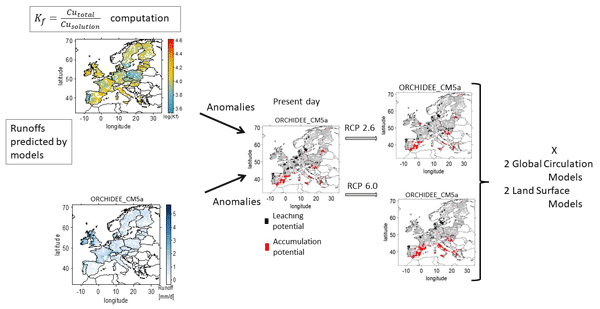
We estimate the tendencies of copper (Cu) export in freshwater or accumulation in soils in Europe for the 21st century and highlight areas of importance for environmental monitoring. We develop a method combining computations of Cu partitioning coefficients between solid and solution phases with runoff data. The surfaces with potential for export or accumulation are roughly constant over the century, but the accumulation potential of Cu increases while leaching potential decreases for 2000–2095.
Nina Raoult, Louis-Axel Edouard-Rambaut, Nicolas Vuichard, Vladislav Bastrikov, Anne Sofie Lansø, Bertrand Guenet, and Philippe Peylin
Biogeosciences, 21, 1017–1036, https://doi.org/10.5194/bg-21-1017-2024, https://doi.org/10.5194/bg-21-1017-2024, 2024
Short summary
Short summary
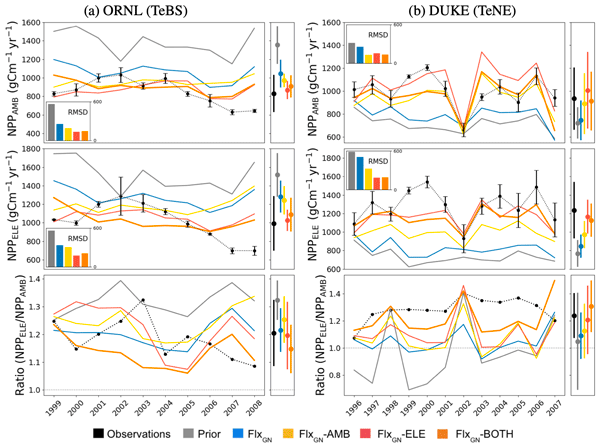
Observations are used to reduce uncertainty in land surface models (LSMs) by optimising poorly constraining parameters. However, optimising against current conditions does not necessarily ensure that the parameters treated as invariant will be robust in a changing climate. Manipulation experiments offer us a unique chance to optimise our models under different (here atmospheric CO2) conditions. By using these data in optimisations, we gain confidence in the future projections of LSMs.
Bertrand Guenet, Jérémie Orliac, Lauric Cécillon, Olivier Torres, Laura Sereni, Philip A. Martin, Pierre Barré, and Laurent Bopp
Biogeosciences, 21, 657–669, https://doi.org/10.5194/bg-21-657-2024, https://doi.org/10.5194/bg-21-657-2024, 2024
Short summary
Short summary
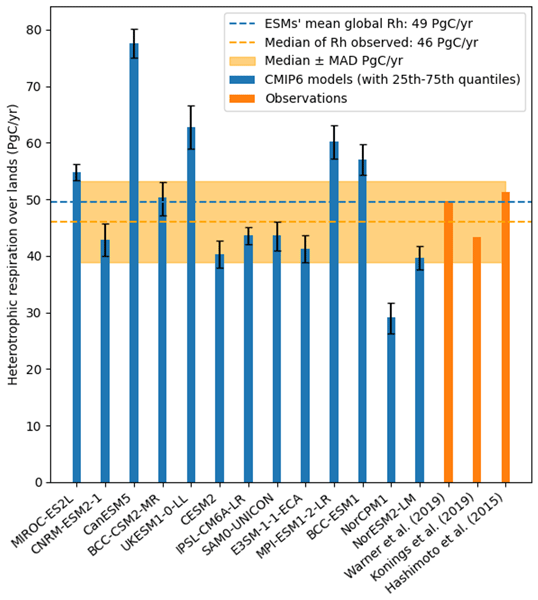
Heterotrophic respiration fluxes are a major flux between surfaces and the atmosphere, but Earth system models do not yet represent them correctly. Here we benchmarked Earth system models against observation-based products, and we identified the important mechanisms that need to be improved in the next-generation Earth system models.
Mounia Mostefaoui, Philippe Ciais, Matthew J. McGrath, Philippe Peylin, Prabir K. Patra, and Yolandi Ernst
Earth Syst. Sci. Data, 16, 245–275, https://doi.org/10.5194/essd-16-245-2024, https://doi.org/10.5194/essd-16-245-2024, 2024
Short summary
Short summary
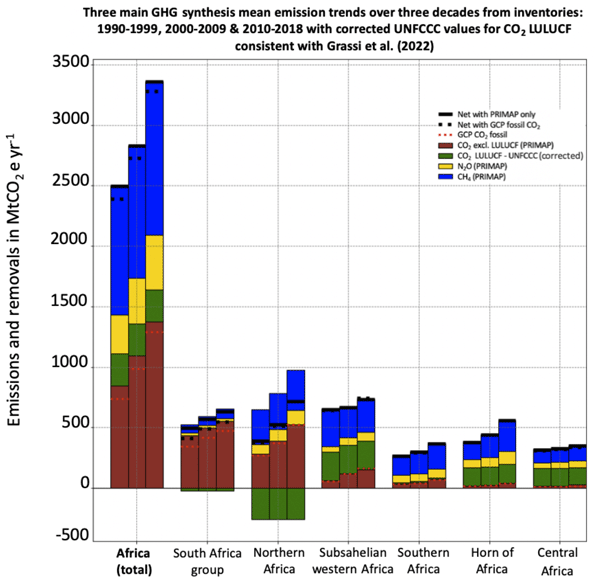
Our aim is to assess African anthropogenic greenhouse gas emissions and removals by using different data products, including inventories and process-based models, and to compare their relative merits with inversion data coming from satellites. We show a good match among the various estimates in terms of overall trends at a regional level and on a decadal basis, but large differences exist even among similar data types, which is a limit to the possibility of verification of country-reported data.
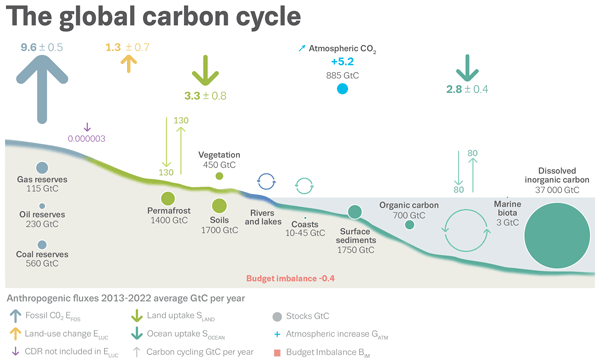
Pierre Friedlingstein, Michael O'Sullivan, Matthew W. Jones, Robbie M. Andrew, Dorothee C. E. Bakker, Judith Hauck, Peter Landschützer, Corinne Le Quéré, Ingrid T. Luijkx, Glen P. Peters, Wouter Peters, Julia Pongratz, Clemens Schwingshackl, Stephen Sitch, Josep G. Canadell, Philippe Ciais, Robert B. Jackson, Simone R. Alin, Peter Anthoni, Leticia Barbero, Nicholas R. Bates, Meike Becker, Nicolas Bellouin, Bertrand Decharme, Laurent Bopp, Ida Bagus Mandhara Brasika, Patricia Cadule, Matthew A. Chamberlain, Naveen Chandra, Thi-Tuyet-Trang Chau, Frédéric Chevallier, Louise P. Chini, Margot Cronin, Xinyu Dou, Kazutaka Enyo, Wiley Evans, Stefanie Falk, Richard A. Feely, Liang Feng, Daniel J. Ford, Thomas Gasser, Josefine Ghattas, Thanos Gkritzalis, Giacomo Grassi, Luke Gregor, Nicolas Gruber, Özgür Gürses, Ian Harris, Matthew Hefner, Jens Heinke, Richard A. Houghton, George C. Hurtt, Yosuke Iida, Tatiana Ilyina, Andrew R. Jacobson, Atul Jain, Tereza Jarníková, Annika Jersild, Fei Jiang, Zhe Jin, Fortunat Joos, Etsushi Kato, Ralph F. Keeling, Daniel Kennedy, Kees Klein Goldewijk, Jürgen Knauer, Jan Ivar Korsbakken, Arne Körtzinger, Xin Lan, Nathalie Lefèvre, Hongmei Li, Junjie Liu, Zhiqiang Liu, Lei Ma, Greg Marland, Nicolas Mayot, Patrick C. McGuire, Galen A. McKinley, Gesa Meyer, Eric J. Morgan, David R. Munro, Shin-Ichiro Nakaoka, Yosuke Niwa, Kevin M. O'Brien, Are Olsen, Abdirahman M. Omar, Tsuneo Ono, Melf Paulsen, Denis Pierrot, Katie Pocock, Benjamin Poulter, Carter M. Powis, Gregor Rehder, Laure Resplandy, Eddy Robertson, Christian Rödenbeck, Thais M. Rosan, Jörg Schwinger, Roland Séférian, T. Luke Smallman, Stephen M. Smith, Reinel Sospedra-Alfonso, Qing Sun, Adrienne J. Sutton, Colm Sweeney, Shintaro Takao, Pieter P. Tans, Hanqin Tian, Bronte Tilbrook, Hiroyuki Tsujino, Francesco Tubiello, Guido R. van der Werf, Erik van Ooijen, Rik Wanninkhof, Michio Watanabe, Cathy Wimart-Rousseau, Dongxu Yang, Xiaojuan Yang, Wenping Yuan, Xu Yue, Sönke Zaehle, Jiye Zeng, and Bo Zheng
Earth Syst. Sci. Data, 15, 5301–5369, https://doi.org/10.5194/essd-15-5301-2023, https://doi.org/10.5194/essd-15-5301-2023, 2023
Short summary
Short summary
The Global Carbon Budget 2023 describes the methodology, main results, and data sets used to quantify the anthropogenic emissions of carbon dioxide (CO2) and their partitioning among the atmosphere, land ecosystems, and the ocean over the historical period (1750–2023). These living datasets are updated every year to provide the highest transparency and traceability in the reporting of CO2, the key driver of climate change.
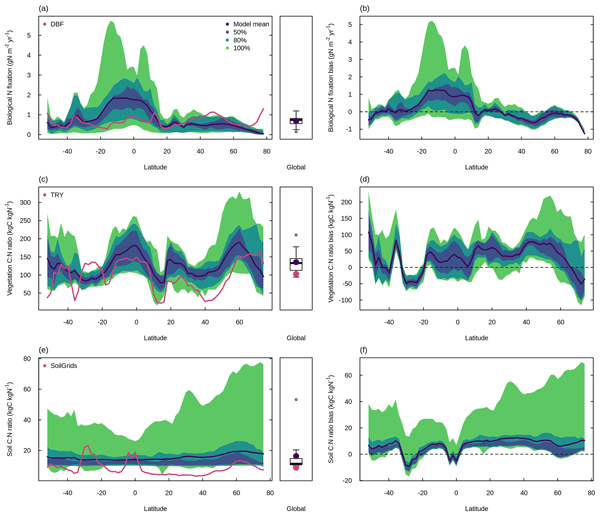
Sian Kou-Giesbrecht, Vivek K. Arora, Christian Seiler, Almut Arneth, Stefanie Falk, Atul K. Jain, Fortunat Joos, Daniel Kennedy, Jürgen Knauer, Stephen Sitch, Michael O'Sullivan, Naiqing Pan, Qing Sun, Hanqin Tian, Nicolas Vuichard, and Sönke Zaehle
Earth Syst. Dynam., 14, 767–795, https://doi.org/10.5194/esd-14-767-2023, https://doi.org/10.5194/esd-14-767-2023, 2023
Short summary
Short summary
Nitrogen (N) is an essential limiting nutrient to terrestrial carbon (C) sequestration. We evaluate N cycling in an ensemble of terrestrial biosphere models. We find that variability in N processes across models is large. Models tended to overestimate C storage per unit N in vegetation and soil, which could have consequences for projecting the future terrestrial C sink. However, N cycling measurements are highly uncertain, and more are necessary to guide the development of N cycling in models.

Cédric Bacour, Natasha MacBean, Frédéric Chevallier, Sébastien Léonard, Ernest N. Koffi, and Philippe Peylin
Biogeosciences, 20, 1089–1111, https://doi.org/10.5194/bg-20-1089-2023, https://doi.org/10.5194/bg-20-1089-2023, 2023
Short summary
Short summary
The impact of assimilating different dataset combinations on regional to global-scale C budgets is explored with the ORCHIDEE model. Assimilating simultaneously multiple datasets is preferable to optimize the values of the model parameters and avoid model overfitting. The challenges in constraining soil C disequilibrium using atmospheric CO2 data are highlighted for an accurate prediction of the land sink distribution.
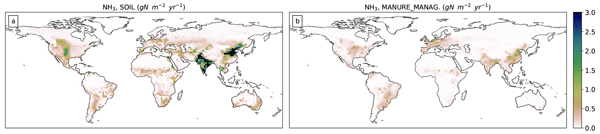
Maureen Beaudor, Nicolas Vuichard, Juliette Lathière, Nikolaos Evangeliou, Martin Van Damme, Lieven Clarisse, and Didier Hauglustaine
Geosci. Model Dev., 16, 1053–1081, https://doi.org/10.5194/gmd-16-1053-2023, https://doi.org/10.5194/gmd-16-1053-2023, 2023
Short summary
Short summary
Ammonia mainly comes from the agricultural sector, and its volatilization relies on environmental variables. Our approach aims at benefiting from an Earth system model framework to estimate it. By doing so, we represent a consistent spatial distribution of the emissions' response to environmental changes.
We greatly improved the seasonal cycle of emissions compared with previous work. In addition, our model includes natural soil emissions (that are rarely represented in modeling approaches).
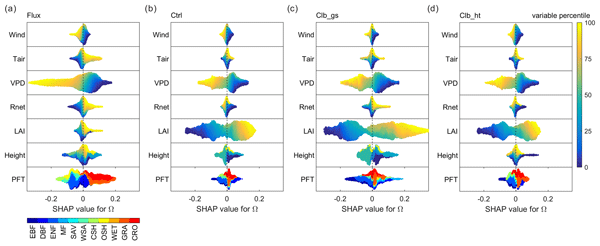
Yuan Zhang, Devaraju Narayanappa, Philippe Ciais, Wei Li, Daniel Goll, Nicolas Vuichard, Martin G. De Kauwe, Laurent Li, and Fabienne Maignan
Geosci. Model Dev., 15, 9111–9125, https://doi.org/10.5194/gmd-15-9111-2022, https://doi.org/10.5194/gmd-15-9111-2022, 2022
Short summary
Short summary
There are a few studies to examine if current models correctly represented the complex processes of transpiration. Here, we use a coefficient Ω, which indicates if transpiration is mainly controlled by vegetation processes or by turbulence, to evaluate the ORCHIDEE model. We found a good performance of ORCHIDEE, but due to compensation of biases in different processes, we also identified how different factors control Ω and where the model is wrong. Our method is generic to evaluate other models.
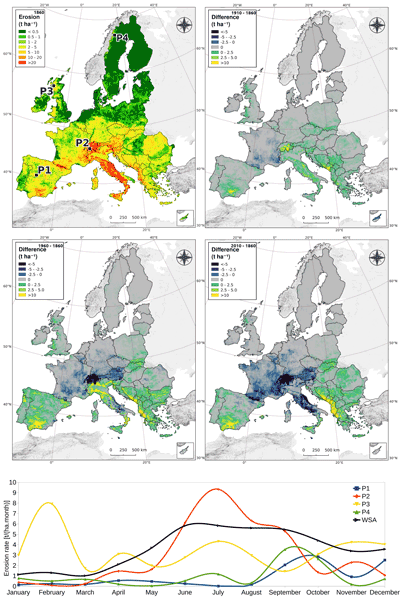
Arthur Nicolaus Fendrich, Philippe Ciais, Emanuele Lugato, Marco Carozzi, Bertrand Guenet, Pasquale Borrelli, Victoria Naipal, Matthew McGrath, Philippe Martin, and Panos Panagos
Geosci. Model Dev., 15, 7835–7857, https://doi.org/10.5194/gmd-15-7835-2022, https://doi.org/10.5194/gmd-15-7835-2022, 2022
Short summary
Short summary
Currently, spatially explicit models for soil carbon stock can simulate the impacts of several changes. However, they do not incorporate the erosion, lateral transport, and deposition (ETD) of soil material. The present work developed ETD formulation, illustrated model calibration and validation for Europe, and presented the results for a depositional site. We expect that our work advances ETD models' description and facilitates their reproduction and incorporation in land surface models.
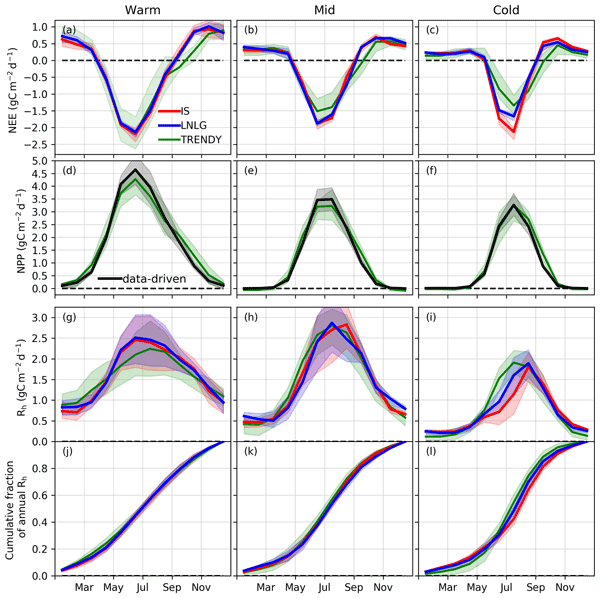
Brendan Byrne, Junjie Liu, Yonghong Yi, Abhishek Chatterjee, Sourish Basu, Rui Cheng, Russell Doughty, Frédéric Chevallier, Kevin W. Bowman, Nicholas C. Parazoo, David Crisp, Xing Li, Jingfeng Xiao, Stephen Sitch, Bertrand Guenet, Feng Deng, Matthew S. Johnson, Sajeev Philip, Patrick C. McGuire, and Charles E. Miller
Biogeosciences, 19, 4779–4799, https://doi.org/10.5194/bg-19-4779-2022, https://doi.org/10.5194/bg-19-4779-2022, 2022
Short summary
Short summary
Plants draw CO2 from the atmosphere during the growing season, while respiration releases CO2 to the atmosphere throughout the year, driving seasonal variations in atmospheric CO2 that can be observed by satellites, such as the Orbiting Carbon Observatory 2 (OCO-2). Using OCO-2 XCO2 data and space-based constraints on plant growth, we show that permafrost-rich northeast Eurasia has a strong seasonal release of CO2 during the autumn, hinting at an unexpectedly large respiration signal from soils.
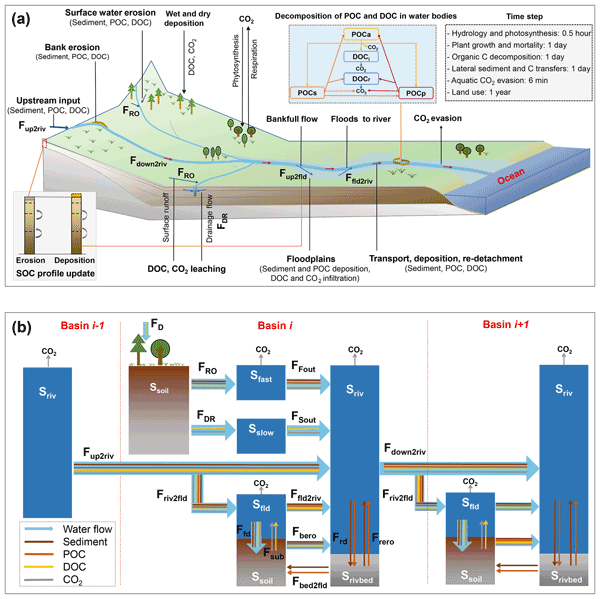
Haicheng Zhang, Ronny Lauerwald, Pierre Regnier, Philippe Ciais, Kristof Van Oost, Victoria Naipal, Bertrand Guenet, and Wenping Yuan
Earth Syst. Dynam., 13, 1119–1144, https://doi.org/10.5194/esd-13-1119-2022, https://doi.org/10.5194/esd-13-1119-2022, 2022
Short summary
Short summary
We present a land surface model which can simulate the complete lateral transfer of sediment and carbon from land to ocean through rivers. Our model captures the water, sediment, and organic carbon discharges in European rivers well. Application of our model in Europe indicates that lateral carbon transfer can strongly change regional land carbon budgets by affecting organic carbon distribution and soil moisture.
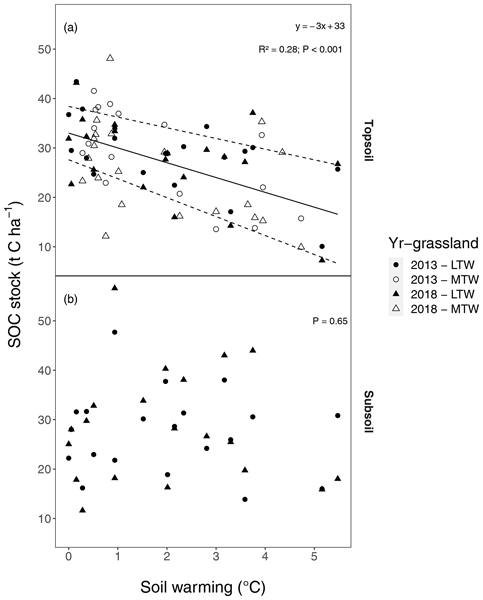
Niel Verbrigghe, Niki I. W. Leblans, Bjarni D. Sigurdsson, Sara Vicca, Chao Fang, Lucia Fuchslueger, Jennifer L. Soong, James T. Weedon, Christopher Poeplau, Cristina Ariza-Carricondo, Michael Bahn, Bertrand Guenet, Per Gundersen, Gunnhildur E. Gunnarsdóttir, Thomas Kätterer, Zhanfeng Liu, Marja Maljanen, Sara Marañón-Jiménez, Kathiravan Meeran, Edda S. Oddsdóttir, Ivika Ostonen, Josep Peñuelas, Andreas Richter, Jordi Sardans, Páll Sigurðsson, Margaret S. Torn, Peter M. Van Bodegom, Erik Verbruggen, Tom W. N. Walker, Håkan Wallander, and Ivan A. Janssens
Biogeosciences, 19, 3381–3393, https://doi.org/10.5194/bg-19-3381-2022, https://doi.org/10.5194/bg-19-3381-2022, 2022
Short summary
Short summary
In subarctic grassland on a geothermal warming gradient, we found large reductions in topsoil carbon stocks, with carbon stocks linearly declining with warming intensity. Most importantly, however, we observed that soil carbon stocks stabilised within 5 years of warming and remained unaffected by warming thereafter, even after > 50 years of warming. Moreover, in contrast to the large topsoil carbon losses, subsoil carbon stocks remained unaffected after > 50 years of soil warming.
Laura Sereni, Bertrand Guenet, Charlotte Blasi, Olivier Crouzet, Jean-Christophe Lata, and Isabelle Lamy
Biogeosciences, 19, 2953–2968, https://doi.org/10.5194/bg-19-2953-2022, https://doi.org/10.5194/bg-19-2953-2022, 2022
Short summary
Short summary
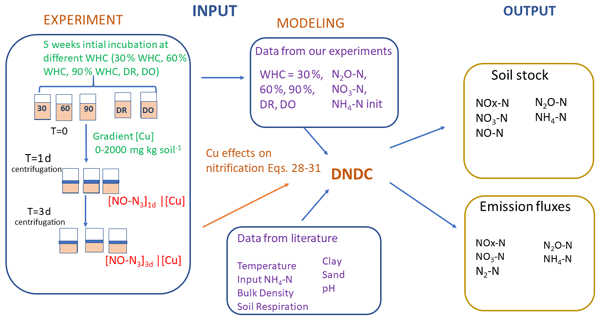
This study focused on the modellisation of two important drivers of soil greenhouse gas emissions: soil contamination and soil moisture change. The aim was to include a Cu function in the soil biogeochemical model DNDC for different soil moisture conditions and then to estimate variation in N2O, NO2 or NOx emissions. Our results show a larger effect of Cu on N2 and N2O emissions than on the other nitrogen species and a higher effect for the soils incubated under constant constant moisture.
Pierre Friedlingstein, Matthew W. Jones, Michael O'Sullivan, Robbie M. Andrew, Dorothee C. E. Bakker, Judith Hauck, Corinne Le Quéré, Glen P. Peters, Wouter Peters, Julia Pongratz, Stephen Sitch, Josep G. Canadell, Philippe Ciais, Rob B. Jackson, Simone R. Alin, Peter Anthoni, Nicholas R. Bates, Meike Becker, Nicolas Bellouin, Laurent Bopp, Thi Tuyet Trang Chau, Frédéric Chevallier, Louise P. Chini, Margot Cronin, Kim I. Currie, Bertrand Decharme, Laique M. Djeutchouang, Xinyu Dou, Wiley Evans, Richard A. Feely, Liang Feng, Thomas Gasser, Dennis Gilfillan, Thanos Gkritzalis, Giacomo Grassi, Luke Gregor, Nicolas Gruber, Özgür Gürses, Ian Harris, Richard A. Houghton, George C. Hurtt, Yosuke Iida, Tatiana Ilyina, Ingrid T. Luijkx, Atul Jain, Steve D. Jones, Etsushi Kato, Daniel Kennedy, Kees Klein Goldewijk, Jürgen Knauer, Jan Ivar Korsbakken, Arne Körtzinger, Peter Landschützer, Siv K. Lauvset, Nathalie Lefèvre, Sebastian Lienert, Junjie Liu, Gregg Marland, Patrick C. McGuire, Joe R. Melton, David R. Munro, Julia E. M. S. Nabel, Shin-Ichiro Nakaoka, Yosuke Niwa, Tsuneo Ono, Denis Pierrot, Benjamin Poulter, Gregor Rehder, Laure Resplandy, Eddy Robertson, Christian Rödenbeck, Thais M. Rosan, Jörg Schwinger, Clemens Schwingshackl, Roland Séférian, Adrienne J. Sutton, Colm Sweeney, Toste Tanhua, Pieter P. Tans, Hanqin Tian, Bronte Tilbrook, Francesco Tubiello, Guido R. van der Werf, Nicolas Vuichard, Chisato Wada, Rik Wanninkhof, Andrew J. Watson, David Willis, Andrew J. Wiltshire, Wenping Yuan, Chao Yue, Xu Yue, Sönke Zaehle, and Jiye Zeng
Earth Syst. Sci. Data, 14, 1917–2005, https://doi.org/10.5194/essd-14-1917-2022, https://doi.org/10.5194/essd-14-1917-2022, 2022
Short summary
Short summary
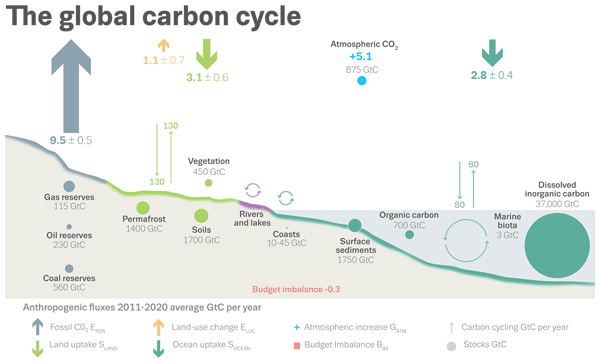
The Global Carbon Budget 2021 describes the data sets and methodology used to quantify the emissions of carbon dioxide and their partitioning among the atmosphere, land, and ocean. These living data are updated every year to provide the highest transparency and traceability in the reporting of CO2, the key driver of climate change.
Irina Melnikova, Olivier Boucher, Patricia Cadule, Katsumasa Tanaka, Thomas Gasser, Tomohiro Hajima, Yann Quilcaille, Hideo Shiogama, Roland Séférian, Kaoru Tachiiri, Nicolas Vuichard, Tokuta Yokohata, and Philippe Ciais
Earth Syst. Dynam., 13, 779–794, https://doi.org/10.5194/esd-13-779-2022, https://doi.org/10.5194/esd-13-779-2022, 2022
Short summary
Short summary
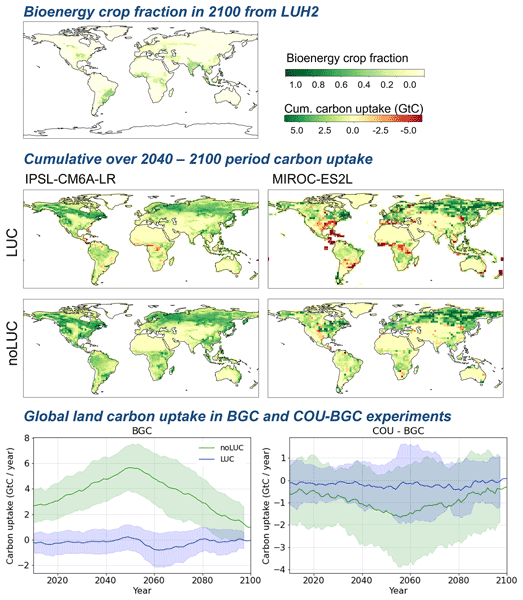
The deployment of bioenergy crops for capturing carbon from the atmosphere facilitates global warming mitigation via generating negative CO2 emissions. Here, we explored the consequences of large-scale energy crops deployment on the land carbon cycle. The land-use change for energy crops leads to carbon emissions and loss of future potential increase in carbon uptake by natural ecosystems. This impact should be taken into account by the modeling teams and accounted for in mitigation policies.
Elodie Salmon, Fabrice Jégou, Bertrand Guenet, Line Jourdain, Chunjing Qiu, Vladislav Bastrikov, Christophe Guimbaud, Dan Zhu, Philippe Ciais, Philippe Peylin, Sébastien Gogo, Fatima Laggoun-Défarge, Mika Aurela, M. Syndonia Bret-Harte, Jiquan Chen, Bogdan H. Chojnicki, Housen Chu, Colin W. Edgar, Eugenie S. Euskirchen, Lawrence B. Flanagan, Krzysztof Fortuniak, David Holl, Janina Klatt, Olaf Kolle, Natalia Kowalska, Lars Kutzbach, Annalea Lohila, Lutz Merbold, Włodzimierz Pawlak, Torsten Sachs, and Klaudia Ziemblińska
Geosci. Model Dev., 15, 2813–2838, https://doi.org/10.5194/gmd-15-2813-2022, https://doi.org/10.5194/gmd-15-2813-2022, 2022
Short summary
Short summary
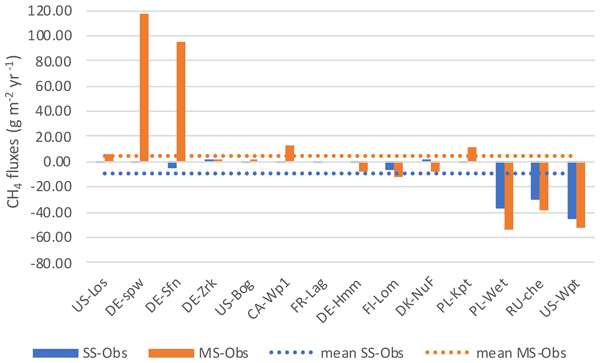
A methane model that features methane production and transport by plants, the ebullition process and diffusion in soil, oxidation to CO2, and CH4 fluxes to the atmosphere has been embedded in the ORCHIDEE-PEAT land surface model, which includes an explicit representation of northern peatlands. This model, ORCHIDEE-PCH4, was calibrated and evaluated on 14 peatland sites. Results show that the model is sensitive to temperature and substrate availability over the top 75 cm of soil depth.
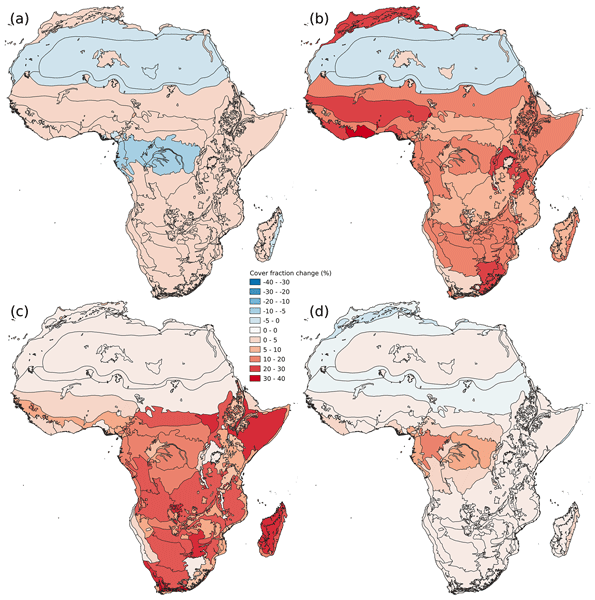
Guillaume Marie, B. Sebastiaan Luyssaert, Cecile Dardel, Thuy Le Toan, Alexandre Bouvet, Stéphane Mermoz, Ludovic Villard, Vladislav Bastrikov, and Philippe Peylin
Geosci. Model Dev., 15, 2599–2617, https://doi.org/10.5194/gmd-15-2599-2022, https://doi.org/10.5194/gmd-15-2599-2022, 2022
Short summary
Short summary
Most Earth system models make use of vegetation maps to initialize a simulation at global scale. Satellite-based biomass map estimates for Africa were used to estimate cover fractions for the 15 land cover classes. This study successfully demonstrates that satellite-based biomass maps can be used to better constrain vegetation maps. Applying this approach at the global scale would increase confidence in assessments of present-day biomass stocks.
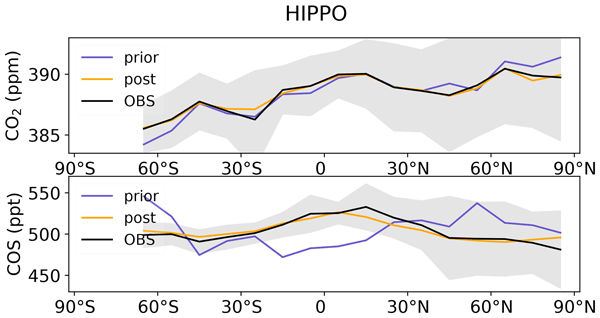
Marine Remaud, Frédéric Chevallier, Fabienne Maignan, Sauveur Belviso, Antoine Berchet, Alexandra Parouffe, Camille Abadie, Cédric Bacour, Sinikka Lennartz, and Philippe Peylin
Atmos. Chem. Phys., 22, 2525–2552, https://doi.org/10.5194/acp-22-2525-2022, https://doi.org/10.5194/acp-22-2525-2022, 2022
Short summary
Short summary
Carbonyl sulfide (COS) has been recognized as a promising indicator of the plant gross primary production (GPP). Here, we assimilate both COS and CO2 measurements into an atmospheric transport model to obtain information on GPP, plant respiration and COS budget. A possible scenario for the period 2008–2019 leads to a global COS biospheric sink of 800 GgS yr−1 and higher oceanic emissions between 400 and 600 GgS yr−1.
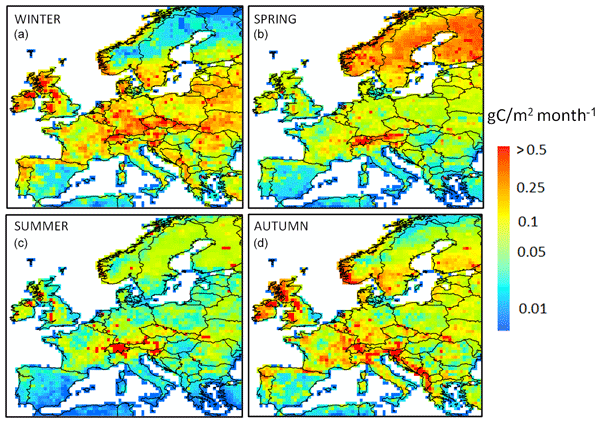
Céline Gommet, Ronny Lauerwald, Philippe Ciais, Bertrand Guenet, Haicheng Zhang, and Pierre Regnier
Earth Syst. Dynam., 13, 393–418, https://doi.org/10.5194/esd-13-393-2022, https://doi.org/10.5194/esd-13-393-2022, 2022
Short summary
Short summary
Dissolved organic carbon (DOC) leaching from soils into river networks is an important component of the land carbon (C) budget, but its spatiotemporal variation is not yet fully constrained. We use a land surface model to simulate the present-day land C budget at the European scale, including leaching of DOC from the soil. We found average leaching of 14.3 Tg C yr−1 (0.6 % of terrestrial net primary production) with seasonal variations. We determine runoff and temperature to be the main drivers.
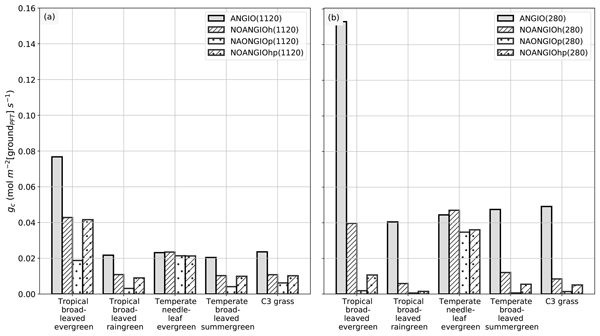
Julia Bres, Pierre Sepulchre, Nicolas Viovy, and Nicolas Vuichard
Biogeosciences, 18, 5729–5750, https://doi.org/10.5194/bg-18-5729-2021, https://doi.org/10.5194/bg-18-5729-2021, 2021
Short summary
Short summary
We emulate angiosperm paleo-traits in a land surface model according to the fossil record, and we assess this paleovegetation functioning under different pCO2 from the leaf scale to the global scale. We show that photosynthesis, transpiration and water-use efficiency are dependent on both the vegetation parameterization and the pCO2. Comparing the modeled vegetation with the fossil record, we provide clues on how to account for angiosperm evolutionary traits in paleoclimate simulations.
Cited articles
Arora, V. K., Katavouta, A., Williams, R. G., Jones, C. D., Brovkin, V., Friedlingstein, P., Schwinger, J., Bopp, L., Boucher, O., Cadule, P., Chamberlain, M. A., Christian, J. R., Delire, C., Fisher, R. A., Hajima, T., Ilyina, T., Joetzjer, E., Kawamiya, M., Koven, C. D., Krasting, J. P., Law, R. M., Lawrence, D. M., Lenton, A., Lindsay, K., Pongratz, J., Raddatz, T., Séférian, R., Tachiiri, K., Tjiputra, J. F., Wiltshire, A., Wu, T., and Ziehn, T.: Carbon–concentration and carbon–climate feedbacks in CMIP6 models and their comparison to CMIP5 models, Biogeosciences, 17, 4173–4222, https://doi.org/10.5194/bg-17-4173-2020, 2020. a, b, c, d, e
Aumont, O., Ethé, C., Tagliabue, A., Bopp, L., and Gehlen, M.: PISCES-v2: an ocean biogeochemical model for carbon and ecosystem studies, Geoscientific Model Development, 8, 2465–2513, https://doi.org/10.5194/gmd-8-2465-2015, 2015. a, b
Balesdent, J., Basile-Doelsch, I., Chadoeuf, J., Cornu, S., Derrien, D., Fekiacova, Z., and Hatté, C.: Atmosphere–Soil Carbon Transfer as a Function of Soil Depth, Nature, 559, 599–602, https://doi.org/10.1038/s41586-018-0328-3, 2018. a
Barry, T., Berteaux, D., and Bültmann, H. (Eds.): Arctic Biodiversity Assessment: Status and Trends in Arctic Biodiversity, The Conservation of Arctic Flora and Fauna, Akureyri, Iceland, ISBN 978-9935-431-22-6, 2013. a
Bastos, A., Ciais, P., Barichivich, J., Bopp, L., Brovkin, V., Gasser, T., Peng, S., Pongratz, J., Viovy, N., and Trudinger, C. M.: Re-evaluating the 1940s CO2 plateau, Biogeosciences, 13, 4877–4897, https://doi.org/10.5194/bg-13-4877-2016, 2016. a, b, c
Bastos, A., O'Sullivan, M., Ciais, P., Makowski, D., Sitch, S., Friedlingstein, P., Chevallier, F., Rödenbeck, C., Pongratz, J., Luijkx, I. T., Patra, P. K., Peylin, P., Canadell, J. G., Lauerwald, R., Li, W., Smith, N. E., Peters, W., Goll, D. S., Jain, A., Kato, E., Lienert, S., Lombardozzi, D. L., Haverd, V., Nabel, J. E. M. S., Poulter, B., Tian, H., Walker, A. P., and Zaehle, S.: Sources of Uncertainty in Regional and Global Terrestrial CO2 Exchange Estimates, Global Biogeochemical Cycles, 34, e2019GB006393, https://doi.org/10.1029/2019GB006393, 2020. a
Bastos, A., Hartung, K., Nützel, T. B., Nabel, J. E. M. S., Houghton, R. A., and Pongratz, J.: Comparison of uncertainties in land-use change fluxes from bookkeeping model parameterisation, Earth System Dynamics, 12, 745–762, https://doi.org/10.5194/esd-12-745-2021, 2021. a
Batjes, N. H., Ribeiro, E., and van Oostrum, A.: Standardised soil profile data to support global mapping and modelling (WoSIS snapshot 2019), Earth Syst. Sci. Data, 12, 299–320, https://doi.org/10.5194/essd-12-299-2020, 2020. a, b, c
Beck, H. E., Wood, E. F., Pan, M., Fisher, C. K., Miralles, D. G., Van Dijk, A. I. J. M., McVicar, T. R., and Adler, R. F.: MSWEP V2 Global 3-Hourly 0.1° Precipitation: Methodology and Quantitative Assessment, Bulletin of the American Meteorological Society, 100, 473–500, https://doi.org/10.1175/BAMS-D-17-0138.1, 2019. a
Beer, C.: Permafrost Sub-grid Heterogeneity of Soil Properties Key for 3-D Soil Processes and Future Climate Projections, Frontiers in Earth Science, 4, https://doi.org/10.3389/feart.2016.00081, 2016. a
Beermann, F., Langer, M., Wetterich, S., Strauss, J., Boike, J., Fiencke, C., Schirrmeister, L., Pfeiffer, E.-M., and Kutzbach, L.: Permafrost Thaw and Liberation of Inorganic Nitrogen in Eastern Siberia, Permafrost and Periglacial Processes, 28, 605–618, https://doi.org/10.1002/ppp.1958, 2017. a
Biskaborn, B. K., Smith, S. L., Noetzli, J., Matthes, H., Vieira, G., Streletskiy, D. A., Schoeneich, P., Romanovsky, V. E., Lewkowicz, A. G., Abramov, A., Allard, M., Boike, J., Cable, W. L., Christiansen, H. H., Delaloye, R., Diekmann, B., Drozdov, D., Etzelmüller, B., Grosse, G., Guglielmin, M., Ingeman-Nielsen, T., Isaksen, K., Ishikawa, M., Johansson, M., Johannsson, H., Joo, A., Kaverin, D., Kholodov, A., Konstantinov, P., Kröger, T., Lambiel, C., Lanckman, J.-P., Luo, D., Malkova, G., Meiklejohn, I., Moskalenko, N., Oliva, M., Phillips, M., Ramos, M., Sannel, A. B. K., Sergeev, D., Seybold, C., Skryabin, P., Vasiliev, A., Wu, Q., Yoshikawa, K., Zheleznyak, M., and Lantuit, H.: Permafrost Is Warming at a Global Scale, Nature Communications, 10, 264, https://doi.org/10.1038/s41467-018-08240-4, 2019. a
Bitz, C. M., Holland, M. M., Weaver, A. J., and Eby, M.: Simulating the Ice-Thickness Distribution in a Coupled Climate Model, Journal of Geophysical Research: Oceans, 106, 2441–2463, https://doi.org/10.1029/1999JC000113, 2001. a
Blanke, B. and Delecluse, P.: Variability of the Tropical Atlantic Ocean Simulated by a General Circulation Model with Two Different Mixed-Layer Physics, Journal of Physical Oceanography, 23, 1363–1388, https://doi.org/10.1175/1520-0485(1993)023<1363:VOTTAO>2.0.CO;2, 1993. a
Bond-Lamberty, B. and Thomson, A.: A global database of soil respiration data, Biogeosciences, 7, 1915–1926, https://doi.org/10.5194/bg-7-1915-2010, 2010. a
Boucher, O., Servonnat, J., Albright, A. L., Aumont, O., Balkanski, Y., Bastrikov, V., Bekki, S., Bonnet, R., Bony, S., Bopp, L., Braconnot, P., Brockmann, P., Cadule, P., Caubel, A., Cheruy, F., Codron, F., Cozic, A., Cugnet, D., D'Andrea, F., Davini, P., Lavergne, C., Denvil, S., Deshayes, J., Devilliers, M., Ducharne, A., Dufresne, J.-L., Dupont, E., Éthé, C., Fairhead, L., Falletti, L., Flavoni, S., Foujols, M.-A., Gardoll, S., Gastineau, G., Ghattas, J., Grandpeix, J.-Y., Guenet, B., Guez, E., L., Guilyardi, E., Guimberteau, M., Hauglustaine, D., Hourdin, F., Idelkadi, A., Joussaume, S., Kageyama, M., Khodri, M., Krinner, G., Lebas, N., Levavasseur, G., Lévy, C., Li, L., Lott, F., Lurton, T., Luyssaert, S., Madec, G., Madeleine, J.-B., Maignan, F., Marchand, M., Marti, O., Mellul, L., Meurdesoif, Y., Mignot, J., Musat, I., Ottlé, C., Peylin, P., Planton, Y., Polcher, J., Rio, C., Rochetin, N., Rousset, C., Sepulchre, P., Sima, A., Swingedouw, D., Thiéblemont, R., Traore, A. K., Vancoppenolle, M., Vial, J., Vialard, J., Viovy, N., and Vuichard, N.: Presentation and Evaluation of the IPSL-CM6A-LR Climate Model, Journal of Advances in Modeling Earth Systems, 12, https://doi.org/10.1029/2019MS002010, 2020. a, b, c, d, e, f, g, h, i, j
Bouillon, S., Fichefet, T., Legat, V., and Madec, G.: The Elastic–Viscous–Plastic Method Revisited, Ocean Modelling, 71, 2–12, https://doi.org/10.1016/j.ocemod.2013.05.013, 2013. a
Brown, J., Hinkel, K. M., and Nelson, F. E.: The Circumpolar Active Layer Monitoring (Calm) Program: Research Designs and Initial Results, Polar Geography, 24, 166–258, https://doi.org/10.1080/10889370009377698, 2000. a
Burke, E., Chadburn, S., and Huntingford, C.: Thawing Permafrost as a Nitrogen Fertiliser: Implications for Climate Feedbacks, Nitrogen, 3, 353–375, https://doi.org/10.3390/nitrogen3020023, 2022. a, b
Cai, L., Lee, H., Aas, K. S., and Westermann, S.: Projecting circum-Arctic excess-ground-ice melt with a sub-grid representation in the Community Land Model, The Cryosphere, 14, 4611–4626, https://doi.org/10.5194/tc-14-4611-2020, 2020. a, b
Chadburn, S., Burke, E., Essery, R., Boike, J., Langer, M., Heikenfeld, M., Cox, P., and Friedlingstein, P.: An improved representation of physical permafrost dynamics in the JULES land-surface model, Geoscientific Model Development, 8, 1493–1508, https://doi.org/10.5194/gmd-8-1493-2015, 2015. a, b
Checa-Garcia, R., Hegglin, M. I., Kinnison, D., Plummer, D. A., and Shine, K. P.: Historical Tropospheric and Stratospheric Ozone Radiative Forcing Using the CMIP6 Database, Geophysical Research Letters, 45, 3264–3273, https://doi.org/10.1002/2017GL076770, 2018. a
Chevallier, F., Lloret, Z., Cozic, A., Takache, S., and Remaud, M.: Toward High-Resolution Global Atmospheric Inverse Modeling Using Graphics Accelerators, Geophysical Research Letters, 50, e2022GL102135, https://doi.org/10.1029/2022GL102135, 2023. a
Ciais, P., Yao, Y., Gasser, T., Baccini, A., Wang, Y., Lauerwald, R., Peng, S., Bastos, A., Li, W., Raymond, P. A., Canadell, J. G., Peters, G. P., Andres, R. J., Chang, J., Yue, C., Dolman, A. J., Haverd, V., Hartmann, J., Laruelle, G., Konings, A. G., King, A. W., Liu, Y., Luyssaert, S., Maignan, F., Patra, P. K., Peregon, A., Regnier, P., Pongratz, J., Poulter, B., Shvidenko, A., Valentini, R., Wang, R., Broquet, G., Yin, Y., Zscheischler, J., Guenet, B., Goll, D. S., Ballantyne, A.-P., Yang, H., Qiu, C., and Zhu, D.: Empirical Estimates of Regional Carbon Budgets Imply Reduced Global Soil Heterotrophic Respiration, National Science Review, 8, https://doi.org/10.1093/nsr/nwaa145, 2021. a
Cleveland, C. C., Townsend, A. R., Schimel, D. S., Fisher, H., Howarth, R. W., Hedin, L. O., Perakis, S. S., Latty, E. F., Von Fischer, J. C., Elseroad, A., and Wasson, M. F.: Global Patterns of Terrestrial Biological Nitrogen (N2) Fixation in Natural Ecosystems, Global Biogeochemical Cycles, 13, 623–645, https://doi.org/10.1029/1999GB900014, 1999. a, b
Copernicus Climate Change Service: ERA5 Monthly Averaged Data on Single Levels from 1940 to Present, Climate Data Store [data set], https://doi.org/10.24381/CDS.F17050D7, 2019. a
Cuntz, M. and Haverd, V.: Physically Accurate Soil Freeze-Thaw Processes in a Global Land Surface Scheme, Journal of Advances in Modeling Earth Systems, 10, 54–77, https://doi.org/10.1002/2017MS001100, 2018. a
Davies-Barnard, T., Meyerholt, J., Zaehle, S., Friedlingstein, P., Brovkin, V., Fan, Y., Fisher, R. A., Jones, C. D., Lee, H., Peano, D., Smith, B., Wårlind, D., and Wiltshire, A. J.: Nitrogen cycling in CMIP6 land surface models: progress and limitations, Biogeosciences, 17, 5129–5148, https://doi.org/10.5194/bg-17-5129-2020, 2020. a
de la Cámara, A. and Lott, F.: A Parameterization of Gravity Waves Emitted by Fronts and Jets, Geophysical Research Letters, 42, 2071–2078, https://doi.org/10.1002/2015GL063298, 2015. a
de la Cámara, A., Lott, F., and Abalos, M.: Climatology of the Middle Atmosphere in LMDz: Impact of Source-Related Parameterizations of Gravity Wave Drag, Journal of Advances in Modeling Earth Systems, 8, 1507–1525, https://doi.org/10.1002/2016MS000753, 2016. a
de Lavergne, C.: On the lifecycle of Antarctic Bottom Water, PhD thesis, Sorbonne Université, https://theses.hal.science/tel-01592475v1 (last access: 15 May 2025), 2016. a
de Lavergne, C., Falahat, S., Madec, G., Roquet, F., Nycander, J., and Vic, C.: Toward Global Maps of Internal Tide Energy Sinks, Ocean Modelling, 137, 52–75, https://doi.org/10.1016/j.ocemod.2019.03.010, 2019. a
de Rosnay, P., Polcher, J., Bruen, M., and Laval, K.: Impact of a Physically Based Soil Water Flow and Soil-Plant Interaction Representation for Modeling Large-Scale Land Surface Processes, Journal of Geophysical Research: Atmospheres, 107, ACL 3–1–ACL 3–19, https://doi.org/10.1029/2001JD000634, 2002. a
de Vrese, P., Georgievski, G., Gonzalez Rouco, J. F., Notz, D., Stacke, T., Steinert, N. J., Wilkenskjeld, S., and Brovkin, V.: Representation of soil hydrology in permafrost regions may explain large part of inter-model spread in simulated Arctic and subarctic climate, The Cryosphere, 17, 2095–2118, https://doi.org/10.5194/tc-17-2095-2023, 2023. a
Decharme, B., Brun, E., Boone, A., Delire, C., Le Moigne, P., and Morin, S.: Impacts of snow and organic soils parameterization on northern Eurasian soil temperature profiles simulated by the ISBA land surface model, The Cryosphere, 10, 853–877, https://doi.org/10.5194/tc-10-853-2016, 2016. a
DiGirolamo, M., Parkinson, C., Cavalieri, D., Gloersen, P., and Zwally, H. J.: Sea Ice Concentrations from Nimbus-7 SMMR and DMSP SSM/I-SSMIS Passive Microwave Data, Version 2, NSIDC [data set], https://doi.org/10.5067/MPYG15WAA4WX, 2022. a
Domine, F., Fourteau, K., Picard, G., Lackner, G., Sarrazin, D., and Poirier, M.: Permafrost Cooled in Winter by Thermal Bridging through Snow-Covered Shrub Branches, Nature Geoscience, 15, 554–560, https://doi.org/10.1038/s41561-022-00979-2, 2022. a
Druel, A., Peylin, P., Krinner, G., Ciais, P., Viovy, N., Peregon, A., Bastrikov, V., Kosykh, N., and Mironycheva-Tokareva, N.: Towards a more detailed representation of high-latitude vegetation in the global land surface model ORCHIDEE (ORC-HL-VEGv1.0), Geoscientific Model Development, 10, 4693–4722, https://doi.org/10.5194/gmd-10-4693-2017, 2017. a, b
Ducharne, A., Ottlé, C., Maignan, F., Vuichard, N., Ghattas, J., Wang, F., Peylin, P., Polcher, J., Guimberteau, M., Maugis, P., Tootchi, A., Verhoef, A., and Mizuochi, H.: The Hydrol Module of ORCHIDEE: Scientific Documentation, http://forge.ipsl.fr/orchidee/attachment/wiki/Documentation/eqs_hydrol_25April2018_Ducharne.pdf (last access: 15 May 2025), 2018. a
Ducoudré, N. I., Laval, K., and Perrier, A.: SECHIBA, a New Set of Parameterizations of the Hydrologic Exchanges at the Land-Atmosphere Interface within the LMD Atmospheric General Circulation Model, Journal of Climate, 6, 248–273, https://doi.org/10.1175/1520-0442(1993)006<0248:SANSOP>2.0.CO;2, 1993. a
Ekici, A., Beer, C., Hagemann, S., Boike, J., Langer, M., and Hauck, C.: Simulating high-latitude permafrost regions by the JSBACH terrestrial ecosystem model, Geoscientific Model Development, 7, 631–647, https://doi.org/10.5194/gmd-7-631-2014, 2014. a, b
Eyring, V., Bony, S., Meehl, G. A., Senior, C. A., Stevens, B., Stouffer, R. J., and Taylor, K. E.: Overview of the Coupled Model Intercomparison Project Phase 6 (CMIP6) experimental design and organization, Geoscientific Model Development, 9, 1937–1958, https://doi.org/10.5194/gmd-9-1937-2016, 2016. a
Farquhar, G. D., von Caemmerer, S., and Berry, J. A.: A Biochemical Model of Photosynthetic CO2 Assimilation in Leaves of C3 Species, Planta, 149, 78–90, https://doi.org/10.1007/BF00386231, 1980. a
Fay, A. R., Munro, D. R., McKinley, G. A., Pierrot, D., Sutherland, S. C., Sweeney, C., and Wanninkhof, R.: Updated climatological mean ΔfCO2 and net sea–air CO2 flux over the global open ocean regions, Earth System Science Data, 16, 2123–2139, https://doi.org/10.5194/essd-16-2123-2024, 2024. a
Feng, M., Peng, S., Wang, Y., Ciais, P., Goll, D. S., Chang, J., Fang, Y., Houlton, B. Z., Liu, G., Sun, Y., and Xi, Y.: Overestimated Nitrogen Loss from Denitrification for Natural Terrestrial Ecosystems in CMIP6 Earth System Models, Nature Communications, 14, 3065, https://doi.org/10.1038/s41467-023-38803-z, 2023. a
Finger, R. A., Turetsky, M. R., Kielland, K., Ruess, R. W., Mack, M. C., and Euskirchen, E. S.: Effects of Permafrost Thaw on Nitrogen Availability and Plant–Soil Interactions in a Boreal Alaskan Lowland, Journal of Ecology, 104, 1542–1554, https://doi.org/10.1111/1365-2745.12639, 2016. a
Fouquart, Y. and Bonnel, B.: Computations of Solar Heating of the Earth's Atmosphere: A New Parametrization, Contributions to Atmospheric Physics, 53, 35–62, 1980. a
Fowler, M. D., Neale, R. B., Waterman, T., Lawrence, D. M., Dirmeyer, P. A., Larson, V. E., Huang, M., Simon, J. S., Truesdale, J., and Chaney, N. W.: Assessing the Atmospheric Response to Subgrid Surface Heterogeneity in the Single-Column Community Earth System Model, Version 2 (CESM2), Journal of Advances in Modeling Earth Systems, 16, e2022MS003517, https://doi.org/10.1029/2022MS003517, 2024. a
Fox-Kemper, B., Danabasoglu, G., Ferrari, R., Griffies, S. M., Hallberg, R. W., Holland, M. M., Maltrud, M. E., Peacock, S., and Samuels, B. L.: Parameterization of Mixed Layer Eddies. III: Implementation and Impact in Global Ocean Climate Simulations, Ocean Modelling, 39, 61–78, https://doi.org/10.1016/j.ocemod.2010.09.002, 2011. a
Friedlingstein, P., O'Sullivan, M., Jones, M. W., Andrew, R. M., Bakker, D. C. E., Hauck, J., Landschützer, P., Le Quéré, C., Luijkx, I. T., Peters, G. P., Peters, W., Pongratz, J., Schwingshackl, C., Sitch, S., Canadell, J. G., Ciais, P., Jackson, R. B., Alin, S. R., Anthoni, P., Barbero, L., Bates, N. R., Becker, M., Bellouin, N., Decharme, B., Bopp, L., Brasika, I. B. M., Cadule, P., Chamberlain, M. A., Chandra, N., Chau, T.-T.-T., Chevallier, F., Chini, L. P., Cronin, M., Dou, X., Enyo, K., Evans, W., Falk, S., Feely, R. A., Feng, L., Ford, D. J., Gasser, T., Ghattas, J., Gkritzalis, T., Grassi, G., Gregor, L., Gruber, N., Gürses, Ö., Harris, I., Hefner, M., Heinke, J., Houghton, R. A., Hurtt, G. C., Iida, Y., Ilyina, T., Jacobson, A. R., Jain, A., Jarníková, T., Jersild, A., Jiang, F., Jin, Z., Joos, F., Kato, E., Keeling, R. F., Kennedy, D., Klein Goldewijk, K., Knauer, J., Korsbakken, J. I., Körtzinger, A., Lan, X., Lefèvre, N., Li, H., Liu, J., Liu, Z., Ma, L., Marland, G., Mayot, N., McGuire, P. C., McKinley, G. A., Meyer, G., Morgan, E. J., Munro, D. R., Nakaoka, S.-I., Niwa, Y., O'Brien, K. M., Olsen, A., Omar, A. M., Ono, T., Paulsen, M., Pierrot, D., Pocock, K., Poulter, B., Powis, C. M., Rehder, G., Resplandy, L., Robertson, E., Rödenbeck, C., Rosan, T. M., Schwinger, J., Séférian, R., Smallman, T. L., Smith, S. M., Sospedra-Alfonso, R., Sun, Q., Sutton, A. J., Sweeney, C., Takao, S., Tans, P. P., Tian, H., Tilbrook, B., Tsujino, H., Tubiello, F., van der Werf, G. R., van Ooijen, E., Wanninkhof, R., Watanabe, M., Wimart-Rousseau, C., Yang, D., Yang, X., Yuan, W., Yue, X., Zaehle, S., Zeng, J., and Zheng, B.: Global Carbon Budget 2023, Earth System Science Data, 15, 5301–5369, https://doi.org/10.5194/essd-15-5301-2023, 2023. a, b, c, d, e, f
Gaillard, R., Cadule, P., Peylin, P., Vuichard, N., and Guenet, B.: IPSL-Perm-LandN: Improving the IPSL Earth System Model to Represent Permafrost Carbon-Nitrogen Interactions, Zenodo [code, data set], https://doi.org/10.5281/zenodo.16739216, 2025a. a
Gaillard, R., Peylin, P., Cadule, P., Bastrikov, V., Chéruy, F., Cuynet, A., Ghattas, J., Zhu, D., and Guenet, B.: Arctic Soil Carbon Insulation Averts Large Spring Cooling from Surface–Atmosphere Feedbacks, Proceedings of the National Academy of Sciences, 122, e2410226122, https://doi.org/10.1073/pnas.2410226122, 2025b. a, b, c, d
Gaspar, P., Grégoris, Y., and Lefevre, J.-M.: A Simple Eddy Kinetic Energy Model for Simulations of the Oceanic Vertical Mixing: Tests at Station Papa and Long-Term Upper Ocean Study Site, Journal of Geophysical Research: Oceans, 95, 16179–16193, https://doi.org/10.1029/JC095iC09p16179, 1990. a
Gier, B. K., Schlund, M., Friedlingstein, P., Jones, C. D., Jones, C., Zaehle, S., and Eyring, V.: Representation of the terrestrial carbon cycle in CMIP6, Biogeosciences, 21, 5321–5360, https://doi.org/10.5194/bg-21-5321-2024, 2024. a, b, c
Gouttevin, I., Krinner, G., Ciais, P., Polcher, J., and Legout, C.: Multi-scale validation of a new soil freezing scheme for a land-surface model with physically-based hydrology, The Cryosphere, 6, 407–430, https://doi.org/10.5194/tc-6-407-2012, 2012. a, b, c
Grandpeix, J.-Y. and Lafore, J.-P.: A Density Current Parameterization Coupled with Emanuel's Convection Scheme. Part I: The Models, Journal of the Atmospheric Sciences, 67, 881–897, https://doi.org/10.1175/2009JAS3044.1, 2010. a
Grandpeix, J.-Y., Lafore, J.-P., and Cheruy, F.: A Density Current Parameterization Coupled with Emanuel's Convection Scheme. Part II: 1D Simulations, Journal of the Atmospheric Sciences, 67, 898–922, https://doi.org/10.1175/2009JAS3045.1, 2010. a
Gruber, S.: Derivation and analysis of a high-resolution estimate of global permafrost zonation, The Cryosphere, 6, 221–233, https://doi.org/10.5194/tc-6-221-2012, 2012. a
Guenet, B., Orliac, J., Cécillon, L., Torres, O., Sereni, L., Martin, P. A., Barré, P., and Bopp, L.: Spatial biases reduce the ability of Earth system models to simulate soil heterotrophic respiration fluxes, Biogeosciences, 21, 657–669, https://doi.org/10.5194/bg-21-657-2024, 2024. a
Guimberteau, M., Zhu, D., Maignan, F., Huang, Y., Yue, C., Dantec-Nédélec, S., Ottlé, C., Jornet-Puig, A., Bastos, A., Laurent, P., Goll, D., Bowring, S., Chang, J., Guenet, B., Tifafi, M., Peng, S., Krinner, G., Ducharne, A., Wang, F., Wang, T., Wang, X., Wang, Y., Yin, Z., Lauerwald, R., Joetzjer, E., Qiu, C., Kim, H., and Ciais, P.: ORCHIDEE-MICT (v8.4.1), a land surface model for the high latitudes: model description and validation, Geoscientific Model Development, 11, 121–163, https://doi.org/10.5194/gmd-11-121-2018, 2018. a, b, c, d
Hagemann, S., Blome, T., Ekici, A., and Beer, C.: Soil-frost-enabled soil-moisture–precipitation feedback over northern high latitudes, Earth System Dynamics, 7, 611–625, https://doi.org/10.5194/esd-7-611-2016, 2016. a
Hegglin, M., Kinnison, D., Lamarque, J.-F., and Plummer, D.: CCMI Ozone in Support of CMIP6 – Version 1.0, WCRP [data set], https://doi.org/10.22033/ESGF/input4MIPs.1115, 2016. a
Hourdin, F. and Armengaud, A.: The Use of Finite-Volume Methods for Atmospheric Advection of Trace Species. Part I: Test of Various Formulations in a General Circulation Model, Monthly Weather Review, 127, 822–837, https://doi.org/10.1175/1520-0493(1999)127<0822:TUOFVM>2.0.CO;2, 1999. a
Hourdin, F., Couvreux, F., and Menut, L.: Parameterization of the Dry Convective Boundary Layer Based on a Mass Flux Representation of Thermals, Journal of the Atmospheric Sciences, 59, 1105–1123, https://doi.org/10.1175/1520-0469(2002)059<1105:POTDCB>2.0.CO;2, 2002. a
Hourdin, F., Grandpeix, J.-Y., Rio, C., Bony, S., Jam, A., Cheruy, F., Rochetin, N., Fairhead, L., Idelkadi, A., Musat, I., Dufresne, J.-L., Lahellec, A., Lefebvre, M.-P., and Roehrig, R.: LMDZ5B: The Atmospheric Component of the IPSL Climate Model with Revisited Parameterizations for Clouds and Convection, Climate Dynamics, 40, 2193–2222, https://doi.org/10.1007/s00382-012-1343-y, 2013. a
Hourdin, F., Jam, A., Rio, C., Couvreux, F., Sandu, I., Lefebvre, M.-P., Brient, F., and Idelkadi, A.: Unified Parameterization of Convective Boundary Layer Transport and Clouds With the Thermal Plume Model, Journal of Advances in Modeling Earth Systems, 11, 2910–2933, https://doi.org/10.1029/2019MS001666, 2019. a
Hourdin, F., Rio, C., Grandpeix, J.-Y., Madeleine, J.-B., Cheruy, F., Rochetin, N., Jam, A., Musat, I., Idelkadi, A., Fairhead, L., Foujols, M.-A., Mellul, L., Traore, A.-K., Dufresne, J.-L., Boucher, O., Lefebvre, M.-P., Millour, E., Vignon, E., Jouhaud, J., Diallo, F. B., Lott, F., Gastineau, G., Caubel, A., Meurdesoif, Y., and Ghattas, J.: LMDZ6A: The Atmospheric Component of the IPSL Climate Model With Improved and Better Tuned Physics, Journal of Advances in Modeling Earth Systems, 12, e2019MS001892, https://doi.org/10.1029/2019MS001892, 2020. a, b, c
Huang, B., Yin, X., Menne, M. J., Vose, R. S., and Zhang, H.-M.: NOAA Global Surface Temperature Dataset (NOAAGlobalTemp), Version 6.0, NOAA [data set], https://doi.org/10.25921/rzxg-p717, 2023. a
Hugelius, G., Tarnocai, C., Broll, G., Canadell, J. G., Kuhry, P., and Swanson, D. K.: The Northern Circumpolar Soil Carbon Database: spatially distributed datasets of soil coverage and soil carbon storage in the northern permafrost regions, Earth System Science Data, 5, 3–13, https://doi.org/10.5194/essd-5-3-2013, 2013. a
Hugelius, G., Strauss, J., Zubrzycki, S., Harden, J. W., Schuur, E. A. G., Ping, C.-L., Schirrmeister, L., Grosse, G., Michaelson, G. J., Koven, C. D., O'Donnell, J. A., Elberling, B., Mishra, U., Camill, P., Yu, Z., Palmtag, J., and Kuhry, P.: Estimated stocks of circumpolar permafrost carbon with quantified uncertainty ranges and identified data gaps, Biogeosciences, 11, 6573–6593, https://doi.org/10.5194/bg-11-6573-2014, 2014. a, b
Hunke, E. C. and Dukowicz, J. K.: An Elastic–Viscous–Plastic Model for Sea Ice Dynamics, Journal of Physical Oceanography, 27, 1849–1867, https://doi.org/10.1175/1520-0485(1997)027<1849:AEVPMF>2.0.CO;2, 1997. a
Huntzinger, D. N., Michalak, A. M., Schwalm, C., Ciais, P., King, A. W., Fang, Y., Schaefer, K., Wei, Y., Cook, R. B., Fisher, J. B., Hayes, D., Huang, M., Ito, A., Jain, A. K., Lei, H., Lu, C., Maignan, F., Mao, J., Parazoo, N., Peng, S., Poulter, B., Ricciuto, D., Shi, X., Tian, H., Wang, W., Zeng, N., and Zhao, F.: Uncertainty in the Response of Terrestrial Carbon Sink to Environmental Drivers Undermines Carbon-Climate Feedback Predictions, Scientific Reports, 7, 4765, https://doi.org/10.1038/s41598-017-03818-2, 2017. a
Hurtt, G. C., Chini, L., Sahajpal, R., Frolking, S., Bodirsky, B. L., Calvin, K., Doelman, J. C., Fisk, J., Fujimori, S., Klein Goldewijk, K., Hasegawa, T., Havlik, P., Heinimann, A., Humpenöder, F., Jungclaus, J., Kaplan, J. O., Kennedy, J., Krisztin, T., Lawrence, D., Lawrence, P., Ma, L., Mertz, O., Pongratz, J., Popp, A., Poulter, B., Riahi, K., Shevliakova, E., Stehfest, E., Thornton, P., Tubiello, F. N., van Vuuren, D. P., and Zhang, X.: Harmonization of global land use change and management for the period 850–2100 (LUH2) for CMIP6, Geoscientific Model Development, 13, 5425–5464, https://doi.org/10.5194/gmd-13-5425-2020, 2020. a, b
IPCC AR6 WGI: Changing State of the Climate System, Chap. 2, in: Climate Change 2021: The Physical Science Basis. Contribution of Working Group I to the Sixth Assessment Report of the Intergovernmental Panel on Climate Change, 287–422, Cambridge University Press, 1 edn., ISBN 978-1-009-15789-6, https://doi.org/10.1017/9781009157896, 2021. a
IPCC SROCCC: Polar Regions, Chap. 3, in: IPCC Special Report on the Ocean and Cryosphere in a Changing Climate, Cambridge University Press, https://doi.org/10.1017/9781009157964.005, 2019. a
Jones, C. D., Arora, V., Friedlingstein, P., Bopp, L., Brovkin, V., Dunne, J., Graven, H., Hoffman, F., Ilyina, T., John, J. G., Jung, M., Kawamiya, M., Koven, C., Pongratz, J., Raddatz, T., Randerson, J. T., and Zaehle, S.: C4MIP – The Coupled Climate–Carbon Cycle Model Intercomparison Project: experimental protocol for CMIP6, Geoscientific Model Development, 9, 2853–2880, https://doi.org/10.5194/gmd-9-2853-2016, 2016. a
Jung, M., Schwalm, C., Migliavacca, M., Walther, S., Camps-Valls, G., Koirala, S., Anthoni, P., Besnard, S., Bodesheim, P., Carvalhais, N., Chevallier, F., Gans, F., Goll, D. S., Haverd, V., Köhler, P., Ichii, K., Jain, A. K., Liu, J., Lombardozzi, D., Nabel, J. E. M. S., Nelson, J. A., O'Sullivan, M., Pallandt, M., Papale, D., Peters, W., Pongratz, J., Rödenbeck, C., Sitch, S., Tramontana, G., Walker, A., Weber, U., and Reichstein, M.: Scaling carbon fluxes from eddy covariance sites to globe: synthesis and evaluation of the FLUXCOM approach, Biogeosciences, 17, 1343–1365, https://doi.org/10.5194/bg-17-1343-2020, 2020. a, b, c
Kattge, J., Knorr, W., Raddatz, T., and Wirth, C.: Quantifying Photosynthetic Capacity and Its Relationship to Leaf Nitrogen Content for Global-Scale Terrestrial Biosphere Models, Global Change Biology, 15, 976–991, https://doi.org/10.1111/j.1365-2486.2008.01744.x, 2009. a
Keuper, F., Dorrepaal, E., van Bodegom, P. M., van Logtestijn, R., Venhuizen, G., van Hal, J., and Aerts, R.: Experimentally Increased Nutrient Availability at the Permafrost Thaw Front Selectively Enhances Biomass Production of Deep-Rooting Subarctic Peatland Species, Global Change Biology, 23, 4257–4266, https://doi.org/10.1111/gcb.13804, 2017. a
Kleinen, T. and Brovkin, V.: Pathway-Dependent Fate of Permafrost Region Carbon, Environmental Research Letters, 13, 094001, https://doi.org/10.1088/1748-9326/aad824, 2018. a
Konings, A. G., Bloom, A. A., Liu, J., Parazoo, N. C., Schimel, D. S., and Bowman, K. W.: Global satellite-driven estimates of heterotrophic respiration, Biogeosciences, 16, 2269–2284, https://doi.org/10.5194/bg-16-2269-2019, 2019. a, b, c
Koven, C. D., Ringeval, B., Friedlingstein, P., Ciais, P., Cadule, P., Khvorostyanov, D., Krinner, G., and Tarnocai, C.: Permafrost Carbon-Climate Feedbacks Accelerate Global Warming, Proceedings of the National Academy of Sciences, 108, 14769–14774, https://doi.org/10.1073/pnas.1103910108, 2011. a
Koven, C. D., Riley, W. J., and Stern, A.: Analysis of Permafrost Thermal Dynamics and Response to Climate Change in the CMIP5 Earth System Models, Journal of Climate, 26, 1877–1900, https://doi.org/10.1175/JCLI-D-12-00228.1, 2013. a
Koven, C. D., Lawrence, D. M., and Riley, W. J.: Permafrost Carbon-climate Feedback Is Sensitive to Deep Soil Carbon Decomposability but Not Deep Soil Nitrogen Dynamics, Proceedings of the National Academy of Sciences, 112, 3752–3757, https://doi.org/10.1073/pnas.1415123112, 2015a. a
Koven, C. D., Schuur, E. A. G., Schädel, C., Bohn, T. J., Burke, E. J., Chen, G., Chen, X., Ciais, P., Grosse, G., Harden, J. W., Hayes, D. J., Hugelius, G., Jafarov, E. E., Krinner, G., Kuhry, P., Lawrence, D. M., MacDougall, A. H., Marchenko, S. S., McGuire, A. D., Natali, S. M., Nicolsky, D. J., Olefeldt, D., Peng, S., Romanovsky, V. E., Schaefer, K. M., Strauss, J., Treat, C. C., and Turetsky, M.: A Simplified, Data-Constrained Approach to Estimate the Permafrost Carbon–Climate Feedback, Philosophical Transactions of the Royal Society A: Mathematical, Physical and Engineering Sciences, 373, 20140423, https://doi.org/10.1098/rsta.2014.0423, 2015b. a
Krinner, G., Viovy, N., de Noblet-Ducoudré, N., Ogée, J., Polcher, J., Friedlingstein, P., Ciais, P., Sitch, S., and Prentice, I. C.: A Dynamic Global Vegetation Model for Studies of the Coupled Atmosphere-Biosphere System, Global Biogeochemical Cycles, 19, https://doi.org/10.1029/2003GB002199, 2005. a, b, c
Lacroix, F., Zaehle, S., Caldararu, S., Schaller, J., Stimmler, P., Holl, D., Kutzbach, L., and Göckede, M.: Mismatch of N Release from the Permafrost and Vegetative Uptake Opens Pathways of Increasing Nitrous Oxide Emissions in the High Arctic, Global Change Biology, 28, 5973–5990, https://doi.org/10.1111/gcb.16345, 2022. a
Lawrence, D. M., Slater, A. G., Romanovsky, V. E., and Nicolsky, D. J.: Sensitivity of a Model Projection of Near-Surface Permafrost Degradation to Soil Column Depth and Representation of Soil Organic Matter, Journal of Geophysical Research, 113, F02011, https://doi.org/10.1029/2007JF000883, 2008. a
Lee, H., Swenson, S. C., Slater, A. G., and Lawrence, D. M.: Effects of Excess Ground Ice on Projections of Permafrost in a Warming Climate, Environmental Research Letters, 9, 124006, https://doi.org/10.1088/1748-9326/9/12/124006, 2014. a
Lehnebach, R., Beyer, R., Letort, V., and Heuret, P.: The Pipe Model Theory Half a Century on: A Review, Annals of Botany, 121, 773–795, https://doi.org/10.1093/aob/mcx194, 2018. a
Lewis, L. R., Ickert-Bond, S. M., Biersma, E. M., Convey, P., Goffinet, B., Hassel, K., Kruijer, H. J., Farge, C. L., Metzgar, J., Stech, M., Villarreal, J. C., and McDaniel, S. F.: Future Directions and Priorities for Arctic Bryophyte Research, Arctic Science, 3, 475–497, https://doi.org/10.1139/as-2016-0043, 2017. a
Li, C., Frolking, S., and Frolking, T. A.: A Model of Nitrous Oxide Evolution from Soil Driven by Rainfall Events: 1. Model Structure and Sensitivity, Journal of Geophysical Research: Atmospheres, 97, 9759–9776, https://doi.org/10.1029/92JD00509, 1992. a
Li, C., Aber, J., Stange, F., Butterbach-Bahl, K., and Papen, H.: A Process-Oriented Model of N2O and NO Emissions from Forest Soils: 1. Model Development, Journal of Geophysical Research: Atmospheres, 105, 4369–4384, https://doi.org/10.1029/1999JD900949, 2000. a
Liddicoat, S. K., Wiltshire, A. J., Jones, C. D., Arora, V. K., Brovkin, V., Cadule, P., Hajima, T., Lawrence, D. M., Pongratz, J., Schwinger, J., Séférian, R., Tjiputra, J. F., and Ziehn, T.: Compatible Fossil Fuel CO2 Emissions in the CMIP6 Earth System Models' Historical and Shared Socioeconomic Pathway Experiments of the Twenty-First Century, Journal of Climate, 34, 2853–2875, https://doi.org/10.1175/JCLI-D-19-0991.1, 2021. a, b, c
Lipscomb, W. H.: Remapping the Thickness Distribution in Sea Ice Models, Journal of Geophysical Research: Oceans, 106, 13989–14000, https://doi.org/10.1029/2000JC000518, 2001. a
Locarnini, R. A., Mishonov, A. V., Baranova, O. K., Reagan, J. R., Boyer, T. P., Seidov, D., Wang, Z., Garcia, H. E., Bouchard, C., Cross, S. L., Paver, C. R., and Dukhovskoy, D.: World Ocean Atlas 2023, Volume 1: Temperature, NOAA, https://doi.org/10.25923/54BH-1613, 2024. a
Loranty, M.: Thermal Bridging by Arctic Shrubs, Nature Geoscience, 515–516, https://doi.org/10.1038/s41561-022-00977-4, 2022. a
Loranty, M. M., Abbott, B. W., Blok, D., Douglas, T. A., Epstein, H. E., Forbes, B. C., Jones, B. M., Kholodov, A. L., Kropp, H., Malhotra, A., Mamet, S. D., Myers-Smith, I. H., Natali, S. M., O'Donnell, J. A., Phoenix, G. K., Rocha, A. V., Sonnentag, O., Tape, K. D., and Walker, D. A.: Reviews and syntheses: Changing ecosystem influences on soil thermal regimes in northern high-latitude permafrost regions, Biogeosciences, 15, 5287–5313, https://doi.org/10.5194/bg-15-5287-2018, 2018. a, b
Lott, F. and Guez, L.: A Stochastic Parameterization of the Gravity Waves Due to Convection and Its Impact on the Equatorial Stratosphere, Journal of Geophysical Research: Atmospheres, 118, 8897–8909, https://doi.org/10.1002/jgrd.50705, 2013. a
Ludwig, W., Probst, J.-L., and Kempe, S.: Predicting the Oceanic Input of Organic Carbon by Continental Erosion, Global Biogeochemical Cycles, 10, 23–41, https://doi.org/10.1029/95GB02925, 1996. a
Lurton, T., Balkanski, Y., Bastrikov, V., Bekki, S., Bopp, L., Braconnot, P., Brockmann, P., Cadule, P., Contoux, C., Cozic, A., Cugnet, D., Dufresne, J.-L., Éthé, C., Foujols, M.-A., Ghattas, J., Hauglustaine, D., Hu, R.-M., Kageyama, M., Khodri, M., Lebas, N., Levavasseur, G., Marchand, M., Ottlé, C., Peylin, P., Sima, A., Szopa, S., Thiéblemont, R., Vuichard, N., and Boucher, O.: Implementation of the CMIP6 Forcing Data in the IPSL-CM6A-LR Model, Journal of Advances in Modeling Earth Systems, 12, https://doi.org/10.1029/2019MS001940, 2020. a, b, c, d
Ma, X., Zhao, S., Zhang, H., and Wang, W.: The Double-ITCZ Problem in CMIP6 and the Influences of Deep Convection and Model Resolution, International Journal of Climatology, 43, 2369–2390, https://doi.org/10.1002/joc.7980, 2023. a
MacDougall, A. H., Avis, C. A., and Weaver, A. J.: Significant Contribution to Climate Warming from the Permafrost Carbon Feedback, Nature Geoscience, 5, 719–721, https://doi.org/10.1038/ngeo1573, 2012. a
Madec, G., Bourdallé-Badie, R., Bouttier, P., Bricaud, C., Bruciaferri, D., Calvert, D., and Vancoppenolle, M.: NEMO ocean engine, Zenodo, https://doi.org/10.5281/zenodo.1472492, 2016. a, b
Markham, J. H.: Variation in Moss-Associated Nitrogen Fixation in Boreal Forest Stands, Oecologia, 161, 353–359, https://doi.org/10.1007/s00442-009-1391-0, 2009. a
Matthes, H., Damseaux, A., Westermann, S., Beer, C., Boone, A., Burke, E., Decharme, B., Genet, H., Jafarov, E., Langer, M., Parmentier, F.-J., Porada, P., Gagne-Landmann, A., Huntzinger, D., Rogers, B. M., Schädel, C., Stacke, T., Wells, J., and Wieder, W. R.: Advances in Permafrost Representation: Biophysical Processes in Earth System Models and the Role of Offline Models, Permafrost and Periglacial Processes, https://doi.org/10.1002/ppp.2269, 2025. a
Matthes, K., Funke, B., Andersson, M. E., Barnard, L., Beer, J., Charbonneau, P., Clilverd, M. A., Dudok de Wit, T., Haberreiter, M., Hendry, A., Jackman, C. H., Kretzschmar, M., Kruschke, T., Kunze, M., Langematz, U., Marsh, D. R., Maycock, A. C., Misios, S., Rodger, C. J., Scaife, A. A., Seppälä, A., Shangguan, M., Sinnhuber, M., Tourpali, K., Usoskin, I., van de Kamp, M., Verronen, P. T., and Versick, S.: Solar forcing for CMIP6 (v3.2), Geoscientific Model Development, 10, 2247–2302, https://doi.org/10.5194/gmd-10-2247-2017, 2017. a
Mayorga, E., Seitzinger, S. P., Harrison, J. A., Dumont, E., Beusen, A. H. W., Bouwman, A. F., Fekete, B. M., Kroeze, C., and Van Drecht, G.: Global Nutrient Export from WaterSheds 2 (NEWS 2): Model Development and Implementation, Environmental Modelling & Software, 25, 837–853, https://doi.org/10.1016/j.envsoft.2010.01.007, 2010. a
McGuire, A. D., Lawrence, D. M., Koven, C., Clein, J. S., Burke, E., Chen, G., Jafarov, E., MacDougall, A. H., Marchenko, S., Nicolsky, D., Peng, S., Rinke, A., Ciais, P., Gouttevin, I., Hayes, D. J., Ji, D., Krinner, G., Moore, J. C., Romanovsky, V., Schädel, C., Schaefer, K., Schuur, E. A. G., and Zhuang, Q.: Dependence of the Evolution of Carbon Dynamics in the Northern Permafrost Region on the Trajectory of Climate Change, Proceedings of the National Academy of Sciences, 115, 3882–3887, https://doi.org/10.1073/pnas.1719903115, 2018. a, b
Meinshausen, M., Vogel, E., Nauels, A., Lorbacher, K., Meinshausen, N., Etheridge, D. M., Fraser, P. J., Montzka, S. A., Rayner, P. J., Trudinger, C. M., Krummel, P. B., Beyerle, U., Canadell, J. G., Daniel, J. S., Enting, I. G., Law, R. M., Lunder, C. R., O'Doherty, S., Prinn, R. G., Reimann, S., Rubino, M., Velders, G. J. M., Vollmer, M. K., Wang, R. H. J., and Weiss, R.: Historical greenhouse gas concentrations for climate modelling (CMIP6), Geoscientific Model Development, 10, 2057–2116, https://doi.org/10.5194/gmd-10-2057-2017, 2017. a
Mishra, U., Hugelius, G., Shelef, E., Yang, Y., Strauss, J., Lupachev, A., Harden, J. W., Jastrow, J. D., Ping, C.-L., Riley, W. J., Schuur, E. A. G., Matamala, R., Siewert, M., Nave, L. E., Koven, C. D., Fuchs, M., Palmtag, J., Kuhry, P., Treat, C. C., Zubrzycki, S., Hoffman, F. M., Elberling, B., Camill, P., Veremeeva, A., and Orr, A.: Spatial Heterogeneity and Environmental Predictors of Permafrost Region Soil Organic Carbon Stocks, Science Advances, 7, eaaz5236, https://doi.org/10.1126/sciadv.aaz5236, 2021. a
Morice, C. P., Kennedy, J. J., Rayner, N. A., Winn, J. P., Hogan, E., Killick, R. E., Dunn, R. J. H., Osborn, T. J., Jones, P. D., and Simpson, I. R.: An Updated Assessment of Near-Surface Temperature Change From 1850: The HadCRUT5 Data Set, Journal of Geophysical Research: Atmospheres, 126, e2019JD032361, https://doi.org/10.1029/2019JD032361, 2021. a
Myers-Smith, I. H. and Hik, D. S.: Shrub Canopies Influence Soil Temperatures but Not Nutrient Dynamics: An Experimental Test of Tundra Snow–Shrub Interactions, Ecology and Evolution, 3, 3683–3700, https://doi.org/10.1002/ece3.710, 2013. a
Natali, S. M., Holdren, J. P., Rogers, B. M., Treharne, R., Duffy, P. B., Pomerance, R., and MacDonald, E.: Permafrost Carbon Feedbacks Threaten Global Climate Goals, Proceedings of the National Academy of Sciences, 118, e2100163118, https://doi.org/10.1073/pnas.2100163118, 2021. a
Obu, J.: How Much of the Earth's Surface Is Underlain by Permafrost?, Journal of Geophysical Research: Earth Surface, 126, e2021JF006123, https://doi.org/10.1029/2021JF006123, 2021. a, b
Obu, J., Westermann, S., Bartsch, A., Berdnikov, N., Christiansen, H. H., Dashtseren, A., Delaloye, R., Elberling, B., Etzelmüller, B., Kholodov, A., Khomutov, A., Kääb, A., Leibman, M. O., Lewkowicz, A. G., Panda, S. K., Romanovsky, V., Way, R. G., Westergaard-Nielsen, A., Wu, T., Yamkhin, J., and Zou, D.: Northern Hemisphere Permafrost Map Based on TTOP Modelling for 2000–2016 at 1 Km2 Scale, Earth-Science Reviews, 193, 299–316, https://doi.org/10.1016/j.earscirev.2019.04.023, 2019. a
O'Donnell, J. A., Romanovsky, V. E., Harden, J. W., and McGuire, A. D.: The Effect of Moisture Content on the Thermal Conductivity of Moss and Organic Soil Horizons From Black Spruce Ecosystems in Interior Alaska, Soil Science, 174, 646–651, https://doi.org/10.1097/SS.0b013e3181c4a7f8, 2009. a, b, c
O'Sullivan, M., Spracklen, D. V., Batterman, S. A., Arnold, S. R., Gloor, M., and Buermann, W.: Have Synergies Between Nitrogen Deposition and Atmospheric CO2 Driven the Recent Enhancement of the Terrestrial Carbon Sink?, Global Biogeochemical Cycles, 33, 163–180, https://doi.org/10.1029/2018GB005922, 2019. a
O'Sullivan, M., Friedlingstein, P., Sitch, S., Anthoni, P., Arneth, A., Arora, V. K., Bastrikov, V., Delire, C., Goll, D. S., Jain, A., Kato, E., Kennedy, D., Knauer, J., Lienert, S., Lombardozzi, D., McGuire, P. C., Melton, J. R., Nabel, J. E. M. S., Pongratz, J., Poulter, B., Séférian, R., Tian, H., Vuichard, N., Walker, A. P., Yuan, W., Yue, X., and Zaehle, S.: Process-Oriented Analysis of Dominant Sources of Uncertainty in the Land Carbon Sink, Nature Communications, 13, 4781, https://doi.org/10.1038/s41467-022-32416-8, 2022. a
O'Sullivan, M., Sitch, S., Friedlingstein, P., Luijkx, I. T., Peters, W., Rosan, T. M., Arneth, A., Arora, V. K., Chandra, N., Chevallier, F., Ciais, P., Falk, S., Feng, L., Gasser, T., Houghton, R. A., Jain, A. K., Kato, E., Kennedy, D., Knauer, J., McGrath, M. J., Niwa, Y., Palmer, P. I., Patra, P. K., Pongratz, J., Poulter, B., Rödenbeck, C., Schwingshackl, C., Sun, Q., Tian, H., Walker, A. P., Yang, D., Yuan, W., Yue, X., and Zaehle, S.: The Key Role of Forest Disturbance in Reconciling Estimates of the Northern Carbon Sink, Communications Earth & Environment, 5, 705, https://doi.org/10.1038/s43247-024-01827-4, 2024. a
Park, H., Launiainen, S., Konstantinov, P. Y., Iijima, Y., and Fedorov, A. N.: Modeling the Effect of Moss Cover on Soil Temperature and Carbon Fluxes at a Tundra Site in Northeastern Siberia, Journal of Geophysical Research: Biogeosciences, 123, 3028–3044, https://doi.org/10.1029/2018JG004491, 2018. a
Park, S.-W., Mun, J.-H., Lee, H., Steinert, N. J., An, S.-I., Shin, J., and Kug, J.-S.: Continued Permafrost Ecosystem Carbon Loss under Net-Zero and Negative Emissions, Science Advances, 11, eadn8819, https://doi.org/10.1126/sciadv.adn8819, 2025. a
Parton, W. J., Scurlock, J. M. O., Ojima, D. S., Gilmanov, T. G., Scholes, R. J., Schimel, D. S., Kirchner, T., Menaut, J.-C., Seastedt, T., Garcia Moya, E., Kamnalrut, A., and Kinyamario, J. I.: Observations and Modeling of Biomass and Soil Organic Matter Dynamics for the Grassland Biome Worldwide, Global Biogeochemical Cycles, 7, 785–809, https://doi.org/10.1029/93GB02042, 1993. a
Peylin, P., Bacour, C., MacBean, N., Leonard, S., Rayner, P., Kuppel, S., Koffi, E., Kane, A., Maignan, F., Chevallier, F., Ciais, P., and Prunet, P.: A new stepwise carbon cycle data assimilation system using multiple data streams to constrain the simulated land surface carbon cycle, Geoscientific Model Development, 9, 3321–3346, https://doi.org/10.5194/gmd-9-3321-2016, 2016. a
Piao, S., Ciais, P., Friedlingstein, P., de Noblet-Ducoudré, N., Cadule, P., Viovy, N., and Wang, T.: Spatiotemporal Patterns of Terrestrial Carbon Cycle during the 20th Century, Global Biogeochemical Cycles, 23, https://doi.org/10.1029/2008GB003339, 2009. a
Poggio, L., de Sousa, L. M., Batjes, N. H., Heuvelink, G. B. M., Kempen, B., Ribeiro, E., and Rossiter, D.: SoilGrids 2.0: producing soil information for the globe with quantified spatial uncertainty, SOIL, 7, 217–240, https://doi.org/10.5194/soil-7-217-2021, 2021. a, b, c
Porada, P., Ekici, A., and Beer, C.: Effects of bryophyte and lichen cover on permafrost soil temperature at large scale, The Cryosphere, 10, 2291–2315, https://doi.org/10.5194/tc-10-2291-2016, 2016. a, b, c
Prentice, I. C., Cramer, W., Harrison, S. P., Leemans, R., Monserud, R. A., and Solomon, A. M.: Special Paper: A Global Biome Model Based on Plant Physiology and Dominance, Soil Properties and Climate, Journal of Biogeography, 19, 117–134, https://doi.org/10.2307/2845499, 1992. a
Ramage, J., Kuhn, M., Virkkala, A.-M., Voigt, C., Marushchak, M. E., Bastos, A., Biasi, C., Canadell, J. G., Ciais, P., López-Blanco, E., Natali, S. M., Olefeldt, D., Potter, S., Poulter, B., Rogers, B. M., Schuur, E. A. G., Treat, C., Turetsky, M. R., Watts, J., and Hugelius, G.: The Net GHG Balance and Budget of the Permafrost Region (2000–2020) From Ecosystem Flux Upscaling, Global Biogeochemical Cycles, 38, e2023GB007953, https://doi.org/10.1029/2023GB007953, 2024. a, b, c, d
Reagan, J. R., Seidov, D., Wang, Z., Dukhovskoy, D., Boyer, T. P., Locarnini, R. A., Baranova, O. K., Mishonov, A. V., Garcia, H. E., Bouchard, C., Cross, S. L., and Paver, C. R.: World Ocean Atlas 2023, Volume 2: Salinity, NOAA, https://doi.org/10.25923/70QT-9574, 2024. a
Regnier, P., Resplandy, L., Najjar, R. G., and Ciais, P.: The Land-to-Ocean Loops of the Global Carbon Cycle, Nature, 603, 401–410, https://doi.org/10.1038/s41586-021-04339-9, 2022. a
Rio, C. and Hourdin, F.: A Thermal Plume Model for the Convective Boundary Layer: Representation of Cumulus Clouds, Journal of the Atmospheric Sciences, 65, 407–425, https://doi.org/10.1175/2007JAS2256.1, 2008. a
Rochetin, N., Couvreux, F., Grandpeix, J.-Y., and Rio, C.: Deep Convection Triggering by Boundary Layer Thermals. Part I: LES Analysis and Stochastic Triggering Formulation, Journal of the Atmospheric Sciences, 71, 496–514, https://doi.org/10.1175/JAS-D-12-0336.1, 2014a. a
Rochetin, N., Grandpeix, J.-Y., Rio, C., and Couvreux, F.: Deep Convection Triggering by Boundary Layer Thermals. Part II: Stochastic Triggering Parameterization for the LMDZ GCM, Journal of the Atmospheric Sciences, 71, 515–538, https://doi.org/10.1175/JAS-D-12-0337.1, 2014b. a
Rogelj, J., Huppmann, D., Krey, V., Riahi, K., Clarke, L., Gidden, M., Nicholls, Z., and Meinshausen, M.: A New Scenario Logic for the Paris Agreement Long-Term Temperature Goal, Nature, 573, 357–363, https://doi.org/10.1038/s41586-019-1541-4, 2019. a
Roquet, F., Madec, G., McDougall, T. J., and Barker, P. M.: Accurate Polynomial Expressions for the Density and Specific Volume of Seawater Using the TEOS-10 Standard, Ocean Modelling, 90, 29–43, https://doi.org/10.1016/j.ocemod.2015.04.002, 2015. a
Rousset, C., Vancoppenolle, M., Madec, G., Fichefet, T., Flavoni, S., Barthélemy, A., Benshila, R., Chanut, J., Levy, C., Masson, S., and Vivier, F.: The Louvain-La-Neuve sea ice model LIM3.6: global and regional capabilities, Geoscientific Model Development, 8, 2991–3005, https://doi.org/10.5194/gmd-8-2991-2015, 2015. a, b
Rubino, M., Etheridge, D. M., Trudinger, C. M., Allison, C. E., Battle, M. O., Langenfelds, R. L., Steele, L. P., Curran, M., Bender, M., White, J. W. C., Jenk, T. M., Blunier, T., and Francey, R. J.: A Revised 1000 Year Atmospheric δ13C-CO2 Record from Law Dome and South Pole, Antarctica, Journal of Geophysical Research: Atmospheres, 118, 8482–8499, https://doi.org/10.1002/jgrd.50668, 2013. a
Ruimy, A., Dedieu, G., and Saugier, B.: TURC: A Diagnostic Model of Continental Gross Primary Productivity and Net Primary Productivity, Global Biogeochemical Cycles, 10, 269–285, https://doi.org/10.1029/96GB00349, 1996. a
Sadourny, R. and Laval, K.: January and July Performance of the LMD General Circulation Model, in: New Perspectives in Climate Modelling, no. 16 in Developments in Atmospheric Science, Elsevier, Amsterdam, edited by: Berger, A. and Nicolis, C., 173–197, ISBN 978-0-444-42295-8, 1984. a
Salmon, V. G., Soucy, P., Mauritz, M., Celis, G., Natali, S. M., Mack, M. C., and Schuur, E. A. G.: Nitrogen Availability Increases in a Tundra Ecosystem during Five Years of Experimental Permafrost Thaw, Global Change Biology, 22, 1927–1941, https://doi.org/10.1111/gcb.13204, 2016. a
Sanderson, B. M., Booth, B. B. B., Dunne, J., Eyring, V., Fisher, R. A., Friedlingstein, P., Gidden, M. J., Hajima, T., Jones, C. D., Jones, C. G., King, A., Koven, C. D., Lawrence, D. M., Lowe, J., Mengis, N., Peters, G. P., Rogelj, J., Smith, C., Snyder, A. C., Simpson, I. R., Swann, A. L. S., Tebaldi, C., Ilyina, T., Schleussner, C.-F., Séférian, R., Samset, B. H., van Vuuren, D., and Zaehle, S.: The need for carbon-emissions-driven climate projections in CMIP7, Geoscientific Model Development, 17, 8141–8172, https://doi.org/10.5194/gmd-17-8141-2024, 2024. a
Santoro, M. and Cartus, O.: ESA Biomass Climate Change Initiative (Biomass_cci): Global Datasets of Forest above-Ground Biomass for the Years 2010, 2017 and 2018, V3, CEDA Archive [data set], https://doi.org/10.5285/5F331C418E9F4935B8EB1B836F8A91B8, 2021. a
Sayedi, S. S., Abbott, B. W., Thornton, B. F., Frederick, J. M., Vonk, J. E., Overduin, P., Schädel, C., Schuur, E. A. G., Bourbonnais, A., Demidov, N., Gavrilov, A., He, S., Hugelius, G., Jakobsson, M., Jones, M. C., Joung, D., Kraev, G., Macdonald, R. W., David McGuire, A., Mu, C., O'Regan, M., Schreiner, K. M., Stranne, C., Pizhankova, E., Vasiliev, A., Westermann, S., Zarnetske, J. P., Zhang, T., Ghandehari, M., Baeumler, S., Brown, B. C., and Frei, R. J.: Subsea Permafrost Carbon Stocks and Climate Change Sensitivity Estimated by Expert Assessment, Environmental Research Letters, 15, 124075, https://doi.org/10.1088/1748-9326/abcc29, 2020. a
Schädel, C., Koven, C. D., Lawrence, D. M., Celis, G., Garnello, A. J., Hutchings, J., Mauritz, M., Natali, S. M., Pegoraro, E., Rodenhizer, H., Salmon, V. G., Taylor, M. A., Webb, E. E., Wieder, W. R., and Schuur, E. A.: Divergent Patterns of Experimental and Model-Derived Permafrost Ecosystem Carbon Dynamics in Response to Arctic Warming, Environmental Research Letters, 13, 105002, https://doi.org/10.1088/1748-9326/aae0ff, 2018. a
Schädel, C., Rogers, B. M., Lawrence, D. M., Koven, C. D., Brovkin, V., Burke, E. J., Genet, H., Huntzinger, D. N., Jafarov, E., McGuire, A. D., Riley, W. J., and Natali, S. M.: Earth System Models Must Include Permafrost Carbon Processes, Nature Climate Change, https://doi.org/10.1038/s41558-023-01909-9, 2024. a, b, c
Schaefer, K., Lantuit, H., Romanovsky, V. E., Schuur, E. A. G., and Witt, R.: The Impact of the Permafrost Carbon Feedback on Global Climate, Environmental Research Letters, 9, 085003, https://doi.org/10.1088/1748-9326/9/8/085003, 2014. a
Schimel, D., Stephens, B. B., and Fisher, J. B.: Effect of Increasing CO2 on the Terrestrial Carbon Cycle, Proceedings of the National Academy of Sciences, 112, 436–441, https://doi.org/10.1073/pnas.1407302112, 2015. a
Schuur, E. A. G., McGuire, A. D., Schädel, C., Grosse, G., Harden, J. W., Hayes, D. J., Hugelius, G., Koven, C. D., Kuhry, P., Lawrence, D. M., Natali, S. M., Olefeldt, D., Romanovsky, V. E., Schaefer, K., Turetsky, M. R., Treat, C. C., and Vonk, J. E.: Climate Change and the Permafrost Carbon Feedback, Nature, 520, 171–179, https://doi.org/10.1038/nature14338, 2015. a
Schuur, E. A. G., Abbott, B. W., Commane, R., Ernakovich, J., Euskirchen, E., Hugelius, G., Grosse, G., Jones, M., Koven, C., Leshyk, V., Lawrence, D., Loranty, M. M., Mauritz, M., Olefeldt, D., Natali, S., Rodenhizer, H., Salmon, V., Schädel, C., Strauss, J., Treat, C., and Turetsky, M.: Permafrost and Climate Change: Carbon Cycle Feedbacks From the Warming Arctic, Annual Review of Environment and Resources, 33, https://doi.org/10.1146/annurev-environ-012220-011847, 2022. a, b, c, d
Sellers, P. J., Randall, D. A., Collatz, G. J., Berry, J. A., Field, C. B., Dazlich, D. A., Zhang, C., Collelo, G. D., and Bounoua, L.: A Revised Land Surface Parameterization (SiB2) for Atmospheric GCMS. Part I: Model Formulation, Journal of Climate, 9, 676–705, https://doi.org/10.1175/1520-0442(1996)009<0676:ARLSPF>2.0.CO;2, 1996. a
Shinozaki, K., Yoda, K., Hozumi, K., and Kira, T.: A Quantitative Analysis of Plant Form-the Pipe Model Theory: I.Basic Analyses, Japanese Journal of Ecology, 14, 97–105, https://doi.org/10.18960/seitai.14.3_97, 1964. a
Shirley, I. A., Mekonnen, Z. A., Wainwright, H., Romanovsky, V. E., Grant, R. F., Hubbard, S. S., Riley, W. J., and Dafflon, B.: Near-Surface Hydrology and Soil Properties Drive Heterogeneity in Permafrost Distribution, Vegetation Dynamics, and Carbon Cycling in a Sub-Arctic Watershed, Journal of Geophysical Research: Biogeosciences, 127, e2022JG006864, https://doi.org/10.1029/2022JG006864, 2022. a
Sitch, S., Smith, B., Prentice, I. C., Arneth, A., Bondeau, A., Cramer, W., Kaplan, J. O., Levis, S., Lucht, W., Sykes, M. T., Thonicke, K., and Venevsky, S.: Evaluation of Ecosystem Dynamics, Plant Geography and Terrestrial Carbon Cycling in the LPJ Dynamic Global Vegetation Model, Global Change Biology, 9, 161–185, https://doi.org/10.1046/j.1365-2486.2003.00569.x, 2003. a
Slater, A. G. and Lawrence, D. M.: Diagnosing Present and Future Permafrost from Climate Models, Journal of Climate, 26, 5608–5623, https://doi.org/10.1175/JCLI-D-12-00341.1, 2013. a
Smith, S. L., O'Neill, H. B., Isaksen, K., Noetzli, J., and Romanovsky, V. E.: The Changing Thermal State of Permafrost, Nature Reviews Earth & Environment, 3, 10–23, https://doi.org/10.1038/s43017-021-00240-1, 2022. a
Solberg, R., Rudjord, Ø., Salberg, A.-B., Killie, M. A., Eastwood, S., Sørensen, A., Marin, C., Premier, V., Schwaizer, G., and Nagler, T.: ESA Snow Climate Change Initiative (Snow_cci): Fractional Snow Cover in CryoClim, v1.0, CEDA Archive [data set], https://doi.org/10.5285/F4654030223445B0BAC63A23AAA60620, 2023. a
Soudzilovskaia, N. A., van Bodegom, P. M., and Cornelissen, J. H.: Dominant Bryophyte Control over High-Latitude Soil Temperature Fluctuations Predicted by Heat Transfer Traits, Field Moisture Regime and Laws of Thermal Insulation, Functional Ecology, 27, 1442–1454, https://doi.org/10.1111/1365-2435.12127, 2013. a, b, c, d
Steinert, N. J. and Sanderson, B. M.: Normalizing the permafrost carbon feedback contribution to the Transient Climate Response to Cumulative Carbon Emissions and the Zero Emissions Commitment, Earth System Dynamics, 16, 1711–1721, https://doi.org/10.5194/esd-16-1711-2025, 2025. a
Steinert, N. J., González-Rouco, J. F., de Vrese, P., García-Bustamante, E., Hagemann, S., Melo-Aguilar, C., Jungclaus, J. H., and Lorenz, S. J.: Increasing the Depth of a Land Surface Model. Part II: Temperature Sensitivity to Improved Subsurface Thermodynamics and Associated Permafrost Response, Journal of Hydrometeorology, 22, 3231–3254, https://doi.org/10.1175/JHM-D-21-0023.1, 2021. a
Steinert, N. J., Debolskiy, M. V., Burke, E. J., García-Pereira, F., and Lee, H.: Evaluating Permafrost Definitions for Global Permafrost Area Estimates in CMIP6 Climate Models, Environmental Research Letters, 19, 014033, https://doi.org/10.1088/1748-9326/ad10d7, 2024. a, b
Street, L. E. and Caldararu, S.: Why Are Arctic Shrubs Becoming More Nitrogen Limited?, New Phytologist, 233, 585–587, https://doi.org/10.1111/nph.17841, 2022. a, b
Swart, N. C., Cole, J. N. S., Kharin, V. V., Lazare, M., Scinocca, J. F., Gillett, N. P., Anstey, J., Arora, V., Christian, J. R., Hanna, S., Jiao, Y., Lee, W. G., Majaess, F., Saenko, O. A., Seiler, C., Seinen, C., Shao, A., Sigmond, M., Solheim, L., von Salzen, K., Yang, D., and Winter, B.: The Canadian Earth System Model version 5 (CanESM5.0.3), Geoscientific Model Development, 12, 4823–4873, https://doi.org/10.5194/gmd-12-4823-2019, 2019. a, b
Tharammal, T., Bala, G., Devaraju, N., and Nemani, R.: A Review of the Major Drivers of the Terrestrial Carbon Uptake: Model-Based Assessments, Consensus, and Uncertainties, Environmental Research Letters, 14, 093005, https://doi.org/10.1088/1748-9326/ab3012, 2019. a
Thomason, L. W., Ernest, N., Millán, L., Rieger, L., Bourassa, A., Vernier, J.-P., Manney, G., Luo, B., Arfeuille, F., and Peter, T.: A global space-based stratospheric aerosol climatology: 1979–2016, Earth System Science Data, 10, 469–492, https://doi.org/10.5194/essd-10-469-2018, 2018. a
Tifafi, M., Guenet, B., and Hatté, C.: Large Differences in Global and Regional Total Soil Carbon Stock Estimates Based on SoilGrids, HWSD, and NCSCD: Intercomparison and Evaluation Based on Field Data From USA, England, Wales, and France: Differences in Total SOC Stock Estimates, Global Biogeochemical Cycles, 32, 42–56, https://doi.org/10.1002/2017GB005678, 2018. a
Torres-Rojas, L., Vergopolan, N., Herman, J. D., and Chaney, N. W.: Towards an Optimal Representation of Sub-Grid Heterogeneity in Land Surface Models, Water Resources Research, 58, e2022WR032233, https://doi.org/10.1029/2022WR032233, 2022. a
Turetsky, M. R., Mack, M. C., Hollingsworth, T. N., and Harden, J. W.: The Role of Mosses in Ecosystem Succession and Function in Alaska's Boreal forestThis Article Is One of a Selection of Papers from The Dynamics of Change in Alaska's Boreal Forests: Resilience and Vulnerability in Response to Climate Warming, Canadian Journal of Forest Research, 40, 1237–1264, https://doi.org/10.1139/X10-072, 2010. a
Turetsky, M. R., Bond-Lamberty, B., Euskirchen, E., Talbot, J., Frolking, S., McGuire, A. D., and Tuittila, E.-S.: The Resilience and Functional Role of Moss in Boreal and Arctic Ecosystems, New Phytologist, 196, 49–67, https://doi.org/10.1111/j.1469-8137.2012.04254.x, 2012. a
Turetsky, M. R., Abbott, B. W., Jones, M. C., Anthony, K. W., Olefeldt, D., Schuur, E. A. G., Grosse, G., Kuhry, P., Hugelius, G., Koven, C., Lawrence, D. M., Gibson, C., Sannel, A. B. K., and McGuire, A. D.: Carbon Release through Abrupt Permafrost Thaw, Nature Geoscience, 13, 138–143, https://doi.org/10.1038/s41561-019-0526-0, 2020. a, b
Van Leer, B.: Towards the Ultimate Conservative Difference Scheme. IV. A New Approach to Numerical Convection, Journal of Computational Physics, 23, 276–299, https://doi.org/10.1016/0021-9991(77)90095-X, 1977. a
Vancoppenolle, M., Fichefet, T., Goosse, H., Bouillon, S., Madec, G., and Maqueda, M. A. M.: Simulating the Mass Balance and Salinity of Arctic and Antarctic Sea Ice. 1. Model Description and Validation, Ocean Modelling, 27, 33–53, https://doi.org/10.1016/j.ocemod.2008.10.005, 2009. a, b
Varney, R. M., Chadburn, S. E., Burke, E. J., and Cox, P. M.: Evaluation of soil carbon simulation in CMIP6 Earth system models, Biogeosciences, 19, 4671–4704, https://doi.org/10.5194/bg-19-4671-2022, 2022. a
Vuichard, N., Messina, P., Luyssaert, S., Guenet, B., Zaehle, S., Ghattas, J., Bastrikov, V., and Peylin, P.: Accounting for carbon and nitrogen interactions in the global terrestrial ecosystem model ORCHIDEE (trunk version, rev 4999): multi-scale evaluation of gross primary production, Geoscientific Model Development, 12, 4751–4779, https://doi.org/10.5194/gmd-12-4751-2019, 2019. a, b, c, d, e, f, g
Wang, T., Ottlé, C., Boone, A., Ciais, P., Brun, E., Morin, S., Krinner, G., Piao, S., and Peng, S.: Evaluation of an Improved Intermediate Complexity Snow Scheme in the ORCHIDEE Land Surface Model: ORCHIDEE SNOW MODEL EVALUATION, Journal of Geophysical Research: Atmospheres, 118, 6064–6079, https://doi.org/10.1002/jgrd.50395, 2013. a, b
Westermann, S., Barboux, C., Bartsch, A., Delaloye, R., Grosse, G., Heim, B., Hugelius, G., Irrgang, A., Kääb, A., Matthes, H., Nitze, I., Pellet, C., Seifert, F., Strozzi, T., Wegmüller, U., Wieczorek, M., and Wiesmann, A.: ESA Permafrost Climate Change Initiative (Permafrost_cci): Permafrost Extent for the Northern Hemisphere, v4.0, CEDA Archive [data set], https://doi.org/10.5285/93444bc1c4364a59869e004bf9bfd94a, 2024a. a, b
Westermann, S., Barboux, C., Bartsch, A., Delaloye, R., Grosse, G., Heim, B., Hugelius, G., Irrgang, A., Kääb, A. M., Matthes, H., Nitze, I., Pellet, C., Seifert, F. M., Strozzi, T., Wegmüller, U., Wieczorek, M., and Wiesmann, A.: ESA Permafrost Climate Change Initiative (Permafrost_cci): Permafrost Active Layer Thickness for the Northern Hemisphere, v4.0, CEDA Archive [data set], https://doi.org/10.5285/D34330CE3F604E368C06D76DE1987CE5, 2024b. a
Wieder, W., Boehnert, J., Bonan, G., and Langseth, M.: Regridded Harmonized World Soil Database v1.2, ORNL DAAC [data set], https://doi.org/10.3334/ORNLDAAC/1247, 2014. a
Wooliver, R., Pellegrini, A. F. A., Waring, B., Houlton, B. Z., Averill, C., Schimel, J., Hedin, L. O., Bailey, J. K., and Schweitzer, J. A.: Changing Perspectives on Terrestrial Nitrogen Cycling: The Importance of Weathering and Evolved Resource-use Traits for Understanding Ecosystem Responses to Global Change, Functional Ecology, 33, 1818–1829, https://doi.org/10.1111/1365-2435.13377, 2019. a
Wu, Y., Verseghy, D. L., and Melton, J. R.: Integrating peatlands into the coupled Canadian Land Surface Scheme (CLASS) v3.6 and the Canadian Terrestrial Ecosystem Model (CTEM) v2.0, Geoscientific Model Development, 9, 2639–2663, https://doi.org/10.5194/gmd-9-2639-2016, 2016. a
Yamada, T.: Simulations of Nocturnal Drainage Flows by a Q2l Turbulence Closure Model, Journal of the Atmospheric Sciences, 40, 91–106, https://doi.org/10.1175/1520-0469(1983)040<0091:SONDFB>2.0.CO;2, 1983. a
Yin, X. and Struik, P. C.: C3 and C4 Photosynthesis Models: An Overview from the Perspective of Crop Modelling, NJAS – Wageningen Journal of Life Sciences, 57, 27–38, https://doi.org/10.1016/j.njas.2009.07.001, 2009. a
Yokohata, T., Saito, K., Takata, K., Nitta, T., Satoh, Y., Hajima, T., Sueyoshi, T., and Iwahana, G.: Model Improvement and Future Projection of Permafrost Processes in a Global Land Surface Model, Progress in Earth and Planetary Science, 7, 69, https://doi.org/10.1186/s40645-020-00380-w, 2020. a
Zaehle, S. and Friend, A. D.: Carbon and Nitrogen Cycle Dynamics in the O-CN Land Surface Model: 1. Model Description, Site-Scale Evaluation, and Sensitivity to Parameter Estimates: SITE-SCALE EVALUATION OF A C–N MODEL, Global Biogeochemical Cycles, 24, https://doi.org/10.1029/2009GB003521, 2010. a, b, c
Zhang, Q., Liu, B., Li, S., and Zhou, T.: Understanding Models' Global Sea Surface Temperature Bias in Mean State: From CMIP5 to CMIP6, Geophysical Research Letters, 50, e2022GL100888, https://doi.org/10.1029/2022GL100888, 2023. a, b
Zhang, Y., Li, C., Zhou, X., and Moore, B.: A Simulation Model Linking Crop Growth and Soil Biogeochemistry for Sustainable Agriculture, Ecological Modelling, 151, 75–108, https://doi.org/10.1016/S0304-3800(01)00527-0, 2002. a
Zhu, D., Ciais, P., Krinner, G., Maignan, F., Jornet Puig, A., and Hugelius, G.: Controls of Soil Organic Matter on Soil Thermal Dynamics in the Northern High Latitudes, Nature Communications, 10, 3172, https://doi.org/10.1038/s41467-019-11103-1, 2019. a, b
Zobler, L.: A World Soil File for Global Climate Modeling, National Aeronautics and Space Administration, Goddard Space Flight Center, Institute for Space Studies, 1986. a
Short summary
The release of carbon from thawing permafrost soils could amplify future climate warming. However, this feedback is highly uncertain because most Earth system models (ESM) do not represent permafrost carbon. We have improved the Institut Pierre-Simon Laplace ESM by including permafrost physical, carbon and nitrogen processes to better represent Arctic ecosystems. The model more accurately represents past and present permafrost physics and biogeochemistry, paving the way for future projections.
The release of carbon from thawing permafrost soils could amplify future climate warming....


