
Articles | Volume 19, issue 12
https://doi.org/10.5194/gmd-19-5531-2026
© Author(s) 2026. This work is distributed under
the Creative Commons Attribution 4.0 License.
the Creative Commons Attribution 4.0 License.
https://doi.org/10.5194/gmd-19-5531-2026
© Author(s) 2026. This work is distributed under
the Creative Commons Attribution 4.0 License.
the Creative Commons Attribution 4.0 License.
Development and technical paper
| 
26 Jun 2026
Development and technical paper |
| 26 Jun 2026
| 26 Jun 2026
A systematic atmospheric parameter optimization method to improve ENSO simulation in the ICON XPP Earth system model

Max Planck Institute for Meteorology, Hamburg, Germany
Dietmar Dommenget
ARC Centre of Excellence for Climate Extremes, School of Earth, Atmosphere and Environment, Monash University, Clayton, Victoria, Australia
Holger Pohlmann
Max Planck Institute for Meteorology, Hamburg, Germany
Wolfgang A. Müller
Max Planck Institute for Meteorology, Hamburg, Germany
Related authors
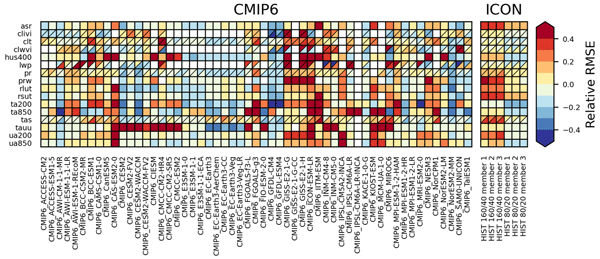
Wolfgang A. Müller, Stephan Lorenz, Trang V. Pham, Andrea Schneidereit, Renate Brokopf, Victor Brovkin, Nils Brüggemann, Fatemeh Chegini, Dietmar Dommenget, Kristina Fröhlich, Barbara Früh, Veronika Gayler, Helmuth Haak, Stefan Hagemann, Moritz Hanke, Tatiana Ilyina, Johann Jungclaus, Martin Köhler, Peter Korn, Luis Kornblueh, Clarissa A. Kroll, Julian Krüger, Karel Castro-Morales, Ulrike Niemeier, Holger Pohlmann, Iuliia Polkova, Roland Potthast, Thomas Riddick, Manuel Schlund, Tobias Stacke, Roland Wirth, Dakuan Yu, and Jochem Marotzke
Geosci. Model Dev., 18, 9385–9415, https://doi.org/10.5194/gmd-18-9385-2025, https://doi.org/10.5194/gmd-18-9385-2025, 2025
Short summary
Short summary
We provide a new Earth System model configuration framed into the ICON architecture, which provides the baseline for the next generation of climate predictions and projections (hereafter ICON XPP). Two resolutions of ICON XPP are presented that show high runtime performances making it suitable to run long integrations and large-ensemble experiments. ICON XPP similarly perform to CMIP6-class of climate models making it a good basis for climate forecasts and projections, and climate research.
Jemma Jeffree, Nicola Maher, Courtney Quinn, and Dietmar Dommenget
EGUsphere, https://doi.org/10.5194/egusphere-2026-5278, https://doi.org/10.5194/egusphere-2026-5278, 2026
This preprint is open for discussion and under review for Earth System Dynamics (ESD).
Short summary
Short summary
The El Niño Southern Oscillation (ENSO) is characterised by warmer or cooler ocean temperatures in the tropical Pacific, impacting weather around the world. An intriguing aspect of ENSO is the way that it behaves differently in different decades. However, we find that a simple linear model with white noise is sufficient to explain more than three quarters of these decadal differences in ENSO behaviour. We conclude that random weather variations have more impact than expected on these timescales.
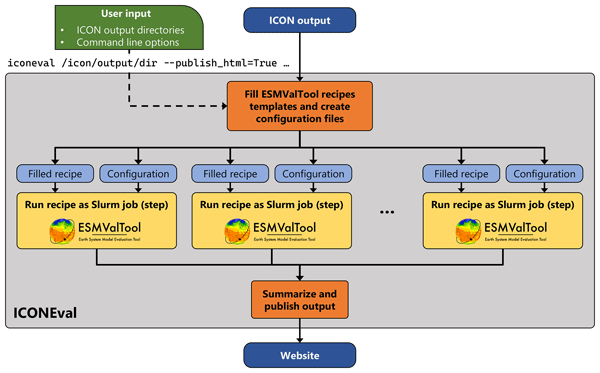
Axel Lauer, Manuel Schlund, Lisa Bock, Birgit Hassler, Gunnar Behrens, Bettina Gier, Lukas Lindenlaub, Stephan Lorenz, Jan-Hendrik Malles, Wolfgang A. Müller, Trang van Pham, Katja Weigel, Guang Zeng, and Veronika Eyring
Geosci. Model Dev., 19, 8731–8754, https://doi.org/10.5194/gmd-19-8731-2026, https://doi.org/10.5194/gmd-19-8731-2026, 2026
Short summary
Short summary
ICONEval is a new framework to facilitate researchers to continuously monitor and check their climate models during the development phase. It builds on the ESMValTool software package to run tests verifying that the results are plausible, follow physical laws, and that the model has sufficient skill in reproducing the observed climate. An important aim is to make it easier to spot model errors early, for example when implementing new model components that use machine learning.

Ned C. Williams, Wolfgang A. Müller, and Joaquim G. Pinto
Earth Syst. Dynam., 17, 1007–1023, https://doi.org/10.5194/esd-17-1007-2026, https://doi.org/10.5194/esd-17-1007-2026, 2026
Short summary
Short summary
Decadal forecasts use models to predict near-term natural and human-induced climate changes. Large scale pressure patterns affect surface impacts, but in summer they are hard to predict. North Atlantic surface temperatures are known to influence these patterns in summer. We find that a large set of retrospective decadal forecasts can predict this ocean-atmosphere interaction but also underestimates it, consistent with other predictable North Atlantic pressure patterns in climate forecasts.
Tobias Spiegl, Ulrike Langematz, Wenjuan Huo, Jürgen Kröger, Thomas Reddmann, Franziska Kappenberger, Sebastian Wahl, Maryam Ramezani Ziarani, Holger Pohlmann, and Miriam Sinnhuber
EGUsphere, https://doi.org/10.5194/egusphere-2026-126, https://doi.org/10.5194/egusphere-2026-126, 2026
Short summary
Short summary
The SOLCHECK project studied how fluctuations in the Sun’s energy output affect weather and climate. Strong solar storms deplete ozone and raise ultraviolet irradiance, the impact of the 11-year solar cycle depends on stratospheric dynamics, and long-term Grand Solar Minima leave fingerprints in past and future climate states. The large model ensemble explored in SOLCHECK helped to separate the various solar effects from human-driven change and improved our understanding of climate feedbacks.
Wolfgang A. Müller, Stephan Lorenz, Trang V. Pham, Andrea Schneidereit, Renate Brokopf, Victor Brovkin, Nils Brüggemann, Fatemeh Chegini, Dietmar Dommenget, Kristina Fröhlich, Barbara Früh, Veronika Gayler, Helmuth Haak, Stefan Hagemann, Moritz Hanke, Tatiana Ilyina, Johann Jungclaus, Martin Köhler, Peter Korn, Luis Kornblueh, Clarissa A. Kroll, Julian Krüger, Karel Castro-Morales, Ulrike Niemeier, Holger Pohlmann, Iuliia Polkova, Roland Potthast, Thomas Riddick, Manuel Schlund, Tobias Stacke, Roland Wirth, Dakuan Yu, and Jochem Marotzke
Geosci. Model Dev., 18, 9385–9415, https://doi.org/10.5194/gmd-18-9385-2025, https://doi.org/10.5194/gmd-18-9385-2025, 2025
Short summary
Short summary
We provide a new Earth System model configuration framed into the ICON architecture, which provides the baseline for the next generation of climate predictions and projections (hereafter ICON XPP). Two resolutions of ICON XPP are presented that show high runtime performances making it suitable to run long integrations and large-ensemble experiments. ICON XPP similarly perform to CMIP6-class of climate models making it a good basis for climate forecasts and projections, and climate research.
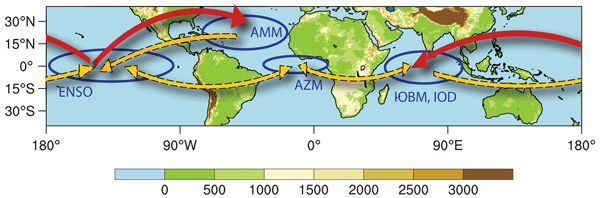
Ingo Richter, Ping Chang, Ping-Gin Chiu, Gokhan Danabasoglu, Takeshi Doi, Dietmar Dommenget, Guillaume Gastineau, Zoe E. Gillett, Aixue Hu, Takahito Kataoka, Noel S. Keenlyside, Fred Kucharski, Yuko M. Okumura, Wonsun Park, Malte F. Stuecker, Andréa S. Taschetto, Chunzai Wang, Stephen G. Yeager, and Sang-Wook Yeh
Geosci. Model Dev., 18, 2587–2608, https://doi.org/10.5194/gmd-18-2587-2025, https://doi.org/10.5194/gmd-18-2587-2025, 2025
Short summary
Short summary
Tropical ocean basins influence each other through multiple pathways and mechanisms, referred to here as tropical basin interaction (TBI). Many researchers have examined TBI using comprehensive climate models but have obtained conflicting results. This may be partly due to differences in experiment protocols and partly due to systematic model errors. The Tropical Basin Interaction Model Intercomparison Project (TBIMIP) aims to address this problem by designing a set of TBI experiments that will be performed by multiple models.
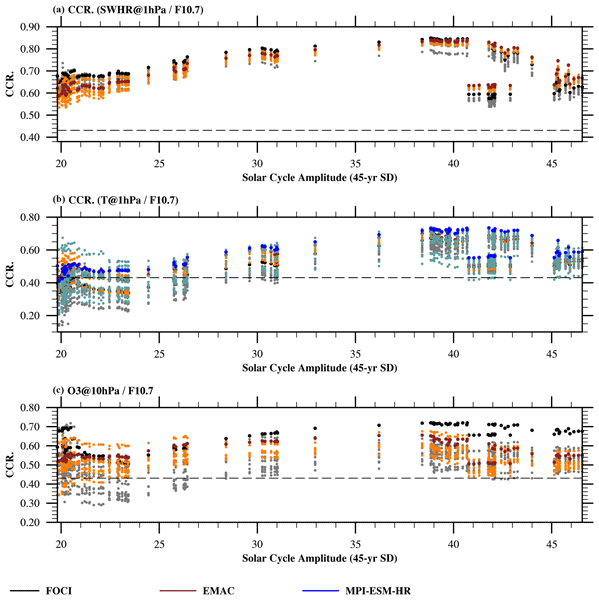
Wenjuan Huo, Tobias Spiegl, Sebastian Wahl, Katja Matthes, Ulrike Langematz, Holger Pohlmann, and Jürgen Kröger
Atmos. Chem. Phys., 25, 2589–2612, https://doi.org/10.5194/acp-25-2589-2025, https://doi.org/10.5194/acp-25-2589-2025, 2025
Short summary
Short summary
Uncertainties of the solar signals in the middle atmosphere are assessed based on large ensemble simulations with multiple climate models. Our results demonstrate that the 11-year solar signals in the shortwave heating rate, temperature, and ozone anomalies are significant and robust. The simulated dynamical responses are model-dependent, and solar imprints in the polar night jet are influenced by biases in the model used.
Lara Wallberg, Laura Suarez-Gutierrez, Daniela Matei, and Wolfgang A. Müller
Earth Syst. Dynam., 15, 1–14, https://doi.org/10.5194/esd-15-1-2024, https://doi.org/10.5194/esd-15-1-2024, 2024
Short summary
Short summary
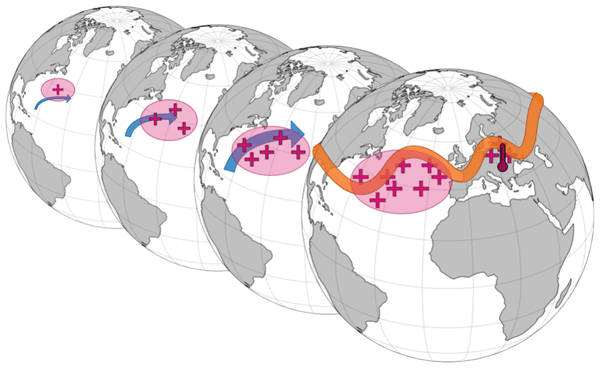
European summer temperatures are influenced by mechanisms on different timescales. We find that timescales of 5 to 10 years dominate the changes in summer temperature over large parts of the continent. Further, we find that specific processes within the North Atlantic, affecting the storage and transport of heat, cause changes in the atmosphere and extremely warm European summers. Our findings could be used for better forecasts of extremely warm European summers several years ahead.
Tobias C. Spiegl, Ulrike Langematz, Holger Pohlmann, and Jürgen Kröger
Weather Clim. Dynam., 4, 789–807, https://doi.org/10.5194/wcd-4-789-2023, https://doi.org/10.5194/wcd-4-789-2023, 2023
Short summary
Short summary
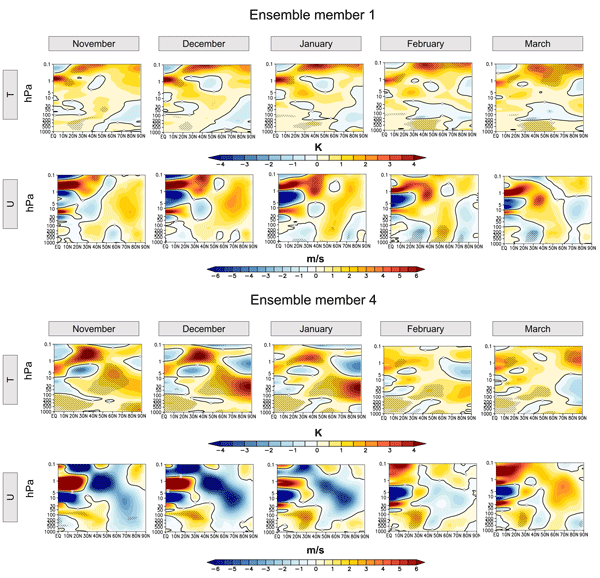
We investigate the role of the solar cycle in atmospheric domains with the Max Plank Institute Earth System Model in high resolution (MPI-ESM-HR). We focus on the tropical upper stratosphere, Northern Hemisphere (NH) winter dynamics and potential surface imprints. We found robust solar signals at the tropical stratopause and a weak dynamical response in the NH during winter. However, we cannot confirm the importance of the 11-year solar cycle for decadal variability in the troposphere.
Zhiang Xie and Dietmar Dommenget
EGUsphere, https://doi.org/10.5194/egusphere-2023-370, https://doi.org/10.5194/egusphere-2023-370, 2023
Preprint archived
Short summary
Short summary
Using numeric modelling, the global interaction between the climate system and ice sheets are examined in this study. The results show the existence of ice sheets slows the response of the climate system to external forcings and enhances the response in high latitude in Northern Hemisphere. Some interactions amplify the climate response, such as the ice-albedo, ice latent heat and topography feedbacks, while others damp or shift the climate response, such as snowfall and sea level feedbacks.

Zhiang Xie, Dietmar Dommenget, Felicity S. McCormack, and Andrew N. Mackintosh
Geosci. Model Dev., 15, 3691–3719, https://doi.org/10.5194/gmd-15-3691-2022, https://doi.org/10.5194/gmd-15-3691-2022, 2022
Short summary
Short summary
Paleoclimate research requires better numerical model tools to explore interactions among the cryosphere, atmosphere, ocean and land surface. To explore those interactions, this study offers a tool, the GREB-ISM, which can be run for 2 million model years within 1 month on a personal computer. A series of experiments show that the GREB-ISM is able to reproduce the modern ice sheet distribution as well as classic climate oscillation features under paleoclimate conditions.
Cited articles
Adler, R. F., Huffman, G. J., Chang, A., Ferraro, R., Xie, P.-P., Janowiak, J., Rudolf, B., Schneider, U., Curtis, S., Bolvin, D., Gruber, A., Susskind, J., Arkin, P., and Nelkin, E.: The Version-2 Global Precipitation Climatology Project (GPCP) Monthly Precipitation Analysis (1979–Present), J. Hydrometeorol., 4, 1147–1167, https://doi.org/10.1175/1525-7541(2003)004<1147:TVGPCP>2.0.CO;2, 2003. a
Bayr, T., Wengel, C., Latif, M., Dommenget, D., Lübbecke, J., and Park, W.: Error compensation of ENSO atmospheric feedbacks in climate models and its influence on simulated ENSO dynamics, Clim. Dynam., 53, 155–172, https://doi.org/10.1007/s00382-018-4575-7, 2019. a, b
Bellenger, H., Guilyardi, E., Leloup, J., Lengaigne, M., and Vialard, J.: ENSO representation in climate models: From CMIP3 to CMIP5, Clim. Dynam., 42, 1999–2018, https://doi.org/10.1007/s00382-013-1783-z, 2014. a, b, c
Cai, W., McPhaden, M. J., Grimm, A. M., Rodrigues, R. R., Taschetto, A. S., Garreaud, R. D., Dewitte, B., Poveda, G., Ham, Y.-G., Santoso, A., Ng, B., Anderson, W., Wang, G., Geng, T., Jo, H.-S., Marengo, J. A., Alves, L. M., Osman, M., Li, S., Wu, L., Karamperidou, C., Takahashi, K., and Vera, C.: Climate impacts of the El Niño–Southern Oscillation on South America, Nat. Rev. Earth Environ., 1, 215–231, https://doi.org/10.1038/s43017-020-0040-3, 2020. a
Collins, M., An, S. Il, Cai, W., Ganachaud, A., Guilyardi, E., Jin, F. F., Jochum, M., Lengaigne, M., Power, S., Timmermann, A., Vecchi, G., and Wittenberg, A.: The impact of global warming on the tropical Pacific Ocean and El Niño, Nat. Geosci., 3, 391–397, https://doi.org/10.1038/ngeo868, 2010. a
Danabasoglu, G., Lamarque, J.-F., Bacmeister, J., Bailey, D. A., DuVivier, A. K., Edwards, J., Emmons, L. K., Fasullo, J., Garcia, R., Gettelman, A., Hannay, C., Holland, M. M., Large, W. G., Lauritzen, P. H., Lawrence, D. M., Lenaerts, J. T. M., Lindsay, K., Lipscomb, W. H., Mills, M. J., Neale, R., Oleson, K. W., Otto-Bliesner, B., Phillips, A. S., Sacks, W., Tilmes, S., van Kampenhout, L., Vertenstein, M., Bertini, A., Dennis, J., Deser, C., Fischer, C., Fox-Kemper, B., Kay, J. E., Kinnison, D., Kushner, P. J., Larson, V. E., Long, M. C., Mickelson, S., Moore, J. K., Nienhouse, E., Polvani, L., Rasch, P. J., and Strand, W. G.: The Community Earth System Model Version 2 (CESM2), J. Adv. Model. Earth Syst., 12, e2019MS001916, https://doi.org/10.1029/2019MS001916, 2020. a
Dipankar, A., Stevens, B., Heinze, R., Moseley, C., Zängl, G., Giorgetta, M., and Brdar, S.: Large eddy simulation using the general circulation model ICON, J. Adv. Model. Earth Syst., 7, 963–986, https://doi.org/10.1002/2015MS000431, 2015. a
Guilyardi, E., Braconnot, P., Jin, F. F., Kim, S. T., Kolasinski, M., Li, T., and Musat, I.: Atmosphere feedbacks during ENSO in a coupled GCM with a modified atmospheric convection scheme, J. Climate, 22, 5698–5718, https://doi.org/10.1175/2009JCLI2815.1, 2009a. a
Guilyardi, E., Wittenberg, A., Fedorov, A., Collins, M., Wang, C., Capotondi, A., van Oldenborgh, G. J., and Stockdale, T.: Understanding El Niño in ocean-atmosphere general circulation models: Progress and challenges, B. Am. Meteorol. Soc., 90, 325–340, https://doi.org/10.1175/2008BAMS2387.1, 2009b. a
Ham, Y. G., Kim, J. H., and Luo, J. J.: Deep learning for multi-year ENSO forecasts, Nature, 573, 568–572, https://doi.org/10.1038/s41586-019-1559-7, 2019. a
Hanke, M., Redler, R., Holfeld, T., and Yastremsky, M.: YAC 1.2.0: New aspects for coupling software in Earth system modelling, Geosci. Model Dev., 9, 2755–2769, https://doi.org/10.5194/gmd-9-2755-2016, 2016. a
Heinze, R., Dipankar, A., Carbajal Henken, C., Moseley, C., Sourdeval, O., Trömel, S., Xie, X., Adamidis, P., Ament, F., Baars, H., Barthlott, C., Behrendt, A., Blahak, U., Bley, S., Brdar, S., Brueck, M., Crewell, S., Deneke, H., Di Girolamo, P., Evaristo, R., Fischer, J., Frank, C., Friederichs, P., Göcke, T., Gorges, K., Hande, L., Hanke, M., Hansen, A., Hege, H.-C., Hoose, C., Jahns, T., Kalthoff, N., Klocke, D., Kneifel, S., Knippertz, P., Kuhn, A., van Laar, T., Macke, A., Maurer, V., Mayer, B., Meyer, C., Muppa, S. K., Neggers, R. A. J., Orlandi, E., Pantillon, F., Pospichal, B., Röber, N., Scheck, L., Seifert, A., Seifert, P., Senf, F., Siligam, P., Simmer, C., Steinke, S., Stevens, B., Wapler, K., Weniger, M., Wulfmeyer, V., Zängl, G., Zhang, D., and Quaas, J.: Large-eddy simulations over Germany using ICON: a comprehensive evaluation, Q. J. Roy. Meteorol. Soc., 143, 69–100, https://doi.org/10.1002/qj.2947, 2017. a
Held, I. M., Guo, H., Adcroft, A., Dunne, J. P., Horowitz, L. W., Krasting, J., Shevliakova, E., Winton, M., Zhao, M., Bushuk, M., Wittenberg, A. T., Wyman, B., Xiang, B., Zhang, R., Anderson, W., Balaji, V., Donner, L., Dunne, K., Durachta, J., Gauthier, P. P. G., Ginoux, P., Golaz, J.-C., Griffies, S. M., Hallberg, R., Harris, L., Harrison, M., Hurlin, W., John, J., Lin, P., Lin, S.-J., Malyshev, S., Menzel, R., Milly, P. C. D., Ming, Y., Naik, V., Paynter, D., Paulot, F., Ramaswamy, V., Reichl, B., Robinson, T., Rosati, A., Seman, C., Silvers, L. G., Underwood, S., and Zadeh, N.: Structure and Performance of GFDL's CM4.0 Climate Model, J. Adv. Model. Earth Syst., 11, 3691–3727, https://doi.org/10.1029/2019MS001829, 2019. a
Hourdin, F., Mauritsen, T., Gettelman, A., Golaz, J.-C., Balaji, V., Duan, Q., Folini, D., Ji, D., Klocke, D., Qian, Y., Rauser, F., Roehrig, R., Svensson, G., Watanabe, M., and Williamson, D.: The art and science of climate model tuning, B. Am. Meteorol. Soc., 98, 589–602, https://doi.org/10.1175/BAMS-D-15-00135.1, 2017. a, b
ICON Partnership: ICON Release 2024.07, World Data Center for Climate [code], https://doi.org/10.35089/WDCC/IconRelease2024.07, 2024. a
Jiang, W., Huang, P., Huang, G., and Ying, J.: Origins of the excessive westward extension of ENSO SST simulated in CMIP5 and CMIP6 models, J. Climate, 34, 2839–2851, https://doi.org/10.1175/JCLI-D-20-0551.1, 2021. a
Jungclaus, J. H., Fischer, N., Haak, H., Lohmann, K., Marotzke, J., Matei, D., Mikolajewicz, U., Notz, D., and Von Storch, J. S.: Characteristics of the ocean simulations in the Max Planck Institute Ocean Model (MPIOM) the ocean component of the MPI-Earth system model, J. Adv. Model. Earth Syst., 5, 422–446, https://doi.org/10.1002/jame.20023, 2013. a
Korn, P., Brüggemann, N., Jungclaus, J. H., Lorenz, S. J., Gutjahr, O., Haak, H., Linardakis, L., Mehlmann, C., Mikolajewicz, U., Notz, D., Putrasahan, D. A., Singh, V., von Storch, J. S., Zhu, X., and Marotzke, J.: ICON-O: The Ocean Component of the ICON Earth System Model–Global Simulation Characteristics and Local Telescoping Capability, J. Adv. Model. Earth Syst., 14, https://doi.org/10.1029/2021MS002952, 2022. a
Kuhlbrodt, T., Jones, C. G., Sellar, A., Storkey, D., Blockley, E., Stringer, M., Hill, R., Graham, T., Ridley, J., Blaker, A., Calvert, D., Copsey, D., Ellis, R., Hewitt, H., Hyder, P., Ineson, S., Mulcahy, J., Siahaan, A., and Walton, J.: The Low-Resolution Version of HadGEM3 GC3.1: Development and Evaluation for Global Climate, J. Adv. Model. Earth Syst., 10, 2865–2888, https://doi.org/10.1029/2018MS001370, 2018. a
Kumar, B. P., Vialard, J., Lengaigne, M., Murty, V. S. N., and McPhaden, M. J.: TropFlux: Air-sea fluxes for the global tropical oceans: description and evaluation, Clim. Dynam., 38, 1521–1543, https://doi.org/10.1007/s00382-011-1115-0, 2012. a
Kumar, K. K., Rajagopalan, B., Hoerling, M., Bates, G., and Cane, M.: Unraveling the mystery of Indian monsoon failure during El Niño, Science, 314, 115–119, https://doi.org/10.1126/science.1131152, 2006. a
Lguensat, R., Deshayes, J., Durand, H., and Balaji, V.: Semi-Automatic Tuning of Coupled Climate Models With Multiple Intrinsic Timescales: Lessons Learned From the Lorenz96 Model, J. Adv. Model. Earth Syst., 15, e2022MS003367, https://doi.org/10.1029/2022MS003367, 2023. a
Li, G. and Xie, S. P.: Tropical biases in CMIP5 multimodel ensemble: The excessive equatorial pacific cold tongue and double ITCZ problems, J. Climate, 27, 1765–1780, https://doi.org/10.1175/JCLI-D-13-00337.1, 2014. a
Lloyd, J., Guilyardi, E., Weller, H., and Slingo, J.: The role of atmosphere feedbacks during ENSO in the CMIP3 models, Atmos. Sci. Lett., 10, 170–176, https://doi.org/10.1002/asl.227, 2009. a, b
Luersen, M. A. and Le Riche, R.: Globalized Nelder–Mead method for engineering optimization, Comput. Struct., 82, 2251–2260, https://doi.org/10.1016/j.compstruc.2004.03.072, 2004. a, b
Mauritsen, T., Bader, J., Becker, T., Behrens, J., Bittner, M., Brokopf, R., Brovkin, V., Claussen, M., Crueger, T., Esch, M., Fast, I., Fiedler, S., Fläschner, D., Gayler, V., Giorgetta, M., Goll, D. S., Haak, H., Hagemann, S., Hedemann, C., Hohenegger, C., Ilyina, T., Jahns, T., Jiménez-de-la-Cuesta, D., Jungclaus, J., Kleinen, T., Kloster, S., Kracher, D., Kinne, S., Kleberg, D., Lasslop, G., Kornblueh, L., Marotzke, J., Matei, D., Meraner, K., Mikolajewicz, U., Modali, K., Möbis, B., Müller, W. A., Nabel, J. E. M. S., Nam, C. C. W., Notz, D., Nyawira, S.-S., Paulsen, H., Peters, K., Pincus, R., Pohlmann, H., Pongratz, J., Popp, M., Raddatz, T. J., Rast, S., Redler, R., Reick, C. H., Rohrschneider, T., Schemann, V., Schmidt, H., Schnur, R., Schulzweida, U., Six, K. D., Stein, L., Stemmler, I., Stevens, B., von Storch, J.-S., Tian, F., Voigt, A., Vrese, P., Wieners, K.-H., Wilkenskjeld, S., Winkler, A., and Roeckner, E.: Developments in the MPI-M Earth System Model version 1.2 (MPI-ESM1.2) and its response to increasing CO2, J. Adv. Model. Earth Syst., 11, 998–1038, https://doi.org/10.1029/2018MS001400, 2019. a
McPhaden, M. J., Zebiak, S. E., and Glantz, M. H.: ENSO as an integrating concept in Earth Science, Science, 314, 1740–1745, https://doi.org/10.1126/science.1132588, 2006. a
Müller, W. A., Jungclaus, J. H., Mauritsen, T., Baehr, J., Bittner, M., Budich, R., Bunzel, F., Esch, M., Ghosh, R., Haak, H., Ilyina, T., Kleine, T., Kornblueh, L., Li, H., Modali, K., Notz, D., Pohlmann, H., Roeckner, E., Stemmler, I., Tian, F., and Marotzke, J.: A higher-resolution version of the Max Planck Institute Earth System Model (MPI-ESM1.2-HR), J. Adv. Model. Earth Syst., 10, 1383–1413, https://doi.org/10.1029/2017MS001217, 2018. a
Müller, W. A., Früh, B., Korn, P., Potthast, R., Baehr, J., Bettems, J.-M., Bölóni, G., Brienen, S., Fröhlich, K., Helmert, J., Jungclaus, J., Köhler, M., Lorenz, S., Schneidereit, A., Schnur, R., Schulz, J.-P., Schlemmer, L., Sgoff, C., Pham, T. V., Pohlmann, H., Vogel, B., Vogel, H., Wirth, R., Zaehle, S., Zängl, G., Stevens, B., and Marotzke, J.: ICON: Toward vertically integrated model configurations for numerical weather prediction, climate predictions, and projections, B. Am. Meteorol. Soc., 106, E1017–E1031, https://doi.org/10.1175/BAMS-D-24-0042.1, 2025a. a, b, c, d
Müller, W. A., Lorenz, S., Pham, T. V., Schneidereit, A., Brokopf, R., Brovkin, V., Brüggemann, N., Chegini, F., Dommenget, D., Fröhlich, K., Früh, B., Gayler, V., Haak, H., Hagemann, S., Hanke, M., Ilyina, T., Jungclaus, J., Köhler, M., Korn, P., Kornblueh, L., Kroll, C. A., Krüger, J., Castro-Morales, K., Niemeier, U., Pohlmann, H., Polkova, I., Potthast, R., Riddick, T., Schlund, M., Stacke, T., Wirth, R., Yu, D., and Marotzke, J.: The ICON-based Earth System Model for climate predictions and projections (ICON XPP v1.0), Geosci. Model Dev., 18, 9385–9415, https://doi.org/10.5194/gmd-18-9385-2025, 2025b. a, b, c, d, e, f, g, h
Murphy, J. M., Sexton, D. M. H., Barnett, D. N., Jones, G. S., Webb, M. J., Collins, M., and Stainforth, D. A.: Quantification of modelling uncertainties in a large ensemble of climate change simulations, Nature, 430, 768–772, https://doi.org/10.1038/nature02771, 2004. a, b
Nelder, J. A. and Mead, R.: A Simplex Method for Function Minimization, Comput. J., 7, 308–313, https://doi.org/10.1093/comjnl/7.4.308, 1965. a
Planton, Y. Y., Guilyardi, E., Wittenberg, A. T., Lee, J., Gleckler, P. J., Bayr, T., McGregor, S., McPhaden, M. J., Power, S., Roehrig, R., Vialard, J., and Voldoire, A.: Evaluating climate models with the CLIVAR 2020 ENSO Metrics Package, B. Am. Meteorol. Soc., 102, E193–E217, https://doi.org/10.1175/BAMS-D-19-0337.1, 2021. a, b, c, d, e, f, g, h, i, j, k, l, m, n, o, p, q
Planton, Y. Y., Lee, J., Wittenberg, A. T., Gleckler, P. J., Guilyardi, É., McGregor, S., and McPhaden, M. J.: Estimating uncertainty in simulated ENSO statistics, J. Adv. Model. Earth Syst., 16, https://doi.org/10.1029/2023MS004147, 2024. a
Reick, C. H., Gayler, V., Goll, D. S., Hagemann, S., Heidkamp, M., Nabel, J. E. M. S., Raddatz, T. J., Roeckner, E., Schnur, R., and Wilkenskjeld, S.: JSBACH 3 – The land component of the MPI Earth System Model: documentation of version 3.2, Berichte zur Erdsystemforschung, 240, https://doi.org/10.17617/2.3279802, 2021. a
Roberts, M. J., Vidale, P. L., Senior, C., Hewitt, H. T., Bates, C., Berthou, S., Chang, P., Christensen, H. M., Danilov, S., Demory, M.-E., Griffies, S. M., Haarsma, R., Jung, T., Martin, G., Minobe, S., Ringler, T., Satoh, M., Schiemann, R., Scoccimarro, E., Stephens, G., and Wehner, M. F.: The benefits of global high resolution for climate simulation: process understanding and the enabling of stakeholder decisions at the regional scale, B. Am. Meteorol. Soc., 99, 2341–2359, https://doi.org/10.1175/BAMS-D-15-00320.1, 2018. a
Saha, S., Nadiga, S., Thiaw, C., Wang, J., Wang, W., Zhang, Q., Van Den Dool, H. M., Pan, H.-L., Moorthi, S., Behringer, D., Stokes, D., Peña, M., Lord, S., White, G., Ebisuzaki, W., Peng, P., and Xie, P.: The NCEP Climate Forecast System, J. Climate, 19, 3483–3517, https://doi.org/10.1175/JCLI3812.1, 2006. a
Severijns, C. A. and Hazeleger, W.: Optimizing parameters in an atmospheric general circulation model, J. Climate, 18, 3527–3535, https://doi.org/10.1175/JCLI3482.1, 2005. a
Shaffrey, L. C., Stevens, I., Norton, W. A., Roberts, M. J., Vidale, P.-L., Harle, J. D., Jrrar, A., Stevens, D. P., Woodage, M. J., Demory, M.-E., Donners, J., Clark, D. B., Clayton, A., Cole, J. W., Wilson, S. S., Connolley, W. M., Davies, T. M., Iwi, A. M., Johns, T. C., King, J. C., New, A. L., Slingo, J. M., Slingo, A., Steenman-Clark, L., and Martin, G. M.: U.K. HiGEM: The new U.K. high-resolution global environment model – model description and basic evaluation, J. Climate, 22, 1861–1896, https://doi.org/10.1175/2008JCLI2508.1, 2009. a
Tett, S. F. B., Rowlands, D. J., Mineter, M. J., and Cartis, C.: Can top-of-atmosphere radiation measurements constrain climate predictions? Part II: climate sensitivity, J. Climate, 26, 9367–9383, https://doi.org/10.1175/JCLI-D-12-00596.1, 2013. a
Timmermann, A., An, S.-I., Kug, J.-S., Jin, F.-F., Cai, W., Capotondi, A., Cobb, K. M., Lengaigne, M., McPhaden, M. J., Stuecker, M. F., Stein, K., Wittenberg, A. T., Yun, K.-S., Bayr, T., Chen, H.-C., Chikamoto, Y., Dewitte, B., Dommenget, D., Grothe, P., Guilyardi, E., Ham, Y.-G., Hayashi, M., Ineson, S., Kang, D., Kim, S., Kim, W., Lee, J.-Y., Li, T., Luo, J.-J., McGregor, S., Planton, Y., Power, S., Rashid, H., Ren, H.-L., Santoso, A., Takahashi, K., Todd, A., Wang, G., Wang, G., Xie, R., Yang, W.-H., Yeh, S.-W., Yoon, J., Zeller, E., and Zhang, X.: El Niño–Southern Oscillation complexity, Nature, 559, 535–545, https://doi.org/10.1038/s41586-018-0252-6, 2018. a
Trenberth, K. E., Branstator, G. W., Karoly, D., Kumar, A., Lau, N.-C., and Ropelewski, C.: Progress during TOGA in understanding and modeling global teleconnections associated with tropical sea surface temperatures, J. Geophys. Res.-Oceans, 103(, 14291–14324, https://doi.org/10.1029/97JC01444, 1998. a
Watson-Parris, D., Williams, A., Deaconu, L., and Stier, P.: Model calibration using ESEm v1.1.0 – an open, scalable Earth system emulator, Geosci. Model Dev., 14, 7659–7672, https://doi.org/10.5194/gmd-14-7659-2021, 2021. a
Williams, K. D., Copsey, D., Blockley, E. W., Bodas-Salcedo, A., Calvert, D., Comer, R., Davis, P., Graham, T., Hewitt, H. T., Hill, R., Hyder, P., Ineson, S., Johns, T. C., Keen, A. B., Lee, R. W., Megann, A., Milton, S. F., Rae, J. G. L., Roberts, M. J., Scaife, A. A., Schiemann, R., Storkey, D., Thorpe, L., Watterson, I. G., Walters, D. N., West, A., Wood, R. A., Woollings, T., and Xavier, P. K.: The Met Office Global Coupled Model 3.0 and 3.1 (GC3.0 and GC3.1) configurations, J. Adv. Model. Earth Syst., 10, 357–380, https://doi.org/10.1002/2017MS001115, 2018. a
Williamson, D., Goldstein, M., Allison, L., Blaker, A., Challenor, P., Jackson, L., and Yamazaki, K.: History matching for exploring and reducing climate model parameter space using observations and a large perturbed physics ensemble, Clim. Dynam., 41, 1703–1729, https://doi.org/10.1007/s00382-013-1896-4, 2013. a, b
Yu, D., Dommenget, D., Pohlmann, H., and Müller, W.: Source data and scripts for publication “A Systematic Atmospheric Parameter Optimization Method to Improve ENSO Simulation in the ICON XPP Earth System Model”, Zenodo [data set], https://doi.org/10.5281/zenodo.18622333, 2026. a
Zängl, G., Reinert, D., Rípodas, P., and Baldauf, M.: The ICON (ICOsahedral Non-hydrostatic) modelling framework of DWD and MPI-M: Description of the non-hydrostatic dynamical core, Q. J. Roy. Meteorol. Soc., 141, 563–579, https://doi.org/10.1002/qj.2378, 2015. a
Zhang, T., Shao, X., and Li, S.: Impacts of atmospheric processes on ENSO asymmetry: A comparison between CESM1 and CCSM4, J. Climate, 30, 9743–9762, https://doi.org/10.1175/JCLI-D-17-0360.1, 2017. a
Zhang, X., Duan, W., and Zebiak, S. E.: Parameter optimization for an intermediate coupled model using ENSO dynamics, J. Climate, 28, 193–214, https://doi.org/10.1175/JCLI-D-14-00348.1, 2015. a
Short summary
We developed a new method to improve how a leading climate model simulates El Niño, a major driver of global weather extremes. By testing how the model responds to small changes in key atmospheric settings, we identified which processes matter most and adjusted them systematically. This approach makes the model’s behavior closer to observations and shows a promising path for building more reliable climate predictions.
We developed a new method to improve how a leading climate model simulates El Niño, a major...


