Articles | Volume 19, issue 12
https://doi.org/10.5194/gmd-19-5343-2026
Development and technical paper
 | 
22 Jun 2026
Development and technical paper |  | 22 Jun 2026

Automatic tuning of iterative pseudo-transient solvers for modeling the deformation of heterogeneous media

Thibault Duretz, Albert de Montserrat, Rubén Sevilla, Ludovic Räss, Ivan Utkin, and Arne Spang

Related authors

Overcoming the numerical challenges owing to rapid ductile localization with DEDLoc (version 1.0.0)
Arne Spang, Marcel Thielmann, Casper Pranger, Albert de Montserrat, and Ludovic Räss
Geosci. Model Dev., 19, 369–388, https://doi.org/10.5194/gmd-19-369-2026,https://doi.org/10.5194/gmd-19-369-2026, 2026
Short summary
A bound-constrained formulation for complex solution phase minimization
Nicolas Riel, Boris J. P. Kaus, Albert de Montserrat, Evangelos Moulas, Eleanor C. R. Green, and Hugo Dominguez
Geosci. Model Dev., 18, 6951–6962, https://doi.org/10.5194/gmd-18-6951-2025,https://doi.org/10.5194/gmd-18-6951-2025, 2025
Short summary
ECOMAN: an open-source package for geodynamic and seismological modelling of mechanical anisotropy
Manuele Faccenda, Brandon P. VanderBeek, Albert de Montserrat, Jianfeng Yang, Francesco Rappisi, and Neil Ribe
Solid Earth, 15, 1241–1264, https://doi.org/10.5194/se-15-1241-2024,https://doi.org/10.5194/se-15-1241-2024, 2024
Short summary
Graphics-processing-unit-accelerated ice flow solver for unstructured meshes using the Shallow-Shelf Approximation (FastIceFlo v1.0.1)
Anjali Sandip, Ludovic Räss, and Mathieu Morlighem
Geosci. Model Dev., 17, 899–909, https://doi.org/10.5194/gmd-17-899-2024,https://doi.org/10.5194/gmd-17-899-2024, 2024
Short summary
Assessing the robustness and scalability of the accelerated pseudo-transient method
Ludovic Räss, Ivan Utkin, Thibault Duretz, Samuel Omlin, and Yuri Y. Podladchikov
Geosci. Model Dev., 15, 5757–5786, https://doi.org/10.5194/gmd-15-5757-2022,https://doi.org/10.5194/gmd-15-5757-2022, 2022
Short summary

Cited articles

Alkhimenkov, Y., Räss, L., Khakimova, L., Quintal, B., and Podladchikov, Y.: Resolving Wave Propagation in Anisotropic Poroelastic Media Using Graphical Processing Units (GPUs), J. Geophys. Res.-Sol. Ea., 126, https://doi.org/10.1029/2020JB021175, 2021. a
Anzt, H., Chow, E., Saak, J., and Dongarra, J.: Updating incomplete factorization preconditioners for model order reduction, Numer. Algorithms, 73, 611–630, https://doi.org/10.1007/s11075-016-0110-2, 2016. a
Balachandar, S. and Yuen, D. A.: Three-dimensional fully spectral numerical method for mantle convection with depth-dependent properties, J. Comput. Phys., 113, https://doi.org/10.1006/jcph.1994.1118, 1994. a
Baumgardner, J. R.: Three-dimensional treatment of convective flow in the earth's mantle, J. Stat. Phys., 39, 501–511, https://doi.org/10.1007/BF01008348, 1985. a
Bezanson, J., Edelman, A., Karpinski, S., and Shah, V. B.: Julia: A Fresh Approach to Numerical Computing, SIAM Rev., 59, 65–98, https://doi.org/10.1137/141000671, 2017. a
Download
Short summary
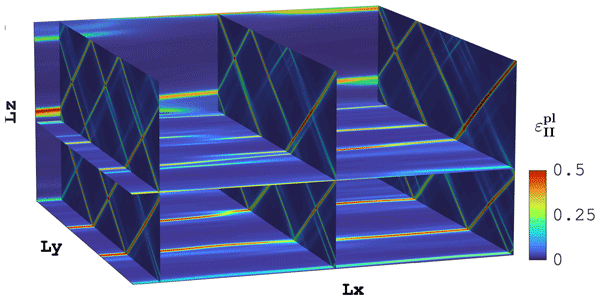
Geodynamic modeling helps scientists understand how the Earth deforms. New computer methods make these simulations faster and more efficient, especially on powerful computers. They automatically adjust settings for better performance and can handle complex materials and flow types. This approach makes it easier to study large, detailed models of Earth processes.
Share