
the Creative Commons Attribution 4.0 License.
the Creative Commons Attribution 4.0 License.
 | 28 Apr 2026
AerChemMIP2 – unraveling the role of reactive gases, aerosol particles, and land use for air quality and climate change in CMIP7
Stephanie Fiedler

Fiona M. O'Connor
Duncan Watson-Parris
Robert J. Allen
William J. Collins
Paul T. Griffiths
Matthew Kasoar
Jarmo Kikstra
Jasper F. Kok
Lee T. Murray
Fabien Paulot
Maria Sand
Steven T. Turnock
James Weber
Laura J. Wilcox
Vaishali Naik
Phase 2 of the Aerosol and Chemistry Model Intercomparison Project (AerChemMIP2) is a registered model intercomparison project (MIP) of the Coupled Model Intercomparison Project phase 7 (CMIP7). The focus of AerChemMIP2 is the quantification of the atmospheric composition, biogeochemical feedbacks, air quality and climate responses to changes in emissions of chemically reactive gases, aerosol particles, and land use. AerChemMIP2 aims to facilitate a better understanding of their relative contributions to changes in atmospheric composition, radiative forcing, and the climate response and feedbacks from the pre-industrial period to the present day and for projected future emission pathways. Some experiments from the first phase of AerChemMIP are requested in the second phase to track changes in the results of CMIP7 compared to phase six of CMIP. New experiments in AerChemMIP2 open scientific opportunities to address knowledge gaps and persistent uncertainties. Specifically, AerChemMIP2 requests experiments (1) to assess the dependence of effective radiative forcing for aerosols on the fidelity of resolved processes and the simulated base climate, (2) to provide first estimates of forcing for hydrogen and individual volatile organic compounds in the context of CMIP, (3) to enable studies on non-linearity in the Earth system response, (4) to understand the response of wild fires to historical forcings, and (5) to quantify the influence of desert dust increases on climate change. AerChemMIP2 further requests variants of the ScenarioMIP-CMIP7 high-end and overshoot scenarios to quantify future responses to policy implementations for air quality management. Diagnostic requests of AerChemMIP2 are made from CMIP7 core experiments to facilitate offline experiments for chemistry and aerosols. The experimental protocol of AerChemMIP2 presented here closely aligns with the CMIP7 core experimental design, and its other registered MIPs. Selected AerChemMIP2 experiments are performed in the Assessment Fast Track (AFT) of CMIP7. Participation of modelling centres in AerChemMIP2 would help to gain new insights for atmospheric composition and implications for air quality in a warming world with rapidly changing emissions.
- Article
(5734 KB) - Full-text XML
- BibTeX
- EndNote


Atmospheric composition is key to understanding climate change and air quality. Atmospheric constituents that typically stay in the atmosphere for weeks to two decades are referred to as short-lived climate forcers (SLCFs, Szopa et al., 2021), and affect both climate change and air quality, schematically depicted in Fig. 1. Emissions and concentrations of SLCFs are spatially and temporally variable. SLCFs may therefore influence climate differently in time and space. Due to their short atmospheric residence time, emission reductions to improve air quality may lead to benefits or adverse influences on global and regional climate on timescales much shorter than for long-lived greenhouse gases (GHGs). Despite their significant role in regional climate change, the magnitude of radiative forcing, climate responses, and feedbacks associated with SLCFs remain insufficiently understood (e.g., Bellouin et al., 2020; Schaeffer et al., 2025). Addressing these critical knowledge gaps is the primary goal of the Aerosol and Chemistry Model Intercomparison Project (AerChemMIP).
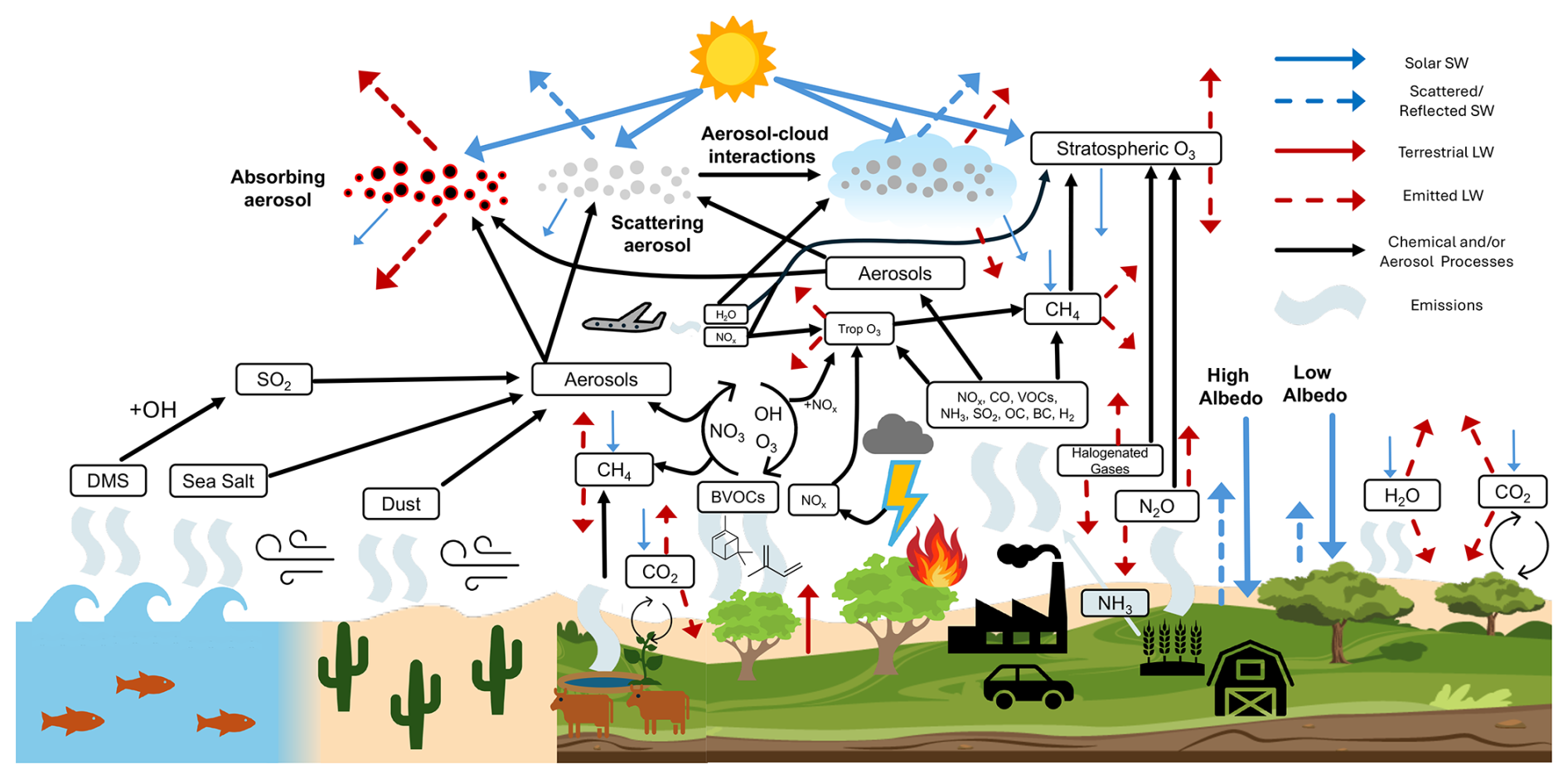
Figure 1Schematic depicting the interaction of natural and anthropogenic trace gas and aerosol emissions with atmospheric composition, air quality, and climate response (Schematic inspired by Bonan, 2016; Fiore et al., 2015).
AerChemMIP phase one (Collins et al., 2017) targeted the role of SLCFs including methane, and was designed in support of the Coupled Model Intercomparison Project phase six (CMIP6, Eyring et al., 2016). Of interest was the role of methane (CH4), tropospheric ozone (O3) and its non-CH4 precursor gases, stratospheric O3, nitrous oxide (N2O) and ozone-depleting substances (ODSs), and aerosol particles and their precursors. The MIP facilitated the quantification of climate and air quality impacts of aerosols and chemically reactive gases (Collins et al., 2017), recently reviewed by Griffiths et al. (2025). It included estimates of forcings and responses from changes in aerosols, tropospheric O3 and their precursor emissions, and halocarbons. Feedbacks from climate-driven changes in natural emissions of individual species were also quantified. There were detailed studies on the role of SLCFs in future climate and air quality with a focus on tradeoffs and co-benefits between air quality and climate policies, highlighting potential win-win scenarios. AerChemMIP experiments highlighted how SLCFs pose attractive options for near-term climate mitigation, and prompted new research on their regional impact and the uncertainties and challenges in assessing the impact of these short-lived climate forcers (Griffiths et al., 2025, and references therein). AerChemMIP focused on the process level within the complex and diverse range of Earth System and climate models, aiming to build confidence in our understanding of the role of these processes in climate forcing and Earth system responses and feedbacks. The experiments also allowed the attribution of historical surface temperature changes to composition changes, and the calculation of radiative forcing of individual components. This newly gained understanding was included in the sixth assessment report (AR6) of Working Group I (WGI) of the Intergovernmental Panel on Climate Change (IPCC), e.g., in the dedicated chapter on SLCFs (Szopa et al., 2021).
AerChemMIP phase two (AerChemMIP2) builds on the experimental protocol of AerChemMIP (Collins et al., 2017) in two ways. First, we largely adopt the same strategy for the experimental designs by again requesting time-slice experiments with prescribed annually repeating conditions for computing radiative forcing and feedbacks, as well as fully coupled and atmosphere-only experiments for the historical and future time periods to study climate forcing and the response of air quality and climate. Second, we partly request that some of the experiments from AerChemMIP are repeated with CMIP7 models and climate forcings data sets in order to track changes in forcings, responses, and feedback estimates since AR6. Nitrate aerosols were, for instance, simulated by only a few models in CMIP6 (Turnock et al., 2020; Allen et al., 2020, 2021). As such, there is currently a large uncertainty in future changes and the associated implication of nitrate aerosols for climate and air quality. AerChemMIP2 experiments can help to address these uncertainties based on the larger number of models with interactive nitrate aerosol capability.
New experiments in AerChemMIP2 are opportunities to address knowledge gaps, some of which have already been known for some time. One of these gaps relates to the historical and future changes of natural dust aerosols, which have important implications for climate and air quality. Desert dust aerosol constitutes the largest fraction of the total aerosol mass in the Earth's atmosphere (e.g., Adebiyi et al., 2023) and affects climate through its direct radiative effect and via its influence on cloud microphysics (e.g., Kok et al., 2023). Moreover, dust influences biogeochemical processes with links to the carbon cycle, air quality and human health, as well as other socio-economic impacts including the transportation, agricultural, and renewable energy sectors. Despite the importance of natural dust, CMIP6 models did not capture observed historical trends for dust aerosols (Kok et al., 2023), although large uncertainties in global dust simulations have been known for some time (Huneeus et al., 2011; Evan et al., 2014). AerChemMIP2 therefore includes new experiments with prescribed monthly dust emission data to induce observationally informed trends for dust aerosols in CMIP7 model simulations. The aim is a first assessment of the spatio-temporal changes in climate forcing and response associated with dust aerosol trends in CMIP7.
Another opportunity in AerChemMIP2 concerns the past evolution of wildfire activities and associated emissions of SLCFs. Fires have devastating impacts on humans and the environment (e.g., Martin et al., 2016) and their emissions in the pre-industrial era have implications for the quantification of present-day anthropogenic aerosol forcing (Hamilton et al., 2018, 2024). Moreover, humans are directly involved in altering the environment in which fires can occur, e.g., through changes in land use, fire weather, and fire management policies, altering the magnitude and extent of past and future wildfires. More models are anticipated to have the capability to perform experiments with co-evolving fire and climate conditions, which AerChemMIP2, in collaboration with FireMIP (Li et al., 2025), will exploit for new climate forcing and response experiments targeting fire emissions.
AerChemMIP2 experiments further enable the quantification and understanding of the role of SLCFs aligned with future scenarios in CMIP7 (Dunne et al., 2025) that complement the set of scenarios expected to be provided by ScenarioMIP-CMIP7 (van Vuuren et al., 2025). AerChemMIP explored the air quality and climate responses to strong air pollution controls with and without CH4 mitigation in a world with increasing long-lived GHGs by requesting variants of the Shared Socioeconomic Pathway SSP3-7.0 (e.g., described by Allen et al., 2021). AerChemMIP2 requests experiments building on two ScenarioMIP-CMIP7 scenarios that have alternative SLCF emission trajectories. SLCFs are of particular importance for regional climate change (Wilcox et al., 2023; Persad et al., 2023), especially in the next few decades, due to both air quality abatement measures and new emerging technologies for sustainability. Reaching climate neutrality implies, for instance, a large-scale increase in renewable energy sources, which may include a growing hydrogen economy, in which hydrogen (H2) is produced from renewables and/or from fossil fuels combined with carbon capture and storage (CCS). Regardless of the production method, H2 is prone to leakage during the whole value chain, and will indirectly contribute to warming by changing methane (CH4), ozone (O3) and stratospheric water vapor levels (Sand et al., 2023; Warwick et al., 2023). The potential implication of a hydrogen economy can be studied with Chemical Transport Models (CTMs) driven by output from selected CMIP7 model experiments, the request for which will be added to the CMIP data request for atmospheric variables (Dingley et al., 2026).
Finally, AerChemMIP2 interacts synergistically with other MIPs for creating multi-purpose experiments, i.e., requesting identical experiments across MIPs, where possible. We do so to avoid duplication of effort and to reduce the overall computational burden for modelling centres. We further identified research areas where novel opportunities arise from the use of consistent parallel experiments across MIP boundaries and other modelling initiatives.
The experiment protocol of AerChemMIP2 is guided by our scientific aims, which are embedded in the scientific goals of the Coupled Model Intercomparison Project phase seven (CMIP7, Dunne et al., 2025). The scientific aims of AerChemMIP2 were defined through community consultation and discussions via online meetings and workshops of the Composition Air quality Climate inTeractions Initiative (CACTI, Fiedler et al., 2024), resulting in four scientific questions for AerChemMIP2.
-
Process Understanding. How have our process understanding and associated impact assessments advanced for global and regional atmospheric composition changes, radiative forcing, and climate responses?
-
Feedbacks. How important are climate feedbacks on natural SLCF emissions, atmospheric composition, and radiative effects?
-
Air quality. What is the relative importance of climate change and emissions of SLCFs for atmospheric composition and air quality over the historical period and into the future?
-
Sustainability. What future climate benefits and/or penalties are expected from improving air quality and what are the climate benefits/trade-offs arising from policies for improved sustainability?
Through addressing these questions, AerChemMIP2 aims to contribute to quantifying and advancing the scientific understanding of the role of SLCFs for (1) global climate forcing and patterns of radiative effects, (2) the spatio-temporal response of atmospheric composition, air quality, and climate to SLCF changes, and (3) climate and biogeochemical feedback mechanisms induced by emission and atmospheric composition changes. The aims of AerChemMIP2 contribute to the four guiding science questions of CMIP7 outlined by Dunne et al. (2025) as follows.
-
Patterns of sea surface change. SLCFs are much more spatially heterogeneously distributed than long-lived, well-mixed GHGs. Through the focus on SLCFs like aerosol particles, AerChemMIP2 supports the CMIP7 science goal concerning a better understanding of historical changes in spatial patterns of radiative effects (Sect. 3.1), climate responses, feedback processes, and their interactions with natural variability (Sect. 3.2). Past research has, for instance, shown northern hemisphere responses of sea-surface temperature patterns to the aerosol increase until the 1980s and their later West to East shift due to changes in atmosphere and ocean dynamics (Fiedler and Putrasahan, 2021; Kang et al., 2021), including a response of the Atlantic Meridional Overturning Circulation (Booth et al., 2012) which is seen as a tipping element in the climate system (McKay et al., 2022). AerChemMIP2 experiments will help to improve the understanding of the role of SLCF emissions in shaping the historical and future spatial patterns of air quality and climate change, and their temporal evolution (Sect. 3.2 and 3.3) paired with precise model-based estimates of patterns of their radiative effects (Sect. 3.1). AerChemMIP2 experiments will therefore be useful in assessing how SLCF emissions contributed to observed changes and whether changes attributed to individual emission perturbations will be different in future emission trajectories.
-
Changing weather. AerChemMIP2 experiments enable the impact of SLCFs on weather patterns and their connection to extremes, including impacts on air quality and associated extremes, to be assessed. Emissions of SLCFs, such as aerosol, have marked regional patterns and are known for different effects on atmospheric radiative transfer and associated weather responses, e.g., ranging from differences in atmospheric stability, cloud microphysical processes, and precipitation formation, to larger scale responses of the atmosphere and ocean circulation (e.g., Allen and Sherwood, 2011; Bellouin et al., 2020; Wilcox et al., 2020; Fiedler and Putrasahan, 2021; Xie et al., 2022; Myhre et al., 2024). AerChemMIP2 experiments may help to better understand both the historical and potential future changes in weather patterns influenced by SLCFs in a warming world, e.g., monsoon precipitation, including extremes. Additionally, extreme weather events, such as heatwaves, can in turn create meteorological conditions favourable for poor air quality which may lead to compound high-impact events (e.g., Fiore et al., 2015; Schnell and Prather, 2017; Guo et al., 2021; Jain et al., 2022). Such co-occurrences of extreme weather and pollution events can be assessed with output from the AerChemMIP2 ensemble of experiments (e.g., Sect. 3.2.1, 3.2.2, and 3.3.1).
-
Water-carbon-climate nexus. Advancing the understanding of biogeochemical feedbacks for climate change is again a component of AerChemMIP2. AerChemMIP2 requests experiments with Earth system models allowing the community to assess chemical cycles in the context of air quality and climate change. New to AerChemMIP2, and hence CMIP7, are experiments with prescribed desert dust aerosols for which CMIP models have been facing uncertainty across multiple CMIP phases such that the past trends were missed by models. As carriers of nutrients for both terrestrial and marine eco-systems, desert dust aerosols influence the carbon cycle and AerChemMIP2 experiments will allow the regional-to-global implications of dust changes in the context of past climate change and future trajectories of SLCF emissions to be assessed (Sect. 3.2.4). Moreover, AerChemMIP2 addresses the role of wild fires through fully coupled simulations with land use, the carbon cycle and SLCFs (Sect. 3.2.5). It also targets the influence of future land-use change on climate and atmospheric composition through experiments with future afforestation and reforestation with feedbacks on emissions (Sect. 3.3.2).
-
Points of no return/ratcheting. Scenarios in AerChemMIP2 include both an overshoot and a high-end emission scenario to quantify the role of SLCF emissions, including CH4, in the future. AerChemMIP2 requests experiments from Earth system models that can simulate feedback mechanisms that other CMIP7 models do not account for. As such, AerChemMIP2 experiment output can address to what extent changes in atmospheric composition from, e.g., increasing CH4 emissions from wetlands due to warming (e.g., O'Connor et al., 2010) and/or decreasing aerosol load due to mitigation policies (e.g., Wood et al., 2024) can exacerbate near-term warming. Earth system models capable of answering these kinds of questions are increasingly becoming available (e.g., Folberth et al., 2022). As such, AerChemMIP2 will help to highlight potential surprises regarding atmospheric composition changes by providing a basis for analyzing CH4 feedbacks which are unique in the MIP family listed by CMIP7 (Sect. 3.3.1).
The AerChemMIP2 experiments are designed to allow the community to address the scientific questions in Sect. 2 while keeping model capabilities in mind. Models contributing to AerChemMIP2 are primarily those with a capability to interactively simulate climate processes with spatio-temporal changes in aerosols (AER) or in trace gas chemistry and aerosols (CHEM). Specifically, AER means that the model should at least have a time-evolving treatment of aerosols, either through time-dependent prescribed input fields or a fully interactive aerosol scheme whereas CHEM means that the model is also required to have an interactive chemistry scheme.
Experiments should preferably be performed with as much capability as possible with respect to the atmosphere, atmospheric composition, land, ocean, and climate components. AerChemMIP2, therefore, expects more complexity in simulated processes in the participating models than is the case for most models in CMIP7. However, model contributions with prescribed concentrations or optical properties, like in many CMIP7 models, are equally welcome (e.g., for aerosols, ozone and their precursors) to facilitate broad intercomparison studies building on model output with different complexities. This diversity in model complexity is deliberately chosen, since too few model contributions in AerChemMIP was challenging for interpreting results and models with intermediate complexity are useful for transient experiments (Griffiths et al., 2025). In the CMIP7 experimental design, Sanderson et al. (2024) argue that emission-driven simulations for carbon dioxide (CO2) should be prioritized. Emission-driven capability for other climate forcers, like CH4 and other SLCFs, is not explicitly expected in CMIP7 (Sanderson et al., 2024) but is encouraged in AerChemMIP2. Therefore, it is anticipated that the complexity of atmospheric composition process representation (e.g., AER or CHEM) will vary across the AerChemMIP2 ensemble, and the capability required to perform a particular simulation is incorporated into the experimental designs described in the following sections. Irrespective of the level of model complexity chosen for participation in AerChemMIP2, we request that the model complexity is consistent with that used in the DECK and ScenarioMIP-CMIP7, whose experiments in some instances act as control experiments for AerChemMIP2. Modelling groups are specifically requested to document the model complexity in the metadata of their output, e.g., by providing a reference for the simulated chemical and aerosol processes.
Motivated by the wide usage of AerChemMIP experiments for research studies (Griffiths et al., 2025, and references therein), we ask modelling centres to replicate a selection of the AerChemMIP phase one experiments (Collins et al., 2017) in phase two. Note that we adjust some of the experiment names for improved clarity, e.g., in AerChemMIP2, we have experiments on air quality (AQ), such as piClim-AQ, to better reflect that these experiments account for perturbations of tropospheric O3, aerosols and their precursor emissions instead of all near-term climate forcers (NTCFs). We have, therefore, changed the name of such experiments compared to AerChemMIP phase one, e.g., from piClim-NTCF to piClim-AQ. For improved clarity, we have also changed the name of the experiments involving stratospheric ODSs to piClim-ODS, rather than using HC for halocarbons from the first phase (piClim-HC). Repeating a selection of experiments in AerChemMIP2 allows the community to document the degree to which results change between CMIP6 and CMIP7. Although the experimental designs are similar, the model output will deliver new information, e.g., additional diagnostics and updating the present-day effective radiative forcing for individual anthropogenic perturbations up to the year 2021 based on the latest model versions and the CMIP7 climate forcing data sets. All AerChemMIP2 experiments are expected to utilize the same version of forcing datasets that are used for the CMIP7 Diagnostic, Evaluation and Characterization of Klima (DECK) suite of experiments (Dunne et al., 2025, also https://input4mips-cvs.readthedocs.io/en/latest/dataset-overviews/, last access: 21 April 2026), unless stated otherwise. This will ensure that the specific responses are due to the experimental protocol and not to any potential forcing differences.
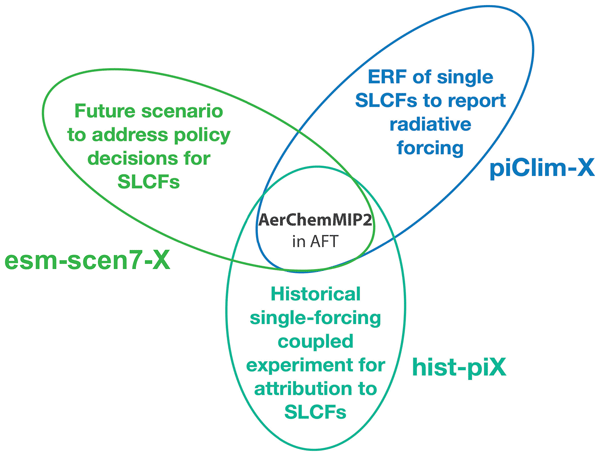
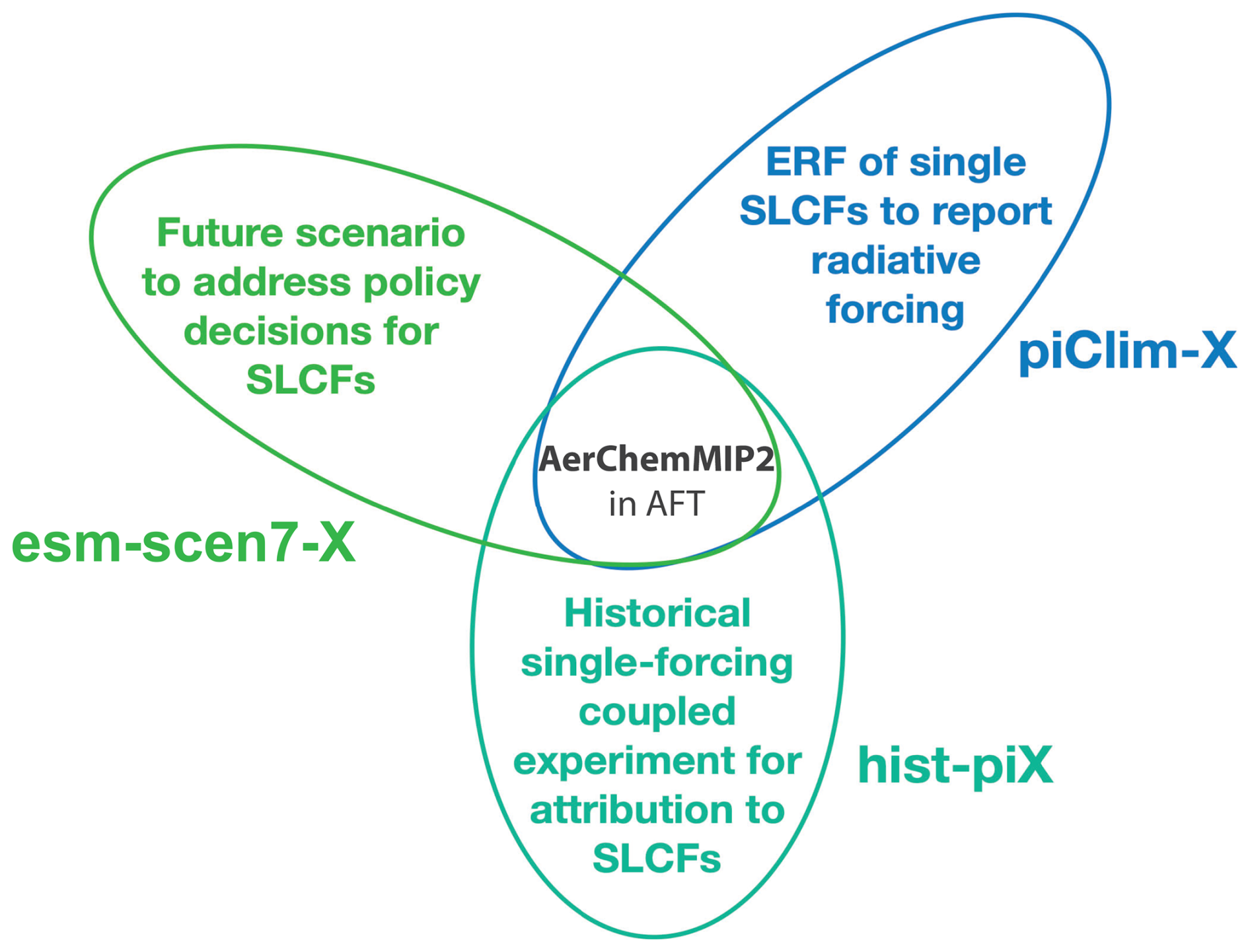
In addition to the request to repeat selected experiments of AerChemMIP, newly designed experiments in AerChemMIP2 address current challenges in composition-climate modelling, where the community perceives major gaps in our understanding of climate change with potential implications for future developments. These challenges include, for instance, the poor representation of changes in desert dust aerosols and the lack of inter-model diversity in fire emissions via fully coupled fire schemes in CMIP6 models. AerChemMIP2 identifies eight topics for advancing our understanding with the help of new experiments and five topics where updates based on previously existing experiment designs are perceived to be useful. These topics are distributed over three families of AerChemMIP2 experiments: time slice experiments with prescribed annually repeating climatologies for sea-surface temperature and sea-ice conditions (Sect. 3.1), atmosphere-only and fully coupled historical experiments with transient changes in climate forcings for 1850–2021 inclusive (Sect. 3.2), as well as atmosphere-only and fully coupled future scenarios for 2022–2125 inclusive (Sect. 3.3). Some of the AerChemMIP2 experiments are included in the Assessment Fast Track (AFT) of CMIP7, schematically depicted in Fig. 2. The reasons for their inclusion and the mix of experiments in AerChemMIP2 from which the scientific opportunities arise are described in the following sections.
3.1 Time slice experiments
We request atmosphere-only experiments for time slices with a prescribed annually repeating monthly climatology of sea-surface temperatures and sea ice. The climatology is based on thirty years output from the model's own PI fully coupled control experiment (piControl) for piClim-X and the last thirty years output from the model's coupled historical experiment (historical or esm-hist) for pdClim-X experiments in AerChemMIP2, where X refers to the emission of an individual or a combination of SLCFs. Models that interactively simulate emissions that depend on the ocean surface state, e.g., surface water concentrations of dimethyl sulphide (DMS) or chlorophyll, are asked to also prescribe them as monthly climatologies, which are to be diagnosed from the same reference experiments.
The categorization of biomass-burning emissions in such experiments is a challenge. AerChemMIP2 encourages models to use the fullest complexity of interactive processes available, and therefore request that models determine and document the PI fire-related emissions as a reference to compute the ERF, and which (if any) are treated as anthropogenic. Not all biomass burning emissions have an anthropogenic origin. For models which apply prescribed agricultural and/or deforestation biomass-burning emissions, we recommend that post-1850 SLCF emissions from agricultural and deforestation fires should, for instance, be attributed to anthropogenic emissions and included in the respective experiments. However, the exact distinction will depend on the complexity of the fire representation in the models and should be documented. For instance, in models which interactively simulate agricultural burning alongside unmanaged wildfire emissions, a separation between natural and anthropogenic emissions might not be possible.
The number of piClim-X and pdClim-X experiments defined below is relatively large but they come with a comparably small computational burden. These are single-forcing atmosphere-only experiments of 30 years in length post model spinup. This is a deviation from phase 1 where the simulation length was 30 years in total, with no recommendation for spinup. However, some models found that up to 15 years was required for spinup, particularly for perturbations such as ODSs (e.g., O'Connor et al., 2021). Therefore, the recommendation is allow sufficient time for spinup and then run the experiments for 30 years. The necessary time for the spinup might depend on the model configuration and could differ substantially between models. We recommend to run the spinup until the simulated radiation balance at the top-of-the atmosphere and the chemistry state reach an equilibrium, i.e., trends across annual values (if any) become small. Some simulations with CMIP6 models required, for instance, 10 years for ozone depletion to reach an equilibrium after the concentrations of ODSs were changed from PI to PD levels (Fig. S2 in Collins et al., 2026). Modellers with interactive chemistry schemes may choose to accelerate the spinup by initialising concentrations of CH4 or ODSs throughout the atmosphere to the new present-day values, e.g., take them from the historical experiment rather than starting from PI levels. Experience from the community during CMIP6 showed that these experiments are relatively easy to perform once the model setup for the piClim-control experiment has been completed; this latter experiment was common to AerChemMIP and the CMIP6-endorsed Radiative Forcing Model Intercomparison Project (RFMIP, Pincus et al., 2016), and it is now a core experiment performed for the AFT of CMIP7 (Dunne et al., 2025). The computational burden is justified by their potential for scientific exploitation and their direct relevance for climate change assessments. AerChemMIP2 and RFMIP2 (Kramer et al., 2025) will again use the same PI base state for their experimental setups to ensure the comparability of the results and to keep the use of computing resources small. It allows modelling centres to easily contribute to both MIPs.
3.1.1 Partitioning of ERF
The piClim-X experiments of AerChemMIP and RFMIP were essential in IPCC AR6 for quantifying individual SLCF effective radiative forcings (ERFs) at the present day (PD) relative to the pre-industrial (PI) period. These estimates allow a detailed assessment of the relative contributions from changes in individual emissions to the radiation imbalance, with simulations accounting for internal natural variability in the radiation budget. Specifically, piClim-X provided the basis for assessing the contribution of PI to PD anthropogenic SLCF emission changes to effective radiative forcings and historical global mean surface temperature change (Szopa et al., 2021). AerChemMIP2 will again enable an analysis of the contributions from changes in emissions of individual aerosol species and reactive gases to present-day effective radiative forcing. In doing so, AerChemMIP2 enables attributing shares of radiative forcing to individual composition changes, e.g., for sulphur dioxide (SO2), which gives additional information that complements estimates of effective radiative forcing for all aerosols taken together as in piClim-aer, also requested by RFMIP (Pincus et al., 2016) and CMIP7 (Dunne et al., 2025). The experiment piClim-aer in AerChemMIP2 uses aerosols and aerosol precursor emissions of BC, organic carbon (OC), ammonia (NH3), and SO2, and omits changes in anthropogenic nitrogen oxides (NOx) and volatile organic compounds (VOC) emissions. Although these latter species may act as aerosol precursors and influence oxidising capacity and secondary aerosol formation, they are omitted here to be consistent with the same experiment in RFMIP2 (Kramer et al., 2025) and to maximise potential contributions from models with AER capabilities.
AerChemMIP2 request partly similar piClim-X experiments compared to AerChemMIP to track changes since CMIP6 and gain new insights, not only because of updated climate forcings data sets and a more recent year for PD values, but also because of new model developments. AerChemMIP had, for instance, few results for nitrate aerosol, due to few models having interactive nitrate aerosol schemes, which limited the understanding of their role in climate and air quality in CMIP6 (Turnock et al., 2020; Allen et al., 2020, 2021) – an aspect that will potentially change in CMIP7 due to additional models with the capability of interactively simulating nitrate aerosols, e.g., GFDL-ESM4.5, which is an updated configuration of ESM4.1 (Dunne et al., 2020; Horowitz et al., 2020), and other models (Kelley et al., 2020; Jones et al., 2021; Tilmes et al., 2023).
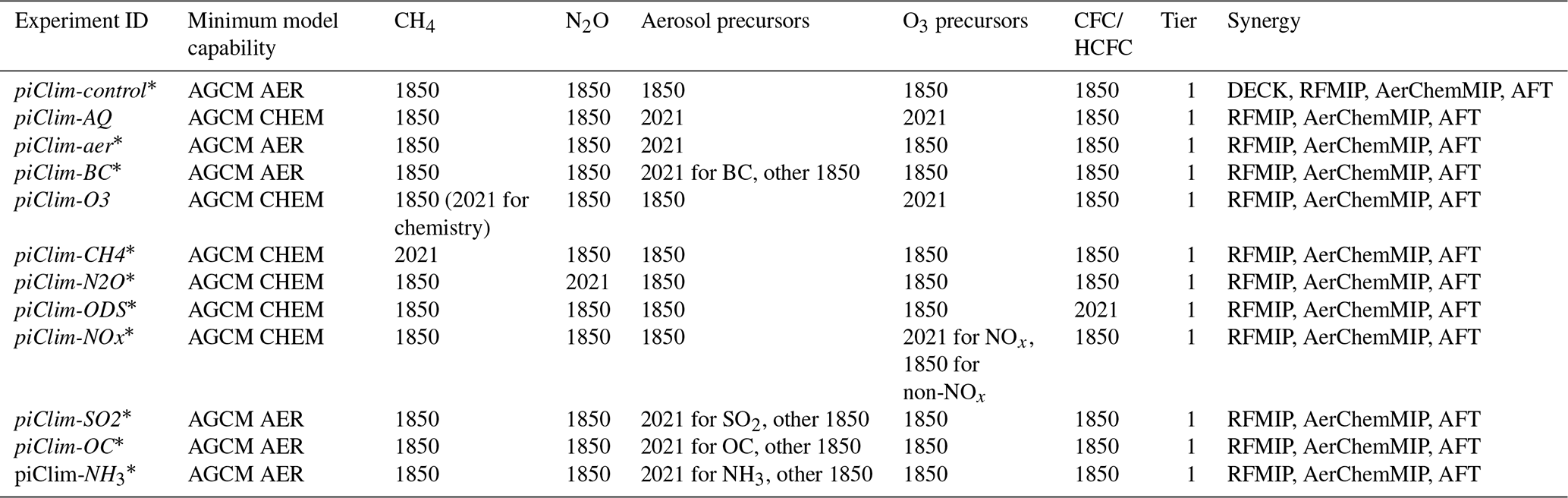
The piClim-X experiments listed in Table 1 contribute to science question 1 and are part of the AFT of CMIP7 (Fig. 2). We request 12 piClim-X experiments (Table 1) for calculating ERFs of anthropogenic SLCFs with experiment piClim-control serving as a reference. The PD conditions are representative of the year 2021, consistent with CMIP7 (Dunne et al., 2025). The conditions of the specified year are to be used in all model components, e.g., PD CH4 levels (either concentrations or emissions) in piClim-CH4 are used in both the chemistry and radiation schemes to allow for both direct radiative effects and chemical adjustments via CH4-driven influences on O3, stratospheric water vapor and CH4 lifetime via changes in the hydroxyl (OH) radical. An exception is the experiment piClim-O3, in which the CH4 levels are for 1850 in the radiative transfer calculation, but for 2021 in the chemistry scheme to account for chemical adjustments (i.e., via CH4 oxidation) influencing the radiative forcing of O3 (Table 1).
Table 1Experiments for computing present-day anthropogenic ERFs relative to the pre-industrial period. piClim-X experiments are atmosphere-only, with prescribed climatologies of the model's own pre-industrial (PI) sea-surface temperatures and sea ice concentrations, determined from the model's respective piControl experiment from the CMIP7 DECK. X denotes different present-day (Year 2021) anthropogenic perturbations to individual SLCFs. AER means that the model should, at least, have a time-evolving treatment of aerosols, either through time-dependent prescribed input fields or fully interactive aerosol treatments. CHEM means that the models are required to have interactive chemistry. Experiments marked with * follow the setup from AerChemMIP phase 1 (Collins et al., 2017) although piClim-CH4 may be concentration- or emission-driven in AerChemMIP2.
3.1.2 State-dependence of ERF
New in AerChemMIP2 are parallel calculations of the effective radiative forcing (ERF) based on two reference states, namely the PI as outlined above and the PD base state. The chemical and physical base states of the atmosphere in the PI and PD differ and are thought to influence the magnitude of ERF, e.g., for anthropogenic aerosols (Carslaw et al., 2013). Models without interactive chemistry and aerosols, as often used for CMIP experiments, however, might only show a weak dependency on the base state, e.g., for anthropogenic aerosol ERF (Fiedler et al., 2025; White et al., 2025). AerChemMIP2 experiments can be used to systematically address the influence of the PI to PD differences in the base state on ERF magnitudes based on the most comprehensive Earth system models that are currently available. In addition to studying the base-state dependence, performing pdClim-X experiments is beneficial for an additional evaluation of the climate model results over the past few decades, for which a rich collection of observational data exists.
To explore the role of the base state for estimates of forcing by SLCFs, AerChemMIP2 adds a new family of pdClim-X experiments. In the pdClim-X experiments, we ask to prescribe the model's own PD climatology for sea surface temperatures and sea ice, and PD SLCFs instead of using their PI equivalents. The PD climatologies can be created from the last thirty years of a fully coupled historical experiment. These pdClim-X experiments, listed in Table 2, can be evaluated against observations, which is an advantage over piClim-X to the extent that the PI state is inherently uncertain. The pdClim-X experiments can also be more relevant for understanding the climate impacts of future changes in SLCFs starting from present conditions. Moreover, the comparison of the new pdClim-X paired experiments against their piClim-X counterparts allows for an assessment of the state-dependence of ERF for O3, aerosols, and black carbon (BC) separately, with a substantially reduced internal variability than for atmosphere-only experiments with transient changes. We separate BC and all aerosols from the estimate for all SLCFs taken together, since aerosol effects showed large differences in ERF in previous assessments (Bellouin et al., 2020).
Table 2As Table 1, but for new pdClim-X experiments for the assessment of a potential state dependence of ERF. pdClim-X experiments use present-day sea surface temperatures and sea ice conditions calculated from the last 30 years of a single realization of the model's own coupled historical (hist) experiment.

3.1.3 Step change for aerosol ERF
Aerosol-cloud interactions are a major uncertainty in understanding and quantifying the ERF of anthropogenic aerosols (Bellouin et al., 2020) – a problem tightly linked to the representation of meteorological processes influencing clouds (Stevens and Bony, 2013; Bony et al., 2015). For instance, model biases in precipitation patterns are known and have not been resolved in CMIP models (Respati et al., 2024), although progress in modelling some precipitation metrics is noticeable across the CMIP phases (Fiedler et al., 2020). Moreover, aerosol effects on clouds co-develop with meteorological conditions, which requires an adequate analysis of the effects that consider different cloud regimes embedded in meso-scale dynamical processes of the atmosphere across world regions. Storm-resolving models have been proposed to overcome some of the longstanding challenges in simulating cloud coupling to atmospheric dynamics and associated precipitation (Guendelman et al., 2024), although accurately modelling cloud microphysical processes remains a challenge (Naumann et al., 2025).
We encourage modelling centres that develop models for storm-resolving simulations with spatial resolutions of a few kilometers (1–20 km) to perform pdClim-control and pdClim-aer. Output from kilometer-scale simulations from models with any implemented aerosol treatment would be welcome, including both models using interactive aerosol schemes and models with prescribed data, e.g., for aerosol concentrations or optical properties. We ask the modelling centres to document their aerosol treatment in the metadata of the model output, e.g., with information on their aerosol treatment along with the reference for the prescribed aerosol data or the implemented aerosol parameterization schemes. Having these experiments from storm-resolving models would create a new line of evidence for aerosol ERF. The consistent experimental setup warrants an unbiased comparison against CMIP7 model results not only for aerosol ERF, but also for the simulated PD atmosphere for which observational data can be leveraged.
3.1.4 Hydrogen
Using hydrogen (H2) is a potential alternative to fossil fuels and is considered a mitigation option for some economic sectors, yet H2 also has a global warming potential (Goita et al., 2025). One reason is the intended and unintended leakage of H2 during its production, transport, storage and end-use, which affects the atmospheric concentration of CH4 which has a far greater warming potential than CO2. As green hydrogen from renewable energy and blue hydrogen with carbon capture are developed to support the transition to low-carbon energy systems, concerns exist that H2 can contribute to warming (Sand et al., 2023; Warwick et al., 2023). By reacting with OH, H2 reduces the atmosphere's ability to remove CH4, leading to longer CH4 lifetimes. H2 can also contribute to the formation of tropospheric ozone and stratospheric water vapor, further enhancing its indirect warming effect. This warming could potentially be large enough to offset positive accomplishments for mitigating the effects of long-lived GHGs in the next few decades (Ocko and Hamburg, 2022), but the magnitude of these leakages is highly uncertain (Esquivel-Elizondo et al., 2023). Although policies for H2 are currently not planned, implications of H2 leakage for climate change are beginning to be quantified (Paulot et al., 2021; Brown et al., 2026; Chua et al., 2025).
We request a new pdClim-H2 experiment to estimate the potential forcing from a future hydrogen economy (pdClim-H2; Table 2) from models that include H2 emissions. The experiment will enable the quantification of ERF of H2. The Community Emissions Data System (CEDS) team will develop an H2 emission data set for the experiment (pers. comm. Steve Smith, PNNL). Models could take the soil uptake into account following Paulot et al. (2024). Interested modelling centres are asked to contact the authors for coordinating the experimental setup in more detail, e.g., for using emissions or concentrations of H2 for the experiment. Being aware of few models having the capability for H2 experiments at the time of writing, namely UKESM1.0 (Brown et al., 2026) and GFDL-AM4.1 (Paulot et al., 2024), we also request output from CMIP7 experiments to setup simulations with chemical transport models (CTMs, Sect. 4.2).
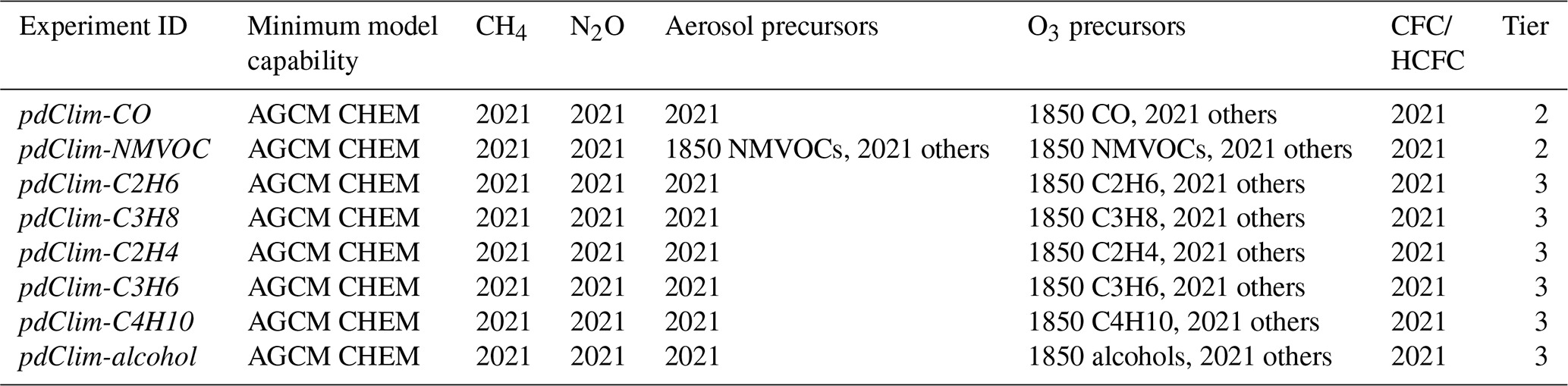
Table 3As Table 1, but for new pdClim-X experiments that quantify the influence of carbon monoxide (CO) and non-methane volatile organic compounds (NMVOCs) on effective radiative forcing.
3.1.5 Volatile organic compounds
A set of new pdClim-X experiments in AerChemMIP2 addresses the role of volatile organic compounds (VOCs), listed in Table 3. We choose here pdClim-X experiments for enabling direct comparison to observational data sets for present-day conditions. Non-methane volatile organic compounds (NMVOCs) contribute to air pollution as precursors of carbon monoxide (CO), tropospheric O3 and secondary organic aerosols, and influence the Earth's radiation budget via their effects on tropospheric O3, aerosols, CH4 lifetime and carbon dioxide (CO2) concentrations (Stevenson et al., 2013). They may also cause aerosol-mediated cloud adjustments via changes in oxidising capacity and secondary aerosol formation (O'Connor et al., 2021; O’Connor et al., 2022). In the first phase of AerChemMIP, the piClim-VOC experiment included emission perturbations of both NMVOCs as well as carbon monoxide (CO) (Collins et al., 2017), complicating the attribution of ERFs to individual NMVOC and CO emission changes. In AerChemMIP2, we add two tier 2 experiments to explicitly quantify the ERFs due to PI to PD changes in anthropogenic emissions of CO (pdClim-CO) and NMVOCs (pdClim-NMVOC).
Additionally, we request 6 pdClim-XVOC simulations, where XVOC = ethane (C2H6), propane (C3H8), ethene (C2H4), propene (C3H6), butane (C4H10), and alcohols, to attribute air pollution and ERFs to changes in anthropogenic emissions of these individual NMVOCs. These experiments are assigned as tier 3 and are not part of the AFT of CMIP7. We expect the ERFs diagnosed from these perturbations to be small. However, these experiments will provide first estimates of the contributions of individual NMVOCs to air pollution and atmospheric composition in broader terms, e.g., particulate matter (PM) and O3, CH4 lifetime, and aerosol burden. The contributions of speciated NMVOCs to air pollution and climate have not been studied before in a consistent manner, highlighting a knowledge gap and an opportunity within AerChemMIP2.
3.1.6 Quantifying Biogeochemical Feedbacks
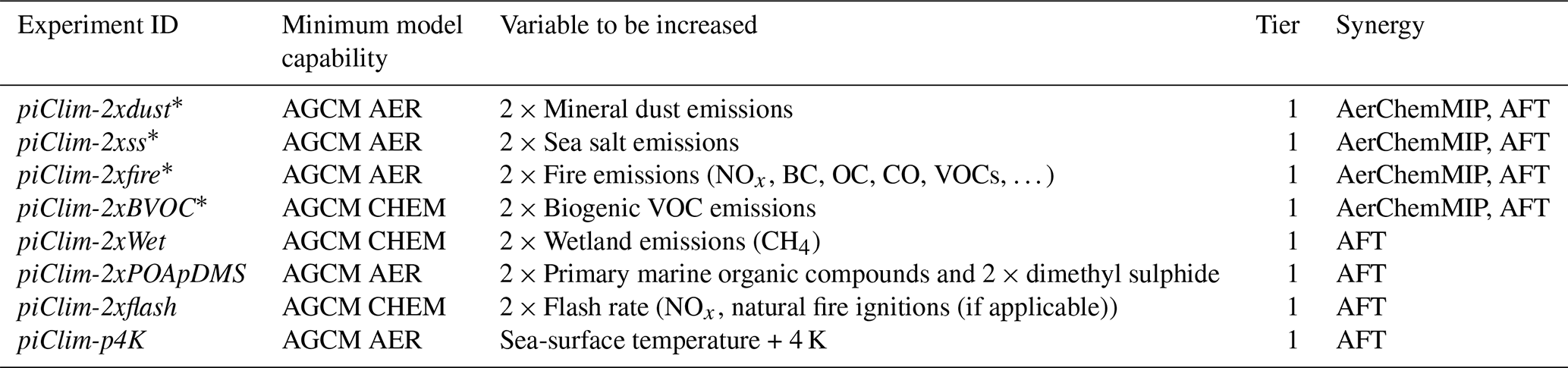
The piClim-2X experiments of AerChemMIP were essential for quantifying the magnitude of biogeochemical climate feedbacks on individual natural emissions of SLCFs (Thornhill et al., 2021a) and were used in IPCC AR6 (IPCC, 2021). In piClim-2X experiments, the emissions of the component of interest are doubled relative to PI levels. AerChemMIP2 again requests such experiments and, to a large extent, uses an identical experimental design as in AerChemMIP. In so doing, the piClim-2X experiments in AerChemMIP2 can be used to quantify changes in the feedback estimates since AerChemMIP arising from model improvements and forcing data updates since CMIP6. The piClim-2X experiments fall under science questions 2 and 3.
We request the 8 piClim-2X experiments listed in Table 4; they allow us to estimate the strength of climate feedbacks on sea spray, desert dust, fires, biogenic volatile organic compounds (BVOCs), wetlands, and primary marine organic aerosols (PMOA) plus dimethyl sulphide (DMS), following the approach in AerChemMIP (Collins et al., 2017) with changes as follows. New in AerChemMIP2 is the piClim-2xWet experiment, in which the CH4 emissions from wetlands are doubled. Output from that experiment allows for a first multi-model assessment of the role of wetlands. The state dependence of the interactive emissions (if any) is not yet well understood. To what extent interactive emissions change due to a simulated warmer climate state compared to the preindustrial can be addressed with the newly added piClim-p4K experiment, where the sea surface temperatures (SSTs) of ice-free ocean grid cells are artificially increased from the model's PI control climatology by +4 Kelvin. Output of this experiment serves to aid feedback analysis by isolating the effect of warming on natural emissions, an approach inspired by experiments in the Cloud Feedback Model Intercomparison Project (CFMIP) protocol (Webb et al., 2017) and future scenario experiments with fixed PI sea-surface conditions (Zanis et al., 2022). Output from piClim-p4K can be used to isolate the response of emission changes to a temperature change and to eliminate any conflation between the biophysical and radiative effects of CO2. The requested experiment piClim-p4K is the same as in RFMIP phase two (RFMIP2.0 Kramer et al., 2025) to help reduce the overall computational burden of modelling centres. Furthermore, we request a new piClim-2xflash experiment, which builds on the piClim-2xNOx experiment from AerChemMIP. In AerChemMIP, piClim-2xNOx doubled the amount of NOx produced per lightning flash with respect to piClim-control. For AerChemMIP2, we instead request that the lightning flash rate itself is doubled. This approach will still increase the production of NOx by lightning, but will also have further impacts on atmospheric composition and top-of-atmosphere radiative fluxes in models with interactive parameterizations for wildfire emissions that account for natural fire ignitions from model-derived lightning flashes.
Table 4Experiments for quantifying the radiative effect of natural emission changes. These are piClim-X experiments like in Table 1, but here for doubled emission fluxes. The experiment piClim-p4K is identical to piClim-control except that a uniform temperature perturbation of 4 K is applied to sea surface temperatures in ice-free conditions. Experiments marked with * follow the setup from AerChemMIP phase 1 (Collins et al., 2017).
3.2 Historical Experiments
In AerChemMIP, attribution experiments were performed in which an all-forcings historical experiment is compared with experiments in which selected species are held at PI levels, which became known as the “all-but-one” experimental design. Both fully coupled experiments (hist-piX) and experiments with prescribed sea-surface temperatures and sea ice (histSST-piX) were requested for CMIP6 covering the period 1850–2014. These experiments targeted aerosol and aerosol precursors (hist-piAer and histSST-piAer), non-CH4 tropospheric O3 precursors (histSST-piO3), CH4 (histSST-piCH4), nitrous oxide (histSST-piN2O), and halocarbons (hist-1950HC and histSST-1950HC). The histSST-piX experiments enabled the attribution of transient changes in radiative forcing and climate responses in some cases, as well as quantifying drivers of composition and air quality changes over the historical period (e.g., Stevenson et al., 2020). Building on that “all-but-one” attribution approach from AerChemMIP, AerChemMIP2 requests historical experiments for 1850–2021 inclusive, using CMIP7 forcing data sets as provided by the CMIP climate forcings task team (Durack et al., 2025). All experiments histSST-piX are requested to be consistent with historical experiments of CMIP7.
3.2.1 Attribution of climate and air quality responses
AerChemMIP2 experiments for the historical period aim to advance the scientific understanding of the contribution of anthropogenic SLCF emissions to atmospheric composition, air quality, and human-induced climate change, leveraging models that have new capabilities in process representation and use updated forcing data provided for CMIP7. Differences in aerosol radiative forcing arising from different emission inventories could be of the order of 0.1 W m−2 (Lund et al., 2023). The hist-piX experiments help to improve the physical science basis of climate change. Specifically, hist-piX experiments are relevant for obtaining information on model performance through the evaluation against observational data, for better understanding drivers of observed climate and air quality changes associated with spatially varying anthropogenic SLCF emissions, particularly on regional scales. Such information is useful to explain, anticipate, and possibly mitigate changes we expect in the future. For instance, the role of anthropogenic aerosol emissions for regional climate and air quality responses remains an outstanding source of uncertainty in our understanding of climate change (e.g., Bellouin et al., 2020; Persad et al., 2023). The experiments can help to quantify the uncertainty in the role of heterogeneous SLCFs in global and regional water cycle changes observed over the historical period. Results from the Precipitation Driver and Response MIP (PDRMIP, Myhre et al., 2017, 2018), AerChemMIP (Allen et al., 2020, 2021), DAMIP (Monerie et al., 2022) and RAMIP (Wilcox et al., 2020) pointed to the role of atmospheric composition in modulating regional precipitation changes, but large uncertainties remain. Reasons for the large range of model results may include model diversity in radiative forcing, model state biases and structural differences, and ensemble size that causes difficulty in obtaining a highly precise estimate of forced responses under variable weather conditions at regional scales.
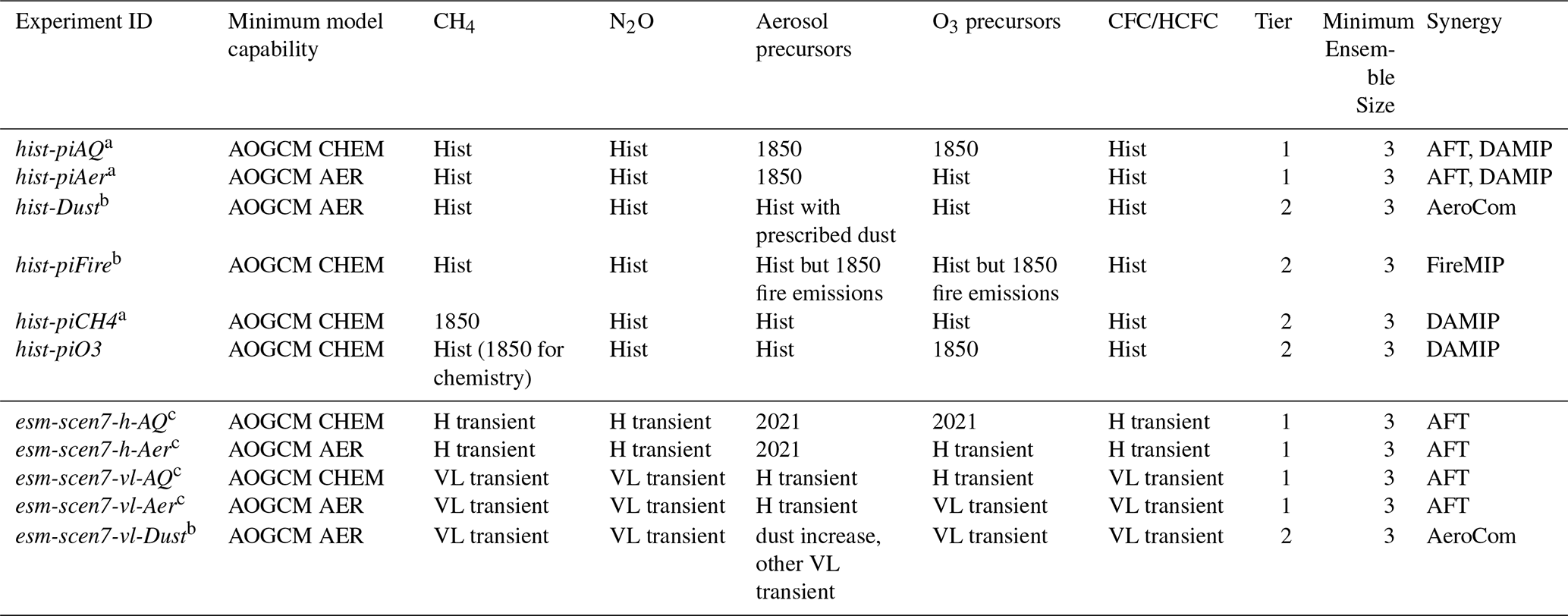
The AerChemMIP2 historical experiments include the fully coupled Earth system model simulations listed in Table 5, namely, hist-piAQ, where anthropogenic SLCF emissions contributing to air pollution are set at PI levels, and hist-piX, where a choice of individual or group of SLCF emissions are set at PI levels. Experiment hist-piAer is identical to that in AerChemMIP phase 1, with aerosols and aerosol precursor emissions of BC, organic carbon (OC), ammonia (NH3), and sulphur dioxide (SO2) set to PI levels. The experiment hist-piAQ is the same as hist-piNTCF from AerChemMIP phase one (Collins et al., 2017) except the new name accurately reflects the experimental protocol wherein air pollutant emissions, including non-CH4 tropospheric O3 precursors, aerosols and their precursor emissions (BC, OC, NH3 and SO2) are set to PI levels. The experiment hist-piAQ can be used to diagnose the climate and air quality responses to the regionally heterogeneous evolution of anthropogenic non-CH4 SLCF emissions, which falls under science questions 3 and 4. A single-forcing experiment for O3 (hist-piO3) allows responses to O3 from all tropospheric O3 precursors (CH4, NMVOCs, CO, and NOx) to be quantified which was not possible in AerChemMIP phase one. We request that CH4 concentrations evolve in the radiation scheme but concentrations or emissions are fixed at PI levels in the chemistry treatment of hist-piO3 to suppress CH4-driven changes on surface-level and tropospheric O3 concentrations, documented elsewhere (e.g., Fiore et al., 2002). Another single-forcing experiment for CH4 (hist-piCH4) allows the net effect of CH4 changes on atmospheric composition and associated climate responses to be cleanly assessed. The fully coupled CMIP7 DECK historical experiment (Dunne et al., 2025) is needed as a reference for computing differences in responses due to PI to PD aerosol and tropospheric O3 precursor emissions changes.
Table 5Experiments with a coupled ocean model for the historical period (1850–2021) and future scenarios with baselines esm-scen7-h and esm-scen7-vl from ScenarioMIP-CMIP7 (2022–2125). The experiments piControl and hist are part of CMIP7 DECK and are used here as reference experiments in AerChemMIP2. H/VL transient and Hist are the component's developments as in the baseline scenario and historical experiments. Experiments marked with a follow the setup from AerChemMIP phase 1 (Collins et al., 2017). Experiments marked with b address feedbacks via natural emissions that were not fully represented in past AOGCMs. Experiments marked with c will allow an assessment of future policy impacts on atmospheric composition and climate change.
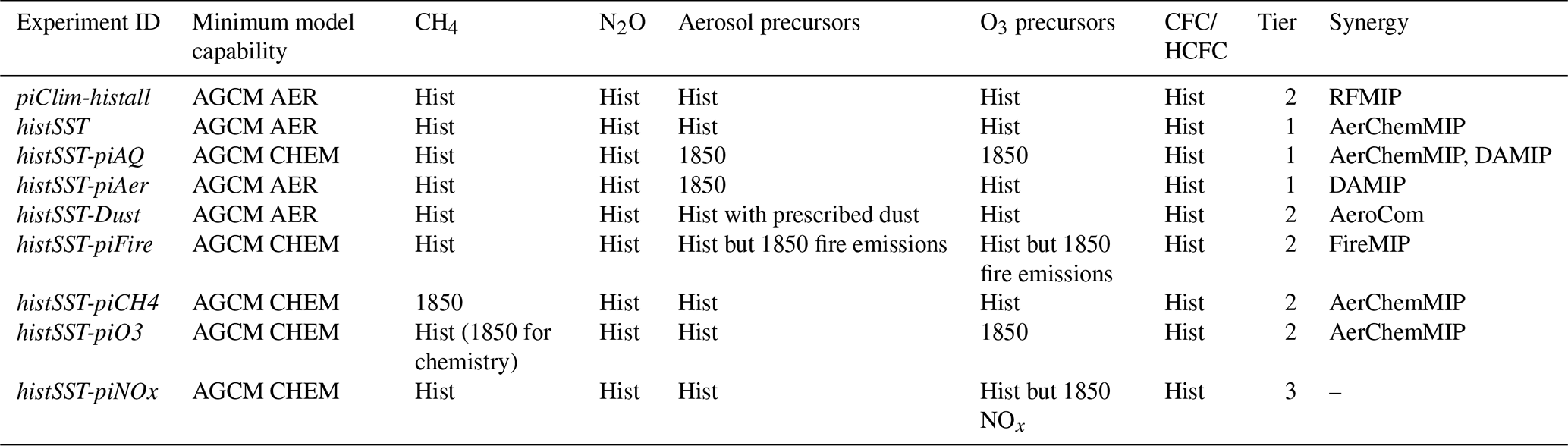
AerChemMIP2 atmosphere-only historical experiments will help to provide policy-relevant information by quantitatively relating a mass change in emissions to radiative forcing and temperature changes. Some interactions are indirect, e.g., perturbations in non-CH4 tropospheric O3 precursor (NMVOCs, CO, and NOx) emissions do not directly affect radiative forcing but do so indirectly via their effects on O3, CH4 lifetime, aerosols, and cloud adjustments. Surface O3 is a critical pollutant and its precursor emissions are controlled to meet air quality standards. However, tropospheric O3 is also a GHG so a policy-relevant question is – what is the climate response and air quality impact from changes in O3 precursor emissions? Similarly, what is the implication of policy-induced emission reductions of aerosols and their precursors for air quality and unmasking warming due to GHGs? The set of atmosphere-only historical experiments histSST-X listed in Table 6 help to address such policy-relevant questions based on observed changes in emissions of SLCFs and CH4. Since composition changes and air quality respond to both climate and emission changes, we request complementary historical experiments with fixed PI sea-surface conditions and transient emission changes (piClim-histall). It means piClim-histall can be used, for example, to establish the extent to which changes in CH4 lifetime over the historical period are driven by climate (e.g., Stevenson et al., 2020) and to determine the associated climate penalty on air quality (Fu and Tian, 2019; Zanis et al., 2022; Murray et al., 2024; Akritidis et al., 2024).
Table 6Historical experiments with prescribed transient changes in sea-surface conditions. These experiments follow the “all-but-one” approach of AerChemMIP, where the climate forcing of interest is held fixed at the pre-industrial level whereas all other forcers evolve as in a historical experiment. piClim-histall uses a prescribed annually repeating climatology of the pre-industrial sea-surface conditions (as used in piClim-control) but time-varying climate forcers.
3.2.2 Disentangling forced response from variability
Three-member ensembles are included in the AFT of CMIP7 for hist-piAQ and hist-piAer, but larger ensemble sizes would be beneficial for separating forced responses from internal variability if modelling centres can afford to provide them. Models which can simulate SLCFs other than aerosols (i.e., CHEM) should perform hist-piAQ while models without such capability (i.e., AER) are asked to perform hist-piAer. The review of AerChemMIP (Griffiths et al., 2025) noted that a relatively small ensemble size prohibited some analyses, particularly with regard to climate responses to anthropogenic emissions at the regional scale. At least three ensemble members are request for all hist-piX experiments as this is seen as the minimum required to disentangle responses from internal variability at large spatial scales, and has been identified as being important when investigating the scale and uncertainty of future air pollution episodes (Fiore et al., 2022; Doherty et al., 2022), but larger ensembles are necessary for estimates of precipitation changes (Monerie et al., 2022). Three-member ensembles for these experiments is also desirable for comparability of the results to the hist-aer experiments from the Detection and Attribution Model Intercomparison Project v2.0 (DAMIP v2.0, Gillett et al., 2025).
We encourage the creation of a larger ensemble size to study pattern effects where modelling centres have the computational capacity, e.g., as was done for the Community Earth System Model (CESM, Deser et al., 2020a; Simpson et al., 2023) and the Seamless System for Prediction and EArth System Research (SPEAR, Delworth et al., 2020) models. Based on experience in the Regional Aerosol Model Intercomparison Project (RAMIP, Wilcox et al., 2023), we suggest ten-member ensembles of hist-piAQ (CHEM) or hist-piAer (AER) experiments per model. Creating ensembles of simulations implies a comparably large request for computational resources but it is justified by the need to explain past climate change and the large interest in the scientific exploitation of AerChemMIP's coupled experiments (Griffiths et al., 2025; Fiedler et al., 2024). Since similar experiments have also been performed for AerChemMIP phase one, changes in the understanding of CMIP7 results against CMIP6 can be documented through a comparison of results from the hist-piX experiments for the overlapping period 1850–2014.
For all fully coupled historical experiments, we request corresponding atmosphere-only experiments (histSST-piAQ, histSST-piAer, histSST-piO3, and histSST-piCH4 listed in Table 6), with prescribed time-varying boundary conditions (e.g., sea surface temperatures and sea ice) taken from the CMIP7 historical experiment of the model to compute the historical changes in effective radiative forcing. We request an additional single-forcing experiment for NOx (histSST-piNOx) to assess the role of anthropogenic NOx as a precursor of tropospheric O3 (Nguyen et al., 2022). A corresponding atmosphere-only experiment including all emission changes and climate change (histSST) is needed as a reference for calculating differences in the chemical and radiation budgets induced by the individual SLCF emission perturbations. The additional experiment piClim-histall, as in RFMIP, is needed to separate the influence of emissions and climate change on atmospheric composition and air quality.
3.2.3 Non-linearity in the climate response
A cross-MIP collaboration between AerChemMIP2 and DAMIP v2.0 (Gillett et al., 2025) is enabled through the parallel request for experiments for single forcing historical simulations for aerosols, following the “all-but-one” approach in AerChemMIP2 and the “only” approach in DAMIP, respectively. The parallel experiments allow non-linearities in climate responses to aerosols to be systematically studied for the first time.
AerChemMIP2 follows again the “all-but-one” experimental design like in AerChemMIP (Collins et al., 2017). One reason is to retain the direct comparability to AerChemMIP results. Another reason is that the “all-but-one” design is better suited for studying responses of chemical interactions because the chemical composition of the atmosphere itself influences the response of aerosols and air quality to emission changes, although neither of the two approaches is necessarily superior to the other for studying climate response to atmospheric composition changes.
Having both experimental designs for aerosols in the framework of CMIP7 will facilitate the study of nonlinearities more systematically than was possible in the past. For example, it might be found that simple emulators are insufficient to accurately model the physical climate response to realistically co-varying chemical and aerosol forcings, for which machine learning emulators might be better suited (e.g., Watson-Parris et al., 2022). Model results can differ for the two different experimental setups, e.g., seen in CESM (Simpson et al., 2023). The ensemble of DAMIP and AerChemMIP available from CMIP6 is, to that end, not conclusive since different models contributed to the two MIPs. For CMIP7, we therefore encourage modelling centres to perform both the AerChemMIP2 hist-piAer experiment following the “all-but-one” approach of AerChemMIP2 and the hist-aer experiment of DAMIP (Gillett et al., 2025).
3.2.4 Desert dust particles
Dust is known to have varied substantially over the historical period, showing both large decadal variability (Prospero and Lamb, 2003; Mahowald et al., 2010; Shao et al., 2013) and a long-term increase of 55±30 % since PI times (Kok et al., 2023). These large changes in dust have important implications for various Earth system processes, including for radiative forcing and biogeochemical feedbacks that fall under the science questions 1 and 2 of AerChemMIP2. Reproducing the past variability and trend of desert dust aerosols has been a longstanding challenge for CMIP-class models (Evan et al., 2014; Kok et al., 2018; Zhao et al., 2022; Kok et al., 2023). CMIP6 historical experiments failed to reproduce the past increase of desert dust aerosols, e.g., illustrated by the percentage change in dust aerosol optical depth in Fig. 3, which hinders a better understanding of the implications of increased dust amounts for the climate response and biogeochemical feedbacks.
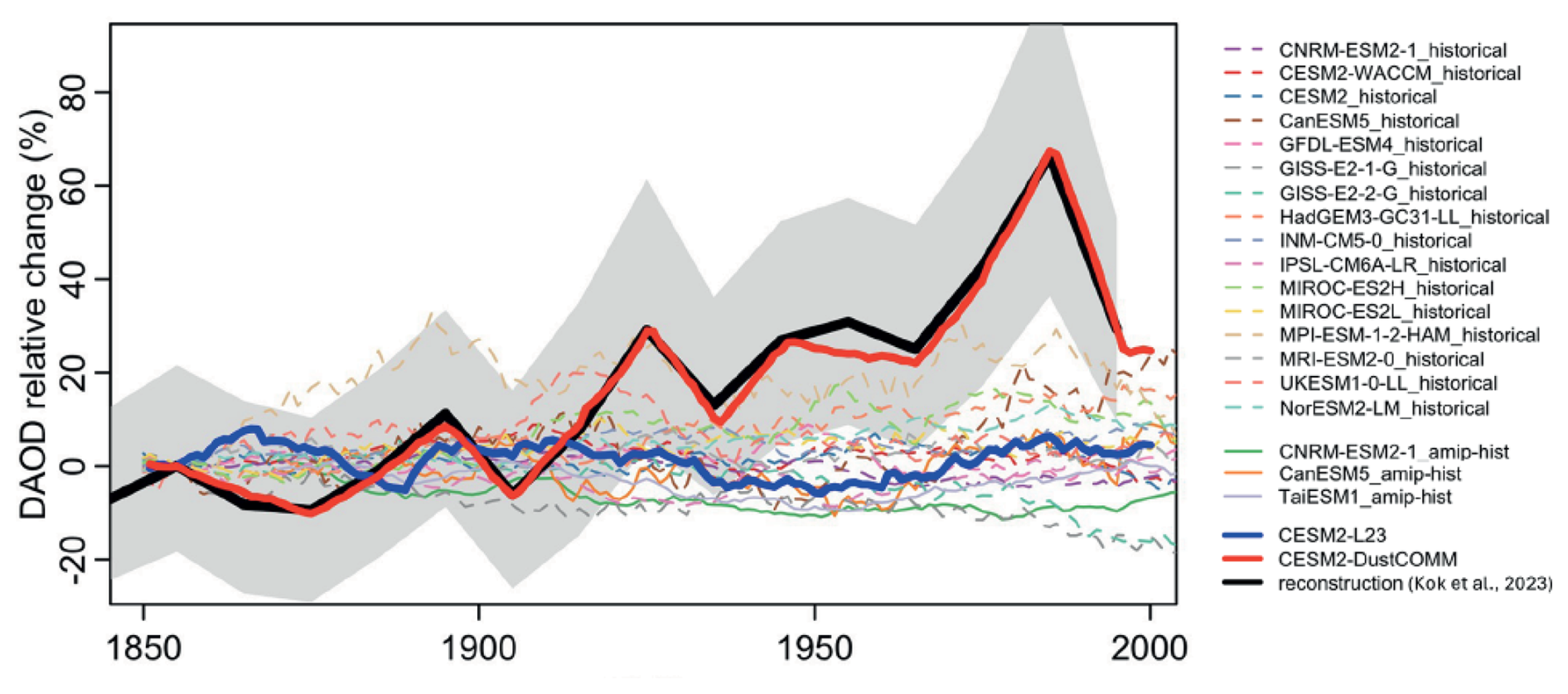
Figure 3Historical development of the percentage change in dust aerosol optical depth. Shown are the ten-year running means of the dust aerosol optical depth (DAOD) from color-coded historical experiments of CMIP6 models from (dashed lines) fully coupled experiments and (solid lines) atmosphere-only experiments, (black) the historical reconstruction from Kok et al. (2023), and the proof-of-concept use of (red) the dust data set from Leung et al. (2025) in CESM2 for the proposed hist-Dust and histSST-Dust experiments of AerChemMIP2 against (blue) the results from the standard setup of CESM2. From Leung et al. (2025).
To address this knowledge gap, we request a new coupled historical experiment hist-Dust (Table 5), where the historical development of desert dust aerosols is prescribed while all other SLCFs are treated as in an historical experiment. Participating models are asked to use the dust emission data from Leung et al. (2025), which was obtained by combining an inversion of dust deposition fluxes from ice cores and other sedimentary records (Hooper and Marx, 2018) with constraints on the modern day dust cycle (Kok et al., 2021a, b). Moreover, we ask for a parallel atmosphere-only historical and future experiments – histSST-Dust (Table 6) and esm-scen7-vl-SST-Dust (Table 7) – to diagnose the radiative effects of desert dust aerosols from the PI to the future. In addition to the historical experiments for dust, we request a future extension with a linear increase of dust aerosols in an overshoot scenario (esm-scen7-vl-Dust; see Sect. 3.3.1). Note that this future increase in dust is hypothetical in that there is currently no consensus on how dust will change in the future (Pu and Ginoux, 2017; Kok et al., 2023), although that gap in our understanding is known for at least two decades (Mahowald and Luo, 2003; Tegen et al., 2004).
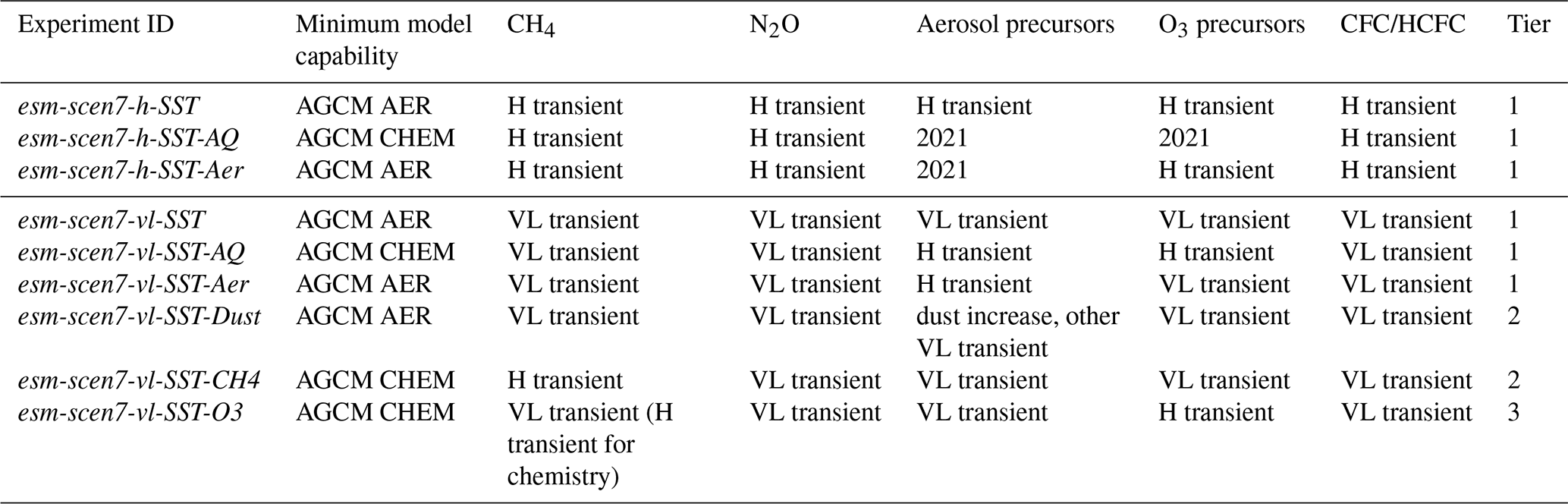
Table 7Experiments for future development with prescribed sea-surface conditions. We cover the period of the future scenarios of CMIP7 (2022–2125). Ref means developments identical to the reference scenario H and VL as in ScenarioMIP-CMIP7. H/VL transient referes to conditions as in the corresponding ScenarioMIP-CMIP7 experiments, e.g., esm-scen7-vl-SST with a relatively cleaner atmosphere compared to esm-scen7-h-SST.
A pilot study using the dust dataset in AeroCom models is ongoing (https://aerocom.met.no/experiments/DURF, last access: 21 April 2026) and successful tests of the dataset in CESM2 are complete. Specifically, the standard configuration of CESM2 failed to reproduce past dust changes like CMIP6 models (blue line in Fig. 3). Prescribing the dust dataset from Leung et al. (2025) in CESM2 yields global variability and trends in dust aerosol optical depth similar to the observational reconstruction from Kok et al. (2023) for the entire historical period (black and red lines in Fig. 3). Community support for adjusting the dust data from Leung et al. (2025) to model-specific requirements will be available, e.g., adjustments of the emission data for different aerosol size bins and scaling the data over time to mimic the observed dust trends in the participating models. Such experience already exists, e.g., from the dust radiative forcing experiment in the AeroCom community. A flexible parameterization for prescribing changes of dust aersosol optical properties is currently developed for use in hist-Dust and esm-scen7-vl-SST-Dust in CMIP models without interactive dust parameterization schemes.
3.2.5 Advancement in Fires
In AerChemMIP2, we expect contributions from models with and without biomass burning feedbacks. The mix of representations of biomass burning across contributing models has the potential to better link to assessments of fires based on experiments in AFT. Emissions from biomass burning are an important contributor to atmospheric composition and climate change (Ward et al., 2012; Zhong et al., 2024), with regionally-varying trends (Earl and Simmonds, 2018; Jones et al., 2022). Extra-tropical fire emissions have increased with warming to a degree that is comparable to the reduction of fires in the tropics for 2001–2023 (Zheng et al., 2021; Jones et al., 2024). Biomass burning is also notable as one of the main drivers of interannual variability in atmospheric composition (Voulgarakis et al., 2015). Simulating the variability in biomass burning may result in a less negative anthropogenic aerosol radiative forcing than prescribing time-averaged biomass-burning emissions, e.g., due to non-linear interactions (Heyblom et al., 2023), as well as surprising coupled responses (Fasullo et al., 2022; Heyblom et al., 2022). Biomass burning is also a major contributor to poor air quality with concomitant effects on human health (Xue et al., 2021; Xu et al., 2024), which similarly require simulating the variability in fire emissions for a full characterization due to non-linear relationships between pollutant concentrations and health impacts.
Historical fire datasets produced for use in CMIP (BB4CMIP, van Marle et al., 2017) show minimal interannual variability in CO2 emissions from fires before the availability of satellite remotely-sensed burned area, in contrast with the historical fire emissions that were diagnosed by ESMs with interactive fire capabilities in CMIP6 (Fig. 4). Moreover, the earlier start in use of recorded visibility data from weather stations in 1960s influenced the representation of interannual variability in emissions data (not shown). Interactively simulated biomass burning emissions across CMIP6 models varied by up to a factor of five (Fig. 5). Most individual historical experiments show much more biomass burning emissions than the CMIP6 and CMIP7 climate forcings datasets. The biomass burning prescribed emissions datasets from the Shared Socioeconomic Pathways (SSPs) in CMIP6 lack future climate-driven changes in biomass burning, whereas evidence for a substantial increase of regional fire activity with warming exists (Dowdy et al., 2019; Abatzoglou et al., 2019; Jones et al., 2022; Galizia et al., 2023).
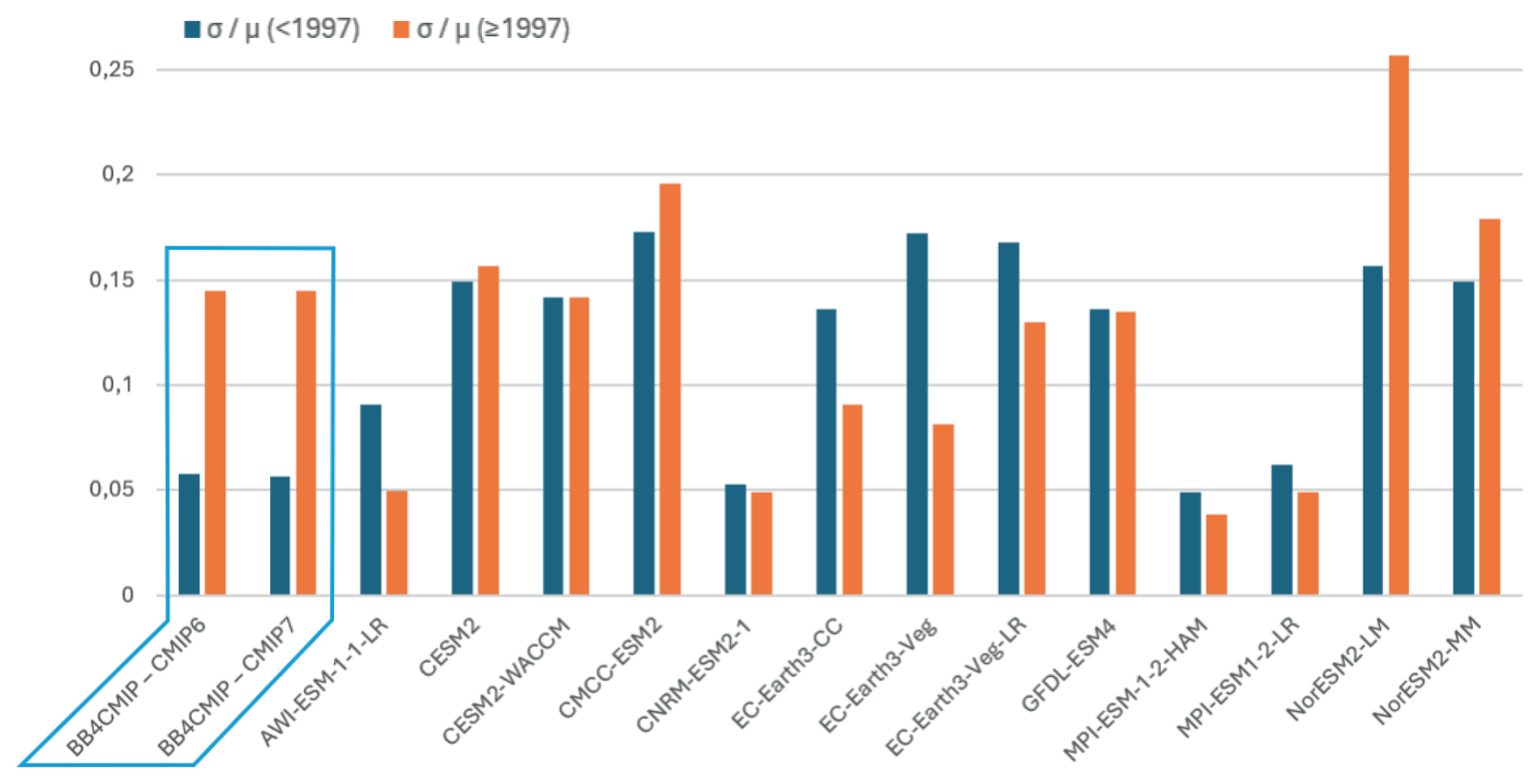
Figure 4Relative interannual variability in fire emissions before and during the satellite era. Shown are the ratios of the year-to-year standard deviation normalized by the mean of annual total fire emissions of CO2, for years (blue, 1850–1996 inclusive) before and (orange, 1997–2014 inclusive) during the availability of satellite data in the Global Fire Emissions Database (GFED) from the CMIP climate forcings data sets for prescribing biomass burning emissions in CMIP6 and CMIP7 (BB4CMIP CMIP6 version 1.1 and CMIP7 version 2.0, van Marle et al., 2017) visually highlighted by the blue frame, and individual historical experiments of CMIP6 models which interactively diagnosed fire emissions.
AerChemMIP2 encourages modelling centres with the capability to perform experiments with interactive fires, to perform piControl and hist experiments with fire feedbacks switched on. The additional hist-piFire (Table 5) experiment, with SLCF emissions from fires held fixed at the PI level but all other forcings evolve as in hist allows an assessment of the role of fire emissions on climate change and air quality, which is a contribution to science questions 1 and 3. Models with the capacity to perform experiments with interactive fires that use it in their model configuration for other experiments of CMIP7 and AerChemMIP2, would only need to additionally perform hist-piFire. As noted above, temporal smoothing of models' biomass-burning emissions may introduce a change in radiative forcing, and therefore for hist-piFire, we recommend that models with interactive fires prescribe monthly fire emissions taken from multiple decades of a PI control simulation in order to maintain both the same seasonal and interannual variability in emissions, rather than prescribing a monthly climatology which is repeated each year. Only SLCF emissions from fires should be held at PI levels, with everything else free to evolve as in hist.
We similarly encourage modelling centres to perform future scenario experiments with interactive fires to address concerns that fire activities increase with warming (Jones et al., 2022) and anthropogenic aerosol reductions (Allen et al., 2024). In addition to the direct impact of fires on lives, livelihoods, and property, fire also accounts for about half of the carbonaceous aerosol emissions globally (Jones et al., 2024), and paired with the projected reduction in anthropogenic SLCF emissions in ScenarioMIP-CMIP7 (van Vuuren et al., 2025) could become a more significant source of SLCFs in the future compared to the past. Despite the consequences, the implications of fires for future atmospheric composition, radiative forcing, and air quality are not currently fully explored or well-quantified. To address this gap in knowledge, we ask those models that use interactive fires in their default configuration to perform the experiments esm-scen7-h and esm-scen7-vl of ScenarioMIP-CMIP7 with fire feedbacks switched on and to submit associated emissions as diagnostic output. More specific model experiments with a focus on fires are part of FireMIP (Li et al., 2025).
3.3 Future Scenario Experiments
Potential future changes in air quality and climate change are tightly connected. SLCFs are co-emitted with CO2, such that CO2 emission reduction targets have a co-benefit of improving air quality (Turnock et al., 2019). Moreover, future climate change can have a regional influence on surface concentrations of pollutants, e.g., by enhancing or decreasing O3 or aerosol particle concentrations over populated areas (e.g., Fu and Tian, 2019; Zanis et al., 2022; Murray et al., 2024; Akritidis et al., 2024). Likewise, Earth system feedbacks in a warming world could have consequences for future air quality (Gomez et al., 2023). The degree to which different SLCFs are reduced, either individually or in combination, can have potentially large impacts on both near-term climate forcing and air quality. Figure 6 (adapted from results in Turnock et al., 2022) highlights that co-benefits and penalties to air quality and climate can occur depending on the emission pathway of each scenario, with the ideal aim of maximizing future co-benefits. Aggressive aerosol mitigation measures are, for instance, thought to be strong enough to threaten the 2° warming goal of the Paris Climate Agreement (Wood et al., 2024), by unmasking the warming associated with GHGs (Allen et al., 2021; Turnock et al., 2022). As such, strong mitigation of SLCF emissions that imply improved air quality in some scenarios of ScenarioMIP-CMIP7 ensures that future warming from GHGs will be clearly visible due to reduced aerosol effects (van Vuuren et al., 2025).
AerChemMIP2 requests a set of variants of ScenarioMIP-CMIP7 scenarios to systematically assess the influence of individual climate forcers, such as CH4 in two differently warming worlds. These experiments can provide information on the effectiveness of net-zero policies, and the implication of their potential failure for air quality and climate change mitigation. As such, AerChemMIP2 addresses the implication of a near-term reduction in SLCF emissions for air quality and climate change to allow investigations that fall under scientific questions 3 and 4. To that end AerChemMIP2 chooses two tier 1 scenarios of ScenarioMIP-CMIP7 (van Vuuren et al., 2025) as baselines, which has been coordinated with CMIP7 and its registered MIPs to reduce the overall computational burden for modelling centres. Specifically, AerChemMIP2 uses the scenario Very Low Low Overshoot (VL) that follows an SSP1 trajectory assuming low air pollution and the high-end (H) scenario that follows an SSP3 development with emissions that adversely affect air quality. The relatively clean VL scenario (esm-scen7-vl) assumes limiting global warming to 1.5 °C in the 21st century with a temporally limited small overshoot of the temperature limit, whereas the polluted H scenario (esm-scen7-h) assumes a lack of ambitious mitigation of climate change which also deteriorates air quality (van Vuuren et al., 2025).
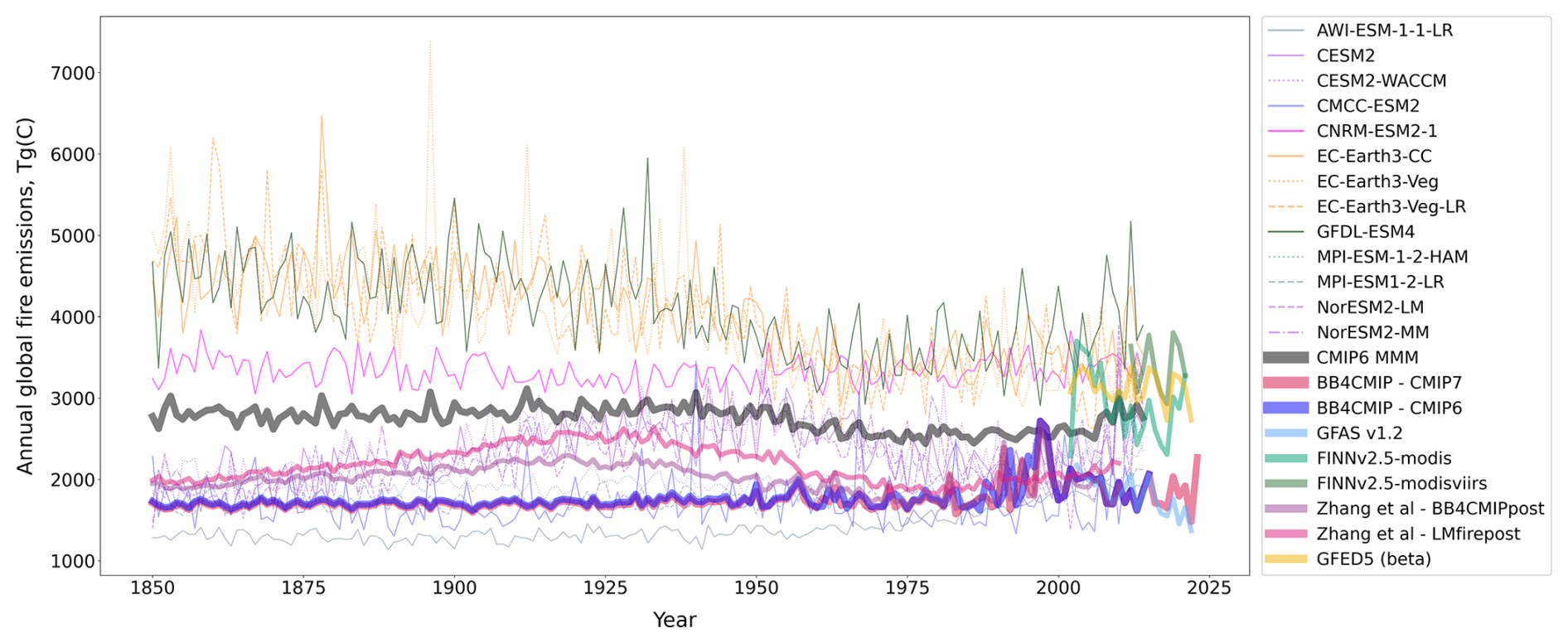
Figure 5Historical development of CO2 emissions associated with fires. Shown are annual global totals of CO2 emission fluxes in Tg(C) from color-coded historical experiments of CMIP6 models of (thin lines) individual fully coupled experiments with interactive fire emission schemes switched on and (thick grey line) the multi-model mean of CMIP6, as well as (thick colored lines) reference data sets including the CMIP climate forcings data sets for CMIP6 and CMIP7 (BB4CMIP CMIP6 version 1.1 and CMIP7 version 2.0, van Marle et al., 2017), observational estimates for the satellite era from the Global Fire Emissions Database (GFED version 5), the Global Fire Assimilation System (GFAS version 1.2, Kaiser et al., 2012), the Fire Inventory from NCAR (FINN version 2.5, Wiedinmyer et al., 2023) and post-corrected data by Zhang et al. (2024). All data are shown for 1850–2014, except the retrieval products from satellite measurements.
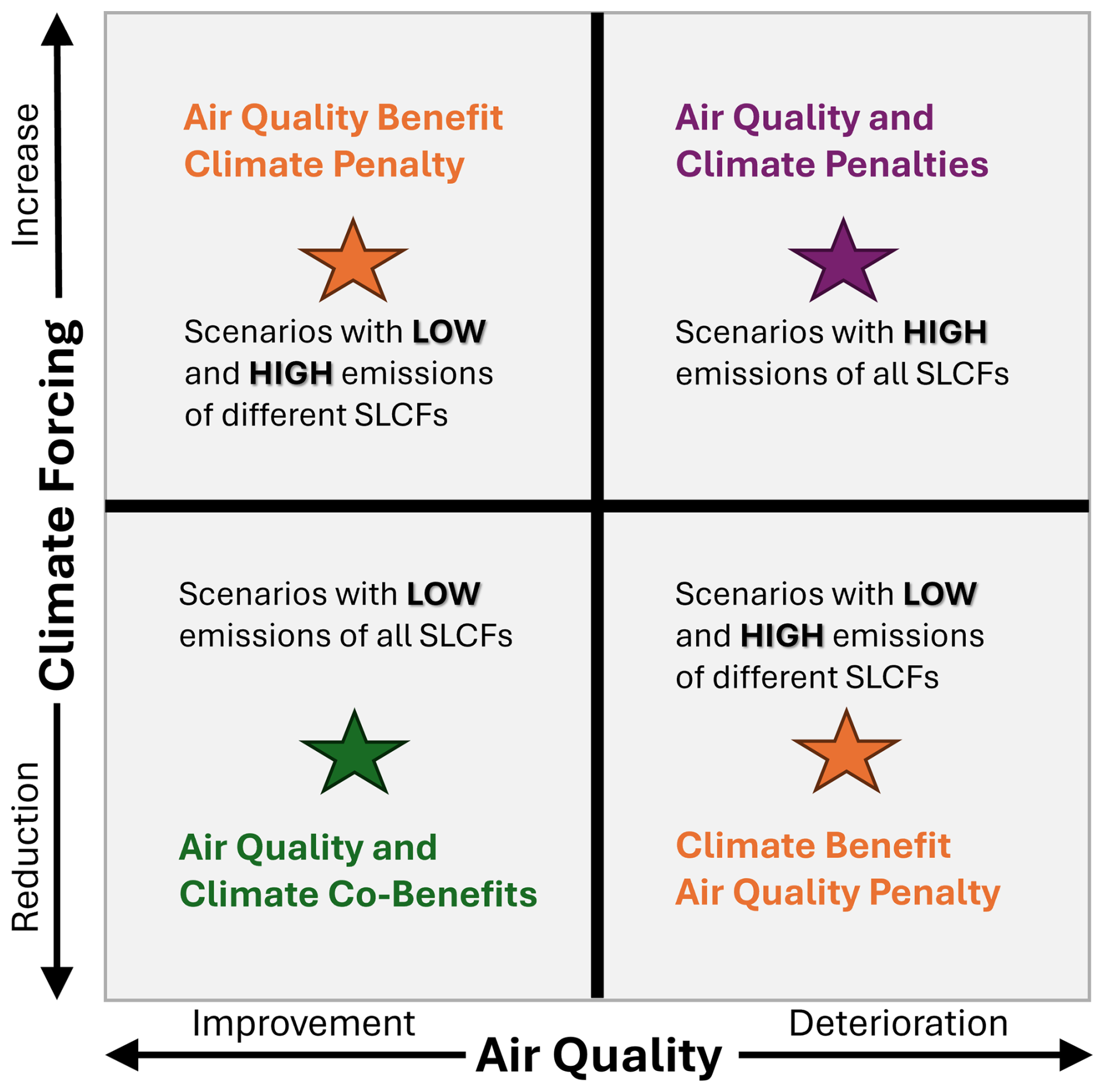
Figure 6Schematic showing how the choice of SLCFs in future scenarios could impact both air quality and climate forcing, adapted from results in Turnock et al. (2022). While ScenarioMIP-CMIP7 will focus on the left quadrants, AerChemMIP2 will request experiments in the right quadrants to address the effectiveness of air quality policies in synergy with climate change developments.
While these scenarios have not yet been finalized, their description in van Vuuren et al. (2025) indicates reductions of emissions across the board for VL, for air pollutants and greenhouse gases alike. Such changes can be driven by a decrease in the use of coal, gas, and oil in the energy system, which are replaced mainly by non-biomass renewables (Fig. 7a). Conversely, the H scenario would see stable or increasing trends in emissions, with no fossil fuel phase out or phase down. For instance for SO2 emissions, the differentiated pathways for coal use, from phase-out to continued or increased use, lead to strong future differences between the two scenarios (Fig. 7b). Depending both on how much vegetation is modelled in the future in these scenarios and how much fire management is assumed, emissions from open burning fires may be different as well. While for SO2, emissions from fires are a small part of global total emissions, this share is larger for some other species such as OC.
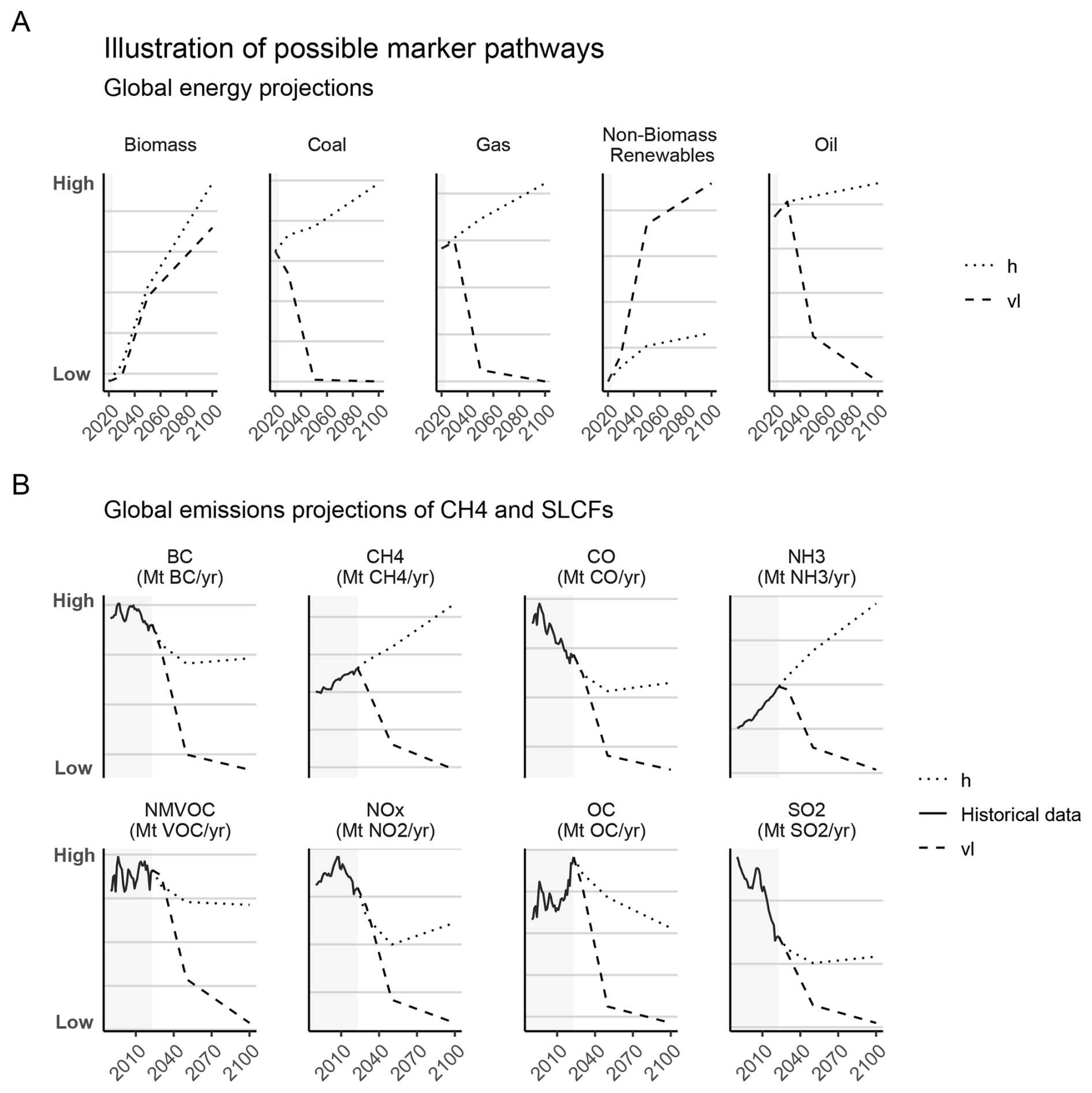
Figure 7An indicative illustration of possible global trajectories for esm-scen7-vl (VL) and esm-scen7-h (H) marker pathways in CMIP7 scenarios for 2023–2100. Shown are (a) primary energy split by different energy carriers, and (b) CH4 and a set of selected SLCFs, harmonized to historical emissions for CMIP7 until 2023 inclusive.
The spatial differences in future energy sources between the two scenarios lead also to diverging regional patterns of SLCF emissions in the two future projections (Fig. 8). In the middle of the 21st century (2050), VL assumes a level of emissions consistent with a substantial reduction of the use of conventional energy sources in stark contrast to H. Several regions such as sub-Saharan Africa and India could see increases in the use of coal in H, while China could keep high levels of coal use for electricity as well (not shown). That development is in contrast to VL which could see a projected (near) phase-out of the use of these conventional energy sources consistent with low emissions of SLCFs and CH4 (Fig. 7b). Similarly, oil and gas use could continue to increase in H, while growth in renewables slows down.
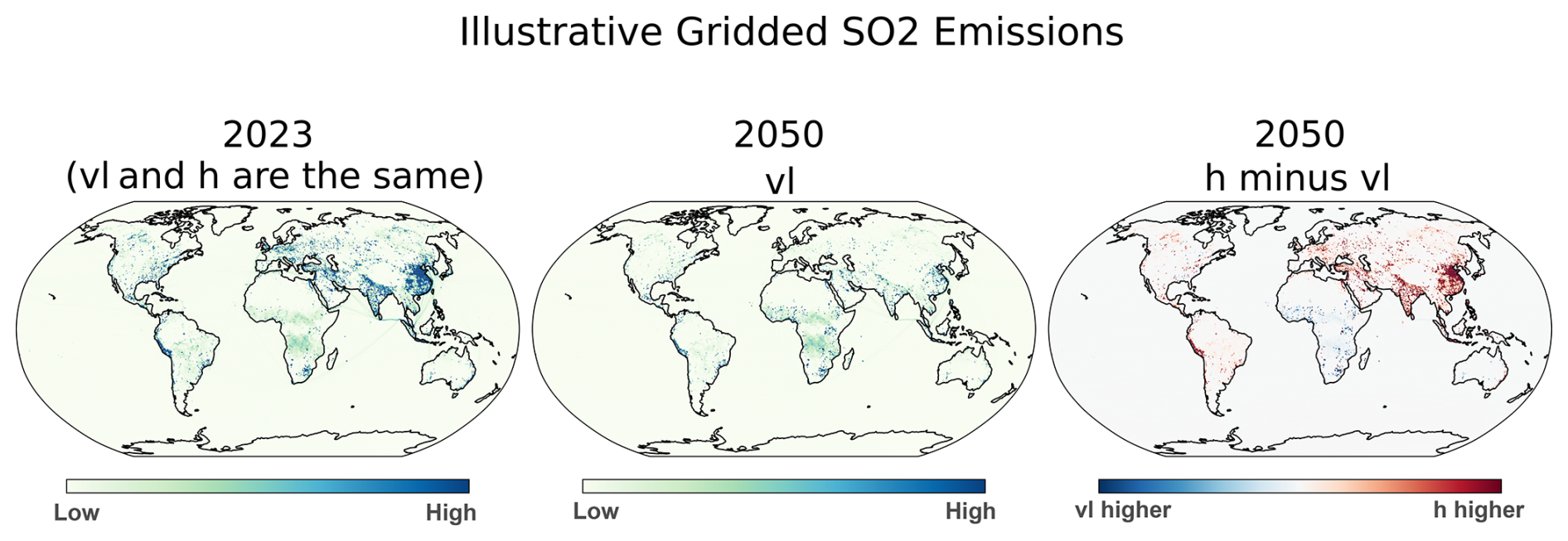
Figure 8An indicative illustration of possible gridded SO2 emissions for esm-scen7-vl (VL) and esm-scen7-h (H) marker pathways. Shown are the total emissions for (left to right) the harmonization year 2023 (end of historical data and start of scenarios), esm-scen7-vl in 2050, and their difference between esm-scen7-vl and esm-scen7-h for 2050. The emission totals include anthropogenic emissions at the surface, vertically integrated aircraft emissions, and open burning emissions.
3.3.1 SLCF emission trajectories
The AerChemMIP2 future scenarios esm-scen7-h-X and esm-scen7-vl-X are fully coupled experiments and variants of the two high-priority ScenarioMIP-CMIP7 experiments VL and H. They are fully consistent with the underlying socio-economic developments of ScenarioMIP-CMIP7 with variants of the future development of SLCFs (Table 5). Specifically, these experiments allow an assessment of the implication of SLCFs for atmospheric composition, air quality, and climate response by isolating the influence of SLCF mitigation compared to the baseline scenarios defined by ScenarioMIP-CMIP7 (van Vuuren et al., 2025).
The AerChemMIP2 variants of the H scenario are to quantify the role of SLCF emissions in a future with high GHG emissions driven by little ambition for climate change mitigation. To that end, we request experiment esm-scen7-h-AQ (Table 5) in which aerosols, O3 and their precursor emissions are set to PD levels while all other emissions follow the H scenario. The setup allows esm-scen7-h-AQ to be a consistent extension of the historical experiment with a future trajectory of strong warming (AerChemMIP2 tier 1). Through comparison of esm-scen7-h-AQ against esm-scen7-h the potential influence of a future implementation of clean air policies for minimizing air pollution despite a lack of climate change mitigation can be assessed (upper left hand quadrant in Fig. 6). All emissions in esm-scen7-h-AQ will follow the prescribed spatio-temporally evolving emissions as in esm-scen7-h, except for aerosols, O3 and their precursors. Aerosol influences can be separately assessed through the additionally requested experiment esm-scen7-h-Aer in models with interactive chemistry. Models without interactive chemistry are asked to prioritize esm-scen7-h-Aer over esm-scen7-h-AQ.
The variants of the VL scenario explore the role of individual SLCFs for climate change in an overshoot of warming before the world follows a trajectory towards climate-neutral conditions (esm-scen7-vl-AQ). Experiments esm-scen7-vl-X assumes higher SLCF emissions, taken from esm-scen7-h, to mimic a theoretical failure of policies for cleaning the air. In contrast to the different long-term pathways of esm-scen7-vl and esm-scen7-h, their expected near-term global mean temperature increase until 2050 might be similar (van Vuuren et al., 2025). AerChemMIP2 could exploit this near-term similarity between those scenarios to explore the impact of different spatial patterns of SLCF emissions for the sensitivity scenario esm-scen7-vl-AQ compared to esm-scen7-h-AQ, and esm-scen7-vl-Aer compared to esm-scen7-h-Aer. The different regional patterns in SLCF emissions could, for instance, mimic a theoretical SLCF emission increase in regions with delayed action in controlling air pollution during economic growth (right hand side of Fig. 6).
AerChemMIP2 also addresses the future air quality and climate response that might arise from more desert dust aerosols through the sensitivity scenario esm-scen7-vl-Dust (Table 5) in which a future extension of the desert dust aerosol increase from the dataset by Leung et al. (2025) is prescribed (compare Sect. 3.2.4). The experiment assumes a hypothetical increase in dust-aerosols over time with a rate similar to what has been seen for past decades. The experiment applies a linear increase to the dust emissions on the PD spatial pattern of sources. The future extension is part of the dust dataset listed for AerChemMIP2 and CMIP6plus via input datasets for Model Intercomparison Projects (ESGF input4MIPs, 2025). In so doing, esm-scen7-vl-Dust is a seamless future extension of hist-Dust. In comparison to output from esm-scen7-vl-Aer, esm-scen7-vl-Dust enables the potential air quality and climate responses to a future with a continuous desert dust increase to be assessed along with SLCF policies targeting anthropogenic sources for improving air quality. The idealized design of experiment esm-scen7-vl-Dust allows us to investigate to what extent the climate response to dust forcing might be linear in a future scenario targeting net zero.
We request three-member ensembles for each of the future scenario experiments in AerChemMIP2 as part of CMIP7-AFT. Models without interactive chemistry schemes (i.e., AER) are encouraged to contribute esm-scen7-h-Aer, esm-scen7-vl-Aer and esm-scen7-vl-Dust simulations, with a lower priority to create esm-scen7-vl-AQ and esm-scen7-h-AQ also. The AerChemMIP2 future experiments will allow the community to quantify the role of future mitigation actions for SLCFs on climate and air quality responses (i.e. which part of Fig. 6 do these actions lead to), which can otherwise not be diagnosed from other CMIP7 output. For instance, esm-scen7-h-Aer and esm-scen7-vl-Aer in comparison to esm-scen7-h and esm-scen7-vl can be used to estimate how much regional warming might be masked by aerosol particles. The experiments can therefore inform policymakers on near- and long-term impacts arising from future SLCF emission changes targeting air quality and climate priorities. The parallel experiments, using ScenarioMIP-CMIP7 experiments as baselines, keep the computational burden for AerChemMIP2 smaller and allow a direct link to the scenarios used for CMIP7.
Analogous AerChemMIP2 future atmosphere-only scenario experiments esm-scen7-vl-SST-X and esm-scen7-h-SST-X are requested and listed in Table 7, e.g., to diagnose the time-evolving effective radiative forcing of SLCFs in the scenarios described above. Prescribed monthly sea-surface temperatures and sea-ice should be from the model's own fully coupled simulation of esm-scen7-vl and esm-scen7-h, respectively. Models with emission fluxes that depend on the sea-surface state should also prescribe these as time-evolving fields taken from their own fully-coupled simulations. The perturbation experiments esm-scen7-vl-SST-X and esm-scen7-h-SST-X use the same forcings as for their fully coupled future experiment counterparts. Moreover, we request two additional future sensitivity scenarios for the individual perturbations of CH4 and O3, with esm-scen7-vl-SST as the reference. These additional experiments can be used to address the potential future implication of different CH4 (esm-scen7-vl-SST-CH4) and O3 precursor (esm-scen7-vl-SST-O3) emissions compared to the development in the VL scenario. Specifically, we ask to prescribe the emissions of the polluted pathway in H (not VL) for CH4 in esm-scen7-vl-SST-CH4 and for O3 precursors in esm-scen7-vl-SST-O3. The esm-scen7-vl-SST-X experiments are deliberately counterfactual scenarios that mimic a theoretical failure of air pollution mitigation in a world that limits warming to 1.5 °C.
3.3.2 Disentangling influences of re/afforestation
AerChemMIP2 aims to address the potential influence of future large-scale forest expansions on atmospheric composition and climate change. Afforestation and reforestation (A/R) efforts are among the most widely-suggested climate change mitigation strategies with a high likelihood of deployment in one form or another (Verdone and Seidl, 2017). A/R will affect the Earth's radiative budget by changing surface albedo (Betts, 2000) and atmospheric composition that can offset a substantial part of the cooling associated with the CO2 uptake by forests (Weber et al., 2024). In addition to sequestering CO2, forests emit large quantities of BVOCs (Guenther et al., 2012) which react chemically, affecting CH4 lifetime, O3 and aerosol abundances, as well as water vapour and cloud properties (Weber et al., 2022). Forest fires are also important sources of reactive gases and aerosols (Ward et al., 2012) while changes in land cover will also affect dust emissions, which influence the Earth's radiative budget (Thornhill et al., 2021a). Influences of A/R on fire and dust emissions have not been assessed in this context. Thus, the net impact of A/R on climate, and so its efficacy as a mitigation strategy, requires a systematic assessment of affected processes alongside the benefit of CO2 sequestration.
The response of atmospheric composition to A/R is also dependent on climate. BVOC emissions as well as fire frequency and severity, and thus associated emissions depend on temperature (Zheng et al., 2021; Burton et al., 2024). Moreover, mineral-dust emissions depend on meteorological and surface conditions (Shao et al., 2011). The impact on composition and climate from a change in BVOC and fire emissions further depends on the contemporaneous anthropogenic emissions of reactive gases and aerosols. For example, a reduction in anthropogenic aerosol emissions amplifies the climate impact of aerosols from A/R (Carslaw et al., 2013) while anthropogenic NOx emissions influence the ozone-forming potential of BVOCs (Seinfeld and Pandis, 1998). Trees themselves can also be damaged by elevated levels of ozone (Cheesman et al., 2024), leading to reduced productivity and carbon sequestration. Therefore, an assessment of the net climate impact of A/R must include changes to non-CO2 processes and be embedded in multiple possible future transient climate scenarios which span the range of possible future surface temperatures (Weber et al., 2024).
To simulate A/R, AerChemMIP2 will use the fully coupled esm-scen7-vl simulation of ScenarioMIP-CMIP7 (van Vuuren et al., 2025), specifically its land use which will feature some level of A/R. The VL scenario assumes a large reliance on negative emission technologies and so is the best option for A/R for AerChemMIP2. In some ESMs participating in ScenarioMIP-CMIP7, the land cover is preferably simulated interactively, e.g., through coupled vegetation schemes (Cox, 2001; Sellar et al., 2019). Output from ESMs with prescribed evolving land cover consistent with the climate forcing data for the VL scenario are equally welcome and should include information on the land-use treatment in the metadata information. Modelling centres should use the same land cover treatment as for their esm-scen7-vl experiment for consistency with the AerChemMIP2 land use (LU) experiments and ScenarioMIP-CMIP7. We encourage modelling centres to run all experiments with interactive chemistry and aerosol (CHEM), e.g., to account for the influence via BVOC and fire emissions. Some of the experiments can also be performed by models without such capability (AER), since these can nevertheless simulate the influence of land-use changes on surface albedo.
We request six atmosphere-only experiments with prescribed changes in sea-surface temperature and sea-ice with details listed in Table 8. These simulations allow the calculation of the net impact on the Earth's radiation budget from the expansion of tree cover simulated in the coupled esm-scen7-vl simulation and, separately, allow the radiative impact of non-CO2 composition and surface albedo to be isolated. These experiments are consistent with the esm-scen7-vl-SST and esm-scen7-h-SST experiments (Table 7) concerning climate forcings such as GHGs and anthropogenic SLCF emissions. The two scenarios esm-scen7-vl and esm-scen7-h are again chosen as references since they span different anthropogenic emission pathways and different future surface temperature evolutions. Thus, these simulations will provide information as to the likely impact of A/R in a future where, after some delay, action is taken to mitigate climate change (VL) and a future where A/R represents the only mitigation method deployed (H).
Table 8Experiments with prescribed sea-surface conditions examining afforestation and reforestation (A/R). Int(eractive) with PD LU means BVOC, fire and dust emissions can evolve with climate (SST change) but land use is fixed at a PD (2021) climatology so BVOC and fire emissions are not influenced by LU changes. Int(eractive) with VL LU means BVOC, fire and dust emissions can evolve with climate and land use changes. Simulations A1, A3, B1 and B3 require models which can calculate BVOC, fire and dust emissions interactively based on climate and land cover (emissions of aerosol and O3 precursor emissions generated interactively in A3/B3 are then prescribed in A2/B2). If a modelling centre cannot do this but would like to participate, we recommend prescribing emissions diagnosed by a model which has such interactive capability. The authors actively encourage modelling centres in this position to contact them so connections can be made with groups who can generate interactive emissions. Index relates each simulation to those in Fig. 9. Int = Interactive, B = BVOC, F = Biomass burning, D = Dust. LU should be prescribed as a monthly climatology from 2021 for pdLU or monthly transient timeseries following VL (VL transient). Further notation as in Table 7.

a A1 vs. A3/B1 vs. B3 gives total RF; A1 vs. A2/B1 vs. B2 gives RF from chemistry and aerosols; A2 vs. A3/B2 vs. B3 gives surface albedo RF. b Min model capability is AGCM since A2 vs. A3/B2 vs. B3 gives surface albedo RF. c Identical to esm-scen7-vl-SST in Table 7.
The anticipated information from the set of future land-use experiments is summarized in Fig. 9. For the esm-scen7-vl (VL) background, the impact of A/R on the radiative budget comes from the comparison of esm-scen7-vl-SST-pdLU-BFD, which uses a fixed PD LU climatology and transient SSTs from VL that can influence BVOC, fire and dust emissions, and esm-scen7-vl-SST, which uses transient LU from VL capturing A/R. This can be considered as the difference between a scenario where A/R is pursued (esm-scen7-vl-SST) and a scenario where SSTs continue to evolve but LU is kept fixed at PD levels. Likewise, for the esm-scen7-h background, comparison of esm-scen7-h-SST-pdLU-BFD and esm-scen7-h-SST-vlLU will yield the full impact of A/R on the radiation budget. Note that while SSTs follow the esm-scen7-h scenario, the LU in esm-scen7-h-SST-vlLU follows that in VL since that scenario has A/R. The experiments esm-scen7-vl-SST-pdLU and esm-scen7-h-SST-vlLU use the model's own prescribed PD climatology for land-use (based on that recommended for CMIP7), but BVOC, fire and dust emissions prescribed from esm-scen7-vl-SST and esm-scen7-h-SST respectively.
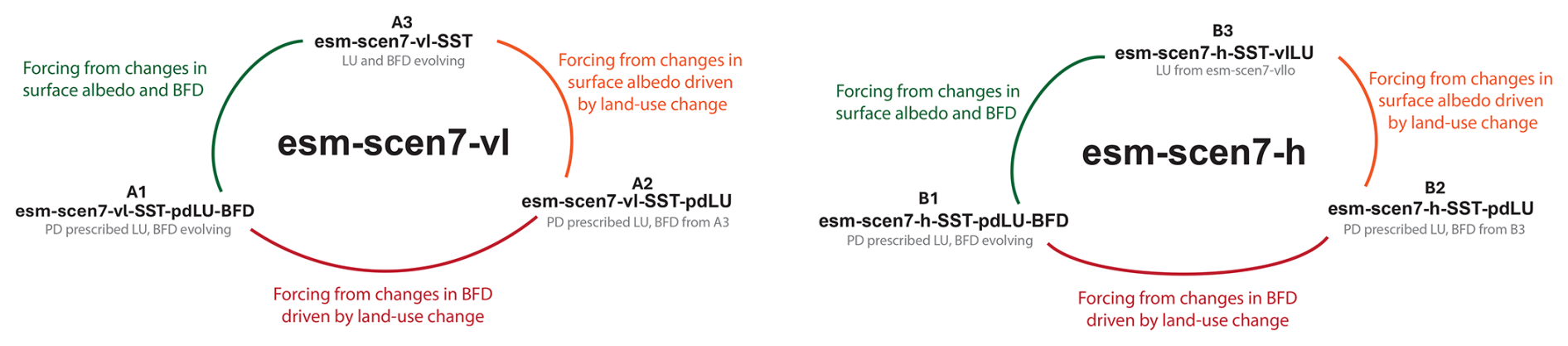
Figure 9Schematic illustrating the relationship between the 6 simulations proposed for the Afforestation/Reforestation (A/R) analysis. BFD refers to BVOC, fire and dust emissions. Anthropogenic aerosols and O3 precursor emissions, SSTs and CO2/CH4/N2O/CFC/HCFCs as in esm-scen7-vl-SST and esm-scen7-h-SST, respectively. Further details are in Table 8.
Comparison of esm-scen7-vl-SST-pdLU-BFD against esm-scen7-vl-SST-pdLU and esm-scen7-h-SST-pdLU-BFD against esm-scen7-h-SST-pdLU isolates the influence of changes to BVOC, fire, and dust emissions from LU change. Likewise, comparison of esm-scen7-vl-SST-pdLU against esm-scen7-vl-SST and esm-scen7-h-SST-pdLU against esm-scen7-h-SST-vlLU isolates the radiative impact of changes to surface albedo due to LU change. Thus the removal of atmospheric CO2 by the biosphere due to A/R is not captured by the proposed experiments. Estimating the carbon removal for the A/R sink can be explored via other methods using output from esm-scen7-vl, e.g. as in Weber et al., 2024). It would allow, for instance, for the reporting of an instantaneous radiative forcing due to A/R's CO2 removal.
The A/R experiments have different tiers. Simulation esm-scen7-vl-SST, also used as a reference for other future scenarios in AerChemMIP2 (Table 7) is Tier 1 while the two additional simulations based on VL are Tier 2. All simulations using the H scenario as a reference are Tier 3 and will simulate multiple influences, including fire and BVOC emission feedbacks and changes to vegetation productivity in a substantially warmer world to be explored. Combining A/R from VL with the H scenario can be interpreted as a future pathway where mitigation via A/R is chosen after climate change impacts have been experienced for longer than projected in the VL scenario. The AerChemMIP2 experiments esm-scen7-h-SST-X therefore help to build an understanding of the effectiveness of A/R as a mitigation policy in an even warmer world.
Technical support will be available for modelling centres to perform the A/R experiments and we encourage interested centres to contact the authors. We also note that a subset of the simulations can be done by models which don't have interactive aerosol and/or chemistry since useful information about the forcing from surface albedo and water vapour changes can still be extracted. Specifically, esm-scen7-vl-SST and esm-scen7-vl-SST-pdLU, which differ only in the land use, can be done by models with a minimum capability. Such contributions from CMIP7 models that would typically not participate in AerChemMIP2, for example, would be informative for the multi-model differences in surface-albedo changes due to A/R.
To provide further consistency with AerChemMIP and minimize model development overhead, the diagnostic request for AerChemMIP2 builds on the AerChemMIP and RAMIP requests. Recent analysis has highlighted the most commonly used CMIP variables (Juckes et al., 2025), but there remains a long tail of rarely used valuable outputs that support key science goals of AerChemMIP2. Following the new data request protocol of CMIP7, a review of the CMIP6 AerChemMIP request was made, a minor number of deletions were made, and new variables were added through a series of community consultation meetings. Together, these variables were proposed as a scientific “opportunity” to CMIP7 and included in version 1.2 of the CMIP7 harmonized data request for simulations in the AFT (Anstey and Ellis, 2025) so that they can be included in key baseline DECK and ScenarioMIP-CMIP7 simulations. For new additions, this involved proposing new names to be included in the Climate and Forecast (CF) standard (e.g., for the tendency of atmosphere mole concentration of ozone due to net chemical production). Moreover, it required proposing new physical parameters (e.g., do3chm), proposing new variable names (a combination of both the physical parameter and its temporal and spatial sampling; e.g., AERmon.do3chm), and organising all variables into groups (e.g., aerchemmip_3d_monthly).
For AerChemMIP2, the data request is organised into 10 variable groups. Additional lower-priority variables will be added to later versions of the data request in order to provide driving fields for offline chemical transport models (CTMs). Further details on how the v1.2 data request for the Atmosphere, including AerChemMIP2, was developed can be found in Dingley et al. (2026).
4.1 Aerosol properties for forcing uncertainty
We take this opportunity to highlight the value of modelling centres providing key diagnostics. For example, while requested in CMIP6, aerosol optical depth (AOD) was not routinely output by models even though it can provide a crucial constraint on the aerosol effective radiative forcing from aerosol-radiation interaction (ERFari) (Watson-Parris et al., 2020). In turn, further details, including the absorption AOD or the single scattering albedo for natural and anthropogenic aerosol provides valuable context for their relative contributions to absorption. CMIP models show considerable uncertainty in the forcing magnitude (Smith et al., 2020; Thornhill et al., 2021b; Fiedler et al., 2023) and the aerosol optical properties are measurable variables to better understand and constrain the simulated aerosol ERFari. In a possible synergy with the Geoengineering Model Intercomparison Project (GeoMIP Visioni et al., 2025), we also request that models output the three-dimensional fields of aerosol extinction on native model levels for comparison with observational products (such as from CALIOP) and the diagnosis of stratospheric AOD for separating historical volcanic eruptions in total AOD.
A large component of the aerosol forcing uncertainty stems from aerosol-cloud interactions (ERFaci; Bellouin et al., 2020). We therefore request key diagnostics such as the cloud droplet number and optical depth. In combination with diagnostics requested by the next phase of the Cloud Feedback MIP (CFMIP, Webb et al., 2017), the output can help to constrain these variables influencing aerosol forcing against historical observations from remote sensing instruments. Synergies with the Clouds and the Earth's Radiant Energy System MIP (CERESMIP, Schmidt et al., 2023) exist to constrain the radiation budget. To further understand the impact on air quality, and health, it is requested that as many modelling centres as possible provide a direct output of surface concentrations of fine particulate matter (PM2.5), in addition to the request for individual aerosol components. This will avoid any underestimation from an approximate calculation of this metric after AerChemMIP2. The model-dependent species included in PM2.5 diagnostics should be documented. Consistent calculations of PM2.5 across multiple-models are additionally possible (Allen et al., 2020).
4.2 Driving fields for Chemistry Transport Models
Studies of future impacts of climate change on surface air quality and stratospheric ozone have traditionally fallen under the realm of free-running climate models that include atmospheric chemistry, due to the necessity of simulating future meteorology. However, there are well-established international modelling initiatives independent of CMIP that study air quality in the present day using CTMs (e.g., Galmarini et al., 2017). CTMs use prescribed meteorology, usually from historical meteorological reanalyses, and therefore have better signal-to-noise ratios for atmospheric composition changes from emission perturbations. They are also able to spend more computational power on more elaborate chemistry mechanisms, as well as perform more sensitivity simulations. One example is H2 for which CTM simulations would enable a better understanding of its role for atmospheric composition.
For AerChemMIP2, we request that modelling centres provide the PD and future archived meteorology that would be necessary for driving CTMs, which typically require hourly temporal resolutions for 2-D fields and 3-hourly resolution for 3-D fields. In later versions of the data request than v1.2 (Dingley et al., 2026), we will specifically request the necessary meteorological fields for driving the widely used GEOS-Chem CTM (http://www.geos-chem.org, last access: 21 April 2026), which is normally driven by reanalysis products from the NASA Global modelling and Assimilation Office. By using different meteorologies from different models to drive a CTM with a consistent chemical mechanism, we can explicitly isolate the impact of different meteorological processes alone on atmospheric composition and surface air pollution. Nevertheless, we realize that this is a large data request, so it is lower in priority than other diagnostics and is only requested from one to two transient coupled simulations, e.g., from a single realization of both a hist and a future scenario experiment.
AerChemMIP2 offers an experimental protocol that facilitates an Earth system model intercomparison, including benchmarking experiments, extended model validation via comparison with observations and other state-of-the-science models. The experiments enable new scientific studies aimed at the role of SLCFs in the Earth system based on state-of-the-science models and forcing data sets, with assessment and quantification of radiative forcing, Earth system feedbacks, carbon budgets and climate sensitivity. The focus is on short-lived climate forcers, methane and land use, targeting the most complex Earth system models currently available, with implications for atmospheric composition, air quality and associated policy development.
While some experiments from AerChemMIP phase one are repeated to update and track changes in the scientific understanding since CMIP6, new experiments explore aspects that would otherwise not be addressed in the context of CMIP7. Specifically, AerChemMIP2 highlights eight scientific opportunities that will enable research studies (1) to advance the understanding of state-dependence of ERFs through new present-day atmosphere-only experiments with CMIP7 models, (2) to globally upscale the aerosol radiative effects for a new line of evidence using storm-resolving models, (3) to provide first multi-model estimates of ERF for hydrogen emissions consistent with CMIP7 forcings, (4) to assess the contributions of non-methane volatile organic compounds to the present-day anthropogenic ERF, (5) to address non-linearity in climate responses through parallel experimental designs across MIP boundaries, (6) to fill knowledge gaps by inducing previously missing desert dust trends in CMIP7 models, (7) to exploit new model capabilities for interactively simulating wild fires, and (8) to disentangle influences of re- and afforestation for future atmospheric composition and climate responses. Updates are enabled through repeating selected AerChemMIP experiments that will allow computations of individual ERFs and biogeochemical feedbacks, attribution studies of climate and air quality responses accounting for internal variability, and future oriented assessments based on emission trajectories consistent with ScenarioMIP-CMIP7.
Contributing to AerChemMIP2 provides the essential basis for multi-model assessments of radiative forcing, response and feedbacks from interactive simulations of atmospheric composition and climate change, which justifies the computational needs. Contributing experiments to AerChemMIP2 is rewarding for modelling centres. We encourage participation in AerChemMIP2 with models of different complexity in terms of number and fidelity of represented processes as well as different spatial resolutions ranging from a hundred to a few kilometers. We ask modelling centres to contribute to AerChemMIP2 experiments listed under all Tiers, which are meant as a help for temporally planning resources for completing experiments rather than misinterpreting tier 1 as being more important than tier 3 experiments. Indeed, tier 3 experiments from AerChemMIP phase one have, for instance, been cited as often as experiments in other tiers and informed IPCC AR6 thanks to contributions from many (Griffiths et al., 2025). Output of AerChemMIP2 experiments will provide avenues to enhance understanding of air quality and climate interactions, to better quantify Earth system feedbacks involving short-lived climate forcers and methane, and to improve traceability and evolution of model performance in comparison to other contemporary models. Moreover, the participation of modelling centres will allow the community to update climate assessments and projections and to bear down on key uncertainties in our understanding of the role of short-lived climate forcers and methane on air quality and climate change.
News from AerChemMIP2 will be distributed via a mailing list (subscription by sending an empty email to: AERCHEMMIP2-subscribe-request@listserv.uni-heidelberg.de). Technical questions on experimental setups and diagnostic output for AerChemMIP2 can be directed to the CACTI (https://www.iup.uni-heidelberg.de/en/research/atmosphere/alic2e-fiedler-group/cooperations-and-outreach/composition-air-quality-climate-interactions-initiative-cacti-emissions-to-response, last access: 21 April 2026) committee: CACTI-committee@listserv.uni-heidelberg.de.
All output from AerChemMIP2 will be published following the same workflows as for CMIP7. Climate forcings data will be available via input4MIPs with details documented by the CMIP Climate Forcings Task Team (https://wcrp-cmip.org/cmip-phases/cmip7/cmip7-forcing-datasets/#deck_datasets_and_their_providers, last access: 21 April 2026). The AerChemMIP2 data request for medium and high priority variables from CMIP7 is available on AirTable v1.2 with details in Dingley et al. (2026). Lower priority variables will be added to later versions with updated information provided on the webpage for the CMIP7 data request (https://wcrp-cmip.org/cmip-phases/cmip7/cmip7-data-request/, last access: 21 April 2026).
Biomass burning emissions are taken from historical experiments of CMIP6 models available from ESGF (https://esgf-metagrid.cloud.dkrz.de/search, last access: 21 April 2026), the BB4CMIP data set (CMIP6 – version 1.1, CMIP7 – version 2.0, van Marle et al., 2017) available via input4MIPs (https://aims2.llnl.gov/search/input4mips/, last access: November 2025), the Global Fire Assimilation System (GFAS version 1.0, Kaiser et al., 2012) from the Copernicus Atmosphere Monitoring Service Atmosphere Data Store (https://doi.org/10.24381/a05253c7, CAMS, 2022), the Fire Inventory from NCAR (FINN version 2.5, Wiedinmyer et al., 2023) downloaded from NCAR's Research Data Archive (https://doi.org/10.5065/XNPA-AF09, Wiedinmyer and Emmons, 2022), from Zhang et al. (2024) accessible on Harvard Dataverse (https://doi.org/10.7910/DVN/KB0ESS, Zhang and Liu, 2024), and from the Global Fire Emissions Database (https://www.globalfiredata.org/data.html, last access: November 2025). Dust data are taken from CMIP6 historical experiments from ESGF (https://aims2.llnl.gov/search/cmip6, last access: 21 April 2026) and from UCLA 1.0.2: DustCOMM, made available via input4MIPs (https://aims2.llnl.gov/search/input4mips/, last access: November 2025). Data display from ScenarioMIP-CMIP7 has been curated by Elmar Kriegler and Nico Bauer from REMIND-MAgPIE for the VL scenario and by Christoph Bertram from GCAM for the H scenario.
The following authors had a primary role in developing the new experiments in AerChemMIP2: WJC, SF, MK, JFK, VN, FMO'C, DW-P, FP, MS, JK, and JW. The AerChemMIP2 diagnostic request was developed via community engagement, with additional input from WJC, SF, PTG, MK, LTM, VN, STT, DWP, and LJW, and co-ordinated and implemented in Airtable by FMO'C. Figures were provided by SF, JFK, MK, STT, and JW. SF led the writing and the coordination for AerChemMIP2. All authors have reviewed and agreed on the content of the manuscript.
At least one of the (co-)authors is a member of the editorial board of Geoscientific Model Development. The peer-review process was guided by an independent editor, and the authors also have no other competing interests to declare.
Publisher's note: Copernicus Publications remains neutral with regard to jurisdictional claims made in the text, published maps, institutional affiliations, or any other geographical representation in this paper. The authors bear the ultimate responsibility for providing appropriate place names. Views expressed in the text are those of the authors and do not necessarily reflect the views of the publisher.
The authors would like to thank the editorial team and the reviewers for their work in support of the publication.
We thank the CACTI community for sharing their views at the workshops, which has informed the experimental designs in AerChemMIP2. We thank the CMIP IPO for supporting CACTI and AerChemMIP2, the CMIP Climate Forcings Task Team and input4MIPs for providing CMIP7 forcing data for the experiments, and ESGF for distributing the AerChemMIP2 experiment output. The authors would also like to acknowledge the contributions to the AerChemMIP2 data request from the following: Olivia Clifton, Mathew Evans, Gerd Folberth, Daniel Grosvenor, Larry Horowitz, Martine Michou, Pierre Nabat, Dirk Olivié, Naga Oshima, Michael Prather, Vichawan Sakulsupich, Michael Schulz, and Toshihiko Takemura. We appreciate comments by Larry Horowitz on an initial draft of the protocol.
SF acknowledges financial support from the Deutsche Forschungsgemeinschaft (DFG, German Research Foundation) for SFB 1502/1-2022 (Projektnummer: 450058266) and from the European Union Horizon 2020 project EXPECT (Towards an Integrated Capability to Explain and Predict Regional Climate Changes, Grant Agreement 101137656). The work of FMO'C was supported by the Met Office Hadley Centre Climate Programme funded by DSIT and the European Union Horizon 2020 Research Programme ESM2025 (grant agreement number 101003536) project. DWP acknowledges funding from U.S. National Science Foundation award 2441832. JFK acknowledges support from the National Science Foundation (NSF) Directorate for Geosciences under grant 2151093. The contributions of STT were funded by the Met Office Climate Science for Service Partnership (CSSP) China project under the International Science Partnerships Fund (ISPF). LJW was supported by the Natural Environment Research Council (NERC; grant NE/W004895/1, TerraFIRMA) and the Research Council of Norway through grant no. 324182 (CATHY). MK was supported by the Leverhulme Trust through the Leverhulme Centre for Wildfires, Environment and Society, grant RC-2018-023.
This research has been supported by the Deutsche Forschungsgemeinschaft (grant no. 450058266), the Horizon 2020 (grant nos. 101137656 and 101003536), the Directorate for Geosciences (grant no. 2151093), the Natural Environment Research Council (grant no. NE/W004895/1), the Leverhulme Trust (grant no. RC-2018-023), the Research Council of Norway through grant no. 324182 (CATHY), and the U.S. National Science Foundation award 2441832.
This paper was edited by Mingxu Liu and reviewed by Jean-Francois Lamarque and one anonymous referee.
Abatzoglou, J. T., Williams, A. P., and Barbero, R.: Global Emergence of Anthropogenic Climate Change in Fire Weather Indices, Geophys. Res. Lett., 46, 326–336, https://doi.org/10.1029/2018GL080959, 2019. a
Adebiyi, A., Kok, J. F., Murray, B. J., Ryder, C. L., Stuut, J.-B. W., Kahn, R. A., Knippertz, P., Formenti, P., Mahowald, N. M., Pérez García-Pando, C., Klose, M., Ansmann, A., Samset, B. H., Ito, A., Balkanski, Y., Di Biagio, C., Romanias, M. N., Huang, Y., and Meng, J.: A review of coarse mineral dust in the Earth system, Aeolian Res., 60, 100849, https://doi.org/10.1016/j.aeolia.2022.100849, 2023. a
Akritidis, D., Bacer, S., Zanis, P., Georgoulias, A. K., Chowdhury, S., Horowitz, L. W., Naik, V., O'Connor, F. M., Keeble, J., Sager, P. L., van Noije, T., Zhou, P., Turnock, S., West, J. J., Lelieveld, J., and Pozzer, A.: Strong increase in mortality attributable to ozone pollution under a climate change and demographic scenario, Environ. Res. Lett., 19, 024041, https://doi.org/10.1088/1748-9326/ad2162, 2024. a, b
Allen, R. J. and Sherwood, S. C.: The impact of natural versus anthropogenic aerosols on atmospheric circulation in the Community Atmosphere Model, Clim. Dynam., 36, 1959–1978, 2011. a
Allen, R. J., Turnock, S., Nabat, P., Neubauer, D., Lohmann, U., Olivié, D., Oshima, N., Michou, M., Wu, T., Zhang, J., Takemura, T., Schulz, M., Tsigaridis, K., Bauer, S. E., Emmons, L., Horowitz, L., Naik, V., van Noije, T., Bergman, T., Lamarque, J.-F., Zanis, P., Tegen, I., Westervelt, D. M., Le Sager, P., Good, P., Shim, S., O'Connor, F., Akritidis, D., Georgoulias, A. K., Deushi, M., Sentman, L. T., John, J. G., Fujimori, S., and Collins, W. J.: Climate and air quality impacts due to mitigation of non-methane near-term climate forcers, Atmos. Chem. Phys., 20, 9641–9663, https://doi.org/10.5194/acp-20-9641-2020, 2020. a, b, c, d
Allen, R. J., Horowitz, L. W., Naik, V., Oshima, N., O'Connor, F. M., Turnock, S., Shim, S., Sager, P. L., van Noije, T., Tsigaridis, K., Bauer, S. E., Sentman, L. T., John, J. G., Broderick, C., Deushi, M., Folberth, G. A., Fujimori, S., and Collins, W. J.: Significant climate benefits from near-term climate forcer mitigation in spite of aerosol reductions, Environ. Res. Lett., https://doi.org/10.1088/1748-9326/abe06b, 2021. a, b, c, d, e
Allen, R. J., Samset, B. H., Wilcox, L. J., and Fisher, R. A.: Are Northern Hemisphere boreal forest fires more sensitive to future aerosol mitigation than to greenhouse gas–driven warming?, Sci. Adv., 10, eadl4007, https://doi.org/10.1126/sciadv.adl4007, 2024. a
Anstey, J. and Ellis, D.: CMIP-Data-Request/CMIP7_DReq_Content: Data request content for v1.2, Zenodo [code], https://doi.org/10.5281/zenodo.15103902, 2025. a
Bellouin, N., Quaas, J., Gryspeerdt, E., Kinne, S., Stier, P., Watson-Parris, D., Boucher, O., Carslaw, K. S., Christensen, M., Daniau, A.-L., Dufresne, J.-L., Feingold, G., Fiedler, S., Forster, P., Gettelman, A., Haywood, J. M., Lohmann, U., Malavelle, F., Mauritsen, T., McCoy, D. T., Myhre, G., Mülmenstädt, J., Neubauer, D., Possner, A., Rugenstein, M., Sato, Y., Schulz, M., Schwartz, S. E., Sourdeval, O., Storelvmo, T., Toll, V., Winker, D., and Stevens, B.: Bounding Global Aerosol Radiative Forcing of Climate Change, Rev. Geophys., 58, e2019RG000660, https://doi.org/10.1029/2019RG000660, 2020. a, b, c, d, e, f
Betts, R. A.: Offset of the potential carbon sink from boreal forestation by decreases in surface albedo, Nature, 408, 187–190, https://doi.org/10.1038/35041545, 2000. a
Bonan, G. B.: Forests, climate, and public policy: A 500-year interdisciplinary odyssey, Annu. Rev. Ecol. Evol. Sys., 47, 97–121, 2016. a
Bony, S., Stevens, B., Frierson, D. M., Jakob, C., Kageyama, M., Pincus, R., Shepherd, T. G., Sherwood, S. C., Siebesma, A. P., Sobel, A. H., and Watanabe, M.: Clouds, circulation and climate sensitivity, Nat. Geosci., 8, 261–268, 2015. a
Booth, B. B., Dunstone, N. J., Halloran, P. R., Andrews, T., and Bellouin, N.: Aerosols implicated as a prime driver of twentieth-century North Atlantic climate variability, Nature, 484, 228–232, 2012. a
Brown, M. A. J., Warwick, N. J., Abraham, N. L., Griffiths, P. T., Rumbold, S. T., Folberth, G. A., O'Connor, F. M., Bryant, H., and Archibald, A. T.: Development of fully interactive hydrogen with methane in UKESM1.0, Geosci. Model Dev., 19, 1537–1557, https://doi.org/10.5194/gmd-19-1537-2026, 2026. a, b
Burton, C., Lampe, S., Kelley, D. I., Thiery, W., Hantson, S., Christidis, N., Gudmundsson, L., Forrest, M., Burke, E., Chang, J., Huang, H., Ito, A., Kou-Giesbrecht, S., Lasslop, G., Li, W., Nieradzik, L., Li, F., Chen, Y., Randerson, J., Reyer, C. P. O., and Mengel, M.: Global burned area increasingly explained by climate change, Nat. Clim. Change, 14, 1186–1192, https://doi.org/10.1038/s41558-024-02140-w, 2024. a
CAMS: Copernicus Atmosphere Monitoring Service (CAMS) global biomass burning emissions based on fire radiative power (GFAS), Copernicus Atmosphere Monitoring Service (CAMS) Atmosphere Data Store [data set], https://doi.org/10.24381/a05253c7, 2022. a
Carslaw, K. S., Lee, L. A., Reddington, C. L., Pringle, K. J., Rap, A., Forster, P. M., Mann, G. W., Spracklen, D. V., Woodhouse, M. T., Regayre, L. A., and Pierce, J. R.: Large contribution of natural aerosols to uncertainty in indirect forcing, Nature, 503, 67–71, https://doi.org/10.1038/nature12674, 2013. a, b
Cheesman, A. W., Brown, F., Artaxo, P., Farha, M. N., Folberth, G. A., Hayes, F. J., Heinrich, V. H. A., Hill, T. C., Mercado, L. M., Oliver, R. J., O'Sullivan, M., Uddling, J., Cernusak, L. A., and Sitch, S.: Reduced productivity and carbon drawdown of tropical forests from ground-level ozone exposure, Nat. Geosci., 17, 1003–1007, https://doi.org/10.1038/s41561-024-01530-1, 2024. a
Chua, G., Naik, V., Paulot, F., Feng, J., and Horowitz, L. W.: Impact of Future Methane Emission Trajectories on Atmospheric Composition and Climate in a Future Hydrogen Economy, Earth's Future, 13, e2025EF006254, https://doi.org/10.1029/2025EF006254, 2025. a
Collins, W. J., Lamarque, J.-F., Schulz, M., Boucher, O., Eyring, V., Hegglin, M. I., Maycock, A., Myhre, G., Prather, M., Shindell, D., and Smith, S. J.: AerChemMIP: quantifying the effects of chemistry and aerosols in CMIP6, Geosci. Model Dev., 10, 585–607, https://doi.org/10.5194/gmd-10-585-2017, 2017. a, b, c, d, e, f, g, h, i, j, k
Collins, W. J., Daniel, J. S., Chipperfield, M. P., Cussac, M., Deushi, M., Faluvegi, G., Griffiths, P., Hodnebrog, Ø., Horowitz, L. W., Keeble, J., Kinnison, D., Naik, V., O'Connor, F. M., Shindell, D., Tilmes, S., Tsigaridis, K., Wang, Z., and Weber, J.: Indirect climate forcing from ozone depleting substances, EGUsphere [preprint], https://doi.org/10.5194/egusphere-2025-6033, 2026. a
Cox, P. M.: Description of the “TRIFFID” dynamic global vegetation model, Hadley Centre Technical Note HCTN, NO. 024, 2001. a
Delworth, T. L., Cooke, W. F., Adcroft, A., Bushuk, M., Chen, J.-H., Dunne, K. A., Ginoux, P., Gudgel, R., Hallberg, R. W., Harris, L., Harrison, M. J., Johnson, N., Kapnick, S. B., Lin, S.-J., Lu, F., Malyshev, S., Milly, P. C., Murakami, H., Naik, V., Pascale, S., Paynter, D., Rosati, A., Schwarzkopf, M., Shevliakova, E., Underwood, S., Wittenberg, A. T., Xiang, B., Yang, X., Zeng, F., Zhang, H., Zhang, L., and Zhao, M.: SPEAR: The Next Generation GFDL Modeling System for Seasonal to Multidecadal Prediction and Projection, J. Adv. Model. Earth Sy., 12, e2019MS001895, https://doi.org/10.1029/2019MS001895, 2020. a
Deser, C., Lehner, F., Rodgers, K. B., Ault, T., Delworth, T. L., DiNezio, P. N., Fiore, A., Frankignoul, C., Fyfe, J. C., Horton, D. E., Kay, J. E., Knutti, R., Lovenduski, N. S., Marotzke, J., McKinnon, K. A., Minobe, S., Randerson, J., Screen, J. A., Simpson, I. R., and Ting, M.: Insights from Earth system model initial-condition large ensembles and future prospects, Nat. Clim. Change, 10, 277–286, https://doi.org/10.1038/s41558-020-0731-2, 2020a. a
Dingley, B., Anstey, J. A., Abalos, M., Abraham, C., Bergman, T., Bock, L., Fiddes, S., Hassler, B., Kramer, R. J., Luo, F., O'Connor, F. M., Šácha, P., Simpson, I. R., Wilcox, L. J., and Zelinka, M. D.: CMIP7 Data Request: atmosphere priorities and opportunities, Geosci. Model Dev., 19, 2945–2984, https://doi.org/10.5194/gmd-19-2945-2026, 2026. a, b, c, d
Doherty, R. M., O'Connor, F. M., and Turnock, S. T.: Projections of Future Air Quality Are Uncertain. But Which Source of Uncertainty Is Most Important?, J. Geophys. Res.-Atmos., 127, e2022JD037948, https://doi.org/10.1029/2022JD037948, 2022. a
Dowdy, A. J., Ye, H., Pepler, A., Thatcher, M., Osbrough, S. L., Evans, J. P., Di Virgilio, G., and McCarthy, N.: Future changes in extreme weather and pyroconvection risk factors for Australian wildfires, Sci. Rep., 9, 10073, https://doi.org/10.1038/s41598-019-46362-x, 2019. a
Dunne, J. P., Horowitz, L. W., Adcroft, A. J., Ginoux, P., Held, I. M., John, J. G., Krasting, J. P., Malyshev, S., Naik, V., Paulot, F., Shevliakova, E., Stock, C. A., Zadeh, N., Balaji, V., Blanton, C., Dunne, K. A., Dupuis, C., Durachta, J., Dussin, R., Gauthier, P. P. G., Griffies, S. M., Guo, H., Hallberg, R. W., Harrison, M., He, J., Hurlin, W., McHugh, C., Menzel, R., Milly, P. C. D., Nikonov, S., Paynter, D. J., Ploshay, J., Radhakrishnan, A., Rand, K., Reichl, B. G., Robinson, T., Schwarzkopf, D. M., Sentman, L. T., Underwood, S., Vahlenkamp, H., Winton, M., Wittenberg, A. T., Wyman, B., Zeng, Y., and Zhao, M.: The GFDL Earth System Model Version 4.1 (GFDL-ESM 4.1): Overall Coupled Model Description and Simulation Characteristics, J. Adv. Model. Earth Sy., 12, e2019MS002015, https://doi.org/10.1029/2019MS002015, 2020. a
Dunne, J. P., Hewitt, H. T., Arblaster, J. M., Bonou, F., Boucher, O., Cavazos, T., Dingley, B., Durack, P. J., Hassler, B., Juckes, M., Miyakawa, T., Mizielinski, M., Naik, V., Nicholls, Z., O'Rourke, E., Pincus, R., Sanderson, B. M., Simpson, I. R., and Taylor, K. E.: An evolving Coupled Model Intercomparison Project phase 7 (CMIP7) and Fast Track in support of future climate assessment, Geosci. Model Dev., 18, 6671–6700, https://doi.org/10.5194/gmd-18-6671-2025, 2025. a, b, c, d, e, f, g, h
Durack, P. J., Naik, V., Nicholls, Z., O’Rourke, E., Turner, B., Buontempo, C., Brookshaw, A., Goddard, C., MacIntosh, C., Hewitt, H., and Dunne, J.: Earth System Forcing for CMIP7 and Beyond, B. Am. Meteorol. Soc., 106, E1580–E1588, https://doi.org/10.1175/BAMS-D-25-0119.1, 2025. a
Earl, N. and Simmonds, I.: Spatial and Temporal Variability and Trends in 2001–2016 Global Fire Activity, J. Geophys. Res.-Atmos., 123, 2524–2536, https://doi.org/10.1002/2017JD027749, 2018. a
ESGF input4MIPs: UCLA 1.0.2: DustCOMM historical dust emissions based on Kok et al. (2023) and Leung et al. (2024b) – source_id: UCLA-1-0-2-increasing, Earth system grid federation (ESGF) [data set], https://esgf-data2.llnl.gov/thredds/dodsC/user_pub_work/input4MIPs/CMIP6Plus/AerChemMIP2/UCLA/UCLA-1-0-2-increasing/atmos/yr/dustscalefactor/gm/v20250226/dustscalefactor_input4MIPs_emissions_AerChemMIP2_UCLA-1-0-2-increasing_gm_2001-2100.nc (last access: 1 November 2025), 2025. a
Esquivel-Elizondo, S., Hormaza Mejia, A., Sun, T., Shrestha, E., Hamburg, S. P., and Ocko, I. B.: Wide range in estimates of hydrogen emissions from infrastructure, Front. Energ. Res., 11, https://doi.org/10.3389/fenrg.2023.1207208, 2023. a
Evan, A. T., Flamant, C., Fiedler, S., and Doherty, O.: An analysis of aeolian dust in climate models, Geophys. Res. Lett., 41, 5996–6001, https://doi.org/10.1002/2014GL060545, 2014. a, b
Eyring, V., Bony, S., Meehl, G. A., Senior, C. A., Stevens, B., Stouffer, R. J., and Taylor, K. E.: Overview of the Coupled Model Intercomparison Project Phase 6 (CMIP6) experimental design and organization, Geosci. Model Dev., 9, 1937–1958, https://doi.org/10.5194/gmd-9-1937-2016, 2016. a
Fasullo, J. T., Lamarque, J.-F., Hannay, C., Rosenbloom, N., Tilmes, S., DeRepentigny, P., Jahn, A., and Deser, C.: Spurious Late Historical-Era Warming in CESM2 Driven by Prescribed Biomass Burning Emissions, Geophys. Res. Lett., 49, e2021GL097420, https://doi.org/10.1029/2021GL097420, 2022. a
Fiedler, S. and Putrasahan, D.: How does the North Atlantic SST pattern respond to anthropogenic aerosols in the 1970s and 2000s?, Geophys. Res. Lett., 48, e2020GL092142, https://doi.org/10.1029/2020GL092142, 2021. a, b
Fiedler, S., Crueger, T., D'Agostino, R., Peters, K., Becker, T., Leutwyler, D., Paccini, L., Burdanowitz, J., Buehler, S. A., Cortes, A. U., Dauhut, T., Dommenget, D., Fraedrich, K., Jungandreas, L., Maher, N., Naumann, A. K., Rugenstein, M., Sakradzija, M., Schmidt, H., Sielmann, F., Stephan, C., Timmreck, C., Zhu, X., and Stevens, B.: Simulated Tropical Precipitation Assessed across Three Major Phases of the Coupled Model Intercomparison Project (CMIP), Mon. Weather Rev., 148, 3653–3680, https://doi.org/10.1175/MWR-D-19-0404.1, 2020. a
Fiedler, S., van Noije, T., Smith, C. J., Boucher, O., Dufresne, J.-L., Kirkevåg, A., Olivié, D., Pinto, R., Reerink, T., Sima, A., and Schulz, M.: Historical Changes and Reasons for Model Differences in Anthropogenic Aerosol Forcing in CMIP6, Geophys. Res. Lett., 50, e2023GL104848, https://doi.org/10.1029/2023GL104848, 2023. a
Fiedler, S., Naik, V., O'Connor, F. M., Smith, C. J., Griffiths, P., Kramer, R. J., Takemura, T., Allen, R. J., Im, U., Kasoar, M., Modak, A., Turnock, S., Voulgarakis, A., Watson-Parris, D., Westervelt, D. M., Wilcox, L. J., Zhao, A., Collins, W. J., Schulz, M., Myhre, G., and Forster, P. M.: Interactions between atmospheric composition and climate change – progress in understanding and future opportunities from AerChemMIP, PDRMIP, and RFMIP, Geosci. Model Dev., 17, 2387–2417, https://doi.org/10.5194/gmd-17-2387-2024, 2024. a, b
Fiedler, S., Pham, T. V., Schlund, M., Wahl, S., Sudarchikova, N., Bischof, S., and Hoesly, R. M.: First Analysis of Climate Forcing and Response to Updated Historical Anthropogenic Aerosol With the New CMIP7 Model ICON XPP, J. Adv. Model. Earth Sy., 17, e2025MS005067, https://doi.org/10.1029/2025MS005067, 2025. a
Fiore, A. M., Jacob, D. J., Field, B. D., Streets, D. G., Fernandes, S. D., and Jang, C.: Linking ozone pollution and climate change: The case for controlling methane, Geophys. Res. Lett., 29, 25-1–25-4, https://doi.org/10.1029/2002GL015601, 2002. a
Fiore, A. M., Naik, V., and Leibensperger, E. M.: Air Quality and Climate Connections, J. Air Waste Manage., 65, 645–685, https://doi.org/10.1080/10962247.2015.1040526, 2015. a, b
Fiore, A. M., Milly, G. P., Hancock, S. E., Quiñones, L., Bowden, J. H., Helstrom, E., Lamarque, J.-F., Schnell, J., West, J. J., and Xu, Y.: Characterizing Changes in Eastern U.S. Pollution Events in a Warming World, J. Geophys. Res.-Atmos., 127, e2021JD035985, https://doi.org/10.1029/2021JD035985, e2021JD035985 2021JD035985, 2022. a
Folberth, G. A., Staniaszek, Z., Archibald, A. T., Gedney, N., Griffiths, P. T., Jones, C. D., O’Connor, F. M., Parker, R. J., Sellar, A. A., and Wiltshire, A.: Description and Evaluation of an Emission-Driven and Fully Coupled Methane Cycle in UKESM1, J. Adv. Model. Earth Sy., 14, e2021MS002982, https://doi.org/10.1029/2021MS002982, 2022. a
Fu, T.-M. and Tian, H.: Climate Change Penalty to Ozone Air Quality: Review of Current Understandings and Knowledge Gaps, Curr. Pollut. Rep., 5, 159–171, https://doi.org/10.1007/s40726-019-00115-6, 2019. a, b
Galizia, L. F., Barbero, R., Rodrigues, M., Ruffault, J., Pimont, F., and Curt, T.: Global Warming Reshapes European Pyroregions, Earth's Future, 11, e2022EF003182, https://doi.org/10.1029/2022EF003182, 2023. a
Galmarini, S., Koffi, B., Solazzo, E., Keating, T., Hogrefe, C., Schulz, M., Benedictow, A., Griesfeller, J. J., Janssens-Maenhout, G., Carmichael, G., Fu, J., and Dentener, F.: Technical note: Coordination and harmonization of the multi-scale, multi-model activities HTAP2, AQMEII3, and MICS-Asia3: simulations, emission inventories, boundary conditions, and model output formats, Atmos. Chem. Phys., 17, 1543–1555, https://doi.org/10.5194/acp-17-1543-2017, 2017. a
Gillett, N. P., Simpson, I. R., Hegerl, G., Knutti, R., Mitchell, D., Ribes, A., Shiogama, H., Stone, D., Tebaldi, C., Wolski, P., Zhang, W., and Arora, V. K.: The Detection and Attribution Model Intercomparison Project (DAMIP v2.0) contribution to CMIP7, Geosci. Model Dev., 18, 4399–4416, https://doi.org/10.5194/gmd-18-4399-2025, 2025. a, b, c
Goita, E. G., Beagle, E. A., Nasta, A. N., Wissmiller, D. L., Ravikumar, A., and Webber, M. E.: Effect of hydrogen leakage on the life cycle climate impacts of hydrogen supply chains, Commun. Earth Environ., 6, 160, https://doi.org/10.1038/s43247-025-02141-3, 2025. a
Gomez, J., Allen, R. J., Turnock, S. T., Horowitz, L. W., Tsigaridis, K., Bauer, S. E., Olivié, D., Thomson, E. S., and Ginoux, P.: The projected future degradation in air quality is caused by more abundant natural aerosols in a warmer world, Commun. Earth Environ., 4, 22, https://doi.org/10.1038/s43247-023-00688-7, 2023. a
Griffiths, P. T., Wilcox, L. J., Allen, R. J., Naik, V., O'Connor, F. M., Prather, M., Archibald, A., Brown, F., Deushi, M., Collins, W., Fiedler, S., Oshima, N., Murray, L. T., Samset, B. H., Smith, C., Turnock, S., Watson-Parris, D., and Young, P. J.: Opinion: The role of AerChemMIP in advancing climate and air quality research, Atmos. Chem. Phys., 25, 8289–8328, https://doi.org/10.5194/acp-25-8289-2025, 2025. a, b, c, d, e, f, g
Guendelman, I., Merlis, T. M., Cheng, K.-Y., Harris, L. M., Bretherton, C. S., Bolot, M., Zhou, L., Kaltenbaugh, A., Clark, S. K., and Fueglistaler, S.: The Precipitation Response to Warming and CO2 Increase: A Comparison of a Global Storm Resolving Model and CMIP6 Models, Geophys. Res. Lett., 51, e2023GL107008, https://doi.org/10.1029/2023GL107008, 2024. a
Guenther, A. B., Jiang, X., Heald, C. L., Sakulyanontvittaya, T., Duhl, T., Emmons, L. K., and Wang, X.: The Model of Emissions of Gases and Aerosols from Nature version 2.1 (MEGAN2.1): an extended and updated framework for modeling biogenic emissions, Geosci. Model Dev., 5, 1471–1492, https://doi.org/10.5194/gmd-5-1471-2012, 2012. a
Guo, L., Wilcox, L. J., Bollasina, M., Turnock, S. T., Lund, M. T., and Zhang, L.: Competing effects of aerosol reductions and circulation changes for future improvements in Beijing haze, Atmos. Chem. Phys., 21, 15299–15308, https://doi.org/10.5194/acp-21-15299-2021, 2021. a
Hamilton, D., Kasoar, M., Bergas-Massó, E., Dalmonech, D., Hantson, S., Lasslop, G., Voulgarakis, A., and Wells, C.: Global Warming Increases Fire Emissions but Resulting Aerosol Forcing is Uncertain, Research Square [preprint], https://doi.org/10.21203/rs.3.rs-4567012/v1, 2024. a
Hamilton, D. S., Hantson, S., Scott, C., Kaplan, J. O., Pringle, K., Nieradzik, L. P., Rap, A., Folberth, G., Spracklen, D. V., and Carslaw, K.: Reassessment of pre-industrial fire emissions strongly affects anthropogenic aerosol forcing, Nat. Commun., 9, 3182, https://doi.org/10.1038/s41467-018-05592-9, 2018. a
Heyblom, K. B., Singh, H. A., Rasch, P. J., and DeRepentigny, P.: Increased Variability of Biomass Burning Emissions in CMIP6 Amplifies Hydrologic Cycle in the CESM2 Large Ensemble, Geophys. Res. Lett., 49, e2021GL096868, https://doi.org/10.1029/2021GL096868, 2022. a
Heyblom, K. B., Singh, H. A., Rasch, P. J., and Hirasawa, H.: Variability in Biomass Burning Emissions Weakens Aerosol Forcing Due To Nonlinear Aerosol-Cloud Interactions, Geophys. Res. Lett., 50, e2022GL102685, https://doi.org/10.1029/2022GL102685, 2023. a
Hooper, J. and Marx, S.: A global doubling of dust emissions during the Anthropocene?, Global Planet. Change, 169, 70–91, https://doi.org/10.1016/j.gloplacha.2018.07.003, 2018. a
Horowitz, L. W., Naik, V., Paulot, F., Ginoux, P. A., Dunne, J. P., Mao, J., Schnell, J., Chen, X., He, J., John, J. G., Lin, M., Lin, P., Malyshev, S., Paynter, D., Shevliakova, E., and Zhao, M.: The GFDL Global Atmospheric Chemistry-Climate Model AM4.1: Model Description and Simulation Characteristics, J. Adv. Model. Earth Sy., 12, e2019MS002032, https://doi.org/10.1029/2019MS002032, 2020. a
Huneeus, N., Schulz, M., Balkanski, Y., Griesfeller, J., Prospero, J., Kinne, S., Bauer, S., Boucher, O., Chin, M., Dentener, F., Diehl, T., Easter, R., Fillmore, D., Ghan, S., Ginoux, P., Grini, A., Horowitz, L., Koch, D., Krol, M. C., Landing, W., Liu, X., Mahowald, N., Miller, R., Morcrette, J.-J., Myhre, G., Penner, J., Perlwitz, J., Stier, P., Takemura, T., and Zender, C. S.: Global dust model intercomparison in AeroCom phase I, Atmos. Chem. Phys., 11, 7781–7816, https://doi.org/10.5194/acp-11-7781-2011, 2011. a
IPCC: Climate Change 2021: The Physical Science Basis. Contribution of Working Group I to the Sixth Assessment Report of the Intergovernmental Panel on Climate Change, edited by: Masson-Delmotte, V., Zhai, P., Pirani, A., Connors, S. L., Péan, C., Berger, S., Caud, N., Chen, Y., Goldfarb, L., Gomis, M. I., Huang, M., Leitzell, K., Lonnoy, E., Matthews, J. B. R., Maycock, T. K., Waterfield, T., Yelekçi, O., Yu, R., and Zhou, B., Cambridge University Press, Cambridge, United Kingdom and New York, NY, USA, https://doi.org/10.1017/9781009157896, 2021. a
Jain, S., Doherty, R. M., Sexton, D., Turnock, S., Li, C., Jia, Z., Shi, Z., and Pei, L.: Future projections of daily haze-conducive and clear weather conditions over the North China Plain using a perturbed parameter ensemble, Atmos. Chem. Phys., 22, 7443–7460, https://doi.org/10.5194/acp-22-7443-2022, 2022. a
Jones, A. C., Hill, A., Remy, S., Abraham, N. L., Dalvi, M., Hardacre, C., Hewitt, A. J., Johnson, B., Mulcahy, J. P., and Turnock, S. T.: Exploring the sensitivity of atmospheric nitrate concentrations to nitric acid uptake rate using the Met Office's Unified Model, Atmos. Chem. Phys., 21, 15901–15927, https://doi.org/10.5194/acp-21-15901-2021, 2021. a
Jones, M. W., Abatzoglou, J. T., Veraverbeke, S., Andela, N., Lasslop, G., Forkel, M., Smith, A. J. P., Burton, C., Betts, R. A., van der Werf, G. R., Sitch, S., Canadell, J. G., Santín, C., Kolden, C., Doerr, S. H., and Le Quéré, C.: Global and Regional Trends and Drivers of Fire Under Climate Change, Rev. Geophys., 60, e2020RG000726, https://doi.org/10.1029/2020RG000726, 2022. a, b, c
Jones, M. W., Veraverbeke, S., Andela, N., Doerr, S. H., Kolden, C., Mataveli, G., Pettinari, M. L., Quéré, C. L., Rosan, T. M., van der Werf, G. R., van Wees, D., and Abatzoglou, J. T.: Global rise in forest fire emissions linked to climate change in the extratropics, Science, 386, eadl5889, https://doi.org/10.1126/science.adl5889, 2024. a, b
Juckes, M., Taylor, K. E., Antonio, F., Brayshaw, D., Buontempo, C., Cao, J., Durack, P. J., Kawamiya, M., Kim, H., Lovato, T., Mackallah, C., Mizielinski, M., Nuzzo, A., Stockhause, M., Visioni, D., Walton, J., Turner, B., O'Rourke, E., and Dingley, B.: Baseline Climate Variables for Earth System Modelling, Geosci. Model Dev., 18, 2639–2663, https://doi.org/10.5194/gmd-18-2639-2025, 2025. a
Kaiser, J. W., Heil, A., Andreae, M. O., Benedetti, A., Chubarova, N., Jones, L., Morcrette, J.-J., Razinger, M., Schultz, M. G., Suttie, M., and van der Werf, G. R.: Biomass burning emissions estimated with a global fire assimilation system based on observed fire radiative power, Biogeosciences, 9, 527–554, https://doi.org/10.5194/bg-9-527-2012, 2012. a, b
Kang, S. M., Xie, S.-P., Deser, C., and Xiang, B.: Zonal mean and shift modes of historical climate response to evolving aerosol distribution, Sci. Bull., 66, 2405–2411, https://doi.org/10.1016/j.scib.2021.07.013, 2021. a
Kelley, M., Schmidt, G. A., Nazarenko, L. S., Bauer, S. E., Ruedy, R., Russell, G. L., Ackerman, A. S., Aleinov, I., Bauer, M., Bleck, R., Canuto, V., Cesana, G., Cheng, Y., Clune, T. L., Cook, B. I., Cruz, C. A., Del Genio, A. D., Elsaesser, G. S., Faluvegi, G., Kiang, N. Y., Kim, D., Lacis, A. A., Leboissetier, A., LeGrande, A. N., Lo, K. K., Marshall, J., Matthews, E. E., McDermid, S., Mezuman, K., Miller, R. L., Murray, L. T., Oinas, V., Orbe, C., García-Pando, C. P., Perlwitz, J. P., Puma, M. J., Rind, D., Romanou, A., Shindell, D. T., Sun, S., Tausnev, N., Tsigaridis, K., Tselioudis, G., Weng, E., Wu, J., and Yao, M.-S.: GISS-E2.1: Configurations and Climatology, J. Adv. Model. Earth Sy., 12, e2019MS002025, https://doi.org/10.1029/2019MS002025, 2020. a
Kok, J. F., Ward, D. S., Mahowald, N. M., and Evan, A. T.: Global and regional importance of the direct dust-climate feedback, Nat. Commun., 9, 241, https://doi.org/10.1038/s41467-017-02620-y, 2018. a
Kok, J. F., Adebiyi, A. A., Albani, S., Balkanski, Y., Checa-Garcia, R., Chin, M., Colarco, P. R., Hamilton, D. S., Huang, Y., Ito, A., Klose, M., Leung, D. M., Li, L., Mahowald, N. M., Miller, R. L., Obiso, V., Pérez García-Pando, C., Rocha-Lima, A., Wan, J. S., and Whicker, C. A.: Improved representation of the global dust cycle using observational constraints on dust properties and abundance, Atmos. Chem. Phys., 21, 8127–8167, https://doi.org/10.5194/acp-21-8127-2021, 2021a. a
Kok, J. F., Adebiyi, A. A., Albani, S., Balkanski, Y., Checa-Garcia, R., Chin, M., Colarco, P. R., Hamilton, D. S., Huang, Y., Ito, A., Klose, M., Li, L., Mahowald, N. M., Miller, R. L., Obiso, V., Pérez García-Pando, C., Rocha-Lima, A., and Wan, J. S.: Contribution of the world's main dust source regions to the global cycle of desert dust, Atmos. Chem. Phys., 21, 8169–8193, https://doi.org/10.5194/acp-21-8169-2021, 2021b. a
Kok, J. F., Storelvmo, T., Karydis, V. A., Adebiyi, A. A., Mahowald, N. M., Evan, A. T., He, C., and Leung, D. M.: Mineral dust aerosol impacts on global climate and climate change, Nat. Rev. Earth Environ., 1–16, https://doi.org/10.1038/s43017-022-00379-5, 2023. a, b, c, d, e, f, g
Kramer, R., Smith, C., and Andrews, T.: The Radiative Forcing Model Intercomparison Project (RFMIP2.0) for CMIP7, EGUsphere [preprint], https://doi.org/10.5194/egusphere-2025-4378, 2025. a, b, c
Leung, D. M., Kok, J. F., Li, L., Lawrence, D. M., Mahowald, N. M., Tilmes, S., and Kluzek, E.: A global dust emission dataset for estimating dust radiative forcings in climate models, Atmos. Chem. Phys., 25, 2311–2331, https://doi.org/10.5194/acp-25-2311-2025, 2025. a, b, c, d, e, f
Li, F., Lawrence, D., Rogers, B., Burton, C., Huang, H., Jiang, Y., Kaiser, J., Kasoar, M., Lee, H., Leung, R., Nieradzik, L., Wang, A., Ward, D., Ce, L., Li, Y., Lin, Z., Voulgarakis, A., and Xue, Y.: The Fire Modeling Intercomparison Project (FireMIP) for CMIP7, EGUsphere [preprint], https://doi.org/10.5194/egusphere-2025-6115, 2025. a, b
Lund, M. T., Myhre, G., Skeie, R. B., Samset, B. H., and Klimont, Z.: Implications of differences between recent anthropogenic aerosol emission inventories for diagnosed AOD and radiative forcing from 1990 to 2019, Atmos. Chem. Phys., 23, 6647–6662, https://doi.org/10.5194/acp-23-6647-2023, 2023. a
Mahowald, N. M. and Luo, C.: A less dusty future?, Geophys. Res. Lett., 30, https://doi.org/10.1029/2003GL017880, 2003. a
Mahowald, N. M., Kloster, S., Engelstaedter, S., Moore, J. K., Mukhopadhyay, S., McConnell, J. R., Albani, S., Doney, S. C., Bhattacharya, A., Curran, M. A. J., Flanner, M. G., Hoffman, F. M., Lawrence, D. M., Lindsay, K., Mayewski, P. A., Neff, J., Rothenberg, D., Thomas, E., Thornton, P. E., and Zender, C. S.: Observed 20th century desert dust variability: impact on climate and biogeochemistry, Atmos. Chem. Phys., 10, 10875–10893, https://doi.org/10.5194/acp-10-10875-2010, 2010. a
Martin, D., Tomida, M., and Meacham, B.: Environmental impact of fire, Fire Sci. Rev., 5, 1–21, 2016. a
McKay, D. I. A., Staal, A., Abrams, J. F., Winkelmann, R., Sakschewski, B., Loriani, S., Fetzer, I., Cornell, S. E., Rockström, J., and Lenton, T. M.: Exceeding 1.5°C global warming could trigger multiple climate tipping points, Science, 377, eabn7950, https://doi.org/10.1126/science.abn7950, 2022. a
Monerie, P.-A., Wilcox, L. J., and Turner, A. G.: Effects of Anthropogenic Aerosol and Greenhouse Gas Emissions on Northern Hemisphere Monsoon Precipitation: Mechanisms and Uncertainty, J. Climate, 35, 2305–2326, https://doi.org/10.1175/JCLI-D-21-0412.1, 2022. a, b
Murray, L. T., Leibensperger, E. M., Mickley, L. J., and Tai, A. P. K.: Estimating future climate change impacts on human mortality and crop yields via air pollution, P. Natl. Acad. Sci. USA, 121, e2400117121, https://doi.org/10.1073/pnas.2400117121, 2024. a, b
Myhre, G., Forster, P. M., Samset, B. H., Odnebrog, Sillmann, J., Aalbergsjø, S. G., Andrews, T., Boucher, O., Faluvegi, G., Fläschner, D., Iversen, T., Kasoar, M., Kharin, V., Kirkevag, A., Lamarque, J. F., Olivié, D., Richardson, T. B., Shindell, D., Shine, K. P., Stjern, C. W., Takemura, T., Voulgarakis, A., and Zwiers, F.: PDRMIP: A precipitation driver and response model intercomparison project-protocol and preliminary results, B. Am. Meteorol. Soc., 98, 1185–1198, https://doi.org/10.1175/BAMS-D-16-0019.1, 2017. a
Myhre, G., Kramer, R. J., Smith, C. J., Hodnebrog, Forster, P., Soden, B. J., Samset, B. H., Stjern, C. W., Andrews, T., Boucher, O., Faluvegi, G., Fläschner, D., Kasoar, M., Kirkevåg, A., Lamarque, J. F., Olivié, D., Richardson, T., Shindell, D., Stier, P., Takemura, T., Voulgarakis, A., and Watson-Parris, D.: Quantifying the Importance of Rapid Adjustments for Global Precipitation Changes, Geophys. Res. Lett., 45, 11399–11405, https://doi.org/10.1029/2018GL079474, 2018. a
Myhre, G., Jouan, C., Stjern, C. W., and Hodnebrog, Ø.: Strong contribution from sensible heat to global precipitation increase in climate models is not supported by observational based data, F. Climate, 6, https://doi.org/10.3389/fclim.2024.1383337, 2024. a
Naumann, A. K., Esch, M., and Stevens, B.: How the representation of microphysical processes affects tropical condensate in the global storm-resolving model ICON, Atmos. Chem. Phys., 25, 6429–6444, https://doi.org/10.5194/acp-25-6429-2025, 2025. a
Nguyen, D.-H., Lin, C., Vu, C.-T., Cheruiyot, N. K., Nguyen, M. K., Le, T. H., Lukkhasorn, W., Vo, T.-D.-H., and Bui, X.-T.: Tropospheric ozone and NOx: A review of worldwide variation and meteorological influences, Environ. Technol. Innovat., 28, 102809, https://doi.org/10.1016/j.eti.2022.102809, 2022. a
Ocko, I. B. and Hamburg, S. P.: Climate consequences of hydrogen emissions, Atmos. Chem. Phys., 22, 9349–9368, https://doi.org/10.5194/acp-22-9349-2022, 2022. a
O'Connor, F. M., Boucher, O., Gedney, N., Jones, C. D., Folberth, G. A., Coppell, R., Friedlingstein, P., Collins, W. J., Chappellaz, J., Ridley, J., and Johnson, C. E.: Possible role of wetlands, permafrost, and methane hydrates in the methane cycle under future climate change: A review, Rev. Geophys., 48, https://doi.org/10.1029/2010RG000326, 2010. a
O'Connor, F. M., Abraham, N. L., Dalvi, M., Folberth, G. A., Griffiths, P. T., Hardacre, C., Johnson, B. T., Kahana, R., Keeble, J., Kim, B., Morgenstern, O., Mulcahy, J. P., Richardson, M., Robertson, E., Seo, J., Shim, S., Teixeira, J. C., Turnock, S. T., Williams, J., Wiltshire, A. J., Woodward, S., and Zeng, G.: Assessment of pre-industrial to present-day anthropogenic climate forcing in UKESM1, Atmos. Chem. Phys., 21, 1211–1243, https://doi.org/10.5194/acp-21-1211-2021, 2021. a, b
O’Connor, F. M., Johnson, B. T., Jamil, O., Andrews, T., Mulcahy, J. P., and Manners, J.: Apportionment of the Pre-Industrial to Present-Day Climate Forcing by Methane Using UKESM1: The Role of the Cloud Radiative Effect, J. Adv. Model. Earth Sy., 14, e2022MS002991, https://doi.org/10.1029/2022MS002991, 2022. a
Paulot, F., Paynter, D., Naik, V., Malyshev, S., Menzel, R., and Horowitz, L. W.: Global modeling of hydrogen using GFDL-AM4.1: Sensitivity of soil removal and radiative forcing, Int. J. Hydrogen Energ., 46, 13446–13460, https://doi.org/10.1016/j.ijhydene.2021.01.088, 2021. a
Paulot, F., Pétron, G., Crotwell, A. M., and Bertagni, M. B.: Reanalysis of NOAA H2 observations: implications for the H2 budget, Atmos. Chem. Phys., 24, 4217–4229, https://doi.org/10.5194/acp-24-4217-2024, 2024. a, b
Persad, G., Samset, B. H., Wilcox, L. J., Allen, R. J., Bollasina, M. A., Booth, B. B. B., Bonfils, C., Crocker, T., Joshi, M., Lund, M. T., Marvel, K., Merikanto, J., Nordling, K., Undorf, S., van Vuuren, D. P., Westervelt, D. M., and Zhao, A.: Rapidly evolving aerosol emissions are a dangerous omission from near-term climate risk assessments, Environ. Res. Clim., 2, 032001, https://doi.org/10.1088/2752-5295/acd6af, 2023. a, b
Pincus, R., Forster, P. M., and Stevens, B.: The Radiative Forcing Model Intercomparison Project (RFMIP): experimental protocol for CMIP6, Geosci. Model Dev., 9, 3447–3460, https://doi.org/10.5194/gmd-9-3447-2016, 2016. a, b
Prospero, J. M. and Lamb, P. J.: African droughts and dust transport to the Caribbean: Climate change implications, Science, 302, 1024–1027, 2003. a
Pu, B. and Ginoux, P.: Projection of American dustiness in the late 21st century due to climate change, Sci. Rep., 7, 5553, https://doi.org/10.1038/s41598-017-05431-9, 2017. a
Respati, M. R., Dommenget, D., Segura, H., and Stassen, C.: Diagnosing drivers of tropical precipitation biases in coupled climate model simulations, Clim. Dynam., 62, 8691–8709, 2024. a
Sand, M.and Skeie, R. B., Sandstad, M., Krishnan, S., Myhre, G., Bryant, H., Derwent, R., Hauglustaine, D., Paulot, F., Prather, M., and Stevenson, D.: A multi-model assessment of the Global Warming Potential of hydrogen, Commun. Earth Environ., 4, 203, https://doi.org/10.1038/s43247-023-00857-8, 2023. a, b
Sanderson, B. M., Booth, B. B. B., Dunne, J., Eyring, V., Fisher, R. A., Friedlingstein, P., Gidden, M. J., Hajima, T., Jones, C. D., Jones, C. G., King, A., Koven, C. D., Lawrence, D. M., Lowe, J., Mengis, N., Peters, G. P., Rogelj, J., Smith, C., Snyder, A. C., Simpson, I. R., Swann, A. L. S., Tebaldi, C., Ilyina, T., Schleussner, C.-F., Séférian, R., Samset, B. H., van Vuuren, D., and Zaehle, S.: The need for carbon-emissions-driven climate projections in CMIP7, Geosci. Model Dev., 17, 8141–8172, https://doi.org/10.5194/gmd-17-8141-2024, 2024. a, b
Schaeffer, R., Schipper, E. L. F., Ospina, D., Mirazo, P., Alencar, A., Anvari, M., Artaxo, P., Biresselioglu, M. E., Blome, T., Boeckmann, M., Brink, E., Broadgate, W., Bustamante, M., Cai, W., Canadell, J. G., Cardinale, R., Chidichimo, M. P., Ditlevsen, P., Eicker, U., Feron, S., Fikru, M. G., Fuss, S., Gaye, A. T., Örjan Gustafsson, Harring, N., He, C., Hebden, S., Heilemann, A., Hirota, M., Janardhanan, N., Juhola, S., Jung, T. Y., Kejun, J., Şiir Kilkiș, Kumarasinghe, N., Lapola, D., Lee, J.-Y., Levis, C., Lusambili, A., Maasakkers, J. D., MacIntosh, C., Mahmood, J., Mankin, J. S., Marchegiani, P., Martin, M., Mukherji, A., Muñoz-Erickson, T. A., Niazi, Z., Nyangon, J., Pandipati, S., Perera, A. T., Persad, G., Åsa Persson, Redman, A., Riipinen, I., Rockström, J., Roffe, S., Roy, J., Sakschewski, B., Samset, B. H., Schlosser, P., Sharifi, A., Shih, W.-Y., Sioen, G. B., Sokona, Y., Stammer, D., Suk, S., Thiam, D., Thompson, V., Tullos, E., van Westen, R. M., Vargas Falla, A. M., Vecellio, D. J., Worden, J., Wu, H. C., Xu, C., Yang, Y., Zachariah, M., Zhang, Z., and Ziervogel, G.: Ten new insights in climate science 2024, One Earth, 101285, https://doi.org/10.1016/j.oneear.2025.101285, 2025. a
Schmidt, G. A., Andrews, T., Bauer, S. E., Durack, P. J., Loeb, N. G., Ramaswamy, V., Arnold, N. P., Bosilovich, M. G., Cole, J., Horowitz, L. W., Johnson, G. C., Lyman, J. M., Medeiros, B., Michibata, T., Olonscheck, D., Paynter, D., Raghuraman, S. P., Schulz, M., Takasuka, D., Tallapragada, V., Taylor, P. C., and Ziehn, T.: CERESMIP: a climate modeling protocol to investigate recent trends in the Earth's Energy Imbalance, Front. Clim., 5, https://doi.org/10.3389/fclim.2023.1202161, 2023. a
Schnell, J. L. and Prather, M. J.: Co-occurrence of extremes in surface ozone, particulate matter, and temperature over eastern North America, P. Natl. Acad. Sci. USA, 114, 2854–2859, https://doi.org/10.1073/pnas.1614453114, 2017. a
Seinfeld, J. H. and Pandis, S. N.: Atmospheric chemistry and physics : from air pollution to climate change, Wiley, ISBN 0-585-31934-0, 1998. a
Sellar, A. A., Jones, C. G., Mulcahy, J. P., Tang, Y., Yool, A., Wiltshire, A., O'Connor, F. M., Stringer, M., Hill, R., Palmieri, J., Woodward, S., de Mora, L., Kuhlbrodt, T., Rumbold, S. T., Kelley, D. I., Ellis, R., Johnson, C. E., Walton, J., Abraham, N. L., Andrews, M. B., Andrews, T., Archibald, A. T., Berthou, S., Burke, E., Blockley, E., Carslaw, K., Dalvi, M., Edwards, J., Folberth, G. A., Gedney, N., Griffiths, P. T., Harper, A. B., Hendry, M. A., Hewitt, A. J., Johnson, B., Jones, A., Jones, C. D., Keeble, J., Liddicoat, S., Morgenstern, O., Parker, R. J., Predoi, V., Robertson, E., Siahaan, A., Smith, R. S., Swaminathan, R., Woodhouse, M. T., Zeng, G., and Zerroukat, M.: UKESM1: Description and Evaluation of the U.K. Earth System Model, J. Adv. Model. Earth Sy., 11, 4513–4558, https://doi.org/10.1029/2019MS001739, 2019. a
Shao, Y., Wyrwoll, K.-H., Chappell, A., Huang, J., Lin, Z., McTainsh, G. H., Mikami, M., Tanaka, T. Y., Wang, X., and Yoon, S.: Dust cycle: An emerging core theme in Earth system science, Aeolian Res., 2, 181–204, https://doi.org/10.1016/j.aeolia.2011.02.001, 2011. a
Shao, Y., Klose, M., and Wyrwoll, K.-H.: Recent global dust trend and connections to climate forcing, J. Geophys. Res.-Atmos., 118, 11107–11118, https://doi.org/10.1002/jgrd.50836, 2013. a
Simpson, I. R., Rosenbloom, N., Danabasoglu, G., Deser, C., Yeager, S. G., McCluskey, C. S., Yamaguchi, R., Lamarque, J.-F., Tilmes, S., Mills, M. J., and Rodgers, K. B.: The CESM2 Single-Forcing Large Ensemble and Comparison to CESM1: Implications for Experimental Design, J. Climate, 36, 5687–5711, https://doi.org/10.1175/JCLI-D-22-0666.1, 2023. a, b
Smith, C. J., Kramer, R. J., Myhre, G., Alterskjær, K., Collins, W., Sima, A., Boucher, O., Dufresne, J.-L., Nabat, P., Michou, M., Yukimoto, S., Cole, J., Paynter, D., Shiogama, H., O'Connor, F. M., Robertson, E., Wiltshire, A., Andrews, T., Hannay, C., Miller, R., Nazarenko, L., Kirkevåg, A., Olivié, D., Fiedler, S., Lewinschal, A., Mackallah, C., Dix, M., Pincus, R., and Forster, P. M.: Effective radiative forcing and adjustments in CMIP6 models, Atmos. Chem. Phys., 20, 9591–9618, https://doi.org/10.5194/acp-20-9591-2020, 2020. a
Stevens, B. and Bony, S.: What Are Climate Models Missing?, Science, 340, 1053–1054, https://doi.org/10.1126/science.1237554, 2013. a
Stevenson, D. S., Young, P. J., Naik, V., Lamarque, J.-F., Shindell, D. T., Voulgarakis, A., Skeie, R. B., Dalsoren, S. B., Myhre, G., Berntsen, T. K., Folberth, G. A., Rumbold, S. T., Collins, W. J., MacKenzie, I. A., Doherty, R. M., Zeng, G., van Noije, T. P. C., Strunk, A., Bergmann, D., Cameron-Smith, P., Plummer, D. A., Strode, S. A., Horowitz, L., Lee, Y. H., Szopa, S., Sudo, K., Nagashima, T., Josse, B., Cionni, I., Righi, M., Eyring, V., Conley, A., Bowman, K. W., Wild, O., and Archibald, A.: Tropospheric ozone changes, radiative forcing and attribution to emissions in the Atmospheric Chemistry and Climate Model Intercomparison Project (ACCMIP), Atmos. Chem. Phys., 13, 3063–3085, https://doi.org/10.5194/acp-13-3063-2013, 2013. a
Stevenson, D. S., Zhao, A., Naik, V., O'Connor, F. M., Tilmes, S., Zeng, G., Murray, L. T., Collins, W. J., Griffiths, P. T., Shim, S., Horowitz, L. W., Sentman, L. T., and Emmons, L.: Trends in global tropospheric hydroxyl radical and methane lifetime since 1850 from AerChemMIP, Atmos. Chem. Phys., 20, 12905–12920, https://doi.org/10.5194/acp-20-12905-2020, 2020. a, b
Szopa, S., Naik, V., Adhikary, B., Artaxo, P., Berntsen, T., Collins, W., Fuzzi, S., Gallardo, L., Kiendler-Scharr, A., Klimont, Z., Liao, H., Unger, N., and Zanis, P.: Short-Lived Climate Forcers, Cambridge University Press, Cambridge, United Kingdom and New York, NY, USA, 817–922, https://doi.org/10.1017/9781009157896.008, 2021. a, b, c
Tegen, I., Werner, M., Harrison, S. P., and Kohfeld, K. E.: Relative importance of climate and land use in determining present and future global soil dust emission, Geophys. Res. Lett., 31, https://doi.org/10.1029/2003GL019216, 2004. a
Thornhill, G., Collins, W., Olivié, D., Skeie, R. B., Archibald, A., Bauer, S., Checa-Garcia, R., Fiedler, S., Folberth, G., Gjermundsen, A., Horowitz, L., Lamarque, J.-F., Michou, M., Mulcahy, J., Nabat, P., Naik, V., O'Connor, F. M., Paulot, F., Schulz, M., Scott, C. E., Séférian, R., Smith, C., Takemura, T., Tilmes, S., Tsigaridis, K., and Weber, J.: Climate-driven chemistry and aerosol feedbacks in CMIP6 Earth system models, Atmos. Chem. Phys., 21, 1105–1126, https://doi.org/10.5194/acp-21-1105-2021, 2021a. a, b
Thornhill, G. D., Collins, W. J., Kramer, R. J., Olivié, D., Skeie, R. B., O'Connor, F. M., Abraham, N. L., Checa-Garcia, R., Bauer, S. E., Deushi, M., Emmons, L. K., Forster, P. M., Horowitz, L. W., Johnson, B., Keeble, J., Lamarque, J.-F., Michou, M., Mills, M. J., Mulcahy, J. P., Myhre, G., Nabat, P., Naik, V., Oshima, N., Schulz, M., Smith, C. J., Takemura, T., Tilmes, S., Wu, T., Zeng, G., and Zhang, J.: Effective radiative forcing from emissions of reactive gases and aerosols – a multi-model comparison, Atmos. Chem. Phys., 21, 853–874, https://doi.org/10.5194/acp-21-853-2021, 2021b. a
Tilmes, S., Mills, M. J., Zhu, Y., Bardeen, C. G., Vitt, F., Yu, P., Fillmore, D., Liu, X., Toon, B., and Deshler, T.: Description and performance of a sectional aerosol microphysical model in the Community Earth System Model (CESM2), Geosci. Model Dev., 16, 6087–6125, https://doi.org/10.5194/gmd-16-6087-2023, 2023. a
Turnock, S. T., Smith, S., and O’Connor, F.: The impact of climate mitigation measures on near term climate forcers, Environ. Res. Lett., 14, 104013, https://doi.org/10.1088/1748-9326/ab4222, 2019. a
Turnock, S. T., Allen, R. J., Andrews, M., Bauer, S. E., Deushi, M., Emmons, L., Good, P., Horowitz, L., John, J. G., Michou, M., Nabat, P., Naik, V., Neubauer, D., O'Connor, F. M., Olivié, D., Oshima, N., Schulz, M., Sellar, A., Shim, S., Takemura, T., Tilmes, S., Tsigaridis, K., Wu, T., and Zhang, J.: Historical and future changes in air pollutants from CMIP6 models, Atmos. Chem. Phys., 20, 14547–14579, https://doi.org/10.5194/acp-20-14547-2020, 2020. a, b
Turnock, S. T., Allen, R., Archibald, A. T., Dalvi, M., Folberth, G., Griffiths, P. T., Keeble, J., Robertson, E., and O'Connor, F. M.: The Future Climate and Air Quality Response From Different Near-Term Climate Forcer, Climate, and Land-Use Scenarios Using UKESM1, Earth's Future, 10, e2022EF002687, https://doi.org/10.1029/2022EF002687, 2022. a, b, c
van Marle, M. J. E., Kloster, S., Magi, B. I., Marlon, J. R., Daniau, A.-L., Field, R. D., Arneth, A., Forrest, M., Hantson, S., Kehrwald, N. M., Knorr, W., Lasslop, G., Li, F., Mangeon, S., Yue, C., Kaiser, J. W., and van der Werf, G. R.: Historic global biomass burning emissions for CMIP6 (BB4CMIP) based on merging satellite observations with proxies and fire models (1750–2015), Geosci. Model Dev., 10, 3329–3357, https://doi.org/10.5194/gmd-10-3329-2017, 2017. a, b, c, d
van Vuuren, D., O'Neill, B., Tebaldi, C., Chini, L., Friedlingstein, P., Hasegawa, T., Riahi, K., Sanderson, B., Govindasamy, B., Bauer, N., Eyring, V., Fall, C., Frieler, K., Gidden, M., Gohar, L., Jones, A., King, A., Knutti, R., Kriegler, E., Lawrence, P., Lennard, C., Lowe, J., Mathison, C., Mehmood, S., Prado, L., Zhang, Q., Rose, S., Ruane, A., Schleussner, C.-F., Seferian, R., Sillmann, J., Smith, C., Sörensson, A., Panickal, S., Tachiiri, K., Vaughan, N., Vishwanathan, S., Yokohata, T., and Ziehn, T.: The Scenario Model Intercomparison Project for CMIP7 (ScenarioMIP-CMIP7) , EGUsphere [preprint], https://doi.org/10.5194/egusphere-2024-3765, 2025. a, b, c, d, e, f, g, h, i
Verdone, M. and Seidl, A.: Time, space, place, and the Bonn Challenge global forest restoration target, Restor. Ecol., 25, 903–911, https://doi.org/10.1111/rec.12512, 2017. a
Visioni, D., Robock, A., Roberts, K. E., Lee, W., Henry, M., Duffey, A., Hirasawa, H., Chegwidden, O., and Sipra, H.: Finalizing experimental protocols for the Geoengineering Model Intercomparison Project (GeoMIP) contribution to CMIP7, B. Am. Meteorol. Soc., BAMS-D-25-0191.1, https://doi.org/10.1175/BAMS-D-25-0191.1, 2025. a
Voulgarakis, A., Marlier, M. E., Faluvegi, G., Shindell, D. T., Tsigaridis, K., and Mangeon, S.: Interannual variability of tropospheric trace gases and aerosols: The role of biomass burning emissions, J. Geophys. Res.-Atmos., 120, 7157–7173, https://doi.org/10.1002/2014JD022926, 2015. a
Ward, D. S., Kloster, S., Mahowald, N. M., Rogers, B. M., Randerson, J. T., and Hess, P. G.: The changing radiative forcing of fires: global model estimates for past, present and future, Atmos. Chem. Phys., 12, 10857–10886, https://doi.org/10.5194/acp-12-10857-2012, 2012. a, b
Warwick, N. J., Archibald, A. T., Griffiths, P. T., Keeble, J., O'Connor, F. M., Pyle, J. A., and Shine, K. P.: Atmospheric composition and climate impacts of a future hydrogen economy, Atmospheric Chemistry and Physics, 23, 13451–13467, https://doi.org/10.5194/acp-23-13451-2023, 2023. a, b
Watson-Parris, D., Bellouin, N., Deaconu, L. T., Schutgens, N. A. J., Yoshioka, M., Regayre, L. A., Pringle, K. J., Johnson, J. S., Smith, C. J., Carslaw, K. S., and Stier, P.: Constraining Uncertainty in Aerosol Direct Forcing, Geophys. Res. Lett., 47, https://doi.org/10.1029/2020gl087141, 2020. a
Watson-Parris, D., Rao, Y., Olivié, D., Seland, Ø., Nowack, P., Camps-Valls, G., Stier, P., Bouabid, S., Dewey, M., Fons, E., Gonzalez, J., Harder, P., Jeggle, K., Lenhardt, J., Manshausen, P., Novitasari, M., Ricard, L., and Roesch, C.: ClimateBench v1.0: A Benchmark for Data-Driven Climate Projections, J. Adv. Model. Earth Sy., 14, e2021MS002954, https://doi.org/10.1029/2021MS002954, 2022. a
Webb, M. J., Andrews, T., Bodas-Salcedo, A., Bony, S., Bretherton, C. S., Chadwick, R., Chepfer, H., Douville, H., Good, P., Kay, J. E., Klein, S. A., Marchand, R., Medeiros, B., Siebesma, A. P., Skinner, C. B., Stevens, B., Tselioudis, G., Tsushima, Y., and Watanabe, M.: The Cloud Feedback Model Intercomparison Project (CFMIP) contribution to CMIP6, Geosci. Model Dev., 10, 359–384, https://doi.org/10.5194/gmd-10-359-2017, 2017. a, b
Weber, J., Archer-Nicholls, S., Abraham, N. L., Shin, Y. M., Griffiths, P., Grosvenor, D. P., Scott, C. E., and Archibald, A. T.: Chemistry-driven changes strongly influence climate forcing from vegetation emissions, Nat. Commun., 13, https://doi.org/10.1038/s41467-022-34944-9, 2022. a
Weber, J., King, J. A., Abraham, N. L., Grosvenor, D. P., Smith, C. J., Shin, Y. M., Lawrence, P., Roe, S., Beerling, D. J., and Martin, M. V.: Chemistry-albedo feedbacks offset up to a third of forestation's CO2 removal benefits, Science, 383, 860–864, https://doi.org/10.1126/science.adg6196, 2024. a, b, c
White, K., Liu, D., and Persad, G.: Absence of Aerosol Indirect Effect Dependence on Background Climate State in NCAR CESM2, J. Climate, 38, 147–163, https://doi.org/10.1175/JCLI-D-23-0755.1, 2025. a
Wiedinmyer, C. and Emmons, L.: Fire Inventory from NCAR version 2 Fire Emission, NSF National Center for Atmospheric Research [data set], https://doi.org/10.5065/XNPA-AF09, 2022. a
Wiedinmyer, C., Kimura, Y., McDonald-Buller, E. C., Emmons, L. K., Buchholz, R. R., Tang, W., Seto, K., Joseph, M. B., Barsanti, K. C., Carlton, A. G., and Yokelson, R.: The Fire Inventory from NCAR version 2.5: an updated global fire emissions model for climate and chemistry applications, Geosci. Model Dev., 16, 3873–3891, https://doi.org/10.5194/gmd-16-3873-2023, 2023. a, b
Wilcox, L. J., Liu, Z., Samset, B. H., Hawkins, E., Lund, M. T., Nordling, K., Undorf, S., Bollasina, M., Ekman, A. M. L., Krishnan, S., Merikanto, J., and Turner, A. G.: Accelerated increases in global and Asian summer monsoon precipitation from future aerosol reductions, Atmos. Chem. Phys., 20, 11955–11977, https://doi.org/10.5194/acp-20-11955-2020, 2020. a, b
Wilcox, L. J., Allen, R. J., Samset, B. H., Bollasina, M. A., Griffiths, P. T., Keeble, J., Lund, M. T., Makkonen, R., Merikanto, J., O'Donnell, D., Paynter, D. J., Persad, G. G., Rumbold, S. T., Takemura, T., Tsigaridis, K., Undorf, S., and Westervelt, D. M.: The Regional Aerosol Model Intercomparison Project (RAMIP), Geosci. Model Dev., 16, 4451–4479, https://doi.org/10.5194/gmd-16-4451-2023, 2023. a, b
Wood, R., Vogt, M. A., and McCoy, I. L.: Aggressive Aerosol Mitigation Policies Reduce Chances of Keeping Global Warming to Below 2C, Earth's Future, 12, e2023EF004233, https://doi.org/10.1029/2023EF004233, 2024. a, b
Xie, X., Myhre, G., Shindell, D., Faluvegi, G., Takemura, T., Voulgarakis, A., Shi, Z., Li, X., Xie, X., Liu, H., Liu, X., and Liu, Y.: Anthropogenic sulfate aerosol pollution in South and East Asia induces increased summer precipitation over arid Central Asia, Commun. Earth Environ., 3, 328, https://doi.org/10.1038/s43247-022-00660-x, 2022. a
Xu, R., Ye, T., Huang, W., Yue, X., Morawska, L., Abramson, M. J., Chen, G., Yu, P., Liu, Y., Yang, Z., Hales, S., Lavigne, E., Saldiva, P. H. N., Coelho, M. S. Z. S., Matus, P., Roye, D., Klompmaker, J., Mistry, M., Breitner, S., Zeka, A., Raz, R., Tong, S., Johnston, F. H., Schwartz, J., Gasparrini, A., Guo, Y., and Li, S.: Global, regional, and national mortality burden attributable to air pollution from landscape fires: a health impact assessment study, Lancet, 404, 2447–2459, 2024. a
Xue, T., Geng, G., Li, J., Han, Y., Guo, Q., Kelly, F. J., Wooster, M. J., Wang, H., Jiangtulu, B., Duan, X., Wanga, B., and Zhu, T.: Associations between exposure to landscape fire smoke and child mortality in low-income and middle-income countries: a matched case-control study, Lancet Planet. Hlth., 5, e588–e598, 2021. a
Zanis, P., Akritidis, D., Turnock, S., Naik, V., Szopa, S., Georgoulias, A. K., Bauer, S. E., Deushi, M., Horowitz, L. W., Keeble, J., Le Sager, P., O'Connor, F. M., Oshima, N., Tsigaridis, K., and van Noije, T.: Climate change penalty and benefit on surface ozone: A global perspective based on CMIP6 earth system models, Environ. Res. Lett., 17, 024014, https://doi.org/10.1088/1748-9326/ac4a34, 2022. a, b, c
Zhang, B. and Liu, P.: Reconstructed Black Carbon Emissions from 1750 to 2010 using Ice Core Records and Inverse modeling, Harvard Dataverse, V1 [data set], https://doi.org/10.7910/DVN/KB0ESS, 2024. a
Zhang, B., Chellman, N. J., Kaplan, J. O., Mickley, L. J., Ito, T., Wang, X., Wensman, S. M., McCrimmon, D., Steffensen, J. P., McConnell, J. R., and and Liu, P.: Improved biomass burning emissions from 1750 to 2010 using ice core records and inverse modeling, Nat. Commun., 15, 3651, https://doi.org/10.1038/s41467-024-47864-7, 2024. a, b
Zhao, A., Ryder, C. L., and Wilcox, L. J.: How well do the CMIP6 models simulate dust aerosols?, Atmos. Chem. Phys., 22, 2095–2119, https://doi.org/10.5194/acp-22-2095-2022, 2022. a
Zheng, B., Ciais, P., Chevallier, F., Chuvieco, E., Chen, Y., and Yang, H.: Increasing forest fire emissions despite the decline in global burned area, Sci. Adv., 7, eabh2646, https://doi.org/10.1126/sciadv.abh2646, 2021. a, b
Zhong, Q., Schutgens, N., Veraverbeke, S., and van der Werf, G. R.: Increasing aerosol emissions from boreal biomass burning exacerbate Arctic warming, Nat. Clim. Change, 1–7, https://doi.org/10.1038/s41558-024-02176-y, 2024. a