
Articles | Volume 19, issue 7
https://doi.org/10.5194/gmd-19-2919-2026
© Author(s) 2026. This work is distributed under
the Creative Commons Attribution 4.0 License.
the Creative Commons Attribution 4.0 License.
https://doi.org/10.5194/gmd-19-2919-2026
© Author(s) 2026. This work is distributed under
the Creative Commons Attribution 4.0 License.
the Creative Commons Attribution 4.0 License.
Model description paper
| 
16 Apr 2026
Model description paper |
| 16 Apr 2026
| 16 Apr 2026
RTSEvo v1.0: a retrogressive thaw slump evolution model
Jiwei Xu
Yangtze River Delta Urban Wetland Ecosystem National Field Scientific Observation and Research Station, School of Environment and Geographic Sciences, Shanghai Normal University, Shanghai, 200234, China
State Key Laboratory of Climate System Prediction and Risk Management, Nanjing Normal University, Nanjing, 210023, China

Yangtze River Delta Urban Wetland Ecosystem National Field Scientific Observation and Research Station, School of Environment and Geographic Sciences, Shanghai Normal University, Shanghai, 200234, China
Yangtze River Delta Urban Wetland Ecosystem National Field Scientific Observation and Research Station, School of Environment and Geographic Sciences, Shanghai Normal University, Shanghai, 200234, China
State Key Laboratory of Climate System Prediction and Risk Management, Nanjing Normal University, Nanjing, 210023, China
Jiangsu Center for Collaborative Innovation in Geographical Information Resource Development and Application, Nanjing, 210023, China
Fujun Niu
Yangtze River Delta Urban Wetland Ecosystem National Field Scientific Observation and Research Station, School of Environment and Geographic Sciences, Shanghai Normal University, Shanghai, 200234, China
Yaonan Zhang
National Cryosphere Desert Data Center, Northwest Institute of Eco-Environment and Resources, Lanzhou, 730000, China
Related authors
Pengfei Li, Zhuotong Nan, Jiwei Xu, and Fujun Niu
EGUsphere, https://doi.org/10.5194/egusphere-2026-5035, https://doi.org/10.5194/egusphere-2026-5035, 2026
This preprint is open for discussion and under review for The Cryosphere (TC).
Short summary
Short summary
Most susceptibility models reduce multi-year inventories to binary occurrence labels and make little use of when failures occurred. We use the temporal ordering of pre-initiation states as weak supervision for susceptibility. Using annual retrogressive thaw slump inventories, the framework captured 89.45 % of 2021–2022 initiations within the top 10 % susceptibility area. The principle may apply to landslides and other mass-movement processes with multi-temporal initiation inventories.
Wenbiao Tian, Hu Yu, Shuping Zhao, Yuhe Cao, Wenjun Yi, Jiwei Xu, and Zhuotong Nan
Geosci. Model Dev., 19, 57–72, https://doi.org/10.5194/gmd-19-57-2026, https://doi.org/10.5194/gmd-19-57-2026, 2026
Short summary
Short summary
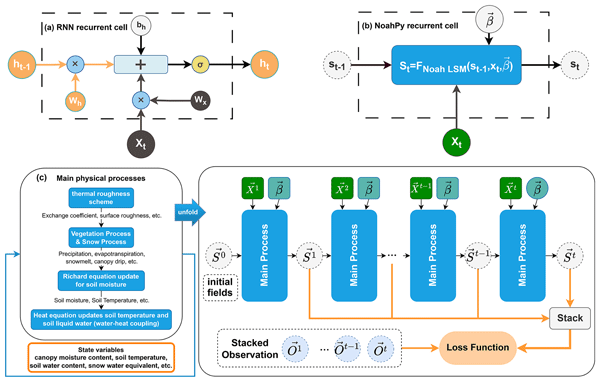
Accurately predicting how permafrost will thaw with land surface models is a grand challenge in Earth science. We created a new computer model by rebuilding a traditional physics model to work with artificial intelligence. Our results show this new approach is much faster and more reliable for tuning model parameters with data. This provides a better tool to build the next generation of climate models and improve predictions of permafrost's future.
Yuhong Chen, Zhuotong Nan, Wenbiao Tian, Yi Zhao, Shuping Zhao, Dongkai Yang, Guifei Jing, and Fujun Niu
The Cryosphere, 20, 5697–5723, https://doi.org/10.5194/tc-20-5697-2026, https://doi.org/10.5194/tc-20-5697-2026, 2026
Short summary
Short summary
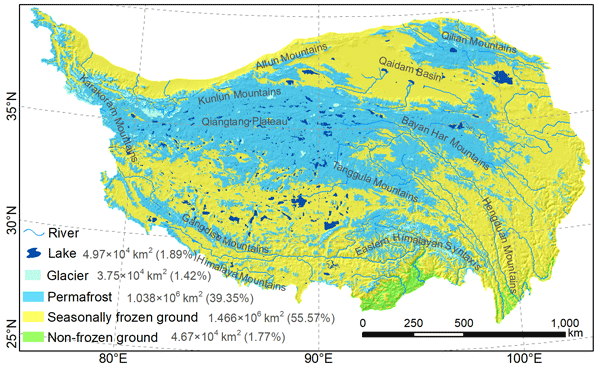
This study presents a 1-km permafrost map of the Qinghai-Tibet Plateau for 2020, generated via a frost number model and space-for-time substitution. Permafrost covers 1.038×10⁶ km² (39.35 %), a 1.82 % decline since 2010, while seasonally frozen ground covers 1.466×10⁶ km² (55.57 %). Validated against boreholes, the map achieves 0.84 accuracy (Kappa= 0.58). This map offers a critical, up-to-date baseline for cryospheric research.
Pengfei Li, Zhuotong Nan, Jiwei Xu, and Fujun Niu
EGUsphere, https://doi.org/10.5194/egusphere-2026-5035, https://doi.org/10.5194/egusphere-2026-5035, 2026
This preprint is open for discussion and under review for The Cryosphere (TC).
Short summary
Short summary
Most susceptibility models reduce multi-year inventories to binary occurrence labels and make little use of when failures occurred. We use the temporal ordering of pre-initiation states as weak supervision for susceptibility. Using annual retrogressive thaw slump inventories, the framework captured 89.45 % of 2021–2022 initiations within the top 10 % susceptibility area. The principle may apply to landslides and other mass-movement processes with multi-temporal initiation inventories.
Guoan Yin, Zhanju Lin, Fujun Niu, Jing Luo, Huini Wang, Hongye Yan, Zeyong Gao, Xin Ju, and Wenbin Yuan
EGUsphere, https://doi.org/10.5194/egusphere-2026-3345, https://doi.org/10.5194/egusphere-2026-3345, 2026
This preprint is open for discussion and under review for Geoscientific Model Development (GMD).
Short summary
Short summary
Climate change is thawing permanently frozen ground, causing the land to sink and damaging critical roads and buildings. To predict this hazard, we developed a fast computer simulation that mimics how different types of underground ice melt and compress. Our study shows that traditional models overestimate how quickly the ground warms but severely underestimate how deeply it collapses. This new tool helps engineers foresee sudden land collapse, protecting vital infrastructure in warming regions.
Lihua Chen, Xingyu Ding, Shuping Zhao, Fujun Niu, Keting Feng, and Zhuotong Nan
Earth Syst. Sci. Data, 18, 3779–3801, https://doi.org/10.5194/essd-18-3779-2026, https://doi.org/10.5194/essd-18-3779-2026, 2026
Short summary
Short summary
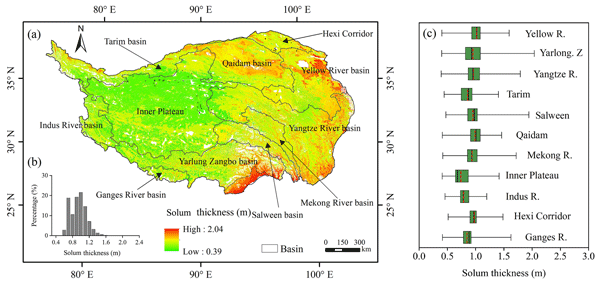
This study presents a high-resolution (1 km) physically-based solum thickness dataset for the Qinghai–Tibet Plateau. Grounded in a mechanistic mass-balance model that couples climate weathering with multi-process erosion, the data resolve geomorphological patterns and offer superior accuracy over conventional statistical products. This dataset provides essential model parameter for hydrological, ecological, and cryosphere models, facilitating more reliable assessments under a changing climate.
Lili Wang and Yaonan Zhang
EGUsphere, https://doi.org/10.5194/egusphere-2026-333, https://doi.org/10.5194/egusphere-2026-333, 2026
Preprint archived
Short summary
Short summary
This study develops a feed-forward fully connected neural network to model glacier-wide annual mass balance using multi-temporal climate, albedo, and topographic data under extremely limited sample conditions. Through feature selection and regularization, the model mitigates overfitting, outperforms a Random Forest benchmark, and shows robust spatial and temporal generalization. The proposed framework enables regional glacier mass-balance estimation in data-scarce high-altitude and cold regions.
Wenbiao Tian, Hu Yu, Shuping Zhao, Yuhe Cao, Wenjun Yi, Jiwei Xu, and Zhuotong Nan
Geosci. Model Dev., 19, 57–72, https://doi.org/10.5194/gmd-19-57-2026, https://doi.org/10.5194/gmd-19-57-2026, 2026
Short summary
Short summary
Accurately predicting how permafrost will thaw with land surface models is a grand challenge in Earth science. We created a new computer model by rebuilding a traditional physics model to work with artificial intelligence. Our results show this new approach is much faster and more reliable for tuning model parameters with data. This provides a better tool to build the next generation of climate models and improve predictions of permafrost's future.
Li Wei, Dongri Song, Peng Cui, Lijun Su, Gordon G. D. Zhou, Kaiheng Hu, Fangqiang Wei, Yong Hong, Guoqiang Ou, Jun Zhang, Zhicheng Kang, Xiaojun Guo, Wei Zhong, Xiaoyu Li, Yaonan Zhang, Chao Shi, and Hui Tang
Earth Syst. Sci. Data, 17, 7331–7358, https://doi.org/10.5194/essd-17-7331-2025, https://doi.org/10.5194/essd-17-7331-2025, 2025
Short summary
Short summary
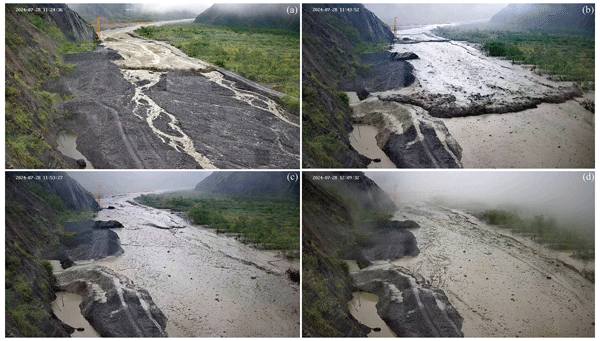
This research presents a unique 64-year (1961–2024) debris-flow dataset for Jiangjia Ravine, Dongchuan, Yunnan, China. The dataset includes detailed measurements of debris-flow kinematic parameters (velocity, depth, and discharge), physical–mechanical properties (particle size, yield stress, and viscosity), seismic data, and hydrometeorological records (e.g., minute-by-minute rainfall and soil moisture). The dataset is publicly accessible via the National Cryosphere Desert Data Center (NCDC).
Zetao Cao, Zhuotong Nan, Jianan Hu, Yuhong Chen, and Yaonan Zhang
Earth Syst. Sci. Data, 15, 3905–3930, https://doi.org/10.5194/essd-15-3905-2023, https://doi.org/10.5194/essd-15-3905-2023, 2023
Short summary
Short summary
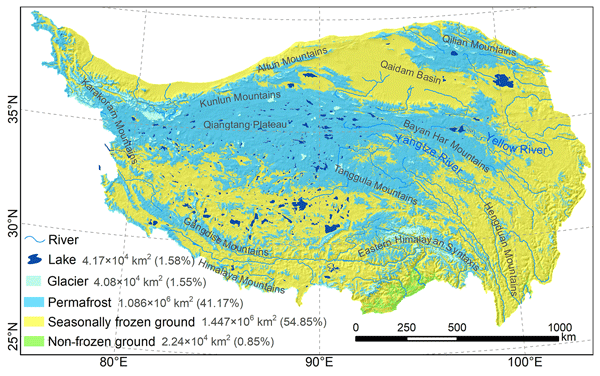
This study provides a new 2010 permafrost distribution map of the Qinghai–Tibet Plateau (QTP), using an effective mapping approach based entirely on satellite temperature data, well constrained by survey-based subregion maps, and considering the effects of local factors. The map shows that permafrost underlies about 41 % of the total QTP. We evaluated it with borehole observations and other maps, and all evidence indicates that this map has excellent accuracy.
Yi Zhao, Zhuotong Nan, Hailong Ji, and Lin Zhao
The Cryosphere, 16, 825–849, https://doi.org/10.5194/tc-16-825-2022, https://doi.org/10.5194/tc-16-825-2022, 2022
Short summary
Short summary
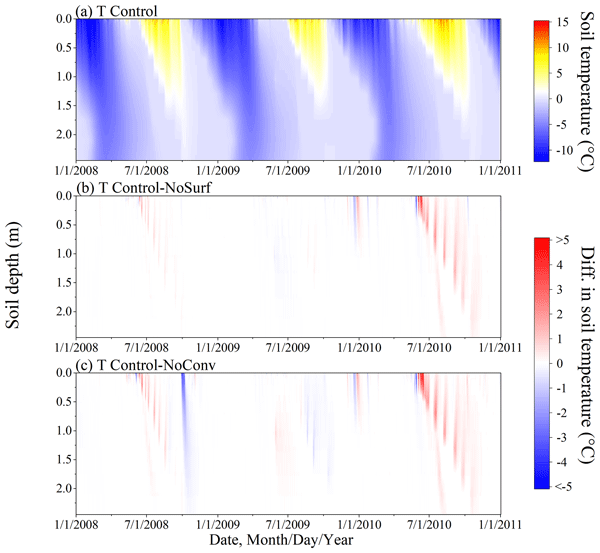
Convective heat transfer (CHT) is important in affecting thermal regimes in permafrost regions. We quantified its thermal impacts by contrasting the simulation results from three scenarios in which the Simultaneous Heat and Water model includes full, partial, and no consideration of CHT. The results show the CHT commonly happens in shallow and middle soil depths during thawing periods and has greater impacts in spring than summer. The CHT has both heating and cooling effects on the active layer.
Cited articles
Adc, W.: Third pole
Breiman, L.: Random Forests, Mach. Learn., 45, 5–32, https://doi.org/10.1023/a:1010933404324, 2001.
Burn, C. R. and Friele, P. A.: Geomorphology, vegetation succession, soil characteristics and permafrost in retrogressive thaw slumps near Mayo, Yukon Territory, Arctic, 42, 31–40, https://doi.org/10.14430/arctic1637, 1989.
Cao, Z., Nan, Z., Hu, J., Chen, Y., and Zhang, Y.: A new 2010 permafrost distribution map over the Qinghai–Tibet Plateau based on subregion survey maps: a benchmark for regional permafrost modeling, Earth Syst. Sci. Data, 15, 3905–3930, https://doi.org/10.5194/essd-15-3905-2023, 2023.
Cassidy, A. E., Christen, A., and Henry, G. H. R.: Impacts of active retrogressive thaw slumps on vegetation, soil, and net ecosystem exchange of carbon dioxide in the Canadian High Arctic, Arct. Sci., 3, 179–202, https://doi.org/10.1139/as-2016-0034, 2017.
Chen, J., Zhang, J., Wu, T.-H., Liu, L., Zhang, F.-Y., Hao, J.-M., Huang, L.-C., Wu, X.-D., Wang, P.-L., Xia, Z.-X., Zhu, X.-F., and Lou, P.-Q.: Elevation-dependent shift of landslide activity in mountain permafrost regions of the Qilian Mountains, Adv. Clim. Change Res., 15, 1067–1077, https://doi.org/10.1016/j.accre.2024.11.003, 2024.
Cheng, G., Zhao, L., Li, R., Wu, X., Sheng, Y., Hu, G., Zou, D., Jin, H., and Wu, Q.: Characteristic, changes and impacts of permafrost on Qinghai-Tibet Plateau, Chin. Sci. Bull., 64, 2783–2795, https://doi.org/10.1360/TB-2019-0191, 2019.
Cohen, J.: A Coefficient of Agreement for Nominal Scales, Educ. Psychol. Meas., 20, 37–46, https://doi.org/10.1177/001316446002000104, 1960.
Coles, S.: An Introduction to Statistical Modeling of Extreme Values, Springer, London, https://doi.org/10.1007/978-1-4471-3675-0, 2001.
Cramer, J. S.: The origins of logistic regression, SSRN Electron. J., https://doi.org/10.2139/ssrn.360300, 2003.
Dai, C., Ward Jones, M. K., van der Sluijs, J., Nesterova, N., Howat, I. M., Liljedahl, A. K., Higman, B., Freymueller, J. T., Kokelj, S. V., and Sriram, S.: Volumetric quantifications and dynamics of areas undergoing retrogressive thaw slumping in the Northern Hemisphere, Nat. Commun., 16, 6795, https://doi.org/10.1038/s41467-025-62017-0, 2025.
Davison, A. C. and Huser, R.: Statistics of extremes, Annu. Rev. Stat. Appl., 2, 203–235, https://doi.org/10.1146/annurev-statistics-010814-020133, 2015.
Deng, H., Zhang, Z., and Wu, Y.: Accelerated permafrost degradation in thermokarst landforms in Qilian Mountains from 2007 to 2020 observed by SBAS-InSAR, Ecol. Indic., 159, 111724, https://doi.org/10.1016/j.ecolind.2024.111724, 2024.
Guyon, I. and Elisseef, f.: An introduction to variable and feature selection, J. Mach. Learn. Res., 3, 1157–1182, 2003.
Halder, K., Srivastava, A. K., Ghosh, A., Das, S., Banerjee, S., Pal, S. C., Chatterjee, U., Bisai, D., Ewert, F., and Gaiser, T.: Improving landslide susceptibility prediction through ensemble recursive feature elimination and meta-learning framework, Sci. Rep., 15, 5170, https://doi.org/10.1038/s41598-025-87587-3, 2025.
Hanley, J. A. and McNeil, B. J.: The meaning and use of the area under a receiver operating characteristic (ROC) curve, Radiology, 143, 29–36, https://doi.org/10.1148/radiology.143.1.7063747, 1982.
He, Y., Huo, T., Gao, B., Zhu, Q., Jin, L., Chen, J., Zhang, Q., and Tang, J.: Thaw slump susceptibility mapping based on sample optimization and ensemble learning techniques in Qinghai-Tibet Railway Corridor, IEEE J. Select. Top. Appl. Earth Obs. Remote Sens., 17, 5443–5459, https://doi.org/10.1109/jstars.2024.3368039, 2024.
Hjort, J., Streletskiy, D., Doré, G., Wu, Q., Bjella, K., and Luoto, M.: Impacts of permafrost degradation on infrastructure, Nat. Rev. Earth Environ., 3, 24–38, https://doi.org/10.1038/s43017-021-00247-8, 2022.
Holt, C. C.: Forecasting seasonals and trends by exponentially weighted moving averages, Int. J. Forecast., 20, 5–10, https://doi.org/10.1016/j.ijforecast.2003.09.015, 2004.
Huang, X., Yin, Y., Feng, L., Tong, X., Zhang, X., Li, J., and Tian, F.: A 10 m resolution land cover map of the Tibetan Plateau with detailed vegetation types, Earth Syst. Sci. Data, 16, 3307–3332, https://doi.org/10.5194/essd-16-3307-2024, 2024.
Jin, D., Sun, J., and Fu, S.: Discussion on landslides hazard mechanism of two kinds of low angle slope in permafrost region of Qinghai-Tibet plateau, Rock Soil Mech., 26, 774–778, https://doi.org/10.16285/j.rsm.2005.05.020, 2005.
Kokelj, S. V., Tunnicliffe, J., Lacelle, D., Lantz, T. C., Chin, K. S., and Fraser, R.: Increased precipitation drives mega slump development and destabilization of ice-rich permafrost terrain, northwestern Canada, Global Planet. Change, 129, 56–68, https://doi.org/10.1016/j.gloplacha.2015.02.008, 2015.
Krautblatter, M., Angelopoulos, M., Pollard, W. H., Lantuit, H., Lenz, J., Fritz, M., Couture, N., and Eppinger, S.: Life cycles and polycyclicity of mega retrogressive thaw slumps in arctic permafrost revealed by 2D/3D geophysics and long-term retreat monitoring, J. Geophys. Res.-Earth, 129, e2023JF007556, https://doi.org/10.1029/2023JF007556, 2024.
Kuang, X. and Jiao, J. J.: Review on climate change on the Tibetan Plateau during the last half century, J. Geophys. Res.-Atmos., 121, 3979–4007, https://doi.org/10.1002/2015jd024728, 2016.
Lacelle, D., Bjornson, J., and Lauriol, B.: Climatic and geomorphic factors affecting contemporary (1950–2004) activity of retrogressive thaw slumps on the Aklavik Plateau, Richardson Mountains, NWT, Canada, Permafrost Periglac. Process., 21, 1–15, https://doi.org/10.1002/ppp.666, 2009.
Lantz, T. C., Kokelj, S. V., Gergel, S. E., and Henry, G. H. R.: Relative impacts of disturbance and temperature: persistent changes in microenvironment and vegetation in retrogressive thaw slumps, Global Change Biol., 15, 1664–1675, https://doi.org/10.1111/j.1365-2486.2009.01917.x, 2009.
Leibman, M., Khomutov, A., and Kizyakov, A.: Cryogenic Landslides in the Arctic Plains of Russia: Classification, Mechanisms, and Landforms, in: Landslide Science for a Safer Geoenvironment, edited by: Sassa, K., Canuti, P., and Yin, Y., Springer, Cham, 493–497, https://doi.org/10.1007/978-3-319-04996-0_75, 2014.
Lewkowicz, A. G. and Way, R. G.: Extremes of summer climate trigger thousands of thermokarst landslides in a High Arctic environment, Nat. Commun., 10, https://doi.org/10.1038/s41467-019-09314-7, 2019.
Li, Y., Liu, Y., Chen, J., Dang, H., Zhang, S., Mei, Q., Zhao, J., Wang, J., Dong, T., and Zhao, Y.: Advances in retrogressive thaw slump research in permafrost regions, Permafrost Periglac. Process., 35, 125–142, https://doi.org/10.1002/ppp.2218, 2024.
Luo, B., Liu, W., Xie, C., Liu, H., Hao, J., Zhou, G., Li, Q., and Li, Q.: A review of progress in the study of retrogressive thaw slumps on the Qinghai-Xizang Plateau, J. Glaciol. Geocryol., 46, 1135–1155, https://doi.org/10.7522/j.issn.1000-0240.2024.0090, 2024a.
Luo, D., Liu, J., Chen, F., and Li, S.: Observed talik development triggers a tipping point in marginal permafrost of the Qinghai-Xizang Plateau, Geosci. Front., 16, 102122, https://doi.org/10.1016/j.gsf.2025.102122, 2025.
Luo, J., Niu, F., Lin, Z., Liu, M., and Yin, G.: Thermokarst lake changes between 1969 and 2010 in the Beilu River Basin, Qinghai–Tibet Plateau, China, Sci. Bull., 60, 556–564, https://doi.org/10.1007/s11434-015-0730-2, 2015.
Luo, J., Niu, F., Lin, Z., Liu, M., Yin, G., and Gao, Z.: The characteristics and patterns of retrogressive thaw slumps developed in permafrost region of the Qinghai-Tibet Plateau, J. Glaciol. Geocryol., 44, 96–105, https://doi.org/10.7522/j.issn.1000-0240.2022.0022, 2022a.
Luo, J., Niu, F., Lin, Z., Liu, M., Yin, G., and Gao, Z.: Inventory and Frequency of Retrogressive Thaw Slumps in Permafrost Region of the Qinghai–Tibet Plateau, Geophys. Res. Lett., 49, https://doi.org/10.1029/2022gl099829, 2022b.
Luo, J., Yin, G.-A., Niu, F.-J., Dong, T.-C., Gao, Z.-Y., Liu, M.-H., and Yu, F.: Machine learning-based predictions of current and future susceptibility to retrogressive thaw slumps across the Northern Hemisphere, Adv. Clim. Change Res., 15, 253–264, https://doi.org/10.1016/j.accre.2024.03.001, 2024b.
Maier, K., Bernhard, P., Ly, S., Volpi, M., Nitze, I., Li, S., and Hajnsek, I.: Detecting mass wasting of Retrogressive Thaw Slumps in spaceborne elevation models using deep learning, Int. J. Appl. Earth Obs. Geoinf., 137, 104419, https://doi.org/10.1016/j.jag.2025.104419, 2025a.
Maier, K., Xia, Z., Liu, L., Lara, M. J., van der Sluijs, J., Bernhard, P., and Hajnsek, I.: Quantifying retrogressive thaw slump mass wasting and carbon mobilisation on the Qinghai-Tibet Plateau using multi-modal remote sensing, The Cryosphere, 19, 4855–4873, https://doi.org/10.5194/tc-19-4855-2025, 2025b.
McKay, M. D., Beckman, R. J., and Conover, W. J.: Comparison of three methods for selecting values of input variables in the analysis of output from a computer code, Technometrics, 21, 239–245, https://doi.org/10.1080/00401706.1979.10489755, 1979.
Misra, P. and Yadav, A. S.: Improving the classification accuracy using recursive feature elimination with cross-validation, Int. J. Emerg. Technol., 11, 659–665, 2020.
Moran, P. A. P.: Notes On Continuous Stochastic Phenomena, Biometrika, 37, 17–23, https://doi.org/10.1093/biomet/37.1-2.17, 1950.
Mu, C., Zhang, T., Zhang, X., Li, L., Guo, H., Zhao, Q., Cao, L., Wu, Q., and Cheng, G.: Carbon loss and chemical changes from permafrost collapse in the northern Tibetan Plateau, J. Geophys. Res.-Biogeo., 121, 1781–1791, https://doi.org/10.1002/2015jg003235, 2016.
NASA JPL: NASADEM Merged DEM Global 1 arc second V001, NASA JPL [data set], https://doi.org/10.5067/MEASURES/NASADEM/NASADEM_HGT.001, 2020.
Nesterova, N., Leibman, M., Kizyakov, A., Lantuit, H., Tarasevich, I., Nitze, I., Veremeeva, A., and Grosse, G.: Review article: Retrogressive thaw slump characteristics and terminology, The Cryosphere, 18, 4787–4810, https://doi.org/10.5194/tc-18-4787-2024, 2024.
Nitze, I., Van der Sluijs, J., Barth, S., Bernhard, P., Huang, L., Kizyakov, A., Lara, Mark J., Nesterova, N., Runge, A., Veremeeva, A., Ward Jones, M., Witharana, C., Xia, Z., and Liljedahl, Anna K.: A labeling intercomparison of retrogressive thaw slumps by a diverse group of domain experts, Permafrost Periglac. Process., 36, 83–92, https://doi.org/10.1002/ppp.2249, 2025.
Niu, F., Cheng, G., Ni, W., and Jin, D.: Engineering-related slope failure in permafrost regions of the Qinghai-Tibet Plateau, Cold. Reg. Sci. Technol., 42, 215–225, https://doi.org/10.1016/j.coldregions.2005.02.002, 2005.
Obu, J.: How much of the earth's surface is underlain by permafrost?, J. Geophys. Res.-Earth, 126, e2021JF006123, https://doi.org/10.1029/2021JF006123, 2021.
Peng, S.: 1-km monthly mean temperature dataset for china (1901–2024), National Tibetan Plateau/Third Pole Environment Data Center [data set], https://doi.org/10.11888/Meteoro.tpdc.270961, 2019.
Peng, S., Ding, Y., Liu, W., and Li, Z.: 1 km monthly temperature and precipitation dataset for China from 1901 to 2017, Earth Syst. Sci. Data, 11, 1931–1946, https://doi.org/10.5194/essd-11-1931-2019, 2019.
Planet Team: Planet application program interface: In space for life on earth, https://api.planet.com (last access: 15 April 2026), 2025.
Pontius, R. G., Boersma, W., Castella, J.-C., Clarke, K., de Nijs, T., Dietzel, C., Duan, Z., Fotsing, E., Goldstein, N., Kok, K., Koomen, E., Lippitt, C. D., McConnell, W., Mohd Sood, A., Pijanowski, B., Pithadia, S., Sweeney, S., Trung, T. N., Veldkamp, A. T., and Verburg, P. H.: Comparing the input, output, and validation maps for several models of land change, Ann. Reg. Sci., 42, 11-37, https://doi.org/10.1007/s00168-007-0138-2, 2008.
Probst, P., Boulesteix, A., and Bischl, B.: Tunability: importance of hyperparameters of machine learning algorithms, J. Mach. Learn. Res., 20, 1934–1965, 2019.
Qi, S.: Engineering geological petrofabric database of Qinghai Tibet Plateau, National Tibetan Plateau/Third Pole Environment Data Center [data set], https://doi.org/10.11888/SolidEar.tpdc.272211, 2021.
Ran, Y., Li, X., and Cheng, G.: Climate warming over the past half century has led to thermal degradation of permafrost on the Qinghai–Tibet Plateau, The Cryosphere, 12, 595–608, https://doi.org/10.5194/tc-12-595-2018, 2018.
Roberts, D. R., Bahn, V., Ciuti, S., Boyce, M. S., Elith, J., Guillera-Arroita, G., Hauenstein, S., Lahoz-Monfort, J. J., Schröder, B., Thuiller, W., Warton, D. I., Wintle, B. A., Hartig, F., and Dormann, C. F.: Cross-validation strategies for data with temporal, spatial, hierarchical, or phylogenetic structure, Ecography, 40, 913–929, https://doi.org/10.1111/ecog.02881, 2017.
Rudy, A. C. A., Lamoureux, S. F., Treitz, P., and van Ewijk, K. Y.: Transferability of regional permafrost disturbance susceptibility modelling using generalized linear and generalized additive models, Geomorphology, 264, 95–108, https://doi.org/10.1016/j.geomorph.2016.04.011, 2016.
Shi, G. and Wei, S.: A China dataset of soil properties for land surface modeling (version 2, CSDLv2), National Tibetan Plateau/Third Pole Environment Data Center [dat aset], https://doi.org/10.11888/Terre.tpdc.301235, 2024.
Sun, D., Xu, J., Wen, H., and Wang, D.: Assessment of landslide susceptibility mapping based on Bayesian hyperparameter optimization: A comparison between logistic regression and random forest, Eng. Geol., 281, https://doi.org/10.1016/j.enggeo.2020.105972, 2021.
Toffoli, T. and Margolus, N.: Cellular automata machines: A new environment for modeling, The MIT Press, 259 pp., https://doi.org/10.7551/mitpress/1763.001.0001, 1987.
Verburg, P. H. and Overmars, K. P.: Combining top-down and bottom-up dynamics in land use modeling: exploring the future of abandoned farmlands in Europe with the Dyna-CLUE model, Landsc. Ecol., 24, 1167–1181, https://doi.org/10.1007/s10980-009-9355-7, 2009.
Verburg, P. H., Soepboer, W., Veldkamp, A., Limpiada, R., Espaldon, V., and Mastura, S. S. A.: Modeling the Spatial Dynamics of Regional Land Use: The CLUE-S Model, Environ. Manage., 30, 391–405, https://doi.org/10.1007/s00267-002-2630-x, 2002.
Wang, F., Wen, Z., Gao, Q., Yu, Q., Li, D., and Chen, L.: Thermokarst landslides susceptibility evaluation across the permafrost region of the central Qinghai-Tibet Plateau: Integrating a machine learning model with InSAR technology, J. Hydrol., 642, https://doi.org/10.1016/j.jhydrol.2024.131800, 2024.
Wang, Y., Sun, Z., and Sun, Y.: Effects of a thaw slump on active layer in permafrost regions with the comparison of effects of thermokarst lakes on the Qinghai–Tibet Plateau, China, Geoderma, 314, 47–57, https://doi.org/10.1016/j.geoderma.2017.10.046, 2018.
Wolfram, S.: Statistical mechanics of cellular automata, Rev. Mod. Phys., 55, 601–644, https://doi.org/10.1103/RevModPhys.55.601, 1983.
Xia, Z., Liu, L., Mu, C., Peng, X., Zhao, Z., Huang, L., Luo, J., and Fan, C.: Annual inventories of retrogressive thaw slumps across the Qinghai-Tibet Plateau from 2016 to 2022, Zenodo [data set], https://doi.org/10.5281/zenodo.10928346, 2024a.
Xia, Z., Liu, L., Mu, C., Peng, X., Zhao, Z., Huang, L., Luo, J., and Fan, C.: Widespread and rapid activities of retrogressive thaw slumps on the Qinghai-Tibet Plateau from 2016 to 2022, Geophys. Res. Lett., 51, https://doi.org/10.1029/2024gl109616, 2024b.
Xu, J. and Nan, Z.: nanzt/RTSEvo (v1.0-GMD), Zenodo [code], https://doi.org/10.5281/zenodo.17850641, 2025a.
Xu, J. and Nan, Z.: Datasets associated with “RTSEvo v1.0: A Retrogressive Thaw Slump Evolution Model” submitted to Geoscientific Model Development, figshare [data set], https://doi.org/10.6084/m9.figshare.30325243, 2025b.
Yan, D., Zheng, X., Feng, M., Liang, S., Hu, Z., Kuang, X., and Feng, Y.: Frozen ground change data set in the Tibetan Plateau (1961–2020), National Tibetan Plateau/Third Pole Environment Data Center [data set], https://doi.org/10.11888/Cryos.tpdc.300955, 2023.
Yang, D., Qiu, H., Ye, B., Liu, Y., Zhang, J., and Zhu, Y.: Distribution and recurrence of warming-induced retrogressive thaw slumps on the central Qinghai-Tibet Plateau, J. Geophys. Res.-Earth, 128, https://doi.org/10.1029/2022jf007047, 2023.
Yao, T., Xue, Y., Chen, D., Chen, F., Thompson, L., Cui, P., Koike, T., Lau, W., Lettenmaier, D., Mosbrugger, V., Zhang, R., Xu, B., Dozier, J., Gillespie, T., Gu, Y., Kang, S., Piao, S., Sugimoto, S., Ueno, K., and Li, Q.: Recent third pole's rapid warming accompanies cryospheric melt and water cycle intensification and interactions between monsoon and environment: Multidisciplinary approach with observations, modeling, and analysis, B. Am. Meteorol. Soc., 100, 423–444, https://doi.org/10.1175/BAMS-D-17-0057.1, 2019.
Yao, T., Bolch, T., Chen, D., Gao, J., Immerzeel, W., Piao, S., Su, F., Thompson, L., Wada, Y., Wang, L., Wang, T., Wu, G., Xu, B., Yang, W., Zhang, G., and Zhao, P.: The imbalance of the Asian water tower, Nat. Rev. Earth Environ., 3, 618–632, https://doi.org/10.1038/s43017-022-00299-4, 2022.
Yi, Y., Kimball, J. S., Chen, R. H., Moghaddam, M., Reichle, R. H., Mishra, U., Zona, D., and Oechel, W. C.: Characterizing permafrost active layer dynamics and sensitivity to landscape spatial heterogeneity in Alaska, The Cryosphere, 12, 145–161, https://doi.org/10.5194/tc-12-145-2018, 2018.
Yin, G., Niu, F., Lin, Z., Luo, J., and Liu, M.: Effects of local factors and climate on permafrost conditions and distribution in Beiluhe basin, Qinghai-Tibet Plateau, China, Sci. Total. Environ., 581–582, 472–485, https://doi.org/10.1016/j.scitotenv.2016.12.155, 2017.
Yin, G., Luo, J., Niu, F., Lin, Z., and Liu, M.: Machine learning-based thermokarst landslide susceptibility modeling across the permafrost region on the Qinghai-Tibet Plateau, Landslides, 18, 2639–2649, https://doi.org/10.1007/s10346-021-01669-7, 2021.
Yin, G., Luo, J., Niu, F., Liu, M., Gao, Z., Dong, T., and Ni, W.: High-resolution assessment of retrogressive thaw slump susceptibility in the Qinghai-Tibet Engineering Corridor, Res. Cold Arid Reg., 15, 288–294, https://doi.org/10.1016/j.rcar.2023.11.006, 2023.
Yu, F., Luo, J., Niu, F., Lin, Z., Li, B., Mu, Y., Ju, X., Liu, M., Yin, G., Gao, Z., Zhao, X., and Zhang, C.: Spatiotemporal dynamics of retrogressive thaw slumps on the Qinghai-Tibet Plateau: integrating UAV-LiDAR and GPR, Landslides, 22, 3351–3363, https://doi.org/10.1007/s10346-025-02549-0, 2025.
Zhang, G., Nan, Z., Zhao, L., Liang, Y., and Cheng, G.: Qinghai-Tibet Plateau wetting reduces permafrost thermal responses to climate warming, Earth Planet. Sc. Lett., 562, https://doi.org/10.1016/j.epsl.2021.116858, 2021.
Zhang, G., Nan, Z., Hu, N., Yin, Z., Zhao, L., Cheng, G., and Mu, C.: Qinghai-Tibet Plateau permafrost at risk in the late 21st century, Earth's Future, 10, https://doi.org/10.1029/2022ef002652, 2022.
Zhao, L., Zou, D., Hu, G., Wu, T., Du, E., Liu, G., Xiao, Y., Li, R., Pang, Q., Qiao, Y., Wu, X., Sun, Z., Xing, Z., Sheng, Y., Zhao, Y., Shi, J., Xie, C., Wang, L., Wang, C., and Cheng, G.: A synthesis dataset of permafrost thermal state for the Qinghai–Tibet (Xizang) Plateau, China, Earth Syst. Sci. Data, 13, 4207–4218, https://doi.org/10.5194/essd-13-4207-2021, 2021.
Zhao, L., Hu, G., Liu, G., Zou, D., Wang, Y., Xiao, Y., Du, E., Wang, C., Xing, Z., Sun, Z., Zhao, Y., Liu, S., Zhang, Y., Wang, L., Zhou, H., and Zhao, J.: Investigation, monitoring, and simulation of permafrost on the Qinghai-Tibet Plateau: A review, Permafrost Periglac. Process., 35, 412–422, https://doi.org/10.1002/ppp.2227, 2024.
Zhou, W., Ma, T., Yin, X., Wu, X., Li, Q., Rupakheti, D., Xiong, X., Zhang, Q., Mu, C., de Foy, B., Rupakheti, M., Kang, S., and Qin, D.: Dramatic carbon loss in a permafrost thaw slump in the Tibetan Plateau is dominated by the loss of microbial necromass carbon, Environ. Sci. Technol., 57, 6910–6921, https://doi.org/10.1021/acs.est.2c07274, 2023.
Zhu, X., Wu, T., Chen, J., Wu, X., Wang, P., Zou, D., Yue, G., Yan, X., Ma, X., Wang, D., Lou, P., Wen, A., Shang, C., and Liu, W.: Summer heat wave in 2022 led to rapid warming of permafrost in the central Qinghai-Tibet Plateau, npj Clim. Atmos. Sci., 7, 216, https://doi.org/10.1038/s41612-024-00765-4, 2024.
Ziteng, F., Qingbai, W., Anping, C., Luyang, W., Guanli, J., Siru, G., Hanbo, Y., and Ji, C.: Non-temperature environmental drivers modulate warming-induced 21st-century permafrost degradation on the Tibetan Plateau, Nat. Commun., 16, 7556, https://doi.org/10.1038/s41467-025-63032-x, 2025.
Zou, D., Pang, Q., Zhao, L., Wang, L., Hu, G., Du, E., Liu, G., Liu, S., and Liu, Y.: Estimation of Permafrost Ground Ice to 10 m Depth on the Qinghai-Tibet Plateau, Permafrost Periglac. Process., 35, 423–434, https://doi.org/10.1002/ppp.2226, 2024.
Short summary
Permafrost is warming, causing more ground collapses known as retrogressive thaw slumps that damage ecosystems and infrastructure. We created a new computer model to predict how these slumps grow and spread over time. By combining satellite data, statistics, and rules that mimic natural erosion, the model can reproduce changes with high accuracy. This helps scientists and planners better forecast future permafrost hazards.
Permafrost is warming, causing more ground collapses known as retrogressive thaw slumps that...


