
Articles | Volume 19, issue 7
https://doi.org/10.5194/gmd-19-2785-2026
© Author(s) 2026. This work is distributed under
the Creative Commons Attribution 4.0 License.
the Creative Commons Attribution 4.0 License.
https://doi.org/10.5194/gmd-19-2785-2026
© Author(s) 2026. This work is distributed under
the Creative Commons Attribution 4.0 License.
the Creative Commons Attribution 4.0 License.
Model description paper
| 
13 Apr 2026
Model description paper |
| 13 Apr 2026
| 13 Apr 2026
“Norkyst” version 3: the coastal ocean forecasting system for Norway

Norwegian Meteorological Institute, Oslo, Norway
University of Oslo, Oslo, Norway
Jon Albretsen
Institute of Marine Research, Bergen, Norway
Lars Asplin
Institute of Marine Research, Bergen, Norway
Håvard Guldbrandsen Frøysa
Institute of Marine Research, Bergen, Norway
Yvonne Gusdal
Norwegian Meteorological Institute, Oslo, Norway
Silje Christine Iversen
Norwegian Meteorological Institute, Oslo, Norway
Mari Fjalstad Jensen
Institute of Marine Research, Bergen, Norway
Ingrid Askeland Johnsen
Institute of Marine Research, Bergen, Norway
Nils Melsom Kristensen
Norwegian Meteorological Institute, Oslo, Norway
Pål Næverlid Sævik
Institute of Marine Research, Bergen, Norway
Anne Dagrun Sandvik
Institute of Marine Research, Bergen, Norway
Magne Simonsen
Norwegian Meteorological Institute, Oslo, Norway
Jofrid Skarðhamar
Institute of Marine Research, Bergen, Norway
Ann Kristin Sperrevik
Norwegian Meteorological Institute, Oslo, Norway
Marta Trodahl
Norwegian Meteorological Institute, Oslo, Norway
now at: Equinor, Stavanger, Norway
Related authors
Jean Rabault, Joey Voermans, Takehiko Nose, Graig Sutherland, Alexander Babanin, Takuji Waseda, Tsubasa Kodaira, Atle Jensen, Lars Willas Dreyer, Øyvind Breivik, Gaute Hope, Malte Müller, Zhaohui Cheng, Lichuan Wu, Aleksey Marchenko, Brian Ward, Kai H. Christensen, Petra Heil, and Karsten Trulsen
EGUsphere, https://doi.org/10.48550/arXiv.2507.19034, https://doi.org/10.48550/arXiv.2507.19034, 2025
Short summary
Short summary
We observe harmonics of the main incoming wave peak in sea ice motion data. These harmonics match non-linear 3-wave interactions predicted from the dispersion relation. This may indicate that wave in ice triads are empirically observed, which suggests that non-linear energy transfers play a role in wave in ice propagation.
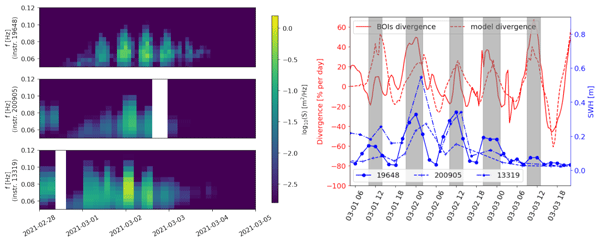
Jean Rabault, Trygve Halsne, Ana Carrasco, Anton Korosov, Joey Voermans, Patrik Bohlinger, Jens Boldingh Debernard, Malte Müller, Øyvind Breivik, Takehiko Nose, Gaute Hope, Fabrice Collard, Sylvain Herlédan, Tsubasa Kodaira, Nick Hughes, Qin Zhang, Kai Håkon Christensen, Alexander Babanin, Lars Willas Dreyer, Cyril Palerme, Lotfi Aouf, Konstantinos Christakos, Atle Jensen, Johannes Röhrs, Aleksey Marchenko, Graig Sutherland, Trygve Kvåle Løken, and Takuji Waseda
The Cryosphere, 19, 6229–6260, https://doi.org/10.5194/tc-19-6229-2025, https://doi.org/10.5194/tc-19-6229-2025, 2025
Short summary
Short summary
We observe strongly modulated waves-in-ice significant wave height using buoys deployed East of Svalbard. We show that these observations likely cannot be explained by wave-current interaction or tide-induced modulation alone. We also demonstrate a strong correlation between the waves height modulation, and the rate of sea ice convergence. Therefore, our data suggest that the rate of sea ice convergence and divergence may modulate wave in ice energy dissipation.
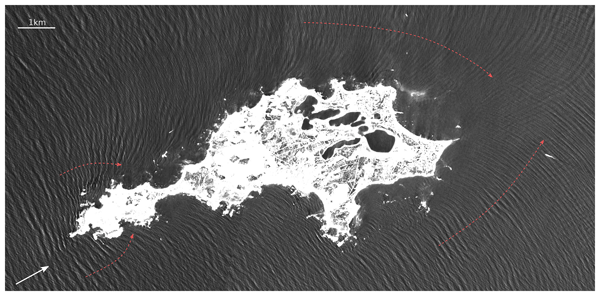
Trygve Halsne, Kai Håkon Christensen, Gaute Hope, and Øyvind Breivik
Geosci. Model Dev., 16, 6515–6530, https://doi.org/10.5194/gmd-16-6515-2023, https://doi.org/10.5194/gmd-16-6515-2023, 2023
Short summary
Short summary
Surface waves that propagate in oceanic or coastal environments get influenced by their surroundings. Changes in the ambient current or the depth profile affect the wave propagation path, and the change in wave direction is called refraction. Some analytical solutions to the governing equations exist under ideal conditions, but for realistic situations, the equations must be solved numerically. Here we present such a numerical solver under an open-source license.
Johannes Röhrs, Yvonne Gusdal, Edel S. U. Rikardsen, Marina Durán Moro, Jostein Brændshøi, Nils Melsom Kristensen, Sindre Fritzner, Keguang Wang, Ann Kristin Sperrevik, Martina Idžanović, Thomas Lavergne, Jens Boldingh Debernard, and Kai H. Christensen
Geosci. Model Dev., 16, 5401–5426, https://doi.org/10.5194/gmd-16-5401-2023, https://doi.org/10.5194/gmd-16-5401-2023, 2023
Short summary
Short summary
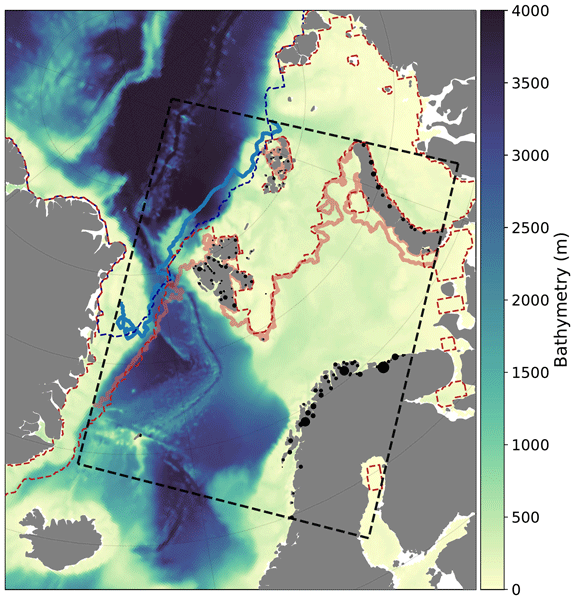
A model to predict ocean currents, temperature, and sea ice is presented, covering the Barents Sea and northern Norway. To quantify forecast uncertainties, the model calculates ensemble forecasts with 24 realizations of ocean and ice conditions. Observations from satellites, buoys, and ships are ingested by the model. The model forecasts are compared with observations, and we show that the ocean model has skill in predicting sea surface temperatures.
Kjersti Kalhagen, Ilker Fer, Till M. Baumann, Jon Albretsen, and Lukas Frank
Ocean Sci., 22, 2333–2355, https://doi.org/10.5194/os-22-2333-2026, https://doi.org/10.5194/os-22-2333-2026, 2026
Short summary
Short summary
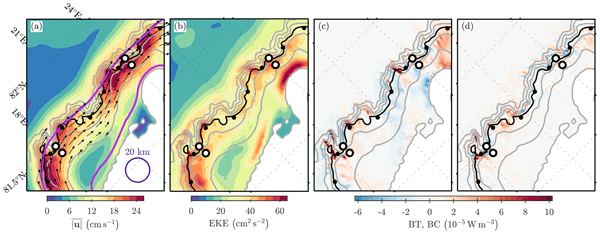
Warm Atlantic Water flowing eastward north of Svalbard loses heat faster than can be explained by cooling to the atmosphere and mixing alone. Using year-long mooring observations and an ocean model, we found that mesoscale variability and energy transfer into eddies are largest in autumn and winter, when the boundary current is also at its strongest and warmest. This mesoscale activity enhances lateral heat exchange and likely contributes to the observed cooling of Atlantic Water along its path.
Silvana Gonzalez, Mari F. Jensen, Ingrid A. Johnsen, Randi Ingvaldsen, Jon Albretsen, Lars Asplin, Anne Sandvik, Vidar S. Lien, Solfrid Sætre Hjøllo, and Anne Britt Sandø
State Planet Discuss., https://doi.org/10.5194/sp-2026-2, https://doi.org/10.5194/sp-2026-2, 2026
Revised manuscript accepted for SP
Short summary
Short summary
Marine heatwaves occurrence is increasing, especially in northern oceans. In summer 2025, western/central Norway had the most intense event on record, with sea temperatures up to 22 °C. This event was shallow and developed quickly. It was mainly driven by unusual weather: strong solar radiation, weak winds, warm air, and persistent high pressure over Scandinavia. The occurrence of these rapid-forming events has important implications for predictability and adaptation.
Jean Rabault, Joey Voermans, Takehiko Nose, Graig Sutherland, Alexander Babanin, Takuji Waseda, Tsubasa Kodaira, Atle Jensen, Lars Willas Dreyer, Øyvind Breivik, Gaute Hope, Malte Müller, Zhaohui Cheng, Lichuan Wu, Aleksey Marchenko, Brian Ward, Kai H. Christensen, Petra Heil, and Karsten Trulsen
EGUsphere, https://doi.org/10.48550/arXiv.2507.19034, https://doi.org/10.48550/arXiv.2507.19034, 2025
Short summary
Short summary
We observe harmonics of the main incoming wave peak in sea ice motion data. These harmonics match non-linear 3-wave interactions predicted from the dispersion relation. This may indicate that wave in ice triads are empirically observed, which suggests that non-linear energy transfers play a role in wave in ice propagation.
Jean Rabault, Trygve Halsne, Ana Carrasco, Anton Korosov, Joey Voermans, Patrik Bohlinger, Jens Boldingh Debernard, Malte Müller, Øyvind Breivik, Takehiko Nose, Gaute Hope, Fabrice Collard, Sylvain Herlédan, Tsubasa Kodaira, Nick Hughes, Qin Zhang, Kai Håkon Christensen, Alexander Babanin, Lars Willas Dreyer, Cyril Palerme, Lotfi Aouf, Konstantinos Christakos, Atle Jensen, Johannes Röhrs, Aleksey Marchenko, Graig Sutherland, Trygve Kvåle Løken, and Takuji Waseda
The Cryosphere, 19, 6229–6260, https://doi.org/10.5194/tc-19-6229-2025, https://doi.org/10.5194/tc-19-6229-2025, 2025
Short summary
Short summary
We observe strongly modulated waves-in-ice significant wave height using buoys deployed East of Svalbard. We show that these observations likely cannot be explained by wave-current interaction or tide-induced modulation alone. We also demonstrate a strong correlation between the waves height modulation, and the rate of sea ice convergence. Therefore, our data suggest that the rate of sea ice convergence and divergence may modulate wave in ice energy dissipation.
Lukas Frank, Jon Albretsen, Ragnheid Skogseth, Frank Nilsen, and Marius O. Jonassen
Ocean Sci., 21, 2419–2442, https://doi.org/10.5194/os-21-2419-2025, https://doi.org/10.5194/os-21-2419-2025, 2025
Short summary
Short summary
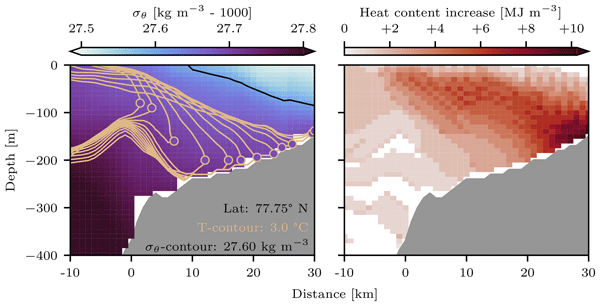
West of Svalbard, warm Atlantic Water frequently deviates from the West Spitsbergen Current onto shallow shelf areas, with significant implications for the regional climate system. The intrusions can be triggered by different processes, but their depths ultimately depend on the density difference between the intruding water and the ambient shelf water. These findings are an important step toward a better understanding of how warm Atlantic Water eventually reaches the fjords of Svalbard.
Marina Durán Moro, Ann Kristin Sperrevik, Thomas Lavergne, Laurent Bertino, Yvonne Gusdal, Silje Christine Iversen, and Jozef Rusin
The Cryosphere, 18, 1597–1619, https://doi.org/10.5194/tc-18-1597-2024, https://doi.org/10.5194/tc-18-1597-2024, 2024
Short summary
Short summary
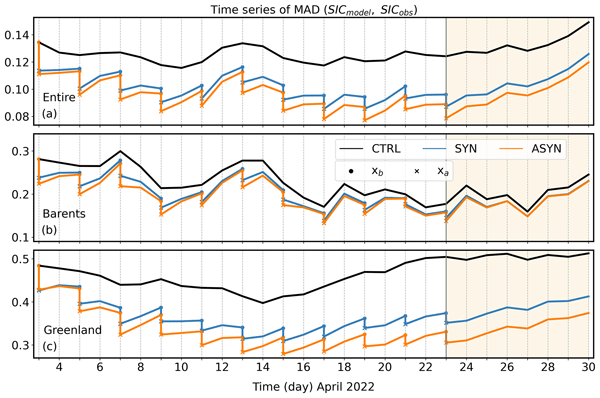
Individual satellite passes instead of daily means of sea ice concentration are used to correct the sea ice model forecast in the Barents Sea. The use of passes provides a significantly larger improvement of the forecasts even after a 7 d period due to the more precise information on temporal and spatial variability contained in the passes. One major advantage of the use of satellite passes is that there is no need to wait for the daily mean availability in order to update the forecast.
Trygve Halsne, Kai Håkon Christensen, Gaute Hope, and Øyvind Breivik
Geosci. Model Dev., 16, 6515–6530, https://doi.org/10.5194/gmd-16-6515-2023, https://doi.org/10.5194/gmd-16-6515-2023, 2023
Short summary
Short summary
Surface waves that propagate in oceanic or coastal environments get influenced by their surroundings. Changes in the ambient current or the depth profile affect the wave propagation path, and the change in wave direction is called refraction. Some analytical solutions to the governing equations exist under ideal conditions, but for realistic situations, the equations must be solved numerically. Here we present such a numerical solver under an open-source license.
Johannes Röhrs, Yvonne Gusdal, Edel S. U. Rikardsen, Marina Durán Moro, Jostein Brændshøi, Nils Melsom Kristensen, Sindre Fritzner, Keguang Wang, Ann Kristin Sperrevik, Martina Idžanović, Thomas Lavergne, Jens Boldingh Debernard, and Kai H. Christensen
Geosci. Model Dev., 16, 5401–5426, https://doi.org/10.5194/gmd-16-5401-2023, https://doi.org/10.5194/gmd-16-5401-2023, 2023
Short summary
Short summary
A model to predict ocean currents, temperature, and sea ice is presented, covering the Barents Sea and northern Norway. To quantify forecast uncertainties, the model calculates ensemble forecasts with 24 realizations of ocean and ice conditions. Observations from satellites, buoys, and ships are ingested by the model. The model forecasts are compared with observations, and we show that the ocean model has skill in predicting sea surface temperatures.
Silje Christine Iversen, Ann Kristin Sperrevik, and Olivier Goux
Ocean Sci., 19, 729–744, https://doi.org/10.5194/os-19-729-2023, https://doi.org/10.5194/os-19-729-2023, 2023
Short summary
Short summary
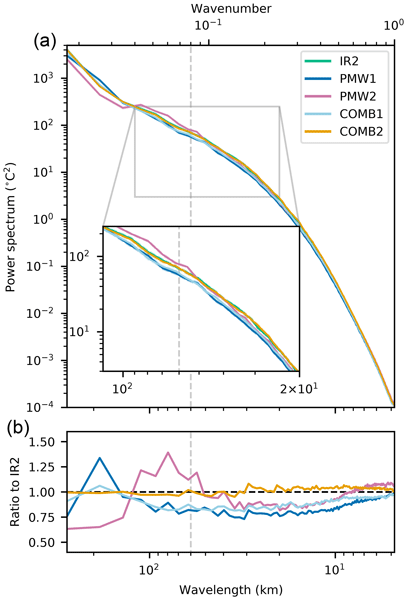
We present two methods to refine the assimilation of satellite sea surface temperatures (SSTs) into a regional ocean model. First, we correct the SSTs for biases and show that this correction reduces the model SST errors. Then, we implement a special observation operator that handles the spatial resolution mismatch between coarse passive microwave SSTs and the high-resolution model. We find that excluding this operator spatially smooths the modeled SST, whereas its inclusion prevents this.
Pedro Duarte, Jostein Brændshøi, Dmitry Shcherbin, Pauline Barras, Jon Albretsen, Yvonne Gusdal, Nicholas Szapiro, Andreas Martinsen, Annette Samuelsen, Keguang Wang, and Jens Boldingh Debernard
Geosci. Model Dev., 15, 4373–4392, https://doi.org/10.5194/gmd-15-4373-2022, https://doi.org/10.5194/gmd-15-4373-2022, 2022
Short summary
Short summary
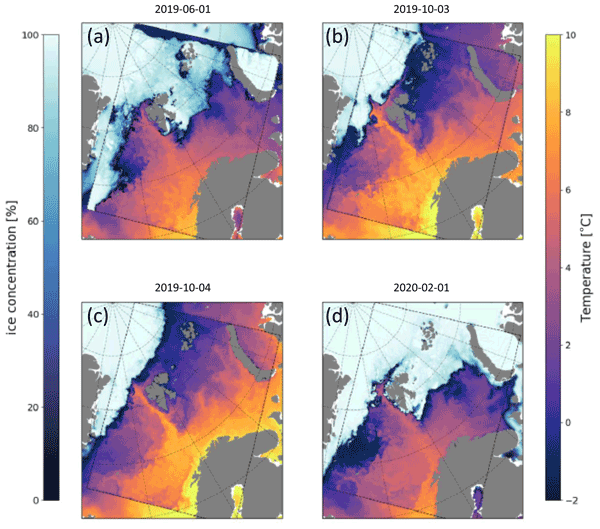
Sea ice models are often implemented for very large domains beyond the regions of sea ice formation, such as the whole Arctic or all of Antarctica. In this study, we implement changes in the Los Alamos Sea Ice Model, allowing it to be implemented for relatively small regions within the Arctic or Antarctica and yet considering the presence and influence of sea ice outside the represented areas. Such regional implementations are important when spatially detailed results are required.
Sissal Vágsheyg Erenbjerg, Jon Albretsen, Knud Simonsen, Erna Lava Olsen, Eigil Kaas, and Bogi Hansen
Ocean Sci., 17, 1639–1655, https://doi.org/10.5194/os-17-1639-2021, https://doi.org/10.5194/os-17-1639-2021, 2021
Short summary
Short summary
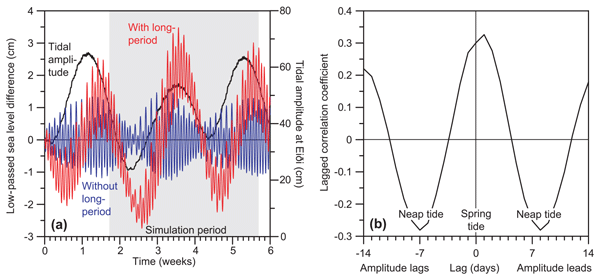
Here, we describe a strait that has narrow and shallow sills in both ends and is close to an amphidromic region. This generates tidally driven flows into and out of the strait, but with very different exchange rates across the entrances in both ends so that it behaves like a mixture between a strait and a fjord. Using a numerical model, we find a fortnightly signal in the net transport through the strait, generated by long-period tides. Our findings are verified by observations.
Cited articles
Albretsen, J., Sperrevik, A. K., Staalstrøm, A., Sandvik, A. D., Vikebø, F., and Asplin, L.: NorKyst-800 Rapport nr. 1: Brukermanual og tekniske beskrivelser, Fisken og havet 2, Institute of Marine Research, https://www.hi.no/en/hi/nettrapporter/fisken-og-havet/2011/fh_2-2011_til_web (last access: 1 April 2026), 2011. a, b
Albretsen, J., Aure, J., Saetre, R., and Danielssen, D. S.: Climatic variability in the Skagerrak and coastal waters of Norway, ICES J. Mar. Sci., 69, 758–763, https://doi.org/10.1093/icesjms/fsr187, 2012. a
Albretsen, J., Sperrevik, A.-K., and Simonsen, M.: Catalog, Norwegian Meteorological Institute [data set], https://thredds.met.no/thredds/catalog/romshindcast/norkyst_v3/catalog.html (last access: 1 April 2026), 2026. a
Asplin, L., Albretsen, J., Johnsen, I. A., and Sandvik, A. D.: The hydrodynamic foundation for salmon lice dispersion modeling along the Norwegian coast, Ocean Dynam., 70, 1151–1167, https://doi.org/10.1007/s10236-020-01378-0, 2020. a
Canuto, V. M., Howard, A., Cheng, Y., and Dubovikov, M. S.: Ocean Turbulence. Part I: One-Point Closure Model–Momentum and Heat Vertical Diffusivities, J. Phys. Oceanogr., 31, 14, https://doi.org/10.1175/1520-0485(2001)031<1413:OTPIOP>2.0.CO;2, 2001. a
Christensen, K. H., Sperrevik, A. K., and Broström, G.: On the Variability in the Onset of the Norwegian Coastal Current, J. Phys. Oceanogr., 48, 723–738, https://doi.org/10.1175/JPO-D-17-0117.1, 2018. a
Christensen, K. H., Gusdal, Y., Albretsen, J., and Asplin, L.: Analysis and plotting scripts, Zenodo [code], https://doi.org/10.5281/zenodo.17053760, 2025a. a
Christensen, K. H., Simonsen, M., and Albretsen, J.: Norkyst v.3 input files (3.0), Zenodo [code], https://doi.org/10.5281/zenodo.16810677, 2025b. a
Dagestad, K. F., Röhrs, J., Breivik, Ø., and Ådlandsvik, B.: OpenDrift v1.0: a generic framework for trajectory modelling, Geosci. Model Dev., 11, 1405–1420, https://doi.org/10.5194/gmd-11-1405-2018, 2018. a
Dalsøren, S. B., Albretsen, J., and Asplin, L.: New validation method for hydrodynamic fjord models applied in the Hardangerfjord, Norway, Estuar. Coast. Shelf Sci., 246, 107028, https://doi.org/10.1016/j.ecss.2020.107028, 2020. a, b
Division for Ocean and Ice: Norkyst v.3, 120 hours ocean forecasts, Norwegian Meteorological Institute [data set], https://data.met.no/dataset/1250dfdf-975c-4c5e-85d4-745506402f06 (last access: 2 April 2026), 2025. a
Donnelly, C., Andersson, J. C., and Arheimer, B.: Using flow signatures and catchment similarities to evaluate the E-HYPE multi-basin model across Europe, Hydrolog. Sci. J., 61, 255–273, https://doi.org/10.1080/02626667.2015.1027710, 2016. a
Eaton, B., Gregory, J., Drach, B., Taylor, K., Hankin, S., Caron, J., Signell, R., Bentley, P., Rappa, G., Höck, H., Pamment, A., Juckes, M., Raspaud, M., Blower, J., Horne, R., Whiteaker, T., Blodgett, D., Zender, C., Lee, D., Hassell, D., Snow, A. D., Kölling, T., Allured, D., Jelenak, A., Soerensen, A. M., Gaultier, L., Herlédan, S., Manzano, F., Bärring, L., Barker, C., and Bartholomew, S. L.: NetCDF Climate and Forecast (CF) Metadata Conventions, Zenodo [data set], https://doi.org/10.5281/zenodo.14275599, 2024. a
Egbert, G. D. and Erofeeva, S. Y.: Efficient Inverse Modeling of Barotropic Ocean Tides, J. Atmos. Ocean. Tech., 19, 183–204, https://doi.org/10.1175/1520-0426(2002)019<0183:EIMOBO>2.0.CO;2, 2002. a
EMODnet Bathymetry Consortium: EMODnet Digital Bathymetry (DTM 2022), EMODnet [datas set], https://doi.org/10.12770/ff3aff8a-cff1-44a3-a2c8-1910bf109f85, 2022. a
EU Copernicus Marine Service Information (CMEMS): Global Ocean – CORA – In-situ Observations Yearly Delivery in Delayed Mode, Marine Data Store (MDS) [data set], https://doi.org/10.17882/46219, 2024. a
Gonzalez, S., Sandvik, A. D., Jensen, M. F., Albretsen, J., Sandø, A. B., Ingvaldsen, R. B., Hjøllo, S. S., and Vikebø, F.: Drivers of the summer 2024 marine heatwave and record salmon lice outbreak in northern Norway, Commun. Earth Environ., 6, 639, https://doi.org/10.1038/s43247-025-02618-1, 2025. a
Haakenstad, H. and Breivik, Ø.: NORA3. Part II: Precipitation and Temperature Statistics in Complex Terrain Modeled with a Nonhydrostatic Model, J. Appl. Meteorol. Clim., 61, 1549–1572, https://doi.org/10.1175/JAMC-D-22-0005.1, 2022. a
Haakenstad, H., Breivik, Ø., Furevik, B. R., Reistad, M., Bohlinger, P., and Aarnes, O. J.: NORA3: A Nonhydrostatic High-Resolution Hindcast of the North Sea, the Norwegian Sea, and the Barents Sea, J. Appl. Meteorol. Clim., 60, 1443–1464, https://doi.org/10.1175/JAMC-D-21-0029.1, 2021. a
Haidvogel, D., Arango, H., Budgell, W., Cornuelle, B., Curchitser, E., Di Lorenzo, E., Fennel, K., Geyer, W., Hermann, A., Lanerolle, L., Levin, J., McWilliams, J., Miller, A., Moore, A., Powell, T., Shchepetkin, A., Sherwood, C., Signell, R., Warner, J., and Wilkin, J.: Ocean forecasting in terrain-following coordinates: Formulation and skill assessment of the Regional Ocean Modeling System, J. Comput. Phys., 227, 3595–3624, https://doi.org/10.1016/j.jcp.2007.06.016, 2008. a
Helland-Hansen, B. and Nansen, F.: The Norwegian Sea – Its Physical Oceanography Based Upon the Norwegian Researches 1900–1904, Report on Norwegian Fishery and Marine Investigations, 2, 1–359, Fiskeridirektoratet, 1909. a
Institute of Marine Research: Stasjonsdata, https://www.imr.no/forskning/forskningsdata/stasjoner/index.html (last access: 1 April 2026), 2026. a
Iversen, S. C., Sperrevik, A. K., and Goux, O.: Improving sea surface temperature in a regional ocean model through refined sea surface temperature assimilation, Ocean Sci., 19, 729–744, https://doi.org/10.5194/os-19-729-2023, 2023. a
Marchesiello, P., McWilliams, J. C., and Shchepetkin, A.: Open boundary conditions for long-term integration of regional oceanic models, Ocean Model., 3, 1–20, https://doi.org/10.1016/S1463-5003(00)00013-5, 2001. a
Mason, E., Molemaker, J., Shchepetkin, A. F., Colas, F., McWilliams, J. C., and Sangrà, P.: Procedures for offline grid nesting in regional ocean models, Ocean Modell., 35, 1–15, https://doi.org/10.1016/j.ocemod.2010.05.007, 2010. a
Müller, M., Homleid, M., Ivarsson, K.-I., Køltzow, M. A. Ø., Lindskog, M., Midtbø, K. H., Andrae, U., Aspelien, T., Berggren, L., Bjørge, D., Dahlgren, P., Kristiansen, J., Randriamampianina, R., Ridal, M., and Vignes, O.: AROME-MetCoOp: A Nordic Convective-Scale Operational Weather Prediction Model, Weather Forecast., 32, 609–627, https://doi.org/10.1175/WAF-D-16-0099.1, 2017. a
Nortek: Nortek home page, https://www.nortekgroup.com/ (last access: 1 April 2026), 2026. a
Norwegian Mapping Authority: Høydedata, https://www.geonorge.no/kartdata/datasett-i-geonorge/hoydedata/ (last access: 1 April 2026), 2026. a
O'Sadnick, M., Petrich, C., Brekke, C., and Skarðhamar, J.: Ice extent in sub-arctic fjords and coastal areas from 2001 to 2019 analyzed from MODIS imagery, Ann. Glaciol., 61, 210–226, https://doi.org/10.1017/aog.2020.34, 2020. a
Röhrs, J., Håkon Christensen, K., Vikebø, F., Sundby, S., Saetra, Ø., and Broström, G.: Wave-induced transport and vertical mixing of pelagic eggs and larvae, Limnol. Oceanogr., 59, 1213–1227, https://doi.org/10.4319/lo.2014.59.4.1213, 2014. a
Röhrs, J., Gusdal, Y., Rikardsen, E. S. U., Durán Moro, M., Brændshøi, J., Kristensen, N. M., Fritzner, S., Wang, K., Sperrevik, A. K., Idžanović, M., Lavergne, T., Debernard, J. B., and Christensen, K. H.: Barents-2.5km v2.0: an operational data-assimilative coupled ocean and sea ice ensemble prediction model for the Barents Sea and Svalbard, Geosci. Model Dev., 16, 5401–5426, https://doi.org/10.5194/gmd-16-5401-2023, 2023. a
Rutgers, The State University of New Jersey: Copy of Release ROMS/TOMS 3.9, Zenodo [code], https://doi.org/10.5281/zenodo.17046086, 2021. a, b
SAIV A/S: SAIV A/S Home page, https://saiv.no/ (last access: 1 April 2026), 2026. a
Sandvik, A. D., Johnsen, I. A., and Myksvoll, M. S.: Prediction of the salmon lice infestation pressure in a Norwegian fjord, ICES J. Mar. Sci., 77, 11, https://doi.org/10.1093/icesjms/fsz256, 2020. a
Sætre, R. (Ed.): The Norwegian coastal current: oceanography and climate, Tapir Academic Press, Trondheim, ISBN 9788251921848, 2007. a
Shchepetkin, A. F.: An adaptive, Courant-number-dependent implicit scheme for vertical advection in oceanic modeling, Ocean Model., 91, 38–69, https://doi.org/10.1016/j.ocemod.2015.03.006, 2015. a
Shchepetkin, A. F. and McWilliams, J. C.: The regional oceanic modeling system (ROMS): a split-explicit, free-surface, topography-following-coordinate oceanic model, Ocean Model., 9, 347–404, https://doi.org/10.1016/j.ocemod.2004.08.002, 2005. a, b
Sverdrup, H. U.: On Conditions for the Vernal Blooming of Phytoplankton, ICES J. Mar. Sci., 18, 287–295, https://doi.org/10.1093/icesjms/18.3.287, 1953. a
Technologies, Visualization & Analysis Systems: Geoscience Community Analysis Toolkit, Zenodo [code], https://doi.org/10.5281/zenodo.15991044, 2025. a
Umlauf, L. and Burchard, H.: A generic length-scale equation for geophysical turbulence models, J. Mar. Res., 61, 235–265, 2003. a
Warner, J. C., Sherwood, C. R., Arango, H. G., and Signell, R. P.: Performance of four turbulence closure models implemented using a generic length scale method, Ocean Model., 8, 81–113, https://doi.org/10.1016/j.ocemod.2003.12.003, 2005. a
Wilkinson, M. D., Dumontier, M., Aalbersberg, I. J., Appleton, G., Axton, M., Baak, A., Blomberg, N., Boiten, J.-W., da Silva Santos, L. B., Bourne, P. E., Bouwman, J., Brookes, A. J., Clark, T., Crosas, M., Dillo, I., Dumon, O., Edmunds, S., Evelo, C. T., Finkers, R., Gonzalez-Beltran, A., Gray, A. J., Groth, P., Goble, C., Grethe, J. S., Heringa, J., 't Hoen, P. A., Hooft, R., Kuhn, T., Kok, R., Kok, J., Lusher, S. J., Martone, M. E., Mons, A., Packer, A. L., Persson, B., Rocca-Serra, P., Roos, M., van Schaik, R., Sansone, S.-A., Schultes, E., Sengstag, T., Slater, T., Strawn, G., Swertz, M. A., Thompson, M., van der Lei, J., van Mulligen, E., Velterop, J., Waagmeester, A., Wittenburg, P., Wolstencroft, K., Zhao, J., and Mons, B.: The FAIR Guiding Principles for scientific data management and stewardship, Sci. Data, 3, 160018, https://doi.org/10.1038/sdata.2016.18, 2016. a
Wu, H. and Zhu, J.: Advection scheme with 3rd high-order spatial interpolation at the middle temporal level and its application to saltwater intrusion in the Changjiang Estuary, Ocean Model., 33, 33–51, https://doi.org/10.1016/j.ocemod.2009.12.001, 2010. a
Short summary
This paper describes
Norkyst, the operational coastal ocean forecasting system for mainland Norway, which is now in version 3. The system produces five day forecasts of ocean currents, temperature, salinity, and sea surface height every day, and we also maintain an archive of historical data going back to 2012. We show that the outputs of Norkyst have sufficient quality so that it's intended use as a free public service supporting scientists, ocean managers, and industry is justified.
This paper describes
Norkyst, the operational coastal ocean forecasting system for mainland...


