
Articles | Volume 19, issue 7
https://doi.org/10.5194/gmd-19-2677-2026
© Author(s) 2026. This work is distributed under
the Creative Commons Attribution 4.0 License.
the Creative Commons Attribution 4.0 License.
Special issue:
https://doi.org/10.5194/gmd-19-2677-2026
© Author(s) 2026. This work is distributed under
the Creative Commons Attribution 4.0 License.
the Creative Commons Attribution 4.0 License.
Development and technical paper
| 
09 Apr 2026
Development and technical paper |
| 09 Apr 2026
| 09 Apr 2026
Revisiting the parameterization of dense water plume dynamics in geopotential coordinates in NEMO v4.2.2

Institute of Marine Research, Bergen, Norway
Bjerknes Centre for Climate Research, Bergen, Norway
Jarle Berntsen
Department of Mathematics, University of Bergen, Bergen, Norway
Magnus Hieronymus
Oceanography Research Department, Swedish Meteorological and Hydrological Institute, Norrköping, Sweden
Per Pemberton
Oceanography Research Department, Swedish Meteorological and Hydrological Institute, Göteborg, Sweden
Hjálmar Hátún
Faeroe Marine Research Institute (FAMRI), Tórshavn, Faeroe Islands, Denmark
Related authors
Itzel Ruvalcaba Baroni, Elin Almroth-Rosell, Lars Axell, Sam T. Fredriksson, Jenny Hieronymus, Magnus Hieronymus, Sandra-Esther Brunnabend, Matthias Gröger, Ivan Kuznetsov, Filippa Fransner, Robinson Hordoir, Saeed Falahat, and Lars Arneborg
Biogeosciences, 21, 2087–2132, https://doi.org/10.5194/bg-21-2087-2024, https://doi.org/10.5194/bg-21-2087-2024, 2024
Short summary
Short summary
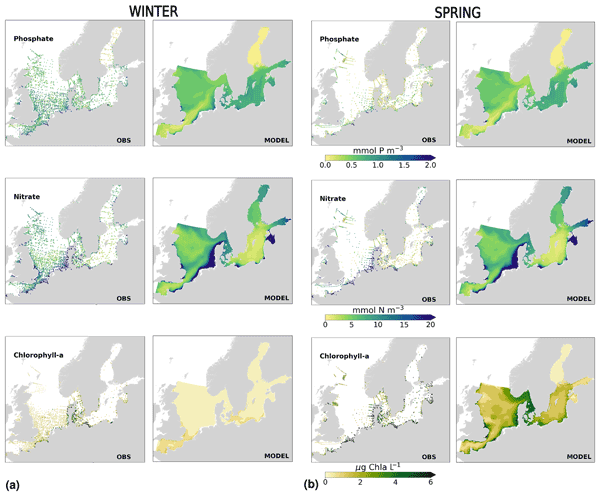
The health of the Baltic and North seas is threatened due to high anthropogenic pressure; thus, different methods to assess the status of these regions are urgently needed. Here, we validated a novel model simulating the ocean dynamics and biogeochemistry of the Baltic and North seas that can be used to create future climate and nutrient scenarios, contribute to European initiatives on de-eutrophication, and provide water quality advice and support on nutrient load reductions for both seas.
Imke Sievers, Andrea M. U. Gierisch, Till A. S. Rasmussen, Robinson Hordoir, and Lars Stenseng
The Cryosphere Discuss., https://doi.org/10.5194/tc-2022-84, https://doi.org/10.5194/tc-2022-84, 2022
Preprint withdrawn
Short summary
Short summary
To predict Arctic sea ice models are used. Many ice models exists. They all are skill full, but give different results. Often this differences result from forcing as for example air temperature. Other differences result from the way the physical equations are solved in the model. In this study two commonly used models are compared under equal forcing, to find out how much the models differ under similar external forcing. The results are compared to observations and to eachother.
Per Pemberton, Iréne Wåhlström, and Sam T. Fredriksson
Ocean Sci., 22, 2375–2404, https://doi.org/10.5194/os-22-2375-2026, https://doi.org/10.5194/os-22-2375-2026, 2026
Short summary
Short summary
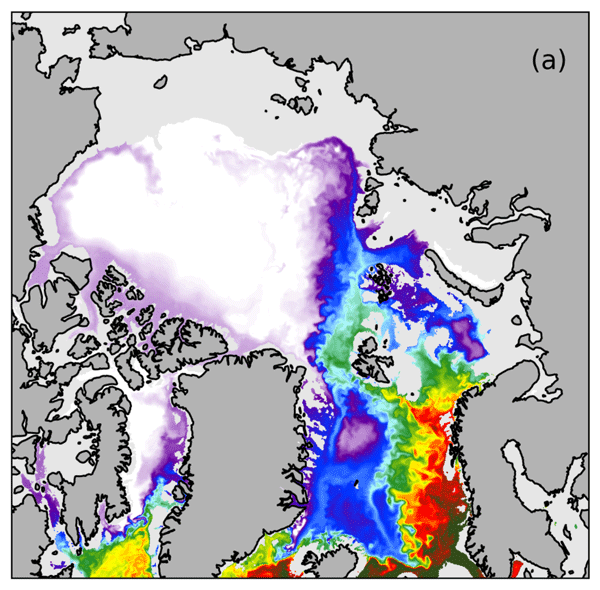
Mesoscale ocean eddies (10–100 km) are crucial for transporting heat and salt in global circulation. While traditionally parameterized in ocean models, advances in computational power allow them to be partly resolved, questioning whether parameterizations should be used in this regime. We examine implications for Atlantic water circulation and heat transport to the Arctic, highlighting challenges in using – or omitting – mesoscale eddy parameterizations.
Florian Börgel, Itzel Ruvalcaba Baroni, Leonie Barghorn, Leonard Borchert, Bronwyn Cahill, Cyril Dutheil, Leonie Esters, Małgorzata Falarz, Helena L. Filipsson, Matthias Gröger, Jari Hänninen, Magnus Hieronymus, Erko Jakobson, Mehdi Pasha Karami, Karol Kuliński, Taavi Liblik, H. E. Markus Meier, Gabriele Messori, Lev Naumov, Thomas Neumann, Piia Post, Gregor Rehder, Anna Rutgersson, and Georg Sebastian Voelker
Earth Syst. Dynam., 17, 415–450, https://doi.org/10.5194/esd-17-415-2026, https://doi.org/10.5194/esd-17-415-2026, 2026
Short summary
Short summary
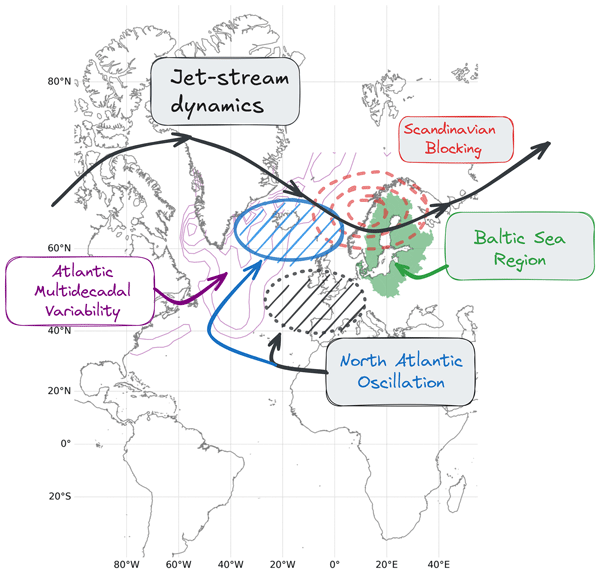
This review explains how weather patterns, guided by the polar jet stream, influence the Baltic Sea’s climate and ecosystem. It covers the North Atlantic Oscillation, blocking events and other processes and discusses how they affect temperature, rainfall, and storms from days to decades. These shifts then impact oxygen levels, productivity, and acidification in the Baltic Sea. Physical links are fairly well known, but biogeochemical pathways remain uncertain.
Göran Björk, Göran Broström, Lars Arneborg, Anis Elyouncha, Daniel Bergman-Sjöstrand, and Per Pemberton
EGUsphere, https://doi.org/10.5194/egusphere-2026-785, https://doi.org/10.5194/egusphere-2026-785, 2026
Short summary
Short summary
During the 2023/2024 ice season, a high-resolution dataset of ice thickness was collected in the Bothnian Bay. The analysis of data revealed a significant frequency of thick deformed ice such that about 60 % was thicker than 1 m. Among the 5500 individually identified ice keels, 20 % had a keel depth larger than 5 m and 2 % a depth larger than 10 m. This type of high-resolution ice data can be of vital importance for design of offshore structures and evaluation of computer ice models.
Lars Arneborg, Magnus Hieronymus, Per Pemberton, Ye Liu, and Sam T. Fredriksson
Ocean Sci., 22, 761–775, https://doi.org/10.5194/os-22-761-2026, https://doi.org/10.5194/os-22-761-2026, 2026
Short summary
Short summary
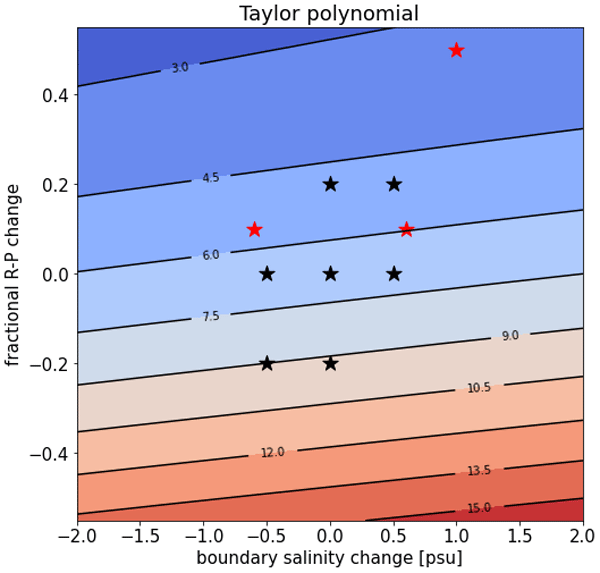
Climate change influences estuaries and their ecosystems not only by rising temperatures but also by salinity changes. This modeling study highlights the magnitude and causes of the Baltic Sea salinity sensitivity to fresh water forcing and changed ocean salinity. The large sensitivity to increased fresh water forcing is shown to be caused by dilution of fresh water within the estuary, recirculation of much of the outflow water back into the estuary, as well as decreasing inflows of ocean water.
Seuri Basilio Kuosmanen and Magnus Hieronymus
EGUsphere, https://doi.org/10.5194/egusphere-2025-1257, https://doi.org/10.5194/egusphere-2025-1257, 2025
Short summary
Short summary
We studied the annual maximum sea levels for the coastal regions in the Baltic Sea and parts of the North Sea. The study aimed to reduce the quantified uncertainty and produce estimates at locations with no tide gauges data. Comparing four statistical models and a baseline model, we concluded that the spatial hierarchical models, which leverages spatial dependency, reduced the uncertainty for higher/lower probability events compared to the other models for locations with or without observations.
Jenny Hieronymus, Magnus Hieronymus, Matthias Gröger, Jörg Schwinger, Raffaele Bernadello, Etienne Tourigny, Valentina Sicardi, Itzel Ruvalcaba Baroni, and Klaus Wyser
Biogeosciences, 21, 2189–2206, https://doi.org/10.5194/bg-21-2189-2024, https://doi.org/10.5194/bg-21-2189-2024, 2024
Short summary
Short summary
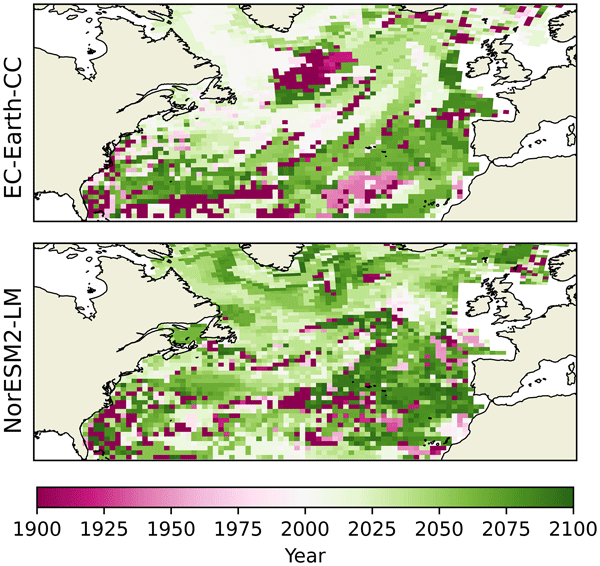
The timing of the net primary production annual maxima in the North Atlantic in the period 1750–2100 is investigated using two Earth system models and the high-emissions scenario SSP5-8.5. It is found that, for most of the region, the annual maxima occur progressively earlier, with the most change occurring after the year 2000. Shifts in the seasonality of the primary production may impact the entire ecosystem, which highlights the need for long-term monitoring campaigns in this area.
Itzel Ruvalcaba Baroni, Elin Almroth-Rosell, Lars Axell, Sam T. Fredriksson, Jenny Hieronymus, Magnus Hieronymus, Sandra-Esther Brunnabend, Matthias Gröger, Ivan Kuznetsov, Filippa Fransner, Robinson Hordoir, Saeed Falahat, and Lars Arneborg
Biogeosciences, 21, 2087–2132, https://doi.org/10.5194/bg-21-2087-2024, https://doi.org/10.5194/bg-21-2087-2024, 2024
Short summary
Short summary
The health of the Baltic and North seas is threatened due to high anthropogenic pressure; thus, different methods to assess the status of these regions are urgently needed. Here, we validated a novel model simulating the ocean dynamics and biogeochemistry of the Baltic and North seas that can be used to create future climate and nutrient scenarios, contribute to European initiatives on de-eutrophication, and provide water quality advice and support on nutrient load reductions for both seas.
Bogi Hansen, Karin M. H. Larsen, Hjálmar Hátún, Steffen M. Olsen, Andrea M. U. Gierisch, Svein Østerhus, and Sólveig R. Ólafsdóttir
Ocean Sci., 19, 1225–1252, https://doi.org/10.5194/os-19-1225-2023, https://doi.org/10.5194/os-19-1225-2023, 2023
Short summary
Short summary
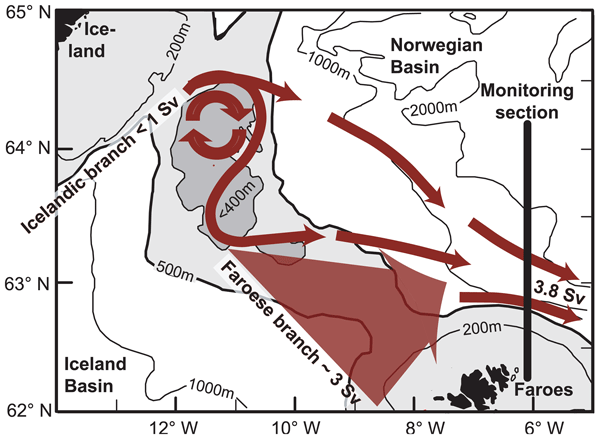
Based on in situ observations combined with sea level anomaly (SLA) data from satellite altimetry, volume as well as heat (relative to 0 °C) transport of the Iceland–Faroe warm-water inflow towards the Arctic (IF inflow) increased from 1993 to 2021. The reprocessed SLA data released in December 2021 represent observed variations accurately. The IF inflow crosses the Iceland–Faroe Ridge in two branches, with retroflection in between. The associated coupling to overflow reduces predictability.
Magnus Hieronymus
Geosci. Model Dev., 16, 2343–2354, https://doi.org/10.5194/gmd-16-2343-2023, https://doi.org/10.5194/gmd-16-2343-2023, 2023
Short summary
Short summary
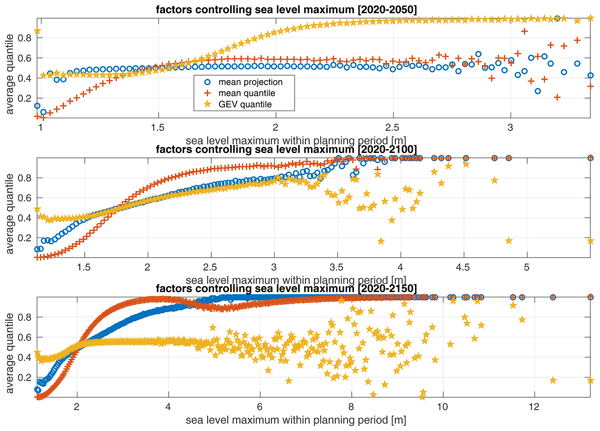
A statistical model called the sea level simulator is presented and made freely available. The sea level simulator integrates mean sea level rise and sea level extremes into a joint probabilistic framework that is useful for flood risk estimation. These flood risk estimates are contingent on probabilities given to different emission scenarios and the length of the planning period. The model is also useful for uncertainty quantification and in decision and adaptation problems.
Matthias Gröger, Manja Placke, H. E. Markus Meier, Florian Börgel, Sandra-Esther Brunnabend, Cyril Dutheil, Ulf Gräwe, Magnus Hieronymus, Thomas Neumann, Hagen Radtke, Semjon Schimanke, Jian Su, and Germo Väli
Geosci. Model Dev., 15, 8613–8638, https://doi.org/10.5194/gmd-15-8613-2022, https://doi.org/10.5194/gmd-15-8613-2022, 2022
Short summary
Short summary
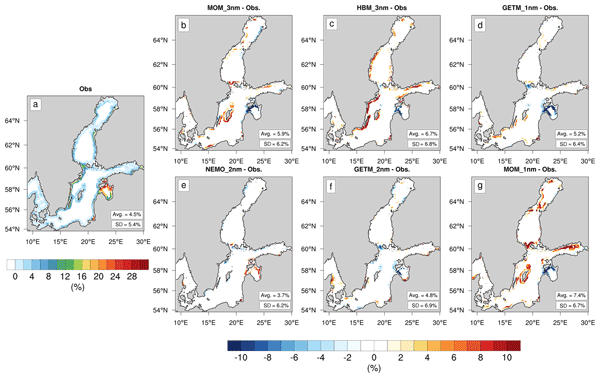
Comparisons of oceanographic climate data from different models often suffer from different model setups, forcing fields, and output of variables. This paper provides a protocol to harmonize these elements to set up multidecadal simulations for the Baltic Sea, a marginal sea in Europe. First results are shown from six different model simulations from four different model platforms. Topical studies for upwelling, marine heat waves, and stratification are also assessed.
Imke Sievers, Andrea M. U. Gierisch, Till A. S. Rasmussen, Robinson Hordoir, and Lars Stenseng
The Cryosphere Discuss., https://doi.org/10.5194/tc-2022-84, https://doi.org/10.5194/tc-2022-84, 2022
Preprint withdrawn
Short summary
Short summary
To predict Arctic sea ice models are used. Many ice models exists. They all are skill full, but give different results. Often this differences result from forcing as for example air temperature. Other differences result from the way the physical equations are solved in the model. In this study two commonly used models are compared under equal forcing, to find out how much the models differ under similar external forcing. The results are compared to observations and to eachother.
Cited articles
Arneborg, L.: Turnover times for the water above sill level in Gullmar Fjord, Cont. Shelf Res., 24, 443–460, https://doi.org/10.1016/j.csr.2003.12.005, 2004. a
Beckmann, A. and Döscher, R.: A method for improved representation of dense water spreading over topography in geopotential-coordinate models, J. Phys. Oceanogr., 27, 581–591, 1997. a
Berntsen, J., Darelius, E., and Avlesen, H.: Topographic effects on buoyancy driven flows along the slope, Environ. Fluid Mech., 23, 369–388, https://doi.org/10.1007/s10652-022-09890-1, 2023. a
Berntsen, J., Hansen, B., Ø sterhus, S., Larsen, K. M. H., and Hátún, H.: Effects of a surface layer cross-flow and slope steepness on the rate of descent of dense water flows along a slope, Ocean Dynam., 74, 879–899, https://doi.org/10.1007/s10236-024-01642-7, 2024. a
Buckley, M. W. and Marshall, J.: Observations, inferences, and mechanisms of the Atlantic Meridional Overturning Circulation: A review, Rev. Geophys., 54, 5–63, https://doi.org/10.1002/2015RG000493, 2016. a
Campin, J.-M. and Goosse, H.: A parameterization of density-driven downsloping flow for a coarse resolution ocean model in z-coordinates, Tellus A, 51, 412–430, 1999. a
Colombo, P., Barnier, B., Penduff, T., Chanut, J., Deshayes, J., Molines, J.-M., Le Sommer, J., Verezemskaya, P., Gulev, S., and Treguier, A.-M.: Representation of the Denmark Strait overflow in a z-coordinate eddying configuration of the NEMO (v3.6) ocean model: resolution and parameter impacts, Geosci. Model Dev., 13, 3347–3371, https://doi.org/10.5194/gmd-13-3347-2020, 2020. a
de Marez, C., Ruiz-Angulo, A., and Le Corre, M.: Structure of the Bottom Boundary Current South of Iceland and Spreading of Deep Waters by Submesoscale Processes, Geophys. Res. Lett., 51, e2023GL107508, https://doi.org/10.1029/2023GL107508, 2024. a
Gent, P. R. and Mcwilliams, J. C.: Isopycnal Mixing in Ocean Circulation Models, J. Phys. Oceanogr., 20, 150–155, 1990. a
Gunduz, M., Özsoy, E., and Hordoir, R.: A model of Black Sea circulation with strait exchange (2008–2018), Geosci. Model Dev., 13, 121–138, https://doi.org/10.5194/gmd-13-121-2020, 2020. a
Hansen, B., Hátún, H., Kristiansen, R., Olsen, S. M., and Østerhus, S.: Stability and forcing of the Iceland-Faroe inflow of water, heat, and salt to the Arctic, Ocean Sci., 6, 1013–1026, https://doi.org/10.5194/os-6-1013-2010, 2010. a
Hordoir, R.: Nemo-NAA10km based on Nemo v4.2.2 for reproducing results of EGUSPHERE-2025-4288 | Development and technical paper, Zenodo [code], https://doi.org/10.5281/zenodo.17104971, 2025. a
Hordoir, R., Polcher, J., Brun-Cottan, J.-C., and Madec, G.: Towards a parametrization of river discharges into ocean general circulation models: a closure through energy conservation, Clim. Dynam., 31, https://doi.org/10.1007/s00382-008-0416-4, 2008. a
Hordoir, R., Axell, L., Höglund, A., Dieterich, C., Fransner, F., Gröger, M., Liu, Y., Pemberton, P., Schimanke, S., Andersson, H., Ljungemyr, P., Nygren, P., Falahat, S., Nord, A., Jönsson, A., Lake, I., Döös, K., Hieronymus, M., Dietze, H., Löptien, U., Kuznetsov, I., Westerlund, A., Tuomi, L., and Haapala, J.: Nemo-Nordic 1.0: a NEMO-based ocean model for the Baltic and North seas – research and operational applications, Geosci. Model Dev., 12, 363–386, https://doi.org/10.5194/gmd-12-363-2019, 2019. a, b, c
Hordoir, R., Skagseth, O., Ingvaldsen, R. B., Sandø , A. B., Löptien, U., Dietze, H., Gierisch, A. M. U., Assmann, K. M., Lundesgaard, O., and Lind, S.: Changes in Arctic Stratification and Mixed Layer Depth Cycle: A Modeling Analysis, J. Geophys. Res.-Oceans, 127, https://doi.org/10.1029/2021JC017270, 2022. a, b, c
Larsen, K. M. H., Hansen, B., Hátún, H., Johansen, G. E., Østerhus, S., and Olsen, S. M.: The Coldest and Densest Overflow Branch Into the North Atlantic is Stable in Transport, But Warming, Geophys. Res. Lett., 51, e2024GL110097, https://doi.org/10.1029/2024GL110097, 2024. a
Legg, S., Hallberg, R. W., and Girton, J. B.: Comparison of entrainment in overflows simulated by z-coordinate, isopycnal and non-hydrostatic models, Ocean Model., 11, 69–97, https://doi.org/10.1016/j.ocemod.2004.11.006, 2006. a
Madec, G. and the NEMO system team: NEMO Ocean Engine, Version 4.2.2, Tech. rep., IPSL, http://www.nemo-ocean.eu/ (last access: 7 April 2026), 2022. a
Mauritzen, C., Price, J., Sanford, T., and Torres, D.: Circulation and mixing in the Faroese Channels, Deep-Sea Res. Pt. I, 52, 883–913, https://doi.org/10.1016/j.dsr.2004.11.018, 2005. a
Tassigny, A., Negretti, M. E., and Wirth, A.: Dynamics of intrusion in downslope gravity currents in a rotating frame, Phys. Rev. Fluids, 9, 074605, https://doi.org/10.1103/PhysRevFluids.9.074605, 2024. a
Ullgren, J. E., Fer, I., Darelius, E., and Beaird, N.: Interaction of the Faroe Bank Channel overflow with Iceland Basin intermediate waters, J. Geophys. Res.-Oceans, 119, 228–240, https://doi.org/10.1002/2013JC009437, 2014. a
Wirth, A. and Negretti, M. E.: Intruding gravity currents and their recirculation in a rotating frame: Numerical results, Ocean Model., 173, 101994, https://doi.org/10.1016/j.ocemod.2022.101994, 2022. a
Download
The requested paper has a corresponding corrigendum published. Please read the corrigendum first before downloading the article.
- Article
(10659 KB) - Full-text XML
Short summary
Dense water created in high latitude regions flows at the bottom of the ocean, from one basin to the next, and contributes to the global ocean circulation. The flow between shallow and deeper basins occurs at straits such as the Faeroe Bank Channel as underwater streams of dense water. Their representation in ocean models is problematic. In the present article, we use a mathematical formulation of dense water plumes to show that the representation of these dense overflows can be improved.
Dense water created in high latitude regions flows at the bottom of the ocean, from one basin to...


Special issue