Articles | Volume 19, issue 6
https://doi.org/10.5194/gmd-19-2479-2026
© Author(s) 2026. This work is distributed under
the Creative Commons Attribution 4.0 License.
https://doi.org/10.5194/gmd-19-2479-2026
© Author(s) 2026. This work is distributed under
the Creative Commons Attribution 4.0 License.
PM2.5 assimilation within JEDI for NOAA's regional Air Quality Model (AQMv7): application to the September 2020 Western US wildfires

Hongli Wang
CORRESPONDING AUTHOR
Cooperative Institute for Research in Environmental Sciences, University of Colorado, Boulder, CO 80305, USA
NOAA Global Systems Laboratory, Boulder, CO 80305, USA
Cory Martin
NOAA/NWS/NCEP/EMC, College Park, MD 20740, USA
Jérôme Barré
NASA Global Modeling and Assimilation Office, Greenbelt, MD 20771, USA
Morgan State University, Baltimore, MD 21251, USA
Ruifang Li
Cooperative Institute for Research in Environmental Sciences, University of Colorado, Boulder, CO 80305, USA
NOAA Global Systems Laboratory, Boulder, CO 80305, USA
Steve Weygandt
NOAA Global Systems Laboratory, Boulder, CO 80305, USA
Jianping Huang
NOAA/NWS/NCEP/EMC, College Park, MD 20740, USA
Youhua Tang
Center for Spatial Information Science and Systems, George Mason University, Fairfax, VA 22030, USA
NOAA Air Resources Laboratory (ARL), College Park, MD 20740, USA
Hyundeok Choi
SAIC@NOAA/NWS/NCEP/EMC, College Park, MD 20740, USA
NOAA/NWS/NCEP/EMC, College Park, MD 20740, USA
Andrew Tangborn
SAIC@NOAA/NWS/NCEP/EMC, College Park, MD 20740, USA
NOAA/NWS/NCEP/EMC, College Park, MD 20740, USA
Kai Wang
LINKER@NOAA/NWS/NCEP/EMC, College Park, MD 20740, USA
NOAA/NWS/NCEP/EMC, College Park, MD 20740, USA
Haixia Liu
LINKER@NOAA/NWS/NCEP/EMC, College Park, MD 20740, USA
NOAA/NWS/NCEP/EMC, College Park, MD 20740, USA
Jeffrey Lee
School of Meteorology, University of Oklahoma, Norman, OK 73072, USA
Related authors
No articles found.
Shih-Wei Wei, Jérôme Barré, Soyoung Ha, Cheng-Hsuan Lu, Maryam Abdi-Oskouei, Benjamin Ménétrier, and Cheng Dang
EGUsphere, https://doi.org/10.5194/egusphere-2025-4503, https://doi.org/10.5194/egusphere-2025-4503, 2025
Short summary
Short summary
This paper presents a flexible workflow using a unified data assimilation framework to evaluate atmospheric composition models. It enables comparison of observations with forecasts of trace gases and aerosols from different models. The system is consistent and adaptable, reducing repetitive work, supporting model validation and observation assessment, and aligning evaluation with operational data assimilation for research and practical applications.
Wei Li, Beiming Tang, Patrick C. Campbell, Youhua Tang, Barry Baker, Zachary Moon, Daniel Tong, Jianping Huang, Kai Wang, Ivanka Stajner, and Raffaele Montuoro
Geosci. Model Dev., 18, 1635–1660, https://doi.org/10.5194/gmd-18-1635-2025, https://doi.org/10.5194/gmd-18-1635-2025, 2025
Short summary
Short summary
The study describes the updates of NOAA's current UFS-AQMv7 air quality forecast model by incorporating the latest scientific and structural changes in CMAQv5.4. An evaluation during the summer of 2023 shows that the updated model overall improves the simulation of MDA8 O3 by reducing the bias by 8%–12% in the contiguous US. PM2.5 predictions have mixed results due to wildfire, highlighting the need for future refinements.
Hongyu Liu, Bo Zhang, Richard H. Moore, Luke D. Ziemba, Richard A. Ferrare, Hyundeok Choi, Armin Sorooshian, David Painemal, Hailong Wang, Michael A. Shook, Amy Jo Scarino, Johnathan W. Hair, Ewan C. Crosbie, Marta A. Fenn, Taylor J. Shingler, Chris A. Hostetler, Gao Chen, Mary M. Kleb, Gan Luo, Fangqun Yu, Mark A. Vaughan, Yongxiang Hu, Glenn S. Diskin, John B. Nowak, Joshua P. DiGangi, Yonghoon Choi, Christoph A. Keller, and Matthew S. Johnson
Atmos. Chem. Phys., 25, 2087–2121, https://doi.org/10.5194/acp-25-2087-2025, https://doi.org/10.5194/acp-25-2087-2025, 2025
Short summary
Short summary
We use the GEOS-Chem model to simulate aerosol distributions and properties over the western North Atlantic Ocean (WNAO) during the winter and summer deployments in 2020 of the NASA ACTIVATE mission. Model results are evaluated against aircraft, ground-based, and satellite observations. The improved understanding of life cycle, composition, transport pathways, and distribution of aerosols has important implications for characterizing aerosol–cloud–meteorology interactions over WNAO.
Jean-Paul Vernier, Thomas J. Aubry, Claudia Timmreck, Anja Schmidt, Lieven Clarisse, Fred Prata, Nicolas Theys, Andrew T. Prata, Graham Mann, Hyundeok Choi, Simon Carn, Richard Rigby, Susan C. Loughlin, and John A. Stevenson
Atmos. Chem. Phys., 24, 5765–5782, https://doi.org/10.5194/acp-24-5765-2024, https://doi.org/10.5194/acp-24-5765-2024, 2024
Short summary
Short summary
The 2019 Raikoke eruption (Kamchatka, Russia) generated one of the largest emissions of particles and gases into the stratosphere since the 1991 Mt. Pinatubo eruption. The Volcano Response (VolRes) initiative, an international effort, provided a platform for the community to share information about this eruption and assess its climate impact. The eruption led to a minor global surface cooling of 0.02 °C in 2020 which is negligible relative to warming induced by human greenhouse gas emissions.
Yunyao Li, Daniel Tong, Siqi Ma, Saulo R. Freitas, Ravan Ahmadov, Mikhail Sofiev, Xiaoyang Zhang, Shobha Kondragunta, Ralph Kahn, Youhua Tang, Barry Baker, Patrick Campbell, Rick Saylor, Georg Grell, and Fangjun Li
Atmos. Chem. Phys., 23, 3083–3101, https://doi.org/10.5194/acp-23-3083-2023, https://doi.org/10.5194/acp-23-3083-2023, 2023
Short summary
Short summary
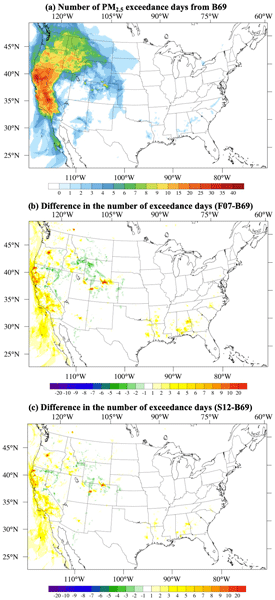
Plume height is important in wildfire smoke dispersion and affects air quality and human health. We assess the impact of plume height on wildfire smoke dispersion and the exceedances of the National Ambient Air Quality Standards. A higher plume height predicts lower pollution near the source region, but higher pollution in downwind regions, due to the faster spread of the smoke once ejected, affects pollution exceedance forecasts and the early warning of extreme air pollution events.
Youhua Tang, Patrick C. Campbell, Pius Lee, Rick Saylor, Fanglin Yang, Barry Baker, Daniel Tong, Ariel Stein, Jianping Huang, Ho-Chun Huang, Li Pan, Jeff McQueen, Ivanka Stajner, Jose Tirado-Delgado, Youngsun Jung, Melissa Yang, Ilann Bourgeois, Jeff Peischl, Tom Ryerson, Donald Blake, Joshua Schwarz, Jose-Luis Jimenez, James Crawford, Glenn Diskin, Richard Moore, Johnathan Hair, Greg Huey, Andrew Rollins, Jack Dibb, and Xiaoyang Zhang
Geosci. Model Dev., 15, 7977–7999, https://doi.org/10.5194/gmd-15-7977-2022, https://doi.org/10.5194/gmd-15-7977-2022, 2022
Short summary
Short summary
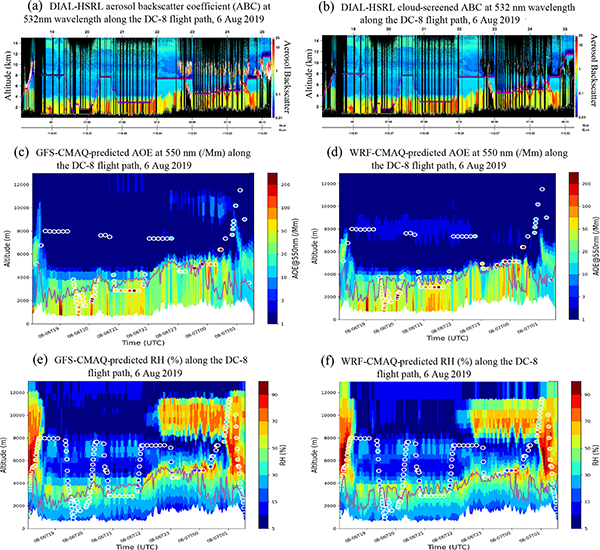
This paper compares two meteorological datasets for driving a regional air quality model: a regional meteorological model using WRF (WRF-CMAQ) and direct interpolation from an operational global model (GFS-CMAQ). In the comparison with surface measurements and aircraft data in summer 2019, these two methods show mixed performance depending on the corresponding meteorological settings. Direct interpolation is found to be a viable method to drive air quality models.
Patrick C. Campbell, Youhua Tang, Pius Lee, Barry Baker, Daniel Tong, Rick Saylor, Ariel Stein, Jianping Huang, Ho-Chun Huang, Edward Strobach, Jeff McQueen, Li Pan, Ivanka Stajner, Jamese Sims, Jose Tirado-Delgado, Youngsun Jung, Fanglin Yang, Tanya L. Spero, and Robert C. Gilliam
Geosci. Model Dev., 15, 3281–3313, https://doi.org/10.5194/gmd-15-3281-2022, https://doi.org/10.5194/gmd-15-3281-2022, 2022
Short summary
Short summary
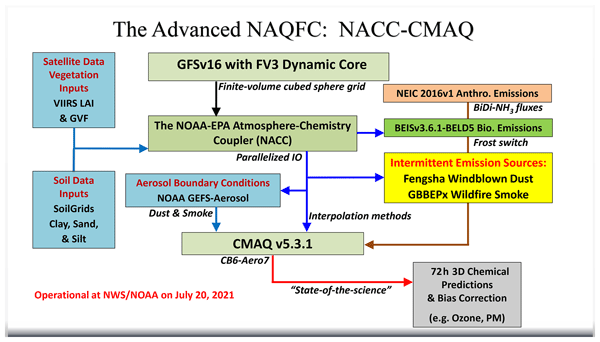
NOAA's National Air Quality Forecast Capability (NAQFC) continues to protect Americans from the harmful effects of air pollution, while saving billions of dollars per year. Here we describe and evaluate the development of the most advanced version of the NAQFC to date, which became operational at NOAA on 20 July 2021. The new NAQFC is based on a coupling of NOAA's operational Global Forecast System (GFS) version 16 with the Community Multiscale Air Quality (CMAQ) model version 5.3.1.
Kai Wang, Yang Zhang, Shaocai Yu, David C. Wong, Jonathan Pleim, Rohit Mathur, James T. Kelly, and Michelle Bell
Geosci. Model Dev., 14, 7189–7221, https://doi.org/10.5194/gmd-14-7189-2021, https://doi.org/10.5194/gmd-14-7189-2021, 2021
Short summary
Short summary
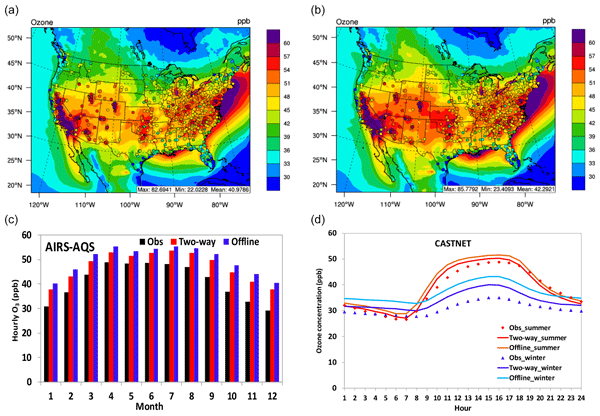
The two-way coupled WRF-CMAQ model accounting for complex chemistry–meteorology feedbacks has been applied to the long-term predictions of regional meteorology and air quality over the US. The model results show superior performance and importance of chemistry–meteorology feedbacks when compared to the offline coupled WRF and CMAQ simulations, which suggests that feedbacks should be considered along with other factors in developing future model applications to inform policy making.
Siqi Ma, Daniel Tong, Lok Lamsal, Julian Wang, Xuelei Zhang, Youhua Tang, Rick Saylor, Tianfeng Chai, Pius Lee, Patrick Campbell, Barry Baker, Shobha Kondragunta, Laura Judd, Timothy A. Berkoff, Scott J. Janz, and Ivanka Stajner
Atmos. Chem. Phys., 21, 16531–16553, https://doi.org/10.5194/acp-21-16531-2021, https://doi.org/10.5194/acp-21-16531-2021, 2021
Short summary
Short summary
Predicting high ozone gets more challenging as urban emissions decrease. How can different techniques be used to foretell the quality of air to better protect human health? We tested four techniques with the CMAQ model against observations during a field campaign over New York City. The new system proves to better predict the magnitude and timing of high ozone. These approaches can be extended to other regions to improve the predictability of high-O3 episodes in contemporary urban environments.
Xiaoyang Chen, Yang Zhang, Kai Wang, Daniel Tong, Pius Lee, Youhua Tang, Jianping Huang, Patrick C. Campbell, Jeff Mcqueen, Havala O. T. Pye, Benjamin N. Murphy, and Daiwen Kang
Geosci. Model Dev., 14, 3969–3993, https://doi.org/10.5194/gmd-14-3969-2021, https://doi.org/10.5194/gmd-14-3969-2021, 2021
Short summary
Short summary
The continuously updated National Air Quality Forecast Capability (NAQFC) provides air quality forecasts. To support the development of the next-generation NAQFC, we evaluate a prototype of GFSv15-CMAQv5.0.2. The performance and the potential improvements for the system are discussed. This study can provide a scientific basis for further development of NAQFC and help it to provide more accurate air quality forecasts to the public over the contiguous United States.
Cited articles
Barkjohn, K. K., Gantt, B., and Clements, A. L.: Development and application of a United States-wide correction for PM2.5 data collected with the PurpleAir sensor, Atmos. Meas. Tech., 14, 4617–4637, https://doi.org/10.5194/amt-14-4617-2021, 2021.
Binkowski, F. S. and Roselle, S. J.: Models-3 Community Multiscale Air Quality (CMAQ) model aerosol component, 1, Model description, J. Geophys. Res.-Atmos., 108, 4183, https://doi.org/10.1029/2001JD001409, 2003.
Black, T. L., Abeles, J. A., Blake, B. T., Jovic, D., Rogers, E., Zhang, X., Aligo, E. A., Dawson, L. C., Lin, Y., Strobach, E., Shafran, P. C., and Carley, J. R.: A limited area modeling capability for the finite-volume cubed-sphere (FV3) dynamical core and comparison with a global two-way nest, J. Adv. Model. Earth Sy., 13, e2021MS002483, https://doi.org/10.1029/2021MS002483, 2021.
Chen, L., Mao, F., Hong, J., Zang, L., Chen, J., Zhang, Y., Gan, Y., Gong, W., and Xu, H.: Improving PM2.5 predictions during COVID-19 lockdown by assimilating multi-source observations and adjusting emissions, Environ. Pollut., 297, 118783, https://doi.org/10.1016/j.envpol.2021.118783, 2022.
Chen, X., Zhang, Y., Wang, K., Tong, D., Lee, P., Tang, Y., Huang, J., Campbell, P. C., Mcqueen, J., Pye, H. O. T., Murphy, B. N., and Kang, D.: Evaluation of the offline-coupled GFSv15–FV3–CMAQv5.0.2 in support of the next-generation National Air Quality Forecast Capability over the contiguous United States, Geosci. Model Dev., 14, 3969–3993, https://doi.org/10.5194/gmd-14-3969-2021, 2021.
Cohen, A. J., Brauer, M., Burnett, R., Anderson, H. R., Frostad, J., Estep, K., Balakrishnan, K., Brunekreef, B., Dandona, L., Dandona, R., Feigin, V., Freedman, G., Hubbell, B., Jobling, A., Kan, H., Knibbs, L., Liu, Y., Martin, R., Morawska, L., Pope, C. A., Shin, H., Straif, K., Shaddick, G., Thomas, M., van Dingenen, R., van Donkelaar, A., Vos, T., Murray, C. J. L., and Forouzanfar, M. H.: Estimates and 25 year trends of the global burden of disease attributable to ambient air pollution: an analysis of data from the Global Burden of Diseases Study 2015, Lancet, 389, 1907–1918, 2017.
Colette, A., Collin, G., Besson, F., Blot, E., Guidard, V., Meleux, F., Royer, A., Petiot, V., Miller, C., Fermond, O., Jeant, A., Adani, M., Arteta, J., Benedictow, A., Bergström, R., Bowdalo, D., Brandt, J., Briganti, G., Carvalho, A. C., Christensen, J. H., Couvidat, F., D'Elia, I., D'Isidoro, M., Denier van der Gon, H., Descombes, G., Di Tomaso, E., Douros, J., Escribano, J., Eskes, H., Fagerli, H., Fatahi, Y., Flemming, J., Friese, E., Frohn, L., Gauss, M., Geels, C., Guarnieri, G., Guevara, M., Guion, A., Guth, J., Hänninen, R., Hansen, K., Im, U., Janssen, R., Jeoffrion, M., Joly, M., Jones, L., Jorba, O., Kadantsev, E., Kahnert, M., Kaminski, J. W., Kouznetsov, R., Kranenburg, R., Kuenen, J., Lange, A. C., Langner, J., Lannuque, V., Macchia, F., Manders, A., Mircea, M., Nyiri, A., Olid, M., Pérez García-Pando, C., Palamarchuk, Y., Piersanti, A., Raux, B., Razinger, M., Robertson, L., Segers, A., Schaap, M., Siljamo, P., Simpson, D., Sofiev, M., Stangel, A., Struzewska, J., Tena, C., Timmermans, R., Tsikerdekis, T., Tsyro, S., Tyuryakov, S., Ung, A., Uppstu, A., Valdebenito, A., van Velthoven, P., Vitali, L., Ye, Z., Peuch, V.-H., and Rouïl, L.: Copernicus Atmosphere Monitoring Service – Regional Air Quality Production System v1.0, Geosci. Model Dev., 18, 6835–6883, https://doi.org/10.5194/gmd-18-6835-2025, 2025.
Colmer, J., Hardman, I., Shimshack, J., and Voorheis, J.: Disparities in PM2.5 air pollution in the United States, Science, 369, 575–578, https://doi.org/10.1126/science.aaz9353, 2020.
Derber, J. C. and Rosati, A.: A global ocean data assimilation system, J. Phys. Oceanogr., 19, 1333–1347, https://doi.org/10.1175/1520-0485(1989)019<1333:AGODAS>2.0.CO;2, 1989.
DOC/NOAA/NWS/NCEP: National Centers for Environmental Prediction, National Weather Service, NOAA, U.S. Department of Commerce, NCEP GFS 0.25 Degree Global Forecast Grids Historical Archive, NSF National Center for Atmospheric Research [data set], https://doi.org/10.5065/D65D8PWK, 2015.
Environmental Protection Agency: Technical Note on Reporting PM2.5 Continuous Monitoring and Speciation Data to the Air Quality System (AQS), https://www.epa.gov/aqs/aqs-memos-technical-note-reporting-pm25-continuous-monitoring-and-speciation-data-air-quality (last access: 24 March 2026), 8 November 2006.
EPA: Wildfire and Air Quality, US Environmental Protection Agency, https://www.epa.gov/sites/default/files/2018-08/documents/epa-2018-science_annualreport_508compressed.pdf (last access: 24 March 2026), 2017.
Ha, S.: Implementation of aerosol data assimilation in WRFDA (v4.0.3) for WRF-Chem (v3.9.1) using the RACM/MADE-VBS scheme, Geosci. Model Dev., 15, 1769–1788, https://doi.org/10.5194/gmd-15-1769-2022, 2022.
Hollingsworth, A. and Lönnberg, P.: The statistical structure of short-range forecast errors as determined from radiosonde data, Part I: The wind field, Tellus A, 38, 111–136, https://doi.org/10.1111/j.1600-0870.1986.tb00460.x, 1986.
Huang, B., Pagowski, M., Trahan, S., Martin, C. R., Tangborn, A., Kondragunta, S., and Kleist, D. T.: JEDI-based three-dimensional Ensemble-Variational Data Assimilation System for global aerosol forecasting at NCEP, J. Adv. Model. Earth Sy., 15, e2022MS003232, https://doi.org/10.1029/2022MS003232, 2023.
Huang, J., Stajner, I., Montuoro, R., Yang, F., Wang, K., Huang, H.-C., Jeon, C.-H., Curtis, B., McQueen, J., Liu, H., Baker, B., Tong, D., Tang, Y., Campbell, P., Grell, G., Frost, G., Schwantes, R., Wang, S., Kondragunta, S., Li, F., and Jung, Y.: Development of the next-generation air quality prediction system in the unified forecast system framework: enhancing predictability of wildfire air quality impacts, B. Am. Meteorol. Soc., https://doi.org/10.1175/BAMS-D-23-0053.1, 2025.
Lee, S., Song, C. H., Han, K. M., Henze, D. K., Lee, K., Yu, J., Woo, J.-H., Jung, J., Choi, Y., Saide, P. E., and Carmichael, G. R.: Impacts of uncertainties in emissions on aerosol data assimilation and short-term PM2.5 predictions over Northeast Asia, Atmos. Environ., 271, 118921, https://doi.org/10.1016/j.atmosenv.2021.118921, 2022.
Li, Y., Tong, D., Ma, S., Zhang, X., Kondragunta, S., Li, F., and Saylor, R.: Dominance of wildfires impact on air quality exceedances during the 2020 record-breaking wildfire season in the United States, Geophys. Res. Lett., 48, e2021GL094908, https://doi.org/10.1029/2021GL094908, 2021.
Li, Z., Zang, Z., Li, Q. B., Chao, Y., Chen, D., Ye, Z., Liu, Y., and Liou, K. N.: A three-dimensional variational data assimilation system for multiple aerosol species with WRF/Chem and an application to PM2.5 prediction, Atmos. Chem. Phys., 13, 4265–4278, https://doi.org/10.5194/acp-13-4265-2013, 2013.
Liu, Z., Snyder, C., Guerrette, J. J., Jung, B.-J., Ban, J., Vahl, S., Wu, Y., Trémolet, Y., Auligné, T., Ménétrier, B., Shlyaeva, A., Herbener, S., Liu, E., Holdaway, D., and Johnson, B. T.: Data assimilation for the Model for Prediction Across Scales – Atmosphere with the Joint Effort for Data assimilation Integration (JEDI-MPAS 1.0.0): EnVar implementation and evaluation, Geosci. Model Dev., 15, 7859–7878, https://doi.org/10.5194/gmd-15-7859-2022, 2022.
Kumar, R., Monache, L. D., Bresch, J., Saide, P. E., Tang, Y., Liu, Z., Silva, A. M. da, Alessandrini, S., Pfister, G., Edwards, D., Lee, P., and Djalalova, I.: Toward improving short-term predictions of fine particulate matter over the United States via assimilation of satellite aerosol optical depth retrievals, J. Geophys. Res.-Atmos., 124, 2753–2773, https://doi.org/10.1029/2018JD029009, 2019.
Mass, C. F., Ovens, D., Conrick, R., and Saltenberger, J.: The September 2020 wildfires over the Pacific Northwest, Weather Forecast., 36, 1843–1865, https://doi.org/10.1175/WAF-D-21-0028.1, 2022.
O'Dell, K., Ford, B., Fischer, E. V., and Pierce, J. R.: Contribution of wildland-fire smoke to US PM2.5 and its influence on recent trends, Environ. Sci. Technol., 53, 1797–1804, https://doi.org/10.1021/acs.est.8b05430, 2019.
Pagowski, M., Grell, G. A., McKeen, S. A., Peckham, S. E., and Devenyi, D.: Three-dimensional variational data assimilation of ozone and fine particulate matter observations: some results using the Weather Research and Forecasting–Chemistry model and grid-point statistical interpolation, Q. J. Roy. Meteor. Soc., 136, 2013–2024, https://doi.org/10.1002/qj.700, 2010.
Pagowski, M., Liu, Z., Grell, G. A., Hu, M., Lin, H.-C., and Schwartz, C. S.: Implementation of aerosol assimilation in Gridpoint Statistical Interpolation (v. 3.2) and WRF-Chem (v. 3.4.1), Geosci. Model Dev., 7, 1621–1627, https://doi.org/10.5194/gmd-7-1621-2014, 2014.
Park, S.-Y., Dash, U. K., Yu, J., Yumimoto, K., Uno, I., and Song, C. H.: Implementation of an ensemble Kalman filter in the Community Multiscale Air Quality model (CMAQ model v5.1) for data assimilation of ground-level PM2.5, Geosci. Model Dev., 15, 2773–2790, https://doi.org/10.5194/gmd-15-2773-2022, 2022.
Robichaud, A.: Surface data assimilation of chemical compounds over North America and its impact on air quality and Air Quality Health Index (AQHI) forecasts, Air Qual. Atmos. Hlth., 10, 955–970, https://doi.org/10.1007/s11869-017-0485-9, 2017.
Robichaud, A., Ménard, R., Zaïtseva, Y., and Anselmo, D.: Multipollutant surface objective analyses and mapping of air quality health index over North America, Air Qual. Atmos. Hlth., 9, 743–759, https://doi.org/10.1007/s11869-015-0385-9, 2016.
Schwartz, C. S., Liu, Z., Lin, H.-C., and McKeen, S. A.: Simultaneous three-dimensional variational assimilation of surface fine particulate matter and MODIS aerosol optical depth, J. Geophys. Res.-Atmos., 117, https://doi.org/10.1029/2011JD017383, 2012.
Sluka, T.: Generic explicit diffusion operator added to JEDI, JCSDA Quarterly Newsletter, 74, https://doi.org/10.25923/cfmw-2a05, 2024.
Sun, W., Liu, Z., Chen, D., Zhao, P., and Chen, M.: Development and application of the WRFDA-Chem three-dimensional variational (3DVAR) system: aiming to improve air quality forecasting and diagnose model deficiencies, Atmos. Chem. Phys., 20, 9311–9329, https://doi.org/10.5194/acp-20-9311-2020, 2020.
Tang, Y., Martin, C. R., Huang, M., Chai, T., Pagowski, M., Wang, H., Kleist, D. T., Baker, B., Campbell, P. C., Huang, J., McQueen, J. T., Montuoro, R., Tong, D., Stajner, I., Jung, Y., Kumar, R., and Kondragunta, S.: Develop and evaluate JEDI-based regional aerosol data assimilation for NOAA UFS-AQM system, The 103rd AMS Annual Meeting, Denver, Colorado, 2023.
Trémolet, Y. and Auligné, T.: The Joint Effort for Data Assimilation Integration (JEDI), JCSDA Quarterly Newsletter, 66, 1–5, https://doi.org/10.25923/RB19-0Q26, 2020.
Vogel, A., Ménard, R., Abu, J., and Chen, J.: Towards a parametric Kalman filter for operational wildfire plume assimilation: Formulation of the forecast step, EGUsphere [preprint], https://doi.org/10.5194/egusphere-2025-6386, 2025.
Wang, H., Weygandt, S., Pagowski, M., Li, R., Montuoro, R., Liu, Q., Dang, C., Ma, Y., Kumar, R., Kondragunta, S., Martin, C., Huang, J., McQueen, J., Stajner, I., and Hughes, B.: Assimilation of aerosol optical depth (AOD) retrievals and PM2.5 in NCEP's next-generation regional air quality forecasting system, WCRP-WWRP Symposium on Data Assimilation and Reanalysis, 2021.
Wang, H., Weygandt, S., Ahmadov, R., Li, R., Romero-Alvarez, J., Li, H., Grell, G., Pagowski, M., Tang, Y., Martin, C., McQueen, J., and Farooqui, M.: Assimilation of surface particulate matter observations in the experimental Rapid Refresh Forecast System coupled with smoke and dust model, CU/CIRES Rendezvous 2023, Boulder, Colorado, https://insidecires.colorado.edu/rendezvous/uploads/Rendezvous_2023_7732_1683821981.pdf (last access: 13 March 2026), 2023.
Wang, H., Martin, C. R., Barré, J. E., Li, R., Allen, B., Luo, H., Weygandt, S. S., Hu, M., Ahmadov, R., Huang, J., Tang, Y., Choi, H., Tangborn, A., Wang, K., Liu, H., Stajner, I., Dang, C., Kondragunta, S., and Kumar, R.: Aerosol data assimilation within JEDI for NOAA's regional air quality model (AQM), The 105th Annual Meeting of the American Meteorological Society, New Orleans, Louisiana, 2025a.
Wang, H., Martin, C., Barré, J., Li, R., Weygandt, S., Huang, J., Tang, Y., Choi, H., Wang, K., Liu, H., and Lee, J.: PM2.5 assimilation within JEDI for NOAA's regional air quality model (AQMv7): application to the September 2020 western US wildfires, Zenodo [data set], https://doi.org/10.5281/zenodo.17049857, 2025b.
Wei, Y., Zhao, X., Zhang, Z., Xu, J., Cheng, S., Liu, Z., Sun, W., Chen, X., Wang, Z., Hao, X., Li, J., and Chen, D.: Impact of model resolution and its representativeness consistency with observations on operational prediction of PM2.5 with 3D-VAR data assimilation, Atmos. Pollut. Res., 15, 102141, https://doi.org/10.1016/j.apr.2024.102141, 2024.
Wen, J. and Burke, M.: Wildfire smoke plume segmentation using geostationary satellite imagery, arXiv, https://doi.org/10.48550/arXiv.2109.01637, 2021.
Wu, J.-B., Xu, J., Pagowski, M., Geng, F., Gu, S., Zhou, G., Xie, Y., and Yu, Z.: Modeling study of a severe aerosol pollution event in December 2013 over Shanghai, China: An application of chemical data assimilation, Particuology, 2015, https://doi.org/10.1016/j.partic.2014.10.008, 2015.
White, S. R., Sugrue, R. A., Guillotte, L., James, E., Wang, H., Ahmadov, R., Thakur, N., and Chow, F. K.: Hourly PM2.5 estimates across California from 2018 to 2023, ACS ES&T Air, https://doi.org/10.1021/acsestair.5c00372, 2026.
Zhang, H., Yee, L. D., Lee, B. H., Curtis, M. P., Worton, D. R., Isaacman-VanWertz, G., Offenberg, J. H., Lewandowski, M., Kleindienst, T. E., Beaver, M. R., Holder, A. L., Lonneman, W. A., Docherty, K. S., Jaoui, M., Pye, H. O. T., Hu, W., Day, D. A., Campuzano-Jost, P., Jimenez, J. L., Guo, H., Weber, R. J., de Gouw, J., Koss, A. R., Edgerton, E. S., Brune, W., Mohr, C., Lopez-Hilfiker, F. D., Lutz, A., Kreisberg, N. M., Spielman, S. R., Hering, S. V., Wilson, K. R., Thornton, J. A., and Goldstein, A. H.: Monoterpenes are the largest source of summertime organic aerosol in the southeastern United States, P. Natl. Acad. Sci. USA, 115, 2038–2043, https://doi.org/10.1073/pnas.1717513115, 2018.
Short summary
This paper describes efforts to develop aerosol data assimilation capabilities for NOAA’s regional air quality modeling system by assimilating PM2.5 observations within the Joint Effort for Data Assimilation Integration framework. Results from the September 2020 Western U.S. wildfires show that assimilating AirNow and/or PurpleAir PM2.5 data reduces mean absolute errors of 1–24 h PM2.5 forecasts over the continental United States on average relative to a control without data assimilation.
This paper describes efforts to develop aerosol data assimilation capabilities for NOAA’s...