
Articles | Volume 19, issue 6
https://doi.org/10.5194/gmd-19-2257-2026
© Author(s) 2026. This work is distributed under
the Creative Commons Attribution 4.0 License.
the Creative Commons Attribution 4.0 License.
https://doi.org/10.5194/gmd-19-2257-2026
© Author(s) 2026. This work is distributed under
the Creative Commons Attribution 4.0 License.
the Creative Commons Attribution 4.0 License.
Development and technical paper
| 
19 Mar 2026
Development and technical paper |
| 19 Mar 2026
| 19 Mar 2026
EcoTWIN 1.0: a fully distributed tracer-aided ecohydrological model tracking water, isotopes, and nutrients

Department of Ecohydrology and Biogeochemistry, Leibniz Institute of Freshwater Ecology and Inland Fisheries, Berlin, Germany
Doerthe Tetzlaff
Department of Ecohydrology and Biogeochemistry, Leibniz Institute of Freshwater Ecology and Inland Fisheries, Berlin, Germany
Geography Institute and IRI THESys, Humboldt University of Berlin, Berlin, Germany
School of Environmental Science and Engineering, Southern University of Science and Technology, Shenzhen, China
Chris Soulsby
Northern Rivers Institute, School of Geosciences, University of Aberdeen, Aberdeen, UK
Related authors
Hyekyeng Jung, Chris Soulsby, Christian Birkel, Songjun Wu, Kristina Yordanova, and Dörthe Tetzlaff
EGUsphere, https://doi.org/10.5194/egusphere-2026-4371, https://doi.org/10.5194/egusphere-2026-4371, 2026
This preprint is open for discussion and under review for Hydrology and Earth System Sciences (HESS).
Short summary
Short summary
A model is built on domain knowledge and improved by analysing its errors, which often leads to new insight about the system being studied. Here, we propose a machine-learning approach that analyses the time series of model errors and separates the information they contain by time step and by the delay to the driving conditions. Applied to an ecohydrological model, it shows how many days earlier a driving factor contributed to the model errors, and how this changes through the seasons.
Cong Jiang, Doerthe Tetzlaff, Songjun Wu, Christian Birkel, Hjalmar Laudon, and Chris Soulsby
Hydrol. Earth Syst. Sci., 30, 3715–3739, https://doi.org/10.5194/hess-30-3715-2026, https://doi.org/10.5194/hess-30-3715-2026, 2026
Short summary
Short summary
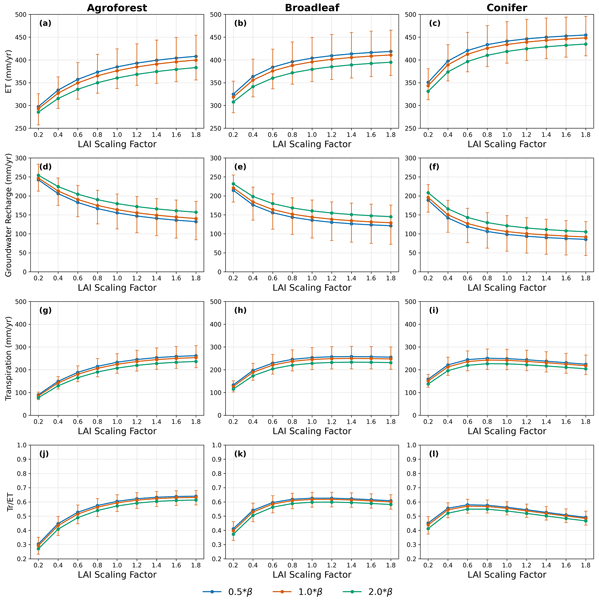
We used a modelling approach supported by stable water isotopes to explore how forest management – such as conifer, broadleaf, and mixed tree–crop systems – affects water partitioning and drought resilience in a drought-sensitive region of Germany. By representing forest type, forest density, and rooting depth, the model helps quantify and show how land use choices affect water availability and ecohydrological resilience, thereby supporting improved land and water management decisions.
Hanwu Zheng, Doerthe Tetzlaff, Christian Birkel, Songjun Wu, Tobias Sauter, and Chris Soulsby
Hydrol. Earth Syst. Sci., 30, 1143–1163, https://doi.org/10.5194/hess-30-1143-2026, https://doi.org/10.5194/hess-30-1143-2026, 2026
Short summary
Short summary
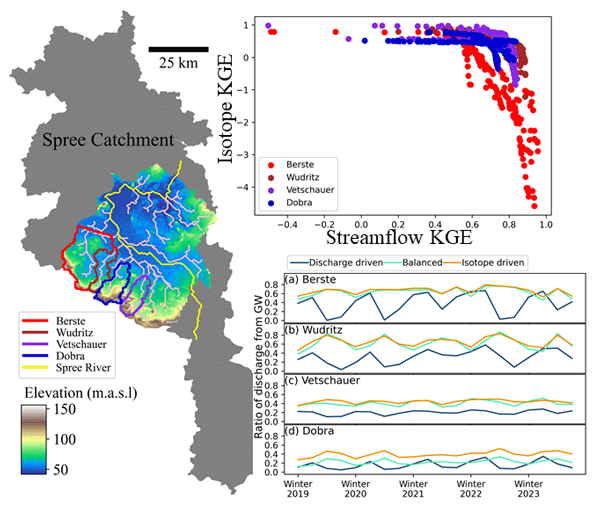
Ecohydrological processes in heavily managed catchments are often inadequately represented in models. We applied a tracer-aided model STARR (Spatially distributed Tracer-Aided Rainfall-Runoff) in an ET (evapotranspiration)-dominated region (the Middle Spree, NE Germany) with major management impacts. Water isotopes were useful in identifying runoff contributions and partitioning ET even at sparse resolution. Trade-offs between discharge- and isotope-based calibrations could be partially mitigated by integrating more process-based conceptualizations into the model.
Hyekyeng Jung, Chris Soulsby, Christian Birkel, Songjun Wu, Kristina Yordanova, and Dörthe Tetzlaff
EGUsphere, https://doi.org/10.5194/egusphere-2026-4371, https://doi.org/10.5194/egusphere-2026-4371, 2026
This preprint is open for discussion and under review for Hydrology and Earth System Sciences (HESS).
Short summary
Short summary
A model is built on domain knowledge and improved by analysing its errors, which often leads to new insight about the system being studied. Here, we propose a machine-learning approach that analyses the time series of model errors and separates the information they contain by time step and by the delay to the driving conditions. Applied to an ecohydrological model, it shows how many days earlier a driving factor contributed to the model errors, and how this changes through the seasons.
Cong Jiang, Doerthe Tetzlaff, Songjun Wu, Christian Birkel, Hjalmar Laudon, and Chris Soulsby
Hydrol. Earth Syst. Sci., 30, 3715–3739, https://doi.org/10.5194/hess-30-3715-2026, https://doi.org/10.5194/hess-30-3715-2026, 2026
Short summary
Short summary
We used a modelling approach supported by stable water isotopes to explore how forest management – such as conifer, broadleaf, and mixed tree–crop systems – affects water partitioning and drought resilience in a drought-sensitive region of Germany. By representing forest type, forest density, and rooting depth, the model helps quantify and show how land use choices affect water availability and ecohydrological resilience, thereby supporting improved land and water management decisions.
Bin Yu, Yanan Chen, and Yi Zheng
EGUsphere, https://doi.org/10.5194/egusphere-2026-1098, https://doi.org/10.5194/egusphere-2026-1098, 2026
Short summary
Short summary
We introduce a deep learning approach that extracts shared operating patterns from diverse, data-rich reservoirs and transfers this knowledge to limited-data areas, yielding skillful simulations of storage and release. Using satellite observations, the model also reconstructs historical behavior in no-data systems. Together, these advances provide a scalable foundation for addressing pressing data gaps in reservoir operations and better supporting large-scale and long-term water management.
Hanwu Zheng, Doerthe Tetzlaff, Christian Birkel, Songjun Wu, Tobias Sauter, and Chris Soulsby
Hydrol. Earth Syst. Sci., 30, 1143–1163, https://doi.org/10.5194/hess-30-1143-2026, https://doi.org/10.5194/hess-30-1143-2026, 2026
Short summary
Short summary
Ecohydrological processes in heavily managed catchments are often inadequately represented in models. We applied a tracer-aided model STARR (Spatially distributed Tracer-Aided Rainfall-Runoff) in an ET (evapotranspiration)-dominated region (the Middle Spree, NE Germany) with major management impacts. Water isotopes were useful in identifying runoff contributions and partitioning ET even at sparse resolution. Trade-offs between discharge- and isotope-based calibrations could be partially mitigated by integrating more process-based conceptualizations into the model.
Ann-Marie Ring, Dörthe Tetzlaff, Christian Birkel, and Chris Soulsby
Hydrol. Earth Syst. Sci., 29, 6663–6683, https://doi.org/10.5194/hess-29-6663-2025, https://doi.org/10.5194/hess-29-6663-2025, 2025
Short summary
Short summary
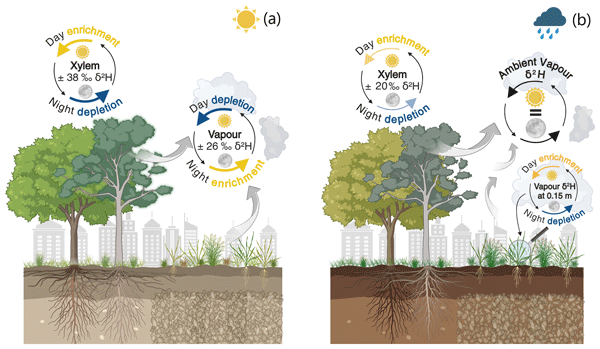
During summer drought, a clear sub-daily cycling of atmospheric water vapour isotopes (δv) and plant xylem water isotopes (δxyl) was observed. δv daytime depletion was driven by evaporation and local atmospheric factors (entrainment). δxyl daytime enrichment was consistent with high vapor pressure deficit and stomatal regulation of transpiration. This sub-daily dataset provides unique insights on sub-daily cycling of stable water isotopes and can help constrain ecohydrological models.
Pedro Henrique Lima Alencar, Saskia Arndt, Kei Namba, Márk Somogyvári, Frederik Bart, Fabio Brill, Juan F. Dueñas, Peter Feindt, Daniel Johnson, Nariman Mahmoodi, Christoph Merz, Subham Mukherjee, Katrin Nissen, Eva Nora Paton, Tobias Sauter, Dörthe Tetzlaff, Franziska Tügel, Thomas Vogelpohl, Stenka Valentinova Vulova, Behnam Zamani, and Hui Hui Zhang
Nat. Hazards Earth Syst. Sci., 25, 4043–4051, https://doi.org/10.5194/nhess-25-4043-2025, https://doi.org/10.5194/nhess-25-4043-2025, 2025
Short summary
Short summary
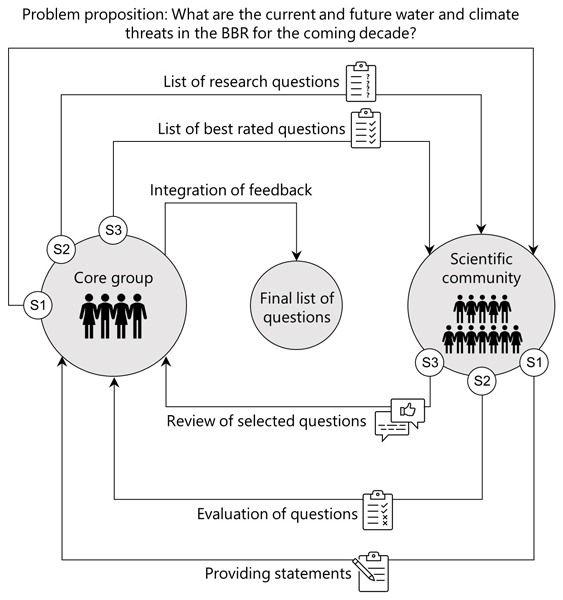
As climate change escalates, the Berlin-Brandenburg region faces new challenges. Climate change-induced extreme events are expected to cause new conflicts to emerge and aggravate existing ones. To guide future research, we co-develop a list of key questions on climate and water challenges in the region. Our findings highlight the need for new research approaches. We expect this list to provide a roadmap for actionable knowledge production to address climate and water challenges in the region.
Maria Magdalena Warter, Dörthe Tetzlaff, Chris Soulsby, Tobias Goldhammer, Daniel Gebler, Kati Vierikko, and Michael T. Monaghan
Hydrol. Earth Syst. Sci., 29, 2707–2725, https://doi.org/10.5194/hess-29-2707-2025, https://doi.org/10.5194/hess-29-2707-2025, 2025
Short summary
Short summary
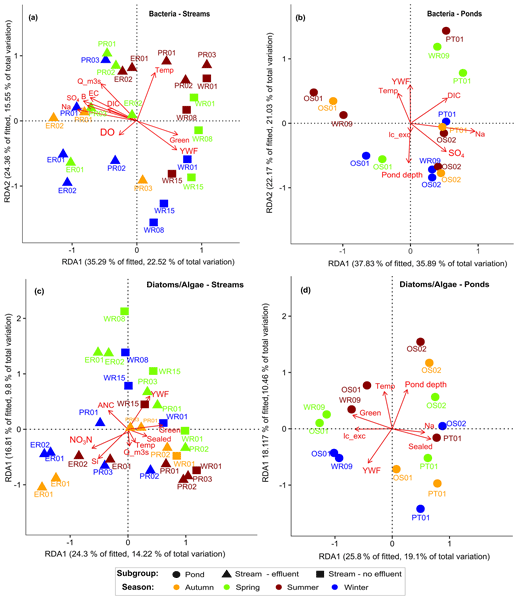
There is a lack of understanding of how urban aquatic nature-based solutions (aquaNBSs) affect ecohydrology and how they in turn are affected by urbanization and climate change. We use a multi-tracer approach of stable water isotopes, hydrochemistry, and microbial and macrophyte diversity to disentangle the effects of hydroclimate and urbanization. The results show potential limitations of aquaNBSs regarding water quality and biodiversity in response to hydroclimate and urban water sources.
Maria Magdalena Warter, Dörthe Tetzlaff, Christian Marx, and Chris Soulsby
Nat. Hazards Earth Syst. Sci., 24, 3907–3924, https://doi.org/10.5194/nhess-24-3907-2024, https://doi.org/10.5194/nhess-24-3907-2024, 2024
Short summary
Short summary
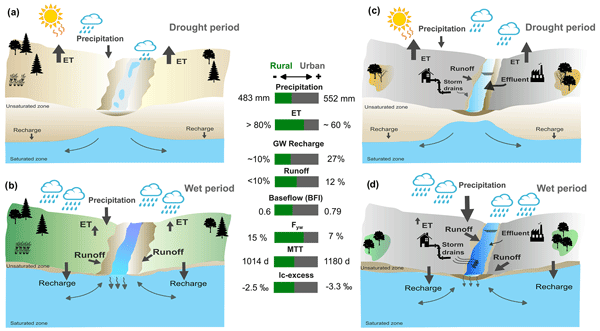
Streams are increasingly impacted by droughts and floods. Still, the amount of water needed for sustainable flows remains unclear and contested. A comparison of two streams in the Berlin–Brandenburg region of northeast Germany, using stable water isotopes, shows strong groundwater dependence with seasonal rainfall contributing to high/low flows. Understanding streamflow variability can help us assess the impacts of climate change on future water resource management.
Salim Goudarzi, Chris Soulsby, Jo Smith, Jamie Lee Stevenson, Alessandro Gimona, Scot Ramsay, Alison Hester, Iris Aalto, and Josie Geris
EGUsphere, https://doi.org/10.5194/egusphere-2024-2258, https://doi.org/10.5194/egusphere-2024-2258, 2024
Preprint archived
Short summary
Short summary
Planting trees on farmlands is now considered as one of the potential solutions to climate change. Trees can suck CO2 out of our atmosphere and store it in their trunks and in the soil beneath them. They can promote biodiversity, protect against soil erosion and drought. They can even help reduce flood risk for downstream communities. But we need models that can tell us the likely impact of trees at different locations and scales. Our study provides such a model.
Chao Wang, Stephen Leisz, Li Li, Xiaoying Shi, Jiafu Mao, Yi Zheng, and Anping Chen
Earth Syst. Dynam., 15, 75–90, https://doi.org/10.5194/esd-15-75-2024, https://doi.org/10.5194/esd-15-75-2024, 2024
Short summary
Short summary
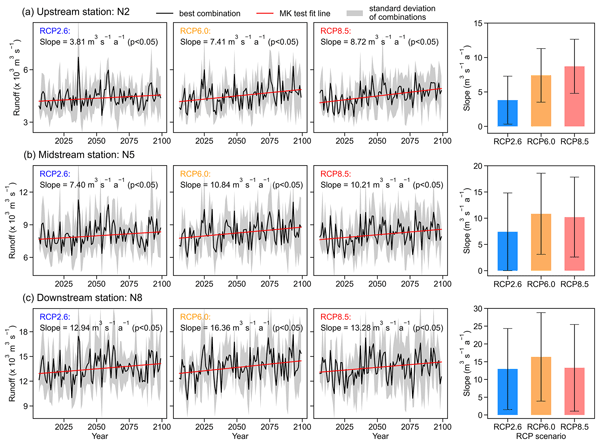
Climate change can significantly impact river runoff; however, predicting future runoff is challenging. Using historical runoff gauge data to evaluate model performances in runoff simulations for the Mekong River, we quantify future runoff changes in the Mekong River with the best simulation combination. Results suggest a significant increase in the annual runoff, along with varied seasonal distributions, thus heightening the need for adapted water resource management measures.

Doerthe Tetzlaff, Aaron Smith, Lukas Kleine, Hauke Daempfling, Jonas Freymueller, and Chris Soulsby
Earth Syst. Sci. Data, 15, 1543–1554, https://doi.org/10.5194/essd-15-1543-2023, https://doi.org/10.5194/essd-15-1543-2023, 2023
Short summary
Short summary
We present a comprehensive set of ecohydrological hydrometric and stable water isotope data of 2 years of data. The data set is unique as the different compartments of the landscape were sampled and the effects of a prolonged drought (2018–2020) captured by a marked negative rainfall anomaly (the most severe regional drought of the 21st century). Thus, the data allow the drought effects on water storage, flux and age dynamics, and persistence of lowland landscapes to be investigated.
Xiaoqiang Yang, Doerthe Tetzlaff, Chris Soulsby, and Dietrich Borchardt
Geosci. Model Dev. Discuss., https://doi.org/10.5194/gmd-2022-239, https://doi.org/10.5194/gmd-2022-239, 2022
Preprint retracted
Short summary
Short summary
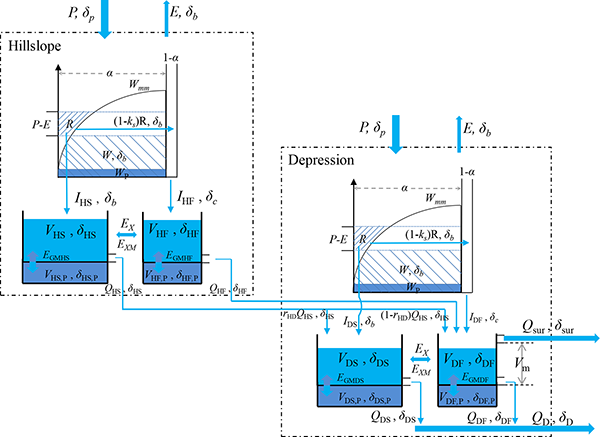
We develop the catchment water quality assessment platform HiWaQ v1.0, which is compatible with multiple hydrological model structures. The nitrogen module (HiWaQ-N) and its coupling tests with two contrasting grid-based hydrological models demonstrate the robustness of the platform in estimating catchment N dynamics. With the unique design of the coupling flexibility, HiWaQ can leverage advancements in hydrological modelling and advance integrated catchment water quantity-quality assessments.
Guangxuan Li, Xi Chen, Zhicai Zhang, Lichun Wang, and Chris Soulsby
Hydrol. Earth Syst. Sci., 26, 5515–5534, https://doi.org/10.5194/hess-26-5515-2022, https://doi.org/10.5194/hess-26-5515-2022, 2022
Short summary
Short summary
We developed a coupled flow–tracer model to understand the effects of passive storage on modeling hydrological function and isotope dynamics in a karst flow system. Models with passive storages show improvement in matching isotope dynamics performance, and the improved performance also strongly depends on the number and location of passive storages. Our results also suggested that the solute transport is primarily controlled by advection and hydrodynamic dispersion in the steep hillslope unit.
Aaron Smith, Doerthe Tetzlaff, Jessica Landgraf, Maren Dubbert, and Chris Soulsby
Biogeosciences, 19, 2465–2485, https://doi.org/10.5194/bg-19-2465-2022, https://doi.org/10.5194/bg-19-2465-2022, 2022
Short summary
Short summary
This research utilizes high-spatiotemporal-resolution soil and vegetation measurements, including water stable isotopes, within an ecohydrological model to partition water flux dynamics and identify flow paths and durations. Results showed high vegetation water use and high spatiotemporal dynamics of vegetation water source and vegetation isotopes. The evaluation of these dynamics further revealed relatively fast flow paths through both shallow soil and vegetation.

Jessica Landgraf, Dörthe Tetzlaff, Maren Dubbert, David Dubbert, Aaron Smith, and Chris Soulsby
Hydrol. Earth Syst. Sci., 26, 2073–2092, https://doi.org/10.5194/hess-26-2073-2022, https://doi.org/10.5194/hess-26-2073-2022, 2022
Short summary
Short summary
Using water stable isotopes, we studied from which water source (lake water, stream water, groundwater, or soil water) two willows were taking their water. We monitored the environmental conditions (e.g. air temperature and soil moisture) and the behaviour of the trees (water flow in the stem). We found that the most likely water sources of the willows were the upper soil layers but that there were seasonal dynamics.
Cited articles
Akbarzadeh, Z., Maavara, T., Slowinski, S., and Van Cappellen, P.: Effects of Damming on River Nitrogen Fluxes: A Global Analysis, Global Biogeochem. Cy., 33, https://doi.org/10.1029/2019GB006222, 2019.
Ala-aho, P., Tetzlaff, D., Mcnamara, J., Laudon, H., and Kormos, P.: Modeling the isotopic evolution of snowpack and snowmelt: Testing a spatially distributed parsimonious approach, Water Resour. Res., 53, https://doi.org/10.1002/2017WR020650, 2017.
Amato, M. T. and Giménez, D.: Predicting monthly near-surface soil temperature from air temperature and the leaf area index, Agr. Forest Meteorol., 345, 109838, https://doi.org/10.1016/j.agrformet.2023.109838, 2024.
Arnold, J., Moriasi, D., Gassman, P., Abbaspour, K., White, M., Srinivasan, R., Santhi, C., Harmel, R., van Griensven, A., Van Liew, M., Kannan, N., and Jha, M.: SWAT: Model use, calibration, and validation, T. ASABE, 55, https://doi.org/10.13031/2013.42256, 2012.
Bajracharya, A., Moghairib, M., Stadnyk, T., and Asadzadeh, M.: Process based calibration of a continental-scale hydrological model using soil moisture and streamflow data, J. Hydrol.: Regional Studies, 47, 101391, https://doi.org/10.1016/j.ejrh.2023.101391, 2023.
Benettin, P., Bailey, S., Campbell, J., Green, M., Rinaldo, A., Likens, G., McGuire, K., and Botter, G.: Linking water age and solute dynamics in streamflow at the Hubbard Brook Experimental Forest, NH, USA, Water Resour. Res., 51, 9256–9272, https://doi.org/10.1002/2015WR017552, 2015.
Beven, K.: A manifesto for the equifinality thesis, J. Hydrol., 320, 18–36, https://doi.org/10.1016/J.JHYDROL.2005.07.007, 2006.
Beven, K.: Facets of uncertainty: Epistemic uncertainty, non-stationarity, likelihood, hypothesis testing, and communication, Hydrolog. Sci. J., 61, 150407155940006, https://doi.org/10.1080/02626667.2015.1031761, 2015.
Birkel, C. and Soulsby, C.: Advancing tracer-aided rainfall-runoff modelling: A review of progress, problems and unrealised potential, Hydrol. Process., 29, 5227–5240, https://doi.org/10.1002/HYP.10594, 2015.
Birkel, C., Tetzlaff, D., and Dunn, S.: Using time domain and geographic source tracers to conceptualize streamflow generation processes in lumped rainfall-runoff models, Water Resour. Res., 47, https://doi.org/10.1029/2010WR009547, 2011.
Condon, L., Kollet, S., Bierkens, M., Maxwell, R., Hill, M., Franssen, H.-J., Verhoef, A., Van Loon, A., Sulis, M., and Abesser, C.: Global Groundwater Modeling and Monitoring: Opportunities and Challenges, Water Resour. Res., 57, https://doi.org/10.1029/2020WR029500, 2021.
Copernicus Climate Change Service, Climate Data Store: ERA5 post-processed daily-statistics on single levels from 1940 to present, Copernicus Climate Change Service (C3S) Climate Data Store (CDS) [data set], https://doi.org/10.24381/cds.4991cf48, 2024.
Craig, H., Gordon, L. I., and Horibe, Y.: Isotopic exchange effects in the evaporation of water: 1. Low-temperature experimental results, J. Geophys. Res., 68, 5079–5087, https://doi.org/10.1029/JZ068I017P05079, 1964.
Dawson, T. and Ehleringer, J.: Streamside trees that do not use stream water, Nature, 350, 335–337, https://doi.org/10.1038/350335a0, 1991.
Dick, J. J., Tetzlaff, D., Birkel, C., and Soulsby, C.: Modelling landscape controls on dissolved organic carbon sources and fluxes to streams, Biogeochemistry, 122, 361–374, https://doi.org/10.1007/S10533-014-0046-3, 2015.
Donnelly, C., Andersson, J. C. M., and Arheimer, B.: Using flow signatures and catchment similarities to evaluate the E-HYPE multi-basin model across Europe, Hydrolog. Sci. J., 61, 255–273, https://doi.org/10.1080/02626667.2015.1027710, 2016.
Eckersten, H., Jansson, P. E., and Johnsson, H.: SOILN model – user's manual 2nd edn., Division of Agricultural Hydrotechnics Communications, 94, 4, https://res.slu.se/id/publ/125709 (last access: 1 April 2025), 1994.
Efstratiadis, A. and Koutsoyiannis, D.: One decade of multi-objective calibration approaches in hydrological modelling: A review, Hydrolog. Sci. J., 55, 58–78, https://doi.org/10.1080/02626660903526292, 2010.
Godsey, S. E., Aas, W., Clair, T. A., de Wit, H. A., Fernandez, I. J., Kahl, J. S., Malcolm, I. A., Neal, C., Neal, M., Nelson, S. J., Norton, S. A., Palucis, M. C., Skjelkvåle, B. L., Soulsby, C., Tetzlaff, D., and Kirchner, J. W.: Generality of fractal 1/f scaling in catchment tracer time series, and its implications for catchment travel time distributions, Hydrol. Process., 24, 1660–1671, https://doi.org/10.1002/hyp.7677, 2010.
Good, S. P., Soderberg, K., Guan, K., King, E. G., Scanlon, T. M., and Caylor, K. K.: δ2H isotopic flux partitioning of evapotranspiration over a grass field following a water pulse and subsequent dry down, Water Resour. Res., 50, 1410–1432, https://doi.org/10.1002/2013WR014333, 2014.
Grizzetti, B., Vigiak, O., Udias, A., Aloe, A., Zanni, M., Bouraoui, F., Pistocchi, A., Dorati, C., Friedland, R., Roo, A., Sanz, C., Leip, A., and Bielza, M.: How EU policies could reduce nutrient pollution in European inland and coastal waters, Global Environmental Change, 69, 102281, https://doi.org/10.1016/j.gloenvcha.2021.102281, 2021.
Hersbach, H., Bell, B., Berrisford, P., Hirahara, S., Horányi, A., Muñoz Sabater, J., Nicolas, J., Peubey, C., Radu, R., Schepers, D., Simmons, A., Soci, C., Abdalla, S., Abellan, X., Balsamo, G., Bechtold, P., Biavati, G., Bidlot, J., Bonavita, M., and Thépaut, J.-N.: The ERA5 global reanalysis, Q. J. Roy. Meteor. Soc., 146, https://doi.org/10.1002/qj.3803, 2020.
Hooper, R., Stone, A., Christophersen, N., de Melo, E., and Seip, H.: Assessing the Birkenes Model of Stream Acidification using a multi-signal calibration methodology, Water Resour. Res., 24, 1308–1316, https://doi.org/10.1029/WR024i008p01308, 1988.
Horita, J., Rozanski, K., and Cohen, S.: Isotope effects in the evaporation of water: A status report of the Craig-Gordon model, Isot. Environ. Health S., 44, 23–49, https://doi.org/10.1080/10256010801887174, 2008.
Hrachowitz, M., Savenije, H., Bogaard, T. A., Tetzlaff, D., and Soulsby, C.: What can flux tracking teach us about water age distribution patterns and their temporal dynamics?, Hydrol. Earth Syst. Sci., 17, 533–564, https://doi.org/10.5194/hess-17-533-2013, 2013.
Jasechko, S., Kirchner, J., Welker, J., and McDonnell, J.: Substantial proportion of global streamflow less than three months old, Nat. Geosci., 9, https://doi.org/10.1038/NGEO2636, 2016.
Jones, E. R., Bierkens, M. F. P., Wanders, N., Sutanudjaja, E. H., van Beek, L. P. H., and van Vliet, M. T. H.: DynQual v1.0: a high-resolution global surface water quality model, Geosci. Model Dev., 16, 4481–4500, https://doi.org/10.5194/gmd-16-4481-2023, 2023.
Jung, H., Tetzlaff, D., Birkel, C., and Soulsby, C.: Recent Developments and Emerging Challenges in Tracer-Aided Modeling, Wiley Interdisciplinary Reviews Water, 12, https://doi.org/10.1002/wat2.70015, 2025.
Kale, R. and Sahoo, B.: Green-Ampt Infiltration Models for Varied Field Conditions: A Revisit, Water Resour. Manag., 25, 3505–3536, https://doi.org/10.1007/s11269-011-9868-0, 2011.
Kumar, R., Samaniego, L., and Attinger, S.: Implications of distributed hydrologic model parameterization on water fluxes at multiple scales and locations, Water Resour. Res., 49, 360–379, https://doi.org/10.1029/2012WR012195, 2013.
Kuppel, S., Tetzlaff, D., Maneta, M. P., and Soulsby, C.: EcH2O-iso 1.0: water isotopes and age tracking in a process-based, distributed ecohydrological model, Geosci. Model Dev., 11, 3045–3069, https://doi.org/10.5194/gmd-11-3045-2018, 2018.
Landgraf, J., Tetzlaff, D., Birkel, C., Stevenson, J., and Soulsby, C.: Assessing land use effects on ecohydrological partitioning in the critical zone through isotope-aided modelling, Earth Surf. Proc. Land., 48, https://doi.org/10.1002/esp.5691, 2023.
Lindström, G., Pers, C., Rosberg, J., Strömqvist, J., and Arheimer, B.: Development and test of the HYPE (Hydrological Predictions for the Environment) model – A water quality model for different spatial scales, Hydrol. Res., 41, https://doi.org/10.2166/nh.2010.007, 2010.
Maneta, M. P. and Silverman, N. L.: A spatially distributed model to simulate water, energy, and vegetation dynamics using information from regional climate models, Earth Interact., 17, 1–44, https://doi.org/10.1175/2012EI000472.1, 2013.
McDonnell, J.: The two water worlds hypothesis: Ecohydrological separation of water between streams and trees?, Wiley Interdisciplinary Reviews: Water, 1, https://doi.org/10.1002/wat2.1027, 2014.
McDonnell, J. and Beven, K.: Debates on Water Resources: The future of Hydrolog. Sci.: A (common) path forward? A call to action aimed at understanding velocities, celerities and residence time distributions of the headwater hydrograph, Water Resour. Res., 50, https://doi.org/10.1002/2013WR015141, 2014.
McMillan, H., Araki, R., Bolotin, L., Kim, D.-H., Coxon, G., Clark, M., and Seibert, J.: Global patterns in observed hydrologic processes, Nature Water, 3, https://doi.org/10.1038/s44221-025-00407-w, 2025.
Mikayilov, F., Rouholahnejad Freund, E., Ashraf Vaghefi, S., Srinivasan, R., Yang, H., and Klöve, B.: A continental-scale hydrology and water quality model for Europe: Calibration and uncertainty of a high-resolution large-scale SWAT model, J. Hydrol., 524, https://doi.org/10.1016/j.jhydrol.2015.03.027, 2015.
Mu, Q., Zhao, M., and Running, S.: Improvements to a MODIS Global Terrestrial Evapotranspiration Algorithm, Remote Sens. Environ., 115, 1781–1800, https://doi.org/10.1016/j.rse.2011.02.019, 2011.
Myneni, R., Knyazikhin, Y., and Park, T.: MOD15A2H MODIS/Terra Leaf Area Index/FPAR 8-Day L4 Global 500m SIN Grid V006, NASA Land Processes Distributed Active Archive Center [data set], https://doi.org/10.5067/MODIS/MOD15A2H.006, 2015.
Nan, Y., He, Z., Tian, F., Wei, Z., and Tian, L.: Can we use precipitation isotope outputs of isotopic general circulation models to improve hydrological modeling in large mountainous catchments on the Tibetan Plateau?, Hydrol. Earth Syst. Sci., 25, 6151–6172, https://doi.org/10.5194/hess-25-6151-2021, 2021.
Naz, B. S., Sharples, W., Ma, Y., Goergen, K., and Kollet, S.: Continental-scale evaluation of a fully distributed coupled land surface and groundwater model, ParFlow-CLM (v3.6.0), over Europe, Geosci. Model Dev., 16, 1617–1639, https://doi.org/10.5194/gmd-16-1617-2023, 2023.
Neal, C., Christophersen, N., Neale, R., Smith, C., and Reynolds, B.: Chloride in precipitation and streamwater for the upland catchment of River Severn, mid- Wales; some consequences for hydrochemical models, Hydrol. Process., 2, 155–165, https://doi.org/10.1002/hyp.3360020206, 1988.
Nearing, G., Ruddell, B., Bennett, A., Prieto, C., and Gupta, H.: Does Information Theory Provide a New Paradigm for Earth Science? Hypothesis Testing, Water Resour. Res., 56, https://doi.org/10.1029/2019WR024918, 2020.
Ocampo, C., Sivapalan, M., and Oldham, C.: Hydrological connectivity of upland-riparian zones in agricultural catchments: Implications for runoff generation and nitrate transport, J. Hydrol., 331, 643–658, https://doi.org/10.1016/j.jhydrol.2006.06.010, 2006.
Pechlivanidis, I., Jackson, B., Mcintyre, N., and Wheater, H.: Catchment scale hydrological modelling: A review of model types, calibration approaches and uncertainty analysis methods in the context of recent developments in technology and applications, GlobalNEST International Journal, 13, 193–214, 2011.
Pesántez, J., Birkel, C., Gaona, G., Arciniega-Esparza, S., Murray, D., Mosquera, G., Célleri, R., Mora-Abril, E., and Crespo, P.: Spatially distributed tracer-aided modelling to explore DOC dynamics, hot spots and hot moments in a tropical mountain catchment, Hydrol. Process., 37, 1–15, https://doi.org/10.1002/hyp.15020, 2023.
Rakovec, O., Kumar, R., Mai, J., Cuntz, M., Thober, S., Zink, M., Attinger, S., Schäfer, D., Schrön, M., and Samaniego, L.: Multiscale and Multivariate Evaluation of Water Fluxes and States over European River Basins, J. Hydrometeorol., 17, 287–307, https://doi.org/10.1175/JHM-D-15-0054.1, 2016.
Rakovec, O., Mizukami, N., Kumar, R., Newman, A., Thober, S., Wood, A., Clark, M., and Samaniego, L.: Diagnostic Evaluation of Large-Domain Hydrologic Models Calibrated Across the Contiguous United States, J. Geophys. Res.-Atmos., 124, https://doi.org/10.1029/2019JD030767, 2019.
Remondi, F., Kirchner, J., Burlando, P., and Fatichi, S.: Water Flux Tracking with A Distributed Hydrological Model to Quantify Controls on the Spatio-Temporal Variability of Transit Time Distributions, Water Resour. Res., 54, https://doi.org/10.1002/2017WR021689, 2018.
Samaniego, L., Kumar, R., and Attinger, S.: Multiscale parameter regionalization of a grid-based hydrologic model at the mesoscale, Water Resour. Res., 46, https://doi.org/10.1029/2008WR007327, 2010.
Seybold, E., Dwivedi, R., Musselman, K., Kincaid, D., Schroth, A., Classen, A., Perdrial, J., and Adair, C.: Winter runoff events pose an unquantified continental-scale risk of high wintertime nutrient export, Environ. Res. Lett., 17, 104044, https://doi.org/10.1088/1748-9326/ac8be5, 2022.
Šimùnek, J., Šejna, M., Saito, H., and Van Genuchten, M. T.: The HYDRUS-1D software package for simulating the one-dimensional movement of water, heat, and multiple solutes in variably-saturated media (Version 4.17), Department of Environmental Sciences University of Riverside California, California [software], https://www.pc-progress.com/Downloads/Pgm_hydrus1D/HYDRUS1D-4.17.pdf (last access: 1 April 2025), 2013.
Skrzypek, G., Mydłowski, A., Dogramaci, S., Hedley, P., Gibson, J. J., and Grierson, P. F.: Estimation of evaporative loss based on the stable isotope composition of water using Hydrocalculator, J. Hydrol., 523, 781–789, https://doi.org/10.1016/J.JHYDROL.2015.02.010, 2015.
Smith, A., Tetzlaff, D., Kleine, L., Maneta, M., and Soulsby, C.: Quantifying the effects of land use and model scale on water partitioning and water ages using tracer-aided ecohydrological models, Hydrol. Earth Syst. Sci., 25, 2239–2259, https://doi.org/10.5194/hess-25-2239-2021, 2021.
Soulsby, C., Birkel, C., Geris, J., Dick, J., Tunaley, C., and Tetzlaff, D.: Stream water age distributions controlled by storage dynamics and nonlinear hydrologic connectivity: Modeling with high-resolution isotope data, Water Resour. Res., 51, 7759–7776, https://doi.org/10.1002/2015WR017888, 2015.
Sprenger, M., Stumpp, C., Weiler, M., Aeschbach, W., Allen, S., Benettin, P., Dubbert, M., Hartmann, A., Hrachowitz, M., Kirchner, J., McDonnell, J., Orlowski, N., Penna, D., Pfahl, S., Rinderer, M., Rodriguez, N., Schmidt, M., and Werner, C.: The Demographics of Water: A Review of Water Ages in the Critical Zone, Rev. Geophys., 57, https://doi.org/10.1029/2018RG000633, 2019.
Tapley, B., Bettadpur, S., Ries, J. C., Thompson, P., and Watkins, M.: GRACE Measurements of Mass Variability in the Earth System, Science, 305, 503–505, https://doi.org/10.1126/science.1099192, 2004.
Tetzlaff, D., Buttle, J., Carey, S. K., Mcguire, K., Laudon, H., and Soulsby, C.: Tracer-based assessment of flow paths, storage and runoff generation in northern catchments: A review, Hydrol. Process., 29, 3475–3490, https://doi.org/10.1002/HYP.10412, 2015.
van Huijgevoort, M., Tetzlaff, D., and Sutanudjaja, E.: Using high resolution tracer data to constrain water storage, flux and age estimates in a spatially distributed rainfall-runoff model, Hydrol. Process., 30, https://doi.org/10.1002/hyp.10902, 2016.
Venohr, M., Hirt, U., Hofmann, J., Opitz, D., Gericke, A., Wetzig, A., Natho, S., Neumann, F., Hürdler, J., Matranga, M., Mahnkopf, J., Gadegast, M., and Behrendt, H.:, Modelling of Nutrient Emissions in River Systems – MONERIS – Methods and Background, Int. Rev. Hydrobiol., 96, 435–483, https://doi.org/10.1002/iroh.201111331, 2011.
Wang, J., Bouwman, A., Vilmin, L., Beusen, A., Hoek, W., Liu, X., and Middelburg, J.: Global inland-water nitrogen cycling has accelerated in the Anthropocene, Nature Water, 2, https://doi.org/10.1038/s44221-024-00282-x, 2024.
Wellen, C., Kamran-Disfani, A.-R., and Arhonditsis, G.: Evaluation of the Current State of Distributed Watershed Nutrient Water Quality Modeling, Environ. Sci. Technol., 49, https://doi.org/10.1021/es5049557, 2015.
Wen, Y., Lin, J.-S., Plaza, F., and Liang, X.: Roles of Hydrology and Transport Processes in Denitrification at Watershed Scale, Water Resour. Res., 60, 1–24, https://doi.org/10.1029/2023WR034971, 2024.
Winkler, K., Fuchs, R., Rounsevell, M., and Herold, M.: Global land use changes are four times greater than previously estimated, Nat. Commun., 12, 2501, https://doi.org/10.1038/s41467-021-22702-2, 2021.
Wu, S., Tetzlaff, D., Yang, X., and Soulsby, C.: Disentangling the influence of landscape characteristics, hydroclimatic variability and land management on surface water NO3–N dynamics: spatially distributed modelling over 30 years in a lowland mixed land use catchment, Water Resour. Res., e2021WR030566, https://doi.org/10.1029/2021WR030566, 2022.
Wu, S., Tetzlaff, D., Beven, K., and Soulsby, C.: DREAM(LoAX): Simultaneous Calibration and Diagnosis for Tracer-Aided Ecohydrological Models Under the Equifinality Thesis, Water Resour. Res., 61, e2024WR038779, https://doi.org/10.1029/2024WR038779, 2025a.
Wu, S., Tetzlaff, D., Yang, X., Sauter, T., and Soulsby, C.: Hydrological Connectivity Dominates NO3-N Cycling in Complex Landscapes – Insights From Integration of Isotopes and Water Quality Modeling, Water Resour. Res., 61, e2025WR040525, https://doi.org/10.1029/2025WR040525, 2025b.
Wu, S., Tetzlaff, D., and Soulsby, C.: Revising Common Approaches for Calibration: Insights From a 1-D Tracer-Aided Hydrological Model With High-Dimensional Parameters and Objectives, Water Resour. Res., 61, e2024WR037656, https://doi.org/10.1029/2024WR037656, 2025c.
Wu, S., Tetzlaff, D., Zheng, Y., and Soulsby, C.: EcoTWIN v1.0 release, Zenodo [data set], https://doi.org/10.5281/zenodo.16747633, 2025d.
Yang, C., Condon, L., and Maxwell, R.: Unravelling groundwater–stream connections over the continental United States, Nature Water, 3, https://doi.org/10.1038/s44221-024-00366-8, 2025.
Yang, X., Jomaa, S., Zink, M., Fleckenstein, J., Borchardt, D., and Rode, M.: A New Fully Distributed Model of Nitrate Transport and Removal at Catchment Scale, Water Resour. Res., 54, https://doi.org/10.1029/2017WR022380, 2018.
Yang, X., Zhang, X., Graeber, D., Hensley, R., Jarvie, H., Lorke, A., Borchardt, D., Li, Q., and Rode, M.: Large-stream nitrate retention patterns shift during droughts: Seasonal to sub-daily insights from high-frequency data-model fusion, Water Res., 243, 120347, https://doi.org/10.1016/j.watres.2023.120347, 2023a.
Yang, X., Tetzlaff, D., Müller, C., Knöller, K., Borchardt, D., and Soulsby, C.: Upscaling Tracer-Aided Ecohydrological Modeling to Larger Catchments: Implications for Process Representation and Heterogeneity in Landscape Organization, Water Resour. Res., 59, e2022WR033033, https://doi.org/10.1029/2022WR033033, 2023b.
Yang, X., Tetzlaff, D., Jin, J., Li, Q., Borchardt, D., and Soulsby, C.: Linking terrestrial biogeochemical processes and water ages to catchment water quality: A new Damköhler analysis based on coupled modeling of isotope tracers and nitrate dynamics, Water Res., 262, 122118, https://doi.org/10.1016/j.watres.2024.122118, 2024.
Zhang, Z., Chen, X., Cheng, Q.-B., Li, S.-L., Yue, F.-J., Peng, T., Waldron, S., Oliver, D., and Soulsby, C.: Coupled hydrological and biogeochemical modelling of nitrogen transport in the karst critical zone, Sci. Total Environ., 732, 138902, https://doi.org/10.1016/j.scitotenv.2020.138902, 2020.
Zhu, J., Jia, Y., Yu, G., Wang, Q., He, N., Chen, Z., He, H., Zhu, X., Li, P., Zhang, F., Liu, X., Goulding, K., Fowler, D., and Vitousek, P.: Changing patterns of global nitrogen deposition driven by socio-economic development, Nat. Commun., 16, 46, https://doi.org/10.1038/s41467-024-55606-y, 2025.
Short summary
We developed EcoTWIN v1.0, a new fully distributed tracer-aided ecohydrological model that tracks water, isotopes, and nutrients fluxes. The model was successfully tested in 17 large European catchments across diverse geological and climatic backgrounds. As a tracer-aided model, EcoTWIN not only captures flow paths but also estimates water ages/travel times, thus bridging hydrology with water quality. This opens new possibilities for understanding the synergy between water and nitrogen cycles.
We developed EcoTWIN v1.0, a new fully distributed tracer-aided ecohydrological model that...


