
Articles | Volume 19, issue 5
https://doi.org/10.5194/gmd-19-2177-2026
© Author(s) 2026. This work is distributed under
the Creative Commons Attribution 4.0 License.
the Creative Commons Attribution 4.0 License.
https://doi.org/10.5194/gmd-19-2177-2026
© Author(s) 2026. This work is distributed under
the Creative Commons Attribution 4.0 License.
the Creative Commons Attribution 4.0 License.
Development and technical paper
| 
17 Mar 2026
Development and technical paper |
| 17 Mar 2026
| 17 Mar 2026
HIDRA-D: deep-learning model for dense sea level forecasting using sparse altimetry and tide gauge data
Marko Rus
Office for Meteorology, Hydrology and Oceanography, Slovenian Environment Agency, Ljubljana, Slovenia
Visual Cognitive Systems Lab, Faculty of Computer and Information Science, University of Ljubljana, Ljubljana, Slovenia

Office for Meteorology, Hydrology and Oceanography, Slovenian Environment Agency, Ljubljana, Slovenia
Marine Biology Station, National Institute of Biology, Piran, Slovenia
Matej Kristan
Visual Cognitive Systems Lab, Faculty of Computer and Information Science, University of Ljubljana, Ljubljana, Slovenia
Related authors
Iva Međugorac, Nikola Metličić, Jadranka Šepić, Marko Rus, Srđan Čupić, Matej Kristan, and Matjaž Ličer
EGUsphere, https://doi.org/10.5194/egusphere-2026-3411, https://doi.org/10.5194/egusphere-2026-3411, 2026
Short summary
Short summary
Strong high-frequency sea-level oscillations can cause coastal flooding and damage along the Adriatic coast. Using over 20 years of observations, we tested whether convolutional neural networks can predict these events from sea-level and atmospheric data. The models reproduced typical oscillations well, but rare extremes were often underestimated.
Amirhossein Barzandeh, Matjaž Ličer, Marko Rus, Matej Kristan, Ilja Maljutenko, Jüri Elken, Priidik Lagemaa, and Rivo Uiboupin
Ocean Sci., 21, 1315–1327, https://doi.org/10.5194/os-21-1315-2025, https://doi.org/10.5194/os-21-1315-2025, 2025
Short summary
Short summary
We evaluated a deep-learning model, HIDRA2, for predicting sea levels along the Estonian coast and compared it to traditional numerical models. HIDRA2 performed better overall, offering faster forecasts and valuable uncertainty estimates using ensemble predictions.

Marko Rus, Hrvoje Mihanović, Matjaž Ličer, and Matej Kristan
Geosci. Model Dev., 18, 605–620, https://doi.org/10.5194/gmd-18-605-2025, https://doi.org/10.5194/gmd-18-605-2025, 2025
Short summary
Short summary
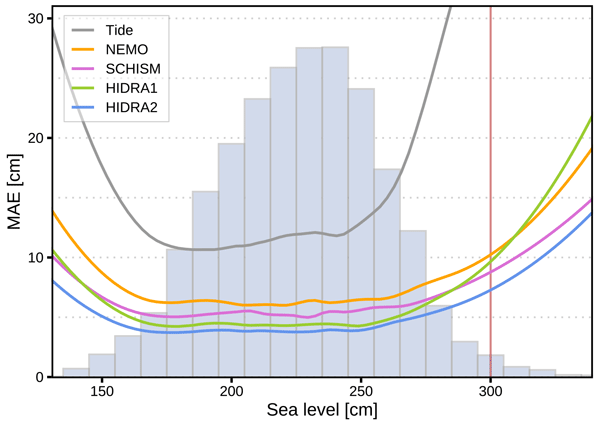
HIDRA3 is a deep-learning model for predicting sea levels and storm surges, offering significant improvements over previous models and numerical simulations. It utilizes data from multiple tide gauges, enhancing predictions even with limited historical data and during sensor outages. With its advanced architecture, HIDRA3 outperforms current state-of-the-art models by achieving a mean absolute error of up to 15 % lower, proving effective for coastal flood forecasting under diverse conditions.
Marko Rus, Anja Fettich, Matej Kristan, and Matjaž Ličer
Geosci. Model Dev., 16, 271–288, https://doi.org/10.5194/gmd-16-271-2023, https://doi.org/10.5194/gmd-16-271-2023, 2023
Short summary
Short summary
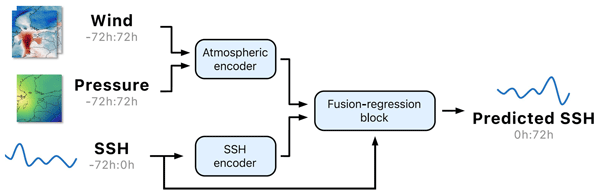
We propose a new fast and reliable deep-learning architecture HIDRA2 for sea level and storm surge modeling. HIDRA2 features new feature encoders and a fusion-regression block. We test HIDRA2 on Adriatic storm surges, which depend on an interaction between tides and seiches. We demonstrate that HIDRA2 learns to effectively mimic the timing and amplitude of Adriatic seiches. This is essential for reliable HIDRA2 predictions of total storm surge sea levels.
Grega Rovšček, Matjaž Ličer, Alexander Barth, and Matej Kristan
Geosci. Model Dev., 19, 8915–8938, https://doi.org/10.5194/gmd-19-8915-2026, https://doi.org/10.5194/gmd-19-8915-2026, 2026
Short summary
Short summary
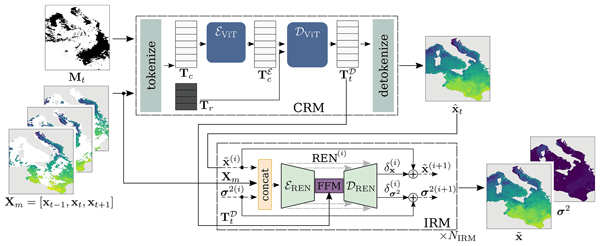
Satellite measurements of sea surface temperature are often blocked by clouds, leaving large gaps in the data used to study the ocean and climate. We developed a new computer model that fills in these missing areas while also estimating how uncertain the reconstruction is. Tests on several ocean regions show more accurate results and more realistic patterns, helping scientists better analyze and model ocean conditions.
Iva Međugorac, Nikola Metličić, Jadranka Šepić, Marko Rus, Srđan Čupić, Matej Kristan, and Matjaž Ličer
EGUsphere, https://doi.org/10.5194/egusphere-2026-3411, https://doi.org/10.5194/egusphere-2026-3411, 2026
Short summary
Short summary
Strong high-frequency sea-level oscillations can cause coastal flooding and damage along the Adriatic coast. Using over 20 years of observations, we tested whether convolutional neural networks can predict these events from sea-level and atmospheric data. The models reproduced typical oscillations well, but rare extremes were often underestimated.
Fabio Giordano, Matjaž Ličer, Stefano Querin, Stefano Salon, and Martin Vodopivec
EGUsphere, https://doi.org/10.5194/egusphere-2026-2567, https://doi.org/10.5194/egusphere-2026-2567, 2026
Short summary
Short summary
In summer 2023, the Gulf of Trieste (Adriatic, Mediterranean Sea) experienced extreme bottom temperatures recorded by a thermometer at 20 m depth. However, the three-month bottom marine heatwave was not detectable from the surface. The event followed a prolonged drought: high salinity and density of surface waters caused unusually deep mixing, allowing warm surface waters to reach the seafloor and imposing extreme stress on bottom-dwelling biota.
Matjaž Zupančič Muc, Vitjan Zavrtanik, Alexander Barth, Aida Alvera-Azcarate, Matjaž Ličer, and Matej Kristan
Geosci. Model Dev., 18, 5549–5573, https://doi.org/10.5194/gmd-18-5549-2025, https://doi.org/10.5194/gmd-18-5549-2025, 2025
Short summary
Short summary
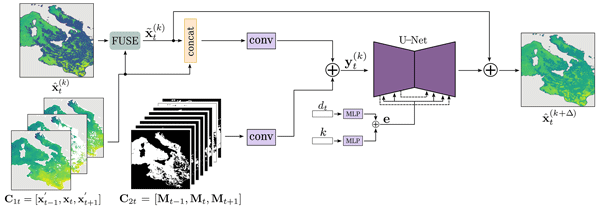
Accurate sea surface temperature data (SST) are crucial for weather forecasting and climate modeling, but satellite observations are often incomplete. We developed a new method called CRITER, which uses machine learning to fill in the gaps in SST data. Our two-stage approach reconstructs large-scale patterns and refines details. Tested on Mediterranean, Adriatic, and Atlantic sea data, CRITER outperforms current methods, reducing errors by up to 44 %.
Amirhossein Barzandeh, Matjaž Ličer, Marko Rus, Matej Kristan, Ilja Maljutenko, Jüri Elken, Priidik Lagemaa, and Rivo Uiboupin
Ocean Sci., 21, 1315–1327, https://doi.org/10.5194/os-21-1315-2025, https://doi.org/10.5194/os-21-1315-2025, 2025
Short summary
Short summary
We evaluated a deep-learning model, HIDRA2, for predicting sea levels along the Estonian coast and compared it to traditional numerical models. HIDRA2 performed better overall, offering faster forecasts and valuable uncertainty estimates using ensemble predictions.
Marko Rus, Hrvoje Mihanović, Matjaž Ličer, and Matej Kristan
Geosci. Model Dev., 18, 605–620, https://doi.org/10.5194/gmd-18-605-2025, https://doi.org/10.5194/gmd-18-605-2025, 2025
Short summary
Short summary
HIDRA3 is a deep-learning model for predicting sea levels and storm surges, offering significant improvements over previous models and numerical simulations. It utilizes data from multiple tide gauges, enhancing predictions even with limited historical data and during sensor outages. With its advanced architecture, HIDRA3 outperforms current state-of-the-art models by achieving a mean absolute error of up to 15 % lower, proving effective for coastal flood forecasting under diverse conditions.
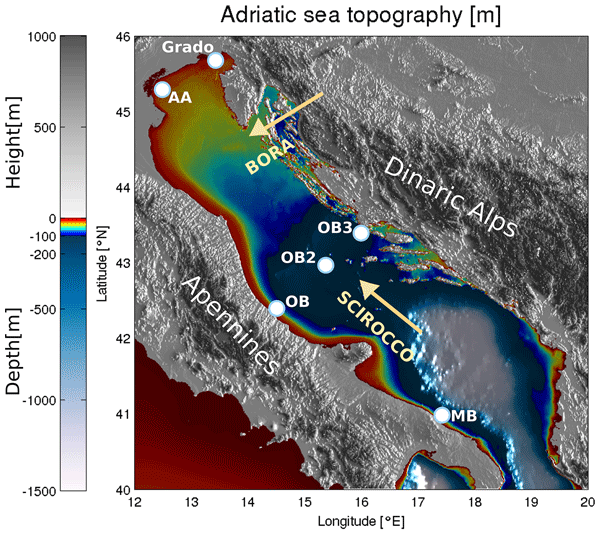
Peter Mlakar, Antonio Ricchi, Sandro Carniel, Davide Bonaldo, and Matjaž Ličer
Geosci. Model Dev., 17, 4705–4725, https://doi.org/10.5194/gmd-17-4705-2024, https://doi.org/10.5194/gmd-17-4705-2024, 2024
Short summary
Short summary
We propose a new point-prediction model, the DEep Learning WAVe Emulating model (DELWAVE), which successfully emulates the Simulating WAves Nearshore model (SWAN) over synoptic to climate timescales. Compared to control climatology over all wind directions, the mismatch between DELWAVE and SWAN is generally small compared to the difference between scenario and control conditions, suggesting that the noise introduced by surrogate modelling is substantially weaker than the climate change signal.
Marko Rus, Anja Fettich, Matej Kristan, and Matjaž Ličer
Geosci. Model Dev., 16, 271–288, https://doi.org/10.5194/gmd-16-271-2023, https://doi.org/10.5194/gmd-16-271-2023, 2023
Short summary
Short summary
We propose a new fast and reliable deep-learning architecture HIDRA2 for sea level and storm surge modeling. HIDRA2 features new feature encoders and a fusion-regression block. We test HIDRA2 on Adriatic storm surges, which depend on an interaction between tides and seiches. We demonstrate that HIDRA2 learns to effectively mimic the timing and amplitude of Adriatic seiches. This is essential for reliable HIDRA2 predictions of total storm surge sea levels.

Nydia Catalina Reyes Suárez, Valentina Tirelli, Laura Ursella, Matjaž Ličer, Massimo Celio, and Vanessa Cardin
Ocean Sci., 18, 1321–1337, https://doi.org/10.5194/os-18-1321-2022, https://doi.org/10.5194/os-18-1321-2022, 2022
Short summary
Short summary
Explaining the dynamics of jellyfish blooms is a challenge for scientists. Biological and meteo-oceanographic data were combined on different timescales to explain the exceptional bloom of the jellyfish Rhizostoma pulmo in the Gulf of Trieste (Adriatic Sea) in April 2021. The bloom was associated with anomalously warm seasonal sea conditions. Then, a strong bora wind event enhanced upwelling and mixing of the water column, causing jellyfish to rise to the surface and accumulate along the coast.
Begoña Pérez Gómez, Ivica Vilibić, Jadranka Šepić, Iva Međugorac, Matjaž Ličer, Laurent Testut, Claire Fraboul, Marta Marcos, Hassen Abdellaoui, Enrique Álvarez Fanjul, Darko Barbalić, Benjamín Casas, Antonio Castaño-Tierno, Srđan Čupić, Aldo Drago, María Angeles Fraile, Daniele A. Galliano, Adam Gauci, Branislav Gloginja, Víctor Martín Guijarro, Maja Jeromel, Marcos Larrad Revuelto, Ayah Lazar, Ibrahim Haktan Keskin, Igor Medvedev, Abdelkader Menassri, Mohamed Aïssa Meslem, Hrvoje Mihanović, Sara Morucci, Dragos Niculescu, José Manuel Quijano de Benito, Josep Pascual, Atanas Palazov, Marco Picone, Fabio Raicich, Mohamed Said, Jordi Salat, Erdinc Sezen, Mehmet Simav, Georgios Sylaios, Elena Tel, Joaquín Tintoré, Klodian Zaimi, and George Zodiatis
Ocean Sci., 18, 997–1053, https://doi.org/10.5194/os-18-997-2022, https://doi.org/10.5194/os-18-997-2022, 2022
Short summary
Short summary
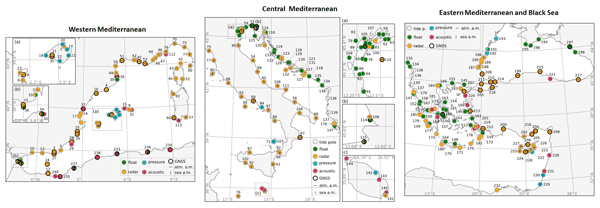
This description and mapping of coastal sea level monitoring networks in the Mediterranean and Black seas reveals the existence of 240 presently operational tide gauges. Information is provided about the type of sensor, time sampling, data availability, and ancillary measurements. An assessment of the fit-for-purpose status of the network is also included, along with recommendations to mitigate existing bottlenecks and improve the network, in a context of sea level rise and increasing extremes.
Emma Reyes, Eva Aguiar, Michele Bendoni, Maristella Berta, Carlo Brandini, Alejandro Cáceres-Euse, Fulvio Capodici, Vanessa Cardin, Daniela Cianelli, Giuseppe Ciraolo, Lorenzo Corgnati, Vlado Dadić, Bartolomeo Doronzo, Aldo Drago, Dylan Dumas, Pierpaolo Falco, Maria Fattorini, Maria J. Fernandes, Adam Gauci, Roberto Gómez, Annalisa Griffa, Charles-Antoine Guérin, Ismael Hernández-Carrasco, Jaime Hernández-Lasheras, Matjaž Ličer, Pablo Lorente, Marcello G. Magaldi, Carlo Mantovani, Hrvoje Mihanović, Anne Molcard, Baptiste Mourre, Adèle Révelard, Catalina Reyes-Suárez, Simona Saviano, Roberta Sciascia, Stefano Taddei, Joaquín Tintoré, Yaron Toledo, Marco Uttieri, Ivica Vilibić, Enrico Zambianchi, and Alejandro Orfila
Ocean Sci., 18, 797–837, https://doi.org/10.5194/os-18-797-2022, https://doi.org/10.5194/os-18-797-2022, 2022
Short summary
Short summary
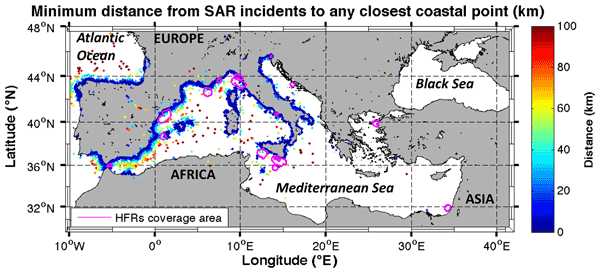
This work reviews the existing advanced and emerging scientific and societal applications using HFR data, developed to address the major challenges identified in Mediterranean coastal waters organized around three main topics: maritime safety, extreme hazards and environmental transport processes. It also includes a discussion and preliminary assessment of the capabilities of existing HFR applications, finally providing a set of recommendations towards setting out future prospects.
Pablo Lorente, Eva Aguiar, Michele Bendoni, Maristella Berta, Carlo Brandini, Alejandro Cáceres-Euse, Fulvio Capodici, Daniela Cianelli, Giuseppe Ciraolo, Lorenzo Corgnati, Vlado Dadić, Bartolomeo Doronzo, Aldo Drago, Dylan Dumas, Pierpaolo Falco, Maria Fattorini, Adam Gauci, Roberto Gómez, Annalisa Griffa, Charles-Antoine Guérin, Ismael Hernández-Carrasco, Jaime Hernández-Lasheras, Matjaž Ličer, Marcello G. Magaldi, Carlo Mantovani, Hrvoje Mihanović, Anne Molcard, Baptiste Mourre, Alejandro Orfila, Adèle Révelard, Emma Reyes, Jorge Sánchez, Simona Saviano, Roberta Sciascia, Stefano Taddei, Joaquín Tintoré, Yaron Toledo, Laura Ursella, Marco Uttieri, Ivica Vilibić, Enrico Zambianchi, and Vanessa Cardin
Ocean Sci., 18, 761–795, https://doi.org/10.5194/os-18-761-2022, https://doi.org/10.5194/os-18-761-2022, 2022
Short summary
Short summary
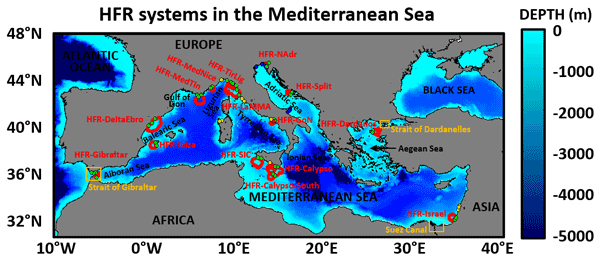
High-frequency radar (HFR) is a land-based remote sensing technology that can provide maps of the surface circulation over broad coastal areas, along with wave and wind information. The main goal of this work is to showcase the current status of the Mediterranean HFR network as well as present and future applications of this sensor for societal benefit such as search and rescue operations, safe vessel navigation, tracking of marine pollutants, and the monitoring of extreme events.
Cited articles
Bajo, M., Ferrarin, C., Umgiesser, G., Bonometto, A., and Coraci, E.: Modelling the barotropic sea level in the Mediterranean Sea using data assimilation, Ocean Sci., 19, 559–579, https://doi.org/10.5194/os-19-559-2023, 2023. a
Barth, A., Alvera-Azcárate, A., Licer, M., and Beckers, J.-M.: DINCAE 1.0: a convolutional neural network with error estimates to reconstruct sea surface temperature satellite observations, Geosci. Model Dev., 13, 1609–1622, https://doi.org/10.5194/gmd-13-1609-2020, 2020. a
Barth, A., Alvera-Azcárate, A., Troupin, C., and Beckers, J.-M.: DINCAE 2.0: multivariate convolutional neural network with error estimates to reconstruct sea surface temperature satellite and altimetry observations, Geosci. Model Dev., 15, 2183–2196, https://doi.org/10.5194/gmd-15-2183-2022, 2022. a
Barzandeh, A., Ličer, M., Rus, M., Kristan, M., Maljutenko, I., Elken, J., Lagemaa, P., and Uiboupin, R.: Application of the HIDRA2 deep-learning model for sea level forecasting along the Estonian coast of the Baltic Sea, Ocean Sci., 21, 1315–1327, https://doi.org/10.5194/os-21-1315-2025, 2025. a
Beauchamp, M., Febvre, Q., Georgenthum, H., and Fablet, R.: 4DVarNet-SSH: end-to-end learning of variational interpolation schemes for nadir and wide-swath satellite altimetry, Geosci. Model Dev., 16, 2119–2147, https://doi.org/10.5194/gmd-16-2119-2023, 2023. a
Bernier, N. B. and Thompson, K. R.: Deterministic and ensemble storm surge prediction for Atlantic Canada with lead times of hours to ten days, Ocean Model., 86, 114–127, https://doi.org/10.1016/j.ocemod.2014.12.002, 2015. a
Bi, K., Xie, L., Zhang, H., Chen, X., Gu, X., and Tian, Q.: Accurate medium-range global weather forecasting with 3D neural networks, Nature, 619, 533–538, https://doi.org/10.1038/s41586-023-06185-3, 2023. a
Chattopadhyay, A., Gray, M., Wu, T., Lowe, A. B., and He, R.: OceanNet: a principled neural operator-based digital twin for regional oceans, Sci. Rep.-UK, 14, 21181, https://doi.org/10.1038/s41598-024-72145-0, 2024. a
Chen, M., Zhang, J., Dong, R., Xu, Y., Liang, H., Zheng, J., Wang, L., and Fu, H.: An Interpretable Weather Forecasting Model With Separately-Learned Dynamics and Physics Neural Networks, Geophys. Res. Lett., 52, e2024GL114310, https://doi.org/10.1029/2024GL114310, 2025. a
Clementi, E., Aydogdu, A., Goglio, A. C., Pistoia, J., Escudier, R., Drudi, M., Grandi, A., Mariani, A., Lyubartsev, V., Lecci, R., Cretí, S., Coppini, G., Masina, S., and Pinardi, N.: Mediterranean Sea Physical Analysis and Forecast (CMEMS MED-Currents, EAS6 system) (Version 1) [data set], https://doi.org/10.25423/CMCC/medsea_analysisforecast_phy_006_013_eas8, 2021. a, b, c
Codiga, D.: Unified Tidal Analysis and Prediction Using the UTide Matlab Functions, Tech. rep., Graduate School of Oceanography, University of Rhode Island, Narragansett, RI, USA, https://github.com/wesleybowman/UTide (last access: 11 March 2026), 2011. a
Epicoco, I., Donno, D., Accarino, G., Norberti, S., Grandi, A., McAdam, R., Elia, D., Clementi, E., Nassisi, P., Scoccimarro, E., Coppini, G., Gualdi, S., Aloisio, G., Masina, S., and Boccaletti, G.: MedFormer: a data-driven model for forecasting the Mediterranean Sea, https://doi.org/10.21203/rs.3.rs-7899254/v1, 2025. a
Fablet, R., Beauchamp, M., Drumetz, L., and Rousseau, F.: Joint Interpolation and Representation Learning for Irregularly Sampled Satellite-Derived Geophysical Fields, Frontiers in Applied Mathematics and Statistics, 7, https://doi.org/10.3389/fams.2021.655224, 2021. a
Ferrarin, C., Valentini, A., Vodopivec, M., Klaric, D., Massaro, G., Bajo, M., De Pascalis, F., Fadini, A., Ghezzo, M., Menegon, S., Bressan, L., Unguendoli, S., Fettich, A., Jerman, J., Ličer, M., Fustar, L., Papa, A., and Carraro, E.: Integrated sea storm management strategy: the 29 October 2018 event in the Adriatic Sea, Nat. Hazards Earth Syst. Sci., 20, 73–93, https://doi.org/10.5194/nhess-20-73-2020, 2020. a
Ferrarin, C., Pantillon, F., Davolio, S., Bajo, M., Miglietta, M. M., Avolio, E., Carrió, D. S., Pytharoulis, I., Sanchez, C., Patlakas, P., González-Alemán, J. J., and Flaounas, E.: Assessing the coastal hazard of Medicane Ianos through ensemble modelling, Nat. Hazards Earth Syst. Sci., 23, 2273–2287, https://doi.org/10.5194/nhess-23-2273-2023, 2023. a
Glorot, X. and Bengio, Y.: Understanding the difficulty of training deep feedforward neural networks, in: Proceedings of the thirteenth international conference on artificial intelligence and statistics, JMLR Workshop and Conference Proceedings, Chia Laguna Resort, Sardinia, Italy, 249–256, https://proceedings.mlr.press/v9/glorot10a.html (last access: 11 March 2026), 2010. a
Guo, Z., Lyu, P., Ling, F., Bai, L., Luo, J.-J., Boers, N., Yamagata, T., Izumo, T., Cravatte, S., Capotondi, A., and Ouyang, W.: Data-driven global ocean modeling for seasonal to decadal prediction, Science Advances, 11, eadu2488, https://doi.org/10.1126/sciadv.adu2488, 2025. a
Hersbach, H., Bell, B., Berrisford, P., Biavati, G., Horányi, A., Muñoz Sabater, J., Nicolas, J., Peubey, C., Radu, R., Rozum, I., Schepers, D., Simmons, A., Soci, C., Dee, D., and Thépaut, J.-N.: ERA5 hourly data on single levels from 1940 to present, Copernicus climate change service (C3S) climate data store (CDS), https://doi.org/10.24381/cds.adbb2d47, 2023. a
Holmberg, D., Clementi, E., Epicoco, I., and Roos, T.: Accurate Mediterranean Sea forecasting via graph-based deep learning, Sci. Rep.-UK, 15, 45051, https://doi.org/10.1038/s41598-025-31177-w, 2025. a
Irrgang, C., Boers, N., Sonnewald, M., Barnes, E. A., Kadow, C., Staneva, J., and Saynisch-Wagner, J.: Towards neural Earth system modelling by integrating artificial intelligence in Earth system science, Nature Machine Intelligence, 3, 667–674, https://doi.org/10.1038/s42256-021-00374-3, 2021. a
Klambauer, G., Unterthiner, T., Mayr, A., and Hochreiter, S.: Self-normalizing neural networks, Adv. Neur. In., 30, https://proceedings.neurips.cc/paper_files/paper/2017/file/5d44ee6f2c3f71b73125876103c8f6c4-Paper.pdf (last access: 11 March 2026), 2017. a
Lam, R., Sanchez-Gonzalez, A., Willson, M., Wirnsberger, P., Fortunato, M., Alet, F., Ravuri, S., Ewalds, T., Eaton-Rosen, Z., Hu, W., Merose, A., Hoyer, S., Holland, G., Vinyals, O., Stott, J., Pritzel, A., Mohamed, S., and Battaglia, P.: Learning skillful medium-range global weather forecasting, Science, 382, 1416–1421, https://doi.org/10.1126/science.adi2336, 2023. a
Leutbecher, M. and Palmer, T.: Ensemble forecasting, Tech. rep., European Centre for Medium-Range Weather Forecasts (ECMWF), https://doi.org/10.21957/c0hq4yg78, 2007. a
Ličer, M., Estival, S., Reyes-Suarez, C., Deponte, D., and Fettich, A.: Lagrangian modelling of a person lost at sea during the Adriatic scirocco storm of 29 October 2018, Nat. Hazards Earth Syst. Sci., 20, 2335–2349, https://doi.org/10.5194/nhess-20-2335-2020, 2020. a
Loshchilov, I. and Hutter, F.: SGDR: Stochastic gradient descent with warm restarts, arXiv [preprint], https://doi.org/10.48550/arXiv.1608.03983, 2016. a
Loshchilov, I. and Hutter, F.: Decoupled weight decay regularization, arXiv [preprint], https://doi.org/10.48550/arXiv.1711.05101, 2017. a
Madec, G. and the NEMO System Team: NEMO Ocean Engine Reference Manual, Zenodo [code], https://doi.org/10.5281/zenodo.1464816, 2024 a, b, c
Mamalakis, A., Barnes, E. A., and Ebert-Uphoff, I.: Investigating the Fidelity of Explainable Artificial Intelligence Methods for Applications of Convolutional Neural Networks in Geoscience, Artificial Intelligence for the Earth Systems, 1, e220012, https://doi.org/10.1175/AIES-D-22-0012.1, 2022. a
Mel, R. and Lionello, P.: Storm Surge Ensemble Prediction for the City of Venice, Weather Forecast., 29, 1044–1057, https://doi.org/10.1175/WAF-D-13-00117.1, 2014. a
Nair, V. and Hinton, G. E.: Rectified linear units improve restricted boltzmann machines, in: Icml, ID 432, 2010. a
Niu, Y., Huang, Q., Zhong, X., Guo, A., Chen, L., Jia, X., Qi, J., Zhang, D., Li, H., and Zhang, X.: A data-driven global ocean forecasting model with sub-daily and eddy-resolving resolution, arXiv [preprint], https://doi.org/10.48550/arXiv.2509.17015, 2025. a
Rus, M.: HIDRA-D, GitHub [code], https://github.com/rusmarko/HIDRA-D (last access: 11 March 2026), 2026. a
Rus, M., Fettich, A., Kristan, M., and Ličer, M.: HIDRA2: deep-learning ensemble sea level and storm tide forecasting in the presence of seiches – the case of the northern Adriatic, Geosci. Model Dev., 16, 271–288, https://doi.org/10.5194/gmd-16-271-2023, 2023. a, b, c, d
Rus, M., Ličer, M., and Kristan, M.: Video supplement for HIDRA-D, TIB AV-Portal [video supplement], https://doi.org/10.5446/70892, 2025a. a
Rus, M., Ličer, M., and Kristan, M.: Code for HIDRA-D: Deep-Learning Model for Dense Sea Level Forecasting using Sparse Altimetry and Tide Gauge Data, Zenodo [code], https://doi.org/10.5281/zenodo.15799686, 202b. a
Rus, M., Ličer, M., and Kristan, M.: Training and Test Datasets, Pretrained Weights and Predictions for HIDRA-D, Zenodo [data set], https://doi.org/10.5281/zenodo.15790578, 2025c. a
Samek, W. and Müller, K.-R.: Towards Explainable Artificial Intelligence, Springer International Publishing, Cham, 5–22, https://doi.org/10.1007/978-3-030-28954-6_1, 2019. a
Umgiesser, G., Ferrarin, C., Bajo, M., Bellafiore, D., Cucco, A., De Pascalis, F., Ghezzo, M., McKiver, W., and Arpaia, L.: Hydrodynamic modelling in marginal and coastal seas – The case of the Adriatic Sea as a permanent laboratory for numerical approach, Ocean Model., 179, 102123, https://doi.org/10.1016/j.ocemod.2022.102123, 2022. a, b
Wang, X., Wang, R., Hu, N., Wang, P., Huo, P., Wang, G., Wang, H., Wang, S., Zhu, J., Xu, J., Yin, J., Bao, S., Luo, C., Zu, Z., Han, Y., Zhang, W., Ren, K., Deng, K., and Song, J.: XiHe: A Data-Driven Model for Global Ocean Eddy-Resolving Forecasting, arXiv [preprint], https://doi.org/10.48550/arXiv.2402.02995, 2024. a
Žust, L., Fettich, A., Kristan, M., and Ličer, M.: HIDRA 1.0: deep-learning-based ensemble sea level forecasting in the northern Adriatic, Geosci. Model Dev., 14, 2057–2074, https://doi.org/10.5194/gmd-14-2057-2021, 2021. a, b
Short summary
This paper introduces HIDRA-D, a novel deep-learning model for dense, gridded sea level forecasting from sparse satellite altimetry and tide gauge data. By forecasting low-frequency spatial components, HIDRA-D offers a faster alternative to traditional numerical models. Evaluated on the satellite altimetry data in the Adriatic Sea, it outperforms the NEMO general circulation model, reducing the mean absolute error by 28.0 %. The model is robust but shows limitations in complex coastal areas.
This paper introduces HIDRA-D, a novel deep-learning model for dense, gridded sea level...


