
Articles | Volume 19, issue 5
https://doi.org/10.5194/gmd-19-2059-2026
© Author(s) 2026. This work is distributed under
the Creative Commons Attribution 4.0 License.
the Creative Commons Attribution 4.0 License.
https://doi.org/10.5194/gmd-19-2059-2026
© Author(s) 2026. This work is distributed under
the Creative Commons Attribution 4.0 License.
the Creative Commons Attribution 4.0 License.
Model evaluation paper
| 
11 Mar 2026
Model evaluation paper |
| 11 Mar 2026
| 11 Mar 2026
Dynamical linkages between planetary boundary layer schemes and wildfire spread processes: a case study using WRF-Fire version 4.6
Yongli Wang
National Institute of Natural Hazards, Ministry of Emergency Management of China, Beijing 100085, China
Chun Yang
Weather Bureau in Beibei District of Chongqing City, Chongqing 400700, China
Lamei Shi
National Institute of Natural Hazards, Ministry of Emergency Management of China, Beijing 100085, China
Qichao Yao
National Institute of Natural Hazards, Ministry of Emergency Management of China, Beijing 100085, China
National Institute of Natural Hazards, Ministry of Emergency Management of China, Beijing 100085, China
Related authors
Mengjie Lou, Qizhong Wu, Yongli Wang, Baogang Zhang, Jinhua Tao, Pu Gan, Huaqiong Cheng, Jiating Zhang, Jiahuan He, and Meng Fan
EGUsphere, https://doi.org/10.5194/egusphere-2026-3195, https://doi.org/10.5194/egusphere-2026-3195, 2026
This preprint is open for discussion and under review for Geoscientific Model Development (GMD).
Short summary
Short summary
Climate change worsens wildfires, but fire drivers are unclear and models run slowly. Simulating a 2023 Inner Mongolia grassland fire, we tested how weather and land cover affect simulation accuracy and found that wind controls burned area and spread distance, humidity drives spread rate and flame length, while fuel depth dominates burned area. In addition, computational optimizations cut runtime by 30%. These findings deepen understanding of fire mechanisms and improve model emergency response.
Mengjie Lou, Qizhong Wu, Yongli Wang, Baogang Zhang, Jinhua Tao, Pu Gan, Huaqiong Cheng, Jiating Zhang, Jiahuan He, and Meng Fan
EGUsphere, https://doi.org/10.5194/egusphere-2026-3195, https://doi.org/10.5194/egusphere-2026-3195, 2026
This preprint is open for discussion and under review for Geoscientific Model Development (GMD).
Short summary
Short summary
Climate change worsens wildfires, but fire drivers are unclear and models run slowly. Simulating a 2023 Inner Mongolia grassland fire, we tested how weather and land cover affect simulation accuracy and found that wind controls burned area and spread distance, humidity drives spread rate and flame length, while fuel depth dominates burned area. In addition, computational optimizations cut runtime by 30%. These findings deepen understanding of fire mechanisms and improve model emergency response.
Xiaoyue Yan, Xuezhen Zhang, and Linhao Zhong
Earth Syst. Sci. Data Discuss., https://doi.org/10.5194/essd-2026-295, https://doi.org/10.5194/essd-2026-295, 2026
Preprint under review for ESSD
Short summary
Short summary
We developed a gridded temperature dataset for East Asia from 1400 to 2000 to improve knowledge of long-term climate change. The dataset provides spatially explicit annual temperature information at 1° resolution and offers a long-term data source for comparing recent warming with earlier centuries, examining regional temperature differences, and placing recent heat and cold events in historical context.
Lamei Shi, Jiahua Zhang, Da Zhang, Jingwen Wang, Xianglei Meng, Yuqin Liu, and Fengmei Yao
Atmos. Chem. Phys., 22, 11255–11274, https://doi.org/10.5194/acp-22-11255-2022, https://doi.org/10.5194/acp-22-11255-2022, 2022
Short summary
Short summary
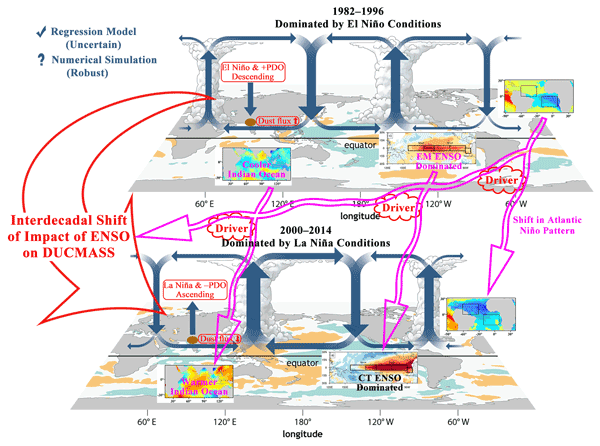
Dust impacts climate and human life. Analyzing the interdecadal change in dust activity and its influence factors is crucial for disaster mitigation. Based on a linear regression method, this study revealed the interdecadal variability of relationships between ENSO and dust over northwestern South Asia from 1982 to 2014 and analyzed the effects of atmospheric factors on this interdecadal variability. The result sheds new light on numerical simulation involving the interdecadal variation of dust.
Yuqin Liu, Tao Lin, Juan Hong, Yonghong Wang, Lamei Shi, Yiyi Huang, Xian Wu, Hao Zhou, Jiahua Zhang, and Gerrit de Leeuw
Atmos. Chem. Phys., 21, 12331–12358, https://doi.org/10.5194/acp-21-12331-2021, https://doi.org/10.5194/acp-21-12331-2021, 2021
Short summary
Short summary
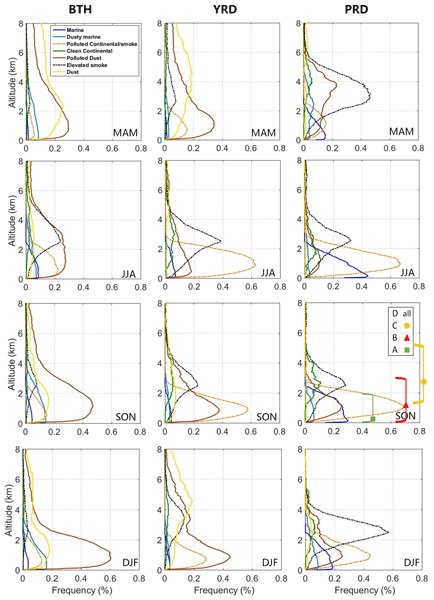
The four-dimensional variation of aerosol properties over the BTH, YRD and PRD (east China) were investigated using satellite observations from 2007 to 2020. Distinct differences between the aerosol optical depth and vertical distribution of the occurrence of aerosol types over these regions depend on season, aerosol loading and meteorological conditions. Day–night differences between the vertical distribution of aerosol types suggest effects of boundary layer dynamics and aerosol transport.
Cited articles
Bougeault, P. and Lacarrere, P.: Parameterization of Orography-Induced Turbulence in a Mesobeta–Scale Model, Mon. Weather Rev., 117, 1872–1890, https://doi.org/10.1175/1520-0493(1989)117<1872:POOITI>2.0.CO;2, 1989.
Bretherton, C. S. and Park, S.: A New Moist Turbulence Parameterization in the Community Atmosphere Model, J. Climate, 22, 3422–3448, https://doi.org/10.1175/2008JCLI2556.1, 2009.
Brown, P. T., Hanley, H., Mahesh, A., Reed, C., Strenfel, S. J., Davis, S. J., Kochanski, A. K., and Clements, C. B.: Climate warming increases extreme daily wildfire growth risk in California, Nature, 621, 760–766, https://doi.org/10.1038/s41586-023-06444-3, 2023.
Campbell, P. C., Bash, J. O., and Spero, T. L.: Updates to the Noah Land Surface Model in WRF-CMAQ to Improve Simulated Meteorology, Air Quality, and Deposition, J. Adv. Model. Earth Syst., 11, 231–256, https://doi.org/10.1029/2018MS001422, 2019.
Campos, C., Couto, F. T., Filippi, J.-B., Baggio, R., and Salgado, R.: Modelling pyro-convection phenomenon during a mega-fire event in Portugal, Atmos. Res., 290, 106776, https://doi.org/10.1016/j.atmosres.2023.106776, 2023.
Coen, J.: Some Requirements for Simulating Wildland Fire Behavior Using Insight from Coupled Weather–Wildland Fire Models, Fire, 1, 6, https://doi.org/10.3390/fire1010006, 2018.
Coen, J. L., Cameron, M., Michalakes, J., Patton, E. G., Riggan, P. J., and Yedinak, K. M.: WRF-Fire: Coupled Weather–Wildland Fire Modeling with the Weather Research and Forecasting Model, J. Appl. Meteorol. Clim., 52, 16–38, https://doi.org/10.1175/JAMC-D-12-023.1, 2013.
Copernicus Climate Change Service (C3S): ERA5 global reanalysis, Climate Data Store (CDS) [data set], https://doi.org/10.24381/cds.143582cf, 2026.
Duane, A., Castellnou, M., and Brotons, L.: Towards a comprehensive look at global drivers of novel extreme wildfire events, Climatic Change, 165, 43, https://doi.org/10.1007/s10584-021-03066-4, 2021.
Farr, T. G. and Kobrick, M.: Shuttle radar topography mission produces a wealth of data, Eos Trans. Am. Geophys. Union, 81, 583–585, https://doi.org/10.1029/EO081i048p00583, 2000.
Farr, T. G., Rosen, P. A., Caro, E., Crippen, R., Duren, R., Hensley, S., Kobrick, M., Paller, M., Rodriguez, E., Roth, L., Seal, D., Shaffer, S., Shimada, J., Umland, J., Werner, M., Oskin, M., Burbank, D., and Alsdorf, D.: Shuttle Radar Topography Mission (SRTM) global digital elevation model, NASA EOSDIS Land Processes DAAC [data set], https://doi.org/10.5066/F7PR7TFT, 2026.
Finney, M. A., Cohen, J. D., Forthofer, J. M., McAllister, S. S., Gollner, M. J., Gorham, D. J., Saito, K., Akafuah, N. K., Adam, B. A., and English, J. D.: Role of buoyant flame dynamics in wildfire spread, P. Natl. Acad. Sci. USA, 112, 9833–9838, https://doi.org/10.1073/pnas.1504498112, 2015.
Hersbach, H., Bell, B., Berrisford, P., Hirahara, S., Horányi, A., Muñoz-Sabater, J., Nicolas, J., Peubey, C., Radu, R., Schepers, D., Simmons, A., Soci, C., Abdalla, S., Abellan, X., Balsamo, G., Bechtold, P., Biavati, G., Bidlot, J., Bonavita, M., De Chiara, G., Dahlgren, P., Dee, D., Diamantakis, M., Dragani, R., Flemming, J., Forbes, R., Fuentes, M., Geer, A., Haimberger, L., Healy, S., Hogan, R. J., Hólm, E., Janisková, M., Keeley, S., Laloyaux, P., Lopez, P., Lupu, C., Radnoti, G., de Rosnay, P., Rozum, I., Vamborg, F., Villaume, S., and Thépaut, J.-N.: The ERA5 global reanalysis, Q. J. Roy. Meteorol. Soc., 146, 1999–2049, https://doi.org/10.1002/qj.3803, 2020.
Iacono, M. J., Delamere, J. S., Mlawer, E. J., Shephard, M. W., Clough, S. A., and Collins, W. D.: Radiative forcing by long-lived greenhouse gases: Calculations with the AER radiative transfer models, J. Geophys. Res.-Atmos., 113, D13103, https://doi.org/10.1029/2008JD009944, 2008.
Janjić, Z. I.: The Step-Mountain Eta Coordinate Model: Further Developments of the Convection, Viscous Sublayer, and Turbulence Closure Schemes, Mon. Weather Rev., 122, 927–945, https://doi.org/10.1175/1520-0493(1994)122<0927:TSMECM>2.0.CO;2, 1994.
Jia, W., Zhang, X., Wang, H., Wang, Y., Wang, D., Zhong, J., Zhang, W., Zhang, L., Guo, L., Lei, Y., Wang, J., Yang, Y., and Lin, Y.: Comprehensive evaluation of typical planetary boundary layer (PBL) parameterization schemes in China – Part 1: Understanding expressiveness of schemes for different regions from the mechanism perspective, Geosci. Model Dev., 16, 6635–6670, https://doi.org/10.5194/gmd-16-6635-2023, 2023.
Jones, M. W., Abatzoglou, J. T., Veraverbeke, S., Andela, N., Lasslop, G., Forkel, M., Smith, A. J. P., Burton, C., Betts, R. A., Van Der Werf, G. R., Sitch, S., Canadell, J. G., Santín, C., Kolden, C., Doerr, S. H., and Le Quéré, C.: Global and Regional Trends and Drivers of Fire Under Climate Change, Rev. Geophys., 60, https://doi.org/10.1029/2020RG000726, 2022.
Li, M., Jia, L., Zhang, F., Hu, M., Shi, Y., and Chen, X.: Characteristics of haze weather in Chongqing, China and its determinants analysis based on automatic monitoring stations, Atmos. Pollut. Res., 7, 638–646, https://doi.org/10.1016/j.apr.2016.02.012, 2016.
Mandel, J., Beezley, J. D., and Kochanski, A. K.: Coupled atmosphere-wildland fire modeling with WRF 3.3 and SFIRE 2011, Geosci. Model Dev., 4, 591–610, https://doi.org/10.5194/gmd-4-591-2011, 2011.
Menezes, I. C., Lopes, D., Fernandes, A. P., Borrego, C., Viegas, D. X., and Miranda, A. I.: Atmospheric dynamics and fire-induced phenomena: Insights from a comprehensive analysis of the Sertã wildfire event, Atmos. Res., 310, 107649, https://doi.org/10.1016/j.atmosres.2024.107649, 2024.
Monin, A. S. and Obukhov, A. M.: Basic laws of turbulent mixing in the surface layer of the atmosphere, Contrib. Geophys. Inst. Acad. Sci. USSR, 24, 163–187, 1954.
Mulverhill, C., Coops, N. C., Boulanger, Y., Hoffman, K. M., Cardinal Christianson, A., Daniels, L. D., Flamand-Hubert, M., Wotherspoon, A. R., and Achim, A.: Wildfires are spreading fast in Canada – we must strengthen forests for the future, Nature, 633, 282–285, https://doi.org/10.1038/d41586-024-02919-z, 2024.
Nakanishi, M. and Niino, H.: An Improved Mellor–Yamada Level-3 Model: Its Numerical Stability and Application to a Regional Prediction of Advection Fog, Bound.-Lay. Meteorol., 119, 397–407, https://doi.org/10.1007/s10546-005-9030-8, 2006.
Nakanishi, M. and Niino, H.: Development of an Improved Turbulence Closure Model for the Atmospheric Boundary Layer, J. Meteorol. Soc. Jpn. Ser. II, 87, 895–912, https://doi.org/10.2151/jmsj.87.895, 2009.
Richardson, D., Black, A. S., Irving, D., Matear, R. J., Monselesan, D. P., Risbey, J. S., Squire, D. T., and Tozer, C. R.: Global increase in wildfire potential from compound fire weather and drought, npj Clim. Atmos. Sci., 5, 23, https://doi.org/10.1038/s41612-022-00248-4, 2022.
Richardson, D., Ribeiro, A. F. S., Batibeniz, F., Quilcaille, Y., Taschetto, A. S., Pitman, A. J., and Zscheischler, J.: Increasing Fire Weather Season Overlap Between North America and Australia Challenges Firefighting Cooperation, Earth's Future, 13, e2024EF005030, https://doi.org/10.1029/2024EF005030, 2025.
Shamsaei, K., Juliano, T. W., Roberts, M., Ebrahimian, H., Kosovic, B., Lareau, N. P., and Taciroglu, E.: Coupled fire-atmosphere simulation of the 2018 Camp Fire using WRF-Fire, Int. J. Wildland Fire, 32, 195–221, https://doi.org/10.1071/WF22013, 2023.
Skamarock, W. C., Klemp, J. B., Dudhia, J., Gill, D. O., Liu, Z., Berner, J., Wang, W., Powers, J. G., Duda, M. G., Barker, D. M., and Huang, X.-Y.: A Description of the Advanced Research WRF Model Version 4, NCAR Tech. Note NCAR/TN-556+STR, NCAR [code], https://doi.org/10.5065/1dfh-6p97, 2021.
Thompson, G., Rasmussen, R. M., and Manning, K.: Explicit Forecasts of Winter Precipitation Using an Improved Bulk Microphysics Scheme. Part I: Description and Sensitivity Analysis, Mon. Weather Rev., 132, 519–542, https://doi.org/10.1175/1520-0493(2004)132<0519:EFOWPU>2.0.CO;2, 2004.
Wang, Q., Zeng, B., Chen, G., and Li, Y.: Simulation performance of planetary boundary layer schemes in WRF v4.3.1 for near-surface wind over the western Sichuan Basin: a single-site assessment, Geosci. Model Dev., 18, 1769–1784, https://doi.org/10.5194/gmd-18-1769-2025, 2025a.
Wang, Y. L., Yang, C., Shi, L. M., Yao, Q. C., and Zhong, L. H.: Model for “Dynamical Linkages Between Planetary Boundary Layer Schemes and Wildfire Spread Processes”, Zenodo [code], https://doi.org/10.5281/zenodo.15851773, 2025b.
Wang, Y. L., Yang, C., Shi, L. M., Yao, Q. C., and Zhong, L. H.: Data for “Dynamical Linkages Between Planetary Boundary Layer Schemes and Wildfire Spread Processes”, Zenodo [data set], https://doi.org/10.5281/zenodo.15772925, 2025c.
Yao, R., Luo, Q., Luo, Z., Jiang, L., and Yang, Y.: An integrated study of urban microclimates in Chongqing, China: Historical weather data, transverse measurement and numerical simulation, Sustain. Cities Soc., 14, 187–199, https://doi.org/10.1016/j.scs.2014.09.007, 2015.
Zhou, J., Zhao, J., Li, Y., Bai, Y., Wu, Y., Xiang, B., and Zhu, H.: The hottest center: characteristics of high temperatures in midsummer of 2022 in Chongqing and its comparison with 2006, Theor. Appl. Climatol., 155, 151–162, https://doi.org/10.1007/s00704-023-04609-8, 2024.
Short summary
Wildfires can strongly affect local weather by heating the land surface and changing wind and turbulence near the ground. This study used computer simulations together with field observations from a mountain wildfire in China to examine how different schemes represent fire–weather interactions. The results show that one scheme performs better, helping improve wildfire prediction in complex terrain.
Wildfires can strongly affect local weather by heating the land surface and changing wind and...


