
Articles | Volume 19, issue 5
https://doi.org/10.5194/gmd-19-1867-2026
© Author(s) 2026. This work is distributed under
the Creative Commons Attribution 4.0 License.
the Creative Commons Attribution 4.0 License.
https://doi.org/10.5194/gmd-19-1867-2026
© Author(s) 2026. This work is distributed under
the Creative Commons Attribution 4.0 License.
the Creative Commons Attribution 4.0 License.
Methods for assessment of models
| 
04 Mar 2026
Methods for assessment of models |
| 04 Mar 2026
| 04 Mar 2026
Data-driven discovery and model reduction methods for the atmospheric effects of high altitude emissions
Jurriaan A. van 't Hoff
Operations & Environment, Faculty of Aerospace Engineering, Delft University of Technology, Kluyverweg 1, 2629 HS Delft, the Netherlands
Tom S. van Cranenburgh
Operations & Environment, Faculty of Aerospace Engineering, Delft University of Technology, Kluyverweg 1, 2629 HS Delft, the Netherlands
Urban Fasel
Department of Aeronautics, Faculty of Engineering, Imperial College London, Exhibition Road, SW7 2AZ, London, UK
Operations & Environment, Faculty of Aerospace Engineering, Delft University of Technology, Kluyverweg 1, 2629 HS Delft, the Netherlands
Department of Engineering, University of Cambridge, 1 JJ Thomson Avenue, Cambridge, CB3 0DY, Cambridge, UK
Related authors
Jurriaan A. van 't Hoff, Didier Hauglustaine, Johannes Pletzer, Agnieszka Skowron, Volker Grewe, Sigrun Matthes, Maximilian M. Meuser, Robin N. Thor, and Irene C. Dedoussi
Atmos. Chem. Phys., 25, 2515–2550, https://doi.org/10.5194/acp-25-2515-2025, https://doi.org/10.5194/acp-25-2515-2025, 2025
Short summary
Short summary
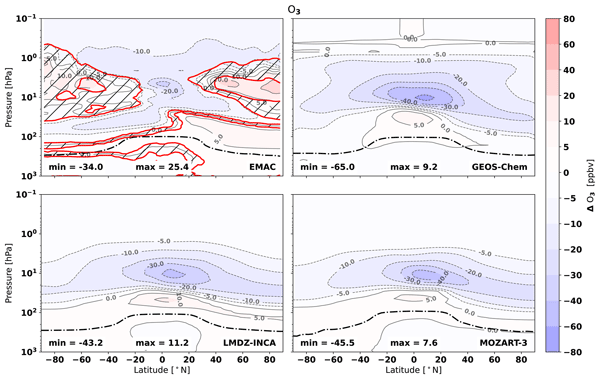
Civil supersonic aircraft may return in the near future, and their emissions could lead to atmospheric changes which are detrimental to public health and the climate. We use four atmospheric chemistry models and show that emissions from a future supersonic aircraft fleet increase stratospheric nitrogen and water vapor levels, while depleting the global ozone column and leading to increases in radiative forcing. Their impacts can be reduced by reducing NOx emissions or the cruise altitude.
Yann Cohen, Didier Hauglustaine, Zosia Staniaszek, Marianne Tronstad Lund, Irene Dedoussi, Sigrun Matthes, Flávio Quadros, Mattia Righi, Agnieszka Skowron, and Robin Thor
Atmos. Chem. Phys., 26, 5983–6013, https://doi.org/10.5194/acp-26-5983-2026, https://doi.org/10.5194/acp-26-5983-2026, 2026
Short summary
Short summary
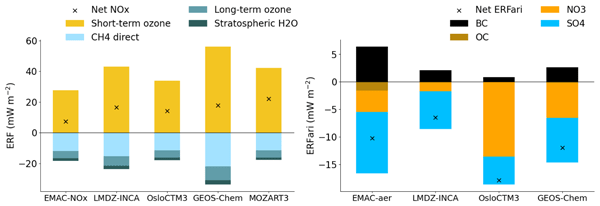
Non-CO2 effects from aviation on climate show large uncertainties. Among them, this study investigates the present-day impact of nitrogen oxides (through ozone and methane) and aerosols produced by aviation on atmospheric composition and therefore on climate, using a global-model intercomparison. Our results show a good consistency between the models for gaseous chemistry, but they also highlight the need for more accurate comparisons and further model development for aerosol parameterization.
Jin Maruhashi, Mattia Righi, Monica Sharma, Johannes Hendricks, Patrick Jöckel, Volker Grewe, and Irene C. Dedoussi
Geosci. Model Dev., 19, 2747–2784, https://doi.org/10.5194/gmd-19-2747-2026, https://doi.org/10.5194/gmd-19-2747-2026, 2026
Short summary
Short summary
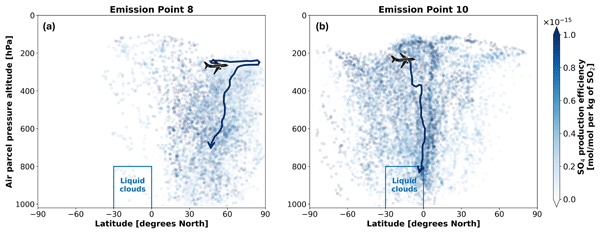
Aerosol-cloud interactions remain a major source of uncertainty in assessing aviation's net climate impact. We develop and evaluate a new Lagrangian tagging model that tracks aviation-emitted SO2 and H2SO4 as they are chemically transformed into SO4 aerosols and transported throughout the atmosphere. This development allows the identification of atmospheric regions with elevated potential for aerosol–cloud interactions driven by SO4 from aircraft.
Jurriaan A. van 't Hoff, Didier Hauglustaine, Johannes Pletzer, Agnieszka Skowron, Volker Grewe, Sigrun Matthes, Maximilian M. Meuser, Robin N. Thor, and Irene C. Dedoussi
Atmos. Chem. Phys., 25, 2515–2550, https://doi.org/10.5194/acp-25-2515-2025, https://doi.org/10.5194/acp-25-2515-2025, 2025
Short summary
Short summary
Civil supersonic aircraft may return in the near future, and their emissions could lead to atmospheric changes which are detrimental to public health and the climate. We use four atmospheric chemistry models and show that emissions from a future supersonic aircraft fleet increase stratospheric nitrogen and water vapor levels, while depleting the global ozone column and leading to increases in radiative forcing. Their impacts can be reduced by reducing NOx emissions or the cruise altitude.
Irene C. Dedoussi, Daven K. Henze, Sebastian D. Eastham, Raymond L. Speth, and Steven R. H. Barrett
Geosci. Model Dev., 17, 5689–5703, https://doi.org/10.5194/gmd-17-5689-2024, https://doi.org/10.5194/gmd-17-5689-2024, 2024
Short summary
Short summary
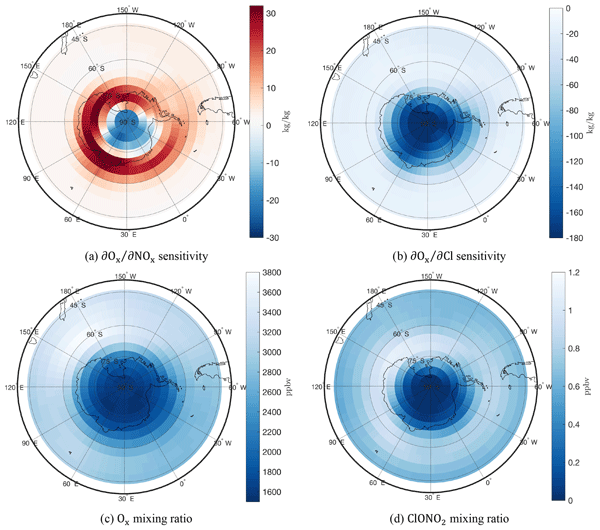
Atmospheric model gradients provide a meaningful tool for better understanding the underlying atmospheric processes. Adjoint modeling enables computationally efficient gradient calculations. We present the adjoint of the GEOS-Chem unified chemistry extension (UCX). With this development, the GEOS-Chem adjoint model can capture stratospheric ozone and other processes jointly with tropospheric processes. We apply it to characterize the Antarctic ozone depletion potential of active halogen species.
Jin Maruhashi, Volker Grewe, Christine Frömming, Patrick Jöckel, and Irene C. Dedoussi
Atmos. Chem. Phys., 22, 14253–14282, https://doi.org/10.5194/acp-22-14253-2022, https://doi.org/10.5194/acp-22-14253-2022, 2022
Short summary
Short summary
Aviation NOx emissions lead to the formation of ozone in the atmosphere in the short term, which has a climate warming effect. This study uses global-scale simulations to characterize the transport patterns between NOx emissions at an altitude of ~ 10.4 km and the resulting ozone. Results show a strong spatial and temporal dependence of NOx in disturbing atmospheric O3 concentrations, with the location that is most impacted in terms of warming not necessarily coinciding with the emission region.
Cited articles
Askham, T. and Kutz, J. N.: Variable projection methods for an optimized dynamic mode decomposition, SIAM J. Appl. Dynam. Syst., 17, 380–416, https://doi.org/10.1137/M1124176, 2018. a
Boninsegna, L., Nüske, F., and Clementi, C.: Sparse Learning of Stochastic Dynamical Equations, J. Chem. Phys., 148, 241723, https://doi.org/10.1063/1.5018409, 2018. a, b
Brunton, S. L. and Kutz, J. N.: Data-Driven Science and Engineering Machine Learning, Dynamical Systems, and Control, https://doi.org/10.1017/9781009089517, 2021. a
Brunton, S. L., Proctor, J. L., Kutz, J. N., and Bialek, W.: Discovering governing equations from data by sparse identification of nonlinear dynamical systems, P. Natl. Acad. Sci. USA, 113, 3932–3937, https://doi.org/10.1073/PNAS.1517384113, 2016. a, b
Callaham, J., Brunton, S., Kutz, J. N., and Storti, D.: Multiscale model reduction for unsteady fluid flow, PhD thesis, https://digital.lib.washington.edu/researchworks/items/b4329d93-710b-4abe-ba60-fb3e2554d8cf (last access: 2 February 2026), 2022. a
Champion, K., Lusch, B., Nathan Kutz, J., and Brunton, S. L.: Data-driven discovery of coordinates and governing equations, P. Natl. Acad. Sci. USA, 116, 22445–22451, https://doi.org/10.1073/PNAS.1906995116, 2019. a
Demo, N., Tezzele, M., and Rozza, G.: PyDMD: Python Dynamic Mode Decomposition Software, J. Open Sour. Softw., 3, 530, https://doi.org/10.21105/joss.00530, 2018. a
de Silva, B. M., Champion, K., Quade, M., Loiseau, J.-C., Nathan Kutz, J., and Brunton, S. L.: PySINDy: A Python package for the sparse identification of nonlinear dynamical systems from data, J. Open Sour. Softw., 5, 2104, https://doi.org/10.21105/joss.02104, 2017. a
Eastham, S. D., Weisenstein, D. K., and Barrett, S. R. H.: Development and Evaluation of the Unified Tropospheric–Stratospheric Chemistry Extension (UCX) for the Global Chemistry-Transport Model GEOS-Chem, Atmos. Environ., 89, 52–63, https://doi.org/10.1016/j.atmosenv.2014.02.001, 2014. a
Eastham, S. D., Fritz, T., Sanz-Morère, I., Prashanth, P., Allroggen, F., Prinn, R. G., Speth, R. L., and Barrett, S. R.: Impacts of a near-future supersonic aircraft fleet on atmospheric composition and climate, Environ. Sci.: Atmos., 2, 388–403, https://doi.org/10.1039/d1ea00081k, 2022. a, b, c
Fasel, U., Kutz, J. N., Brunton, B. W., and Brunton, S. L.: Ensemble-SINDy: Robust sparse model discovery in the low-data, high-noise limit, with active learning and control, P. Roy. Soc. A, 478, https://doi.org/10.1098/RSPA.2021.0904, 2022. a, b
Ichinaga, S. M., Andreuzzi, F., Demo, N., Tezzele, M., Lapo, K., Rozza, G., Brunton, S. L., and Kutz, J. N.: PyDMD: A Python package for robust dynamic mode decomposition, Journal of Machine Learning Research, 25, 1–9, 2024. a
Kaptanoglu, A. A., Callaham, J. L., Aravkin, A., Hansen, C. J., and Brunton, S. L.: Promoting Global Stability in Data-Driven Models of Quadratic Nonlinear Dynamics, Phy. Rev. Fluids, 6, 094401, https://doi.org/10.1103/PhysRevFluids.6.094401, 2021a. a
Kaptanoglu, A. A., de Silva, B. M., Fasel, U., Kaheman, K., Goldschmidt, A. J., Callaham, J. L., Delahunt, C. B., Nicolaou, Z. G., Champion, K., Loiseau, J.-C., Kutz, J. N., and Brunton, S. L.: PySINDy: A comprehensive Python package for robust sparse system identification, J. Open Sour. Softw., 7, 3994, https://doi.org/10.21105/joss.03994, 2021b. a
Khodkar, M. A. and Hassanzadeh, P.: A data-driven, physics-informed framework for forecasting the spatiotemporal evolution of chaotic dynamics with nonlinearities modeled as exogenous forcings, J. Comput. Phys., 440, 110412, https://doi.org/10.1016/J.JCP.2021.110412, 2021. a
Kwasniok, F.: Linear Inverse Modeling of Large-Scale Atmospheric Flow Using Optimal Mode Decomposition, J. Atmos. Sci., 79, 2181–2204, https://doi.org/10.1175/JAS-D-21-0193.1, 2022. a
Loiseau, J.-C. and Brunton, S. L.: Constrained sparse Galerkin regression, J. Fluid Mech., 838, 42–67, 2018. a
Mangan, N. M., Kutz, J. N., Brunton, S. L., and Proctor, J. L.: Model selection for dynamical systems via sparse regression and information criteria, P. Roy. Soc. A, 473, https://doi.org/10.1098/rspa.2017.0009, 2017. a
Messenger, D. A. and Bortz, D. M.: Weak SINDy for partial differential equations, J. Comput. Phys., 443, 110525, https://doi.org/10.1016/J.JCP.2021.110525, 2021. a
Newman, M.: An Empirical Benchmark for Decadal Forecasts of Global Surface Temperature Anomalies, J. Climate, 26, 5260–5269, https://doi.org/10.1175/JCLI-D-12-00590.1, 2013. a
Perkins, W. A. and Hakim, G.: Linear Inverse Modeling for Coupled Atmosphere-Ocean Ensemble Climate Prediction, J. Adv. Model. Earth Syst., 12, e2019MS001778, https://doi.org/10.1029/2019MS001778, 2020. a
Rao, P., Dwight, R., Singh, D., Maruhashi, J., Dedoussi, I., Grewe, V., and Frömming, C.: The Ozone Radiative Forcing of Nitrogen Oxide Emissions from Aviation Can Be Estimated Using a Probabilistic Approach, Commun. Earth Environ., 5, 1–12, https://doi.org/10.1038/s43247-024-01691-2, 2024. a
Reinbold, P. A. K., Gurevich, D. R., and Grigoriev, R. O.: Using noisy or incomplete data to discover models of spatiotemporal dynamics, Phys. Rev. E, 101, https://doi.org/10.1103/PhysRevE.101.010203, 2020. a
Rudy, S. H., Brunton, S. L., Proctor, J. L., and Kutz, J. N.: Data-driven discovery of partial differential equations, Sci. Adv., 3, 123, https://doi.org/10.1126/sciadv.1602614, 2017. a
Sashidhar, D. and Kutz, J. N.: Bagging, optimized dynamic mode decomposition for robust, stable forecasting with spatial and temporal uncertainty quantification, Philos. T. Roy. Soc. A, 380,https://doi.org/10.1098/RSTA.2021.0199, 2022. a
Savitzky, A. and Golay, M. J. E.: Smoothing and Differentiation of Data by Simplified Least Squares Procedures, Anal. Chem., 36, 1627–1639, https://doi.org/10.1021/ac60214a047, 1964. a
Speth, R. L., Eastham, S. D., Prashanth, P., and Allroggen, F.: Global Environmental Impact of Supersonic Cruise Aircraft in the Stratosphere, Tech. rep., Massachusetts Institute of Technology, Cambridge, Massachusetts, https://ntrs.nasa.gov/api/citations/20205009400/downloads/CR-20205009400.pdf (last access: 2 February 2026), 2021. a
Taira, K., Brunton, S. L., Dawson, S. T., Rowley, C. W., Colonius, T., McKeon, B. J., Schmidt, O. T., Gordeyev, S., Theofilis, V., and Ukeiley, L. S.: Modal analysis of fluid flows: An overview, AIAA J., 55, 4013–4041, https://doi.org/10.2514/1.J056060, 2017. a
Taira, K., Hemati, M. S., Brunton, S. L., Sun, Y., Duraisamy, K., Bagheri, S., Dawson, S. T., and Yeh, C. A.: Modal analysis of fluid flows: Applications and outlook, AIAA J., 58, 998–1022, https://doi.org/10.2514/1.J058462, 2020. a
van 't Hoff, J., Grewe, V., and Dedoussi, I. C.: Supporting Dataset for “Sensitivities of Atmospheric Ozone and Radiative Forcing to Supersonic Aircraft Emissions across Two Flight Corridors”, 4TU.ResearchData [data set], https://doi.org/10.4121/D5947A0D-F34D-400B-87DE-46EBDA16EC44.V1, 2024a. a
van 't Hoff, J., Hauglustaine, D., Pletzer, J., Skowron, A., Grewe, V., Matthes, S., Meuser, M. M., Thor, R. N., and Dedoussi, I. C.: Supporting Dataset for “Multi-model Assessment of the Atmospheric and Radiative Effects of Supersonic Transport Aircraft”, 4TU.ResearchData [data set], https://doi.org/10.4121/DD38833D-6C5D-47D8-BB10-7535CE1EECF1.V1, 2025a. a
van 't Hoff, J., van Cranenburgh, T., Fasel, U., and Dedoussi, I.: Supporting data and code for “Data-driven discovery and model reduction methods for the atmospheric effects of high altitude emissions”, 4TU.ResearchData [code and data set], https://doi.org/10.4121/D7C8091B-FC2B-4C21-A498-D4A01C9A7A40, 2025b. a
van 't Hoff, J. A., Hauglustaine, D., Pletzer, J., Skowron, A., Grewe, V., Matthes, S., Meuser, M. M., Thor, R. N., and Dedoussi, I. C.: Multi-model assessment of the atmospheric and radiative effects of supersonic transport aircraft, Atmos. Chem. Phys., 25, 2515–2550, https://doi.org/10.5194/acp-25-2515-2025, 2025c. a, b, c, d, e, f
Velegar, M., Keller, C., and Kutz, J. N.: Optimized Dynamic Mode Decomposition for Reconstruction and Forecasting of Atmospheric Chemistry Data, arXiv [preprint], https://doi.org/10.48550/arXiv.2404.12396, 2024. a, b, c
Weiss, J.: A Tutorial on the Proper Orthogonal Decomposition, Tech. rep., Technische Universität Berlin, https://doi.org/10.14279/depositonce-8512, 2019. a
Zanna, L. and Bolton, T.: Data-driven equation discovery of ocean mesoscale closures, Geophys. Res. Lett., 47, e2020GL088376, https://doi.org/10.1029/2020GL088376, 2020. a
Zhang, J., Wuebbles, D., Kinnison, D., and Baughcum, S. L.: Potential Impacts of Supersonic Aircraft Emissions on Ozone and Resulting Forcing on Climate: An Update on Historical Analysis, J. Geophys. Res.-Atmos., 126, https://doi.org/10.1029/2020JD034130, 2021a. a, b
Zhang, J., Wuebbles, D., Kinnison, D., and Baughcum, S. L.: Stratospheric Ozone and Climate Forcing Sensitivity to Cruise Altitudes for Fleets of Potential Supersonic Transport Aircraft, J. Geophys. Res.-Atmos., 126, e2021JD034971, https://doi.org/10.1029/2021JD034971, 2021b. a
Zhang, J., Wuebbles, D., Pfaender, J. H., Kinnison, D., and Davis, N.: Potential Impacts on Ozone and Climate From a Proposed Fleet of Supersonic Aircraft, Earth's Future, 11, e2022EF003409, https://doi.org/10.1029/2022EF003409, 2023. a, b, c
Short summary
Chemistry transport models (CTMs) are critical in environmental assessments, but their computational cost often limits direct use in decision-making. We evaluate data-driven model discovery and reduction methods as reduced-order models for CTM simulations, showing they can reconstruct and forecast changes in global ozone distribution from supersonic aircraft emissions for several years at a fraction of the CTM cost while also being more accessible.
Chemistry transport models (CTMs) are critical in environmental assessments, but their...


