
Articles | Volume 19, issue 1
https://doi.org/10.5194/gmd-19-167-2026
© Author(s) 2026. This work is distributed under
the Creative Commons Attribution 4.0 License.
the Creative Commons Attribution 4.0 License.
https://doi.org/10.5194/gmd-19-167-2026
© Author(s) 2026. This work is distributed under
the Creative Commons Attribution 4.0 License.
the Creative Commons Attribution 4.0 License.
Model description paper
| 
07 Jan 2026
Model description paper |
| 07 Jan 2026
| 07 Jan 2026
Sentinel-1 SAR-based globally distributed co-seismic landslide detection by deep neural networks

Department of Earth Sciences, University of Cambridge, Cambridge, UK
Department of Geography, University of Cambridge, Cambridge, UK
Machine Intelligence and Slope Stability Laboratory, Department of Geosciences, University of Padova, Padova, Italy
Alessandro Mondini
National Research Council, Research Institute for Applied Mathematics and Information Technologies, Genova, Italy
Kushanav Bhuyan
State Key Laboratory of Geohazard Prevention and Geoenvironment Protection, University of Technology, Chengdu, China
Machine Intelligence and Slope Stability Laboratory, Department of Geosciences, University of Padova, Padova, Italy
Chengyong Fang
State Key Laboratory of Geohazard Prevention and Geoenvironment Protection, University of Technology, Chengdu, China
Oriol Monserrat
Department of Remote Sensing, Geomatics Research Unit, Centre Tecnologic de Telecomunicacions de Catalunya (CTTC), Barcelona, Spain
Alessandro Novellino
British Geological Survey, Keyworth, Nottingham, UK
Filippo Catani
Machine Intelligence and Slope Stability Laboratory, Department of Geosciences, University of Padova, Padova, Italy
Related authors
Lorenzo Nava, Maximillian Van Wyk de Vries, and Louie Elliot Bell
Nat. Hazards Earth Syst. Sci., 26, 2305–2318, https://doi.org/10.5194/nhess-26-2305-2026, https://doi.org/10.5194/nhess-26-2305-2026, 2026
Short summary
Short summary
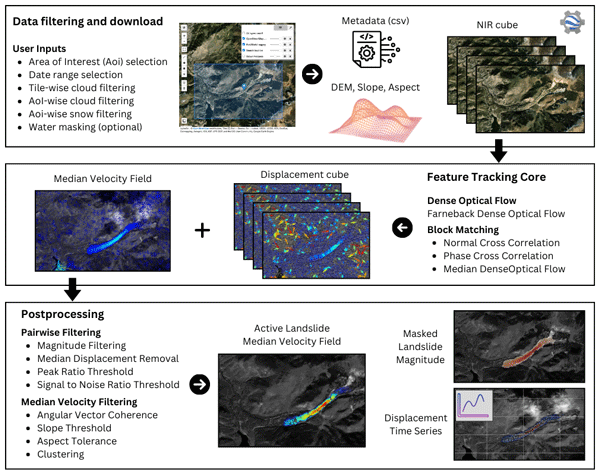
We introduce TerraTrack, an open-source tool for detecting and monitoring slow-moving landslides using Sentinel-2 data. It automates image acquisition, landslide identification, and time-series generation in an accessible and cloud-based workflow. TerraTrack supports early warning, complements interferometric synthetic aperture radar (InSAR), and offers a scalable solution for landslide hazard identification and monitoring.
Lorenzo Nava, Alessandro Novellino, Chengyong Fang, Kushanav Bhuyan, Kathryn Leeming, Itahisa Gonzalez Alvarez, Claire Dashwood, Sophie Doward, Rahul Chahel, Emma McAllister, Sansar Raj Meena, and Filippo Catani
Nat. Hazards Earth Syst. Sci., 25, 2371–2377, https://doi.org/10.5194/nhess-25-2371-2025, https://doi.org/10.5194/nhess-25-2371-2025, 2025
Short summary
Short summary
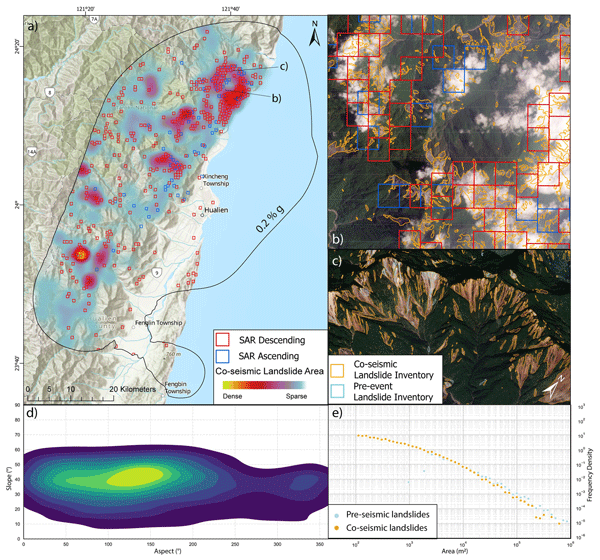
On 2 April 2024, a Mw 7.4 earthquake hit Taiwan's eastern coast, causing extensive landslides and damage. We used automated methods combining Earth observation (EO) data with AI to quickly inventory the landslides. This approach identified 7090 landslides over 75 km2 within 3 h of acquiring the EO imagery. The study highlights AI's role in improving landslide detection efforts in disaster response.
Chengyong Fang, Xuanmei Fan, Xin Wang, Lorenzo Nava, Hao Zhong, Xiujun Dong, Jixiao Qi, and Filippo Catani
Earth Syst. Sci. Data, 16, 4817–4842, https://doi.org/10.5194/essd-16-4817-2024, https://doi.org/10.5194/essd-16-4817-2024, 2024
Short summary
Short summary
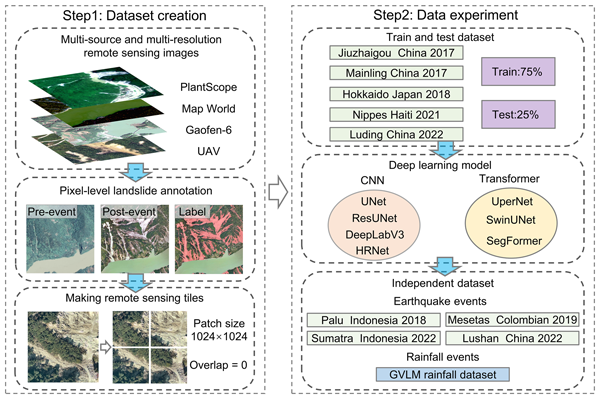
In this study, we present the largest publicly available landslide dataset, Globally Distributed Coseismic Landslide Dataset (GDCLD), which includes multi-sensor high-resolution images from various locations around the world. We test GDCLD with seven advanced algorithms and show that it is effective in achieving reliable landslide mapping across different triggers and environments, with great potential in enhancing emergency response and disaster management.
Sansar Raj Meena, Lorenzo Nava, Kushanav Bhuyan, Silvia Puliero, Lucas Pedrosa Soares, Helen Cristina Dias, Mario Floris, and Filippo Catani
Earth Syst. Sci. Data, 15, 3283–3298, https://doi.org/10.5194/essd-15-3283-2023, https://doi.org/10.5194/essd-15-3283-2023, 2023
Short summary
Short summary
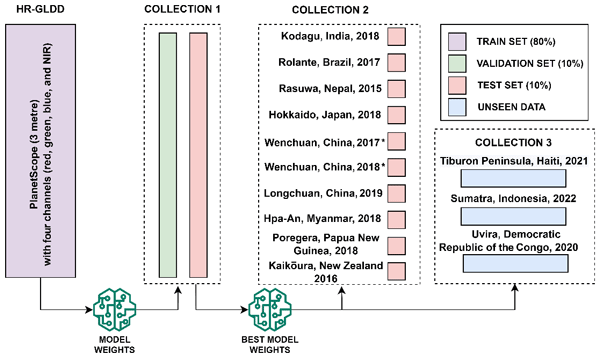
Landslides occur often across the world, with the potential to cause significant damage. Although a substantial amount of research has been conducted on the mapping of landslides using remote-sensing data, gaps and uncertainties remain when developing models to be operational at the global scale. To address this issue, we present the High-Resolution Global landslide Detector Database (HR-GLDD) for landslide mapping with landslide instances from 10 different physiographical regions globally.
Alessandro C. Mondini, Alessandro Simoni, Fabio Bovenga, Alessandro Mercurio, Cristina Reyes-Carmona, Boyun Yu, and Federico Agliardi
EGUsphere, https://doi.org/10.31223/X51B7T, https://doi.org/10.31223/X51B7T, 2026
This preprint is open for discussion and under review for Natural Hazards and Earth System Sciences (NHESS).
Short summary
Short summary
We developed a model to automatically detect landslide displacements from satellite radar interferograms. We introduced geomorphological constraints in the learning process to replicate the interpretative process of expert operators. Our results show the system accurately identifies displacements in very noisy environments. This method allows scientists to rapidly analyse vast regions, offering a fast and practical tool for monitoring natural hazards and protecting environments.
Fausto Guzzetti, Alessandro Cesare Mondini, Paola Salvati, Antonella Bodini, and Antonio Pievatolo
EGUsphere, https://doi.org/10.5194/egusphere-2026-4342, https://doi.org/10.5194/egusphere-2026-4342, 2026
This preprint is open for discussion and under review for Natural Hazards and Earth System Sciences (NHESS).
Short summary
Short summary
Using a detailed record of deaths and missing persons caused by floods and landslides in Italy from 1950 to 2024, we examine how human losses changed and what may explain them. Deaths and fatal days fell sharply until about 1970, mainly because of fewer landslide deaths, and then remained much lower. Rainfall drives year-to-year changes, while broad social and economic progress appears to have reduced mortality even though hazardous events continue.
Qi Gao, Michele Crosetto, Oriol Monserrat, Marta Monfort, and Pavel Pavlovsky
Int. Arch. Photogramm. Remote Sens. Spatial Inf. Sci., XLIX-B3-2026, 509–514, https://doi.org/10.5194/isprs-archives-XLIX-B3-2026-509-2026, https://doi.org/10.5194/isprs-archives-XLIX-B3-2026-509-2026, 2026
Michele Crosetto, Maria C. Ramlie, Anna Barra, María Cuevas-González, Riccardo Palamà, Oriol Monserrat, Qi Gao, and Saeedeh Shahbazi
Int. Arch. Photogramm. Remote Sens. Spatial Inf. Sci., XLIX-B3-2026, 487–492, https://doi.org/10.5194/isprs-archives-XLIX-B3-2026-487-2026, https://doi.org/10.5194/isprs-archives-XLIX-B3-2026-487-2026, 2026
Qingkai Meng, Yong Dai, Filippo Catani, Shilong Chen, Qiuhui Wang, Qing Li, Ying Peng, Han Wu, and Ying Meng
EGUsphere, https://doi.org/10.5194/egusphere-2026-2637, https://doi.org/10.5194/egusphere-2026-2637, 2026
Preprint archived
Short summary
Short summary
This study introduces a transparent graph-based method to improve landslide susceptibility assessment. Instead of treating terrain, rainfall, snowmelt, rivers, faults, and slope shape as separate factors, it links them into spatial dependency pathways and measures how their influences connect across a region. In the Ili River Basin, the method identified fourteen pathways and mapped where each matters most. This helps explain why places are prone to landslides and supports targeted management.
Lorenzo Nava, Maximillian Van Wyk de Vries, and Louie Elliot Bell
Nat. Hazards Earth Syst. Sci., 26, 2305–2318, https://doi.org/10.5194/nhess-26-2305-2026, https://doi.org/10.5194/nhess-26-2305-2026, 2026
Short summary
Short summary
We introduce TerraTrack, an open-source tool for detecting and monitoring slow-moving landslides using Sentinel-2 data. It automates image acquisition, landslide identification, and time-series generation in an accessible and cloud-based workflow. TerraTrack supports early warning, complements interferometric synthetic aperture radar (InSAR), and offers a scalable solution for landslide hazard identification and monitoring.
Lukas Schild, Ascanio Rosi, and Filippo Catani
EGUsphere, https://doi.org/10.5194/egusphere-2026-1796, https://doi.org/10.5194/egusphere-2026-1796, 2026
Short summary
Short summary
We developed a transparent machine learning model that forecasts rainfall-triggered landslides from satellite rain data. It matches the accuracy of complex models while staying easy to understand, and keeps missed warnings low. We also introduce simple visual thresholds to help decision-makers use the predictions. This is needed, for example, for Early Warning Systems, where it is extremely helpful to understand the models' predictions.
Michele Crosetto, Oriol Monserrat, Paula Olea-Encina, and Maria Carmelia Ramlie
Int. Arch. Photogramm. Remote Sens. Spatial Inf. Sci., XLVIII-4-W21-2025, 7–12, https://doi.org/10.5194/isprs-archives-XLVIII-4-W21-2025-7-2026, https://doi.org/10.5194/isprs-archives-XLVIII-4-W21-2025-7-2026, 2026
Lorenzo Nava, Alessandro Novellino, Chengyong Fang, Kushanav Bhuyan, Kathryn Leeming, Itahisa Gonzalez Alvarez, Claire Dashwood, Sophie Doward, Rahul Chahel, Emma McAllister, Sansar Raj Meena, and Filippo Catani
Nat. Hazards Earth Syst. Sci., 25, 2371–2377, https://doi.org/10.5194/nhess-25-2371-2025, https://doi.org/10.5194/nhess-25-2371-2025, 2025
Short summary
Short summary
On 2 April 2024, a Mw 7.4 earthquake hit Taiwan's eastern coast, causing extensive landslides and damage. We used automated methods combining Earth observation (EO) data with AI to quickly inventory the landslides. This approach identified 7090 landslides over 75 km2 within 3 h of acquiring the EO imagery. The study highlights AI's role in improving landslide detection efforts in disaster response.
Maria Carmelia Ramlie, Oriol Monserrat, Bruno Crippa, Paula Olea-Encina, and Michele Crosetto
Int. Arch. Photogramm. Remote Sens. Spatial Inf. Sci., XLVIII-3-2024, 459–464, https://doi.org/10.5194/isprs-archives-XLVIII-3-2024-459-2024, https://doi.org/10.5194/isprs-archives-XLVIII-3-2024-459-2024, 2024
Oriol Monserrat, Anna Barra, Marta Béjar-Pizarro, Jonathan S. Rivera, Jorge Pedro Galve, Carolina Guardiola, Maria Cuevas-González, Rosa Maria Mateos, Pablo Ezquerro, Jose Miguel Azañon, Saeedeh Shahbazi, Jose Navarro, Michele Crosetto, and Guido Luzi
Int. Arch. Photogramm. Remote Sens. Spatial Inf. Sci., XLVIII-3-2024, 351–356, https://doi.org/10.5194/isprs-archives-XLVIII-3-2024-351-2024, https://doi.org/10.5194/isprs-archives-XLVIII-3-2024-351-2024, 2024
Chengyong Fang, Xuanmei Fan, Xin Wang, Lorenzo Nava, Hao Zhong, Xiujun Dong, Jixiao Qi, and Filippo Catani
Earth Syst. Sci. Data, 16, 4817–4842, https://doi.org/10.5194/essd-16-4817-2024, https://doi.org/10.5194/essd-16-4817-2024, 2024
Short summary
Short summary
In this study, we present the largest publicly available landslide dataset, Globally Distributed Coseismic Landslide Dataset (GDCLD), which includes multi-sensor high-resolution images from various locations around the world. We test GDCLD with seven advanced algorithms and show that it is effective in achieving reliable landslide mapping across different triggers and environments, with great potential in enhancing emergency response and disaster management.
Sansar Raj Meena, Lorenzo Nava, Kushanav Bhuyan, Silvia Puliero, Lucas Pedrosa Soares, Helen Cristina Dias, Mario Floris, and Filippo Catani
Earth Syst. Sci. Data, 15, 3283–3298, https://doi.org/10.5194/essd-15-3283-2023, https://doi.org/10.5194/essd-15-3283-2023, 2023
Short summary
Short summary
Landslides occur often across the world, with the potential to cause significant damage. Although a substantial amount of research has been conducted on the mapping of landslides using remote-sensing data, gaps and uncertainties remain when developing models to be operational at the global scale. To address this issue, we present the High-Resolution Global landslide Detector Database (HR-GLDD) for landslide mapping with landslide instances from 10 different physiographical regions globally.

Guillermo Tamburini-Beliveau, Sebastián Balbarani, and Oriol Monserrat
Nat. Hazards Earth Syst. Sci., 23, 1987–1999, https://doi.org/10.5194/nhess-23-1987-2023, https://doi.org/10.5194/nhess-23-1987-2023, 2023
Short summary
Short summary
Landslides and ground deformation associated with the construction of a hydropower mega dam in the Santa Cruz River in Argentine Patagonia have been monitored using radar and optical satellite data, together with the analysis of technical reports. This allowed us to assess the integrity of the construction, providing a new and independent dataset. We have been able to identify ground deformation trends that put the construction works at risk.

Txomin Bornaetxea, Ivan Marchesini, Sumit Kumar, Rabisankar Karmakar, and Alessandro Mondini
Nat. Hazards Earth Syst. Sci., 22, 2929–2941, https://doi.org/10.5194/nhess-22-2929-2022, https://doi.org/10.5194/nhess-22-2929-2022, 2022
Short summary
Short summary
One cannot know if there is a landslide or not in an area that one has not observed. This is an obvious statement, but when landslide inventories are obtained by field observation, this fact is seldom taken into account. Since fieldwork campaigns are often done following the roads, we present a methodology to estimate the visibility of the terrain from the roads, and we demonstrate that fieldwork-based inventories are underestimating landslide density in less visible areas.
Angelica Tarpanelli, Alessandro C. Mondini, and Stefania Camici
Nat. Hazards Earth Syst. Sci., 22, 2473–2489, https://doi.org/10.5194/nhess-22-2473-2022, https://doi.org/10.5194/nhess-22-2473-2022, 2022
Short summary
Short summary
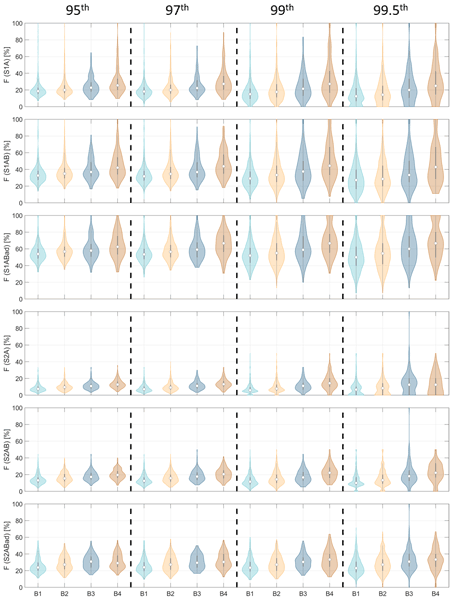
We analysed 10 years of river discharge data from almost 2000 sites in Europe, and we extracted flood events, as proxies of flood inundations, based on the overpasses of Sentinel-1 and Sentinel-2 satellites to derive the percentage of potential inundation events that they were able to observe. Results show that on average 58 % of flood events are potentially observable by Sentinel-1 and only 28 % by Sentinel-2 due to the obstacle of cloud coverage.
Y. Wassie, Q. Gao, O. Monserrat, A. Barra, B. Crippa, and M. Crosetto
Int. Arch. Photogramm. Remote Sens. Spatial Inf. Sci., XLIII-B3-2022, 361–366, https://doi.org/10.5194/isprs-archives-XLIII-B3-2022-361-2022, https://doi.org/10.5194/isprs-archives-XLIII-B3-2022-361-2022, 2022
R. Palamà, M. Crosetto, O. Monserrat, A. Barra, B. Crippa, M. Mróz, N. Kotulak, M. Mleczko, and J. Rapinski
Int. Arch. Photogramm. Remote Sens. Spatial Inf. Sci., XLIII-B3-2022, 321–326, https://doi.org/10.5194/isprs-archives-XLIII-B3-2022-321-2022, https://doi.org/10.5194/isprs-archives-XLIII-B3-2022-321-2022, 2022
J. A. Navarro, D. García, M. Crosetto, and O. Monserrat
Int. Arch. Photogramm. Remote Sens. Spatial Inf. Sci., XLIII-B3-2022, 313–320, https://doi.org/10.5194/isprs-archives-XLIII-B3-2022-313-2022, https://doi.org/10.5194/isprs-archives-XLIII-B3-2022-313-2022, 2022
S. M. Mirmazloumi, Á. F. Gambin, Y. Wassie, A. Barra, R. Palamà, M. Crosetto, O. Monserrat, and B. Crippa
Int. Arch. Photogramm. Remote Sens. Spatial Inf. Sci., XLIII-B3-2022, 307–312, https://doi.org/10.5194/isprs-archives-XLIII-B3-2022-307-2022, https://doi.org/10.5194/isprs-archives-XLIII-B3-2022-307-2022, 2022
Q. Gao, M. Crosetto, O. Monserrat, R. Palama, and A. Barra
Int. Arch. Photogramm. Remote Sens. Spatial Inf. Sci., XLIII-B3-2022, 271–276, https://doi.org/10.5194/isprs-archives-XLIII-B3-2022-271-2022, https://doi.org/10.5194/isprs-archives-XLIII-B3-2022-271-2022, 2022
M. Crosetto, L. Solari, A. Barra, O. Monserrat, M. Cuevas-González, R. Palamà, Y. Wassie, S. Shahbazi, S. M. Mirmazloumi, B. Crippa, and M. Mróz
Int. Arch. Photogramm. Remote Sens. Spatial Inf. Sci., XLIII-B3-2022, 257–262, https://doi.org/10.5194/isprs-archives-XLIII-B3-2022-257-2022, https://doi.org/10.5194/isprs-archives-XLIII-B3-2022-257-2022, 2022
Andrea Manconi, Alessandro C. Mondini, and the AlpArray working group
Nat. Hazards Earth Syst. Sci., 22, 1655–1664, https://doi.org/10.5194/nhess-22-1655-2022, https://doi.org/10.5194/nhess-22-1655-2022, 2022
Short summary
Short summary
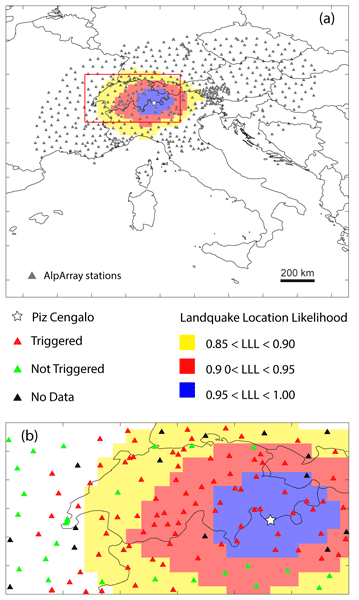
Information on when, where, and how landslide events occur is the key to building complete catalogues and performing accurate hazard assessments. Here we show a procedure that allows us to benefit from the increased density of seismic sensors installed on ground for earthquake monitoring and from the unprecedented availability of satellite radar data. We show how the procedure works on a recent sequence of landslides that occurred at Piz Cengalo (Swiss Alps) in 2017.
Sansar Raj Meena, Silvia Puliero, Kushanav Bhuyan, Mario Floris, and Filippo Catani
Nat. Hazards Earth Syst. Sci., 22, 1395–1417, https://doi.org/10.5194/nhess-22-1395-2022, https://doi.org/10.5194/nhess-22-1395-2022, 2022
Short summary
Short summary
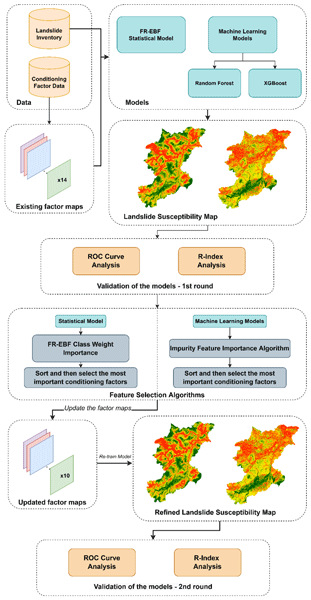
The study investigated the importance of the conditioning factors in predicting landslide occurrences using the mentioned models. In this paper, we evaluated the importance of the conditioning factors (features) in the overall prediction capabilities of the statistical and machine learning algorithms.
Cited articles
Abadi, M., Agarwal, A., Barham, P., Brevdo, E., Chen, Z., Citro, C., Corrado, G. S., Davis, A., Dean, J., and Devin, M.: Tensorflow: Large-scale machine learning on heterogeneous distributed systems, arXiv [preprint], https://doi.org/10.48550/arXiv.1603.04467, 2016. a
Amatya, P., Scheip, C., Déprez, A., Malet, J.-P., Slaughter, S. L., Handwerger, A. L., Emberson, R., Jean-Baptiste, J., Huang, M.-H., Clark, M. K., Zekkos, D., Huang, J.-R., Pacini, F., and Boissier, E.: Learnings from rapid response efforts to remotely detect landslides triggered by the August 2021 Nippes earthquake and Tropical Storm Grace in Haiti, Natural Hazards, 118, 2337–2375, https://doi.org/10.1007/s11069-023-06096-6, 2023. a, b, c
Beni, T., Nava, L., Gigli, G., Frodella, W., Catani, F., Casagli, N., Gallego, J. I., Margottini, C., and Spizzichino, D.: Classification of rock slope cavernous weathering on UAV photogrammetric point clouds: The example of Hegra (UNESCO World Heritage Site, Kingdom of Saudi Arabia), Eng. Geol., 325, https://doi.org/10.1016/j.enggeo.2023.107286, 2023. a
Bhuyan, K., Tanyaş, H., Nava, L., Puliero, S., Meena, S. R., Floris, M., van Westen, C., and Catani, F.: Generating multi-temporal landslide inventories through a general deep transfer learning strategy using HR EO data, Sci. Rep., 13, 162, https://doi.org/10.1038/s41598-022-27352-y, 2023. a
Blaschke, T.: Object based image analysis for remote sensing, ISPRS J. Photogramm. Remote Sens., 65, 2–16, https://doi.org/10.1016/j.isprsjprs.2009.06.004, 2010. a
Burrows, K., Walters, R. J., Milledge, D., Spaans, K., and Densmore, A. L.: A new method for large-scale landslide classification from satellite radar, Remote Sensing, 11, 237, https://doi.org/10.3390/rs11030237, 2019. a
Burrows, K., Walters, R. J., Milledge, D., and Densmore, A. L.: A systematic exploration of satellite radar coherence methods for rapid landslide detection, Nat. Hazards Earth Syst. Sci., 20, 3197–3214, https://doi.org/10.5194/nhess-20-3197-2020, 2020. a, b, c, d
Burrows, K., Milledge, D., Walters, R. J., and Bellugi, D.: Integrating empirical models and satellite radar can improve landslide detection for emergency response, Nat. Hazards Earth Syst. Sci., 21, 2993–3014, https://doi.org/10.5194/nhess-21-2993-2021, 2021. a
Catani, F.: Landslide detection by deep learning of non-nadiral and crowdsourced optical images, Landslides, 18, https://doi.org/10.1007/s10346-020-01513-4, 2021. a
Catani, F., Casagli, N., Ermini, L., Righini, G., and Menduni, G.: Landslide hazard and risk mapping at catchment scale in the Arno River basin, Landslides, 2, 329–342, https://doi.org/10.1007/s10346-005-0021-0, 2005. a
Chen, L., Li, Z., Song, C., Xing, J., Cai, X., Fang, Z., Luo, R., and Li, Z.: Automatic detection of earthquake triggered landslides using Sentinel-1 SAR imagery based on deep learning, International Journal of Digital Earth, 17, 2393261, https://doi.org/10.1080/17538947.2024.2393261, 2024. a
Chorowicz, J., Scanvic, J. Y., Rouzeau, O., and Cuervo, G. V.: Observation of recent and active landslides from SAR ERS-1 and JERS-1 imagery using a stereo-simulation approach: Example of the Chicamocha valley in Colombia, Int. J. Remote Sens., 19, 3187–3196, https://doi.org/10.1080/014311698214253, 1998. a
Dai, L., Fan, X., Wang, X., Fang, C., Zou, C., Tang, X., Wei, Z., Xia, M., Wang, D., and Xu, Q.: Coseismic landslides triggered by the 2022 Luding Ms6.8 earthquake, China, Landslides, 20, 1277–1292, https://doi.org/10.1007/s10346-023-02061-3, 2023a. a
Dai, L., Fan, X., Wang, X., Fang, C., Zou, C., Tang, X., Wei, Z., Xia, M., Wang, D., and Xu, Q.: Coseismic landslides triggered by the 2022 Luding Ms6.8 earthquake, China, Landslides, 20, 1277–1292, https://doi.org/10.1007/s10346-023-02061-3, 2023b. a
Deprez, A., Marc, O., Malet, J.-P., Stumpf, A., and Michéa, D.: ALADIM – A change detection on-line service for landslide detection from EO imagery, EGU General Assembly 2022, Vienna, Austria, 23–27 May 2022, EGU22-3536, https://doi.org/10.5194/egusphere-egu22-3536, 2022. a
Eeckhaut, M. V. D., Hervás, J., and Montanarella, L.: Landslide databases in Europe: Analysis and recommendations for interoperability and harmonisation, in: Landslide Science and Practice, 35–42, Springer Berlin Heidelberg, https://doi.org/10.1007/978-3-642-31325-7_4, 2013. a
European Space Agency/Copernicus: Sentinel-1 – Copernicus open-access SAR mission, https://sentinels.copernicus.eu/web/sentinel/copernicus/sentinel-1 (last access: 3 January 2025), 2025. a
Fang, C., Fan, X., Zhong, H., Lombardo, L., Tanyaş, H., and Wang, X.: A novel historical landslide detection approach based on LiDAR and lightweight attention U-Net, Remote Sens., 14, 4357, https://doi.org/10.3390/rs14174357, 2022. a
Fang, C., Fan, X., Wang, X., Nava, L., Zhong, H., Dong, X., Qi, J., and Catani, F.: A globally distributed dataset of coseismic landslide mapping via multi-source high-resolution remote sensing images, Earth Syst. Sci. Data, 16, 4817–4842, https://doi.org/10.5194/essd-16-4817-2024, 2024. a, b, c
Ferrario, M. F.: Landslides triggered by multiple earthquakes: Insights from the 2018 Lombok (Indonesia) events, Natural Hazards, 98, https://doi.org/10.1007/s11069-019-03718-w, 2019. a, b
Froude, M. J. and Petley, D. N.: Global fatal landslide occurrence from 2004 to 2016, Nat. Hazards Earth Syst. Sci., 18, 2161–2181, https://doi.org/10.5194/nhess-18-2161-2018, 2018. a
García-Delgado, H., Cordón, J. L. C., and Rodríguez, C. A. G.: Landslides triggered by the December 24, 2019 Mesetas (Meta, Colombia) earthquake, in: Proceedings of the 13th International Symposium on Landslides, https://www.issmge.org/publications/publication/landslides-triggered-by-the-december-24-2019-mesetas-meta-colombia-earthquake (last access: 12 December 2023), 2021. a
Ghorbanzadeh, O., Blaschke, T., Gholamnia, K., Meena, S. R., Tiede, D., and Aryal, J.: Evaluation of different machine learning methods and deep-learning convolutional neural networks for landslide detection, Remote Sens., 11, https://doi.org/10.3390/rs11020196, 2019. a
Ghorbanzadeh, O., Xu, Y., Zhao, H., Wang, J., Zhong, Y., Zhao, D., Zang, Q., Wang, S., Zhang, F., Shi, Y., Zhu, X., Bai, L., Li, W., Peng, W., and Ghamisi, P.: The outcome of the 2022 landslide4sense competition: Advanced landslide detection from multisource satellite imagery, IEEE J. Sel. Top. Appl. Earth Observ. Remote Sens., 15, 9927–9942, 2022. a
Guan, H., Huang, J., Li, L., Li, X., Miao, S., Su, W., Ma, Y., Niu, Q., and Huang, H.: Improved Gaussian mixture model to map the flooded crops of VV and VH polarization data, Remote Sens. Environ., 295, 113714, https://doi.org/10.1016/j.rse.2023.113714, 2023. a
Guzzetti, F., Mondini, A. C., Cardinali, M., Fiorucci, F., Santangelo, M., and Chang, K.-T.: Landslide inventory maps: New tools for an old problem, Earth Sci. Rev., 112, 42–66, https://doi.org/10.1016/j.earscirev.2012.02.001, 2012. a, b, c
Han, Z., Fang, Z., Li, Y., and Fu, B.: A novel Dynahead-Yolo neural network for the detection of landslides with variable proportions using remote sensing images, Front. Earth Sci. (Lausanne), 10, https://doi.org/10.3389/feart.2022.1077153, 2023. a
Handwerger, A. L., Huang, M.-H., Jones, S. Y., Amatya, P., Kerner, H. R., and Kirschbaum, D. B.: Generating landslide density heatmaps for rapid detection using open-access satellite radar data in Google Earth Engine, Nat. Hazards Earth Syst. Sci., 22, 753–773, https://doi.org/10.5194/nhess-22-753-2022, 2022. a, b, c, d
Hertel, V., Chow, C., Wani, O., Wieland, M., and Martinis, S.: Probabilistic SAR-based water segmentation with adapted Bayesian convolutional neural network, Remote Sens. Environ., 285, 113388, https://doi.org/10.1016/j.rse.2022.113388, 2023. a, b
Hu, K., Zhang, X., You, Y., Hu, X., Liu, W., and Li, Y.: Landslides and dammed lakes triggered by the 2017 Ms6.9 Milin earthquake in the Tsangpo gorge, Landslides, 16, 993–1001, https://doi.org/10.1007/s10346-019-01168-w, 2019. a
Ji, Y., Sun, W., Wang, Y., Lv, Z., Yang, G., Zhan, Y., and Li, C.: Domain Adaptive and Interactive Differential Attention Network for Remote Sensing Image Change Detection, IEEE Transactions on Geoscience and Remote Sensing, https://doi.org/10.1109/TGRS.2024.3382116, 2024. a
Kingma, D. P. and Ba, J.: Adam: A method for stochastic optimization, arXiv [preprint], https://doi.org/10.48550/arXiv.1412.6980, 2017. a
Konishi, T. and Suga, Y.: Landslide detection using COSMO-SkyMed images: A case study of a landslide event on Kii Peninsula, Japan, Eur. J. Remote Sens., 51, 205–221, https://doi.org/10.1080/22797254.2017.1418185, 2018. a
Lee, C.-H., Lin, C.-R., and Chen, M.-S.: Sliding window filtering: an efficient method for incremental mining on a time-variant database, Inf. Syst., 30, 227–244, https://doi.org/10.1016/j.is.2004.02.001, 2005. a
Liang, R., Dai, K., Lopez-Sanchez, J. M., Han, Y., Shi, X., and Xu, Q.: Landslide mapping from post-event single-temporal polarimetric SAR image by a deep learning method exploiting a morphological model, Remote Sensing of Environment, 328, 114904, https://doi.org/10.1016/j.rse.2025.114904, 2025. a
Lin, S.-Y., Lin, C.-W., and Van Gasselt, S.: Towards Monitoring of Mountain Mass Wasting Using Object-Based Image Analysis Using SAR Intensity Images, in: 2021 IEEE International Geoscience and Remote Sensing Symposium IGARSS, 3813–3816, https://doi.org/10.1109/IGARSS47720.2021.9554248, 2021. a
Lin, T.-Y., Goyal, P., Girshick, R., He, K., and Dollar, P.: Focal Loss for Dense Object Detection, in: Proc. IEEE Int. Conf. Computer Vision (ICCV), p. 299, https://doi.org/10.1109/ICCV.2017.324, 2017. a
Lindsay, E., Frauenfelder, R., Rüther, D., Nava, L., Rubensdotter, L., Strout, J., and Nordal, S.: Multi-temporal satellite image composites in Google Earth Engine for improved landslide visibility: A case study of a glacial landscape, Remote Sens., 14, https://doi.org/10.3390/rs14102301, 2022. a
Lindsay, E., Ganerød, J., Devoli, G., Reiche, J., Nordal, S., Frauenfelder, R., and Tokle, L.: Understanding landslide expression in SAR backscatter data: A global study, Preprints, 2023020390, https://doi.org/10.20944/preprints202302.0390.v1, 2023. a
Liu, Q., Wu, T., Deng, Y., and Liu, Z.: SE-YOLOv7 Landslide Detection Algorithm Based on Attention Mechanism and Improved Loss Function, Land, 12, 1522, https://doi.org/10.3390/land12081522, 2023. a
Liu, Y., Zhang, Y., Wang, Y., Hou, F., Yuan, J., Tian, J., and He, Z.: A survey of visual transformers, IEEE Transactions on Neural Networks and Learning Systems, 35, 7478–7498, https://doi.org/10.1109/TNNLS.2022.3227717, 2024. a
Manconi, A., Casu, F., Ardizzone, F., Bonano, M., Cardinali, M., De Luca, C., Gueguen, E., Marchesini, I., Parise, M., Vennari, C., Lanari, R., and Guzzetti, F.: Brief Communication: Rapid mapping of landslide events: the 3 December 2013 Montescaglioso landslide, Italy, Nat. Hazards Earth Syst. Sci., 14, 1835–1841, https://doi.org/10.5194/nhess-14-1835-2014, 2014. a
Martinez, S. N., Allstadt, K. E., Slaughter, S. L., Schmitt, R., Collins, E., Schaefer, L. N., and Ellison, S.: Landslides triggered by the August 14, 2021, magnitude 7.2 Nippes, Haiti, earthquake, USGS Open-File Report, 2021–1112, 1–17, https://doi.org/10.3133/ofr20211112, 2021. a
Meena, S. R. and Piralilou, M. T.: Comparison of Earthquake-Triggered Landslide Inventories: A Case Study of the 2015 Gorkha Earthquake, Nepal, Geosciences, 9, 437, https://doi.org/10.3390/geosciences9100437, 2019. a
Meena, S. R., Ghorbanzadeh, O., van Westen, C. J., Nachappa, T. G., Blaschke, T., Singh, R. P., and Sarkar, R.: Rapid mapping of landslides in the Western Ghats (India) triggered by 2018 extreme monsoon rainfall using a deep learning approach, Landslides, 18, 1937–1950, https://doi.org/10.1007/s10346-020-01602-4, 2021. a
Meena, S. R., Nava, L., Bhuyan, K., Puliero, S., Soares, L. P., Dias, H. C., Floris, M., and Catani, F.: HR-GLDD: a globally distributed dataset using generalized deep learning (DL) for rapid landslide mapping on high-resolution (HR) satellite imagery, Earth Syst. Sci. Data, 15, 3283–3298, https://doi.org/10.5194/essd-15-3283-2023, 2023. a, b, c, d
Mondini, A., Santangelo, M., Rocchetti, M., Rossetto, E., Manconi, A., and Monserrat, O.: Sentinel-1 SAR amplitude imagery for rapid landslide detection, Remote Sens., 11, 760, https://doi.org/10.3390/rs11070760, 2019. a
Mondini, A. C., Guzzetti, F., Chang, K. T., Monserrat, O., Martha, T. R., and Manconi, A.: Landslide failures detection and mapping using Synthetic Aperture Radar: Past, present and future, Earth Sci. Rev., https://doi.org/10.1016/j.earscirev.2021.103574, 2021a. a
Mondini, A. C., Guzzetti, F., Chang, K. T., Monserrat, O., Martha, T. R., and Manconi, A.: Landslide failures detection and mapping using Synthetic Aperture Radar: Past, present and future, Earth-Science Reviews, 217, 103574, https://doi.org/10.1016/j.earscirev.2021.103574, 2021b. a, b
NASA Earthdata: Synthetic aperture radar (SAR), https://www.earthdata.nasa.gov/learn/earth-observation-data-basics/sar (last access: 10 April 2025), 2025. a
Nava, L.: SAR-LRA: A Synthetic Aperture Radar-Based Landslide Rapid Assessment Tool, GitHub [ICE], https://github.com/lorenzonava96/SAR-and-DL-for-Landslide-Rapid-Assessment/blob/main/SAR-LRA Tool V2/SAR_LRA_Tool_V2.ipynb, last access: (10 November 2025) 2025.
Nava, L., Bhuyan, K., Meena, S. R., Monserrat, O., and Catani, F.: Rapid mapping of landslides on SAR data by Attention U-Net, Remote Sens., 14, https://doi.org/10.3390/rs14061449, 2022a. a
Nava, L., Mondini, A. C., Fang, C., Bhuyan, K., Monserrat, O., Novellino, A., and Catani, F.: SAR-LRA: A Synthetic Aperture Radar-Based Landslide Rapid Assessment Tool, Zenodo [code, data set], https://doi.org/10.5281/zenodo.14898556, 2025. a, b, c
Neubeck, A. and Gool, L. V.: Efficient non-maximum suppression, in: Proc. 18th Int. Conf. Pattern Recognition (ICPR'06), 850–855, IEEE, https://doi.org/10.1109/ICPR.2006.479, 2006. a
Nocentini, N., Rosi, A., Segoni, S., and Fanti, R.: Towards landslide space-time forecasting through machine learning: The influence of rainfall parameters and model setting, Front. Earth Sci. (Lausanne), 11, https://doi.org/10.3389/feart.2023.1152130, 2023. a
Novellino, A., Pennington, C., Leeming, K., Taylor, S., Alvarez, I. G., McAllister, E., Arnhardt, C., and Winson, A.: Mapping landslides from space: A review, Landslides, 1–12, https://doi.org/10.1007/s10346-024-02215-x, 2024. a
Ohki, M., Abe, T., Tadono, T., and Shimada, M.: Landslide detection in mountainous forest areas using polarimetry and interferometric coherence, Earth, Planets and Space, 72, https://doi.org/10.1186/s40623-020-01191-5, 2020. a
Plank, S., Twele, A., and Martinis, S.: Landslide mapping in vegetated areas using change detection based on optical and polarimetric SAR data, Remote Sens., 8, https://doi.org/10.3390/rs8040307, 2016. a
Prakash, N., Manconi, A., and Loew, S.: A new strategy to map landslides with a generalized convolutional neural network, Sci. Rep., 11, 9722, https://doi.org/10.1038/s41598-021-89015-8, 2021. a, b
Roback, K., Clark, M. K., West, A. J., Zekkos, D., Li, G., Gallen, S. F., Chamlagain, D., and Godt, J. W.: The size, distribution, and mobility of landslides caused by the 2015 Mw7.8 Gorkha earthquake, Nepal, Geomorphology, 301, 121–138, https://doi.org/10.1016/j.geomorph.2017.01.030, 2017. a
Ruiz, P., Rodriguez, N., Valverde, J., Marden, A., Vecchiarelli, L., Seal, D., Jessee, M. A. N., and Hamburger, M. W.: A comprehensive catalog of coseismic landslides in Costa Rica: Toward the development of an empirical landslide hazard model, in: AGU Fall Meeting Abstracts, NH030–0004, 2020. a
Santangelo, M., Cardinali, M., Bucci, F., Fiorucci, F., and Mondini, A. C.: Exploring event landslide mapping using Sentinel-1 SAR backscatter products, Geomorphology, 397, 108021, https://doi.org/10.1016/j.geomorph.2021.108021, 2022. a, b
Scheip, C. M. and Wegmann, K. W.: HazMapper: a global open-source natural hazard mapping application in Google Earth Engine, Nat. Hazards Earth Syst. Sci., 21, 1495–1511, https://doi.org/10.5194/nhess-21-1495-2021, 2021. a
Segoni, S., Rossi, G., Rosi, A., and Catani, F.: Landslides triggered by rainfall: A semi-automated procedure to define consistent intensity–duration thresholds, Comput. Geosci., 63, 123–131, https://doi.org/10.1016/j.cageo.2013.10.009, 2014. a
Serey, A., Piñero-Feliciangeli, L., Sepúlveda, S. A., Poblete, F., Petley, D. N., and Murphy, W.: Landslides induced by the 2010 Chile megathrust earthquake: A comprehensive inventory and correlations with geological and seismic factors, Landslides, https://doi.org/10.1007/s10346-019-01150-6, 2019. a
Singhroy, V.: SAR integrated techniques for geohazard assessment, Advances in Space Research, 15, 67–78, https://doi.org/10.1016/0273-1177(95)00076-Q, 1995. a, b
Soldato, M. D., Solari, L., Novellino, A., Monserrat, O., and Raspini, F.: A new set of tools for the generation of InSAR visibility maps over wide areas, Geosciences, 11, 229, https://doi.org/10.3390/geosciences11060229, 2021. a
Song, K., Wang, F., Dai, Z., Iio, A., Osaka, O., and Sakata, S.: Geological characteristics of landslides triggered by the 2016 Kumamoto earthquake in Mt. Aso volcano, Japan, Bulletin of Engineering Geology and the Environment, 78, https://doi.org/10.1007/s10064-017-1097-1, 2019. a
Suga, Y. and Konishi, T.: Landslide detection using very high-resolution satellite imageries, in: Proc. SPIE, SPIE, Vol. 8524, 852428, https://doi.org/10.1117/12.976033, 2012. a
Tang, X., Liu, M., Zhong, H., Ju, Y., Li, W., and Xu, Q.: MILL: Channel attention-based deep multiple instance learning for landslide recognition, ACM Trans. Multimedia Comput. Commun. Appl., 17, https://doi.org/10.1145/3454009, 2021. a, b
Tanyaş, H., van Westen, C. J., Allstadt, K. E., Jessee, M. A. N., Görüm, T., Jibson, R. W., Godt, J. W., Sato, H. P., Schmitt, R. G., Marc, O., and Hovius, N.: Presentation and analysis of a worldwide database of earthquake‐induced landslide inventories, J. Geophys. Res. Earth Surf., 122, 1991–2015, https://doi.org/10.1002/2017JF004236, 2017. a
Tanyaş, H., Görüm, T., Fadel, I., Yıldırım, C., and Lombardo, L.: An open dataset for landslides triggered by the 2016 Mw 7.8 Kaikōura earthquake, New Zealand, Landslides, 19, 1405–1420, https://doi.org/10.1007/s10346-022-01869-9, 2022a. a
Tanyaş, H., Hill, K., Mahoney, L., Fadel, I., and Lombardo, L.: The world’s second-largest, recorded landslide event: Lessons learnt from the landslides triggered during and after the 2018 Mw 7.5 Papua New Guinea earthquake, Eng. Geol., 297, 106504, https://doi.org/10.1016/j.enggeo.2021.106504, 2022b. a
Uemoto, J., Moriyama, T., Nadai, A., Kojima, S., and Umehara, T.: Landslide detection based on height and amplitude differences using pre- and post-event airborne X-band SAR data, Natural Hazards, 95, 485–503, https://doi.org/10.1007/s11069-018-3492-8, 2019. a
Vollrath, A., Mullissa, A., and Reiche, J.: Angular-based radiometric slope correction for Sentinel-1 on Google Earth Engine, Remote Sens., 12, 1867, https://doi.org/10.3390/rs12111867, 2020. a
Wang, F., Fan, X., Yunus, A. P., Subramanian, S. S., Alonso-Rodriguez, A., Dai, L., Xu, Q., and Huang, R.: Coseismic landslides triggered by the 2018 Hokkaido, Japan (Mw 6.6), earthquake: Spatial distribution, controlling factors, and possible failure mechanism, Landslides, 16, https://doi.org/10.1007/s10346-019-01187-7, 2019. a, b
Williams, J. G., Rosser, N. J., Kincey, M. E., Benjamin, J., Oven, K. J., Densmore, A. L., Milledge, D. G., Robinson, T. R., Jordan, C. A., and Dijkstra, T. A.: Satellite-based emergency mapping using optical imagery: experience and reflections from the 2015 Nepal earthquakes, Nat. Hazards Earth Syst. Sci., 18, 185–205, https://doi.org/10.5194/nhess-18-185-2018, 2018. a, b, c, d
Wilson, A. M. and Jetz, W.: Remotely sensed high-resolution global cloud dynamics for predicting ecosystem and biodiversity distributions, PLoS Biol., 14, https://doi.org/10.1371/journal.pbio.1002415, 2016. a
Xu, S., Dimasaka, J., Wald, D. J., and et al.: Seismic multi-hazard and impact estimation via causal inference from satellite imagery, Nature Communications, 13, 7793, https://doi.org/10.1038/s41467-022-35418-8, 2022. a
Xu, Y., Ouyang, C., Xu, Q., Wang, D., Zhao, B., and Luo, Y.: CAS Landslide Dataset: A large-scale and multisensor dataset for deep learning-based landslide detection, Sci. Data, 11, 12, https://doi.org/10.1038/s41597-023-02847-z, 2024. a, b, c
Yang, Y., Rogers, B. M., Fiske, G., Watts, J., Potter, S., Windholz, T., Mullen, T., Nitze, I., and Natali, S. M.: Mapping retrogressive thaw slumps using deep neural networks, Remote Sens. Environ., 288, 113495, https://doi.org/10.1016/j.rse.2023.113495, 2023. a
Zhang, Z., Wang, H., Xu, F., and Jin, Y.-Q.: Complex-valued convolutional neural network and its application in polarimetric SAR image classification, IEEE Trans. Geosci. Remote Sens., 55, 7177–7188, https://doi.org/10.1109/TGRS.2017.2743222, 2017. a
Zhou, G., Liu, W., Zhu, Q., Lu, Y., and Liu, Y.: ECA-MobileNetV3(Large)+SegNet model for binary sugarcane classification of remotely sensed images, IEEE Trans. Geosci. Remote Sens., 60, 1–15, https://doi.org/10.1109/TGRS.2022.3215802, 2022. a
Short summary
This paper presents a framework for landslide rapid detection using radar and deep learning, trained and tested on data from ≈73000 landslides across diverse regions in the world. The method showed high accuracy and rapid response potential regardless of weather and illumination conditions. By overcoming the limits of optical satellite imagery, it offers a powerful tool for timely landslide disaster response, benefiting disaster management and advancing methods for monitoring hazardous terrains.
This paper presents a framework for landslide rapid detection using radar and deep learning,...


