
Articles | Volume 19, issue 3
https://doi.org/10.5194/gmd-19-1301-2026
© Author(s) 2026. This work is distributed under
the Creative Commons Attribution 4.0 License.
the Creative Commons Attribution 4.0 License.
https://doi.org/10.5194/gmd-19-1301-2026
© Author(s) 2026. This work is distributed under
the Creative Commons Attribution 4.0 License.
the Creative Commons Attribution 4.0 License.
Model description paper
| 
12 Feb 2026
Model description paper |
| 12 Feb 2026
| 12 Feb 2026
AGILE v0.1: The Open Global Glacier Data Assimilation Framework
Patrick Schmitt
CORRESPONDING AUTHOR

Department of Atmospheric and Cryospheric Sciences, University of Innsbruck, Innsbruck, Austria
Fabien Maussion
Department of Atmospheric and Cryospheric Sciences, University of Innsbruck, Innsbruck, Austria
School of Geographical Sciences, University of Bristol, Bristol, United Kingdom
Daniel N. Goldberg
School of Geosciences, University of Edinburgh, Edinburgh, United Kingdom
Philipp Gregor
Meteorologisches Institut, Ludwig-Maximilians-Universität München, München, Germany
Related authors
Ruitang Yang, Lizz Ultee, Kristoffer Aalstad, Matvey V. Debolskiy, Regine Hock, Patrick Schmitt, David Rounce, and Tian Li
EGUsphere, https://doi.org/10.5194/egusphere-2026-1081, https://doi.org/10.5194/egusphere-2026-1081, 2026
Short summary
Short summary
We present a new framework to model frontal ablation of marine-terminating glaciers by linking two global glacier models with a simple physics-based calving scheme and Bayesian calibration. Applied to 71 Svalbard glaciers (2000–2019) and projected to 2100, it reproduces seasonal front changes but overestimates ablation due to uncertain geometry and velocity. This efficient approach can improve regional to global simulations.
Lea Hartl, Patrick Schmitt, Lilian Schuster, Kay Helfricht, Jakob Abermann, and Fabien Maussion
The Cryosphere, 19, 1431–1452, https://doi.org/10.5194/tc-19-1431-2025, https://doi.org/10.5194/tc-19-1431-2025, 2025
Short summary
Short summary
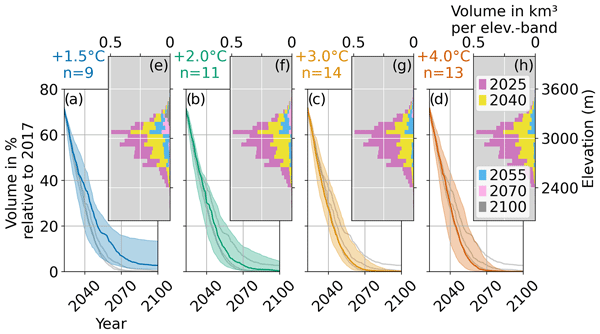
We use regional observations of glacier area and volume change to inform glacier evolution modeling in the Ötztal and Stubai range (Austrian Alps) until 2100 in different climate scenarios. Glaciers in the region lost 23 % of their volume between 2006 and 2017. Under current warming trajectories, glacier loss in the region is expected to be near-total by 2075. We show that integrating regional calibration and validation data in glacier models is important to improve confidence in projections.
Rodrigo Aguayo, Fabien Maussion, Lilian Schuster, Marius Schaefer, Alexis Caro, Patrick Schmitt, Jonathan Mackay, Lizz Ultee, Jorge Leon-Muñoz, and Mauricio Aguayo
The Cryosphere, 18, 5383–5406, https://doi.org/10.5194/tc-18-5383-2024, https://doi.org/10.5194/tc-18-5383-2024, 2024
Short summary
Short summary
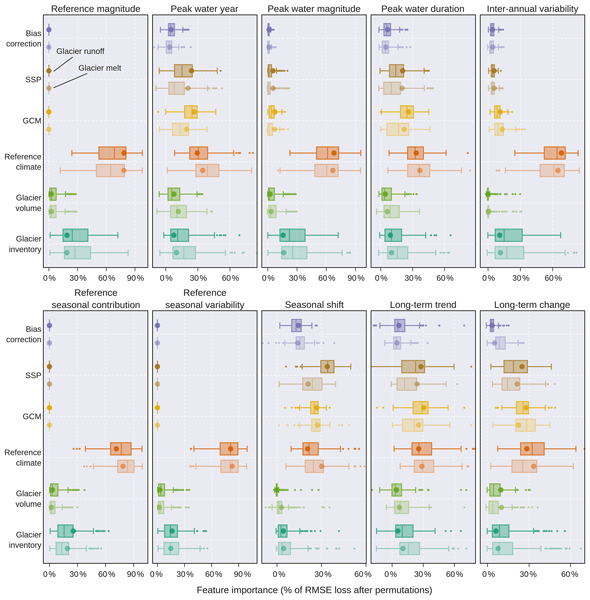
Predicting how much water will come from glaciers in the future is a complex task, and there are many factors that make it uncertain. Using a glacier model, we explored 1920 scenarios for each glacier in the Patagonian Andes. We found that the choice of the historical climate data was the most important factor, while other factors such as different data sources, climate models and emission scenarios played a smaller role.
Daniel N. Goldberg, Paul R. Holland, and Kaitlin A. Naughten
EGUsphere, https://doi.org/10.5194/egusphere-2026-3779, https://doi.org/10.5194/egusphere-2026-3779, 2026
Short summary
Short summary
Antarctica’s Amundsen Sea glaciers are major contributors to sea-level rise. Using multi-century, high-resolution coupled ice–ocean simulations of the region, we show that 21st century predictions depend strongly on how ice-sheet models are initialized, especially for Thwaites Glacier. By the 22nd century, however, ocean warming becomes the dominant driver, leading to much faster ice loss under high-emissions scenarios, highlighting the importance of improving coupled climate–ice models.
Laure Moinat, Florian Franziskakis, Christian Vérard, Daniel Nathan Goldberg, and Maura Brunetti
Geosci. Model Dev., 19, 4357–4384, https://doi.org/10.5194/gmd-19-4357-2026, https://doi.org/10.5194/gmd-19-4357-2026, 2026
Short summary
Short summary
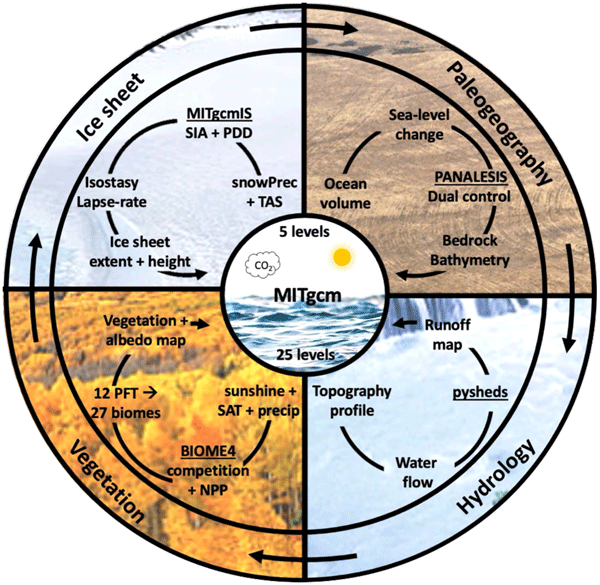
We describe a new tool, BIG-MITgcm, that consistently reproduces the global-scale dynamics of the ocean, atmosphere, vegetation and ice on multimillennial timescales at a low computational cost. Evaluated against observations and state-of-the-art Earth system models, it includes asynchronous coupling to models of vegetation, hydrology and a newly developed global-scale ice sheet. Using arbitrary continental configurations, it enables studies of past and present climates on Earth or exoplanets.
Jaime Otero, Daniel Goldberg, Peter Nienow, and Yefan Wang
EGUsphere, https://doi.org/10.5194/egusphere-2026-2298, https://doi.org/10.5194/egusphere-2026-2298, 2026
Short summary
Short summary
As climate change creates new lakes at the front of retreating glaciers, these ice bodies often accelerate and lose mass more quickly. We used a computer model to study this process at an Icelandic glacier. Our results show that thinning ice is the main driver for recent acceleration, with 37 % of the total ice loss resulting from the presence of the lake. These findings imply that as lakes grow globally, glaciers could vanish more rapidly than predicted, enhancing the rate of sea level rise.
Ruitang Yang, Lizz Ultee, Kristoffer Aalstad, Matvey V. Debolskiy, Regine Hock, Patrick Schmitt, David Rounce, and Tian Li
EGUsphere, https://doi.org/10.5194/egusphere-2026-1081, https://doi.org/10.5194/egusphere-2026-1081, 2026
Short summary
Short summary
We present a new framework to model frontal ablation of marine-terminating glaciers by linking two global glacier models with a simple physics-based calving scheme and Bayesian calibration. Applied to 71 Svalbard glaciers (2000–2019) and projected to 2100, it reproduces seasonal front changes but overestimates ablation due to uncertain geometry and velocity. This efficient approach can improve regional to global simulations.
Claire K. Yung, Xylar S. Asay-Davis, Alistair Adcroft, Christopher Y. S. Bull, Jan De Rydt, Michael S. Dinniman, Benjamin K. Galton-Fenzi, Daniel Goldberg, David E. Gwyther, Robert Hallberg, Matthew Harrison, Tore Hattermann, David M. Holland, Denise Holland, Paul R. Holland, James R. Jordan, Nicolas C. Jourdain, Kazuya Kusahara, Gustavo Marques, Pierre Mathiot, Dimitris Menemenlis, Adele K. Morrison, Yoshihiro Nakayama, Olga Sergienko, Robin S. Smith, Alon Stern, Ralph Timmermann, and Qin Zhou
The Cryosphere, 20, 2053–2088, https://doi.org/10.5194/tc-20-2053-2026, https://doi.org/10.5194/tc-20-2053-2026, 2026
Short summary
Short summary
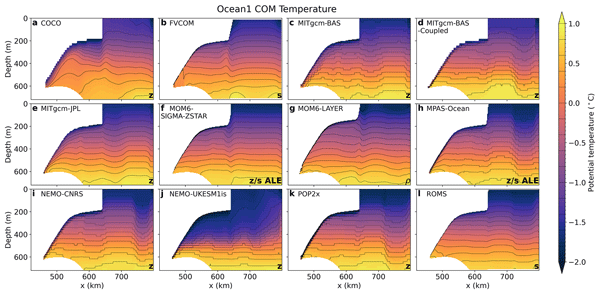
The second Ice Shelf-Ocean Model Intercomparison Project, ISOMIP+, compares 12 ice shelf-ocean models with a common, idealised, static configuration, aiming to assess inter-model variability. Models show similar basal melt rate patterns, ocean profiles and circulation but differ in ice-ocean boundary layer properties. Ice-ocean boundary layer representation is a key area for future work, as are realistic-domain ice sheet-ocean model intercomparisons.
Gillian M. A. Smith, Daniel N. Goldberg, Guillaume Jouvet, James R. Maddison, and Hamish D. Pritchard
EGUsphere, https://doi.org/10.5194/egusphere-2026-788, https://doi.org/10.5194/egusphere-2026-788, 2026
Short summary
Short summary
We estimate the thickness of a large glacier in the Himalaya, using recently available thickness measurements and a computational model which uses higher-order physics to match estimated thickness with satellite-observed velocity. Our velocity inversion achieves similar accuracy to leading thickness estimates, while thickness-constrained inversions show increased accuracy, but limited interpolative power. We make recommendations for future measurement locations and for choosing model parameters.
Brad Reed, Jan De Rydt, Kaitlin A. Naughten, and Daniel N. Goldberg
EGUsphere, https://doi.org/10.5194/egusphere-2026-931, https://doi.org/10.5194/egusphere-2026-931, 2026
Short summary
Short summary
Melting beneath Antarctic ice shelves drives ice loss and raises sea levels, but the computer models we use to predict this are poorly constrained. We improved how these models are set up by using multiple real-world observations of ice thinning and glacier speed, rather than melt rates alone. This better captures how the ice and ocean interact. Our projections show this approach adds 14 mm of extra sea-level rise by 2100, which is more than switching to a warmer climate scenario alone.
Jakob Steiner, William Armstrong, Will Kochtitzky, Robert McNabb, Rodrigo Aguayo, Tobias Bolch, Fabien Maussion, Vibhor Agarwal, Iestyn Barr, Nathaniel R. Baurley, Mike Cloutier, Katelyn DeWater, Frank Donachie, Yoann Drocourt, Siddhi Garg, Gunjan Joshi, Byron Guzman, Stanislav Kutuzov, Thomas Loriaux, Caleb Mathias, Brian Menounos, Evan Miles, Aleksandra Osika, Kaleigh Potter, Adina Racoviteanu, Brianna Rick, Miles Sterner, Guy D. Tallentire, Levan Tielidze, Rebecca White, Kunpeng Wu, and Whyjay Zheng
Earth Syst. Sci. Data, 18, 1665–1681, https://doi.org/10.5194/essd-18-1665-2026, https://doi.org/10.5194/essd-18-1665-2026, 2026
Short summary
Short summary
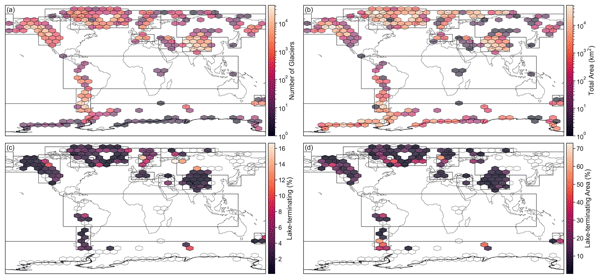
Many mountain glaciers around the world flow into lakes – exactly how many however, has never been mapped. Across a large team of experts we have now identified all glaciers that end in lakes. Only about 1% do so, but they are generally larger than those which end on land. This is important to understand, as lakes can influence the behaviour of glacier ice, including how fast it disappears. This new dataset allows us to better model glaciers at a global scale, accounting for the effect of lakes.
Jowan M. Barnes, G. Hilmar Gudmundsson, Daniel N. Goldberg, and Sainan Sun
The Cryosphere, 20, 777–790, https://doi.org/10.5194/tc-20-777-2026, https://doi.org/10.5194/tc-20-777-2026, 2026
Short summary
Short summary
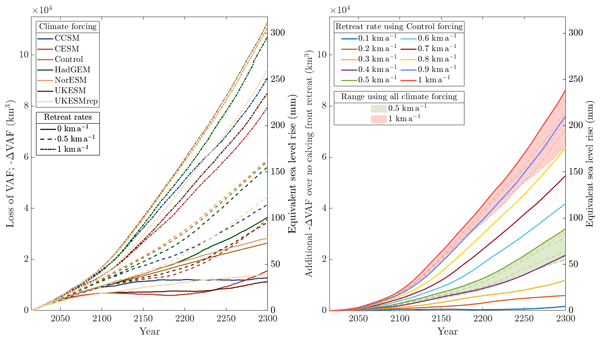
Calving is where ice breaks off the front of glaciers. It has not been included widely in modelling as it is difficult to represent. We use our ice flow model to investigate the effects of calving floating ice shelves in West Antarctica. More calving leads to more ice loss and greater sea level rise, with local differences due to the shape of the bedrock. We find that ocean forcing and calving should be considered equally when trying to improve how models represent the real world.
Jan Niklas Richter, Anselm Arndt, Nikolina Ban, Nicolas Gampierakis, Fabien Maussion, Rainer Prinz, Matthias Scheiter, Nikolaus Umlauf, and Lindsey Nicholson
EGUsphere, https://doi.org/10.5194/egusphere-2025-6249, https://doi.org/10.5194/egusphere-2025-6249, 2026
Short summary
Short summary
We developed a multi-objective Bayesian framework to calibrate a surface energy balance (SEB) model using only publicly available satellite data and climate simulations. The framework constrains model parameters well but also reveals biases in the forcing, affecting the SEB and the simulated mass balance and snowlines. The results indicate that an uncertainty-aware model chain can help identify model errors and provides a first step towards physical glacier modelling without in-situ data.
Hamish D. Pritchard, Edward C. King, David J. Goodger, Douglas Boyle, Daniel N. Goldberg, Beatriz Recinos, Andrew Orr, and Dhananjay Regmi
Earth Syst. Sci. Data, 18, 199–217, https://doi.org/10.5194/essd-18-199-2026, https://doi.org/10.5194/essd-18-199-2026, 2026
Short summary
Short summary
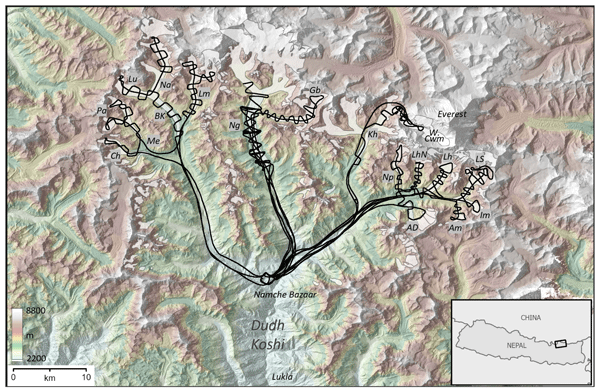
We present a new and uniquely extensive dataset of glacier thickness from the Khumbu Himal around Mount Everest that stretches for 119 km, doubling the extent of thickness measurements in High Mountain Asia. Such measurements are key inputs for models that estimate how much ice is stored on the whole mountain range scale and for models that predict how this ice reserve will change in future, and what impact this will have on water supply for the large populations living downstream.
Kamilla Hauknes Sjursen, Jordi Bolibar, Marijn van der Meer, Liss Marie Andreassen, Julian Peter Biesheuvel, Thorben Dunse, Matthias Huss, Fabien Maussion, David R. Rounce, and Brandon Tober
The Cryosphere, 19, 5801–5826, https://doi.org/10.5194/tc-19-5801-2025, https://doi.org/10.5194/tc-19-5801-2025, 2025
Short summary
Short summary
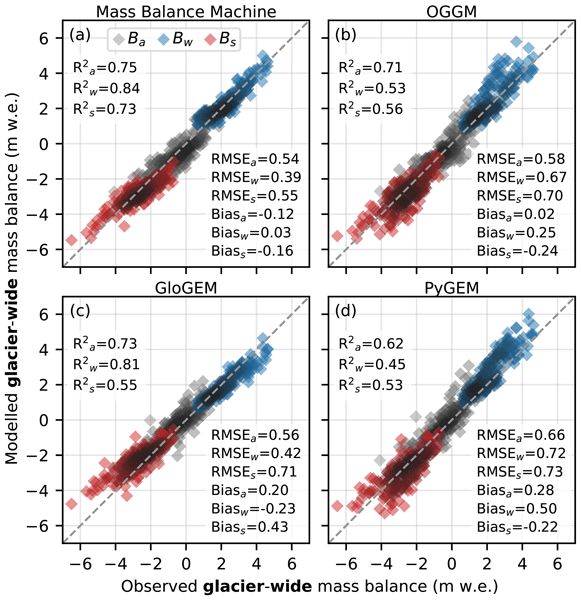
Understanding glacier mass changes is crucial for assessing freshwater availability in many regions of the world. We present the Mass Balance Machine, a machine learning model that learns from sparse measurements of glacier mass change to make predictions on unmonitored glaciers. Using data from Norway, we show that the model provides accurate estimates of mass changes at different spatiotemporal scales. Our findings show that machine learning can be a valuable tool to improve such predictions.
Larissa Nora van der Laan, Anouk Vlug, Adam A. Scaife, Fabien Maussion, and Kristian Förster
The Cryosphere, 19, 3879–3896, https://doi.org/10.5194/tc-19-3879-2025, https://doi.org/10.5194/tc-19-3879-2025, 2025
Short summary
Short summary
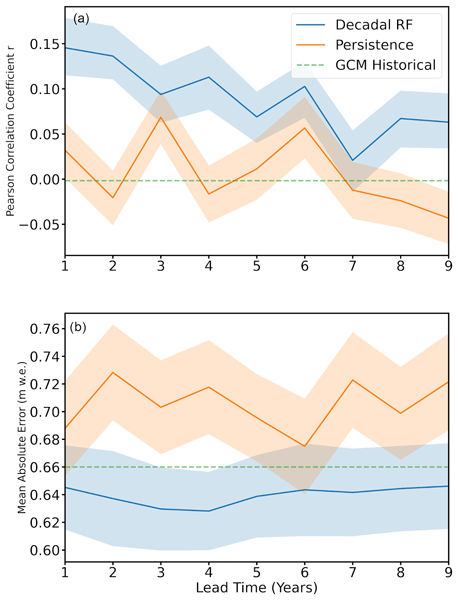
Usually, glacier models are supplied with climate information from long (e.g., 100-year) simulations by global climate models. In this paper, we test the feasibility of supplying glacier models with shorter simulations to get more accurate information on 5–10-year timescales. Reliable information on these timescales is very important, especially for water management experts, to know how much meltwater to expect, affecting rivers, agriculture and drinking water.
Lorenz Hänchen, Emily Potter, Cornelia Klein, Pierluigi Calanca, Fabien Maussion, Wolfgang Gurgiser, and Georg Wohlfahrt
Hydrol. Earth Syst. Sci., 29, 2727–2747, https://doi.org/10.5194/hess-29-2727-2025, https://doi.org/10.5194/hess-29-2727-2025, 2025
Short summary
Short summary
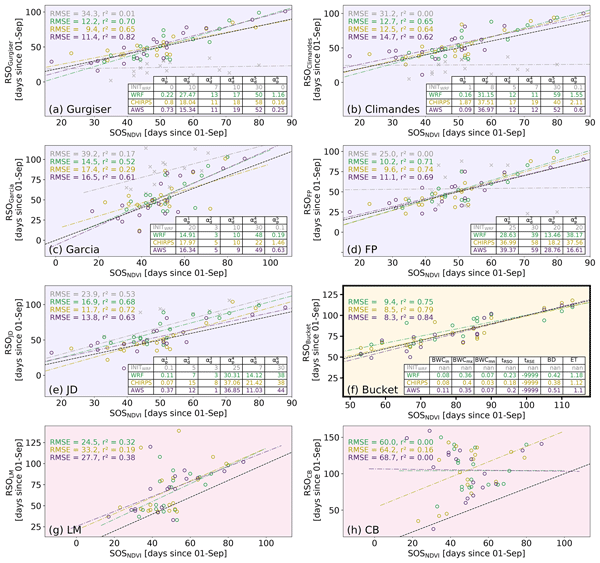
In semi-arid regions, the timing and duration of the rainy season are crucial for agriculture. This study introduces a new framework for improving estimations of the onset and end of the rainy season by testing how well they fit local vegetation data. We improve the performance of existing methods and present a new one with higher performance. Our findings can help us to make informed decisions about water usage, and the framework can be applied to other regions as well.
Finn Wimberly, Lizz Ultee, Lilian Schuster, Matthias Huss, David R. Rounce, Fabien Maussion, Sloan Coats, Jonathan Mackay, and Erik Holmgren
The Cryosphere, 19, 1491–1511, https://doi.org/10.5194/tc-19-1491-2025, https://doi.org/10.5194/tc-19-1491-2025, 2025
Short summary
Short summary
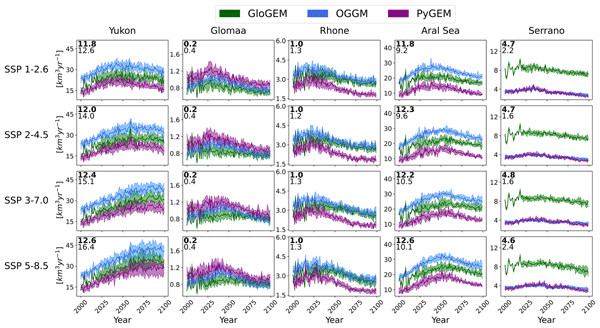
Glacier models have historically been used to understand glacier melt’s contribution to sea level rise. The capacity to project seasonal glacier runoff is a relatively recent development for these models. In this study we provide the first model intercomparison of runoff projections for the glacier evolution models capable of simulating future runoff globally. We compare model projections from 2000 to 2100 for all major river basins larger than 3000 km2 with over 30 km2 of initial glacier cover.
Lea Hartl, Patrick Schmitt, Lilian Schuster, Kay Helfricht, Jakob Abermann, and Fabien Maussion
The Cryosphere, 19, 1431–1452, https://doi.org/10.5194/tc-19-1431-2025, https://doi.org/10.5194/tc-19-1431-2025, 2025
Short summary
Short summary
We use regional observations of glacier area and volume change to inform glacier evolution modeling in the Ötztal and Stubai range (Austrian Alps) until 2100 in different climate scenarios. Glaciers in the region lost 23 % of their volume between 2006 and 2017. Under current warming trajectories, glacier loss in the region is expected to be near-total by 2075. We show that integrating regional calibration and validation data in glacier models is important to improve confidence in projections.
Rodrigo Aguayo, Fabien Maussion, Lilian Schuster, Marius Schaefer, Alexis Caro, Patrick Schmitt, Jonathan Mackay, Lizz Ultee, Jorge Leon-Muñoz, and Mauricio Aguayo
The Cryosphere, 18, 5383–5406, https://doi.org/10.5194/tc-18-5383-2024, https://doi.org/10.5194/tc-18-5383-2024, 2024
Short summary
Short summary
Predicting how much water will come from glaciers in the future is a complex task, and there are many factors that make it uncertain. Using a glacier model, we explored 1920 scenarios for each glacier in the Patagonian Andes. We found that the choice of the historical climate data was the most important factor, while other factors such as different data sources, climate models and emission scenarios played a smaller role.
Harry Zekollari, Matthias Huss, Lilian Schuster, Fabien Maussion, David R. Rounce, Rodrigo Aguayo, Nicolas Champollion, Loris Compagno, Romain Hugonnet, Ben Marzeion, Seyedhamidreza Mojtabavi, and Daniel Farinotti
The Cryosphere, 18, 5045–5066, https://doi.org/10.5194/tc-18-5045-2024, https://doi.org/10.5194/tc-18-5045-2024, 2024
Short summary
Short summary
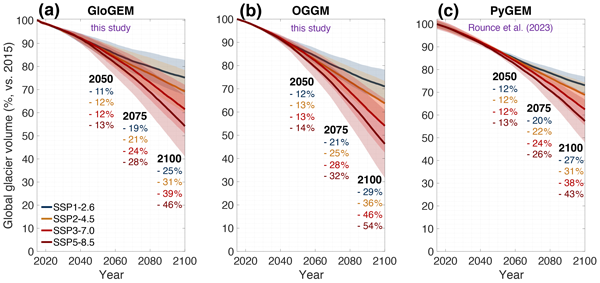
Glaciers are major contributors to sea-level rise and act as key water resources. Here, we model the global evolution of glaciers under the latest generation of climate scenarios. We show that the type of observations used for model calibration can strongly affect the projections at the local scale. Our newly projected 21st century global mass loss is higher than the current community estimate as reported in the latest Intergovernmental Panel on Climate Change (IPCC) report.
Sarah Hanus, Lilian Schuster, Peter Burek, Fabien Maussion, Yoshihide Wada, and Daniel Viviroli
Geosci. Model Dev., 17, 5123–5144, https://doi.org/10.5194/gmd-17-5123-2024, https://doi.org/10.5194/gmd-17-5123-2024, 2024
Short summary
Short summary
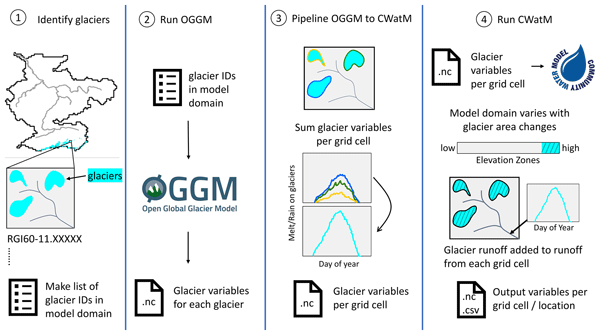
This study presents a coupling of the large-scale glacier model OGGM and the hydrological model CWatM. Projected future increase in discharge is less strong while future decrease in discharge is stronger when glacier runoff is explicitly included in the large-scale hydrological model. This is because glacier runoff is projected to decrease in nearly all basins. We conclude that an improved glacier representation can prevent underestimating future discharge changes in large river basins.
Marin Kneib, Amaury Dehecq, Fanny Brun, Fatima Karbou, Laurane Charrier, Silvan Leinss, Patrick Wagnon, and Fabien Maussion
The Cryosphere, 18, 2809–2830, https://doi.org/10.5194/tc-18-2809-2024, https://doi.org/10.5194/tc-18-2809-2024, 2024
Short summary
Short summary
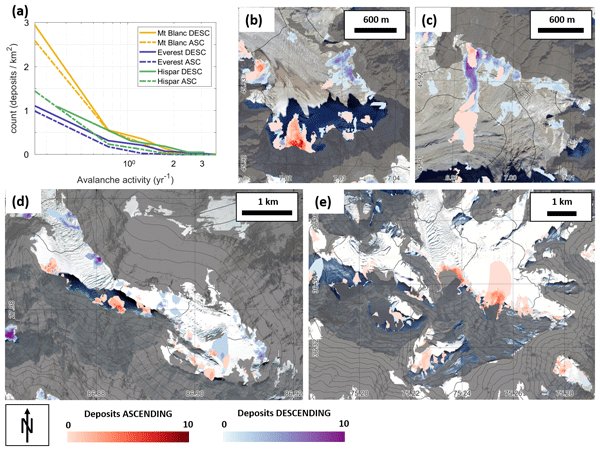
Avalanches are important for the mass balance of mountain glaciers, but few data exist on where and when they occur and which glaciers they affect the most. We developed an approach to map avalanches over large glaciated areas and long periods of time using satellite radar data. The application of this method to various regions in the Alps and High Mountain Asia reveals the variability of avalanches on these glaciers and provides key data to better represent these processes in glacier models.
David T. Bett, Alexander T. Bradley, C. Rosie Williams, Paul R. Holland, Robert J. Arthern, and Daniel N. Goldberg
The Cryosphere, 18, 2653–2675, https://doi.org/10.5194/tc-18-2653-2024, https://doi.org/10.5194/tc-18-2653-2024, 2024
Short summary
Short summary
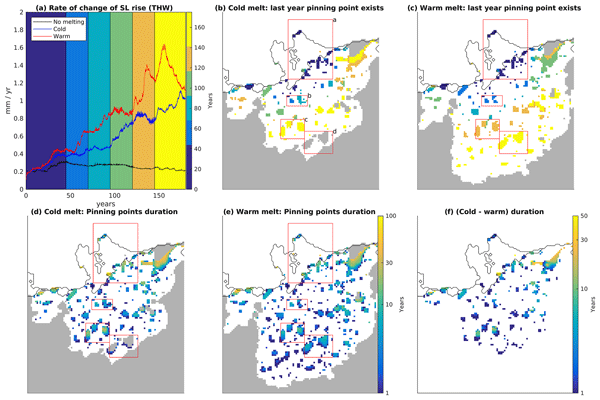
A new ice–ocean model simulates future ice sheet evolution in the Amundsen Sea sector of Antarctica. Substantial ice retreat is simulated in all scenarios, with some retreat still occurring even with no future ocean melting. The future of small "pinning points" (islands of ice that contact the seabed) is an important control on this retreat. Ocean melting is crucial in causing these features to go afloat, providing the link by which climate change may affect this sector's sea level contribution.
Jordi Bolibar, Facundo Sapienza, Fabien Maussion, Redouane Lguensat, Bert Wouters, and Fernando Pérez
Geosci. Model Dev., 16, 6671–6687, https://doi.org/10.5194/gmd-16-6671-2023, https://doi.org/10.5194/gmd-16-6671-2023, 2023
Short summary
Short summary
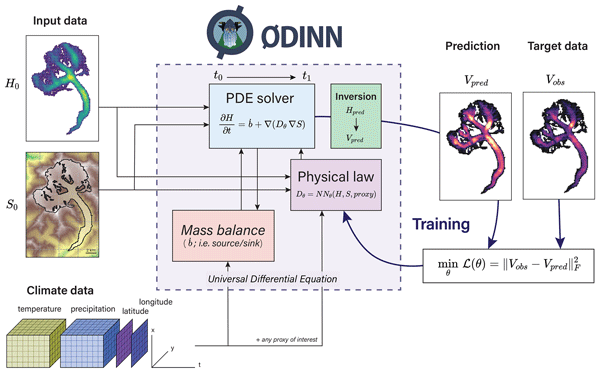
We developed a new modelling framework combining numerical methods with machine learning. Using this approach, we focused on understanding how ice moves within glaciers, and we successfully learnt a prescribed law describing ice movement for 17 glaciers worldwide as a proof of concept. Our framework has the potential to discover important laws governing glacier processes, aiding our understanding of glacier physics and their contribution to water resources and sea-level rise.
Beatriz Recinos, Daniel Goldberg, James R. Maddison, and Joe Todd
The Cryosphere, 17, 4241–4266, https://doi.org/10.5194/tc-17-4241-2023, https://doi.org/10.5194/tc-17-4241-2023, 2023
Short summary
Short summary
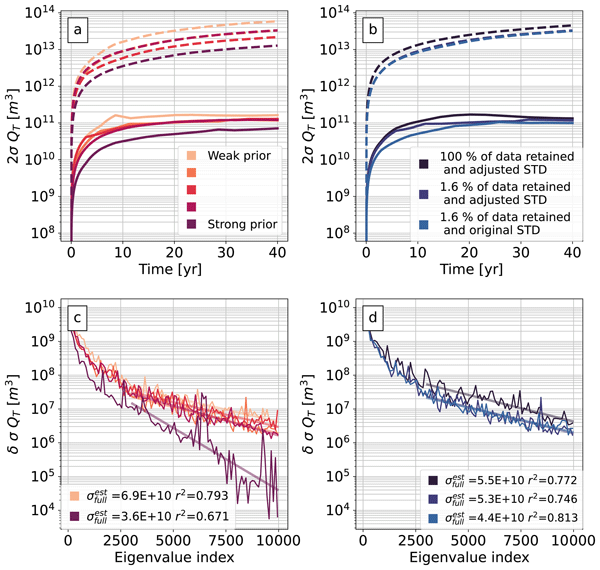
Ice sheet models generate forecasts of ice sheet mass loss, a significant contributor to sea level rise; thus, capturing the complete range of possible projections of mass loss is of critical societal importance. Here we add to data assimilation techniques commonly used in ice sheet modelling (a Bayesian inference approach) and fully characterize calibration uncertainty. We successfully propagate this type of error onto sea level rise projections of three ice streams in West Antarctica.
Philipp Gregor, Tobias Zinner, Fabian Jakub, and Bernhard Mayer
Atmos. Meas. Tech., 16, 3257–3271, https://doi.org/10.5194/amt-16-3257-2023, https://doi.org/10.5194/amt-16-3257-2023, 2023
Short summary
Short summary
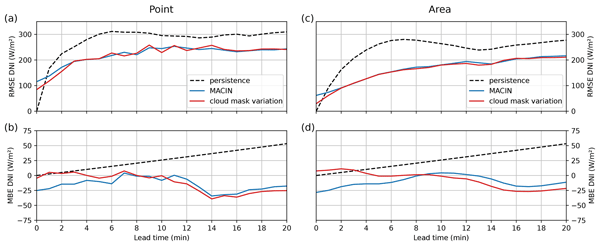
This work introduces MACIN, a model for short-term forecasting of direct irradiance for solar energy applications. MACIN exploits cloud images of multiple cameras to predict irradiance. The model is applied to artificial images of clouds from a weather model. The artificial cloud data allow for a more in-depth evaluation and attribution of errors compared with real data. Good performance of derived cloud information and significant forecast improvements over a baseline forecast were found.
Nidheesh Gangadharan, Hugues Goosse, David Parkes, Heiko Goelzer, Fabien Maussion, and Ben Marzeion
Earth Syst. Dynam., 13, 1417–1435, https://doi.org/10.5194/esd-13-1417-2022, https://doi.org/10.5194/esd-13-1417-2022, 2022
Short summary
Short summary
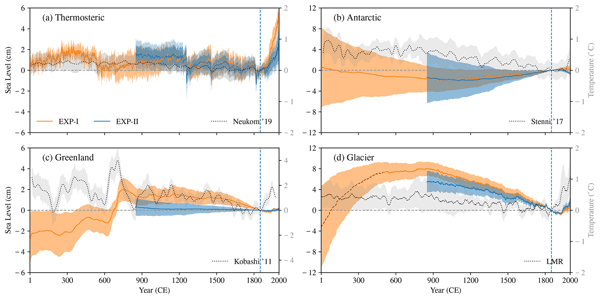
We describe the contributions of ocean thermal expansion and land-ice melting (ice sheets and glaciers) to global-mean sea-level (GMSL) changes in the Common Era. The mass contributions are the major sources of GMSL changes in the pre-industrial Common Era and glaciers are the largest contributor. The paper also describes the current state of climate modelling, uncertainties and knowledge gaps along with the potential implications of the past variabilities in the contemporary sea-level rise.
Helen Ockenden, Robert G. Bingham, Andrew Curtis, and Daniel Goldberg
The Cryosphere, 16, 3867–3887, https://doi.org/10.5194/tc-16-3867-2022, https://doi.org/10.5194/tc-16-3867-2022, 2022
Short summary
Short summary
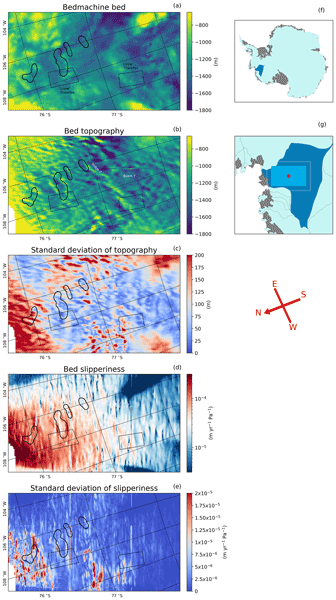
Hills and valleys hidden under the ice of Thwaites Glacier have an impact on ice flow and future ice loss, but there are not many three-dimensional observations of their location or size. We apply a mathematical theory to new high-resolution observations of the ice surface to predict the bed topography beneath the ice. There is a good correlation with ice-penetrating radar observations. The method may be useful in areas with few direct observations or as a further constraint for other methods.
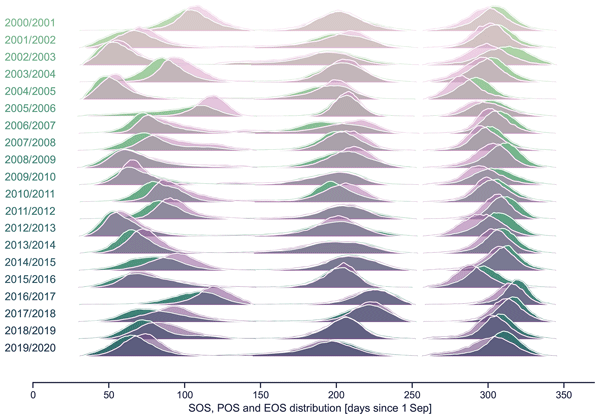
Lorenz Hänchen, Cornelia Klein, Fabien Maussion, Wolfgang Gurgiser, Pierluigi Calanca, and Georg Wohlfahrt
Earth Syst. Dynam., 13, 595–611, https://doi.org/10.5194/esd-13-595-2022, https://doi.org/10.5194/esd-13-595-2022, 2022
Short summary
Short summary
To date, farmers' perceptions of hydrological changes do not match analysis of meteorological data. In contrast to rainfall data, we find greening of vegetation, indicating increased water availability in the past decades. The start of the season is highly variable, making farmers' perceptions comprehensible. We show that the El Niño–Southern Oscillation has complex effects on vegetation seasonality but does not drive the greening we observe. Improved onset forecasts could help local farmers.
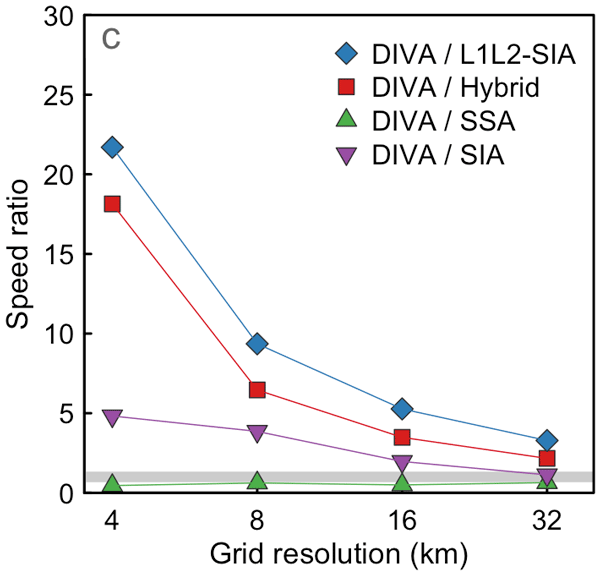
Alexander Robinson, Daniel Goldberg, and William H. Lipscomb
The Cryosphere, 16, 689–709, https://doi.org/10.5194/tc-16-689-2022, https://doi.org/10.5194/tc-16-689-2022, 2022
Short summary
Short summary
Here we investigate the numerical stability of several commonly used methods in order to determine which of them are capable of resolving the complex physics of the ice flow and are also computationally efficient. We find that the so-called DIVA solver outperforms the others. Its representation of the physics is consistent with more complex methods, while it remains computationally efficient at high resolution.
Cited articles
Aguayo, R., Maussion, F., Schuster, L., Schaefer, M., Caro, A., Schmitt, P., Mackay, J., Ultee, L., Leon-Muñoz, J., and Aguayo, M.: Unravelling the sources of uncertainty in glacier runoff projections in the Patagonian Andes (40–56° S), The Cryosphere, 18, 5383–5406, https://doi.org/10.5194/tc-18-5383-2024, 2024. a, b
Bosson, J. B., Huss, M., Cauvy-Fraunié, S., Clément, J. C., Costes, G., Fischer, M., Poulenard, J., and Arthaud, F.: Future emergence of new ecosystems caused by glacial retreat, Nature, 620, 562–569, https://doi.org/10.1038/s41586-023-06302-2, 2023. a
Brinkerhoff, D. J. and Johnson, J. V.: Data assimilation and prognostic whole ice sheet modelling with the variationally derived, higher order, open source, and fully parallel ice sheet model VarGlaS, The Cryosphere, 7, 1161–1184, https://doi.org/10.5194/tc-7-1161-2013, 2013. a
Byrd, R. H., Lu, P., Nocedal, J., and Zhu, C.: A Limited Memory Algorithm for Bound Constrained Optimization, SIAM Journal on Scientific Computing, 16, 1190–1208, https://doi.org/10.1137/0916069, 1995. a
Cannone, N., Diolaiuti, G., Guglielmin, M., and Smiraglia, C.: Accelerating Climate Change Impacts on Alpine Glacier Forefield Ecosystems in the European Alps, Ecological Applications, 18, 637–648, https://doi.org/10.1890/07-1188.1, 2008. a
Colton, D. and Kress, R.: Inverse Acoustic and Electromagnetic Scattering Theory, Springer New York, https://doi.org/10.1007/978-1-4614-4942-3, 2013. a
Cook, S. J., Jouvet, G., Millan, R., Rabatel, A., Zekollari, H., and Dussaillant, I.: Committed Ice Loss in the European Alps Until 2050 Using a Deep‐Learning‐Aided 3D Ice‐Flow Model With Data Assimilation, Geophysical Research Letters, 50, https://doi.org/10.1029/2023gl105029, 2023. a, b, c, d
COP-DEM: Copernicus DEM, CDSE [data set], https://doi.org/10.5270/esa-c5d3d65, 2022. a
Farinotti, D., Huss, M., Fürst, J. J., Landmann, J., Machguth, H., Maussion, F., and Pandit, A.: A consensus estimate for the ice thickness distribution of all glaciers on Earth, Nature Geoscience, 12, 168–173, https://doi.org/10.1038/s41561-019-0300-3, 2019. a, b, c, d
Fürst, J. J., Gillet-Chaulet, F., Benham, T. J., Dowdeswell, J. A., Grabiec, M., Navarro, F., Pettersson, R., Moholdt, G., Nuth, C., Sass, B., Aas, K., Fettweis, X., Lang, C., Seehaus, T., and Braun, M.: Application of a two-step approach for mapping ice thickness to various glacier types on Svalbard, The Cryosphere, 11, 2003–2032, https://doi.org/10.5194/tc-11-2003-2017, 2017. a, b
Gillet-Chaulet, F., Gagliardini, O., Seddik, H., Nodet, M., Durand, G., Ritz, C., Zwinger, T., Greve, R., and Vaughan, D. G.: Greenland ice sheet contribution to sea-level rise from a new-generation ice-sheet model, The Cryosphere, 6, 1561–1576, https://doi.org/10.5194/tc-6-1561-2012, 2012. a
Gobbi, M., Ambrosini, R., Casarotto, C., Diolaiuti, G., Ficetola, G. F., Lencioni, V., Seppi, R., Smiraglia, C., Tampucci, D., Valle, B., and Caccianiga, M.: Vanishing permanent glaciers: climate change is threatening a European Union habitat (Code 8340) and its poorly known biodiversity, Biodiversity and Conservation, 30, 2267–2276, https://doi.org/10.1007/s10531-021-02185-9, 2021. a
Hansen, P. C.: Analysis of Discrete Ill-Posed Problems by Means of the L-Curve, SIAM Review, 34, 561–580, http://www.jstor.org/stable/2132628 (last access: 21 January 2026), 1992. a
Hartl, L., Schmitt, P., Schuster, L., Helfricht, K., Abermann, J., and Maussion, F.: Recent observations and glacier modeling point towards near-complete glacier loss in western Austria (Ötztal and Stubai mountain range) if 1.5 °C is not met, The Cryosphere, 19, 1431–1452, https://doi.org/10.5194/tc-19-1431-2025, 2025. a
Hindmarsh, R. C. A.: Notes on Basic Glaciological Computational Methods and Algorithms, Springer Berlin Heidelberg, Berlin, Heidelberg, ISBN 978-3-662-04439-1, 222–249, https://doi.org/10.1007/978-3-662-04439-1_13, 2001. a
Hugonnet, R., McNabb, R., Berthier, E., Menounos, B., Nuth, C., Girod, L., Farinotti, D., Huss, M., Dussaillant, I., Brun, F., and Kääb, A.: Accelerated global glacier mass loss in the early twenty-first century, Nature, 592, 726–731, https://doi.org/10.1038/s41586-021-03436-z, 2021. a, b, c, d
Huss, M. and Farinotti, D.: Distributed ice thickness and volume of all glaciers around the globe, Journal of Geophysical Research: Earth Surface, 117, https://doi.org/10.1029/2012jf002523, 2012. a, b
Huss, M. and Hock, R.: A new model for global glacier change and sea-level rise, Frontiers in Earth Science, 3, https://doi.org/10.3389/feart.2015.00054, 2015. a, b
Huss, M. and Hock, R.: Global-scale hydrological response to future glacier mass loss, Nature Climate Change, 8, 135–140, https://doi.org/10.1038/s41558-017-0049-x, 2018. a
Jouvet, G.: Inversion of a Stokes glacier flow model emulated by deep learning, Journal of Glaciology, 69, 13–26, https://doi.org/10.1017/jog.2022.41, 2022. a, b
Lange, S.: WFDE5 over land merged with ERA5 over the ocean (W5E5), GFZ Data Services [data set], https://doi.org/10.5880/PIK.2019.023, 2019. a
Linsbauer, A., Paul, F., and Haeberli, W.: Modeling glacier thickness distribution and bed topography over entire mountain ranges with GlabTop: Application of a fast and robust approach, Journal of Geophysical Research: Earth Surface, 117, https://doi.org/10.1029/2011jf002313, 2012. a
Lipscomb, W. H., Price, S. F., Hoffman, M. J., Leguy, G. R., Bennett, A. R., Bradley, S. L., Evans, K. J., Fyke, J. G., Kennedy, J. H., Perego, M., Ranken, D. M., Sacks, W. J., Salinger, A. G., Vargo, L. J., and Worley, P. H.: Description and evaluation of the Community Ice Sheet Model (CISM) v2.1, Geosci. Model Dev., 12, 387–424, https://doi.org/10.5194/gmd-12-387-2019, 2019. a
Lorenc, A. C.: Development of an Operational Variational Assimilation Scheme (gtSpecial IssueltData Assimilation in Meteology and Oceanography: Theory and Practice), Journal of the Meteorological Society of Japan. Ser. II, 75, 339–346, https://doi.org/10.2151/jmsj1965.75.1b_339, 1997. a
Marzeion, B., Jarosch, A. H., and Hofer, M.: Past and future sea-level change from the surface mass balance of glaciers, The Cryosphere, 6, 1295–1322, https://doi.org/10.5194/tc-6-1295-2012, 2012. a, b
Marzeion, B., Hock, R., Anderson, B., Bliss, A., Champollion, N., Fujita, K., Huss, M., Immerzeel, W. W., Kraaijenbrink, P., Malles, J., Maussion, F., Radić, V., Rounce, D. R., Sakai, A., Shannon, S., van de Wal, R., and Zekollari, H.: Partitioning the Uncertainty of Ensemble Projections of Global Glacier Mass Change, Earth's Future, 8, https://doi.org/10.1029/2019ef001470, 2020. a
Maussion, F., Butenko, A., Champollion, N., Dusch, M., Eis, J., Fourteau, K., Gregor, P., Jarosch, A. H., Landmann, J., Oesterle, F., Recinos, B., Rothenpieler, T., Vlug, A., Wild, C. T., and Marzeion, B.: The Open Global Glacier Model (OGGM) v1.1, Geosci. Model Dev., 12, 909–931, https://doi.org/10.5194/gmd-12-909-2019, 2019. a, b, c, d, e, f
Millan, R., Mouginot, J., Rabatel, A., and Morlighem, M.: Ice velocity and thickness of the world’s glaciers, Nature Geoscience, 15, 124–129, https://doi.org/10.1038/s41561-021-00885-z, 2022. a, b
Morales, J. L. and Nocedal, J.: Remark on “algorithm 778: L-BFGS-B: Fortran subroutines for large-scale bound constrained optimization”, ACM Transactions on Mathematical Software, 38, 1–4, https://doi.org/10.1145/2049662.2049669, 2011. a
Oerlemans, J.: A flowline model for Nigardsbreen, Norway: projection of future glacier length based on dynamic calibration with the historic record, Annals of Glaciology, 24, 382–389, https://doi.org/10.3189/s0260305500012489, 1997. a
Paszke, A., Gross, S., Massa, F., Lerer, A., Bradbury, J., Chanan, G., Killeen, T., Lin, Z., Gimelshein, N., Antiga, L., Desmaison, A., Kopf, A., Yang, E., DeVito, Z., Raison, M., Tejani, A., Chilamkurthy, S., Steiner, B., Fang, L., Bai, J., and Chintala, S.: PyTorch: An Imperative Style, High-Performance Deep Learning Library, in: Advances in Neural Information Processing Systems 32, edited by: Wallach, H., Larochelle, H., Beygelzimer, A., d'Alché-Buc, F., Fox, E., and Garnett, R., Curran Associates, Inc., 8024–8035, http://papers.neurips.cc/paper/9015-pytorch-an-imperative-style-high-performance-deep-learning-library.pdf (last access: 21 January 2026), 2019. a
Recinos, B., Goldberg, D., Maddison, J. R., and Todd, J.: A framework for time-dependent ice sheet uncertainty quantification, applied to three West Antarctic ice streams, The Cryosphere, 17, 4241–4266, https://doi.org/10.5194/tc-17-4241-2023, 2023. a, b
RGI 7 Consortium: Randolph Glacier Inventory – A Dataset of Global Glacier Outlines, Version 7, National Snow and Ice Data Center [data set], https://doi.org/10.5067/F6JMOVY5NAVZ, 2023. a
Rounce, D. R., Khurana, T., Short, M. B., Hock, R., Shean, D. E., and Brinkerhoff, D. J.: Quantifying parameter uncertainty in a large-scale glacier evolution model using Bayesian inference: application to High Mountain Asia, Journal of Glaciology, 66, 175–187, https://doi.org/10.1017/jog.2019.91, 2020. a, b, c
Rounce, D. R., Hock, R., Maussion, F., Hugonnet, R., Kochtitzky, W., Huss, M., Berthier, E., Brinkerhoff, D., Compagno, L., Copland, L., Farinotti, D., Menounos, B., and McNabb, R. W.: Global glacier change in the 21st century: Every increase in temperature matters, Science, 379, 78–83, https://doi.org/10.1126/science.abo1324, 2023. a
Schmitt, P., Gregor, P., and Maussion, F.: OGGM/AGILE: AGILE v0.1.2, Zenodo [code], https://doi.org/10.5281/zenodo.17774989, 2025. a, b
Schmitt, P., Gregor, P., and Maussion, F.: OGGM/AGILE: Container build 20230525 used in Publication, Zenodo [code], https://doi.org/10.5281/zenodo.18314100, 2026. a
Schuster, L., Rounce, D. R., and Maussion, F.: Glacier projections sensitivity to temperature-index model choices and calibration strategies, Annals of Glaciology, 64, https://doi.org/10.1017/aog.2023.57, 2023. a
Shean, D. E., Bhushan, S., Montesano, P., Rounce, D. R., Arendt, A., and Osmanoglu, B.: A Systematic, Regional Assessment of High Mountain Asia Glacier Mass Balance, Frontiers in Earth Science, 7, https://doi.org/10.3389/feart.2019.00363, 2020. a
Slangen, A. B., Palmer, M. D., Camargo, C. M., Church, J. A., Edwards, T. L., Hermans, T. H., Hewitt, H. T., Garner, G. G., Gregory, J. M., Kopp, R. E., Santos, V. M., and van de Wal, R. S.: The evolution of 21st century sea-level projections from IPCC AR5 to AR6 and beyond, Cambridge Prisms: Coastal Futures, 1, https://doi.org/10.1017/cft.2022.8, 2022. a
The GlaMBIE Team: Community estimate of global glacier mass changes from 2000 to 2023, Nature, 639, 382–388, https://doi.org/10.1038/s41586-024-08545-z, 2025. a
Ultee, L., Coats, S., and Mackay, J.: Glacial runoff buffers droughts through the 21st century, Earth Syst. Dynam., 13, 935–959, https://doi.org/10.5194/esd-13-935-2022, 2022. a
Uuemaa, E., Ahi, S., Montibeller, B., Muru, M., and Kmoch, A.: Vertical Accuracy of Freely Available Global Digital Elevation Models (ASTER, AW3D30, MERIT, TanDEM-X, SRTM, and NASADEM), Remote Sensing, 12, 3482, https://doi.org/10.3390/rs12213482, 2020. a
van Pelt, W. and Frank, T.: New glacier thickness and bed topography maps for Svalbard, The Cryosphere, 19, 1–17, https://doi.org/10.5194/tc-19-1-2025, 2025. a, b
Virtanen, P., Gommers, R., Oliphant, T. E., Haberland, M., Reddy, T., Cournapeau, D., Burovski, E., Peterson, P., Weckesser, W., Bright, J., van der Walt, S. J., Brett, M., Wilson, J., Millman, K. J., Mayorov, N., Nelson, A. R. J., Jones, E., Kern, R., Larson, E., Carey, C. J., Polat, İ., Feng, Y., Moore, E. W., VanderPlas, J., Laxalde, D., Perktold, J., Cimrman, R., Henriksen, I., Quintero, E. A., Harris, C. R., Archibald, A. M., Ribeiro, A. H., Pedregosa, F., van Mulbregt, P., and SciPy 1.0 Contributors: SciPy 1.0: Fundamental Algorithms for Scientific Computing in Python, Nature Methods, 17, 261–272, https://doi.org/10.1038/s41592-019-0686-2, 2020. a, b
Welty, E., Zemp, M., Navarro, F., Huss, M., Fürst, J. J., Gärtner-Roer, I., Landmann, J., Machguth, H., Naegeli, K., Andreassen, L. M., Farinotti, D., Li, H., and GlaThiDa Contributors: Worldwide version-controlled database of glacier thickness observations, Earth Syst. Sci. Data, 12, 3039–3055, https://doi.org/10.5194/essd-12-3039-2020, 2020. a
Werder, M. A., Huss, M., Paul, F., Dehecq, A., and Farinotti, D.: A Bayesian ice thickness estimation model for large-scale applications, Journal of Glaciology, 66, 137–152, https://doi.org/10.1017/jog.2019.93, 2019. a, b
Wimberly, F., Ultee, L., Schuster, L., Huss, M., Rounce, D. R., Maussion, F., Coats, S., Mackay, J., and Holmgren, E.: Inter-model differences in 21st century glacier runoff for the world's major river basins, The Cryosphere, 19, 1491–1511, https://doi.org/10.5194/tc-19-1491-2025, 2025. a
Wolovick, M., Humbert, A., Kleiner, T., and Rückamp, M.: Regularization and L-curves in ice sheet inverse models: a case study in the Filchner–Ronne catchment, The Cryosphere, 17, 5027–5060, https://doi.org/10.5194/tc-17-5027-2023, 2023. a
Zekollari, H., Huss, M., and Farinotti, D.: Modelling the future evolution of glaciers in the European Alps under the EURO-CORDEX RCM ensemble, The Cryosphere, 13, 1125–1146, https://doi.org/10.5194/tc-13-1125-2019, 2019. a
Zekollari, H., Huss, M., Schuster, L., Maussion, F., Rounce, D. R., Aguayo, R., Champollion, N., Compagno, L., Hugonnet, R., Marzeion, B., Mojtabavi, S., and Farinotti, D.: Twenty-first century global glacier evolution under CMIP6 scenarios and the role of glacier-specific observations, The Cryosphere, 18, 5045–5066, https://doi.org/10.5194/tc-18-5045-2024, 2024. a
Zekollari, H., Schuster, L., Maussion, F., Hock, R., Marzeion, B., Rounce, D. R., Compagno, L., Fujita, K., Huss, M., James, M., Kraaijenbrink, P. D. A., Lipscomb, W. H., Minallah, S., Oberrauch, M., Van Tricht, L., Champollion, N., Edwards, T., Farinotti, D., Immerzeel, W., Leguy, G., and Sakai, A.: Glacier preservation doubled by limiting warming to 1.5 °C versus 2.7 °C, Science, 388, 979–983, https://doi.org/10.1126/science.adu4675, 2025. a
Zemp, M., Frey, H., Gärtner-Roer, I., Nussbaumer, S. U., Hoelzle, M., Paul, F., Haeberli, W., Denzinger, F., Ahlstrøm, A. P., Anderson, B., Bajracharya, S., Baroni, C., Braun, L. N., Cáceres, B. E., Casassa, G., Cobos, G., Dávila, L. R., Delgado Granados, H., Demuth, M. N., Espizua, L., Fischer, A., Fujita, K., Gadek, B., Ghazanfar, A., Ove Hagen, J., Holmlund, P., Karimi, N., Li, Z., Pelto, M., Pitte, P., Popovnin, V. V., Portocarrero, C. A., Prinz, R., Sangewar, C. V., Severskiy, I., Sigurđsson, O., Soruco, A., Usubaliev, R., and Vincent, C.: Historically unprecedented global glacier decline in the early 21st century, Journal of Glaciology, 61, 745–762, https://doi.org/10.3189/2015jog15j017, 2015. a
Zemp, M., Huss, M., Thibert, E., Eckert, N., McNabb, R., Huber, J., Barandun, M., Machguth, H., Nussbaumer, S. U., Gärtner-Roer, I., Thomson, L., Paul, F., Maussion, F., Kutuzov, S., and Cogley, J. G.: Global glacier mass changes and their contributions to sea-level rise from 1961 to 2016, Nature, 568, 382–386, https://doi.org/10.1038/s41586-019-1071-0, 2019. a
Zhu, C., Byrd, R. H., Lu, P., and Nocedal, J.: Algorithm 778: L-BFGS-B, ACM Transactions on Mathematical Software, 23, 550–560, https://doi.org/10.1145/279232.279236, 1997. a
Short summary
To improve large-scale understanding of glaciers, we developed a new data assimilation method that integrates available observations in a dynamically consistent way, while taking their timestamps into account. It is designed to flexibly include new glacier data as it becomes available. We tested the method with idealized experiments and found promising results in terms of accuracy and efficiency, showing strong potential for real-world applications.
To improve large-scale understanding of glaciers, we developed a new data assimilation method...


