
Articles | Volume 19, issue 21
https://doi.org/10.5194/gmd-19-10735-2026
© Author(s) 2026. This work is distributed under
the Creative Commons Attribution 4.0 License.
the Creative Commons Attribution 4.0 License.
https://doi.org/10.5194/gmd-19-10735-2026
© Author(s) 2026. This work is distributed under
the Creative Commons Attribution 4.0 License.
the Creative Commons Attribution 4.0 License.
Model description paper
| 
11 Nov 2026
Model description paper |
| 11 Nov 2026
| 11 Nov 2026
Quantifying charger-related uncertainty in electrical mobility analysis of aerosols with MPSS-UQ 1.0

Department of Technical Physics, University of Eastern Finland, Kuopio, Finland
Aku Ursin
Department of Technical Physics, University of Eastern Finland, Kuopio, Finland
Arttu Ylisirniö
Department of Technical Physics, University of Eastern Finland, Kuopio, Finland
Kari Erkki Juhani Lehtinen
Department of Technical Physics, University of Eastern Finland, Kuopio, Finland
Related authors
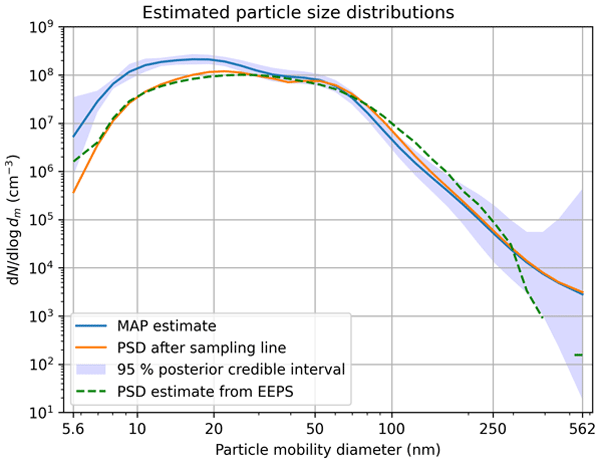
Matti Niskanen, Aku Seppänen, Henri Oikarinen, Miska Olin, Panu Karjalainen, Santtu Mikkonen, and Kari Lehtinen
Geosci. Model Dev., 18, 2983–3001, https://doi.org/10.5194/gmd-18-2983-2025, https://doi.org/10.5194/gmd-18-2983-2025, 2025
Short summary
Short summary
Particle size is a key factor determining the properties of aerosol particles which have a major influence on the climate and on human health. When measuring the particle sizes, however, sometimes the sampling lines that transfer the aerosol to the measurement device distort the size distribution, making the measurement unreliable. We propose a method to correct for the distortions and estimate the true particle sizes, improving measurement accuracy.
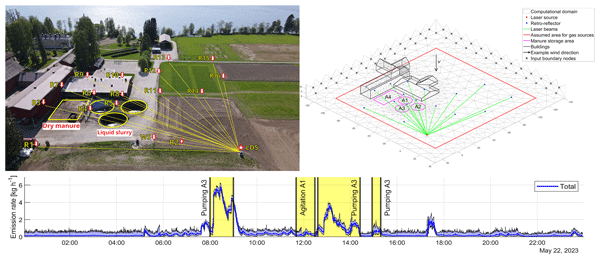
Kenneth Scheel, Elias Vänskä, Damien Weidmann, and Aku Ursin
Atmos. Meas. Tech., 19, 2343–2367, https://doi.org/10.5194/amt-19-2343-2026, https://doi.org/10.5194/amt-19-2343-2026, 2026
Short summary
Short summary
We present a laser-based tomographic approach for dynamically quantifying and mapping greenhouse gas emissions at facility scale. It was applied during a campaign at a research farm in Eastern Finland, where methane emissions from typical manure-handling events were monitored. The results show that incorporating prior information on source locations improves the tolerance of the flux estimates with respect to environmental disturbances.
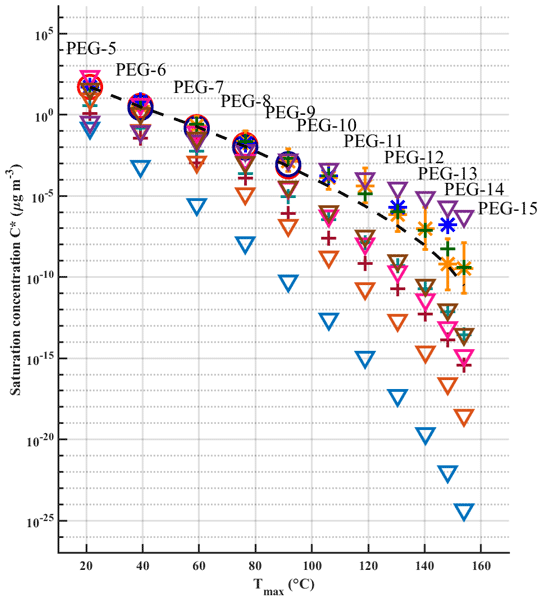
Arttu Ylisirniö, Noora Hyttinen, Zijun Li, Mitchell Alton, Aki Nissinen, Iida Pullinen, Pasi Miettinen, Taina Yli-Juuti, and Siegfried Schobesberger
Atmos. Meas. Tech., 18, 6449–6464, https://doi.org/10.5194/amt-18-6449-2025, https://doi.org/10.5194/amt-18-6449-2025, 2025
Short summary
Short summary
This study increases the knowledge of the low-volatility organic compounds observed in ambient aerosol particles by providing new volatility information about compounds used for calibrating volatility measurement instruments. Previously, such information was not available, and calibration of the instrument had to be extrapolated to cover the whole measurement range. Results of this study will provide the scientific community with better tools for investigating the complexity of ambient aerosols.
Matti Niskanen, Aku Seppänen, Henri Oikarinen, Miska Olin, Panu Karjalainen, Santtu Mikkonen, and Kari Lehtinen
Geosci. Model Dev., 18, 2983–3001, https://doi.org/10.5194/gmd-18-2983-2025, https://doi.org/10.5194/gmd-18-2983-2025, 2025
Short summary
Short summary
Particle size is a key factor determining the properties of aerosol particles which have a major influence on the climate and on human health. When measuring the particle sizes, however, sometimes the sampling lines that transfer the aerosol to the measurement device distort the size distribution, making the measurement unreliable. We propose a method to correct for the distortions and estimate the true particle sizes, improving measurement accuracy.
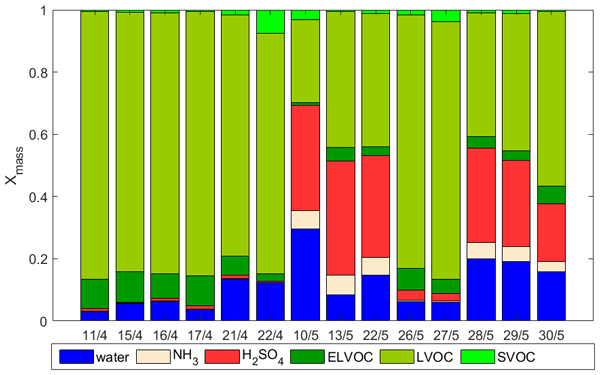
Arto Heitto, Cheng Wu, Diego Aliaga, Luis Blacutt, Xuemeng Chen, Yvette Gramlich, Liine Heikkinen, Wei Huang, Radovan Krejci, Paolo Laj, Isabel Moreno, Karine Sellegri, Fernando Velarde, Kay Weinhold, Alfred Wiedensohler, Qiaozhi Zha, Federico Bianchi, Marcos Andrade, Kari E. J. Lehtinen, Claudia Mohr, and Taina Yli-Juuti
Atmos. Chem. Phys., 24, 1315–1328, https://doi.org/10.5194/acp-24-1315-2024, https://doi.org/10.5194/acp-24-1315-2024, 2024
Short summary
Short summary
Particle growth at the Chacaltaya station in Bolivia was simulated based on measured vapor concentrations and ambient conditions. Major contributors to the simulated growth were low-volatility organic compounds (LVOCs). Also, sulfuric acid had major role when volcanic activity was occurring in the area. This study provides insight on nanoparticle growth at this high-altitude Southern Hemispheric site and hence contributes to building knowledge of early growth of atmospheric particles.
Markku Kulmala, Anna Lintunen, Hanna Lappalainen, Annele Virtanen, Chao Yan, Ekaterina Ezhova, Tuomo Nieminen, Ilona Riipinen, Risto Makkonen, Johanna Tamminen, Anu-Maija Sundström, Antti Arola, Armin Hansel, Kari Lehtinen, Timo Vesala, Tuukka Petäjä, Jaana Bäck, Tom Kokkonen, and Veli-Matti Kerminen
Atmos. Chem. Phys., 23, 14949–14971, https://doi.org/10.5194/acp-23-14949-2023, https://doi.org/10.5194/acp-23-14949-2023, 2023
Short summary
Short summary
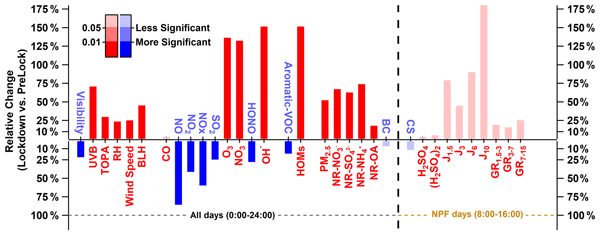
To be able to meet global grand challenges, we need comprehensive open data with proper metadata. In this opinion paper, we describe the SMEAR (Station for Measuring Earth surface – Atmosphere Relations) concept and include several examples (cases), such as new particle formation and growth, feedback loops and the effect of COVID-19, and what has been learned from these investigations. The future needs and the potential of comprehensive observations of the environment are summarized.
Tuuli Miinalainen, Harri Kokkola, Antti Lipponen, Antti-Pekka Hyvärinen, Vijay Kumar Soni, Kari E. J. Lehtinen, and Thomas Kühn
Atmos. Chem. Phys., 23, 3471–3491, https://doi.org/10.5194/acp-23-3471-2023, https://doi.org/10.5194/acp-23-3471-2023, 2023
Short summary
Short summary
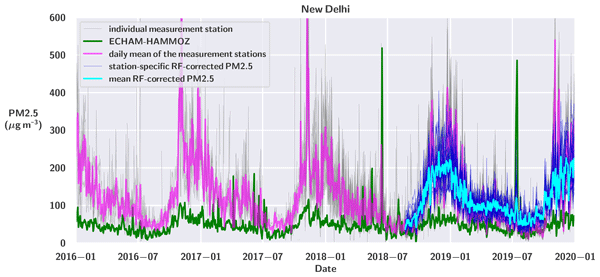
We simulated the effects of aerosol emission mitigation on both global and regional radiative forcing and city-level air quality with a global-scale climate model. We used a machine learning downscaling approach to bias-correct the PM2.5 values obtained from the global model for the Indian megacity New Delhi. Our results indicate that aerosol mitigation could result in both improved air quality and less radiative heating for India.
Zijun Li, Angela Buchholz, Luis M. F. Barreira, Arttu Ylisirniö, Liqing Hao, Iida Pullinen, Siegfried Schobesberger, and Annele Virtanen
Atmos. Chem. Phys., 23, 203–220, https://doi.org/10.5194/acp-23-203-2023, https://doi.org/10.5194/acp-23-203-2023, 2023
Short summary
Short summary
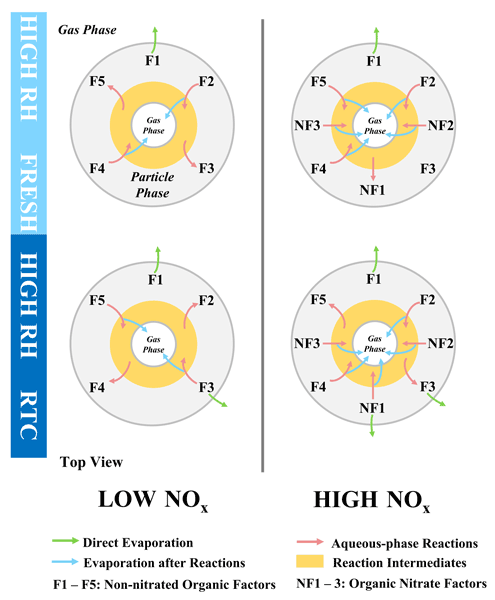
Interaction between NOx and biogenic emissions can be important in suburban areas. Our study showed that the addition of NOx during α-pinene SOA formation produced considerable amounts of organic nitrates and affected the composition of non-nitrated organic compounds. The compositional difference consequently altered the primary type of aqueous-phase processes during the isothermal particle evaporation.
Antti Lipponen, Jaakko Reinvall, Arttu Väisänen, Henri Taskinen, Timo Lähivaara, Larisa Sogacheva, Pekka Kolmonen, Kari Lehtinen, Antti Arola, and Ville Kolehmainen
Atmos. Meas. Tech., 15, 895–914, https://doi.org/10.5194/amt-15-895-2022, https://doi.org/10.5194/amt-15-895-2022, 2022
Short summary
Short summary
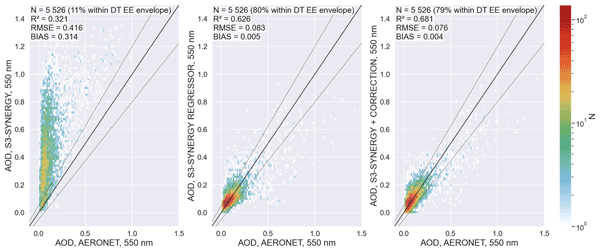
We have developed a machine-learning-based model that can be used to correct the Sentinel-3 satellite-based aerosol parameter data of the Synergy data product. The strength of the model is that the original satellite data processing does not have to be carried out again but the correction can be carried out with the data already available. We show that the correction significantly improves the accuracy of the satellite aerosol parameters.
Arto Heitto, Kari Lehtinen, Tuukka Petäjä, Felipe Lopez-Hilfiker, Joel A. Thornton, Markku Kulmala, and Taina Yli-Juuti
Atmos. Chem. Phys., 22, 155–171, https://doi.org/10.5194/acp-22-155-2022, https://doi.org/10.5194/acp-22-155-2022, 2022
Short summary
Short summary
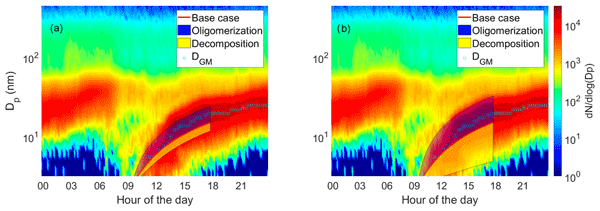
For atmospheric aerosol particles to take part in cloud formation, they need to be at least a few tens of nanometers in diameter. By using a particle condensation model, we investigated how two types of chemical reactions, oligomerization and decomposition, of organic molecules inside the particle may affect the growth of secondary aerosol particles to these sizes. We show that the effect is potentially significant, which highlights the importance of increasing understanding of these processes.
Zijun Li, Angela Buchholz, Arttu Ylisirniö, Luis Barreira, Liqing Hao, Siegfried Schobesberger, Taina Yli-Juuti, and Annele Virtanen
Atmos. Chem. Phys., 21, 18283–18302, https://doi.org/10.5194/acp-21-18283-2021, https://doi.org/10.5194/acp-21-18283-2021, 2021
Short summary
Short summary
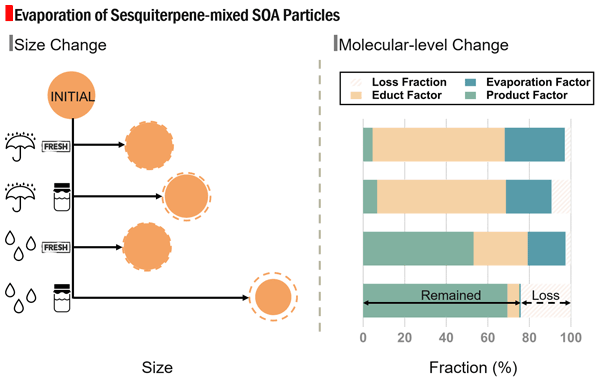
We compared the evolution of two types of secondary organic aerosol (SOA) particles during isothermal evaporation. The sesquiterpene SOA particles demonstrated higher resilience to evaporation than α-pinene SOA particles generated under comparable conditions. In-depth analysis showed that under high-relative-humidity conditions, particulate water drove the evolution of particulate constituents by reducing the particle viscosity and initiating chemical aqueous-phase processes.
Cited articles
Adachi, M., Okuyama, K., Kozuru, H., Kousaka, Y., and Pui, D. Y. H.: Bipolar Diffusion Charging of Aerosol Particles Under High Particle/Ion Concentration Ratios, Aerosol Sci. Tec., 11, 144–156, https://doi.org/10.1080/02786828908959307, 1989. a
Andrieu, C. and Thoms, J.: A tutorial on adaptive MCMC, Stat. Comput., 18, 343–373, https://doi.org/10.1007/s11222-008-9110-y, 2008. a
Bellouin, N., Quaas, J., Gryspeerdt, E., Kinne, S., Stier, P., Watson‐Parris, D., Boucher, O., Carslaw, K. S., Christensen, M., Daniau, A., Dufresne, J., Feingold, G., Fiedler, S., Forster, P., Gettelman, A., Haywood, J. M., Lohmann, U., Malavelle, F., Mauritsen, T., McCoy, D. T., Myhre, G., Mülmenstädt, J., Neubauer, D., Possner, A., Rugenstein, M., Sato, Y., Schulz, M., Schwartz, S. E., Sourdeval, O., Storelvmo, T., Toll, V., Winker, D., and Stevens, B.: Bounding Global Aerosol Radiative Forcing of Climate Change, Rev. Geophys., 58, https://doi.org/10.1029/2019rg000660, 2020. a
Berger, J. O., Liseo, B., and Wolpert, R. L.: Integrated likelihood methods for eliminating nuisance parameters, Stat. Sci., 14, https://doi.org/10.1214/ss/1009211804, 1999. a
Cai, R., Jiang, J., Mirme, S., and Kangasluoma, J.: Parameters governing the performance of electrical mobility spectrometers for measuring sub-3 nm particles, J. Aerosol Sci., 127, 102–115, https://doi.org/10.1016/j.jaerosci.2018.11.002, 2019. a
CEN/TS: Ambient air – Determination of the particle number size distribution of atmospheric aerosol using a Mobility Particle Size Spectrometer (MPSS), Technical Specification CEN/TS 17434:2020, Brussels, Belgium, 2020. a
Coquelin, L., Le Brusquet, L., Fischer, N., Gensdarmes, F., Motzkus, C., Mace, T., and Fleury, G.: Uncertainty propagation using the Monte Carlo method in the measurement of airborne particle size distribution with a scanning mobility particle sizer, Meas. Sci. Technol., 29, 055801, https://doi.org/10.1088/1361-6501/aaae87, 2018. a, b, c
Dal Maso, M., Kulmala, M., Riipinen, I., Wagner, R., Hussein, T., Aalto, P. P., and Lehtinen, K. E.: Formation and growth of fresh atmospheric aerosols: eight years of aerosol size distribution data from SMEAR II, Hyytiälä, Finland, Boreal Environ. Res., 10, 323–336, https://www.borenv.net/BER/archive/ber105.htm (last access: 25 October 2026), 2005. a
Davies, C. N.: Definitive equations for the fluid resistance of spheres, Proc. Phys. Soc., 57, 259–270, https://doi.org/10.1088/0959-5309/57/4/301, 1945. a
de La Verpilliere, J. L., Swanson, J. J., and Boies, A. M.: Unsteady bipolar diffusion charging in aerosol neutralisers: A non-dimensional approach to predict charge distribution equilibrium behaviour, J. Aerosol Sci., 86, 55–68, https://doi.org/10.1016/j.jaerosci.2015.03.006, 2015. a
Deng, C., Li, Y., Yan, C., Wu, J., Cai, R., Wang, D., Liu, Y., Kangasluoma, J., Kerminen, V.-M., Kulmala, M., and Jiang, J.: Measurement report: Size distributions of urban aerosols down to 1 nm from long-term measurements, Atmos. Chem. Phys., 22, 13569–13580, https://doi.org/10.5194/acp-22-13569-2022, 2022. a
Ehn, M., Junninen, H., Petäjä, T., Kurtén, T., Kerminen, V.-M., Schobesberger, S., Manninen, H. E., Ortega, I. K., Vehkamäki, H., Kulmala, M., and Worsnop, D. R.: Composition and temporal behavior of ambient ions in the boreal forest, Atmos. Chem. Phys., 10, 8513–8530, https://doi.org/10.5194/acp-10-8513-2010, 2010. a
Flagan, R. C.: Differential Mobility Analysis of Aerosols: A Tutorial, KONA Powder Part. J., 26, 254–268, https://doi.org/10.14356/kona.2008023, 2008. a, b
Fuchs, N. A.: On the stationary charge distribution on aerosol particles in a bipolar ionic atmosphere, Geofisica pura e applicata, 56, 185–193, https://doi.org/10.1007/bf01993343, 1963. a, b
Gatti, M. and Kortshagen, U.: Analytical model of particle charging in plasmas over a wide range of collisionality, Phys. Rev. E, 78, 046402, https://doi.org/10.1103/physreve.78.046402, 2008. a, b
Gelman, A., Stern, H. S., Carlin, J. B., Dunson, D. B., Vehtari, A., and Rubin, D. B.: Bayesian Data Analysis, Chapman and Hall/CRC, 3rd Edn., 1–349, https://doi.org/10.1201/b16018, 2013. a, b
Gopalakrishnan, R. and Hogan, C. J.: Coulomb-influenced collisions in aerosols and dusty plasmas, Phys. Rev. E, 85, 026410, https://doi.org/10.1103/physreve.85.026410, 2012. a
Gopalakrishnan, R., Meredith, M. J., Larriba-Andaluz, C., and Hogan, C. J.: Brownian dynamics determination of the bipolar steady state charge distribution on spheres and non-spheres in the transition regime, J. Aerosol Sci., 63, 126–145, https://doi.org/10.1016/j.jaerosci.2013.04.007, 2013. a, b, c
Gormley, P. and Kennedy, M.: Diffusion from a stream flowing through a cylindrical tube, P. Roy. Irish Acad. A, 52, 163–169, https://www.jstor.org/stable/20488498 (last access: 25 October 2026), 1949. a
Hinds, W. C.: Aerosol Technology Properties, Behavior, and Measurement of Airborne Particles, Wiley & Sons, Incorporated, John, 2nd Edn., ISBN 978-0471194101, 1999. a
Hoppel, W. A. and Frick, G. M.: Ion–Aerosol Attachment Coefficients and the Steady-State Charge Distribution on Aerosols in a Bipolar Ion Environment, Aerosol Sci. Technol., 5, 1–21, https://doi.org/10.1080/02786828608959073, 1986. a, b
Ibarra, I., Rodríguez-Maroto, J., and Alonso, M.: Bipolar charging and neutralization of particles below 10 nm, the conditions to reach the stationary charge distribution, and the effect of a non-stationary charge distribution on particle sizing, J. Aerosol Sci., 140, 105479, https://doi.org/10.1016/j.jaerosci.2019.105479, 2020. a
ISO 15900:2009(E): Determination of particle size distribution – Differential electrical mobility analysis for aerosol particles, Standard, Geneva, CH, https://www.iso.org/standard/39573.html (last access: 25 October 2026), 2009. a
Jacob, P. E., Murray, L. M., Holmes, C. C., and Robert, C. P.: Better together? Statistical learning in models made of modules, arXiv [preprint], https://doi.org/10.48550/ARXIV.1708.08719, 2017. a
Kahn, R. A., Andrews, E., Brock, C. A., Chin, M., Feingold, G., Gettelman, A., Levy, R. C., Murphy, D. M., Nenes, A., Pierce, J. R., Popp, T., Redemann, J., Sayer, A. M., da Silva, A. M., Sogacheva, L., and Stier, P.: Reducing Aerosol Forcing Uncertainty by Combining Models With Satellite and Within‐The‐Atmosphere Observations: A Three‐Way Street, Rev. Geophys., 61, https://doi.org/10.1029/2022rg000796, 2023. a
Kaipio, J. and Somersalo, E.: Statistical and Computational Inverse Problems, vol. 160 of Applied Mathematical Sciences, Springer-Verlag GmbH, ISBN 978-0-387-27132-3, https://doi.org/10.1007/b138659, 2005. a, b, c
Kaipio, J. and Somersalo, E.: Statistical inverse problems: Discretization, model reduction and inverse crimes, J. Comput. Appl. Math., 198, 493–504, https://doi.org/10.1016/j.cam.2005.09.027, 2007. a
Kaipio, J. P. and Kolehmainen, V.: Approximate marginalization over modeling errors and uncertainties in inverse problems, in: Bayesian Theory and Applications, edited by: Damien, P., Dellaportas, P., Polson, N. G., and Stephens, D. A., pp. 644–672, Oxford University Press, Oxford, UK, ISBN 9780191744167, https://doi.org/10.1093/acprof:oso/9780199695607.003.0032, 2013. a
Kangasluoma, J. and Kontkanen, J.: On the sources of uncertainty in the sub-3 nm particle concentration measurement, J. Aerosol Sci., 112, 34–51, https://doi.org/10.1016/j.jaerosci.2017.07.002, 2017. a, b
Kangasluoma, J., Cai, R., Jiang, J., Deng, C., Stolzenburg, D., Ahonen, L. R., Chan, T., Fu, Y., Kim, C., Laurila, T. M., Zhou, Y., Dada, L., Sulo, J., Flagan, R. C., Kulmala, M., Petäjä, T., and Lehtipalo, K.: Overview of measurements and current instrumentation for 1–10 nm aerosol particle number size distributions, J. Aerosol Sci.e, 148, 105584, https://doi.org/10.1016/j.jaerosci.2020.105584, 2020. a
Karlsson, M. N. and Martinsson, B. G.: Methods to measure and predict the transfer function size dependence of individual DMAs, J. Aerosol Sci., 34, 603–625, https://doi.org/10.1016/s0021-8502(03)00020-x, 2003. a
Kilpatrick, W.: An experimental mass-mobility relation for ions in air at atmospheric pressure, in: Proc. Annu. Conf. Massspectrosc, vol. 19, 320–325, 1971. a
Knutson, E. and Whitby, K.: Aerosol classification by electric mobility: apparatus, theory, and applications, J. Aerosol Sci., 6, 443–451, https://doi.org/10.1016/0021-8502(75)90060-9, 1975. a
Larriba, C. and Hogan, C. J.: Ion Mobilities in Diatomic Gases: Measurement versus Prediction with Non-Specular Scattering Models, J. Phys. Chem. A, 117, 3887–3901, https://doi.org/10.1021/jp312432z, 2013. a
Lee, H. M., Kim, C. S., Shimada, M., and Okuyama, K.: Effects of Mobility Changes and Distribution of Bipolar Ions on Aerosol Nanoparticle Diffusion Charging, J. Chem. Eng. Jpn., 38, 486–496, https://doi.org/10.1252/jcej.38.486, 2005. a
Leppä, J., Mui, W., Grantz, A. M., and Flagan, R. C.: Charge distribution uncertainty in differential mobility analysis of aerosols, Aerosol Sci. Tech., 51, 1168–1189, https://doi.org/10.1080/02786826.2017.1341039, 2017. a, b, c, d
Li, L., Chahl, H. S., and Gopalakrishnan, R.: Comparison of the predictions of Langevin Dynamics-based diffusion charging collision kernel models with canonical experiments, J. Aerosol Sci., 140, 105481, https://doi.org/10.1016/j.jaerosci.2019.105481, 2020. a
Lieberman, C., Willcox, K., and Ghattas, O.: Parameter and State Model Reduction for Large-Scale Statistical Inverse Problems, SIAM J. Sci. Comput., 32, 2523–2542, https://doi.org/10.1137/090775622, 2010. a
Little, R. J. A.: Regression With Missing X’s: A Review, J. Am. Stat. Assoc., 87, 1227, https://doi.org/10.2307/2290664, 1992. a
Liu, F., Bayarri, M. J., and Berger, J. O.: Modularization in Bayesian analysis, with emphasis on analysis of computer models, Bayesian Anal., 4, https://doi.org/10.1214/09-ba404, 2009. a
Lòpez-Yglesias, X. and Flagan, R. C.: Population Balances of Micron-Sized Aerosols in a Bipolar Ion Environment, Aerosol Sci. Tech., 47, 681–687, https://doi.org/10.1080/02786826.2013.783683, 2013. a
MacKay, D. J. C.: Information theory, inference and learning algorithms, chap. 27, Cambridge University PRESS, https://www.inference.org.uk/mackay/itprnn/ps/ (last access: 25 October 2026), 2003. a
Mäkelä, J. M., Jokinen, V., Mattila, T., Ukkonen, A., and Keskinen, J.: Mobility distribution of acetone cluster ions, J. Aerosol Sci., 27, 175–190, https://doi.org/10.1016/0021-8502(95)00560-9, 1996. a, b
Maißer, A., Thomas, J. M., Larriba-Andaluz, C., He, S., and Hogan, C. J.: The mass–mobility distributions of ions produced by a Po-210 source in air, J. Aerosol Sci., 90, 36–50, https://doi.org/10.1016/j.jaerosci.2015.08.004, 2015. a
Manisalidis, I., Stavropoulou, E., Stavropoulos, A., and Bezirtzoglou, E.: Environmental and Health Impacts of Air Pollution: A Review, Front. Publ. Health, 8, https://doi.org/10.3389/fpubh.2020.00014, 2020. a
Nishida, R. T., Johnson, T. J., and Olfert, J. S.: On the three charge regimes of bipolar charge conditioners, Aerosol Sci. Tech., 59, 499–520, https://doi.org/10.1080/02786826.2025.2461161, 2025. a
Niskanen, M.: MPSS-UQ v.1.0, Zenodo [code and data set], https://doi.org/10.5281/zenodo.19458251, 2026. a, b, c
Ozon, M., Stolzenburg, D., Dada, L., Seppänen, A., and Lehtinen, K. E. J.: Aerosol formation and growth rates from chamber experiments using Kalman smoothing, Atmos. Chem. Phys., 21, 12595–12611, https://doi.org/10.5194/acp-21-12595-2021, 2021. a
Pfeifer, J., Mahfouz, N. G. A., Schulze, B. C., Mathot, S., Stolzenburg, D., Baalbaki, R., Brasseur, Z., Caudillo, L., Dada, L., Granzin, M., He, X.-C., Lamkaddam, H., Lopez, B., Makhmutov, V., Marten, R., Mentler, B., Müller, T., Onnela, A., Philippov, M., Piedehierro, A. A., Rörup, B., Schervish, M., Tian, P., Umo, N. S., Wang, D. S., Wang, M., Weber, S. K., Welti, A., Wu, Y., Zauner-Wieczorek, M., Amorim, A., El Haddad, I., Kulmala, M., Lehtipalo, K., Petäjä, T., Tomé, A., Mirme, S., Manninen, H. E., Donahue, N. M., Flagan, R. C., Kürten, A., Curtius, J., and Kirkby, J.: Measurement of the collision rate coefficients between atmospheric ions and multiply charged aerosol particles in the CERN CLOUD chamber, Atmos. Chem. Phys., 23, 6703–6718, https://doi.org/10.5194/acp-23-6703-2023, 2023. a
Plummer, M.: Cuts in Bayesian graphical models, Stat. Comput., 25, 37–43, https://doi.org/10.1007/s11222-014-9503-z, 2014. a
Portin, H., Leskinen, A., Hao, L., Kortelainen, A., Miettinen, P., Jaatinen, A., Laaksonen, A., Lehtinen, K. E. J., Romakkaniemi, S., and Komppula, M.: The effect of local sources on particle size and chemical composition and their role in aerosol–cloud interactions at Puijo measurement station, Atmos. Chem. Phys., 14, 6021–6034, https://doi.org/10.5194/acp-14-6021-2014, 2014. a
Ramachandran, G. and Kandlikar, M.: Bayesian analysis for inversion of aerosol size distribution data, J. Aerosol Sci., 27, 1099–1112, https://doi.org/10.1016/0021-8502(96)00005-5, 1996. a
Reischl, G., Mäkelä, J., Karch, R., and Necid, J.: Bipolar charging of ultrafine particles in the size range below 10 nm, J. Aerosol Sci., 27, 931–949, https://doi.org/10.1016/0021-8502(96)00026-2, 1996. a
Schmidt-Ott, F., Maisser, A., and Biskos, G.: Mass and Mobility of Ions Produced by Radioactive Sources and Corona Discharges, Anal. Chem., 96, 14405–14412, https://doi.org/10.1021/acs.analchem.4c01796, 2024. a, b
Seinfeld, J. H. and Pandis, S. N.: Atmospheric Chemistry and Physics: From Air Pollution to Climate Change, John Wiley & Sons, 3rd Edn., ISBN 1118947401, https://www.wiley.com/en-us/shop/general-chemistry/atmospheric-chemistry-and-physics-from-air-pollution-to-climate-change-3rd-edition-p-9781118947401 (last access: 7 November 2026), 2016. a, b, c, d
Shiraiwa, M., Ueda, K., Pozzer, A., Lammel, G., Kampf, C. J., Fushimi, A., Enami, S., Arangio, A. M., Fröhlich-Nowoisky, J., Fujitani, Y., Furuyama, A., Lakey, P. S. J., Lelieveld, J., Lucas, K., Morino, Y., Pöschl, U., Takahama, S., Takami, A., Tong, H., Weber, B., Yoshino, A., and Sato, K.: Aerosol Health Effects from Molecular to Global Scales, Environ. Sci. Technol., 51, 13545–13567, https://doi.org/10.1021/acs.est.7b04417, 2017. a
Sipkens, T. A., Boies, A., Corbin, J. C., Chakrabarty, R. K., Olfert, J., and Rogak, S. N.: Overview of methods to characterize the mass, size, and morphology of soot, J. Aerosol Sci., 173, 106211, https://doi.org/10.1016/j.jaerosci.2023.106211, 2023. a
Sorooshian, A., Alexandrov, M. D., Bell, A. D., Bennett, R., Betito, G., Burton, S. P., Buzanowicz, M. E., Cairns, B., Chemyakin, E. V., Chen, G., Choi, Y., Collister, B. L., Cook, A. L., Corral, A. F., Crosbie, E. C., van Diedenhoven, B., DiGangi, J. P., Diskin, G. S., Dmitrovic, S., Edwards, E.-L., Fenn, M. A., Ferrare, R. A., van Gilst, D., Hair, J. W., Harper, D. B., Hilario, M. R. A., Hostetler, C. A., Jester, N., Jones, M., Kirschler, S., Kleb, M. M., Kusterer, J. M., Leavor, S., Lee, J. W., Liu, H., McCauley, K., Moore, R. H., Nied, J., Notari, A., Nowak, J. B., Painemal, D., Phillips, K. E., Robinson, C. E., Scarino, A. J., Schlosser, J. S., Seaman, S. T., Seethala, C., Shingler, T. J., Shook, M. A., Sinclair, K. A., Smith Jr., W. L., Spangenberg, D. A., Stamnes, S. A., Thornhill, K. L., Voigt, C., Vömel, H., Wasilewski, A. P., Wang, H., Winstead, E. L., Zeider, K., Zeng, X., Zhang, B., Ziemba, L. D., and Zuidema, P.: Spatially coordinated airborne data and complementary products for aerosol, gas, cloud, and meteorological studies: the NASA ACTIVATE dataset, Earth Syst. Sci. Data, 15, 3419–3472, https://doi.org/10.5194/essd-15-3419-2023, 2023. a
Stolzenburg, M. R.: An ultrafine aerosol size distribution measuring system, University of Minnesota, 1988. a
Świrniak, G. and Mroczka, J.: Forward and inverse analysis for particle size distribution measurements of disperse samples: A review, Measurement, 187, 110256, https://doi.org/10.1016/j.measurement.2021.110256, 2022. a
TSI: Scanning Mobility Particle Sizer (SMPS) spectrometer model 3938 operation and service manual, TSI Incorporated, 500 Cardigan Road / Shoreview, MN 55126 / USA, C Edn., p/N 6006760, https://tsi.com/products/particle-sizers/scanning-mobility-particle-sizer-spectrometers/general-scanning-mobility-particle-sizer-smps-3938 (last access: 7 November 2026), 2016. a
Väänänen, R., Kyrö, E.-M., Nieminen, T., Kivekäs, N., Junninen, H., Virkkula, A., Dal Maso, M., Lihavainen, H., Viisanen, Y., Svenningsson, B., Holst, T., Arneth, A., Aalto, P. P., Kulmala, M., and Kerminen, V.-M.: Analysis of particle size distribution changes between three measurement sites in northern Scandinavia, Atmos. Chem. Phys., 13, 11887–11903, https://doi.org/10.5194/acp-13-11887-2013, 2013. a
Vasilatou, K., Iida, K., Kazemimanesh, M., Olfert, J., Sakurai, H., Sipkens, T. A., and Smallwood, G. J.: Aerosol physical characterization: A review on the current state of aerosol documentary standards and calibration strategies, J. Aerosol Sci., 183, 106483, https://doi.org/10.1016/j.jaerosci.2024.106483, 2025. a
Viskari, T., Asmi, E., Kolmonen, P., Vuollekoski, H., Petäjä, T., and Järvinen, H.: Estimation of aerosol particle number distributions with Kalman Filtering – Part 1: Theory, general aspects and statistical validity, Atmos. Chem. Phys., 12, 11767–11779, https://doi.org/10.5194/acp-12-11767-2012, 2012. a
Voutilainen, A. and Kaipio, J.: Estimation of non-stationary aerosol size distributions using the state-space approach, J. Aerosol Sci., 32, 631–648, https://doi.org/10.1016/s0021-8502(00)00110-5, 2001. a, b
Voutilainen, A., Kolehmainen, V., and Kaipio, J. P.: Statistical inversion of aerosol size measurement data, Inverse Probl. Eng., 9, 67–94, https://doi.org/10.1080/174159701088027753, 2001. a
Wang, S. C. and Flagan, R. C.: Scanning Electrical Mobility Spectrometer, Aerosol Sci. Technol., 13, 230–240, https://doi.org/10.1080/02786829008959441, 1990. a
Wiedensohler, A.: An approximation of the bipolar charge distribution for particles in the submicron size range, J. Aerosol Sci., 19, 387–389, https://doi.org/10.1016/0021-8502(88)90278-9, 1988. a, b, c
Wiedensohler, A., Birmili, W., Nowak, A., Sonntag, A., Weinhold, K., Merkel, M., Wehner, B., Tuch, T., Pfeifer, S., Fiebig, M., Fjäraa, A. M., Asmi, E., Sellegri, K., Depuy, R., Venzac, H., Villani, P., Laj, P., Aalto, P., Ogren, J. A., Swietlicki, E., Williams, P., Roldin, P., Quincey, P., Hüglin, C., Fierz-Schmidhauser, R., Gysel, M., Weingartner, E., Riccobono, F., Santos, S., Grüning, C., Faloon, K., Beddows, D., Harrison, R., Monahan, C., Jennings, S. G., O'Dowd, C. D., Marinoni, A., Horn, H.-G., Keck, L., Jiang, J., Scheckman, J., McMurry, P. H., Deng, Z., Zhao, C. S., Moerman, M., Henzing, B., de Leeuw, G., Löschau, G., and Bastian, S.: Mobility particle size spectrometers: harmonization of technical standards and data structure to facilitate high quality long-term observations of atmospheric particle number size distributions, Atmos. Meas. Tech., 5, 657–685, https://doi.org/10.5194/amt-5-657-2012, 2012. a
Wiedensohler, A., Wiesner, A., Weinhold, K., Birmili, W., Hermann, M., Merkel, M., Müller, T., Pfeifer, S., Schmidt, A., Tuch, T., Velarde, F., Quincey, P., Seeger, S., and Nowak, A.: Mobility particle size spectrometers: Calibration procedures and measurement uncertainties, Aerosol Sci. Tech., 52, 146–164, https://doi.org/10.1080/02786826.2017.1387229, 2017. a, b, c
Zhang, R., Li, Y., Zhao, J., Aridjis-Olivos, B., Zhao, L., Kowalewski, V., Kabir, M., Johnson, N. M., Nielsen, E. R., Brooks, S. D., Zhang, Y., Vedlitz, A., Porter, W., North, S. W., Li, W., Young, M. W., Seinfeld, J. H., Wang, Y., and Wang, Y.: Detecting supramolecular organic nanoparticles during heat wave, Science, 391, https://doi.org/10.1126/science.ady5192, 2026. a
Short summary
Measuring tiny airborne particles by their movement in an electric field is common in atmospheric science, but the results almost never include uncertainty estimates. The largest source of uncertainty in these measurements relates to particle charging. We developed a Bayesian method to systematically quantify this uncertainty. Applied to a month of atmospheric data, accounting for charging uncertainty widened the plausible range of particle concentrations by a factor of two to ten.
Measuring tiny airborne particles by their movement in an electric field is common in...


Altmetrics
Final-revised paper
Preprint