
Articles | Volume 19, issue 3
https://doi.org/10.5194/gmd-19-1055-2026
© Author(s) 2026. This work is distributed under
the Creative Commons Attribution 4.0 License.
the Creative Commons Attribution 4.0 License.
https://doi.org/10.5194/gmd-19-1055-2026
© Author(s) 2026. This work is distributed under
the Creative Commons Attribution 4.0 License.
the Creative Commons Attribution 4.0 License.
Development and technical paper
| 
02 Feb 2026
Development and technical paper |
| 02 Feb 2026
| 02 Feb 2026
A hybrid physics–AI approach using universal differential equations with state-dependent neural networks for learnable, regionalizable, spatially distributed hydrological modeling
Ngo Nghi Truyen Huynh
CORRESPONDING AUTHOR
INRAE RECOVER, Aix-Marseille Université, 3275 Route Cézanne, 13182 Aix-en-Provence, France
Pierre-André Garambois
CORRESPONDING AUTHOR
INRAE RECOVER, Aix-Marseille Université, 3275 Route Cézanne, 13182 Aix-en-Provence, France
François Colleoni
INRAE RECOVER, Aix-Marseille Université, 3275 Route Cézanne, 13182 Aix-en-Provence, France
Jérôme Monnier
INSA, Institut de Mathématiques de Toulouse (IMT), Université de Toulouse, 31400 Toulouse, France
Related authors
Mohamed Amine Berkaoui, Mohamed Saadi, François Colleoni, Ngo Nghi Truyen Huynh, Ahmad Akhtari, Kevin Larnier, Hélène Roux, and Pierre-André Garambois
EGUsphere, https://doi.org/10.5194/egusphere-2026-1557, https://doi.org/10.5194/egusphere-2026-1557, 2026
Short summary
Short summary
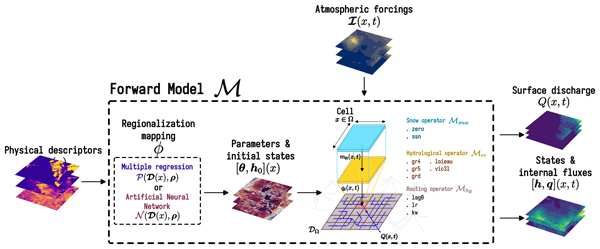
We present an integrated hydrological–hydraulic (H&H) modeling framework that combines grid-based hydrology with vector-based river routing, leveraging sub-grid information derived from high-resolution topography. This approach improves the representation of river networks and drainage areas across spatial resolutions, reducing errors and spatial distortions associated with regular grid discretization, and leading to more stable streamflow simulations across scales.
François Colleoni, Ngo Nghi Truyen Huynh, Pierre-André Garambois, Maxime Jay-Allemand, Didier Organde, Benjamin Renard, Thomas De Fournas, Apolline El Baz, Julie Demargne, and Pierre Javelle
Geosci. Model Dev., 18, 7003–7034, https://doi.org/10.5194/gmd-18-7003-2025, https://doi.org/10.5194/gmd-18-7003-2025, 2025
Short summary
Short summary
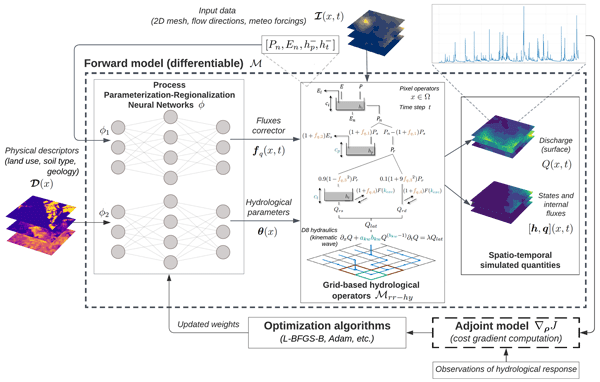
We present smash, an open-source framework for high-resolution hydrological modeling and data assimilation. It combines process-based models with neural networks for regionalization, enabling accurate simulations from the catchment scale to the country scale. With an efficient, differentiable solver, smash supports large-scale calibration and parallel computing. Tested on open datasets, it shows strong performance in river flow prediction, making it a valuable tool for research and operational use.
Ngo Nghi Truyen Huynh, Pierre-André Garambois, Benjamin Renard, François Colleoni, Jérôme Monnier, and Hélène Roux
Hydrol. Earth Syst. Sci., 29, 3589–3613, https://doi.org/10.5194/hess-29-3589-2025, https://doi.org/10.5194/hess-29-3589-2025, 2025
Short summary
Short summary
Understanding and modeling flash-flood-prone areas remains challenging due to limited data and scale-relevant hydrological theory. While machine learning shows promise, its integration with process-based models is difficult. We present an approach incorporating machine learning into a high-resolution hydrological model to correct internal fluxes and transfer parameters between watersheds. Results show improved accuracy, advancing the development of learnable and interpretable process-based models.
Mohamed Amine Berkaoui, Mohamed Saadi, François Colleoni, Ngo Nghi Truyen Huynh, Ahmad Akhtari, Kevin Larnier, Hélène Roux, and Pierre-André Garambois
EGUsphere, https://doi.org/10.5194/egusphere-2026-1557, https://doi.org/10.5194/egusphere-2026-1557, 2026
Short summary
Short summary
We present an integrated hydrological–hydraulic (H&H) modeling framework that combines grid-based hydrology with vector-based river routing, leveraging sub-grid information derived from high-resolution topography. This approach improves the representation of river networks and drainage areas across spatial resolutions, reducing errors and spatial distortions associated with regular grid discretization, and leading to more stable streamflow simulations across scales.
Guillaume Evin, Benoit Hingray, Guillaume Thirel, Agnès Ducharne, Laurent Strohmenger, Lola Corre, Yves Tramblay, Jean-Philippe Vidal, Jérémie Bonneau, François Colleoni, Joël Gailhard, Florence Habets, Frédéric Hendrickx, Louis Héraut, Peng Huang, Matthieu Le Lay, Claire Magand, Paola Marson, Céline Monteil, Simon Munier, Alix Reverdy, Jean-Michel Soubeyroux, Yoann Robin, Jean-Pierre Vergnes, Mathieu Vrac, and Eric Sauquet
Hydrol. Earth Syst. Sci., 30, 1023–1051, https://doi.org/10.5194/hess-30-1023-2026, https://doi.org/10.5194/hess-30-1023-2026, 2026
Short summary
Short summary
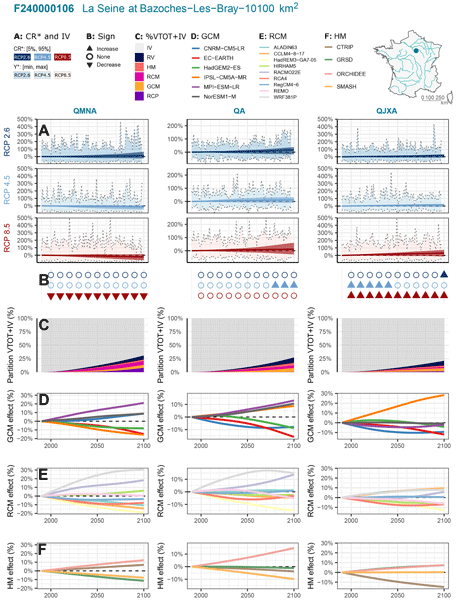
Explore2 provides hydrological projections for 1,735 French catchments. Using QUALYPSO (Quasi-Ergodic Analysis of Climate Projections Using Data Augmentation), this study assesses uncertainties, including internal variability. By the end of the century, low flows are projected to decline in southern France under high emissions, while other indicators remain uncertain. Emission scenarios and regional climate models are key uncertainty sources. Internal variability is often as large as climate-driven changes.
Frédéric Pons, Nabil Hocini, and Pierre-André Garambois
EGUsphere, https://doi.org/10.5194/egusphere-2025-3333, https://doi.org/10.5194/egusphere-2025-3333, 2026
This preprint is open for discussion and under review for Geoscientific Model Development (GMD).
Short summary
Short summary
Cartino 2D (C2D) enables large-scale, automated flood modeling using reference 2D complete hydraulic model Telemac2D adapted for hydrology. It features topography-aware unstructured meshing, spatial parameterization, and supports rainfall or discharge forcing. Applied across France and at high resolution in cities, it shows strong scalability and consistency, opening new paths for local to national flood risk assessment.
François Colleoni, Ngo Nghi Truyen Huynh, Pierre-André Garambois, Maxime Jay-Allemand, Didier Organde, Benjamin Renard, Thomas De Fournas, Apolline El Baz, Julie Demargne, and Pierre Javelle
Geosci. Model Dev., 18, 7003–7034, https://doi.org/10.5194/gmd-18-7003-2025, https://doi.org/10.5194/gmd-18-7003-2025, 2025
Short summary
Short summary
We present smash, an open-source framework for high-resolution hydrological modeling and data assimilation. It combines process-based models with neural networks for regionalization, enabling accurate simulations from the catchment scale to the country scale. With an efficient, differentiable solver, smash supports large-scale calibration and parallel computing. Tested on open datasets, it shows strong performance in river flow prediction, making it a valuable tool for research and operational use.
Ngo Nghi Truyen Huynh, Pierre-André Garambois, Benjamin Renard, François Colleoni, Jérôme Monnier, and Hélène Roux
Hydrol. Earth Syst. Sci., 29, 3589–3613, https://doi.org/10.5194/hess-29-3589-2025, https://doi.org/10.5194/hess-29-3589-2025, 2025
Short summary
Short summary
Understanding and modeling flash-flood-prone areas remains challenging due to limited data and scale-relevant hydrological theory. While machine learning shows promise, its integration with process-based models is difficult. We present an approach incorporating machine learning into a high-resolution hydrological model to correct internal fluxes and transfer parameters between watersheds. Results show improved accuracy, advancing the development of learnable and interpretable process-based models.
Juliette Godet, Pierre Nicolle, Nabil Hocini, Eric Gaume, Philippe Davy, Frederic Pons, Pierre Javelle, Pierre-André Garambois, Dimitri Lague, and Olivier Payrastre
Earth Syst. Sci. Data, 17, 2963–2983, https://doi.org/10.5194/essd-17-2963-2025, https://doi.org/10.5194/essd-17-2963-2025, 2025
Short summary
Short summary
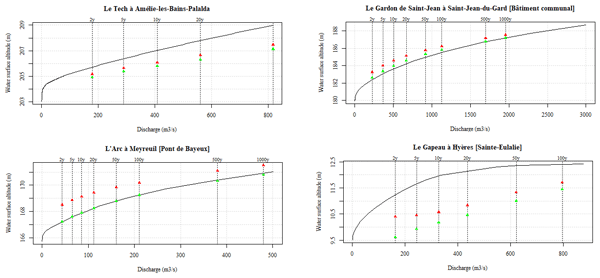
This paper describes a dataset that includes input, output, and validation data for the simulation of flash flood hazards and three specific flash flood events in the French Mediterranean region. This dataset is particularly valuable as flood mapping methods often lack sufficient benchmark data. Additionally, we demonstrate how the hydraulic method we used, named Floodos, produces highly satisfactory results.
Maxime Jay-Allemand, Julie Demargne, Pierre-André Garambois, Pierre Javelle, Igor Gejadze, François Colleoni, Didier Organde, Patrick Arnaud, and Catherine Fouchier
Proc. IAHS, 385, 281–290, https://doi.org/10.5194/piahs-385-281-2024, https://doi.org/10.5194/piahs-385-281-2024, 2024
Short summary
Short summary
This work targets the improvement of a hydrologic model used for flash flood warnings. A gridded model is used to spatially describe the hydrological processes. We develop a method to estimate the best model setup based on scarce river flow observations. It uses a complex algorithm combined with geographical descriptors to generate gridded parameters that better capture catchment characteristics. Results are promising, improving the discharge estimations where no observations are available.
Guillaume Evin, Matthieu Le Lay, Catherine Fouchier, David Penot, Francois Colleoni, Alexandre Mas, Pierre-André Garambois, and Olivier Laurantin
Hydrol. Earth Syst. Sci., 28, 261–281, https://doi.org/10.5194/hess-28-261-2024, https://doi.org/10.5194/hess-28-261-2024, 2024
Short summary
Short summary
Hydrological modelling of mountainous catchments is challenging for many reasons, the main one being the temporal and spatial representation of precipitation forcings. This study presents an evaluation of the hydrological modelling of 55 small mountainous catchments of the northern French Alps, focusing on the influence of the type of precipitation reanalyses used as inputs. These evaluations emphasize the added value of radar measurements, in particular for the reproduction of flood events.
Reyhaneh Hashemi, Pierre Brigode, Pierre-André Garambois, and Pierre Javelle
Hydrol. Earth Syst. Sci., 26, 5793–5816, https://doi.org/10.5194/hess-26-5793-2022, https://doi.org/10.5194/hess-26-5793-2022, 2022
Short summary
Short summary
Hydrologists have long dreamed of a tool that could adequately predict runoff in catchments. Data-driven long short-term memory (LSTM) models appear very promising to the hydrology community in this respect. Here, we have sought to benefit from traditional practices in hydrology to improve the effectiveness of LSTM models. We discovered that one LSTM parameter has a hydrologic interpretation and that there is a need to increase the data and to tune two parameters, thereby improving predictions.
Léo Pujol, Pierre-André Garambois, and Jérôme Monnier
Geosci. Model Dev., 15, 6085–6113, https://doi.org/10.5194/gmd-15-6085-2022, https://doi.org/10.5194/gmd-15-6085-2022, 2022
Short summary
Short summary
This contribution presents a new numerical model for representing hydraulic–hydrological quantities at the basin scale. It allows modeling large areas at a low computational cost, with fine zooms where needed. It allows the integration of local and satellite measurements, via data assimilation methods, to improve the model's match to observations. Using this capability, good matches to in situ observations are obtained on a model of the complex Adour river network with fine zooms on floodplains.
François Colleoni, Pierre-André Garambois, Pierre Javelle, Maxime Jay-Allemand, and Patrick Arnaud
EGUsphere, https://doi.org/10.5194/egusphere-2022-506, https://doi.org/10.5194/egusphere-2022-506, 2022
Preprint archived
Short summary
Short summary
This contribution presents the first evaluation of Variational Data Assimilation successfully applied over a large sample to the spatially distributed calibration of a newly taylored grid-based parsimonious model structure and corresponding adjoint. High performances are obtained in spatio-temporal validation and at flood time scales, especially for mediterranenan and oceanic catchments. Regional sensitivity analysis revealed the importance of the non conservative and production components.
Abubakar Haruna, Pierre-Andre Garambois, Helene Roux, Pierre Javelle, and Maxime Jay-Allemand
Hydrol. Earth Syst. Sci. Discuss., https://doi.org/10.5194/hess-2021-414, https://doi.org/10.5194/hess-2021-414, 2021
Manuscript not accepted for further review
Short summary
Short summary
We compared three hydrological models in a flash flood modelling framework. We first identified the sensitive parameters of each model, then compared their performances in terms of outlet discharge and soil moisture simulation. We found out that resulting from the differences in their complexities/process representation, performance depends on the aspect/measure used. The study then highlights and proposed some future investigations/modifications to improve the models.
Cited articles
Beven, K.: Towards an alternative blueprint for a physically based digitally simulated hydrologic response modelling system, Hydrological Processes, 16, 189–206, https://doi.org/10.1002/hyp.343, 2002. a
Beven, K.: How to make advances in hydrological modelling, Hydrology Research, 50, 1481–1494, https://doi.org/10.2166/nh.2019.134, 2019. a, b
Beven, K.: Deep learning, hydrological processes and the uniqueness of place, Hydrological Processes, 34, 3608–3613, https://doi.org/10.1002/hyp.13805, 2020. a, b
Castaings, W., Dartus, D., Le Dimet, F.-X., and Saulnier, G.-M.: Sensitivity analysis and parameter estimation for distributed hydrological modeling: potential of variational methods, Hydrol. Earth Syst. Sci., 13, 503–517, https://doi.org/10.5194/hess-13-503-2009, 2009. a
Cho, K. and Kim, Y.: Improving streamflow prediction in the WRF-Hydro model with LSTM networks, Journal of Hydrology, 605, 127297, https://doi.org/10.1016/j.jhydrol.2021.127297, 2022. a
Clark, M. P. and Kavetski, D.: Ancient numerical daemons of conceptual hydrological modeling: 1. Fidelity and efficiency of time stepping schemes, Water Resources Research, 46, https://doi.org/10.1029/2009WR008894, 2010. a
Clark, M. P., Bierkens, M. F. P., Samaniego, L., Woods, R. A., Uijlenhoet, R., Bennett, K. E., Pauwels, V. R. N., Cai, X., Wood, A. W., and Peters-Lidard, C. D.: The evolution of process-based hydrologic models: historical challenges and the collective quest for physical realism, Hydrol. Earth Syst. Sci., 21, 3427–3440, https://doi.org/10.5194/hess-21-3427-2017, 2017. a
Colleoni, F., Huynh, N. N. T., Garambois, P.-A., Jay-Allemand, M., Organde, D., Renard, B., De Fournas, T., El Baz, A., Demargne, J., and Javelle, P.:
smash v1.0: a differentiable and regionalizable high-resolution hydrological modeling and data assimilation framework, Geosci. Model Dev., 18, 7003–7034, https://doi.org/10.5194/gmd-18-7003-2025, 2025. a, b, c
Ettalbi, M., Garambois, P.-A., Huynh, N. N. T., Arnaud, P., Ferreira, E., and Baghdadi, N.: Improving parameter regionalization learning for spatialized differentiable hydrological models by assimilation of satellite-based soil moisture data, Journal of Hydrology, 660, 133300, https://doi.org/10.1016/j.jhydrol.2025.133300, 2025. a
Feng, D., Fang, K., and Shen, C.: Enhancing Streamflow Forecast and Extracting Insights Using Long-Short Term Memory Networks With Data Integration at Continental Scales, Water Resources Research, 56, e2019WR026793, https://doi.org/10.1029/2019WR026793, 2020. a
Feng, D., Liu, J., Lawson, K., and Shen, C.: Differentiable, Learnable, Regionalized Process-Based Models With Multiphysical Outputs can Approach State-Of-The-Art Hydrologic Prediction Accuracy, Water Resources Research, 58, e2022WR032404, https://doi.org/10.1029/2022WR032404, 2022. a
Ficchì, A., Perrin, C., and Andréassian, V.: Hydrological modelling at multiple sub-daily time steps: Model improvement via flux-matching, Journal of Hydrology, 575, 1308–1327, https://doi.org/10.1016/j.jhydrol.2019.05.084, 2019. a
Frame, J. M., Kratzert, F., Raney II, A., Rahman, M., Salas, F. R., and Nearing, G. S.: Post-Processing the National Water Model with Long Short-Term Memory Networks for Streamflow Predictions and Model Diagnostics, JAWRA Journal of the American Water Resources Association, 57, 885–905, https://doi.org/10.1111/1752-1688.12964, 2021. a
Freeze, R. and Harlan, R.: Blueprint for a physically-based, digitally-simulated hydrologic response model, Journal of Hydrology, 9, 237–258, https://doi.org/10.1016/0022-1694(69)90020-1, 1969. a
Garambois, P.-A., Colleoni, F., Huynh, N. N. T., Akhtari, A., Nguyen, N. B., El-Baz, A., Jay-Allemand, M., and Javelle, P.: Spatially distributed gradient-based calibration and parametric sensitivity of a spatialized hydrological model over 235 French catchments, Journal of Hydrology: Regional Studies, 60, 102485, https://doi.org/10.1016/j.ejrh.2025.102485, 2025. a
Goodfellow, I., Bengio, Y., and Courville, A.: Deep Learning, MIT Press, http://www.deeplearningbook.org (last access: 5 November 2025), 2016. a
Hascoet, L. and Pascual, V.: The Tapenade automatic differentiation tool: principles, model, and specification, ACM Transactions on Mathematical Software (TOMS), 39, 1–43, 2013. a
He, Q., Barajas-Solano, D., Tartakovsky, G., and Tartakovsky, A. M.: Physics-informed neural networks for multiphysics data assimilation with application to subsurface transport, Advances in Water Resources, 141, 103610, https://doi.org/10.1016/j.advwatres.2020.103610, 2020. a
Höge, M., Scheidegger, A., Baity-Jesi, M., Albert, C., and Fenicia, F.: Improving hydrologic models for predictions and process understanding using neural ODEs, Hydrol. Earth Syst. Sci., 26, 5085–5102, https://doi.org/10.5194/hess-26-5085-2022, 2022. a, b
Huynh, N. N. T.: Aude River basin (1 km, 1 h), Zenodo [data set], https://doi.org/10.5281/zenodo.15315600, 2025a. a
Huynh, N. N. T.: Hybrid physics-AI regional calibration for the Aude river basin, Zenodo [code], https://doi.org/10.5281/zenodo.16419642, 2025b. a
Huynh, N. N. T., Garambois, P.-A., Colleoni, F., and Javelle, P.: Signatures-and-sensitivity-based multi-criteria variational calibration for distributed hydrological modeling applied to Mediterranean floods, Journal of Hydrology, 625, 129992, https://doi.org/10.1016/j.jhydrol.2023.129992, 2023. a
Huynh, N. N. T., Garambois, P.-A., Colleoni, F., Renard, B., Roux, H., Demargne, J., Jay-Allemand, M., and Javelle, P.: Learning Regionalization Using Accurate Spatial Cost Gradients Within a Differentiable High-Resolution Hydrological Model: Application to the French Mediterranean Region, Water Resources Research, 60, e2024WR037544, https://doi.org/10.1029/2024WR037544, 2024. a, b, c, d, e, f, g, h
Huynh, N. N. T., Colleoni, F., El Baz, A., Garambois, P.-A., Jay-Allemand, M., Renard, B., Akhtari, A., and Nguyen, N. B.: SMASH v1.1.0, Zenodo [code], https://doi.org/10.5281/zenodo.15498851, 2025a. a, b
Huynh, N. N. T., Garambois, P.-A., Renard, B., Colleoni, F., Monnier, J., and Roux, H.: A distributed hybrid physics–AI framework for learning corrections of internal hydrological fluxes and enhancing high-resolution regionalized flood modeling, Hydrol. Earth Syst. Sci., 29, 3589–3613, https://doi.org/10.5194/hess-29-3589-2025, 2025b. a, b, c, d
Jay-Allemand, M., Javelle, P., Gejadze, I., Arnaud, P., Malaterre, P.-O., Fine, J.-A., and Organde, D.: On the potential of variational calibration for a fully distributed hydrological model: application on a Mediterranean catchment, Hydrol. Earth Syst. Sci., 24, 5519–5538, https://doi.org/10.5194/hess-24-5519-2020, 2020. a
Kratzert, F., Klotz, D., Brenner, C., Schulz, K., and Herrnegger, M.: Rainfall–runoff modelling using Long Short-Term Memory (LSTM) networks, Hydrol. Earth Syst. Sci., 22, 6005–6022, https://doi.org/10.5194/hess-22-6005-2018, 2018. a, b, c
LeCun, Y.: The Power and Limits of Deep Learning, Research-Technology Management, 61, 22–27, https://doi.org/10.1080/08956308.2018.1516928, 2018. a
LeCun, Y.: A path towards autonomous machine intelligence version 0.9.2, 2022–06-27, Open Review, 62, 1–62, 2022. a
LeCun, Y., Bengio, Y., and Hinton, G.: Deep learning, Nature, 521, 436–444, https://doi.org/10.1038/nature14539, 2015. a, b
Lions, J. L.: Optimal Control of Systems Governed by Partial Differential Equations, 1 edn., vol. 170 of Grundlehren der mathematischen Wissenschaften, Springer Berlin, Heidelberg, ISBN 978-3-642-65026-0, 1971. a
Paszke, A., Gross, S., Massa, F., Lerer, A., Bradbury, J., Chanan, G., Killeen, T., Lin, Z., Gimelshein, N., Antiga, L., Desmaison, A., Köpf, A., Yang, E., DeVito, Z., Raison, M., Tejani, A., Chilamkurthy, S., Steiner, B., Fang, L., Bai, J., and Chintala, S.: PyTorch: an imperative style, high-performance deep learning library, in: Proceedings of the 33rd International Conference on Neural Information Processing Systems, 721, pp. 8026–8037, Vancouver, Canada, 8–14 December 2019, https://dl.acm.org/doi/10.5555/3454287.3455008 (last access: 5 November 2025), 2019. a
Perrin, C., Michel, C., and Andrèassian, V.: Improvement of a parsimonious model for streamflow simulation, Journal of Hydrology, 279, 275–289, https://doi.org/10.1016/S0022-1694(03)00225-7, 2003. a, b
Philipps, M., Schmid, N., and Hasenauer, J.: Current state and open problems in universal differential equations for systems biology, npj Systems Biology and Applications, 11, 101, https://doi.org/10.1038/s41540-025-00550-w, 2025. a
Rackauckas, C., Ma, Y., Martensen, J., Warner, C., Zubov, K., Supekar, R., Skinner, D., Ramadhan, A., and Edelman, A.: Universal Differential Equations for Scientific Machine Learning, arXiv [preprint], https://doi.org/10.48550/arXiv.2001.04385, 2021. a, b
Raissi, M., Perdikaris, P., and Karniadakis, G.: Physics-informed neural networks: A deep learning framework for solving forward and inverse problems involving nonlinear partial differential equations, Journal of Computational Physics, 378, 686–707, https://doi.org/10.1016/j.jcp.2018.10.045, 2019. a
Reichstein, M., Camps-Valls, G., Stevens, B., Jung, M., Denzler, J., Carvalhais, N., and Prabhat: Deep learning and process understanding for data-driven Earth system science, Nature, 566, 195–204, https://doi.org/10.1038/s41586-019-0912-1, 2019. a, b, c, d
Santos, L., Thirel, G., and Perrin, C.: Continuous state-space representation of a bucket-type rainfall-runoff model: a case study with the GR4 model using state-space GR4 (version 1.0), Geosci. Model Dev., 11, 1591–1605, https://doi.org/10.5194/gmd-11-1591-2018, 2018. a, b, c
Shen, C.: A Transdisciplinary Review of Deep Learning Research and Its Relevance for Water Resources Scientists, Water Resources Research, 54, 8558–8593, https://doi.org/10.1029/2018WR022643, 2018. a
Shen, C., Appling, A. P., Gentine, P., Bandai, T., Gupta, H., Tartakovsky, A., Baity-Jesi, M., Fenicia, F., Kifer, D., Li, L., Liu, X., Ren, W., Zheng, Y., Harman, C. J., Clark, M., Farthing, M., Feng, D., Kumar, P., Aboelyazeed, D., Rahmani, F., Song, Y., Beck, H. E., Bindas, T., Dwivedi, D., Fang, K., Höge, M., Rackauckas, C., Mohanty, B., Roy, T., Xu, C., and Lawson, K.: Differentiable modelling to unify machine learning and physical models for geosciences, Nature Reviews Earth & Environment, 4, 552–567, https://doi.org/10.1038/s43017-023-00450-9, 2023. a
Sit, M., Demiray, B. Z., Xiang, Z., Ewing, G. J., Sermet, Y., and Demir, I.: A comprehensive review of deep learning applications in hydrology and water resources, Water Science and Technology, 82, 2635–2670, https://doi.org/10.2166/wst.2020.369, 2020. a, b
Song, Y., Knoben, W. J. M., Clark, M. P., Feng, D., Lawson, K., Sawadekar, K., and Shen, C.: When ancient numerical demons meet physics-informed machine learning: adjoint-based gradients for implicit differentiable modeling, Hydrol. Earth Syst. Sci., 28, 3051–3077, https://doi.org/10.5194/hess-28-3051-2024, 2024. a
Turing, A. M.: I.—COMPUTING MACHINERY AND INTELLIGENCE, Mind, LIX, 433–460, https://doi.org/10.1093/mind/LIX.236.433, 1950. a
Wang, C., Jiang, S., Zheng, Y., Han, F., Kumar, R., Rakovec, O., and Li, S.: Distributed Hydrological Modeling With Physics-Encoded Deep Learning: A General Framework and Its Application in the Amazon, Water Resources Research, 60, e2023WR036170, https://doi.org/10.1029/2023WR036170, 2024. a
Xiang, Z., Yan, J., and Demir, I.: A Rainfall-Runoff Model With LSTM-Based Sequence-to-Sequence Learning, Water Resources Research, 56, e2019WR025326, https://doi.org/10.1029/2019WR025326, 2020. a
Yin, Y., Guen, V. L., Dona, J., de Bézenac, E., Ayed, I., Thome, N., and Gallinari, P.: Augmenting physical models with deep networks for complex dynamics forecasting, Journal of Statistical Mechanics: Theory and Experiment, 2021, 124 012, https://doi.org/10.1088/1742-5468/ac3ae5, 2021. a
Short summary
To better understand hydrological processes and improve flood simulation, combining artificial intelligence (AI) with process-based models is a promising direction. We introduce a hybrid physics–AI approach that seamlessly integrates neural networks into a distributed hydrological model to refine water flow dynamics within an implicit numerical scheme. The hybrid models demonstrate strong performance and interpretable results, leading to reliable streamflow simulations for flood modeling.
To better understand hydrological processes and improve flood simulation, combining artificial...


