Articles | Volume 19, issue 20
https://doi.org/10.5194/gmd-19-10143-2026
© Author(s) 2026. This work is distributed under
the Creative Commons Attribution 4.0 License.
https://doi.org/10.5194/gmd-19-10143-2026
© Author(s) 2026. This work is distributed under
the Creative Commons Attribution 4.0 License.
AstroComb(v.1.0): non-linear, multi-channel, probabilistic cyclostratigraphic analysis

Niels Bohr Institute, University of Copenhagen, Jagtvej 128, 2200 Copenhagen, Denmark
Klaus Mosegaard
Niels Bohr Institute, University of Copenhagen, Jagtvej 128, 2200 Copenhagen, Denmark
Aske L. Sørensen
Department of Geosciences and Natural Resource Management, University of Copenhagen, Østervoldgade 10, 2100 Copenhagen, Denmark
Mohammad Youssof
Niels Bohr Institute, University of Copenhagen, Jagtvej 128, 2200 Copenhagen, Denmark
Nicolas Thibault
Department of Geosciences and Natural Resource Management, University of Copenhagen, Østervoldgade 10, 2100 Copenhagen, Denmark
Tais W. Dahl
Department of Geosciences and Natural Resource Management, University of Copenhagen, Østervoldgade 10, 2100 Copenhagen, Denmark
Related authors
No articles found.
Rie Hjørnegaard Malm, Kristen Rune Skalborg Hansen, Robert Evans, Lene Møller Madsen, Jesper Milán, Nicolas Thibaut, and Ben Kennedy
Geosci. Commun., 9, 139–144, https://doi.org/10.5194/gc-9-139-2026, https://doi.org/10.5194/gc-9-139-2026, 2026
Short summary
Short summary
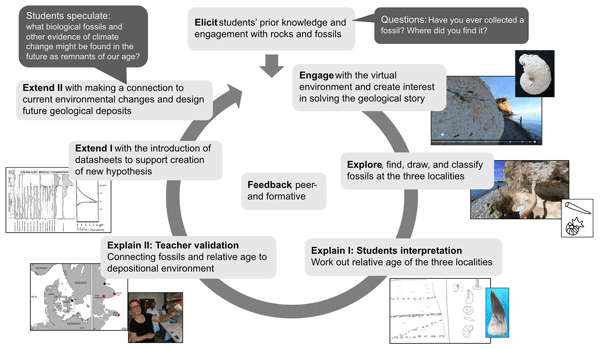
This GC Insights presents a virtual fieldwork module integrating 360 videos and inquiry-based learning to support geoscience education at the upper secondary level. The design enables students to engage in scientific practices, including data collection, interpretation, and hypothesis formation. The paper discusses how virtual environments can facilitate an exploratory learning and foster deeper conceptual understanding, when designed carefully as an inquiry lesson.
Stephen P. Hesselbo, Aisha Al-Suwaidi, Sarah J. Baker, Giorgia Ballabio, Claire M. Belcher, Andrew Bond, Ian Boomer, Remco Bos, Christian J. Bjerrum, Kara Bogus, Richard Boyle, James V. Browning, Alan R. Butcher, Daniel J. Condon, Philip Copestake, Stuart Daines, Christopher Dalby, Magret Damaschke, Susana E. Damborenea, Jean-Francois Deconinck, Alexander J. Dickson, Isabel M. Fendley, Calum P. Fox, Angela Fraguas, Joost Frieling, Thomas A. Gibson, Tianchen He, Kat Hickey, Linda A. Hinnov, Teuntje P. Hollaar, Chunju Huang, Alexander J. L. Hudson, Hugh C. Jenkyns, Erdem Idiz, Mengjie Jiang, Wout Krijgsman, Christoph Korte, Melanie J. Leng, Timothy M. Lenton, Katharina Leu, Crispin T. S. Little, Conall MacNiocaill, Miguel O. Manceñido, Tamsin A. Mather, Emanuela Mattioli, Kenneth G. Miller, Robert J. Newton, Kevin N. Page, József Pálfy, Gregory Pieńkowski, Richard J. Porter, Simon W. Poulton, Alberto C. Riccardi, James B. Riding, Ailsa Roper, Micha Ruhl, Ricardo L. Silva, Marisa S. Storm, Guillaume Suan, Dominika Szűcs, Nicolas Thibault, Alfred Uchman, James N. Stanley, Clemens V. Ullmann, Bas van de Schootbrugge, Madeleine L. Vickers, Sonja Wadas, Jessica H. Whiteside, Paul B. Wignall, Thomas Wonik, Weimu Xu, Christian Zeeden, and Ke Zhao
Sci. Dril., 32, 1–25, https://doi.org/10.5194/sd-32-1-2023, https://doi.org/10.5194/sd-32-1-2023, 2023
Short summary
Short summary
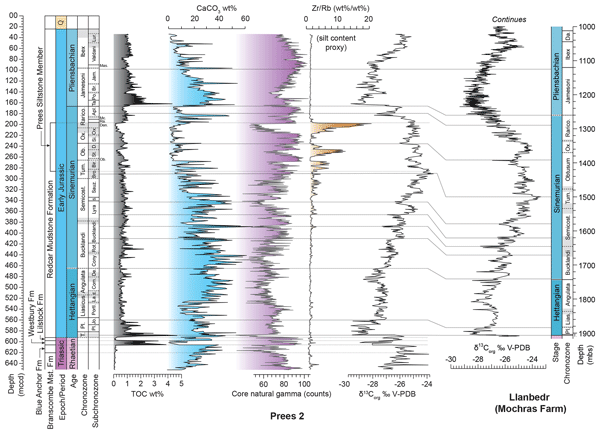
We present initial results from a 650 m long core of Late Triasssic to Early Jurassic (190–202 Myr) sedimentary strata from the Cheshire Basin, UK, which is shown to be an exceptional record of Earth evolution for the time of break-up of the supercontinent Pangaea. Further work will determine periodic changes in depositional environments caused by solar system dynamics and used to reconstruct orbital history.
Morgan T. Jones, Ella W. Stokke, Alan D. Rooney, Joost Frieling, Philip A. E. Pogge von Strandmann, David J. Wilson, Henrik H. Svensen, Sverre Planke, Thierry Adatte, Nicolas Thibault, Madeleine L. Vickers, Tamsin A. Mather, Christian Tegner, Valentin Zuchuat, and Bo P. Schultz
Clim. Past, 19, 1623–1652, https://doi.org/10.5194/cp-19-1623-2023, https://doi.org/10.5194/cp-19-1623-2023, 2023
Short summary
Short summary
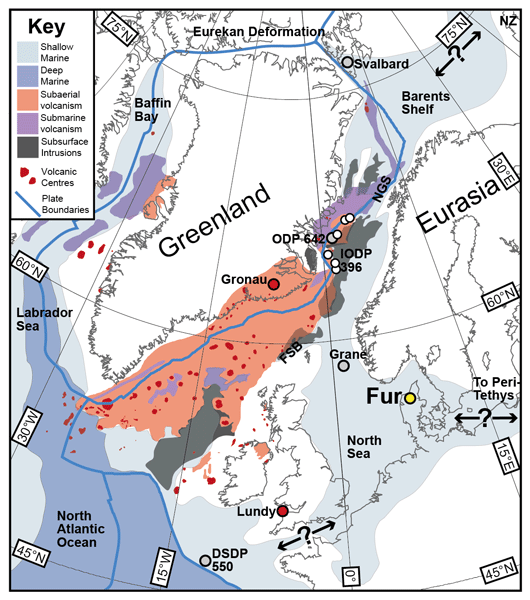
There are periods in Earth’s history when huge volumes of magma are erupted at the Earth’s surface. The gases released from volcanic eruptions and from sediments heated by the magma are believed to have caused severe climate changes in the geological past. We use a variety of volcanic and climatic tracers to assess how the North Atlantic Igneous Province (56–54 Ma) affected the oceans and atmosphere during a period of extreme global warming.
Cited articles
Farhat, M., Auclair-Desrotour, P., Boué, G., and Laskar, J.: The resonant tidal evolution of the Earth–Moon distance, Astron. Astrophys., 665, L1, https://doi.org/10.1051/0004-6361/202243445, 2022. a
Fernandes, I.: AstroComb-1.0, Zenodo [code], https://doi.org/10.5281/zenodo.17966228, 2025. a
Hays, J. D., Imbrie, J., and Shackleton, N. J.: Variations in the Earth's Orbit: Pacemaker of the Ice Ages, Science, 194, 1121–1132, https://doi.org/10.1126/science.194.4270.1121, 1976. a
Herbert, T. D.: Reading orbital signals distorted by sedimentation: models and examples, in: Orbital Forcing and Cyclic Sequences, edited by: de Boer, P. L. and Smith, D. G., vol. 19 of Special Publication, 483–507, International Association of Sedimentologists, 1994. a
Hinnov, L. A.: Cyclostratigraphy and its revolutionizing applications in the Earth and planetary sciences, Geol. Soc. Am. Bull., 125, 1703–1734, https://doi.org/10.1130/B30934.1, 2013. a
Hoang, N., Laskar, J., Hara, N. C., Wu, Y., Sultanov, A., Sinnesael, M., Westerhold, T., and Bujons, P.: AstroGeoFit: A genetic algorithm and Bayesian approach for the astronomical calibration of the geological timescale, Paleoceanogr. Paleoclimatol., 40, e2024PA005021, https://doi.org/10.1029/2024PA005021, 2025. a, b, c
Kemp, D. B. and Sexton, P. F.: Time-scale uncertainty of abrupt events in the geologic record arising from unsteady sedimentation, Geology, 42, 891–894, https://doi.org/10.1130/G35783.1, 2014. a
Kullback, S. and Leibler, R. A.: On information and sufficiency, Ann. Math. Stat., 22, 79–86, https://doi.org/10.1214/aoms/1177729694, 1951. a
Laskar, J.: Chapter 4 – Astrochronology, in: Geologic Time Scale 2020, edited by: Gradstein, F. M., Ogg, J. G., Schmitz, M. D., and Ogg, G. M., 139–158, Elsevier, https://doi.org/10.1016/B978-0-12-824360-2.00004-8, 2020. a
Laskar, J., Robutel, P., Joutel, F., Gastineau, M., Correia, A. C. M., and Levrard, B.: A long-term numerical solution for the insolation quantities of the Earth, Astron. Astrophys., 428, 261–285, https://doi.org/10.1051/0004-6361:20041335, 2004. a, b
Laskar, J., Fienga, A., Gastineau, M., and Manche, H.: A new orbital solution for the long-term motion of the Earth, Astron. Astrophys., 532, A89, https://doi.org/10.1051/0004-6361/201116836, 2011. a, b
Li, M., Kump, L. R., Hinnov, L. A., and Mann, M. E.: Tracking variable sedimentation rates and astronomical forcing in Phanerozoic paleoclimate proxy series with evolutionary correlation coefficients and hypothesis testing, Earth Planet. Sci. Lett., 501, 165–179, https://doi.org/10.1016/j.epsl.2018.08.041, 2018. a
Ma, C., Meyers, S. R., and Sageman, B. B.: Theory of chaotic orbital variations confirmed by Cretaceous geological evidence, Nature, 542, 468–470, 2017. a
Malinverno, A. and Meyers, S. R.: Bayesian estimation of past astronomical frequencies, lunar distance, and length of day from sediment cycles, Geochem., Geophys., Geosyst., 25, e2023GC011176, https://doi.org/10.1029/2023GC011176, 2024. a
Malinverno, A., Erba, E., and Herbert, T. D.: Orbital tuning as an inverse problem: Chronology of the early Aptian oceanic anoxic event 1a (Selli Level) in the Cismon APTICORE, Paleoceanography, 25, PA2203, https://doi.org/10.1029/2009PA001769, 2010. a, b, c
Meyers, S. R.: The evaluation of eccentricity-related amplitude modulation and bundling in paleoclimate data: An inverse approach for astrochronologic testing and timescale optimization, Paleoceanography, 30, 1625–1640, https://doi.org/10.1002/2015PA002850, 2015. a, b
Meyers, S. R. and Malinverno, A.: Proterozoic Milankovitch cycles and the history of the solar system, Proc. Natl. Aca. Sci. USA, 115, 1717689 115, https://doi.org/10.1073/pnas.1717689115, 2018. a, b, c, d
Meyers, S. R. and Sageman, B. B.: Quantification of Deep-Time Orbital Forcing by Average Spectral Misfit, Am. J. Sci., 307, 773–792, https://doi.org/10.2475/05.2007.01, 2007. a, b
Meyers, S. R., Sageman, B., and Hinnov, L.: Integrated quantitative stratigraphy of the Cenomanian-Turonian Bridge Creek Limestone Member using evolutive harmonic analysis and stratigraphic modeling, J. Sediment. Res., 71, 627–643, 2001. a
Munnecke, A., Westphal, H., Elrick, M., and Reijmer, J. J. G.: The mineralogical composition of precursor sediments of calcareous rhythmites: A new approach, Int. J. Earth Sci., 90, 795–812, https://doi.org/10.1007/s005310000137, 2001. a
Pälike, H., Norris, R. D., Herrle, J. O., Wilson, P. A., Coxall, H. K., Lear, C. H., Shackleton, N. J., Tripati, A. K., and Wade, B. S.: The heartbeat of the Oligocene climate system, Science, 314, 1894–1898, 2006. a
Paola, C.: A mind of their own: Recent advances in autogenic dynamics in rivers and deltas, SEPM Special Publications, 106, 5–17, https://doi.org/10.2110/sepmsp.106.04, 2016. a
Peng, C., Zou, C., Wu, H., Zhang, S., Kouamelan, K. S., and Wang, C.: Evaluating geophysical logs as proxies for cyclostratigraphy in lacustrine deposits using power ratio accumulation, Palaeogr. Palaeoclimatol. Palaeoecol., 614, 111428, https://doi.org/10.1016/j.palaeo.2023.111428, 2023. a
Ripepe, M. and Fischer, A. G.: Stratigraphic rhythms synthesized from orbital variations, in: Sedimentary Modeling, edited by: Franseen, E. K., Watney, W. L., Kendall, C. G. S. C., and Ross, W., Kansas Geological Survey, https://doi.org/10.17161/kgsbulletin.no.233.20466, 1991. a
Schiffelbein, P. and Dorman, L.: Spectral effects of time–depth nonlinearities in deep sea sediment records: a demodulation technique for realigning time and depth scales, J. Geophys. Res., 91, 3821–3835, 1986. a
Sinnesael, M., Zivanovic, M., De Vleeschouwer, D., Claeys, P., and Schoukens, J.: Astronomical component estimation (ACE v.1) by time-variant sinusoidal modeling, Geosci. Model Dev., 9, 3517–3531, https://doi.org/10.5194/gmd-9-3517-2016, 2016. a
Sinnesael, M., Zivanovic, M., De Vleeschouwer, D., and Claeys, P.: Spectral Moments in Cyclostratigraphy: Advantages and Disadvantages Compared to More Classic Approaches, Paleoceanogr. Paleoclimatol., 33, 493–510, https://doi.org/10.1029/2017PA003293, 2018. a, b
Tarantola, A.: Inverse problem theory and methods for model parameter estimation, Society of Industrial and Applied Mathematics, https://doi.org/10.1137/1.9780898717921, 2005. a
Trayler, R. B., Meyers, S. R., Sageman, B. B., and Schmitz, M. D.: Bayesian integration of astrochronology and radioisotope geochronology, Geochronology, 6, 107–123, https://doi.org/10.5194/gchron-6-107-2024, 2024. a
Waltham, D.: Milankovitch Period Uncertainties and Their Impact on Cyclostratigraphy, J. Sediment. Res., 85, 990–998, https://doi.org/10.2110/jsr.2015.66, 2015. a
Zhao, Z., Thibault, N. R., Dahl, T. W., Schovsbo, N. H., Sørensen, A. L., Rasmussen, C. M. Ã., and Nielsen, A. T.: Synchronizing rock clocks in the late Cambrian, Nat. Commun., 13, 1990, https://doi.org/10.1038/s41467-022-29651-4, 2022. a, b, c, d
Zhao, Z., Pang, X., Zou, C., Dickson, A. J., Basu, A., Guo, Z., Pan, S., Nielsen, A. T., Schovsbo, N. H., Jing, Z., and Dahl, T. W.: Dynamic oceanic redox conditions across the late Cambrian SPICE event constrained by molybdenum and uranium isotopes, Earth Planet. Sci. Lett., 604, 118 013, https://doi.org/10.1016/j.epsl.2023.118013, 2023. a
Zhou, M., Wu, H., Hinnov, L. A., Fang, Q., Zhang, S., Yang, T., and Shi, M.: Earth-Moon dynamics from cyclostratigraphy reveals possible ocean tide resonance in the Mesoproterozoic era, Sci. Adv., 10, eadn7674, https://doi.org/10.1126/sciadv.adn7674, 2024. a
Short summary
We introduce a new method to more precisely date ancient sediment layers using astronomical time cycles recorded in the rock. Unlike previous tools, it handles complex, multi-channel data without oversimplifying and gives clear estimates of dating uncertainty. This helps future research in better understand Earth's past climate, biological changes, and geologic events with greater confidence and accuracy.
We introduce a new method to more precisely date ancient sediment layers using astronomical time...