
the Creative Commons Attribution 4.0 License.
the Creative Commons Attribution 4.0 License.
 | 19 Oct 2026
Development and validation of ARMS-gb v2.0: extending fast radiative transfer modeling capability to all-sky conditions for ground-based microwave radiometer retrievals
Ziyue Huang
Yi-Ning Shi
Fuzhong Weng
Jun Yang

Ground-based microwave radiometers provide continuous, all-weather observations of boundary-layer temperature and humidity, closing a critical near-surface observation gap. The Advanced Radiative Transfer Modeling System – ground-based (ARMS-gb) is a fast radiative transfer model specifically designed to simulate the brightness temperatures observed by these instruments. This paper presents ARMS-gb v2.0, which introduces a hydrometeor absorption and scattering module and an accelerated discrete ordinate method (ADOM) solver for multiple scattering. The model now simulates cloud water, rain, ice, snow, and graupel using optical-property look-up tables computed with Mie theory and the discrete dipole approximation (DDA). The existing tangent-linear and adjoint (TL/AD) modules are also extended to include hydrometeor processes, supporting all-sky retrieval and variational data assimilation. Validation against field measurements from 14- and 22-channel ground-based microwave radiometers indicates that ARMS-gb v2.0 effectively simulates brightness temperatures under cloudy non-precipitating conditions, with the mean observed minus simulated brightness temperature generally within 1 K of the corresponding clear-sky baseline. Compared with ARMS-gb v1.0, which neglects cloud effects, the root mean square error (RMSE) under cloudy conditions decreases by 1–2 K in the water-vapor band, most notably at 30 GHz, where the coefficient of determination (R2) increases from 0.55 to 0.77. In the weak oxygen band, where frozen hydrometeors have stronger scattering effects, the observation-minus-background (O–B) decreases by 3–4 K. At 51 GHz, the RMSE decreases from 5.23 to 3.22 K, and R2 increases from 0.52 to 0.81. Moreover, the results indicate that the DDA model slightly outperforms the Mie model in characterizing frozen hydrometeors at these channels. However, large O–B departures remain during precipitation events, with RMSE values in the water-vapor absorption band reaching 30–40 K, reflecting rain-contaminated measurement effects and atmospheric hydrometeor uncertainties that require dedicated quality control and observation-error modeling before assimilation or retrieval applications.
- Article
(5944 KB) - Full-text XML
- BibTeX
- EndNote


In recent years, extreme weather events have become more frequent and variable, and the vertical thermodynamic structure of the planetary boundary layer (PBL) plays a central role in their formation and evolution. The development of low-altitude aviation increases the demand for reliable boundary-layer observations, which motivates more efficient and accurate measurement techniques and targeted mechanistic studies. Microwave remote sensing operates in the presence of clouds and precipitation and supports long-term continuous unattended monitoring, which provides clear advantages for all-sky applications. In the microwave region, gaseous absorption is primarily controlled by temperature, pressure, and water-vapor density. Under cloudy or precipitating conditions, hydrometeors, including cloud water, rain, ice, snow, and graupel, additionally contribute to the total extinction through absorption and scattering, thereby modifying the microwave opacity and the observed brightness temperatures. Although satellite-based microwave radiometers provide extensive coverage of the atmosphere, they cannot reliably retrieve PBL temperature and humidity over land because land-surface microwave emissivity is highly variable and introduces significant uncertainty in the measured radiances (Martinet et al., 2020). This limitation causes an observation gap between the surface and the upper troposphere (National Research Council, 2009), which is precisely the critical region where energy and water-vapor exchanges occur between the land surface and the free atmosphere (Wu et al., 2024).
Ground-based microwave radiometers (GMRs), operating in an upward-looking configuration, provide continuous retrievals of temperature and humidity profiles under all-sky conditions, with high temporal resolution and moderate vertical resolution that decreases with height within the PBL (Cimini et al., 2006; Wei et al., 2024). GMRs can capture rapid boundary-layer variability, and contribute to understanding PBL dynamical processes while helping to bridge the observation gap between the surface and the upper troposphere (De Angelis et al., 2017). Compared with radiosondes, GMRs can offer high-frequency, continuous observations that are not affected by wind advection and therefore show stronger local representativeness, which enables long-duration all-weather monitoring within the PBL (Madhulatha et al., 2013). Under clear-sky conditions, the atmosphere is nearly transparent in the window channels; absorption in the K-band is dominated by water vapor, whereas the V-band is primarily controlled by oxygen absorption. With cloud and precipitation, optical thickness increases rapidly because cloud water, rain, ice, snow, and graupel contribute additional absorption and scattering. All-sky microwave observations are therefore both valuable and challenging, motivating the development of a fast, accurate all-sky radiative-transfer operator for GMRs.
Radiative transfer models (RTMs) provide the essential link between atmospheric state variables and observed radiances, and fast RTMs are indispensable for variational assimilation in modern numerical weather prediction (NWP) systems (Hu and Han, 2021; Weng and Liu, 2003; Yang et al., 2020). Early applications were limited to clear-sky oceanic conditions due to the difficulty of simulating cloud and precipitation microphysics, as well as surface emissivity. With subsequent advances, mainstream fast RTMs such as CRTM (Weng et al., 2005), RTTOV (Saunders et al., 1999), and ARMS (Weng et al., 2020; Yang et al., 2020) have been extended to all-sky capabilities, which has enabled the operational assimilation of cloud-affected satellite radiances (Bauer et al., 2010; Geer et al., 2017). Despite being less affected by surface emissivity and capable of providing continuous, high temporal resolution boundary-layer observations, the assimilation of GMR observations has lagged behind satellite applications, owing to the lack of suitable forward models and effective methods for handling water vapor and hydrometeors. High-accuracy monochromatic tools (e.g., MonoRTM; Clough et al., 2005), together with absorption models such as MPM (Rosenkranz, 1998), are widely used as references, but they are computationally too expensive for routine, instrument-level broadband simulations at the temporal resolution required by GMR retrieval and data-assimilation applications. When each broadband channel is approximated by a single monochromatic calculation at the channel centre frequency, systematic brightness-temperature biases of a few kelvin (∼2–3 K) have been reported (Yang and Min, 2015). To our knowledge, only two dedicated fast radiative transfer models for ground-based microwave radiometers are currently available, RTTOV-gb in Europe (Cimini et al., 2019) and ARMS-gb in China (Shi et al., 2025). RTTOV-gb was a significant development; however, recent studies report substantial biases in water-vapor channels (Cao et al., 2023) and the lack of an operational cloud-scattering option, leaving many cloud-affected GMR observations unused. ARMS-gb v1.0 is a fast radiative transfer model for GMRs that incorporates a line-by-line trained gaseous absorption scheme and an advanced water-vapor vertical interpolation with tangent-linear and adjoint modules for Jacobian evaluation. Validation against benchmark simulations and real observations demonstrated that the performance of ARMS-gb v1.0 is comparable to or better than RTTOV-gb in humid environments and is useful for observation-minus-background (O–B) monitoring. Despite these advances, ARMS-gb v1.0 remains a clear-sky model, and RTTOV-gb accounts only for absorption by cloud liquid water, precluding direct all-sky assimilation of GMR radiances. Additionally, variational systems rely on a forward-model operator with its associated Jacobians, while the observation-error covariance accounts for radiometric noise, representativeness, and forward-model uncertainties. Therefore, a fast and accurate all-sky RTM with tangent-linear and adjoint capabilities is essential. Here, we describe several new aspects of ARMS-gb v2.0, which incorporates hydrometeor scattering and absorption modules together with a numerically stable multiple-scattering solver, and provides forward, tangent-linear, and adjoint modules under all-sky conditions to support the direct assimilation of GMR observations.
This paper is organized as follows. Section 2 describes the two main developments in ARMS-gb v2.0: the computation of hydrometeor optical properties and a multiple-scattering solver. Section 3 explores sensitivity to hydrometeor water content and particle size across the water-vapor and oxygen microwave absorption bands. Section 4 evaluates all-sky simulations with the updated RTM against six months of field measurements from ground-based observations collected in China for a 14-channel and a 22-channel GMR, and examines error characteristics and sources for retrieval and data assimilation. Section 5 concludes with a summary and perspectives.
The primary advancement in ARMS-gb v2.0 is the extension from clear-sky to all-sky applications while retaining the gaseous absorption parameterization, clear-sky solver, and vertical interpolation scheme of v1.0 for continuity. In the microwave regime, we solve a scalar radiative transfer equation for brightness temperatures, and atmospheric attenuation is determined by temperature, pressure, water-vapor density, and hydrometeor microphysical properties, so hydrometeors can significantly perturb the radiance field even when gas absorption is well captured. Figure 1 compares the time series of observed and simulated clear-sky brightness temperatures measured by YKW-1, a 22-channel GMR, at Yan'an Station (36.34° N, 109.27° E). For context, the corresponding liquid and solid hydrometeor profiles from the fifth-generation ECMWF atmospheric reanalysis (ERA5, Hersbach et al., 2020) are also shown. The forward simulations simply consider gaseous absorption and do not include any cloud or precipitation scattering information. The simulations accurately track observations during cloud-free periods, whereas departures grow in water-vapor and weak-oxygen channels when hydrometeors are present, which motivates a consistent representation of their combined effects. To address this, ARMS-gb was updated with two new modules. The first is a cloud optics module that calculates the bulk scattering properties of cloud particles. These properties are derived by integrating the single-particle attributes of various hydrometeors (cloud water, rain, ice, snow, and graupel) over the particle size distribution, utilizing a precomputed look-up table (LUT). The second is an all-sky radiative transfer solver that accounts for multiple scattering and emission, applies appropriate lower boundary conditions, and enables physically consistent simulations under all-sky conditions.
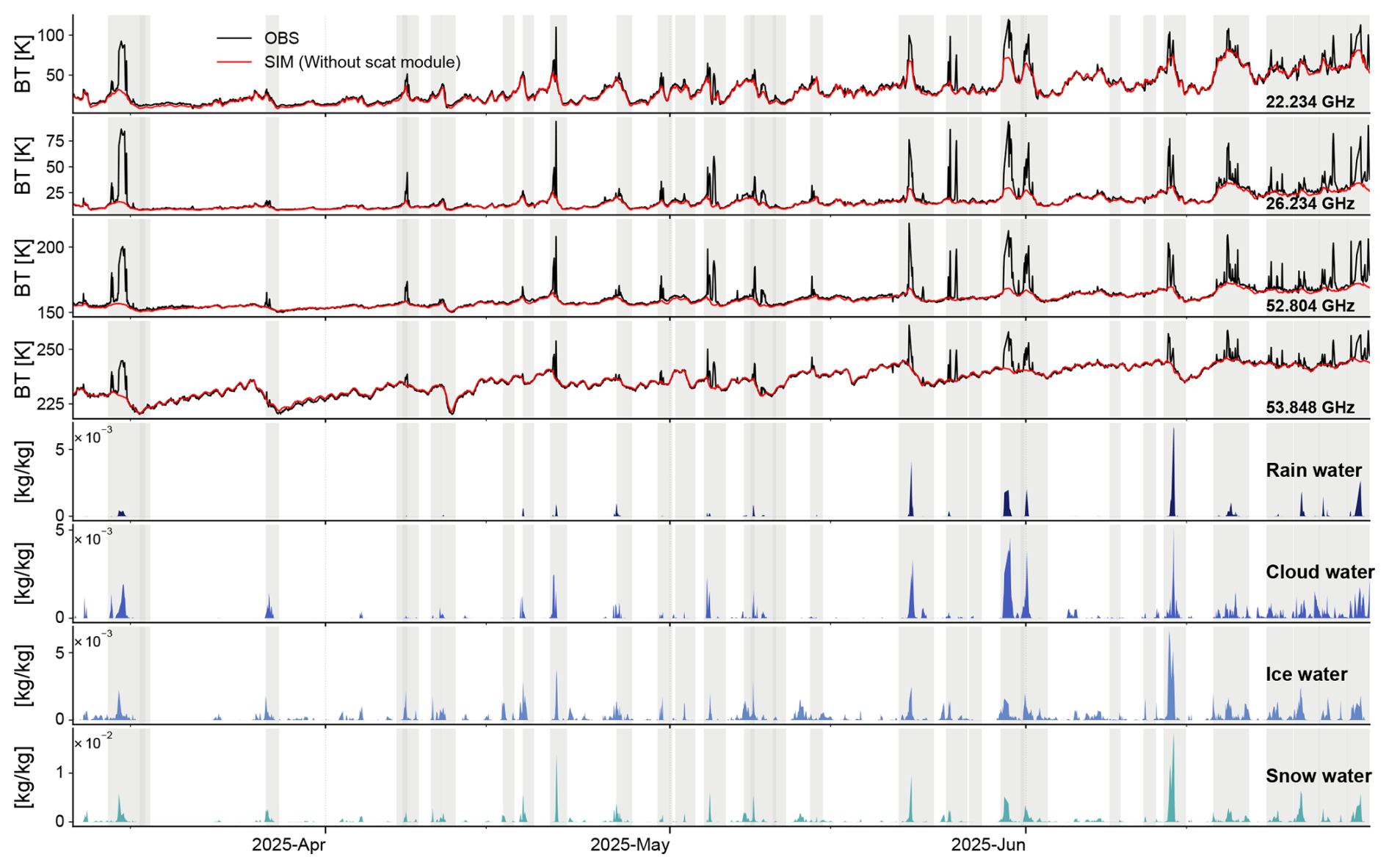
Figure 1Time series of observed (OBS) and simulated (SIM) brightness temperatures from a ground-based microwave radiometer at Yan'an station from April to June 2025. The simulations were performed using a model without a cloud scattering module. For reference, the corresponding hydrometeor profiles from ERA5 reanalysis for the same period are shown in the bottom panels.
2.1 Cloud particle absorption and scattering module
ARMS-gb v2.0 parameterizes the scattering and absorption properties of cloud and precipitation particles using a pre-computed LUT, following the methods of Huang et al. (2025). The LUT includes five hydrometeor categories: cloud water, rain, ice, snow, and graupel. Single-particle optical properties – extinction coefficient, single-scattering albedo (SSA), and the full phase function – are calculated with Mie theory for liquid droplets and with a rough-surfaced aggregate model, based on the discrete dipole approximation (DDA, Draine and Flatau, 1994), for nonspherical frozen particles. These single scattering properties are then integrated over a modified gamma size distribution to obtain bulk optical parameters (Petty and Huang, 2011). The LUT is constructed for liquid hydrometeors at temperatures ranging from 275 to 290 K in 5 K intervals and for solid hydrometeors from 243 to 273 K in 10 K intervals. Hydrometeor phase is prescribed by the input category. Between 273 and 275 K, liquid hydrometeors use the liquid LUT values at 275 K, whereas solid hydrometeors use the corresponding solid LUT. Melting hydrometeors are not treated separately in the current version. For refractive indices, we adopted the refractive-index data of Ray (1972) for liquid water and the ice model developed by Mätzler (2006), ensuring robustness across the full microwave spectrum and a wide range of temperatures. In addition, for solid hydrometeors (ice, snow, and graupel), their complex refractive indices were further adjusted using the Maxwell–Garnett mixing formulation (Garnett, 1906) to represent the effective dielectric properties of ice–air mixtures. The LUT was constructed entirely from physics-based scattering calculations and is therefore independent of the observational datasets used for model evaluation.
Figure 2 shows that extinction increases monotonically with frequency and effective radius for all hydrometeors between 20 and 60 GHz. Cloud liquid water remains absorption dominated with SSA near zero, so its influence in the 22–31 GHz vapor band and the 51–59 GHz oxygen band is mainly through absorption. Frozen species behave differently. Scattering strengthens rapidly with increasing size and frequency, and once effective radii reach a few hundred micrometers and frequencies exceed about 45–50 GHz, the albedo approaches unity, indicating a scattering-dominated regime that is most evident in the oxygen band. The difference panels use Mie minus DDA and are shown only for frozen species, since cloud-water differences are identically zero when both configurations use Mie. For ice and snow, the differences are small at small radii and low frequencies and grow to positive values with size and frequency, which means the spherical assumption tends to produce stronger extinction and higher albedo than the nonspherical treatment. Differences for graupel remain comparatively small, consistent with its more compact and near-spherical habit. Band dependence is clear. The 22–31 GHz water-vapor band is only moderately sensitive to frozen-phase scattering, whereas the 51–59 GHz oxygen band is highly sensitive, and the DDA–Mie discrepancies are amplified there. These results imply that nonspherical particle effects should be considered for ice and snow in the oxygen band and are weaker in the vapor band. In forward modeling and data assimilation, the Mie-based spherical treatment yields stronger scattering for large frozen hydrometeors in the oxygen band than the DDA-based nonspherical treatment, with the magnitude of the difference depending on particle size and frequency.
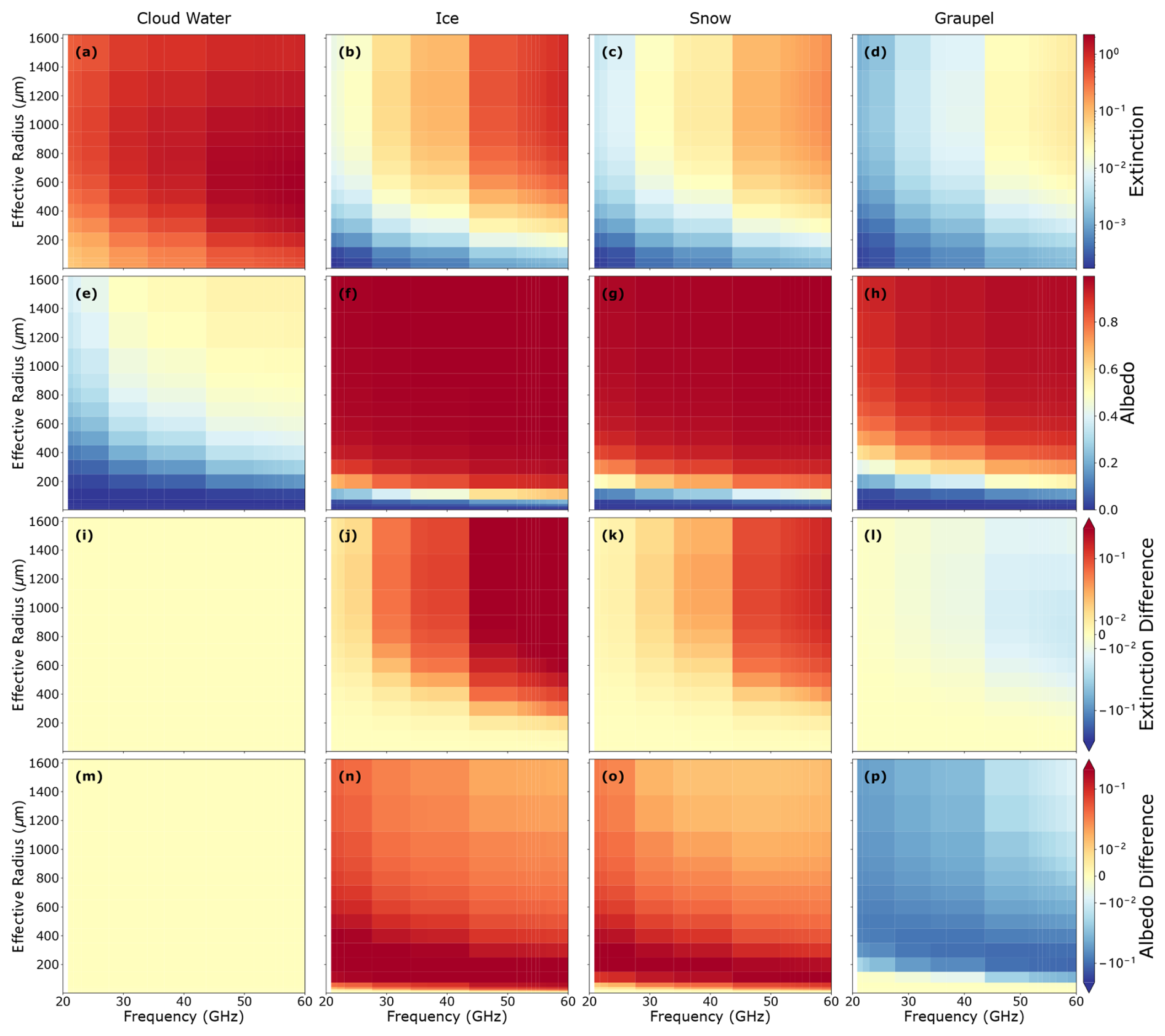
Figure 2Scattering properties of the cloud particles. The top two rows (a–h) show the extinction coefficient and SSA of Mie, and the bottom two rows (i–p) show the corresponding difference between results computed from Mie and DDA.
2.2 Accelerated Discrete Ordinate Method
Ground-based microwave radiometers observe downwelling radiance primarily from atmospheric thermal emission, with the cosmic microwave background entering as the top boundary. Under clear-sky conditions, hydrometeors are absent and scattering is negligible, so the source function reduces to gaseous Planck emission with absorption, whereas in all-sky scenes, clouds and precipitation introduce extinction, emission, and multiple scattering. Accordingly, the monochromatic radiative transfer equation for a plane-parallel layer in the microwave band can be written as Eq. (1):
where is the diffuse radiance along direction μ,ϕ at optical depth τ. The variable μ is the cosine of the viewing zenith angle and ϕ is the azimuth angle. and ω refer to the phase function and SSA, respectively. B(τ) is the vertical distribution of the Planck function and we adopt the linear-in-tau approximation as:
with
By expanding the phase function in a series of Legendre polynomials and the radiance into a Fourier cosine series, the equation is replaced by 2M independent equations:
with
where is associated Legendre polynomial, the expansion coefficient can be determined from the orthogonal property of Legendre polynomials (Liou et al., 1988).
In radiative transfer simulations, the atmosphere is typically divided into multiple plane-parallel layers, which are categorized as either scattering or non-scattering. This study employs an accelerated discrete ordinate method (ADOM, Shi and Weng, 2025), where the Discrete Ordinates Method (DOM, Stamnes et al., 1988) is applied exclusively to the scattering layers. To enhance computational efficiency, adjacent non-scattering layers are merged based on non-scattering radiative transfer theory. Within the ADOM framework, the DOM is used to solve the radiative transfer equation for each scattering layer. By applying the discrete ordinates method, the integral form of Eq. (4) can be approximated as:
where 2N is the number of streams, and N is typically set equal to M. The terms μi and ai represent the Gaussian quadrature points and the corresponding weights, respectively. By substituting Eq. (7) into Eq. (4), the radiative transfer equation can be written in its discrete-ordinate form as:
with
The definitions of all symbols are consistent with those in Shi and Weng (2025). Solving this equation yields the radiances at the top and bottom of the scattering layer.
In the non-scattering layer, the scattering term can be ignored in Eq. (4), and the solution for the downward radiation at the lower boundary of each layer is composed of two terms: (1) the downward radiation incident at the upper boundary, attenuated through the entire layer, and (2) the integrated, attenuated thermal emission from within the layer. The detailed derivations for both scattering and non-scattering layers are provided in Shi and Weng (2025). After merging the non-scattering layers, ADOM yields a K-layer atmospheric profile. The upper boundary is set to the cosmic background radiation, while the lower boundary is determined by the surface thermal emission and diffuse reflection. To compute the radiance at an arbitrary viewing zenith angle, we introduce ±μsim as an additional Gaussian quadrature point with zero weight. The radiance at the specified viewing angle for a ground-based microwave radiometer can then be expressed as .
3.1 Ground-based microwave radiometers and ERA5 data
Two GMR systems were used in this study: YKW-1 at Yan'an Station (36.34° N, 109.27° E), manufactured by Beifang Tianqiong, and YKW-2 at Karamay Station (45.37° N, 84.51° E), manufactured by Airda. YKW-1 and YKW-2 have 22 and 14 channels, respectively, with channel settings corresponding to those of the MP-3000A and HATPRO radiometers used in Zheng et al. (2026). These channels cover the water vapor absorption band near 22–31 GHz and the oxygen absorption band near 51–59 GHz, and their center frequencies are listed in Tables 1 and 2. Both instruments undergo routine liquid nitrogen calibration every six months, with a nominal calibration accuracy better than 1 K.

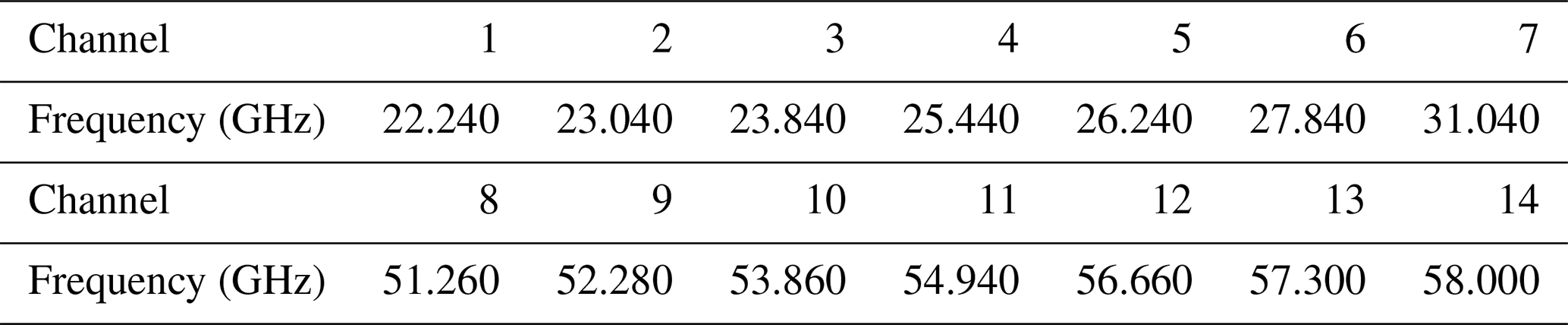
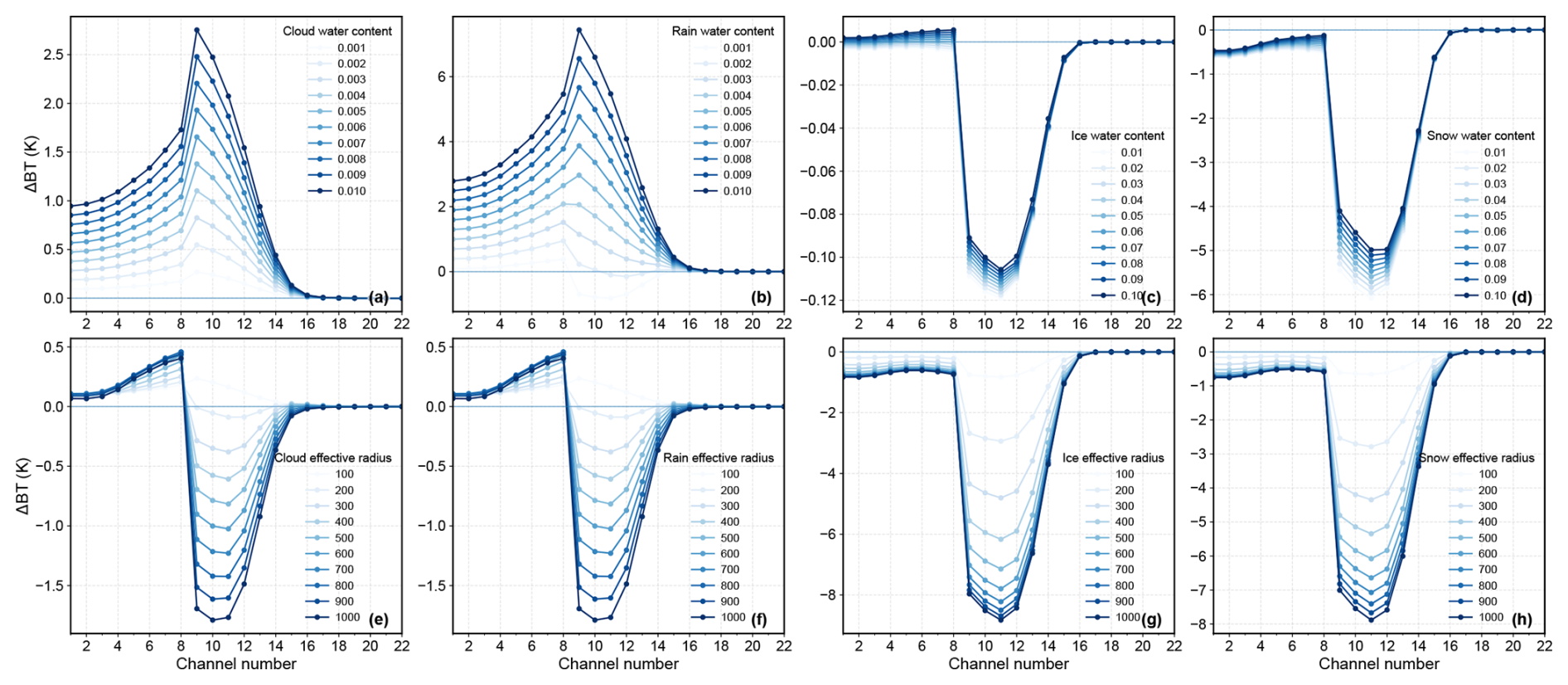
Figure 3Clear-sky-referenced ΔBT for the YKW-1 at Yan'an in response to perturbations in hydrometeor content and effective radius, separated by cloud liquid water, rainwater, ice, and snow.
Hourly ERA5 atmospheric profiles (Hersbach et al., 2020) were collocated with GMR observations at both stations from January to June 2025. ERA5 provided vertical profiles of temperature and humidity, together with mass mixing ratios of cloud liquid water, rainwater, cloud ice, and snow. The hydrometeor mixing ratios were converted to water paths for individual model layers before being supplied to ARMS-gb v2.0. These collocated profiles were used in the realistic sensitivity experiments and the evaluation against observations.
3.2 Sensitivity experiments
The interaction between microwave radiation and atmospheric hydrometeors plays a fundamental role in microwave radiative transfer and thus in the resulting brightness temperatures observed by GMRs. This interaction involves absorption, thermal emission, and scattering, whose relative contributions depend on hydrometeor phase, water path, particle effective radius, and vertical distribution. Consequently, hydrometeor-induced brightness-temperature responses vary with atmospheric conditions and channel frequency, motivating a systematic examination of their microphysical and spectral dependencies.
To examine these microphysical dependencies under controlled atmospheric conditions, idealized single-species experiments were performed for YKW-1 using the U.S. Standard Atmosphere, 1976, as the clear-sky background. Cloud liquid water and rainwater were prescribed between 700 and 800 hPa, whereas cloud ice and snow were prescribed between 366 and 545 hPa. These pressure ranges correspond to approximately 2–3 km and 5–8 km, respectively, in the U.S. Standard Atmosphere. They were selected to represent lower-tropospheric liquid clouds and precipitation and colder ice and snow layers aloft in the idealized sensitivity experiments. Only one hydrometeor species was included in each experiment. Two series of experiments were conducted to separately examine the effects of water path and particle size. In the water-path experiments, the layer-integrated water paths varied from 0.001 to 0.010 kg m−2 for cloud liquid water and rainwater and from 0.01 to 0.10 kg m−2 for cloud ice and snow. The effective radii were fixed at 50 µm for cloud liquid water and cloud ice and 500 µm for rainwater and snow. In the particle-size experiments, the water paths were fixed at 0.001 kg m−2 for cloud liquid water and rainwater and 0.01 kg m−2 for cloud ice and snow, while the effective radii varied from 100 to 1000 µm. The hydrometeor-induced brightness-temperature response was defined relative to the clear-sky simulation as , and the resulting channel-dependent responses are presented in Fig. 3.
Cloud liquid water generally produces positive ΔBT through absorption and thermal emission, with the strongest responses occurring in the 22–31 GHz water-vapor band and the weak oxygen absorption band near 51–55 GHz. At the sensitive channels, ΔBT increases approximately linearly with cloud liquid water path. Rainwater exhibits a more nonlinear response. At small water paths, scattering produces negative ΔBT in several weak oxygen-band channels, whereas absorption and emission become increasingly important as the water path increases. The particle-size experiments further show that cloud liquid water and rainwater produce nearly identical spectral responses when assigned the same water path and effective radius. Increasing the effective radius strengthens scattering and leads to progressively more negative ΔBT in the weak oxygen-band channels. Cloud ice and snow generally produce negative ΔBT in the weak oxygen absorption band because particle scattering redirects radiation away from the viewing direction. Ice crystals generally have smaller effective radii than snow particles, and small ice crystals therefore produce only a weak brightness-temperature response, as evident in the water-path experiments. At the same effective radius, however, snow particles produce a slightly smaller reduction in brightness temperature than ice crystals, consistent with the lower bulk density and associated optical properties of snow. At the higher-frequency oxygen channels, the hydrometeor-induced responses become small as molecular oxygen absorption increasingly dominates the downwelling radiance.
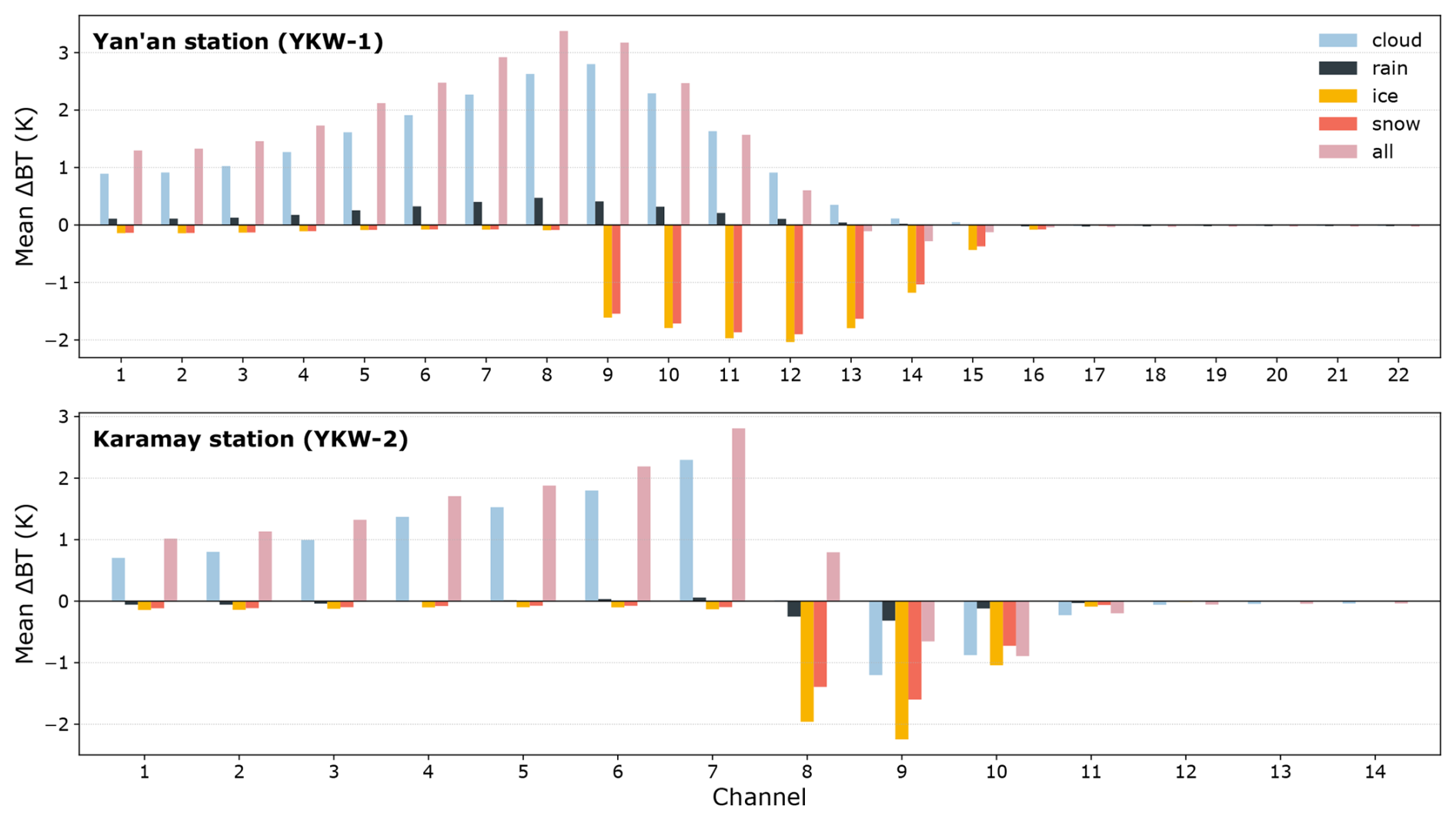
Figure 4Mean hydrometeor-induced brightness-temperature responses (ΔBT) by channel for YKW-1 at Yan'an and YKW-2 at Karamay. The results are based on ARMS-gb v2.0 simulations driven by 2135 and 2845 hourly cloudy non-precipitating ERA5 profiles, respectively. Bars show the responses to cloud liquid water, rainwater, cloud ice, and snow included separately, together with the combined response when all four species are included. ΔBT is calculated relative to the corresponding clear-sky simulation.
Samples with a radiometer rain-sensor flag were classified as precipitating. Among the remaining samples, clear-sky cases were identified following Shi et al. (2025). The screening used sky infrared temperature, the 10 min brightness-temperature standard deviation in the window channel near 31 GHz, and the sum of ERA5 total-column cloud liquid water and cloud ice water. All remaining non-precipitating samples were subsequently classified as cloudy non-precipitating cases. After scene classification and quality-control screening, 2135 hourly profiles representing cloudy non-precipitating conditions were retained for Yan'an and 2845 for Karamay. For each of these profiles, ARMS-gb v2.0 simulations were performed with each hydrometeor species included separately and with all four species included together. Figure 4 presents the corresponding mean ΔBT values for each channel at the two sites.
At both sites, hydrometeor-induced ΔBT showed a clear dependence on channel frequency and hydrometeor species. In the 22–31 GHz water-vapor band, cloud liquid water produced the dominant positive response through absorption and thermal emission, whereas rainwater produced a smaller warming. For YKW-1, the combined hydrometeor response increased across the water-vapor channels and was approximately 3 K at channels 8–10. For YKW-2, a similar positive response was evident across the water-vapor band and peaked near channel 7. In the weak oxygen absorption band near 51–55 GHz, cloud ice and snow generally produced negative ΔBT through scattering. Snow produced stronger mean cooling than cloud ice in these ERA5 profiles, particularly around channels 9–13 for YKW-1 and channels 8–10 for YKW-2. The combined response reflected the net effects of absorption and emission by cloud liquid water, extinction by rainwater, and scattering by frozen particles. At higher oxygen-band frequencies, hydrometeor-induced responses became small as molecular oxygen absorption increasingly dominated the measured radiance. These results underscore the importance of representing both liquid and frozen hydrometeors in all-sky GMR simulations, particularly in the water-vapor and weak oxygen absorption bands.
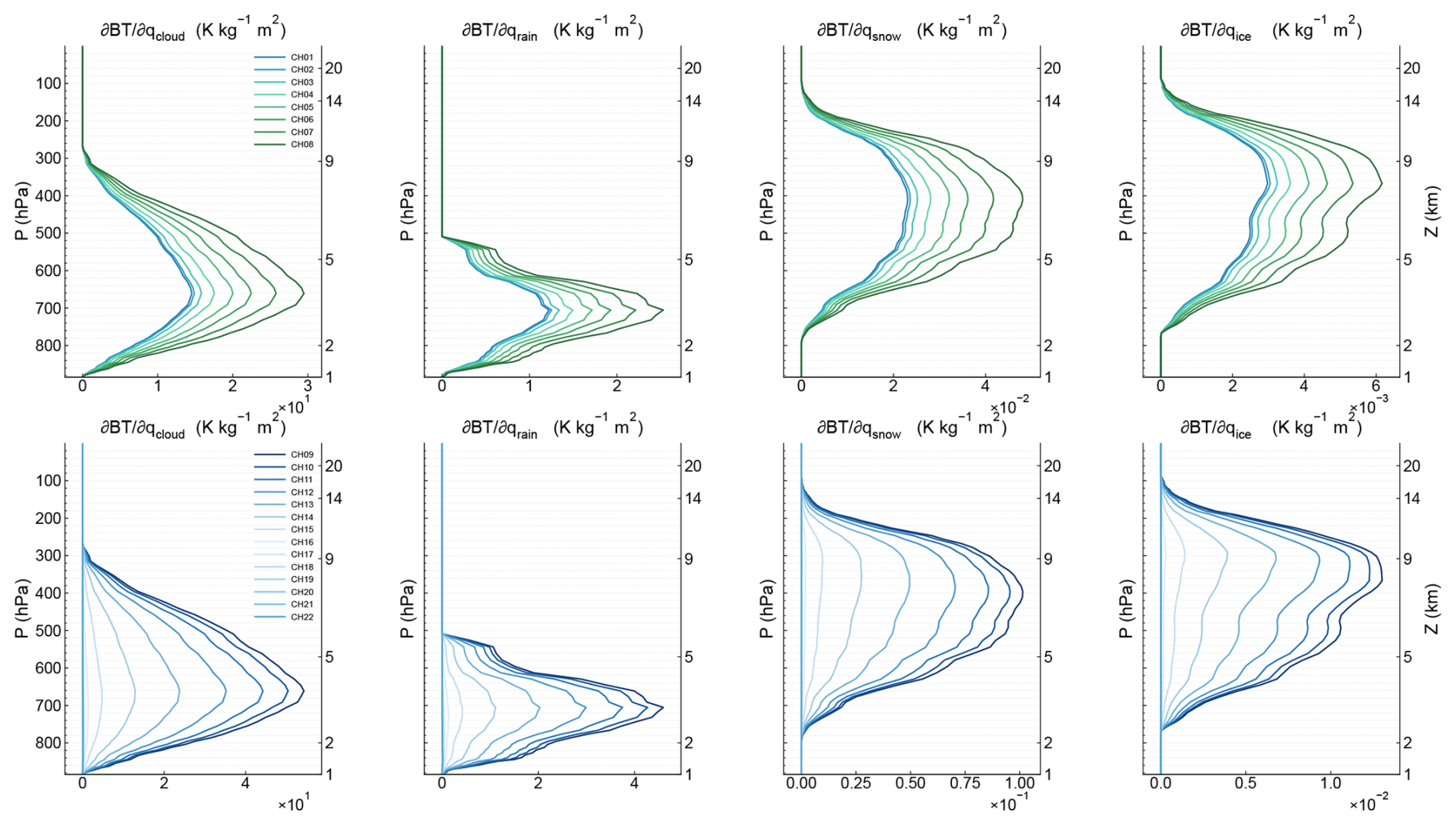
Figure 5Mean brightness-temperature Jacobians with respect to hydrometeor water paths for YKW-1 at Yan'an under zenith-viewing geometry, averaged over 2135 cloudy non-precipitating hourly ERA5 profiles from January–June 2025. Columns represent cloud liquid water, rainwater, snow, and cloud ice; the upper and lower rows show channels 1–8 and 9–22, respectively.
Jacobian analysis provides a complementary diagnostic of radiative transfer and is fundamental in retrieval and data assimilation because it links perturbations in atmospheric state variables to changes in observed brightness temperatures. ARMS-gb v2.0 includes tangent-linear, adjoint, and K-matrix capabilities for efficiently computing the Jacobians required for such applications. Figure 5 shows the mean brightness-temperature Jacobians with respect to cloud liquid water, rainwater, cloud ice, and snow for YKW-1 at Yan'an under zenith-viewing geometry. The Jacobians were derived from simulations driven by 2135 cloudy non-precipitating hourly ERA5 profiles spanning January–June 2025. These Jacobians quantify how perturbations in hydrometeor content at different pressure levels alter the observed brightness temperatures, thereby providing a direct measure of vertical sensitivity. The GMR brightness temperature exhibits pronounced sensitivity to liquid hydrometeors, with the strongest impact in the lower troposphere. The cloud-liquid-water Jacobians show pronounced sensitivity around 600 hPa, whereas the rainwater Jacobians peak closer to the surface, near 700 hPa. In contrast, the sensitivity to snow is much weaker than that to liquid water, with only modest responses at altitudes of 5–9 km. Cloud ice sensitivities are approximately one order of magnitude smaller than those for snow, and the corresponding Jacobians show a weak bimodal structure. The Jacobians also show that the response peaks of different channels occur at nearly the same altitudes and differ mainly in magnitude, indicating that GMR observations provide limited vertical discrimination of hydrometeor effects.
In this section, ARMS-gb v2.0 is evaluated against collocated GMR brightness-temperature observations. Clear-sky simulations provide channel-dependent O–B baselines, while the primary evaluation of the all-sky capability focuses on cloudy non-precipitating scenes. Precipitation cases are examined separately to characterize rain-contaminated O–B departures and are not treated as strict validation of the radiative transfer model.
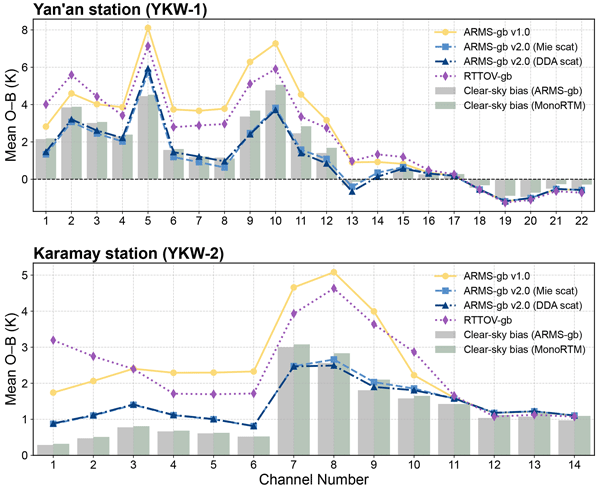
Figure 6 compares the mean O–B departures for each channel at Yan'an and Karamay during April–June 2025. The cloudy-scene comparison includes ARMS-gb v1.0, ARMS-gb v2.0 with Mie- and DDA-based scattering treatments, and RTTOV-gb. To assess whether the persistent clear-sky baseline departures arose primarily from the ARMS-gb clear-sky radiative-transfer calculation, MonoRTM was used as a high-accuracy clear-sky radiative-transfer reference. The MonoRTM simulations used the same ERA5 profiles and GMR channel settings as ARMS-gb. Each channel was represented by 256 monochromatic calculations across its nominal bandwidth, and the resulting radiances were averaged to obtain channel-equivalent brightness temperatures. Following the selection of cloudy non-precipitating scenes and the removal of invalid records, 1012 hourly profiles per channel and model were retained for Yan'an and 1014 for Karamay. The clear-sky statistics used 402 valid profiles at Yan'an and 420 at Karamay. The ARMS-gb and MonoRTM baselines exhibit similar channel-dependent structures, with maximum differences of approximately 0.38 K at Yan'an and 0.30 K at Karamay. This agreement indicates that the ARMS-gb clear-sky radiative-transfer calculation is unlikely to be the dominant source of the persistent baseline departures. The residual departures may also reflect uncertainties in instrument calibration, channel characterization, collocation, and ERA5 background profiles.
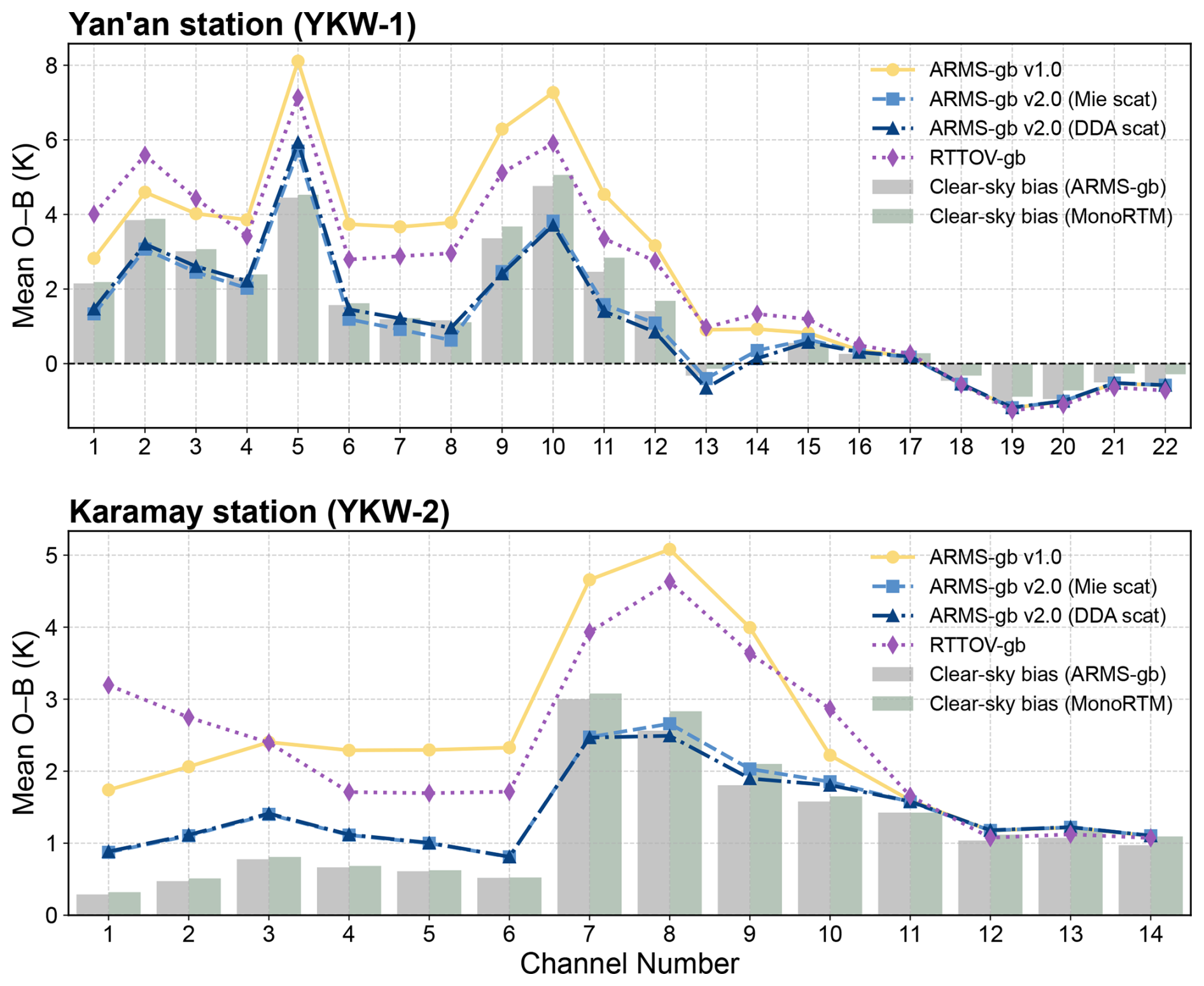
Figure 6Mean O–B departures for each channel at Yan'an (YKW-1) and Karamay (YKW-2) during April–June 2025. Lines show cloudy non-precipitating simulations, while bars show ARMS-gb and MonoRTM clear-sky baselines.
The difference between the cloudy-sky mean O–B and the corresponding clear-sky baseline provides an additional diagnostic of hydrometeor treatment. In the water-vapor and weak oxygen absorption bands, both ARMS-gb v2.0 configurations produce cloudy-sky departures closer to the clear-sky baseline than ARMS-gb v1.0. For YKW-1, the clear-sky baseline has local maxima of approximately 5 K near channels 5 and 10. Relative to this baseline, ARMS-gb v1.0 produces an additional departure of approximately 3.6 K at channel 5 and 1.8–2.8 K across channels 6–12. Both ARMS-gb v2.0 configurations substantially reduce these differences, generally keeping them within approximately ±1 K, although the residual at channel 5 reaches 1.3–1.5 K. For YKW-2, the clear-sky baseline ranges from approximately 0.3 to 0.8 K in channels 1–6, increases to approximately 3 K at channel 7, and decreases at higher frequencies. ARMS-gb v1.0 produces additional departures of approximately 1.5–1.8 K in channels 1–6 and more than 2 K at channels 8 and 9, whereas ARMS-gb v2.0 reduces them to within approximately ±0.7 K. RTTOV-gb also improves upon ARMS-gb v1.0 in many hydrometeor-sensitive channels but generally remains farther from the clear-sky baseline than ARMS-gb v2.0. The Mie- and DDA-based results are broadly similar, with maximum differences of approximately 0.33 K at Yan'an and 0.17 K at Karamay. In the weak oxygen absorption channels, however, the DDA-based treatment generally produces O–B departures slightly closer to the corresponding clear-sky baselines than the Mie-based treatment. Differences between the two treatments diminish in the strongly absorbing oxygen channels, consistent with their weaker sensitivity to hydrometeors.
Given the high temporal resolution of GMR observations, the temporal variation of O–B provides a direct assessment of model performance under changing atmospheric conditions. Figure 7 shows the time series of O–B for ARMS-gb v2.0 at four representative YKW-1 channels at Yan'an from 10 March to 30 June 2025. Clear sky, cloudy, and precipitation periods are indicated by the scene classification bar above the panels. During most clear sky and cloudy periods, O–B remains close to zero. Compared with Fig. 1, where neglecting hydrometeor absorption and scattering leads to pronounced departures in the water vapor and weak oxygen absorption channels during cloudy periods, Fig. 7 shows that including the absorption and scattering effects of cloud particles in ARMS-gb v2.0 improves the simulation of brightness temperatures under cloudy conditions. Larger positive departures occur mainly during precipitation, particularly at 22.234 and 26.234 GHz, indicating underestimation of the largest brightness temperature enhancements. These departures may reflect both uncertainties in atmospheric hydrometeors and measurement effects near the instrument and should not be attributed solely to errors in the radiative transfer model. Departures are generally smaller at 52.804 GHz and especially at 53.848 GHz, consistent with the weaker sensitivity of the more strongly absorbing oxygen channels to water vapor and hydrometeors.
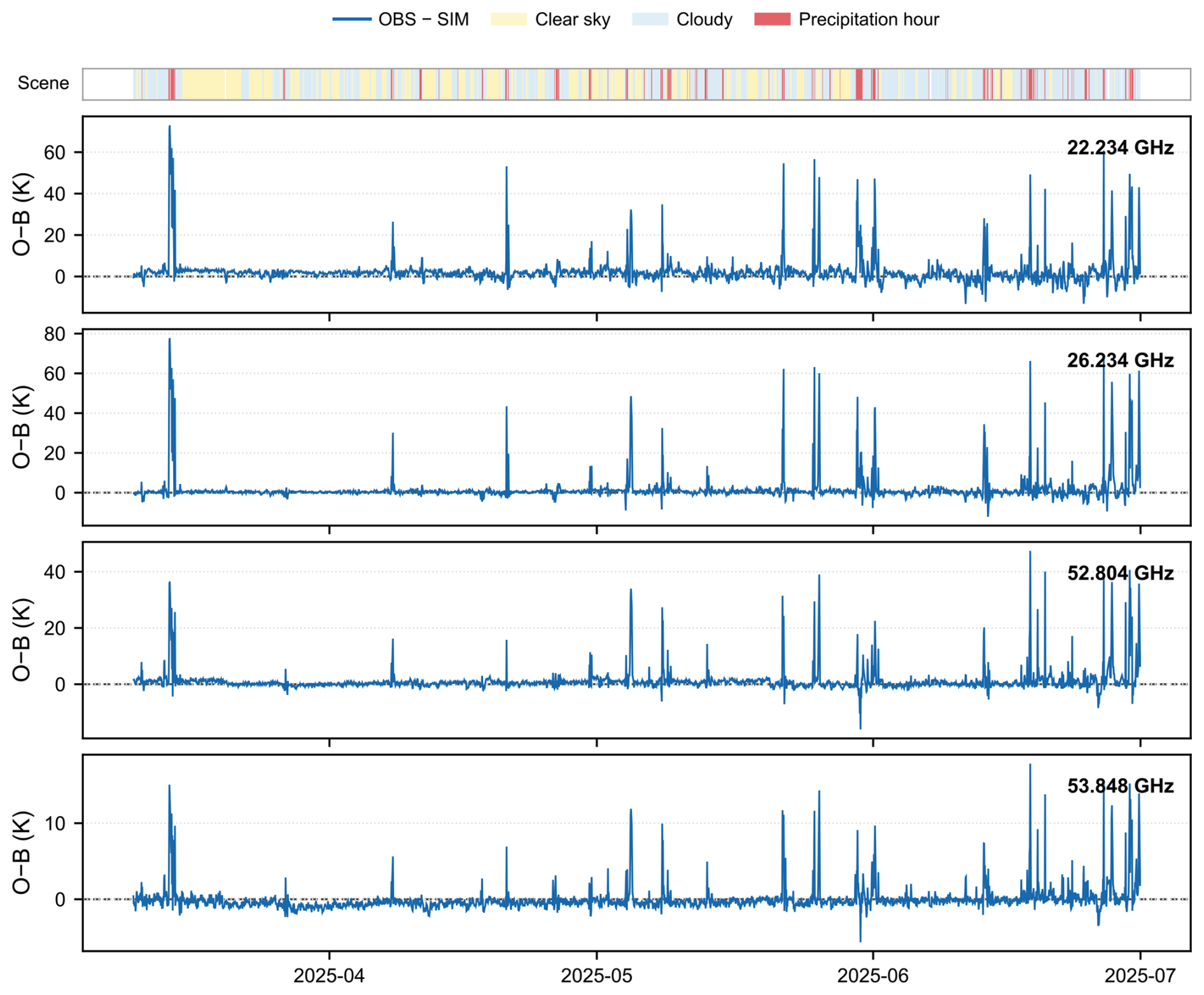
Figure 7Time series of differences between observed and simulated brightness temperatures (O–B) for ARMS-gb v2.0 at four representative YKW-1 channels at Yan'an from 10 March to 30 June 2025. The scene classification bar indicates clear sky, cloudy, and precipitation periods.
Model performance at Yan'an was evaluated against YKW-1 observations collected during January–June 2025. The analysis included 2135 quality-controlled hourly cases classified as cloudy and non-precipitating. Figure 8 presents scatterplots of observed versus simulated brightness temperatures with fitted regression lines and reports the coefficient of determination (R2), root mean square error (RMSE), and median O–B. Probability density functions (PDFs) above each panel show the corresponding distributions of observed and simulated brightness temperatures. To assess the robustness of the improvement in correlation, we excluded the few data points with very high brightness temperatures from the analysis. ARMS-gb v2.0 produced the highest R2 values at the selected channels in the water vapor and weak oxygen absorption bands. At 22.234 GHz, the R2 values were 0.95, 0.96, and 0.95 for ARMS-gb v1.0, ARMS-gb v2.0, and RTTOV-gb, respectively. RTTOV-gb showed intermediate agreement. At 30.000 GHz, where brightness temperatures were more strongly affected by hydrometeors, R2 increased from 0.55 for ARMS-gb v1.0 to 0.77 for ARMS-gb v2.0. A similarly pronounced improvement occurred at 51.248 GHz, where ARMS-gb v2.0 reduced the RMSE from 5.23 to 3.22 K and increased R2 from 0.52 to 0.81 relative to ARMS-gb v1.0. RTTOV-gb improved upon ARMS-gb v1.0 but remained less accurate than ARMS-gb v2.0. At the higher-frequency oxygen-band channels near 53–55 GHz, the simulations from all three models clustered closely around the 1:1 line, although ARMS-gb v2.0 generally produced the lowest RMSE and tightest scatter. Overall, ARMS-gb v2.0 achieved better agreement with the observed brightness temperatures than ARMS-gb v1.0 and RTTOV-gb, with the clearest improvements at 30.000 and 51.248 GHz.
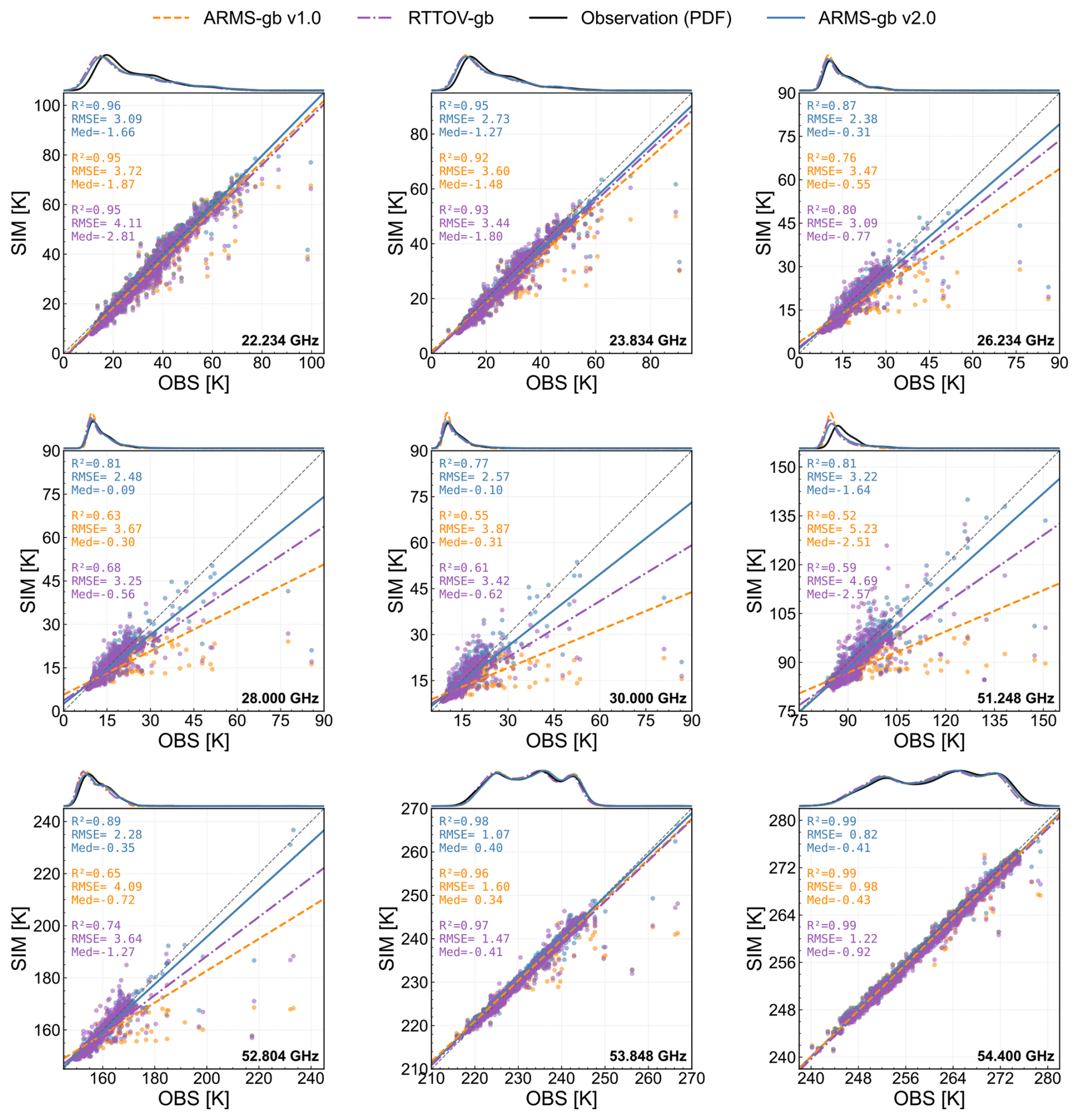
Figure 8Scatter plots of observed versus simulated brightness temperatures at selected YKW-1 channels, comparing ARMS-gb v1.0, v2.0, and RTTOV-gb with regression lines and summary statistics. The few data points with very high brightness temperatures were excluded from the analysis for the channels between 22.234 and 30.000 GHz and for the 51.248 GHz channel. Marginal PDFs of observations (black) and simulations are shown above each panel.
The diurnal variation in the ARMS-gb v2.0 O–B departures was examined using cloudy non-precipitating cases from January–June 2025. Figure 9 presents the corresponding mean departures for each YKW-1 channel and local hour. Distinct diurnal patterns were evident in both the water-vapor and oxygen absorption bands. In the lower-frequency water-vapor channels (channels 1–7), the departures were weakly positive overnight and increased to approximately 1–3 K in the early morning. They then decreased to near-zero or slightly negative values around midday before increasing again in the late afternoon and evening. Diurnal amplitudes were larger in the oxygen absorption band, particularly for channels 9–12. These channels reached midday minima ranging from approximately −6 to −3 K and evening maxima of approximately 3–6 K, with a secondary positive peak in the early morning. By contrast, the higher-frequency oxygen-band channels (channels 15–22) remained close to zero and showed comparatively weak diurnal variability throughout the day. These patterns may reflect combined contributions from mismatches in the ERA5 representation of boundary-layer and cloud evolution, residual radiative-transfer errors, and temperature-dependent instrumental or calibration effects. Because O–B statistics alone cannot distinguish these contributions, the patterns should not be attributed to a single error source. Their systematic time dependence should nevertheless be considered when developing bias-correction schemes and specifying observation errors for all-sky retrieval and data assimilation.
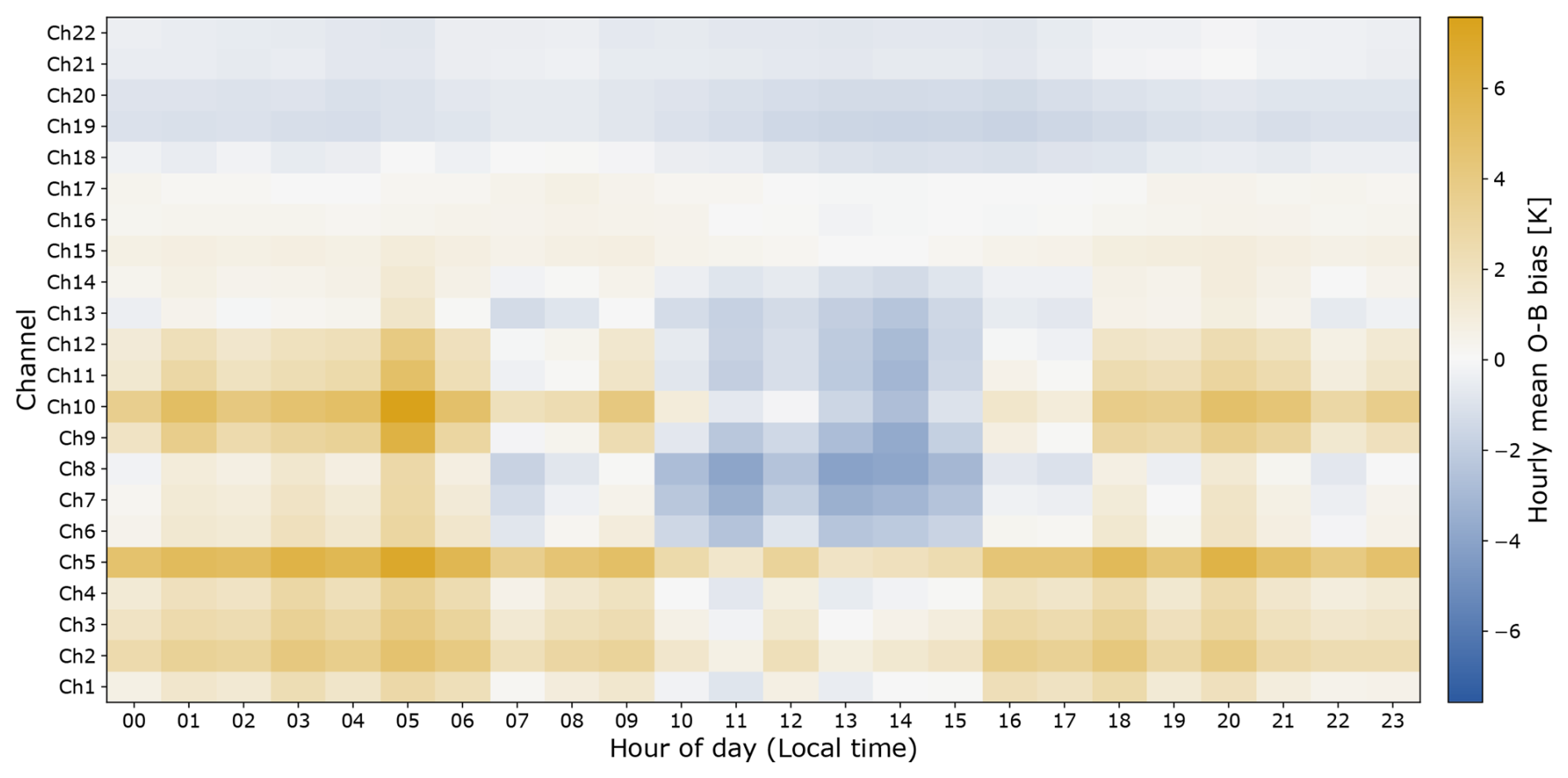
Figure 9Diurnal variation of the mean O–B bias for the YKW-1 ground-based microwave radiometer at Yan'an station from January to June 2025. The time is shown in local time (UTC+8).
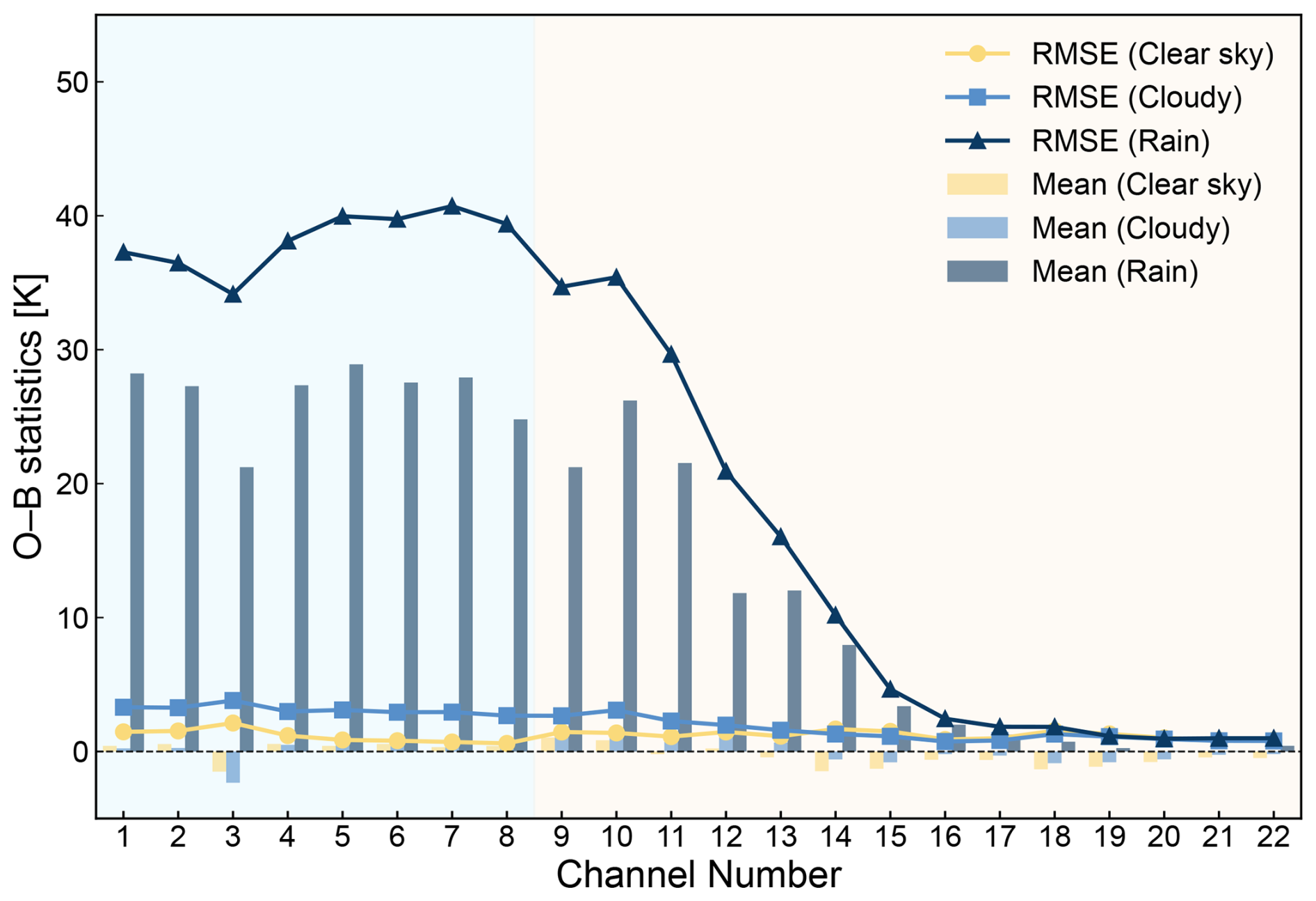
Figure 10RMSE and mean O–B for the YKW-1 at Yan'an station across all channels from January to June 2025, grouped by clear-sky, cloudy, and rainy conditions.
Reliable use of ground-based microwave radiometer observations in numerical weather prediction and nowcasting requires quantitative characterization of their error properties under different weather conditions, particularly during precipitation. Figure 10 summarizes the mean O–B and RMSE for YKW-1 at Yan'an under clear-sky, cloudy non-precipitating, and precipitating conditions from January to June 2025. In the six-month statistics, clear-sky departures were comparatively small, with mean O–B generally close to zero and RMSE around 2 K. Cloudy non-precipitating conditions produced modestly larger departures, although RMSE remained below 3 K for most channels. During precipitation, however, RMSE exceeded 35 K across much of the water-vapor band and peaked above 40 K at channel 7, while mean O–B reached nearly 30 K. The precipitation-related departures were largest in the water-vapor and weak oxygen absorption channels and decreased toward the strongly absorbing oxygen channels. These large departures should not be interpreted solely as atmospheric radiative-transfer errors. The simulations represent atmospheric rainwater absorption and scattering, whereas wet-radome and other near-instrument effects remain in the observations and are neither corrected nor represented in ARMS-gb v2.0. The observed and simulated conditions are therefore not fully equivalent during precipitation. Additional uncertainty arises from the representation of rainwater profiles and raindrop size distributions. Water deposited on the radome can also alter its effective microwave transmission and emission, while raindrop impacts and evaporation near the instrument may introduce further perturbations. Because these atmospheric and instrument-related contributions cannot be separated using O–B statistics alone, the precipitation cases are used here to characterize the practical magnitude of rain-contaminated departures rather than to provide strict model validation. Precipitation-affected GMR observations should therefore be used in retrieval and data assimilation only after applying rain-specific quality control, wet-radome corrections, and appropriate observation-error characterization.
This study presents ARMS-gb v2.0, a fast all-sky radiative transfer model for ground-based microwave radiometers. The model extends the previous version by adding a hydrometeor absorption and scattering module and implementing the accelerated discrete ordinate method for multiple scattering. It also provides tangent-linear and adjoint capabilities for all-sky variational applications. It supports simulations of cloud water, rain, ice, snow, and graupel using optical-property LUTs computed with Mie theory for liquid hydrometeors and DDA for frozen hydrometeors. The sensitivity experiments showed that brightness-temperature responses depend strongly on channel frequency, hydrometeor water path, and particle effective radius. Liquid hydrometeors generally enhanced downwelling brightness temperatures through absorption and thermal emission, whereas frozen hydrometeors generally produced cooling through scattering in weak oxygen absorption channels.
To evaluate the performance of ARMS-gb v2.0 under cloudy non-precipitating conditions, we conducted six-month experiments using observations from the 22-channel YKW-1 at Yan'an and the 14-channel YKW-2 at Karamay. ARMS-gb and MonoRTM produced similar channel-dependent clear-sky O–B departures at both sites, providing reference baselines for the cloudy-sky evaluation. Compared with ARMS-gb v1.0, ARMS-gb v2.0 brought the cloudy-sky mean O–B closer to the corresponding clear-sky baseline, with the differences generally remaining within ±1 K. At Yan'an, R2 increased from 0.55 to 0.77 at 30 GHz and from 0.52 to 0.81 at 51 GHz, where RMSE decreased from 5.23 to 3.22 K. The Mie- and DDA-based configurations yielded broadly comparable results, with the DDA-based treatment showing a slight advantage in the weak oxygen absorption channels. During precipitation, GMR observations are affected by atmospheric rainwater, wet-radome effects, and other near-instrument processes, resulting in large and difficult-to-separate errors. Rain-affected observations should therefore not be used routinely in retrieval or data assimilation unless these errors are quantitatively characterized and explicitly accounted for.
Overall, the results show that ARMS-gb v2.0 provides an improved forward-model framework for simulating GMR brightness temperatures under cloudy non-precipitating conditions. Future work will extend instrument coverage, including higher-frequency systems, and improve the quantitative characterization of atmospheric and instrument-related uncertainties during precipitation. The model will also be integrated into one-dimensional variational retrieval and data-assimilation frameworks to support more reliable use of GMR observations for boundary-layer monitoring under cloudy and, ultimately, precipitation-affected conditions.
The ARMS-gb v2.0 code is available on Zenodo at https://doi.org/10.5281/zenodo.21254364 (Huang et al., 2026). The 137-level ERA5 reanalysis data are available from the Copernicus Climate Data Store at https://doi.org/10.24381/cds.143582cf (Copernicus Climate Change Service, 2023). The original operational GMR observations from Karamay and Yan'an used in this study are managed by the China Meteorological Administration and require application and approval through CMADaaS for use under the CMA data policy (https://data.cma.cn/en, last access: 15 October 2026, China Meteorological Administration, 2026). The processed O–B result files used in the model-evaluation experiments are available on Zenodo at https://doi.org/10.5281/zenodo.21262924 (Huang and Shi, 2026). RTTOV-gb can be downloaded from the EUMETSAT NWP SAF website https://nwp-saf.eumetsat.int/site/software/rttov-gb/ (last access: 15 October 2026) (Cimini et al., 2019).
ZH and YNS developed the model code and prepared the initial draft. JY and FW offered the conception of the study and led the model development. All authors discussed this work and reviewed the paper.
The contact author has declared that none of the authors has any competing interests.
Publisher's note: Copernicus Publications remains neutral with regard to jurisdictional claims made in the text, published maps, institutional affiliations, or any other geographical representation in this paper. The authors bear the ultimate responsibility for providing appropriate place names. Views expressed in the text are those of the authors and do not necessarily reflect the views of the publisher.
We thank Jiajia Mao for her assistance in obtaining and preprocessing the ground-based microwave radiometer data. We also thank the editor and the reviewers for their constructive comments and suggestions, which helped improve the manuscript.
This research was funded by the National Natural Science Foundation of China (grant nos. U2542214, U2542208 and 42305162), the National Key Research and Development Program of China (grant no. 2021YFB3900400), and the Independent Research Project of the State Key Laboratory of Severe Weather Meteorological Science and Technology (grant no. CXFZ2025J009).
This paper was edited by Graham Mann and reviewed by two anonymous referees.
Bauer, P., Geer, A. J., Lopez, P., and Salmond, D.: Direct 4D-Var assimilation of all-sky radiances. Part I: Implementation, Q. J. Roy. Meteor. Soc., 136, 1868–1885, 2010.
Cao, Y., Shi, B., Zhao, X., Yang, T., and Min, J.: Direct Assimilation of Ground-Based Microwave Radiometer Clear-Sky Radiance Data and Its Impact on the Forecast of Heavy Rainfall, Remote Sens.-Basel, 15, 4314, https://doi.org/10.3390/rs15174314, 2023.
China Meteorological Administration: China Meteorological Data Service Center, https://data.cma.cn/en (last access: 15 October 2026), 2026.
Cimini, D., Hewison, T. J., Martin, L., Güldner, J., Gaffard, C., and Marzano, F. S.: Temperature and humidity profile retrievals from ground-based microwave radiometers during TUC, Meteorol. Z., 15, 45–56, https://doi.org/10.1127/0941-2948/2006/0099, 2006.
Cimini, D., Hocking, J., De Angelis, F., Cersosimo, A., Di Paola, F., Gallucci, D., Gentile, S., Geraldi, E., Larosa, S., Nilo, S., Romano, F., Ricciardelli, E., Ripepi, E., Viggiano, M., Luini, L., Riva, C., Marzano, F. S., Martinet, P., Song, Y. Y., Ahn, M. H., and Rosenkranz, P. W.: RTTOV-gb v1.0 – updates on sensors, absorption models, uncertainty, and availability, Geosci. Model Dev., 12, 1833–1845, https://doi.org/10.5194/gmd-12-1833-2019, 2019.
Clough, S. A., Shephard, M. W., Mlawer, E. J., Delamere, J. S., Iacono, M. J., Cady-Pereira, K., Boukabara, S., and Brown, P. D.: Atmospheric radiative transfer modeling: a summary of the AER codes, J. Quant. Spectrosc. Ra., 91, 233–244, https://doi.org/10.1016/j.jqsrt.2004.05.058, 2005.
Copernicus Climate Change Service: Complete ERA5 global atmospheric reanalysis, Copernicus Climate Change Service (C3S) Climate Data Store (CDS) [data set], https://doi.org/10.24381/cds.143582cf, 2023.
De Angelis, F., Cimini, D., Löhnert, U., Caumont, O., Haefele, A., Pospichal, B., Martinet, P., Navas-Guzmán, F., Klein-Baltink, H., Dupont, J.-C., and Hocking, J.: Long-term observations minus background monitoring of ground-based brightness temperatures from a microwave radiometer network, Atmos. Meas. Tech., 10, 3947–3961, https://doi.org/10.5194/amt-10-3947-2017, 2017.
Draine, B. T. and Flatau, P. J.: Discrete-Dipole Approximation For Scattering Calculations, J. Opt. Soc. Am. A, 11, 1491, https://doi.org/10.1364/JOSAA.11.001491, 1994.
Garnett, J. M.: VII. Colours in metal glasses, in metallic films, and in metallic solutions. – II, Philos. T. R. Soc. Lond., 205, 237–288, 1906.
Geer, A. J., Baordo, F., Bormann, N., Chambon, P., English, S. J., Kazumori, M., Lawrence, H., Lean, P., Lonitz, K., and Lupu, C.: The growing impact of satellite observations sensitive to humidity, cloud and precipitation: Impact of Satellite Humidity, Cloud and Precipitation Observations, Q. J. Roy. Meteor. Soc., 143, 3189–3206, https://doi.org/10.1002/qj.3172, 2017.
Hersbach, H., Bell, B., Berrisford, P., Hirahara, S., Horányi, A., Muñoz-Sabater, J., Nicolas, J., Peubey, C., Radu, R., and Schepers, D.: The ERA5 global reanalysis, Q. J. Roy. Meteor. Soc., 146, 1999–2049, 2020.
Hu, H. and Han, Y.: Comparing the Thermal Structures of Tropical Cyclones Derived From Suomi NPP ATMS and FY-3D Microwave Sounders, IEEE T. Geosci. Remote, 59, 8073–8083, https://doi.org/10.1109/TGRS.2020.3034262, 2021.
Huang, Z. and Shi, Y.-N.: Supplementary processed datasets for the evaluation of ARMS-gb v2.0 all-sky ground-based microwave radiometer simulations, Zenodo [data set], https://doi.org/10.5281/zenodo.21262924, 2026.
Huang, Z., Lu, H., Ma, Z., Shi, Y., Han, Y., Hu, H., and Yang, J.: A Nonspherical Cloud Scattering Database Using Aggregates of Roughened Bullet Rosettes Model for the Advanced Radiative Transfer Modeling System (ARMS), Adv. Atmos. Sci., 42, 1483–1498, https://doi.org/10.1007/s00376-024-4117-7, 2025.
Huang, Z., Shi, Y.-N., Weng, F., and Yang, J.: Development and validation of ARMS-gb v2.0: Extending fast radiative transfer modeling capability to all-sky conditions for ground-based microwave radiometers, Zenodo [code], https://doi.org/10.5281/zenodo.21254364, 2026.
Liou, K.-N., Fu, Q., and Ackerman, T. P.: A Simple Formulation of the Delta-Four-Stream Approximation for Radiative Transfer Parameterizations, J. Atmos. Sci., 45, 1940–1948, https://doi.org/10.1175/1520-0469(1988)045<1940:ASFOTD>2.0.CO;2, 1988.
Madhulatha, A., Rajeevan, M., Venkat Ratnam, M., Bhate, J., and Naidu, C. V.: Nowcasting severe convective activity over southeast India using ground-based microwave radiometer observations, J. Geophys. Res.-Atmos., 118, 1–13, https://doi.org/10.1029/2012JD018174, 2013.
Martinet, P., Cimini, D., Burnet, F., Ménétrier, B., Michel, Y., and Unger, V.: Improvement of numerical weather prediction model analysis during fog conditions through the assimilation of ground-based microwave radiometer observations: a 1D-Var study, Atmos. Meas. Tech., 13, 6593–6611, https://doi.org/10.5194/amt-13-6593-2020, 2020.
Mätzler, C. (Ed.): Thermal Microwave Radiation: Applications for Remote Sensing, Institution of Engineering and Technology, https://doi.org/10.1049/PBEW052E, 2006.
National Research Council: Observing Weather and Climate from the Ground Up: A Nationwide Network of Networks, The National Academies Press, Washington, DC, https://doi.org/10.17226/12540, 2009.
Petty, G. W. and Huang, W.: The Modified Gamma Size Distribution Applied to Inhomogeneous and Nonspherical Particles: Key Relationships and Conversions, J. Atmos. Sci., 68, 1460–1473, https://doi.org/10.1175/2011JAS3645.1, 2011.
Ray, P. S.: Broadband complex refractive indices of ice and water, Appl. Optics, 11, 1836–1844, 1972.
Rosenkranz, P. W.: Water vapor microwave continuum absorption: A comparison of measurements and models, Radio Sci., 33, 919–928, https://doi.org/10.1029/98RS01182, 1998.
Saunders, R., Matricardi, M., and Brunel, P.: An improved fast radiative transfer model for assimilation of satellite radiance observations: Assimilation of Satellite Radiance Observations, Q. J. Roy. Meteor. Soc., 125, 1407–1425, https://doi.org/10.1002/qj.1999.49712555615, 1999.
Shi, Y. and Weng, F.: An Accelerated Discrete Ordinate Method (ADOM) Developed for Scalar Radiative Transfer by Merging Adjacent Clear-Sky Atmospheric Layers: Forward and Jacobians Derivation, J. Adv. Model. Earth Sy., 17, e2025MS005136, https://doi.org/10.1029/2025MS005136, 2025.
Shi, Y.-N., Yang, J., Han, W., Han, L., Mao, J., Kan, W., and Weng, F.: Development of a fast radiative transfer model for ground-based microwave radiometers (ARMS-gb v1.0): validation and comparison to RTTOV-gb, Geosci. Model Dev., 18, 1947–1964, https://doi.org/10.5194/gmd-18-1947-2025, 2025.
Stamnes, K., Tsay, S.-C., Wiscombe, W., and Jayaweera, K.: Numerically stable algorithm for discrete-ordinate-method radiative transfer in multiple scattering and emitting layered media, Appl. Optics, 27, 2502, https://doi.org/10.1364/AO.27.002502, 1988.
Wei, Y., Peng, K., Ma, Y., Sun, Y., Zhao, D., Ren, X., Yang, S., Ahmad, M., Pan, X., Wang, Z., and Xin, J.: Validation of ERA5 Boundary Layer Meteorological Variables by Remote-Sensing Measurements in the Southeast China Mountains, Remote Sens.-Basel, 16, 548, https://doi.org/10.3390/rs16030548, 2024.
Weng, F. and Liu, Q.: Satellite Data Assimilation in Numerical Weather Prediction Models. Part I: Forward Radiative Transfer and Jacobian Modeling in Cloudy Atmospheres, J. Atmos. Sci., 60, 2633–2646, https://doi.org/10.1175/1520-0469(2003)060<2633:SDAINW>2.0.CO;2, 2003.
Weng, F., Han, Y., van Delst, P., Liu, Q., Kleespies, T., Yan, B., and Le Marshall, J.: JCSDA Community Radiative Transfer Model (CRTM), in: Proceedings of the 14th International TOVS Study Conference, Beijing, China, 217–222, https://itwg.ssec.wisc.edu/wordpress/wp-content/uploads/2023/05/6_8_Weng_paper_itsc14.pdf (last access: 15 October 2026), 2005.
Weng, F., Yu, X., Duan, Y., Yang, J., and Wang, J.: Advanced Radiative Transfer Modeling System (ARMS): A New-Generation Satellite Observation Operator Developed for Numerical Weather Prediction and Remote Sensing Applications, Adv. Atmos. Sci., 37, 131–136, https://doi.org/10.1007/s00376-019-9170-2, 2020.
Wu, J., Guo, J., Yun, Y., Yang, R., Guo, X., Meng, D., Sun, Y., Zhang, Z., Xu, H., and Chen, T.: Can ERA5 reanalysis data characterize the pre-storm environment?, Atmos. Res., 297, 107108, https://doi.org/10.1016/j.atmosres.2023.107108, 2024.
Yang, J. and Min, Q.: A passive and active microwave-vector radiative transfer (PAM-VRT) model, J. Quant. Spectrosc. Ra., 165, 123–133, https://doi.org/10.1016/j.jqsrt.2015.06.028, 2015.
Yang, J., Ding, S., Dong, P., Bi, L., and Yi, B.: Advanced radiative transfer modeling system developed for satellite data assimilation and remote sensing applications, J. Quant. Spectrosc. Ra., 251, 107043, https://doi.org/10.1016/j.jqsrt.2020.107043, 2020.
Zheng, Q., Sun, W., Liu, Z., Mao, J., He, J., Li, J., and Jiang, X.: Direct assimilation of ground-based microwave radiometer observations with machine learning bias correction based on developments of RTTOV-gb v1.0 and WRFDA v4.5, Geosci. Model Dev., 19, 731–754, https://doi.org/10.5194/gmd-19-731-2026, 2026.
- Abstract
- Introduction
- Model development
- Sensitivity of microwave brightness temperatures to hydrometeors
- Evaluation against ground-based microwave radiometer observations
- Conclusions
- Code and data availability
- Author contributions
- Competing interests
- Disclaimer
- Acknowledgements
- Financial support
- Review statement
- References