Articles | Volume 19, issue 18
https://doi.org/10.5194/gmd-19-8977-2026
© Author(s) 2026. This work is distributed under
the Creative Commons Attribution 4.0 License.
Special issue:
https://doi.org/10.5194/gmd-19-8977-2026
© Author(s) 2026. This work is distributed under
the Creative Commons Attribution 4.0 License.
CMIP6 data usage: lessons learned from more than 200 million downloads

Juliette Lavoie
CORRESPONDING AUTHOR
Ouranos, Montreal, Canada
Aude Carreric
Barcelona Supercomputing Center (BSC), Barcelona, Spain
Alistair Duffey
Department of Earth Sciences, University College London, London, UK
Reflective, San Francisco, United States
Giovanni Chellini
Laboratoire des Sciences du Climat et de l'Environnement, Institut Pierre-Simon Laplace, CEA/CNRS/UVSQ, Gif-sur-Yvette, France
Elisa Ziegler
CORRESPONDING AUTHOR
Department of Geosciences, University of Tübingen, Tübingen, Germany
Related authors
No articles found.
Mehdi Pasha Karami, Torben Koenigk, Shiyu Wang, René Navarro Labastida, Tim Kruschke, Aude Carréric, Pablo Ortega, Klaus Wyser, Ramon Fuentes Franco, Agatha M. de Boer, Marie Sicard, and Aitor Aldama Campino
Earth Syst. Dynam., 17, 1151–1176, https://doi.org/10.5194/esd-17-1151-2026, https://doi.org/10.5194/esd-17-1151-2026, 2026
Short summary
Short summary
This study uses a high-resolution global climate model to simulate future climate, with a particular focus on the Arctic and North Atlantic. The model projects a nearly ice-free Arctic by 2040. The paper also introduces a framework to diagnose deep-water formation (DWF) in the Labrador, Irminger, and Greenland Seas and to quantify their regional contributions to the Atlantic Meridional Overturning Circulation (AMOC), revealing how different ocean regions contribute to the weakening of AMOC in a warming climate.
Man Mei Chim, Dominik Stiller, Elisa Ziegler, Thomas J. Aubry, Lucas Boissel, Sébastien Guillet, Brennan Rodgers, Matthew Toohey, Christine Pohl, and Alexei Rozanov
EGUsphere, https://doi.org/10.5194/egusphere-2026-4193, https://doi.org/10.5194/egusphere-2026-4193, 2026
Short summary
Short summary
Stratospheric aerosols from explosive volcanic eruptions are a major climate forcer. We compare the stratospheric aerosol forcing for the next phase of coordinated climate model experiments (CMIP7) against complementary datasets, such as observations of lunar eclipses, stellar extinction, and from satellites. We highlight the potential value of combining observational constraints from complementary datasets with the extensive CMIP7 volcanic emission inventory to refine future forcing data.
Anthony C. Jones, James M. Haywood, Matthew Henry, and Alistair Duffey
Atmos. Chem. Phys., 26, 7589–7605, https://doi.org/10.5194/acp-26-7589-2026, https://doi.org/10.5194/acp-26-7589-2026, 2026
Short summary
Short summary
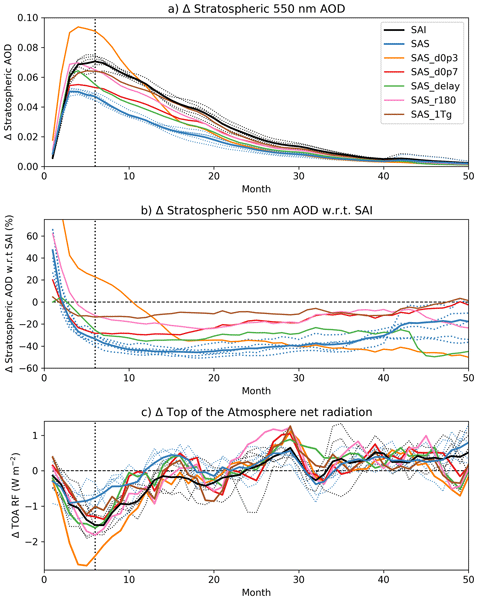
Injecting aerosol into the stratosphere has been suggested to rapidly cool the planet and counter climate change. Rival actors who oppose deployment may seek to counter stratospheric aerosol injection. Using a climate model, we investigate whether stratospheric aerosol removal could be hastened by injecting coarse aerosol which promote aerosol growth and gravitational settling. We find that this could be effective, reducing aerosol impacts by 30 % in simulations, and warrants further research.
Thomas J. Aubry, Matthew Toohey, Sujan Khanal, Man Mei Chim, Magali Verkerk, Ben Johnson, Anja Schmidt, Mahesh Kovilakam, Michael Sigl, Zebedee Nicholls, Larry Thomason, Vaishali Naik, Landon Rieger, Dominik Stiller, Elisa Ziegler, Paul Durack, and Isabel H. Smith
Geosci. Model Dev., 19, 3725–3756, https://doi.org/10.5194/gmd-19-3725-2026, https://doi.org/10.5194/gmd-19-3725-2026, 2026
Short summary
Short summary
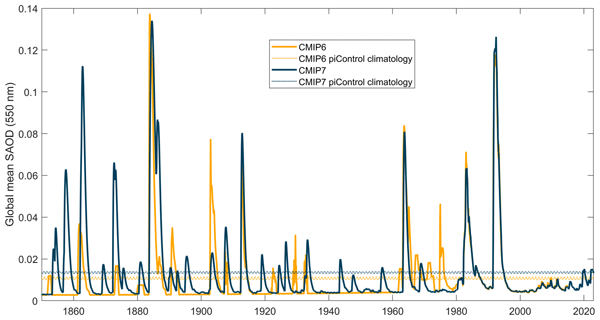
Climate forcings, such as solar radiation or anthropogenic greenhouse gases, are required to run global climate model simulations. Stratospheric aerosols, which mostly originate from large volcanic eruptions, are a key natural forcing. In this paper, we document the stratospheric aerosol forcing dataset that will feed the next generation (CMIP7) of climate models. Our dataset is very different from its predecessor (CMIP6), which might affect simulations of the 1850–2021 climate.
Alistair Duffey, Walker Lee, Lauren Wheeler, Peter Irvine, Benjamin Wagman, Matthew Henry, Daniele Visioni, Michel Tsamados, and Douglas MacMartin
Earth Syst. Dynam., 17, 353–385, https://doi.org/10.5194/esd-17-353-2026, https://doi.org/10.5194/esd-17-353-2026, 2026
Short summary
Short summary
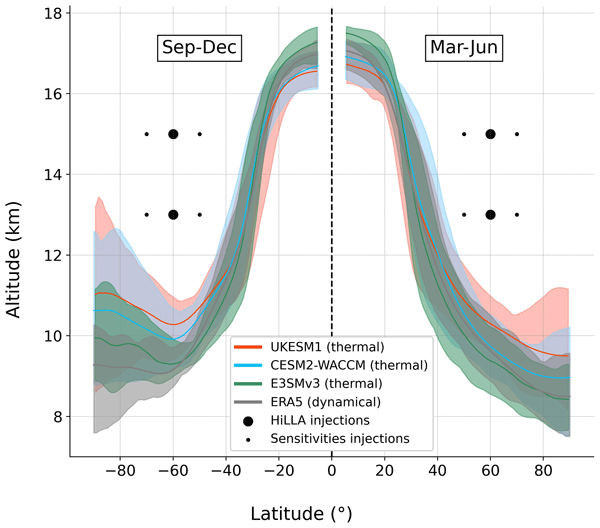
Adding a layer of reflective particles high in the atmosphere is one suggested way of cooling the planet and reducing the impacts of climate change. This technique might be less logistically difficult in the high latitudes, because the material could be released at lower altitude there. Here, we use new simulations in three earth system models to assess how this form of intervention, High-Latitude Low-Altitude Stratospheric Aerosol Injection (HiLLA-SAI), would impact the global climate.
Moritz Adam, Elisa Ziegler, Björn Gonzalez, Nils Weitzel, and Kira Rehfeld
EGUsphere, https://doi.org/10.5194/egusphere-2026-626, https://doi.org/10.5194/egusphere-2026-626, 2026
Short summary
Short summary
As plants take up Carbon Dioxide from the atmosphere, they buffer climate change. They are vulnerable to extreme weather and climate. When temperature and moisture extremes happen simultaneously, they strongly affect how plants grow. We use complex computer models to understand impacts of extremes on plants. We compared the models to observations. The models do well globally and okay in many regions. Locally, they need improvement because modeling how water moves through the soil is difficult.
Jared Farley, Douglas G. MacMartin, Daniele Visioni, Ben Kravitz, Ewa M. Bednarz, Alistair Duffey, Matthew Henry, and Ali Akherati
Geosci. Model Dev., 19, 1809–1831, https://doi.org/10.5194/gmd-19-1809-2026, https://doi.org/10.5194/gmd-19-1809-2026, 2026
Short summary
Short summary
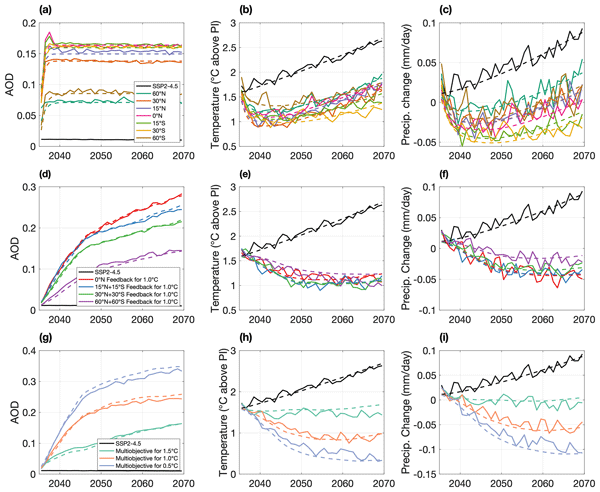
As the climate changes, many are studying sunlight reflection as a potential method of cooling. Such climate intervention could be deployed in many possible ways, including in scenarios where not every actor agrees on the strategy of cooling. These scenarios are so diverse that to explore all of them using earth system models proves to be too costly. In this paper, we develop a simplified climate model that allows users to easily explore climate intervention scenarios of their choice.
Kerstin Ebell, Christian Buhren, Rosa Gierens, Giovanni Chellini, Melanie Lauer, Andreas Walbröl, Sandro Dahlke, Pavel Krobot, and Mario Mech
Atmos. Chem. Phys., 25, 7315–7342, https://doi.org/10.5194/acp-25-7315-2025, https://doi.org/10.5194/acp-25-7315-2025, 2025
Short summary
Short summary
Ground-based observations of precipitation are rare in the Arctic. Since 2017, additional temporally highly resolved precipitation measurements have been carried out by a precipitation gauge and an optical precipitation sensor at Ny-Ålesund, Svalbard. These new data facilitate the distinction between liquid and solid precipitation. Using reanalysis data, we also find that water vapor transport contributes strongly to precipitation and especially to extreme precipitation events.
Gideon Futerman, Mira Adhikari, Alistair Duffey, Yuanchao Fan, Jessica Gurevitch, Peter Irvine, and Claudia Wieners
Earth Syst. Dynam., 16, 939–978, https://doi.org/10.5194/esd-16-939-2025, https://doi.org/10.5194/esd-16-939-2025, 2025
Short summary
Short summary
This review assesses the interaction of solar radiation modification (SRM), a technology to reduce the impacts of climate change by reflecting sunlight and earth system tipping elements. We find that SRM at least partially reduces the risk of hitting most (9 out of 15) of the tipping points we studied relative to the same emission pathway and did not overall worsen the risk for any. Uncertainties for all tipping elements studied were high, so we also lay out suggestions for future research.
Elisa Ziegler, Nils Weitzel, Jean-Philippe Baudouin, Marie-Luise Kapsch, Uwe Mikolajewicz, Lauren Gregoire, Ruza Ivanovic, Paul J. Valdes, Christian Wirths, and Kira Rehfeld
Clim. Past, 21, 627–659, https://doi.org/10.5194/cp-21-627-2025, https://doi.org/10.5194/cp-21-627-2025, 2025
Short summary
Short summary
During the Last Deglaciation, global surface temperature rose by about 4–7 °C over several millennia. We show that changes in year-to-year up to century-to-century fluctuations of temperature and precipitation during the Deglaciation were mostly larger than during either the preceding or succeeding more stable periods in 15 climate model simulations. The analysis demonstrates how ice sheets, meltwater, and volcanism influence simulated variability to inform future simulation protocols.
Nils Weitzel, Heather Andres, Jean-Philippe Baudouin, Marie-Luise Kapsch, Uwe Mikolajewicz, Lukas Jonkers, Oliver Bothe, Elisa Ziegler, Thomas Kleinen, André Paul, and Kira Rehfeld
Clim. Past, 20, 865–890, https://doi.org/10.5194/cp-20-865-2024, https://doi.org/10.5194/cp-20-865-2024, 2024
Short summary
Short summary
The ability of climate models to faithfully reproduce past warming episodes is a valuable test considering potentially large future warming. We develop a new method to compare simulations of the last deglaciation with temperature reconstructions. We find that reconstructions differ more between regions than simulations, potentially due to deficiencies in the simulation design, models, or reconstructions. Our work is a promising step towards benchmarking simulations of past climate transitions.
Giovanni Chellini, Rosa Gierens, Kerstin Ebell, Theresa Kiszler, Pavel Krobot, Alexander Myagkov, Vera Schemann, and Stefan Kneifel
Earth Syst. Sci. Data, 15, 5427–5448, https://doi.org/10.5194/essd-15-5427-2023, https://doi.org/10.5194/essd-15-5427-2023, 2023
Short summary
Short summary
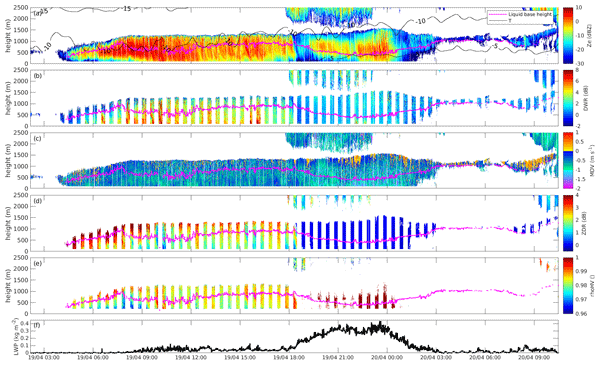
We present a comprehensive quality-controlled dataset of remote sensing observations of low-level mixed-phase clouds (LLMPCs) taken at the high Arctic site of Ny-Ålesund, Svalbard, Norway. LLMPCs occur frequently in the Arctic region, and substantially warm the surface. However, our understanding of microphysical processes in these clouds is incomplete. This dataset includes a comprehensive set of variables which allow for extensive investigation of such processes in LLMPCs at the site.
Alistair Duffey, Robbie Mallett, Peter J. Irvine, Michel Tsamados, and Julienne Stroeve
Earth Syst. Dynam., 14, 1165–1169, https://doi.org/10.5194/esd-14-1165-2023, https://doi.org/10.5194/esd-14-1165-2023, 2023
Short summary
Short summary
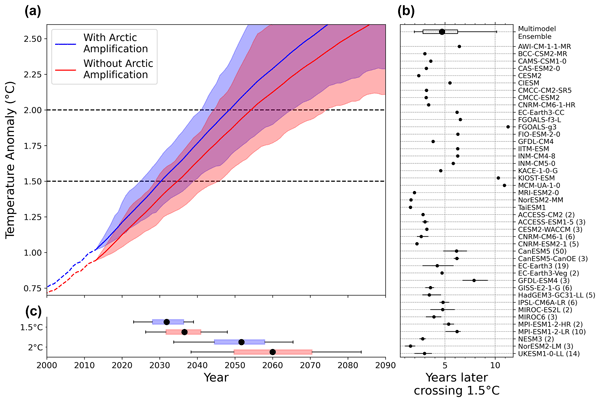
The Arctic is warming several times faster than the rest of the planet. Here, we use climate model projections to quantify for the first time how this faster warming in the Arctic impacts the timing of crossing the 1.5 °C and 2 °C thresholds defined in the Paris Agreement. We show that under plausible emissions scenarios that fail to meet the Paris 1.5 °C target, a hypothetical world without faster warming in the Arctic would breach that 1.5 °C target around 5 years later.
Christian Wirths, Elisa Ziegler, and Kira Rehfeld
EGUsphere, https://doi.org/10.5194/egusphere-2023-86, https://doi.org/10.5194/egusphere-2023-86, 2023
Preprint archived
Short summary
Short summary
We compare Holocene temperature trends from reconstructions and global climate models of different complexities. We find that models of all complexities disagree with mid-Holocene trends in reconstructions, and we show that this disagreement is largely independent of the type of reconstruction. From our results we conclude that a seasonal bias in the reconstructions is unlikely as a full explanation for the disagreement.
Giovanni Chellini and Kerstin Ebell
Atmos. Meas. Tech. Discuss., https://doi.org/10.5194/amt-2022-22, https://doi.org/10.5194/amt-2022-22, 2022
Preprint withdrawn
Short summary
Short summary
Moisture inversions (MIs), i.e. atmospheric layers where specific humidity increases with height, are frequent in the Arctic. This study assesses the capability of two satellite instruments, IASI and AIRS, and one reanalysis, ERA5, to detect MIs at an Arctic site. The comparison with radiosonde data shows that humidity profiles from IASI and AIRS severely underestimate the occurrence of MIs. On the other hand, MI characteristics in ERA5 are comparable to those in the radiosonde data.
Cited articles
Acosta, M. C., Palomas, S., Paronuzzi Ticco, S. V., Utrera, G., Biercamp, J., Bretonniere, P.-A., Budich, R., Castrillo, M., Caubel, A., Doblas-Reyes, F., Epicoco, I., Fladrich, U., Joussaume, S., Kumar Gupta, A., Lawrence, B., Le Sager, P., Lister, G., Moine, M.-P., Rioual, J.-C., Valcke, S., Zadeh, N., and Balaji, V.: The computational and energy cost of simulation and storage for climate science: lessons from CMIP6, Geosci. Model Dev., 17, 3081–3098, https://doi.org/10.5194/gmd-17-3081-2024, 2024.
Agarwal, D., Ayliffe, J., J. H. Buck, J., Damerow, J., Parton, G., Stall, S., Stockhause, M., and Wyborn, L.: Complex Citation Working Group Recommendation, Zenodo [report], https://doi.org/10.15497/RDA00130, 2025.
Balaji, V., Taylor, K. E., Juckes, M., Lawrence, B. N., Durack, P. J., Lautenschlager, M., Blanton, C., Cinquini, L., Denvil, S., Elkington, M., Guglielmo, F., Guilyardi, E., Hassell, D., Kharin, S., Kindermann, S., Nikonov, S., Radhakrishnan, A., Stockhause, M., Weigel, T., and Williams, D.: Requirements for a global data infrastructure in support of CMIP6, Geosci. Model Dev., 11, 3659–3680, https://doi.org/10.5194/gmd-11-3659-2018, 2018.
Buontempo, C., Burgess, S.N., Dee, D., Pinty, B., Thépaut, J.-N., Rixen, M., Almond, S., Armstrong, D., Brookshaw, A., Alos, A.L., Bell, B., Bergeron, C., Cagnazzo, C., Comyn-Platt, E., Damasio-Da-Costa, E., Guillory, A., Hersbach, H., Horányi, A., Nicolas, J., Obregon, A., Ramos, E.P., Raoult, B., Muñoz-Sabater, J., Simmons, A., Soci, C., Suttie, M., Vamborg, F., Varndell, J., Vermoote, S., Yang, X., and de Marcilla, J. G.: The Copernicus Climate Change Service: Climate Science in Action, B. Am. Meteorol. Soc., 103, E2669–E2687, https://doi.org/10.1175/BAMS-D-21-0315.1, 2022.
Busecke, J. J. M. and Stern, C. I.: cmip6-leap-feedstock (v0.2.0), Zenodo [code], https://doi.org/10.5281/zenodo.10621538, 2024.
Durack, P. J., Taylor, K. E., Gleckler, P. J., Meehl, G. A., Lawrence, B. N., Covey, C., Stouffer, R. J., Levavasseur, G., Ben-Nasser, A., Denvil, S., Stockhause, M., Gregory, J. M., Juckes, M., Ames, S. K., Antonio, F., Bader, D. C., Dunne, J. P., Ellis, D., Eyring, V., Fiore, S. L., Joussaume, S., Kershaw, P., Lamarque, J.-F., Lautenschlager, M., Lee, J., Mauzey, C. F., Mizielinski, M., Nassisi, P., Nuzzo, A., O'Rourke, E., Painter, J., Potter, G. L., Rodriguez, S., and Williams, D. N.: The Coupled Model Intercomparison Project (CMIP): Reviewing project history, evolution, infrastructure and implementation, EGUsphere [preprint], https://doi.org/10.5194/egusphere-2024-3729, 2025.
Eyring, V., Bony, S., Meehl, G. A., Senior, C. A., Stevens, B., Stouffer, R. J., and Taylor, K. E.: Overview of the Coupled Model Intercomparison Project Phase 6 (CMIP6) experimental design and organization. Geosci. Model Dev., 9, 1937–1958, https://doi.org/10.5194/gmd-9-1937-2016, 2016.
Gates, W. L., Boyle, J. S., Covey, C., Dease, C. G., Doutriaux, C. M., Drach, R. S., Fiorino, M., Gleckler, P. J., Hnilo, J. J., Marlais, S. M., Phillips, T. J., Potter, G. L., Santer, B. D., Sperber, K. R., Taylor, K. E., and Williams, D. N.: An Overview of the Results of the Atmospheric Model Intercomparison Project (AMIP I), B. Am. Meteorol. Soc., 80, 29–56, https://doi.org/10.1175/1520-0477(1999)080<0029:AOOTRO>2.0.CO;2, 1999.
Gentemann, C. L., Holdgraf, C., Abernathey, R., Crichton, D., Colliander, J., Kearns, E. J., Panda, Y., and Signell, R. P.: Science Storms the Cloud, AGU Adv., 2, e2020AV000354, https://doi.org/10.1029/2020AV000354, 2021.
Gutowski Jr., W. J., Giorgi, F., Timbal, B., Frigon, A., Jacob, D., Kang, H.-S., Raghavan, K., Lee, B., Lennard, C., Nikulin, G., O'Rourke, E., Rixen, M., Solman, S., Stephenson, T., and Tangang, F.: WCRP COordinated Regional Downscaling EXperiment (CORDEX): A diagnostic MIP for CMIP6, Geosci. Model Dev., 9, 4087–4095, https://doi.org/10.5194/gmd-9-4087-2016, 2016.
Ju, Y., Azad, N., Ding, W., and He, H.: Progress and Trends in Coupled Model Intercomparison Project (CMIP) Research: A Bibliometric Analysis, Agriculture, 15, 826, https://doi.org/10.3390/agriculture15080826, 2025.
Juckes, M., Eyring, V., Taylor, K., Balaji, V., and Stouffer, R.: The CMIP6 Data Request: the next generation climate archive, in: EGU General Assembly Conference Abstracts, 17, 13112, 2015.
Juckes, M., Taylor, K. E., Durack, P. J., Lawrence, B., Mizielinski, M. S., Pamment, A., Peterschmitt, J.-Y., Rixen, M., and Sénési, S.: The CMIP6 Data Request (DREQ, version 01.00.31), Geosci. Model Dev., 13, 201–224, https://doi.org/10.5194/gmd-13-201-2020, 2020.
Juckes, M., Taylor, K. E., Antonio, F., Brayshaw, D., Buontempo, C., Cao, J., Durack, P. J., Kawamiya, M., Kim, H., Lovato, T., Mackallah, C., Mizielinski, M., Nuzzo, A., Stockhause, M., Visioni, D., Walton, J., Turner, B., O'Rourke, E., and Dingley, B.: Baseline Climate Variables for Earth System Modelling, Geosci. Model Dev., 18, 2639–2663, https://doi.org/10.5194/gmd-18-2639-2025, 2025.
Kindermann, S., Stockhause, M., Nuzzo, A., Juckes, M., Hassel, D., Levavasseur, G., and Spinuso, A.: Second KPI and TA report for ENES CDI data services (IS-ENES3 Deliverable D7.3), https://raw.githubusercontent.com/IS-ENES3/IS-ENES-Website/main/pdf_documents/IS-ENES3-D7.3.pdf (last access: 9 September 2026), 2022.
Kindermann, S., Stockhause, M., Nuzzo, A., Juckes, M., Hassel, D., Levavasseur, G., and Spinuso, A.: Final KPI and TA report for ENES CDI data services (IS-ENES3 Deliverable D7.6), https://raw.githubusercontent.com/IS-ENES3/IS-ENES-Website/main/pdf_documents/IS-ENES3_D7.6.pdf (last access: 9 September 2026), 2023.
Klöwer, M., Razinger, M., Dominguez, J. J., Düben, P. D., and Palmer, T. N.: Compressing atmospheric data into its real information content, Nat. Comput. Sci., 1, 713–724, https://doi.org/10.1038/s43588-021-00156-2, 2021.
Lavoie, J., Ziegler, E., Carreric, A., Duffey, A., and Chellini, G.: CMIP6 Data Usage (v1.0.1), Zenodo [code and data set], https://doi.org/10.5281/zenodo.18881806, 2026 (code also available at: https://github.com/Fresh-Eyes-on-CMIP/CMIP6_Data_Usage, last access: 9 September 2026).
Mackallah, C., Juckes, M., Anstey, J., Dingley, B., Pascoe, C., Rigoudy, G., Moine, M.-P., Lovato, T., Pamment, A., Schupfner, M., Kawamiya, M., Bergman, T., Koven, C., O'Rourke, E., Turner, B., Ellis, D., and Mizielinski, M.: CMIP7 Data Request: co-created guidance for the production of CMIP7 data [v1.2.2.3], EGUsphere [preprint], https://doi.org/10.5194/egusphere-2026-1641, 2026.
Meehl, G. A.: Global Coupled General Circulation Models, B. Am. Meteorol. Soc., 76, 951–957, https://doi.org/10.1175/1520-0477-76.6.951, 1995.
Meehl, G. A., Boer, G. J., Covey, C., Latif, M., and Stouffer, R. J.: Intercomparison makes for a better climate model, Eos Trans. Am. Geophys. Union, 78, 445–451, https://doi.org/10.1029/97EO00276, 1997.
Meehl, G. A., Covey, C., McAvaney, B., Latif, M., and Stouffer, R. J.: Overview of the coupled model intercomparison project, B. Am. Meteorol. Soc., 86, 89–93, https://doi.org/10.1175/BAMS-86-1-89, 2005.
Mizielinski, M., Anstey, J., Kershaw, P., Pascoe, C., Radhakrishnan, A., Schupfner, M., and Hoffman, F.: Accessing and using CMIP data, CMIP 2026 Community Workshop, Kyoto, Japan, Zenodo [presentation], https://doi.org/10.5281/zenodo.18934629, 2026.
O'Neill, B. C., Tebaldi, C., van Vuuren, D. P., Eyring, V., Friedlingstein, P., Hurtt, G., Knutti, R., Kriegler, E., Lamarque, J.-F., Lowe, J., Meehl, G. A., Moss, R., Riahi, K., and Sanderson, B. M.: The Scenario Model Intercomparison Project (ScenarioMIP) for CMIP6, Geosci. Model Dev., 9, 3461–3482, https://doi.org/10.5194/gmd-9-3461-2016, 2016.
O'Rourke, E.: CMIP6 Community Survey Results, Zenodo [presentation], https://doi.org/10.5281/zenodo.8113057, 2023.
Ramamurthy, M.: Geoscience Cyberinfrastructure in the Cloud: Data-Proximate Computing to Address Big Data and Open Science Challenges, in: 2017 IEEE 13th International Conference on e-Science (e-Science), Auckland, New Zealand, 444–445, https://doi.org/10.1109/eScience.2017.63, 2017.
Sigmond, M., Anstey, J., Arora, V., Digby, R., Gillett, N., Kharin, V., Merryfield, W., Reader, C., Scinocca, J., Swart, N., Virgin, J., Abraham, C., Cole, J., Lambert, N., Lee, W.-S., Liang, Y., Malinina, E., Rieger, L., von Salzen, K., Seiler, C., Seinen, C., Shao, A., Sospedra-Alfonso, R., Wang, L., and Yang, D.: Improvements in the Canadian Earth System Model (CanESM) through systematic model analysis: CanESM5.0 and CanESM5.1, Geosci. Model Dev., 16, 6553–6591, https://doi.org/10.5194/gmd-16-6553-2023, 2023.
Stern, C., Abernathey, R., Hamman, J., Wegener, R., Lepore, C., Harkins, S., and Merose, A.: Pangeo Forge: Crowdsourcing Analysis-Ready, Cloud Optimized Data Production, Front. Clim., 3, 782909, https://doi.org/10.3389/fclim.2021.782909, 2022.
Stockhause, M., Toussaint, F., and Lautenschlager, M.: CMIP6 Data Citation and Long-Term Archival, Zenodo [report], https://doi.org/10.5281/zenodo.35178, 2015.
Voosen, P.: Climate modelers grapple with their own emissions, Science, 384, 494–495, https://doi.org/10.1126/science.adq1772, 2024.
Short summary
The Coupled Model Intercomparison Project (CMIP) is a large collaborative project to better understand the Earth’s climate system. The data produced through this project is downloaded by users around the world. In this paper, we analyze the patterns of downloads and the usage of this massive dataset. From this analysis, we make some recommendations for future data production and usage tracking.
The Coupled Model Intercomparison Project (CMIP) is a large collaborative project to better...
Special issue