
Articles | Volume 19, issue 18
https://doi.org/10.5194/gmd-19-8959-2026
© Author(s) 2026. This work is distributed under
the Creative Commons Attribution 4.0 License.
the Creative Commons Attribution 4.0 License.
https://doi.org/10.5194/gmd-19-8959-2026
© Author(s) 2026. This work is distributed under
the Creative Commons Attribution 4.0 License.
the Creative Commons Attribution 4.0 License.
Model description paper
| 
22 Sep 2026
Model description paper |
| 22 Sep 2026
| 22 Sep 2026
A simplified isoprene oxidation mechanism for fast formaldehyde-based emission inversion of isoprene
Glenn-Michael Oomen
CORRESPONDING AUTHOR

Royal Belgian Institute for Space Aeronomy (BIRA-IASB), Brussels, Belgium
Jean-François Müller
Royal Belgian Institute for Space Aeronomy (BIRA-IASB), Brussels, Belgium
Trissevgeni Stavrakou
Royal Belgian Institute for Space Aeronomy (BIRA-IASB), Brussels, Belgium
Isabelle De Smedt
Royal Belgian Institute for Space Aeronomy (BIRA-IASB), Brussels, Belgium
Vincent Huijnen
Royal Netherlands Meteorological Institute (KNMI), De Bilt, the Netherlands
Flora Kluge
European Center for Medium-Range Weather Forecasting (ECMWF), Bonn, Germany
Antje Inness
European Center for Medium-Range Weather Forecasting (ECMWF), Reading, United Kingdom
Johannes Flemming
European Center for Medium-Range Weather Forecasting (ECMWF), Bonn, Germany
Related authors
Yasmine Sfendla, Trissevgeni Stavrakou, Jean-François Müller, Glenn-Michael Oomen, Beata Opacka, Thomas Danckaert, Isabelle De Smedt, and Christophe Lerot
Atmos. Chem. Phys., 26, 733–767, https://doi.org/10.5194/acp-26-733-2026, https://doi.org/10.5194/acp-26-733-2026, 2026
Short summary
Short summary
Volatile organic compounds (VOC) emitted from industry, wildfires, fuel use and vegetation impact the climate and are detrimental to human health. To guide regulation aimed at mitigating their impacts, it is important to know their emissions. We used satellite observations of formaldehyde and glyoxal, combined with a chemical transport model, and demonstrate that VOC emissions are about 20 % larger than expected; furthermore, unknown chemical pathways must be invoked to explain the observations.
Jean-François Müller, Trissevgeni Stavrakou, Glenn-Michael Oomen, Beata Opacka, Isabelle De Smedt, Alex Guenther, Corinne Vigouroux, Bavo Langerock, Carlos Augusto Bauer Aquino, Michel Grutter, James Hannigan, Frank Hase, Rigel Kivi, Erik Lutsch, Emmanuel Mahieu, Maria Makarova, Jean-Marc Metzger, Isamu Morino, Isao Murata, Tomoo Nagahama, Justus Notholt, Ivan Ortega, Mathias Palm, Amelie Röhling, Wolfgang Stremme, Kimberly Strong, Ralf Sussmann, Yao Té, and Alan Fried
Atmos. Chem. Phys., 24, 2207–2237, https://doi.org/10.5194/acp-24-2207-2024, https://doi.org/10.5194/acp-24-2207-2024, 2024
Short summary
Short summary
Formaldehyde observations from satellites can be used to constrain the emissions of volatile organic compounds, but those observations have biases. Using an atmospheric model, aircraft and ground-based remote sensing data, we quantify these biases, propose a correction to the data, and assess the consequence of this correction for the evaluation of emissions.
Glenn-Michael Oomen, Jean-François Müller, Trissevgeni Stavrakou, Isabelle De Smedt, Thomas Blumenstock, Rigel Kivi, Maria Makarova, Mathias Palm, Amelie Röhling, Yao Té, Corinne Vigouroux, Martina M. Friedrich, Udo Frieß, François Hendrick, Alexis Merlaud, Ankie Piters, Andreas Richter, Michel Van Roozendael, and Thomas Wagner
Atmos. Chem. Phys., 24, 449–474, https://doi.org/10.5194/acp-24-449-2024, https://doi.org/10.5194/acp-24-449-2024, 2024
Short summary
Short summary
Natural emissions from vegetation have a profound impact on air quality for their role in the formation of harmful tropospheric ozone and organic aerosols, yet these emissions are highly uncertain. In this study, we quantify emissions of organic gases over Europe using high-quality satellite measurements of formaldehyde. These satellite observations suggest that emissions from vegetation are much higher than predicted by models, especially in southern Europe.
Benjamin Weyland, Simon Rosanka, Domenico Taraborrelli, Birger Bohn, Andreas Zahn, Florian Obersteiner, Eric Förster, Mariano Mertens, Patrick Jöckel, Helmut Ziereis, Katharina Kaiser, Horst Fischer, John N. Crowley, Nijing Wang, Achim Edtbauer, Jonathan Williams, Maria Dolores Andrés Hernández, John P. Burrows, Flora Kluge, Meike K. Rotermund, Andre Butz, and Klaus Pfeilsticker
Atmos. Chem. Phys., 26, 6825–6856, https://doi.org/10.5194/acp-26-6825-2026, https://doi.org/10.5194/acp-26-6825-2026, 2026
Short summary
Short summary
The destruction by sunlight of nitrous acid (HONO) produces the so-called detergent of the atmosphere. HONO has been measured in concentrations which exceed predictions based on known chemistry for decades. Several reactions have been proposed which may explain this excess HONO. This study reports on airborne measurements of HONO; the observations exceed predictions and form a C-shaped profile in the troposphere. Together with a host of other measurements, various reactions are investigated.
Dylan B. A. Jones, Lucas Prates, Zhen Qu, William Y. Y. Cheng, Kazuyuki Miyazaki, Takashi Sekiya, Antje Inness, Rajesh Kumar, Xiao Tang, Helen Worden, Gerbrand Koren, and Vincent Huijnen
Atmos. Chem. Phys., 26, 6655–6682, https://doi.org/10.5194/acp-26-6655-2026, https://doi.org/10.5194/acp-26-6655-2026, 2026
Short summary
Short summary
We evaluate five chemical reanalysis products to assess their potential to provide useful information on tropospheric ozone variability. We find that the reanalyses produce consistent information on ozone variations in the free troposphere, but have large discrepancies at the surface. The results suggests that improvements in the reanalyses are needed to better exploit the assimilated observations to enhance the utility of the reanalysis products at the surface.
Herizo Narivelo, Bastien Sauvage, Klaas Folkert Boersma, Isabelle De Smedt, Isidora Anglou, Michel Van Roozendael, Eric Le Flochmoën, and Brice Barret
EGUsphere, https://doi.org/10.5194/egusphere-2026-1652, https://doi.org/10.5194/egusphere-2026-1652, 2026
Short summary
Short summary
Tropospheric ozone is a key component of air pollution; it is produced by the photochemical oxidation of volatile organic compounds in the presence of nitrogen oxides. Using satellite observations, we determine the best combination of emission inventories for biomass-burning and anthropogenic sources, we analyse the impact of the evolution of two surface emissions in tropics on tropospheric ozone and its chemical regime, using numerical simulations over the last few decades.
Jean-François Müller, Trissevgeni Stavrakou, Bruno Franco, Lieven Clarisse, Crist Amelynck, Niels Schoon, Bert W. D. Verreyken, Beata Opacka, Corinne Vigouroux, Alex B. Guenther, Emmanuel Mahieu, Maria Makarova, and Kimberly Strong
Atmos. Chem. Phys., 26, 5375–5406, https://doi.org/10.5194/acp-26-5375-2026, https://doi.org/10.5194/acp-26-5375-2026, 2026
Short summary
Short summary
We use an atmospheric model and aircraft measurements to evaluate methanol measurements from satellite sensors. The spaceborne data are found to be too low over source regions. Next, we use the model and the bias-corrected satellite data to derive improved terrestrial emissions of methanol between 2008 and 2019, and we evaluate the results against aircraft and ground-based measurements. This work shows that biogenic emissions of methanol might be ~ 60 % larger than previously estimated.
Antoine Pasternak, Jean-François Müller, Catalina Poraicu, Alexis Merlaud, Frederik Tack, and Trissevgeni Stavrakou
Atmos. Chem. Phys., 26, 5185–5212, https://doi.org/10.5194/acp-26-5185-2026, https://doi.org/10.5194/acp-26-5185-2026, 2026
Short summary
Short summary
Nitrogen dioxide (NO₂) is a major air pollutant with strong spatial variability near urban sources. We use a regional chemical transport model to simulate NO₂ levels over Bucharest and compare the results with in situ, aircraft, and satellite measurements. We find that emissions of nitrogen oxides are likely underestimated and that the accuracy of the satellite instrument varies with pollution levels. Our results improve the interpretation of satellite data for air quality monitoring.
Quentin Errera, Marc Op de beeck, Stefan Bender, Johannes Flemming, Bernd Funke, Alex Hoffmann, Michael Höpfner, Nathaniel Livesey, Gabriele Poli, Didier Pieroux, Piera Raspollini, and Björn-Martin Sinnhuber
Atmos. Meas. Tech., 19, 2601–2620, https://doi.org/10.5194/amt-19-2601-2026, https://doi.org/10.5194/amt-19-2601-2026, 2026
Short summary
Short summary
The Changing Atmosphere Infra-Red Tomography Explorer (CAIRT) is a satellite mission concept developed to observe, among other, the gradient of ozone and water vapour in the upper troposphere and lower stratosphere where these species have their largest radiative impact. By simulating CAIRT observations and measuring their constrain on an atmospheric model using data assimilation, this study shows that CAIRT specifications are adequate to fulfil this objective.
Tim Butler, Tabish Ansari, Claudio A. Belis, Elisa Bergas-Masso, Willem van Caspel, Hilde Fagerli, Johannes Flemming, Marta Garcia Vivanco, Paul Griffiths, Douglas S. Hamilton, Coralina Hernandez Trujillo, Lena Höglund-Isaksson, Vincent Huijnen, Matthew Kasoar, Johannes W. Kaiser, Gerbrand Koren, Zbigniew Klimont, Florian Lindl, Aura Lupascu, Mariano Mertens, Martijn Schaap, Steven T. Turnock, Oliver Wild, Philipp Weiss, Jacek Kaminski, Rosa Wu, and Terry Keating
EGUsphere, https://doi.org/10.5194/egusphere-2026-1367, https://doi.org/10.5194/egusphere-2026-1367, 2026
Short summary
Short summary
Air pollution travels across continents, meaning emissions in one region can affect air quality far away. To better understand this, scientists from many groups are planning to run coordinated computer simulations of the atmosphere. By comparing results across models and emission scenarios, the planned study will show how pollution moves between regions and which sources matter most, helping governments design more effective air quality policies.
Michael Kahnert, Melanie Ades, Mickaël Bacles, Johannes Flemming, Vincent Guidard, Alexander Haefele, Robin J. Hogan, Samuel Rémy, and Eric Sauvageat
EGUsphere, https://doi.org/10.5194/egusphere-2025-6077, https://doi.org/10.5194/egusphere-2025-6077, 2026
Short summary
Short summary
The Copernicus Atmosphere Monitoring Service (CAMS) provides quality-controlled information related to air quality and health. We explore the possibility to constrain the CAMS global forecasting model by use of ground-based observations of laser light backscattered by particulate matter. We find that the vertical distribution of particulate matter can be predicted more faithfully with this approach, which can have implications for air quality forecasts provided by CAMS to end users.
Anna Moustaka, Antonis Gkikas, Stavros-Andreas Logothetis, Johannes Flemming, Samuel Rémy, Melanie Ades, Angela Benedetti, Kleareti Tourpali, Vassilis Amiridis, and Stelios Kazadzis
EGUsphere, https://doi.org/10.5194/egusphere-2026-1107, https://doi.org/10.5194/egusphere-2026-1107, 2026
This preprint is open for discussion and under review for Atmospheric Chemistry and Physics (ACP).
Short summary
Short summary
We examined how atmospheric aerosols have changed worldwide over the past two decades using a global atmospheric reanalysis together with ground-based observations. We found strong regional differences, with clear declines in some industrialized areas and increases in parts of South Asia and the Middle East. These long-term records help improve understanding of changes in climate and air quality.
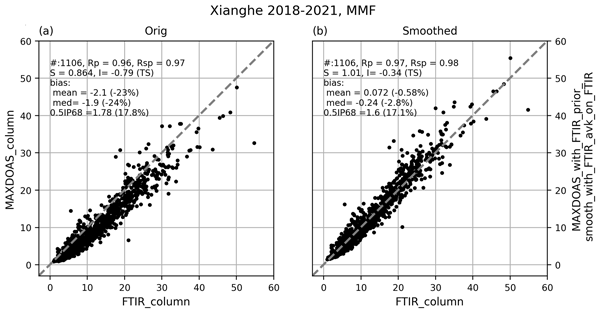
Gaia Pinardi, Martina M. Friedrich, Corinne Vigouroux, Bavo Langerock, Isabelle De Smedt, Caroline Fayt, Christian Hermans, Steffen Beirle, Thomas Wagner, Minqiang Zhou, Ting Wang, Pucai Wang, Martine De Mazière, and Michel Van Roozendael
Atmos. Meas. Tech., 19, 1259–1291, https://doi.org/10.5194/amt-19-1259-2026, https://doi.org/10.5194/amt-19-1259-2026, 2026
Short summary
Short summary
We evaluate ground-based remote-sensing measurements of formaldehyde from three techniques at a suburban site in China. A systematic −20 % bias in Multi-AXis Differential Optical Absorption Spectroscopy compared to direct-sun ultraviolet and infrared data is linked to limited sensitivity above a few kilometers and simplified vertical profiles assumptions. Using model-based priors and accounting for vertical sensitivity removes these differences, improving consistency for satellite validation.
Yasmine Sfendla, Trissevgeni Stavrakou, Jean-François Müller, Glenn-Michael Oomen, Beata Opacka, Thomas Danckaert, Isabelle De Smedt, and Christophe Lerot
Atmos. Chem. Phys., 26, 733–767, https://doi.org/10.5194/acp-26-733-2026, https://doi.org/10.5194/acp-26-733-2026, 2026
Short summary
Short summary
Volatile organic compounds (VOC) emitted from industry, wildfires, fuel use and vegetation impact the climate and are detrimental to human health. To guide regulation aimed at mitigating their impacts, it is important to know their emissions. We used satellite observations of formaldehyde and glyoxal, combined with a chemical transport model, and demonstrate that VOC emissions are about 20 % larger than expected; furthermore, unknown chemical pathways must be invoked to explain the observations.
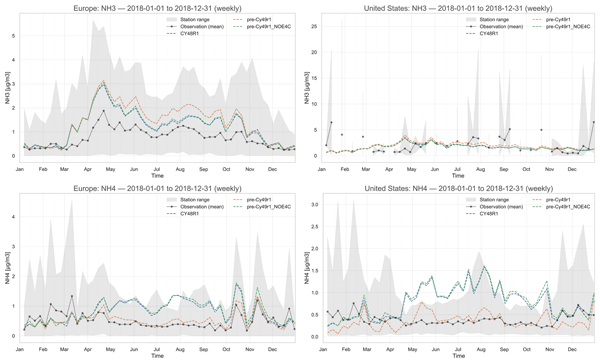
Jason E. Williams, Swen Metzger, Samuel Rémy, Vincent Huijnen, and Johannes Flemming
Geosci. Model Dev., 18, 9913–9943, https://doi.org/10.5194/gmd-18-9913-2025, https://doi.org/10.5194/gmd-18-9913-2025, 2025
Short summary
Short summary
One of the main constituents of Particulate Matter at the surface are Secondary Inorganic Aerosols (SIA) which are influenced by both anthropogenic emissions and the acidity of clouds and aerosols. This study shows improvements in introduced into the IFS-COMPO (Integrated Forecast System-COMPOsition) simulating the surface concentrations of SIA and the resulting changes in the total wet deposition for Europe, the US and South-East Asia.
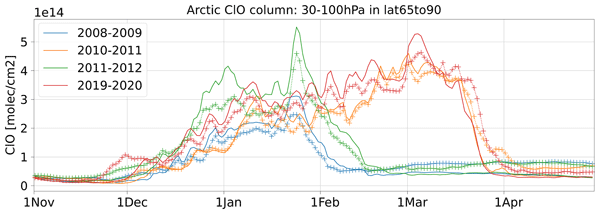
Simon Chabrillat, Samuel Rémy, Quentin Errera, Vincent Huijnen, Christine Bingen, Jonas Debosscher, François Hendrick, Swen Metzger, Adrien Mora, Daniele Minganti, Marc Op de beek, Léa Reisenfeld, Jason E. Williams, Henk Eskes, and Johannes Flemming
Geosci. Model Dev., 18, 8973–9014, https://doi.org/10.5194/gmd-18-8973-2025, https://doi.org/10.5194/gmd-18-8973-2025, 2025
Short summary
Short summary
We document the forecasts of the composition of the stratosphere by the Copernicus Atmosphere Monitoring Service. The model's predictions are compared with satellite measurements over a recent period, during polar ozone depletion events, and after the Mount Pinatubo volcanic eruption. The system performs well for sulfate aerosols, ozone and several other key gases but not as well for several nitrogen-containing gases. Chemical processes in aerosols and polar clouds should be improved.
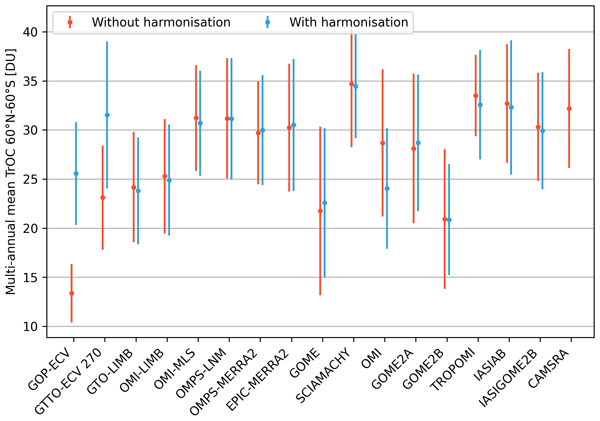
Arno Keppens, Daan Hubert, José Granville, Oindrila Nath, Jean-Christopher Lambert, Catherine Wespes, Pierre-François Coheur, Cathy Clerbaux, Anne Boynard, Richard Siddans, Barry Latter, Brian Kerridge, Serena Di Pede, Pepijn Veefkind, Juan Cuesta, Gaelle Dufour, Klaus-Peter Heue, Melanie Coldewey-Egbers, Diego Loyola, Andrea Orfanoz-Cheuquelaf, Swathi Maratt Satheesan, Kai-Uwe Eichmann, Alexei Rozanov, Viktoria F. Sofieva, Jerald R. Ziemke, Antje Inness, Roeland Van Malderen, and Lars Hoffmann
Atmos. Meas. Tech., 18, 6893–6916, https://doi.org/10.5194/amt-18-6893-2025, https://doi.org/10.5194/amt-18-6893-2025, 2025
Short summary
Short summary
The first Tropospheric Ozone Assessment Report (TOAR) encountered discrepancies between several satellite sensors’ estimates of the distribution and change of ozone in the free troposphere. Therefore, contributing to the second TOAR, we harmonise as much as possible the observational perspective of sixteen tropospheric ozone products from satellites. This only partially accounts for the observed discrepancies, with a reduction of 10–40 % of the inter-product dispersion upon harmonisation.
Hantao Wang, Kazuyuki Miyazaki, Haitong Zhe Sun, Zhen Qu, Xiang Liu, Antje Inness, Martin Schultz, Sabine Schröder, Marc Serre, and J. Jason West
Atmos. Chem. Phys., 25, 15969–15990, https://doi.org/10.5194/acp-25-15969-2025, https://doi.org/10.5194/acp-25-15969-2025, 2025
Short summary
Short summary
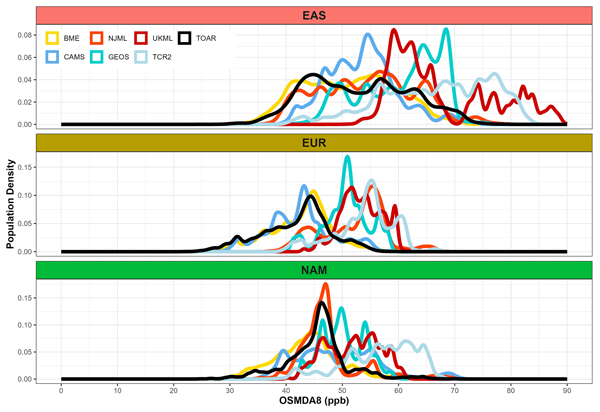
We compare six datasets of global ground-level ozone, developed using geostatistical, machine learning, or reanalysis methods. The datasets show important differences from one another in ozone magnitude, greater than 5 ppb, and trends, globally and regionally. Compared with measurements, performance varies among datasets, and most overestimate ozone, particularly at lower concentrations. These differences among datasets highlight uncertainties for applications to health and other impacts.
Augustin Colette, Gaëlle Collin, François Besson, Etienne Blot, Vincent Guidard, Frédérik Meleux, Adrien Royer, Valentin Petiot, Claire Miller, Oihana Fermond, Alizé Jeant, Mario Adani, Joaquim Arteta, Anna Benedictow, Robert Bergström, Dene Bowdalo, Jorgen Brandt, Gino Briganti, Ana C. Carvalho, Jesper Heile Christensen, Florian Couvidat, Ilaria D'Elia, Massimo D'Isidoro, Hugo Denier van der Gon, Gaël Descombes, Enza Di Tomaso, John Douros, Jeronimo Escribano, Henk Eskes, Hilde Fagerli, Yalda Fatahi, Johannes Flemming, Elmar Friese, Lise Frohn, Michael Gauss, Camilla Geels, Guido Guarnieri, Marc Guevara, Antoine Guion, Jonathan Guth, Risto Hänninen, Kaj Hansen, Ulas Im, Ruud Janssen, Marine Jeoffrion, Mathieu Joly, Luke Jones, Oriol Jorba, Evgeni Kadantsev, Michael Kahnert, Jacek W. Kaminski, Rostislav Kouznetsov, Richard Kranenburg, Jeroen Kuenen, Anne Caroline Lange, Joachim Langner, Victor Lannuque, Francesca Macchia, Astrid Manders, Mihaela Mircea, Agnes Nyiri, Miriam Olid, Carlos Pérez García-Pando, Yuliia Palamarchuk, Antonio Piersanti, Blandine Raux, Miha Razinger, Lennard Robertson, Arjo Segers, Martijn Schaap, Pilvi Siljamo, David Simpson, Mikhail Sofiev, Anders Stangel, Joanna Struzewska, Carles Tena, Renske Timmermans, Thanos Tsikerdekis, Svetlana Tsyro, Svyatoslav Tyuryakov, Anthony Ung, Andreas Uppstu, Alvaro Valdebenito, Peter van Velthoven, Lina Vitali, Zhuyun Ye, Vincent-Henri Peuch, and Laurence Rouïl
Geosci. Model Dev., 18, 6835–6883, https://doi.org/10.5194/gmd-18-6835-2025, https://doi.org/10.5194/gmd-18-6835-2025, 2025
Short summary
Short summary
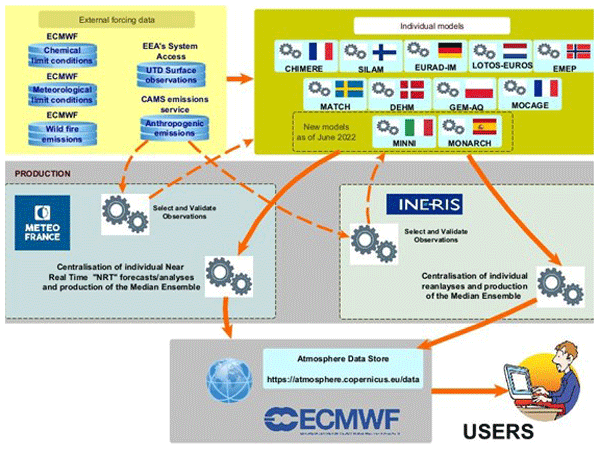
The Copernicus Atmosphere Monitoring Service – Regional Production delivers daily forecasts, analyses, and reanalyses of air quality in Europe. The service relies on a distributed modelling production by 11 leading European modelling teams following stringent requirements with an operational design that has no equivalent in the world. All the products are free, open, and quality-assured and disseminated with a high level of reliability.
Huan Yu, Isabelle De Smedt, Nicolas Theys, Maarten Sneep, Pepijn Veefkind, and Michel Van Roozendael
Atmos. Meas. Tech., 18, 4131–4163, https://doi.org/10.5194/amt-18-4131-2025, https://doi.org/10.5194/amt-18-4131-2025, 2025
Short summary
Short summary
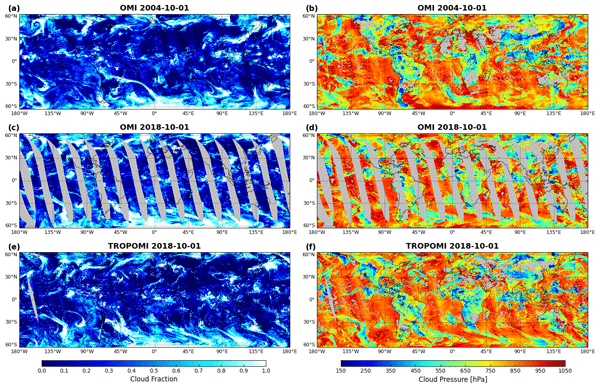
We introduce a new cloud retrieval algorithm using the O2–O2 absorption band at 477 nm to generate harmonized cloud datasets from OMI and TROPOMI. The algorithm improves upon the OMI O2–O2 operational cloud algorithm in several aspects. The new approach improves consistency in cloud parameters and NO2 retrievals between two sensors.
Anam M. Khan, Olivia E. Clifton, Jesse O. Bash, Sam Bland, Nathan Booth, Philip Cheung, Lisa Emberson, Johannes Flemming, Erick Fredj, Stefano Galmarini, Laurens Ganzeveld, Orestis Gazetas, Ignacio Goded, Christian Hogrefe, Christopher D. Holmes, László Horváth, Vincent Huijnen, Qian Li, Paul A. Makar, Ivan Mammarella, Giovanni Manca, J. William Munger, Juan L. Pérez-Camanyo, Jonathan Pleim, Limei Ran, Roberto San Jose, Donna Schwede, Sam J. Silva, Ralf Staebler, Shihan Sun, Amos P. K. Tai, Eran Tas, Timo Vesala, Tamás Weidinger, Zhiyong Wu, Leiming Zhang, and Paul C. Stoy
Atmos. Chem. Phys., 25, 8613–8635, https://doi.org/10.5194/acp-25-8613-2025, https://doi.org/10.5194/acp-25-8613-2025, 2025
Short summary
Short summary
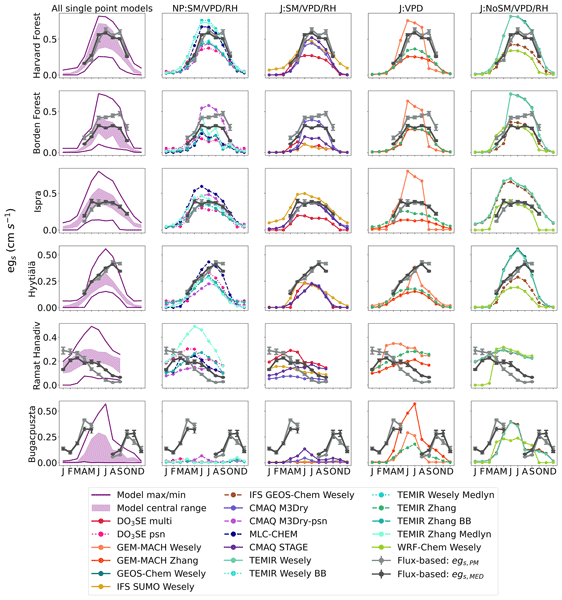
Vegetation removes tropospheric ozone through stomatal uptake, and accurately modeling the stomatal uptake of ozone is important for modeling dry deposition and air quality. We evaluated the stomatal component of ozone dry deposition modeled by atmospheric chemistry models at six sites. We find that models and observation-based estimates agree at times during the growing season at all sites, but some models overestimated the stomatal component during the dry summers at a seasonally dry site.
Suvarna Fadnavis, Yasin Elshorbany, Jerald Ziemke, Brice Barret, Alexandru Rap, P. R. Satheesh Chandran, Richard J. Pope, Vijay Sagar, Domenico Taraborrelli, Eric Le Flochmoen, Juan Cuesta, Catherine Wespes, Folkert Boersma, Isolde Glissenaar, Isabelle De Smedt, Michel Van Roozendael, Hervé Petetin, and Isidora Anglou
Atmos. Chem. Phys., 25, 8229–8254, https://doi.org/10.5194/acp-25-8229-2025, https://doi.org/10.5194/acp-25-8229-2025, 2025
Short summary
Short summary
Satellites and model simulations show enhancement in tropospheric ozone, which is highly impacted by human-produced nitrous oxides compared to volatile organic compounds. The increased amount of ozone enhances ozone radiative forcing. The ozone enhancement and associated radiative forcing are the highest over South and East Asia. The emissions of nitrous oxides show a higher influence on shifting ozone photochemical regimes than volatile organic compounds.
Catalina Poraicu, Jean-François Müller, Trissevgeni Stavrakou, Crist Amelynck, Bert W. D. Verreyken, Niels Schoon, Corinne Vigouroux, Nicolas Kumps, Jérôme Brioude, Pierre Tulet, and Camille Mouchel-Vallon
Atmos. Chem. Phys., 25, 6903–6941, https://doi.org/10.5194/acp-25-6903-2025, https://doi.org/10.5194/acp-25-6903-2025, 2025
Short summary
Short summary
We investigated the sources and impacts of nitrogen oxides and organic compounds over a remote tropical island. Simulations of the high-resolution Weather Research and Forecasting model coupled with chemistry (WRF-Chem) were evaluated using in situ Fourier transform infrared spectroscopy (FTIR) and satellite measurements. This work highlights gaps in current models, like missing sources of key organic compounds and inaccuracies in emission inventories, emphasizing the importance of improving chemical and dynamical processes in atmospheric modelling for budget estimates in tropical regions.
Yuhang Zhang, Huan Yu, Isabelle De Smedt, Jintai Lin, Nicolas Theys, Michel Van Roozendael, Gaia Pinardi, Steven Compernolle, Ruijing Ni, Fangxuan Ren, Sijie Wang, Lulu Chen, Jos Van Geffen, Mengyao Liu, Alexander M. Cede, Martin Tiefengraber, Alexis Merlaud, Martina M. Friedrich, Andreas Richter, Ankie Piters, Vinod Kumar, Vinayak Sinha, Thomas Wagner, Yongjoo Choi, Hisahiro Takashima, Yugo Kanaya, Hitoshi Irie, Robert Spurr, Wenfu Sun, and Lorenzo Fabris
Atmos. Meas. Tech., 18, 1561–1589, https://doi.org/10.5194/amt-18-1561-2025, https://doi.org/10.5194/amt-18-1561-2025, 2025
Short summary
Short summary
We developed an advanced algorithm for global retrieval of TROPOspheric Monitoring Instrument (TROPOMI) HCHO and NO2 vertical column densities with much improved consistency. Sensitivity tests demonstrate the complexity and nonlinear interactions of auxiliary parameters in the air mass factor calculation. An improved agreement is found with measurements from a global ground-based instrument network. The scientific retrieval provides a useful source of information for studies combining HCHO and NO2.
Beata Opacka, Trissevgeni Stavrakou, Jean-François Müller, Isabelle De Smedt, Jos van Geffen, Eloise A. Marais, Rebekah P. Horner, Dylan B. Millet, Kelly C. Wells, and Alex B. Guenther
Atmos. Chem. Phys., 25, 2863–2894, https://doi.org/10.5194/acp-25-2863-2025, https://doi.org/10.5194/acp-25-2863-2025, 2025
Short summary
Short summary
Vegetation releases biogenic volatile organic compounds, while soils and lightning contribute to the natural emissions of nitrogen oxides into the atmosphere. These gases interact in complex ways. Using satellite data and models, we developed a new method to simultaneously optimize these natural emissions over Africa in 2019. Our approach resulted in an increase in natural emissions, supported by independent data indicating that current estimates are underestimated.
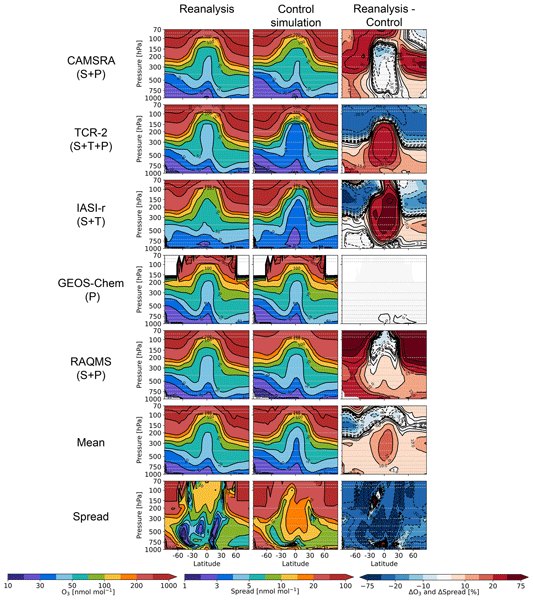
Takashi Sekiya, Emanuele Emili, Kazuyuki Miyazaki, Antje Inness, Zhen Qu, R. Bradley Pierce, Dylan Jones, Helen Worden, William Y. Y. Cheng, Vincent Huijnen, and Gerbrand Koren
Atmos. Chem. Phys., 25, 2243–2268, https://doi.org/10.5194/acp-25-2243-2025, https://doi.org/10.5194/acp-25-2243-2025, 2025
Short summary
Short summary
Five global chemical reanalysis datasets were used to assess the relative impacts of assimilating satellite ozone and its precursor measurements on tropospheric ozone analyses for 2010. The multiple reanalysis system comparison allows an evaluation of the dependency of the impacts on different reanalysis systems. The results suggested the importance of satellite ozone and its precursor measurements for improving ozone analysis in the whole troposphere, with varying magnitudes among the systems.
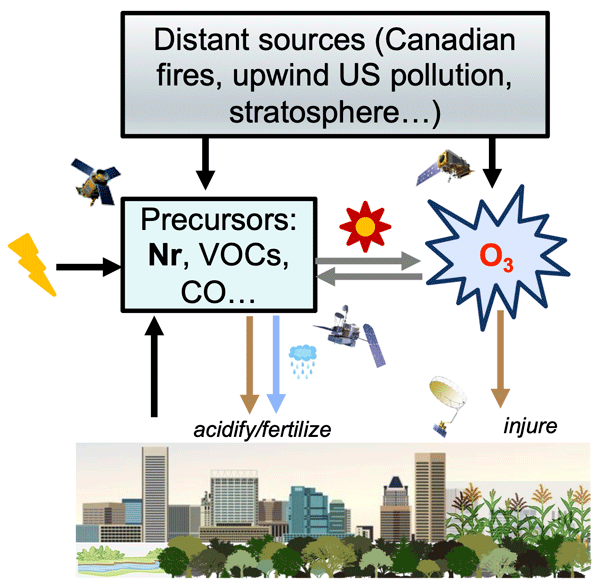
Min Huang, Gregory R. Carmichael, Kevin W. Bowman, Isabelle De Smedt, Andreas Colliander, Michael H. Cosh, Sujay V. Kumar, Alex B. Guenther, Scott J. Janz, Ryan M. Stauffer, Anne M. Thompson, Niko M. Fedkin, Robert J. Swap, John D. Bolten, and Alicia T. Joseph
Atmos. Chem. Phys., 25, 1449–1476, https://doi.org/10.5194/acp-25-1449-2025, https://doi.org/10.5194/acp-25-1449-2025, 2025
Short summary
Short summary
We use model simulations along with multiplatform, multidisciplinary observations and a range of analysis methods to estimate and understand the distributions, temporal changes, and impacts of reactive nitrogen and ozone over the most populous US region that has undergone significant environmental changes. Deposition, biogenic emissions, and extra-regional sources have been playing increasingly important roles in controlling pollutant budgets in this area as local anthropogenic emissions drop.
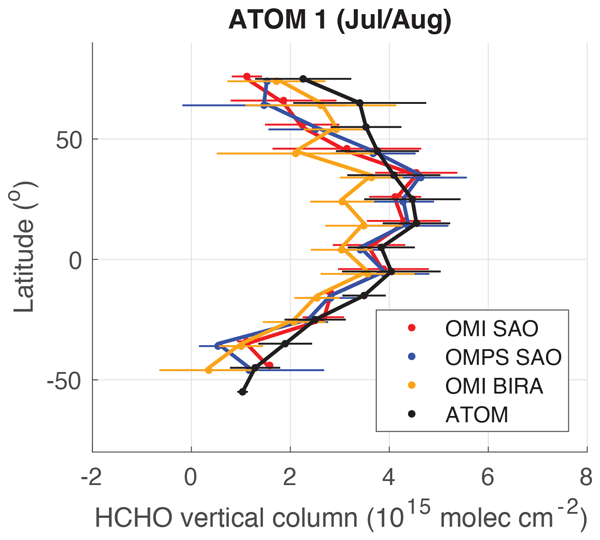
Jin Liao, Glenn M. Wolfe, Alexander E. Kotsakis, Julie M. Nicely, Jason M. St. Clair, Thomas F. Hanisco, Gonzalo González Abad, Caroline R. Nowlan, Zolal Ayazpour, Isabelle De Smedt, Eric C. Apel, and Rebecca S. Hornbrook
Atmos. Meas. Tech., 18, 1–16, https://doi.org/10.5194/amt-18-1-2025, https://doi.org/10.5194/amt-18-1-2025, 2025
Short summary
Short summary
Validation of satellite HCHO over the remote marine regions is relatively low, and modeled HCHO in these regions is usually added as a global satellite HCHO background. This paper intercompares three satellite HCHO retrievals and validates them against in situ observations from the NASA ATom mission. All retrievals are correlated with ATom-integrated columns over remote oceans, with OMI SAO (v004) showing the best agreement. A persistent low bias is found in all retrievals at high latitudes.
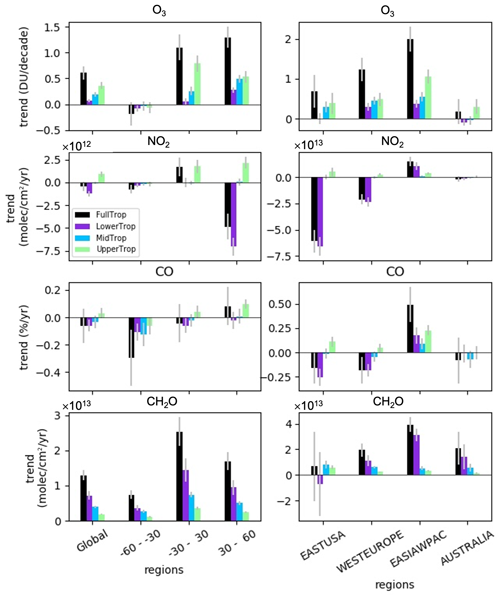
Yasin Elshorbany, Jerald R. Ziemke, Sarah Strode, Hervé Petetin, Kazuyuki Miyazaki, Isabelle De Smedt, Kenneth Pickering, Rodrigo J. Seguel, Helen Worden, Tamara Emmerichs, Domenico Taraborrelli, Maria Cazorla, Suvarna Fadnavis, Rebecca R. Buchholz, Benjamin Gaubert, Néstor Y. Rojas, Thiago Nogueira, Thérèse Salameh, and Min Huang
Atmos. Chem. Phys., 24, 12225–12257, https://doi.org/10.5194/acp-24-12225-2024, https://doi.org/10.5194/acp-24-12225-2024, 2024
Short summary
Short summary
We investigated tropospheric ozone spatial variability and trends from 2005 to 2019 and related those to ozone precursors on global and regional scales. We also investigate the spatiotemporal characteristics of the ozone formation regime in relation to ozone chemical sources and sinks. Our analysis is based on remote sensing products of the tropospheric column of ozone and its precursors, nitrogen dioxide, formaldehyde, and total column CO, as well as ozonesonde data and model simulations.
Eunjo S. Ha, Rokjin J. Park, Hyeong-Ahn Kwon, Gitaek T. Lee, Sieun D. Lee, Seunga Shin, Dong-Won Lee, Hyunkee Hong, Christophe Lerot, Isabelle De Smedt, Thomas Danckaert, Francois Hendrick, and Hitoshi Irie
Atmos. Meas. Tech., 17, 6369–6384, https://doi.org/10.5194/amt-17-6369-2024, https://doi.org/10.5194/amt-17-6369-2024, 2024
Short summary
Short summary
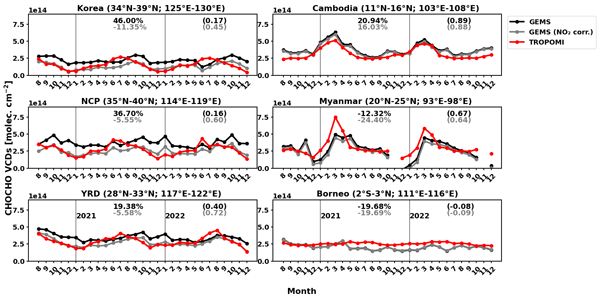
In this study, we evaluated the GEMS glyoxal products by comparing them with TROPOMI and MAX-DOAS measurements. GEMS and TROPOMI VCDs present similar spatial distributions. Monthly variations in GEMS VCDs and TROPOMI and MAX-DOAS VCDs differ in northeastern Asia, which we attributed to a polluted reference spectrum and high NO2 concentrations. GEMS glyoxal products with unparalleled temporal resolution would enrich our understanding of VOC emissions and diurnal variation.
Samuel Rémy, Swen Metzger, Vincent Huijnen, Jason E. Williams, and Johannes Flemming
Geosci. Model Dev., 17, 7539–7567, https://doi.org/10.5194/gmd-17-7539-2024, https://doi.org/10.5194/gmd-17-7539-2024, 2024
Short summary
Short summary
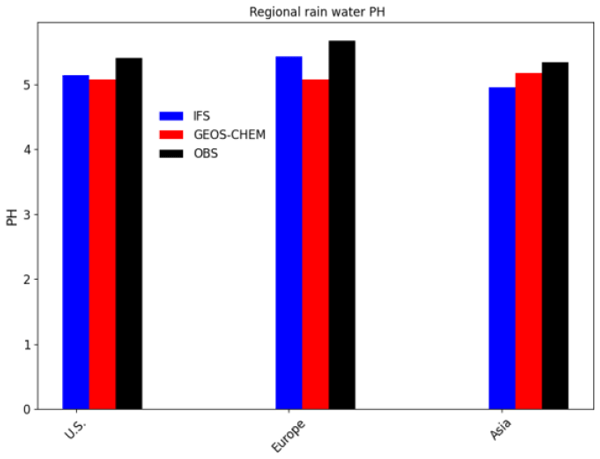
In this paper we describe the development of the future operational cycle 49R1 of the IFS-COMPO system, used for operational forecasts of atmospheric composition in the CAMS project, and focus on the implementation of the thermodynamical model EQSAM4Clim version 12. The implementation of EQSAM4Clim significantly improves the simulated secondary inorganic aerosol surface concentration. The new aerosol and precipitation acidity diagnostics showed good agreement against observational datasets.
Jorge E. Pachón, Mariel A. Opazo, Pablo Lichtig, Nicolas Huneeus, Idir Bouarar, Guy Brasseur, Cathy W. Y. Li, Johannes Flemming, Laurent Menut, Camilo Menares, Laura Gallardo, Michael Gauss, Mikhail Sofiev, Rostislav Kouznetsov, Julia Palamarchuk, Andreas Uppstu, Laura Dawidowski, Nestor Y. Rojas, María de Fátima Andrade, Mario E. Gavidia-Calderón, Alejandro H. Delgado Peralta, and Daniel Schuch
Geosci. Model Dev., 17, 7467–7512, https://doi.org/10.5194/gmd-17-7467-2024, https://doi.org/10.5194/gmd-17-7467-2024, 2024
Short summary
Short summary
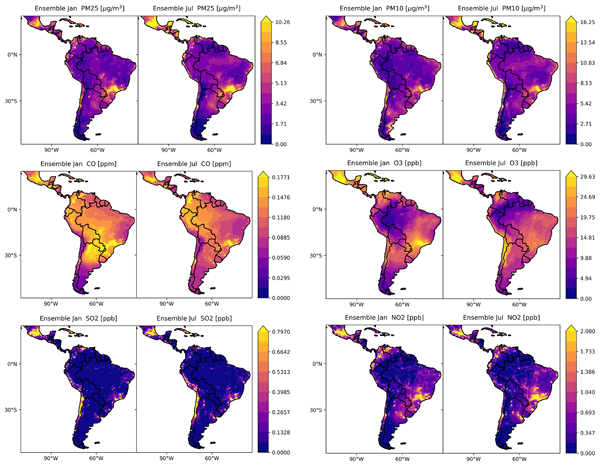
Latin America (LAC) has some of the most populated urban areas in the world, with high levels of air pollution. Air quality management in LAC has been traditionally focused on surveillance and building emission inventories. This study performed the first intercomparison and model evaluation in LAC, with interesting and insightful findings for the region. A multiscale modeling ensemble chain was assembled as a first step towards an air quality forecasting system.
Henk Eskes, Athanasios Tsikerdekis, Melanie Ades, Mihai Alexe, Anna Carlin Benedictow, Yasmine Bennouna, Lewis Blake, Idir Bouarar, Simon Chabrillat, Richard Engelen, Quentin Errera, Johannes Flemming, Sebastien Garrigues, Jan Griesfeller, Vincent Huijnen, Luka Ilić, Antje Inness, John Kapsomenakis, Zak Kipling, Bavo Langerock, Augustin Mortier, Mark Parrington, Isabelle Pison, Mikko Pitkänen, Samuel Remy, Andreas Richter, Anja Schoenhardt, Michael Schulz, Valerie Thouret, Thorsten Warneke, Christos Zerefos, and Vincent-Henri Peuch
Atmos. Chem. Phys., 24, 9475–9514, https://doi.org/10.5194/acp-24-9475-2024, https://doi.org/10.5194/acp-24-9475-2024, 2024
Short summary
Short summary
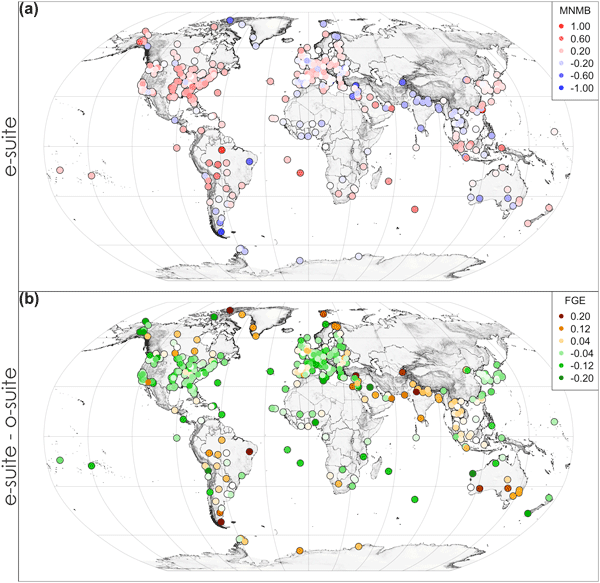
The Copernicus Atmosphere Monitoring Service (CAMS) provides global analyses and forecasts of aerosols and trace gases in the atmosphere. On 27 June 2023 a major upgrade, Cy48R1, became operational. Comparisons with in situ, surface remote sensing, aircraft, and balloon and satellite observations show that the new CAMS system is a significant improvement. The results quantify the skill of CAMS to forecast impactful events, such as wildfires, dust storms and air pollution peaks.
Sören Johansson, Michael Höpfner, Felix Friedl-Vallon, Norbert Glatthor, Thomas Gulde, Vincent Huijnen, Anne Kleinert, Erik Kretschmer, Guido Maucher, Tom Neubert, Hans Nordmeyer, Christof Piesch, Peter Preusse, Martin Riese, Björn-Martin Sinnhuber, Jörn Ungermann, Gerald Wetzel, and Wolfgang Woiwode
Atmos. Chem. Phys., 24, 8125–8138, https://doi.org/10.5194/acp-24-8125-2024, https://doi.org/10.5194/acp-24-8125-2024, 2024
Short summary
Short summary
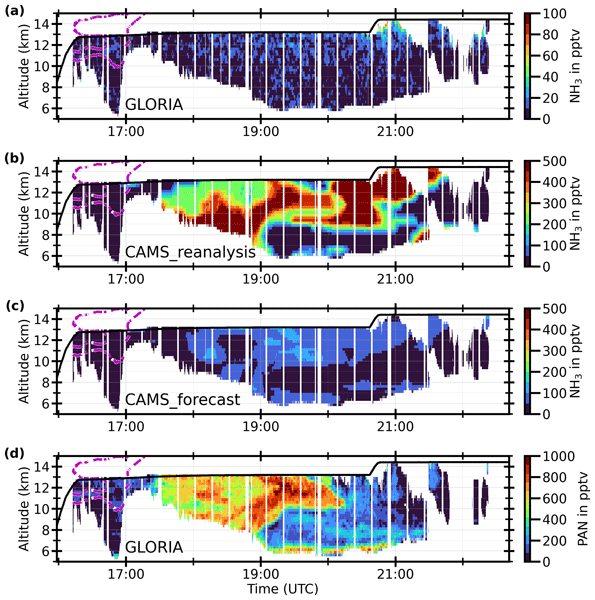
We present airborne infrared limb sounding GLORIA measurements of ammonia (NH3) in the upper troposphere of air masses within the Asian monsoon and of those connected with biomass burning. Comparing CAMS (Copernicus Atmosphere Monitoring Service) model data, we find that the model reproduces the measured enhanced NH3 within the Asian monsoon well but not that within biomass burning plumes, where no enhanced NH3 is measured in the upper troposphere but considerable amounts are simulated by CAMS.
Swen Metzger, Samuel Rémy, Jason E. Williams, Vincent Huijnen, and Johannes Flemming
Geosci. Model Dev., 17, 5009–5021, https://doi.org/10.5194/gmd-17-5009-2024, https://doi.org/10.5194/gmd-17-5009-2024, 2024
Short summary
Short summary
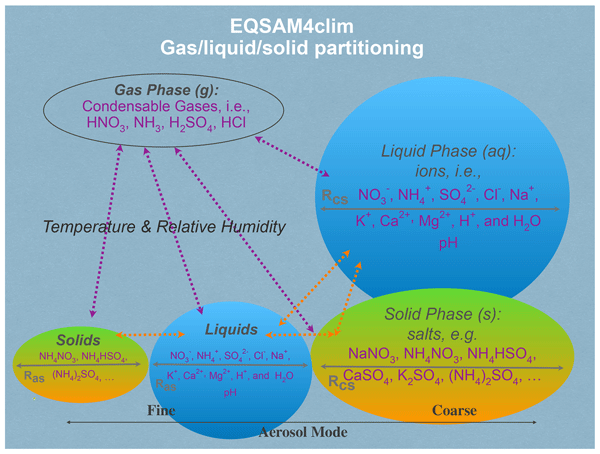
EQSAM4Clim has recently been revised to provide an accurate and efficient method for calculating the acidity of atmospheric particles. It is based on an analytical concept that is sufficiently fast and free of numerical noise, which makes it attractive for air quality forecasting. Version 12 allows the calculation of aerosol composition based on the gas–liquid–solid and the reduced gas–liquid partitioning with the associated water uptake for both cases, including the acidity of the aerosols.
Peng Xian, Jeffrey S. Reid, Melanie Ades, Angela Benedetti, Peter R. Colarco, Arlindo da Silva, Tom F. Eck, Johannes Flemming, Edward J. Hyer, Zak Kipling, Samuel Rémy, Tsuyoshi Thomas Sekiyama, Taichu Tanaka, Keiya Yumimoto, and Jianglong Zhang
Atmos. Chem. Phys., 24, 6385–6411, https://doi.org/10.5194/acp-24-6385-2024, https://doi.org/10.5194/acp-24-6385-2024, 2024
Short summary
Short summary
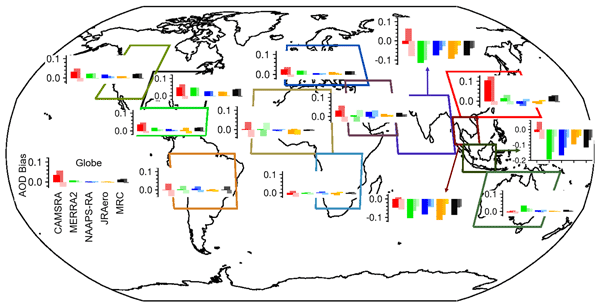
The study compares and evaluates monthly AOD of four reanalyses (RA) and their consensus (i.e., ensemble mean). The basic verification characteristics of these RA versus both AERONET and MODIS retrievals are presented. The study discusses the strength of each RA and identifies regions where divergence and challenges are prominent. The RA consensus usually performs very well on a global scale in terms of how well it matches the observational data, making it a good choice for various applications.
Gitaek T. Lee, Rokjin J. Park, Hyeong-Ahn Kwon, Eunjo S. Ha, Sieun D. Lee, Seunga Shin, Myoung-Hwan Ahn, Mina Kang, Yong-Sang Choi, Gyuyeon Kim, Dong-Won Lee, Deok-Rae Kim, Hyunkee Hong, Bavo Langerock, Corinne Vigouroux, Christophe Lerot, Francois Hendrick, Gaia Pinardi, Isabelle De Smedt, Michel Van Roozendael, Pucai Wang, Heesung Chong, Yeseul Cho, and Jhoon Kim
Atmos. Chem. Phys., 24, 4733–4749, https://doi.org/10.5194/acp-24-4733-2024, https://doi.org/10.5194/acp-24-4733-2024, 2024
Short summary
Short summary
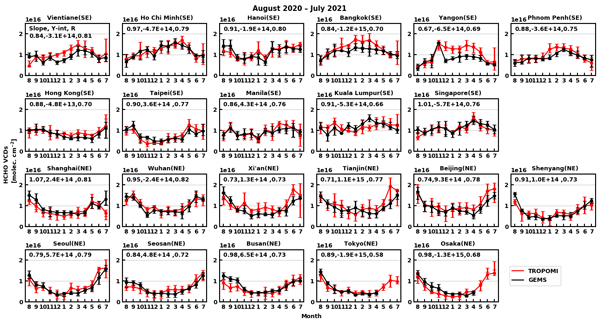
This study evaluates the Geostationary Environment Monitoring Spectrometer (GEMS) HCHO product by comparing its vertical column densities (VCDs) with those of TROPOMI and ground-based observations. Based on some sensitivity tests, obtaining radiance references under clear-sky conditions significantly improves HCHO retrieval quality. GEMS HCHO VCDs captured seasonal and diurnal variations well during the first year of observation, showing consistency with TROPOMI and ground-based observations.
Adrianus de Laat, Vincent Huijnen, Niels Andela, and Matthias Forkel
EGUsphere, https://doi.org/10.5194/egusphere-2024-732, https://doi.org/10.5194/egusphere-2024-732, 2024
Preprint archived
Short summary
Short summary
This study assesses state-of-the art and more advanced and innovative satellite-observation-based (bottom-up) wildfire emission estimates. They are evaluated by comparison with satellite observation of single fire emission plumes. Results indicate that more advanced fire emission estimates – more information – are more realistic but that especially for a limited number of very large fires certain differences remain – for unknown reasons.
Adrien Deroubaix, Marco Vountas, Benjamin Gaubert, Maria Dolores Andrés Hernández, Stephan Borrmann, Guy Brasseur, Bruna Holanda, Yugo Kanaya, Katharina Kaiser, Flora Kluge, Ovid Oktavian Krüger, Inga Labuhn, Michael Lichtenstern, Klaus Pfeilsticker, Mira Pöhlker, Hans Schlager, Johannes Schneider, Guillaume Siour, Basudev Swain, Paolo Tuccella, Kameswara S. Vinjamuri, Mihalis Vrekoussis, Benjamin Weyland, and John P. Burrows
EGUsphere, https://doi.org/10.5194/egusphere-2024-516, https://doi.org/10.5194/egusphere-2024-516, 2024
Preprint archived
Short summary
Short summary
This study assesses atmospheric composition using air quality models during aircraft campaigns in Europe and Asia, focusing on carbonaceous aerosols and trace gases. While carbon monoxide is well modeled, other pollutants have moderate to weak agreement with observations. Wind speed modeling is reliable for identifying pollution plumes, where models tend to overestimate concentrations. This highlights challenges in accurately modeling aerosol and trace gas composition, particularly in cities.
Adrien Deroubaix, Marco Vountas, Benjamin Gaubert, Maria Dolores Andrés Hernández, Stephan Borrmann, Guy Brasseur, Bruna Holanda, Yugo Kanaya, Katharina Kaiser, Flora Kluge, Ovid Oktavian Krüger, Inga Labuhn, Michael Lichtenstern, Klaus Pfeilsticker, Mira Pöhlker, Hans Schlager, Johannes Schneider, Guillaume Siour, Basudev Swain, Paolo Tuccella, Kameswara S. Vinjamuri, Mihalis Vrekoussis, Benjamin Weyland, and John P. Burrows
EGUsphere, https://doi.org/10.5194/egusphere-2024-521, https://doi.org/10.5194/egusphere-2024-521, 2024
Preprint archived
Short summary
Short summary
This study explores the proportional relationships between carbonaceous aerosols (black and organic carbon) and trace gases using airborne measurements from two campaigns in Europe and East Asia. Differences between regions were found, but air quality models struggled to reproduce them accurately. We show that these proportional relationships can help to constrain models and can be used to infer aerosol concentrations from satellite observations of trace gases, especially in urban areas.
Jean-François Müller, Trissevgeni Stavrakou, Glenn-Michael Oomen, Beata Opacka, Isabelle De Smedt, Alex Guenther, Corinne Vigouroux, Bavo Langerock, Carlos Augusto Bauer Aquino, Michel Grutter, James Hannigan, Frank Hase, Rigel Kivi, Erik Lutsch, Emmanuel Mahieu, Maria Makarova, Jean-Marc Metzger, Isamu Morino, Isao Murata, Tomoo Nagahama, Justus Notholt, Ivan Ortega, Mathias Palm, Amelie Röhling, Wolfgang Stremme, Kimberly Strong, Ralf Sussmann, Yao Té, and Alan Fried
Atmos. Chem. Phys., 24, 2207–2237, https://doi.org/10.5194/acp-24-2207-2024, https://doi.org/10.5194/acp-24-2207-2024, 2024
Short summary
Short summary
Formaldehyde observations from satellites can be used to constrain the emissions of volatile organic compounds, but those observations have biases. Using an atmospheric model, aircraft and ground-based remote sensing data, we quantify these biases, propose a correction to the data, and assess the consequence of this correction for the evaluation of emissions.
Glenn-Michael Oomen, Jean-François Müller, Trissevgeni Stavrakou, Isabelle De Smedt, Thomas Blumenstock, Rigel Kivi, Maria Makarova, Mathias Palm, Amelie Röhling, Yao Té, Corinne Vigouroux, Martina M. Friedrich, Udo Frieß, François Hendrick, Alexis Merlaud, Ankie Piters, Andreas Richter, Michel Van Roozendael, and Thomas Wagner
Atmos. Chem. Phys., 24, 449–474, https://doi.org/10.5194/acp-24-449-2024, https://doi.org/10.5194/acp-24-449-2024, 2024
Short summary
Short summary
Natural emissions from vegetation have a profound impact on air quality for their role in the formation of harmful tropospheric ozone and organic aerosols, yet these emissions are highly uncertain. In this study, we quantify emissions of organic gases over Europe using high-quality satellite measurements of formaldehyde. These satellite observations suggest that emissions from vegetation are much higher than predicted by models, especially in southern Europe.
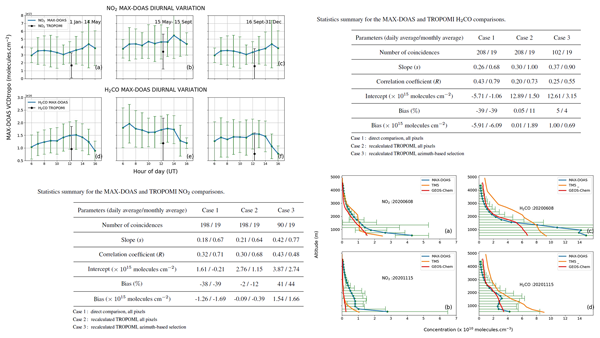
Rodriguez Yombo Phaka, Alexis Merlaud, Gaia Pinardi, Martina M. Friedrich, Michel Van Roozendael, Jean-François Müller, Trissevgeni Stavrakou, Isabelle De Smedt, François Hendrick, Ermioni Dimitropoulou, Richard Bopili Mbotia Lepiba, Edmond Phuku Phuati, Buenimio Lomami Djibi, Lars Jacobs, Caroline Fayt, Jean-Pierre Mbungu Tsumbu, and Emmanuel Mahieu
Atmos. Meas. Tech., 16, 5029–5050, https://doi.org/10.5194/amt-16-5029-2023, https://doi.org/10.5194/amt-16-5029-2023, 2023
Short summary
Short summary
We present air quality measurements in Kinshasa, Democratic Republic of the Congo, performed with a newly developed instrument which was installed on a roof of the University of Kinshasa in November 2019. The instrument records spectra of the scattered sunlight, from which we derive the abundances of nitrogen dioxide and formaldehyde, two important pollutants. We compare our ground-based measurements with those of the TROPOspheric Monitoring Instrument (TROPOMI).
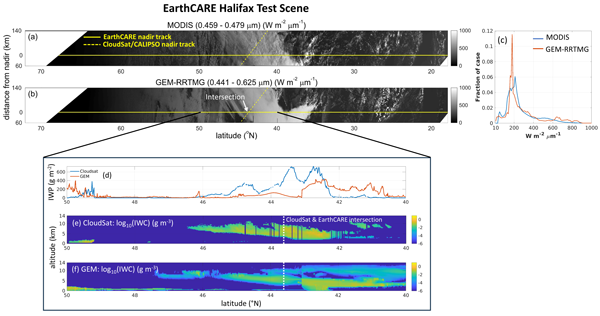
Zhipeng Qu, David P. Donovan, Howard W. Barker, Jason N. S. Cole, Mark W. Shephard, and Vincent Huijnen
Atmos. Meas. Tech., 16, 4927–4946, https://doi.org/10.5194/amt-16-4927-2023, https://doi.org/10.5194/amt-16-4927-2023, 2023
Short summary
Short summary
The EarthCARE satellite mission Level 2 algorithm development requires realistic 3D cloud and aerosol scenes along the satellite orbits. One of the best ways to produce these scenes is to use a high-resolution numerical weather prediction model to simulate atmospheric conditions at 250 m horizontal resolution. This paper describes the production and validation of three EarthCARE test scenes.
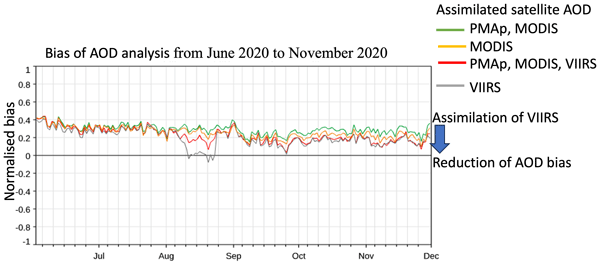
Sebastien Garrigues, Melanie Ades, Samuel Remy, Johannes Flemming, Zak Kipling, Istvan Laszlo, Mark Parrington, Antje Inness, Roberto Ribas, Luke Jones, Richard Engelen, and Vincent-Henri Peuch
Atmos. Chem. Phys., 23, 10473–10487, https://doi.org/10.5194/acp-23-10473-2023, https://doi.org/10.5194/acp-23-10473-2023, 2023
Short summary
Short summary
The Copernicus Atmosphere Monitoring Service (CAMS) provides global monitoring of aerosols using the ECMWF forecast model constrained by the assimilation of satellite aerosol optical depth (AOD). This work aims at evaluating the assimilation of the NOAA VIIRS AOD product in the ECMWF model. It shows that the introduction of VIIRS in the CAMS data assimilation system enhances the accuracy of the aerosol analysis, particularly over Europe and desert and maritime sites.
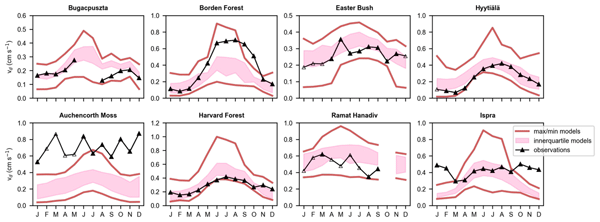
Olivia E. Clifton, Donna Schwede, Christian Hogrefe, Jesse O. Bash, Sam Bland, Philip Cheung, Mhairi Coyle, Lisa Emberson, Johannes Flemming, Erick Fredj, Stefano Galmarini, Laurens Ganzeveld, Orestis Gazetas, Ignacio Goded, Christopher D. Holmes, László Horváth, Vincent Huijnen, Qian Li, Paul A. Makar, Ivan Mammarella, Giovanni Manca, J. William Munger, Juan L. Pérez-Camanyo, Jonathan Pleim, Limei Ran, Roberto San Jose, Sam J. Silva, Ralf Staebler, Shihan Sun, Amos P. K. Tai, Eran Tas, Timo Vesala, Tamás Weidinger, Zhiyong Wu, and Leiming Zhang
Atmos. Chem. Phys., 23, 9911–9961, https://doi.org/10.5194/acp-23-9911-2023, https://doi.org/10.5194/acp-23-9911-2023, 2023
Short summary
Short summary
A primary sink of air pollutants is dry deposition. Dry deposition estimates differ across the models used to simulate atmospheric chemistry. Here, we introduce an effort to examine dry deposition schemes from atmospheric chemistry models. We provide our approach’s rationale, document the schemes, and describe datasets used to drive and evaluate the schemes. We also launch the analysis of results by evaluating against observations and identifying the processes leading to model–model differences.
Midhun George, Maria Dolores Andrés Hernández, Vladyslav Nenakhov, Yangzhuoran Liu, John Philip Burrows, Birger Bohn, Eric Förster, Florian Obersteiner, Andreas Zahn, Theresa Harlaß, Helmut Ziereis, Hans Schlager, Benjamin Schreiner, Flora Kluge, Katja Bigge, and Klaus Pfeilsticker
Atmos. Chem. Phys., 23, 7799–7822, https://doi.org/10.5194/acp-23-7799-2023, https://doi.org/10.5194/acp-23-7799-2023, 2023
Short summary
Short summary
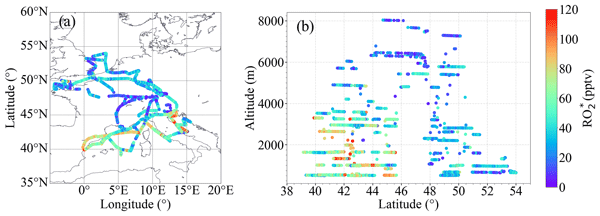
The applicability of photostationary steady-state (PSS) assumptions to estimate the amount of the sum of peroxy radicals (RO2*) during the EMeRGe airborne observations from the known radical chemistry and onboard measurements of RO2* precursors, photolysis frequencies, and other trace gases such as NOx and O3 was investigated. The comparison of the calculated RO2* with the actual measurements provides an insight into the main processes controlling their concentration in the air masses measured.
Anna Agustí-Panareda, Jérôme Barré, Sébastien Massart, Antje Inness, Ilse Aben, Melanie Ades, Bianca C. Baier, Gianpaolo Balsamo, Tobias Borsdorff, Nicolas Bousserez, Souhail Boussetta, Michael Buchwitz, Luca Cantarello, Cyril Crevoisier, Richard Engelen, Henk Eskes, Johannes Flemming, Sébastien Garrigues, Otto Hasekamp, Vincent Huijnen, Luke Jones, Zak Kipling, Bavo Langerock, Joe McNorton, Nicolas Meilhac, Stefan Noël, Mark Parrington, Vincent-Henri Peuch, Michel Ramonet, Miha Razinger, Maximilian Reuter, Roberto Ribas, Martin Suttie, Colm Sweeney, Jérôme Tarniewicz, and Lianghai Wu
Atmos. Chem. Phys., 23, 3829–3859, https://doi.org/10.5194/acp-23-3829-2023, https://doi.org/10.5194/acp-23-3829-2023, 2023
Short summary
Short summary
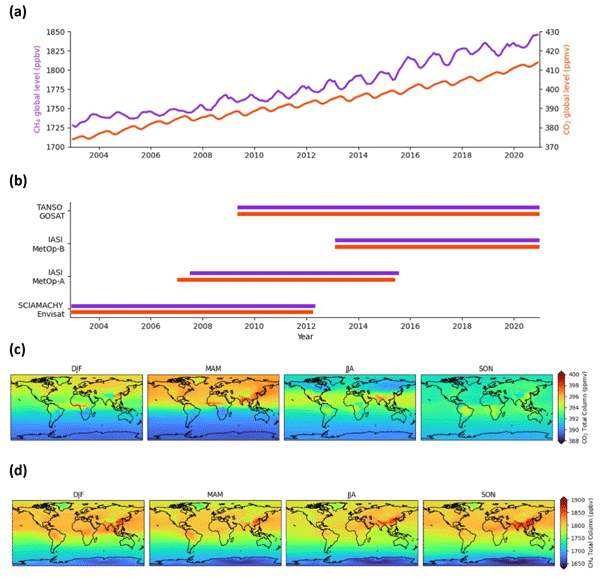
We present a global dataset of atmospheric CO2 and CH4, the two most important human-made greenhouse gases, which covers almost 2 decades (2003–2020). It is produced by combining satellite data of CO2 and CH4 with a weather and air composition prediction model, and it has been carefully evaluated against independent observations to ensure validity and point out deficiencies to the user. This dataset can be used for scientific studies in the field of climate change and the global carbon cycle.
Flora Kluge, Tilman Hüneke, Christophe Lerot, Simon Rosanka, Meike K. Rotermund, Domenico Taraborrelli, Benjamin Weyland, and Klaus Pfeilsticker
Atmos. Chem. Phys., 23, 1369–1401, https://doi.org/10.5194/acp-23-1369-2023, https://doi.org/10.5194/acp-23-1369-2023, 2023
Short summary
Short summary
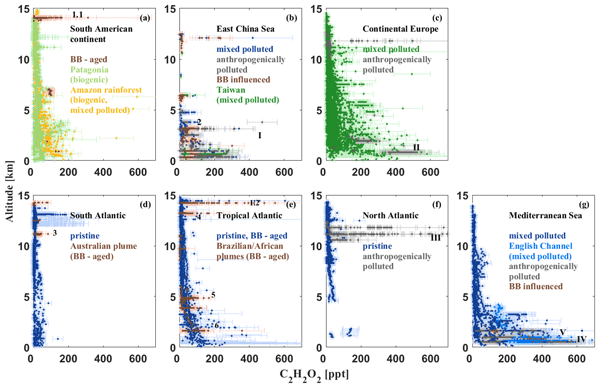
Using airborne glyoxal concentration and vertical column density measurements, vertical profiles are inferred for eight global regions in aged biomass burning plumes and the tropical marine boundary layer. Using TROPOMI observations, an analysis of space- and airborne measurements is performed. A comparison to EMAC simulations shows a general glyoxal underprediction, which points to various missing sources and precursors from anthropogenic activities, biomass burning, and the sea surface.
Catalina Poraicu, Jean-François Müller, Trissevgeni Stavrakou, Dominique Fonteyn, Frederik Tack, Felix Deutsch, Quentin Laffineur, Roeland Van Malderen, and Nele Veldeman
Geosci. Model Dev., 16, 479–508, https://doi.org/10.5194/gmd-16-479-2023, https://doi.org/10.5194/gmd-16-479-2023, 2023
Short summary
Short summary
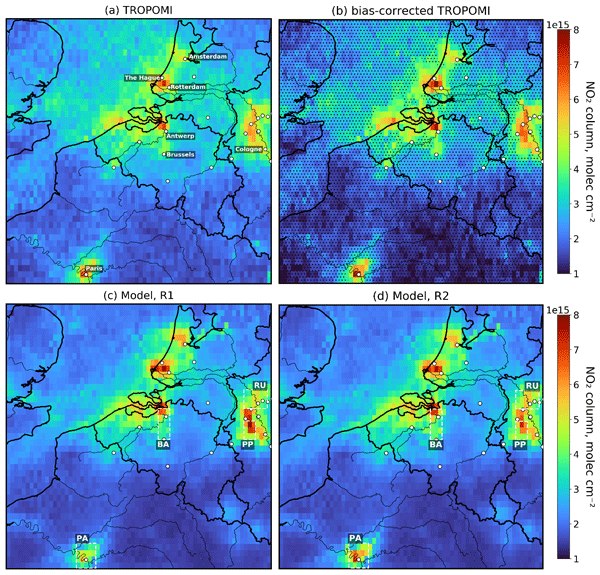
High-resolution WRF-Chem simulations are conducted over Antwerp, Belgium, in June 2019 and evaluated using meteorological data and in situ, airborne, and spaceborne NO2 measurements. An intercomparison of model, aircraft, and TROPOMI NO2 columns is conducted to characterize biases in versions 1.3.1 and 2.3.1 of the satellite product. A mass balance method is implemented to provide improved emissions for simulating NO2 distribution over the study area.
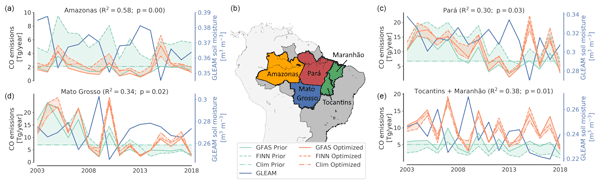
Stijn Naus, Lucas G. Domingues, Maarten Krol, Ingrid T. Luijkx, Luciana V. Gatti, John B. Miller, Emanuel Gloor, Sourish Basu, Caio Correia, Gerbrand Koren, Helen M. Worden, Johannes Flemming, Gabrielle Pétron, and Wouter Peters
Atmos. Chem. Phys., 22, 14735–14750, https://doi.org/10.5194/acp-22-14735-2022, https://doi.org/10.5194/acp-22-14735-2022, 2022
Short summary
Short summary
We assimilate MOPITT CO satellite data in the TM5-4D-Var inverse modelling framework to estimate Amazon fire CO emissions for 2003–2018. We show that fire emissions have decreased over the analysis period, coincident with a decrease in deforestation rates. However, interannual variations in fire emissions are large, and they correlate strongly with soil moisture. Our results reveal an important role for robust, top-down fire CO emissions in quantifying and attributing Amazon fire intensity.
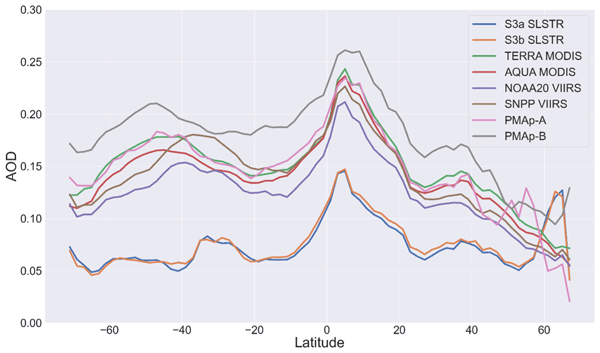
Sebastien Garrigues, Samuel Remy, Julien Chimot, Melanie Ades, Antje Inness, Johannes Flemming, Zak Kipling, Istvan Laszlo, Angela Benedetti, Roberto Ribas, Soheila Jafariserajehlou, Bertrand Fougnie, Shobha Kondragunta, Richard Engelen, Vincent-Henri Peuch, Mark Parrington, Nicolas Bousserez, Margarita Vazquez Navarro, and Anna Agusti-Panareda
Atmos. Chem. Phys., 22, 14657–14692, https://doi.org/10.5194/acp-22-14657-2022, https://doi.org/10.5194/acp-22-14657-2022, 2022
Short summary
Short summary
The Copernicus Atmosphere Monitoring Service (CAMS) provides global monitoring of aerosols using the ECMWF forecast model constrained by the assimilation of satellite aerosol optical depth (AOD). This work aims at evaluating two new satellite AODs to enhance the CAMS aerosol global forecast. It highlights the spatial and temporal differences between the satellite AOD products at the model spatial resolution, which is essential information to design multi-satellite AOD data assimilation schemes.

Antje Inness, Ilse Aben, Melanie Ades, Tobias Borsdorff, Johannes Flemming, Luke Jones, Jochen Landgraf, Bavo Langerock, Philippe Nedelec, Mark Parrington, and Roberto Ribas
Atmos. Chem. Phys., 22, 14355–14376, https://doi.org/10.5194/acp-22-14355-2022, https://doi.org/10.5194/acp-22-14355-2022, 2022
Short summary
Short summary
The Copernicus Atmosphere Monitoring Service (CAMS) provides daily global air quality forecasts to users worldwide. One of the species of interest is carbon monoxide (CO), an important trace gas in the atmosphere with anthropogenic and natural sources, produced by incomplete combustion, for example, by wildfires. This paper looks at how well CAMS can model CO in the atmosphere and shows that the fields can be improved when blending CO data from the TROPOMI instrument with the CAMS model.

Nicolas Theys, Christophe Lerot, Hugues Brenot, Jeroen van Gent, Isabelle De Smedt, Lieven Clarisse, Mike Burton, Matthew Varnam, Catherine Hayer, Benjamin Esse, and Michel Van Roozendael
Atmos. Meas. Tech., 15, 4801–4817, https://doi.org/10.5194/amt-15-4801-2022, https://doi.org/10.5194/amt-15-4801-2022, 2022
Short summary
Short summary
Sulfur dioxide plume height after a volcanic eruption is an important piece of information for many different scientific studies and applications. Satellite UV retrievals are useful in this respect, but available algorithms have shown so far limited sensitivity to SO2 height. Here we present a new technique to improve the retrieval of SO2 plume height for SO2 columns as low as 5 DU. We demonstrate the algorithm using TROPOMI measurements and compare with other height estimates.
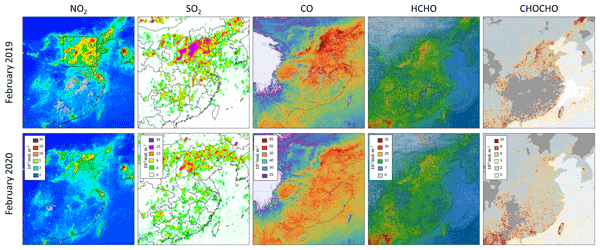
Pieternel F. Levelt, Deborah C. Stein Zweers, Ilse Aben, Maite Bauwens, Tobias Borsdorff, Isabelle De Smedt, Henk J. Eskes, Christophe Lerot, Diego G. Loyola, Fabian Romahn, Trissevgeni Stavrakou, Nicolas Theys, Michel Van Roozendael, J. Pepijn Veefkind, and Tijl Verhoelst
Atmos. Chem. Phys., 22, 10319–10351, https://doi.org/10.5194/acp-22-10319-2022, https://doi.org/10.5194/acp-22-10319-2022, 2022
Short summary
Short summary
Using the COVID-19 lockdown periods as an example, we show how Sentinel-5P/TROPOMI trace gas data (NO2, SO2, CO, HCHO and CHOCHO) can be used to understand impacts on air quality for regions and cities around the globe. We also provide information for both experienced and inexperienced users about how we created the data using state-of-the-art algorithms, where to get the data, methods taking meteorological and seasonal variability into consideration, and insights for future studies.
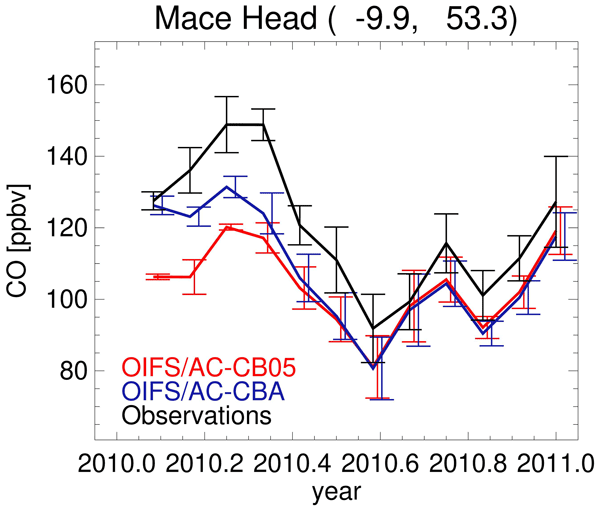
Vincent Huijnen, Philippe Le Sager, Marcus O. Köhler, Glenn Carver, Samuel Rémy, Johannes Flemming, Simon Chabrillat, Quentin Errera, and Twan van Noije
Geosci. Model Dev., 15, 6221–6241, https://doi.org/10.5194/gmd-15-6221-2022, https://doi.org/10.5194/gmd-15-6221-2022, 2022
Short summary
Short summary
We report on the first implementation of atmospheric chemistry and aerosol as part of the OpenIFS model, based on the CAMS global model. We give an overview of the model and evaluate two reference model configurations, with and without the stratospheric chemistry extension, against a variety of observational datasets. This OpenIFS version with atmospheric composition components is open to the scientific user community under a standard OpenIFS license.
Samuel Rémy, Zak Kipling, Vincent Huijnen, Johannes Flemming, Pierre Nabat, Martine Michou, Melanie Ades, Richard Engelen, and Vincent-Henri Peuch
Geosci. Model Dev., 15, 4881–4912, https://doi.org/10.5194/gmd-15-4881-2022, https://doi.org/10.5194/gmd-15-4881-2022, 2022
Short summary
Short summary
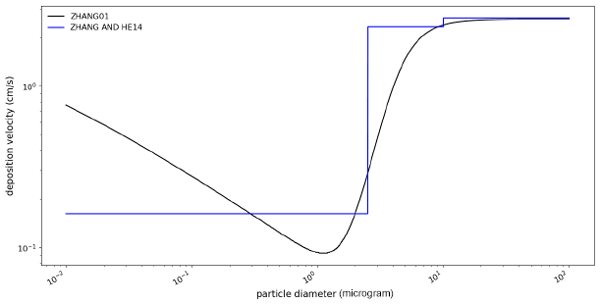
This article describes a new version of IFS-AER, the tropospheric aerosol scheme used to provide global aerosol products within the Copernicus Atmosphere Monitoring Service (CAMS) cycle. Several components of the model have been updated, such as the dynamical dust and sea salt aerosol emission schemes. New deposition schemes have also been incorporated but are not yet used operationally. This new version of IFS-AER has been evaluated and shown to have a greater skill than previous versions.
Jason E. Williams, Vincent Huijnen, Idir Bouarar, Mehdi Meziane, Timo Schreurs, Sophie Pelletier, Virginie Marécal, Beatrice Josse, and Johannes Flemming
Geosci. Model Dev., 15, 4657–4687, https://doi.org/10.5194/gmd-15-4657-2022, https://doi.org/10.5194/gmd-15-4657-2022, 2022
Short summary
Short summary
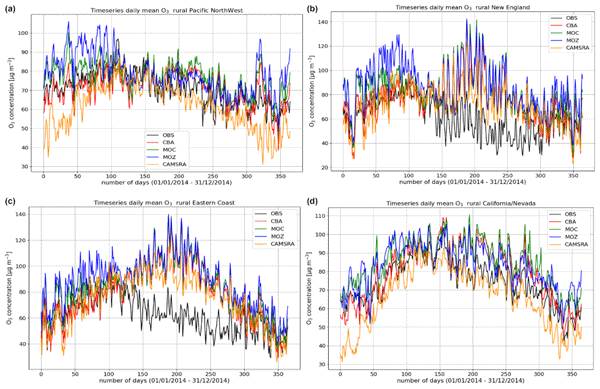
The global CAMS air quality model is used for providing tropospheric ozone information to end users. This paper updates the chemical mechanism employed (CBA) and compares it against two other mechanisms (MOCAGE, MOZART) and a multi-decadal dataset based on a previous version of CBA. We perform extensive validation for the US using multiple surface and aircraft datasets, providing an assessment of biases and the extent of correlation across different seasons during 2014.
Sieglinde Callewaert, Jérôme Brioude, Bavo Langerock, Valentin Duflot, Dominique Fonteyn, Jean-François Müller, Jean-Marc Metzger, Christian Hermans, Nicolas Kumps, Michel Ramonet, Morgan Lopez, Emmanuel Mahieu, and Martine De Mazière
Atmos. Chem. Phys., 22, 7763–7792, https://doi.org/10.5194/acp-22-7763-2022, https://doi.org/10.5194/acp-22-7763-2022, 2022
Short summary
Short summary
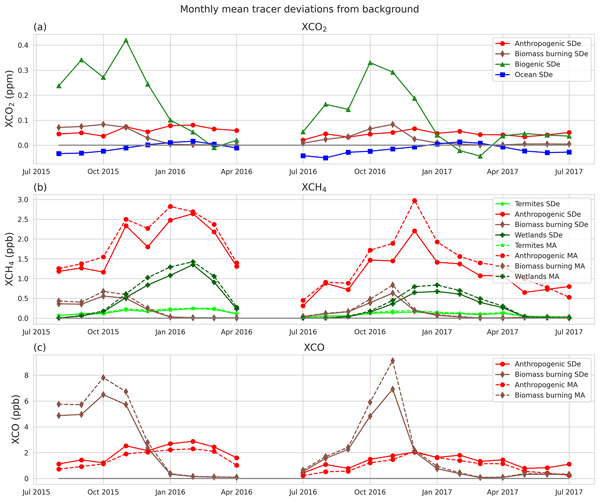
A regional atmospheric transport model is used to analyze the factors contributing to CO2, CH4, and CO observations at Réunion Island. We show that the surface observations are dominated by local fluxes and dynamical processes, while the column data are influenced by larger-scale mechanisms such as biomass burning plumes. The model is able to capture the measured time series well; however, the results are highly dependent on accurate boundary conditions and high-resolution emission inventories.
Tianlang Zhao, Jingqiu Mao, William R. Simpson, Isabelle De Smedt, Lei Zhu, Thomas F. Hanisco, Glenn M. Wolfe, Jason M. St. Clair, Gonzalo González Abad, Caroline R. Nowlan, Barbara Barletta, Simone Meinardi, Donald R. Blake, Eric C. Apel, and Rebecca S. Hornbrook
Atmos. Chem. Phys., 22, 7163–7178, https://doi.org/10.5194/acp-22-7163-2022, https://doi.org/10.5194/acp-22-7163-2022, 2022
Short summary
Short summary
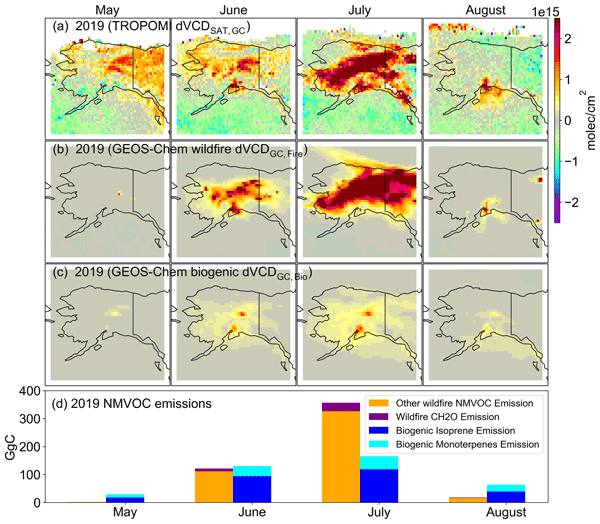
Monitoring formaldehyde (HCHO) can help us understand Arctic vegetation change. Here, we compare satellite data and model and show that Alaska summertime HCHO is largely dominated by a background from methane oxidation during mild wildfire years and is dominated by wildfire (largely from direct emission of fire) during strong fire years. Consequently, it is challenging to use satellite HCHO to study vegetation change in the Arctic region.
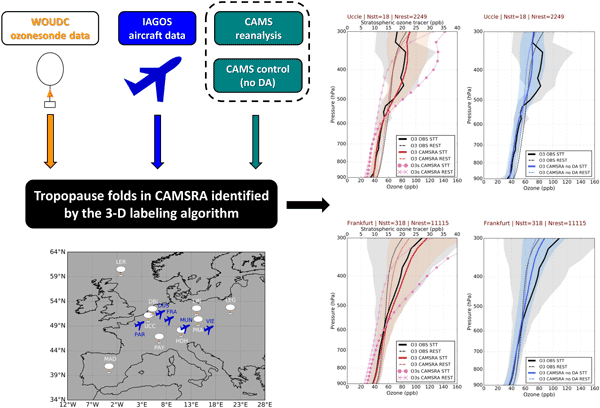
Dimitris Akritidis, Andrea Pozzer, Johannes Flemming, Antje Inness, Philippe Nédélec, and Prodromos Zanis
Atmos. Chem. Phys., 22, 6275–6289, https://doi.org/10.5194/acp-22-6275-2022, https://doi.org/10.5194/acp-22-6275-2022, 2022
Short summary
Short summary
We perform a process-oriented evaluation of Copernicus Atmosphere Monitoring Service (CAMS) reanalysis (CAMSRA) O3 over Europe using WOUDC (World Ozone and Ultraviolet Radiation Data Centre) ozonesondes and IAGOS (In-service Aircraft for a Global Observing System) aircraft measurements. Chemical data assimilation assists CAMSRA to reproduce the observed O3 increases in the troposphere during the examined folding events, but it mostly results in O3 overestimation in the upper troposphere.

Joe McNorton, Nicolas Bousserez, Anna Agustí-Panareda, Gianpaolo Balsamo, Luca Cantarello, Richard Engelen, Vincent Huijnen, Antje Inness, Zak Kipling, Mark Parrington, and Roberto Ribas
Atmos. Chem. Phys., 22, 5961–5981, https://doi.org/10.5194/acp-22-5961-2022, https://doi.org/10.5194/acp-22-5961-2022, 2022
Short summary
Short summary
Concentrations of atmospheric methane continue to grow, in recent years at an increasing rate, for unknown reasons. Using newly available satellite observations and a state-of-the-art weather prediction model we perform global estimates of emissions from hotspots at high resolution. Results show that the system can accurately report on biases in national inventories and is used to conclude that the early COVID-19 slowdown period (March–June 2020) had little impact on global methane emissions.
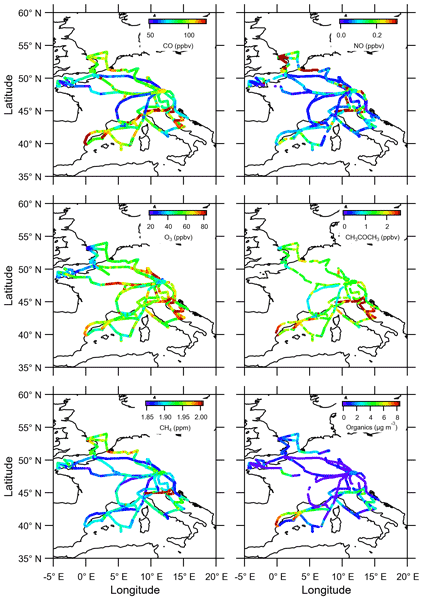
M. Dolores Andrés Hernández, Andreas Hilboll, Helmut Ziereis, Eric Förster, Ovid O. Krüger, Katharina Kaiser, Johannes Schneider, Francesca Barnaba, Mihalis Vrekoussis, Jörg Schmidt, Heidi Huntrieser, Anne-Marlene Blechschmidt, Midhun George, Vladyslav Nenakhov, Theresa Harlass, Bruna A. Holanda, Jennifer Wolf, Lisa Eirenschmalz, Marc Krebsbach, Mira L. Pöhlker, Anna B. Kalisz Hedegaard, Linlu Mei, Klaus Pfeilsticker, Yangzhuoran Liu, Ralf Koppmann, Hans Schlager, Birger Bohn, Ulrich Schumann, Andreas Richter, Benjamin Schreiner, Daniel Sauer, Robert Baumann, Mariano Mertens, Patrick Jöckel, Markus Kilian, Greta Stratmann, Christopher Pöhlker, Monica Campanelli, Marco Pandolfi, Michael Sicard, José L. Gómez-Amo, Manuel Pujadas, Katja Bigge, Flora Kluge, Anja Schwarz, Nikos Daskalakis, David Walter, Andreas Zahn, Ulrich Pöschl, Harald Bönisch, Stephan Borrmann, Ulrich Platt, and John P. Burrows
Atmos. Chem. Phys., 22, 5877–5924, https://doi.org/10.5194/acp-22-5877-2022, https://doi.org/10.5194/acp-22-5877-2022, 2022
Short summary
Short summary
EMeRGe provides a unique set of in situ and remote sensing airborne measurements of trace gases and aerosol particles along selected flight routes in the lower troposphere over Europe. The interpretation uses also complementary collocated ground-based and satellite measurements. The collected data help to improve the current understanding of the complex spatial distribution of trace gases and aerosol particles resulting from mixing, transport, and transformation of pollution plumes over Europe.
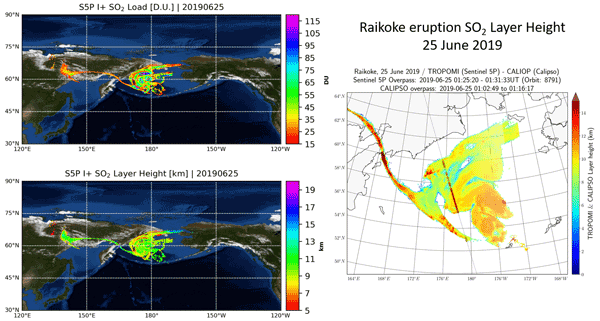
Maria-Elissavet Koukouli, Konstantinos Michailidis, Pascal Hedelt, Isabelle A. Taylor, Antje Inness, Lieven Clarisse, Dimitris Balis, Dmitry Efremenko, Diego Loyola, Roy G. Grainger, and Christian Retscher
Atmos. Chem. Phys., 22, 5665–5683, https://doi.org/10.5194/acp-22-5665-2022, https://doi.org/10.5194/acp-22-5665-2022, 2022
Short summary
Short summary
Volcanic eruptions eject large amounts of ash and trace gases into the atmosphere. The use of space-borne instruments enables the global monitoring of volcanic SO2 emissions in an economical and risk-free manner. The main aim of this paper is to present its extensive verification, accomplished within the ESA S5P+I: SO2LH project, over major recent volcanic eruptions, against collocated space-borne measurements, as well as assess its impact on the forecasts provided by CAMS.

Beatriz M. Monge-Sanz, Alessio Bozzo, Nicholas Byrne, Martyn P. Chipperfield, Michail Diamantakis, Johannes Flemming, Lesley J. Gray, Robin J. Hogan, Luke Jones, Linus Magnusson, Inna Polichtchouk, Theodore G. Shepherd, Nils Wedi, and Antje Weisheimer
Atmos. Chem. Phys., 22, 4277–4302, https://doi.org/10.5194/acp-22-4277-2022, https://doi.org/10.5194/acp-22-4277-2022, 2022
Short summary
Short summary
The stratosphere is emerging as one of the keys to improve tropospheric weather and climate predictions. This study provides evidence of the role the stratospheric ozone layer plays in improving weather predictions at different timescales. Using a new ozone modelling approach suitable for high-resolution global models that provide operational forecasts from days to seasons, we find significant improvements in stratospheric meteorological fields and stratosphere–troposphere coupling.
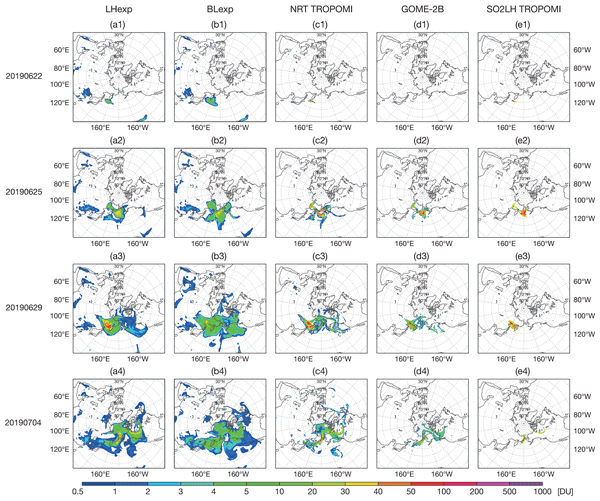
Antje Inness, Melanie Ades, Dimitris Balis, Dmitry Efremenko, Johannes Flemming, Pascal Hedelt, Maria-Elissavet Koukouli, Diego Loyola, and Roberto Ribas
Geosci. Model Dev., 15, 971–994, https://doi.org/10.5194/gmd-15-971-2022, https://doi.org/10.5194/gmd-15-971-2022, 2022
Short summary
Short summary
This paper describes the way that the Copernicus Atmosphere Monitoring Service (CAMS) produces forecasts of volcanic SO2. These forecasts are provided routinely every day. They are created by blending SO2 data from satellite instruments (TROPOMI and GOME-2) with the CAMS model. We show that the quality of the CAMS SO2 forecasts can be improved if additional information about the height of volcanic plumes is provided in the satellite data.
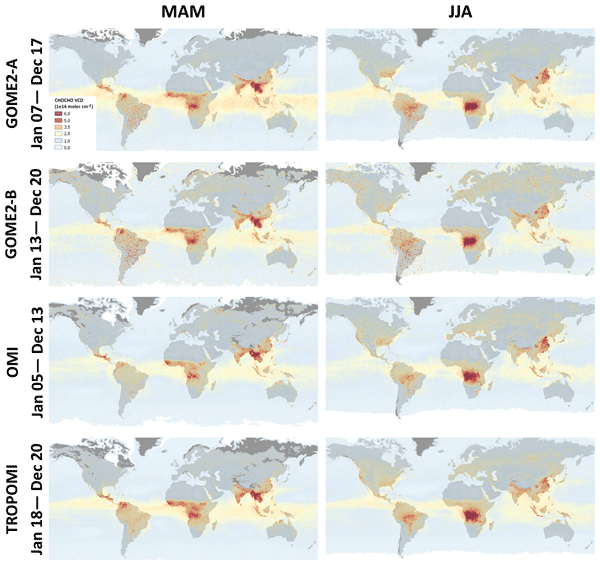
Christophe Lerot, François Hendrick, Michel Van Roozendael, Leonardo M. A. Alvarado, Andreas Richter, Isabelle De Smedt, Nicolas Theys, Jonas Vlietinck, Huan Yu, Jeroen Van Gent, Trissevgeni Stavrakou, Jean-François Müller, Pieter Valks, Diego Loyola, Hitoshi Irie, Vinod Kumar, Thomas Wagner, Stefan F. Schreier, Vinayak Sinha, Ting Wang, Pucai Wang, and Christian Retscher
Atmos. Meas. Tech., 14, 7775–7807, https://doi.org/10.5194/amt-14-7775-2021, https://doi.org/10.5194/amt-14-7775-2021, 2021
Short summary
Short summary
Global measurements of glyoxal tropospheric columns from the satellite instrument TROPOMI are presented. Such measurements can contribute to the estimation of atmospheric emissions of volatile organic compounds. This new glyoxal product has been fully characterized with a comprehensive error budget, with comparison with other satellite data sets as well as with validation based on independent ground-based remote sensing glyoxal observations.
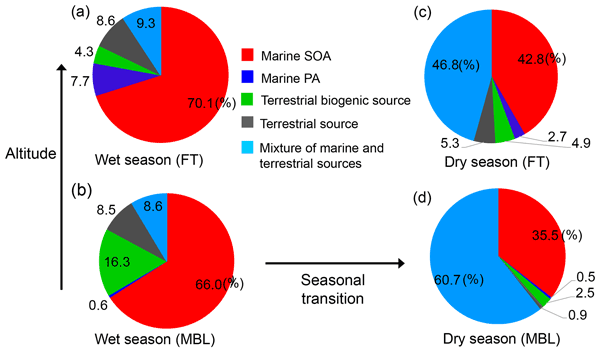
Sharmine Akter Simu, Yuzo Miyazaki, Eri Tachibana, Henning Finkenzeller, Jérôme Brioude, Aurélie Colomb, Olivier Magand, Bert Verreyken, Stephanie Evan, Rainer Volkamer, and Trissevgeni Stavrakou
Atmos. Chem. Phys., 21, 17017–17029, https://doi.org/10.5194/acp-21-17017-2021, https://doi.org/10.5194/acp-21-17017-2021, 2021
Short summary
Short summary
The tropical Indian Ocean (IO) is expected to be a significant source of water-soluble organic carbon (WSOC), which is relevant to cloud formation. Our study showed that marine secondary organic formation dominantly contributed to the aerosol WSOC mass at the high-altitude observatory in the southwest IO in the wet season in both marine boundary layer and free troposphere (FT). This suggests that the effect of marine secondary sources is important up to FT, a process missing in climate models.
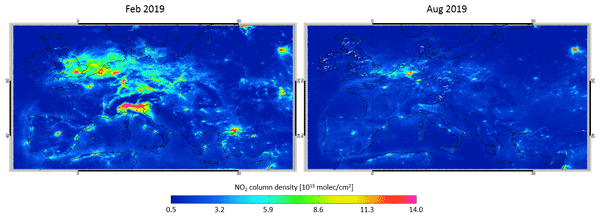
Song Liu, Pieter Valks, Gaia Pinardi, Jian Xu, Ka Lok Chan, Athina Argyrouli, Ronny Lutz, Steffen Beirle, Ehsan Khorsandi, Frank Baier, Vincent Huijnen, Alkiviadis Bais, Sebastian Donner, Steffen Dörner, Myrto Gratsea, François Hendrick, Dimitris Karagkiozidis, Kezia Lange, Ankie J. M. Piters, Julia Remmers, Andreas Richter, Michel Van Roozendael, Thomas Wagner, Mark Wenig, and Diego G. Loyola
Atmos. Meas. Tech., 14, 7297–7327, https://doi.org/10.5194/amt-14-7297-2021, https://doi.org/10.5194/amt-14-7297-2021, 2021
Short summary
Short summary
In this work, an improved tropospheric NO2 retrieval algorithm from TROPOMI measurements over Europe is presented. The stratospheric estimation is implemented with correction for the dependency of the stratospheric NO2 on the viewing geometry. The AMF calculation is implemented using improved surface albedo, a priori NO2 profiles, and cloud correction. The improved tropospheric NO2 data show good correlations with ground-based MAX-DOAS measurements.
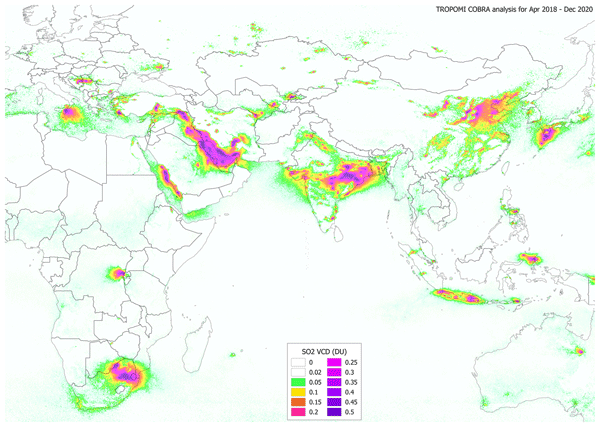
Nicolas Theys, Vitali Fioletov, Can Li, Isabelle De Smedt, Christophe Lerot, Chris McLinden, Nickolay Krotkov, Debora Griffin, Lieven Clarisse, Pascal Hedelt, Diego Loyola, Thomas Wagner, Vinod Kumar, Antje Innes, Roberto Ribas, François Hendrick, Jonas Vlietinck, Hugues Brenot, and Michel Van Roozendael
Atmos. Chem. Phys., 21, 16727–16744, https://doi.org/10.5194/acp-21-16727-2021, https://doi.org/10.5194/acp-21-16727-2021, 2021
Short summary
Short summary
We present a new algorithm to retrieve sulfur dioxide from space UV measurements. We apply the technique to high-resolution TROPOMI measurements and demonstrate the high sensitivity of the approach to weak SO2 emissions worldwide with an unprecedented limit of detection of 8 kt yr−1. This result has broad implications for atmospheric science studies dealing with improving emission inventories and identifying and quantifying missing sources, in the context of air quality and climate.
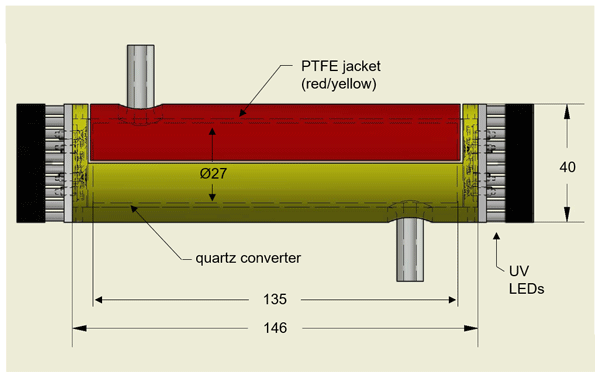
Clara M. Nussbaumer, Uwe Parchatka, Ivan Tadic, Birger Bohn, Daniel Marno, Monica Martinez, Roland Rohloff, Hartwig Harder, Flora Kluge, Klaus Pfeilsticker, Florian Obersteiner, Martin Zöger, Raphael Doerich, John N. Crowley, Jos Lelieveld, and Horst Fischer
Atmos. Meas. Tech., 14, 6759–6776, https://doi.org/10.5194/amt-14-6759-2021, https://doi.org/10.5194/amt-14-6759-2021, 2021
Short summary
Short summary
NO2 plays a central role in atmospheric photochemical processes and requires accurate measurements. This research presents NO2 data obtained via chemiluminescence using a photolytic converter from airborne studies around Cabo Verde and laboratory investigations. We show the limits and error-proneness of a conventional blue light converter in aircraft measurements affected by humidity and NO levels and suggest the use of an alternative quartz converter for more reliable results.
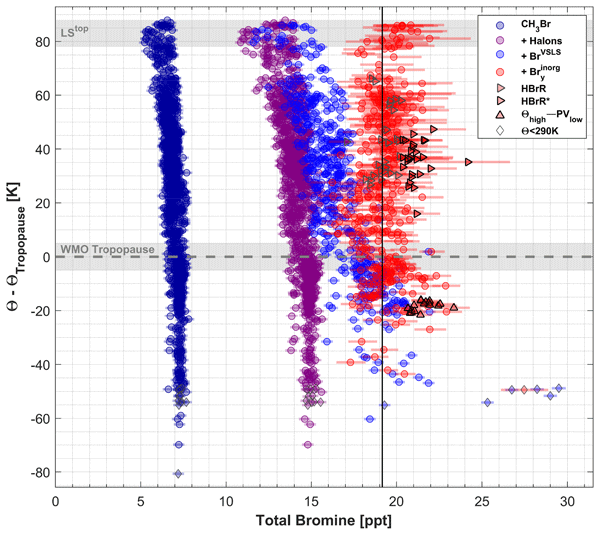
Meike K. Rotermund, Vera Bense, Martyn P. Chipperfield, Andreas Engel, Jens-Uwe Grooß, Peter Hoor, Tilman Hüneke, Timo Keber, Flora Kluge, Benjamin Schreiner, Tanja Schuck, Bärbel Vogel, Andreas Zahn, and Klaus Pfeilsticker
Atmos. Chem. Phys., 21, 15375–15407, https://doi.org/10.5194/acp-21-15375-2021, https://doi.org/10.5194/acp-21-15375-2021, 2021
Short summary
Short summary
Airborne total bromine (Brtot) and tracer measurements suggest Brtot-rich air masses persistently protruded into the lower stratosphere (LS), creating a high Brtot region over the North Atlantic in fall 2017. The main source is via isentropic transport by the Asian monsoon and to a lesser extent transport across the extratropical tropopause as quantified by a Lagrange model. The transport of Brtot via Central American hurricanes is also observed. Lastly, the impact of Brtot on LS O3 is assessed.
Cited articles
Andreae, M. O.: Emission of trace gases and aerosols from biomass burning – an updated assessment, Atmos. Chem. Phys., 19, 8523–8546, https://doi.org/10.5194/acp-19-8523-2019, 2019. a
Archibald, A. T., Jenkin, M. E., and Shallcross, D. E.: An isoprene mechanism intercomparison, Atmos. Environ., 44, 5356–5364, https://doi.org/10.1016/j.atmosenv.2009.09.016, 2010. a
Atkinson, R. and Arey, J.: Gas-phase tropospheric chemistry of biogenic volatile organic compounds: a review, Atmos. Environ., 37, 197–219, https://doi.org/10.1016/S1352-2310(03)00391-1, 2003. a
Bates, K. H. and Jacob, D. J.: A new model mechanism for atmospheric oxidation of isoprene: global effects on oxidants, nitrogen oxides, organic products, and secondary organic aerosol, Atmos. Chem. Phys., 19, 9613–9640, https://doi.org/10.5194/acp-19-9613-2019, 2019. a
Bauwens, M., Stavrakou, T., Müller, J.-F., De Smedt, I., Van Roozendael, M., van der Werf, G. R., Wiedinmyer, C., Kaiser, J. W., Sindelarova, K., and Guenther, A.: Nine years of global hydrocarbon emissions based on source inversion of OMI formaldehyde observations, Atmos. Chem. Phys., 16, 10133–10158, https://doi.org/10.5194/acp-16-10133-2016, 2016. a
Burkholder, J. B., Sander, S. P., Abbatt, J. P. D., Barker, J. R., Huie, R. E., Kolb, C. E., Kurylo, M. J., Orkin, V. L., Wilmouth, D. M., and Wine, P. H.: Chemical Kinetics and Photochemical Data for Use in Atmospheric Studies, Evaluation number 18, Jet Propulsion Laboratory, Pasadena, USA, https://ntrs.nasa.gov/citations/20160006735 (last access: 14 September 2026), 2015. a
Claeys, M., Graham, B., Vas, G., Wang, W., Vermeylen, R., Pashynska, V., Cafmeyer, J., Guyon, P., Andreae, M. O., Artaxo, P., and Maenhaut, W.: Formation of Secondary Organic Aerosols Through Photooxidation of Isoprene, Science, 303, 1173–1176, https://doi.org/10.1126/science.1092805, 2004. a
Compernolle, S., Lambert, J.-C., Verhoelst, T., Langerock, B., Pinardi, G., Sha, M. K., Krause, K., Richter, A., and Vigouroux, C.: Product Validation and Intercomparison Report, Tech. Rep. Precursors_cci+_D4.1_PVIR_02_00, ESA Climate Change Initiative (CCI+) Precursors Project, https://climate.esa.int/en/projects/precursors-for-aerosols-and-ozone/ (last access: 14 September 2026), 2025. a
Darmenov, A. and da Silva, A.: The Quick Fire Emissions Dataset (QFED) – Documentation of Versions 2.1, 2.2 and 2.4, NASA Global Modeling and Assimilation Office, NASA/TM-2015-104606, 38, 183 pp., https://gmao.gsfc.nasa.gov/pubs/docs/Darmenov796.pdf (last access: 14 September 2026), 2015. a
De Smedt, I., Pinardi, G., Vigouroux, C., Compernolle, S., Bais, A., Benavent, N., Boersma, F., Chan, K.-L., Donner, S., Eichmann, K.-U., Hedelt, P., Hendrick, F., Irie, H., Kumar, V., Lambert, J.-C., Langerock, B., Lerot, C., Liu, C., Loyola, D., Piters, A., Richter, A., Rivera Cárdenas, C., Romahn, F., Ryan, R. G., Sinha, V., Theys, N., Vlietinck, J., Wagner, T., Wang, T., Yu, H., and Van Roozendael, M.: Comparative assessment of TROPOMI and OMI formaldehyde observations and validation against MAX-DOAS network column measurements, Atmos. Chem. Phys., 21, 12561–12593, https://doi.org/10.5194/acp-21-12561-2021, 2021. a
De Smedt, I., Vlietinck, J., Yu, H., Theys, N., Danckaert, T., and Van Roozendael, M.: CCI+P HCHO tropospheric column L3 data from TROPOMI, v2, Royal Belgian Institute for Space Aeronomy [data set], https://doi.org/10.18758/Y591KDA5, 2025. a, b
Gao, F. and Han, L.: Implementing the Nelder-Mead simplex algorithm with adaptive parameters, Comput. Optim. Appl., 51, 259–277, https://doi.org/10.1007/s10589-010-9329-3, 2012. a
Guenther, A. B., Jiang, X., Heald, C. L., Sakulyanontvittaya, T., Duhl, T., Emmons, L. K., and Wang, X.: The Model of Emissions of Gases and Aerosols from Nature version 2.1 (MEGAN2.1): an extended and updated framework for modeling biogenic emissions, Geosci. Model Dev., 5, 1471–1492, https://doi.org/10.5194/gmd-5-1471-2012, 2012. a
Hersbach, H., Bell, B., Berrisford, P., Hirahara, S., Horányi, A., Muñoz-Sabater, J., Nicolas, J., Peubey, C., Radu, R., Schepers, D., Simmons, A., Soci, C., Abdalla, S., Abellan, X., Balsamo, G., Bechtold, P., Biavati, G., Bidlot, J., Bonavita, M., Chiara, G., Dahlgren, P., Dee, D., Diamantakis, M., Dragani, R., Flemming, J., Forbes, R., Fuentes, M., Geer, A., Haimberger, L., Healy, S., Hogan, R. J., Hólm, E., Janisková, M., Keeley, S., Laloyaux, P., Lopez, P., Lupu, C., Radnoti, G., Rosnay, P., Rozum, I., Vamborg, F., Villaume, S., and Thépaut, J.-N.: The ERA5 global reanalysis, Q. J. Roy. Meteor. Soc., 146, 1999–2049, https://doi.org/10.1002/qj.3803, 2020. a
Inness, A., Ades, M., Agustí-Panareda, A., Barré, J., Benedictow, A., Blechschmidt, A.-M., Dominguez, J. J., Engelen, R., Eskes, H., Flemming, J., Huijnen, V., Jones, L., Kipling, Z., Massart, S., Parrington, M., Peuch, V.-H., Razinger, M., Remy, S., Schulz, M., and Suttie, M.: The CAMS reanalysis of atmospheric composition, Atmos. Chem. Phys., 19, 3515–3556, https://doi.org/10.5194/acp-19-3515-2019, 2019. a, b
Jenkin, M. E., Young, J. C., and Rickard, A. R.: The MCM v3.3.1 degradation scheme for isoprene, Atmos. Chem. Phys., 15, 11433–11459, https://doi.org/10.5194/acp-15-11433-2015, 2015. a, b
Jenkin, M. E., Khan, M. A. H., Shallcross, D. E., Bergström, R., Simpson, D., Murphy, K. L. C., and Rickard, A. R.: The CRI v2.2 reduced degradation scheme for isoprene, Atmos. Environ., 212, 172–182, https://doi.org/10.1016/j.atmosenv.2019.05.055, 2019. a, b
Kaiser, J., Jacob, D. J., Zhu, L., Travis, K. R., Fisher, J. A., González Abad, G., Zhang, L., Zhang, X., Fried, A., Crounse, J. D., St. Clair, J. M., and Wisthaler, A.: High-resolution inversion of OMI formaldehyde columns to quantify isoprene emission on ecosystem-relevant scales: application to the southeast US, Atmos. Chem. Phys., 18, 5483–5497, https://doi.org/10.5194/acp-18-5483-2018, 2018. a
Li, H., Ciais, P., Kumar, P., Hauglustaine, D. A., Chevallier, F., Broquet, G., Millet, D. B., Wells, K. C., Lian, J., and Zheng, B.: Global biogenic isoprene emissions 2013–2020 inferred from satellite isoprene observations, Earth Syst. Sci. Data, 17, 7035–7054, https://doi.org/10.5194/essd-17-7035-2025, 2025. a
Li, H., Ciais, P., Kumar, P., Broquet, G., Chevallier, F., Hauglustaine, D. A., Millet, D. B., Wells, K. C., Lian, J., Bourtsoukidis, E., Zhang, K., and Zheng, B.: Contrasting Biogenic Isoprene Emission Responses to La Niña and El Niño Driven by Temperature: Insights from HCHO-Based Global Inversion, Environ. Sci. Technol., 60, 3403–3415, https://doi.org/10.1021/acs.est.5c12927, 2026. a
Marais, E. A., Jacob, D. J., Kurosu, T. P., Chance, K., Murphy, J. G., Reeves, C., Mills, G., Casadio, S., Millet, D. B., Barkley, M. P., Paulot, F., and Mao, J.: Isoprene emissions in Africa inferred from OMI observations of formaldehyde columns, Atmos. Chem. Phys., 12, 6219–6235, https://doi.org/10.5194/acp-12-6219-2012, 2012. a
Millet, D. B., Jacob, D. J., Boersma, K. F., Fu, T.-M., Kurosu, T. P., Chance, K., Heald, C. L., and Guenther, A.: Spatial distribution of isoprene emissions from North America derived from formaldehyde column measurements by the OMI satellite sensor, J. Geophys. Res.-Atmos., 113, D02307, https://doi.org/10.1029/2007JD008950, 2008. a
Müller, J.-F. and Stavrakou, T.: Inversion of CO and NOx emissions using the adjoint of the IMAGES model, Atmos. Chem. Phys., 5, 1157–1186, https://doi.org/10.5194/acp-5-1157-2005, 2005. a
Müller, J.-F., Stavrakou, T., Bauwens, M., Compernolle, S., and Peeters, J.: Chemistry and deposition in the Model of Atmospheric composition at Global and Regional scales using Inversion Techniques for Trace gas Emissions (MAGRITTE v1.0). Part B. Dry deposition, Geosci. Model Dev. Discuss. [preprint], https://doi.org/10.5194/gmd-2018-317, 2018a. a, b
Müller, J.-F., Stavrakou, T., Bauwens, M., George, M., Hurtmans, D., Coheur, P. F., Clerbaux, C., and Sweeney, C.: Top-Down CO Emissions Based On IASI Observations and Hemispheric Constraints on OH Levels, Geophys. Res. Lett., 45, 1621–1629, https://doi.org/10.1002/2017GL076697, 2018b. a
Müller, J.-F., Stavrakou, T., and Peeters, J.: Chemistry and deposition in the Model of Atmospheric composition at Global and Regional scales using Inversion Techniques for Trace gas Emissions (MAGRITTE v1.1) – Part 1: Chemical mechanism, Geosci. Model Dev., 12, 2307–2356, https://doi.org/10.5194/gmd-12-2307-2019, 2019. a, b, c, d, e, f, g
Müller, J.-F., Stavrakou, T., Oomen, G.-M., Opacka, B., De Smedt, I., Guenther, A., Vigouroux, C., Langerock, B., Aquino, C. A. B., Grutter, M., Hannigan, J., Hase, F., Kivi, R., Lutsch, E., Mahieu, E., Makarova, M., Metzger, J.-M., Morino, I., Murata, I., Nagahama, T., Notholt, J., Ortega, I., Palm, M., Röhling, A., Stremme, W., Strong, K., Sussmann, R., Té, Y., and Fried, A.: Bias correction of OMI HCHO columns based on FTIR and aircraft measurements and impact on top-down emission estimates, Atmos. Chem. Phys., 24, 2207–2237, https://doi.org/10.5194/acp-24-2207-2024, 2024. a, b, c
Novelli, A., Vereecken, L., Bohn, B., Dorn, H.-P., Gkatzelis, G. I., Hofzumahaus, A., Holland, F., Reimer, D., Rohrer, F., Rosanka, S., Taraborrelli, D., Tillmann, R., Wegener, R., Yu, Z., Kiendler-Scharr, A., Wahner, A., and Fuchs, H.: Importance of isomerization reactions for OH radical regeneration from the photo-oxidation of isoprene investigated in the atmospheric simulation chamber SAPHIR, Atmos. Chem. Phys., 20, 3333–3355, https://doi.org/10.5194/acp-20-3333-2020, 2020. a
Oomen, G.-M.: SICMA v1.1.0 software, Zenodo [code], https://doi.org/10.5281/zenodo.21838936, 2026. a, b
Oomen, G.-M., Müller, J.-F., Stavrakou, T., De Smedt, I., Blumenstock, T., Kivi, R., Makarova, M., Palm, M., Röhling, A., Té, Y., Vigouroux, C., Friedrich, M. M., Frieß, U., Hendrick, F., Merlaud, A., Piters, A., Richter, A., Van Roozendael, M., and Wagner, T.: Weekly derived top-down volatile-organic-compound fluxes over Europe from TROPOMI HCHO data from 2018 to 2021, Atmos. Chem. Phys., 24, 449–474, https://doi.org/10.5194/acp-24-449-2024, 2024. a, b, c, d
Opacka, B., Stavrakou, T., Müller, J.-F., De Smedt, I., van Geffen, J., Marais, E. A., Horner, R. P., Millet, D. B., Wells, K. C., and Guenther, A. B.: Natural emissions of VOC and NOx over Africa constrained by TROPOMI HCHO and NO2 data using the MAGRITTEv1.1 model, Atmos. Chem. Phys., 25, 2863–2894, https://doi.org/10.5194/acp-25-2863-2025, 2025. a, b
Palmer, P. I., Abbot, D. S., Fu, T.-M., Jacob, D. J., Chance, K., Kurosu, T. P., Guenther, A., Wiedinmyer, C., Stanton, J. C., Pilling, M. J., Pressley, S. N., Lamb, B., and Sumner, A. L.: Quantifying the seasonal and interannual variability of North American isoprene emissions using satellite observations of the formaldehyde column, J. Geophys. Res.-Atmos., 111, D12315, https://doi.org/10.1029/2005JD006689, 2006. a
Peeters, J., Nguyen, T. L., and Vereecken, L.: HOx radical regeneration in the oxidation of isoprene, Phys. Chem. Chem. Phys., 11, 5935, https://doi.org/10.1039/b908511d, 2009. a
Peeters, J., Müller, J.-F., Stavrakou, T., and Nguyen, V. S.: Hydroxyl Radical Recycling in Isoprene Oxidation Driven by Hydrogen Bonding and Hydrogen Tunneling: The Upgraded LIM1 Mechanism, J. Phys. Chem. A, 118, 8625–8643, https://doi.org/10.1021/jp5033146, 2014. a
Sander, R.: Compilation of Henry's law constants (version 4.0) for water as solvent, Atmos. Chem. Phys., 15, 4399–4981, https://doi.org/10.5194/acp-15-4399-2015, 2015. a
Sandu, A., Sander, R., Long, M. S., Yantosca, R. M., Lin, H., Shen, L., and Jacob, D. J.: KineticPreProcessor/KPP: The Kinetic PreProcessor (KPP) 3.0.2, Zenodo [code], https://doi.org/10.5281/zenodo.8030063, 2023. a
Sfendla, Y., Stavrakou, T., Müller, J.-F., Oomen, G.-M., Opacka, B., Danckaert, T., De Smedt, I., and Lerot, C.: Global VOC emissions quantified from inversion of TROPOMI spaceborne formaldehyde and glyoxal data, Atmos. Chem. Phys., 26, 733–767, https://doi.org/10.5194/acp-26-733-2026, 2026. a, b, c
Sindelarova, K., Markova, J., Simpson, D., Huszar, P., Karlicky, J., Darras, S., and Granier, C.: High-resolution biogenic global emission inventory for the time period 2000–2019 for air quality modelling, Earth Syst. Sci. Data, 14, 251–270, https://doi.org/10.5194/essd-14-251-2022, 2022. a, b
Soulie, A., Granier, C., Darras, S., Zilbermann, N., Doumbia, T., Guevara, M., Jalkanen, J.-P., Keita, S., Liousse, C., Crippa, M., Guizzardi, D., Hoesly, R., and Smith, S. J.: Global anthropogenic emissions (CAMS-GLOB-ANT) for the Copernicus Atmosphere Monitoring Service simulations of air quality forecasts and reanalyses, Earth Syst. Sci. Data, 16, 2261–2279, https://doi.org/10.5194/essd-16-2261-2024, 2024. a
Stavrakou, T., Müller, J.-F., De Smedt, I., Van Roozendael, M., Kanakidou, M., Vrekoussis, M., Wittrock, F., Richter, A., and Burrows, J. P.: The continental source of glyoxal estimated by the synergistic use of spaceborne measurements and inverse modelling, Atmos. Chem. Phys., 9, 8431–8446, https://doi.org/10.5194/acp-9-8431-2009, 2009a. a
Stavrakou, T., Müller, J.-F., De Smedt, I., Van Roozendael, M., van der Werf, G. R., Giglio, L., and Guenther, A.: Global emissions of non-methane hydrocarbons deduced from SCIAMACHY formaldehyde columns through 2003–2006, Atmos. Chem. Phys., 9, 3663–3679, https://doi.org/10.5194/acp-9-3663-2009, 2009b. a, b
Stavrakou, T., Müller, J.-F., Bauwens, M., De Smedt, I., Van Roozendael, M., De Mazière, M., Vigouroux, C., Hendrick, F., George, M., Clerbaux, C., Coheur, P.-F., and Guenther, A.: How consistent are top-down hydrocarbon emissions based on formaldehyde observations from GOME-2 and OMI?, Atmos. Chem. Phys., 15, 11861–11884, https://doi.org/10.5194/acp-15-11861-2015, 2015. a
Stavrakou, T., Müller, J. F., Bauwens, M., De Smedt, I., Van Roozendael, M., and Guenther, A.: Impact of Short-Term Climate Variability on Volatile Organic Compounds Emissions Assessed Using OMI Satellite Formaldehyde Observations, Geophys. Res. Lett., 45, 8681–8689, https://doi.org/10.1029/2018GL078676, 2018. a, b
Sun, S., Palmer, P. I., Siddans, R., Kerridge, B. J., Ventress, L., Edtbauer, A., Ringsdorf, A., Pfannerstill, E. Y., and Williams, J.: Seasonal isoprene emission estimates over tropical South America inferred from satellite observations of isoprene, Atmos. Chem. Phys., 25, 15801–15818, https://doi.org/10.5194/acp-25-15801-2025, 2025. a
Tilstra, L. G., de Graaf, M., Trees, V. J. H., Litvinov, P., Dubovik, O., and Stammes, P.: A directional surface reflectance climatology determined from TROPOMI observations, Atmos. Meas. Tech., 17, 2235–2256, https://doi.org/10.5194/amt-17-2235-2024, 2024. a
Van Roozendael, M., Boersma, F., Seo, S., Valks, P., De Smedt, I., Theys, N., Hedelt, P., Danckaert, T., Clarisse, L., Van Damme, M., Clerbaux, C., and George, M.: Algorithm Theoretical Basis Document, Tech. Rep. Precursors_cci+_D2.1_ATBD_02_04, ESA Climate Change Initiative (CCI+) Precursors Project, https://climate.esa.int/en/projects/precursors-for-aerosols-and-ozone/ (last access: 14 September 2026), 2026. a
Vigouroux, C., Langerock, B., Bauer Aquino, C. A., Blumenstock, T., Cheng, Z., De Mazière, M., De Smedt, I., Grutter, M., Hannigan, J. W., Jones, N., Kivi, R., Loyola, D., Lutsch, E., Mahieu, E., Makarova, M., Metzger, J.-M., Morino, I., Murata, I., Nagahama, T., Notholt, J., Ortega, I., Palm, M., Pinardi, G., Röhling, A., Smale, D., Stremme, W., Strong, K., Sussmann, R., Té, Y., van Roozendael, M., Wang, P., and Winkler, H.: TROPOMI–Sentinel-5 Precursor formaldehyde validation using an extensive network of ground-based Fourier-transform infrared stations, Atmos. Meas. Tech., 13, 3751–3767, https://doi.org/10.5194/amt-13-3751-2020, 2020. a
Wells, K. C., Millet, D. B., Payne, V. H., Deventer, M. J., Bates, K. H., de Gouw, J. A., Graus, M., Warneke, C., Wisthaler, A., and Fuentes, J. D.: Satellite isoprene retrievals constrain emissions and atmospheric oxidation, Nature, 585, 225–233, https://doi.org/10.1038/s41586-020-2664-3, 2020. a
Wennberg, P. O., Bates, K. H., Crounse, J. D., Dodson, L. G., McVay, R. C., Mertens, L. A., Nguyen, T. B., Praske, E., Schwantes, R. H., Smarte, M. D., St Clair, J. M., Teng, A. P., Zhang, X., and Seinfeld, J. H.: Gas-Phase Reactions of Isoprene and Its Major Oxidation Products, Chem. Rev., 118, 3337–3390, https://doi.org/10.1021/acs.chemrev.7b00439, 2018. a, b, c, d, e, f, g
Williams, J. E., Huijnen, V., Bouarar, I., Meziane, M., Schreurs, T., Pelletier, S., Marécal, V., Josse, B., and Flemming, J.: Regional evaluation of the performance of the global CAMS chemical modeling system over the United States (IFS cycle 47r1), Geosci. Model Dev., 15, 4657–4687, https://doi.org/10.5194/gmd-15-4657-2022, 2022. a, b
Wiser, F., Place, B. K., Sen, S., Pye, H. O. T., Yang, B., Westervelt, D. M., Henze, D. K., Fiore, A. M., and McNeill, V. F.: AMORE-Isoprene v1.0: a new reduced mechanism for gas-phase isoprene oxidation, Geosci. Model Dev., 16, 1801–1821, https://doi.org/10.5194/gmd-16-1801-2023, 2023. a, b
Short summary
We developed a strongly simplified mechanism for isoprene oxidation that reduces the computational cost of atmospheric chemistry while retaining the key processes controlling formaldehyde formation. Its parameters were optimized using box-model simulations, and the mechanism reproduces the full chemistry well in global simulations. It also gives similar isoprene emissions when constrained by satellite formaldehyde observations, enabling faster large-scale simulations and emission inversions.
We developed a strongly simplified mechanism for isoprene oxidation that reduces the...


