
Articles | Volume 19, issue 18
https://doi.org/10.5194/gmd-19-8709-2026
© Author(s) 2026. This work is distributed under
the Creative Commons Attribution 4.0 License.
the Creative Commons Attribution 4.0 License.
https://doi.org/10.5194/gmd-19-8709-2026
© Author(s) 2026. This work is distributed under
the Creative Commons Attribution 4.0 License.
the Creative Commons Attribution 4.0 License.
Development and technical paper
| 
18 Sep 2026
Development and technical paper |
| 18 Sep 2026
| 18 Sep 2026
A new Earth Observation–based WRF configuration for urban regional climate simulations over Paris

Department of Meteorology and Climatology, School of Geology, Aristotle University of Thessaloniki, Thessaloniki, 54124, Greece
Vasileios Pavlidis
Department of Meteorology and Climatology, School of Geology, Aristotle University of Thessaloniki, Thessaloniki, 54124, Greece
Maria Gkolemi
Instituto de Fisica de Cantabria (IFCA), CSIC-Universidad de Cantabria, Santander, 39005, Spain
Zina Mitraka
Remote Sensing Lab, Foundation for Research and Technology – Hellas, Heraklion, 70013, Greece
Nektarios Chrysoulakis
Remote Sensing Lab, Foundation for Research and Technology – Hellas, Heraklion, 70013, Greece
Josipa Milovac
Instituto de Fisica de Cantabria (IFCA), CSIC-Universidad de Cantabria, Santander, 39005, Spain
Jesus Fernandez
Instituto de Fisica de Cantabria (IFCA), CSIC-Universidad de Cantabria, Santander, 39005, Spain
Eleni Katragkou
Department of Meteorology and Climatology, School of Geology, Aristotle University of Thessaloniki, Thessaloniki, 54124, Greece
Related authors
No articles found.
Moetasim Ashfaq, Erika Coppola, Chris Lennard, Claas Teichmann, Deeksha Rastogi, Elias Massoud, Erasmo Buonomo, Eun-Soon Im, George Zittis, Jason P. Evans, Jesus Fernandez, Katherine J. Evans, Maria Leidinice da Silva, Marianna Adinolfi, Melissa Bukovsky, Rosmeri Porfirio da Rocha, Shabeh ul Hasson, Silvina A. Solman, Stefan Sobolowski, Sushant Das, Swen Brands, Tereza Cavazos, Thanh Ngo-Duc, and Xuejie Gao
EGUsphere, https://doi.org/10.5194/egusphere-2026-2649, https://doi.org/10.5194/egusphere-2026-2649, 2026
Short summary
Short summary
Producing reliable regional climate projections requires carefully selecting which global climate models drive them. We developed a transparent and reproducible framework to identify a balanced, representative subset of models for the Coordinated Regional Climate Downscaling Experiment, a major international effort to generate high-resolution climate projections worldwide. While designed for this initiative, the framework is broadly applicable to other models sub-selection efforts.
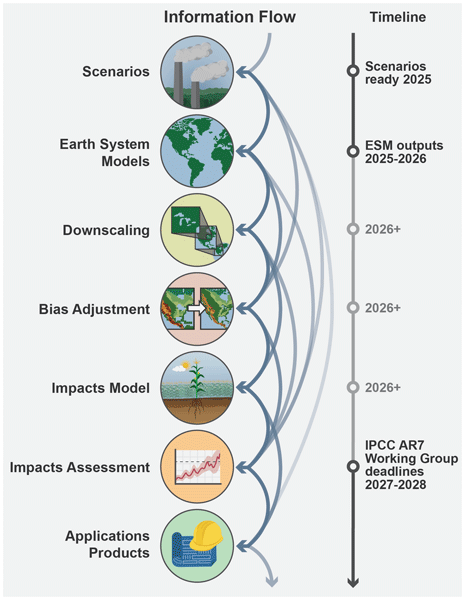
Alex C. Ruane, Charlotte L. Pascoe, Claas Teichmann, David J. Brayshaw, Carlo Buontempo, Ibrahima Diouf, Jesus Fernandez, Paula L. M. Gonzalez, Birgit Hassler, Vanessa Hernaman, Ulas Im, Doroteaciro Iovino, Martin Juckes, Iréne L. Lake, Timothy Lam, Xiaomao Lin, Jiafu Mao, Negin Nazarian, Sylvie Parey, Indrani Roy, Wan-Ling Tseng, Briony Turner, Andrew Wiebe, Lei Zhao, and Damaris Zurell
Geosci. Model Dev., 18, 9497–9540, https://doi.org/10.5194/gmd-18-9497-2025, https://doi.org/10.5194/gmd-18-9497-2025, 2025
Short summary
Short summary
This paper describes how the Coupled Model Intercomparison Project organized its 7th phase (CMIP7) to encourage the production of Earth system model outputs relevant for impacts and adaptation. Community engagement identified 13 opportunities for application across human and natural systems, 60 variable groups and 539 unique variables. We also show how simulations can more efficiently meet applications needs by targeting appropriate resolution, time slices, experiments and variable groups.
Odysseas Sifounakis, Edwin Haas, Klaus Butterbach-Bahl, Eleni Katragkou, Maria Chara Karypidou, and Maria P. Papadopoulou
EGUsphere, https://doi.org/10.5194/egusphere-2025-5311, https://doi.org/10.5194/egusphere-2025-5311, 2025
Short summary
Short summary
Using bio-geochemical models and future climate scenarios, we mapped all nitrogen and carbon fluxes from croplands. Climate change will strain food production – especially under climate change – yet soil carbon losses stay moderate where farming sustains. Nitrous oxide (a major greenhouse gas) tends to fall, while ammonia losses rise. Reporting the full balance improves transparency and guides smarter fertilizer use and soil management.
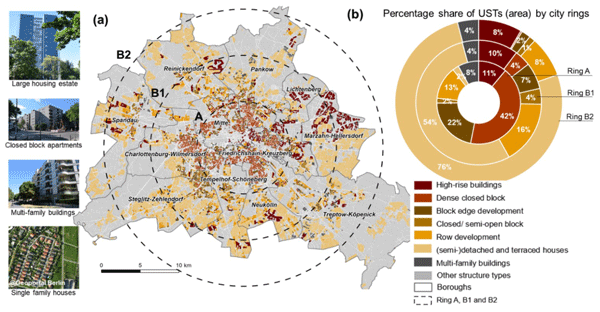
Nimra Iqbal, Marvin Ravan, Zina Mitraka, Joern Birkmann, Sue Grimmond, Denise Hertwig, Nektarios Chrysoulakis, Giorgos Somarakis, Angela Wendnagel-Beck, and Emmanouil Panagiotakis
Nat. Hazards Earth Syst. Sci., 25, 2481–2502, https://doi.org/10.5194/nhess-25-2481-2025, https://doi.org/10.5194/nhess-25-2481-2025, 2025
Short summary
Short summary
This work deepens the understanding of how perceived heat stress, human vulnerability (e.g. age, income) and adaptive capacities (e.g. green, shaded spaces) are coupled with urban structures. The results show that perceived heat stress decreases with distance from the urban center, however, human vulnerability and adaptive capacities depend more strongly on inner variations and differences between urban structures. Planning policies and adaptation strategies should account for these differences.
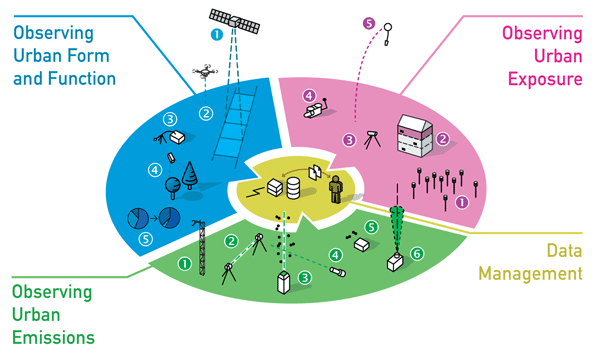
Matthias Zeeman, Andreas Christen, Sue Grimmond, Daniel Fenner, William Morrison, Gregor Feigel, Markus Sulzer, and Nektarios Chrysoulakis
Geosci. Instrum. Method. Data Syst., 13, 393–424, https://doi.org/10.5194/gi-13-393-2024, https://doi.org/10.5194/gi-13-393-2024, 2024
Short summary
Short summary
This study presents an overview of a data system for documenting, processing, managing, and publishing data streams from research networks of atmospheric and environmental sensors of varying complexity in urban environments. Our solutions aim to deliver resilient, near-time data using freely available software.
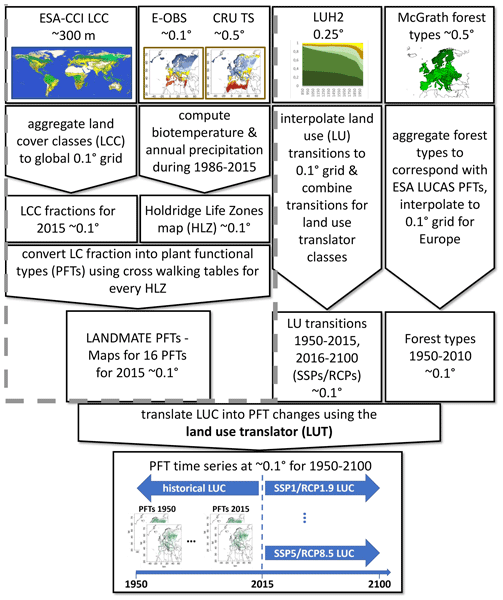
Peter Hoffmann, Vanessa Reinhart, Diana Rechid, Nathalie de Noblet-Ducoudré, Edouard L. Davin, Christina Asmus, Benjamin Bechtel, Jürgen Böhner, Eleni Katragkou, and Sebastiaan Luyssaert
Earth Syst. Sci. Data, 15, 3819–3852, https://doi.org/10.5194/essd-15-3819-2023, https://doi.org/10.5194/essd-15-3819-2023, 2023
Short summary
Short summary
This paper introduces the new high-resolution land use and land cover change dataset LUCAS LUC for Europe (version 1.1), tailored for use in regional climate models. Historical and projected future land use change information from the Land-Use Harmonization 2 (LUH2) dataset is translated into annual plant functional type changes from 1950 to 2015 and 2016 to 2100, respectively, by employing a newly developed land use translator.
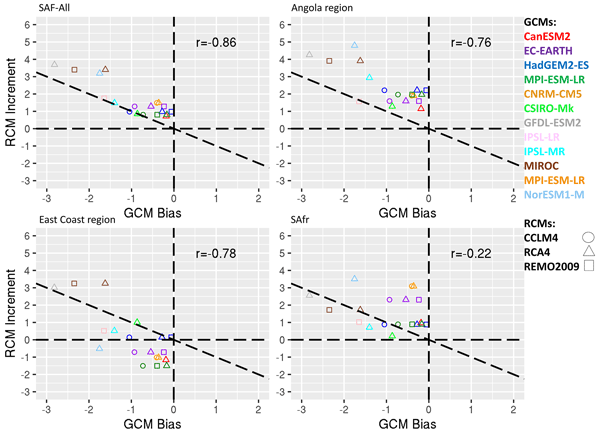
Maria Chara Karypidou, Stefan Pieter Sobolowski, Lorenzo Sangelantoni, Grigory Nikulin, and Eleni Katragkou
Geosci. Model Dev., 16, 1887–1908, https://doi.org/10.5194/gmd-16-1887-2023, https://doi.org/10.5194/gmd-16-1887-2023, 2023
Short summary
Short summary
Southern Africa is listed among the climate change hotspots; hence, accurate climate change information is vital for the optimal preparedness of local communities. In this work we assess the degree to which regional climate models (RCMs) are influenced by the global climate models (GCMs) from which they receive their lateral boundary forcing. We find that although GCMs exert a strong impact on RCMs, RCMs are still able to display substantial improvement relative to the driving GCMs.
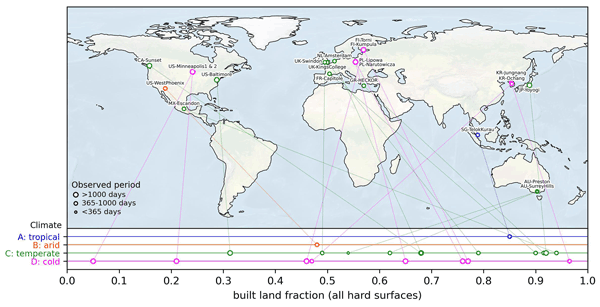
Mathew Lipson, Sue Grimmond, Martin Best, Winston T. L. Chow, Andreas Christen, Nektarios Chrysoulakis, Andrew Coutts, Ben Crawford, Stevan Earl, Jonathan Evans, Krzysztof Fortuniak, Bert G. Heusinkveld, Je-Woo Hong, Jinkyu Hong, Leena Järvi, Sungsoo Jo, Yeon-Hee Kim, Simone Kotthaus, Keunmin Lee, Valéry Masson, Joseph P. McFadden, Oliver Michels, Wlodzimierz Pawlak, Matthias Roth, Hirofumi Sugawara, Nigel Tapper, Erik Velasco, and Helen Claire Ward
Earth Syst. Sci. Data, 14, 5157–5178, https://doi.org/10.5194/essd-14-5157-2022, https://doi.org/10.5194/essd-14-5157-2022, 2022
Short summary
Short summary
We describe a new openly accessible collection of atmospheric observations from 20 cities around the world, capturing 50 site years. The observations capture local meteorology (temperature, humidity, wind, etc.) and the energy fluxes between the land and atmosphere (e.g. radiation and sensible and latent heat fluxes). These observations can be used to improve our understanding of urban climate processes and to test the accuracy of urban climate models.

Jorge Baño-Medina, Rodrigo Manzanas, Ezequiel Cimadevilla, Jesús Fernández, Jose González-Abad, Antonio S. Cofiño, and José Manuel Gutiérrez
Geosci. Model Dev., 15, 6747–6758, https://doi.org/10.5194/gmd-15-6747-2022, https://doi.org/10.5194/gmd-15-6747-2022, 2022
Short summary
Short summary
Deep neural networks are used to produce downscaled regional climate change projections over Europe for temperature and precipitation for the first time. The resulting dataset, DeepESD, is analyzed against state-of-the-art downscaling methodologies, reproducing more accurately the observed climate in the historical period and showing plausible future climate change signals with low computational requirements.
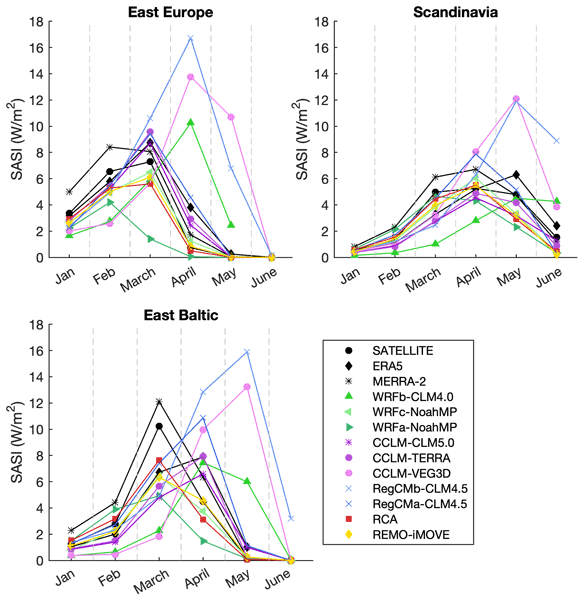
Anne Sophie Daloz, Clemens Schwingshackl, Priscilla Mooney, Susanna Strada, Diana Rechid, Edouard L. Davin, Eleni Katragkou, Nathalie de Noblet-Ducoudré, Michal Belda, Tomas Halenka, Marcus Breil, Rita M. Cardoso, Peter Hoffmann, Daniela C. A. Lima, Ronny Meier, Pedro M. M. Soares, Giannis Sofiadis, Gustav Strandberg, Merja H. Toelle, and Marianne T. Lund
The Cryosphere, 16, 2403–2419, https://doi.org/10.5194/tc-16-2403-2022, https://doi.org/10.5194/tc-16-2403-2022, 2022
Short summary
Short summary
Snow plays a major role in the regulation of the Earth's surface temperature. Together with climate change, rising temperatures are already altering snow in many ways. In this context, it is crucial to better understand the ability of climate models to represent snow and snow processes. This work focuses on Europe and shows that the melting season in spring still represents a challenge for climate models and that more work is needed to accurately simulate snow–atmosphere interactions.
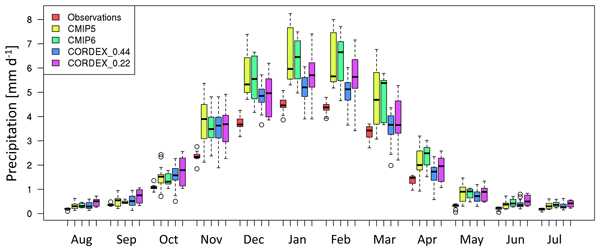
Maria Chara Karypidou, Eleni Katragkou, and Stefan Pieter Sobolowski
Geosci. Model Dev., 15, 3387–3404, https://doi.org/10.5194/gmd-15-3387-2022, https://doi.org/10.5194/gmd-15-3387-2022, 2022
Short summary
Short summary
The region of southern Africa (SAF) is highly vulnerable to the impacts of climate change and is projected to experience severe precipitation shortages in the coming decades. Reliable climatic information is therefore necessary for the optimal adaptation of local communities. In this work we show that regional climate models are reliable tools for the simulation of precipitation over southern Africa. However, there is still a great need for the expansion and maintenance of observational data.
Priscilla A. Mooney, Diana Rechid, Edouard L. Davin, Eleni Katragkou, Natalie de Noblet-Ducoudré, Marcus Breil, Rita M. Cardoso, Anne Sophie Daloz, Peter Hoffmann, Daniela C. A. Lima, Ronny Meier, Pedro M. M. Soares, Giannis Sofiadis, Susanna Strada, Gustav Strandberg, Merja H. Toelle, and Marianne T. Lund
The Cryosphere, 16, 1383–1397, https://doi.org/10.5194/tc-16-1383-2022, https://doi.org/10.5194/tc-16-1383-2022, 2022
Short summary
Short summary
We use multiple regional climate models to show that afforestation in sub-polar and alpine regions reduces the radiative impact of snow albedo on the atmosphere, reduces snow cover, and delays the start of the snowmelt season. This is important for local communities that are highly reliant on snowpack for water resources and winter tourism. However, models disagree on the amount of change particularly when snow is melting. This shows that more research is needed on snow–vegetation interactions.
Giannis Sofiadis, Eleni Katragkou, Edouard L. Davin, Diana Rechid, Nathalie de Noblet-Ducoudre, Marcus Breil, Rita M. Cardoso, Peter Hoffmann, Lisa Jach, Ronny Meier, Priscilla A. Mooney, Pedro M. M. Soares, Susanna Strada, Merja H. Tölle, and Kirsten Warrach Sagi
Geosci. Model Dev., 15, 595–616, https://doi.org/10.5194/gmd-15-595-2022, https://doi.org/10.5194/gmd-15-595-2022, 2022
Short summary
Short summary
Afforestation is currently promoted as a greenhouse gas mitigation strategy. In our study, we examine the differences in soil temperature and moisture between grounds covered either by forests or grass. The main conclusion emerged is that forest-covered grounds are cooler but drier than open lands in summer. Therefore, afforestation disrupts the seasonal cycle of soil temperature, which in turn could trigger changes in crucial chemical processes such as soil carbon sequestration.
Cited articles
Barlage, M., Tewari, M., Chen, F., Miguez-Macho, G., Yang, Z. L., and Niu, G. Y.: The effect of groundwater interaction in North American regional climate simulations with WRF/Noah-MP, Climatic Change, 129, 485–498, https://doi.org/10.1007/s10584-014-1308-8, 2015.
Bassett, R., Young, P. J., Blair, G. S., Samreen, F., and Simm, W.: A Large Ensemble Approach to Quantifying Internal Model Variability Within the WRF Numerical Model, J. Geophys. Res.-Atmos., 125, https://doi.org/10.1029/2019JD031286, 2020.
Bougeault, P. and Lacarrere, P.: Parameterization of Orography-Induced Turbulence in a Mesobeta–Scale Model, Mon. Weather Rev., https://doi.org/10.1175/1520-0493(1989)117%3C1872:POOITI%3E2.0.CO;2, 1989.
Britter, R. E. and Hanna, S. R.: Flow and dispersion in urban areas, Annu. Rev. Fluid Mech., 35, 469–496, https://doi.org/10.1146/annurev.fluid.35.101101.161147, 2003.
Brousse, O., Martilli, A., Foley, M., Mills, G., and Bechtel, B.: WUDAPT, an efficient land use producing data tool for mesoscale models? Integration of urban LCZ in WRF over Madrid, Urban Clim., 17, 116–134, https://doi.org/10.1016/j.uclim.2016.04.001, 2016.
Chen, F., Kusaka, H., Bornstein, R., Ching, J., Grimmond, C. S. B., Grossman-Clarke, S., Loridan, T., Manning, K. W., Martilli, A., Miao, S., Sailor, D., Salamanca, F. P., Taha, H., Tewari, M., Wang, X., Wyszogrodzki, A. A., and Zhang, C.: The integrated WRF/urban modelling system: Development, evaluation, and applications to urban environmental problems, Int. J. Climatol., 31, 273–288, https://doi.org/10.1002/joc.2158, 2011.
Chen, F., Barlage, M., Tewari, M., Rasmussen, R., Jin, J., Lettenmaier, D., Livneh, B., Lin, C., Miguez-Macho, G., Niu, G. Y., Wen, L., and Yang, Z. L.: Modeling seasonal snowpack evolution in the complex terrain and forested colorado headwaters region: A model intercomparison study, J. Geophys. Res., 119, 13795–13819, https://doi.org/10.1002/2014JD022167, 2014.
Chen, L., Li, Y., Chen, F., Barr, A., Barlage, M., and Wan, B.: The incorporation of an organic soil layer in the Noah-MP land surface model and its evaluation over a boreal aspen forest, Atmos. Chem. Phys., 16, 8375–8387, https://doi.org/10.5194/acp-16-8375-2016, 2016.
Ching, J., Mills, G., Bechtel, B., See, L., Feddema, J., Wang, X., Ren, C., Brorousse, O., Martilli, A., Neophytou, M., Mouzourides, P., Stewart, I., Hanna, A., Ng, E., Foley, M., Alexander, P., Aliaga, D., Niyogi, D., Shreevastava, A., Bhalachandran, P., Masson, V., Hidalgo, J., Fung, J., Andrade, M., Baklanov, A., Dai, W., Milcinski, G., Demuzere, M., Brunsell, N., Pesaresi, M., Miao, S., Mu, Q., Chen, F., and Theeuwesits, N.: WUDAPT: An urban weather, climate, and environmental modeling infrastructure for the anthropocene, B. Am. Meteorol. Soc., 99, 1907–1924, https://doi.org/10.1175/BAMS-D-16-0236.1, 2018.
Demuzere, M., Kittner, J., Martilli, A., Mills, G., Moede, C., Stewart, I. D., van Vliet, J., and Bechtel, B.: A global map of local climate zones to support earth system modelling and urban-scale environmental science, Earth Syst. Sci. Data, 14, 3835–3873, https://doi.org/10.5194/essd-14-3835-2022, 2022a.
Demuzere, M., Argüeso, D., Zonato, A., and Kittner, J.: W2W: A Python package that injects WUDAPT's Local Climate Zone information in WRF, J. Open Source Softw., 7, 4432, https://doi.org/10.21105/joss.04432, 2022b.
Diez-Sierra, J., Quintana, Y., Langendijk, G. S., Milovac, J., Demuzere, M., Nogherotto, R., Pietikäinen, J. P., Rechid, D., Zazulie, N., Solman, S. A., and Fernández, J.: A global CORDEX-based dataset delineating urban areas and their surroundings to assess climate change in megacities, Sci. Data, 12, https://doi.org/10.1038/s41597-025-06257-1, 2025.
Earth Resources Observation and Science (EROS) Center: ASTER GED, Collection 2, U.S. Geological Survey [data set], https://doi.org/10.5066/P9ZQJ30Q, 2021.
European Environment Agency: Urban Atlas Building Height 2012 (raster 10 m), Europe, European Environment Agency [data set], https://doi.org/10.2909/42690e05-edf4-43fc-8020-33e130f62023, 2022.
Florczyk, A. J., Melchiorri, M., Corbane, C., Schiavina, M., Maffenini, M., Pesaresi, M., Politis, P., Sabo, S., Freire, S., Ehrlich, D., Kemper, T., Tommasi, P., Airaghi, D., and Zanchetta, L.: Description of the GHS Urban Centre Database, https://doi.org/10.2760/037310, 2015.
Gao, Y., Li, K., Chen, F., Jiang, Y., and Lu, C.: Assessing and improving Noah-MP land model simulations for the central Tibetan plateau, J. Geophys. Res., 120, 9258–9278, https://doi.org/10.1002/2015JD023404, 2015.
Garioud, A.: Artificial intelligence for country-scale land cover description, EGU General Assembly 2024, Vienna, Austria, 14–19 Apr 2024, EGU24-6477, https://doi.org/10.5194/egusphere-egu24-6477, 2024.
Hang, J., Zeng, L., Li, X., and Wang, D.: Evaluation of a single-layer urban energy balance model using measured energy fluxes by scaled outdoor experiments in humid subtropical climate, Build. Environ., 254, https://doi.org/10.1016/j.buildenv.2024.111364, 2024.
Hawkins, T. W., Brazel, A. J., Stefanov, W. L., Bigler, W., and Saffell, E. M.: The Role of Rural Variability in Urban Heat Island Determination for Phoenix, Arizona, J. Atmos. Meteorol. Clim., https://doi.org/10.1175/1520-0450(2004)043<0476:TRORVI>2.0.CO;2, 2003.
Hersbach, H., Bell, B., Berrisford, P., Hirahara, S., Horányi, A., Muñoz-Sabater, J., Nicolas, J., Peubey, C., Radu, R., Schepers, D., Simmons, A., Soci, C., Abdalla, S., Abellan, X., Balsamo, G., Bechtold, P., Biavati, G., Bidlot, J., Bonavita, M., De Chiara, G., Dahlgren, P., Dee, D., Diamantakis, M., Dragani, R., Flemming, J., Forbes, R., Fuentes, M., Geer, A., Haimberger, L., Healy, S., Hogan, R. J., Hólm, E., Janisková, M., Keeley, S., Laloyaux, P., Lopez, P., Lupu, C., Radnoti, G., de Rosnay, P., Rozum, I., Vamborg, F., Villaume, S., and Thépaut, J. N.: The ERA5 global reanalysis, Q. J. Roy. Meteor. Soc., 146, 1999–2049, https://doi.org/10.1002/qj.3803, 2020.
Hoffmann, P., Reinhart, V., Rechid, D., De Noblet-Ducoudré, N., Davin, E. L., Asmus, C., Bechtel, B., Böhner, J., Katragkou, E., and Luyssaert, S.: High-resolution land use and land cover dataset for regional climate modelling: Historical and future changes in Europe, Earth Syst. Sci. Data, 15, 3819–3852, https://doi.org/10.5194/essd-15-3819-2023, 2023.
Hong, S. Y. and Jang, J.: Impacts of Shallow Convection Processes on a Simulated Boreal Summer Climatology in a Global Atmospheric Model, Asia. Pac. J. Atmos. Sci., 54, 361–370, https://doi.org/10.1007/s13143-018-0013-3, 2018.
Iacono, M. J., Delamere, J. S., Mlawer, E. J., Shephard, M. W., Clough, S. A., and Collins, W. D.: Radiative forcing by long-lived greenhouse gases: Calculations with the AER radiative transfer models, J. Geophys. Res.-Atmos., 113, https://doi.org/10.1029/2008JD009944, 2008.
Jacob, D., Teichmann, C., Sobolowski, S., Katragkou, E., Anders, I., Belda, M., Benestad, R., Boberg, F., Buonomo, E., Cardoso, R. M., Casanueva, A., Christensen, O. B., Christensen, J. H., Coppola, E., De Cruz, L., Davin, E. L., Dobler, A., Domínguez, M., Fealy, R., Fernandez, J., Gaertner, M. A., García-Díez, M., Giorgi, F., Gobiet, A., Goergen, K., Gómez-Navarro, J. J., Alemán, J. J. G., Gutiérrez, C., Gutiérrez, J. M., Güttler, I., Haensler, A., Halenka, T., Jerez, S., Jiménez-Guerrero, P., Jones, R. G., Keuler, K., Kjellström, E., Knist, S., Kotlarski, S., Maraun, D., van Meijgaard, E., Mercogliano, P., Montávez, J. P., Navarra, A., Nikulin, G., de Noblet-Ducoudré, N., Panitz, H. J., Pfeifer, S., Piazza, M., Pichelli, E., Pietikäinen, J. P., Prein, A. F., Preuschmann, S., Rechid, D., Rockel, B., Romera, R., Sánchez, E., Sieck, K., Soares, P. M. M., Somot, S., Srnec, L., Sørland, S. L., Termonia, P., Truhetz, H., Vautard, R., Warrach-Sagi, K., and Wulfmeyer, V.: Regional climate downscaling over Europe: perspectives from the EURO-CORDEX community, Reg. Environ. Change, 20, https://doi.org/10.1007/s10113-020-01606-9, 2020.
Kain, J.: The Kain–Fritsch Convective Parameterization: An Update, J. Appl. Meteorol., 43, 170–181, https://doi.org/10.1175/1520-0450(2004)043<0170:TKCPAU>2.0.CO;2, 2004.
Katragkou, E., Sobolowski, S. P., Teichmann, C., Solmon, F., Pavlidis, V., Rechid, D., Hoffmann, P., Fernandez, J., Nikulin, G., and Jacob, D.: Delivering an Improved Framework for the New Generation of CMIP6-Driven EURO-CORDEX Regional Climate Simulations, B. Am. Meteorol. Soc., 105, E962–E974, https://doi.org/10.1175/BAMS-D-23-0131.1, 2024.
Kusaka, H. and Kimura, F.: Coupling a Single-Layer Urban Canopy Model with a Simple Atmospheric Model: Impact on Urban Heat Island Simulation for an Idealized Case, J. Meteorol. Soc. Jpn. Ser. II, 82, 67–80, https://doi.org/10.2151/jmsj.82.67, 2004.
Kusaka, H., Kondo, H., Kikegawa, Y., and Kimura, F.: A Simple Single-Layer Urban Canopy Model For Atmospheric Models: Comparison With Multi-Layer And Slab Models, Bound.-Lay. Meteorol., 101, 329–358, https://doi.org/10.1023/A:1019207923078, 2001.
Kyriakidis, I., Pavlidis, V., Gkolemi, M., Mitraka, Z., Chrysoulakis, N., Milovac, J., Fernández, J., and Katragkou, E.: A new Earth Observation–based WRF configuration for urban regional climate simulations over Paris, Zenodo [code and data set], https://doi.org/10.5281/zenodo.19253784, 2026.
Langendijk, G. S., Halenka, T., Hoffmann, P., Adinolfi, M., Aldama Campino, A., Asselin, O., Bastin, S., Bechtel, B., Belda, M., Bushenkova, A., Campanale, A., Chun, K. P., Constantinidou, K., Coppola, E., Demuzere, M., Doan, Q. Van, Evans, J., Feldmann, H., Fernandez, J., Fita, L., Hadjinicolaou, P., Hamdi, R., Hundhausen, M., Grawe, D., Johannsen, F., Milovac, J., Katragkou, E., Kerroumi, N. E. I., Kotlarski, S., Le Roy, B., Lemonsu, A., Lennard, C., Lipson, M., Mandal, S., Muñoz Pabón, L. E., Pavlidis, V., Pietikäinen, J. P., Raffa, M., Raluy-López, E., Rechid, D., Rui, I., Schulz, J. P., Soares, P. M. M., Takane, Y., Teichmann, C., Thatcher, M., Top, S., Van Schaeybroeck, B., Wang, F., and Yuan, J.: Towards better understanding the urban environment and its interactions with regional climate change – The WCRP CORDEX Flagship Pilot Study URB-RCC, Urban Clim., 58, https://doi.org/10.1016/j.uclim.2024.102165, 2024.
Langendijk, G. S., Fernandez, J., Demuzere, M., Diez-Sierra, J., Quintana, Y., Fita, L., Zazulie, N., Nogherotto, R., Carril, A. F., Chun, K. P., Giuliani, G., Halenka, T., Hoffmann, P., Muñoz, L. E., Pietikäinen, J.-P., Rechid, D., and Yuan, J.: Representation of global mega-cities and their urban heat island in CORDEX-CORE regional climate model simulations, npj Urban Sustainability, https://doi.org/10.1038/s42949-025-00325-6, 2025.
Liu, Y., Chen, F., Warner, T., and Basara, J.: Verification of a Mesoscale Data-Assimilation and Forecasting System for the Oklahoma City Area during the Joint Urban 2003 Field Project, J. Appl. Meteorol. Climatol., 45, 912–929, https://doi.org/10.1175/JAM2383.1, 2006.
Martilli, A., Clappier, A., and Rotach, M. W.: An Urban Surface Exchange Parameterisation for Mesoscale Models, Bound.-Lay. Meteorol., 104, 261–304, https://doi.org/10.1023/A:1016099921195, 2002.
Martilli, A., Brousse, O., and Ching, J.: Urbanized WRF modeling using WUDAPT, https://doi.org/10.13140/RG.2.1.3405.2724, 2016.
Niu, G. Y., Yang, Z. L., Mitchell, K. E., Chen, F., Ek, M. B., Barlage, M., Kumar, A., Manning, K., Niyogi, D., Rosero, E., Tewari, M., and Xia, Y.: The community Noah land surface model with multiparameterization options (Noah-MP): 1. Model description and evaluation with local-scale measurements, J. Geophys. Res.-Atmos., 116, https://doi.org/10.1029/2010JD015139, 2011.
Reinhart, V., Hoffmann, P., Rechid, D., Böhner, J., and Bechtel, B.: High-resolution land use and land cover dataset for regional climate modelling: a plant functional type map for Europe 2015, Earth Syst. Sci. Data, 14, 1735–1794, https://doi.org/10.5194/essd-14-1735-2022, 2022.
Roujean, J. L., Leon-Tavares, J., Smets, B., Claes, P., Camacho De Coca, F., and Sanchez-Zapero, J.: Surface albedo and toc-r 300 m products from PROBA-V instrument in the framework of Copernicus Global Land Service, Remote Sens. Environ., 215, 57–73, https://doi.org/10.1016/j.rse.2018.05.015, 2018.
Salamanca, F. and Martilli, A.: A new Building Energy Model coupled with an Urban Canopy Parameterization for urban climate simulations-part II. Validation with one dimension off-line simulations, Theor. Appl. Climatol., 99, 345–356, https://doi.org/10.1007/s00704-009-0143-8, 2010.
Salamanca, F., Krpo, A., Martilli, A., and Clappier, A.: A new building energy model coupled with an urban canopy parameterization for urban climate simulations-part I. formulation, verification, and sensitivity analysis of the model, Theor. Appl. Climatol., 99, 331–344, https://doi.org/10.1007/s00704-009-0142-9, 2010.
Segura, R., Badia, A., Ventura, S., Gilabert, J., Martilli, A., and Villalba, G.: Sensitivity study of PBL schemes and soil initialization using the WRF-BEP-BEM model over a Mediterranean coastal city, Urban Clim., 39, https://doi.org/10.1016/j.uclim.2021.100982, 2021.
Skamarock, W. C., Klemp, J. B., Dudhia, J., Gill, D. O., Liu, Z., Berner, J., Wang, W., Powers, J. G., Duda, M. G., Barker, D. M., and Huang, X.-Y.: A Description of the Advanced Research WRF Model Version 4, Boulder, CO, USA, https://doi.org/10.5065/1dfh-6p97, 2021.
Sobolowski, S., Somot, S., Fernandez, J., Evin, G., Brands, S., Maraun, D., Kotlarski, S., Jury, M., Benestad, R. E., Teichmann, C., Christensen, O. B., Bülow, K., Buonomo, E., Katragkou, E., Steger, C., Sørland, S., Nikulin, G., McSweeney, C., Dobler, A., Palmer, T., Wilcke, R., Boé, J., Brunner, L., Ribes, A., Qasmi, S., Nabat, P., Sevault, F., and Oudar, T.: GCM Selection and Ensemble Design: Best Practices and Recommendations from the EURO-CORDEX Community, B. Am. Meteorol. Soc., 106, E1834–E1850, https://doi.org/10.1175/BAMS-D-23-0189.1, 2025.
Stewart, I. D. and Oke, T. R.: Local climate zones for urban temperature studies, B. Am. Meteorol. Soc., 93, 1879–1900, https://doi.org/10.1175/BAMS-D-11-00019.1, 2012.
Tewari, M., Chen, F., Wang, W., Dudhia, J., LeMone, M. A., Mitchell, K. E., Ek, M. B., Gayno, G., Wegiel, J. W., and Cuenca, R. H.: Implementation and verification of the unified Noah land surface model in the WRF model, in: Proceedings of the 20th Conference on Weather Analysis and Forecasting/16th Conference on Numerical Weather Prediction, Seattle, Washington, USA, 11–15 January 2004, American Meteorological Society, paper 14.2a, 2004.
Thompson, G., Rasmussen, R. M., and Manning, K.: Explicit Forecasts of Winter Precipitation Using an Improved Bulk Microphysics Scheme. Part I: Description and Sensitivity Analysis, Mon. Weather Rev., https://doi.org/10.1175/1520-0493(2004)132<0519:EFOWPU>2.0.CO;2, 2004.
Thompson, G., Field, P. R., Rasmussen, R. M., and Hall, W. D.: Explicit forecasts of winter precipitation using an improved bulk microphysics scheme. Part II: Implementation of a new snow parameterization, Mon. Weather Rev., 136, 5095–5115, https://doi.org/10.1175/2008MWR2387.1, 2008.
United Nations: World Urbanization Prospects 2025 Summary of Results, ISBN: 9789211544589, eISBN: 9789211576788, 2025.
Yang, Z. L., Niu, G. Y., Mitchell, K. E., Chen, F., Ek, M. B., Barlage, M., Longuevergne, L., Manning, K., Niyogi, D., Tewari, M., and Xia, Y.: The community Noah land surface model with multiparameterization options (Noah-MP): 2. Evaluation over global river basins, J. Geophys. Res.-Atmos., 116, https://doi.org/10.1029/2010JD015140, 2011.
Short summary
This study introduces a novel approach to incorporating city-specific EO (Earth Observation) data into an urban canopy model named BEP-BEM (Building Effect Parameterization-Building Energy Model) integrated in WRF (Weather Research and Forecasting). We highlight the added value given by BEP-BEM in the representation of the urban processes compared to a slab urban bulk approach. The implementation of the EO data improved specific aspects of the model performance.
This study introduces a novel approach to incorporating city-specific EO (Earth Observation)...


