
the Creative Commons Attribution 4.0 License.
the Creative Commons Attribution 4.0 License.
 | 18 Sep 2026
The Cloud Feedback Model Intercomparison Project (CFMIP) contribution to CMIP7

Alejandro Bodas-Salcedo
Mark D. Zelinka
Timothy Andrews
Florent Brient
Robin Chadwick
An-Zhuo Dai
Jonathan M. Gregory
Yen-Ting Hwang
Sarah M. Kang
Jennifer E. Kay
Thorsten Mauritsen
Tomoo Ogura
George Tselioudis
Masahiro Watanabe
Mark J. Webb
Allison A. Wing
Cloud processes constitute one of the key uncertainties for climate change projections. The fourth iteration of the Cloud Feedback Model Intercomparison Project, CFMIP4, contributes to the Coupled Model Intercomparison Project phase 7 (CMIP7), by providing a set of global climate model experiments aiming to enhance our understanding of clouds, circulation and climate sensitivity, thereby informing improved projections of future climate change. CFMIP4 targets four knowledge gaps: (1) Physical mechanisms of cloud feedback and adjustment; (2) Dependence of cloud feedback and adjustment on climate base state and on the nature of the forcing; (3) Coupled mechanisms of the sea-surface temperature “pattern effect”; and (4) Coupling of clouds with circulation and precipitation. CFMIP4 contributes four CMIP7 Assessment Fast Track experiments that are central to the quantification of climate feedback and sensitivity in past, present and future climates, essential for process understanding and model evaluation. Furthermore, CFMIP4 supports the joint analysis of models and observations through a data request that includes process and satellite simulator output.
- Article
(686 KB) - Full-text XML
- BibTeX
- EndNote


Clouds play a fundamental role for climate variability and change by modulating the Earth's radiation budget, as well as by coupling with atmospheric circulation and precipitation. These processes are however subject to substantial and long-standing uncertainty in global climate models (GCMs), and they are difficult to constrain observationally. The purpose of the Cloud Feedback Model Intercomparison Project (CFMIP) is to inform improved projections of future climate change, by understanding and evaluating clouds, circulation and climate sensitivity.
The present paper aims to motivate and describe the science questions and experimental protocol of the fourth iteration of CFMIP, hereafter CFMIP4, which will contribute to phase seven of the Coupled Model Intercomparison Project (CMIP7; Dunne et al., 2025). While the present paper focuses on global climate modelling, we highlight that the CFMIP community's activities and interests extend to field studies (e.g., Bony et al., 2017; Wendisch et al., 2024; Stevens et al., 2026), analysis of satellite observations (e.g., Wall et al., 2022b; Wilson Kemsley et al., 2025; Ceppi et al., 2026a; Zelinka et al., 2026), and process modelling (e.g., Shen et al., 2022; Jansson et al., 2023; Wing et al., 2024; Peng et al., 2025). Correspondingly, the CFMIP experiment protocol and data request are designed to facilitate the validation of global climate model simulations against observations and process-resolving modelling across a range of scales.
A long-standing focus of CFMIP activities has been on understanding and quantifying cloud feedback and adjustment, the two main processes through which clouds affect the climate sensitivity. Cloud feedback and adjustment represent respectively the slow, SST-mediated and the fast, non-SST-mediated components of the cloud-radiative response to forcing. Cloud feedback in particular has dominated inter-model spread in climate sensitivity across generations of GCMs (Charney et al., 1979; Cess et al., 1990; Zelinka et al., 2020), and also constitutes a key uncertainty in process-based assessments of the climate sensitivity (Sherwood et al., 2020; Forster et al., 2021). Radiative feedback is commonly estimated by least-squares regression of top-of-atmosphere radiative anomalies onto global-mean surface temperature, under the assumption that the Earth's global radiative response, R, is approximately linear with respect to surface temperature anomaly ΔT: R≈λΔT, with the climate feedback parameter λ assumed near-constant (Gregory et al., 2004).
Over the last decade, the CFMIP community has played a leading role in demonstrating that cloud feedback is in fact non-constant, and in particular that it differs substantially between observed historical climate and future projected climate change (e.g., Zhou et al., 2016; Gregory and Andrews, 2016; Andrews et al., 2018, 2022). Analysis of experiments involving different forcing agents and forcing time evolutions has revealed that λ varies with time, forcing agent, forcing magnitude, and the climate base state (e.g., Hansen et al., 2005; Marvel et al., 2016; Ceppi and Gregory, 2019; Bloch-Johnson et al., 2021; Salvi et al., 2022; Günther et al., 2022; Zhou et al., 2023; Salvi et al., 2023; Ringer et al., 2023; Mutton et al., 2024), with cloud feedback often dominating the variations in λ.
Much of this variation in cloud feedback is now understood to result from anomalous patterns of sea-surface temperature (SST), via their effect on lower-tropospheric stability and boundary-layer cloud – a phenomenon known as the “SST pattern effect” (Stevens et al., 2016; Rugenstein et al., 2023). This pattern effect accounts for cloud-radiative variability on timescales ranging from inter-annual to multi-decadal, involving both forced SST responses and unforced coupled climate variability. Beyond the SST pattern effect however, the climate base state also affects cloud feedback (and potentially also cloud adjustment), particularly through a dependence on temperature (e.g., Bloch-Johnson et al., 2015; Bjordal et al., 2020; Bloch-Johnson et al., 2021) – thus further contributing to changes in λ as the climate warms.
The climate impact of clouds occurs not only via the global radiation budget, but also through interactions with regional climate processes. The CFMIP community therefore has a long-standing interest in cloud–circulation coupling across a range of scales (Bony et al., 2015), from convective processes (Wing et al., 2018; Bony et al., 2020; Wing et al., 2024) to planetary-scale circulations such as the Hadley cells and the midlatitude jets (Tselioudis et al., 2016; Natchiar et al., 2024). Recent years have seen an increased focus on interactions between clouds and ocean processes, producing novel insights into how clouds can affect patterns of SST under both natural variability and forced climate change (Ying and Huang, 2016; Bellomo et al., 2016; Brown et al., 2016; Myers and Mechoso, 2020; Kim et al., 2022; Hsiao et al., 2022; Kang et al., 2023b; Breul et al., 2025).
These recent advances in the understanding of clouds and their coupling with circulation and climate sensitivity motivate a new set of science questions that underpin the CFMIP4 experimental protocol. Section 2 will introduce the CFMIP4 science questions, review the insights gained from the previous iteration of CFMIP experiments (i.e. CFMIP-3; Webb et al., 2017), and discuss new opportunities for progress. The experimental protocol and data request are described in Sects. 3 and 4 respectively.
The CFMIP4 science questions are deliberately broad in scope, to encompass the range of current and future research directions within the CFMIP community. We however highlight specific knowledge gaps relevant to our science questions, where we hope the new CFMIP4 experiment protocol and data request will provide new opportunities for progress.
2.1 What are the physical mechanisms underlying cloud feedbacks and adjustments in nature, and how credibly do models represent these?
Considerable uncertainty remains on feedback mechanisms for individual cloud regimes. While the rise of high clouds with warming is reasonably well understood (Hartmann and Larson, 2002; Zelinka and Hartmann, 2010) and observed (Norris et al., 2016; Richardson et al., 2022; Chepfer et al., 2025), there are ongoing efforts to elucidate how high-cloud amount and optical depth respond to warming, and how this affects longwave and shortwave radiation (McKim et al., 2024; Raghuraman et al., 2024; Wilson Kemsley et al., 2025). In particular, further observational and modelling work is needed to verify a hypothesis that predicts a reduction in high-cloud amount as the upper troposphere warms and stabilises (Bony et al., 2016; McKim et al., 2024). As for low-cloud feedback, while observational evidence of a positive feedback is now strong (Myers et al., 2021; Cesana and Del Genio, 2021; Ceppi et al., 2024), the relative importance of various potential physical drivers remains unclear (Nuijens and Siebesma, 2019; Myers et al., 2023; Ogura et al., 2023; Vogel et al., 2022). Open questions also remain regarding the magnitude and microphysical mechanisms of phase-change feedbacks (Mülmenstädt et al., 2021; Wall et al., 2022b; McCoy et al., 2023; Tan et al., 2025) and the possible coupling between aerosol forcing and cloud feedback (e.g., Gettelman et al., 2024).
The representation of cloud feedback processes in climate models is a long-standing challenge (Ceppi et al., 2017; Zelinka et al., 2020), with uncertainty resulting from a combination of structural and parametric uncertainty (e.g., Duffy et al., 2023). Recent trends in clouds and radiation are providing new opportunities to observationally assess the feedback and adjustments of clouds, and to validate the behaviour of GCMs, particularly through the use of satellite simulator output provided as part of CFMIP-3 (Bodas-Salcedo et al., 2011; Webb et al., 2017; Swales et al., 2018). Observations indicate a rapid increase in Earth's energy imbalance since the turn of the century, at a rate close to 0.5 W m−2 decade−1 (Loeb et al., 2024; Kuhlbrodt et al., 2024; Mauritsen et al., 2025), with changes in marine low clouds and storm-track clouds making a large contribution to this trend (Goessling et al., 2025; Tselioudis et al., 2025; Ceppi et al., 2026a; Zelinka et al., 2026). GCMs appear unable to replicate the magnitude of this energy imbalance increase, whether SSTs are interactive (Olonscheck and Rugenstein, 2024) or prescribed (Raghuraman et al., 2021; Hodnebrog et al., 2024); the reasons for this discrepancy are presently unclear. There is a pressing need to quantify the contributions of cloud feedback and adjustments to the observed trends, and the ability of GCMs to represent these. While much research so far has focused on the cloud response to weakening aerosol emissions (Quaas et al., 2022; Hodnebrog et al., 2024), we highlight the need for observational constraints on greenhouse gas adjustments, which may have made a comparably large contribution to the recent cloud-radiative trends (Ceppi et al., 2026a; Zelinka et al., 2026).
2.2 How and why do cloud feedbacks and adjustments depend on climate base state and on the nature of the climate forcing?
Analyses of CFMIP-3 experiments forced with different levels of SST (±4 K) and CO2 (halving, doubling, quadrupling from pre-industrial) have revealed a substantial inter-model spread in cloud feedback state-dependence, with most GCMs simulating a more amplifying feedback as the climate warms (Bloch-Johnson et al., 2021; Ringer et al., 2023). This is a first-order control on climate sensitivity in some GCMs; for example, CESM2 simulates a near-doubling of the climate sensitivity between the abrupt-2xCO2 and abrupt-4xCO2 experiments (Bloch-Johnson et al., 2021; Poletti et al., 2024; Raghuraman and Medeiros, 2026). State-dependence also affects non-cloud feedbacks (e.g., Seeley and Jeevanjee, 2021; Bourdin et al., 2021; Koll et al., 2023) and the degree to which they are masked by clouds (Stevens and Kluft, 2023; Kluft et al., 2025). Understanding to what extent this feedback state-dependence is due to changing SST patterns, feedback temperature dependence, or other processes, is an avenue for future research.
It has long been recognised that forcing agents can differ in their “efficacy”, i.e. the amount of temperature change per unit radiative forcing, as a result of differences in climate feedback (Hansen et al., 2005). Hence, temporal changes in the relative importance of various forcing agents mean that climate feedback may differ between the historical period and future climate change (Marvel et al., 2016). Several studies have identified a role for the patterns of SST response, and thus cloud feedback, in explaining forcing efficacy differences (Haugstad et al., 2017; Ceppi and Gregory, 2019; Salvi et al., 2022; Günther et al., 2022; Zhou et al., 2023; Zhang et al., 2023). The results are however highly model dependent (Richardson et al., 2019; Myhre et al., 2024), and it remains therefore uncertain to what extent changes in the relative strength of diverse forcing agents may contribute to time variation in historical climate feedback (Zhou et al., 2016; Andrews et al., 2022).
2.3 What coupled processes underlie the SST pattern effect, and how does this affect cloud feedback?
Understanding the mechanisms of SST pattern formation has been identified as one of four fundamental science questions guiding the activities of CMIP7 (Dunne et al., 2025). There is compelling evidence that aspects of the observed SST warming pattern in recent decades, for example the east–west contrast across the tropical Pacific Ocean, lie outside of the range of coupled GCM simulations (Wills et al., 2022; Simpson et al., 2025). This has important implications for the time evolution of climate feedback via the pattern effect (Gregory and Andrews, 2016; Zhou et al., 2016; Andrews and Webb, 2018), as revealed by CFMIP-3 experiment amip-piForcing, in which atmosphere GCMs are forced with observed historical SST and sea-ice but with constant pre-industrial forcing (Table 1; Andrews et al., 2022; Salvi et al., 2023). It is presently unclear whether this model bias indicates issues with the GCM representation of natural variability, the forced response, or both.
Of particular relevance to CFMIP is the potential role of subtropical marine stratocumulus clouds, whose feedback GCMs tend to under-represent (Myers et al., 2021; Ceppi et al., 2024). Recent modelling evidence suggests that a stronger (and thus more realistic) stratocumulus cloud feedback results in a stronger coupling between Southern Ocean and tropical Pacific SST anomalies (Kim et al., 2022). Thus, GCMs with Southern Ocean SSTs nudged towards the observed decadal cooling trend during 1979 to 2013 produce a more realistic tropical Pacific warming pattern, with suppressed East Pacific warming, to the extent that they simulate a realistically strong stratocumulus cloud feedback (Kang et al., 2023a, b). Coupled mean-state biases in SSTs, clouds and circulation around the Intertropical Convergence Zone (ITCZ) region may also play an important role for the SST warming pattern through their impact on the trade winds (Dong et al., 2026; Espinosa et al., 2026).
2.4 What are the mechanisms underlying cloud–circulation coupling and regional precipitation change, and how credibly do models represent these?
Under global warming, climate models simulate shifts in features of the atmospheric circulation such as the jet streams, the subtropical dry zones, and tropical rainfall – all of which will have substantial impacts on regional climate through their coupling with the radiative budget components and the hydrological cycle. Shifts in these circulation features are however highly uncertain among climate models (e.g., Kidston and Gerber, 2010; Scheff and Frierson, 2012; Harvey et al., 2020; Curtis et al., 2020; Grise and Davis, 2020; Wang et al., 2020). Cloud–circulation coupling contributes to this uncertainty, with cloud-radiative heating affecting atmospheric temperature gradients through local diabatic effects as well as via coupling with SSTs (Rädel et al., 2016; Byrne and Zanna, 2020; Voigt et al., 2021).
CFMIP-3 included a set of atmosphere-only time-slice experiments (piSST, a4SST, and variants) aimed at decomposing the coupled 4×CO2 climate response into contributions from SST, sea-ice, and direct responses to CO2, providing insight into sources of inter-model uncertainty (Webb et al., 2017; Chadwick et al., 2017). Analysis of these simulations has revealed that rapid adjustments, uniform SST changes and SST warming patterns all contribute substantially to model uncertainty in tropical circulation and precipitation, with the balance between mechanisms varying by region (Chadwick et al., 2017; Mutton et al., 2025). This highlights the need for tighter constraints on the coupled response of clouds and circulation to rapid adjustments and SST-mediated warming.
Table 1 summarises the CFMIP4 protocol and the science questions addressed by each experiment. A summary schematic of the experiments is provided in Fig. 1. In our experiment names, we follow the convention that “4k” has a lower-case k in CMIP7 (Dunne et al., 2025), whereas it was upper-case K in CMIP6. Compared to the previous iteration, CFMIP-3, the main changes include:
-
A contribution to the new CMIP7 Assessment Fast Track (AFT; Dunne et al., 2025), through the following experiments: amip-piForcing for historical feedback and pattern effect; amip-p4k for cloud feedback; abrupt-2xCO2 and abrupt-0p5xCO2 for forcing and feedback state-dependence.
-
Three new experiments, described in greater detail in the subsections below: amip-p4k-rad and amip-p4k-turb (cloud feedback processes); piClim-deltaSST (CO2-forced pattern effect).
-
An additional amip-piForcing variant forced with HadISST1 SST and sea-ice concentration (SIC; Rayner et al., 2003), and extending to December 2025.
-
An overall more compact set of experiments: we have discontinued the aquaplanet experiments, amip-4xCO2, amip-future4K, the abrupt solar forcing experiments, and the lwoff experiments with longwave cloud-radiative effects switched off (Webb et al., 2017). The piSST and a4SST set of experiments has also been reduced from eight to three, to focus on the processes identified as most important in previous analyses.
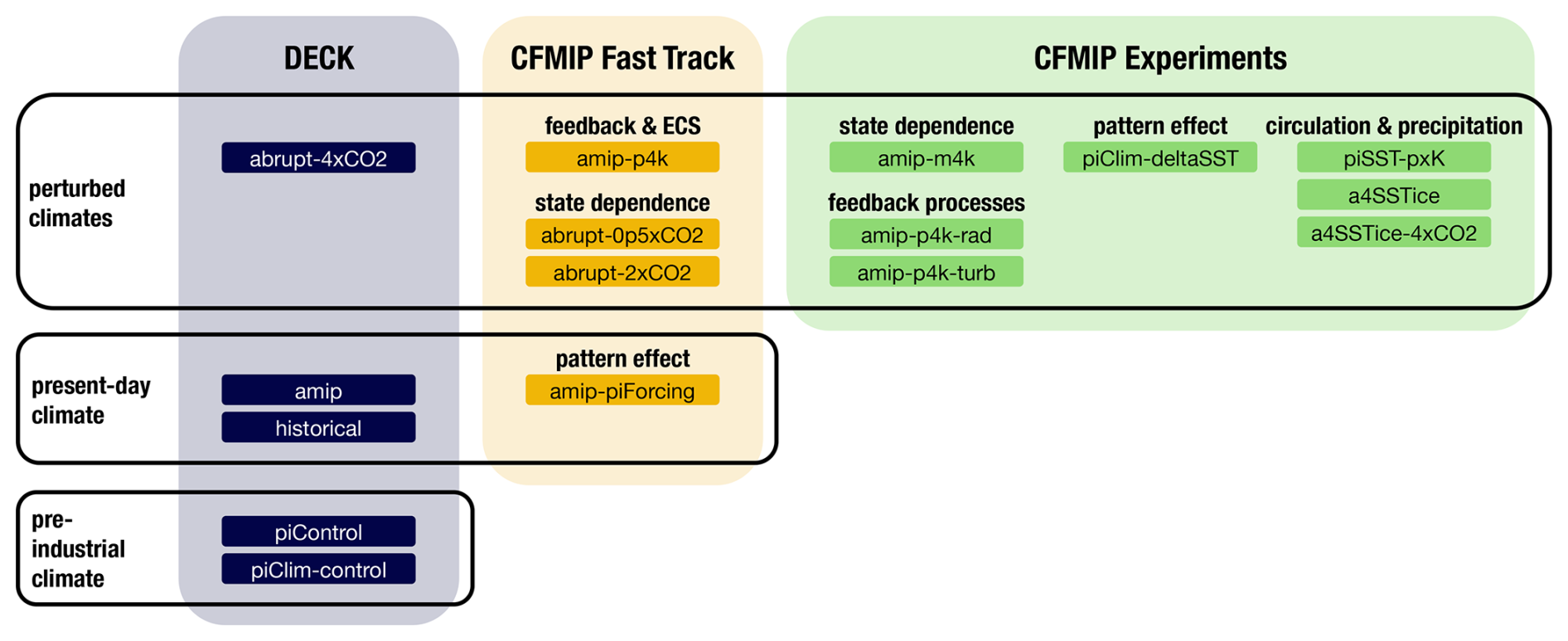
Figure 1Schematic of the CFMIP4 and related CMIP7 DECK experiments. Experiments are grouped horizontally according to pre-industrial, present-day, or perturbed climates; experiments are also grouped according to the key science questions they address (see Table 1 for additional details).
Note that the former amip-4xCO2 experiment has been superseded by Radiative Forcing Model Intercomparison Project (RFMIP; Kramer et al., 2025) experiments piClim-4xCO2 and piClim-4xCO2-rad. By comparison with piClim-control, both experiments quantify the effective radiative forcing of CO2, respectively with and without plant physiological responses. piClim-4xCO2-rad is therefore the closest analogue to amip-4xCO2, which did not include the plant physiological effect.
Contrary to CFMIP-3, the CFMIP4 protocol does not distinguish between mandatory Tier 1 experiments and optional higher tiers. Our hope is that the reduced set of experiments will encourage full participation in our protocol by modelling groups.
We highlight the continuity in CFMIP and related DECK experiments abrupt-4xCO2, amip and amip-p4K, relative to previous iterations of CFMIP and CMIP. This continuity facilitates an evaluation of the drivers of changes in cloud adjustment and feedback (and thus effective radiative forcing and climate sensitivity) across generations of CMIP models, as for example performed by Zelinka et al. (2020).
Table 1Summary of CFMIP4 and related CMIP7 DECK experiments. For abrupt CO2 forcing experiments, we request a minimum of 300 years of simulation, but encourage modelling groups to extend the simulations to 1000 years or longer if possible.
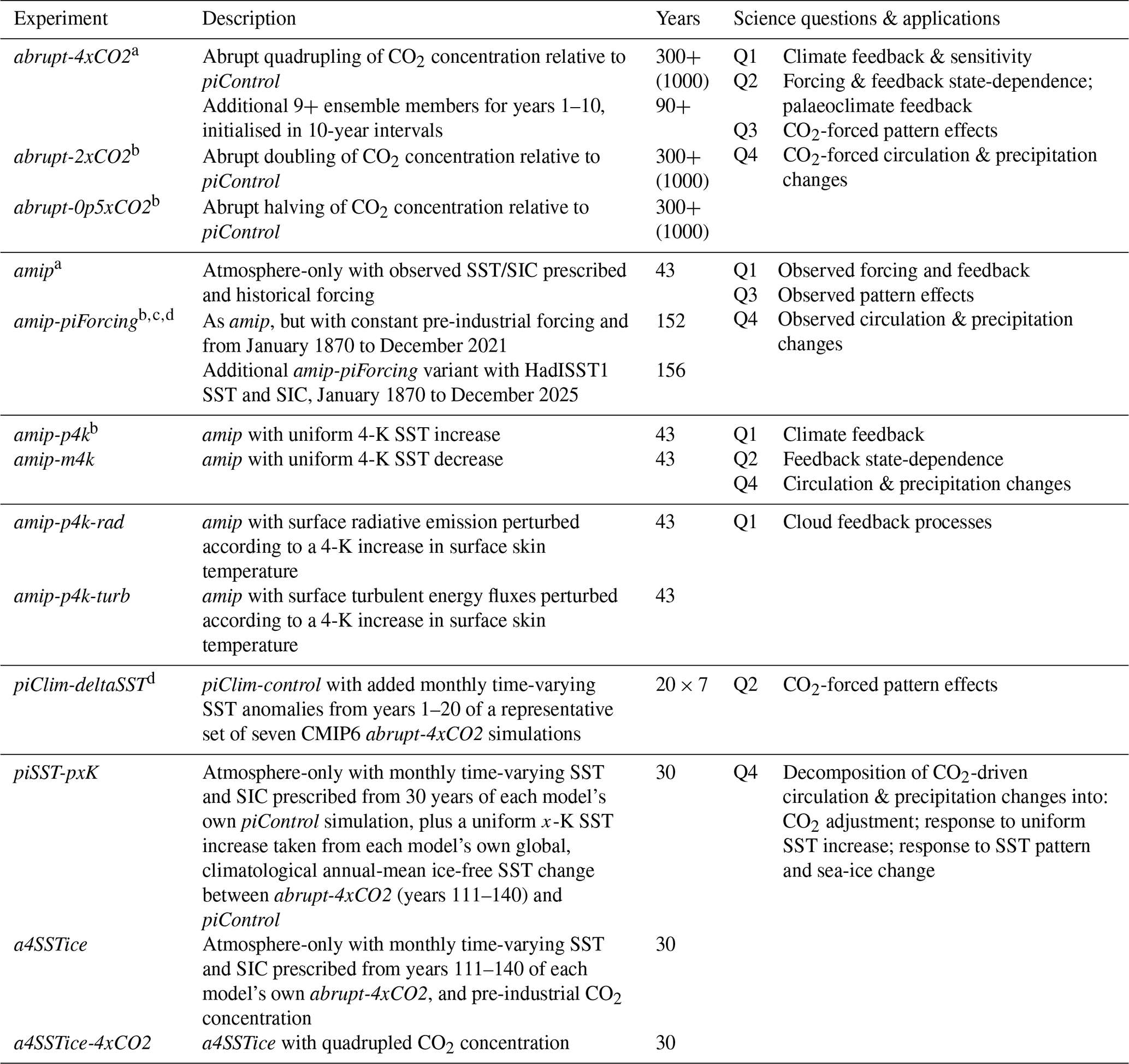
a DECK; b Assessment Fast Track; c Minimum three realisations; d SST forcing variants to be denoted by different forcing indices (f1, f2, etc.).
3.1 Coupled abrupt CO2 forcing experiments
Assessments of climate feedback and equilibrium climate sensitivity (ECS) are typically based on the abrupt-4xCO2 experiment (e.g., Andrews et al., 2012; Zelinka et al., 2020), part of the Diagnostics, Evaluation and Characterization of Klima (DECK) group of core CMIP7 experiments (Dunne et al., 2025). To support research on cloud processes, we ask modelling groups to output the CFMIP variables requested as part of our “Baseline” opportunity for this and all other DECK experiments (see Sect. 4, and note that “opportunities” refer to data requests in CMIP7).
The abrupt-4xCO2 experiment is complemented by CO2 doubling and halving experiments, abrupt-2xCO2 and abrupt-0p5xCO2, both of which are part of the AFT (Dunne et al., 2025). Comparing among these experiments will quantify the degree to which climate feedback, ECS and the pattern effect are sensitive to climate state and forcing magnitude. This will be supported by RFMIP experiments piClim-4xCO2, piClim-2xCO2 and piClim-0p5xCO2, addressing the state-dependence of effective radiative forcing, including cloud adjustments (Kramer et al., 2025). The abrupt-0p5CO2 experiment can also support the assessment of feedback processes in colder palaeoclimates, for example the Last Glacial Maximum (Cooper et al., 2024).
As a novel aspect of CFMIP4 and CMIP7, all abrupt CO2 forcing experiments should be run for a minimum of 300 years, and ideally 1000 years or longer (Dunne et al., 2025). This will facilitate an assessment of the longer timescales of the coupled climate response (Li et al., 2013; Geoffroy et al., 2013; Andrews et al., 2015; Proistosescu and Huybers, 2017; Rugenstein et al., 2019), including the time evolution of climate feedback and the pattern effect, and thus the ECS (Rugenstein et al., 2020; Bloch-Johnson et al., 2021).
Another addition to CFMIP4 is the request of an extra nine abrupt-4xCO2 ensemble members (and more if possible) for the first 10 years of the experiment, to support the assessment of the fast timescale of the SST response pattern (e.g., Rugenstein et al., 2016; Ceppi et al., 2018; Heede et al., 2020; Zhang and Kang, 2026). The choice of 10 years aims to keep the computational burden of the request limited, while also allowing for an accurate characterisation of the early SST response to CO2 forcing. The ensemble members should be initialised in 10-year intervals from the parent piControl simulation, to ensure variability in ocean conditions is adequately sampled.
3.2 Atmosphere-only experiments
3.2.1 amip
The DECK experiment amip simulates historical climate conditions (including atmospheric composition and insolation) with prescribed observed SST and SIC from January 1979 to December 2021. To support process studies of cloud-radiative trends and feedback, and comparison with observations, for amip and its variants with uniform 4-K SST increase or decrease we request outputs from both our “Baseline” and “Extension for process-level studies” opportunities (Sect. 4). The “Extension” outputs should be supplied for at least one ensemble member.
3.2.2 amip-piForcing
The AFT experiment amip-piForcing follows the same protocol as amip, but with forcing agents set to pre-industrial values. This facilitates the diagnosis of the SST-mediated radiative response, climate feedback and the pattern effect (Gregory and Andrews, 2016; Zhou et al., 2016; Andrews et al., 2022). Comparison of amip and amip-piForcing during their period of overlap also provides an estimate of the historical effective radiative forcing, complementary to the RFMIP experiment piClim-histall (Kramer et al., 2025).
The CMIP7 protocol for amip-piForcing employs the Atmospheric Model Intercomparison Project (AMIP) II SST and SIC dataset, ending December 2022 (Hurrell et al., 2008; Durack et al., 2025; Dunne et al., 2025). This means that the period since 2023, which saw large anomalies in SST, global-mean surface temperature and the global energy budget (Kuhlbrodt et al., 2024; Schmidt, 2024; Goessling et al., 2025), is not covered. We therefore request that participating modelling centres run an additional amip-piForcing variant with HadISST1 SST and SIC (Rayner et al., 2003), extending up to December 2025 (input files available on https://doi.org/10.5281/zenodo.21164517 (Ceppi et al., 2026b), pending final publication on the Earth System Grid Federation). The choice of HadISST1 is motivated by the fact that it is a regularly updated, operational dataset, and that it has been used in previous studies to force atmosphere-only GCMs (Lewis and Mauritsen, 2021; Andrews et al., 2022; Modak and Mauritsen, 2023; Fan et al., 2025), despite known shortcomings in e.g. the representation of Southern Ocean SST trends (Schmidt et al., 2023).
Comparing between the AMIP II and the HadISST1 variants of amip-piForcing will provide a measure of the sensitivity of the radiative response to the choice of SST and SIC boundary conditions. (Note however that the HadISST1 and AMIP II datasets are not completely independent: AMIP II uses HadISST1 SST and SIC before 1981, with some post-processing to match the 1971–2000 climatology of the Optimum Interpolation v2 dataset (Reynolds et al., 2002) used from November 1981 onwards.) Previous studies have highlighted a substantial dependence of the radiative response on the SST dataset for certain historical periods, although most studies were based on single GCMs (Lewis and Mauritsen, 2021; Modak and Mauritsen, 2023; Fan et al., 2025).
Although the AFT request is for a single amip-piForcing realisation, we encourage modelling groups to perform a minimum of three realisations with perturbed initial conditions (and for each of the two sets of SST/SIC boundary conditions), as this will permit a more accurate characterisation of the time-varying historical climate feedback. Simulation output should be archived using different forcing indices corresponding to different boundary conditions; we request f1 for AMIP II and f2 for HadISST1. We therefore request a total of six amip-piForcing variants: r1i1p1f1 to r3i1p1f1 for AMIP II SST and SIC, and r1i1p1f2 to r3i1p1f2 for HadISST1. The HadISST1 SST and SIC monthly-mean boundary conditions have been processed to ensure adequate sampling of the seasonal cycle according to the method of Taylor et al. (2000).
Note that a new version of HadISST SST, HadISST2, is due to be released soon and will be used in the CERESMIP protocol (Schmidt et al., 2023). Once published on input4MIPs, we encourage modelling centres participating in CFMIP to perform a third set of amip-piForcing simulations with HadISST2 SST and SIC, using the forcing variant f3. This will facilitate comparisons between CERESMIP amip simulations and CFMIP amip-piForcing simulations.
3.2.3 amip-p4k, amip-m4k
Experiments amip-p4k and amip-m4k follow the amip protocol, except that SSTs are uniformly increased or decreased by 4 K over ice-free regions; SIC and SSTs under sea-ice remain unchanged, with SSTs at the freezing point. amip-p4k was adopted into the AFT for the diagnosis of climate feedback. As an atmosphere-only experiment, it is relatively low-cost, and furthermore the use of prescribed SSTs ensures that cloud feedback can be robustly estimated even from short simulations (Qin et al., 2022). This makes the protocol highly suitable for high-resolution models, e.g. the highresSST-p4kuni experiment of HighResMIP (Roberts et al., 2025) or the superparameterised simulations of Peng et al. (2025).
Moreover, comparing between amip-p4k and amip-m4k responses provides an estimate of feedback state-dependence with SST patterns held fixed, thus isolating the role of global temperature changes for climate feedback (Bjordal et al., 2020; Ringer et al., 2023). This is complementary to estimates based on coupled abrupt CO2 forcing experiments, which additionally include effects from changing SST patterns.
3.2.4 amip-p4k-rad, amip-p4k-turb
The two experiments amip-p4k-rad and amip-p4k-turb, new to CFMIP4, aim to provide a better understanding of low-cloud feedback mechanisms. The idea behind the experiments, introduced by Ogura et al. (2023), is that uniform SST warming modifies the atmosphere via two causal pathways: first by increasing upwelling longwave radiation from the sea surface, and second by changing turbulent transport at the air-sea interface, particularly latent and sensible heat fluxes. The experiments isolate the impact of each of these two pathways on low-cloud feedback, motivated by previously hypothesized mechanisms involving changes in surface turbulent fluxes (e.g., Rieck et al., 2012).
Following Ogura et al. (2023), amip-p4k-rad is run exactly as amip but a 4-K anomaly is added (over ocean regions only) to the SST used in the radiation code for the calculation of surface upwelling longwave radiation. For amip-p4k-turb, the protocol again follows amip but a 4-K anomaly is added to the SST seen by the model's surface turbulent exchange scheme only. We recommend perturbing sensible and latent heat fluxes only, and keeping any other turbulent fluxes (e.g. of momentum or aerosols) unperturbed. Test simulations indicate that perturbing momentum or aerosol fluxes has very little impact on low-cloud properties (T. Ogura, personal communication, 2026).
3.3 piClim-deltaSST
In previous CFMIP protocols, experiment amip-future4K (or amipFuture in CMIP5) served to assess the global climate response to patterned warming, with the warming pattern taken from the model-mean response in CMIP3 1pctCO2 simulations (Webb et al., 2017). Being calculated from a model mean, the amip-future4K warming pattern was muted and underestimated the amplitude of SST anomaly patterns found in individual models. Furthermore, the use of the 1pctCO2 experiment meant the pattern combined fast and slow timescales of the climate response to CO2 forcing (Good et al., 2011; Andrews et al., 2015; Proistosescu and Huybers, 2017; Ceppi et al., 2018). Because of these issues, amip-future4K proved to be of limited use to interpret the CO2-forced pattern effect in individual climate models.
In CFMIP4, we replace amip-future4K by the new experiment piClim-deltaSST, whose aim is to represent the climate response to model-specific CO2-forced SST change. Thus, instead of a single model-mean SST pattern, piClim-deltaSST uses SST anomalies from individual CMIP6 GCMs forced with abrupt CO2 quadrupling (calculated relative to the corresponding piControl monthly climatology, taken from the contemporaneous period). The chosen GCMs are CanESM5, CESM2, CNRM-ESM2-1, GFDL-CM4, HadGEM3-GC31-LL, MIROC6, and NorESM2-LM. They are selected for their diverse representation of the pattern effect, as measured by the cloud-radiative effect (CRE) feedback simulated in piClim-deltaSST test simulations with the HadAM3 atmosphere-only model (J. M. Gregory, personal communication, 2026), and furthermore these GCMs come from different modelling groups. We use the first 20 years of these GCMs' integrations to calculate a set of monthly time-varying SST anomaly fields, ΔSSTi(x,t), where x is location, t is time (in months), and subscript i refers to one of the seven GCMs listed above.
Modelling centres are requested to perform this experiment following the piClim-control protocol, but with the following modifications:
-
The monthly time-varying SST anomaly fields ΔSSTi(x,t) should be added to the piClim-control SST monthly climatology. SIC is kept to the piClim-control climatology. SSTs should be kept to freezing (−1.8 °C) wherever SIC is greater than zero, or wherever the ΔSSTi(x,t) anomaly takes SST to below freezing.
-
The simulations should be run for 20 years, i.e. the time range of the ΔSST datasets.
-
The simulations with different SST anomaly fields should be saved under different forcing indices (f1 to f7), in alphabetical order of the GCMs used to derive the SST anomaly fields. The recommended forcing indices are provided as part of the filenames of the input datasets (available on https://doi.org/10.5281/zenodo.21164517 (Ceppi et al., 2026b), pending final publication on the Earth System Grid Federation).
Note that, by keeping SIC fixed to the control climatology, piClim-deltaSST excludes effects associated with changes in the pattern of SIC (Zhou et al., 2025).
3.4 piSST and a4SSTice time-slice experiments
This set of three atmosphere-only experiments provides a decomposition of the abrupt-4xCO2 climate response into three main components: direct CO2 effect; response to uniform SST increase; and response to SST pattern and sea-ice change. The science focus of these experiments is the coupled response of clouds, circulation and precipitation to CO2 forcing in GCMs. To adequately resolve regional features of circulation and precipitation (and their variability), the experiments here use monthly time-varying SST and SIC fields. This is a key difference from the setup of the piClim experiments.
The three experiments are set up as follows:
-
piSST-pxK uses monthly time-varying SST, SIC and atmospheric constituents from 30 years of each model's own piControl run, with SSTs uniformly increased by x K in ice-free regions, where x is the global, climatological annual-mean ice-free SST change between years 111–140 of abrupt-4xCO2 and piControl. The 30 years should be chosen to be parallel to years 111–140 of the abrupt-4xCO2 run.
-
a4SSTice uses monthly time-varying SST and SIC from years 111–140 of each model's own abrupt-4xCO2 run, but keeping atmospheric constituents to pre-industrial levels.
-
a4SSTice-4xCO2 is set up like a4SSTice, but CO2 concentration is quadrupled.
Unlike in the previous iteration of CFMIP, there is no piSST experiment with SST and SIC taken directly from piControl. This is because the piSST and piControl climates are sufficiently identical that piControl can be used as a reference for comparison with the atmosphere-only simulations with perturbed SST, SIC and/or CO2 concentration.
Differences between experiment pairs can be interpreted as follows:
-
a4SSTice-4xCO2 minus piControl can be compared with the climate response simulated in years 111–140 of abrupt-4xCO2 relative to piControl, to confirm that the atmosphere-only framework can adequately replicate coupled GCM responses. A previous analysis suggests that this is generally the case (Chadwick et al., 2017).
-
piSST-pxK minus piControl provides the response to uniform SST increase.
-
a4SSTice minus piSST-pxK provides the response to the (zero-mean) pattern of SST change and the change in SIC.
-
a4SSTice-4xCO2 minus a4SSTice provides the direct CO2 effect, including the plant physiological response.
The CMIP7 data request is structured into groups of scientific objectives referred to as “Opportunities”, two of which are related to CFMIP. Together, the data requested in these two opportunities includes all fields requested in CFMIP-3, augmented by several new fields. The first is the Clouds, circulation and climate sensitivity: baseline opportunity, which is intended to capture the base set of variables essential for performing analyses to answer the key CFMIP questions listed in Sect. 2. The data requested include the Baseline Climate Variables (Juckes et al., 2025), monthly-mean 2D and 3D fields, daily-mean 2D fields, and fixed fields. These data are requested from the 10 DECK experiments in addition to the suite of CFMIP experiments listed in Table 1.
Supplementing this is a second opportunity, Clouds, circulation and climate sensitivity: extension for process-level studies, which is intended to capture variables crucial for advanced diagnosis and evaluation of cloud, radiation, and precipitation processes in the present-day and warmed climate. In addition to requesting the same variables as the baseline opportunity, this opportunity requests daily-mean 3D fields; sub-hourly instantaneous fields at specified “cfSites” locations; additional output from the CFMIP Observation Simulator Package (COSP; Bodas-Salcedo et al., 2011; Swales et al., 2018); and monthly climatologies of hourly-resolved top-of-atmosphere (TOA) fluxes. The variables included here also ensure that CFMIP experiment output can be more directly compared with global satellite observations and field campaign data. Furthermore, cfSites output can be used to provide large-scale forcings for regional process-resolving model experiments, for example with single-column models (Dal Gesso and Neggers, 2018) or large-eddy simulations (Shen et al., 2022).
Five new cfSites locations have been added to the request since CFMIP-3, corresponding to locations of field campaigns and surface-based observational facilities (Webb, 2025). Several new COSP outputs are requested, including phase-separated cloud fraction histograms produced by the MODIS simulator, which are useful for diagnosing cloud phase feedbacks (Wall et al., 2025). Some of these COSP variables are only produced by COSP version 2 (Swales et al., 2018), but either COSP version can be used to contribute to CFMIP. To keep the data volume reasonable, this second opportunity is applicable only to a subset of five experiments (amip, amip-p4k, amip-m4k, amip-p4k-rad, and amip-p4k-turb) rather than for the full suite of experiments in Table 1.
Producing data from these two opportunities across a large collection of climate models will allow major progress across the topics of interest to the CFMIP community by facilitating advanced diagnosis and understanding of cloud processes, feedbacks, adjustments, and biases. Additional information about the CFMIP data request and how it fits into the broader CMIP7 data request can be found in Dingley et al. (2026). The data request database is currently hosted on the Airtable cloud platform (https://bit.ly/CMIP-DR-Opportunities, last access: 8 September 2026, Opportunity IDs 78–79).
The growing climate change signal means that understanding cloud processes and their impact on Earth's energy imbalance is a critical challenge for the research community. CFMIP plays a central role in this endeavour, by supporting CMIP7 and its Assessment Fast Track with a set of experiments aimed at understanding cloud-radiative processes under past, present and future climate. The CFMIP protocol is also key to understanding the mechanisms of the “SST pattern effect”, one of four fundamental science questions underpinning CMIP7 activities (Dunne et al., 2025).
The scope of CFMIP extends beyond pure cloud processes: the CFMIP4 science questions and experimental protocol support improved understanding of climate feedback processes, coupled climate variability and change, atmosphere and ocean circulation, and precipitation. The CFMIP science community actively collaborates on these topics, particularly through its annual meeting. We invite interested members of the climate research community to engage with CFMIP through membership of the mailing list (https://groups.google.com/g/cfmip_all/, last access: 8 September 2026) and attendance at the CFMIP annual meeting.
CFMIP science questions are highly complementary to other CMIP-related initiatives. In particular, the Radiative Forcing Model Intercomparison Project (RFMIP; Pincus et al., 2016; Kramer et al., 2025) provides experiments supporting the diagnosis and process understanding of radiative forcing and thus climate sensitivity. Furthermore, the Regional Aerosol Model Intercomparison Project (RAMIP; Wilcox et al., 2023) and the Aerosol and Chemistry Model Intercomparison Project (AerChemMIP; Collins et al., 2017; Fiedler et al., 2026) support the understanding of aerosol processes, including their interaction with clouds. CFMIP experiments and output variables also support the aim of assessing aerosol processes, for example through the use of satellite simulator output (e.g., Wall et al., 2022a).
Beyond the protocol outlined here, CFMIP also supports informal experiments and model intercomparison projects (MIPs) related to the aims of CFMIP. This includes for example the Radiative-Convective Equilibrium Model Intercomparison Project (RCEMIP; Wing et al., 2018, 2024), the Extratropical–Tropical Interaction Model Intercomparison Project (ETIN-MIP; Kang et al., 2019), or the Green's Function Model Intercomparison Project (GFMIP; Bloch-Johnson et al., 2024). An up-to-date list of supported informal experiments is available at https://www.cfmip.org/experiments/informal-experiments (last access: 8 September 2026), and the CFMIP committee welcomes additional informal experiment proposals.
No code or data has been used or is necessary to replicate the work here presented.
PC, ABS, MJW and MDZ jointly designed the protocol, with input from co-authors. PC led the writing of the paper. MDZ led the writing of Sect. 4. AZD processed and uploaded the SST and sea-ice boundary condition files for CFMIP4. All co-authors commented on and edited the draft.
The contact author has declared that none of the authors has any competing interests.
Publisher's note: Copernicus Publications remains neutral with regard to jurisdictional claims made in the text, published maps, institutional affiliations, or any other geographical representation in this paper. The authors bear the ultimate responsibility for providing appropriate place names. Views expressed in the text are those of the authors and do not necessarily reflect the views of the publisher.
We acknowledge the World Climate Research Programme's Working Group on Coupled Modelling, which is responsible for CMIP, and we thank the climate modelling groups for producing and making available their model output. We also thank the Earth System Grid Federation (ESGF) for archiving the model output and providing access, and we thank the multiple funding agencies who support CMIP and ESGF.
PC was supported by UK Research and Innovation (UKRI) under the UK government's Horizon Europe funding Guarantee (grant EP/Y036123/1). PC was additionally supported through UK Natural Environmental Research Council (NERC) grants NE/V012045/1 and NE/T006250/1. MJW, ABS and TA were supported by the Met Office Hadley Centre Climate Programme funded by DSIT. The effort of MDZ was supported by the US Department of Energy (DOE) Regional and Global Model Analysis program area and was performed under the auspices of the DOE by Lawrence Livermore National Laboratory under Contract DE-AC52-07NA27344. FB acknowledges the financial support of grant MOBYDYC ANR-22-CE01-0005. AAW is supported by US National Science Foundation (NSF) Grant AGS-2140419. YTH was supported by the National Science and Technology Council, R.O.C. (112-2111-M-002-016-MY4).
This paper was edited by Xianan Jiang and reviewed by Andrew Gettelman, Bjorn Stevens, and two anonymous referees.
Andrews, T. and Webb, M. J.: The dependence of global cloud and lapse-rate feedbacks on the spatial structure of tropical Pacific warming, J. Climate, 31, 641–654, https://doi.org/10.1175/JCLI-D-17-0087.1, 2018. a
Andrews, T., Gregory, J. M., Webb, M. J., and Taylor, K. E.: Forcing, feedbacks and climate sensitivity in CMIP5 coupled atmosphere-ocean climate models, Geophys. Res. Lett., 39, L09712, https://doi.org/10.1029/2012GL051607, 2012. a
Andrews, T., Gregory, J. M., and Webb, M. J.: The Dependence of Radiative Forcing and Feedback on Evolving Patterns of Surface Temperature Change in Climate Models, J. Climate, 28, 1630–1648, https://doi.org/10.1175/JCLI-D-14-00545.1, 2015. a, b
Andrews, T., Gregory, J. M., Paynter, D., Silvers, L. G., Zhou, C., Mauritsen, T., Webb, M. J., Armour, K. C., Forster, P. M., and Titchner, H.: Accounting for Changing Temperature Patterns Increases Historical Estimates of Climate Sensitivity, Geophys. Res. Lett., 45, 8490–8499, https://doi.org/10.1029/2018GL078887, 2018. a
Andrews, T., Bodas-Salcedo, A., Gregory, J. M., Dong, Y., Armour, K. C., Paynter, D., Lin, P., Modak, A., Mauritsen, T., Cole, J. N. S., Medeiros, B., Benedict, J. J., Douville, H., Roehrig, R., Koshiro, T., Kawai, H., Ogura, T., Dufresne, J.-L., Allan, R. P., and Liu, C.: On the Effect of Historical SST Patterns on Radiative Feedback, J. Geophys. Res.-Atmos., 127, e2022JD036675, https://doi.org/10.1029/2022JD036675, 2022. a, b, c, d, e
Bellomo, K., Clement, A. C., Murphy, L. N., Polvani, L. M., and Cane, M. A.: New observational evidence for a positive cloud feedback that amplifies the Atlantic Multidecadal Oscillation, Geophys. Res. Lett., 43, 9852–9859, https://doi.org/10.1002/2016GL069961, 2016. a
Bjordal, J., Storelvmo, T., Alterskjær, K., and Carlsen, T.: Equilibrium climate sensitivity above 5 °C plausible due to state-dependent cloud feedback, Nat. Geosci., 13, 718–721, https://doi.org/10.1038/s41561-020-00649-1, 2020. a, b
Bloch-Johnson, J., Pierrehumbert, R. T., and Abbot, D. S.: Feedback temperature dependence determines the risk of high warming, Geophys. Res. Lett., 42, 4973–4980, https://doi.org/10.1002/2015GL064240, 2015. a
Bloch-Johnson, J., Rugenstein, M., Stolpe, M. B., Rohrschneider, T., Zheng, Y., and Gregory, J. M.: Climate Sensitivity Increases Under Higher CO2 Levels Due to Feedback Temperature Dependence, Geophys. Res. Lett., 48, e2020GL089074, https://doi.org/10.1029/2020GL089074, 2021. a, b, c, d, e
Bloch-Johnson, J., Rugenstein, M. A. A., Alessi, M. J., Proistosescu, C., Zhao, M., Zhang, B., Williams, A. I. L., Gregory, J. M., Cole, J., Dong, Y., Duffy, M. L., Kang, S. M., and Zhou, C.: The Green's Function Model Intercomparison Project (GFMIP) Protocol, J. Adv. Model. Earth Sy., 16, e2023MS003700, https://doi.org/10.1029/2023MS003700, 2024. a
Bodas-Salcedo, A., Webb, M. J., Bony, S., Chepfer, H., Dufresne, J.-L., Klein, S. A., Zhang, Y., Marchand, R., Haynes, J. M., Pincus, R., and John, V. O.: COSP: Satellite simulation software for model assessment, B. Am. Meteorol. Soc., 92, 1023–1043, https://doi.org/10.1175/2011BAMS2856.1, 2011. a, b
Bony, S., Stevens, B., Frierson, D. M. W., Jakob, C., Kageyama, M., Pincus, R., Shepherd, T. G., Sherwood, S. C., Siebesma, A. P., Sobel, A. H., Watanabe, M., and Webb, M. J.: Clouds, circulation and climate sensitivity, Nat. Geosci., 8, 261–268, https://doi.org/10.1038/ngeo2398, 2015. a
Bony, S., Stevens, B., Coppin, D., Becker, T., Reed, K. A., Voigt, A., and Medeiros, B.: Thermodynamic control of anvil cloud amount, P. Natl. Acad. Sci. USA, 113, 8927–32, https://doi.org/10.1073/pnas.1601472113, 2016. a
Bony, S., Stevens, B., Ament, F., Bigorre, S., Chazette, P., Crewell, S., Delanoë, J., Emanuel, K., Farrell, D., Flamant, C., Gross, S., Hirsch, L., Karstensen, J., Mayer, B., Nuijens, L., Ruppert, J. H., Sandu, I., Siebesma, P., Speich, S., Szczap, F., Totems, J., Vogel, R., Wendisch, M., and Wirth, M.: EUREC4A: A Field Campaign to Elucidate the Couplings Between Clouds, Convection and Circulation, Surv. Geophys., 38, 1529–1568, https://doi.org/10.1007/s10712-017-9428-0, 2017. a
Bony, S., Semie, A., Kramer, R. J., Soden, B., Tompkins, A. M., and Emanuel, K. A.: Observed Modulation of the Tropical Radiation Budget by Deep Convective Organization and Lower-Tropospheric Stability, AGU Adv., 1, e2019AV000155, https://doi.org/10.1029/2019AV000155, 2020. a
Bourdin, S., Kluft, L., and Stevens, B.: Dependence of Climate Sensitivity on the Given Distribution of Relative Humidity, Geophys. Res. Lett., 48, e2021GL092462, https://doi.org/10.1029/2021GL092462, 2021. a
Breul, P., Ceppi, P., and Nowack, P.: The importance of stratocumulus clouds for projected warming patterns and circulation changes, Atmos. Chem. Phys., 25, 11991–12005, https://doi.org/10.5194/acp-25-11991-2025, 2025. a
Brown, P. T., Lozier, M. S., Zhang, R., and Li, W.: The necessity of cloud feedback for a basin-scale Atlantic Multidecadal Oscillation, Geophys. Res. Lett., 43, 3955–3963, https://doi.org/10.1002/2016GL068303, 2016. a
Byrne, M. P. and Zanna, L.: Radiative Effects of Clouds and Water Vapor on an Axisymmetric Monsoon, J. Climate, 33, 8789–8811, https://doi.org/10.1175/JCLI-D-19-0974.1, 2020. a
Ceppi, P. and Gregory, J. M.: A refined model for the Earth's global energy balance, Clim. Dynam., 53, 4781–4797, https://doi.org/10.1007/s00382-019-04825-x, 2019. a, b
Ceppi, P., Brient, F., Zelinka, M. D., and Hartmann, D. L.: Cloud feedback mechanisms and their representation in global climate models, WIRes Clim. Change, 8, e465, https://doi.org/10.1002/wcc.465, 2017. a
Ceppi, P., Zappa, G., Shepherd, T. G., and Gregory, J. M.: Fast and slow components of the extratropical atmospheric circulation response to CO2 forcing, J. Climate, 31, 1091–1105, https://doi.org/10.1175/JCLI-D-17-0323.1, 2018. a, b
Ceppi, P., Myers, T. A., Nowack, P., Wall, C. J., and Zelinka, M. D.: Implications of a Pervasive Climate Model Bias for Low-Cloud Feedback, Geophys. Res. Lett., 51, e2024GL110525, https://doi.org/10.1029/2024GL110525, 2024. a, b
Ceppi, P., Wilson Kemsley, S., Andersen, H., Andrews, T., Kramer, R. J., Nowack, P., Wall, C. J., and Zelinka, M. D.: Emerging low-cloud feedback and adjustment in global satellite observations, Atmos. Chem. Phys., 26, 4153–4171, https://doi.org/10.5194/acp-26-4153-2026, 2026a. a, b, c
Ceppi, P., Gregory, J., and Dai, A.-Z.: SST and sea-ice boundary conditions for CFMIP4 experiments, Zenodo [data set], https://doi.org/10.5281/zenodo.21164518, 2026b. a, b
Cesana, G. V. and Del Genio, A. D.: Observational constraint on cloud feedbacks suggests moderate climate sensitivity, Nat. Clim. Change, 11, 213–218, https://doi.org/10.1038/s41558-020-00970-y, 2021. a
Cess, R. D., Potter, G. L., Blanchet, J. P., Boer, G. J., Del Genio, A. D., Déqué, M., Dymnikov, V., Galin, V., Gates, W. L., Ghan, S. J., Kiehl, J. T., Lacis, A. A., Le Treut, H., Li, Z.-X., Liang, X.-Z., McAvaney, B. J., Meleshko, V. P., Mitchell, J. F. B., Morcrette, J.-J., Randall, D. A., Rikus, L., Roeckner, E., Royer, J. F., Schlese, U., Sheinin, D. A., Slingo, A., Sokolov, A. P., Taylor, K. E., Washington, W. M., Wetherald, R. T., Yagai, I., and Zhang, M.-H.: Intercomparison and interpretation of climate feedback processes in 19 atmospheric general circulation models, J. Geophys. Res., 95, 16601, https://doi.org/10.1029/JD095iD10p16601, 1990. a
Chadwick, R., Douville, H., and Skinner, C. B.: Timeslice experiments for understanding regional climate projections: applications to the tropical hydrological cycle and European winter circulation, Clim. Dynam., 1–19, https://doi.org/10.1007/s00382-016-3488-6, 2017. a, b, c
Charney, J. G., Arakawa, A., Baker, D. J., Bolin, B., Dickinson, R. E., Goody, R. M., Leith, C. E., Stommel, H. M., and Wunsch, C. I.: Carbon Dioxide and Climate, Tech. rep., National Academy of Science, Washington, D.C., https://doi.org/10.17226/12181, 1979. a
Chepfer, H., Chomette, O., Arouf, A., Noel, V., Winker, D., Feofilov, A., and Alava Baldazo, A.: Variability and Trends in Cloud Properties Over 17 Years From CALIPSO Space Lidar Observations, J. Geophys. Res.-Atmos., 130, e2025JD043764, https://doi.org/10.1029/2025JD043764, 2025. a
Collins, W. J., Lamarque, J.-F., Schulz, M., Boucher, O., Eyring, V., Hegglin, M. I., Maycock, A., Myhre, G., Prather, M., Shindell, D., and Smith, S. J.: AerChemMIP: quantifying the effects of chemistry and aerosols in CMIP6, Geosci. Model Dev., 10, 585–607, https://doi.org/10.5194/gmd-10-585-2017, 2017. a
Cooper, V. T., Armour, K. C., Hakim, G. J., Tierney, J. E., Osman, M. B., Proistosescu, C., Dong, Y., Burls, N. J., Andrews, T., Amrhein, D. E., Zhu, J., Dong, W., Ming, Y., and Chmielowiec, P.: Last Glacial Maximum pattern effects reduce climate sensitivity estimates, Sci. Adv., 10, eadk9461, https://doi.org/10.1126/sciadv.adk9461, 2024. a
Curtis, P. E., Ceppi, P., and Zappa, G.: Role of the mean state for the Southern Hemispheric jet stream response to CO2 forcing in CMIP6 models, Environ. Res. Lett., 15, 064011, https://doi.org/10.1088/1748-9326/ab8331, 2020. a
Dal Gesso, S. and Neggers, R. A. J.: Can We Use Single-Column Models for Understanding the Boundary Layer Cloud-Climate Feedback?, J. Adv. Model. Earth Sy., 10, 245–261, https://doi.org/10.1002/2017MS001113, 2018. a
Dingley, B., Anstey, J. A., Abalos, M., Abraham, C., Bergman, T., Bock, L., Fiddes, S., Hassler, B., Kramer, R. J., Luo, F., O'Connor, F. M., Šácha, P., Simpson, I. R., Wilcox, L. J., and Zelinka, M. D.: CMIP7 Data Request: atmosphere priorities and opportunities, Geosci. Model Dev., 19, 2945–2984, https://doi.org/10.5194/gmd-19-2945-2026, 2026. a
Dong, Y., Lu, K., Hwang, Y.-T., Hu, R.-J., Ceppi, P., Breul, P., Roach, L. A., and Deser, C.: Tropical Impacts of the Southern Ocean Underestimated by Mean-State Biases, Sci. Adv., 12, eaed1936, https://doi.org/10.1126/sciadv.aed1936, 2026. a
Duffy, M. L., Medeiros, B., Gettelman, A., and Eidhammer, T.: Perturbing Parameters to Understand Cloud Contributions to Climate Change, J. Climate, 37, 213–227, https://doi.org/10.1175/JCLI-D-23-0250.1, 2023. a
Dunne, J. P., Hewitt, H. T., Arblaster, J. M., Bonou, F., Boucher, O., Cavazos, T., Dingley, B., Durack, P. J., Hassler, B., Juckes, M., Miyakawa, T., Mizielinski, M., Naik, V., Nicholls, Z., O'Rourke, E., Pincus, R., Sanderson, B. M., Simpson, I. R., and Taylor, K. E.: An evolving Coupled Model Intercomparison Project phase 7 (CMIP7) and Fast Track in support of future climate assessment, Geosci. Model Dev., 18, 6671–6700, https://doi.org/10.5194/gmd-18-6671-2025, 2025. a, b, c, d, e, f, g, h, i
Durack, P. J., Taylor, K. E., Ames, S. K., Po-Chedley, S., and Mauzey, C.: PCMDI AMIP SST and Sea-Ice Boundary Conditions Version 1.1.10, Earth System Grid Federation [data set], https://doi.org/10.25981/ESGF.input4MIPs.CMIP7/2575015, 2025. a
Espinosa, Z. I., Zelinka, M. D., Bitz, C. M., and Armour, K. C.: The Strength of Coupling to the Southern Ocean Modulates Tropical Eastern Pacific Variability and Forced Response, J. Climate, 39, 1543–1558, https://doi.org/10.1175/JCLI-D-25-0226.1, 2026. a
Fan, C., Paynter, D., Kramer, R. J., and Lin, P.: Sensitivity of Earth's Radiation Budget to Lower Boundary Condition Data Sets in Historical Climate Simulations, Geophys. Res. Lett., 52, e2025GL115914, https://doi.org/10.1029/2025GL115914, 2025. a, b
Fiedler, S., O'Connor, F. M., Watson-Parris, D., Allen, R. J., Collins, W. J., Griffiths, P. T., Kasoar, M., Kikstra, J., Kok, J. F., Murray, L. T., Paulot, F., Sand, M., Turnock, S. T., Weber, J., Wilcox, L. J., and Naik, V.: AerChemMIP2 – unraveling the role of reactive gases, aerosol particles, and land use for air quality and climate change in CMIP7, Geosci. Model Dev., 19, 3477–3508, https://doi.org/10.5194/gmd-19-3477-2026, 2026. a
Forster, P. M., Storelvmo, T., Armour, K., Collins, W., Dufresne, J.-L., Frame, D., Lunt, D., Mauritsen, T., Palmer, M., Watanabe, M., Wild, M., and Zhang, H.: The Earth's energy budget, climate feedbacks, and climate sensitivity, in: Climate Change 2021: The Physical Science Basis. Contribution of Working Group I to the Sixth Assessment Report of the Intergovernmental Panel on Climate Change, edited by: Masson-Delmotte, V., Zhai, P., Pirani, A., Connors, S. L., Péan, C., Berger, S., Caud, N., Chen, Y., Goldfarb, L., Gomis, M. I., Huang, M., Leitzell, K., Lonnoy, E., Matthews, J. B. R., Maycock, T. K., Waterfield, T., Yelekçi, O., Yu, R., and Zhou, B., Cambridge University Press, https://www.ipcc.ch/report/ar6/wg1/downloads/report/IPCC_AR6_WGI_Chapter07.pdf (last access: 8 September 2026), 2021. a
Geoffroy, O., Saint-Martin, D., Bellon, G., Voldoire, A., Olivié, D. J. L., and Tytéca, S.: Transient Climate Response in a Two-Layer Energy-Balance Model. Part II: Representation of the Efficacy of Deep-Ocean Heat Uptake and Validation for CMIP5 AOGCMs, J. Climate, 26, 1859–1876, https://doi.org/10.1175/JCLI-D-12-00196.1, 2013. a
Gettelman, A., Eidhammer, T., Duffy, M. L., McCoy, D. T., Song, C., and Watson-Parris, D.: The Interaction Between Climate Forcing and Feedbacks, J. Geophys. Res.-Atmos., 129, e2024JD040857, https://doi.org/10.1029/2024JD040857, 2024. a
Goessling, H. F., Rackow, T., and Jung, T.: Recent global temperature surge intensified by record-low planetary albedo, Science, 387, 68–73, https://doi.org/10.1126/science.adq7280, 2025. a, b
Good, P., Gregory, J. M., and Lowe, J. A.: A step-response simple climate model to reconstruct and interpret AOGCM projections, Geophys. Res. Lett., 38, L01703, https://doi.org/10.1029/2010GL045208, 2011. a
Gregory, J. M. and Andrews, T.: Variation in climate sensitivity and feedback parameters during the historical period, Geophys. Res. Lett., 43, 3911–3920, https://doi.org/10.1002/2016GL068406, 2016. a, b, c
Gregory, J. M., Ingram, W. J., Palmer, M. A., Jones, G. S., Stott, P. A., Thorpe, R. B., Lowe, J. A., Johns, T. C., and Williams, K. D.: A new method for diagnosing radiative forcing and climate sensitivity, Geophys. Res. Lett., 31, L03205, https://doi.org/10.1029/2003GL018747, 2004. a
Grise, K. M. and Davis, S. M.: Hadley cell expansion in CMIP6 models, Atmos. Chem. Phys., 20, 5249–5268, https://doi.org/10.5194/acp-20-5249-2020, 2020. a
Günther, M., Schmidt, H., Timmreck, C., and Toohey, M.: Climate Feedback to Stratospheric Aerosol Forcing: The Key Role of the Pattern Effect, J. Climate, 35, 4303–4317, https://doi.org/10.1175/JCLI-D-22-0306.1, 2022. a, b
Hansen, J., Sato, M., Ruedy, R., Nazarenko, L., Lacis, A., Schmidt, G. A., Russell, G., Aleinov, I., Bauer, M., Bauer, S., Bell, N., Cairns, B., Canuto, V., Chandler, M., Cheng, Y., Del Genio, A., Faluvegi, G., Fleming, E., Friend, A., Hall, T., Jackman, C., Kelley, M., Kiang, N., Koch, D., Lean, J., Lerner, J., Lo, K., Menon, S., Miller, R., Minnis, P., Novakov, T., Oinas, V., Perlwitz, J., Perlwitz, J., Rind, D., Romanou, A., Shindell, D., Stone, P., Sun, S., Tausnev, N., Thresher, D., Wielicki, B., Wong, T., Yao, M., and Zhang, S.: Efficacy of climate forcings, J. Geophys. Res., 110, D18104, https://doi.org/10.1029/2005JD005776, 2005. a, b
Hartmann, D. L. and Larson, K.: An important constraint on tropical cloud–climate feedback, Geophys. Res. Lett., 29, 1951, https://doi.org/10.1029/2002GL015835, 2002. a
Harvey, B. J., Cook, P., Shaffrey, L. C., and Schiemann, R.: The Response of the Northern Hemisphere Storm Tracks and Jet Streams to Climate Change in the CMIP3, CMIP5, and CMIP6 Climate Models, J. Geophys. Res.-Atmos., 125, e2020JD032701, https://doi.org/10.1029/2020JD032701, 2020. a
Haugstad, A. D., Armour, K. C., Battisti, D. S., and Rose, B. E.: Relative roles of surface temperature and climate forcing patterns in the inconstancy of radiative feedbacks, Geophys. Res. Lett., 44, 7455–7463, https://doi.org/10.1002/2017GL074372, 2017. a
Heede, U. K., Fedorov, A. V., and Burls, N. J.: Time Scales and Mechanisms for the Tropical Pacific Response to Global Warming: A Tug of War between the Ocean Thermostat and Weaker Walker, J. Climate, 33, 6101–6118, https://doi.org/10.1175/JCLI-D-19-0690.1, 2020. a
Hodnebrog, Ø., Myhre, G., Jouan, C., Andrews, T., Forster, P. M., Jia, H., Loeb, N. G., Olivié, D. J. L., Paynter, D., Quaas, J., Raghuraman, S. P., and Schulz, M.: Recent reductions in aerosol emissions have increased Earth’s energy imbalance, Commun. Earth Environ., 5, 166, https://doi.org/10.1038/s43247-024-01324-8, 2024. a, b
Hsiao, W.-T., Hwang, Y.-T., Chen, Y.-J., and Kang, S. M.: The Role of Clouds in Shaping Tropical Pacific Response Pattern to Extratropical Thermal Forcing, Geophys. Res. Lett., 49, e2022GL098023, https://doi.org/10.1029/2022GL098023, 2022. a
Hurrell, J. W., Hack, J. J., Shea, D., Caron, J. M., and Rosinski, J.: A New Sea Surface Temperature and Sea Ice Boundary Dataset for the Community Atmosphere Model, J. Climate, 21, 5145–5153, https://doi.org/10.1175/2008JCLI2292.1, 2008. a
Jansson, F., Janssens, M., Grönqvist, J. H., Siebesma, A. P., Glassmeier, F., Attema, J., Azizi, V., Satoh, M., Sato, Y., Schulz, H., and Kölling, T.: Cloud Botany: Shallow Cumulus Clouds in an Ensemble of Idealized Large-Domain Large-Eddy Simulations of the Trades, J. Adv. Model. Earth Sy., 15, e2023MS003796, https://doi.org/10.1029/2023MS003796, 2023. a
Juckes, M., Taylor, K. E., Antonio, F., Brayshaw, D., Buontempo, C., Cao, J., Durack, P. J., Kawamiya, M., Kim, H., Lovato, T., Mackallah, C., Mizielinski, M., Nuzzo, A., Stockhause, M., Visioni, D., Walton, J., Turner, B., O'Rourke, E., and Dingley, B.: Baseline Climate Variables for Earth System Modelling, Geosci. Model Dev., 18, 2639–2663, https://doi.org/10.5194/gmd-18-2639-2025, 2025. a
Kang, S. M., Hawcroft, M., Xiang, B., Hwang, Y. T., Cazes, G., Codron, F., Crueger, T., Deser, C., Hodnebrog, Ø., Kim, H., Kim, J., Kosaka, Y., Losada, T., Mechoso, C. R., Myhre, G., Seland, Ø., Stevens, B., Watanabe, M., and Yu, S.: Extratropical–tropical interaction model intercomparison project (ETIN-MIP): Protocol and initial results, B. Am. Meteorol. Soc., 100, 2589–2605, https://doi.org/10.1175/BAMS-D-18-0301.1, 2019. a
Kang, S. M., Ceppi, P., Yu, Y., and Kang, I.-S.: Recent global climate feedback controlled by Southern Ocean cooling, Nat. Geosci., 16, 775–780, https://doi.org/10.1038/s41561-023-01256-6, 2023a. a
Kang, S. M., Yu, Y., Deser, C., Zhang, X., Kang, I.-S., Lee, S.-S., Rodgers, K. B., and Ceppi, P.: Global impacts of recent Southern Ocean cooling, P. Natl. Acad. Sci., 120, e2300881120, https://doi.org/10.1073/pnas.2300881120, 2023b. a, b
Kidston, J. and Gerber, E. P.: Intermodel variability of the poleward shift of the austral jet stream in the CMIP3 integrations linked to biases in 20th century climatology, Geophys. Res. Lett., 37, L09708, https://doi.org/10.1029/2010GL042873, 2010. a
Kim, H., Kang, S. M., Kay, J. E., and Xie, S.-P.: Subtropical clouds key to Southern Ocean teleconnections to the tropical Pacific, P. Natl. Acad. Sci., 119, e2200514119, https://doi.org/10.1073/pnas.2200514119, 2022. a, b
Kluft, L., Stevens, B., Brath, M., and Buehler, S. A.: A conceptual framework for understanding longwave cloud effects on climate sensitivity, Atmos. Chem. Phys., 25, 9075–9084, https://doi.org/10.5194/acp-25-9075-2025, 2025. a
Koll, D. D. B., Jeevanjee, N., and Lutsko, N. J.: An Analytic Model for the Clear-Sky Longwave Feedback, J. Atmos. Sci., 80, 1923–1951, https://doi.org/10.1175/JAS-D-22-0178.1, 2023. a
Kramer, R. J., Smith, C., and Andrews, T.: The Radiative Forcing Model Intercomparison Project (RFMIP2.0) for CMIP7, Geosci. Model Dev., 19, 4447–4466, https://doi.org/10.5194/gmd-19-4447-2026, 2026. a, b, c, d
Kuhlbrodt, T., Swaminathan, R., Ceppi, P., and Wilder, T.: A Glimpse into the Future: The 2023 Ocean Temperature and Sea Ice Extremes in the Context of Longer-Term Climate Change, J. Climate, 105, E474–E485, https://doi.org/10.1175/BAMS-D-23-0209.1, 2024. a, b
Lewis, N. and Mauritsen, T.: Negligible Unforced Historical Pattern Effect on Climate Feedback Strength Found in HadISST-Based AMIP Simulations, J. Climate, 34, 39–55, https://doi.org/10.1175/JCLI-D-19-0941.1, 2021. a, b
Li, C., von Storch, J.-S., and Marotzke, J.: Deep-ocean heat uptake and equilibrium climate response, Clim. Dynam., 40, 1071–1086, https://doi.org/10.1007/s00382-012-1350-z, 2013. a
Loeb, N. G., Ham, S.-H., Allan, R. P., Thorsen, T. J., Meyssignac, B., Kato, S., Johnson, G. C., and Lyman, J. M.: Observational Assessment of Changes in Earth's Energy Imbalance Since 2000, Surv. Geophys., https://doi.org/10.1007/s10712-024-09838-8, 2024. a
Marvel, K., Schmidt, G. A., Miller, R. L., and Nazarenko, L. S.: Implications for climate sensitivity from the response to individual forcings, Nat. Clim. Change, 6, 386–389, https://doi.org/10.1038/nclimate2888, 2016. a, b
Mauritsen, T., Tsushima, Y., Meyssignac, B., Loeb, N. G., Hakuba, M., Pilewskie, P., Cole, J., Suzuki, K., Ackerman, T. P., Allan, R. P., Andrews, T., Bender, F. A.-M., Bloch-Johnson, J., Bodas-Salcedo, A., Brookshaw, A., Ceppi, P., Clerbaux, N., Dessler, A. E., Donohoe, A., Dufresne, J.-L., Eyring, V., Findell, K. L., Gettelman, A., Gristey, J. J., Hawkins, E., Heimbach, P., Hewitt, H. T., Jeevanjee, N., Jones, C., Kang, S. M., Kato, S., Kay, J. E., Klein, S. A., Knutti, R., Kramer, R., Lee, J.-Y., McCoy, D. T., Medeiros, B., Megner, L., Modak, A., Ogura, T., Palmer, M. D., Paynter, D., Quaas, J., Ramanathan, V., Ringer, M., von Schuckmann, K., Sherwood, S., Stevens, B., Tan, I., Tselioudis, G., Sutton, R., Voigt, A., Watanabe, M., Webb, M. J., Wild, M., and Zelinka, M. D.: Earth's Energy Imbalance More Than Doubled in Recent Decades, AGU Adv., 6, e2024AV001636, https://doi.org/10.1029/2024AV001636, 2025. a
McCoy, D. T., Frazer, M. E., Mülmenstädt, J., Tan, I., Terai, C. R., and Zelinka, M. D.: Extratropical Cloud Feedbacks, in: Clouds and Their Climatic Impacts, 133–157, American Geophysical Union (AGU), ISBN 978-1-119-70035-7, https://doi.org/10.1002/9781119700357.ch6, 2023. a
McKim, B., Bony, S., and Dufresne, J.-L.: Weak anvil cloud area feedback suggested by physical and observational constraints, Nat. Geosci., 17, 392–397, https://doi.org/10.1038/s41561-024-01414-4, 2024. a, b
Modak, A. and Mauritsen, T.: Better-constrained climate sensitivity when accounting for dataset dependency on pattern effect estimates, Atmos. Chem. Phys., 23, 7535–7549, https://doi.org/10.5194/acp-23-7535-2023, 2023. a, b
Mutton, H., Andrews, T., Hermanson, L., Seabrook, M., Smith, D. M., Ringer, M. A., Jones, G. S., and Webb, M. J.: Feedbacks, Pattern Effects, and Efficacies in a Large Ensemble of HadGEM3-GC3.1-LL Historical Simulations, J. Geophys. Res.-Atmos., 129, e2024JD041137, https://doi.org/10.1029/2024JD041137, 2024. a
Mutton, H., Chadwick, R., Collins, M., Lambert, F. H., Taylor, C. M., Geen, R., Douville, H., and Saint-Lu, M.: Understanding the Uncertainty in the West African Monsoon Precipitation Response to Increasing CO2, J. Climate, 38, 3151–3168, https://doi.org/10.1175/JCLI-D-24-0506.1, 2025. a
Myers, T. A. and Mechoso, C. R.: Relative Contributions of Atmospheric, Oceanic, and Coupled Processes to North Pacific and North Atlantic Variability, Geophys. Res. Lett., 47, https://doi.org/10.1029/2019GL086321, 2020. a
Myers, T. A., Scott, R. C., Zelinka, M. D., Klein, S. A., Norris, J. R., and Caldwell, P. M.: Observational constraints on low cloud feedback reduce uncertainty of climate sensitivity, Nat. Clim. Change, 501–507, https://doi.org/10.1038/s41558-021-01039-0, 2021. a, b
Myers, T. A., Vogel, R., Brient, F., Parishani, H., and Scott, R. C.: Tropical Marine Low Clouds: Feedbacks to Warming and on Climate Variability, in: Clouds and Their Climatic Impacts, 159–177, American Geophysical Union (AGU), ISBN 978-1-119-70035-7, https://doi.org/10.1002/9781119700357.ch7, 2023. a
Myhre, G., Byrom, R. E., Andrews, T., Forster, P. M., and Smith, C. J.: Efficacy of climate forcings in transient CMIP6 simulations, Front. Climate, 6, https://doi.org/10.3389/fclim.2024.1397358, 2024. a
Mülmenstädt, J., Salzmann, M., Kay, J. E., Zelinka, M. D., Ma, P.-L., Nam, C., Kretzschmar, J., Hörnig, S., and Quaas, J.: An underestimated negative cloud feedback from cloud lifetime changes, Nat. Clim. Change, 11, 508–513, https://doi.org/10.1038/s41558-021-01038-1, 2021. a
Natchiar, S. R. M., Webb, M. J., Lambert, F. H., Vallis, G. K., Morcrette, C. J., Holloway, C. E., Sergeev, D. E., and Boutle, I.: Reduction in the Tropical High Cloud Fraction in Response to an Indirect Weakening of the Hadley Cell, J. Adv. Model. Earth Sy., 16, e2023MS003985, https://doi.org/10.1029/2023MS003985, 2024. a
Norris, J. R., Allen, R. J., Evan, A. T., Zelinka, M. D., O'Dell, C. W., and Klein, S. A.: Evidence for climate change in the satellite cloud record, Nature, 536, 72–75, https://doi.org/10.1038/nature18273, 2016. a
Nuijens, L. and Siebesma, A. P.: Boundary Layer Clouds and Convection over Subtropical Oceans in our Current and in a Warmer Climate, Current Climate Change Reports, 5, 80–94, https://doi.org/10.1007/s40641-019-00126-x, 2019. a
Ogura, T., Webb, M. J., and Lock, A. P.: Positive Low Cloud Feedback Primarily Caused by Increasing Longwave Radiation From the Sea Surface in Two Versions of a Climate Model, Geophys. Res. Lett., 50, e2023GL104786, https://doi.org/10.1029/2023GL104786, 2023. a, b, c
Olonscheck, D. and Rugenstein, M.: Coupled Climate Models Systematically Underestimate Radiation Response to Surface Warming, Geophys. Res. Lett., 51, e2023GL106909, https://doi.org/10.1029/2023GL106909, 2024. a
Peng, L., Blossey, P. N., Hannah, W. M., Bretherton, C. S., Terai, C. R., Jenney, A. M., Ferretti, S. L., Parishani, H., and Pritchard, M. S.: Resolving Low Cloud Feedbacks Globally With E3SM High-Res MMF: Agreement With LES but Stronger Shortwave Effects, J. Adv. Model. Earth Sy., 17, e2025MS005003, https://doi.org/10.1029/2025MS005003, 2025. a, b
Pincus, R., Forster, P. M., and Stevens, B.: The Radiative Forcing Model Intercomparison Project (RFMIP): experimental protocol for CMIP6, Geosci. Model Dev., 9, 3447–3460, https://doi.org/10.5194/gmd-9-3447-2016, 2016. a
Poletti, A. N., Frierson, D. M. W., and Armour, K. C.: Why Do CO2 Quadrupling Simulations Warm More Than Twice as Much as CO2 Doubling Simulations in CMIP6?, Geophys. Res. Lett., 51, e2023GL107320, https://doi.org/10.1029/2023GL107320, 2024. a
Proistosescu, C. and Huybers, P. J.: Slow climate mode reconciles historical and model-based estimates of climate sensitivity, Sci. Adv., 3, https://doi.org/10.1126/sciadv.1602821, 2017. a, b
Qin, Y., Zelinka, M. D., and Klein, S. A.: On the Correspondence Between Atmosphere-Only and Coupled Simulations for Radiative Feedbacks and Forcing From CO2, J. Geophys. Res.-Atmos., 127, e2021JD035460, https://doi.org/10.1029/2021JD035460, 2022. a
Quaas, J., Jia, H., Smith, C., Albright, A. L., Aas, W., Bellouin, N., Boucher, O., Doutriaux-Boucher, M., Forster, P. M., Grosvenor, D., Jenkins, S., Klimont, Z., Loeb, N. G., Ma, X., Naik, V., Paulot, F., Stier, P., Wild, M., Myhre, G., and Schulz, M.: Robust evidence for reversal of the trend in aerosol effective climate forcing, Atmos. Chem. Phys., 22, 12221–12239, https://doi.org/10.5194/acp-22-12221-2022, 2022. a
Raghuraman, S. P. and Medeiros, B.: Cloud Feedback Overestimated in Coupled CESM2 Simulations Relative to AMIP Simulations and Satellite Observations: Importance of the Pattern Effect and Implications for Climate Sensitivity, Environ. Res. Lett., 21, 084018, https://doi.org/10.1088/1748-9326/ae5fab, 2026. a
Raghuraman, S. P., Paynter, D., and Ramaswamy, V.: Anthropogenic forcing and response yield observed positive trend in Earth's energy imbalance, Nat. Commun., 12, 4577, https://doi.org/10.1038/s41467-021-24544-4, 2021. a
Raghuraman, S. P., Medeiros, B., and Gettelman, A.: Observational Quantification of Tropical High Cloud Changes and Feedbacks, J. Geophys. Res.-Atmos., 129, e2023JD039364, https://doi.org/10.1029/2023JD039364, 2024. a
Rayner, N. A., Parker, D. E., Horton, E. B., Folland, C. K., Alexander, L. V., Rowell, D. P., Kent, E. C., and Kaplan, A.: Global analyses of sea surface temperature, sea ice, and night marine air temperature since the late nineteenth century, J. Geophys. Res.-Atmos., 108, https://doi.org/10.1029/2002JD002670, 2003. a, b
Reynolds, R. W., Rayner, N. A., Smith, T. M., Stokes, D. C., and Wang, W.: An Improved In Situ and Satellite SST Analysis for Climate, J. Climate, 15, 1609–1625, https://doi.org/10.1175/1520-0442(2002)015<1609:AIISAS>2.0.CO;2, 2002. a
Richardson, M. T., Roy, R. J., and Lebsock, M. D.: Satellites Suggest Rising Tropical High Cloud Altitude: 2002–2021, Geophys. Res. Lett., 49, e2022GL098160, https://doi.org/10.1029/2022GL098160, 2022. a
Richardson, T. B., Forster, P. M., Smith, C. J., Maycock, A. C., Wood, T., Andrews, T., Boucher, O., Faluvegi, G., Fläschner, D., Hodnebrog, Ø., Kasoar, M., Kirkevåg, A., Lamarque, J. F., Mülmenstädt, J., Myhre, G., Olivié, D., Portmann, R. W., Samset, B. H., Shawki, D., Shindell, D., Stier, P., Takemura, T., Voulgarakis, A., and Watson-Parris, D.: Efficacy of Climate Forcings in PDRMIP Models, J. Geophys. Res.-Atmos., 124, 12824–12844, https://doi.org/10.1029/2019JD030581, 2019. a
Rieck, M., Nuijens, L., and Stevens, B.: Marine Boundary Layer Cloud Feedbacks in a Constant Relative Humidity Atmosphere, J. Atmos. Sci., 69, 2538–2550, https://doi.org/10.1175/JAS-D-11-0203.1, 2012. a
Ringer, M. A., Bodas-Salcedo, A., and Webb, M. J.: Global and Regional Climate Feedbacks in Response to Uniform Warming and Cooling, J. Geophys. Res.-Atmos., 128, e2023JD038861, https://doi.org/10.1029/2023JD038861, 2023. a, b, c
Roberts, M. J., Reed, K. A., Bao, Q., Barsugli, J. J., Camargo, S. J., Caron, L.-P., Chang, P., Chen, C.-T., Christensen, H. M., Danabasoglu, G., Frenger, I., Fučkar, N. S., ul Hasson, S., Hewitt, H. T., Huang, H., Kim, D., Kodama, C., Lai, M., Leung, L.-Y. R., Mizuta, R., Nobre, P., Ortega, P., Paquin, D., Roberts, C. D., Scoccimarro, E., Seddon, J., Treguier, A. M., Tu, C.-Y., Ullrich, P. A., Vidale, P. L., Wehner, M. F., Zarzycki, C. M., Zhang, B., Zhang, W., and Zhao, M.: High-Resolution Model Intercomparison Project phase 2 (HighResMIP2) towards CMIP7, Geosci. Model Dev., 18, 1307–1332, https://doi.org/10.5194/gmd-18-1307-2025, 2025. a
Rugenstein, M., Bloch-Johnson, J., Abe-Ouchi, A., Andrews, T., Beyerle, U., Cao, L., Chadha, T., Danabasoglu, G., Dufresne, J.-L., Duan, L., Foujols, M.-A., Frölicher, T., Geoffroy, O., Gregory, J., Knutti, R., Li, C., Marzocchi, A., Mauritsen, T., Menary, M., Moyer, E., Nazarenko, L., Paynter, D., Saint-Martin, D., Schmidt, G. A., Yamamoto, A., and Yang, S.: LongRunMIP: Motivation and Design for a Large Collection of Millennial-Length AOGCM Simulations, B. Am. Meteorol. Soc., 100, 2551–2570, https://doi.org/10.1175/BAMS-D-19-0068.1, 2019. a
Rugenstein, M., Bloch-Johnson, J., Gregory, J., Andrews, T., Mauritsen, T., Li, C., Frölicher, T. L., Paynter, D., Danabasoglu, G., Yang, S., Dufresne, J.-L., Cao, L., Schmidt, G. A., Abe-Ouchi, A., Geoffroy, O., and Knutti, R.: Equilibrium Climate Sensitivity Estimated by Equilibrating Climate Models, Geophys. Res. Lett., 47, e2019GL083898, https://doi.org/10.1029/2019GL083898, 2020. a
Rugenstein, M., Zelinka, M., Karnauskas, K. D., Ceppi, P., and Andrews, T.: Patterns of Surface Warming Matter for Climate Sensitivity, Eos, 104, https://doi.org/10.1029/2023EO230411, 2023. a
Rugenstein, M. A. A., Gregory, J. M., Schaller, N., Sedláček, J., and Knutti, R.: Multi-annual ocean-atmosphere adjustments to radiative forcing, J. Climate, JCLI-D-16-0312.1, https://doi.org/10.1175/JCLI-D-16-0312.1, 2016. a
Rädel, G., Mauritsen, T., Stevens, B., Dommenget, D., Matei, D., Bellomo, K., and Clement, A.: Amplification of El Niño by cloud longwave coupling to atmospheric circulation, Nat. Geosci., 9, 106–110, https://doi.org/10.1038/ngeo2630, 2016. a
Salvi, P., Ceppi, P., and Gregory, J. M.: Interpreting Differences in Radiative Feedbacks From Aerosols Versus Greenhouse Gases, Geophys. Res. Lett., 49, e2022GL097766, https://doi.org/10.1029/2022GL097766, 2022. a, b
Salvi, P., Gregory, J. M., and Ceppi, P.: Time-Evolving Radiative Feedbacks in the Historical Period, J. Geophys. Res.-Atmos., 128, e2023JD038984, https://doi.org/10.1029/2023JD038984, 2023. a, b
Scheff, J. and Frierson, D.: 21st-century multi-model subtropical precipitation declines are mostly mid-latitude shifts, J. Climate, 120125132609008, https://doi.org/10.1175/JCLI-D-11-00393.1, 2012. a
Schmidt, G.: Climate models can't explain 2023's huge heat anomaly – we could be in uncharted territory, Nature, 627, 467–467, https://doi.org/10.1038/d41586-024-00816-z, 2024. a
Schmidt, G. A., Andrews, T., Bauer, S. E., Durack, P. J., Loeb, N. G., Ramaswamy, V., Arnold, N. P., Bosilovich, M. G., Cole, J., Horowitz, L. W., Johnson, G. C., Lyman, J. M., Medeiros, B., Michibata, T., Olonscheck, D., Paynter, D., Raghuraman, S. P., Schulz, M., Takasuka, D., Tallapragada, V., Taylor, P. C., and Ziehn, T.: CERESMIP: a climate modeling protocol to investigate recent trends in the Earth's Energy Imbalance, Frontiers in Climate, 5, https://doi.org/10.3389/fclim.2023.1202161, 2023. a, b
Seeley, J. T. and Jeevanjee, N.: H2O Windows and CO2 Radiator Fins: A Clear-Sky Explanation for the Peak in Equilibrium Climate Sensitivity, Geophys. Res. Lett., 48, e2020GL089609, https://doi.org/10.1029/2020GL089609, 2021. a
Shen, Z., Sridhar, A., Tan, Z., Jaruga, A., and Schneider, T.: A Library of Large-Eddy Simulations Forced by Global Climate Models, J. Adv. Model. Earth Sy., 14, e2021MS002631, https://doi.org/10.1029/2021MS002631, 2022. a, b
Sherwood, S., Webb, M. J., Annan, J. D., Armour, K. C., Forster, P. M., Hargreaves, J. C., Hegerl, G., Klein, S. A., Marvel, K. D., Rohling, E. J., Watanabe, M., Andrews, T., Braconnot, P., Bretherton, C. S., Foster, G. L., Hausfather, Z., Heydt, A. S. v. d., Knutti, R., Mauritsen, T., Norris, J. R., Proistosescu, C., Rugenstein, M., Schmidt, G. A., Tokarska, K. B., and Zelinka, M. D.: An assessment of Earth's climate sensitivity using multiple lines of evidence, Rev. Geophys., 58, 1–92, https://doi.org/10.1029/2019RG000678, 2020. a
Simpson, I. R., Shaw, T. A., Ceppi, P., Clement, A. C., Fischer, E., Grise, K. M., Pendergrass, A. G., Screen, J. A., Wills, R. C. J., Woollings, T., Blackport, R., Kang, J. M., and Po-Chedley, S.: Confronting Earth System Model trends with observations, Sci. Adv., 11, eadt8035, https://doi.org/10.1126/sciadv.adt8035, 2025. a
Stevens, B. and Kluft, L.: A colorful look at climate sensitivity, Atmos. Chem. Phys., 23, 14673–14689, https://doi.org/10.5194/acp-23-14673-2023, 2023. a
Stevens, B., Sherwood, S. C., Bony, S., and Webb, M. J.: Prospects for narrowing bounds on Earth's equilibrium climate sensitivity, Earth's Future, 4, 512–522, https://doi.org/10.1002/2016EF000376, 2016. a
Stevens, B., Bony, S., Gross, S., Klocke, D., Windmiller, J. M., Wing, A. A., von Bismarck, J., Brito, E., David, R. O., Delanoë, J., Farrell, D., and Wu, Y.: ORCESTRA: Organized Convection and EarthCARE Studies Over the Tropical Atlantic, Tellus, 79, https://doi.org/10.16993/tellus.4123, 2026. a
Swales, D. J., Pincus, R., and Bodas-Salcedo, A.: The Cloud Feedback Model Intercomparison Project Observational Simulator Package: Version 2, Geosci. Model Dev., 11, 77–81, https://doi.org/10.5194/gmd-11-77-2018, 2018. a, b, c
Tan, I., Zhou, C., Lamy, A., and Stauffer, C. L.: Moderate climate sensitivity due to opposing mixed-phase cloud feedbacks, npj Climate and Atmospheric Science, 8, 86, https://doi.org/10.1038/s41612-025-00948-7, 2025. a
Taylor, K. E., Williamson, D., and Zwiers, F.: The sea surface temperature and sea ice concentration boundary conditions for AMIP II simulations, Tech. Rep. 60, Lawrence Livermore National Laboratory, Program for Climate Model Diagnosis and Intercomparison, https://pcmdi.llnl.gov/report/pdf/60.pdf (last access: 8 September 2026), 2000. a
Tselioudis, G., Lipat, B. R., Konsta, D., Grise, K. M., and Polvani, L. M.: Midlatitude cloud shifts, their primary link to the Hadley cell, and their diverse radiative effects, Geophys. Res. Lett., 43, 4594–4601, https://doi.org/10.1002/2016GL068242, 2016. a
Tselioudis, G., Remillard, J., Jakob, C., and Rossow, W. B.: Contraction of the World's Storm-Cloud Zones the Primary Contributor to the 21st Century Increase in the Earth's Sunlight Absorption, Geophys. Res. Lett., 52, e2025GL114882, https://doi.org/10.1029/2025GL114882, 2025. a
Vogel, R., Albright, A. L., Vial, J., George, G., Stevens, B., and Bony, S.: Strong cloud–circulation coupling explains weak trade cumulus feedback, Nature, 612, 696–700, https://doi.org/10.1038/s41586-022-05364-y, 2022. a
Voigt, A., Albern, N., Ceppi, P., Grise, K., Li, Y., and Medeiros, B.: Clouds, radiation, and atmospheric circulation in the present‐day climate and under climate change, WIREs Clim. Change, 12, https://doi.org/10.1002/wcc.694, 2021. a
Wall, C. J., Norris, J. R., Possner, A., McCoy, D. T., McCoy, I. L., and Lutsko, N. J.: Assessing effective radiative forcing from aerosol–cloud interactions over the global ocean, P. Natl. Acad. Sci., 119, e2210481119, https://doi.org/10.1073/pnas.2210481119, 2022a. a
Wall, C. J., Storelvmo, T., Norris, J. R., and Tan, I.: Observational Constraints on Southern Ocean Cloud-Phase Feedback, J. Climate, 35, 5087–5102, https://doi.org/10.1175/JCLI-D-21-0812.1, 2022b. a, b
Wang, B., Jin, C., and Liu, J.: Understanding Future Change of Global Monsoons Projected by CMIP6 Models, J. Climate, 33, 6471–6489, https://doi.org/10.1175/JCLI-D-19-0993.1, 2020. a
Webb, M.: CFMIP Cfsites Locations for CFMIP4/CMIP7, Zenodo, https://doi.org/10.5281/zenodo.17966101, 2025. a
Webb, M. J., Andrews, T., Bodas-Salcedo, A., Bony, S., Bretherton, C. S., Chadwick, R., Chepfer, H., Douville, H., Good, P., Kay, J. E., Klein, S. A., Marchand, R., Medeiros, B., Siebesma, A. P., Skinner, C. B., Stevens, B., Tselioudis, G., Tsushima, Y., and Watanabe, M.: The Cloud Feedback Model Intercomparison Project (CFMIP) contribution to CMIP6, Geosci. Model Dev., 10, 359–384, https://doi.org/10.5194/gmd-10-359-2017, 2017. a, b, c, d, e
Wendisch, M., Crewell, S., Ehrlich, A., Herber, A., Kirbus, B., Lüpkes, C., Mech, M., Abel, S. J., Akansu, E. F., Ament, F., Aubry, C., Becker, S., Borrmann, S., Bozem, H., Brückner, M., Clemen, H.-C., Dahlke, S., Dekoutsidis, G., Delanoë, J., De La Torre Castro, E., Dorff, H., Dupuy, R., Eppers, O., Ewald, F., George, G., Gorodetskaya, I. V., Grawe, S., Groß, S., Hartmann, J., Henning, S., Hirsch, L., Jäkel, E., Joppe, P., Jourdan, O., Jurányi, Z., Karalis, M., Kellermann, M., Klingebiel, M., Lonardi, M., Lucke, J., Luebke, A. E., Maahn, M., Maherndl, N., Maturilli, M., Mayer, B., Mayer, J., Mertes, S., Michaelis, J., Michalkov, M., Mioche, G., Moser, M., Müller, H., Neggers, R., Ori, D., Paul, D., Paulus, F. M., Pilz, C., Pithan, F., Pöhlker, M., Pörtge, V., Ringel, M., Risse, N., Roberts, G. C., Rosenburg, S., Röttenbacher, J., Rückert, J., Schäfer, M., Schaefer, J., Schemann, V., Schirmacher, I., Schmidt, J., Schmidt, S., Schneider, J., Schnitt, S., Schwarz, A., Siebert, H., Sodemann, H., Sperzel, T., Spreen, G., Stevens, B., Stratmann, F., Svensson, G., Tatzelt, C., Tuch, T., Vihma, T., Voigt, C., Volkmer, L., Walbröl, A., Weber, A., Wehner, B., Wetzel, B., Wirth, M., and Zinner, T.: Overview: quasi-Lagrangian observations of Arctic air mass transformations – introduction and initial results of the HALO–(𝒜ℒ)3 aircraft campaign, Atmos. Chem. Phys., 24, 8865–8892, https://doi.org/10.5194/acp-24-8865-2024, 2024. a
Wilcox, L. J., Allen, R. J., Samset, B. H., Bollasina, M. A., Griffiths, P. T., Keeble, J., Lund, M. T., Makkonen, R., Merikanto, J., O'Donnell, D., Paynter, D. J., Persad, G. G., Rumbold, S. T., Takemura, T., Tsigaridis, K., Undorf, S., and Westervelt, D. M.: The Regional Aerosol Model Intercomparison Project (RAMIP), Geosci. Model Dev., 16, 4451–4479, https://doi.org/10.5194/gmd-16-4451-2023, 2023. a
Wills, R. C. J., Dong, Y., Proistosescu, C., Armour, K. C., and Battisti, D. S.: Systematic Climate Model Biases in the Large-Scale Patterns of Recent Sea-Surface Temperature and Sea-Level Pressure Change, Geophys. Res. Lett., 49, e2022GL100011, https://doi.org/10.1029/2022GL100011, 2022. a
Wilson Kemsley, S., Nowack, P., and Ceppi, P.: Climate Models Underestimate Global Decreases in High-Cloud Amount With Warming, Geophys. Res. Lett., 52, e2024GL113316, https://doi.org/10.1029/2024GL113316, 2025. a, b
Wing, A. A., Reed, K. A., Satoh, M., Stevens, B., Bony, S., and Ohno, T.: Radiative–convective equilibrium model intercomparison project, Geosci. Model Dev., 11, 793–813, https://doi.org/10.5194/gmd-11-793-2018, 2018. a, b
Wing, A. A., Silvers, L. G., and Reed, K. A.: RCEMIP-II: mock-Walker simulations as phase II of the radiative–convective equilibrium model intercomparison project, Geosci. Model Dev., 17, 6195–6225, https://doi.org/10.5194/gmd-17-6195-2024, 2024. a, b, c
Ying, J. and Huang, P.: Cloud–Radiation Feedback as a Leading Source of Uncertainty in the Tropical Pacific SST Warming Pattern in CMIP5 Models, J. Climate, 29, 3867–3881, https://doi.org/10.1175/JCLI-D-15-0796.1, 2016. a
Zelinka, M. D. and Hartmann, D. L.: Why is longwave cloud feedback positive?, J. Geophys. Res., 115, D16117, https://doi.org/10.1029/2010JD013817, 2010. a
Zelinka, M. D., Myers, T. A., McCoy, D. T., Po‐Chedley, S., Caldwell, P. M., Ceppi, P., Klein, S. A., and Taylor, K. E.: Causes of Higher Climate Sensitivity in CMIP6 Models, Geophys. Res. Lett., 47, https://doi.org/10.1029/2019GL085782, 2020. a, b, c, d
Zelinka, M. D., Myers, T. A., Qin, Y., Chao, L.-W., Klein, S. A., Po-Chedley, S., Ma, P.-L., Wall, C. J., Ceppi, P., and Gettelman, A.: Recent Cloud Trends and Extremes Reaffirm Established Bounds on Cloud Feedback and Aerosol-Cloud Interactions, Commun. Earth Environ., https://doi.org/10.1038/s43247-026-03461-8, 2026. a, b, c
Zhang, B., Zhao, M., He, H., Soden, B. J., Tan, Z., Xiang, B., and Wang, C.: The Dependence of Climate Sensitivity on the Meridional Distribution of Radiative Forcing, Geophys. Res. Lett., 50, e2023GL105492, https://doi.org/10.1029/2023GL105492, 2023. a
Zhang, J. and Kang, S. M.: Fast Expansion and Slow Contraction of the ITCZ in Response to CO2 Forcing, Sci. Adv., 12, eaef2833, https://doi.org/10.1126/sciadv.aef2833, 2026. a
Zhou, C., Zelinka, M. D., and Klein, S. A.: Impact of decadal cloud variations on the Earth's energy budget, Nat. Geosci., 9, 871–874, https://doi.org/10.1038/ngeo2828, 2016. a, b, c, d
Zhou, C., Wang, M., Zelinka, M. D., Liu, Y., Dong, Y., and Armour, K. C.: Explaining Forcing Efficacy With Pattern Effect and State Dependence, Geophys. Res. Lett., 50, e2022GL101700, https://doi.org/10.1029/2022GL101700, 2023. a, b
Zhou, C., Wang, Q., Tan, I., Zhang, L., Zelinka, M. D., Wang, M., and Bloch-Johnson, J.: Sea Ice Pattern Effect on Earth's Energy Budget Is Characterized by Hemispheric Asymmetry, Sci. Adv., 11, eadr4248, https://doi.org/10.1126/sciadv.adr4248, 2025. a