
Articles | Volume 19, issue 16
https://doi.org/10.5194/gmd-19-7569-2026
© Author(s) 2026. This work is distributed under
the Creative Commons Attribution 4.0 License.
the Creative Commons Attribution 4.0 License.
https://doi.org/10.5194/gmd-19-7569-2026
© Author(s) 2026. This work is distributed under
the Creative Commons Attribution 4.0 License.
the Creative Commons Attribution 4.0 License.
Development and technical paper
| 
17 Aug 2026
Development and technical paper |
| 17 Aug 2026
| 17 Aug 2026
Inclusion of MyAMI-derived Mg ∕ Ca corrections to the marine carbonate system in the cGENIE.cookie Earth system model (v.0.91)
Markus Adloff
CORRESPONDING AUTHOR

School of Geography, Earth and Environmental Sciences, University of Birmingham, Edgbaston, Birmingham, B15 2TT, United Kingdom
School of Earth Sciences, University of Bristol, Wills Memorial Building, Queens Road, Bristol, BS8 1RJ, United Kingdom
Terra M. Ganey
Earth and Planetary Sciences, University of California Santa Cruz, 1156 High Street, Santa Cruz, CA 95064, USA
Mathis P. Hain
Earth and Planetary Sciences, University of California Santa Cruz, 1156 High Street, Santa Cruz, CA 95064, USA
Michael J. Henehan
School of Earth Sciences, University of Bristol, Wills Memorial Building, Queens Road, Bristol, BS8 1RJ, United Kingdom
Sarah E. Greene
School of Geography, Earth and Environmental Sciences, University of Birmingham, Edgbaston, Birmingham, B15 2TT, United Kingdom
Andy Ridgwell
Earth and Planetary Sciences, University of California Riverside, Geology 1242, 900 University Ave., Riverside, CA 92521, USA
Related authors
Markus Adloff, Frerk Pöppelmeier, Ashley Dinauer, Charlotte Laufkötter, and Fortunat Joos
EGUsphere, https://doi.org/10.5194/egusphere-2026-275, https://doi.org/10.5194/egusphere-2026-275, 2026
Short summary
Short summary
Carbon cycle models need to account for the recycling of marine particulate matter is recycled in the ocean to simulate marine biogeochemistry. Here, we show that a more complex representation than often-employed static exponential remineralisation profiles better captures key features of the marine biogeochemistry of a glacial ocean and alters the sensitivity of the marine carbon sink and marine oxygenation to warming.

Markus Adloff, Aurich Jeltsch-Thömmes, Frerk Pöppelmeier, Thomas F. Stocker, and Fortunat Joos
Clim. Past, 21, 571–592, https://doi.org/10.5194/cp-21-571-2025, https://doi.org/10.5194/cp-21-571-2025, 2025
Short summary
Short summary
We simulated how different processes affected the carbon cycle over the last eight glacial cycles. We found that the effects of interactive marine sediments enlarge the carbon fluxes that result from these processes, especially in the ocean, and alter various proxy signals. We provide an assessment of the directions of regional and global proxy changes that might be expected in response to different glacial–interglacial Earth system changes in the presence of interactive marine sediments.
Markus Adloff, Frerk Pöppelmeier, Aurich Jeltsch-Thömmes, Thomas F. Stocker, and Fortunat Joos
Clim. Past, 20, 1233–1250, https://doi.org/10.5194/cp-20-1233-2024, https://doi.org/10.5194/cp-20-1233-2024, 2024
Short summary
Short summary
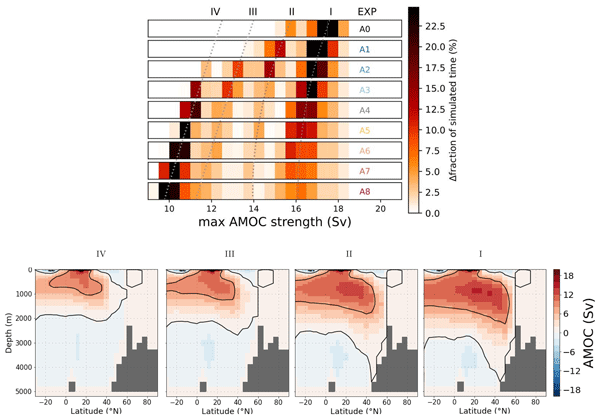
The Atlantic Meridional Overturning Circulation (AMOC) is an ocean current that transports heat into the North Atlantic. Over the ice age cycles, AMOC strength and its spatial pattern varied. We tested the role of heat forcing for these AMOC changes by simulating the temperature changes of the last eight glacial cycles. In our model, AMOC shifts between four distinct circulation modes caused by heat and salt redistributions that reproduce reconstructed long-term North Atlantic SST changes.
Marina J. Vergotti, Diego K. Kersting, Thomas C. Brachert, Steeve Comeau, Daniel A. Frick, Ed C. Hathorne, Michael J. Henehan, Josefine Holtz, Nuria Teixidó, Valby van Schijndel, and Juan Pablo D'Olivo
EGUsphere, https://doi.org/10.5194/egusphere-2026-2720, https://doi.org/10.5194/egusphere-2026-2720, 2026
Short summary
Short summary
We studied how the Mediterranean coral Cladocora caespitosa regulates skeletal growth by reconstructing seasonal changes in its internal chemistry over 7 years using boron-based geochemical proxies. We show that C. caespitosa increases its internal pH and dissolved inorganic carbon similarly to tropical corals, in order to boost the calcification of its skeleton. Comparisons with environmental data indicate temperature as the dominant external influence on the internal chemistry of the coral.
Markus Adloff, Frerk Pöppelmeier, Ashley Dinauer, Charlotte Laufkötter, and Fortunat Joos
EGUsphere, https://doi.org/10.5194/egusphere-2026-275, https://doi.org/10.5194/egusphere-2026-275, 2026
Short summary
Short summary
Carbon cycle models need to account for the recycling of marine particulate matter is recycled in the ocean to simulate marine biogeochemistry. Here, we show that a more complex representation than often-employed static exponential remineralisation profiles better captures key features of the marine biogeochemistry of a glacial ocean and alters the sensitivity of the marine carbon sink and marine oxygenation to warming.
Markus Adloff, Aurich Jeltsch-Thömmes, Frerk Pöppelmeier, Thomas F. Stocker, and Fortunat Joos
Clim. Past, 21, 571–592, https://doi.org/10.5194/cp-21-571-2025, https://doi.org/10.5194/cp-21-571-2025, 2025
Short summary
Short summary
We simulated how different processes affected the carbon cycle over the last eight glacial cycles. We found that the effects of interactive marine sediments enlarge the carbon fluxes that result from these processes, especially in the ocean, and alter various proxy signals. We provide an assessment of the directions of regional and global proxy changes that might be expected in response to different glacial–interglacial Earth system changes in the presence of interactive marine sediments.
Keyi Cheng, Andy Ridgwell, and Dalton S. Hardisty
Biogeosciences, 21, 4927–4949, https://doi.org/10.5194/bg-21-4927-2024, https://doi.org/10.5194/bg-21-4927-2024, 2024
Short summary
Short summary
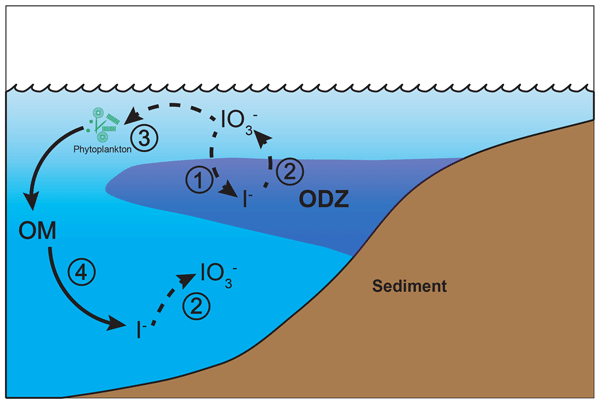
The carbonate paleoredox proxy, I / Ca, has shown its potential to quantify the redox change in the past ocean, which is of broad importance for understanding climate change and evolution. Here, we tuned and optimized the marine iodine cycling embedded in an Earth system model, “cGENIE”, against modern ocean observations and then tested its ability to estimate I / Ca in the Cretaceous ocean. Our study implies cGENIE’s potential to quantify redox change in the past using the I / Ca proxy.
Markus Adloff, Frerk Pöppelmeier, Aurich Jeltsch-Thömmes, Thomas F. Stocker, and Fortunat Joos
Clim. Past, 20, 1233–1250, https://doi.org/10.5194/cp-20-1233-2024, https://doi.org/10.5194/cp-20-1233-2024, 2024
Short summary
Short summary
The Atlantic Meridional Overturning Circulation (AMOC) is an ocean current that transports heat into the North Atlantic. Over the ice age cycles, AMOC strength and its spatial pattern varied. We tested the role of heat forcing for these AMOC changes by simulating the temperature changes of the last eight glacial cycles. In our model, AMOC shifts between four distinct circulation modes caused by heat and salt redistributions that reproduce reconstructed long-term North Atlantic SST changes.
Aaron A. Naidoo-Bagwell, Fanny M. Monteiro, Katharine R. Hendry, Scott Burgan, Jamie D. Wilson, Ben A. Ward, Andy Ridgwell, and Daniel J. Conley
Geosci. Model Dev., 17, 1729–1748, https://doi.org/10.5194/gmd-17-1729-2024, https://doi.org/10.5194/gmd-17-1729-2024, 2024
Short summary
Short summary
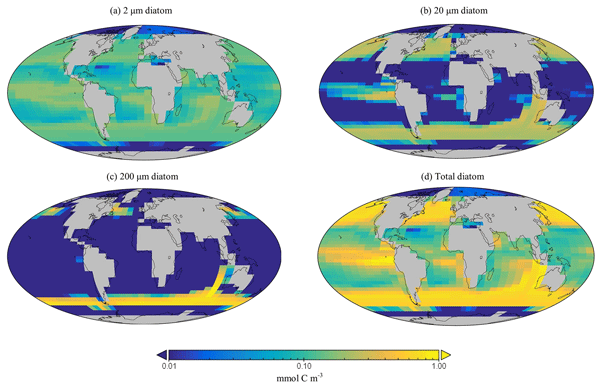
As an extension to the EcoGEnIE 1.0 Earth system model that features a diverse plankton community, EcoGEnIE 1.1 includes siliceous plankton diatoms and also considers their impact on biogeochemical cycles. With updates to existing nutrient cycles and the introduction of the silicon cycle, we see improved model performance relative to observational data. Through a more functionally diverse plankton community, the new model enables more comprehensive future study of ocean ecology.
Elwyn de la Vega, Thomas B. Chalk, Mathis P. Hain, Megan R. Wilding, Daniel Casey, Robin Gledhill, Chongguang Luo, Paul A. Wilson, and Gavin L. Foster
Clim. Past, 19, 2493–2510, https://doi.org/10.5194/cp-19-2493-2023, https://doi.org/10.5194/cp-19-2493-2023, 2023
Short summary
Short summary
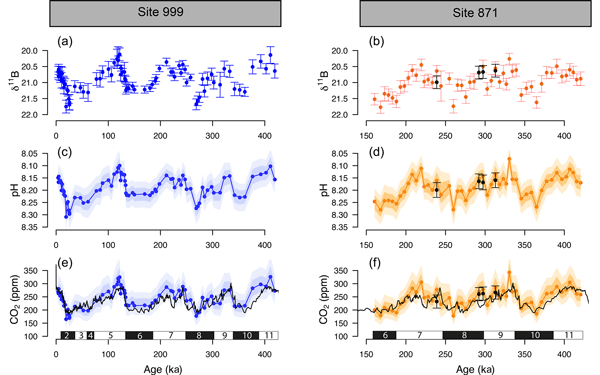
We evaluate how faithfully the boron isotope composition of foraminifera records atmospheric CO2 by comparing it to the high-fidelity CO2 record from the Antarctic ice cores. We evaluate potential factors and find that partial dissolution of foraminifera shells, assumptions of seawater chemistry, and the biology of foraminifera all have a negligible effect on reconstructed CO2. This gives confidence in the use of boron isotopes beyond the interval when ice core CO2 is available.
Katherine A. Crichton, Andy Ridgwell, Daniel J. Lunt, Alex Farnsworth, and Paul N. Pearson
Clim. Past, 17, 2223–2254, https://doi.org/10.5194/cp-17-2223-2021, https://doi.org/10.5194/cp-17-2223-2021, 2021
Short summary
Short summary
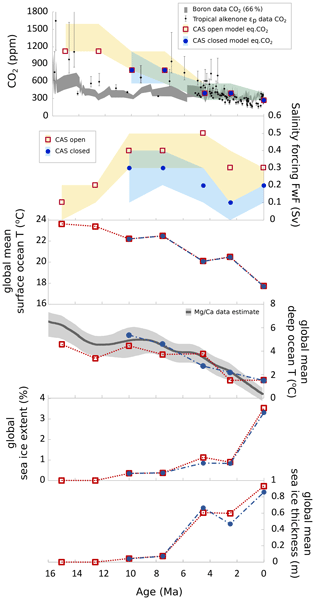
The middle Miocene (15 Ma) was a period of global warmth up to 8 °C warmer than present. We investigate changes in ocean circulation and heat distribution since the middle Miocene and the cooling to the present using the cGENIE Earth system model. We create seven time slices at ~2.5 Myr intervals, constrained with paleo-proxy data, showing a progressive reduction in atmospheric CO2 and a strengthening of the Atlantic Meridional Overturning Circulation.
Kate E. Ashley, Xavier Crosta, Johan Etourneau, Philippine Campagne, Harry Gilchrist, Uthmaan Ibraheem, Sarah E. Greene, Sabine Schmidt, Yvette Eley, Guillaume Massé, and James Bendle
Biogeosciences, 18, 5555–5571, https://doi.org/10.5194/bg-18-5555-2021, https://doi.org/10.5194/bg-18-5555-2021, 2021
Short summary
Short summary
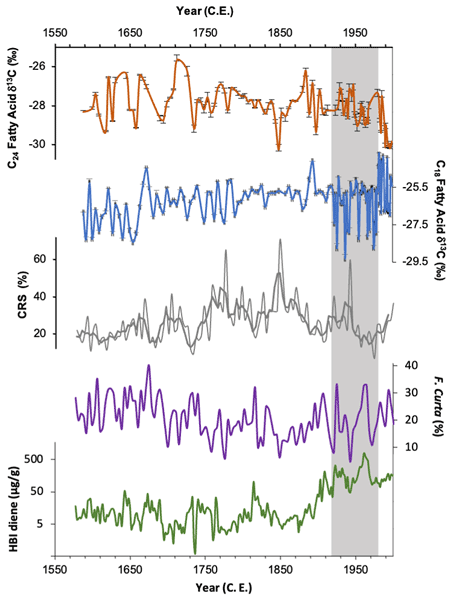
We explore the potential for the use of carbon isotopes of algal fatty acid as a new proxy for past primary productivity in Antarctic coastal zones. Coastal polynyas are hotspots of primary productivity and are known to draw down CO2 from the atmosphere. Reconstructions of past productivity changes could provide a baseline for the role of these areas as sinks for atmospheric CO2.
Yoshiki Kanzaki, Dominik Hülse, Sandra Kirtland Turner, and Andy Ridgwell
Geosci. Model Dev., 14, 5999–6023, https://doi.org/10.5194/gmd-14-5999-2021, https://doi.org/10.5194/gmd-14-5999-2021, 2021
Short summary
Short summary
Sedimentary carbonate plays a central role in regulating Earth’s carbon cycle and climate, and also serves as an archive of paleoenvironments, hosting various trace elements/isotopes. To help obtain
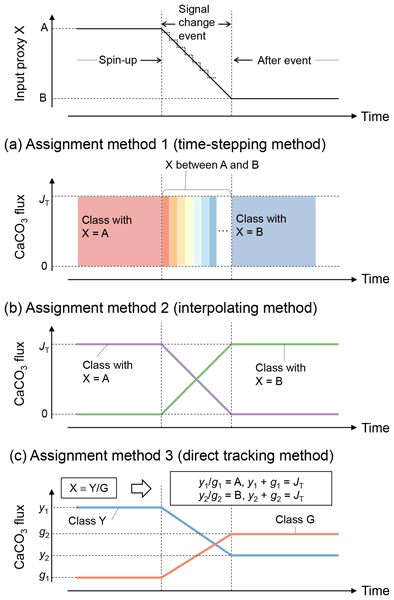
trueenvironmental changes from carbonate records over diagenetic distortion, IMP has been newly developed and has the capability to simulate the diagenesis of multiple carbonate particles and implement different styles of particle mixing by benthos using an adapted transition matrix method.
Cited articles
Anagnostou, E., John, E. H., Babila, T. L., Sexton, P. F., Ridgwell, A., Lunt, D. J., Pearson, P. N., Chalk, T. B., Pancost, R. D., and Foster, G. L.: Proxy evidence for state-dependence of climate sensitivity in the Eocene greenhouse, Nat. Commun., 11, 1–9, https://doi.org/10.1038/s41467-020-17887-x, 2020.
Archer, D.: Modeling the calcite lysocline, J. Geophys. Res.-Oceans, 96, 17037–17050, https://doi.org/10.1029/91JC01812, 1991.
Ben-Yaakov, S. and Goldhaber, M. B.: The influence of sea water composition on the apparent constants of the carbonate system, Deep Sea Research and Oceanographic Abstracts, 20, 87–99, https://doi.org/10.1016/0011-7471(73)90044-2, 1973.
Berner, R. A.: The role of magnesium in the crystal growth of calcite and aragonite from sea water, Geochim. Cosmochim. Ac., 39, 489–504, https://doi.org/10.1016/0016-7037(75)90102-7, 1975.
Branson, O., Whiteford, R., Filipe, and Coenen, D.: Oscarbranson/cbsyst: 0.4.9, Zenodo, https://doi.org/10.5281/zenodo.1402261, 2023.
Brennan, S. T., Lowenstein, T. K., and Cendón, D. I.: The major-ion composition of Cenozoic seawater: The past 36 million years from fluid inclusions in marine halite, Am. J. Sci., 313, 713–775, https://doi.org/10.2475/08.2013.01, 2013.
Cao, L., Eby, M., Ridgwell, A., Caldeira, K., Archer, D., Ishida, A., Joos, F., Matsumoto, K., Mikolajewicz, U., Mouchet, A., Orr, J. C., Plattner, G.-K., Schlitzer, R., Tokos, K., Totterdell, I., Tschumi, T., Yamanaka, Y., and Yool, A.: The role of ocean transport in the uptake of anthropogenic CO2, Biogeosciences, 6, 375–390, https://doi.org/10.5194/bg-6-375-2009, 2009.
CenCO2PIP (Cenozoic CO2 Proxy Integration Project) Consortium, Hönisch, B., Royer, D. L., Breecker, D. O., Polissar, P. J., Bowen, G. J., Henehan, M. J., Cui, Y., Steinthorsdottir, M., McElwain, J. C., and Kohn, M. J.: Toward a Cenozoic history of atmospheric CO2, Science, 382, eadi5177, https://doi.org/10.1126/science.adi5177, 2023.
Clegg, S. L., Waters, J. F., Turner, D. R., and Dickson, A. G.: Chemical speciation models based upon the Pitzer activity coefficient equations, including the propagation of uncertainties. III. Seawater from the freezing point to 45 °C, including acid-base equilibria, Mar. Chem., 250, 104196, https://doi.org/10.1016/j.marchem.2022.104196, 2023.
Colbourn, G., Ridgwell, A., and Lenton, T. M.: The Rock Geochemical Model (RokGeM) v0.9, Geosci. Model Dev., 6, 1543–1573, https://doi.org/10.5194/gmd-6-1543-2013, 2013.
Dickson, A. G.: An exact definition of total alkalinity and a procedure for the estimation of alkalinity and total inorganic carbon from titration data, Deep-Sea Res. Pt. A, 28, 609–623, https://doi.org/10.1016/0198-0149(81)90121-7, 1981.
Dickson, A. G.: The oceanic carbon dioxide system: planning for quality data, US JGOFS News, 2, p. 2, 1990.
Dickson, A. G. and Millero, F. J.: A comparison of the equilibrium constants for the dissociation of carbonic acid in seawater media, Deep-Sea Res. Pt. A, 34, 1733–1743, https://doi.org/10.1016/0198-0149(87)90021-5, 1987.
Dickson, A. G. and Riley, J. P.: The estimation of acid dissociation constants in seawater media from potentionmetric titrations with strong base. I. The ionic product of water—Kw, Mar. Chem., 7, 89–99. https://doi.org/10.1016/0304-4203(79)90001-X, 1979.
Dickson, A. G., Sabine, C. L., and Christian, J. R. (Eds.): Guide to Best Practices for Ocean CO2 Measurements, PICES Special Publication 3, 191 pp., ISBN 1-897176-07-4, 2007.
Garrels, R. M. and Thompson, M. E.: A chemical model for sea water at 25 degrees C and one atmosphere total pressure, Am. J. Sci., 260, 57–66, https://doi.org/10.2475/ajs.260.1.57, 1962.
Greene, S. E., Ridgwell, A., Kirtland Turner, S., Schmidt, D. N., Pälike, H., Thomas, E., Greene, L. K., and Hoogakker, B. A. A.: Early Cenozoic decoupling of climate and carbonate compensation depth trends, Paleoceanogr. Paleocl., 34, 930–945, https://doi.org/10.1029/2019PA003601, 2019.
Gutjahr, M., Ridgwell, A., Sexton, P. F., Anagnostou, E., Pearson, P. N., Pälike, H., Norris, R. D., Thomas, E., and Foster, G. L.: Very large release of mostly volcanic carbon during the Palaeocene–Eocene Thermal Maximum, Nature, 548, 573–577, https://doi.org/10.1038/nature23646, 2017.
Hain, M. P., Sigman, D. M., Higgins, J. A., and Haug, G. H.: The effects of secular calcium and magnesium concentration changes on the thermodynamics of seawater acid/base chemistry: Implications for Eocene and Cretaceous ocean carbon chemistry and buffering, Global Biogeochem. Cy., 29, 517–533, https://doi.org/10.1002/2014GB004986, 2015.
Hain, M. P., Sigman, D. M., Higgins, J. A., and Haug, G. H.: Response to Comment by Zeebe and Tyrrell on “The Effects of Secular Calcium and Magnesium Concentration Changes on the Thermodynamics of Seawater Acid/Base Chemistry: Implications for the Eocene and Cretaceous Ocean Carbon Chemistry and Buffering,” Global Biogeochem. Cy., 32, 898–901, https://doi.org/10.1002/2018GB005931, 2018.
Hain, M. P., Allen, K. A., and Turner, S. K.: Earth system carbon cycle dynamics though time, in: Treatise on geochemistry, edited by: Anbar, A. D. and Weis, D., 3rd Edn., Hardback, https://doi.org/10.1016/B978-0-323-99762-1.00080-2, 2024.
Hain, M. P., Allen, K. A., and Turner, S. K.: Earth system carbon cycle dynamics through time, Treatise on Geochemistry, 5, 381–418, https://doi.org/10.1016/B978-0-323-99762-1.00080-2, 2025.
Hardie, L. A.: Secular variation in seawater chemistry: An explanation for the coupled secular variation in the mineralogies of marine limestones and potash evaporites over the past 600 My, Geology, 24, 279–283, https://doi.org/10.1130/0091-7613(1996)024<0279:SVISCA>2.3.CO;2, 1996.
Harvie, C. E., Møller, N., and Weare, J. H.: The prediction of mineral solubilities in natural waters: The Na-K-Mg-Ca-H-Cl-SO4-OH-HCO3-CO3-CO2-H2O system to high ionic strengths at 25 °C, Geochim. Cosmochim. Ac., 48, 723–751, https://doi.org/10.1016/0016-7037(84)90098-X, 1984.
Henehan, M. J., Ridgwell, A., Thomas, E., Zhang, S., Alegret, L., Schmidt, D. N., Rae, J. W., Witts, J. D., Landman, N. H., Greene, S. E., and Huber, B. T.: Rapid ocean acidification and protracted Earth system recovery followed the end-Cretaceous Chicxulub impact, P. Natl. Acad. Sci., 116, 22500–22504, https://doi.org/10.1073/pnas.1905989116, 2019.
Hershey, J. P., Plese, T., and Millero, F. J.: The pK1* for the dissociation of H2S in various ionic media, Geochim. Cosmochim. Ac., 52, 2047–2051, https://doi.org/10.1016/0016-7037(88)90183-4, 1988.
Hönisch, B., Ridgwell, A., Schmidt, D. N., Thomas, E., Gibbs, S. J., Sluijs, A., Zeebe, R., Kump, L., Martindale, R. C., Greene, S. E., and Kiessling, W.: The geological record of ocean acidification, Science, 335, 1058–1063, https://doi.org/10.1126/science.1208277, 2012.
Horita, J., Friedman, T. J., Lazar, B., and Holland, H. D.: The composition of Permian seawater, Geochim. Cosmochim. Ac., 55, 417–432, https://doi.org/10.1016/0016-7037(91)90001-L, 1991.
Hülse, D. and Ridgwell, A.: Instability in the geological regulation of Earth's climate, Science, 389, eadh7730, https://doi.org/10.1126/science.adh7730, 2025.
Hülse, D., Arndt, S., Wilson, J. D., Munhoven, G., and Ridgwell, A.: Understanding the causes and consequences of past marine carbon cycling variability through models, Earth-Sci. Rev., 171, 349–382, https://doi.org/10.1016/j.earscirev.2017.06.004, 2017.
Jennions, S. M., Thomas, E., Schmidt, D. N., Lunt, D., and Ridgwell, A.: Changes in benthic ecosystems and ocean circulation in the Southeast Atlantic across Eocene Thermal Maximum 2, Paleoceanography, 30, 1059–1077, https://doi.org/10.1002/2015PA002821, 2015.
Kirtland Turner, S. and Ridgwell, A.: Recovering the true size of an Eocene hyperthermal from the marine sedimentary record, Paleoceanography, 28, 700–712, https://doi.org/10.1002/2013PA002541, 2013.
Klochko, K., Kaufman, A. J., Yao, W., Byrne, R. H., and Tossell, J. A.: Experimental measurement of boron isotope fractionation in seawater, Earth Planet. Sc. Lett., 248, 276–285, https://doi.org/10.1016/j.epsl.2006.05.034, 2006.
Larson, T. E., Sollo Jr., F. W., and McGurk, F. F.: Complexes affecting the solubility of calcium carbonate in water, ISWS Contract Report CR 145, https://hdl.handle.net/2142/90381 (last access: 26 July 2026), 1973.
Lewis, E. R. and Wallace, D. W. R.: Program developed for CO2 system calculations (No. cdiac: CDIAC-105), Environmental System Science Data Infrastructure for a Virtual Ecosystem (ESS-DIVE) (United States), https://doi.org/10.15485/1464255, 1998.
Li, M., Kump, L. R., Ridgwell, A., Tierney, J. E., Hakim, G. J., Malevich, S. B., Poulsen, C. J., Tardif, R., Zhang, H., and Zhu, J.: Coupled decline in ocean pH and carbonate saturation during the Palaeocene–Eocene Thermal Maximum, Nat. Geosci., 17, 1299–1305, https://doi.org/10.1038/s41561-024-01579-y, 2024.
Mehrbach, C., Culberson, C. H., Hawley, J. E., and Pytkowicx, R. M.: Measurement of the apparent dissociation constants of carbonic acid in seawater at atmospheric pressure 1, Limnol. Oceanogr., 18, 897–907, https://doi.org/10.4319/lo.1973.18.6.0897, 1973.
Millero, F. J.: The thermodynamics of the carbonate system in seawater, Geochim. Cosmochim. Ac., 43, 1651–1661, https://doi.org/10.1016/0016-7037(79)90184-4, 1979.
Millero, F. J.: The effect of pressure on the solubility of minerals in water and seawater, Geochim. Cosmochim. Ac., 46, 11–22, https://doi.org/10.1016/0016-7037(82)90286-1, 1982.
Millero, F. J.: The estimation of the pK∗ HA of acids in seawater using the Pitzer equations, Geochim. Cosmochim. Ac., 47, 2121–2129, https://doi.org/10.1016/0016-7037(83)90037-6, 1983.
Millero, F. J.: Chemical Oceanography, Vol. 1, CRC press, ISBN 9780849388408, 1992.
Millero, F. J.: Thermodynamics of the carbon dioxide system in the oceans, Geochimi. Cosmochim. Ac., 59, 661–677, https://doi.org/10.1016/0016-7037(94)00354-O, 1995.
Millero, F. J.: Chemical Oceanography, Vol. 30, CRC press, 2005.
Millero, F. J. and Pierrot, D.: A chemical equilibrium model for natural waters, Aquat. Geochem., 4, 153–199, https://doi.org/10.1023/A:1009656023546, 1998.
Millero, F. J. and Schreiber, D. R.: Use of the ion pairing model to estimate activity coefficients of the ionic components of natural waters, Am. J. Sci., 282, 1508–1540, 1982.
Millero, F. J. and Thurmond, V.: The ionization of carbonic acid in Na-Mg-Cl solutions at 25 °C, J. Solution Chem., 12, 401–412, https://doi.org/10.1007/BF00646393, 1983.
Millero, F. J., Pierrot, D., Lee, K., Wanninkhof, R., Feely, R., Sabine, C. L., Key, R. M., and Takahashi, T.: Dissociation constants for carbonic acid determined from field measurements, Deep-Sea Res. Pt. I, 49, 1705–1723, https://doi.org/10.1016/S0967-0637(02)00093-6, 2002.
Morel, F. and Morgan, J.: Numerical method for computing equilibriums in aqueous chemical systems, Environ. Sci. Technol., 6, 58–67, 1972.
Morse, J. W., Arvidson, R. S., and Lüttge, A.: Calcium carbonate formation and dissolution, Chem. Rev., 107, 342–381, https://doi.org/10.1021/cr050358j, 2007.
Mucci, A.: The solubility of calcite and aragonite in seawater at various salinities, temperatures, and one atmosphere total pressure, Am. J. Sci., 283, 780–799, 1983.
Orr, J. C., Epitalon, J.-M., and Gattuso, J.-P.: Comparison of ten packages that compute ocean carbonate chemistry, Biogeosciences, 12, 1483–1510, https://doi.org/10.5194/bg-12-1483-2015, 2015.
Orr, J. C., Epitalon, J. M., Dickson, A. G., and Gattuso, J. P.: Routine uncertainty propagation for the marine carbon dioxide system, Mar. Chem., 207, 84–107, https://doi.org/10.1016/j.marchem.2018.10.006, 2018.
Panchuk, K., Ridgwell, A., and Kump, L. R.: Sedimentary response to Paleocene-Eocene Thermal Maximum carbon release: A model-data comparison, Geology, 36, 315–318, https://doi.org/10.1130/G24474A.1, 2008.
Pines, D., Ditkovich, J., Mukra, T., Miller, Y., Kiefer, P. M., Daschakraborty, S., Hynes, J. T., and Pines, E.: How acidic is carbonic acid?, J. Phys. Chem. B, 120, 2440–2451, https://doi.org/10.1021/acs.jpcb.5b12428, 2016.
Pitzer, K. S. (Ed.): Activity coefficients in electrolyte solutions, Vol. 2, 75–153, CRC press, Boca Raton, FL, 1991.
Pytkowicz, R. M. and Hawley, J. E.: Bicarbonate and carbonate ion‐pairs and a model of seawater at 25 °C 1, Limnol. Oceanogr., 19, 223–234, https://doi.org/10.4319/lo.1974.19.2.0223, 1974.
Rae, J. W., Zhang, Y. G., Liu, X., Foster, G. L., Stoll, H. M., and Whiteford, R. D.: Atmospheric CO2 over the past 66 million years from marine archives, Annu. Rev. Earth Pl. Sc., 49, https://doi.org/10.1146/annurev-earth-082420-063026 2021.
Raitzsch, M., Hain, M., Henehan, M., and Gattuso, J.-P.: Seacarbx -529 seacarb extension for deep-time carbonate system calculations, Zenodo, https://doi.org/10.5281/zenodo.5909811, 2022.
Reinhard, C. T., Olson, S. L., Kirtland Turner, S., Pälike, C., Kanzaki, Y., and Ridgwell, A.: Oceanic and atmospheric methane cycling in the cGENIE Earth system model – release v0.9.14, Geosci. Model Dev., 13, 5687–5706, https://doi.org/10.5194/gmd-13-5687-2020, 2020.
Ridgwell, A.: A Mid Mesozoic Revolution in the regulation of ocean chemistry, Mar. Geol., 217, 339–357, https://doi.org/10.1016/j.margeo.2004.10.036, 2005.
Ridgwell, A.: Interpreting transient carbonate compensation depth changes by marine sediment core modeling, Paleoceanography, 22, https://doi.org/10.1029/2006PA001372, 2007.
Ridgwell, A.: genie-model/cookiedoc: for: Adloff_et_al.GMD.2026 (v0.91), Zenodo [data set, code], https://doi.org/10.5281/zenodo.20671786, 2026.
Ridgwell, A. and Hargreaves, J. C.: Regulation of atmospheric CO2 by deep‐sea sediments in an Earth system model, Global Biogeochem. Cy., 21, https://doi.org/10.1029/2006GB002764, 2007.
Ridgwell, A. and Schmidt, D. N.: Past constraints on the vulnerability of marine calcifiers to massive carbon dioxide release, Nat. Geosci., 3, 196–200, https://doi.org/10.1038/ngeo755, 2010.
Ridgwell, A. and Zeebe, R. E.: The role of the global carbonate cycle in the regulation and evolution of the Earth system, Earth Planet. Sc. Lett., 234, 299–315, https://doi.org/10.1016/j.epsl.2005.03.006, 2005.
Ridgwell, A. J., Kennedy, M. J., and Caldeira, K.: Carbonate deposition, climate stability, and Neoproterozoic ice ages, Science, 302, 859–862, https://doi.org/10.1126/science.1088342, 2003.
Ridgwell, A., Hargreaves, J. C., Edwards, N. R., Annan, J. D., Lenton, T. M., Marsh, R., Yool, A., and Watson, A.: Marine geochemical data assimilation in an efficient Earth System Model of global biogeochemical cycling, Biogeosciences, 4, 87–104, https://doi.org/10.5194/bg-4-87-2007, 2007.
Ridgwell, A., Schmidt, D. N., Turley, C., Brownlee, C., Maldonado, M. T., Tortell, P., and Young, J. R.: From laboratory manipulations to Earth system models: scaling calcification impacts of ocean acidification, Biogeosciences, 6, 2611–2623, https://doi.org/10.5194/bg-6-2611-2009, 2009.
Ridgwell, A., Adloff, M., Reinhard, C., van de Velde, S., Monteiro, F., Camillalxy98, Vervoort, P., Kanzaki, Y., Ward, B., Hülse, D., Wilson, J., Li, M., InkyANB, Tangirala, R. T., and Kirtland Turner, S.: genie-model/cgenie.cookie: Adloff_et_al.GMD.2026 (v0.91), Zenodo [code], https://doi.org/10.5281/zenodo.20671781, 2025.
Ridgwell, A., Reinhard, C., van de Velde, S., Adloff, M., Monteiro, F., Vervoort, P., Camillalxy98, Ward, B., Kanzaki, Y., Hülse, D., Wilson, J., Li, M., InkyANB, Jiang, Q., and Kirtland Turner, S.: derpycode/cgenie.muffin: Ganey_et_al.2026 (v0.9.76), Zenodo [software], https://doi.org/10.5281/zenodo.20632229, 2026.
Ridgwell, A. J.: Glacial-interglacial perturbations in the global carbon cycle, PhD thesis, Univ. of East Anglia at Norwich, Norwich, UK, https://www.seao2.info/thesis.html (last access: 26 July 2026), 2001.
Si, W., Herbert, T., Wu, M., and Rosenthal, Y.: Increased Biogenic Calcification and Burial Under Elevated pCO2 During the Miocene: A Model-Data Comparison, Global Biogeochem. Cy., 37, 2022GB007541, https://doi.org/10.1029/2022GB007541, 2023.
Sillen, L. G.: The physical chemistry of seawater, in: Oceanography – Invited Lectures Presented at the International Oceanography Congress, edited by: Sears, M., 549–581, Washington, DC, Am. Assoc. Adv. Sci. Publ. 67, https://books.google.co.uk/books?id=9BNj0QEACAAJ (last access: 26 July 2026), 1961.
Skirrow, G.: The dissolved gases – carbon dioxide, in: Chemical Oceanography, edited by: Riley, I. P. and Skirrow, G., Vol. 2. Academic Press, New York, 1–181, https://doi.org/10.4319/lo.1976.21.2.0347, 1975.
Sosdian, S. M., Greenop, R., Hain, M. P., Foster, G. L., Pearson, P. N., and Lear, C. H.: Constraining the evolution of Neogene ocean carbonate chemistry using the boron isotope pH proxy, Earth Planet. Sc. Lett., 498, 362–376, https://doi.org/10.1016/j.epsl.2018.06.017, 2018.
Stanley, S. M.: Influence of seawater chemistry on biomineralization throughout Phanerozoic time: Paleontological and experimental evidence, Palaeogeogr. Palaeocl., 232, 214–236, https://doi.org/10.1016/j.palaeo.2005.12.010, 2006.
Stanley, S. M. and Hardie, L. A.: Secular oscillations in the carbonate mineralogy of reef-building and sediment-producing organisms driven by tectonically forced shifts in seawater chemistry, Palaeogeogr. Palaeocl., 144, 3–19, https://doi.org/10.1016/S0031-0182(98)00109-6, 1998.
Stanley, S. M., Ries, J. B., and Hardie, L. A.: Seawater chemistry, coccolithophore population growth, and the origin of Cretaceous chalk, Geology, 33, 593–596, https://doi.org/10.1130/G21405.1, 2005.
Stefánsson, A., Lemke, K. H., Bénézeth, P., and Schott, J.: Magnesium bicarbonate and carbonate interactions in aqueous solutions: An infrared spectroscopic and quantum chemical study, Geochim. Cosmochim. Ac., 198, 271–284, https://doi.org/10.1016/j.gca.2016.10.032, 2017.
Timofeeff, M. N., Lowenstein, T. K., Da Silva, M. A. M., and Harris, N. B.: Secular variation in the major-ion chemistry of seawater: Evidence from fluid inclusions in Cretaceous halites, Geochim. Cosmochim. Ac., 70, 1977–1994, https://doi.org/10.1016/j.gca.2006.01.020, 2006.
Turner, D. R., Achterberg, E. P., Chen, C. T. A., Clegg, S. L., Hatje, V., Maldonado, M. T., Sander, S. G., Van den Berg, C. M., and Wells, M.: Toward a quality-controlled and accessible Pitzer model for seawater and related systems, Frontiers in Marine Science, 3, 139, https://doi.org/10.3389/fmars.2016.00139, 2016.
Tyrrell, T. and Zeebe, R. E.: History of carbonate ion concentration over the last 100 million years, Geochim. Cosmochim. Ac., 68, 3521–3530, https://doi.org/10.1016/j.gca.2004.02.018, 2004.
Wanninkhof, R.: Relationship between wind speed and gas exchange over the ocean, J. Geophys. Res.-Oceans, 97, 7373–7382, https://doi.org/10.1029/92JC00188, 1992.
Whiteford, R., Branson, O., and Mayk, D.: Using Kgen to generate cross-verified apparent equilibrium constants (K∗'s) for Palaeoseawater carbonate chemistry, Geochem. Geophy. Geosy., 26, 2023GC011417, https://doi.org/10.1029/2023GC011417, 2025.
Yao, W. and Millero, F. J.: The chemistry of the anoxic waters in the Framvaren Fjord, Norway, Aquat. Geochem., 1, 53–88, https://doi.org/10.1007/BF01025231, 1995.
Zeebe, R. E. and Tyrrell, T.: Comment on “The effects of secular calcium and magnesium concentration changes on the thermodynamics of seawater acid/base chemistry: Implications for Eocene and Cretaceous ocean carbon chemistry and buffering” by Hain et al.(2015), Global Biogeochem. Cy., 32, 895–897, https://doi.org/10.1002/2017GB005786, 2018.
Zeebe, R. E. and Wolf-Gladrow, D.: CO2 in seawater: equilibrium, kinetics, isotopes, Vol. 65, Gulf Professional Publishing, 2001.
Short summary
Seawater composition affects carbon cycling in the ocean and has changed over Earth history, requiring corrections when reconstructing past marine carbonate systems. We present a new correction scheme for the intermediate complexity Earth system model cGENIE based on the ion interaction model MyAMI. We validate the new scheme, find significant improvements over the default scheme, and discuss the relevance of accurate and consistent major ion correction in carbon cycle reconstructions.
Seawater composition affects carbon cycling in the ocean and has changed over Earth history,...


