Articles | Volume 19, issue 15
https://doi.org/10.5194/gmd-19-7525-2026
© Author(s) 2026. This work is distributed under
the Creative Commons Attribution 4.0 License.
https://doi.org/10.5194/gmd-19-7525-2026
© Author(s) 2026. This work is distributed under
the Creative Commons Attribution 4.0 License.
GPU-accelerated finite-element method for the three-dimensional unstructured mesh atmospheric dynamic framework

Leisheng Li
Institute of Software, Chinese Academy of Sciences, Beijing 100190, China
Ximeng Fu
Institute of Software, Chinese Academy of Sciences, Beijing 100190, China
University of Chinese Academy of Sciences, Beijing 100190, China
Xiyu Zheng
Institute of Software, Chinese Academy of Sciences, Beijing 100190, China
University of Chinese Academy of Sciences, Beijing 100190, China
Huiyuan Li
Institute of Software, Chinese Academy of Sciences, Beijing 100190, China
Jinxi Li
CORRESPONDING AUTHOR
State Key Laboratory of Atmospheric Environment and Extreme Meteorology, Institute of Atmospheric Physics, Chinese Academy of Sciences, Beijing 100029, China
Related authors
No articles found.
Kai Cao, Qizhong Wu, Xiao Tang, Jinxi Li, Xueshun Chen, Huansheng Chen, Wending Wang, Huangjian Wu, Lei Kong, Jie Li, Jiang Zhu, and Zifa Wang
EGUsphere, https://doi.org/10.5194/egusphere-2026-3368, https://doi.org/10.5194/egusphere-2026-3368, 2026
This preprint is open for discussion and under review for Geoscientific Model Development (GMD).
Short summary
Short summary
This study achieves significant acceleration by developing an optimized advection module for Emission and atmospheric Processes Integrated and Coupled Community Model on Graphics Processing Unit. Through implementing thread-block indexing, minimizing Central Processing Unit and Graphics Processing Unit communication, and an parallel framework, we demonstrate speedups: 556.5× faster offline performance for the Heterogeneous Interface advection solver and 20.5× acceleration in coupled simulations.
Xiaofei Wu, Siyang Chen, Jinxi Li, Yu Zhang, Zifa Wang, Pu Gan, Jie Zheng, and Fangxin Fang
EGUsphere, https://doi.org/10.5194/egusphere-2026-1685, https://doi.org/10.5194/egusphere-2026-1685, 2026
Short summary
Short summary
Cities face a major challenge in tracking how wind and air pollution move through complex building clusters. Common numerical models often struggle to balance accuracy with calculating speed. We developed a new simulation system that automatically adjusts its focus to where the air is moving rapidly. By testing this against observations, it significantly improves predictions of wind and pollution. This tool helps urban planners design healthier cities by better identifying how pollutants travel.
Kai Cao, Qizhong Wu, Xiao Tang, Jinxi Li, Xueshun Chen, Huansheng Chen, Wending Wang, Huangjian Wu, Lei Kong, Jie Li, Jiang Zhu, and Zifa Wang
EGUsphere, https://doi.org/10.5194/egusphere-2025-2918, https://doi.org/10.5194/egusphere-2025-2918, 2025
Preprint archived
Short summary
Short summary
This study achieves significant acceleration by developing an optimized advection module for Emission and atmospheric Processes Integrated and Coupled Community Model on GPU-like accelerators. Through implementing thread-block coordinated indexing, minimizing CPU-GPU communication, and an hybrid parallelization framework, we demonstrate prominent speedups: 556.5× faster offline performance for the Heterogeneous Interface PPM solver and 20.5× acceleration in coupled simulations.
Cited articles
AMCG: Fluidity manual, GitHub [code], https://fluidityproject.github.io/get-fluidity.html (last access: 10 August 2026), 2014. a
AMD: CUDA to HIP API Function Comparison, https://rocm.docs.amd.com/projects/HIP/en/latest/reference/api_syntax.html (last access: 10 August 2026), 2025. a
Bogenschutz, P. A., Clevenger, T. C., Bradley, A. M., Caldwell, P. M., Beydoun, H., Mahfouz, N., Keen, N. D., Guba, O., Bertagna, L., Foucar, J., Zhang, J., and Donahue, A. S.: High Performance, High Fidelity: A GPU-Accelerated Doubly-Periodic Configuration of the Simple Cloud-Resolving E3SM Atmosphere Model Version 1 (DP-SCREAMv1), J. Adv. Model. Earth Sy., 17, e2025MS005127, https://doi.org/10.1029/2025MS005127, 2025. a
Böhm, F., Bauer, D., Kohl, N., Alappat, C. L., Thönnes, D., Mohr, M., Köstler, H., and Rüde, U.: Code Generation and Performance Engineering for Matrix-Free Finite Element Methods on Hybrid Tetrahedral Grids, SIAM J. Sci. Comput., 47, B131–B159, https://doi.org/10.1137/24M1653756, 2025. a
Conde, D. A. S., Ferreira, R. M. L., Canelas, R., Ricardo, A. M., and Mendes, L.: A Distributed-Heterogeneous Design for Explicit Hyperbolic Solvers. Application to Tsunami Urban Run-Up Modelling, J. Adv. Model. Earth Sy., 17, e2024MS004602, https://doi.org/10.1029/2024MS004602, 2025. a
Czarnul, P., Proficz, J., and Drypczewski, K.: Survey of Methodologies, Approaches, and Challenges in Parallel Programming Using High-Performance Computing Systems, Sci. Programming-Neth., 2020, 4176794, https://doi.org/10.1155/2020/4176794, 2020. a
Farrell, P. E., Piggott, M. D., Pain, C. C., Gorman, G. J., and Wilson, C. R.: Conservative interpolation between unstructured meshes via supermesh construction, Comput. Method. Appl. M., 198, 2632–2642, https://doi.org/10.1016/j.cma.2009.03.004, 2009. a
Fischer, P., Min, M., Rathnayake, T., Dutta, S., Kolev, T., Dobrev, V., Camier, J.-S., Kronbichler, M., Warburton, T., Swirydowicz, K., and Brown, J.: Scalability of High-Performance PDE Solvers, Int. J. High Perform. C., 34, 562–586, https://doi.org/10.1177/1094342020915762, 2020. a
Fu, X.: GPU-Accelerated Implementation of the Fluidity-Atmosphere Dynamical Core, Zenodo [code], https://doi.org/10.5281/zenodo.18799735, 2026. a
Gan, P., Li, J., Fang, F., Wu, X., Zhu, J., Wang, Z., Zhu, M., and Zou, X.: HyMeshAI: Deep learning enabled three-dimensional adaptive mesh generator for high-resolution atmospheric simulations, J. Comput. Phys., 554, 114760, https://doi.org/10.1016/j.jcp.2026.114760, 2026a. a
Gan, P., Li, J., Wu, X., Wu, Q., Zou, X., Wang, Z., Zhu, J., Yuan, H., Xie, F., Tang, X., Li, L., and Fang, F.: Tibetan Plateau Mountain Wave Simulation Using AI-Driven 3D Adaptive Mesh Refinement, J. Geophys. Res.-Atmos., 131, https://doi.org/10.1029/2025JD045585, 2026b. a
Georgescu, S., Chow, P., and Okuda, H.: GPU Acceleration for FEM-Based Structural Analysis, Arch. Comput. Method. E., 20, 111–121, https://doi.org/10.1007/s11831-013-9082-8, 2013. a
Giraldo, F. X.: An Introduction to Element-Based Galerkin Methods, Texts in Computational Science and Engineering, 1 edn., Springer, https://doi.org/10.1007/978-3-030-55069-1, 2020. a
Goddeke, D., Buijssen, S., Wobker, H., and Turek, S.: GPU acceleration of an unmodified parallel finite element Navier-Stokes solver, in: Proceedings of the 2009 International Conference on High Performance Computing and Simulation, HPCS 2009, pp. 12 – 21, https://doi.org/10.1109/HPCSIM.2009.5191718, 2009. a
Huang, P., Chen, C., Li, X., Shen, X., and Xiao, F.: An Adaptive Nonhydrostatic Atmospheric Dynamical Core Using a Multi-Moment Constrained Finite Volume Method, Adv. Atmos. Sci., 39, 487–501, https://doi.org/10.1007/s00376-021-1185-9, 2022. a
Jendersie, R., Lessig, C., and Richter, T.: A GPU parallelization of the neXtSIM-DG dynamical core (v0.3.1), Geosci. Model Dev., 18, 3017–3040, https://doi.org/10.5194/gmd-18-3017-2025, 2025. a
Kam, P.-H., Tam, C.-Y., Sze, W.-P., Cheung, C.-C., Ng, K.-K., and Lee, S.-H.: Dynamically Adapting Mesh Refinement in an Unstructured Grid Global Model for Numerical Weather Prediction, Weather Forecast., 40, 1445 – 1462, https://doi.org/10.1175/WAF-D-24-0239.1, 2025. a
Kiran, U., Gautam, S. S., and Sharma, D.: GPU-based matrix-free finite element solver exploiting symmetry of elemental matrices, Computing, 102, 1941–1965, https://doi.org/10.1007/s00607-020-00827-4, 2020. a, b
Kopera, M. A. and Giraldo, F. X.: Analysis of adaptive mesh refinement for IMEX discontinuous Galerkin solutions of the compressible Euler equations with application to atmospheric simulations, J. Comput. Phys., 275, 92–117, https://doi.org/10.1016/j.jcp.2014.06.026, 2014. a
Kronbichler, M. and Kormann, K.: A generic interface for parallel cell-based finite element operator application, Comput. Fluids, 63, 135–147, https://doi.org/10.1016/j.compfluid.2012.04.012, 2012. a, b
Kronbichler, M. and Kormann, K.: Fast Matrix-Free Evaluation of Discontinuous Galerkin Finite Element Operators, ACM T. Math. Software, 45, 1–40, https://doi.org/10.1145/3325864, 2019. a
Li, J., Fang, F., Steppeler, J., Zhu, J., Cheng, Y., and Wu, X.: Demonstration of a three-dimensional dynamically adaptive atmospheric dynamic framework for the simulation of mountain waves, Meteorol. Atmos. Phys., 133, 1627–1645, https://doi.org/10.1007/s00703-021-00828-8, 2021. a, b, c
Li, L., Fu, X., Zheng, X., Li, H., and Li, J.: Atmospheric Mountain Wave Simulation Dataset (Fluidity-Atmosphere), Zenodo [data set], https://doi.org/10.5281/zenodo.17824052, 2025. a
Macioł, P., Płaszewski, P., and Banaś, K.: 3D finite element numerical integration on GPUs, Procedia Comput. Sci., 1, 1093–1100, https://doi.org/10.1016/j.procs.2010.04.121, 2010. a
Marras, S., Kelly, J., Moragues Ginard, M., Müller, A., Kopera, M., Vázquez, M., Giraldo, F., Houzeaux, G., and Jorba, O.: A Review of Element-Based Galerkin Methods for Numerical Weather Prediction: Finite Elements, Spectral Elements, and Discontinuous Galerkin, Arch. Comput. Method. E., 23, 673–722, https://doi.org/10.1007/s11831-015-9152-1, 2015. a
Michalakes, J.: HPC for Weather Forecasting, in: Parallel Algorithms in Computational Science and Engineering, edited by: Grama, A. and Sameh, A. H., Springer International Publishing, Cham, pp. 297–323, https://doi.org/10.1007/978-3-030-43736-7_10, 2020. a
Mills, R. T., Adams, M. F., Balay, S., Brown, J., Dener, A., Knepley, M., Kruger, S. E., Morgan, H., Munson, T., Rupp, K., Smith, B. F., Zampini, S., Zhang, H., and Zhang, J.: Toward performance-portable PETSc for GPU-based exascale systems, Parallel Comput., 108, 102831, https://doi.org/10.1016/j.parco.2021.102831, 2021. a
Müller, A., Behrens, J., Giraldo, F. X., and Wirth, V.: Comparison between adaptive and uniform discontinuous Galerkin simulations in dry 2D bubble experiments, J. Comput. Phys., 235, 371–393, https://doi.org/10.1016/j.jcp.2012.10.038, 2013. a
Müller, E. H., Scheichl, R., and Vainikko, E.: Petascale solvers for anisotropic PDEs in atmospheric modelling on GPU clusters, Parallel Comput., 50, 53–69, https://doi.org/10.1016/j.parco.2015.10.007, 2015. a
NVIDIA: CUDA C Programming Guide, https://docs.nvidia.com/cuda/cuda-c-programming-guide/index.html (last access: 10 August 2026), 2025a. a
NVIDIA: Sparse Matrix Formats, https://docs.nvidia.com/nvpl/latest/sparse/storage_format/sparse_matrix.html (last access: 10 August 2026), 2025b. a
Petersen, M. R., Asay-Davis, X. S., Barthel, A. M., Begeman, C. B., Bishnu, S., Brus, S. R., Jones, P. W., Kang, H.-G., Kim, Y., Mametjanov, A., O'Neill, B. J., Overfelt, J. R., Ringel, K. K., Smith, K. M., Sreepathi, S., Van Roekel, L. P., and Waruszewski, M.: The ocean model for E3SM global applications: Omega version 0.1.0 – a new high-performance computing code for exascale architectures, Geosci. Model Dev., 19, 3569–3594, https://doi.org/10.5194/gmd-19-3569-2026, 2026. a
Piggott, M. D., Gorman, G. J., Pain, C. C., Allison, P. A., Candy, A. S., Martin, B. T., and Wells, M. R.: A new computational framework for multi-scale ocean modelling based on adapting unstructured meshes, Int. J. Numer. Meth. Fl., 56, 1003–1015, https://doi.org/10.1002/fld.1663, 2008. a
Ratnakar, S. K., Sanfui, S., and Sharma, D.: Graphics Processing Unit-Based Element-by-Element Strategies for Accelerating Topology Optimization of Three-Dimensional Continuum Structures Using Unstructured All-Hexahedral Mesh, J. Comput. Inf. Sci. Eng., 22, 021013, https://doi.org/10.1115/1.4052892, 2021. a
Rudi, J., Malossi, A. C. I., Isaac, T., Stadler, G., Gurnis, M., Staar, P. W. J., Ineichen, Y., Bekas, C., Curioni, A., and Ghattas, O.: An extreme-scale implicit solver for complex PDEs: highly heterogeneous flow in earth's mantle, in: SC '15: Proceedings of the International Conference for High Performance Computing, Networking, Storage and Analysis, pp. 1–12, https://doi.org/10.1145/2807591.2807675, 2015. a
Sanfui, S. and Sharma, D.: A three-stage graphics processing unit-based finite element analyses matrix generation strategy for unstructured meshes, Int. J. Numer. Meth. Eng., 121, 3824–3848, https://doi.org/10.1002/nme.6383, 2020. a
Sanfui, S. and Sharma, D.: Symbolic and Numeric Kernel Division for Graphics Processing Unit-Based Finite Element Analysis Assembly of Regular Meshes With Modified Sparse Storage Formats, J. Comput. Inf. Sci. Eng., 22, https://doi.org/10.1115/1.4051123, 2021. a
Savre, J., Percival, J., Herzog, M., and Pain, C.: Two-Dimensional Evaluation of ATHAM-Fluidity, a Nonhydrostatic Atmospheric Model Using Mixed Continuous/Discontinuous Finite Elements and Anisotropic Grid Optimization, Mon. Weather Rev., 144, 4349 – 4372, https://doi.org/10.1175/MWR-D-15-0398.1, 2016. a
Simek, V., Dvorak, R., Zboril, F., and Kunovsky, J.: Towards Accelerated Computation of Atmospheric Equations Using CUDA, in: 2009 11th International Conference on Computer Modelling and Simulation, pp. 449–454, https://doi.org/10.1109/UKSIM.2009.25, 2009. a
Smolarkiewicz, P. K., Szmelter, J., and Wyszogrodzki, A. A.: An unstructured-mesh atmospheric model for nonhydrostatic dynamics, J. Comput. Phys., 254, 184–199, https://doi.org/10.1016/j.jcp.2013.07.027, 2013. a
Stone, C. P., Walden, A., Zubair, M., and Nielsen, E. J.: Accelerating unstructured-grid CFD algorithms on NVIDIA and AMD GPUs, in: 2021 IEEE/ACM 11th Workshop on Irregular Applications: Architectures and Algorithms (IA3), pp. 19–26, https://doi.org/10.1109/IA354616.2021.00010, 2021. a, b
Sulyok, A. A., Balogh, G. D., Reguly, I. Z., and Mudalige, G. R.: Locality optimized unstructured mesh algorithms on GPUs, J. Parallel Distr. Com., 134, 50–64, https://doi.org/10.1016/j.jpdc.2019.07.011, 2019. a
Szmelter, J., Zhang, Z., and Smolarkiewicz, P. K.: An unstructured-mesh atmospheric model for nonhydrostatic dynamics: Towards optimal mesh resolution, J. Comput. Phys., 294, 363–381, https://doi.org/10.1016/j.jcp.2015.03.054, 2015. a
Takle, E. and Russell, R.: Applications of the finite element method to modeling the atmospheric boundary layer, Comput. Math. Appl., 16, 57–68, https://doi.org/10.1016/0898-1221(88)90024-7, 1988. a
Tang, J., Cui, P., Zhang, J., Zhou, N., Wu, X., Gong, X., and Zhang, Y.: Review of mesh adaptation for fluid numerical simulation, Advances in Mechanics, 53, 661, https://doi.org/10.6052/1000-0992-23-013, 2023. a
Thibault, J. and Senocak, I.: CUDA Implementation of a Navier-Stokes Solver on Multi-GPU Desktop Platforms for Incompressible Flows, in: 47th AIAA Aerospace Sciences Meeting including The New Horizons Forum and Aerospace Exposition, https://doi.org/10.2514/6.2009-758, 2012. a
Tissaoui, Y., Marras, S., Quaini, A., de Brangaca Alves, F. A. V., and Giraldo, F. X.: A non-column based, fully unstructured implementation of Kessler's microphysics with warm rain using continuous and discontinuous spectral elements, J. Adv. Model. Earth Sy., 15, e2022MS003283, https://doi.org/10.1029/2022MS003283, 2023. a
Short summary
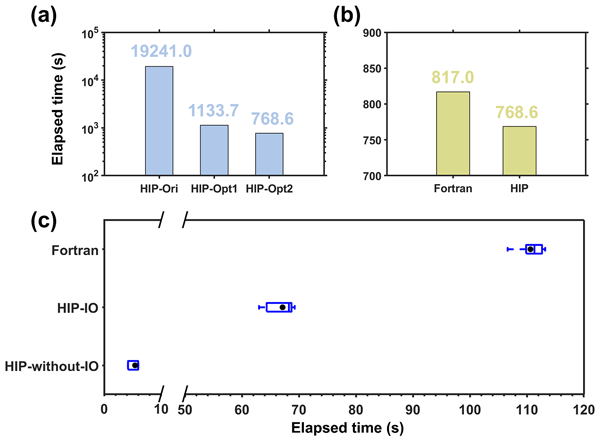
Scientists use irregular grid models for accurate weather simulation, which help capture details but also make the calculations slow on traditional computers. We redesigned this model for Graphics Processing Units (GPUs) by reorganizing data and calculations. This makes the slowest parts hundreds of times faster and the whole simulation over ten times faster. This allows for higher-resolution simulations.
Scientists use irregular grid models for accurate weather simulation, which help capture details...