Articles | Volume 19, issue 15
https://doi.org/10.5194/gmd-19-7197-2026
Development and technical paper
 | 
05 Aug 2026
Development and technical paper |  | 05 Aug 2026

DReaMIT: a dynamical reanalysis framework for modelling surface-based temperature inversions in cold environments

Victor Pozsgay, Nick Noad, Philip Bonnaventure, and Stephan Gruber

Related authors

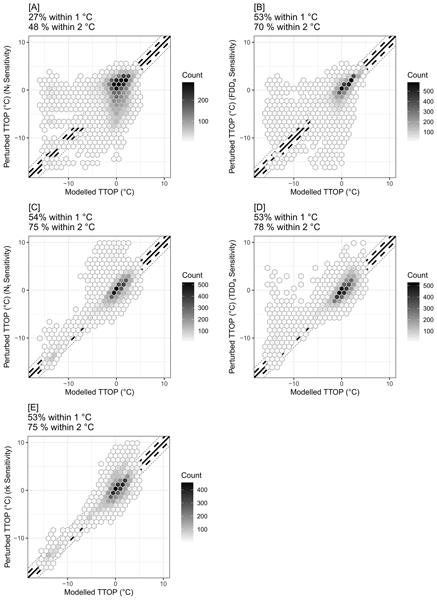
Determining TTOP model parameter importance and overall performance across northern Canada
Madeleine C. Garibaldi, Philip P. Bonnaventure, Robert G. Way, Alexandre Bevington, Sharon L. Smith, Scott F. Lamoureux, Jean E. Holloway, Antoni G. Lewkowicz, and Hannah Ackerman
The Cryosphere, 20, 2375–2392, https://doi.org/10.5194/tc-20-2375-2026,https://doi.org/10.5194/tc-20-2375-2026, 2026
Short summary
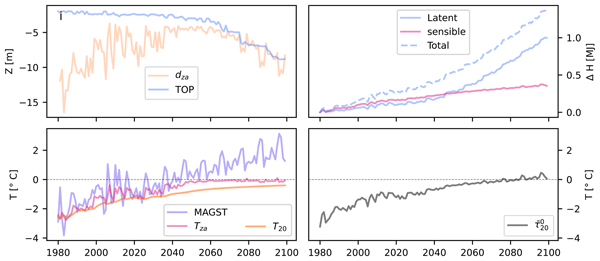
Beyond MAGT: learning more from permafrost thermal monitoring data with additional metrics
Nicholas Brown and Stephan Gruber
The Cryosphere, 20, 1771–1796, https://doi.org/10.5194/tc-20-1771-2026,https://doi.org/10.5194/tc-20-1771-2026, 2026
Short summary
A standardized permafrost ground temperature collection for Canada 2025
Olivia Meier-Legault, Nicholas Brown, Larry Adjun, Michel Allard, Alejandro Alvarez, Maude Auclair, Alex Bevington, Samuel Bilodeau, William Cable, Olivia Carpino, Ariane Castagner, Lin Chen, Alexandre Chiasson, Ryan Connon, Stephanie Coulombe, Jeffrey Crompton, Derek Cronmiller, Gautier Davesne, Mason Dominico, Marc-André Ducharme, Timothy Ensom, Louise Farquharson, Vanessa Foord, Daniel Fortier, Philippe Fortier, Duane Froese, Samuel Gagnon, Francis Gauthier, Marten Geertsema, Etienne Godin, Galina Jonat, Steven V. Kokelj, Michelle Landry, Antoni Lewkowicz, Panya Lipovsky, Emmanual L’Hérault, Hannah Macdonell, Lancelot Massé, Dmitry Nicolsky, Moya Painter, Leesee Papatsie, Victor Pozsgay, William Quinton, Vladimir Romanovsky, Ashley C.A. Rudy, Denis Sarrazin, Emilie Stewart-Jones, Donald Walker, Thomas Wright, Joseph Young, and Stephan Gruber
Earth Syst. Sci. Data Discuss., https://doi.org/10.5194/essd-2026-96,https://doi.org/10.5194/essd-2026-96, 2026
Revised manuscript accepted for ESSD
Short summary
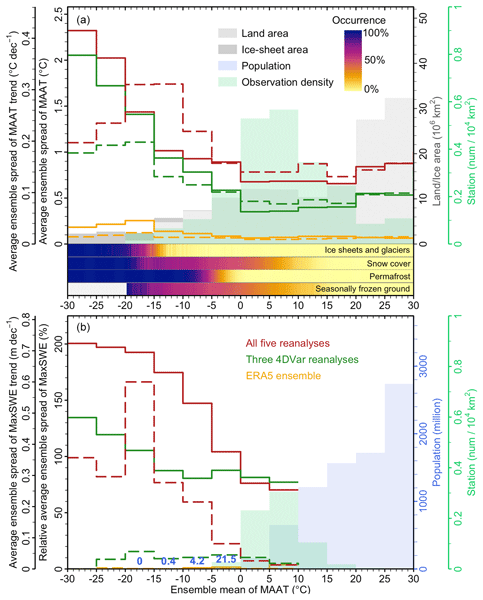
Brief communication: Reanalyses underperform in cold regions, raising concerns for climate services and research
Bin Cao and Stephan Gruber
The Cryosphere, 19, 4525–4532, https://doi.org/10.5194/tc-19-4525-2025,https://doi.org/10.5194/tc-19-4525-2025, 2025
Short summary
Simulating soil heat transfer with excess ice, erosion and deposition, guaranteed energy conservation, adaptive mesh refinement, and accurate spin-up (FreeThawXice1D)
Niccolò Tubini and Stephan Gruber
EGUsphere, https://doi.org/10.5194/egusphere-2025-2649,https://doi.org/10.5194/egusphere-2025-2649, 2025
Short summary

Cited articles

Canada, Environment and Climate Change: Historical Data – Climate – Environment and Climate Change Canada, http://climate.weather.gc.ca/historical_data/search_historic_data_e.html (last access: 7 November 2025), 2011. a
Cao, B., Gruber, S., and Zhang, T.: REDCAPP (v1.0): parameterizing valley inversions in air temperature data downscaled from reanalyses, Geosci. Model Dev., 10, 2905–2923, https://doi.org/10.5194/gmd-10-2905-2017, 2017. a, b, c, d, e, f, g
Cao, B., Quan, X., Brown, N., Stewart-Jones, E., and Gruber, S.: GlobSim (v1.0): deriving meteorological time series for point locations from multiple global reanalyses, Geosci. Model Dev., 12, 4661–4679, https://doi.org/10.5194/gmd-12-4661-2019, 2019. a, b
Crosman, E. T. and Horel, J. D.: Large-eddy simulations of a Salt Lake Valley cold-air pool, Atmos. Res., 193, 10–25, https://doi.org/10.1016/j.atmosres.2017.04.010, 2017. a
Daly, C., Halbleib, M., Smith, J. I., Gibson, W. P., Doggett, M. K., Taylor, G. H., Curtis, J., and Pasteris, P. P.: Physiographically sensitive mapping of climatological temperature and precipitation across the conterminous United States, Int. J. Climatol., 28, 2031–2064, https://doi.org/10.1002/joc.1688, 2008. a
Download
Short summary
Surface-based temperature inversions occur when cold air becomes trapped near the ground beneath a layer of warmer air. This study combines field data, analysis, and modelling to develop DReaMIT, a model that captures the timing and strength of inversions across northern mountain terrain. The model's transferability beyond the valleys where it was developed makes it valuable globally to cold-region researchers for mapping and modelling permafrost and assessing climate change impacts.
Share