Articles | Volume 19, issue 2
https://doi.org/10.5194/gmd-19-647-2026
© Author(s) 2026. This work is distributed under
the Creative Commons Attribution 4.0 License.
https://doi.org/10.5194/gmd-19-647-2026
© Author(s) 2026. This work is distributed under
the Creative Commons Attribution 4.0 License.
A suite of coupled ocean-sea ice simulations examining the effect of regime shift in sea-ice thickness distribution on ice–ocean interaction in the Arctic Ocean
Hiroshi Sumata
CORRESPONDING AUTHOR
Norwegian Meteorological Institute, Tromsø, Norway
Norwegian Polar Institute, Fram Centre, Tromsø, Norway
Mats A. Granskog
Norwegian Polar Institute, Fram Centre, Tromsø, Norway
Pedro Duarte
Norwegian Polar Institute, Fram Centre, Tromsø, Norway
Related authors
No articles found.
Letizia Tedesco, Giulia Castellani, Pedro Duarte, Meibing Jin, Sebastien Moreau, Eric Mortenson, Benjamin Tobey Saenz, Nadja Steiner, and Martin Vancoppenolle
The Cryosphere, 20, 723–736, https://doi.org/10.5194/tc-20-723-2026, https://doi.org/10.5194/tc-20-723-2026, 2026
Short summary
Short summary
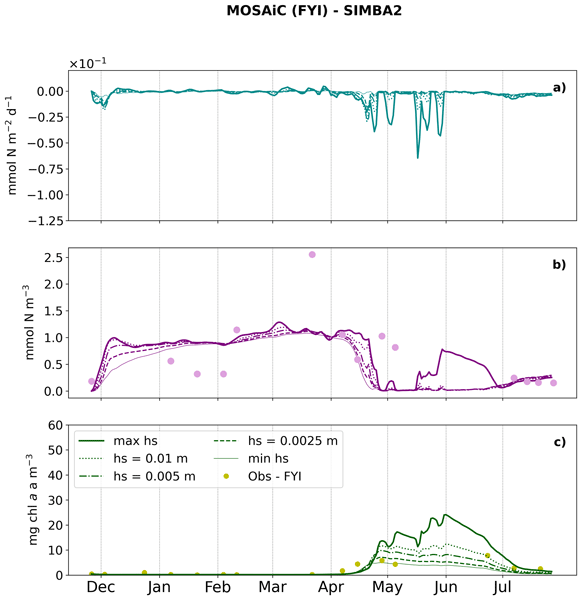
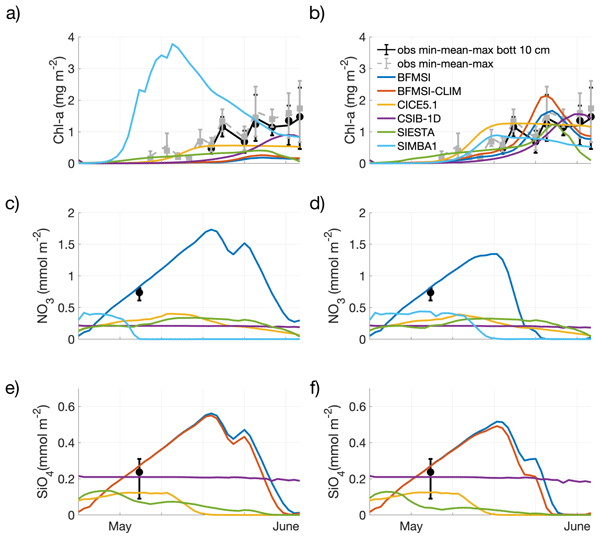
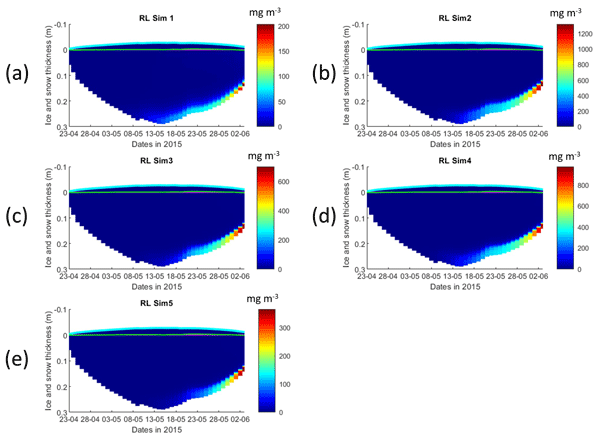
Sea ice hosts tiny algae that support polar marine life, yet their growth remains challenging to simulate. We tested six computer models using data from a 2015 Arctic drifting ice expedition to see how well they reproduced spring algae blooms and nutrient changes. While tuning helped models better match algae growth, nutrients remained difficult to capture. Our results highlight key challenges in representing fragile sea‑ice habitats that are expected to become more common as the Arctic warms.
Giulia Castellani, Karley Campbell, Sebastien Moreau, and Pedro Duarte
EGUsphere, https://doi.org/10.5194/egusphere-2025-5384, https://doi.org/10.5194/egusphere-2025-5384, 2026
This preprint is open for discussion and under review for Geoscientific Model Development (GMD).
Short summary
Short summary
Nutrients exchange at the ocean-ice interface is a key process to supply nutrients and support sea-ice algal growth in polar regions. Such fluxes depend on the characteristics of the flow. We develop a parameterization that accounts for shifts between smooth and turbulent flow and we implement it in two sea-ice biogeochemical models. The parameterization leads to larger fluxes of nutrients that support higher production, resulting in more than double biomass accumulation.
Dmitry V. Divine, Sebastian Gerland, and Mats A. Granskog
EGUsphere, https://doi.org/10.5194/egusphere-2025-5511, https://doi.org/10.5194/egusphere-2025-5511, 2025
This preprint is open for discussion and under review for The Cryosphere (TC).
Short summary
Short summary
We present seven years of sea-ice draft measurements from sonar instruments in the Fram Strait, the region between Svalbard and Greenland where most of Arctic sea-ice export occurs. The data show that smooth, level ice makes up about half of ice cover, while ridges – formed when ice floes collide – are frequent and can contain up to half of the total ice volume. Ridges are becoming fewer and shallower, with smaller ridges growing in importance as Arctic ice thins.
Madison M. Smith, Niels Fuchs, Evgenii Salganik, Donald K. Perovich, Ian Raphael, Mats A. Granskog, Kirstin Schulz, Matthew D. Shupe, and Melinda Webster
The Cryosphere, 19, 619–644, https://doi.org/10.5194/tc-19-619-2025, https://doi.org/10.5194/tc-19-619-2025, 2025
Short summary
Short summary
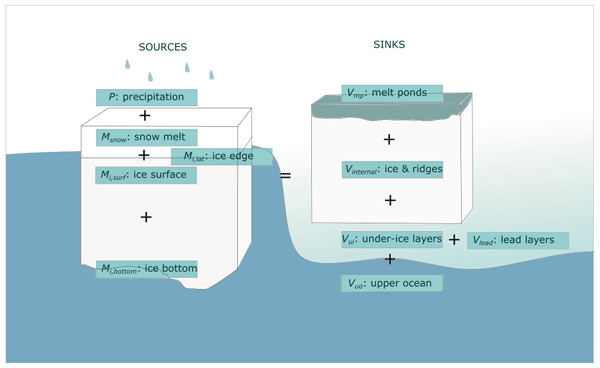
The fate of freshwater from Arctic sea ice and snowmelt impacts interactions of the atmosphere, sea ice, and ocean. We complete a comprehensive analysis of datasets from a 2020 central Arctic field campaign to understand the drivers of the sea ice freshwater budget and the fate of this water. Over half of the freshwater comes from surface melt, and a majority fraction is incorporated into the ocean. Results suggest that the representation of melt ponds is a key area for future development.
Evgenii Salganik, Benjamin A. Lange, Christian Katlein, Ilkka Matero, Philipp Anhaus, Morven Muilwijk, Knut V. Høyland, and Mats A. Granskog
The Cryosphere, 17, 4873–4887, https://doi.org/10.5194/tc-17-4873-2023, https://doi.org/10.5194/tc-17-4873-2023, 2023
Short summary
Short summary
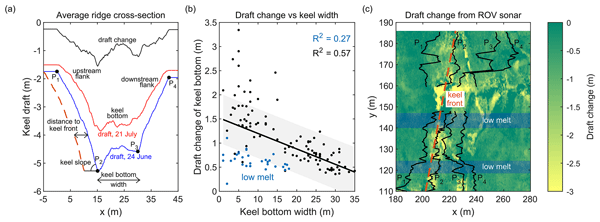
The Arctic Ocean is covered by a layer of sea ice that can break up, forming ice ridges. Here we measure ice thickness using an underwater sonar and compare ice thickness reduction for different ice types. We also study how the shape of ridged ice influences how it melts, showing that deeper, steeper, and narrower ridged ice melts the fastest. We show that deformed ice melts 3.8 times faster than undeformed ice at the bottom ice--ocean boundary, while at the surface they melt at a similar rate.
Pedro Duarte, Jostein Brændshøi, Dmitry Shcherbin, Pauline Barras, Jon Albretsen, Yvonne Gusdal, Nicholas Szapiro, Andreas Martinsen, Annette Samuelsen, Keguang Wang, and Jens Boldingh Debernard
Geosci. Model Dev., 15, 4373–4392, https://doi.org/10.5194/gmd-15-4373-2022, https://doi.org/10.5194/gmd-15-4373-2022, 2022
Short summary
Short summary
Sea ice models are often implemented for very large domains beyond the regions of sea ice formation, such as the whole Arctic or all of Antarctica. In this study, we implement changes in the Los Alamos Sea Ice Model, allowing it to be implemented for relatively small regions within the Arctic or Antarctica and yet considering the presence and influence of sea ice outside the represented areas. Such regional implementations are important when spatially detailed results are required.
Muhammed Fatih Sert, Helge Niemann, Eoghan P. Reeves, Mats A. Granskog, Kevin P. Hand, Timo Kekäläinen, Janne Jänis, Pamela E. Rossel, Bénédicte Ferré, Anna Silyakova, and Friederike Gründger
Biogeosciences, 19, 2101–2120, https://doi.org/10.5194/bg-19-2101-2022, https://doi.org/10.5194/bg-19-2101-2022, 2022
Short summary
Short summary
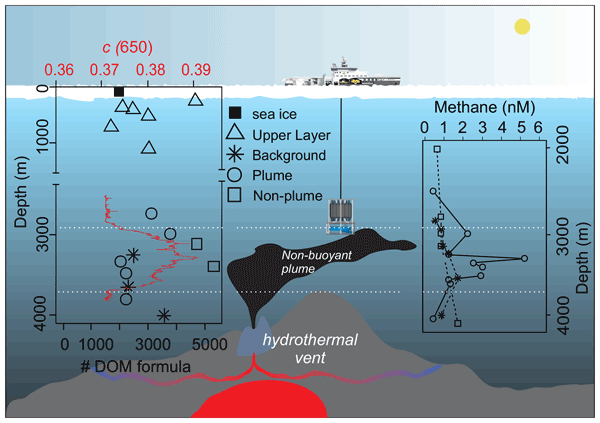
We investigate organic matter composition in the Arctic Ocean water column. We collected seawater samples from sea ice to deep waters at six vertical profiles near an active hydrothermal vent and its plume. In comparison to seawater, we found that the organic matter in waters directly affected by the hydrothermal plume had different chemical composition. We suggest that hydrothermal processes may influence the organic matter distribution in the deep ocean.
Tristan Petit, Børge Hamre, Håkon Sandven, Rüdiger Röttgers, Piotr Kowalczuk, Monika Zablocka, and Mats A. Granskog
Ocean Sci., 18, 455–468, https://doi.org/10.5194/os-18-455-2022, https://doi.org/10.5194/os-18-455-2022, 2022
Short summary
Short summary
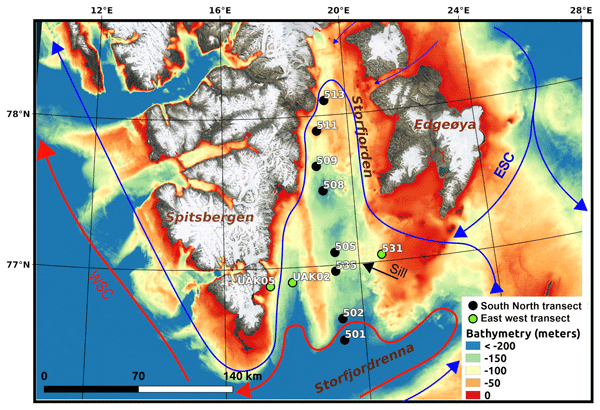
We provide the first insights on bio-optical processes in Storfjorden (Svalbard). Information on factors controlling light propagation in the water column in this arctic fjord becomes crucial in times of rapid sea ice decline. We find a significant contribution of dissolved matter to light absorption and a subsurface absorption maximum linked to phytoplankton production. Dense bottom waters from sea ice formation carry elevated levels of dissolved and particulate matter.
Pedro Duarte, Philipp Assmy, Karley Campbell, and Arild Sundfjord
Geosci. Model Dev., 15, 841–857, https://doi.org/10.5194/gmd-15-841-2022, https://doi.org/10.5194/gmd-15-841-2022, 2022
Short summary
Short summary
Sea ice modeling is an important part of Earth system models (ESMs). The results of ESMs are used by the Intergovernmental Panel on Climate Change in their reports. In this study we present an improvement to calculate the exchange of nutrients between the ocean and the sea ice. This nutrient exchange is an essential process to keep the ice-associated ecosystem functioning. We found out that previous calculation methods may underestimate the primary production of the ice-associated ecosystem.
Cited articles
Assmy, P., Fernandez-Mendez, M., Duarte, P., Meyer, A., Randelhoff, A., Mundy, C. J., Olsen, L. M., Kauko, H. M., Bailey, A., Chierici, M., Cohen, L., Doulgeris, A. P., Ehn, J. K., Fransson, A., Gerland, S., Hop, H., Hudson, S. R., Hughes, N., Itkin, P., Johnsen, G., King, J. A., Koch, B. P., Koenig, Z., Kwasniewski, S., Laney, S. R., Nicolaus, M., Pavlov, A. K., Polashenski, C. M., Provost, C., Rosel, A., Sandbu, M., Spreen, G., Smedsrud, L. H., Sundfjord, A., Taskjelle, T., Tatarek, A., Wiktor, J., Wagner, P. M., Wold, A., Steen, H., and Granskog, M. A.: Leads in Arctic pack ice enable early phytoplankton blooms below snow-covered sea ice, Sci. Rep., 7, 40850, https://doi.org/10.1038/srep40850, 2017.
Brenner, S., Rainville, L., Thomson, J., Cole, S., and Lee, C.: Comparing Observations and Parameterizations of Ice–Ocean Drag Through an Annual Cycle Across the Beaufort Sea, J. Geophys. Res.-Oceans, 126, e2020JC016977, https://doi.org/10.1029/2020JC016977, 2021.
Cole, S. T., Toole, J. M., Lele, R., Timmermans, M. L., Gallaher, S. G., Stanton, T. P., Shaw, W. J., Hwang, B., Maksym, T., Wilkinson, J. P., Ortiz, M., Graber, H., Rainville, L., Petty, A. A., Farrell, S. L., Richter-Menge, J. A., and Haas, C.: Ice and ocean velocity in the Arctic marginal ice zone: Ice roughness and momentum transfer, Elem. Sci. Anthrop., 5, 55, https://doi.org/10.1525/Elementa.241, 2017.
Debernard, J., Kristensen, N. M., Maartensson, S., Wang, K., Hedstrom, K., Brændshøi, J., and Szapiro, N.: met-no/metroms: Version 0.4.1 (v0.4.1), Zenodo [code], https://doi.org/10.5281/zenodo.5067164, 2021.
de Boyer Montégut, C., Madec, G., Fischer, A. S., Lazar, A., and Iudicone, D.: Mixed layer depth over the global ocean: An examination of profile data and a profile-based climatology, J. Geophys. Res., 109, C12003, https://doi.org/10.1029/2004JC002378, 2004.
Duarte, P.: MCT, CICE and ROMS code used with for the S4K simulations (v1.1), Zenodo [code], https://doi.org/10.5281/zenodo.5815093, 2022.
Duarte, P., Brændshøi, J., Shcherbin, D., Barras, P., Albretsen, J., Gusdal, Y., Szapiro, N., Martinsen, A., Samuelsen, A., Wang, K., and Debernard, J. B.: Implementation and evaluation of open boundary conditions for sea ice in a regional coupled ocean (ROMS) and sea ice (CICE) modeling system, Geosci. Model Dev., 15, 4373–4392, https://doi.org/10.5194/gmd-15-4373-2022, 2022.
Fanning, K. A. and Torres, L. M.: Rn-222 and Ra-226 – Indicators of Sea-Ice Effects on Air–Sea Gas-Exchange, Polar Res., 10, 51–58, https://doi.org/10.3402/polar.v10i1.6727, 1991.
Farrell, S. L., Kurtz, N., Connor, L. N., Elder, B. C., Leuschen, C., and Markus, T.: A first assessment of IceBridge snow and ice thickness data over Arctic sea ice, IEEE Trans. Geosci. Rem. Sens., 50, 2098–2111, https://doi.org/10.1109/TGRS.2011.2170843, 2011.
Feltham, D. L.: Sea ice rheology, Ann. Rev. Fluid. Mech., 40, 91–112, https://doi.org/10.1146/annurev.fluid.40.111406.102151, 2008.
Fox-Kemper, B., Hewitt, H. T., Xiao, C., Aðalgeirsdóttir, G., Drijfhout, S. S., Edwards, T. L., Golledge, N. R., Hemer, M., Kopp, R. E., Krinner, G., Mix, A., Notz, D., Nowicki, S., Nurhati, I. S., Ruiz, L., Sallée, J.-B., Slangen, A. B. A., and Yu, Y.: Ocean, Cryosphere and Sea Level Change, in: Climate Change 2021: The Physical Science Basis. Contribution of Working Group I to the Sixth Assessment Report of the Intergovernmental Panel on Climate Change, edited by: Masson-Delmotte, V., Zhai, P., Pirani, A., Connors, S. L., Péan, C., Berger, S., Caud, N., Chen, Y., Goldfarb, L., Gomis, M. I., Huang, M., Leitzell, K., Lonnoy, E., Matthews, J. B. R., Maycock, T. K., Waterfield, T., Yelekçi, O., Yu, R., and Zhou, B., Cambridge University Press, Cambridge, United Kingdom and New York, NY, USA, 1211–1362, https://doi.org/10.1017/9781009157896.011, 2021.
Haas, C., Hendricks, S., Eicken, H., and Herber, A.: Synoptic airborne thickness surveys reveal state of Arctic sea ice cover, Geophys. Res. Lett., 37, L09501, https://doi.org/10.1029/2010gl042652, 2010.
Hansen, E., Ekeberg, O. C., Gerland, S., Pavlova, O., Spreen, G., and Tschudi, M.: Variability in categories of Arctic sea ice in Fram Strait, J. Geophys. Res.-Oceans, 119, 7175–7189, https://doi.org/10.1002/2014JC010048, 2014.
Hattermann, T., Isachsen, P. E., von Appen, W. J., Albretsen, J., and Sundfjord, A.: Eddy-driven recirculation of Atlantic Water in Fram Strait, Geophys. Res. Lett., 43, 3406–3414, https://doi.org/10.1002/2016GL068323, 2016.
Hersbach, H., Bell, B., Berrisford, P., Hirahara, S., Horányi, A., Muñoz-Sabater, J., Nicolas, J., Peubey, C., Radu, R., Schepers, D., Simmons, A., Soci, C., Abdalla, S., Abellan, X., Balsamo, G., Bechtold, P., Biavati, G., Bidlot, J., Bonavita, M., De Chiara, G., Dahlgren, P., Dee, D., Diamantakis, M., Dragani, R., Flemming, J., Forbes, R., Fuentes, M., Geer, A., Haimberger, L., Healy, S., Hogan, R. J., Hólm, E., Janisková, M., Keeley, S., Laloyaux, P., Lopez, P., Lupu, C., Radnoti, G., de Rosnay, P., Rozum, I., Vamborg, F., Villaume, S., and Thépaut, J. N.: The ERA5 global reanalysis, Q. J. Roy. Meteor. Soc., 146, 1999–2049, https://doi.org/10.1002/qj.3803, 2020.
Hibler III, W. D.: A dynamic thermodynamic sea ice model, J. Phys. Oceanogr., 9, 815–846, https://doi.org/10.1175/1520-0485(1979)009<0815:ADTSIM>2.0.CO;2, 1979.
Hunke, C. E., Lipscomb, W. H., Turner, A. K., Jeffery, N., and Elliott, S.: CICE: the Los Alamos Sea Ice Model Documentation and Software User's Manual Version 5.1 LA-CC-06–012, https://github.com/CICE-Consortium/CICE-svn-trunk/blob/svn/tags/release-5.1/doc/cicedoc.pdf (last access: 15 July 2025), 2015.
Idzanovic, M., Rikardsen, E. S. U., and Röhrs, J.: Forecast uncertainty and ensemble spread in surface currents from a regional ocean model, Front. Mar. Sci., 10, 1177337, https://doi.org/10.3389/fmars.2023.1177337, 2023.
Krumpen, T., Belter, H. J., Boetius, A., Damm, E., Haas, C., Hendricks, S., Nicolaus, M., Nöthig, E. M., Paul, S., Peeken, I., Ricker, R., and Stein, R.: Arctic warming interrupts the Transpolar Drift and affects long-range transport of sea ice and ice-rafted matter, Sci. Rep., 9, 5459, https://doi.org/10.1038/s41598-019-41456-y, 2019.
Krumpen, T., von Albedyll, L., Bünger, H. J., Castellani, G., Hartmann, J., Helm, V., Hendricks, S., Hutter, N., Landy, J. C., Lisovski, S., Lüpkes, C., Rohde, J., Suhrhoff, M., and Haas, C.: Smoother sea ice with fewer pressure ridges in a more dynamic Arctic, Nat. Clim. Change, 15, https://doi.org/10.1038/s41558-024-02199-5, 2025.
Landrum, L. L. and Holland, M. M.: Influences of changing sea ice and snow thicknesses on simulated Arctic winter heat fluxes, The Cryosphere, 16, 1483–1495, https://doi.org/10.5194/tc-16-1483-2022, 2022.
Larson, J., Jacob, R., and Ong, E.: The Model Coupling Toolkit: A new fortran90 toolkit for building multiphysics parallel coupled models, Int. J. High Perform. Comput. Appl., 19, 277–292, https://doi.org/10.1177/1094342005056115, 2005.
Leu, E., Mundy, C. J., Assmy, P., Campbell, K., Gabrielsen, T. M., Gosselin, M., Juul-Pedersen, T., and Gradinger, R.: Arctic spring awakening – Steering principles behind the phenology of vernal ice algal blooms, Prog. Oceanogr., 139, 151–170, https://doi.org/10.1016/j.pocean.2015.07.012, 2015.
Lind, S., Ingvaldsen, R. B., and Furevik, T.: Arctic warming hotspot in the northern Barents Sea linked to declining sea-ice import, Nat. Clim. Change, 8, 634–639, https://doi.org/10.1038/s41558-018-0205-y, 2018.
Long, M. H., Koopmans, D., Berg, P., Rysgaard, S., Glud, R. N., and Søgaard, D. H.: Oxygen exchange and ice melt measured at the ice-water interface by eddy correlation, Biogeosciences, 9, 1957–1967, https://doi.org/10.5194/bg-9-1957-2012, 2012.
Loose, B., McGillis, W. R., Schlosser, P., Perovich, D., and Takahashi, T.: Effects of freezing, growth, and ice cover on gas transport processes in laboratory seawater experiments, Geophys. Res. Lett., 36, L05603, https://doi.org/10.1029/2008gl036318, 2009.
Lüpkes, C., Gryanik, V. M., Hartmann, J., and Andreas, E. L.: A parametrization, based on sea ice morphology, of the neutral atmospheric drag coefficients for weather prediction and climate models, J. Geophys. Res.-Atmos, 117, D13112, https://doi.org/10.1029/2012JD017630, 2012.
Martin, T., Tsamados, M., Schroeder, D., and Feltham, D. L.: The impact of variable sea ice roughness on changes in Arctic Ocean surface stress: A model study, J. Geophys. Res.-Oceans, 121, 1931–1952, https://doi.org/10.1002/2015JC011186, 2016.
Mchedlishvili, A., Lüpkes, C., Petty, A., Tsamados, M., and Spreen, G.: New estimates of pan-Arctic sea ice–atmosphere neutral drag coefficients from ICESat-2 elevation data, The Cryosphere, 17, 4103–4131, https://doi.org/10.5194/tc-17-4103-2023, 2023.
Melling, H., Johnston, P. H., and Riedel, D. A.: Measurements of the Underside Topography of Sea-Ice by Moored Subsea Sonar, J. Atmos. Ocean. Tech., 12, 589–602, https://doi.org/10.1175/1520-0426(1995)012<0589:Motuto>2.0.Co;2, 1995.
Muilwijk, M., Hattermann, T., Martin, T., and Granskog, M. A.: Future sea ice weakening amplifies wind-driven trends in surface stress and Arctic Ocean spin-up, Nat. Comm., 15, 6889, https://doi.org/10.1038/S41467-024-50874-0, 2024.
Muramatsu, M., Watanabe, E., Itoh, M., Onodera, J., Mizobata, K., and Ueno, H.: Subsurface warming associated with Pacific Summer Water transport toward the Chukchi Borderland in the Arctic Ocean, Sci. Rep., 15, 24, https://doi.org/10.1038/S41598-024-81994-8, 2025.
Polyakov, I. V., Pnyushkov, A. V., Alkire, M. B., Ashik, I. M., Baumann, T. M., Carmack, E. C., Goszczko, I., Guthrie, J., Ivanov, V. V., Kanzow, T., Krishfield, R., Kwok, R., Sundfjord, A., Morison, J., Rember, R., and Yulin, A.: Greater role for Atlantic inflows on sea-ice loss in the Eurasian Basin of the Arctic Ocean, Science, 356, 285–291, https://doi.org/10.1126/science.aai8204, 2017.
Polyakov, I. V., Rippeth, T. P., Fer, I., Alkire, M. B., Baumann, T. M., Carmack, E. C., Ingvaldsen, R., Ivanov, V. V., Janout, M., Lind, S., Padman, L., Pnyushkov, A. V., and Rember, R.: Weakening of Cold Halocline Layer Exposes Sea Ice to Oceanic Heat in the Eastern Arctic Ocean, J. Climate, 33, 8107–8123, https://doi.org/10.1175/jcli-d-19-0976.1, 2020.
Rabenstein, L., Hendricks, S., Martin, T., Pfaffhuber, A., and Haas, C.: Thickness and surface-properties of different sea-ice regimes within the Arctic Trans Polar Drift: Data from summers 2001, 2004 and 2007, J. Geophys. Res.-Oceans , 115, C12059, https://doi.org/10.1029/2009jc005846, 2010.
Rheinlaender, J. W., Regan, H., Rampal, P., Boutin, G., Olason, E., and Davy, R.: Breaking the Ice: Exploring the Changing Dynamics of Winter Breakup Events in the Beaufort Sea, J. Geophys. Res.-Oceans, 129, e2023JC020395, https://doi.org/10.1029/2023JC020395, 2024.
Röhrs, J., Gusdal, Y., Rikardsen, E. S. U., Durán Moro, M., Brændshøi, J., Kristensen, N. M., Fritzner, S., Wang, K., Sperrevik, A. K., Idžanović, M., Lavergne, T., Debernard, J. B., and Christensen, K. H.: Barents-2.5km v2.0: an operational data-assimilative coupled ocean and sea ice ensemble prediction model for the Barents Sea and Svalbard, Geosci. Model Dev., 16, 5401–5426, https://doi.org/10.5194/gmd-16-5401-2023, 2023.
Sakov, P., Counillon, F., Bertino, L., Lisæter, K. A., Oke, P. R., and Korablev, A.: TOPAZ4: an ocean-sea ice data assimilation system for the North Atlantic and Arctic, Ocean Sci., 8, 633–656, https://doi.org/10.5194/os-8-633-2012, 2012.
Schröder, D., Feltham, D. L., Tsamados, M., Ridout, A., and Tilling, R.: New insight from CryoSat-2 sea ice thickness for sea ice modelling, The Cryosphere, 13, 125–139, https://doi.org/10.5194/tc-13-125-2019, 2019.
Serreze, M. C., Holland, M. M., and Stroeve, J.: Perspectives on the Arctic's shrinking sea-ice cover, Science, 315, 1533–1536, https://doi.org/10.1126/science.1139426, 2007.
Shchepetkin, A. F. and McWilliams, J. C.: The regional oceanic modeling system (ROMS): A split-explicit, free-surface, topography-following-coordinate oceanic model, Ocean Model., 9, 347–404, https://doi.org/10.1016/j.ocemod.2004.08.002, 2005.
Sterlin, J., Tsamados, M., Fichefet, T., Massonnet, F., and Barbic, G.: Effects of sea ice form drag on the polar oceans in the NEMO-LIM3 global ocean-sea ice model, Ocean Model., 184, 102227, https://doi.org/10.1016/j.ocemod.2023.102227, 2023.
Sumata, H., de Steur, L., Divine, D. V., Granskog, M. A., and Gerland, S.: Regime shift in Arctic Ocean sea ice thickness, Nature, 615, 443–449, https://doi.org/10.1038/s41586-022-05686-x, 2023.
Sumata, H.: Monthly sea ice thickness distribution in Fram Strait, Norwegian Polar Institute [data set], https://doi.org/10.21334/NPOLAR.2022.B94CB848, 2022.
Sumata, H., Granskog, M., and Duarte, P.: Weaker dynamical coupling between sea ice and ocean in a thinner Arctic sea ice regime – Model input, boundary and forcing files v1.0, Norwegian Polar Institute [data set], https://doi.org/10.21334/NPOLAR.2025.70C53C63, 2025.
Tsamados, M., Feltham, D. L., Schroeder, D., Flocco, D., Farrell, S. L., Kurtz, N., Laxon, S. W., and Bacon, S.: Impact of Variable Atmospheric and Oceanic Form Drag on Simulations of Arctic Sea Ice, J. Phys. Oceanogr., 44, 1329–1353, https://doi.org/10.1175/jpo-d-13-0215.1, 2014.
Timmermans, M. L.: The impact of stored solar heat on Arctic sea ice growth, Geophys. Res. Lett., 42, 6399–6406, https://doi.org/10.1002/2015GL064541, 2015.
von Albedyll, L., Haas, C., and Dierking, W.: Linking sea ice deformation to ice thickness redistribution using high-resolution satellite and airborne observations, The Cryosphere, 15, 2167–2186, https://doi.org/10.5194/tc-15-2167-2021, 2021.
Ward, J. L. and Tandon, N. F.: Why is summertime Arctic sea ice drift speed projected to decrease?, The Cryosphere, 18, 995–1012, https://doi.org/10.5194/tc-18-995-2024, 2024.
Weeks, W. F. and Hibler III, W. D.: On sea ice, University of Alaska Press, Fairbanks, ISBN 978-1-60223-079-8, 2010.
Xie, J., Bertino, L., Counillon, F., Lisæter, K. A., and Sakov, P.: Quality assessment of the TOPAZ4 reanalysis in the Arctic over the period 1991–2013, Ocean Sci., 13, 123–144, https://doi.org/10.5194/os-13-123-2017, 2017.
Short summary
A major shift in Arctic sea ice occurred in 2007, transitioning from thicker, deformed ice to thinner, more uniform ice with reduced surface roughness. This abrupt change likely altered the dynamic and thermodynamic interactions between sea ice and ocean. We present a suite of regional coupled ocean-sea ice simulations designed to assess the potential impact of the regime shift on sea ice-ocean interactions, with a regional focus on the Atlantic sector of the Arctic Ocean.
A major shift in Arctic sea ice occurred in 2007, transitioning from thicker, deformed ice to...