
the Creative Commons Attribution 4.0 License.
the Creative Commons Attribution 4.0 License.
 | 09 Jul 2026
CMIP7 data request: ocean and sea ice priorities and opportunities

Patricia DeRepentigny
Anne Marie Treguier
Christian Stepanek
Eleanor O'Rourke
Chloe Mackallah
Alberto Meucci
Yevgeny Aksenov
Paul J. Durack
Nicole Feldl
Oluwayemi Garuba
Vanessa Hernaman
Céline Heuzé
Doroteaciro Iovino
Gaurav Madan
André L. Marquez
François Massonnet
Jenny Mecking
Dhrubajyoti Samanta
Patrick C. Taylor
Wan-Ling Tseng
Martin Vancoppenolle
The ocean and sea ice are central to Earth's climate system, influencing global heat and carbon cycles, weather patterns, and sea level rise. Recent decades have seen rapid advances in Earth System Models (ESMs), but limitations remain in simulating and comparing key oceanic and cryospheric processes across models. A recurring challenge in model intercomparison efforts like the Coupled Model Intercomparison Project (CMIP) is determining the output variables that best represent essential mechanisms while remaining manageable in volume and complexity. Here we present the CMIP7 ocean and sea ice data request, developed through an international, community-based process to prioritize variables for model output. We identify seven opportunities – science-based use cases spanning ocean and cryosphere drivers and responses, paleoclimate, polar amplification, extremes, wind waves, and rapid model evaluation – to guide variable selection and temporal resolution. To address these opportunities, we request new high-frequency and depth-integrated variables, support improved diagnostics of ocean heat uptake, sea ice processes, and model-observation comparison, and build on lessons from CMIP6. Our approach enables targeted, efficient, and transparent data curation to support a wide range of users, from model developers to policymakers. This effort reflects a growing need for more sophisticated, integrative model outputs that address pressing climate questions, including regional extremes and tipping points, while laying the groundwork for future modeling developments.
- Article
(483 KB) - Full-text XML
- BibTeX
- EndNote


The ocean and sea ice play several critical roles in the Earth system (Fox-Kemper et al., 2021a). One of the most well-known is the oceans' capacity to act as a vast reservoir for thermal energy: since the 1950s, over 90 % of the excess energy on Earth resulting from human activities has been stored in the oceans (Johnson and Lyman, 2020; Cheng et al., 2022; Johnson et al., 2022; Li et al., 2023). Similarly, the ocean takes up about a quarter of the anthropogenic carbon emissions, resulting in ocean acidification (e.g., Gruber et al., 2023). Oceans cover about 72 % of Earth's surface, are the source of most of the evaporated water, and receive most of the precipitation that falls back to the surface (e.g., Mayer et al., 2021). The ocean contributes about a third of the meridional heat transport from the equator to the poles, with the remainder divided fairly evenly between the latent heat transport of the water cycle (poleward via humidity and equatorward as liquid ocean water) and the atmosphere (Trenberth, 2022). Furthermore, the ocean participates in many coupled modes of variability with global relevance, such as the El Niño-Southern Oscillation (ENSO). However, due to their vast mass and thermal capacity, the ocean adjusts more slowly to changes than the atmosphere does, causing it to lag behind the atmosphere in response to external forcing (Frankignoul and Hasselmann, 1977). This capacity enables the oceans to buffer transient climate changes to some extent, dampening and delaying the full effect of external forcing on the climate system (e.g., Stuecker, 2023). Finally, changes in ocean conditions directly affect human society through local climate impacts (e.g., land-sea breezes, monsoons, and marine climate), sea level rise, coastal inundation and erosion, and shifts in marine resources such as fisheries and transportation (Cooley et al., 2022).
Although sea ice constitutes only a small fraction (about 0.1 %) of Earth's total ice volume, it has many consequential climate effects (Fox-Kemper et al., 2021a). The combined Arctic and Antarctic sea ice systems cover an area ranging between 16 and 28 million km2, depending on the time of the year, corresponding to about 4 %–8 % of the global ocean surface. Sea ice affects the albedo of the Earth, insulates the oceans from the atmosphere, and is an important habitat for many species. The formation and melting of sea ice affects the formation of key ocean water masses (e.g., Abernathey et al., 2016). There is a long-running debate about whether sea ice affects mid-latitude extreme weather (e.g., Francis, 2017; Screen et al., 2018; IPCC, 2021a, Cross-Chapter Box 10.1). The polar oceans and sea ice also impact land ice by interacting with the ice shelves that buttress the ice sheets (Sun et al., 2020; Reese et al., 2023; Bradley and Hewitt, 2024). Finally, the reduction of sea ice, both in terms of areal coverage and volume, is one of the clearest indicators of ongoing climate change. In February 2025, global sea ice coverage reached a record low, with Arctic sea ice 8 % below average and Antarctic sea ice 26 % below average (based on OSI SAF, 2025).
These considerations highlight the value of carefully identifying ocean and sea ice characteristics that are critical for understanding and researching climate change in the coming years. Our team assembled experts from 21 institutions to discuss and prioritize the variables in modern Earth System Models (ESMs) most relevant for the study of the oceans and sea ice. ESMs, including those participating in the upcoming Coupled Model Intercomparison Project Phase 7 (CMIP7), are designed to simulate many of the effects described above. The multiple climactic roles of ocean and sea ice require a variety of variables to accurately quantify their interactions and their tendencies, across multiple timescales, depth ranges, background climates and forcing scenarios. This paper aims to identify and prioritize the key ocean and sea ice data variables to be requested from ESMs, facilitating comparison among models and with observations, revealing mechanisms, and monitoring changes. Selecting variables for data requests requires careful judgment: (1) excessive data demands can overwhelm the capabilities of modeling centers, users, and storage facilities and increase the risk of inefficiencies and errors in data management, (2) structures must be imposed for the timely release of data and ensuring seamless workflow integration adhering to deadlines from higher level activities, including Intergovernmental Panel on Climate Change assessment reports (e.g., IPCC, 2021a, and the upcoming Seventh Assessment Report), and (3) a broad, inclusive user community is desired. The data request decisions must be reasoned and judicious.
The data generated in CMIP7 Assessment Fast Track (CMIP7 Assessment Fast Track) and the rest of CMIP7 and related model intercomparisons will serve multiple user groups, including modelers aiming to improve their products (e.g., Fox-Kemper et al., 2019), observationalists seeking context for past and present measurements, as well as scientists, policy-makers, and managers evaluating the future impacts of ocean and climate changes on vulnerable natural and built systems. To address their diverse needs, the Ocean and Sea Ice Author Team, under the wider CMIP7 Data Request Task Team, has identified a number of opportunities that represent both traditional and new applications for model data and that motivate the choice of physical parameters, variables, and variable groups requested. These opportunities are selected based on their potential to enhance understanding of the roles of the oceans and sea ice in the climate system and their projected changes.
This paper introduces the opportunities related to ocean and sea ice, lays out the related groups of variables, with special attention to variables to be requested for the first time for CMIP7 and their geographic and temporal sampling requirements, and clarifies variable definitions or provides references where they are carefully defined. It is not the role of this paper to elaborate on definitional choices, analyze the sensitivity of results to subtle differences in variable definition, or prescribe the protocols needed for different model intercomparison exercises. Companion papers, such as the Ocean Model Intercomparison Project (OMIP) for CMIP7 (Baylor Fox-Kemper, personal communication, 2025) and others (Notz et al., 2016; McDougall et al., 2021; Treguier et al., 2023) serve to complement this paper and fulfill these necessary roles. The accompanying tables of variables are archived as a dataset (CMIP Model Benchmarking Task Team, 2024).
The Oceans and Sea Ice Author Team was recruited via open call between 2 February and 1 March 2024 (https://wcrp-cmip.org/cmip7-ocean-seaice-call/ last access: 20 June 2026). Members were sought from across the ocean and sea ice communities to gather variable requirements for the CMIP7 Data Request (Mackallah et al., 2026), which is collaboratively organized using the platform Airtable. Applications were reviewed by OMIP and Ocean Model Development Panel (OMDP) representatives alongside three members of the Data Request Task Team. A diverse final group of 21 authors was formed, including World Climate Research Program Core Project representatives from Climate and Cryosphere (CliC), Climate and Ocean Variability, Predictability and Change (CLIVAR, including the Ocean Model Development Panel and its OMIP Working Group), and Earth System Modeling and Observation (ESMO). The team also included representatives from the following Model Intercomparison Projects: Ocean Model Intercomparison Project (OMIP), Sea Ice Model Intercomparison Project (SIMIP), Paleoclimate Model Intercomparison Project (PMIP), and the High Resolution Model Intercomparison Project (HighResMIP). The author team spans a range of geographical regions, genders, career stages, and CMIP experiences.
Many members of this team were not involved in previous data requests, but all were creators and/or users of past CMIP or other ocean and sea ice model data. Consequently, new ideas and opinions are combined with the legacy of CMIP6 and earlier CMIP rounds of data requests. Decisions on the variable selection involved reflecting on user experiences in what was effective and what was not, and building on information about which variables were downloaded and which were used for major publications and assessment reports such as the United Nations Intergovernmental Panel on Climate Change Sixth Assessment Report (AR6: IPCC, 2021a).
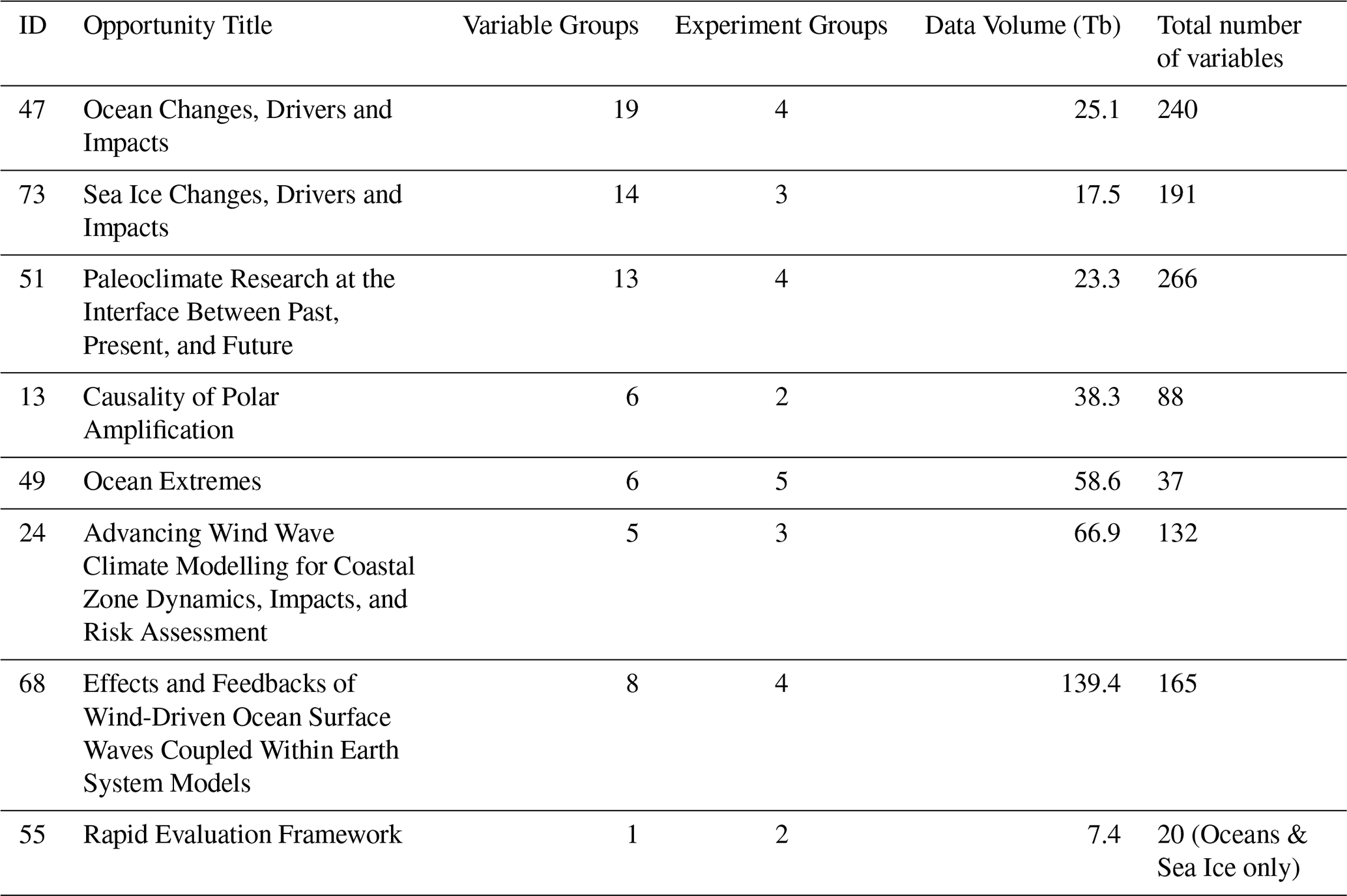
The team first convened on 28 June 2024, with community engagement activities beginning subsequently alongside the first public consultation. Author team members were instructed to utilize their networks as community representatives to gather scientific requirements for the ocean and sea ice components of the CMIP7 Data Request. Through the first consultation phase, 11 opportunities were submitted (Table 1) with the initial selection of variables and their technical definitions (Appendix A). The author team met every two to three weeks to discuss the submitted opportunities, identify any remaining gaps, integrate input from the wider community, and focus on variable group development and refinement. A harmonization sprint, involving all thematic teams, was held in September 2024, which resulted in the merging of several opportunities within and across themes (the Ocean and Sea Ice Theme is one example), and culminated in the designation of themes to lead each opportunity. The Ocean and Sea Ice Theme progressed with seven opportunities after reviewing the output of the cross-thematic sprint and agreeing on appropriate merges of opportunities. The final list of opportunities led by the Ocean and Sea Ice Theme is found in Table 1, including some projections of number of variables and size. This size estimate is based on average CMIP6 grids (53 levels, 301 latitudes, 410 longitudes), so we expect approximately an increase of data volume by a factor of 1.89 for CMIP7 (Fox-Kemper, 2018; Hewitt et al., 2022) Further details of how the author team approached and conducted the decision making for each consultation phase can be found in Appendix A.
Following the v1.0 release in November 2024, the team focused on finalizing variable groups, supporting the processing of new variables and contributing to cross-theme meetings. Regular team meetings continued with additional sub-group meetings, which focused on opportunity- or variable-specific requirements. GitHub discussions refined those opportunities requiring new CF standard names (https://github.com/cf-convention/vocabularies/issues, last access: 20 June 2026) or other technical decisions. Collaborative spreadsheets helped to gather input between meetings, with some members of the team interacting directly with the Airtable from a very early stage, with International Project Office (IPO) support and Data Request Task Team liaison members updating the Airtable records as needed. A systematic variable review was conducted during the Phase 2 and Phase 3 consultation periods to address comments, rectify errors and highlight remaining outstanding issues to the team. Furthermore, the author team members contributed to cross-thematic meetings on issues such as consistent use of time subsets and separation, categorization, and prioritization of variable groups within opportunities. Following the v1.1 release, opportunity proposers, who were not part of the existing author team, were invited to join to facilitate their contribution to paper development and final variable selection.
The opportunities selected by the author team are presented roughly in order from the most familiar variables from previous data requests to those opportunities that require many new variables (Table 1). Each opportunity description motivates some basic science questions, involves justification of frequency and resolution for which specific variables are needed, and presents some of the ideas behind newly introduced variables. Where relevant, these opportunities relate to some of the other CMIP7 themes, and these linkages are spelled out. Version 1.2.2.3 of the CMIP7 data request (Data Request Task Team, 2025a, b; Anstey et al., 2025; Fox-Kemper and Anstey, 2026) provides all of the variables requested, not just the novel ones emphasized in this paper.
Table 1Data request opportunities led by the Ocean and Sea Ice Theme, including total number of variable groups, experiments requested, and variables. The approximate data volume for all variables in each opportunity is also given in terabytes. However, this estimate does not include redundancy with other opportunity requests. For example, nearly 75 % of the data values requested for Opportunity ID 68 are baseline variables, so only 25 % of this data volume is additional to that from other requests.
3.1 Ocean Changes, Drivers and Impacts Opportunity (ID 47)
As already noted in the introduction and references within, the ocean plays a vital role in the climate system by absorbing heat and carbon dioxide, regulating global temperatures, and influencing weather patterns. As the main source of uncertainty in seasonal to decadal (i.e., near-term) projections, the internal variability of the climate system often stems from ocean processes: ENSO, the Pacific Decadal Oscillation (PDO), the Atlantic Meridional Variability (AMV/AMO), etc. (IPCC, 2021b, Annex IV). These modes of variability involve changes in ocean heat and salt content, sea ice properties, as well as transport by ocean currents at all depths. In this context, the goal of this opportunity is to continue efforts started in previous CMIP phases to quantify the processes that drive ocean variability and change and to provide understanding and a more robust assessment of climate projections (e.g., Griffies et al., 2016; Orr et al., 2017). In addition, this opportunity aims to better coordinate modeling efforts and comparison across models, for example, through improved grid specifications, as well as investigating the impacts of changes in oceanic properties on the global climate system.
The Meridional Overturning Circulation (MOC) is an important aspect of climate and an active part of the oceanic response to climate change. The Atlantic Meridional Overturning Circulation (AMOC) is projected to decline during this century (Fox-Kemper et al., 2021a), and a potential future collapse would imply a dramatic climate shift with enormous global and regional impacts (e.g., Zhang et al., 2019; Bellomo and Mehling, 2024). Many processes and feedback that govern AMOC are still debated, for example the role of warming versus freshwater forcing (Wen et al., 2023), input from Arctic sea ice and ice sheet melting (He and Clark, 2022), and the role of deep convection in different regions (Menary et al., 2020). Furthermore, the Southern Ocean MOC also plays a key role in sequestering heat and carbon (Williams et al., 2023). Quantifying and understanding the processes governing deep water formation and upwelling requires a full-depth analysis, considering the strong mesoscale variability (Morrison et al., 2016; Hewitt et al., 2020; Jackson et al., 2020). Within this opportunity, MOC-related variables are clustered together in the variable group called ocean_meridional_overturning_streamfunctions to facilitate a better understanding of the changes in the MOC and their potential drivers.
Other processes and mechanisms prioritized in this opportunity include the relationship between changes in the ocean and polar processes and mechanisms, which remains poorly understood. For example: To what extent is ocean warming contributing to the melting of Arctic sea ice (Dörr et al., 2024) and ice shelves (Slater and Straneo, 2022)? Will deep convection migrate northward, accelerating changes to the cryosphere (Heuzé and Liu, 2024)? Will the Beaufort Gyre collapse and release its stored freshwater (Timmermans and Marshall, 2020)?
Oceanic climate change throughout the ocean basins is addressed by this opportunity. How will western boundary currents and gyres respond to climate change (Sen Gupta et al., 2021)? How will eastern boundary currents and upwelling respond (Bograd et al., 2023)? Globally, the three-dimensional dynamics of the ocean not only control thermosteric and halosteric sea level changes at regional scales (Griffies et al., 2014; Fox-Kemper et al., 2021a), but also manometric sea level changes in shallow oceans (Samanta et al., 2024; Jevrejeva et al., 2024). These sea level drivers will affect the future of human activities in coastal regions across the globe.
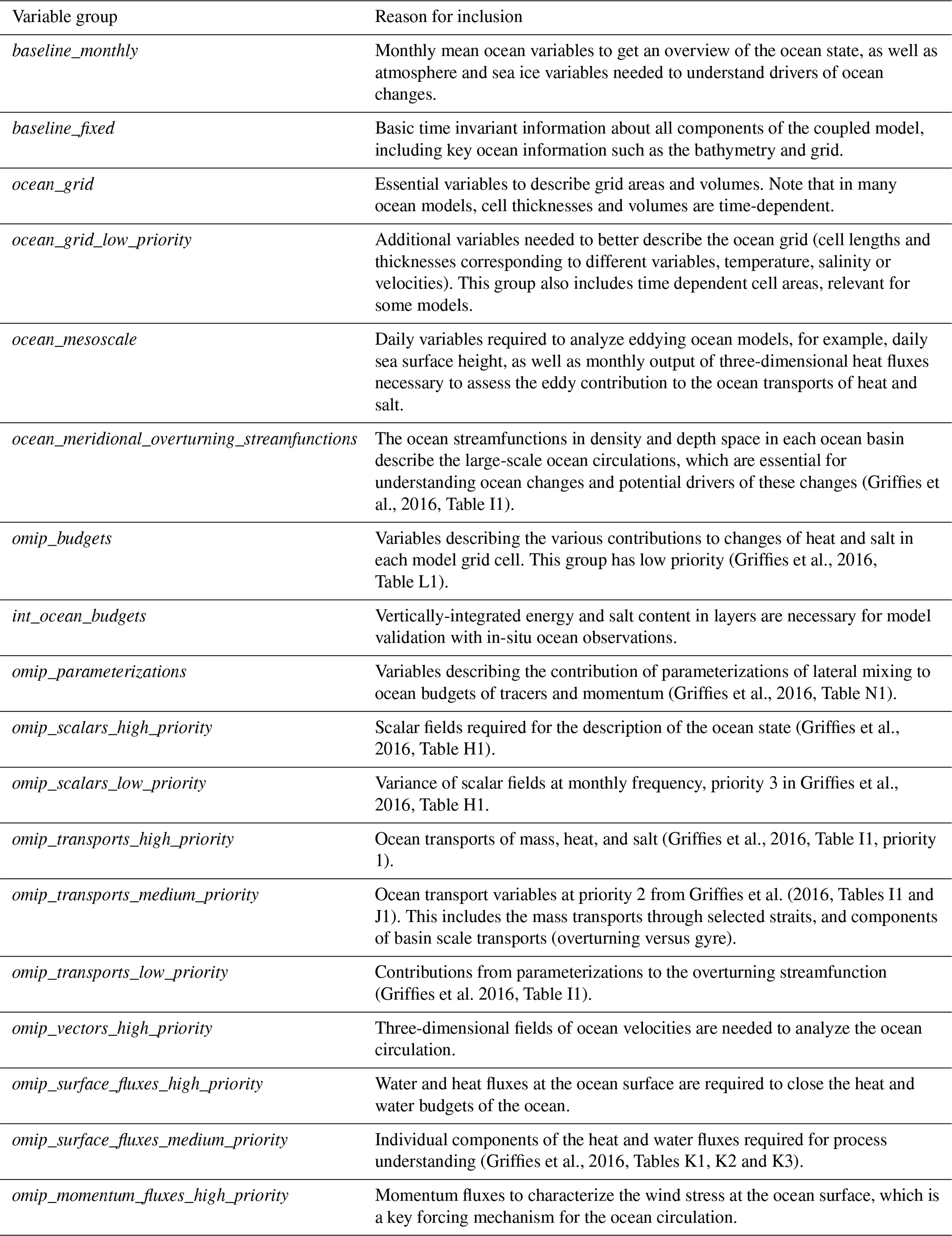
To achieve these goals, the Ocean Changes, Drivers and Impacts Opportunity requests the datasets necessary to analyze three-dimensional ocean processes and their time evolution, as well as their feedbacks on the atmosphere and cryosphere, going beyond those defined as baselines in Juckes et al. (2025). Most of these diagnostics and the corresponding variables were defined and some were introduced in the contribution of OMIP to CMIP6 (Griffies et al., 2016; Orr et al., 2017). The main variable groups attached to this opportunity are inherited from Griffies et al. (2016), but have here been prioritized differently based on the experience gained from CMIP6 and a desire to reduce the size of the data requested: for example, the scalar fields in Table H1 of Griffies et al. (2016) have been split into two variable groups: omip_scalar_high_priority and omip_scalars_low priority. The extensive list of variables provided by Griffies et al. (2016) covers most of the needs of this opportunity across different types of ocean models, providing continuity between CMIP6 and CMIP7 as ocean models evolve. An additional OMIP paper including further developments and refinements impacting ocean variables and the new OMIP protocols is underway – (Baylor Fox-Kemper, personal communication, 2025). A novelty in CMIP7 is the ocean_mesoscale variable group, which contains variables essential for analyzing the output of eddying ocean models. In models with a horizontal grid-spacing of ° or finer, ocean eddies are no longer entirely parameterized but largely resolved, requiring additional variables for heat and salt transport to accurately compute their contribution to the heat and salt budgets. Given that mesoscale eddy activity has changed throughout the historical period (Martínez-Moreno et al., 2021) and is projected to continue evolving in the future (Beech et al., 2022), being able to better quantify these changes will be instrumental to more robustly assess climate simulations. Finally, some new variables (in the variable group int_ocean_budgets) include vertically-integrated heat and salt content, intended to more easily track the large-scale changes in the energy and freshwater cycles and compare to observations, and thereby to inform the energy budgeting of the whole Earth system. While these variables can be calculated instantaneously from the three-dimensional temperature, salinity, and grid specifications, the increasing complexity of the vertical coordinates used in modern models makes this task complex. Furthermore, because of the limits of observing technology, ranges of depth easily accessed by bathythermograph, Argo floats, and other tools have made for a standard set of layers based on hydrostatic pressure ranges in the observational literature (0–300, 0–700, 0–2000 m and total depth, where meter ranges imply their hydrostatic pressure equivalents). These new variables, calculated online, will facilitate the evaluation of ocean models using in-situ observations (e.g., Eyring et al., 2021).
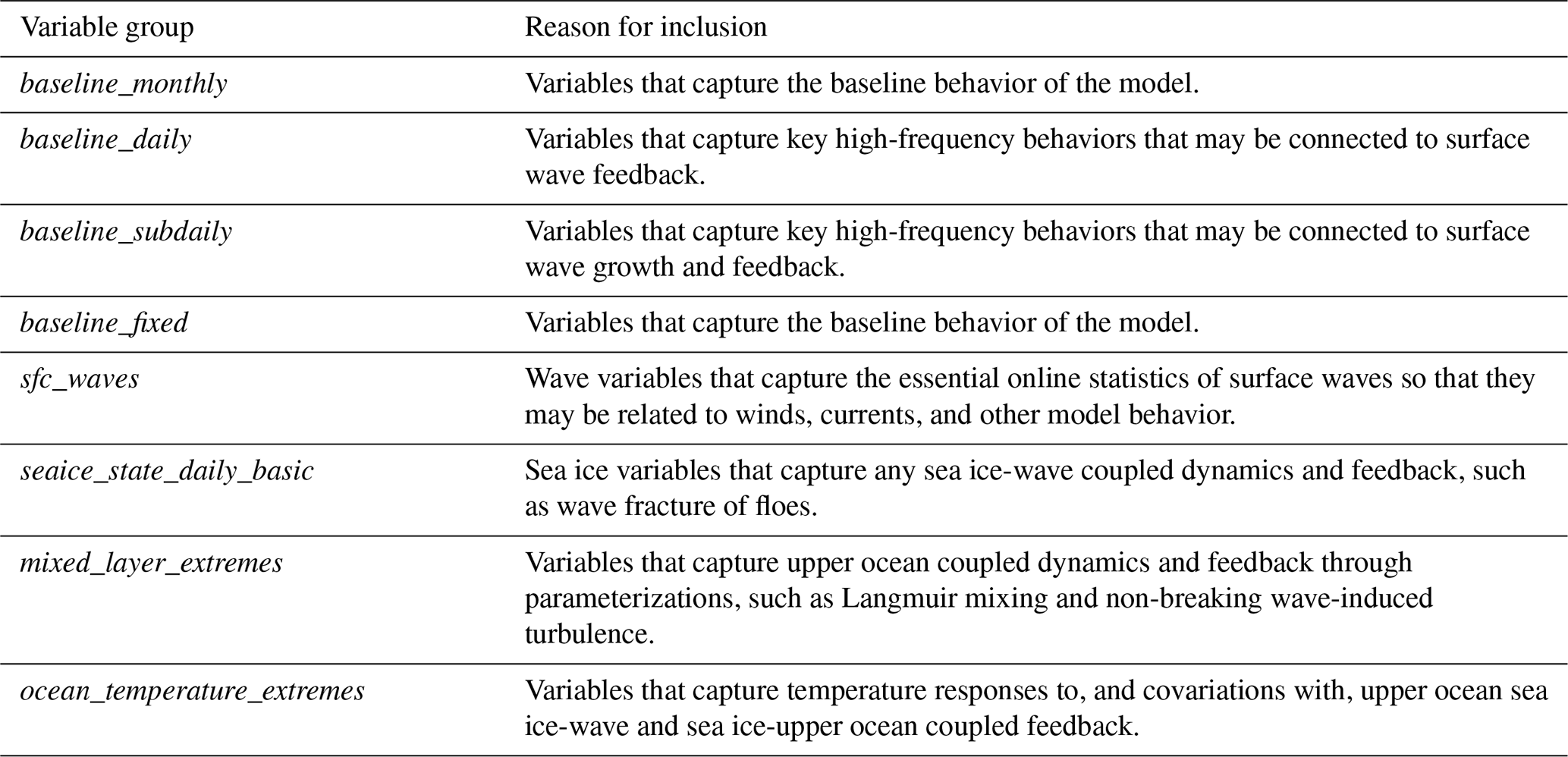
Table 2Ocean Changes, Drivers and Impacts Opportunity variable groups and their rationales for inclusion.
3.2 Sea Ice Changes, Drivers and Impacts Opportunity (ID 73)
Sea ice plays a role of prime importance in the climate system because of its widespread coverage and very different physical properties compared to the ocean and atmosphere. Often compared to a white blanket, sea ice reflects solar radiation back to space and acts as a thermal insulator by drastically reducing the turbulent heat fluxes from the warmer ocean to the colder atmosphere during winter (Zampieri et al., 2024) and mitigating the warming of the ocean by absorbing heat during the polar summers (Li and Liu, 2022). Sea ice evolves because of thermodynamic processes, that change its mass and heat content, and as a result of so-called dynamic processes, responsible for its drift and deformation. Sea ice is not only a mediator of atmospheric-oceanic heat exchange but also of the transfer of momentum from the atmosphere to the ocean (i.e., stresses). The seasonal formation of new sea ice and consequent rejection of salty brine into the ocean reduces the stability of the underlying water column and contributes to forming the world's densest waters. These feed the ocean thermohaline circulation on a global scale (Fox-Kemper et al., 2021a). In contrast, the melting of sea ice freshens the surface ocean and has a stabilizing effect on its vertical stratification (Linders and Björk, 2013). Sea ice is not a continuous rigid plate, but rather composed of a dynamic ensemble of floes in non-uniform motion, with varying thickness and sizes that span over several orders of magnitude (Gherardi and Lagomarsino, 2015), making its accurate representation in climate model simulations challenging.
Changes in sea ice have significant impacts on atmosphere, ocean, marine biogeochemistry, ecosystems, and human activities. In recent decades, the Arctic sea ice cover has been declining rapidly, and the signal of a forced sea ice retreat has clearly emerged from the background noise of year-to-year variability (Notz and SIMIP Community, 2020). In contrast, the Antarctic sea ice area showed a small positive trend over 1979–2015, but this was followed by sudden decreases in recent years (Eayrs et al., 2021), which suggests that the Antarctic might be rapidly transitioning to a new, low sea ice state (Purich and Doddridge, 2023; Hobbs et al., 2024) because of thermodynamic processes (Himmich et al., 2024). Given the importance of sea ice in the climate system and the swift transitions currently occurring in the polar regions, it is essential to advance our understanding of past and future sea ice changes, their driving mechanisms, and their impacts.
Ahead of CMIP6, the SIMIP Community developed a protocol detailing a standard for sea ice model output to streamline, and hence simplify the analysis of the simulated sea ice evolution in model inter-comparison projects (Notz et al., 2016). This protocol allowed researchers to conduct process-level analysis of the three main budgets that cover the evolution of sea ice, namely the heat, momentum and mass budgets (e.g., Keen et al., 2021; Watts et al., 2021; Zanowski et al., 2021; Lee et al., 2023; Frankignoul et al., 2024; Kuang et al., 2024). Notwithstanding this massive effort and the success it has enabled in sea ice modeling studies, simulations of past and future sea ice evolution from CMIP6 models still exhibit a large inter-model spread and fail at capturing important sensitivities, including the response of sea ice area to global mean temperature change (Notz and SIMIP Community, 2020; Roach et al., 2020).
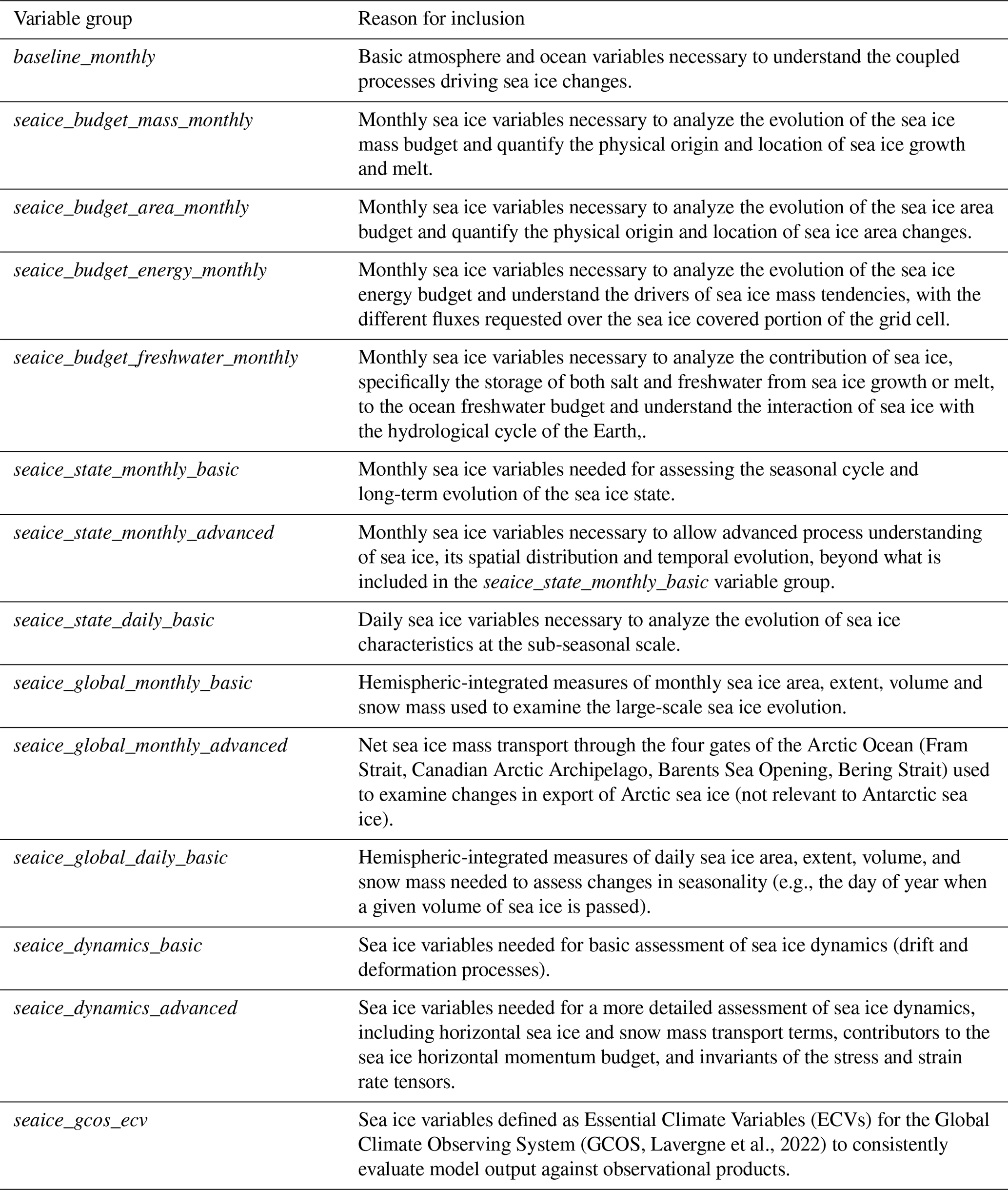
To achieve a process-based assessment of the sea ice evolution, we need variables to diagnose the state of Arctic and Antarctic sea ice, understand the mechanisms driving changes, and assess impacts (Table 3). The Sea Ice Changes, Drivers and Impacts Opportunity seeks to provide the necessary model outputs to reproduce and build on the work done with CMIP6 simulations, leading to a better understanding and, ultimately, reducing biases and errors in the simulation of sea ice. The variable groups were created mainly following Appendix D–H of Notz et al. (2016), which grouped variables based on the following categories: sea ice state variables, tendencies of sea ice mass, heat and freshwater fluxes, sea ice dynamics, and integrated quantities. The prioritization of each variable group was based on past usage/download of the variables included in the group by the SIMIP Community as well as considerations related to the amount of data produced. In addition, the seaice_gcos_ecv variable group was created to align with the seven essential climate sea ice variables defined by the Global Climate Observing System (GCOS; Lavergne et al., 2022) to facilitate the evaluation of model output against observational products. Similar to what was done in CMIP6, it was decided to not include sea ice albedo as part of this data request because of the difficulty in standardizing its calculation, and instead users are encouraged to compute the ratio of outgoing shortwave radiation over the incoming shortwave radiation as this is the only accurate way to calculate a broadband albedo that would be consistent with observation-based calculations. Finally, a few new variables were added compared to CMIP6, namely the effective melt pond fraction to allow for direct comparison with observations, as well as the integrated mass of snow on sea ice for each hemisphere to allow for a complete high-level analysis of the total mass of the cryosphere in the Earth system (see Appendix B for more detail).
Table 3Sea Ice Changes, Drivers and Impacts Opportunity variable groups and their rationales for inclusion.
3.3 Paleoclimate Research at the Interface between Past, Present, and Future Opportunity (ID 51)
In paleoclimate research, the integration of modeling (e.g., Sherriff-Tadano and Klockmann, 2021) and model-independent data from geologic, glaciologic, and marine climate archives (e.g., Gulev et al., 2021; Fox-Kemper et al., 2021a; Walter et al., 2023) is possible, providing an opportunity for testing the skill and robustness of climate models and improving confidence in projections of future climate change (e.g., Masson-Delmotte et al., 2013; Haywood et al., 2019; Kageyama et al., 2024). The study of paleoclimates provides a critical window into climate conditions that differ significantly from the present, including periods with higher global temperatures and different atmospheric CO2 concentrations. For example, about 3 million years ago, a much warmer than present Arctic supported large herbivores at atmospheric CO2 levels comparable to today (Rybczynski et al., 2013; de la Vega et al., 2020). Such paleoclimate reconstructions offer verification data, provide a test for climate model performance under warm climates bearing similarity to future projections, and highlight the exceptional nature of current anthropogenic climate change.
The goal of this opportunity is to leverage paleoclimate records and experiments to evaluate model performance across a broad range of climate states beyond the instrumental record and to reflect on thresholds in the Earth system under conditions that are extremely different from today. This includes quantifying uncertainties and model-discord (e.g., Kageyama et al., 2021) and identifying potential biases in model simulations, particularly for extreme or non-analog conditions. Paleoclimate simulations allow researchers to assess the capability of models to reproduce reconstructed climatic features such as polar amplification, flat meridional temperature gradients, or past sea ice extent, which are often poorly captured in climate models (Dowsett et al., 2013). By integrating geological and glaciological evidence with climate model outputs, model skill can be evaluated for climate states that are outside the range of modern observational conditions where models are developed and calibrated to succeed (e.g., Zhu et al., 2019). Overconfidence in model parameter calibrations can be reduced (e.g., Lohmann et al., 2022), leading to better constraints on feedback, tipping points, and the dynamics of large-scale circulation systems (e.g., Armstrong McKay et al., 2022; Wunderling et al., 2024; Brown et al., 2020; Cooper et al., 2024). The inclusion of paleoclimate benchmarks helps evaluate the stability and reliability of climate model components under diverse forcing regimes, ultimately informing future scenario projections.
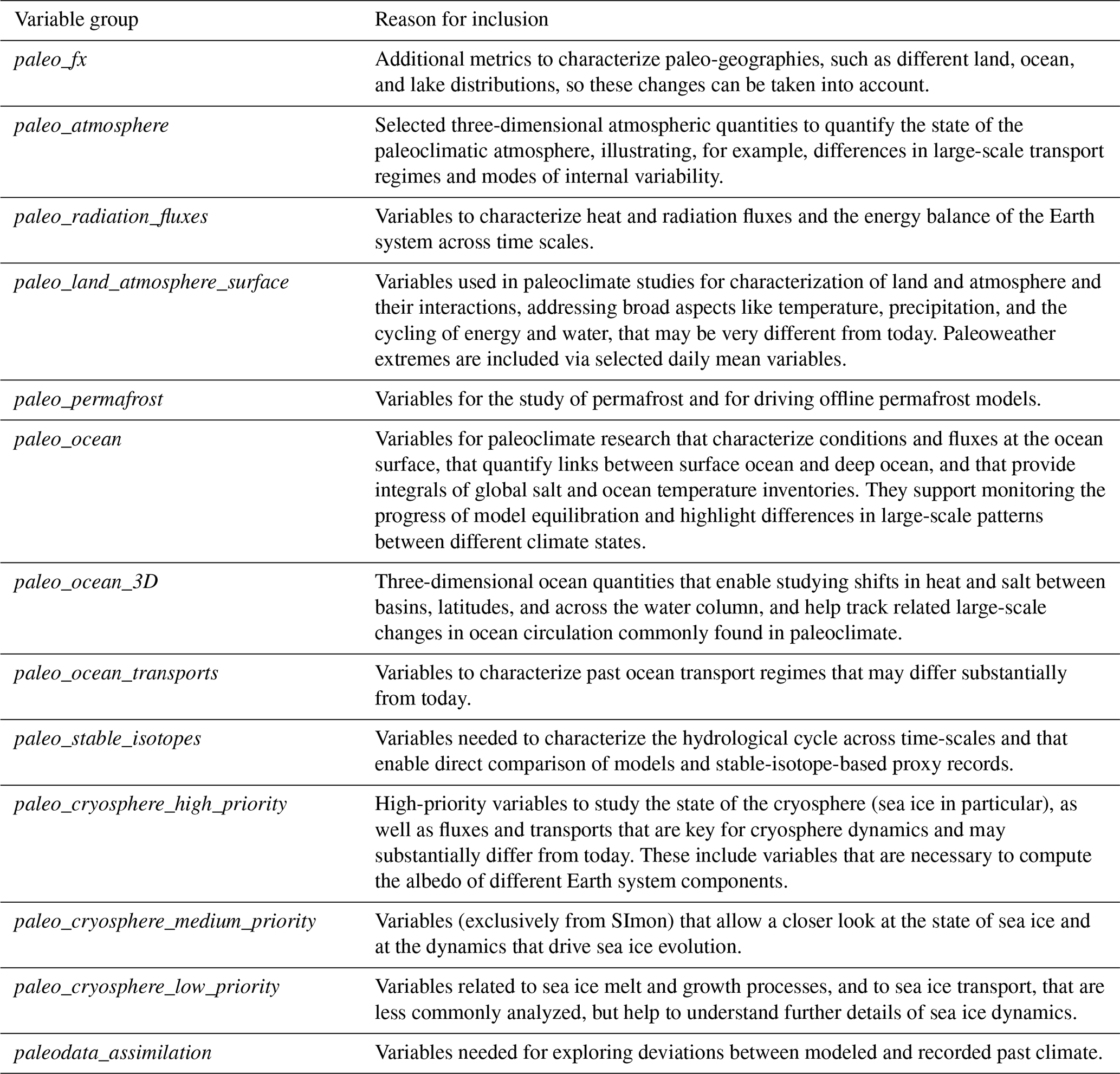
To achieve these aims, this opportunity incorporates a broad suite of CMIP7 Assessment Fast Track experiments. Starting from the PMIP-sponsored CMIP7 Assessment Fast Track simulation abrupt-127k (Sime et al., 2025) that aims at process understanding within CMIP7 Assessment Fast Track (Dunne et al., 2025), with a particular focus on sea ice and climate dynamics in a warming Arctic, we include in the variable request also further CMIP7 Assessment Fast Track simulations. Our goal is that other PMIP7 simulations of climates from the distant past may also be compared with historical and future period simulations. This is particularly relevant for PMIP4 simulations, Last Interglacial lig127k and mid-Holocene simulation midHolocene that will feature again in PMIP7, and PlioMIP3 Pliocene simulation LP (Haywood et al., 2024). Yet, these are just examples. The variable request includes diagnostics of the atmosphere, ocean, land surface, and sea ice to support model-data comparisons and analysis of key climate processes across timescales (Table 4). Sea ice variables, many aligned with SIMIP (Notz et al., 2016), are included to examine cryosphere evolution under past, present and future warm climates. In addition, specific variables support paleoclimate-focused research areas such as stable water isotopes, data assimilation, and coupled carbon-cycle feedback. These outputs will enable the evaluation of model performance across a wide range of climatic states, improve understanding of processes driving climate variability and change, and enhance integration between diverse research communities within CMIP7 that focus on past or future climates.
Table 4Paleoclimate Research at the Interface between Past, Present, and Future Opportunity variable groups and their rationales for inclusion.
3.4 Causality of Polar Amplification Opportunity (ID 13)
Polar amplification – enhanced warming at high latitudes relative to global mean temperature warming – is a robust feature of global climate change identified more than a century ago (Arrhenius, 1896). While polar amplification occurs in remote regions of the planet, it has global consequences. High-latitude climate change affects sea level rise, ocean and atmospheric circulation patterns, and the carbon cycle in addition to the local impacts on ecosystems and human systems (e.g., Constable et al., 2022). The rate of Arctic climate change has implications for economic development in the region, natural resource exploration, geopolitics, and adaptation (Nanni et al., 2024). However, the uncertainty in high-latitude climate projections continues to be greater than in other regions of the globe across CMIP generations (Holland and Bitz, 2003; Hahn et al., 2021). The Causality of Polar Amplification Opportunity seeks to assess the processes driving polar amplification and enable the determination of the contributions of high-frequency processes to the inter-model spread.
At the heart of polar amplification uncertainty is the current inability to attribute causality to the polar climate changes seen in observations and simulated by models. While polar amplification is a coupled atmosphere-sea ice-ocean process, a robust, quantitative understanding of the causal factors is imperfect (Manabe and Stouffer, 1980; Previdi et al., 2021; Taylor et al., 2022). Evidence suggests that the processes and feedback between sea ice, atmosphere, and ocean that are central to polar amplification unfold at high frequencies (e.g., from days to weeks). For instance, atmospheric rivers are responsible for up to 90 % of the poleward atmospheric moist energy transport (Newman et al., 2012), and an increase in the frequency of such events penetrating the Arctic accounts for much of the sea ice decline in the Barents-Kara Sea and central Arctic during the ice growth season (Zhang et al., 2023). Such high-frequency variability and the associated interactions with the sea ice pack, atmospheric state, and ocean are posited to be central to the causality of polar amplification (Taylor et al., 2022; Parker et al., 2022; Cardinale and Rose, 2023).
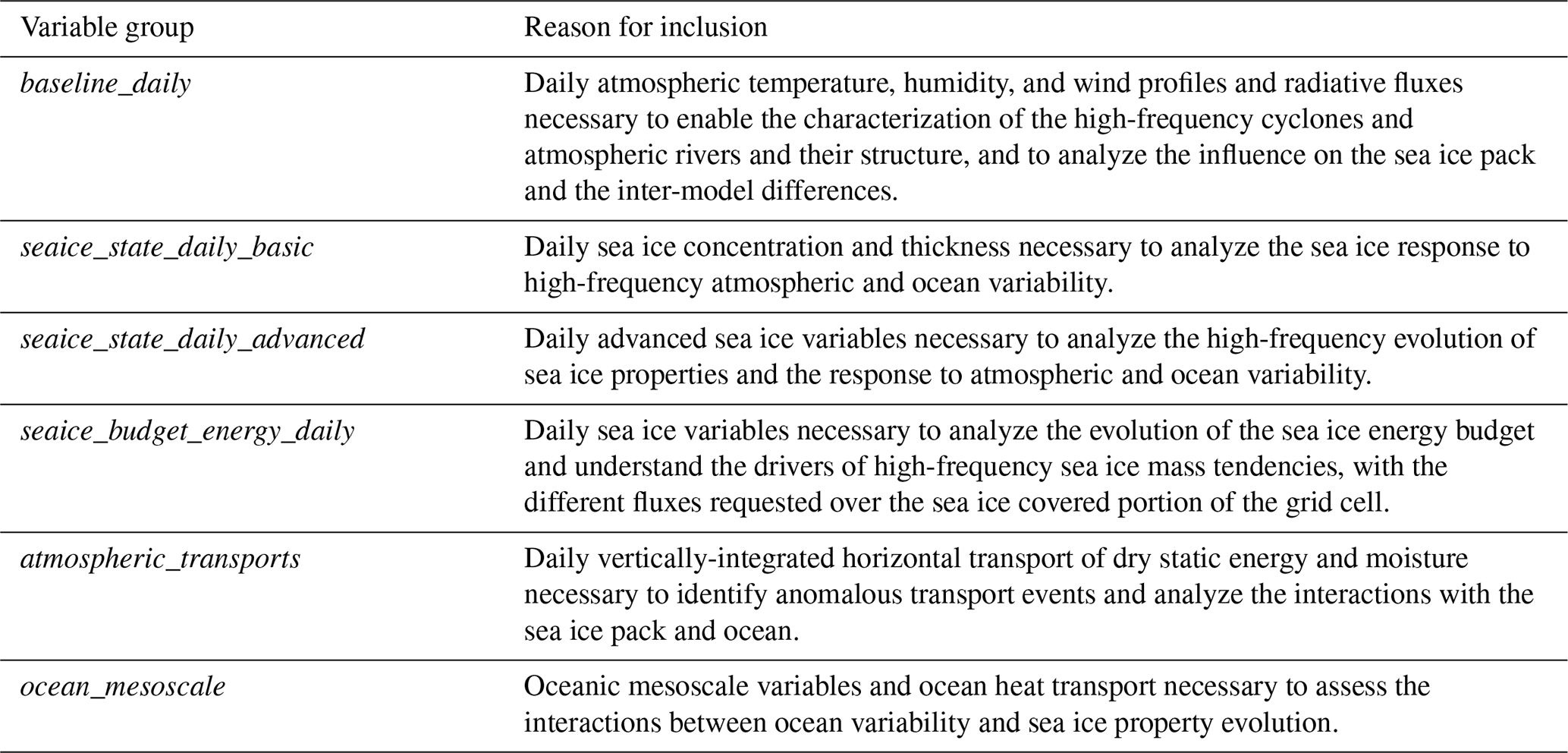
Contributions from high-frequency variability (e.g., atmospheric rivers and cyclones) to the inter-model spread in polar amplification cannot be accurately assessed with monthly mean model outputs. In the absence of sub-monthly data, the atmospheric energy transport by transient eddies can only be calculated as the residual between the total atmospheric energy transport and the transport by the mean meridional circulation (e.g., Donohoe et al., 2020). Furthermore, there is increasing recognition that the character (moist versus dry, e.g., Graversen and Burtu, 2016) and vertical structure (e.g., Cardinale and Rose, 2023) of the atmospheric energy transport matter more than the total amount. To enable studies that advance our understanding of the causal mechanisms of polar amplification, this opportunity contains the necessary model outputs from sea ice, atmosphere, and ocean components to assess the contributions of high-frequency processes to polar amplification and the inter-model spread in projections of polar climate change (Table 5). Key sea ice variables include thickness, concentration, and surface energy budget diagnostics. Atmospheric variables such as wind, temperature, specific humidity, and geopotential height at all model levels and surface pressure are needed (Cox et al., 2024). For the ocean, mixed layer depth and thermal energy transport are most useful in studying polar amplification.
Table 5Causality of Polar Amplification Opportunity variable groups and their rationales for inclusion.
3.5 Ocean Extremes Opportunity (ID 49)
Ocean extreme events are by definition uncommon and intense occurrences, often impacting marine life and coastal environments. Marine heatwaves are an example of short-term extreme oceanic events. These rare events occupy the tail of the upper ocean temperature distribution – typically defined as being in the 90th percentile of the climatology or a similar threshold – and can persist for days to months (Hobday et al., 2018; Oliver et al., 2021). They primarily affect the mixed layer which overlaps with the euphotic zone where most ocean photosynthesis occurs (Smith et al., 2024; Smale et al., 2019), and they have a large impact on reef-forming corals that provide critical ecosystem services such as coastal defense, subsistence fisheries, and nursery habitats for commercially important fish and shellfish (Gomes et al., 2024). Other ocean extremes, including anomalous subsurface oxygen or pH, salinity changes, or extreme sea level events, can occur independently or as compound events with marine heatwaves (Gruber et al., 2021; Burger et al., 2022; Ren and Rudnick, 2021; Han et al., 2022). Mesoscale eddies, fronts, or other anomalies in surface velocity or vorticity are often associated with these compound events. The Ocean Extremes Opportunity aims to investigate and address the impacts of extreme ocean conditions such as marine heatwaves, hypoxic zones, extreme salinities, sea level extremes and storm surges, ocean acidification, and compound events.
As the climate changes, extreme conditions are becoming more frequent and severe in many regions, posing significant risks to marine ecosystems, livelihoods (e.g., fisheries), and coastal communities and infrastructure (Gruber et al., 2021; Fox-Kemper et al., 2021a; van de Wal et al., 2024; Smith et al., 2025). Studying these characteristics requires high-frequency surface data, built up over the whole scenario time series to establish climatological ranges and capture events and changing likelihoods (Table 6). Coastal hazards in the form of extreme sea levels cause billions of dollars of damage globally, and are projected to increase in frequency (Fox-Kemper et al., 2021a). Extreme sea levels are caused by the complex interplay of multiple contributors, including astronomical tides, storm surges, waves, and sea level variability (Idier et al., 2019; Melet et al., 2024), which vary on sub-daily to interannual frequencies, as well as climate change trends. Storm surges and extreme waves are caused by prevailing atmospheric surface pressure and wind conditions. Their magnitude and the extent of their impact on a coastline are influenced by bathymetry, coastal morphology, tidal amplitude, and tidal cycle, and are further exacerbated by sea level rise (Bernier et al., 2024). Additionally, coincident pluvial and fluvial flooding can compound the severity of inundation and erosion, especially during extreme weather events. These factors highlight the need for comprehensive climate data, including winds, atmospheric pressure, precipitation, and variables associated with ocean circulation (currents, temperature, salinity), as well as other environmental variables, to better understand current and future coastal hazards risk. Long-term assessment of ocean extremes is important for identifying vulnerable regions, assessing infrastructure and ecosystem viability, designing coastal protection to appropriate levels, and enabling various adaptation measures to be considered and tested via sensitivity testing. In the coming decades, ocean extremes and associated floods and erosion are likely to remain a leading cause of natural disasters because of the increasing frequency and intensity of extremes combined with escalatingcoastal development associated with greater exposure (Bernier et al., 2024).
Table 6Ocean Extremes Opportunity variable groups and their rationales for inclusion.
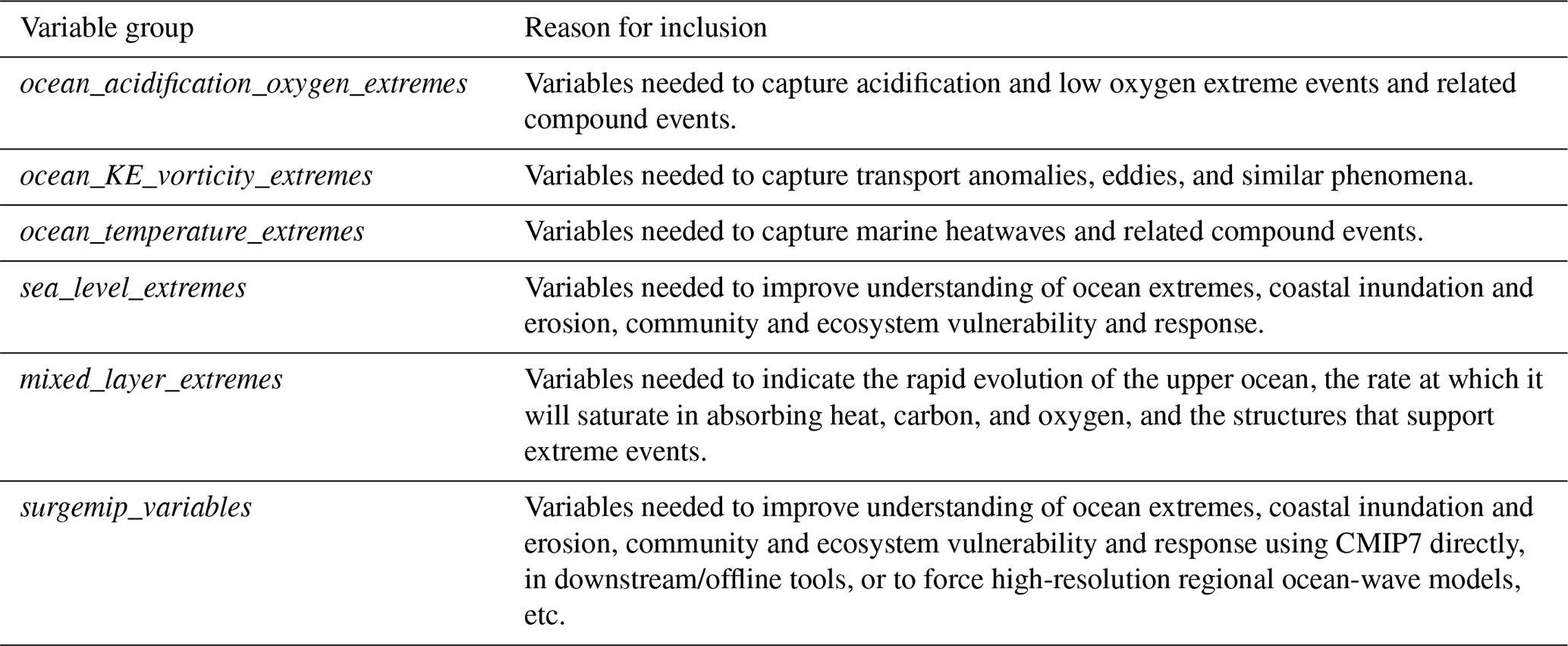
To better understand the transient nature of ocean extreme events, the Ocean Extremes Opportunity seeks to capture the statistics of these events and how they compare to observed statistics during the historical period, their changing likelihoods, and their sensitivity to anthropogenic forcing through a wide range of scenarios. Studying the characteristics of ocean extremes requires high-frequency surface data, built up over the whole scenario time series to establish climatological ranges and capture events and changing likelihoods. Furthermore, high-frequency subsurface marine heatwave events are also under study and have been found to be more frequent under climate change (Sun et al., 2023). By including surface values of temperature, salinity, velocity, sea level, pH and a minimal amount of subsurface information (200 m depth only), including also oxygen concentration, this opportunity will allow for a better understanding of the mechanisms and stratification conditions associated with these extremes. Additionally, variables needed to quantify storm surges, which exacerbate extremes, are included. These data will be useful in understanding such events, but they will also enable the study of their correlation with modes of climate variability such as ENSO, with changes in ocean currents and stratification, as well as the evaluation of potential impacts on vulnerable ecosystems and coastal regions. Surface fluxes, which are part of many other opportunities, can also be used for causal inference about specific events.
3.6 Advancing Wind Wave Climate Modeling for Coastal Zone Dynamics, Impacts, and Risk Assessment Opportunity (ID 24)
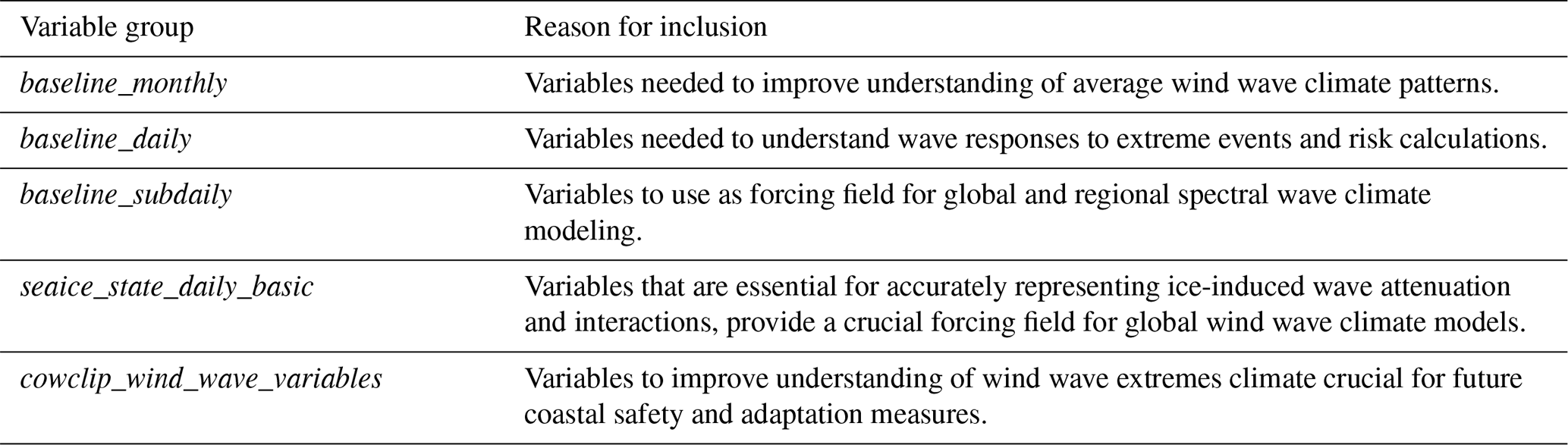
Wind waves are ocean surface gravity waves generated by the action of the wind blowing across the ocean surface over a certain distance known as fetch (Young, 1999; Holthuijsen, 2007). Understanding how wind wave climate evolves on global and regional scales is essential for predicting coastal hazards, erosion, and other wave-related impacts, as well as for supporting marine operations and climate adaptation strategies such as renewable energy activities (Casas-Prat et al., 2024). However, despite the many roles surface waves play in the coupled climate system (Cavaleri et al., 2012), studies on wind wave climate projections are often hindered by significant uncertainties (Morim et al., 2019), particularly at the extremes (Meucci et al., 2020) which are of the utmost importance for the safety of offshore and coastal activities. Currently, most global climate models participating in the CMIP effort do not include an active, two-way coupled wave component (Casas-Prat et al., 2024), and those that do often use a coarse wave component resolution to lower computational costs (e.g., Li et al., 2017). To enhance our understanding of wind wave climate and to improve future projections, high-resolution data on ocean surface wind speed and sea ice concentration are crucial to drive offline wave simulations (typically, subdaily fields on the ESM grid are necessary for this task, see Table 7). The purpose of this opportunity is to enable high-resolution and flexible modeling of ocean surface wind wave climates over an ensemble of ESM outputs, in support of global and regional risk and impact assessments, building on the internationally coordinated effort of the Coordinated Ocean Wave Climate Project (COWCliP). By offering computational efficiency and spatial detail in comparison to what is presently possible using a full-physics online wave model as an ESM component (see the next opportunity), this method provides actionable data for stakeholders involved in climate adaptation and marine planning.
Table 7Advancing Wind Wave Climate Modeling for Coastal Zone Dynamics, Impacts, and Risk Assessment Opportunity variable groups and their rationales for inclusion.
The societal benefits of improved wind wave modeling extend far beyond academia. Coastal hazards driven by wind waves pose significant risks to coastal communities, economies, and ecosystems. Currently, around 15 % of the global population lives within 10 km of the coast, which equates to more than a billion people (Cosby et al., 2024). In terms of economic risk, coastal areas are home to major cities, critical infrastructure, and industries like shipping, fisheries, and tourism. Coastal cities and agglomerations have increased in number by 4.5 times since 1945 (Barragán and de Andrés, 2015) and the population living in proximity to coasts is projected to continue to increase, further intensifying the vulnerability of coastal areas to hazards such as storm surge, flooding, and erosion. As climate change intensifies, the frequency of extreme wave events is likely to rise (Meucci et al., 2020; Lobeto et al., 2021; O'Grady et al., 2021), putting more lives and assets in danger.
Furthermore, the growing demand for sustainable energy sources highlights a critical need for comprehensive assessments of wave energy, offshore wind energy, and other types of renewable energy that can be deployed on or near coastlines. These assessments depend on the potential of high-resolution coastal wind wave information, which is fundamental to evaluating the feasibility of wave and offshore wind energy as renewable resources (Kulkarni et al., 2018; Jung et al., 2024). Such data help identify optimal locations for wave and wind energy farms by analyzing long-term wave climate patterns and understanding climate variations. Large-scale atmospheric and oceanic variability, such as the ENSO and the North Atlantic Oscillation (NAO), climatic trends, and connected regional, coastal wind and wave variability at high resolution are all important for long-term planning (Tseng et al., 2024). The harsh marine environment poses strong currents, high waves, and corrosive conditions, which can impact the safety, longevity and reliability of infrastructure. Detailed risk assessments help identify potential hazards, inform mitigation strategies, and ensure compliance with international safety standards, safeguarding both workers and the environment.
For effective offline wind wave climate modeling, high-resolution temporal and spatial data are essential. Wind patterns can vary significantly over short time scales and distances, and the interaction between wind, waves, and ice requires detailed data to capture these dynamics. Similarly, sea ice concentration data is critical for understanding how ice attenuates or reflects wave energy, as well as how a changing ice cover due to warming temperatures alters wave patterns. Without high-resolution data, models may miss localized phenomena such as extreme wave events or changes in coastal wave energy distribution, which are crucial for understanding and predicting coastal erosion and other hazards. By incorporating finer-scale data into wave models, we can better understand the spatial variability of wave energy, identify vulnerable coastal zones, and assess the future risks posed by changing wave climates.
3.7 Effects and Feedbacks of Wind-Driven Ocean Surface Waves Coupled Within Earth System Models Opportunity (ID 68)
Traditionally, ocean surface wind wave climate studies, such as those highlighted in the previous opportunity (ID 24), rely on high-frequency output from ESMs for offline execution of a comprehensive suite of statistically or dynamically downscaled wave climate ensembles for past and future conditions (e.g., Hemer et al., 2013; Morim et al., 2019; Meucci et al., 2020, 2024; Casas-Prat et al., 2024). However, numerous studies have demonstrated that ocean waves play a critical role in regulating Earth's climate system by influencing the exchange of energy, momentum, and mass between the ocean and atmosphere (e.g., Babanin, 2006; Belcher et al., 2012; Cavaleri et al., 2012; Qiao et al., 2013, 2016; Li et al., 2016, 2019; Li and Fox-Kemper, 2017; Fox-Kemper et al., 2021b). Some of these feedback mechanisms have been recognized by meteorological institutions, where two-way wave-atmosphere interactions are now incorporated into weather prediction models (e.g., Janssen, 1991; ECMWF, 2024). Ongoing research seeks to clarify to what extent ocean surface waves influence the climate on longer timescales. The goal of this opportunity is to support research on the influence of ocean surface waves on the climate system, including their feedbacks within ESMs and their long-term role as climate drivers. Unlike ID 24, this is not part of an established coordinated modeling effort, but rather aims to advance understanding and foster new developments in surface waves that are coupled online as a component within ESMs.
Breaking waves, for instance, contribute to the generation of sea spray, which has significant implications for cloud formation (Veron, 2015; DeMott et al., 2016; Brumer et al., 2017; Deike et al., 2022). Additionally, wave-driven processes modulate air-sea gas exchange, particularly affecting CO2 uptake (Deike and Melville, 2018; Woolf et al., 2019). Ocean waves play a significant role not only in the modulation of the atmospheric boundary layer, but also influence ocean mixed layer depths through both breaking and non-breaking motions that induce turbulence via Langmuir instabilities or other mechanisms (Qiao et al., 2013, 2016; Li et al., 2016, 2019; Li and Fox-Kemper, 2017). However, fully-coupled interactions between waves, mean flow, and turbulence still have many unknowns (Kantha and Clayson, 2004; Suzuki et al., 2016; Wu et al., 2019; Fox-Kemper et al., 2021b).
In the polar regions, ocean waves play a crucial role in shaping sea ice dynamics, particularly in the marginal ice zone (e.g., Roach et al., 2018). As waves propagate through this region, they can fracture the ice, breaking it into smaller floes. This process enhances both lateral melting (melting from the edges of ice floes) and basal melting (melting from beneath the ice) by increasing the ice's exposure to warmer ocean waters (Alberello et al., 2022). Additionally, waves alter air-sea-ice flux exchanges, influencing how heat, moisture, and momentum are transferred between the ocean and the atmosphere (Bennetts et al., 2024). Furthermore, the reduction of sea ice due to storm-driven wave activity can have far-reaching consequences (Kohout et al., 2014; Blanchard-Wrigglesworth et al., 2024). When sea ice is absent or significantly weakened, ice shelves become more exposed to powerful ocean swells, leading to ice shelf disintegration and an acceleration of the loss of polar ice masses (Massom et al., 2018).
Given the increasing recognition of ocean waves as key components of the Earth system, several modeling centers have started incorporating wave coupling into ESMs and Global Climate Models (GCMs; Qiao et al., 2013, 2016; Li et al., 2016, 2017; Reichl and Li, 2019; Bao et al., 2020; Danabasoglu et al., 2020; Brus et al., 2021). This coupling should allow for a more accurate representation of air-sea interactions, improving the simulation of weather and climate phenomena (Fox-Kemper et al., 2019, 2021b). By integrating wave processes into climate models, researchers aim to enhance predictions of extreme events and long-term climate variability as well as to better understand the roles of waves in the climate system and the feedback processes they entail.
High temporal and spatial resolution outputs of wave parameters from coupled climate models, including significant wave height, mean and peak wave periods, and mean wave direction, are particularly valuable for comparing wave climate simulations performed with the traditional stand-alone spectral wave models, which rely solely on atmospheric forcing (Table 8). By analyzing wave fields from coupled climate models alongside conventional wave climate model outputs, we can start assessing the added value of wave coupling in representing long-term wave climate variability and extreme wave events. In addition, this opportunity includes some key ocean and sea ice variables so that the impacts of parameterizations and wave effects mentioned above can be assessed. Since surface waves affect multiple aspects of the climate system, this opportunity has the potential to improve the results and findings from other opportunities (e.g., ID 13, ID 24, ID 49, and ID 73). This opportunity will enable more comprehensive evaluations of wave climate projections, leading to an improved understanding of wave-driven feedback and better-informed applications in climate science, coastal hazard assessment, and marine operations.
Table 8Effects and Feedbacks of Wind-Driven Ocean Surface Waves Coupled within Earth System Models Opportunity variable groups and their rationales for inclusion.
3.8 Rapid Evaluation Framework Opportunity (REF) (ID 55)
The CMIP Rapid Evaluation Framework (Hoffman et al., 2025) was created to evaluate and benchmark the newly available CMIP7 Assessment Fast Track simulations as soon as they are uploaded to the Earth System Grid Federation (ESGF), providing metrics and diagnostics that are available through different open-source evaluation and benchmarking tools. This opportunity contains the set of variables (Table 9) that are needed for the planned diagnostics and metrics for the REF (CMIP Model Benchmarking Task Team, 2024). The selected metrics and diagnostics for the REF to be available for all CMIP7 Assessment Fast Track experiments were intentionally chosen for very basic evaluations and are not expected to require highly specific variables. The exact selection of variables was also made consistent with the model evaluation diagnostics in Chap. 3 of the latest IPCC report (Eyring et al., 2021). Due to the fixed timeline for the CMIP7 Assessment Fast Track simulations, there is only a short period for the technical implementation of the REF, and therefore the available metrics and diagnostics in this first version of the REF will be limited to a temporal resolution of monthly mean data and about five metrics/diagnostics per realm. Implementation will be based on a selection made by the community. The realms were chosen specifically to be consistent with the realms used for the data request. Find more information about the REF Opportunity in Hoffman et al. (2025).
Table 9Rapid Evaluation Framework Opportunity variable groups and their rationales for inclusion.

4.1 Prioritization process
The prioritization process, both in terms of selecting, combining, and sometimes rejecting opportunities, and in terms of prioritizing among variables and variable groups, is inevitably imperfect. While the team met frequently, discussed the selected opportunities in detail, and then reviewed the variables collectively and individually for errors or oversights, there are far too many variables involved to keep a clear perspective on all that is required and most urgent. Building this team from a group of scientists, few of whom had previously worked together, required effort, as did familiarizing oneself with the procedures, protocols, and software selected by the IPO and CMIP Data Request Task Team for the development of the CMIP7 data request. Added complexity and challenges stemmed from the need to coordinate with other author teams in the data request development process, and doing so strictly remotely. The data request surely would have benefited from a slower, longer process, where opportunities to meet in person, such as at large conferences, could have been taken. On the other hand, the design of the CMIP7 data request had to be implemented within the tight schedule of the overall CMIP7 Assessment Fast Track and IPCC cycle.
While consistency with the CMIP6 data request is insufficient to ensure a successful CMIP7 outcome, it is at least reassuring that the groundwork laid out in CMIP6 was maintained, particularly in the two “Drivers and Impacts” opportunities (ID 47 & 73). Due to specifics of requests from opportunity teams, some variables, for example intpn2, were only requested in a regional context (30 to 90° S); modeling centers may provide the global version of these variables instead or in addition to the regional data. Many of the other opportunities were designed by reference to specific single-model studies that were successful, and thus the multi-model intercomparisons enabled by this data request have a stable foundation.
4.2 Outstanding gaps in ocean and sea ice Earth system processes
Despite the large number of variables, increases in output frequency over CMIP6, and the inevitably vast quantity of data that this request will trigger to be captured, there are still identifiable gaps in the resulting data request that will make certain processes remain in the shadows, at least in a multi-model sense. Sub-daily data remains extremely rare, but in many of the processes highlighted in these opportunities (e.g., those involving surface waves or processes that depend on particular phases of the diurnal cycle), that frequency is requested for study. While emphasis on extreme events is mostly on ones that persist over a matter of days, such as heat waves, their peak intensity is of even shorter duration and potentially more impactful. Many of these high-frequency variables are only requested for ocean surface or near-surface levels, which reduces their data volume substantially. One issue that was not resolved in this data request is how to describe the ocean surface as a coordinate designation – a depth of 0 m is not wholly accurate, as many modeling centers provide the uppermost gridcell average, which is not centered on 0 m. However, no consensus on an improved designation was found in time for this data request. Ocean tides are rarely included in ESMs, but in some prototype simulations they have shown significant climate impacts that persist in averages (Arbic, 2022); in most of the world, a semi-diurnal tide dominates, and thus, sub-daily output is needed for tidal coastal dynamics (e.g., Ahmed et al., 2025).
Although this data request also applies to the models in the HighResMIP simulations, and appreciating that some CMIP models will be fairly high-resolution for all applications, reproduction of real-world spatial detail and heterogeneity remains a challenge for the representation and study of many Earth system processes that observations reveal to be important (Hewitt et al., 2020, 2022). While parameterizations can be made to capture some aspects of these unresolved or poorly-resolved phenomena in the Earth system, a one-size-fits-all data request, such as that produced for CMIP7, cannot meaningfully capture the variety of parameterization mechanisms or their diagnostics so as to compare them across models. This means that it remains painful to carry out careful multi-model parameterization and high-resolution intercomparison studies, although with diligence and focus they still occur (e.g., Chassignet et al., 2020; Uchida et al., 2022; Li et al., 2019).
4.3 Key reflections from the data request process
In a world of increasing automation and artificial intelligence, the process of constructing these data requests was still frustratingly manual and required human intelligence. One simpler idea would be just to request the most popular variables from the CMIP6 request. While download statistics about previous generations of CMIP models were collected by the Earth System Grid Federation (which maintains and curates the repository), key flaws in the collected statistics limit their utility. Not every download was used; some downloads – especially of large-output variables – were downloaded much less often than they were used (i.e., they were shared among colleagues at modeling centers after being downloaded only once), and many routine analyses (e.g., ocean heat content using multiple equations of state, McDougall et al., 2021) ended up requiring the download of much more data than necessary to obtain key data subsets. So, while our team did consult these download statistics in prioritizing and confirming key variables, CMIP7 Assessment Fast Track missed a chance to profoundly improve the data request, analysis tools, and data access, while simultaneously reducing data storage requirements. The goal is to make the most of CMIP data worldwide, but that is a lofty aspiration. With added foresight, the data request process could have been mostly automated, and then our team could have focused more on facilitating new scientific insights instead of onerous cross-checking and debugging.
Another aspect of automation and artificial intelligence is the growing use of emulators and machine learning parameterizations. The data requested here are not intentionally suited to such purposes, except in that they are the variables for processes with impacts and effects that are important. Their importance suggests that they are likely to be included in machine learning approaches (e.g., ID 22 & 80 of the Impacts and Adaptation data request; Ruane et al., 2025). However, in fields outside of climate science, many recent successes in machine learning have resulted from carefully curated benchmark training datasets (e.g., Wu et al., 2018; Hu et al., 2020). Although there are limits to how much a benchmark-trained system applies to the real world (Raji et al., 2021), at present, the bigger issue for climate science is the lack of benchmark climate datasets designed specifically for machine learning applications. A future potential application of machine learning would be to provide diagnostic emulators that can infer many variables from a few saved variables, thereby greatly reducing the data storage and data request complexity in favor of a more complex emulation (with the accompanying issues in making these emulators trustworthy).
One challenge that confronts teams such as ours trying to optimize the data storage effort is that some variables can of course only be calculated online during simulation, while others can be calculated offline when given the correct input data. Indeed, standard analyses that may be centrally prepared, as considered for example in the CMIP7 Rapid Evaluation Framework (Dingley et al., 2025), are ideal to limit data storage load and to speed up exploration by avoiding preparing the same analyses over and over again. Two oceanic examples that our team considered were mixed layer depth, which can only be calculated at full accuracy online (see Treguier et al., 2023, for a quantification of the errors when calculating after the fact), and ocean heat content (phcint), which can be calculated after the fact from 3D temperature, salinity, and grid specifications (areacello, volcello). Treguier et al. (2023) find that mixed layer depth errors in calculating after the fact were somewhat smaller than the errors in CMIP6 due to discrepancies in the definition of mixed layer depth used by multiple modeling centers. In this data request, we seek to eliminate these inter-model definitional discrepancies, which then leaves after-the-fact calculation as a leading error, which justifies our request for the mixed layer depth as calculated online. The ocean heat content (and salt content) can be calculated accurately from 3D fields, but this calculation is done so often and is so expensive in data recall that we ask modeling centers to do it in advance, especially as this avoids users needing to download 3D temperature data in order to find a 2D field. Furthermore, the use of new vertical coordinates makes these calculations complex and sensitive to how the grid specifications are used (including missing ingredients needed to account for temporal rectification effects). Providing the calculated ocean heat content necessarily increases the number of variables requested from modeling centers, with some redundancy in many cases, but as these variables are used widely, require downloading large data volumes, and are prone to error in calculation we deem this addition to be justified. Another example is the request for modeling centers to provide hemispherically-integrated sea ice variables (such as sea-ice area, extent, volume, etc.), as we know from previous CMIP phases that these are the most downloaded sea ice variables, and calculating them offline after regridding can lead to errors compared to doing it online. In general, there tends to be a tradeoff between the number of variables requested (which can actually reduce the data volume needed to be downloaded and stored when they are, e.g., integrated, as ocean heat content is, or 2D, as mixed layer depth is) and the volume of data requested (e.g., higher frequency 3D fields reduce the rectification errors in after-the-fact calculations in variable vertical grid models). We only anticipate these issues will become more complex as model configurations diversify in vertical grid specifications and unstructured horizontal grids. The OMIP protocol and diagnostics are under discussion (Baylor Fox-Kemper, personal communication, 2025), and this forthcoming paper will contain further details and discussion.
There are a few potential issues with baseline and depth-related ocean variables that require further specification. Both conservative temperature and potential temperature are available as variables, and modeling centers can choose to upload only the variable corresponding to the equation of state used by their model, or to upload both temperature variables after performing a conversion. It is important for the metadata for each model to note which equation of state is used and which uploaded variable is the native state variable and the derived state variable. Similarly, practical salinity or absolute salinity can be uploaded or both (after a similar conversion). Unlike in past data requests, there is expected to be diversity of equations of state used in this CMIP round, and these variables differ substantially enough that model-observation comparisons require apples-to-apples comparisons to avoid the spurious appearance of model bias. For the depth-integrated variables (those that begin with “integral_wrt_depth”) that are part of this data request, it is intended that these variables be relevant for ocean energy and salt content calculations and for comparisons to hydrographic observations by CTD sensors (which detect depth by a pressure sensor). So, in the case of models making the Boussinesq approximation, depth from the free surface should set the deeper integration bound (thereby making heat content change less dependent on the choice of reference density) while in non-Boussinesq models pressure from the free surface is the relevant integration bound. Where the ocean is ice covered, the depth/hydrostatic pressure of the liquid ocean should be used (this convention can be accounted for when comparing to, e.g., ice-tethered profilers). Finally, we request that the ocean mixed layer depth be calculated as suggested by Treguier et al. (2023) as to be directly comparable to the SEANOE observational product: as the depth at which (Conservative or potential) density differs by 0.03 kg m−3 from the (Conservative or potential) density found at the 10 m depth level. The choice of density should correspond to the equation of state used by the model.
Inevitably, future model generations will involve more data, more complex data structures (e.g., unstructured grid meshes, parameters describing hybrid ML-dynamical models), and more and new questions about how the Earth works and what we can do to conserve and protect its bounty. The length of assessment reports, the number of papers cited in the assessments, the size of data repositories, and the number of variables requested have all been monotonically increasing. The CMIP enterprise has become central to the study of the Earth system, but if care is not taken to seek out unifying ideas, streamlined processes, and opportunities to take advantage of automation, it may crumble under its ponderous weight (Stevens, 2024). Sharing our climate science challenges through collaborations with data scientists and computer scientists is one pathway to lightening the burden, but this data request did not fully accomplish a handshake with those communities through benchmark data.
Finally, the essence of science is prediction of what may occur. Scrutinizing such predictions in the light of observations and experiments is how they are evaluated and improved. The continual race to higher spatial and temporal resolution in climate model output is paired with observations that are increasingly high-resolution and sophisticated. This data request design process involved mostly scientists who have experience in evaluating models versus observations rather than in collecting observations. We foresee that there is a potential to evaluate models in a much more intricate manner than just decimating and interpolating observations collected by other scientists onto our model grid and then calculating simple biases and errors, as it has often been done in the past. To this end, we suggest that future data request designs could benefit from increased involvement of observationalists. It is a life's work to become an expert in the limits and advantages of particular observations. Their suggestions during the data request design would have offered new insights.
The CMIP7 data request for ocean and sea ice variables represents a significant step forward in addressing critical gaps in Earth system modeling. Seven opportunities were selected, covering past, present and future changes in ocean and polar climate, their drivers, and impacts. By refining variable selection and prioritizing key processes, this effort aims to enhance the representation of oceanic and cryospheric dynamics, ultimately improving climate projections. The inclusion of new variables related to surface waves and extremes underscores the evolving needs of the scientific community. These improvements will not only benefit model intercomparison studies but also provide societal and economic benefits, for example through adaptation to coastal hazards.
Looking ahead, continued collaboration and refinement of the CMIP7 data request will be essential to ensure that model output meets the needs of a wide range of stakeholders, from climate scientists to policymakers. Addressing outstanding gaps, such as high-resolution process representation and improved coupling between ocean, ice, and atmosphere components in coupled ESMs, remains a priority. As models become more sophisticated, and observational constraints improve, CMIP7 will play a pivotal role in advancing our understanding of climate variability and long-term change. The success of this initiative will ultimately depend on the engagement of the research community and the effective integration of these advancements into future climate assessments and mitigation strategies.
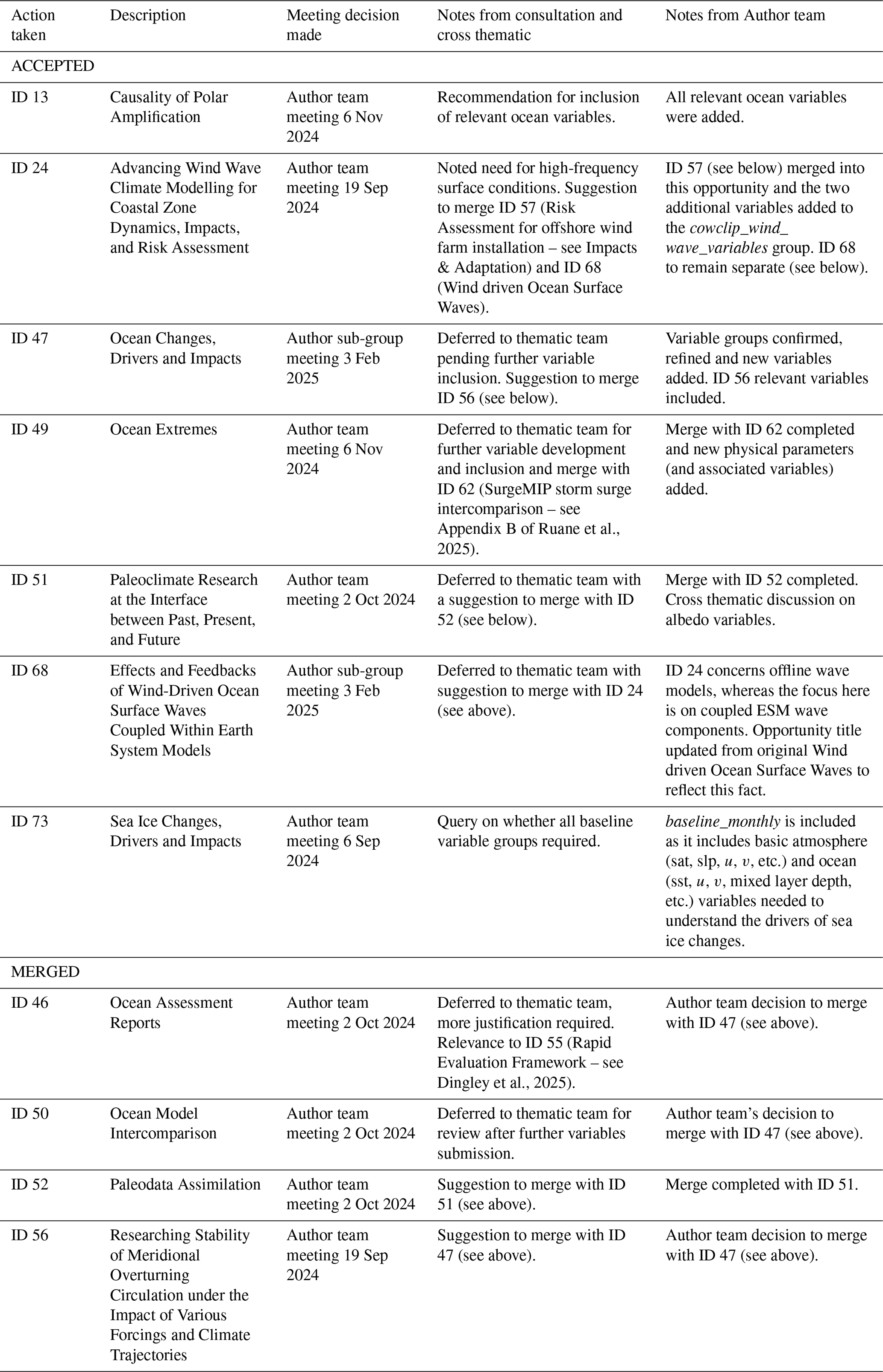
The processing of opportunities proposed in the open call of August 2024, including proposals from both within the author team and more widely, was carried out by revising the evaluation made within each thematic author team in the framework of a cross-thematic meeting in mid-September 2024. The meeting participants selected certain opportunities, rejected some, and merged others with shared scientific objectives and domain. In a subsequent step, an interactive discussion was held between members of our author team, opportunity proposal leaders, and the relevant domain communities. The goal was to harmonize the initially proposed opportunities and improve their description and data requirements. The following table summarizes the key processing actions and decisions.
Table A1Key processing actions and decisions, outcomes, and the dates actions were taken.
The variables that are newly introduced in CMIP7 are tabulated below. The Coordinate Specifications column lists special aspects of the time and spatial requirements for each variable. The full grid specifications can be found in v1.2 of the CMIP7 Data Request (Data Request Task Team, 2025a).

The variables and their metadata included latest CMIP7 Assessment Fast Track Data Request can be accessed at https://doi.org/10.5281/zenodo.14774070 (Anstey et al., 2025). At the time of this publication, the latest major release is v1.2 (Data Request Task Team, 2025a, https://doi.org/10.5281/zenodo.15116894), and the latest minor release is v1.2.2.3 (Anstey et al., 2025, https://doi.org/10.5281/zenodo.14774070). For long-term archival and readability purposes, a csv version of the v1.2.2.3 archive can be found at https://doi.org/10.5281/zenodo.18202918 (Fox-Kemper and Anstey, 2026).
BFK and PDR led the conceptualization, investigation, methodology, and data curation with contributions from AMT, CS, EOR, CM, AM, YA, PJD, NF, VH, ALM, FM, JM, DS, PCT, WLT and MV. BFK and PDR led the writing of this manuscript with support in writing of the original draft from AMT, CS, EOR, AM, NF, VH, CH, DI, GM, ALM, FM, DS, PCT and WLT and review and editing support from YA, PJD, and MV. MK provided coordination support to the Earth System theme and EOR provided resources and project administration support.
The contact author has declared that none of the authors has any competing interests.
For all the EU projects, views and opinions expressed are however those of the author(s) only and do not necessarily reflect those of the European Union or the European Research Council Executive Agency, European Climate Infrastructure and Environment Executive Agency (CINEA), or European Research Council Executive Agency. Neither the European Union nor the granting authority can be held responsible for them.
Publisher's note: Copernicus Publications remains neutral with regard to jurisdictional claims made in the text, published maps, institutional affiliations, or any other geographical representation in this paper. The authors bear the ultimate responsibility for providing appropriate place names. Views expressed in the text are those of the authors and do not necessarily reflect the views of the publisher.
The Oceans and Sea Ice Theme Author Team acknowledges the valuable contributions from a widespread scientific community who participated in the data request effort and public consulting processes. We thank Martin Juckes, Robert Fajber, and Tommi Bergman for helpful comments on the draft.
BFK is funded by NSF RISE-2425380, the Equitable Climate Futures initiative at Brown University, and the SASIP project of the Schmidt Futures Foundation. PDR is funded by the European Union (ERC, ArcticWATCH, 101040858). AMT is funded by the European Union (EERIE project, grant no. 101081383). CS is funded through the Alfred Wegener Institute's research program “Changing Earth – Sustaining our Future” of the Helmholtz Association, the Helmholtz Climate Initiative REKLIM and acknowledges support by the European Union (ERC, i2B, 101118519). The CMIP IPO (EOR) is hosted by the European Space Agency, with staff provided on contract by HE Space Operations Ltd. AM contributed voluntarily with the support of CSIRO and the University of Melbourne. YA acknowledges funding support from the European Union's project EPOC “Explaining and Predicting the Ocean Conveyor”, EU grant no. 101059547 and UKRI grant no. 10038003, and from the EC Horizon Europe project OptimESM “Optimal High Resolution Earth System Models for Exploring Future Climate Changes” under grant no. 101081193 and UKRI grant no. 10039429, and from the UK NERC Highlight Topic “Interacting ice Sheet and Ocean Tipping - Indicators, Processes, Impacts and Challenges (ISOTIPIC)”, grant no. NE/Y503320/1 and funding support from the UK NERC LTS-M projects BIOPOLE (grant no. NE/W004933/1) and CANARI (grant no. NE/W004984/1), and from Atlantic Climate and Environment Strategic Science (AtlantiS) grant (grant no. NE/Y005589/1). The work of PJD from Lawrence Livermore National Laboratory (LLNL) is supported by the Regional and Global Model Analysis (RGMA) program area under the Earth and Environmental System Modeling (EESM) program within the Earth and Environmental Systems Sciences Division (EESSD) of the United States Department of Energy's (DoE) Office of Science. This work was performed under the auspices of the US DoE by LLNL under contract DE-AC52-07NA27344. LLNL IM Release: LLNL-JRNL-2007705. NF is funded under NSF Award no. AGS-2311541. CH is funded under Swedish National Space Agency grant no. 2022-00149. DI is supported by the Foundation Euro-Mediterranean Centre on Climate Change (CMCC). GM is supported by NERC through the ALPACA (grant no. NE/Y005279/1) project and by UKRI (grant no. 10039018) as part of the EPOC project (Explaining and Predicting the Ocean Conveyor; grant no. 101059547). ALM is partially supported by the project “Development of the Community Earth System Model – MONAN” under the contract no. 01340.005344/2021-50. FM is a F.R.S.-FNRS Research Associate. JM acknowledges funding support from the EC Horizon Europe project OptimESM “Optimal High Resolution Earth System Models for Exploring Future Climate Changes” under grant no. 101081193 and UKRI grant no. 10039429, and from the UK NERC Highlight Topic “Interacting ice Sheet and Ocean Tipping – Indicators, Processes, Impacts and Challenges (ISOTIPIC)” (grant no. NE/Y503320/1). PCT is supported by the NASA Radiation Budget Science Project and NASA's Radiation Sciences and Cryosphere Programs. WLT is supported by the National Science and Technology Council, Taiwan (NSTC 113-2111-M-002-016). MK is supported by the MEXT SENTAN Program (grant no. JPMXD0722681344). Funding for publication costs were covered by the CMIP International Project Office, a subsidiary of the World Climate Research Project.
This paper was edited by Riccardo Farneti and reviewed by Brandon Reichl, David Bailey, and one anonymous referee.
Abernathey, R. P., Cerovecki, I., Holland, P. R., Newsom, E., Mazloff, M., and Talley, L. D.: Water-mass transformation by sea ice in the upper branch of the Southern Ocean overturning, Nature Geoscience, 9, 596–601, 2016.
Ahmed, A., Fox-Kemper, B., Watkins, D. M., Wexler, D., and Wilhelmus, M. M.: Estuarine temperature variability: Integrating four decades of remote sensing observations and in-situ sea surface measurements, Remote Sensing of Environment, 322, 114643, https://doi.org/10.1016/j.rse.2025.114643, 2025.
Alberello, A., Bennetts, L. G., Onorato, M., Vichi, M., MacHutchon, K., Eayrs, C., Ntamba, B. N., Benetazzo, A., Bergamasco, F., Nelli, F., Pattani, R., Clarke, H., Tersigni, I., and Toffoli, A.: Three-dimensional imaging of waves and floes in the marginal ice zone during a cyclone, Nature Communications, 13, 4590, https://doi.org/10.1038/s41467-022-32036-2, 2022.
Anstey, J., Dingley, B., and Ellis, D.: CMIP-Data-Request/CMIP7_DReq_Content: Data request content for v1.2.2.3, Zenodo [code], https://doi.org/10.5281/zenodo.14774070, 2025.
Arbic, B. K.: Incorporating tides and internal gravity waves within global ocean general circulation models: A review, Progress in Oceanography, 206, 102824, https://doi.org/10.1016/j.pocean.2022.102824, 2022.
Armstrong McKay, D. I., Staal, A.,Abrams, J. F., Winkelmann, R., Sakschewski, B., Loriani, S., Fetzer, I., Cornell, S. E., Rockström, J., and Lenton, T. M.: Exceeding 1.5 C global warming could trigger multiple climate tipping points, Science, 377, eabn7950, https://doi.org/10.1126/science.abn7950, 2022.
Arrhenius, S.: XXXI. On the influence of carbonic acid in the air upon the temperature of the ground, The London, Edinburgh, and Dublin Philosophical Magazine and Journal of Science, 41, 237–276, 1896.
Babanin, A. V.: On a wave-induced turbulence and a wave-mixed upper ocean layer, Geophysical Research Letters, 33, https://doi.org/10.1029/2006GL027308, 2006.
Bao, Y., Song, Z., and Qiao, F.: FIO-ESM Version 2.0: Model Description and Evaluation, Journal of Geophysical Research: Oceans, 125, e2019JC016036, https://doi.org/10.1029/2019JC016036, 2020.
Barragán, J. M. and de Andrés, M.: Analysis and trends of the world's coastal cities and agglomerations, Ocean & Coastal Management, 114, 11–20, https://doi.org/10.1016/j.ocecoaman.2015.06.004, 2015.
Beech, N., Rackow, T., Semmler, T., Danilov, S., Wang, Q., and Jung, T.: Long-term evolution of ocean eddy activity in a warming world, Nature Climate Change, 12, 910–917, https://doi.org/10.1038/s41558-022-01478-3, 2022.
Belcher, S. E., Grant, A. A. L. M., Hanley, K. E., Fox-Kemper, B., Van Roekel, L., Sullivan, P. P., Large, W. G., Brown, A., Hines, A., Calvert, D., Rutgersson, A., Petterson, H., Bidlot, J., Janssen, P. A. E. M., and Polton, J. A.: A global perspective on Langmuir turbulence in the ocean surface boundary layer, Geophysical Research Letters, 39, L18605, https://doi.org/10.1029/2012GL052932, 2012.
Bellomo, K. and Mehling, O.: Impacts and state-dependence of AMOC weakening in a warming climate, Geophysical Research Letters, 51, e2023GL107624, https://doi.org/10.1029/2023GL107624, 2024.
Bennetts, L. G., Shakespeare, C. J., Vreugdenhil, C. A., Foppert, A., Gayen, B., Meyer, A., Morrison, A. K., Padman, L., Phillips, H. E., Stevens, C. L., Toffoli, A., Constantinou, N. C., Cusack, J. M., Cyriac, A., Doddridge, E. W., England, M. H., Evans, D. G., Heil, P., Hogg, A. M., Holmes, R. M., Huneke, W. G. C., Jones, N. L., Keating, S. R., Kiss, A. E., Kraitzman, N., Malyarenko, A., McConnochie, C. D., Meucci, A., Montiel, F., Neme, J., Nikurashin, M., Patel, R. S., Peng, J.-P., Rayson, M., Rosevear, M. G., Sohail, T., Spence, P., and Stanley, G. J.: Closing the Loops on Southern Ocean Dynamics: From the Circumpolar Current to Ice Shelves and From Bottom Mixing to Surface Waves, Reviews of Geophysics, 62, e2022RG000781, https://doi.org/10.1029/2022RG000781, 2024.
Bernier, N. B., Hemer, M., Mori, N., Appendini, C. M., Breivik, O., de Camargo, R., Casas-Prat, M., Duong, T. M., Haigh, I. D., Howard, T., Hernaman, V., Huizy, O., Irish, J. L., Kirezci, E., Kohno, N., Lee, J.-W., McInnes, K. L., Meyer, E. M., Marcos, M., Marsooli, R., Martin Oliva, A., Menendez, M., Moghimi, S., Muis, S., Polton, J. A., Pringle, W. J., Ranasinghe, R., Saillour, T., Smith, G., Tadesse, M. G., Swail, V., Tomoya, S., Voukouvalas, E., Wahl, T., Wang, P., Weisse, R., Westerink, J. J., Young, I., and Zhang, Y. J.: Storm surges and extreme sea levels: Review, establishment of model intercomparison and coordination of surge climate projection efforts (SurgeMIP), Weather and Climate Extremes, 45, 100689, https://doi.org/10.1016/j.wace.2024.100689, 2024.
Blanchard-Wrigglesworth, E., Brenner, S., Webster, M., Horvat, C., Foss, Ø., and Bitz, C. M.: Model biases in simulating extreme sea ice loss associated with the record January 2022 Arctic cyclone, Journal of Geophysical Research: Oceans, 129, e2024JC021127, https://doi.org/10.1029/2024JC021127, 2024.
Bograd, S. J., Jacox, M. G., Hazen, E. L., Lovecchio, E., Montes, I., Buil, M. P., Shannon, L. J., Sydeman, W. J., and Rykaczewski, R. R.: Climate change impacts on eastern boundary upwelling systems, Annual Review of Marine Science, 15, 303–328, https://doi.org/10.1146/annurev-marine-032122-021945, 2023.
Bradley, A. T. and Hewitt, I. J.: Tipping point in ice-sheet grounding-zone melting due to ocean water intrusion, Nature Geoscience, 17, 631–637, https://doi.org/10.1038/s41561-024-01465-7, 2024.
Brown, S. C., Wigley, T. M. L., Otto-Bliesner, B. L., Rahbek, C., and Fordham, D. A.: Persistent Quaternary climate refugia are hospices for biodiversity in the Anthropocene, Nature Climate Change, 10, 244–248, https://doi.org/10.1038/s41558-019-0682-7, 2020.
Brumer, S. E., Zappa, C. J., Brooks, I. M., Tamura, H., Brown, S. M., Blomquist, B. W., Fairall, C. W., and Cifuentes-Lorenzen, A.: Whitecap Coverage Dependence on Wind and Wave Statistics as Observed during SO GasEx and HiWinGS, Journal of Physical Oceanography, 47, 2211–2235, https://doi.org/10.1175/JPO-D-17-0005.1, 2017.
Brus, S. R., Wolfram, P. J., Van Roekel, L. P., and Meixner, J. D.: Unstructured global to coastal wave modeling for the Energy Exascale Earth System Model using WAVEWATCH III version 6.07, Geoscientific Model Development, 14, 2917–2938, https://doi.org/10.5194/gmd-14-2917-2021, 2021.
Burger, F. A., Terhaar, J., and Froelicher, T. L.: Compound marine heatwaves and ocean acidity extremes, Nature Communications, 13, 4722, https://doi.org/10.1038/s41467-022-32120-7, 2022.
Cardinale, C. J. and Rose, B. E. J.: The Increasing Efficiency of the Poleward Energy Transport Into the Arctic in a Warming Climate, Geophysical Research Letters, 50, e2022GL100834, https://doi.org/10.1029/2022GL100834, 2023.
Casas-Prat, M., Hemer, M. A., Dodet, G., Morim, J., Wang, X. L., Mori, N., Young, I., Erikson, L., Kamranzad, B., Kumar, P., Menéndez, M., and Feng, Y.: Wind-wave climate changes and their impacts, Nature Reviews Earth & Environment, 5, 23–42, https://doi.org/10.1038/s43017-023-00502-0, 2024.
Cavaleri, L., Fox-Kemper, B., and Hemer, M.: Wind Waves in the Coupled Climate System, Bulletin of the American Meteorological Society, 93, 1651–1661, https://doi.org/10.1175/BAMS-D-11-00170.1, 2012.
Chassignet, E. P., Yeager, S. G., Fox-Kemper, B., Bozec, A., Castruccio, F., Danabasoglu, G., Horvat, C., Kim, W. M., Koldunov, N., Li, Y., Lin, P., Liu, H., Sein, D. V., Sidorenko, D., Wang, Q., and Xu, X.: Impact of horizontal resolution on global ocean–sea ice model simulations based on the experimental protocols of the Ocean Model Intercomparison Project phase 2 (OMIP-2), Geoscientific Model Development, 13, 4595–4637, https://doi.org/10.5194/gmd-13-4595-2020, 2020.
Cheng, L., von Schuckmann, K., Abraham, J. P., Trenberth, K. E., Mann, M. E., Zanna, L., England, M. H., Zika, J. D., Fasullo, J. T., Yu, Y., Pan, Y., Zhu, J., Newsom, E. R., Bronselaer, B., and Lin, X.: Past and future ocean warming, Nature Reviews Earth & Environment, 3, 776–794, https://doi.org/10.1038/s43017-022-00345-1, 2022.
CMIP Model Benchmarking Task Team: CMIP7 Assessment Fast Track Diagnostics list for the Rapid Evaluation Framework, Zenodo [data set], https://doi.org/10.5281/zenodo.14284375, 2024.
Constable, A., Harper, S., Dawson, J., Holsman, K., Mustonen, T., Piepenburg, D., and Rost, B.: Cross-Chapter Paper 6: Polar Regions, in: Climate Change 2022: Impacts, Adaptation and Vulnerability. Contribution of Working Group II to the Sixth Assessment Report of the Intergovernmental Panel on Climate Change, edited by: Pörtner, H. O., Roberts, D. C., Tignor, M., Poloczanska, E. S., Mintenbeck, K., Alegría, A., Craig, M., Langsdorf, S., Löschke, S., Möller, V., Okem, A., and Rama, B., Cambridge University Press, Cambridge, UK and New York, USA, 2319–2368, ISBN 9781009325844, https://doi.org/10.1017/9781009325844.023, 2022.
Cooley, S., Schoeman, D., Bopp, L., Boyd, P., Donner, S., Ghebrehiwet, D. Y., Ito, S.-I.,Kiessling, W., Martinetto, P., Ojea, E., Racault, M.-F., Rost, B., and Skern-Mauritzen, M.: Chapter 3: Ocean and Coastal Ecosystems and their Services, in: Climate Change 2022: Impacts, Adaptation, and Vulnerability. Contribution of Working Group II to the Sixth Assessment Report of the Intergovernmental Panel on Climate Change, edited by: Pörtner, H. O., Roberts, D. C., Tignor, M., Poloczanska, E. S., Mintenbeck, K., Alegría, A., Craig, M., Langsdorf, S., Löschke, S., Möller, V., Okem, A., and Rama, B., Cambridge University Press, Cambridge, UK and New York, USA, 379–550, ISBN 9781009325844, https://doi.org/10.1017/9781009325844.005, 2022.
Cooper, V. T., Armour, K. C., Hakim, G. J., Tierney, J. E., Osman, M. B., Proistosescu, C., Dong, Y., Burls, N. J., Andrews, T., Amrhein, D. E., Zhu, J., Dong, W., Ming, Y., and Chmielowiec, P.: Last Glacial Maximum pattern effects reduce climate sensitivity estimates, Science Advances, 10, eadk9461, https://doi.org/10.1126/sciadv.adk9461, 2024.
Cosby, A. G., Lebakula, V., Smith, C. N., Wanik, D. K., Bergene, K., Rose, A. N., Swanson, D., and Bloom, D. E.: Accelerating growth of human coastal populations at the global and continent levels: 2000–2018, Scientific Reports, 14, 22489, https://doi.org/10.1038/s41598-024-73287-x, 2024.
Cox, T., Donohoe, A., Armour, K. C., Roe, G. H., and Frierson, D. M. W.: A New Method for Calculating Instantaneous Atmospheric Heat Transport, Journal of Climate, 37, 4337–4346, https://doi.org/10.1175/JCLI-D-23-0521.1, 2024.
Data Request Task Team: CMIP-Data-Request/CMIP7_DReq_Content: Data request content for v1.2, Zenodo [code], https://doi.org/10.5281/zenodo.15116894, 2025a.
Data Request Task Team: CMIP-Data-Request/CMIP7_DReq_Software: v1.4 CMIP7 data request software, Zenodo [code], https://doi.org/10.5281/zenodo.17993659, 2025b.
Danabasoglu, G., Lamarque, J.-F., Bacmeister, J., Bailey, D. A., DuVivier, A. K., Edwards, J., Emmons, L. K., Fasullo, J., Garcia, R., Gettelman, A., Hannay, C., Holland, M. M., Large, W. G., Lawrence, D. M., Lenaerts, J. T. M., Lindsay, K., Lipscomb, W. H., Mills, M. J., Neale, R., Oleson, K. W., Otto-Bliesner, B., Phillips, A. S., Sacks, W., Tilmes, S., van Kampenhout, L., Vertenstein, M., Bertini, A., Dennis, J., Deser, C., Fischer, C., Fox-Kemper, B., Kay, J. E., Kinnison, D., Kushner, P. J., Long, M. C., Mickelson, S., Moore, J. K., Nienhouse, E., Polvani, L., Rasch, P. J., and Strand, W. G.: The Community Earth System Model version 2 (CESM2), Journal of Advances in Modeling Earth Systems (JAMES), 12, e2019MS001916, https://doi.org/10.1029/2019MS001916, 2020.
de la Vega, E., Chalk, T. B., Wilson, P. A., Bysani, R. P., and Foster, G. L.: Atmospheric CO2 during the Mid-Piacenzian Warm Period and the M2 glaciation, Scientific Reports, 10, 11002, https://doi.org/10.1038/s41598-020-67154-8, 2020.
Deike, L. and Melville, W. K.: Gas Transfer by Breaking Waves, Geophysical Research Letters, 45, 10482–10492, https://doi.org/10.1029/2018GL078758, 2018.
Deike, L., Reichl, B. G., and Paulot, F.: A Mechanistic Sea Spray Generation Function Based on the Sea State and the Physics of Bubble Bursting, AGU Advances, 3, e2022AV000750, https://doi.org/10.1029/2022AV000750, 2022.
DeMott, P. J, Hill, T. C. J., McCluskey, C. S., Prather, K. A., Collins, D. B., Sullivan, R. C., Ruppel, M. J., Mason, R. H., Irish, V. E., Lee, T., Hwang, C. Y., Rhee, T. S., Snider, J. S., McMeeking, G. R., Dhaniyala, S., Lewis, E. R., Wentzell, J. J. B., Abbatt, J., Lee, C., Sultana, C. M., Ault, A. P., Axson, J. L., Martinez, M. D., Venero, I., Santos-Figueroa, G., Stokes, M. D., Deane, G. B., Mayol-Bracero, O. L., Grassian, V. H., Bertram, T. H., Bertram, A. K., Moffett, B. F., and Franc, G. D.: Sea spray aerosol as a unique source of ice nucleating particles, Proceedings of the National Academy of Sciences, 113, 5797–5803, https://doi.org/10.1073/pnas.1514034112, 2016.
Dingley, B., Anstey, J. A., Abalos, M., Abraham, C., Bergman, T., Bock, L., Fiddes, S., Hassler, B., Kramer, R. J., Luo, F., O'Connor, F. M., Šácha, P., Simpson, I. R., Wilcox, L. J., and Zelinka, M. D.: CMIP7 Data Request: Atmosphere Priorities and Opportunities, EGUsphere [preprint], https://doi.org/10.5194/egusphere-2025-3189, 2025.
Donohoe, A., Armour, K. C., Roe, G. H., Battisti, D. S., and Hahn, L.: The Partitioning of Meridional Heat Transport from the Last Glacial Maximum to CO2 Quadrupling in Coupled Climate Models, Journal of Climate, 33, 4141–4165, https://doi.org/10.1175/JCLI-D-19-0797.1, 2020.
Dörr, J., Årthun, M., Eldevik, T., and Sandø, A. B.: Expanding Influence of Atlantic and Pacific Ocean Heat Transport on Winter Sea-Ice Variability in a Warming Arctic, Journal of Geophysical Research: Oceans, 129, e2023JC019900, https://doi.org/10.1029/2023JC019900, 2024.
Dowsett, H. J., Foley, K. M., Stoll, D. K., Chandler, M. A., Sohl, L. E., Bentsen, M., Otto-Bliesner, B. L., Bragg, F. J., Chan, W.-L., Contoux, C., Dolan, A. M., Haywood, A. M., Jonas, J. A., Jost, A., Kamae, Y., Lohmann, G., Lunt, D. J., Nisancioglu, K. H., Abe-Ouchi, A., Ramstein, G., Riesselman, C. R., Robinson, M. M., Rosenbloom, N. A., Salzmann, U., Stepanek, C., Strother, S. L., Ueda, H., Yan, Q., and Zhang, Z.: Sea Surface Temperature of the mid-Piacenzian Ocean: A Data-Model Comparison, Scientific Reports, 3, 2013, https://doi.org/10.1038/srep02013, 2013.
Dunne, J. P., Hewitt, H. T., Arblaster, J. M., Bonou, F., Boucher, O., Cavazos, T., Dingley, B., Durack, P. J., Hassler, B., Juckes, M., Miyakawa, T., Mizielinski, M., Naik, V., Nicholls, Z., O'Rourke, E., Pincus, R., Sanderson, B. M., Simpson, I. R., and Taylor, K. E.: An evolving Coupled Model Intercomparison Project phase 7 (CMIP7) and Fast Track in support of future climate assessment, Geoscientific Model Development, 18, 6671–6700, https://doi.org/10.5194/gmd-18-6671-2025, 2025.
Eayrs, C., Li, X., Raphael, M. N., and Holland, D. M.: Rapid decline in Antarctic sea ice in recent years hints at future change, Nature Geoscience, 14, 460–464, https://doi.org/10.1038/s41561-021-00768-3, 2021.
ECMWF: IFS Documentation CY49R1 – Part VII: ECMWF Wave Model, Chap. 7, ECMWF, https://doi.org/10.21957/8315ddc858, 2024.
Eyring, V., Gillett, N., Achuta Rao, K., Barimalala, R., Barreiro Parrillo, M., Bellouin, N., Cassou, C., Durack, P., Kosaka, Y., McGregor, S., Min, S., Morgenstern, O., and Sun, Y.: Human Influence on the Climate System, in: Climate Change 2021: The Physical Science Basis. Contribution of Working Group I to the Sixth Assessment Report of the Intergovernmental Panel on Climate Change, edited by: Masson-Delmotte, V., Zhai, P., Pirani, A., Connors, S., Péan, C., Berger, S., Caud, N., Chen, Y., Goldfarb, L., Gomis, M., Huang, M., Leitzell, K., Lonnoy, E., Matthews, J., Maycock, T., Waterfield, T., Yelekçi, O., Yu, R., and Zhou, B., Cambridge University Press, Cambridge, United Kingdom and New York, NY, USA, 423–552, https://doi.org/10.1017/9781009157896.005, 2021.
Fox-Kemper, B.: Notions for the Motions of the Oceans, edited by: Chassignet, E. P., Pascual, A., Tintore, J., and Verron, J., New Frontiers in Operational Oceanography, 27, https://doi.org/10.17125/gov2018, 2018.
Fox-Kemper, B. and Anstey, J.: CMIP-Data-Request/CMIP7_DReq_Content: Data request content for v1.2.2.3 (csv version), Zenodo [data set], https://doi.org/10.5281/zenodo.18202918, 2026.
Fox-Kemper, B., Adcroft, A., Boening, Claus W., C. W., Chassignet, E. P., Curchitser, E., Danabasoglu, G., Eden, C., England, M. H., Gerdes, R., Greatbatch, R. J., Griffies, S. M., Hallberg, R. W., Hanert, E., Heimbach, P., Hewitt, H. T., Hill, C. N., Komuro, Y., Legg, S., Le Sommer, J., Masina, S., Marsland, S. J., Penny, S. G., Qiao, F., Ringler, T. D., Treguier, A. M., Tsujino, H., Uotila, P., and Yeager, S. G.: Challenges and Prospects in Ocean Circulation Models, Frontiers in Marine Science, 6, 65, https://doi.org/10.3389/fmars.2019.00065, 2019.
Fox-Kemper, B., Hewitt, H. T., Xiao, C., Adalgeirsdottir, G., Drijfhout, S. S., Edwards, T. L., Golledge, N. R., Hemer, M., Kopp, R. E., Krinner, G., Mix, A., Notz, D., Nowicki, S., Nurhati, I. S., Ruiz, L., Sallee, J.-B., Slangen, A. B. A., and Yu, Y.: Ocean, Cryosphere and Sea Level Change, in: Climate Change 2021: The Physical Science Basis. Contribution of Working Group I to the Sixth Assessment Report of the Intergovernmental Panel on Climate Change, edited by: Masson-Delmotte, V., Zhai, P., Pirani, A., Connors, S. L., Péan, C., Berger, S., Caud, N., Chen, Y., Goldfarb, L., Gomis, M. I., Huang, M., Leitzell, K., Lonnoy, E., Matthews, J. B. R., Maycock, T. K., Waterfield, T., Yelekçi, O., Yu, R., and Zhou, B., Cambridge University Press, United Kingdom and New York, NY, USA, 1211–1362, https://doi.org/10.1017/9781009157896.011, 2021a.
Fox-Kemper, B., Johnson, L., and Qiao, F.: Chapter 4 – Ocean Near-Surface Layers, in: Ocean Mixing, edited by: Meredith, M. P. and Naveira Garabato, A. C., Elsevier, 65–94, https://doi.org/10.1016/B978-0-12-821512-8.00011-6, 2021b.
Francis, J. A.: Why Are Arctic Linkages to Extreme Weather Still up in the Air?, Bulletin of the American Meteorological Society, 98, 2551–2557, https://doi.org/10.1175/BAMS-D-17-0006.1, 2017.
Frankignoul, C. and Hasselmann, K.: Stochastic climate models, Part II Application to sea-surface temperature anomalies and thermocline variability, Tellus, 29, 289–305, https://doi.org/10.3402/tellusa.v29i4.11362, 1977.
Frankignoul, C., Raillard, L., Ferster, B., and Kwon, Y.-O.: Arctic September Sea Ice Concentration Biases in CMIP6 Models and Their Relationships with Other Model Variables, Journal of Climate, 37, 4257–4274, https://doi.org/10.1175/JCLI-D-23-0452.1, 2024.
Gherardi, M. and Lagomarsino, M. C.: Characterizing the size and shape of sea ice floes, Scientific Reports, 5, 10226, https://doi.org/10.1038/srep10226, 2015.
Gomes, D. G. E., Ruzicka, J. J., Crozier, L. G., Huff, D. D., Brodeur, R. D., and Stewart, J. D.: Marine heatwaves disrupt ecosystem structure and function via altered food webs and energy flux, Nature Communications, 15, 1988, https://doi.org/10.1038/s41467-024-46263-2, 2024.
Graversen, R. G. and Burtu, M.: Arctic amplification enhanced by latent energy transport of atmospheric planetary waves, Quarterly Journal of the Royal Meteorological Society, 142, 2046–2054, https://doi.org/10.1002/qj.2802, 2016.
Griffies, S. M., Yin, J., Durack, P. J., Goddard, P., Bates, S. C., Behrens, E., Bentsen, M., Bi, D., Biastoch, A., Böning, C. W., Bozec, A., Chassignet, E., Danabasoglu, G., Danilov, S., Domingues, C. M., Drange, H., Farneti, R., Fernandez, E., Greatbatch, R. J., Holland, D. M., Ilicak, M., Large, W. G., Lorbacher, K., Lu, J., Marsland, S. J., Mishra, A., George Nurser, A., Salas y Mélia, D., Palter, J. B., Samuels, B. L., Schröter, J., Schwarzkopf, F. U., Sidorenko, D., Treguier, A. M., heng Tseng, Y., Tsujino, H., Uotila, P., Valcke, S., Voldoire, A., Wang, Q., Winton, M., and Zhang, X.: An assessment of global and regional sea level for years 1993–2007 in a suite of interannual CORE-II simulations, Ocean Modelling, 78, 35–89, https://doi.org/10.1016/j.ocemod.2014.03.004, 2014.
Griffies, S. M., Danabasoglu, G., Durack, P. J., Adcroft, A. J., Balaji, V., Böning, C. W., Chassignet, E. P., Curchitser, E., Deshayes, J., Drange, H., Fox-Kemper, B., Gleckler, P. J., Gregory, J. M., Haak, H., Hallberg, R. W., Heimbach, P., Hewitt, H. T., Holland, D. M., Ilyina, T., Jungclaus, J. H., Komuro, Y., Krasting, J. P., Large, W. G., Marsland, S. J., Masina, S., McDougall, T. J., Nurser, A. J. G., Orr, J. C., Pirani, A., Qiao, F., Stouffer, R. J., Taylor, K. E., Treguier, A. M., Tsujino, H., Uotila, P., Valdivieso, M., Wang, Q., Winton, M., and Yeager, S. G.: OMIP contribution to CMIP6: experimental and diagnostic protocol for the physical component of the Ocean Model Intercomparison Project, Geoscientific Model Development, 9, 3231–3296, https://doi.org/10.5194/gmd-9-3231-2016, 2016.
Gruber, N., Boyd, P. W., Frölicher, T. L., and Vogt, M.: Biogeochemical extremes and compound events in the ocean, Nature, 600, 395–407, https://doi.org/10.1038/s41586-021-03981-7, 2021.
Gruber, N., Bakker, D. C. E., DeVries, T., Gregor, L., Hauck, J., Landschützer, P., McKinley, G. A., and Müller, J. D.: Trends and variability in the ocean carbon sink, Nature Reviews Earth & Environment, 4, 119–134, https://doi.org/10.1038/s43017-022-00381-x, 2023.
Gulev, S., Thorne, P., Ahn, J., Dentener, F., Domingues, C., Gerland, S., Gong, D., Kaufman, D., Nnamchi, H., Quaas, J., Rivera, J., Sathyendranath, S., Smith, S., Trewin, B., von Schuckmann, K., and Vose, R.: Changing State of the Climate System, in: Climate Change 2021: The Physical Science Basis. Contribution of Working Group I to the Sixth Assessment Report of the Intergovernmental Panel on Climate Change, edited by: Masson-Delmotte, V., Zhai, P., Pirani, A., Connors, S., Péan, C., Berger, S., Caud, N., Chen, Y., Goldfarb, L., Gomis, M., Huang, M., Leitzell, K., Lonnoy, E., Matthews, J., Maycock, T., Waterfield, T., Yelekçi, O., Yu, R., and Zhou, B., Cambridge University Press, Cambridge, United Kingdom and New York, NY, USA, 287–422, https://doi.org/10.1017/9781009157896.004, 2021.
Hahn, L. C., Armour, K. C., Zelinka, M. D., Bitz, C. M., and Donohoe, A.: Contributions to Polar Amplification in CMIP5 and CMIP6 Models, Frontiers in Earth Science, 9, https://doi.org/10.3389/feart.2021.710036, 2021.
Han, W., Zhang, L., Meehl, G. A., Kido, S., Tozuka, T., Li, Y., McPhaden, M. J., Hu, A., Cazenave, A., Rosenbloom, N., Strand, G., West, B. J., and Xing, W.: Sea level extremes and compounding marine heatwaves in coastal Indonesia, Nature Communications, 13, 6410, https://doi.org/10.1038/s41467-022-34003-3, 2022.
Haywood, A. M., Tindall, J. C., Burton, L., Chandler, M. A., Dolan, A. M., Dowsett, H. J., Feng, R., Fletcher, T., Foley, K. M., Hill, D., Hunter, S., Otto-Bliesner, B., Lunt, D. J., Robinson, M. M., and Salzmann, U.: Pliocene model Intercomparison project phase 3 (PlioMIP3) – Science plan and experimental design, Global Planet. Change, 232, 104316, https://doi.org/10.1016/j.gloplacha.2023.104316, 2024.
Haywood, A. M., Valdes, P. J., Aze, T., Barlow, N., Burke, A., Dolan, A. M., von der Heydt, A. S., Hill, D. J., Jamieson, S. S. R., Otto-Bliesner, B. L., Salzmann, U., Saupe, E., and Voss, J.: What can Palaeoclimate Modelling do for you?, Earth Systems and Environment, 3, 1–18, https://doi.org/10.1007/s41748-019-00093-1, 2019.
He, F. and Clark, P. U.: Freshwater forcing of the Atlantic Meridional Overturning Circulation revisited, Nature Climate Change, 12, 449–454, https://doi.org/10.1038/s41558-022-01328-2, 2022.
Hemer, M. A., Fan, Y., Mori, N., Semedo, A., and Wang, X. L.: Projected changes in wave climate from a multi-model ensemble, Nature Climate Change, 3, 471–476, https://doi.org/10.1038/nclimate1791, 2013.
Heuzé, C. and Liu, H.: No Emergence of Deep Convection in the Arctic Ocean Across CMIP6 Models, Geophysical Research Letters, 51, e2023GL106499, https://doi.org/10.1029/2023GL106499, 2024.
Hewitt, H., Fox-Kemper, B., Pearson, B., Roberts, M., and Klocke, D.: The small scales of the ocean may hold the key to surprises, Nature Climate Change, https://doi.org/10.1038/s41558-022-01386-6, 2022.
Hewitt, H. T., Roberts, M., Mathiot, P., Biastoch, A., Blackley, E., Chassignet, E. P., Fox-Kemper, B., Hyder, P., Marshall, D. P., Popova, E., Treguier, A.-M., Zanna, L., Yool, A., Yu, Y., Beadling, R., Bell, M., Kuhlbrodt, T., Arsouze, T., Bellucci, A., Castruccio, F., Gan, B., Pustrasahan, D., Roberts, C. D., Van Roekel, L., and Zhiang, Q.: Resolving and Parameterising the Ocean Mesoscale in Earth System Models, Current Climate Change Reports, https://doi.org/10.1007/s40641-020-00164-w, 2020.
Himmich, K., Vancoppenolle, M., Stammerjohn, S., Bocquet, M., Madec, G., Sallée, J. B., and Fleury, S.: Thermodynamics drive post-2016 changes in the Antarctic sea ice seasonal cycle, Journal of Geophysical Research: Oceans, 129, e2024JC021112, https://doi.org/10.1029/2024JC021112, 2024.
Hobbs, W., Spence, P., Meyer, A., Schroeter, S., Fraser, A. D., Reid, P., Tian, T. R., Wang, Z., Liniger, G., Doddridge, E. W., and Boyd, P. W.: Observational Evidence for a Regime Shift in Summer Antarctic Sea Ice, Journal of Climate, 37, 2263–2275, https://doi.org/10.1175/JCLI-D-23-0479.1, 2024.
Hobday, A. J., Oliver, E. C., Gupta, A. S., Benthuysen, J. A., Donat, M. G., Holbrook, N. J., Moore, P. J., Thomsen, M. S., Wernberg, T., and Smale, D. A.: Categorizing and Naming Marine Heatwaves, Oceanography, 31, 162–173, https://doi.org/10.5670/oceanog.2018.205, 2018.
Hoffman, F. M., Hassler, B., Swaminathan, R., Lewis, J., Andela, B., Collier, N., Hegedűs, D., Lee, J., Pascoe, C., Pflüger, M., Stockhause, M., Ullrich, P., Xu, M., Bock, L., Chun, F., Gier, B. K., Kelley, D. I., Lauer, A., Lenhardt, J., Schlund, M., Sreeush, M. G., Weigel, K., Blockley, E., Beadling, R., Beucher, R., Dugassa, D. D., Lembo, V., Lu, J., Brands, S., Tjiputra, J., Malinina, E., Mederios, B., Scoccimarro, E., Walton, J., Kershaw, P., Marquez, A. L., Roberts, M. J., O’Rourke, E., Dingley, E., Turner, B., Hewitt, H., and Dunne, J. P.: Rapid Evaluation Framework for the CMIP7 Assessment Fast Track, EGUsphere [preprint], https://doi.org/10.5194/egusphere-2025-2685, 2025.
Holland, M. M. and Bitz, C. M.: Polar amplification of climate change in coupled models, Climate Dynamics, 21, 221–232, https://doi.org/10.1007/s00382-003-0332-6, 2003.
Holthuijsen, L. H.: Waves in Oceanic and Coastal Waters, Cambridge University Press, Cambridge, https://doi.org/10.1017/CBO9780511618536, 2007.
Hu, W., Fey, M., Zitnik, M., Dong, Y., Ren, H., Liu, B., Catasta, M., and Leskovec, J.: Open Graph Benchmark: Datasets for Machine Learning on Graphs, in: Advances in Neural Information Processing Systems, edited by: Larochelle, H., Ranzato, M., Hadsell, R., Balcan, M., and Lin, H., vol. 33, Curran Associates, Inc., 22118–22133, https://proceedings.neurips.cc/paper_files/paper/2020/file/fb60d411a5c5b72b2e7d3527cfc84fd0-Paper.pdf (last access: 21 June 2026), 2020.
Idier, D., Bertin, X., Thompson, P., and Pickering, M. D.: Interactions Between Mean Sea Level, Tide, Surge, Waves and Flooding: Mechanisms and Contributions to Sea Level Variations at the Coast, Surveys in Geophysics, 40, 1603–1630, https://doi.org/10.1007/s10712-019-09549-5, 2019.
IPCC: Climate Change 2021: The Physical Science Basis. Contribution of Working Group I to the Sixth Assessment Report of the Intergovernmental Panel on Climate Change, edited by: Masson-Delmotte, V., Zhai, P., Pirani, A., Connors, S. L., Péan, C., Berger, S., Caud, N., Chen, Y., Goldfarb, L., Gomis, M. I., Huang, M., Leitzell, K., Lonnoy, E., Matthews, J. B. R., Maycock, T. K., Waterfield, T., Yelekçi, O., Yu, R., and Zhou, B., Cambridge University Press, Cambridge, United Kingdom and New York, NY, USA, https://doi.org/10.1017/9781009157896, 2021a.
IPCC: Annex IV: Modes of Variability, in: Climate Change 2021: The Physical Science Basis. Contribution of Working Group I to the Sixth Assessment Report of the Intergovernmental Panel on Climate Change, edited by: Masson-Delmotte, V., Zhai, P., Pirani, A., Connors, S., Péan, C., Berger, S., Caud, N., Chen, Y., Goldfarb, L., Gomis, M., Huang, M., Leitzell, K., Lonnoy, E., Matthews, J., Maycock, T., Waterfield, T., Yelekçi, O., Yu, R., and Zhou, B., Cambridge University Press, Cambridge, United Kingdom and New York, NY, USA, 2153–2192, https://doi.org/10.1017/9781009157896.018, 2021b.
Jackson, L. C., Roberts, M. J., Hewitt, H. T., Iovino, D., Koenigk, T., Meccia, V. L., Roberts, C. D., Ruprich-Robert, Y., and Wood, R. A.: Impact of ocean resolution and mean state on the rate of AMOC weakening, Climate Dynamics 55, 1711–1732, https://doi.org/10.1007/s00382-020-05345-9, 2020.
Janssen, P. A. E. M.: Quasi-linear Theory of Wind-Wave Generation Applied to Wave Forecasting, Journal of Physical Oceanography, 21, 1631–1642, https://doi.org/10.1175/1520-0485(1991)021<1631:QLTOWW>2.0.CO;2, 1991.
Jevrejeva, S., Calafat, F. M., De Dominicis, M., Hirschi, J. J.-M., Mecking, J. V., Polton, J. A., Sinha, B., Wise, A., and Holt, J.: Challenges, advances and opportunities in regional sea level projections: The role of ocean-shelf dynamics, Earth's Future, 12, e2024EF004886, https://doi.org/10.1029/2024EF004886, 2024.
Johnson, G. C. and Lyman, J. M.: Warming trends increasingly dominate global ocean, Nature Climate Change, 10, 757–761, https://doi.org/10.1038/s41558-020-0822-0, 2020.
Johnson, G. C., Lumpkin, R., Boyer, T., Bringas, F., Cetinić, I., Chambers, D. P., Cheng, L., Dong, S., Feely, R. A., Fox-Kemper, B., Frajka-Williams, E., Franz, B. A., Fu, Y., Gao, M., Garg, J., Gilson, J., Goni, G., Hamlington, B. D., Hewitt, H. T., Hobbs, W. R., Hu, Z.-Z., Huang, B., Jevrejeva, S., Johns, W. E., Katsunari, S., Kennedy, J. J., Kersalé, M., Killick, R. E., Leuliette, E., Locarnini, R., Lozier, M. S., Lyman, J. M., Merrifield, M. A., Mishonov, A., Mitchum, G. T., Moat, B. I., Nerem, R. S., Notz, D., Perez, R. C., Purkey, S. G., Rayner, D., Reagan, J., Schmid, C., Siegel, D. A., Smeed, D. A., Stackhouse, P. W., Sweet, W., Thompson, P. R., Volkov, D. L., Wanninkhof, R., Weller, R. A., Wen, C., Westberry, T. K., Widlansky, M. J., Willis, J. K., Yu, L., and Zhang, H.-M.: Global oceans, Bulletin of the American Meteorological Society, 103, S143–S192, https://doi.org/10.1175/BAMS-D-22-0072.1, 2022.
Juckes, M., Taylor, K. E., Antonio, F., Brayshaw, D., Buontempo, C., Cao, J., Durack, P. J., Kawamiya, M., Kim, H., Lovato, T., Mackallah, C., Mizielinski, M., Nuzzo, A., Stockhause, M., Visioni, D., Walton, J., Turner, B., O'Rourke, E., and Dingley, B.: Baseline Climate Variables for Earth System Modelling, Geoscientific Model Development, 18, 2639–2663, https://doi.org/10.5194/gmd-18-2639-2025, 2025.
Jung, C., Sander, L., and Schindler, D.: Future global offshore wind energy under climate change and advanced wind turbine technology, Energy Conversion and Management, 321, 119075, https://doi.org/10.1016/j.enconman.2024.119075, 2024.
Kageyama, M., Sime, L. C., Sicard, M., Guarino, M.-V., de Vernal, A., Stein, R., Schroeder, D., Malmierca-Vallet, I., Abe-Ouchi, A., Bitz, C., Braconnot, P., Brady, E. C., Cao, J., Chamberlain, M. A., Feltham, D., Guo, C., LeGrande, A. N., Lohmann, G., Meissner, K. J., Menviel, L., Morozova, P., Nisancioglu, K. H., Otto-Bliesner, B. L., O'ishi, R., Ramos Buarque, S., Salas y Melia, D., Sherriff-Tadano, S., Stroeve, J., Shi, X., Sun, B., Tomas, R. A., Volodin, E., Yeung, N. K. H., Zhang, Q., Zhang, Z., Zheng, W., and Ziehn, T.: A multi-model CMIP6-PMIP4 study of Arctic sea ice at 127 ka: sea ice data compilation and model differences, Climate of the Past, 17, 37–62, https://doi.org/10.5194/cp-17-37-2021, 2021.
Kageyama, M., Braconnot, P., Chiessi, C. M., Rehfeld, K., Ait Brahim, Y., Dütsch, M., Gwinneth, B., Hou, A., Loutre, M.-F., Hendrizan, M., Meissner, K., Mongwe, P., Otto-Bliesner, B., Pezzi, L. P., Rovere, A., Seltzer, A., Sime, L., and Zhu, J.: Lessons from paleoclimates for recent and future climate change: opportunities and insights, Frontiers in Climate, 6, https://doi.org/10.3389/fclim.2024.1511997, 2024.
Kantha, L. H. and Clayson, C. A.: On the effect of surface gravity waves on mixing in the oceanic mixed layer, Ocean Model., 6.2, 101–124, 2004.
Keen, A., Blockley, E., Bailey, D. A., Boldingh Debernard, J., Bushuk, M., Delhaye, S., Docquier, D., Feltham, D., Massonnet, F., O'Farrell, S., Ponsoni, L., Rodriguez, J. M., Schroeder, D., Swart, N., Toyoda, T., Tsujino, H., Vancoppenolle, M., and Wyser, K.: An inter-comparison of the mass budget of the Arctic sea ice in CMIP6 models, The Cryosphere, 15, 951–982, https://doi.org/10.5194/tc-15-951-2021, 2021.
Kohout, A. L., Williams, M. J. M., Dean, S. M., and Meylan, M. H.: Storm-induced sea-ice breakup and the implications for ice extent, Nature, 509, 604-607, https://doi.org/10.1038/nature13262, 2014.
Kuang, H.-Y., Sun, S.-Z., Ye, Y.-F., Wang, S.-Y., Bi, H.-B., Chen, Z.-Q., and Cheng, X.: An assessment of the CMIP6 performance in simulating Arctic sea ice volume flux via Fram Strait, Advances in Climate Change Research, 15, 584–595, https://doi.org/10.1016/j.accre.2024.06.008, 2024.
Kulkarni, S., Deo, M. C., and Ghosh, S.: Framework for assessment of climate change impact on offshore wind energy, Meteorological Applications, 25, 94–104, https://doi.org/10.1002/met.1673, 2018.
Lavergne, T., Kern, S., Aaboe, S., Derby, L., Dybkjaer, G., Garric, G., Heil, P., Hendricks, S., Holfort, J., Howell, S., Key, J., Lieser, J. L., Maksym, T., Maslowski, W., Meier, W., Muñoz-Sabater, J., Nicolas, J., Özsoy, B., Rabe, B., Rack, W., Raphael, M., de Rosnay, P., Smolyanitsky, V., Tietsche, S., Ukita, J., Vichi, M., Wagner, P., Willmes, S., and Zhao, X.: A New Structure for the Sea Ice Essential Climate Variables of the Global Climate Observing System, Bulletin of the American Meteorological Society, 103, E1502–E1521, https://doi.org/10.1175/BAMS-D-21-0227.1, 2022.
Lee, Y. J., Watts, M., Maslowski, W., Kinney, J. C., and Osinski, R.: Assessment of the Pan-Arctic Accelerated Rate of Sea Ice Decline in CMIP6 Historical Simulations, Journal of Climate, 36, 6069–6089, https://doi.org/10.1175/JCLI-D-21-0539.1, 2023.
Li, Q. and Fox-Kemper, B.: Assessing the effects of Langmuir turbulence on the entrainment buoyancy flux in the ocean surface boundary layer, Journal of Physical Oceanography, 47, 2863–2886, https://doi.org/10.1175/JPO-D-17-0085.1, 2017.
Li, Q., Webb, A., Fox-Kemper, B., Craig, A., Danabasoglu, G., Large, W. G., and Vertenstein, M.: Langmuir Mixing Effects on Global Climate: WAVEWATCH III in CESM, Ocean Modelling, 103, 145–160, https://doi.org/10.1016/j.ocemod.2015.07.020, 2016.
Li, Q., Fox-Kemper, B., Breivik, O., and Webb, A.: Statistical Models of Global Langmuir Mixing, Ocean Modelling, 113, 95–114, https://doi.org/10.1016/j.ocemod.2017.03.016, 2017.
Li, Q., Reichl, B. G., Fox-Kemper, B., Adcroft, A. J., Belcher, S., Danabasoglu, G., Grant, A., Griffies, S. M., Hallberg, R. W., Hara, T., Harcourt, R., Kukulka, T., Large, W. G., McWilliams, J. C., Pearson, B., Sullivan, P., Roekel, L. V., Wang, P., and Zheng, Z.: Comparing Ocean Boundary Vertical Mixing Schemes Including Langmuir Turbulence, Journal of Advances in Modeling Earth Systems (JAMES), 11, 3545–3592, https://doi.org/10.1029/2019MS001810, 2019.
Li, S. and Liu, W.: Impacts of Arctic sea ice loss on global ocean circulations and interbasin ocean heat exchanges, Climate Dynamics, 59, 2701–2716, https://doi.org/10.1007/s00382-022-06241-0, 2022.
Li, Z., England, M. H., and Groeskamp, S.: Recent acceleration in global ocean heat accumulation by mode and intermediate waters, Nature Communications, 14, 6888, https://doi.org/10.1038/s41467-023-42468-z, 2023.
Linders, J. and Björk, G.: The melt-freeze cycle of the Arctic Ocean ice cover and its dependence on ocean stratification, Journal of Geophysical Research: Oceans, 118, 5963–5976, https://doi.org/10.1002/jgrc.20409, 2013.
Lobeto, H., Menendez, M., and Losada, I. J.: Future behavior of wind wave extremes due to climate change, Scientific Reports, 11, 7869, https://doi.org/10.1038/s41598-021-86524-4, 2021.
Lohmann, G., Knorr, G., Hossain, A., and Stepanek, C.: Effects of CO2 and Ocean Mixing on Miocene and Pliocene Temperature Gradients, Paleoceanography and Paleoclimatology, 37, e2020PA003953, https://doi.org/10.1029/2020PA003953, 2022.
Mackallah, C., Juckes, M., Anstey, J., Dingley, B., Pascoe, C., Rigoudy, G., Moine, M.-P., Lovato, T., Pamment, A., Schupfner, M., Kawamiya, M., Bergman, T., Koven, C., O'Rourke, E., Turner, B., Ellis, D., and Mizielinski, M.: CMIP7 Data Request: co-created guidance for the production of CMIP7 data [v1.2.2.3], EGUsphere [preprint], https://doi.org/10.5194/egusphere-2026-1641, 2026.
Manabe, S. and Stouffer, R. J.: Sensitivity of a global climate model to an increase of CO2 concentration in the atmosphere, Journal of Geophysical Research: Oceans, 85, 5529–5554, https://doi.org/10.1029/JC085iC10p05529, 1980.
Martínez-Moreno, J., Hogg, A. M., England, M. H., Constantinou, N. C., Kiss, A. E., and Morrison, A. K.: Global changes in oceanic mesoscale currents over the satellite altimetry record, Nature Climate Change, 11, 397–403, https://doi.org/10.1038/s41558-021-01006-9, 2021.
Massom, R. A., Scambos, T. A., Bennetts, L. G., Reid, P., Squire, V. A., and Stammerjohn, S. E.: Antarctic ice shelf disintegration triggered by sea ice loss and ocean swell, Nature, 558, 383–389, https://doi.org/10.1038/s41586-018-0212-1, 2018.
Masson-Delmotte, V., Schulz, M., Abe-Ouchi, A., Beer, J., Ganopolski, A., Rouco, J. F. G., Jansen, E., Lambeck, K., Luterbacher, J., Naish, T., Osborn, T., Otto-Bliesner, B., Quinn, T., Ramesh, R., Rojas, M., Shao, X., and Timmermann, A.: Information from Paleoclimate Archives, in: Climate Change 2013: The Physical Science Basis. Contribution of Working Group I to the Fifth Assessment Report of the Intergovernmental Panel on Climate Change, edited by: Stocker, T. F., Qin, D., Plattner, G.-K., Tignor, M., Allen, S. K., Boschung, J., Nauels, A., Xia, Y., Bex, V., and Midgley, P. M., Chap. 5, Cambridge University Press, Cambridge, United Kingdom and New York, USA, 383–464, https://doi.org/10.1017/CBO9781107415324.013, 2013.
Mayer, J., Mayer, M., and Haimberger, L.: Consistency and Homogeneity of Atmospheric Energy, Moisture, and Mass Budgets in ERA5, Journal of Climate, 34, 3955–3974, https://doi.org/10.1175/JCLI-D-20-0676.1, 2021.
McDougall, T. J., Barker, P. M., Holmes, R. M., Pawlowicz, R., Griffies, S. M., and Durack, P. J.: The interpretation of temperature and salinity variables in numerical ocean model output and the calculation of heat fluxes and heat content, Geoscientific Model Development, 14, 6445–6466, https://doi.org/10.5194/gmd-14-6445-2021, 2021.
Melet, A., van de Wal, R., Amores, A., Arns, A., Chaigneau, A. A., Dinu, I., Haigh, I. D., Hermans, T. H. J., Lionello, P., Marcos, M., Meier, H. E. M., Meyssignac, B., Palmer, M. D., Reese, R., Simpson, M. J. R., and Slangen, A. B. A.: Sea Level Rise in Europe: Observations and projections, in: Sea Level Rise in Europe: 1st Assessment Report of the Knowledge Hub on Sea Level Rise, edited by: Bart van den Hurk, Nadia Pinardi, Kate Larkin, Kristin Richter, Petra Manderscheid, and Thorsten Kiefer, Copernicus Publications, State Planet, 3-slre1, 4, https://doi.org/10.5194/sp-3-slre1-4-2024, 2024.
Menary, M. B., Jackson, L. C., and Lozier, M. S.: Reconciling the Relationship Between the AMOC and Labrador Sea in OSNAP Observations and Climate Models, Geophysical Research Letters, 47, e2020GL089793, https://doi.org/10.1029/2020GL089793, 2020.
Meucci, A., Young, I. R., Hemer, M., Kirezci, E., and Ranasinghe, R.: Projected 21st century changes in extreme wind-wave events, Science Advances, 6, eaaz7295, https://doi.org/10.1126/sciadv.aaz7295, 2020.
Meucci, A., Young, I. R., Trenham, C., and Hemer, M.: An 8-model ensemble of CMIP6-derived ocean surface wave climate, Scientific Data, 11, 100, https://doi.org/10.1038/s41597-024-02932-x, 2024.
Morim, J., Hemer, M., Wang, X. L., Cartwright, N., Trenham, C., Semedo, A., Young, I., Bricheno, L., Camus, P., Casas-Prat, M., Erikson, L., Mentaschi, L., Mori, N., Shimura, T., Timmermans, B., Aarnes, O., Breivik, Ø., Behrens, A., Dobrynin, M., Menendez, M., Staneva, J., Wehner, M., Wolf, J., Kamranzad, B., Webb, A., Stopa, J., and Andutta, F.: Robustness and uncertainties in global multivariate wind-wave climate projections, Nature Climate Change, 9, 711–718, https://doi.org/10.1038/s41558-019-0542-5, 2019.
Morrison, A. K., Griffies, S. M., Winton, M., Anderson, W. G., and Sarmiento, J. L.: Mechanisms of Southern Ocean Heat Uptake and Transport in a Global Eddying Climate Model, Journal of Climate, 29, 2059–2075, https://doi.org/10.1175/JCLI-D-15-0579.1, 2016.
Nanni, U., DeRepentigny, P., Lundén, A., Popovaitÿe, V., Shen, Y., Basaran, I. K., Neubern, N. D., Mascorda-Cabre, L., Bennett, A., Hansen, T. V., Holmes, F. A., Kavvatha, E., Meyer, A., Prakash, A., and Wołoszyn, A.: Redefining Arctic boundaries in a changing climate: interdisciplinary perspectives on governance strategies, Polar Geography, 47, 127–155, https://doi.org/10.1080/1088937X.2024.2359926, 2024.
Newman, M., Kiladis, G. N., Weickmann, K. M., Ralph, F. M., and Sardeshmukh, P. D.: Relative Contributions of Synoptic and Low- Frequency Eddies to Time-Mean Atmospheric Moisture Transport, Including the Role of Atmospheric Rivers, Journal of Climate, 25, 7341–7361, https://doi.org/10.1175/JCLI-D-11-00665.1, 2012.
Notz, D. and SIMIP Community: Arctic Sea Ice in CMIP6, Geophysical Research Letters, 47, e2019GL086749, https://doi.org/10.1029/2019GL086749, 2020.
Notz, D., Jahn, A., Holland, M., Hunke, E., Massonnet, F., Stroeve, J., Tremblay, B., and Vancoppenolle, M.: The CMIP6 Sea-Ice Model Intercomparison Project (SIMIP): understanding sea ice through climate-model simulations, Geoscientific Model Development, 9, 3427–3446, https://doi.org/10.5194/gmd-9-3427-2016, 2016.
O'Grady, J. G., Hemer, M. A., McInnes, K. L., Trenham, C. E., and Stephenson, A. G.: Projected incremental changes to extreme wind-driven wave heights for the twenty-first century, Scientific Reports, 11, 8826, https://doi.org/10.1038/s41598-021-87358-w, 2021.
Oliver, E. C., Benthuysen, J. A., Darmaraki, S., Donat, M. G., Hobday, A. J., Holbrook, N. J., Schlegel, R. W., and Sen Gupta, A.: Marine Heatwaves, Annual Review of Marine Science, 13, 313–342, https://doi.org/10.1146/annurev-marine-032720-095144, 2021.
Orr, J. C., Najjar, R. G., Aumont, O., Bopp, L., Bullister, J. L., Danabasoglu, G., Doney, S. C., Dunne, J. P., Dutay, J.-C., Graven, H., Griffies, S. M., John, J. G., Joos, F., Levin, I., Lindsay, K., Matear, R. J., McKinley, G. A., Mouchet, A., Oschlies, A., Romanou, A., Schlitzer, R., Tagliabue, A., Tanhua, T., and Yool, A.: Biogeochemical protocols and diagnostics for the CMIP6 Ocean Model Intercomparison Project (OMIP), Geoscientific Model Development, 10, 2169–2199, https://doi.org/10.5194/gmd-10-2169-2017, 2017.
OSI SAF: Sea ice index 1978–onwards, version 2.3, OSI-420, EUMETSAT Ocean and Sea Ice Satellite Application Facility, OSI SAF [data set], https://doi.org/10.15770/EUM_SAF_OSI_0022, 2025.
Parker, C. L., Mooney, P. A., Webster, M. A., and Boisvert, L. N.: The influence of recent and future climate change on spring Arctic cyclones, Nature Communications, 13, 6514, https://doi.org/10.1038/s41467-022-34126-7, 2022.
Previdi, M., Smith, K. L., and Polvani, L. M.: Arctic amplification of climate change: a review of underlying mechanisms, Environmental Research Letters, 16, 093003, https://doi.org/10.1088/1748-9326/ac1c29, 2021.
Purich, A. and Doddridge, E. W.: Record low Antarctic sea ice coverage indicates a new sea ice state, Communications Earth & Environment, 4, 314, https://doi.org/10.1038/s43247-023-00961-9, 2023.
Qiao, F., Song, Z., Bao, Y., Song, Y., Shu, Q., Huang, C., and Zhao, W.: Development and evaluation of an Earth System Model with surface gravity waves, Journal of Geophysical Research: Oceans, 118, 4514–4524, https://doi.org/10.1002/jgrc.20327, 2013.
Qiao, F., Yuan, Y., Deng, J., Dai, D., and Song, Z.: Wave–turbulence interaction-induced vertical mixing and its effects in ocean and climate models, Philosophical Transactions of the Royal Society A: Mathematical, Physical and Engineering Sciences, 374, 20150201, https://doi.org/10.1098/rsta.2015.0201, 2016.
Raji, I. D., Bender, E. M., Paullada, A., Denton, E., and Hanna, A.: AI and the Everything in the Whole Wide World Benchmark, arXiv [preprint], https://doi.org/10.48550/arXiv.2111.15366, 2021.
Reese, R., Garbe, J., Hill, E. A., Urruty, B., Naughten, K. A., Gagliardini, O., Durand, G., Gillet-Chaulet, F., Gudmundsson, G. H., Chandler, D., Langebroek, P. M., and Winkelmann, R.: The stability of present-day Antarctic grounding lines – Part 2: Onset of irreversible retreat of Amundsen Sea glaciers under current climate on centennial timescales cannot be excluded, The Cryosphere, 17, 3761–3783, https://doi.org/10.5194/tc-17-3761-2023, 2023.
Reichl, B. G. and Li, Q.: A Parameterization with a Constrained Potential Energy Conversion Rate of Vertical Mixing Due to Langmuir Turbulence, Journal of Physical Oceanography, 49, 2935–2959, https://doi.org/10.1175/JPO-D-18-0258.1, 2019.
Ren, A. S. and Rudnick, D. L.: Temperature and salinity extremes from 2014–2019 in the California Current System and its source waters, Communications Earth & Environment, 2, 62, https://doi.org/10.1038/s43247-021-00131-9, 2021.
Roach, L. A., Horvat, C., Dean, S. M., and Bitz, C. M.: An Emergent Sea Ice Floe Size Distribution in a Global Coupled Ocean-Sea Ice Model, Journal of Geophysical Research: Oceans, 123, 4322–4337, https://doi.org/10.1029/2017JC013692, 2018.
Roach, L. A., Dörr, J., Holmes, C. R., Massonnet, F., Blockley, E. W., Notz, D., Rackow, T., Raphael, M. N., O'Farrell, S. P., Bailey, D. A., and Bitz, C. M.: Antarctic Sea Ice Area in CMIP6, Geophysical Research Letters, 47, e2019GL086729, https://doi.org/10.1029/2019GL086729, 2020.
Ruane, A. C., Pascoe, C. L., Teichmann, C., Brayshaw, D. J., Buontempo, C., Diouf, I., Fernandez, J., Gonzalez, P. L. M., Hassler, B., Hernaman, V., Im, U., Iovino, D., Juckes, M., Lake, I. L., Lam, T., Lin, X., Mao, J., Nazarian, N., Parey, S., Roy, I., Tseng, W.-L., Turner, B., Wiebe, A., Zhao, L., and Zurell, D.: CMIP7 data request: impacts and adaptation priorities and opportunities, Geoscientific Model Development, 18, 9497–9540, https://doi.org/10.5194/gmd-18-9497-2025, 2025.
Rybczynski, N., Gosse, J. C., Richard Harington, C., Wogelius, R. A., Hidy, A. J., and Buckley, M.: Mid-Pliocene warm-period deposits in the High Arctic yield insight into camel evolution, Nature Communications, 4, 1550, https://doi.org/10.1038/ncomms2516, 2013.
Samanta, D., Vairagi, V., Richter, K., McDonagh, E. L., Karnauskas, K. B., Goodkin, N. F., Chew, L. Y., and Horton, B. P.: The role of anthropogenic forcings on historical sea-level change in the Indo-Pacific warm pool region, Earth's Future, 12, e2023EF003684, https://doi.org/10.1029/2023EF003684, 2024.
Screen, J. A., Deser, C., Smith, D. M., Zhang, X., Blackport, R., Kushner, P. J., Oudar, T., McCusker, K. E., and Sun, L.: Consistency and discrepancy in the atmospheric response toArctic sea-ice loss across climate models, Nature Geoscience, 11, 155–163, https://doi.org/10.1038/s41561-018-0059-y, 2018.
Sen Gupta, A., Stellema, A., Pontes, G. M., Taschetto, A. S., Vergés, A., and Rossi, V.: Future changes to the upper ocean Western Boundary Currents across two generations of climate models, Scientific Reports, 11, 9538, https://doi.org/10.1038/s41598-021-88934-w, 2021.
Sherriff-Tadano, S. and Klockmann, M.: PMIP contributions to understanding the deep ocean circulation of the Last Glacial Maximum, Past Global Changes Magazine, 29, 84–85, https://doi.org/10.22498/pages.29.2.84, 2021.
Sime, L. C., Diamond, R., Stepanek, C., Brierley, C., Schroeder, D., Kageyama, M., Malmierca-Vallet, I., Blockley, E., West, A., Feltham, D., Ridley, J., Braconnot, P., Williams, C. J. R., Shi, X., Otto-Bliesner, B. L., Macarewich, S. I., Ramos Buarque, S., Zhang, Q., LeGrande, A., Zheng, W., Jiang, D., Morozova, P., Guo, C., Zhang, Z., Yeung, N., Menviel, L., Narayanasetti, S., Reeves, O., Pollock, M., and Zhao, A.: A sea ice free Arctic: Assessment Fast Track abrupt-127k experimental protocol and motivation, EGUsphere [preprint], https://doi.org/10.5194/egusphere-2025-3531, 2025.
Slater, D. A. and Straneo, F.: Submarine melting of glaciers in Greenland amplified by atmospheric warming, Nature Geoscience, 15, 794–799, https://doi.org/10.1038/s41561-022-01035-9, 2022.
Smale, D. A., Wernberg, T., Oliver, E. C. J., Thomsen, M., Harvey, B. P., Straub, S. C., Burrows, M. T., Alexander, L. V., Benthuysen, J. A., Donat, M. G., Feng, M., Hobday, A. J., Holbrook, N. J., Perkins-Kirkpatrick, S. E., Scannell, H. A., Sen Gupta, A., Payne, B. L., and Moore, P. J.: Marine heatwaves threaten global biodiversity and the provision of ecosystem services, Nature Climate Change, 9, 306–312, https://doi.org/10.1038/s41558-019-0412-1, 2019.
Smith, K. E., Aubin, M., Burrows, M. T., Filbee-Dexter, K., Hobday, A. J., Holbrook, N. J., King, N. G., Moore, P. J., Sen Gupta, A., Thomsen, M., Wernberg, T., Wilson, E., and Smale, D. A.: Global impacts of marine heatwaves on coastal foundation species, Nature Communications, 15, 5052, https://doi.org/10.1038/s41467-024-49307-9, 2024.
Smith, K. E., Sen Gupta, A., Burrows, M. T., Filbee-Dexter, K., Hobday, A. J., Holbrook, N. J., Malan, N., Moore, P. J., Oliver, E. C. J., Thomsen, M. S., Wernberg, T., Zhao, Z., and Smale, D. A.: Ocean extremes as a stress test for marine ecosystems and society, Nature Climate Change, 1–5, https://doi.org/10.1038/s41558-025-02269-2, 2025.
Stevens, B.: A Perspective on the Future of CMIP, AGU Advances, 5, e2023AV001086, https://doi.org/10.1029/2023AV001086, 2024.
Stuecker, M. F.: The climate variability trio: stochastic fluctuations, El Niño, and the seasonal cycle, Geoscience Letters, 10, 51, https://doi.org/10.1186/s40562-023-00305-7, 2023.
Sun, D., Li, F., Jing, Z., Hu, S., and Zhang, B.: Frequent marine heatwaves hidden below the surface of the global ocean, Nature Geoscience, 16, 1099–1104, https://doi.org/10.1038/s41561-023-01325-w, 2023.
Sun, S., Pattyn, F., Simon, E. G., Albrecht, T., Cornford, S., Calov, R., Dumas, C., Gillet-Chaulet, F., Goelzer, H., Golledge, N. R., Greve, R., Hoffman, M. J., Humbert, A., Kazmierczak, E., Kleiner, T., Leguy, G. R., Lipscomb, W. H., Martin, D., Morlighem, M., Nowicki, S., Pollard, D., Price, S., Quiquet, A., Seroussi, H., Schlemm, T., Sutter, J., van de Wal, R. S. W., Winkelmann, R., and Zhang, T.: Antarctic ice sheet response to sudden and sustained ice-shelf collapse (ABUMIP), Journal of Glaciology, 66, 891–904, https://doi.org/10.1017/jog.2020.67, 2020.
Suzuki, N., Fox-Kemper, B., Hamlington, P. E., and Van Roekel, L. P.: Surface Waves Affect Frontogenesis, Journal of Geophysical Research-Oceans, 121, 1–28, https://doi.org/10.1002/2015JC011563, 2016.
Taylor, P. C., Boeke, R. C., Boisvert, L. N., Feldl, N., Henry, M., Huang, Y., Langen, P. L., Liu, W., Pithan, F., Sejas, S. A., and Tan, I.: Process Drivers, Inter-Model Spread, and the Path Forward: A Review of Amplified Arctic Warming, Frontiers in Earth Science, 9, https://doi.org/10.3389/feart.2021.758361, 2022.
Timmermans, M.-L. and Marshall, J.: Understanding Arctic Ocean Circulation: A Review of Ocean Dynamics in a Changing Climate, Journal of Geophysical Research: Oceans, 125, e2018JC014378, https://doi.org/10.1029/2018JC014378, 2020.
Treguier, A. M., de Boyer Montégut, C., Bozec, A., Chassignet, E. P., Fox-Kemper, B., McC. Hogg, A., Iovino, D., Kiss, A. E., Le Sommer, J., Li, Y., Lin, P., Lique, C., Liu, H., Serazin, G., Sidorenko, D., Wang, Q., Xu, X., and Yeager, S.: The mixed-layer depth in the Ocean Model Intercomparison Project (OMIP): impact of resolving mesoscale eddies, Geoscientific Model Development, 16, 3849–3872, https://doi.org/10.5194/gmd-16-3849-2023, 2023.
Trenberth, K. E.: The changing flow of energy through the climate system, Cambridge University Press, ISBN 978-1-108-97246-8, 2022.
Tseng, W.-L., Lin, C.-W., Wang, Y.-C., Hsu, H.-H., Chiu, K.-M., Wu, Y.-S., Hsieh, Y.-H., and Chen, Y.-T.: Evaluating constraints on offshore wind farm installation across the Taiwan Strait by exploring the influence of El Niño-Southern Oscillation on weather window assessment, Heliyon, 10, https://doi.org/10.1016/j.heliyon.2024.e40125, 2024.
Uchida, T., Le Sommer, J., Stern, C., Abernathey, R. P., Holdgraf, C., Albert, A., Brodeau, L., Chassignet, E. P., Xu, X., Gula, J., Roullet, G., Koldunov, N., Danilov, S., Wang, Q., Menemenlis, D., Bricaud, C., Arbic, B. K., Shriver, J. F., Qiao, F., Xiao, B., Biastoch, A., Schubert, R., Fox-Kemper, B., Dewar, W. K., and Wallcraft, A.: Cloud-based framework for inter-comparing submesoscale-permitting realistic ocean models, Geoscientific Model Development, 15, 5829–5856, https://doi.org/10.5194/gmd-15-5829-2022, 2022.
van de Wal, R., Melet, A., Bellafiore, D., Camus, P., Ferrarin, C., Oude Essink, G., Haigh, I. D., Lionello, P., Luijendijk, A., Toimil, A., Staneva, J., and Vousdoukas, M.: Sea Level Rise in Europe: Impacts and consequences, in: Sea Level Rise in Europe: 1st Assessment Report of the Knowledge Hub on Sea Level Rise (SLRE1), edited by: van den Hurk, B., Pinardi, N., Kiefer, T., Larkin, K., Manderscheid, P., and Richter, K., Copernicus Publications, State Planet, 3-slre1, 5, https://doi.org/10.5194/sp-3-slre1-5-2024, 2024.
Veron, F.: Ocean Spray, Annual Review of Fluid Mechanics, 47, 507–538, https://doi.org/10.1146/annurev-fluid-010814-014651, 2015.
Walter, R. M., Sayani, H. R., Felis, T., Cobb, K. M., Abram, N. J., Arzey, A. K., Atwood, A. R., Brenner, L. D., Dassié, É. P., DeLong, K. L., Ellis, B., Emile-Geay, J., Fischer, M. J., Goodkin, N. F., Hargreaves, J. A., Kilbourne, K. H., Krawczyk, H., McKay, N. P., Moore, A. L., Murty, S. A., Ong, M. R., Ramos, R. D., Reed, E. V., Samanta, D., Sanchez, S. C., Zinke, J., and the PAGES CoralHydro2k Project Members: The CoralHydro2k database: a global, actively curated compilation of coral δ18O and Sr Ca proxy records of tropical ocean hydrology and temperature for the Common Era, Earth System Science Data, 15, 2081–2116, https://doi.org/10.5194/essd-15-2081-2023, 2023.
Watts, M., Maslowski, W., Lee, Y. J., Kinney, J. C., and Osinski, R.: A Spatial Evaluation of Arctic Sea Ice and Regional Limitations in CMIP6 Historical Simulations, Journal of Climate, 34, 6399–6420, https://doi.org/10.1175/JCLI-D-20-0491.1, 2021.
Wen, Q., Zhu, C., Chen, D., Liu, M., Ning, L., Yan, M., Liu, J., and Liu, Z.: Separating direct heat flux forcing and freshwater feedback on AMOC change under global warming, Geophysical Research Letters, 50, e2023GL105478, https://doi.org/10.1029/2023GL105478, 2023.
Williams, R. G., Ceppi, P., Roussenov, V., Katavouta, A., and Meijers, A. J.: The role of the Southern Ocean in the global climate response to carbon emissions, Philosophical Transactions of the Royal Society A, 381, 20220062, https://doi.org/10.1098/rsta.2022.0062, 2023.
Woolf, D., Shutler, J., Goddijn-Murphy, L., Watson, A., Chapron, B., Nightingale, P., Donlon, C., Piskozub, J., Yelland, M., Ashton, I., Holding, T., Schuster, U., Girard-Ardhuin, F., Grouazel, A., Piolle, J.-F., Warren, M., Wrobel-Niedzwiecka, I., Land, P., Torres, R., Prytherch, J., Moat, B., Hanafin, J., Ardhuin, F., and Paul, F.: Key Uncertainties in the Recent Air-Sea Flux of CO2, Global Biogeochemical Cycles, 33, 1548–1563, https://doi.org/10.1029/2018GB006041, 2019.
Wu, L., Breivik, Ø., and Rutgersson, A.: Ocean-Wave-Atmosphere Interaction Processes in a Fully Coupled Modeling System, Journal of Advances in Modeling Earth Systems, 11, 3852–3874, https://doi.org/10.1029/2019MS001761, 2019.
Wu, Z., Ramsundar, B., Feinberg, E. N., Gomes, J., Geniesse, C., Pappu, A. S., Leswing, K., and Pande, V.: MoleculeNet: a benchmark for molecular machine learning, Chemical Science, 9, 513–530, 2018.
Wunderling, N., von der Heydt, A. S., Aksenov, Y., Barker, S., Bastiaansen, R., Brovkin, V., Brunetti, M., Couplet, V., Kleinen, T., Lear, C. H., Lohmann, J., Roman-Cuesta, R. M., Sinet, S., Swingedouw, D., Winkelmann, R., Anand, P., Barichivich, J., Bathiany, S., Baudena, M., Bruun, J. T., Chiessi, C. M., Coxall, H. K., Docquier, D., Donges, J. F., Falkena, S. K. J., Klose, A. K., Obura, D., Rocha, J., Rynders, S., Steinert, N. J., and Willeit, M.: Climate tipping point interactions and cascades: a review, Earth System Dynamics, 15, 41–74, https://doi.org/10.5194/esd-15-41-2024, 2024.
Young, I. R.: Wind Generated Ocean Waves, vol. 2, Elsevier Ocean Engineering Series, Elsevier, ISBN 0-08-043317-0, 1999.
Zampieri, L., Clemens-Sewall, D., Sledd, A., Hutter, N., and Holland, M.: Modeling the Winter Heat Conduction Through the Sea Ice System During MOSAiC, Geophysical Research Letters, 51, e2023GL106760, https://doi.org/10.1029/2023GL106760, 2024.
Zanowski, H., Jahn, A., and Holland, M. M.: Arctic Ocean Freshwater in CMIP6 Ensembles: Declining Sea Ice, Increasing Ocean Storage and Export, Journal of Geophysical Research: Oceans, 126, e2020JC016930, https://doi.org/10.1029/2020JC016930, 2021.
Zhang, P., Chen, G., Ting, M., Ruby Leung, L., Guan, B., and Li, L.: More frequent atmospheric rivers slow the seasonal recovery of Arctic sea ice, Nature Climate Change, 13, 266–273, https://doi.org/10.1038/s41558-023-01599-3, 2023.
Zhang, R., Sutton, R., Danabasoglu, G., Kwon, Y.-O., Marsh, R., Yeager, S. G., Amrhein, D. E., and Little, C. M.: A review of the role of the Atlantic meridional overturning circulation in Atlantic multidecadal variability and associated climate impacts, Reviews of Geophysics, 57, 316–375, https://doi.org/10.1029/2019RG000644, 2019.
Zhu, J., Poulsen, C. J., and Tierney, J. E.: Simulation of Eocene extreme warmth and high climate sensitivity through cloud feedbacks, Science Advances, 5, eaax1874, https://doi.org/10.1126/sciadv.aax1874, 2019.
Zhu, J., Poulsen, C. J., and Otto-Bliesner, B. L.: High climate sensitivity in CMIP6 model not supported by paleoclimate, Nature Climate Change, 10, 378–379, https://doi.org/10.1038/s41558-020-0764-6, 2020.
- Abstract
- Introduction
- Approach and methodology
- Ocean & Sea Ice Opportunities included in the CMIP7 data request
- Discussion
- Conclusions
- Appendix A: Opportunity processing
- Appendix B: New variable description
- Code and data availability
- Author contributions
- Competing interests
- Disclaimer
- Acknowledgements
- Financial support
- Review statement
- References
- Abstract
- Introduction
- Approach and methodology
- Ocean & Sea Ice Opportunities included in the CMIP7 data request
- Discussion
- Conclusions
- Appendix A: Opportunity processing
- Appendix B: New variable description
- Code and data availability
- Author contributions
- Competing interests
- Disclaimer
- Acknowledgements
- Financial support
- Review statement
- References