Articles | Volume 19, issue 2
https://doi.org/10.5194/gmd-19-595-2026
© Author(s) 2026. This work is distributed under
the Creative Commons Attribution 4.0 License.
https://doi.org/10.5194/gmd-19-595-2026
© Author(s) 2026. This work is distributed under
the Creative Commons Attribution 4.0 License.
Evaluation of semi-implicit and explicit sedimentation approaches in the two-moment cloud microphysics scheme of ICON

Simon Bolt
Institute for Atmospheric and Climate Science, ETH Zurich, Zurich, Switzerland
Nadja Omanovic
CORRESPONDING AUTHOR
Institute for Atmospheric and Climate Science, ETH Zurich, Zurich, Switzerland
Related authors
No articles found.
Nadja Omanovic, Debora Bötticher, Christopher Fuchs, and Ulrike Lohmann
EGUsphere, https://doi.org/10.5194/egusphere-2025-5916, https://doi.org/10.5194/egusphere-2025-5916, 2025
This preprint is open for discussion and under review for Atmospheric Chemistry and Physics (ACP).
Short summary
Short summary
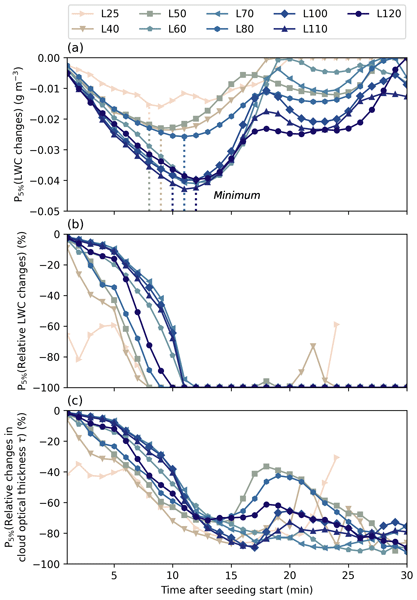
The interplay of liquid and ice particles in clouds is a crucial driver for forming rain over land. We use numerical simulations to evaluate how fast clouds can be glaciated through ice particles and how this depends on different initial states of the cloud. We find that the more water a cloud contains, the longer the glaciation takes while any additional turbulent mixing does not have a major impact.
Kevin Ohneiser, Patric Seifert, Willi Schimmel, Fabian Senf, Tom Gaudek, Martin Radenz, Audrey Teisseire, Veronika Ettrichrätz, Teresa Vogl, Nina Maherndl, Nils Pfeifer, Jan Henneberger, Anna J. Miller, Nadja Omanovic, Christopher Fuchs, Huiying Zhang, Fabiola Ramelli, Robert Spirig, Anton Kötsche, Heike Kalesse-Los, Maximilian Maahn, Heather Corden, Alexis Berne, Majid Hajipour, Hannes Griesche, Julian Hofer, Ronny Engelmann, Annett Skupin, Albert Ansmann, and Holger Baars
Atmos. Chem. Phys., 25, 17363–17386, https://doi.org/10.5194/acp-25-17363-2025, https://doi.org/10.5194/acp-25-17363-2025, 2025
Short summary
Short summary
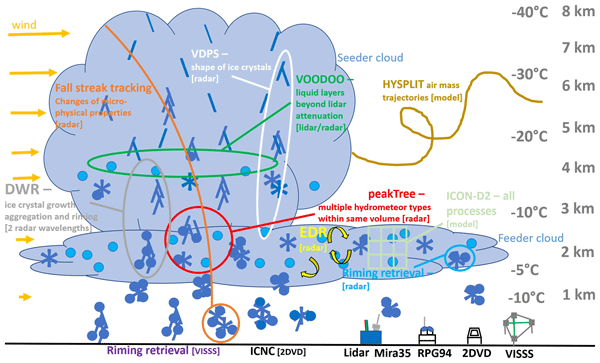
This study focuses on a seeder-feeder cloud system on 8 Jan 2024 in Eriswil, Switzerland. It is shown how the interaction of these cloud systems changes the cloud microphysical properties and the precipitation patterns. A big set of advanced remote-sensing techniques and retrieval algorithms are applied, so that a detailed view on the seeder-feeder cloud system is available. The gained knowledge can be used to improve weather models and weather forecasts.
Christopher Fuchs, Fabiola Ramelli, Anna J. Miller, Nadja Omanovic, Robert Spirig, Huiying Zhang, Patric Seifert, Kevin Ohneiser, Ulrike Lohmann, and Jan Henneberger
Atmos. Chem. Phys., 25, 12177–12196, https://doi.org/10.5194/acp-25-12177-2025, https://doi.org/10.5194/acp-25-12177-2025, 2025
Short summary
Short summary
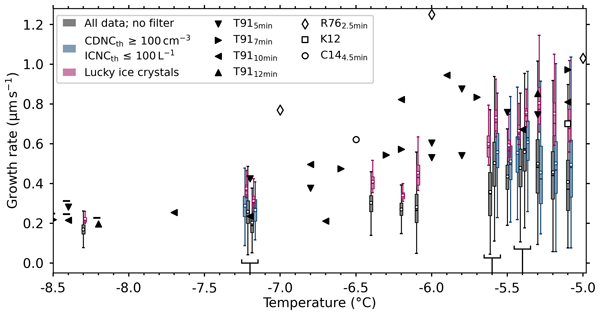
We quantify diffusional ice crystal growth in natural clouds using cloud seeding experiments. We report growth rates for 14 experiments between −5.1 °C and −8.3 °C and observe strong variations depending on the cloud characteristics. Comparing our growth rates to laboratory data, we found similar temperature-dependent trends, but the laboratory rates are higher. These data fill the gap in quantitative in situ observation of ice crystal growth, helping to validate models and laboratory experiments.
Huiying Zhang, Fabiola Ramelli, Christopher Fuchs, Nadja Omanovic, Anna J. Miller, Robert Spirig, Zhaolong Wu, Yunpei Chu, Xia Li, Ulrike Lohmann, and Jan Henneberger
EGUsphere, https://doi.org/10.5194/egusphere-2025-4397, https://doi.org/10.5194/egusphere-2025-4397, 2025
Short summary
Short summary
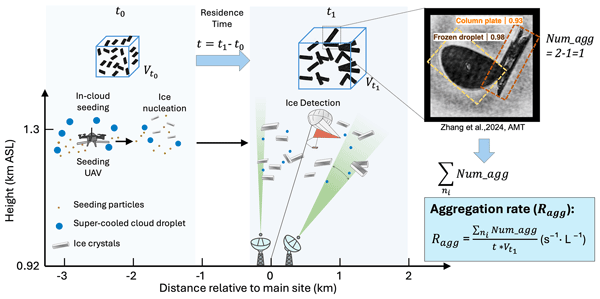
Ice crystals in clouds aggregate, shaping snow and rain, yet rates are hard to measure. Using cloud seeding, we sampled crystals downwind after known times. A deep-learning algorithm quantified aggregation by counting crystal components. Initial ice concentration was the main driver, confirmed by causal analysis, physics, and machine learning, though weaker than theory predicts. Temperature, size, and shape also mattered, while turbulence was negligible.
Anna J. Miller, Christopher Fuchs, Fabiola Ramelli, Huiying Zhang, Nadja Omanovic, Robert Spirig, Claudia Marcolli, Zamin A. Kanji, Ulrike Lohmann, and Jan Henneberger
Atmos. Chem. Phys., 25, 5387–5407, https://doi.org/10.5194/acp-25-5387-2025, https://doi.org/10.5194/acp-25-5387-2025, 2025
Short summary
Short summary
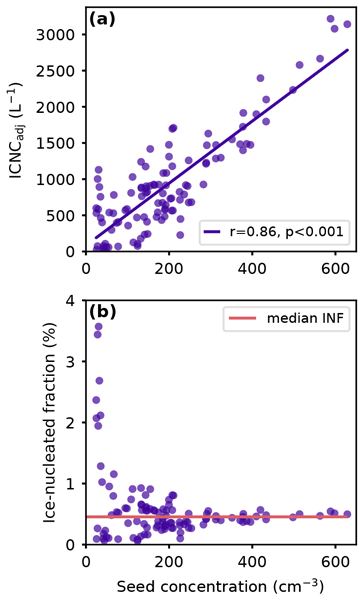
We analyzed the ability of silver iodide particles (a commonly used cloud-seeding agent) to form ice crystals in naturally occurring liquid clouds at −5 to −8 °C and found that only ≈ 0.1 %−1 % of particles nucleate ice, with a negative dependence on temperature. By contextualizing our results with previous laboratory studies, we help to bridge the gap between laboratory and field experiments, which also helps to inform future cloud-seeding projects.
Nadja Omanovic, Brigitta Goger, and Ulrike Lohmann
Atmos. Chem. Phys., 24, 14145–14175, https://doi.org/10.5194/acp-24-14145-2024, https://doi.org/10.5194/acp-24-14145-2024, 2024
Short summary
Short summary
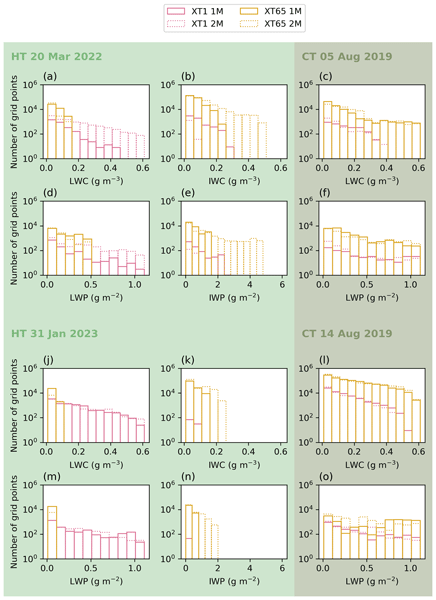
We evaluated the numerical weather model ICON in two horizontal resolutions with two bulk microphysics schemes over hilly and complex terrain in Switzerland and Austria, respectively. We focused on the model's ability to simulate mid-level clouds in summer and winter. By combining observational data from two different field campaigns, we show that an increase in the horizontal resolution and a more advanced cloud microphysics scheme is strongly beneficial for cloud representation.
Nadja Omanovic, Sylvaine Ferrachat, Christopher Fuchs, Jan Henneberger, Anna J. Miller, Kevin Ohneiser, Fabiola Ramelli, Patric Seifert, Robert Spirig, Huiying Zhang, and Ulrike Lohmann
Atmos. Chem. Phys., 24, 6825–6844, https://doi.org/10.5194/acp-24-6825-2024, https://doi.org/10.5194/acp-24-6825-2024, 2024
Short summary
Short summary
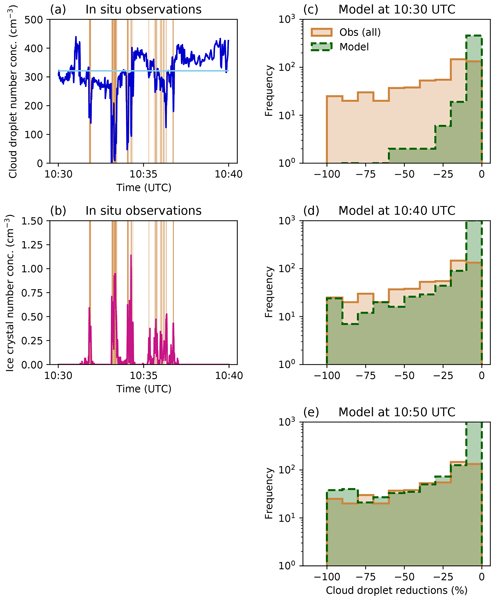
We present simulations with a high-resolution numerical weather prediction model to study the growth of ice crystals in low clouds following glaciogenic seeding. We show that the simulated ice crystals grow slower than observed and do not consume as many cloud droplets as measured in the field. This may have implications for forecasting precipitation, as the ice phase is crucial for precipitation at middle and high latitudes.
Anna J. Miller, Fabiola Ramelli, Christopher Fuchs, Nadja Omanovic, Robert Spirig, Huiying Zhang, Ulrike Lohmann, Zamin A. Kanji, and Jan Henneberger
Atmos. Meas. Tech., 17, 601–625, https://doi.org/10.5194/amt-17-601-2024, https://doi.org/10.5194/amt-17-601-2024, 2024
Short summary
Short summary
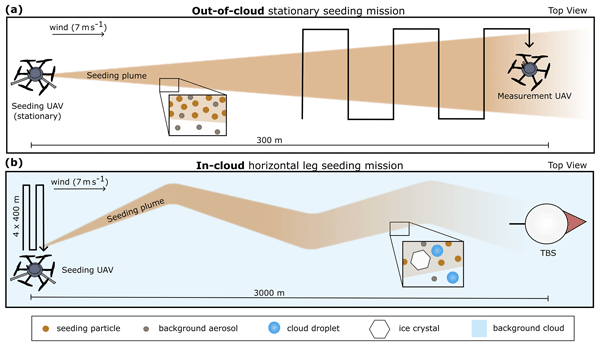
We present a method for aerosol and cloud research using two uncrewed aerial vehicles (UAVs). The UAVs have a propeller heating mechanism that allows flights in icing conditions, which has so far been a limitation for cloud research with UAVs. One UAV burns seeding flares, producing a plume of particles that causes ice formation in supercooled clouds. The second UAV measures aerosol size distributions and is used for measuring the seeding plume or for characterizing the boundary layer.
Colin Tully, David Neubauer, Nadja Omanovic, and Ulrike Lohmann
Atmos. Chem. Phys., 22, 11455–11484, https://doi.org/10.5194/acp-22-11455-2022, https://doi.org/10.5194/acp-22-11455-2022, 2022
Short summary
Short summary
The proposed geoengineering method, cirrus cloud thinning, was evaluated using a more physically based microphysics scheme coupled to a more realistic approach for calculating ice cloud fractions in the ECHAM-HAM GCM. Sensitivity tests reveal that using the new ice cloud fraction approach and increasing the critical ice saturation ratio for ice nucleation on seeding particles reduces warming from overseeding. However, this geoengineering method is unlikely to be feasible on a global scale.
Cited articles
Ban, N., Schmidli, J., and Schär, C.: Heavy precipitation in a changing climate: Does short-term summer precipitation increase faster?, Geophysical Research Letters, 42, 1165–1172, https://doi.org/10.1002/2014GL062588, 2015. a
Barrett, A. I., Wellmann, C., Seifert, A., Hoose, C., Vogel, B., and Kunz, M.: One Step at a Time: How Model Time Step Significantly Affects Convection-Permitting Simulations, Journal of Advances in Modeling Earth Systems, 11, 641–658, https://doi.org/10.1029/2018MS001418, 2019. a
Bauer, P., Thorpe, A., and Brunet, G.: The quiet revolution of numerical weather prediction, Nature, 525, 47–55, https://doi.org/10.1038/nature14956, 2015. a
Blahak, U.: Towards a better representation of high density ice particles in a state-of-the-art two-moment bulk microphysical scheme, in: Proc. 15th Int. Conf. Clouds and Precip., vol. 20208, Cancun, Mexico, https://api.semanticscholar.org/CorpusID:201686126 (last access; 14 January 2026), 2008. a, b
Bolt, S. and Omanovic, N.: Data for publication “Evaluation of Semi-Implicit and Explicit Sedimentation Approaches in the Two-Moment Cloud Microphysics Scheme of ICON”, Zenodo [data set], https://doi.org/10.5281/zenodo.15608274, 2025a. a
Bolt, S. and Omanovic, N.: ICON code modifications for publication “Evaluation of Semi-Implicit and Explicit Sedimentation Approaches in the Two-Moment Cloud Microphysics Scheme of ICON”, Zenodo [code], https://doi.org/10.5281/zenodo.17728555, 2025b. a
Bolt, S. and Omanovic, N.: Scripts for publication “Evaluation of Semi-Implicit and Explicit Sedimentation Approaches in the Two-Moment Cloud Microphysics Scheme of ICON”, Zenodo [code], https://doi.org/10.5281/zenodo.15609458, 2025c. a
Crameri, F., Shephard, G. E., and Heron, P. J.: The misuse of colour in science communication, Nature Communications, 11, https://doi.org/10.1038/s41467-020-19160-7, 2020. a
Dai, A.: Global Precipitation and Thunderstorm Frequencies. Part II: Diurnal Variations, Journal of Climate, 14, 1112–1128, https://doi.org/10.1175/1520-0442(2001)014<1112:GPATFP>2.0.CO;2, 2001. a
Doms, G., Förstner, J., Heise, E., Herzog, H.-J., Mironov, D., Raschendorfer, M., Reinhardt, T., Ritter, B., Schrodin, R., Schulz, J.-P., and Vogel, G.: COSMO-Model Version 6.00: A Description of the Nonhydrostatic Regional COSMO-Model – Part II: Physical Parametrizations, https://doi.org/10.5676/DWD_PUB/NWV/COSMO-DOC_6.00_II, 2021. a, b, c
Feldmann, M., Germann, U., Gabella, M., and Berne, A.: A characterisation of Alpine mesocyclone occurrence, Weather Clim. Dynam., 2, 1225–1244, https://doi.org/10.5194/wcd-2-1225-2021, 2021. a
Fuhrer, O., Osuna, C., Lapillonne, X., Gysi, T., Cumming, B., Bianco, M., Arteaga, A., and Schulthess, T. C.: Towards a performance portable, architecture agnostic implementation strategy for weather and climate models, Supercomputing Frontiers and Innovations, 1, 45–62, https://doi.org/10.14529/jsfi140103, 2014. a
Fuhrer, O., Chadha, T., Hoefler, T., Kwasniewski, G., Lapillonne, X., Leutwyler, D., Lüthi, D., Osuna, C., Schär, C., Schulthess, T. C., and Vogt, H.: Near-global climate simulation at 1 km resolution: establishing a performance baseline on 4888 GPUs with COSMO 5.0, Geosci. Model Dev., 11, 1665–1681, https://doi.org/10.5194/gmd-11-1665-2018, 2018. a
Heim, C., Panosetti, D., Schlemmer, L., Leuenberger, D., and Schär, C.: The Influence of the Resolution of Orography on the Simulation of Orographic Moist Convection, Monthly Weather Review, 148, 2391–2410, https://doi.org/10.1175/MWR-D-19-0247.1, 2020. a
Heinze, R., Dipankar, A., Henken, C. C., Moseley, C., Sourdeval, O., Trömel, S., Xie, X., Adamidis, P., Ament, F., Baars, H., Barthlott, C., Behrendt, A., Blahak, U., Bley, S., Brdar, S., Brueck, M., Crewell, S., Deneke, H., Di Girolamo, P., Evaristo, R., Fischer, J., Frank, C., Friederichs, P., Göcke, T., Gorges, K., Hande, L., Hanke, M., Hansen, A., Hege, H.-C., Hoose, C., Jahns, T., Kalthoff, N., Klocke, D., Kneifel, S., Knippertz, P., Kuhn, A., van Laar, T., Macke, A., Maurer, V., Mayer, B., Meyer, C. I., Muppa, S. K., Neggers, R. A. J., Orlandi, E., Pantillon, F., Pospichal, B., Röber, N., Scheck, L., Seifert, A., Seifert, P., Senf, F., Siligam, P., Simmer, C., Steinke, S., Stevens, B., Wapler, K., Weniger, M., Wulfmeyer, V., Zängl, G., Zhang, D., and Quaas, J.: Large-eddy simulations over Germany using ICON: a comprehensive evaluation, Quarterly Journal of the Royal Meteorological Society, 143, 69–100, https://doi.org/10.1002/qj.2947, 2017. a
ICON partnership (MPI-M, DWD, DKRZ, KIT, and C2SM): ICON release 2024.10, WDC Climate [code], https://doi.org/10.35089/WDCC/IconRelease2024.10, 2024. a, b
Kendon, E. J., Roberts, N. M., Fowler, H. J., Roberts, M. J., Chan, S. C., and Senior, C. A.: Heavier summer downpours with climate change revealed by weather forecast resolution model, Nature Climate Change, 4, 570–576, https://doi.org/10.1038/nclimate2258, 2014. a
Lean, H. W., Clark, P. A., Dixon, M., Roberts, N. M., Fitch, A., Forbes, R., and Halliwell, C.: Characteristics of High-Resolution Versions of the Met Office Unified Model for Forecasting Convection over the United Kingdom, Monthly Weather Review, 136, 3408–3424, https://doi.org/10.1175/2008MWR2332.1, 2008. a
Leutwyler, D., Fuhrer, O., Lapillonne, X., Lüthi, D., and Schär, C.: Towards European-scale convection-resolving climate simulations with GPUs: a study with COSMO 4.19, Geosci. Model Dev., 9, 3393–3412, https://doi.org/10.5194/gmd-9-3393-2016, 2016. a
Mansell, E. R.: On Sedimentation and Advection in Multimoment Bulk Microphysics, Journal of the Atmospheric Sciences, 67, 3084–3094, https://doi.org/10.1175/2010JAS3341.1, 2010. a, b
Mikkola, J., Sinclair, V. A., Bister, M., and Bianchi, F.: Daytime along-valley winds in the Himalayas as simulated by the Weather Research and Forecasting (WRF) model, Atmos. Chem. Phys., 23, 821–842, https://doi.org/10.5194/acp-23-821-2023, 2023. a
Milbrandt, J. A. and Yau, M. K.: A Multimoment Bulk Microphysics Parameterization. Part I: Analysis of the Role of the Spectral Shape Parameter, Journal of the Atmospheric Sciences, 62, 3051–3064, https://doi.org/10.1175/JAS3534.1, 2005. a, b
Miyamoto, Y., Kajikawa, Y., Yoshida, R., Yamaura, T., Yashiro, H., and Tomita, H.: Deep moist atmospheric convection in a subkilometer global simulation, Geophysical Research Letters, 40, 4922–4926, https://doi.org/10.1002/grl.50944, 2013. a
Noppel, H., Blahak, U., Seifert, A., and Beheng, K. D.: Simulations of a hailstorm and the impact of CCN using an advanced two-moment cloud microphysical scheme, Atmospheric Research, 96, 286–301, https://doi.org/10.1016/j.atmosres.2009.09.008, 2010. a
Omanovic, N., Goger, B., and Lohmann, U.: The impact of the mesh size and microphysics scheme on the representation of mid-level clouds in the ICON model in hilly and complex terrain, Atmos. Chem. Phys., 24, 14145–14175, https://doi.org/10.5194/acp-24-14145-2024, 2024. a
Owens, J. D., Houston, M., Luebke, D., Green, S., Stone, J. E., and Phillips, J. C.: GPU Computing, Proceedings of the IEEE, 96, 879–899, https://doi.org/10.1109/JPROC.2008.917757, 2008. a
Paredes, E. G., Groner, L., Ubbiali, S., Vogt, H., Madonna, A., Mariotti, K., Cruz, F., Benedicic, L., Bianco, M., VandeVondele, J., and Schulthess, T. C.: GT4Py: High Performance Stencils for Weather and Climate Applications using Python, arXiv [preprint], https://doi.org/10.48550/arXiv.2311.08322, 2023. a
Project ICON-22: ICON-22 – MeteoSwiss, https://www.meteoswiss.admin.ch/about-us/research-and-cooperation/projects/2023/icon-22.html, last access: 7 May 2025. a
Reinert, D., Rieger, D., and Prill, F.: ICON Tutorial 2024: Working with the ICON Model, https://doi.org/10.5676/DWD_PUB/NWV/ ICON_TUTORIAL2024, 2024. a
Reinert, D., Prill, F., Frank, H., Denhard, M., Baldauf, M., Schraff, C., Gebhardt, C., Marsigli, C., Förstner, J., Zängl, G., Schlemmer, L., Blahak, U., and Welzbacher, C.: DWD Database Reference for the Global and Regional ICON and ICON-EPS Forecasting System, version 2.5.0, https://www.dwd.de/SharedDocs/downloads/DE/modelldokumentationen/nwv/icon/icon_dbbeschr_aktuell.pdf, last access: 7 May 2025. a
Schmidli, J., Böing, S., and Fuhrer, O.: Accuracy of Simulated Diurnal Valley Winds in the Swiss Alps: Influence of Grid Resolution, Topography Filtering, and Land Surface Datasets, Atmosphere, 9, https://doi.org/10.3390/atmos9050196, 2018. a
Segal, Y. and Khain, A.: Dependence of droplet concentration on aerosol conditions in different cloud types: Application to droplet concentration parameterization of aerosol conditions, Journal of Geophysical Research: Atmospheres, 111, https://doi.org/10.1029/2005JD006561, 2006. a
Seifert, A.: On the Parameterization of Evaporation of Raindrops as Simulated by a One-Dimensional Rainshaft Model, Journal of the Atmospheric Sciences, 65, 3608–3619, https://doi.org/10.1175/2008JAS2586.1, 2008. a, b
Seifert, A. and Beheng, K. D.: A two-moment cloud microphysics parameterization for mixed-phase clouds. Part 1: Model description, Meteorology and Atmospheric Physics, 92, 45–66, https://doi.org/10.1007/s00703-005-0112-4, 2006. a, b
Seifert, A., Blahak, U., and Buhr, R.: On the analytic approximation of bulk collision rates of non-spherical hydrometeors, Geosci. Model Dev., 7, 463–478, https://doi.org/10.5194/gmd-7-463-2014, 2014. a
Skamarock, W. C.: Positive-Definite and Monotonic Limiters for Unrestricted-Time-Step Transport Schemes, Monthly Weather Review, 134, 2241–2250, https://doi.org/10.1175/MWR3170.1, 2006. a
Smolarkiewicz, P. K. and Pudykiewicz, J. A.: A Class of Semi-Lagrangian Approximations for Fluids, Journal of Atmospheric Sciences, 49, 2082–2096, https://doi.org/10.1175/1520-0469(1992)049<2082:ACOSLA>2.0.CO;2, 1992. a, b, c
Staniforth, A. and Côté, J.: Semi-Lagrangian Integration Schemes for Atmospheric Models – A Review, Monthly Weather Review, 119, 2206–2223, https://doi.org/10.1175/1520-0493(1991)119<2206:SLISFA>2.0.CO;2, 1991. a
Stevens, B., Acquistapace, C., Hansen, A., Heinze, R., Klinger, C., Klocke, D., Rybka, H., Schubotz, W., Windmiller, J., Adamidis, P., Arka, I., Barlakas, V., Biercamp, J., Brueck, M., Brune, S., Buehler, S. A., Burkhardt, U., Cioni, G., Costa-Surós, M., Crewell, S., Crüger, T., Deneke, H., Friederichs, P., Henken, C. C., Hohenegger, C., Jacob, M., Jakub, F., Kalthoff, N., Köhler, M., van Laar, T. W., Li, P., Löhnert, U., Macke, A., Madenach, N., Mayer, B., Nam, C., Naumann, A. K., Peters, K., Poll, S., Quaas, J., Röber, N., Rochetin, N., Scheck, L., Schemann, V., Schnitt, S., Seifert, A., Senf, F., Shapkalijevski, M., Simmer, C., Singh, S., Sourdeval, O., Spickermann, D., Strandgren, J., Tessiot, O., Vercauteren, N., Vial, J., Voigt, A., and Zängl, G.: The Added Value of Large-eddy and Storm-resolving Models for Simulating Clouds and Precipitation, Journal of the Meteorological Society of Japan. Ser. II, 98, 395–435, https://doi.org/10.2151/jmsj.2020-021, 2020. a
Wacker, U. and Seifert, A.: Evolution of rain water profiles resulting from pure sedimentation: Spectral vs. parameterized description, Atmospheric Research, 58, 19–39, https://doi.org/10.1016/S0169-8095(01)00081-3, 2001. a, b, c
Zängl, G., Reinert, D., Rípodas, P., and Baldauf, M.: The ICON (ICOsahedral Non-hydrostatic) modelling framework of DWD and MPI-M: Description of the non-hydrostatic dynamical core, Quarterly Journal of the Royal Meteorological Society, 141, 563–579, https://doi.org/10.1002/qj.2378, 2015. a
Short summary
We examined the two-moment cloud microphysics sedimentation schemes of the ICON (ICOsahedral Nonhydrostatic) weather model, comparing the default semi-implicit with an explicit method faster on graphics processing units. Using idealized setups and thunderstorm case studies, we find differences in numerical diffusion and extreme precipitation rates due to changed coupling with the remaining microphysics. Neither method develops alarming instabilities in full model setups; both can be safely used.
We examined the two-moment cloud microphysics sedimentation schemes of the ICON (ICOsahedral...