Articles | Volume 19, issue 2
https://doi.org/10.5194/gmd-19-579-2026
Development and technical paper
 | 
19 Jan 2026
Development and technical paper |  | 19 Jan 2026

Examining spin-up behaviour within WRF dynamical downscaling applications

Megan S. Mallard, Tanya L. Spero, Jared H. Bowden, Jeff Willison, Christopher G. Nolte, and Anna M. Jalowska

Related authors

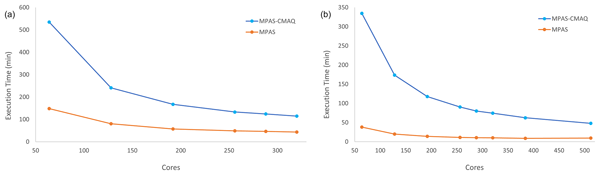
Development of the MPAS-CMAQ coupled system (V1.0) for multiscale global air quality modeling
David C. Wong, Jeff Willison, Jonathan E. Pleim, Golam Sarwar, James Beidler, Russ Bullock, Jerold A. Herwehe, Rob Gilliam, Daiwen Kang, Christian Hogrefe, George Pouliot, and Hosein Foroutan
Geosci. Model Dev., 17, 7855–7866, https://doi.org/10.5194/gmd-17-7855-2024,https://doi.org/10.5194/gmd-17-7855-2024, 2024
Short summary
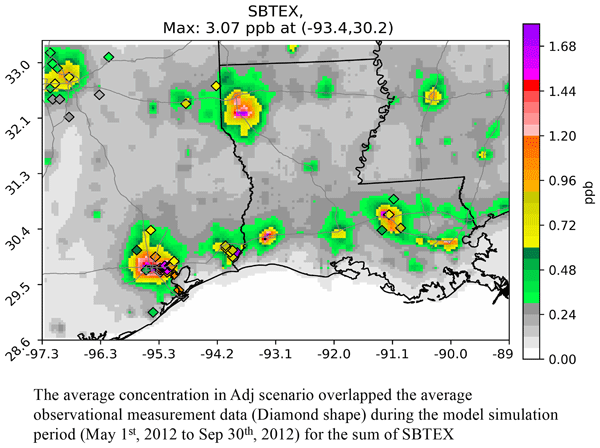
Spatiotemporally resolved emissions and concentrations of styrene, benzene, toluene, ethylbenzene, and xylenes (SBTEX) in the US Gulf region
Chi-Tsan Wang, Bok H. Baek, William Vizuete, Lawrence S. Engel, Jia Xing, Jaime Green, Marc Serre, Richard Strott, Jared Bowden, and Jung-Hun Woo
Earth Syst. Sci. Data, 15, 5261–5279, https://doi.org/10.5194/essd-15-5261-2023,https://doi.org/10.5194/essd-15-5261-2023, 2023
Short summary
Lightning assimilation in the WRF model (Version 4.1.1): technique updates and assessment of the applications from regional to hemispheric scales
Daiwen Kang, Nicholas K. Heath, Robert C. Gilliam, Tanya L. Spero, and Jonathan E. Pleim
Geosci. Model Dev., 15, 8561–8579, https://doi.org/10.5194/gmd-15-8561-2022,https://doi.org/10.5194/gmd-15-8561-2022, 2022
Short summary
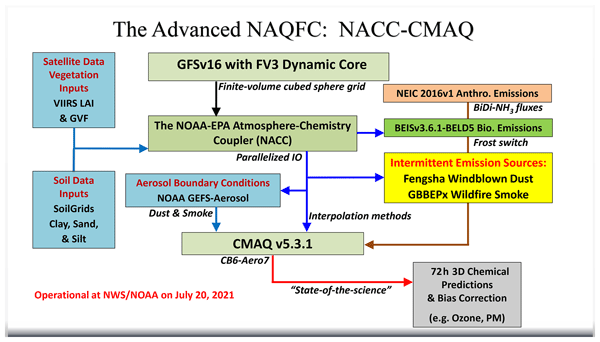
Development and evaluation of an advanced National Air Quality Forecasting Capability using the NOAA Global Forecast System version 16
Patrick C. Campbell, Youhua Tang, Pius Lee, Barry Baker, Daniel Tong, Rick Saylor, Ariel Stein, Jianping Huang, Ho-Chun Huang, Edward Strobach, Jeff McQueen, Li Pan, Ivanka Stajner, Jamese Sims, Jose Tirado-Delgado, Youngsun Jung, Fanglin Yang, Tanya L. Spero, and Robert C. Gilliam
Geosci. Model Dev., 15, 3281–3313, https://doi.org/10.5194/gmd-15-3281-2022,https://doi.org/10.5194/gmd-15-3281-2022, 2022
Short summary
The Detailed Emissions Scaling, Isolation, and Diagnostic (DESID) module in the Community Multiscale Air Quality (CMAQ) modeling system version 5.3.2
Benjamin N. Murphy, Christopher G. Nolte, Fahim Sidi, Jesse O. Bash, K. Wyat Appel, Carey Jang, Daiwen Kang, James Kelly, Rohit Mathur, Sergey Napelenok, George Pouliot, and Havala O. T. Pye
Geosci. Model Dev., 14, 3407–3420, https://doi.org/10.5194/gmd-14-3407-2021,https://doi.org/10.5194/gmd-14-3407-2021, 2021
Short summary

Cited articles

Bowden, J. H., Otte, T. L., Nolte, C. G., and Otte, M. J.: Examining interior grid nudging techniques using two-way nesting in the WRF model for regional climate modeling, J. Climate, 25, 2805–2823, https://doi.org/10.1175/JCLI-D-11-00167.1, 2012. 
Chaney, N. W., Herman, J. D., Ek, M. B., and Wood, E. F.: Deriving global parameter estimates for the Noah land surface model using FLUXNET and machine learning, J. Geophys. Res. Atmos., 121, 13218–13235, https://doi.org/10.1002/2016JD024821, 2016. 
Chen, F. and Dudhia, J.: Coupling an advanced land surface–hydrology model with the Penn State–NCAR MM5 modeling system. Part I: Model implementation and sensitivity, Mon. Weather Rev., 129, 569–585, https://doi.org/10.1175/1520-0493(2001)129%3C0569:CAALSH%3E2.0.CO;2, 2001. 
CORDEX: Experiment protocol CORDEX-CMIP6 RCMs, https://cordex.org/experiment-guidelines/cordex-cmip6/experiment-protocol-cordex-cmip6-rcms/ (last access: 5 March 2025), 2021. 
Cosgrove, B. A., Lohmann, D., Mitchell, K. E., Houser, P. R., Wood, E. F., Schaake, J. C., Robock, A., Sheffield, J., Duan, Q., Luo, L., Higgins, R. W., Pinker, R. T., and Tarpley, J. D.: Land surface model spin-up behavior in the North American Land Data Assimilation System (NLDAS), J. Geophys. Res., 108, 8845, https://doi.org/10.1029/2002JD003316, 2003. 
Download
Short summary
“Spin-up” is time needed for a model’s result to become effectively free of influence from initial conditions, and it is usually excluded from analysis. Here, spin-up is examined by comparing one decadal simulation to another initialized 20 years prior, in order to determine when their solutions converge. Differences lessen over the first fall and winter, but re-emerge over the following spring and summer, suggesting that at least 1 annual cycle is needed to spin up regional climate simulations.
Share