
Articles | Volume 19, issue 12
https://doi.org/10.5194/gmd-19-5743-2026
© Author(s) 2026. This work is distributed under
the Creative Commons Attribution 4.0 License.
the Creative Commons Attribution 4.0 License.
https://doi.org/10.5194/gmd-19-5743-2026
© Author(s) 2026. This work is distributed under
the Creative Commons Attribution 4.0 License.
the Creative Commons Attribution 4.0 License.
Model evaluation paper
| 
01 Jul 2026
Model evaluation paper |
| 01 Jul 2026
| 01 Jul 2026
Optimization of snow cover fraction parameterization in the Community Land Model: implementation and preliminary validation over the Tibetan Plateau
Kai Yang
CORRESPONDING AUTHOR
Institute of Mountain Hazards and Environment, Chinese Academy of Sciences, Chengdu, China
Chenghai Wang
Key Laboratory of Climate Resource Development and Disaster Prevention of Gansu Province, Research and Development Center of Earth System Model, College of Atmospheric Sciences, Lanzhou University, Lanzhou, China
Ningxia Meteorological Bureau, Yinchuan, China
Lingyun Ai
Key Laboratory of Climate Resource Development and Disaster Prevention of Gansu Province, Research and Development Center of Earth System Model, College of Atmospheric Sciences, Lanzhou University, Lanzhou, China
Feimin Zhang
Key Laboratory of Climate Resource Development and Disaster Prevention of Gansu Province, Research and Development Center of Earth System Model, College of Atmospheric Sciences, Lanzhou University, Lanzhou, China
Pinghan Zhaoye
Key Laboratory of Climate Resource Development and Disaster Prevention of Gansu Province, Research and Development Center of Earth System Model, College of Atmospheric Sciences, Lanzhou University, Lanzhou, China
Changzhou Environmental Monitoring Center of Jiangsu Province, Changzhou, China
Related authors
Lingyun Ai, Kai Yang, Feimin Zhang, Chenghai Wang, Tonghua Wu, Qi Qi, and Haohui Li
EGUsphere, https://doi.org/10.5194/egusphere-2025-5676, https://doi.org/10.5194/egusphere-2025-5676, 2026
Preprint archived
Short summary
Short summary
Since the early 1990s, the Siberian continuous permafrost has experienced markedly increased interannual variability in winter soil temperature. This heightened thermal instability is primarily driven by more variable winter snow depth, which insulates the soil. The influence extends meters deep, threatening permafrost stability and elevating risks of carbon release and ecosystem change under climate warming.
Feimin Zhang, Kaixuan Bi, Xing Chen, Yi Yang, Fang Yang, and Chenghai Wang
Earth Syst. Sci. Data, 18, 3711–3728, https://doi.org/10.5194/essd-18-3711-2026, https://doi.org/10.5194/essd-18-3711-2026, 2026
Short summary
Short summary
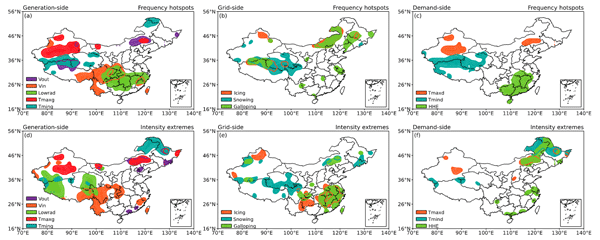
The China New-type Power Systems Meteorological (CNPS-Met) dataset covers mainland China with a daily resolution and a 25 km grid. It includes eight meteorological variables and eleven high-impact weather events related to power generation, grid transmission, and electricity demand. CNPS-Met outperforms other existing datasets in accuracy for most meteorological variables. We also quantified the frequency hotspots and intensity extremes of high-impact weather events.
Lingyun Ai, Kai Yang, Feimin Zhang, Chenghai Wang, Tonghua Wu, Qi Qi, and Haohui Li
EGUsphere, https://doi.org/10.5194/egusphere-2025-5676, https://doi.org/10.5194/egusphere-2025-5676, 2026
Preprint archived
Short summary
Short summary
Since the early 1990s, the Siberian continuous permafrost has experienced markedly increased interannual variability in winter soil temperature. This heightened thermal instability is primarily driven by more variable winter snow depth, which insulates the soil. The influence extends meters deep, threatening permafrost stability and elevating risks of carbon release and ecosystem change under climate warming.
Ruolin Li, Yang Cui, and Qi Feng
EGUsphere, https://doi.org/10.5194/egusphere-2025-5752, https://doi.org/10.5194/egusphere-2025-5752, 2025
This preprint is open for discussion and under review for Earth System Dynamics (ESD).
Short summary
Short summary
Precipitation recycling is typically viewed as an atmospheric process, but we show that land-surface conditions actively regulate its timing. By analyzing rainfall events in a dryland region, we find that the persistence of soil cooling (thermal memory) significantly delays the return of recycled moisture to the atmosphere. This reveals a new "coupling-memory-recycling" pathway where soil thermodynamics control the tempo of the local water cycle.
Ruolin Li, Yang Cui, and Qi Feng
EGUsphere, https://doi.org/10.5194/egusphere-2025-5314, https://doi.org/10.5194/egusphere-2025-5314, 2025
Preprint archived
Short summary
Short summary
Rainfall can recycle within the atmosphere, meaning that some of the water that falls as rain evaporates and falls again nearby. This study explores how such recycling behaves during short wet periods in north-western China’s semi-arid region. Using weather data and machine learning, we found that stronger rain does not endlessly increase local recycling. This self-limiting feedback helps keep the regional water cycle balanced under a wetter climate.
Cited articles
Cui, T., Li, C., and Tian, F.: Evaluation of temperature and precipitation simulations in CMIP6 models over the Tibetan Plateau, Earth Space Sci., 8, e2020EA001620, https://doi.org/10.1029/2020EA001620, 2021.
Domine, F., Fourteau, K., Picard, G., Lackner, G., Sarrazin, D., and Poirier, M.: Permafrost cooled in winter by thermal bridging through snow-covered shrub branches, Nat. Geosci., 15, 554–560, https://doi.org/10.1038/s41561-022-00979-2, 2022.
Douville, H., Royer, J. F., and Mahfouf, J. F.: A new snow parameterization for the Meteo-France climate model. Part II: Validation in a 3-D GCM experiment, Clim. Dynam., 12, 37–52, https://doi.org/10.1007/BF00208761, 1995.
Ehlers, T. A., Chen, D., Appel, E., Bolch, T., Chen, F., Diekmann, B., Dippold, M. A., Giese, M., Guggenberger, G., Lai, H.-W., Li, X., Liu, J., Liu, Y., Ma, Y., Miehe, G., Mosbrugger, V., Mulch, A., Piao, S., Schwalb, A., Thompson, L. G., Su, Z., Sun, H., Yao, T., Yang, X., Yang, K., and Zhu, L.: Past, present, and future geo-biosphere interactions on the Tibetan Plateau and implications for permafrost, Earth-Sci. Rev., 234, 104197, https://doi.org/10.1016/j.earscirev.2022.104197, 2022.
He, J., Yang, K., Tang, W., Lu, H., Qin, J., Chen, Y. Y., and Li, X.: The first high-resolution meteorological forcing dataset for land process studies over China, Sci. Data, 7, 25, https://doi.org/10.1038/s41597-020-0369-y, 2020.
Henderson, G. R., Peings, Y., Furtado, J. C., and Kushner, P. J.: Snow–atmosphere coupling in the Northern Hemisphere, Nat. Clim. Change, 8, 954–963, https://doi.org/10.1038/s41558-018-0295-6, 2018.
Jennings, K. S., Collins, M., Hatchett, B. J., Heggli, A., Hur, N., Tonino, S., Nolin, A. W., Yu, G., Zhang, W., and Arienzo, M. M.: Machine learning shows a limit to rain-snow partitioning accuracy when using near-surface meteorology, Nat. Commun., 16, 2929, https://doi.org/10.1038/s41467-025-58234-2, 2025.
Jiang, Y., Chen, F., Gao, Y., He, C., Barlage, M., and Huang, W.: Assessment of uncertainty sources in snow cover simulation in the Tibetan plateau, J. Geophys. Res.-Atmos., 125, e2020JD032674, https://doi.org/10.1029/2020JD032674, 2020.
Jiang, Y., Yang, K., Qi, Y., Zhou, X., He, J., Lu, H., Li, X., Chen, Y., Li, X. D., Zhou, B., Mamtimin, A., Shao, C., Ma, X., Tian, J., and Zhou, J.: TPHiPr: a long-term (1979–2020) high-accuracy precipitation dataset (1/30°, daily) for the Third Pole region based on high-resolution atmospheric modeling and dense observations, Earth Syst. Sci. Data, 15, 621–638, https://doi.org/10.5194/essd-15-621-2023, 2023.
Lawrence, D. M., Fisher, R. A., Koven, C. D., Oleson, K. W., Swenson, S. C., Bonan, G., Collier, N., Ghimire, B., van Kampenhout, L., Kennedy, D., Kluzek, E., Lawrence, P. J., Li, F., Li, H., Lombardozzi, D., Riley, W. J., Sacks, W. J., Shi, M., Vertenstein, M., Wieder, W. R., Xu, C., Ali, A. A., Badger, A. M., Bisht, G., van den Broeke, M., Brunke, M. A., Burns, S. P., Buzan, J., Clark, M., Craig, A., Dahlin, K., Drewniak, B., Fisher, J. B., Flanner, M., Fox, A. M., Gentine, P., Hoffman, F., Keppel-Aleks, G., Knox, R., Kumar, S., Lenaerts, J., Leung, L. R., Lipscomb, W. H., Lu, Y., Pandey, A., Pelletier, J. D., Perket, J., Randerson, J. T., Ricciuto, D. M., Sanderson, B. M., Slater, A., Subin, Z. M., Tang, J., Thomas, R. Q., Val Martin, M., and Zeng, X.: The Community Land Model version 5: Description of new features, benchmarking, and impact of forcing uncertainty, J. Adv. Model. Earth Syst., 11, 4245–4287, https://doi.org/10.1029/2018MS001583, 2019.
Lawrence, P. J. and Chase, T. N.: Representing a new MODIS consistent land surface in the Community Land Model (CLM 3.0), J. Geophys. Res., 112, G01023, https://doi.org/10.1029/2006JG000168, 2007.
Leroux, N. R., Vionnet, V., and Thériault, J. M.: Performance of precipitation phase partitioning methods and their impact on snowpack evolution in a humid continental climate, Hydrol. Process., 37, e15028, https://doi.org/10.1002/hyp.15028, 2023.
Liang, S., Cheng, J., Jia, K., Jiang, B., Liu, Q., Xiao, Z., Yao, Y., Yuan, W., Zhang, X., Zhao, X., and Zhou, J.: The Global Land Surface Satellite (GLASS) Product Suite, B. Am. Meteorol. Soc., 102, E323–E337, 2021.
Liston, G. E.: Representing subgrid snow cover heterogeneities in regional and global models, J. Climate, 17, 1381–1397, https://doi.org/10.1175/1520-0442(2004)017<1381:RSSCHI>2.0.CO;2, 2004
Liu, L. and Ma, Y.: Improvement of Albedo and Snow-Cover Simulation during Snow Events over the Tibetan Plateau, Mon. Weather Rev., 152, 705–724, https://doi.org/10.1175/MWR-D-23-0083.1, 2024.
Liu, R., Su, J., Zheng, D., Lü, H., and Zhu, Y.: Comprehensive assessment of various meteorological forcing datasets on the Tibetan Plateau: insights from independent observations and multivariate comparisons, J. Hydrol., 656, 133025, https://doi.org/10.1016/j.jhydrol.2025.133025, 2025.
Lopez-Moreno, J. I. and Stähli, M.: Statistical analysis of the snow cover variability in a subalpine watershed: Assessing the role of topography and forest, interactions, J. Hydrol., 348, 379–394, https://doi.org/10.1016/j.jhydrol.2007.10.018, 2008.
Lu, H., Zheng, D., Yang, K., and Yang, F.: Last-decade progress in understanding and modeling the land surface processes on the Tibetan Plateau, Hydrol. Earth Syst. Sci., 24, 5745–5758, https://doi.org/10.5194/hess-24-5745-2020, 2020.
Ma, X. and Wang, A.: Systematic Evaluation of a High-Resolution CLM5 Simulation over Continental China for 1979–2018, J. Hydrometeorol., 23, 1879–1897, https://doi.org/10.1175/JHM-D-22-0051.1, 2022.
Meng, X., Lyu, S., Zhang, T., Zhao, L., Li, Z., Han, B., Li, S., Ma, D., Chen, H., Ao, Y., Luo, S., Shen, Y., Guo, J., and Wen, L.: Simulated cold bias being improved by using MODIS time-varying albedo in the Tibetan Plateau in WRF model, Environ. Res. Lett., 13, 044028, https://doi.org/10.1088/1748-9326/aab44a, 2018.
Miao, X., Guo, W., Qiu, B., Lu, S., Zhang, Y., Xue, Y., and Sun, S.: Accounting for topographic effects on snow cover fraction and surface albedo simulations over the Tibetan Plateau in winter, J. Adv. Model. Earth Syst., 14, e2022MS003035, https://doi.org/10.1029/2022MS003035, 2022.
Niu, G.-Y. and Yang, Z.-L.: An observation-based formulation of snow cover fraction and its evaluation over large North American river basins, J. Geophys. Res., 112, D21101, https://doi.org/10.1029/2007JD008674, 2007.
Orsolini, Y., Wegmann, M., Dutra, E., Liu, B., Balsamo, G., Yang, K., de Rosnay, P., Zhu, C., Wang, W., Senan, R., and Arduini, G.: Evaluation of snow depth and snow cover over the Tibetan Plateau in global reanalyses using in situ and satellite remote sensing observations, The Cryosphere, 13, 2221–2239, https://doi.org/10.5194/tc-13-2221-2019, 2019.
Prentice, I. C., Liang, X., Medlyn, B. E., and Wang, Y.-P.: Reliable, robust and realistic: the three R's of next-generation land-surface modelling, Atmos. Chem. Phys., 15, 5987–6005, https://doi.org/10.5194/acp-15-5987-2015, 2015.
Qi, Q., Yang, K., Li, H., Ai, L., Wang, C., and Wu, T.: Negative impacts of the withered grass stems on winter snow cover over the Tibetan Plateau, Agr. Forest Meteorol., 352, 110053, https://doi.org/10.1016/j.agrformet.2024.110053, 2024.
Sturm, M., Holmgren, J., McFadden, J. P., Liston, G. E., Chapin, F. S., and Racine, C. H.: Snow–shrub interactions in Arctic tundra: A hypothesis with climatic implications, J. Climate, 14, 336–344, https://doi.org/10.1175/1520-0442(2001)014<0336:SSIIAT>2.0.CO;2, 2001.
Swenson, S. C. and Lawrence, D. M.: A new fractional snow-covered area parameterization for the Community Land Model and its effect on the surface energy balance, J. Geophys. Res., 117, D21107, https://doi.org/10.1029/2012JD018178, 2012.
Tang, Z. G., Wang, J., Li, H. Y., and Yan, L. L.: Spatiotemporal changes of snow cover over the Tibetan plateau based on cloud-removed moderate resolution imaging spectroradiometer fractional snow cover product from 2001 to 2011, J. Appl. Remote Sens., 7, 073582, https://doi.org/10.1117/1.JRS.7.073582, 2013.
Toure, A. M., Rodell, M., Yang, Z., Beaudoing, H., Kim, E., Zhang, Y., and Kwon, Y.: Evaluation of the snow simulations from the Community Land Model, version 4 (CLM4), J. Hydrometeorol., 17, 153–170, https://doi.org/10.1175/JHM-D-14-0165.1, 2016.
USGS: USGS EROS Archive – Digital Elevation – HYDRO1K, USGS [data set], https://doi.org/10.5066/F77P8WN0, 2026.
van Kampenhout, L., Lenaerts, J., Lipscomb, W. H., Sacks, W. J., Lawrence, D. M., Slater, A. G., and van den Broeke, M. R.: Improving the representation of polar snow and firn in the Community Earth System Model, J. Adv. Model. Earth Syst., 9, 2583–2600, https://doi.org/10.1002/2017MS000988, 2017.
Vionnet, V., Brun, E., Morin, S., Boone, A., Faroux, S., Le Moigne, P., Martin, E., and Willemet, J.-M.: The detailed snowpack scheme Crocus and its implementation in SURFEX v7.2, Geosci. Model Dev., 5, 773–791, https://doi.org/10.5194/gmd-5-773-2012, 2012.
Wang, A., Zeng, X., and Guo, D.: Estimates of Global Surface Hydrology and Heat Fluxes from the Community Land Model (CLM4.5) with Four Atmospheric Forcing Datasets, J. Hydrometeorol., 17, 2493–2510, https://doi.org/10.1175/JHM-D-16-0041.1, 2016.
Wang, C., Yang, K., Li, Y., Wu, D., and Bo, Y.: Impacts of Spatiotemporal Anomalies of Tibetan Plateau Snow Cover on Summer Precipitation in Eastern China, J. Climate, 30, 885–903, https://doi.org/10.1175/JCLI-D-16-0041.1, 2017.
Wang, W., Yang, K., Zhao, L., Zheng, Z., Lu, H., Mamtimin, A., Ding, B., Li, X., Zhao, L., Li, H., Che, T., and Moore, J. C.: Characterizing Surface Albedo of Shallow Fresh Snow and Its Importance for Snow Ablation on the Interior of the Tibetan Plateau, J. Hydrometeorol., 21, 815–827, https://doi.org/10.1175/JHM-D-19-0193.1, 2020.
Xie, Z., Hu, Z., Gu, L., Sun, G., Du, Y., and Yan, X.: Meteorological Forcing Datasets for Blowing Snow Modeling on the Tibetan Plateau: Evaluation and Intercomparison, J. Hydrometeorol., 18, 2761–2780, https://doi.org/10.1175/JHM-D-17-0075.1, 2017.
Xie, Z., Hu, Z., Ma, Y., Sun, G., Gu, L., Liu, S., Wang, Y., Zheng, H., and Ma, W.: Modeling blowing snow over the Tibetan Plateau with the Community Land Model: Method and preliminary evaluation, J. Geophys. Res.-Atmos., 124, 9332–9355, https://doi.org/10.1029/2019JD030684, 2019.
Yan, D., Ma, N., and Zhang, Y.: Development of a fine-resolution snow depth product based on the snow cover probability in the Tibetan Plateau: Validations and spatial-temporal analyses, J. Hydrol., 604, 127027, https://doi.org/10.1016/j.jhydrol.2021.127027, 2022.
Yang, M., Wang, X., Pang, G., Wan, G., and Liu, Z.: The Tibetan Plateau cryosphere: Observations and model simulations for current status and recent changes, Earth-Sci. Rev., 190, 353–369, https://doi.org/10.1016/j.earscirev.2018.12.018, 2019.
Yang, K.: Codes for manuscript “Optimization of snow cover fraction parameterization in the Community Land Model: implementation and preliminary validation over the Tibetan Plateau”, Zenodo [code], https://doi.org/10.5281/zenodo.20822911, 2026.
Yang, K., He, J., Tang, W. J., Qin, J., and Cheng, C.: On downward shortwave and longwave radiations over high altitude regions: Observation and modeling in the Tibetan Plateau, Agr. Forest Meteorol., 150, 38–4, https://doi.org/10.1016/j.agrformet.2009.08.004, 2010.
Yang, K., Qi, Q., and Wang, C.: Possible impacts of vegetation cover increment on the relationship between winter snow cover anomalies over the Third Pole and summer precipitation in East Asia, npj Clim. Atmos. Sci., 6, 140, https://doi.org/10.1038/s41612-023-00467-3, 2023.
Zeng, J., Yuan, X., Ji, P., and Shi, C.: Effects of meteorological forcings and land surface model on soil moisture simulation over China, J. Hydrol., 603, 126978, https://doi.org/10.1016/j.jhydrol.2021.126978, 2021.
Zhang, P., Zheng, D., van der Velde, R., Wen, J., and Su, Z.: Impact of model physics, meteorological forcing, and soil property data on simulating soil moisture and temperature profiles on the Tibetan Plateau, J. Hydrol., 654, 132809, https://doi.org/10.1016/j.jhydrol.2025.132809, 2025.
Zhang, X., Huang, A., Dai, Y., Li, W., Gu, C., Yuan, H., Wei, N., Zhang, Y., Qiu, B., and Cai, S.: Influences of 3D sub-grid terrain radiative effect on the performance of CoLM over Heihe River Basin, Tibetan Plateau, J. Adv. Model. Earth Syst., 14, e2021MS002654, https://doi.org/10.1029/2021MS002654, 2022.
Zhou, X., Ding, B., Yang, K., Pan, J., Ma, X., Zhao, L., Li, X., and Shi, J.: Reducing the cold bias of the WRF model over the Tibetan Plateau by implementing a snow coverage-topography relationship and a fresh snow albedo scheme, J. Adv. Model. Earth Syst., 15, e2023MS003626, https://doi.org/10.1029/2023ms003626, 2023.
Short summary
Climate models still exhibit substantial cold biases over the Tibetan Plateau, with snow cover biases recognized as one of the major contributing factors. By incorporating the effects of standing dead grass stems and topographic relief on snow distribution and snow depletion processes, the snow cover fraction (SCF) parameterization was optimized, reducing positive SCF biases by 63 % and alleviating surface cold biases by approximately 1–2 °C in snow-affected regions.
Climate models still exhibit substantial cold biases over the Tibetan Plateau, with snow cover...


