
Articles | Volume 19, issue 12
https://doi.org/10.5194/gmd-19-5723-2026
© Author(s) 2026. This work is distributed under
the Creative Commons Attribution 4.0 License.
the Creative Commons Attribution 4.0 License.
https://doi.org/10.5194/gmd-19-5723-2026
© Author(s) 2026. This work is distributed under
the Creative Commons Attribution 4.0 License.
the Creative Commons Attribution 4.0 License.
Development and technical paper
| 
30 Jun 2026
Development and technical paper |
| 30 Jun 2026
| 30 Jun 2026
A novel ALE scheme with the internal boundary for coupling tectonic and surface processes in geodynamic models
Neng Lu
CORRESPONDING AUTHOR
Research School of Earth Sciences, Australian National University, Canberra, ACT 2601, Australia
Louis Moresi
Research School of Earth Sciences, Australian National University, Canberra, ACT 2601, Australia
Julian Giordani
School of Geosciences, Sydney University, Sydney, NSW 2006, Australia
Ben S. Knight
School of Earth and Planetary Sciences, Curtin University, Perth, WA 6845, Australia
Related authors
Neng Lu, Louis Moresi, and Julian Giordani
Geosci. Model Dev., 19, 5191–5206, https://doi.org/10.5194/gmd-19-5191-2026, https://doi.org/10.5194/gmd-19-5191-2026, 2026
Short summary
Short summary
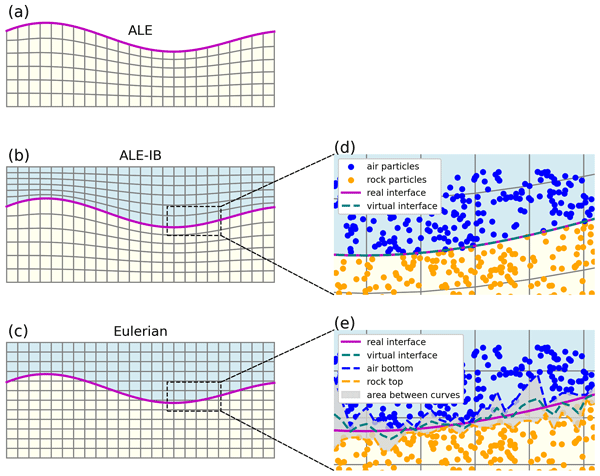
This study presents a novel scheme for simulating Earth's free surface. Traditional methods like 'Sticky Air' in the Eulerian scheme face limitations such as increased computational costs and marker fluctuation issues. Our approach integrates the 'Sticky Air' concept into an Arbitrary Lagrangian–Eulerian framework using an internal boundary enabling a true free surface simulation, which reduces marker noise and enhances numerical stability.
Ben S. Knight and Chris Clark
Geosci. Model Dev., 19, 6571–6586, https://doi.org/10.5194/gmd-19-6571-2026, https://doi.org/10.5194/gmd-19-6571-2026, 2026
Short summary
Short summary
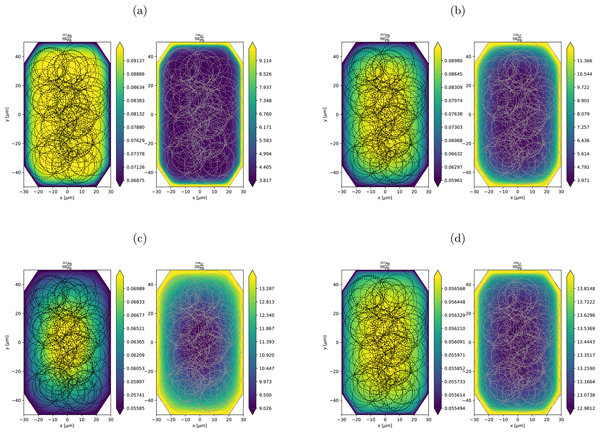
This study examines how high temperatures can alter the geochemical record in zircon crystals used to date rock events. Using computer simulations, we model how movement of atoms, radioactive decay, and the formation of new elements interact in a zircon under changing heat conditions. Our simulation is compared with measurements from rocks in southern India to estimate temperature history of the region. The work aims to improve insights from rock dating and our understanding of Earth's past.
Neng Lu, Louis Moresi, and Julian Giordani
Geosci. Model Dev., 19, 5191–5206, https://doi.org/10.5194/gmd-19-5191-2026, https://doi.org/10.5194/gmd-19-5191-2026, 2026
Short summary
Short summary
This study presents a novel scheme for simulating Earth's free surface. Traditional methods like 'Sticky Air' in the Eulerian scheme face limitations such as increased computational costs and marker fluctuation issues. Our approach integrates the 'Sticky Air' concept into an Arbitrary Lagrangian–Eulerian framework using an internal boundary enabling a true free surface simulation, which reduces marker noise and enhances numerical stability.
Sara Polanco, Mike Blum, Tristan Salles, Bruce C. Frederick, Rebecca Farrington, Xuesong Ding, Ben Mather, Claire Mallard, and Louis Moresi
Earth Surf. Dynam., 12, 301–320, https://doi.org/10.5194/esurf-12-301-2024, https://doi.org/10.5194/esurf-12-301-2024, 2024
Short summary
Short summary
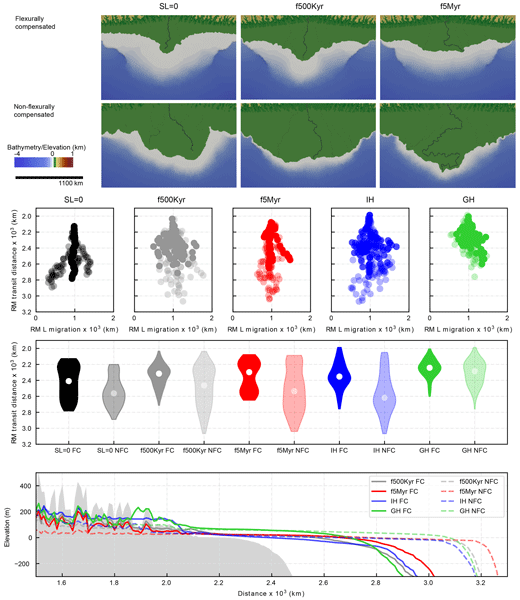
Two-thirds of the world's most populated cities are situated close to deltas. We use computer simulations to understand how deltas sink or rise in response to climate-driven sea level changes that operate from thousands to millions of years. Our research shows that because of the interaction between the outer layers of the Earth, sediment transport, and sea level changes deltas develop a self-regulated mechanism that modifies the space they need to gain or lose land.
Till Sachau, Haibin Yang, Justin Lang, Paul D. Bons, and Louis Moresi
Geosci. Model Dev., 15, 8749–8764, https://doi.org/10.5194/gmd-15-8749-2022, https://doi.org/10.5194/gmd-15-8749-2022, 2022
Short summary
Short summary
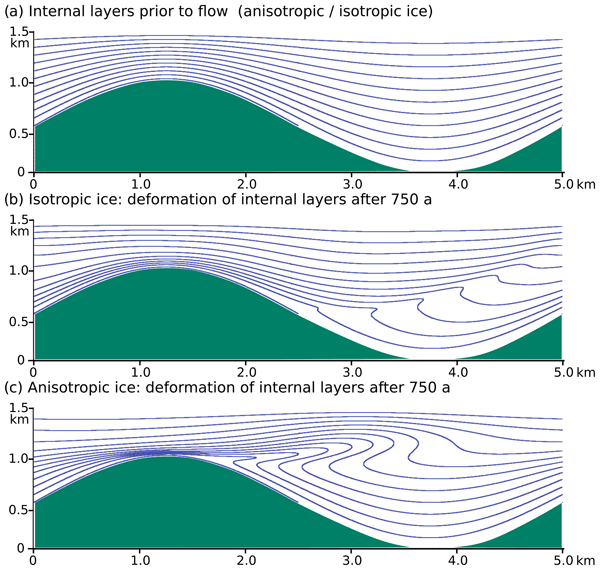
Knowledge of the internal structures of the major continental ice sheets is improving, thanks to new investigative techniques. These structures are an essential indication of the flow behavior and dynamics of ice transport, which in turn is important for understanding the actual impact of the vast amounts of water trapped in continental ice sheets on global sea-level rise. The software studied here is specifically designed to simulate such structures and their evolution.
Cited articles
Avouac, J.-P. and Burov, E.: Erosion as a driving mechanism of intracontinental mountain growth, J. Geophys. Res.-Sol. Ea., 101, 17747–17769, https://doi.org/10.1029/96jb01344, 1996. a, b, c
Batt, G. and Braun, J.: On the thermomechanical evolution of compressional orogens, Geophys. J. Int., 128, 364–382, https://doi.org/10.1111/j.1365-246x.1997.tb01561.x, 1997. a, b
Batt, G. E. and Braun, J.: The tectonic evolution of the Southern Alps, New Zealand: insights from fully thermally coupled dynamical modelling, Geophys. J. Int., 136, 403–420, https://doi.org/10.1046/j.1365-246x.1999.00730.x, 1999. a
Beaumont, C., Fullsack, P., and Hamilton, J.: Erosional control of active compressional orogens, in: Thrust Tectonics, Springer, https://doi.org/10.1007/978-94-011-3066-0_1, 1–18, 1992. a
Beaumont, C., Kamp, P. J., Hamilton, J., and Fullsack, P.: The continental collision zone, South Island, New Zealand: comparison of geodynamical models and observations, J. Geophys. Res.-Sol. Ea., 101, 3333–3359, https://doi.org/10.1029/95jb02401, 1996. a
Beaumont, C., Jamieson, R. A., Nguyen, M., and Lee, B.: Himalayan tectonics explained by extrusion of a low-viscosity crustal channel coupled to focused surface denudation, Nature, 414, 738, https://doi.org/10.1038/414738a, 2001. a
Beucher, R., Moresi, L., Giordani, J., Mansour, J., Sandiford, D., Farrington, R., Mondy, L., Mallard, C., Rey, P., Duclaux, G., Kaluza, Q., Laik, A., and Morón, S.: UWGeodynamics: a teaching and research tool for numerical geodynamic modelling, Journal of Open Source Software, 4, 1136, https://doi.org/10.21105/joss.01136, 2019. a, b, c
Beucher, R., Giordani, J., Moresi, L., Mansour, J., Kaluza, O., Velic, M., Farrington, R., Quenette, S., Beall, A., Sandiford, D., Mondy, L., Mallard, C., Rey, P., Duclaux, G., Laik, A., Morón, S., Beall, A., Knight, B., and Lu, N.: Underworld2: Python Geodynamics Modelling for Desktop, HPC and Cloud (v2.16.4), Zenodo [code], https://doi.org/10.5281/zenodo.15128361, 2025. a
Braun, J. and Sambridge, M.: Modelling landscape evolution on geological time scales: a new method based on irregular spatial discretization, Basin Res., 9, 27–52, https://doi.org/10.1046/j.1365-2117.1997.00030.x, 1997. a, b
Braun, J. and Willett, S. D.: A very efficient O(n), implicit and parallel method to solve the stream power equation governing fluvial incision and landscape evolution, Geomorphology, 180, 170–179, https://doi.org/10.1016/j.geomorph.2012.10.008, 2013. a
Braun, J. and Yamato, P.: Structural evolution of a three-dimensional, finite-width crustal wedge, Tectonophysics, 484, 181–192, https://doi.org/10.1016/j.tecto.2009.08.032, 2010. a, b
Braun, J., Heimsath, A. M., and Chappell, J.: Sediment transport mechanisms on soil-mantled hillslopes, Geology, 29, 683–686, https://doi.org/10.1130/0091-7613(2001)029<0683:stmosm>2.0.co;2, 2001. a
Braun, J., Thieulot, C., Fullsack, P., DeKool, M., Beaumont, C., and Huismans, R.: DOUAR: a new three-dimensional creeping flow numerical model for the solution of geological problems, Phys. Earth Planet. In., 171, 76–91, https://doi.org/10.1016/j.pepi.2008.05.003, 2008. a
Collignon, M., Kaus, B., May, D., and Fernandez, N.: Influences of surface processes on fold growth during 3-D detachment folding, Geochem. Geophy. Geosy., 15, 3281–3303, https://doi.org/10.1002/2014gc005450, 2014. a, b
Densmore, A. L., Ellis, M. A., and Anderson, R. S.: Landsliding and the evolution of normal-fault-bounded mountains, J. Geophys. Res.-Sol. Ea., 103, 15203–15219, https://doi.org/10.1029/98jb00510, 1998. a
Dietrich, W. E., Bellugi, D. G., Sklar, L. S., Stock, J. D., Heimsath, A. M., and Roering, J. J.: Geomorphic transport laws for predicting landscape form and dynamics, Prediction in Geomorphology, 135, 103–132, https://doi.org/10.1029/135gm09, 2003. a
Gasparini, N. M. and Brandon, M. T.: A generalized power law approximation for fluvial incision of bedrock channels, J. Geophys. Res.-Earth, 116, https://doi.org/10.1029/2009jf001655, 2011. a
Gleason, G. C. and Tullis, J.: A flow law for dislocation creep of quartz aggregates determined with the molten salt cell, Tectonophysics, 247, 1–23, https://doi.org/10.1016/0040-1951(95)00011-b, 1995. a
Goren, L., Willett, S. D., Herman, F., and Braun, J.: Coupled numerical–analytical approach to landscape evolution modeling, Earth Surf. Proc. Land., 39, 522–545, https://doi.org/10.1002/esp.3514, 2014. a
Hirth, G. and Kohlstedf, D.: Rheology of the upper mantle and the mantle wedge: a view from the experimentalists, Geophysical monograph-american geophysical union, 138, 83–106, https://doi.org/10.1029/138gm06, 2003. a
Howard, A. D.: A detachment-limited model of drainage basin evolution, Water Resour. Res., 30, 2261–2285, https://doi.org/10.1029/94WR00757, 1994. a
Kaus, B. J., Steedman, C., and Becker, T. W.: From passive continental margin to mountain belt: insights from analytical and numerical models and application to Taiwan, Phys. Earth Planet. In., 171, 235–251, https://doi.org/10.1016/j.pepi.2008.06.015, 2008. a
Kirby, E. and Ouimet, W.: Tectonic geomorphology along the eastern margin of Tibet: insights into the pattern and processes of active deformation adjacent to the Sichuan Basin, Geol. Soc., Lond., Spec. Publ., 353, 165–188, https://doi.org/10.1144/sp353.9, 2011. a
Knight, B. S., Capitanio, F. A., and Weinberg, R. F.: Convergence velocity controls on the structural evolution of orogens, Tectonics, 40, e2020TC006570, https://doi.org/10.1029/2020tc006570, 2021. a, b, c
Kooi, H. and Beaumont, C.: Escarpment evolution on high-elevation rifted margins: insights derived from a surface processes model that combines diffusion, advection, and reaction, J. Geophys. Res.-Sol. Ea., 99, 12191–12209, https://doi.org/10.1029/94jb00047, 1994. a
Kooi, H. and Beaumont, C.: Large-scale geomorphology: classical concepts reconciled and integrated with contemporary ideas via a surface processes model, J. Geophys. Res.-Sol. Ea., 101, 3361–3386, https://doi.org/10.1029/95jb01861, 1996. a
Kramer, S. C., Wilson, C. R., and Davies, D. R.: An implicit free surface algorithm for geodynamical simulations, Phys. Earth Planet. In., 194, 25–37, https://doi.org/10.1016/j.pepi.2012.01.001, 2012. a
Kurfeß, D. and Heidbach, O.: CASQUS: a new simulation tool for coupled 3D finite element modeling of tectonic and surface processes based on ABAQUS™ and CASCADE, Comput. Geosci., 35, 1959–1967, https://doi.org/10.1016/j.cageo.2008.10.019, 2009. a
Lague, D.: The stream power river incision model: evidence, theory and beyond, Earth Surf. Proc. Land., 39, 38–61, https://doi.org/10.1002/esp.3462, 2014. a
Lu, N.: ALEIB-CouplingModeling (v0), Zenodo [code], https://doi.org/10.5281/zenodo.17972136, 2025. a
Lu, N., Moresi, L., and Giordani, J.: A novel ALE scheme with the internal boundary for true free surface simulation in geodynamic models, Geosci. Model Dev., 19, 5191–5206, https://doi.org/10.5194/gmd-19-5191-2026, 2026. a, b
Maniatis, G., Kurfeß, D., Hampel, A., and Heidbach, O.: Slip acceleration on normal faults due to erosion and sedimentation – results from a new three-dimensional numerical model coupling tectonics and landscape evolution, Earth Planet. Sc. Lett., 284, 570–582, https://doi.org/10.1016/j.epsl.2009.05.024, 2009. a
Mansour, J., Giordani, J., Moresi, L., Beucher, R., Kaluza, O., Velic, M., Farrington, R., Quenette, S., and Beall, A.: Underworld2: Python geodynamics modelling for desktop, HPC and cloud, Journal of Open Source Software, 5, 1797, https://doi.org/10.21105/joss.01797, 2020. a, b, c
May, D. A., Brown, J., and Le Pourhiet, L.: pTatin3D: High-performance methods for long-term lithospheric dynamics, in: SC'14: Proceedings of the International Conference for High Performance Computing, Networking, Storage and Analysis, IEEE, 274–284, https://doi.org/10.1109/sc.2014.28, 2014. a
Moresi, L., Dufour, F., and Mühlhaus, H.-B.: Mantle convection modeling with viscoelastic/brittle lithosphere: numerical methodology and plate tectonic modeling, Pure Appl. Geophys., 159, 2335–2356, https://doi.org/10.1007/978-3-0348-8197-5_10, 2002. a
Moresi, L., Dufour, F., and Mühlhaus, H.-B.: A Lagrangian integration point finite element method for large deformation modeling of viscoelastic geomaterials, J. Comput. Phys., 184, 476–497, https://doi.org/10.1016/s0021-9991(02)00031-1, 2003. a
Moresi, L., Quenette, S., Lemiale, V., Meriaux, C., Appelbe, B., and Mühlhaus, H.-B.: Computational approaches to studying non-linear dynamics of the crust and mantle, Phys. Earth Planet. In., 163, 69–82, https://doi.org/10.1016/j.pepi.2007.06.009, 2007. a, b, c
Nettesheim, M., Ehlers, T. A., Whipp, D. M., and Koptev, A.: The influence of upper-plate advance and erosion on overriding plate deformation in orogen syntaxes, Solid Earth, 9, 1207–1224, https://doi.org/10.5194/se-9-1207-2018, 2018. a
Neuharth, D., Brune, S., Wrona, T., Glerum, A., Braun, J., and Yuan, X.: Evolution of rift systems and their fault networks in response to surface processes, Tectonics, 41, e2021TC007166, https://doi.org/10.1029/2021TC007166, 2022. a
Pysklywec, R. N.: Surface erosion control on the evolution of the deep lithosphere, Geology, 34, 225–228, https://doi.org/10.1130/g21963.1, 2006. a
Roering, J. J., Kirchner, J. W., and Dietrich, W. E.: Evidence for nonlinear, diffusive sediment transport on hillslopes and implications for landscape morphology, Water Resour. Res., 35, 853–870, https://doi.org/10.1029/1998wr900090, 1999. a
Roy, S., Koons, P., Upton, P., and Tucker, G.: Dynamic links among rock damage, erosion, and strain during orogenesis, Geology, 44, 583–586, https://doi.org/10.1130/g37753.1, 2016. a
Salles, T. and Hardiman, L.: Badlands: an open-source, flexible and parallel framework to study landscape dynamics, Comput. Geosci., 91, 77–89, https://doi.org/10.1016/j.cageo.2016.03.011, 2016. a, b
Salles, T., Ding, X., and Brocard, G.: pyBadlands: a framework to simulate sediment transport, landscape dynamics and basin stratigraphic evolution through space and time, PLoS One, 13, e0195557, https://doi.org/10.1371/journal.pone.0195557, 2018. a, b
Schröder, S.: Modelling Surface Evolution Coupled with Tectonics: A Case Study for the Pamir, PhD thesis, Universität Potsdam, https://publishup.uni-potsdam.de/frontdoor/index/index/docId/9038 (last access: 30 March 2026), 2016. a
Stock, J. D. and Montgomery, D. R.: Geologic constraints on bedrock river incision using the stream power law, J. Geophys. Res.-Sol. Ea., 104, 4983–4993, https://doi.org/10.1029/98jb02139, 1999. a
Thieulot, C.: FANTOM: two-and three-dimensional numerical modelling of creeping flows for the solution of geological problems, Phys. Earth Planet. In., 188, 47–68, https://doi.org/10.1016/j.pepi.2011.06.011, 2011. a
Tucker, G. E. and Slingerland, R.: Predicting sediment flux from fold and thrust belts, Basin Res., 8, 329–349, https://doi.org/10.1046/j.1365-2117.1996.00238.x, 1996. a
Tucker, G. E., Lancaster, S. T., Gasparini, N. M., and Bras, R. L.: The channel-hillslope integrated landscape development model (CHILD), in: Landscape Erosion and Evolution Modeling, Springer, https://doi.org/10.1007/978-1-4615-0575-4_12, 349–388, 2001. a
Turcotte, D. L. and Schubert, G.: Geodynamics, Cambridge University Press, https://doi.org/10.1017/cbo9780511807442, 2002. a
Vogt, K., Willingshofer, E., Matenco, L., Sokoutis, D., Gerya, T., and Cloetingh, S.: The role of lateral strength contrasts in orogenesis: a 2D numerical study, Tectonophysics, 746, 549–561, https://doi.org/10.1016/j.tecto.2017.08.010, 2018. a, b
Whipple, K. X. and Tucker, G. E.: Dynamics of the stream-power river incision model: implications for height limits of mountain ranges, landscape response timescales, and research needs, J. Geophys. Res.-Sol. Ea., 104, 17661–17674, https://doi.org/10.1029/1999JB900120, 1999. a, b, c
Willett, S. D.: Orogeny and orography: the effects of erosion on the structure of mountain belts, J. Geophys. Res.-Sol. Ea., 104, 28957–28981, https://doi.org/10.1029/1999JB900248, 1999. a
Willett, S., Beaumont, C., and Fullsack, P.: Mechanical model for the tectonics of doubly vergent compressional orogens, Geology, 21, 371–374, https://doi.org/10.1130/0091-7613(1993)021<0371:mmftto>2.3.co;2, 1993. a
Wolf, L., Huismans, R. S., Wolf, S. G., Rouby, D., and May, D. A.: Evolution of rift architecture and fault linkage during continental rifting: investigating the effects of tectonics and surface processes using lithosphere-scale 3d coupled numerical models, J. Geophys. Res.-Sol. Ea., 127, e2022JB024687, https://doi.org/10.1029/2022jb024687, 2022. a, b
Zhong, S., Gurnis, M., and Moresi, L.: Free-surface formulation of mantle convection – I. Basic theory and application to plumes, Geophys. J. Int., 127, 708–718, https://doi.org/10.1111/j.1365-246X.1996.tb04049.x, 1996. a
Short summary
This study introduces a novel framework combining geodynamic and surface process models, enhancing our understanding of Earth's crust and upper mantle deformation. By integrating the codes Underworld 2 and Badlands within the Arbitrary Lagrangian-Eulerian with Internal Boundary (ALE-IB) scheme, our approach overcomes the limitations of previous methods. It maintains internal interface integrity and precise surface tracking, improving simulation fidelity.
This study introduces a novel framework combining geodynamic and surface process models,...


