Articles | Volume 19, issue 11
https://doi.org/10.5194/gmd-19-5119-2026
© Author(s) 2026. This work is distributed under
the Creative Commons Attribution 4.0 License.
https://doi.org/10.5194/gmd-19-5119-2026
© Author(s) 2026. This work is distributed under
the Creative Commons Attribution 4.0 License.
EMMA-Tracker v1.0: a mesoscale convective system tracker and 27-year European observational climatology

David Kneidinger
CORRESPONDING AUTHOR
Wegener Center for Climate and Global Change, University of Graz, Graz, Austria
Armin Schaffer
Wegener Center for Climate and Global Change, University of Graz, Graz, Austria
Douglas Maraun
Wegener Center for Climate and Global Change, University of Graz, Graz, Austria
Related authors
No articles found.
Daniel Viviroli, Martin Jury, Maria Staudinger, Martina Kauzlaric, Heimo Truhetz, and Douglas Maraun
Nat. Hazards Earth Syst. Sci., 26, 1835–1857, https://doi.org/10.5194/nhess-26-1835-2026, https://doi.org/10.5194/nhess-26-1835-2026, 2026
Short summary
Short summary
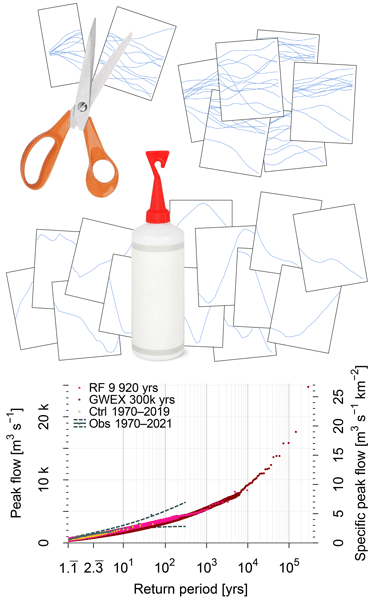
Estimating the frequency and magnitude of floods is challenging due to the limited length of streamflow records. Here, we explore whether an extensive archive of meteorological forecasts run over past dates can assist in this context. After processing and concatenating these data for use as input to a hydrological model, we derive flood statistics from simulated streamflow. Results are promising for the larger catchments studied, providing a valuable complementary perspective on rare floods.
Armin Schaffer, Albert Ossó, and Douglas Maraun
EGUsphere, https://doi.org/10.5194/egusphere-2026-1712, https://doi.org/10.5194/egusphere-2026-1712, 2026
This preprint is open for discussion and under review for Weather and Climate Dynamics (WCD).
Short summary
Short summary
Atmospheric fronts are a major cause of heavy rainfall in Europe. To understand how climate change affects these events, we analyzed two sets of global and regional climate models. We found that while changing weather patterns may reduce frontal frequency in some areas, the number of heavy rain events will surge. Extreme rainfall events are projected to more than double per degree of warming, driven by increased humidity rather than storm dynamics.
Armin Schaffer, Tobias Lichtenegger, Albert Ossó, and Douglas Maraun
Weather Clim. Dynam., 6, 1815–1830, https://doi.org/10.5194/wcd-6-1815-2025, https://doi.org/10.5194/wcd-6-1815-2025, 2025
Short summary
Short summary
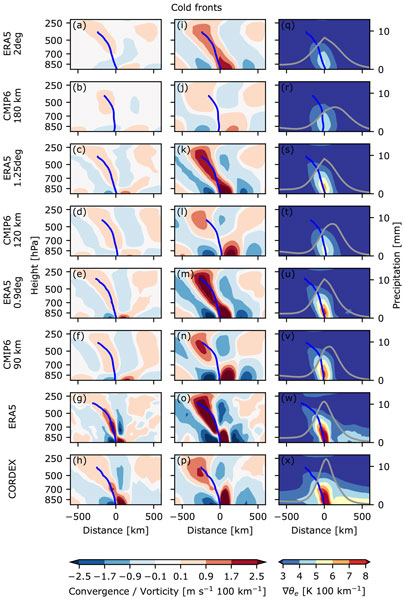
Heavy rainfall in Europe is often linked to weather fronts. To understand how these events may change in the future, we first need to evaluate how well climate models represent them. We found that all models show substantial biases, particularly for cold fronts, while higher-resolution models improve their simulation. Warm fronts also show biases, though they are generally better represented than cold fronts. This highlights the importance of high-resolution models for reliable projections.
Kai Kornuber, Emanuele Bevacqua, Mariana Madruga de Brito, Wiebke S. Jäger, Pauline Rivoire, Cassandra D. W. Rogers, Fabiola Banfi, Fulden Batibeniz, James Carruthers, Carlo de Michele, Silvia de Angeli, Cristina Deidda, Marleen C. de Ruiter, Andreas H. Fink, Henrique M. D. Goulart, Katharina Küpfer, Patrick Ludwig, Douglas Maraun, Gabriele Messori, Shruti Nath, Fiachra O’Loughlin, Joaquim G. Pinto, Benjamin Poschlod, Alexandre M. Ramos, Colin Raymond, Andreia F. S. Ribeiro, Deepti Singh, Laura Suarez Gutierrez, Philip J. Ward, and Christopher J. White
EGUsphere, https://doi.org/10.5194/egusphere-2025-4683, https://doi.org/10.5194/egusphere-2025-4683, 2025
Short summary
Short summary
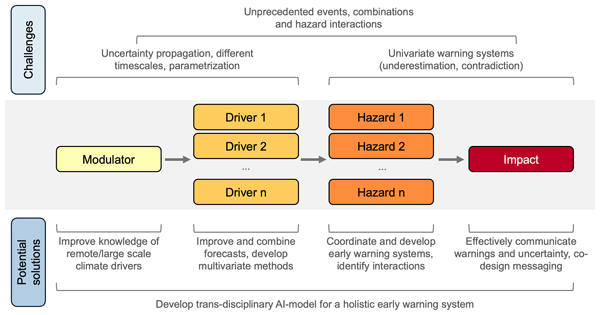
Impacts from extreme weather events are becoming increasingly severe under global warming, in particular when events occur simultaneously or successively. While these complex event combinations are often difficult to analyse as impact data, early warning schemes or modelling frameworks might not be fit for purpose. In this perspective we reflect on the usability of compound event research to bridge the gap between academic research and real-world applications, by formulating a set of guidelines.
Colin Manning, Martin Widmann, Douglas Maraun, Anne F. Van Loon, and Emanuele Bevacqua
Weather Clim. Dynam., 4, 309–329, https://doi.org/10.5194/wcd-4-309-2023, https://doi.org/10.5194/wcd-4-309-2023, 2023
Short summary
Short summary
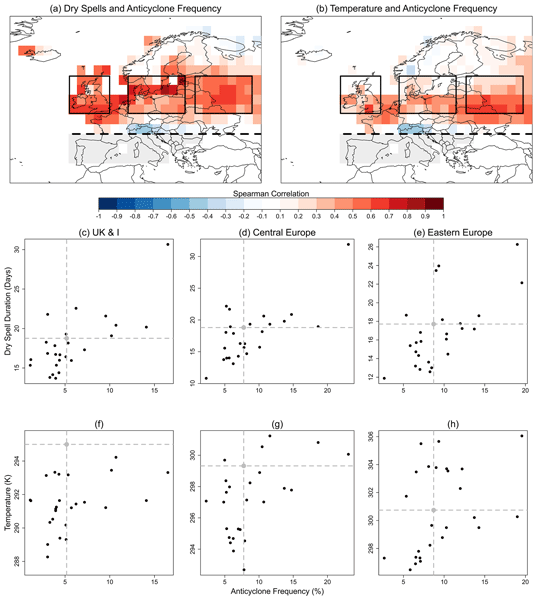
Climate models differ in their representation of dry spells and high temperatures, linked to errors in the simulation of persistent large-scale anticyclones. Models that simulate more persistent anticyclones simulate longer and hotter dry spells, and vice versa. This information is important to consider when assessing the likelihood of such events in current and future climate simulations so that we can assess the plausibility of their future projections.
Yi Yang, Douglas Maraun, Albert Ossó, and Jianping Tang
Nat. Hazards Earth Syst. Sci., 23, 693–709, https://doi.org/10.5194/nhess-23-693-2023, https://doi.org/10.5194/nhess-23-693-2023, 2023
Short summary
Short summary
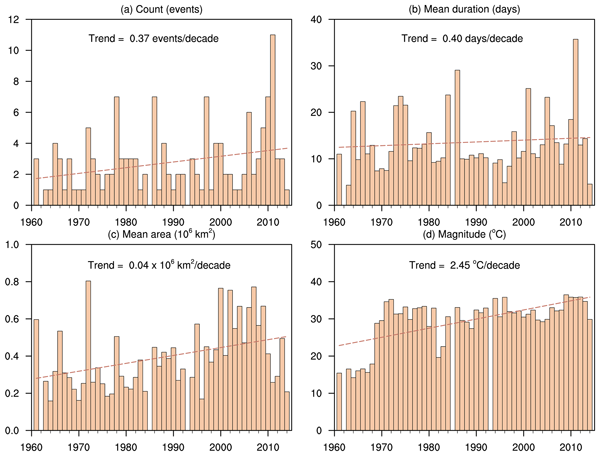
This study quantifies the spatiotemporal variation and characteristics of compound long-duration dry and hot events in China over the 1961–2014 period. The results show that over the past few decades, there has been a substantial increase in the frequency of these compound events across most parts of China, which is dominated by rising temperatures. We detect a strong increase in the spatially contiguous areas experiencing concurrent dry and hot conditions.
Raphael Knevels, Helene Petschko, Herwig Proske, Philip Leopold, Aditya N. Mishra, Douglas Maraun, and Alexander Brenning
Nat. Hazards Earth Syst. Sci., 23, 205–229, https://doi.org/10.5194/nhess-23-205-2023, https://doi.org/10.5194/nhess-23-205-2023, 2023
Short summary
Short summary
In summer 2009 and 2014, rainfall events occurred in the Styrian Basin (Austria), triggering thousands of landslides. Landslide storylines help to show potential future changes under changing environmental conditions. The often neglected uncertainty quantification was the aim of this study. We found uncertainty arising from the landslide model to be of the same order as climate scenario uncertainty. Understanding the dimensions of uncertainty is crucial for allowing informed decision-making.
Marco Hofmann, Claudia Volosciuk, Martin Dubrovský, Douglas Maraun, and Hans R. Schultz
Earth Syst. Dynam., 13, 911–934, https://doi.org/10.5194/esd-13-911-2022, https://doi.org/10.5194/esd-13-911-2022, 2022
Short summary
Short summary
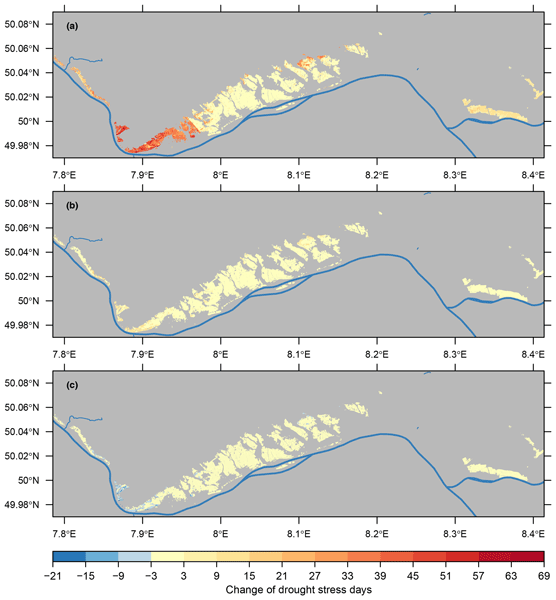
We modelled water budget developments of viticultural growing regions on the spatial scale of individual vineyard plots with respect to landscape features like the available water capacity of the soils, slope, and aspect of the sites. We used an ensemble of climate simulations and focused on the occurrence of drought stress. The results show a high bandwidth of projected changes where the risk of potential drought stress becomes more apparent in steep-slope regions.
Cited articles
Ban, N., Caillaud, C., Coppola, E., Pichelli, E., Sobolowski, S., Adinolfi, M., Ahrens, B., Alias, A., Anders, I., Bastin, S., Belušić, D., Berthou, S., Brisson, E., Cardoso, R. M., Chan, S. C., Christensen, O. B., Fernández, J., Fita, L., Frisius, T., Gašparac, G., Giorgi, F., Goergen, K., Haugen, J. E., Hodnebrog, Ø., Kartsios, S., Katragkou, E., Kendon, E. J., Keuler, K., Lavin-Gullon, A., Lenderink, G., Leutwyler, D., Lorenz, T., Maraun, D., Mercogliano, P., Milovac, J., Panitz, H.-J., Raffa, M., Remedio, A. R., Schär, C., Soares, P. M. M., Srnec, L., Steensen, B. M., Stocchi, P., Tölle, M. H., Truhetz, H., Vergara-Temprado, J., de Vries, H., Warrach-Sagi, K., Wulfmeyer, V., and Zander, M. J.: The first multi-model ensemble of regional climate simulations at kilometer-scale resolution, part I: evaluation of precipitation, Clim. Dynam., 57, 275–302, https://doi.org/10.1007/s00382-021-05708-w, 2021 a
Berg, P., Moseley, C., and Haerter, J. O.: Strong increase in convective precipitation in response to higher temperatures, Nat. Geosci., 6, 181–185, 2013. a
Catto, J. L. and Pfahl, S.: The importance of fronts for extreme precipitation, J. Geophys. Res.-Atmos., 118, 10791–10801, https://doi.org/10.1002/jgrd.50852, 2013. a, b
Catto, J. L., Nicholls, N., Jakob, C., and Shelton, K. L.: Atmospheric fronts in current and future climates, Geophys. Res. Lett., 41, 7642–7650, https://doi.org/10.1002/2014GL061943, 2014. a
Coppola, E., Sobolowski, S., Pichelli, E., Raffaele, F., Ahrens, B., Anders, I., Ban, N., Bastin, S., Belda, M., Belusic, D., Caldas-Alvarez, A., Cardoso, R. M., Davolio, S., Dobler, A., Fernandez, J., Fita, L., Fumiere, Q., Giorgi, F., Goergen, K., Güttler, I., Halenka, T., Heinzeller, D., Hodnebrog, Ø., Jacob, D., Kartsios, S., Katragkou, E., Kendon, E., Khodayar, S., Kunstmann, H., Knist, S., Lavín-Gullón, A., Lind, P., Lorenz, T., Maraun, D., Marelle, L., van Meijgaard, E., Milovac, J., Myhre, G., Panitz, H.-J., Piazza, M., Raffa, M., Raub, T., Rockel, B., Schär, C., Sieck, K., Soares, P. M. M., Somot, S., Srnec, L., Stocchi, P., Tölle, M. H., Truhetz, H., Vautard, R., de Vries, H., and Warrach-Sagi, K.: A first-of-its-kind multi-model convection permitting ensemble for investigating convective phenomena over Europe and the Mediterranean, Clim. Dynam., 55, 3–34, https://doi.org/10.1007/s00382-018-4521-8, 2020. a
Cui, W., Dong, X., Xi, B., Feng, Z., and Fan, J.: Can the GPM IMERG Final Product Accurately Represent MCSs’ Precipitation Characteristics over the Central and Eastern United States?, J. Hydrometeorol., 21, 39–57, https://doi.org/10.1175/JHM-D-19-0123.1, 2020. a
Cui, W., Galarneau Jr., T. J., and Hoogewind, K. A.: Changes in Mesoscale Convective System Precipitation Structures in Response to a Warming Climate, J. Geophys. Res.-Atmos., 129, e2023JD039920, https://doi.org/10.1029/2023JD039920, 2024. a
Doblas-Reyes, F., Sörensson, A., Almazroui, M., Dosio, A., Gutowski, W., Haarsma, R., Hamdi, R., Hewitson, B., Kwon, W.-T., Lamptey, B., Maraun, D., Stephenson, T., Takayabu, I., Terray, L., Turner, A., and Zuo, Z.: IPCC AR6 WGI Chapter 10: Linking global to regional climate change, Cambridge University Press, 1363–1512, https://doi.org/10.1017/9781009157896.012, 2021. a
Dong, B., Sutton, R. T., Woollings, T., and Hodges, K.: Variability of the North Atlantic summer storm track: mechanisms and impacts on European climate, Environ. Res. Lett., 8, 034037, https://doi.org/10.1088/1748-9326/8/3/034037, 2013. a
Dougherty, E. M., Prein, A. F., Gutmann, E. D., and Newman, A. J.: Future Simulated Changes in Central U. S. Mesoscale Convective System Rainfall Caused by Changes in Convective and Stratiform Structure, J. Geophys. Res.-Atmos., 128, e2022JD037537, https://doi.org/10.1029/2022JD037537, 2023. a
EURO-CORDEX: EURO-CORDEX-CMIP6 Atmosphere Variable List, https://doi.org/10.5281/zenodo.8414798, 2022. a, b
Eyring, V., Cox, P. M., Flato, G. M., Gleckler, P. J., Abramowitz, G., Caldwell, P., Collins, W. D., Gier, B. K., Hall, A. D., Hoffman, F. M., Hurtt, G. C., Jahn, A., Jones, C. D., Klein, S. A., Krasting, J. P., Kwiatkowski, L., Lorenz, R., Maloney, E., Meehl, G. A., Pendergrass, A. G., Pincus, R., Ruane, A. C., Russell, J. L., Sanderson, B. M., Santer, B. D., Sherwood, S. C., Simpson, I. R., Stouffer, R. J., and Williamson, M. S.: Taking climate model evaluation to the next level, Nat. Clim. Change, 9, 102–110, https://doi.org/10.1038/s41558-018-0355-y, 2019. a
Feng, Z., Leung, L. R., Liu, N., Wang, J., Houze Jr., R. A., Li, J., Hardin, J. C., Chen, D., and Guo, J.: A Global High-Resolution Mesoscale Convective System Database Using Satellite-Derived Cloud Tops, Surface Precipitation, and Tracking, J. Geophys. Res.-Atmos., 126, e2020JD034202, https://doi.org/10.1029/2020JD034202, 2021a. a, b, c, d, e
Feng, Z., Song, F., Sakaguchi, K., and Leung, L. R.: Evaluation of Mesoscale Convective Systems in Climate Simulations: Methodological Development and Results from MPAS-CAM over the United States, J. Climate, 34, 2611–2633, https://doi.org/10.1175/JCLI-D-20-0136.1, 2021b. a
Feng, Z., Hardin, J., Barnes, H. C., Li, J., Leung, L. R., Varble, A., and Zhang, Z.: PyFLEXTRKR: a flexible feature tracking Python software for convective cloud analysis, Geosci. Model Dev., 16, 2753–2776, https://doi.org/10.5194/gmd-16-2753-2023, 2023. a, b, c
Feng, Z., Prein, A. F., Kukulies, J., Fiolleau, T., Jones, W. K., Maybee, B., Moon, Z. L., Núñez Ocasio, K. M., Dong, W., Molina, M. J., Albright, M. G., Rajagopal, M., Robledo, V., Song, J., Song, F., Leung, L. R., Varble, A. C., Klein, C., Roca, R., Feng, R., and Mejia, J. F.: Mesoscale Convective Systems Tracking Method Intercomparison (MCSMIP): Application to DYAMOND Global km-Scale Simulations, J. Geophys. Res.-Atmos., 130, e2024JD042204, https://doi.org/10.1029/2024JD042204, 2025. a
Fery, L. and Faranda, D.: Analysing 23 years of warm-season derechos in France: a climatology and investigation of synoptic and environmental changes, Weather Clim. Dynam., 5, 439–461, https://doi.org/10.5194/wcd-5-439-2024, 2024. a
Fosser, G., Khodayar, S., and Berg, P.: The effect of resolution and convection-permitting climate modeling on future precipitation change in the Alps, J. Climate, 28, 6187–6203, 2015. a
García-Herrera, R., Hernández, E., Paredes, D., Barriopedro, D., Correoso, J., and Prieto, L.: A MASCOTTE-based characterization of MCSs over Spain, 2000–2002, Atmos. Res., 73, 261–282, https://doi.org/10.1016/j.atmosres.2004.11.003, 2005. a
Gatzen, C. and Pucik, T.: Analysis of the high-end derecho in Corsica in 2022, in: ECSS 2023 – 12th European Conference on Severe Storms, https://doi.org/10.5194/ecss2023-148, 2023. a
Haberlie, A. M. and Ashley, W. S.: Climatological representation of mesoscale convective systems in a dynamically downscaled climate simulation, Int. J. Climatol., 39, 1144–1153, https://doi.org/10.1002/joc.5880, 2019. a
Haslinger, K., Breinl, K., Pavlin, L., Pistotnik, G., Bertola, M., Olefs, M., Greilinger, M., Schöner, W., and Blöschl, G.: Increasing hourly heavy rainfall in Austria reflected in flood changes, Nature, 639, 667–672, 2025. a
Hayden, L., Liu, C., and Liu, N.: Properties of Mesoscale Convective Systems Throughout Their Lifetimes Using IMERG, GPM, WWLLN, and a Simplified Tracking Algorithm, J. Geophys. Res.-Atmos., 126, e2021JD035264, https://doi.org/10.1029/2021JD035264, 2021. a
Hénin, R., Ramos, A. M., Schemm, S., Gouveia, C. M., and Liberato, M. L. R.: Assigning precipitation to mid-latitudes fronts on sub-daily scales in the North Atlantic and European sector: Climatology and trends, Int. J. Climatol., 39, 317–330, https://doi.org/10.1002/joc.5808, 2019. a
Hersbach, H., Bell, B., Berrisford, P., Biavati, G., Horányi, A., Muñoz Sabater, J., Nicolas, J., Peubey, C., Radu, R., Rozum, I., Schepers, D., Simmons, A., Soci, C., Dee, D., and Thépaut, J.-N.: ERA5 hourly data on single levels from 1940 to present, Climate Data Store [data set], https://doi.org/10.24381/cds.adbb2d47, 2023a. a, b
Hersbach, H., Bell, B., Berrisford, P., Biavati, G., Horányi, A., Muñoz Sabater, J., Nicolas, J., Peubey, C., Radu, R., Rozum, I., Schepers, D., Simmons, A., Soci, C., Dee, D., and Thépaut, J.-N.: ERA5 hourly data on pressure levels from 1940 to present, Copernicus Climate Change Service (C3S) Climate Data Store (CDS) [data set], https://doi.org/10.24381/cds.bd0915c6, 2023b. a
Hohenegger, C., Brockhaus, P., Bretherton, C. S., and Schär, C.: An intercomparison of regional climate simulations for Europe: assessing uncertainties in model projections, Clim. Dynam., 33, 929–946, 2009. a
Huffman, G. J., Stocker, E. F., Bolvin, D. T., Nelkin, E. J., and Tan, J.: GPM IMERG final precipitation l3 hourly 0.1 degree × 0.1 degree v07, [data set], https://doi.org/10.5067/GPM/IMERG/3B-HH/07, 2019. a, b
Huffman, G. J., Stocker, E. F., Bolvin, D. T., Nelkin, E. J., and Tan, J.: GPM IMERG Final Precipitation L3 Half Hourly V07, Goddard Earth Sciences Data and Information Services Center (GES DISC) [data set], https://doi.org/10.5067/GPM/IMERG/3B-HH/07, 2023. a
Jacob, D., Petersen, J., Eggert, B., Alias, A., Christensen, O. B., Bouwer, L. M., Braun, A., Colette, A., Déqué, M., Georgievski, G., Georgopoulou, E., Gobiet, A., Menut, L., Nikulin, G., Haensler, A., Hempelmann, N., Jones, C., Keuler, K., Kovats, S., Kröner, N., Kotlarski, S., Kriegsmann, A., Martin, E., van Meijgaard, E., Moseley, C., Pfeifer, S., Preuschmann, S., Radermacher, C., Radtke, K., Rechid, D., Rounsevell, M., Samuelsson, P., Somot, S., Soussana, J.-F., Teichmann, C., Valentini, R., Vautard, R., Weber, B., and Yiou, P.: EURO-CORDEX: new high-resolution climate change projections for European impact research, Reg. Environ. Change, 14, 563–578, https://doi.org/10.1007/s10113-013-0499-2, 2014. a
Jacob, D., Teichmann, C., Sobolowski, S., Katragkou, E., Anders, I., Belda, M., Benestad, R., Boberg, F., Buonomo, E., Cardoso, R. M., Casanueva, A., Christensen, O. B., Christensen, J. H., Coppola, E., De Cruz, L., Davin, E. L., Dobler, A., Domínguez, M., Fealy, R., Fernandez, J., Gaertner, M. A., García-Díez, M., Giorgi, F., Gobiet, A., Goergen, K., Gómez-Navarro, J. J., Alemán, J. J. G., Gutiérrez, C., Gutiérrez, J. M., Güttler, I., Haensler, A., Halenka, T., Jerez, S., Jiménez-Guerrero, P., Jones, R. G., Keuler, K., Kjellström, E., Knist, S., Kotlarski, S., Maraun, D., van Meijgaard, E., Mercogliano, P., Montávez, J. P., Navarra, A., Nikulin, G., de Noblet-Ducoudré, N., Panitz, H.-J., Pfeifer, S., Piazza, M., Pichelli, E., Pietikäinen, J.-P., Prein, A. F., Preuschmann, S., Rechid, D., Rockel, B., Romera, R., Sánchez, E., Sieck, K., Soares, P. M. M., Somot, S., Srnec, L., Sørland, S. L., Termonia, P., Truhetz, H., Vautard, R., Warrach-Sagi, K., and Wulfmeyer, V.: Regional climate downscaling over Europe: perspectives from the EURO-CORDEX community, Reg. Environ. Change, 20, 51, https://doi.org/10.1007/s10113-020-01606-9, 2020. a
Kendon, E. J., Ban, N., Roberts, N. M., Fowler, H. J., Roberts, M. J., Chan, S. C., Evans, J. P., Fosser, G., and Wilkinson, J. M.: Do Convection-Permitting Regional Climate Models Improve Projections of Future Precipitation Change?, B. Am. Meteorol. Soc., 98, 79–93, https://doi.org/10.1175/BAMS-D-15-0004.1, 2017. a, b
Kendon, E. J., Prein, A. F., Senior, C. A., and Stirling, A.: Challenges and outlook for convection-permitting climate modelling, Philos. T. R. Soc. A, 379, 20190547, https://doi.org/10.1098/rsta.2019.0547, 2021. a
Kneidinger, D.: 27-Year Dataset of European Warm-Season Mesoscale Convective Systems, Zenodo [data set], https://doi.org/10.5281/zenodo.18234276, 2026a. a
Kneidinger, D.: ERA5 Pressure Level Input Data for EMMA-Trackerv1.0 Climatology (Part 1: 1998–2010), Zenodo [data set], https://doi.org/10.5281/zenodo.19347622, 2026b. a
Kneidinger, D.: ERA5 Pressure Level Input Data for EMMA-Trackerv1.0 Climatology (Part 2: 2011–2024), Zenodo [data set], https://doi.org/10.5281/zenodo.19347730, 2026c. a
Kneidinger, D.: ERA5 Surface and IMERG Precipitation Input Data for EMMA-Trackerv1.0 Climatology (1998–2024), Zenodo [data set], https://doi.org/10.5281/zenodo.19347740, 2026d. a
Kneidinger, D.: DavidKneidinger/emma-analysis: EMMA-Tracker Initial Public Release Codes, Zenodo [code], https://doi.org/10.5281/zenodo.19234249, 2026e. a
Kneidinger, D., Schaffer, A., and Maraun, D.: EMMA-Tracker v1.0: A lifecycle-based algorithm for identifying and tracking mesoscale convective systems in observations and climate models, Zenodo [code], https://doi.org/10.5281/zenodo.19233057, 2026. a
Kolios, S. and Feidas, H.: A warm season climatology of mesoscale convective systems in the Mediterranean basin using satellite data, Theor. Appl. Climatol., 102, 29–42, https://doi.org/10.1007/s00704-009-0241-7, 2010. a
Kotlarski, S., Keuler, K., Christensen, O. B., Colette, A., Déqué, M., Gobiet, A., Goergen, K., Jacob, D., Lüthi, D., van Meijgaard, E., Nikulin, G., Schär, C., Teichmann, C., Vautard, R., Warrach-Sagi, K., and Wulfmeyer, V.: Regional climate modeling on European scales: a joint standard evaluation of the EURO-CORDEX RCM ensemble, Geosci. Model Dev., 7, 1297–1333, https://doi.org/10.5194/gmd-7-1297-2014, 2014. a
Lin, G., Jones, C. R., Leung, L. R., Feng, Z., and Ovchinnikov, M.: Mesoscale Convective Systems in a Superparameterized E3SM Simulation at High Resolution, J. Adv. Model. Earth Sy., 14, e2021MS002660, https://doi.org/10.1029/2021MS002660, 2022. a
Meredith, E. P., Ulbrich, U., Rust, H. W., and Truhetz, H.: Present and future diurnal hourly precipitation in 0.11° EURO-CORDEX models and at convection-permitting resolution, Environ. Res. Commun., 3, 055002, https://doi.org/10.1088/2515-7620/abf15e, 2021. a
Mikuš, P., Prtenjak, M. T., and Mahović, N. S.: Analysis of the convective activity and its synoptic background over Croatia, Atmos. Res., 104, 139–153, 2012. a
Mohammed, S., Nasr, A., and Mahmoud, M.: Comprehensive Assessment of GPM-IMERG and ERA5 Precipitation Products Across Ireland, Remote Sens.-Basel, 17, https://doi.org/10.3390/rs17183154, 2025. a
Moseley, C., Berg, P., and Haerter, J. O.: Probing the precipitation life cycle by iterative rain cell tracking, J. Geophys. Res.-Atmos., 118, 13361–13370, https://doi.org/10.1002/2013JD020868, 2013. a, b
Navarro, A., García-Ortega, E., Merino, A., Sánchez, J. L., Kummerow, C., and Tapiador, F. J.: Assessment of IMERG Precipitation Estimates over Europe, Remote Sens.-Basel, 11, https://doi.org/10.3390/rs11212470, 2019. a
Núñez Ocasio, K. M. and Moon, Z. L.: TAMS: a tracking, classifying, and variable-assigning algorithm for mesoscale convective systems in simulated and satellite-derived datasets, Geosci. Model Dev., 17, 6035–6049, https://doi.org/10.5194/gmd-17-6035-2024, 2024. a
O, S., Foelsche, U., Kirchengast, G., Fuchsberger, J., Tan, J., and Petersen, W. A.: Evaluation of GPM IMERG Early, Late, and Final rainfall estimates using WegenerNet gauge data in southeastern Austria, Hydrol. Earth Syst. Sci., 21, 6559–6572, https://doi.org/10.5194/hess-21-6559-2017, 2017. a
Pacey, G., Pfahl, S., Schielicke, L., and Wapler, K.: The climatology and nature of warm-season convective cells in cold-frontal environments over Germany, Nat. Hazards Earth Syst. Sci., 23, 3703–3721, https://doi.org/10.5194/nhess-23-3703-2023, 2023. a
Pradhan, R. K., Markonis, Y., Vargas Godoy, M. R., Villalba-Pradas, A., Andreadis, K. M., Nikolopoulos, E. I., Papalexiou, S. M., Rahim, A., Tapiador, F. J., and Hanel, M.: Review of GPM IMERG performance: A global perspective, Remote Sens. Environ., 268, 112754, https://doi.org/10.1016/j.rse.2021.112754, 2022. a
Prein, A. F., Langhans, W., Fosser, G., Ferrone, A., Ban, N., Goergen, K., Keller, M., Tölle, M., Gutjahr, O., Feser, F., Brisson, E., Kollet, S., Schmidli, J., van Lipzig, N. P. M., and Leung, R.: A review on regional convection-permitting climate modeling: Demonstrations, prospects, and challenges, Rev. Geophys., 53, 323–361, https://doi.org/10.1002/2014RG000475, 2015. a, b
Prein, A. F., Ge, M., Valle, A. R., Wang, D., and Giangrande, S. E.: Towards a Unified Setup to Simulate Mid-Latitude and Tropical Mesoscale Convective Systems at Kilometer-Scales, Earth and Space Science, 9, e2022EA002295, https://doi.org/10.1029/2022EA002295, 2022. a
Pucik, T., Groenemeijer, P., Rädler, A. T., Taszarek, M., and Zanini, E.: The derecho and hailstorms of 18 August 2022, ESSL, https://www.essl.org/cms/the-derecho-and-hailstorms-of-18-august-2022/ (last access: 11 June 2026), 2022. a
Púčik, T., Groenemeijer, P., Rädler, A. T., Tijssen, L., Nikulin, G., Prein, A. F., van Meijgaard, E., Fealy, R., Jacob, D., and Teichmann, C.: Future Changes in European Severe Convection Environments in a Regional Climate Model Ensemble, J. Climate, 30, 6771–6794, https://doi.org/10.1175/JCLI-D-16-0777.1, 2017. a
Rehbein, A. and Ambrizzi, T.: Mesoscale convective systems over the Amazon basin in a changing climate under global warming, Clim. Dynam., 61, 1815–1827, https://doi.org/10.1007/s00382-022-06657-8, 2023. a
Rigo, T., Berenguer, M., and del Carmen Llasat, M.: An improved analysis of mesoscale convective systems in the western Mediterranean using weather radar, Atmos. Res., 227, 147–156, https://doi.org/10.1016/j.atmosres.2019.05.001, 2019. a, b, c
Rüdisühli, S., Sprenger, M., Leutwyler, D., Schär, C., and Wernli, H.: Attribution of precipitation to cyclones and fronts over Europe in a kilometer-scale regional climate simulation, Weather Clim. Dynam., 1, 675–699, https://doi.org/10.5194/wcd-1-675-2020, 2020. a, b
Schaffer, A., Lichtenegger, T., Truhetz, H., Ossó, A., Martínez-Alvarado, O., and Maraun, D.: Drivers of Cold Frontal Hourly Extreme Precipitation: A Climatological Study Over Europe, Geophys. Res. Lett., 51, e2024GL111025, https://doi.org/10.1029/2024GL111025, 2024. a, b, c, d
Schaffer, A., Lichtenegger, T., Ossó, A., and Maraun, D.: Resolution dependence and biases in cold and warm frontal heavy precipitation over Europe in CMIP6 and EURO-CORDEX models, Weather Clim. Dynam., 6, 1815–1830, https://doi.org/10.5194/wcd-6-1815-2025, 2025. a
Stocchi, P. and Davolio, S.: Intense air-sea exchange and heavy rainfall: impact of the northern Adriatic SST, Adv. Sci. Res., 13, 7–12, 2016. a
Taszarek, M., Allen, J., Púčik, T., Groenemeijer, P., Czernecki, B., Kolendowicz, L., Lagouvardos, K., Kotroni, V., and Schulz, W.: A Climatology of Thunderstorms across Europe from a Synthesis of Multiple Data Sources, J. Climate, 32, 1813–1837, https://doi.org/10.1175/JCLI-D-18-0372.1, 2019. a, b
Tsai, W.-M., Duan, S., O’Brien, T. A., Catto, J. L., Ullrich, P. A., Zhou, Y., Leung, L. R., Feng, Z., Boos, W. R., Suhas, D. L., Ahmed, F., and Neelin, J. D.: Co-Occurring Atmospheric Features and Their Contributions to Precipitation Extremes, J. Geophys. Res.-Atmos., 130, e2024JD041687, https://doi.org/10.1029/2024JD041687, 2025. a
Short summary
Mesoscale Convective Systems cause extreme weather and flash floods, yet they remain difficult to simulate in climate models. We developed a tracking tool to identify these storms using standard model data. Our 27-year record for Europe shows these systems drive over 60 percent of heavy hourly rain in the warm-season. This algorithm allows us to evaluate climate model performance and investigate how these intense storms will change in a warming climate.
Mesoscale Convective Systems cause extreme weather and flash floods, yet they remain difficult...