
Articles | Volume 19, issue 10
https://doi.org/10.5194/gmd-19-4703-2026
© Author(s) 2026. This work is distributed under
the Creative Commons Attribution 4.0 License.
the Creative Commons Attribution 4.0 License.
https://doi.org/10.5194/gmd-19-4703-2026
© Author(s) 2026. This work is distributed under
the Creative Commons Attribution 4.0 License.
the Creative Commons Attribution 4.0 License.
Model description paper
| 
01 Jun 2026
Model description paper |
| 01 Jun 2026
| 01 Jun 2026
AIFS Single 1.1.0: an update to ECMWF's machine-learned weather forecast model AIFS
Gabriel Moldovan
CORRESPONDING AUTHOR

European Centre for Medium-Range Weather Forecasts, Shinfield Park, Reading, RG2 9AX, United Kingdom
Ewan Pinnington
European Centre for Medium-Range Weather Forecasts, Shinfield Park, Reading, RG2 9AX, United Kingdom
Ana Prieto Nemesio
European Centre for Medium-Range Weather Forecasts, Robert-Schuman-Platz 3, 53175 Bonn, Germany
Simon Lang
European Centre for Medium-Range Weather Forecasts, Shinfield Park, Reading, RG2 9AX, United Kingdom
Zied Ben Bouallègue
European Centre for Medium-Range Weather Forecasts, Shinfield Park, Reading, RG2 9AX, United Kingdom
Jesper Dramsch
European Centre for Medium-Range Weather Forecasts, Robert-Schuman-Platz 3, 53175 Bonn, Germany
Mihai Alexe
European Centre for Medium-Range Weather Forecasts, Robert-Schuman-Platz 3, 53175 Bonn, Germany
Mario Santa Cruz
European Centre for Medium-Range Weather Forecasts, Shinfield Park, Reading, RG2 9AX, United Kingdom
Sara Hahner
European Centre for Medium-Range Weather Forecasts, Robert-Schuman-Platz 3, 53175 Bonn, Germany
Harrison Cook
European Centre for Medium-Range Weather Forecasts, Shinfield Park, Reading, RG2 9AX, United Kingdom
Helen Theissen
European Centre for Medium-Range Weather Forecasts, Shinfield Park, Reading, RG2 9AX, United Kingdom
Mariana Clare
European Centre for Medium-Range Weather Forecasts, Robert-Schuman-Platz 3, 53175 Bonn, Germany
Cathal O'Brien
European Centre for Medium-Range Weather Forecasts, Robert-Schuman-Platz 3, 53175 Bonn, Germany
Jan Polster
European Centre for Medium-Range Weather Forecasts, Robert-Schuman-Platz 3, 53175 Bonn, Germany
Linus Magnusson
European Centre for Medium-Range Weather Forecasts, Shinfield Park, Reading, RG2 9AX, United Kingdom
Gert Mertes
European Centre for Medium-Range Weather Forecasts, Shinfield Park, Reading, RG2 9AX, United Kingdom
Florian Pinault
European Centre for Medium-Range Weather Forecasts, Robert-Schuman-Platz 3, 53175 Bonn, Germany
Baudouin Raoult
European Centre for Medium-Range Weather Forecasts, Shinfield Park, Reading, RG2 9AX, United Kingdom
Patricia de Rosnay
European Centre for Medium-Range Weather Forecasts, Shinfield Park, Reading, RG2 9AX, United Kingdom
Richard Forbes
European Centre for Medium-Range Weather Forecasts, Shinfield Park, Reading, RG2 9AX, United Kingdom
Matthew Chantry
European Centre for Medium-Range Weather Forecasts, Shinfield Park, Reading, RG2 9AX, United Kingdom
Related authors
No articles found.
Ming Hon Franco Lee, Hanna Joos, Heini Wernli, Richard Forbes, and Michael Sprenger
EGUsphere, https://doi.org/10.5194/egusphere-2026-4609, https://doi.org/10.5194/egusphere-2026-4609, 2026
This preprint is open for discussion and under review for Weather and Climate Dynamics (WCD).
Short summary
Short summary
Warm conveyor belts are coherent, rapidly ascending airstreams in extratropical cyclones, creating divergent outflows at upper levels. Using a numerical simulation, turbulence is found modifying potential vorticity near the tropopause in an outflow region. Despite the complex flow, changes in potential vorticity are retained due to the coordination provided by the outflow, leading to a potential upscale effect on the dynamics on larger scales, possibly affecting weather predictability.
Pierre Vanderbecken, Jasmin Vural, Oscar Rojas-Muñoz, Sébastien Garrigues, Bertrand Bonan, Cédric Bacour, Uwe Rascher, Bastian Siegmann, Patricia de Rosnay, and Jean-Christophe Calvet
Biogeosciences, 23, 6687–6703, https://doi.org/10.5194/bg-23-6687-2026, https://doi.org/10.5194/bg-23-6687-2026, 2026
Short summary
Short summary
New satellite observations are used to improve our understanding of regional-scale vegetation. Innovative artificial intelligence methods are employed to combine the available information. The effectiveness of this approach is evaluated using independent observations. The results show that agricultural practices such as irrigation can be modelled more accurately.
Ekaterina Vorobeva, Yvan Orsolini, Patricia de Rosnay, Jonathan Day, Retish Senan, Damien Decremer, and Frederic Vitart
The Cryosphere, 20, 4605–4618, https://doi.org/10.5194/tc-20-4605-2026, https://doi.org/10.5194/tc-20-4605-2026, 2026
Short summary
Short summary
How reliable are probabilistic seasonal snow forecasts in winter? Although they are routinely issued by operational prediction centres, their reliability has never been evaluated. We close this gap by analyzing 30 years of seasonal snow re-forecasts and evaluating them against two snow datasets. Our results provide comprehensive assessment of seasonal snow forecast reliability and offer new insights into their performance in different parts of the Northern Hemisphere.
Paolo Andreozzi, Mark D. Fielding, Robin J. Hogan, Richard M. Forbes, Adrian A. Hill, Samuel Rémy, Birger Bohn, and Ulrich Löhnert
Atmos. Chem. Phys., 26, 11309–11338, https://doi.org/10.5194/acp-26-11309-2026, https://doi.org/10.5194/acp-26-11309-2026, 2026
Short summary
Short summary
Aerosols significantly contribute to the Earth’s climate, but models still struggle to represent them. Here we use satellite observations of clouds to constrain aerosol processes in a weather and air-quality model. We show that African wildfires lead to overly bright simulated clouds and that the model removes too much aerosol in mixed-phase clouds. This demonstrates how cloud observations can target weakly constrained aerosol processes, with potential benefits for weather and climate modelling.
Ming Hon Franco Lee, Hanna Joos, Heini Wernli, Richard Forbes, and Michael Sprenger
EGUsphere, https://doi.org/10.5194/egusphere-2026-4184, https://doi.org/10.5194/egusphere-2026-4184, 2026
Short summary
Short summary
Turbulence near jet streams modifies the atmospheric flow, but there is limited research on the underlying mechanism. In this study, we infer this feedback by tracing the change in potential vorticity. We use an analytical framework to explain the systematic changes caused by turbulence in a numerical simulation of a jet stream. A typical tripolar pattern appears repeatedly, and it is highly related to the coherence of the jet. The improved understanding may help advance weather forecasts.
Ambrogio Volonté, Hanna Joos, Ming Hon Franco Lee, Richard Forbes, and Rémi Bouffet-Klein
Weather Clim. Dynam., 7, 1241–1264, https://doi.org/10.5194/wcd-7-1241-2026, https://doi.org/10.5194/wcd-7-1241-2026, 2026
Short summary
Short summary
Sting jets are air flows that can form in cloudy and unstable regions of intense windstorms. They can cause damaging wind gusts as they descend and accelerate while releasing their instability. We use a numerical simulation of Storm Ciarán to identify the individual cloud processes, such as condensation and sublimation, driving the onset of this instability. We reveal their complex interplay and highlight the unique properties of the three-dimensional environment in which a sting jet develops.
Nina Raoult, Ewan Pinnington, Mario Santa Cruz, Florian Pinault, Baudouin Raoult, Natalie Zelenka, Gabriele Arduini, Gianpaolo Balsamo, Souhail Boussetta, Matthew Chantry, Patricia de Rosnay, Peter Dueben, and Christoph Rüdiger
EGUsphere, https://doi.org/10.5194/egusphere-2026-3620, https://doi.org/10.5194/egusphere-2026-3620, 2026
Short summary
Short summary
The land surface shapes our weather and climate by controlling how heat and water move between the ground and the air, so the models representing it matter enormously. But they are costly to run and carry built-in errors. We built a faster artificial-intelligence version of one, then used real measurements from sites worldwide to correct some of these errors. The result stays reliable over years and better captures these heat and water exchanges—a quicker, more accurate tool for forecasting.
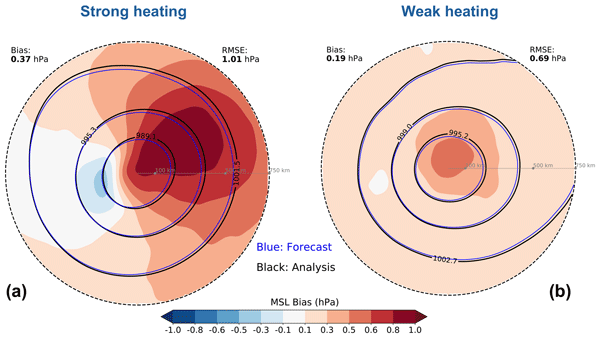
Qidi Yu, Clemens Spensberger, Linus Magnusson, and Thomas Spengler
Weather Clim. Dynam., 7, 1117–1131, https://doi.org/10.5194/wcd-7-1117-2026, https://doi.org/10.5194/wcd-7-1117-2026, 2026
Short summary
Short summary
Forecast biases of winter extratropical cyclones are quantified by varying diabatic heating intensity. A southwest shift and underestimated intensity are found in the strong heating group. The weaker heating group mainly shows an intensity bias. Specific biases are identified for wind, moisture, temperature, and upper-level circulation fields. Findings highlight that representing moist processes and their interaction with atmospheric dynamics is a key area for future model developments.
Qidi Yu, Linus Magnusson, Clemens Spensberger, and Thomas Spengler
EGUsphere, https://doi.org/10.5194/egusphere-2026-3727, https://doi.org/10.5194/egusphere-2026-3727, 2026
Short summary
Short summary
Forecast models still struggle to capture moisture and how it interacts with winter ocean storms. We compared 12-hour forecasts from a leading physics-based model at 9 km resolution and its artificial intelligence model. Both improve on the previous version, yet the former underestimates storm strength, linked to how it represents the vertical distribution of heating, while the latter shows a physical inconsistency: near-surface winds that do not match its pressure pattern.
Karan Ruparell, Dai Yamazaki, Kieran Hunt, Hannah Cloke, Christel Prudhomme, Florian Pappenberger, and Matthew Chantry
EGUsphere, https://doi.org/10.5194/egusphere-2026-2909, https://doi.org/10.5194/egusphere-2026-2909, 2026
Short summary
Short summary
Reservoirs change how rivers behave, making them harder to predict. We tested whether machine learning models can learn these effects by training on river sites with and without upstream reservoirs across Great Britain. Models without reservoir training overestimated regulated flows, while reservoir-only models performed poorly on natural rivers. Training on both performed well everywhere. All models failed at heavily managed reservoirs where human decisions dominate river flow.
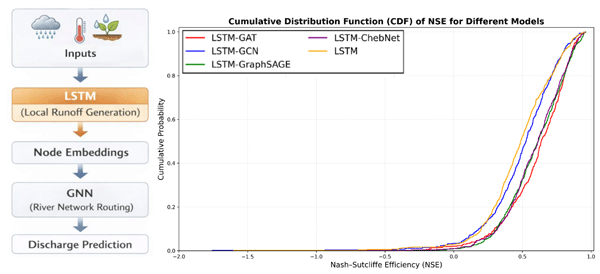
Hamidreza Mosaffa, Florian Pappenberger, Christel Prudhomme, Matthew Chantry, Christoph Rüdiger, and Hannah Cloke
Hydrol. Earth Syst. Sci., 30, 2079–2092, https://doi.org/10.5194/hess-30-2079-2026, https://doi.org/10.5194/hess-30-2079-2026, 2026
Short summary
Short summary
This study improves river flow prediction by combining two types of artificial intelligence models. One model estimates how rainfall becomes runoff in each part of a river basin, while another represents how water moves through the river network. By linking these processes, the approach better captures how water travels across large basins. The results show more accurate streamflow predictions, which can support water management and flood forecasting.
Fatima M. Pillosu, Mariana Claire, Calum Baugh, Florian Pappenberger, Christel Prudhome, and Hannah L. Cloke
EGUsphere, https://doi.org/10.5194/egusphere-2026-1591, https://doi.org/10.5194/egusphere-2026-1591, 2026
Short summary
Short summary
This paper presents the first global, medium-range probabilistic forecasts of flash flood occurrence. A single XGBoost model trained on coarse impact reports achieves skilful predictions, challenging assumptions that complex architectures and high-resolution data are required. At a time of heightened attention to flash flood risk and early warning, this work demonstrates that skilful global forecasting is achievable in data-sparse regions where flash flood risk is highest.
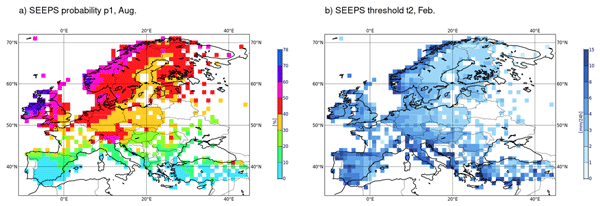
Zied Ben-Bouallègue, Ana Prieto-Nemesio, Angela Iza Wong, Florian Pinault, Marlies van der Schee, and Umberto Modigliani
Earth Syst. Sci. Data, 18, 713–720, https://doi.org/10.5194/essd-18-713-2026, https://doi.org/10.5194/essd-18-713-2026, 2026
Short summary
Short summary
SEEPS4ALL (Stable and Equitable Error in Probability Space) is a precipitation dataset consisting of observations at meteorological stations over 3 years (2022–2024 for now), and a set of corresponding climate statistics estimated over 30 years (1991–2020). A climatology is derived separately for each station and each month of the year. Along with the dataset, SEEPS4ALL also resembles a set of verification tools. In a nutshell, SEEPS4ALL helps promote the benchmark of daily precipitation forecasts against in-situ observations over Europe.
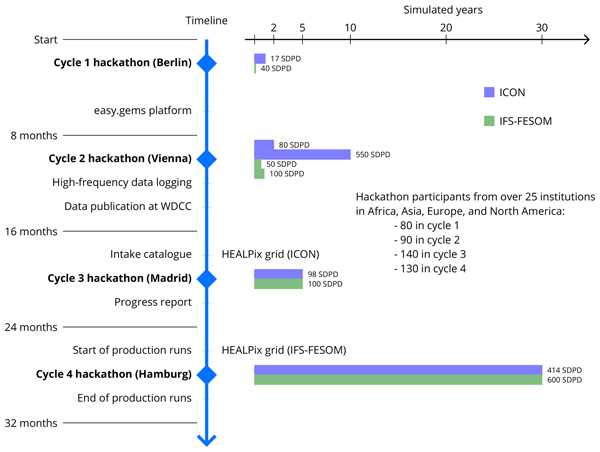
Hans Segura, Xabier Pedruzo-Bagazgoitia, Philipp Weiss, Sebastian K. Müller, Thomas Rackow, Junhong Lee, Edgar Dolores-Tesillos, Imme Benedict, Matthias Aengenheyster, Razvan Aguridan, Gabriele Arduini, Alexander J. Baker, Jiawei Bao, Swantje Bastin, Eulàlia Baulenas, Tobias Becker, Sebastian Beyer, Hendryk Bockelmann, Nils Brüggemann, Lukas Brunner, Suvarchal K. Cheedela, Sushant Das, Jasper Denissen, Ian Dragaud, Piotr Dziekan, Madeleine Ekblom, Jan Frederik Engels, Monika Esch, Richard Forbes, Claudia Frauen, Lilli Freischem, Diego García-Maroto, Philipp Geier, Paul Gierz, Álvaro González-Cervera, Katherine Grayson, Matthew Griffith, Oliver Gutjahr, Helmuth Haak, Ioan Hadade, Kerstin Haslehner, Shabeh ul Hasson, Jan Hegewald, Lukas Kluft, Aleksei Koldunov, Nikolay Koldunov, Tobias Kölling, Shunya Koseki, Sergey Kosukhin, Josh Kousal, Peter Kuma, Arjun U. Kumar, Rumeng Li, Nicolas Maury, Maximilian Meindl, Sebastian Milinski, Kristian Mogensen, Bimochan Niraula, Jakub Nowak, Divya Sri Praturi, Ulrike Proske, Dian Putrasahan, René Redler, David Santuy, Domokos Sármány, Reiner Schnur, Patrick Scholz, Dmitry Sidorenko, Dorian Spät, Birgit Sützl, Daisuke Takasuka, Adrian Tompkins, Alejandro Uribe, Mirco Valentini, Menno Veerman, Aiko Voigt, Sarah Warnau, Fabian Wachsmann, Marta Wacławczyk, Nils Wedi, Karl-Hermann Wieners, Jonathan Wille, Marius Winkler, Yuting Wu, Florian Ziemen, Janos Zimmermann, Frida A.-M. Bender, Dragana Bojovic, Sandrine Bony, Simona Bordoni, Patrice Brehmer, Marcus Dengler, Emanuel Dutra, Saliou Faye, Erich Fischer, Chiel van Heerwaarden, Cathy Hohenegger, Heikki Järvinen, Markus Jochum, Thomas Jung, Johann H. Jungclaus, Noel S. Keenlyside, Daniel Klocke, Heike Konow, Martina Klose, Szymon Malinowski, Olivia Martius, Thorsten Mauritsen, Juan Pedro Mellado, Theresa Mieslinger, Elsa Mohino, Hanna Pawłowska, Karsten Peters-von Gehlen, Abdoulaye Sarré, Pajam Sobhani, Philip Stier, Lauri Tuppi, Pier Luigi Vidale, Irina Sandu, and Bjorn Stevens
Geosci. Model Dev., 18, 7735–7761, https://doi.org/10.5194/gmd-18-7735-2025, https://doi.org/10.5194/gmd-18-7735-2025, 2025
Short summary
Short summary
The Next Generation of Earth Modeling Systems project (nextGEMS) developed two Earth system models that use horizontal grid spacing of 10 km and finer, giving more fidelity to the representation of local phenomena, globally. In its fourth cycle, nextGEMS simulated the Earth System climate over the 2020–2049 period under the SSP3-7.0 scenario. Here, we provide an overview of nextGEMS, insights into the model development, and the realism of multi-decadal, kilometer-scale simulations.
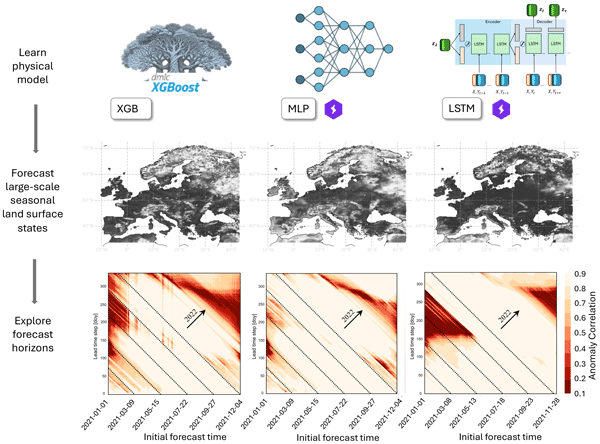
Marieke Wesselkamp, Matthew Chantry, Ewan Pinnington, Margarita Choulga, Souhail Boussetta, Maria Kalweit, Joschka Bödecker, Carsten F. Dormann, Florian Pappenberger, and Gianpaolo Balsamo
Geosci. Model Dev., 18, 921–937, https://doi.org/10.5194/gmd-18-921-2025, https://doi.org/10.5194/gmd-18-921-2025, 2025
Short summary
Short summary
We compared spatiotemporal forecasts of three machine learning models that learned water and energy
states on the land surface from a physical model scheme. The forecasting models were developed with reanalysis data and simulations on a European scale and transferred to the globe. We found that all approaches deliver highly accurate approximations of the physical dynamic at long time horizons, implying their usefulness to advance land surface forecasting with synthetic data.
states on the land surface from a physical model scheme. The forecasting models were developed with reanalysis data and simulations on a European scale and transferred to the globe. We found that all approaches deliver highly accurate approximations of the physical dynamic at long time horizons, implying their usefulness to advance land surface forecasting with synthetic data.
Thomas Rackow, Xabier Pedruzo-Bagazgoitia, Tobias Becker, Sebastian Milinski, Irina Sandu, Razvan Aguridan, Peter Bechtold, Sebastian Beyer, Jean Bidlot, Souhail Boussetta, Willem Deconinck, Michail Diamantakis, Peter Dueben, Emanuel Dutra, Richard Forbes, Rohit Ghosh, Helge F. Goessling, Ioan Hadade, Jan Hegewald, Thomas Jung, Sarah Keeley, Lukas Kluft, Nikolay Koldunov, Aleksei Koldunov, Tobias Kölling, Josh Kousal, Christian Kühnlein, Pedro Maciel, Kristian Mogensen, Tiago Quintino, Inna Polichtchouk, Balthasar Reuter, Domokos Sármány, Patrick Scholz, Dmitry Sidorenko, Jan Streffing, Birgit Sützl, Daisuke Takasuka, Steffen Tietsche, Mirco Valentini, Benoît Vannière, Nils Wedi, Lorenzo Zampieri, and Florian Ziemen
Geosci. Model Dev., 18, 33–69, https://doi.org/10.5194/gmd-18-33-2025, https://doi.org/10.5194/gmd-18-33-2025, 2025
Short summary
Short summary
Detailed global climate model simulations have been created based on a numerical weather prediction model, offering more accurate spatial detail down to the scale of individual cities ("kilometre-scale") and a better understanding of climate phenomena such as atmospheric storms, whirls in the ocean, and cracks in sea ice. The new model aims to provide globally consistent information on local climate change with greater precision, benefiting environmental planning and local impact modelling.
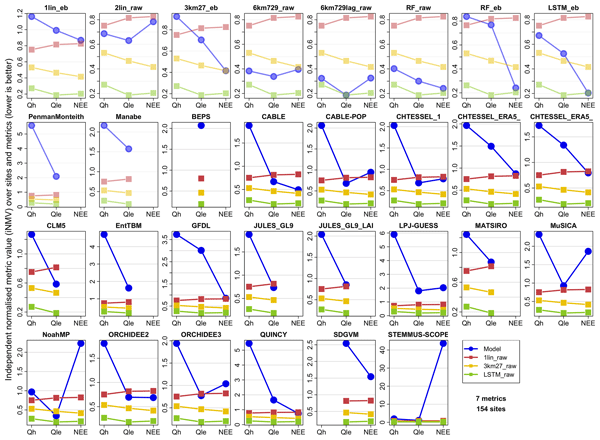
Gab Abramowitz, Anna Ukkola, Sanaa Hobeichi, Jon Cranko Page, Mathew Lipson, Martin G. De Kauwe, Samuel Green, Claire Brenner, Jonathan Frame, Grey Nearing, Martyn Clark, Martin Best, Peter Anthoni, Gabriele Arduini, Souhail Boussetta, Silvia Caldararu, Kyeungwoo Cho, Matthias Cuntz, David Fairbairn, Craig R. Ferguson, Hyungjun Kim, Yeonjoo Kim, Jürgen Knauer, David Lawrence, Xiangzhong Luo, Sergey Malyshev, Tomoko Nitta, Jerome Ogee, Keith Oleson, Catherine Ottlé, Phillipe Peylin, Patricia de Rosnay, Heather Rumbold, Bob Su, Nicolas Vuichard, Anthony P. Walker, Xiaoni Wang-Faivre, Yunfei Wang, and Yijian Zeng
Biogeosciences, 21, 5517–5538, https://doi.org/10.5194/bg-21-5517-2024, https://doi.org/10.5194/bg-21-5517-2024, 2024
Short summary
Short summary
This paper evaluates land models – computer-based models that simulate ecosystem dynamics; land carbon, water, and energy cycles; and the role of land in the climate system. It uses machine learning and AI approaches to show that, despite the complexity of land models, they do not perform nearly as well as they could given the amount of information they are provided with about the prediction problem.
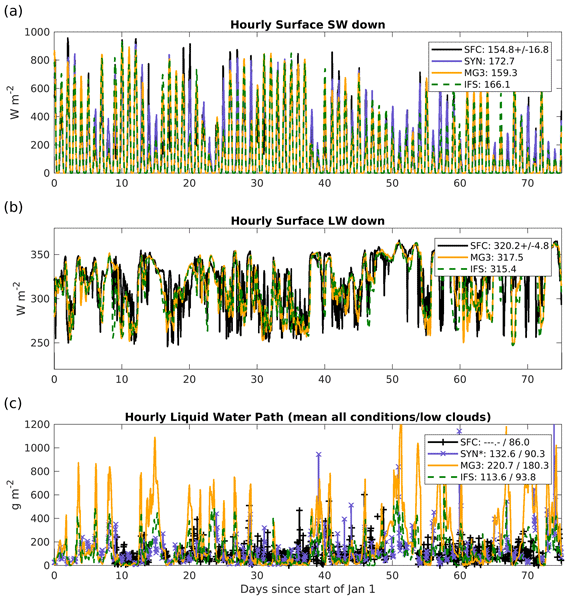
Andrew Gettelman, Richard Forbes, Roger Marchand, Chih-Chieh Chen, and Mark Fielding
Geosci. Model Dev., 17, 8069–8092, https://doi.org/10.5194/gmd-17-8069-2024, https://doi.org/10.5194/gmd-17-8069-2024, 2024
Short summary
Short summary
Supercooled liquid clouds (liquid clouds colder than 0°C) are common at higher latitudes (especially over the Southern Ocean) and are critical for constraining climate projections. We compare a single-column version of a weather model to observations with two different cloud schemes and find that both the dynamical environment and atmospheric aerosols are important for reproducing observations.
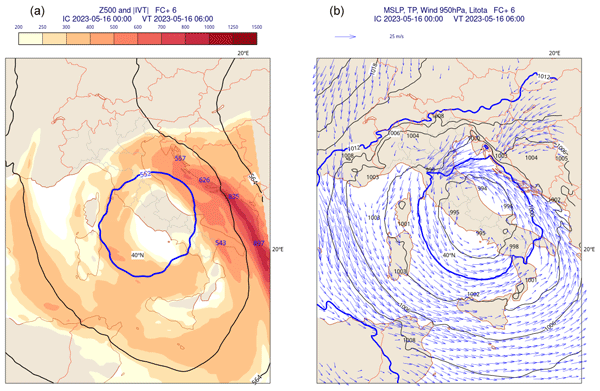
Joshua Dorrington, Marta Wenta, Federico Grazzini, Linus Magnusson, Frederic Vitart, and Christian M. Grams
Nat. Hazards Earth Syst. Sci., 24, 2995–3012, https://doi.org/10.5194/nhess-24-2995-2024, https://doi.org/10.5194/nhess-24-2995-2024, 2024
Short summary
Short summary
Extreme rainfall is the leading weather-related source of damages in Europe, but it is still difficult to predict on long timescales. A recent example of this was the devastating floods in the Italian region of Emiglia Romagna in May 2023. We present perspectives based on large-scale dynamical information that allows us to better understand and predict such events.
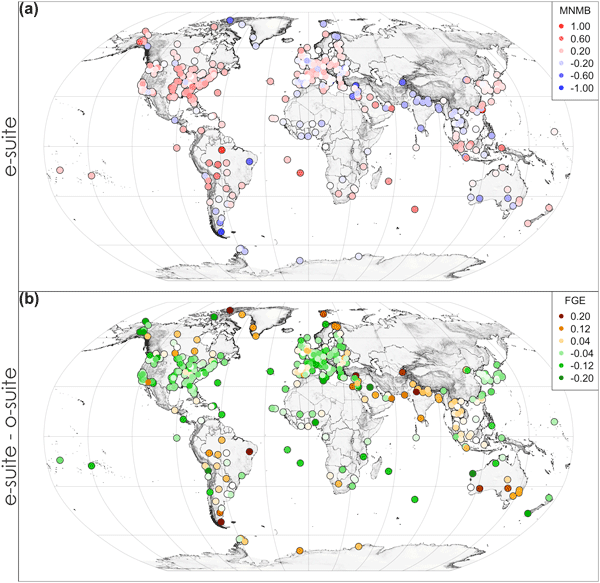
Henk Eskes, Athanasios Tsikerdekis, Melanie Ades, Mihai Alexe, Anna Carlin Benedictow, Yasmine Bennouna, Lewis Blake, Idir Bouarar, Simon Chabrillat, Richard Engelen, Quentin Errera, Johannes Flemming, Sebastien Garrigues, Jan Griesfeller, Vincent Huijnen, Luka Ilić, Antje Inness, John Kapsomenakis, Zak Kipling, Bavo Langerock, Augustin Mortier, Mark Parrington, Isabelle Pison, Mikko Pitkänen, Samuel Remy, Andreas Richter, Anja Schoenhardt, Michael Schulz, Valerie Thouret, Thorsten Warneke, Christos Zerefos, and Vincent-Henri Peuch
Atmos. Chem. Phys., 24, 9475–9514, https://doi.org/10.5194/acp-24-9475-2024, https://doi.org/10.5194/acp-24-9475-2024, 2024
Short summary
Short summary
The Copernicus Atmosphere Monitoring Service (CAMS) provides global analyses and forecasts of aerosols and trace gases in the atmosphere. On 27 June 2023 a major upgrade, Cy48R1, became operational. Comparisons with in situ, surface remote sensing, aircraft, and balloon and satellite observations show that the new CAMS system is a significant improvement. The results quantify the skill of CAMS to forecast impactful events, such as wildfires, dust storms and air pollution peaks.
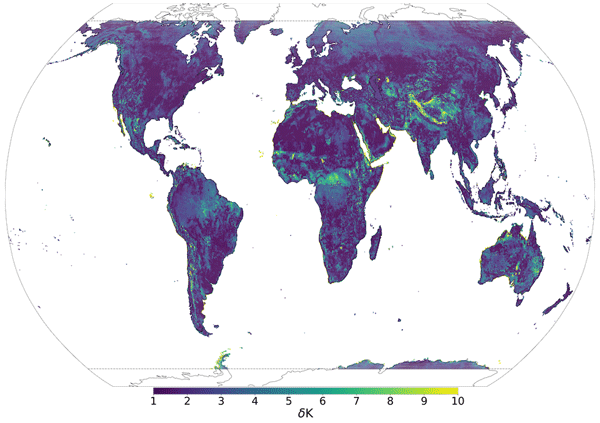
Tom Kimpson, Margarita Choulga, Matthew Chantry, Gianpaolo Balsamo, Souhail Boussetta, Peter Dueben, and Tim Palmer
Hydrol. Earth Syst. Sci., 27, 4661–4685, https://doi.org/10.5194/hess-27-4661-2023, https://doi.org/10.5194/hess-27-4661-2023, 2023
Short summary
Short summary
Lakes play an important role when we try to explain and predict the weather. More accurate and up-to-date description of lakes all around the world for numerical models is a continuous task. However, it is difficult to assess the impact of updated lake description within a weather prediction system. In this work, we develop a method to quickly and automatically define how, where, and when updated lake description affects weather prediction.
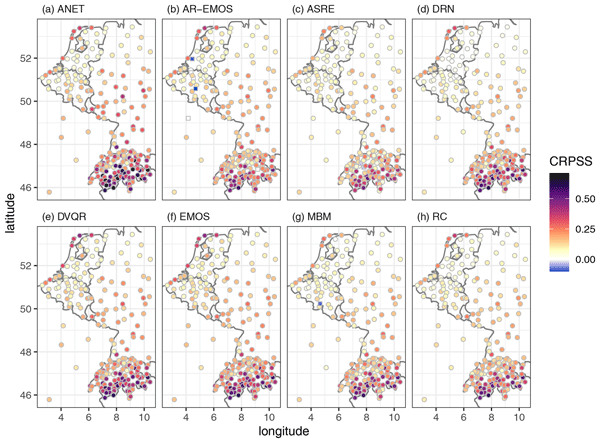
Jonathan Demaeyer, Jonas Bhend, Sebastian Lerch, Cristina Primo, Bert Van Schaeybroeck, Aitor Atencia, Zied Ben Bouallègue, Jieyu Chen, Markus Dabernig, Gavin Evans, Jana Faganeli Pucer, Ben Hooper, Nina Horat, David Jobst, Janko Merše, Peter Mlakar, Annette Möller, Olivier Mestre, Maxime Taillardat, and Stéphane Vannitsem
Earth Syst. Sci. Data, 15, 2635–2653, https://doi.org/10.5194/essd-15-2635-2023, https://doi.org/10.5194/essd-15-2635-2023, 2023
Short summary
Short summary
A benchmark dataset is proposed to compare different statistical postprocessing methods used in forecasting centers to properly calibrate ensemble weather forecasts. This dataset is based on ensemble forecasts covering a portion of central Europe and includes the corresponding observations. Examples on how to download and use the data are provided, a set of evaluation methods is proposed, and a first benchmark of several methods for the correction of 2 m temperature forecasts is performed.
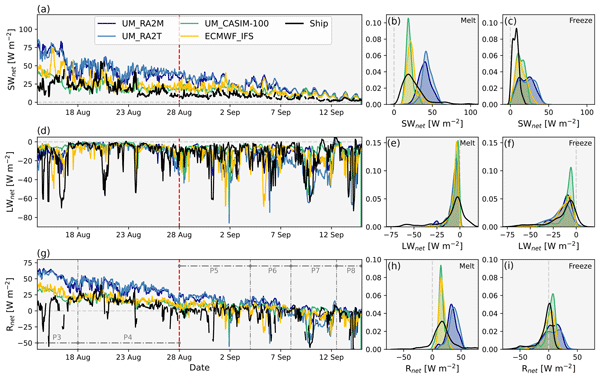
Gillian Young McCusker, Jutta Vüllers, Peggy Achtert, Paul Field, Jonathan J. Day, Richard Forbes, Ruth Price, Ewan O'Connor, Michael Tjernström, John Prytherch, Ryan Neely III, and Ian M. Brooks
Atmos. Chem. Phys., 23, 4819–4847, https://doi.org/10.5194/acp-23-4819-2023, https://doi.org/10.5194/acp-23-4819-2023, 2023
Short summary
Short summary
In this study, we show that recent versions of two atmospheric models – the Unified Model and Integrated Forecasting System – overestimate Arctic cloud fraction within the lower troposphere by comparison with recent remote-sensing measurements made during the Arctic Ocean 2018 expedition. The overabundance of cloud is interlinked with the modelled thermodynamic structure, with strong negative temperature biases coincident with these overestimated cloud layers.
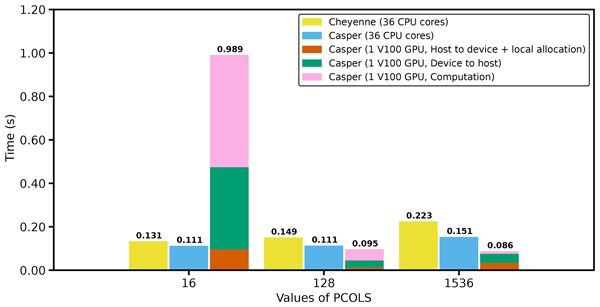
Andrew Gettelman, Hugh Morrison, Trude Eidhammer, Katherine Thayer-Calder, Jian Sun, Richard Forbes, Zachary McGraw, Jiang Zhu, Trude Storelvmo, and John Dennis
Geosci. Model Dev., 16, 1735–1754, https://doi.org/10.5194/gmd-16-1735-2023, https://doi.org/10.5194/gmd-16-1735-2023, 2023
Short summary
Short summary
Clouds are a critical part of weather and climate prediction. In this work, we document updates and corrections to the description of clouds used in several Earth system models. These updates include the ability to run the scheme on graphics processing units (GPUs), changes to the numerical description of precipitation, and a correction to the ice number. There are big improvements in the computational performance that can be achieved with GPU acceleration.
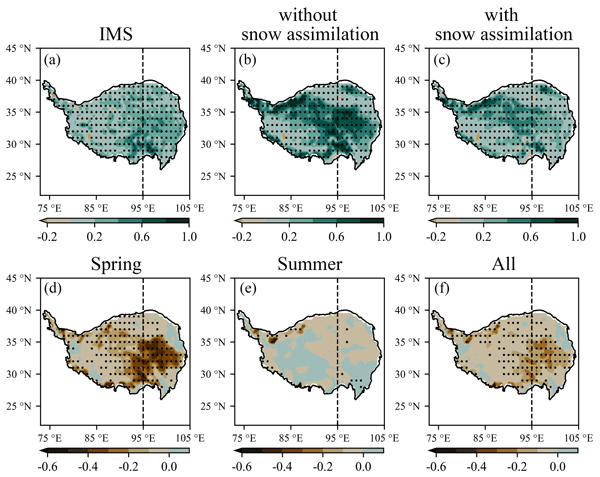
Wei Li, Jie Chen, Lu Li, Yvan J. Orsolini, Yiheng Xiang, Retish Senan, and Patricia de Rosnay
The Cryosphere, 16, 4985–5000, https://doi.org/10.5194/tc-16-4985-2022, https://doi.org/10.5194/tc-16-4985-2022, 2022
Short summary
Short summary
Snow assimilation over the Tibetan Plateau (TP) may influence seasonal forecasts over this region. To investigate the impacts of snow assimilation on the seasonal forecasts of snow, temperature and precipitation, twin ensemble reforecasts are initialized with and without snow assimilation above 1500 m altitude over the TP for spring and summer in 2018. The results show that snow assimilation can improve seasonal forecasts over the TP through the interaction between land and atmosphere.
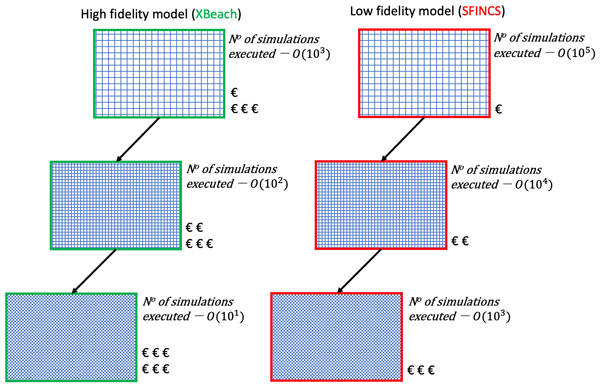
Mariana C. A. Clare, Tim W. B. Leijnse, Robert T. McCall, Ferdinand L. M. Diermanse, Colin J. Cotter, and Matthew D. Piggott
Nat. Hazards Earth Syst. Sci., 22, 2491–2515, https://doi.org/10.5194/nhess-22-2491-2022, https://doi.org/10.5194/nhess-22-2491-2022, 2022
Short summary
Short summary
Assessing uncertainty is computationally expensive because it requires multiple runs of expensive models. We take the novel approach of assessing uncertainty from coastal flooding using a multilevel multifidelity (MLMF) method which combines the efficiency of less accurate models with the accuracy of more expensive models at different resolutions. This significantly reduces the computational cost but maintains accuracy, making previously unfeasible real-world studies possible.
Jonathan J. Day, Sarah Keeley, Gabriele Arduini, Linus Magnusson, Kristian Mogensen, Mark Rodwell, Irina Sandu, and Steffen Tietsche
Weather Clim. Dynam., 3, 713–731, https://doi.org/10.5194/wcd-3-713-2022, https://doi.org/10.5194/wcd-3-713-2022, 2022
Short summary
Short summary
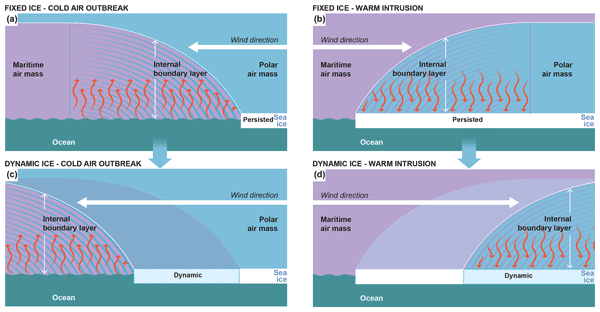
A recent drive to develop seamless forecasting systems has culminated in the development of weather forecasting systems that include a coupled representation of the atmosphere, ocean and sea ice. Before this, sea ice and sea surface temperature anomalies were typically fixed throughout a given forecast. We show that the dynamic coupling is most beneficial during periods of rapid ice advance, where persistence is a poor forecast of the sea ice and leads to large errors in the uncoupled system.

Beatriz M. Monge-Sanz, Alessio Bozzo, Nicholas Byrne, Martyn P. Chipperfield, Michail Diamantakis, Johannes Flemming, Lesley J. Gray, Robin J. Hogan, Luke Jones, Linus Magnusson, Inna Polichtchouk, Theodore G. Shepherd, Nils Wedi, and Antje Weisheimer
Atmos. Chem. Phys., 22, 4277–4302, https://doi.org/10.5194/acp-22-4277-2022, https://doi.org/10.5194/acp-22-4277-2022, 2022
Short summary
Short summary
The stratosphere is emerging as one of the keys to improve tropospheric weather and climate predictions. This study provides evidence of the role the stratospheric ozone layer plays in improving weather predictions at different timescales. Using a new ozone modelling approach suitable for high-resolution global models that provide operational forecasts from days to seasons, we find significant improvements in stratospheric meteorological fields and stratosphere–troposphere coupling.
Ian Boutle, Wayne Angevine, Jian-Wen Bao, Thierry Bergot, Ritthik Bhattacharya, Andreas Bott, Leo Ducongé, Richard Forbes, Tobias Goecke, Evelyn Grell, Adrian Hill, Adele L. Igel, Innocent Kudzotsa, Christine Lac, Bjorn Maronga, Sami Romakkaniemi, Juerg Schmidli, Johannes Schwenkel, Gert-Jan Steeneveld, and Benoît Vié
Atmos. Chem. Phys., 22, 319–333, https://doi.org/10.5194/acp-22-319-2022, https://doi.org/10.5194/acp-22-319-2022, 2022
Short summary
Short summary
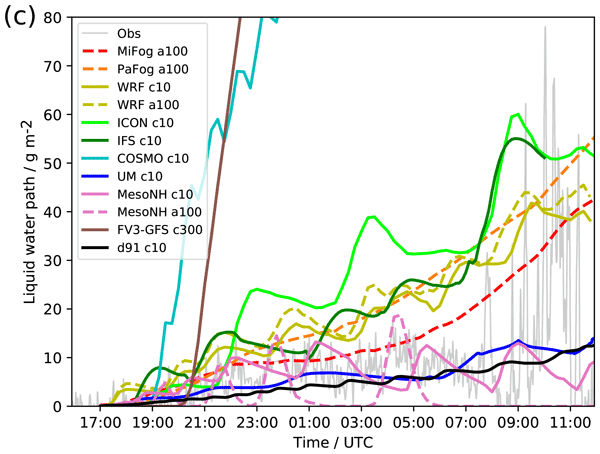
Fog forecasting is one of the biggest problems for numerical weather prediction. By comparing many models used for fog forecasting with others used for fog research, we hoped to help guide forecast improvements. We show some key processes that, if improved, will help improve fog forecasting, such as how water is deposited on the ground. We also showed that research models were not themselves a suitable baseline for comparison, and we discuss what future observations are required to improve them.
Cited articles
Balogh, B., Saint-Martin, D., and Geoffroy, O.: Online Test of a Neural Network Deep Convection Parameterization in ARP-GEM1, arXiv [preprint], https://doi.org/10.48550/arXiv.2410.21920, 2024. a
Ben Bouallègue, Z., Clare, M. C. A., Magnusson, L., Gascón, E., Maier-Gerber, M., Janoušek, M., Rodwell, M., Pinault, F., Dramsch, J. S., Lang, S. T. K., Raoult, B., Rabier, F., Chevallier, M., Sandu, I., Dueben, P., Chantry, M., and Pappenberger, F.: The rise of data-driven weather forecasting: A first statistical assessment of machine learning-based weather forecasts in an operational-like context, B. Am. Meteorol. Soc., 105, E864–E883, https://doi.org/10.1175/BAMS-D-23-0162.1, 2024. a, b, c
Bi, K., Xie, L., Zhang, H., et al.: Accurate medium-range global weather forecasting with 3D neural networks, Nature, 619, 533–538, https://doi.org/10.1038/s41586-023-06185-3, 2023. a
Bonavita, M.: On Some Limitations of Current Machine Learning Weather Prediction Models, Geophys. Res. Lett., 51, e2023GL107377, https://doi.org/10.1029/2023GL107377, 2024. a, b
Bonev, B., Kurth, T., Mahesh, A., Bisson, M., Kossaifi, J., Kashinath, K., Anandkumar, A., Collins, W. D., Pritchard, M. S., and Keller, A.: FourCastNet 3: A geometric approach to probabilistic machine-learning weather forecasting at scale, arXiv [preprint], https://doi.org/10.48550/arXiv.2507.12144, 2025. a
Brenowitz, N. D., Cohen, Y., Pathak, J., Mahesh, A., Bonev, B., Kurth, T., Durran, D. R., Harrington, P., and Pritchard, M. S.: A Practical Probabilistic Benchmark for AI Weather Models, Geophys. Res. Lett., 52, https://doi.org/10.1029/2024gl113656, 2025. a
Chen, L., Zhong, X., Zhang, F., Cheng, Y., Xu, Y., Qi, Y., and Li, H.: FuXi: a cascade machine learning forecasting system for 15-day global weather forecast, npj Clim. Atmos. Sci., 6, https://doi.org/10.1038/s41612-023-00512-1, 2023. a, b
ECMWF: aifs-single-1.1 (Revision 7976552), ECMWF [code], https://doi.org/10.57967/hf/6415, 2025a. a
ECMWF: Open data, ECMWF [data set], https://doi.org/10.21957/OPEN-DATA, 2025b. a
European Centre for Medium-Range Weather Forecasts: AIFS 1.1.0: Permanent Archive of Checkpoints and Source Code for Training and Inference, Zenodo [code], https://doi.org/10.5281/ZENODO.17349820, 2025. a
Hakim, G. J. and Masanam, S.: Dynamical tests of a deep-learning weather prediction model, Artif. Intel. Earth Syst., 3, https://doi.org/10.1175/aies-d-23-0090, 2024. a
Harder, P., Hernandez-Garcia, A., Ramesh, V., Yang, Q., Sattigeri, P., Szwarcman, D., Watson, C., and Rolnick, D.: Hard-Constrained Deep Learning for Climate Downscaling, arXiv [preprint] https://doi.org/10.48550/arXiv.2208.05424, 2024. a
Hersbach, H., Bell, B., Berrisford, P., et al.: The ERA5 global reanalysis, Q. J. Roy. Meteorol. Soc., 146, 1999–2049, https://doi.org/10.1002/qj.3803, 2020. a
Hersbach, H., Bell, B., Berrisford, P., Biavati, G., Horányi, A., Muñoz Sabater, J., Nicolas, J., Peubey, C., Radu, R., Rozum, I., Schepers, D., Simmons, A., Soci, C., Dee, D., and Thépaut, J.-N.: ERA5 hourly data on single levels from 1940 to present, Copernicus Climate Change Service (C3S) Climate Data Store (CDS) [data set], https://doi.org/10.24381/cds.adbb2d47, 2023. a
Huffman, G. J., Stocker, E. F., Bolvin, D. T., Nelkin, E. J., and Tan, J.: GPM IMERG Final Precipitation L3 1 day 0.1 degree × 0.1 degree V07, GES DISC [data set], https://doi.org/10.5067/GPM/IMERGDF/DAY/07, 2023. a
Jolliffe, I. T. and Stephenson, D. B. (Eds.): Forecast verification, in: 2nd Edn., Wiley-Blackwell, Hoboken, NJ, https://doi.org/10.1002/9781119960003, 2011. a
Keisler, R.: Forecasting global weather with graph neural networks, arXiv [preprint], arXiv:2202.07575, https://doi.org/10.48550/arXiv.2202.07575, 2022. a
Kent, C., Scaife, A. A., Dunstone, N. J., Smith, D., Hardiman, S. C., Dunstan, T., and Watt-Meyer, O.: Skilful global seasonal predictions from a machine learning weather model trained on reanalysis data, arXiv [preprint], https://doi.org/10.48550/arXiv.2503.23953, 2025. a
Lam, R., Sanchez-Gonzalez, A., Willson, M., Wirnsberger, P., Fortunato, M., Alet, F., Ravuri, S., Ewalds, T., Eaton-Rosen, Z., Hu, W., Merose, A., Hoyer, S., Holland, G., Vinyals, O., Stott, J., Pritzel, A., Mohamed, S., and Battaglia, P.: Learning skillful medium-range global weather forecasting, Science, 382, 1416–1421, https://doi.org/10.1126/science.adi2336, 2023. a, b, c, d
Lang, S., Alexe, M., Chantry, M., Dramsch, J., Pinault, F., Raoult, B., Clare, M. C. A., Lessig, C., Maier-Gerber, M., Magnusson, L., Bouallègue, Z. B., Nemesio, A. P., Dueben, P. D., Brown, A., Pappenberger, F., and Rabier, F.: AIFS – ECMWF's data-driven forecasting system, arXiv 9preprint], arXiv:2406.01465, https://doi.org/10.48550/arXiv.2406.01465, 2024a. a, b, c, d, e, f, g, h
Lang, S., Alexe, M., Clare, M. C. A., Roberts, C., Adewoyin, R., Bouallègue, Z. B., Chantry, M., Dramsch, J., Dueben, P. D., Hahner, S., Maciel, P., Prieto-Nemesio, A., O'Brien, C., Pinault, F., Polster, J., Raoult, B., Tietsche, S., and Leutbecher, M.: AIFS-CRPS: Ensemble forecasting using a model trained with a loss function based on the Continuous Ranked Probability Score, arXiv [preprint], arXiv:2412.15832, https://doi.org/10.48550/arXiv.2412.15832, 2024b. a, b, c
Loshchilov, I. and Hutter, F.: Decoupled Weight Decay Regularization, in: International Conference on Learning Representations, https://openreview.net/forum?id=Bkg6RiCqY7 (last access: 31 March 2026), 2019. a
Micikevicius, P., Narang, S., Alben, J., Diamos, G., Elsen, E., Garcia, D., Ginsburg, B., Houston, M., Kuchaiev, O., Venkatesh, G., and Wu, H.: Mixed Precision Training, arXiv [preprint], https://doi.org/10.48550/arXiv.1710.03740, 2018. a
Muñoz Sabater, J., Dutra, E., Agustí-Panareda, A., Albergel, C., Arduini, G., Balsamo, G., Boussetta, S., Choulga, M., Harrigan, S., Hersbach, H., Martens, B., Miralles, D. G., Piles, M., Rodríguez-Fernández, N. J., Zsoter, E., Buontempo, C., and Thépaut, J.-N.: ERA5-Land: a state-of-the-art global reanalysis dataset for land applications, Earth Syst. Sci. Data, 13, 4349–4383, https://doi.org/10.5194/essd-13-4349-2021, 2021. a
Nipen, T. N., Haugen, H. H., Ingstad, M. S., Nordhagen, E. M., Salihi, A. F. S., Tedesco, P., Seierstad, I. A., Kristiansen, J., Lang, S., Alexe, M., Dramsch, J., Raoult, B., Mertes, G., and Chantry, M.: Regional data-driven weather modeling with a global stretched-grid, arXiv [preprint], https://doi.org/10.48550/arXiv.2409.02891, 2024. a
Pathak, J., Subramanian, S., Harrington, P., Raja, S., Chattopadhyay, A., Mardani, M., Kurth, T., Hall, D., Li, Z., Azizzadenesheli, K., and Hassanzadeh, P.: FourCastNet: A global data-driven high-resolution weather model using adaptive fourier neural operators, arXiv [preprint], arXiv:2202.11214, https://doi.org/10.48550/arXiv.2202.11214, 2022. a
Pfeifroth, U., Kothe, S., Drücke, J., Trentmann, J., Schröder, M., Selbach, N., and Hollmann, R.: Surface Radiation Data Set – Heliosat (SARAH) – Edition 3, EUMETSAT, https://doi.org/10.5676/EUM_SAF_CM/SARAH/V003, 2023. a
Rasp, S., Hoyer, S., Merose, A., Langmore, I., Battaglia, P., Russell, T., Sanchez-Gonzalez, A., Yang, V., Carver, R., Agrawal, S., Chantry, M., Ben Bouallegue, Z., Dueben, P., Bromberg, C., Sisk, J., Barrington, L., Bell, A., and Sha, F.: WeatherBench 2: A Benchmark for the Next Generation of Data-Driven Global Weather Models, J. Adv. Model. Earth Syst., 16, e2023MS004019, https://doi.org/10.1029/2023MS004019, 2024. a
Rodwell, M. J., Richardson, D. S., Hewson, T. D., and Haiden, T.: A new equitable score suitable for verifying precipitation in numerical weather prediction, Q. J. Roy. Meteorol. Soc., 136, 1344–1363, https://doi.org/10.1002/qj.656, 2010. a
Schreck, J. S., Sha, Y., Chapman, W., Kimpara, D., Berner, J., McGinnis, S., Kazadi, A., Sobhani, N., Kirk, B., Becker, C., Gantos, G., and Gagne II, D. J.: Community Research Earth Digital Intelligence Twin: a scalable framework for AI-driven Earth System Modeling, npj Clim. Atmos. Sci., 8, https://doi.org/10.1038/s41612-025-01125-6, 2025. a
Sha, Y., Schreck, J. S., Chapman, W., and Gagne II, D. J.: Investigating the Use of Terrain-Following Coordinates in AI-Driven Precipitation Forecasts, Geophys. Res. Lett., 52, e2025GL118478, https://doi.org/10.1029/2025GL118478, 2025a. a, b, c
Sha, Y., Schreck, J. S., Chapman, W., and Gagne II, D. J.: Improving AI Weather Prediction Models Using Global Mass and Energy Conservation Schemes, J. Adv. Model. Earth Syst., 17, e2025MS005138, https://doi.org/10.1029/2025MS005138, 2025b. a
Subramaniam, A., Durran, D., Pruitt, D., Cresswell-Clay, N., and Yik, W.: Imposing the Fundamental Dynamical Constraint of Hydrostatic Balance to Improve Global ML Weather Prediction, arXiv [preprint], https://doi.org/10.48550/arXiv.2506.08285, 2025. a
Thiem, H. and Collins, N.: Historic January 2025 Snowstorm in the Southern US, https://www.climate.gov/news-features/event-tracker/historic-january-2025-snowstorm-southern-us (last access: 31 March 2026), 2025. a
Wedi, N. P.: Increasing the horizontal resolution in numerical weather prediction and climate simulations: illusion or panacea?, Philos. T. Roy. Soc.. A, 372, https://doi.org/10.1098/rsta.2013.0289, 2014. a
Wijnands, J. S., Ginderachter, M. V., François, B., Buurman, S., Termonia, P., and den Bleeken, D. V.: A comparison of stretched-grid and limited-area modelling for data-driven regional weather forecasting, arXiv [preprint], https://doi.org/10.48550/arXiv.2507.18378, 2025. a
Wilks, D. S.: Statistical methods in the atmospheric sciences, in: 4th Edn., Elsevier Science Publishing, Philadelphia, PA, https://doi.org/10.1016/C2017-0-03921-6, 2019. a
Zuo, H., Alonso-Balmaseda, M., de Boisseson, E., Browne, P., Chrust, M., Keeley, S., Mogensen, K., Pelletier, C., de Rosnay, P., and Takakura, T.: ECMWF's next ensemble reanalysis system for ocean and sea ice: ORAS6, ECMWF Newsletter, 30–36, https://doi.org/10.21957/hzd5y821lk, 2024. a
Short summary
We present the latest release of the Artificial Intelligence Forecasting System, AIFS 1.1.0, which shows improved headline forecasting skill through an expanded dataset and enhanced training schedule. The model also incorporates hard physical constraints that facilitate training and improve rainfall prediction. Finally, we extend the set of forecasted variables to include soil conditions and energy-related fields, strengthening the operational value of AIFS.
We present the latest release of the Artificial Intelligence Forecasting System, AIFS 1.1.0,...


