
Articles | Volume 19, issue 10
https://doi.org/10.5194/gmd-19-4601-2026
© Author(s) 2026. This work is distributed under
the Creative Commons Attribution 4.0 License.
the Creative Commons Attribution 4.0 License.
https://doi.org/10.5194/gmd-19-4601-2026
© Author(s) 2026. This work is distributed under
the Creative Commons Attribution 4.0 License.
the Creative Commons Attribution 4.0 License.
Model description paper
| 
28 May 2026
Model description paper |
| 28 May 2026
| 28 May 2026
S2AS v1.0 and 2D polarity–volatility lumping framework v1.0: automated compound classification and scalable lumping for organic aerosol modelling
Dalrin Ampritta Amaladhasan
Department of Atmospheric and Oceanic Sciences, McGill University, Montreal, Quebec, H3A 0B9, Canada
Dan Hassan-Barthaux
Department of Atmospheric and Oceanic Sciences, McGill University, Montreal, Quebec, H3A 0B9, Canada
Department of Atmospheric and Oceanic Sciences, McGill University, Montreal, Quebec, H3A 0B9, Canada
Related authors
No articles found.
Camilo Serrano Damha, Kyle Gorkowski, and Andreas Zuend
Atmos. Chem. Phys., 25, 5773–5792, https://doi.org/10.5194/acp-25-5773-2025, https://doi.org/10.5194/acp-25-5773-2025, 2025
Short summary
Short summary
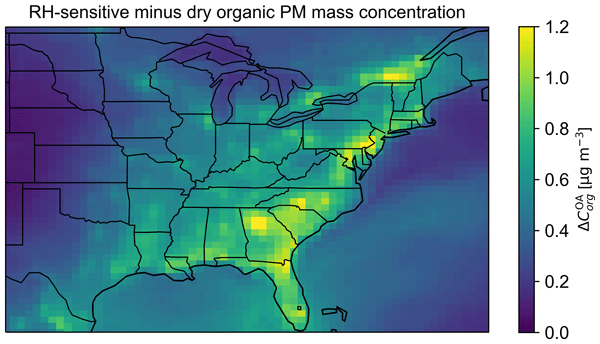
We implemented the BAT-VBS (Binary Activity Thermodynamics volatility basis set) aerosol thermodynamics model in the GEOS-Chem chemical transport model to efficiently account for organic aerosol water uptake, nonideal mixing, and impacts on the gas–particle partitioning of semi-volatile organics. Compared to GEOS-Chem's complex (dry) scheme, we show that the BAT-VBS model can predict substantial enhancements in organic aerosol mass concentration at moderate-to-high relative humidity.
Ryan Schmedding and Andreas Zuend
Atmos. Chem. Phys., 25, 327–346, https://doi.org/10.5194/acp-25-327-2025, https://doi.org/10.5194/acp-25-327-2025, 2025
Short summary
Short summary
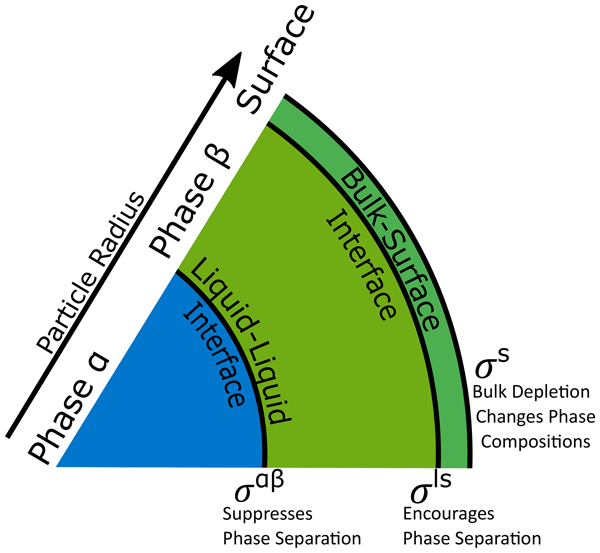
Four different approaches for computing the interfacial tension between liquid phases in aerosol particles were tested for particles with diameters from 10 nm to more than 5 μm. Antonov's rule led to the strongest reductions in the onset relative humidity of liquid–liquid phase separation and reproduced measured interfacial tensions for highly immiscible systems. A modified form of the Butler equation was able to best reproduce measured interfacial tensions in more miscible systems.
Liviana K. Klein, Allan K. Bertram, Andreas Zuend, Florence Gregson, and Ulrich K. Krieger
Atmos. Chem. Phys., 24, 13341–13359, https://doi.org/10.5194/acp-24-13341-2024, https://doi.org/10.5194/acp-24-13341-2024, 2024
Short summary
Short summary
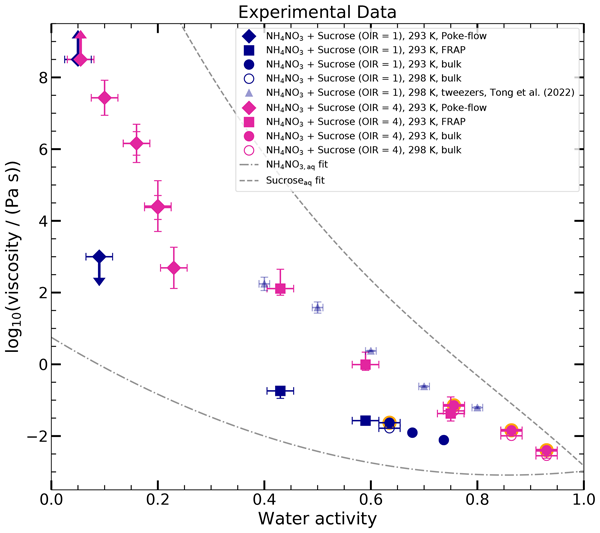
The viscosity of ammonium nitrate–sucrose–H2O was quantified with three methods ranging from liquid to solid state depending on the relative humidity. Moreover, the corresponding estimated internal aerosol mixing times remained below 1 h for most tropospheric conditions, making equilibrium partitioning a reasonable assumption.
Ryan Schmedding and Andreas Zuend
Atmos. Chem. Phys., 23, 7741–7765, https://doi.org/10.5194/acp-23-7741-2023, https://doi.org/10.5194/acp-23-7741-2023, 2023
Short summary
Short summary
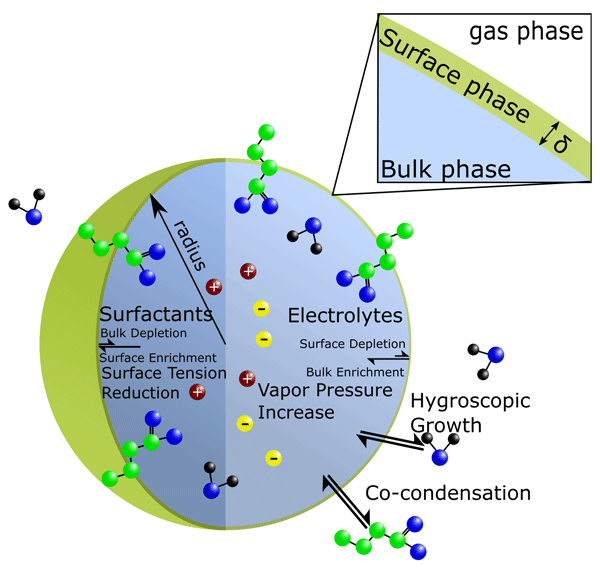
Aerosol particles below 100 nm in diameter have high surface-area-to-volume ratios. The enrichment of compounds in the surface of an aerosol particle may lead to depletion of that species in the interior bulk of the particle. We present a framework for modeling the equilibrium bulk–surface partitioning of mixed organic–inorganic particles, including cases of co-condensation of semivolatile organic compounds and species with extremely limited solubility in the bulk or surface of a particle.
Rani Jeong, Joseph Lilek, Andreas Zuend, Rongshuang Xu, Man Nin Chan, Dohyun Kim, Hi Gyu Moon, and Mijung Song
Atmos. Chem. Phys., 22, 8805–8817, https://doi.org/10.5194/acp-22-8805-2022, https://doi.org/10.5194/acp-22-8805-2022, 2022
Short summary
Short summary
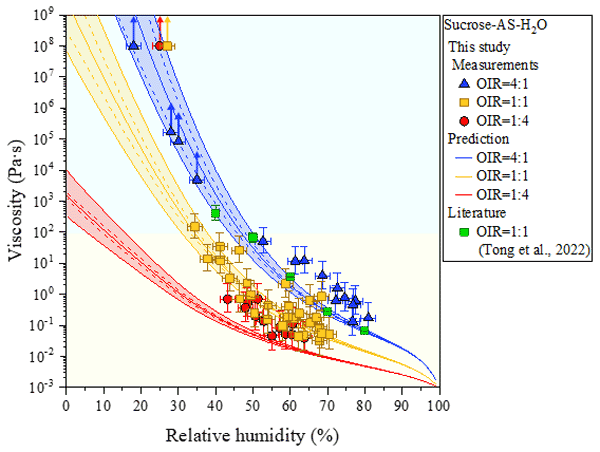
In this study, the viscosities of particles of sucrose–H2O, AS–H2O, and sucrose–AS–H2O for OIRs of 4:1, 1:1, and 1:4 for decreasing RH, were quantified by poke-and-flow and bead-mobility techniques at 293 ± 1 K. Based on the viscosity results, the particles of binary and ternary systems ranged from liquid to semisolid, and even the solid state depending on the RH. Moreover, we compared the measured viscosities of ternary systems to the predicted viscosities with excellent agreement.
Joseph Lilek and Andreas Zuend
Atmos. Chem. Phys., 22, 3203–3233, https://doi.org/10.5194/acp-22-3203-2022, https://doi.org/10.5194/acp-22-3203-2022, 2022
Short summary
Short summary
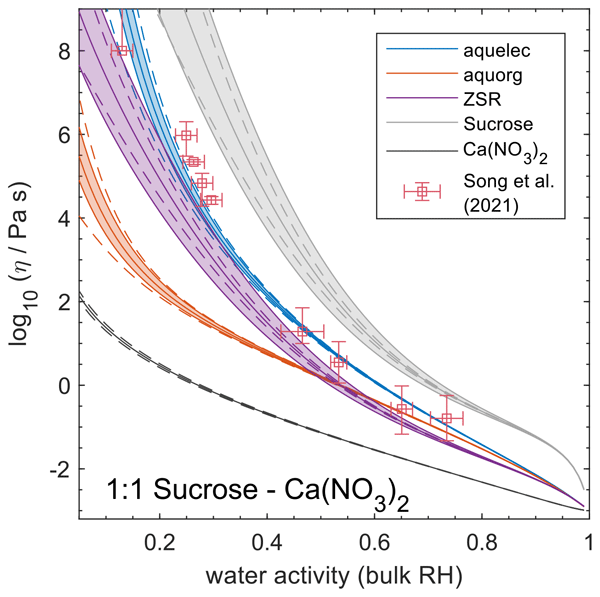
Depending on temperature and chemical makeup, certain aerosols can be highly viscous or glassy, with atmospheric implications. We have therefore implemented two major upgrades to the predictive viscosity model AIOMFAC-VISC. First, we created a new viscosity model for aqueous electrolyte solutions containing an arbitrary number of ion species. Second, we integrated the electrolyte model within the existing AIOMFAC-VISC framework to enable viscosity predictions for organic–inorganic mixtures.
Hang Yin, Jing Dou, Liviana Klein, Ulrich K. Krieger, Alison Bain, Brandon J. Wallace, Thomas C. Preston, and Andreas Zuend
Atmos. Chem. Phys., 22, 973–1013, https://doi.org/10.5194/acp-22-973-2022, https://doi.org/10.5194/acp-22-973-2022, 2022
Short summary
Short summary
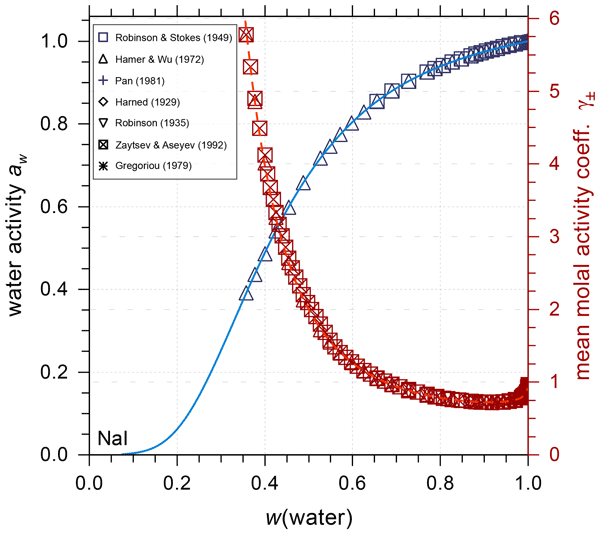
Iodine and carbonate species are important components in marine and dust aerosols, respectively. We introduce an extended version of the AIOMFAC thermodynamic mixing model, which includes the ions I−, IO3−, HCO3−, CO32−, OH−, and CO2(aq) as new species, and we discuss two methods for solving the carbonate dissociation equilibria numerically. We also present new experimental water activity data for aqueous iodide and iodate systems.
Dalrin Ampritta Amaladhasan, Claudia Heyn, Christopher R. Hoyle, Imad El Haddad, Miriam Elser, Simone M. Pieber, Jay G. Slowik, Antonio Amorim, Jonathan Duplissy, Sebastian Ehrhart, Vladimir Makhmutov, Ugo Molteni, Matti Rissanen, Yuri Stozhkov, Robert Wagner, Armin Hansel, Jasper Kirkby, Neil M. Donahue, Rainer Volkamer, Urs Baltensperger, Martin Gysel-Beer, and Andreas Zuend
Atmos. Chem. Phys., 22, 215–244, https://doi.org/10.5194/acp-22-215-2022, https://doi.org/10.5194/acp-22-215-2022, 2022
Short summary
Short summary
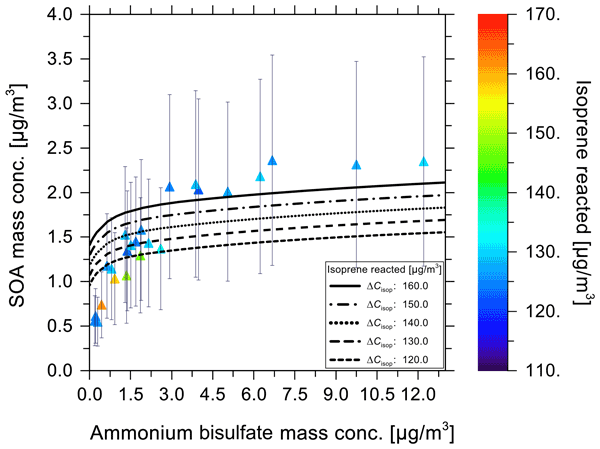
We use a combination of models for gas-phase chemical reactions and equilibrium gas–particle partitioning of isoprene-derived secondary organic aerosols (SOAs) informed by dark ozonolysis experiments conducted in the CLOUD chamber. Our predictions cover high to low relative humidities (RHs) and quantify how SOA mass yields are enhanced at high RH as well as the impact of inorganic seeds of distinct hygroscopicities and acidities on the coupled partitioning of water and semi-volatile organics.
Young-Chul Song, Joseph Lilek, Jae Bong Lee, Man Nin Chan, Zhijun Wu, Andreas Zuend, and Mijung Song
Atmos. Chem. Phys., 21, 10215–10228, https://doi.org/10.5194/acp-21-10215-2021, https://doi.org/10.5194/acp-21-10215-2021, 2021
Short summary
Short summary
We report viscosity of binary mixtures of organic material / H2O and inorganic salts / H2O, as well as ternary mixtures of organic material / inorganic salts/ H2O, over the atmospheric relative humidity (RH) range. The viscosity measurements indicate that the studied mixed organic–inorganic particles range in phase state from liquid to semi-solid or even solid across the atmospheric RH range at a temperature of 293 K.
Cited articles
Allen, F., Pon, A., Greiner, R., and Wishart, D.: Computational prediction of electron ionization mass spectra to assist in GC/MS compound identification, Anal. Chem., 88, 7689–7697, 2016. a
Amaladhasan, D. A. and Zuend, A.: 2D polarity–volatility lumping framework, Zenodo [code], https://doi.org/10.5281/zenodo.18968224, 2026a. a
Amaladhasan, D. A. and Zuend, A.: SMILES to AIOMFAC subgroups (S2AS) tool, Zenodo [code], https://doi.org/10.5281/zenodo.18968164, 2026b. a
Amaladhasan, D. A., Zuend, A., and Hassan-Barthaux, D.: Alpha-pinene and Toluene SOA system data used in Amaladhasan et al. for 2D lumping, Zenodo [data set], https://doi.org/10.5281/zenodo.17088390, 2026. a
Armeli, G., Peters, J.-H., and Koop, T.: Machine-Learning-Based Prediction of the Glass Transition Temperature of Organic Compounds Using Experimental Data, ACS Omega, 8, 12298–12309, https://doi.org/10.1021/acsomega.2c08146, 2023. a
Aumont, B., Szopa, S., and Madronich, S.: Modelling the evolution of organic carbon during its gas-phase tropospheric oxidation: development of an explicit model based on a self generating approach, Atmos. Chem. Phys., 5, 2497–2517, https://doi.org/10.5194/acp-5-2497-2005, 2005. a, b, c
Barley, M. H. and McFiggans, G.: The critical assessment of vapour pressure estimation methods for use in modelling the formation of atmospheric organic aerosol, Atmos. Chem. Phys., 10, 749–767, https://doi.org/10.5194/acp-10-749-2010, 2010. a
Bertram, A. K., Martin, S. T., Hanna, S. J., Smith, M. L., Bodsworth, A., Chen, Q., Kuwata, M., Liu, A., You, Y., and Zorn, S. R.: Predicting the relative humidities of liquid-liquid phase separation, efflorescence, and deliquescence of mixed particles of ammonium sulfate, organic material, and water using the organic-to-sulfate mass ratio of the particle and the oxygen-to-carbon elemental ratio of the organic component, Atmos. Chem. Phys., 11, 10995–11006, https://doi.org/10.5194/acp-11-10995-2011, 2011. a
Bilde, M., Barsanti, K., Booth, M., Cappa, C. D., Donahue, N. M., Emanuelsson, E. U., McFiggans, G., Krieger, U. K., Marcolli, C., Topping, D., Ziemann, P., Barley, M., Clegg, S., Dennis-Smither, B., Hallquist, M., Hallquist, A. M., Khlystov, A., Kulmala, M., Mogensen, D., Percival, C. J., Pope, F., Reid, J. P., Ribeiro da Silva, M. A. V., Rosenoern, T., Salo, K., Soonsin, V. P., Yli-Juuti, T., Prisle, N. L., Pagels, J., Rarey, J., Zardini, A. A., and Riipinen, I.: Saturation Vapor Pressures and Transition Enthalpies of Low-Volatility Organic Molecules of Atmospheric Relevance: From Dicarboxylic Acids to Complex Mixtures, Chem. Rev., 115, 4115–4156, https://doi.org/10.1021/cr5005502, 2015. a
Burkardt, J.: ASA058 the K-Means Problem, https://people.math.sc.edu/Burkardt/f_src/asa058/asa058.html (last access: 8 August 2025), 2008. a
Byun, D. W., Young, J., and Odman, M. T.: Governing Equations and Computational Structure of the Community Multiscale Air Quality (CMAQ) Chemical Transport Model, Chap. 6, Science Algorithms of the EPA Models-3 Community Multiscale Air Quality (CMAQ) Modeling System, 6-1–6-41, https://www.cmascenter.org/cmaq/science_documentation/pdf/ch06.pdf (last access: 25 May 2026), 1999. a
Chang, E. I. and Pankow, J. F.: Prediction of activity coefficients in liquid aerosol particles containing organic compounds, dissolved inorganic salts, and water – Part 2: Consideration of phase separation effects by an X-UNIFAC model, Atmos. Environ., 40, 6422–6436, https://doi.org/10.1016/j.atmosenv.2006.04.031, 2006. a, b
Chang, E. I. and Pankow, J. F.: Organic particulate matter formation at varying relative humidity using surrogate secondary and primary organic compounds with activity corrections in the condensed phase obtained using a method based on the Wilson equation, Atmos. Chem. Phys., 10, 5475–5490, https://doi.org/10.5194/acp-10-5475-2010, 2010. a
Compernolle, S., Ceulemans, K., and Müller, J.-F.: EVAPORATION: a new vapour pressure estimation methodfor organic molecules including non-additivity and intramolecular interactions, Atmos. Chem. Phys., 11, 9431–9450, https://doi.org/10.5194/acp-11-9431-2011, 2011. a, b, c, d
DeRieux, W.-S. W., Li, Y., Lin, P., Laskin, J., Laskin, A., Bertram, A. K., Nizkorodov, S. A., and Shiraiwa, M.: Predicting the glass transition temperature and viscosity of secondary organic material using molecular composition, Atmos. Chem. Phys., 18, 6331–6351, https://doi.org/10.5194/acp-18-6331-2018, 2018. a
Donahue, N. M., Robinson, A. L., Stanier, C. O., and Pandis, S. N.: Coupled Partitioning, Dilution, and Chemical Aging of Semivolatile Organics, Environ. Sci. Technol., 40, 2635–2643, https://doi.org/10.1021/es052297c, 2006. a, b, c
Donahue, N. M., Epstein, S. A., Pandis, S. N., and Robinson, A. L.: A two-dimensional volatility basis set: 1. organic-aerosol mixing thermodynamics, Atmos. Chem. Phys., 11, 3303–3318, https://doi.org/10.5194/acp-11-3303-2011, 2011. a, b
Donahue, N. M., Kroll, J. H., Pandis, S. N., and Robinson, A. L.: A two-dimensional volatility basis set – Part 2: Diagnostics of organic-aerosol evolution, Atmos. Chem. Phys., 12, 615–634, https://doi.org/10.5194/acp-12-615-2012, 2012. a, b
Ehrlich, H.-C. and Rarey, M.: Systematic benchmark of substructure search in molecular graphs-From Ullmann to VF2, J. Cheminformatics, 4, 1–17, 2012. a
Erdakos, G. B. and Pankow, J. F.: Gas/particle partitioning of neutral and ionizing compounds to single- and multi-phase aerosol particles. 2. Phase separation in liquid particulate matter containing both polar and low-polarity organic compounds, Atmos. Environ., 38, 1005–1013, https://doi.org/10.1016/j.atmosenv.2003.10.038, 2004. a
Fredenslund, A., Jones, R. L., and Prausnitz, J. M.: Group-Contribution Estimation of Activity Coefficients in Nonideal Liquid Mixtures, AIChE J., 21, 1086–1099, 1975. a
Galeazzo, T. and Shiraiwa, M.: Predicting glass transition temperature and melting point of organic compounds via machine learning and molecular embeddings, Environmental Science: Atmospheres, 2, 362–374, https://doi.org/10.1039/D1EA00090J, 2022. a
Girolami, G. S.: A Simple “Back of the Envelope” Method for Estimating the Densities and Molecular Volumes of Liquids and Solids, J. Chem. Educ., 71, 962, https://doi.org/10.1021/ed071p962, 1994. a
Hallquist, M., Wenger, J. C., Baltensperger, U., Rudich, Y., Simpson, D., Claeys, M., Dommen, J., Donahue, N. M., George, C., Goldstein, A. H., Hamilton, J. F., Herrmann, H., Hoffmann, T., Iinuma, Y., Jang, M., Jenkin, M. E., Jimenez, J. L., Kiendler-Scharr, A., Maenhaut, W., McFiggans, G., Mentel, Th. F., Monod, A., Prévôt, A. S. H., Seinfeld, J. H., Surratt, J. D., Szmigielski, R., and Wildt, J.: The formation, properties and impact of secondary organic aerosol: current and emerging issues, Atmos. Chem. Phys., 9, 5155–5236, https://doi.org/10.5194/acp-9-5155-2009, 2009. a
Hansen, H. K., Rasmussen, P., Fredenslund, A., Schiller, M., and Gmehling, J.: Vapor–liquid equilibria by UNIFAC group contribution. 5. Revision and extension, Ind. Eng. Chem. Res., 30, 2352–2355, https://doi.org/10.1021/ie00058a017, 1991. a
Hartigan, J. A. and Wong, M. A.: Algorithm AS 136: A K-Means Clustering Algorithm, J. Roy. Stat. Soc. C-App., 28, 100–108, https://doi.org/10.2307/2346830, 1979. a, b
Huang, Y., Mahrt, F., Xu, S., Shiraiwa, M., Zuend, A., and Bertram, A. K.: Coexistence of three liquid phases in individual atmospheric aerosol particles, P. Natl. Acad. Sci. USA, 118, e2102512118, https://doi.org/10.1073/pnas.2102512118, 2021. a
Jenkin, M. E., Saunders, S. M., and Pilling, M. J.: The tropospheric degradation of volatile organic compounds: A protocol for mechanism development, Atmos. Environ., 31, 81–104, https://doi.org/10.1016/S1352-2310(96)00105-7, 1997. a, b
Jenkin, M. E., Saunders, S. M., Wagner, V., and Pilling, M. J.: Protocol for the development of the Master Chemical Mechanism, MCM v3 (Part B): tropospheric degradation of aromatic volatile organic compounds, Atmos. Chem. Phys., 3, 181–193, https://doi.org/10.5194/acp-3-181-2003, 2003. a
Jimenez, J. L., Canagaratna, M. R., Donahue, N. M., Prevot, A. S. H., Zhang, Q., Kroll, J. H., DeCarlo, P. F., Allan, J. D., Coe, H., Ng, N. L., Aiken, A. C., Docherty, K. S., Ulbrich, I. M., Grieshop, A. P., Robinson, A. L., Duplissy, J., Smith, J. D., Wilson, K. R., Lanz, V. A., Hueglin, C., Sun, Y. L., Tian, J., Laaksonen, A., Raatikainen, T., Rautiainen, J., Vaattovaara, P., Ehn, M., Kulmala, M., Tomlinson, J. M., Collins, D. R., Cubison, M. J., Dunlea, E. J., Huffman, J. A., Onasch, T. B., Alfarra, M. R., Williams, P. I., Bower, K., Kondo, Y., Schneider, J., Drewnick, F., Borrmann, S., Weimer, S., Demerjian, K., Salcedo, D., Cottrell, L., Griffin, R., Takami, A., Miyoshi, T., Hatakeyama, S., Shimono, A., Sun, J. Y., Zhang, Y. M., Dzepina, K., Kimmel, J. R., Sueper, D., Jayne, J. T., Herndon, S. C., Trimborn, A. M., Williams, L. R., Wood, E. C., Middlebrook, A. M., Kolb, C. E., Baltensperger, U., and Worsnop, D. R.: Evolution of Organic Aerosols in the Atmosphere, Science, 326, 1525–1529, https://doi.org/10.1126/science.1180353, 2009. a
Kamlet, M. J., Doherty, R. M., Abraham, M. H., Marcus, Y., and Taft, R. W.: Linear solvation energy relationship. 46. An improved equation for correlation and prediction of octanol/water partition coefficients of organic nonelectrolytes (including strong hydrogen bond donor solutes), J. Phys. Chem., 92, 5244–5255, https://doi.org/10.1021/j100329a035, 1988. a
Kroll, J. H., Donahue, N. M., Jimenez, J. L., Kessler, S. H., Canagaratna, M. R., Wilson, K. R., Altieri, K. E., Mazzoleni, L. R., Wozniak, A. S., Bluhm, H., Mysak, E. R., Smith, J. D., Kolb, C. E., and Worsnop, D. R.: Carbon oxidation state as a metric for describing the chemistry of atmospheric organic aerosol, Nat. Chem., 3, 133–139, https://doi.org/10.1038/nchem.948, 2011. a, b, c
Lannuque, V., D’Anna, B., Couvidat, F., Valorso, R., and Sartelet, K.: Improvement in Modeling of OH and HO2 Radical Concentrations during Toluene and Xylene Oxidation with RACM2 Using MCM/GECKO-A, Atmosphere-Basel, 12, https://doi.org/10.3390/atmos12060732, 2021. a
Marcolli, C. and Peter, Th.: Water activity in polyol/water systems: new UNIFAC parameterization, Atmos. Chem. Phys., 5, 1545–1555, https://doi.org/10.5194/acp-5-1545-2005, 2005. a, b, c
Mouchel-Vallon, C., Lee-Taylor, J., Hodzic, A., Artaxo, P., Aumont, B., Camredon, M., Gurarie, D., Jimenez, J.-L., Lenschow, D. H., Martin, S. T., Nascimento, J., Orlando, J. J., Palm, B. B., Shilling, J. E., Shrivastava, M., and Madronich, S.: Exploration of oxidative chemistry and secondary organic aerosol formation in the Amazon during the wet season: explicit modeling of the Manaus urban plume with GECKO-A, Atmos. Chem. Phys., 20, 5995–6014, https://doi.org/10.5194/acp-20-5995-2020, 2020. a, b, c
Nannoolal, Y., Rarey, J., and Ramjugernath, D.: Estimation of pure component properties: Part 3. Estimation of the vapor pressure of non-electrolyte organic compounds via group contributions and group interactions, Fluid Phase Equilibr., 269, 117–133, 2008. a
OEChem: OpenEye Scientific Software, Inc., Santa Fe, NM, USA, https://www.eyesopen.com/oechem-tk (last access: 25 May 2026), 2012. a
O'Meara, S., Booth, A. M., Barley, M. H., Topping, D., and McFiggans, G.: An assessment of vapour pressure estimation methods, Phys. Chem. Chem. Phys., 16, 19453–19469, https://doi.org/10.1039/C4CP00857J, 2014. a
Pankow, J. F.: Gas/particle partitioning of neutral and ionizing compounds to single and multi-phase aerosol particles. 1. Unified modeling framework, Atmos. Environ., 37, 3323–3333, https://doi.org/10.1016/S1352-2310(03)00346-7, 2003. a, b, c
Pankow, J. F. and Asher, W. E.: SIMPOL.1: a simple group contribution method for predicting vapor pressures and enthalpies of vaporization of multifunctional organic compounds, Atmos. Chem. Phys., 8, 2773–2796, https://doi.org/10.5194/acp-8-2773-2008, 2008. a, b
Pankow, J. F. and Barsanti, C. K.: The carbon number-polarity grid: A means to manage the complexity of the mix of organic compounds when modeling atmospheric organic particulate matter, Atmos. Environ., 43, 2829–2835, https://doi.org/10.1016/j.atmosenv.2008.12.050, 2009. a
Pankow, J. F. and Chang, E. I.: Variation in the sensitivity of predicted levels of atmospheric organic particulate matter (OPM), Environ. Sci. Technol., 42, 7321–7329, 2008. a
Pavlov, D., Rybalkin, M., Karulin, B., Kozhevnikov, M., Savelyev, A., and Churinov, A.: Indigo: universal cheminformatics API, J. Cheminformatics, 3, https://doi.org/10.1186/1758-2946-3-S1-P4, 2011. a, b
Pun, B. K. L., Griffin, R. J., Seigneur, C., and Seinfeld, J. H.: Secondary organic aerosol – 2. Thermodynamic model for gas/particle partitioning of molecular constituents, J. Geophys. Res.-Atmos., 107, https://doi.org/10.1029/2001JD000542, 2002. a
Rastak, N., Pajunoja, A., Acosta Navarro, J. C., Ma, J., Song, M., Partridge, D. G., Kirkevåg, A., Leong, Y., Hu, W. W., Taylor, N. F., Lambe, A., Cerully, K., Bougiatioti, A., Liu, P., Krejci, R., Petäjä, T., Percival, C., Davidovits, P., Worsnop, D. R., Ekman, A. M. L., Nenes, A., Martin, S., Jimenez, J. L., Collins, D. R., Topping, D. O., Bertram, A. K., Zuend, A., Virtanen, A., and Riipinen, I.: Microphysical explanation of the RH-dependent water affinity of biogenic organic aerosol and its importance for climate, Geophys. Res. Lett., 44, 5167–5177, https://doi.org/10.1002/2017GL073056, 2017. a
Ruggeri, G., Bernhard, F. A., Henderson, B. H., and Takahama, S.: Model–measurement comparison of functional group abundance in α-pinene and 1,3,5-trimethylbenzene secondary organic aerosol formation, Atmos. Chem. Phys., 16, 8729–8747, https://doi.org/10.5194/acp-16-8729-2016, 2016. a
Saunders, S. M., Jenkin, M. E., Derwent, R. G., and Pilling, M. J.: Protocol for the development of the Master Chemical Mechanism, MCM v3 (Part A): tropospheric degradation of non-aromatic volatile organic compounds, Atmos. Chem. Phys., 3, 161–180, https://doi.org/10.5194/acp-3-161-2003, 2003. a, b
Schervish, M. and Shiraiwa, M.: Impact of phase state and non-ideal mixing on equilibration timescales of secondary organic aerosol partitioning, Atmos. Chem. Phys., 23, 221–233, https://doi.org/10.5194/acp-23-221-2023, 2023. a
Schmedding, R. and Zuend, A.: The role of interfacial tension in the size-dependent phase separation of atmospheric aerosol particles, Atmos. Chem. Phys., 25, 327–346, https://doi.org/10.5194/acp-25-327-2025, 2025. a
Schmedding, R., Franssen, M., and Zuend, A.: A Machine Learning Approach for Predicting the Pure-Component Surface Tension of Atmospherically Relevant Organic Compounds, ACS ES&T Air, https://doi.org/10.1021/acsestair.4c00291, 2025. a
Semeniuk, K. and Dastoor, A.: Current State of Atmospheric Aerosol Thermodynamics and Mass Transfer Modeling: A Review, Atmosphere-Basel, 11, https://doi.org/10.3390/atmos11020156, 2020. a
Smith, M. L., Kuwata, M., and Martin, S. T.: Secondary Organic Material Produced by the Dark Ozonolysis of α-Pinene Minimally Affects the Deliquescence and Efflorescence of Ammonium Sulfate, Aerosol Sci. Tech., 45, 244–261, https://doi.org/10.1080/02786826.2010.532178, 2011. a
Sommers, J. M., Stroud, C. A., Adam, M. G., O'Brien, J., Brook, J. R., Hayden, K., Lee, A. K. Y., Li, K., Liggio, J., Mihele, C., Mittermeier, R. L., Stevens, R. G., Wolde, M., Zuend, A., and Hayes, P. L.: Evaluating SOA formation from different sources of semi- and intermediate-volatility organic compounds from the Athabasca oil sands, Environmental Science: Atmospheres, 2, 469–490, https://doi.org/10.1039/D1EA00053E, 2022. a
Sparks, D. N.: Algorithm AS 58: Euclidean Cluster Analysis, J. Roy. Stat. Soc. C-App., 22, 126–130, https://doi.org/10.2307/2346321, 1973. a, b
Steinbeck, C., Han, Y., Kuhn, S., Horlacher, O., Luttmann, E., and Willighagen, E.: The Chemistry Development Kit (CDK): An open-source Java library for chemo-and bioinformatics, J. Chem. Inf. Comp. Sci., 43, 493–500, 2003. a
Topping, D., Barley, M., Bane, M. K., Higham, N., Aumont, B., Dingle, N., and McFiggans, G.: UManSysProp v1.0: an online and open-source facility for molecular property prediction and atmospheric aerosol calculations, Geosci. Model Dev., 9, 899–914, https://doi.org/10.5194/gmd-9-899-2016, 2016. a, b, c, d, e, f
Topping, D. L. and Bane, M. (Eds.): Introduction to aerosol modelling: From theory to code, John Wiley & Sons, https://doi.org/10.1002/9781119625728, 2022. a
Topping, D. O., McFiggans, G. B., Kiss, G., Varga, Z., Facchini, M. C., Decesari, S., and Mircea, M.: Surface tensions of multi-component mixed inorganic/organic aqueous systems of atmospheric significance: measurements, model predictions and importance for cloud activation predictions, Atmos. Chem. Phys., 7, 2371–2398, https://doi.org/10.5194/acp-7-2371-2007, 2007. a
Toropov, A. A., Rasulev, B. F., Leszczynska, D., and Leszczynski, J.: Multiplicative SMILES-based optimal descriptors: QSPR modeling of fullerene C60 solubility in organic solvents, Chem. Phys. Lett., 457, 332–336, 2008. a
Tulet, P., Grini, A., Griffin, R. J., and Petitcol, S.: ORILAM-SOA: A computationally efficient model for predicting secondary organic aerosols in three-dimensional atmospheric models, J. Geophys. Res., 111, https://doi.org/10.1029/2006JD007152, 2006. a
Wang, Z., Couvidat, F., and Sartelet, K.: GENerator of reduced Organic Aerosol mechanism (GENOA v1.0): an automatic generation tool of semi-explicit mechanisms, Geosci. Model Dev., 15, 8957–8982, https://doi.org/10.5194/gmd-15-8957-2022, 2022. a, b
Weininger, D.: SMILES, a chemical language and information system. 1. Introduction to methodology and encoding rules, J. Chem. Inf. Comp. Sci., 28, 31–36, https://doi.org/10.1021/ci00057a005, 1988. a
Wienke, G. and Gmehling, J.: Prediction of octanol–water partition coefficients, Henry coefficients and water solubilities using UNIFAC, Toxicol. Environ. Chem., 65, 57–86, https://doi.org/10.1080/02772249809358557, 1998. a
Wiser, F., Sen, S., Wang, Z., Lee-Taylor, J., Barsanti, K. C., Orlando, J., Westervelt, D. M., Henze, D. K., Fiore, A. M., Berman, A., Carter, R., and McNeill, V. F.: A graph theory-based algorithm for the reduction of atmospheric chemical mechanisms, PNAS Nexus, 4, 11, https://doi.org/10.1093/pnasnexus/pgaf273, 2025. a
Zhang, J., Zuend, A., Top, J., Surdu, M., Ei Haddad, I., Slowik, J. G., Prevot, A. S. H., and Bell, D. M.: Estimation of the Volatility and Apparent Activity Coefficient of Levoglucosan in Wood-Burning Organic Aerosols, Environ. Sci. Tech. Let., 11, 1214–1219, https://doi.org/10.1021/acs.estlett.4c00608, 2024. a
Zuend, A. and Seinfeld, J. H.: Modeling the gas-particle partitioning of secondary organic aerosol: the importance of liquid-liquid phase separation, Atmos. Chem. Phys., 12, 3857–3882, https://doi.org/10.5194/acp-12-3857-2012, 2012. a, b, c, d
Zuend, A. and Seinfeld, J. H.: A practical method for the calculation of liquid-liquid equilibria in multicomponent organic-water-electrolyte systems using physicochemical constraints, Fluid Phase Equilibr., 337, 201–213, https://doi.org/10.1016/j.fluid.2012.09.034, 2013. a
Zuend, A., Marcolli, C., Luo, B. P., and Peter, T.: A thermodynamic model of mixed organic-inorganic aerosols to predict activity coefficients, Atmos. Chem. Phys., 8, 4559–4593, https://doi.org/10.5194/acp-8-4559-2008, 2008. a, b, c
Zuend, A., Marcolli, C., Peter, T., and Seinfeld, J. H.: Computation of liquid-liquid equilibria and phase stabilities: implications for RH-dependent gas/particle partitioning of organic-inorganic aerosols, Atmos. Chem. Phys., 10, 7795–7820, https://doi.org/10.5194/acp-10-7795-2010, 2010. a, b, c, d, e
Zuend, A., Marcolli, C., Booth, A. M., Lienhard, D. M., Soonsin, V., Krieger, U. K., Topping, D. O., McFiggans, G., Peter, T., and Seinfeld, J. H.: New and extended parameterization of the thermodynamic model AIOMFAC: calculation of activity coefficients for organic-inorganic mixtures containing carboxyl, hydroxyl, carbonyl, ether, ester, alkenyl, alkyl, and aromatic functional groups, Atmos. Chem. Phys., 11, 9155–9206, https://doi.org/10.5194/acp-11-9155-2011, 2011. a, b, c
Zuend, A., Hassan-Barthaux, D., and Amaladhasan, D. A.: SMILES_to_sat_vapour_pressure, Zenodo [code], https://doi.org/10.5281/zenodo.17172675, 2025. a
Short summary
A 2-dimensional polarity–volatility framework is introduced. It enables the automated characterization of thousands of organics and their systematic lumping into adjustable sets of surrogate components. A new polarity metric based on an activity coefficient ratio is presented for use in this framework. A related molecule substructure parsing tool for input file generation is introduced. This framework enables reduced-complexity representations of near-explicit organic aerosol systems.
A 2-dimensional polarity–volatility framework is introduced. It enables the automated...


