
Articles | Volume 19, issue 8
https://doi.org/10.5194/gmd-19-3335-2026
© Author(s) 2026. This work is distributed under
the Creative Commons Attribution 4.0 License.
the Creative Commons Attribution 4.0 License.
https://doi.org/10.5194/gmd-19-3335-2026
© Author(s) 2026. This work is distributed under
the Creative Commons Attribution 4.0 License.
the Creative Commons Attribution 4.0 License.
Model description paper
| 
27 Apr 2026
Model description paper |
| 27 Apr 2026
| 27 Apr 2026
A Geographically Weighted Gaussian Process Regression (GW-GPR) emulator of anthropogenic PM2.5 from the GEOS-Chem High Performance (GCHP) 13.0.0 global chemical transport model

Center for Sustainability Science and Strategy, Massachusetts Institute of Technology, Cambridge, MA, USA
Sebastian D. Eastham
Brahmal Vasudevan Institute for Sustainable Aviation, Department of Aeronautics, Faculty of Engineering, Imperial College London, South Kensington, London, UK
Erwan Monier
Department of Land, Air and Water Resources, University of California, Davis, CA, USA
Center for Sustainability Science and Strategy, Massachusetts Institute of Technology, Cambridge, MA, USA
Department of Earth, Atmospheric and Planetary Sciences, Massachusetts Institute of Technology, Cambridge, MA, USA
Institute for Data, Systems and Society, Massachusetts Institute of Technology, Cambridge, MA, USA
Related authors
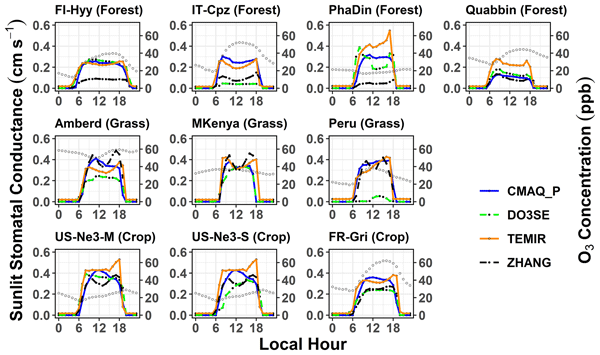
Tamara Emmerichs, Abdulla Al Mamun, Lisa Emberson, Huiting Mao, Leiming Zhang, Limei Ran, Clara Betancourt, Anthony Wong, Gerbrand Koren, Giacomo Gerosa, Min Huang, and Pierluigi Guaita
Biogeosciences, 22, 4823–4849, https://doi.org/10.5194/bg-22-4823-2025, https://doi.org/10.5194/bg-22-4823-2025, 2025
Short summary
Short summary
The risk of ozone pollution to plants is estimated based on the flux through the plant pores which still has uncertainties. In this study, we estimate this quantity with nine models at different land types worldwide, driven by measurement data. The models mostly estimated reasonable summertime ozone flux to plants. The model results varied by land cover, mainly related to the a lack of moisture in the soil. This work is an important step for assessing the ozone impact on vegetation.
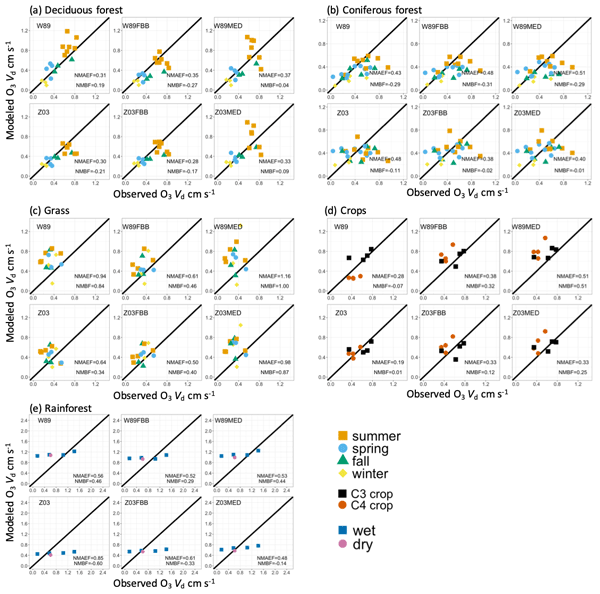
Shihan Sun, Amos P. K. Tai, David H. Y. Yung, Anthony Y. H. Wong, Jason A. Ducker, and Christopher D. Holmes
Biogeosciences, 19, 1753–1776, https://doi.org/10.5194/bg-19-1753-2022, https://doi.org/10.5194/bg-19-1753-2022, 2022
Short summary
Short summary
We developed and used a terrestrial biosphere model to compare and evaluate widely used empirical dry deposition schemes with different stomatal approaches and found that using photosynthesis-based stomatal approaches can reduce biases in modeled dry deposition velocities in current chemical transport models. Our study shows systematic errors in current dry deposition schemes and the importance of representing plant ecophysiological processes in models under a changing climate.

Anthony Y. H. Wong and Jeffrey A. Geddes
Atmos. Chem. Phys., 21, 16479–16497, https://doi.org/10.5194/acp-21-16479-2021, https://doi.org/10.5194/acp-21-16479-2021, 2021
Short summary
Short summary
Land cover change and land management are considered to have important and distinct impacts on air quality. Here we use remote sensing products and agricultural emission inventories to characterize contemporary global land cover and land management changes for chemical transport model simulations. We find that contemporary land system change has a significant impact on global air quality, with land management dominating the effects on PM and land cover change dominating the impacts on ozone.
Sebastian David Eastham, Hamid Reza Abbasi, Marc E. J. Stettler, Tristan Abbott, and Zebediah Engberg
EGUsphere, https://doi.org/10.5194/egusphere-2026-4489, https://doi.org/10.5194/egusphere-2026-4489, 2026
This preprint is open for discussion and under review for Geoscientific Model Development (GMD).
Short summary
Short summary
Aircraft condensation trails (contrails) have been estimated as being responsible for up to half of aviation's overall climate impacts, but this is subject to high uncertainty and few contrail models are fast enough to support rapid exploration of the parameter space. We present CLAMP, a new contrail model designed to simulate a 12-hour contrail in less than a minute while providing results similar to higher-fidelity approaches.
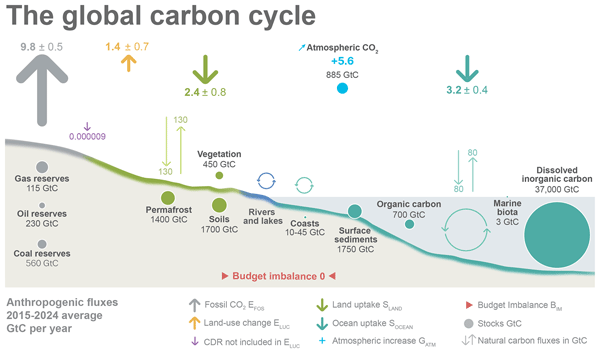
Pierre Friedlingstein, Michael O'Sullivan, Matthew W. Jones, Robbie M. Andrew, Dorothee C. E. Bakker, Judith Hauck, Peter Landschützer, Corinne Le Quéré, Hongmei Li, Ingrid T. Luijkx, Glen P. Peters, Wouter Peters, Julia Pongratz, Clemens Schwingshackl, Stephen Sitch, Josep G. Canadell, Philippe Ciais, Kjetil Aas, Simone R. Alin, Peter Anthoni, Leticia Barbero, Nicholas R. Bates, Nicolas Bellouin, Alice Benoit-Cattin, Carla F. Berghoff, Raffaele Bernardello, Laurent Bopp, Ida Bagus Mandhara Brasika, Matthew A. Chamberlain, Naveen Chandra, Frédéric Chevallier, Louise P. Chini, Nathan O. Collier, Thomas H. Colligan, Margot Cronin, Laique M. Djeutchouang, Xinyu Dou, Matt P. Enright, Kazutaka Enyo, Michael Erb, Wiley Evans, Richard A. Feely, Liang Feng, Daniel J. Ford, Adrianna Foster, Filippa Fransner, Thomas Gasser, Marion Gehlen, Thanos Gkritzalis, Jefferson Goncalves De Souza, Giacomo Grassi, Luke Gregor, Nicolas Gruber, Bertrand Guenet, Özgür Gürses, Kirsty Harrington, Ian Harris, Jens Heinke, George C. Hurtt, Yosuke Iida, Tatiana Ilyina, Akihiko Ito, Andrew R. Jacobson, Atul K. Jain, Tereza Jarníková, Annika Jersild, Fei Jiang, Steve D. Jones, Etsushi Kato, Ralph F. Keeling, Kees Klein Goldewijk, Jürgen Knauer, Yawen Kong, Jan Ivar Korsbakken, Charles Koven, Taro Kunimitsu, Xin Lan, Junjie Liu, Zhiqiang Liu, Zhu Liu, Claire Lo Monaco, Lei Ma, Gregg Marland, Patrick C. McGuire, Galen A. McKinley, Joe R. Melton, Natalie Monacci, Erwan Monier, Eric J. Morgan, David R. Munro, Jens D. Müller, Shin-Ichiro Nakaoka, Lorna R. Nayagam, Yosuke Niwa, Tobias Nutzel, Are Olsen, Abdirahman M. Omar, Naiqing Pan, Sudhanshu Pandey, Denis Pierrot, Zhangcai Qin, Pierre Regnier, Gregor Rehder, Laure Resplandy, Alizée Roobaert, Thais M. Rosan, Christian Rödenbeck, Jörg Schwinger, Ingunn Skjelvan, T. Luke Smallman, Victoria Spada, Mohanan G. Sreeush, Qing Sun, Adrienne J. Sutton, Colm Sweeney, Didier Swingedouw, Roland Séférian, Shintaro Takao, Hiroaki Tatebe, Hanqin Tian, Xiangjun Tian, Bronte Tilbrook, Hiroyuki Tsujino, Francesco Tubiello, Erik van Ooijen, Guido R. van der Werf, Sebastiaan J. van de Velde, Anthony P. Walker, Rik Wanninkhof, Xiaojuan Yang, Wenping Yuan, Xu Yue, and Jiye Zeng
Earth Syst. Sci. Data, 18, 3211–3288, https://doi.org/10.5194/essd-18-3211-2026, https://doi.org/10.5194/essd-18-3211-2026, 2026
Short summary
Short summary
The Global Carbon Budget 2025 describes the methodology, main results, and datasets used to quantify the anthropogenic emissions of carbon dioxide (CO2) and their partitioning among the atmosphere, land ecosystems, and the ocean over the historical period (1750–2025). These living datasets are updated every year to provide the highest transparency and traceability in the reporting of CO2, the key driver of climate change.
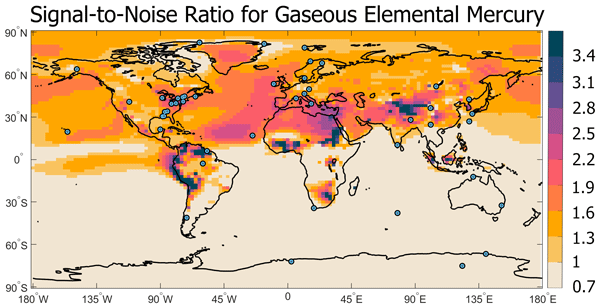
Charikleia Gournia, Noelle E. Selin, and Aryeh Feinberg
Atmos. Chem. Phys., 26, 5039–5061, https://doi.org/10.5194/acp-26-5039-2026, https://doi.org/10.5194/acp-26-5039-2026, 2026
Short summary
Short summary
Human activities release mercury into the air, but current estimates of these emissions vary widely. Our study examines how the uncertainty in global anthropogenic mercury emission estimates impacts the model's ability to reproduce observations. We found that differences in emissions inventories significantly change results, especially in Asia. The work highlights where increased monitoring is needed to improve estimates and better inform global mercury reduction policies.
Christopher B. Womack, Glenn Flierl, Shahine Bouabid, Andre N. Souza, Paolo Giani, Sebastian D. Eastham, and Noelle E. Selin
Earth Syst. Dynam., 17, 107–139, https://doi.org/10.5194/esd-17-107-2026, https://doi.org/10.5194/esd-17-107-2026, 2026
Short summary
Short summary
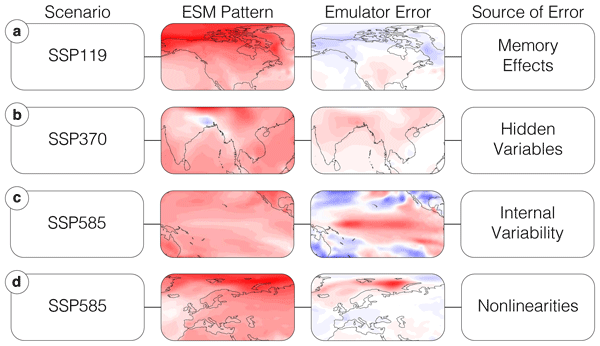
Climate emulators allow for rapid projections without the computational costs associated with full-scale climate models. Here, we outline a framework to compare a variety of emulation techniques both theoretically and practically through a series of stress tests that expose common sources of emulator error. Our results help clarify which emulators are best suited for different tasks and show how future climate scenarios can be used to support emulator design.
Caleb Akhtar Martínez, Sebastian D. Eastham, and Jerome P. Jarrett
Atmos. Chem. Phys., 25, 12875–12891, https://doi.org/10.5194/acp-25-12875-2025, https://doi.org/10.5194/acp-25-12875-2025, 2025
Short summary
Short summary
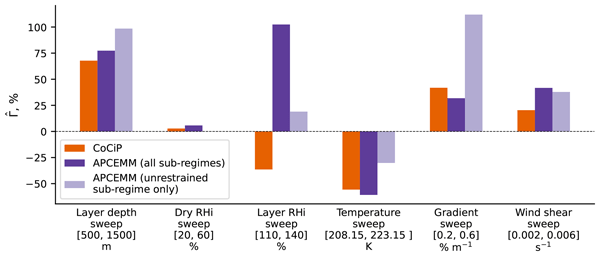
Contrails are clouds that form behind aircraft and can warm the atmosphere as much as carbon dioxide emissions from those planes. This work compares two contrail models of different complexities to understand their lifecycle and impact. The models differ in how contrails evolve over time, implying that we may be significantly underestimating their climate impact. This highlights the need for model diversity and more evaluation against observations of long-lived contrails.
Tamara Emmerichs, Abdulla Al Mamun, Lisa Emberson, Huiting Mao, Leiming Zhang, Limei Ran, Clara Betancourt, Anthony Wong, Gerbrand Koren, Giacomo Gerosa, Min Huang, and Pierluigi Guaita
Biogeosciences, 22, 4823–4849, https://doi.org/10.5194/bg-22-4823-2025, https://doi.org/10.5194/bg-22-4823-2025, 2025
Short summary
Short summary
The risk of ozone pollution to plants is estimated based on the flux through the plant pores which still has uncertainties. In this study, we estimate this quantity with nine models at different land types worldwide, driven by measurement data. The models mostly estimated reasonable summertime ozone flux to plants. The model results varied by land cover, mainly related to the a lack of moisture in the soil. This work is an important step for assessing the ozone impact on vegetation.
William J. Collins, Fiona M. O'Connor, Rachael E. Byrom, Øivind Hodnebrog, Patrick Jöckel, Mariano Mertens, Gunnar Myhre, Matthias Nützel, Dirk Olivié, Ragnhild Bieltvedt Skeie, Laura Stecher, Larry W. Horowitz, Vaishali Naik, Gregory Faluvegi, Ulas Im, Lee T. Murray, Drew Shindell, Kostas Tsigaridis, Nathan Luke Abraham, and James Keeble
Atmos. Chem. Phys., 25, 9031–9060, https://doi.org/10.5194/acp-25-9031-2025, https://doi.org/10.5194/acp-25-9031-2025, 2025
Short summary
Short summary
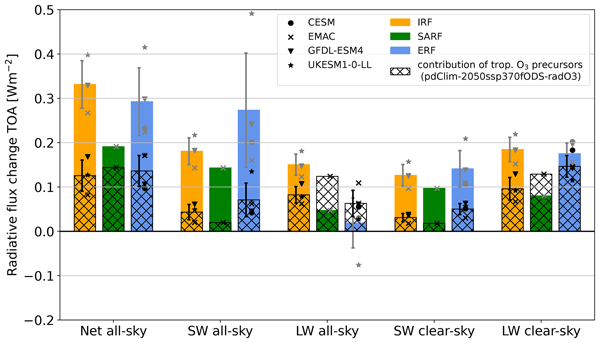
We used 7 climate models that include atmospheric chemistry and find that in a scenario with weak controls on air quality, the warming effects (over 2015 to 2050) of decreases in ozone-depleting substances and increases in air quality pollutants are approximately equal and would make ozone the second highest contributor to warming over this period. We find that for stratospheric ozone recovery, the standard measure of climate effects underestimates a more comprehensive measure.
Ashu Dastoor, Hélène Angot, Johannes Bieser, Flora Brocza, Brock Edwards, Aryeh Feinberg, Xinbin Feng, Benjamin Geyman, Charikleia Gournia, Yipeng He, Ian M. Hedgecock, Ilia Ilyin, Jane Kirk, Che-Jen Lin, Igor Lehnherr, Robert Mason, David McLagan, Marilena Muntean, Peter Rafaj, Eric M. Roy, Andrei Ryjkov, Noelle E. Selin, Francesco De Simone, Anne L. Soerensen, Frits Steenhuisen, Oleg Travnikov, Shuxiao Wang, Xun Wang, Simon Wilson, Rosa Wu, Qingru Wu, Yanxu Zhang, Jun Zhou, Wei Zhu, and Scott Zolkos
Geosci. Model Dev., 18, 2747–2860, https://doi.org/10.5194/gmd-18-2747-2025, https://doi.org/10.5194/gmd-18-2747-2025, 2025
Short summary
Short summary
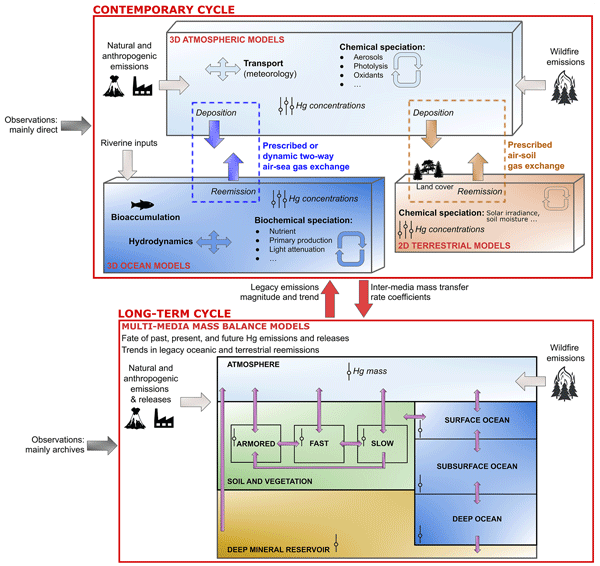
This paper introduces the Multi-Compartment Mercury (Hg) Modeling and Analysis Project (MCHgMAP) aimed at informing the effectiveness evaluations of two multilateral environmental agreements: the Minamata Convention on Mercury and the Convention on Long-Range Transboundary Air Pollution. The experimental design exploits a variety of models (atmospheric, land, oceanic ,and multimedia mass balance models) to assess the short- and long-term influences of anthropogenic Hg releases into the environment.
Vincent R. Meijer, Sebastian D. Eastham, Ian A. Waitz, and Steven R. H. Barrett
Atmos. Meas. Tech., 17, 6145–6162, https://doi.org/10.5194/amt-17-6145-2024, https://doi.org/10.5194/amt-17-6145-2024, 2024
Short summary
Short summary
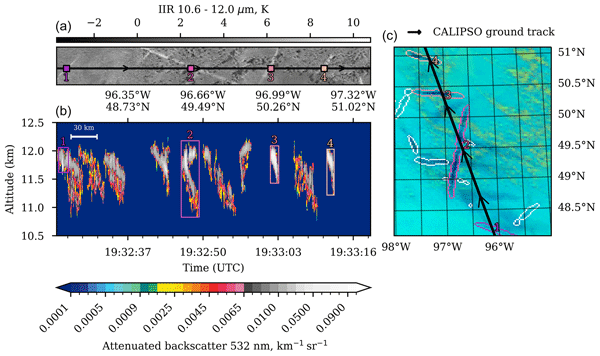
Aviation's climate impact is partly due to contrails: the clouds that form behind aircraft and which can linger for hours under certain atmospheric conditions. Accurately forecasting these conditions could allow aircraft to avoid forming these contrails and thus reduce their environmental footprint. Our research uses deep learning to identify three-dimensional contrail locations in two-dimensional satellite imagery, which can be used to assess and improve these forecasts.
Haipeng Lin, Louisa K. Emmons, Elizabeth W. Lundgren, Laura Hyesung Yang, Xu Feng, Ruijun Dang, Shixian Zhai, Yunxiao Tang, Makoto M. Kelp, Nadia K. Colombi, Sebastian D. Eastham, Thibaud M. Fritz, and Daniel J. Jacob
Atmos. Chem. Phys., 24, 8607–8624, https://doi.org/10.5194/acp-24-8607-2024, https://doi.org/10.5194/acp-24-8607-2024, 2024
Short summary
Short summary
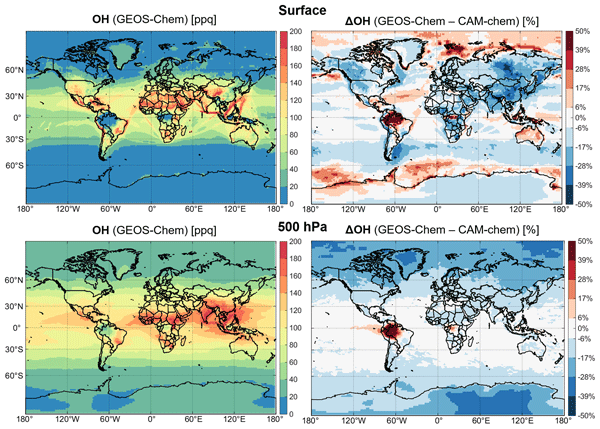
Tropospheric ozone is a major air pollutant, a greenhouse gas, and a major indicator of model skill. Global atmospheric chemistry models show large differences in simulations of tropospheric ozone, but isolating sources of differences is complicated by different model environments. By implementing the GEOS-Chem model side by side to CAM-chem within a common Earth system model, we identify and evaluate specific differences between the two models and their impacts on key chemical species.
Irene C. Dedoussi, Daven K. Henze, Sebastian D. Eastham, Raymond L. Speth, and Steven R. H. Barrett
Geosci. Model Dev., 17, 5689–5703, https://doi.org/10.5194/gmd-17-5689-2024, https://doi.org/10.5194/gmd-17-5689-2024, 2024
Short summary
Short summary
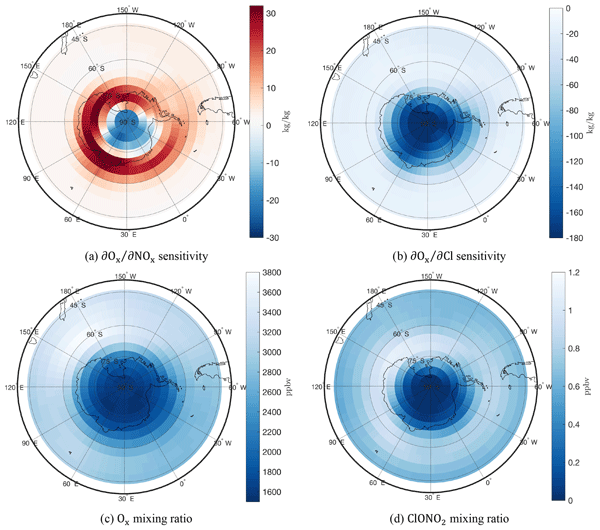
Atmospheric model gradients provide a meaningful tool for better understanding the underlying atmospheric processes. Adjoint modeling enables computationally efficient gradient calculations. We present the adjoint of the GEOS-Chem unified chemistry extension (UCX). With this development, the GEOS-Chem adjoint model can capture stratospheric ozone and other processes jointly with tropospheric processes. We apply it to characterize the Antarctic ozone depletion potential of active halogen species.
Sebastian D. Eastham, Guillaume P. Chossière, Raymond L. Speth, Daniel J. Jacob, and Steven R. H. Barrett
Atmos. Chem. Phys., 24, 2687–2703, https://doi.org/10.5194/acp-24-2687-2024, https://doi.org/10.5194/acp-24-2687-2024, 2024
Short summary
Short summary
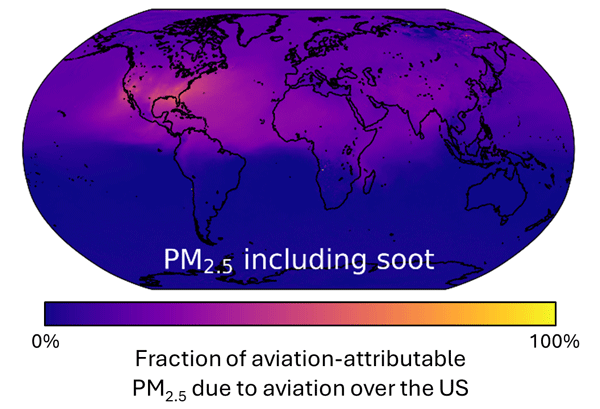
Emissions from aircraft are known to cause air quality impacts worldwide, but the scale and mechanisms of this impact are not well understood. This work uses high-resolution computational modeling of the atmosphere to show that air pollution changes from aviation are mostly the result of emissions during cruise (high-altitude) operations, that these impacts are related to how much non-aviation pollution is present, and that prior regional assessments have underestimated these impacts.
Ruijun Dang, Daniel J. Jacob, Viral Shah, Sebastian D. Eastham, Thibaud M. Fritz, Loretta J. Mickley, Tianjia Liu, Yi Wang, and Jun Wang
Atmos. Chem. Phys., 23, 6271–6284, https://doi.org/10.5194/acp-23-6271-2023, https://doi.org/10.5194/acp-23-6271-2023, 2023
Short summary
Short summary
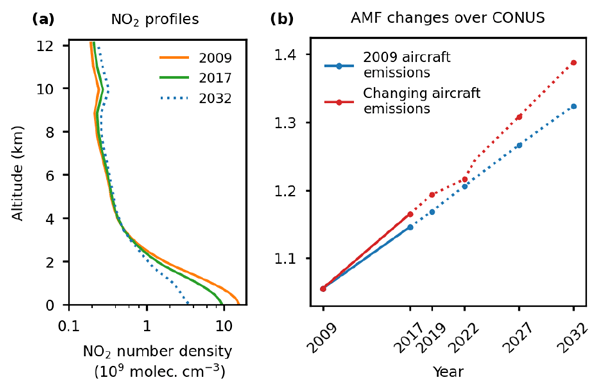
We use the GEOS-Chem model to better understand the magnitude and trend in free tropospheric NO2 over the contiguous US. Model underestimate of background NO2 is largely corrected by considering aerosol nitrate photolysis. Increase in aircraft emissions affects satellite retrievals by altering the NO2 shape factor, and this effect is expected to increase in future. We show the importance of properly accounting for the free tropospheric background in interpreting NO2 observations from space.
Fangqun Yu, Gan Luo, Arshad Arjunan Nair, Sebastian Eastham, Christina J. Williamson, Agnieszka Kupc, and Charles A. Brock
Atmos. Chem. Phys., 23, 1863–1877, https://doi.org/10.5194/acp-23-1863-2023, https://doi.org/10.5194/acp-23-1863-2023, 2023
Short summary
Short summary
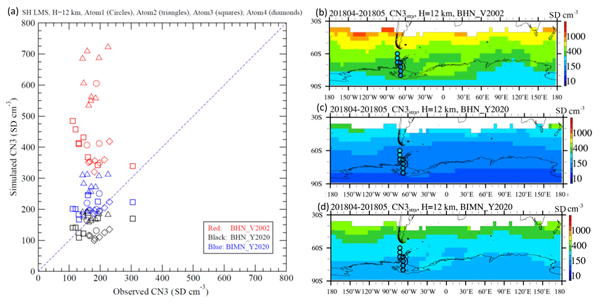
Particle number concentrations and size distributions in the stratosphere are studied through model simulations and comparisons with measurements. The nucleation scheme used in most of the solar geoengineering modeling studies overpredicts the nucleation rates and particle number concentrations in the stratosphere. The model based on updated nucleation schemes captures reasonably well some aspects of particle size distributions but misses some features. The possible reasons are discussed.
Viral Shah, Daniel J. Jacob, Ruijun Dang, Lok N. Lamsal, Sarah A. Strode, Stephen D. Steenrod, K. Folkert Boersma, Sebastian D. Eastham, Thibaud M. Fritz, Chelsea Thompson, Jeff Peischl, Ilann Bourgeois, Ilana B. Pollack, Benjamin A. Nault, Ronald C. Cohen, Pedro Campuzano-Jost, Jose L. Jimenez, Simone T. Andersen, Lucy J. Carpenter, Tomás Sherwen, and Mat J. Evans
Atmos. Chem. Phys., 23, 1227–1257, https://doi.org/10.5194/acp-23-1227-2023, https://doi.org/10.5194/acp-23-1227-2023, 2023
Short summary
Short summary
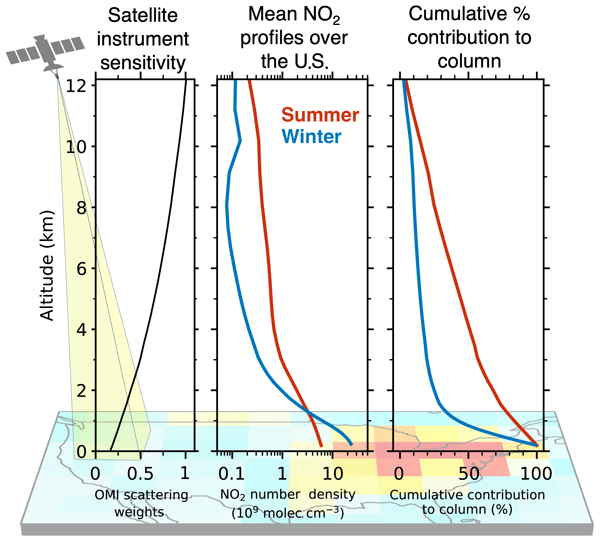
NOx in the free troposphere (above 2 km) affects global tropospheric chemistry and the retrieval and interpretation of satellite NO2 measurements. We evaluate free tropospheric NOx in global atmospheric chemistry models and find that recycling NOx from its reservoirs over the oceans is faster than that simulated in the models, resulting in increases in simulated tropospheric ozone and OH. Over the U.S., free tropospheric NO2 contributes the majority of the tropospheric NO2 column in summer.
Randall V. Martin, Sebastian D. Eastham, Liam Bindle, Elizabeth W. Lundgren, Thomas L. Clune, Christoph A. Keller, William Downs, Dandan Zhang, Robert A. Lucchesi, Melissa P. Sulprizio, Robert M. Yantosca, Yanshun Li, Lucas Estrada, William M. Putman, Benjamin M. Auer, Atanas L. Trayanov, Steven Pawson, and Daniel J. Jacob
Geosci. Model Dev., 15, 8731–8748, https://doi.org/10.5194/gmd-15-8731-2022, https://doi.org/10.5194/gmd-15-8731-2022, 2022
Short summary
Short summary
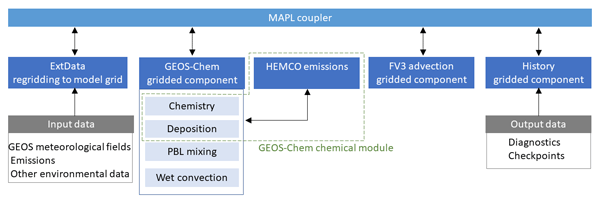
Atmospheric chemistry models must be able to operate both online as components of Earth system models and offline as standalone models. The widely used GEOS-Chem model operates both online and offline, but the classic offline version is not suitable for massively parallel simulations. We describe a new generation of the offline high-performance GEOS-Chem (GCHP) that enables high-resolution simulations on thousands of cores, including on the cloud, with improved access, performance, and accuracy.
Thibaud M. Fritz, Sebastian D. Eastham, Louisa K. Emmons, Haipeng Lin, Elizabeth W. Lundgren, Steve Goldhaber, Steven R. H. Barrett, and Daniel J. Jacob
Geosci. Model Dev., 15, 8669–8704, https://doi.org/10.5194/gmd-15-8669-2022, https://doi.org/10.5194/gmd-15-8669-2022, 2022
Short summary
Short summary
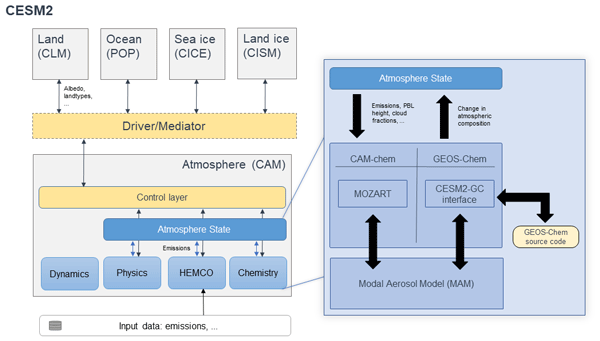
We bring the state-of-the-science chemistry module GEOS-Chem into the Community Earth System Model (CESM). We show that some known differences between results from GEOS-Chem and CESM's CAM-chem chemistry module may be due to the configuration of model meteorology rather than inherent differences in the model chemistry. This is a significant step towards a truly modular Earth system model and allows two strong but currently separate research communities to benefit from each other's advances.

William Atkinson, Sebastian D. Eastham, Y.-H. Henry Chen, Jennifer Morris, Sergey Paltsev, C. Adam Schlosser, and Noelle E. Selin
Geosci. Model Dev., 15, 7767–7789, https://doi.org/10.5194/gmd-15-7767-2022, https://doi.org/10.5194/gmd-15-7767-2022, 2022
Short summary
Short summary
Understanding policy effects on human-caused air pollutant emissions is key for assessing related health impacts. We develop a flexible scenario tool that combines updated emissions data sets, long-term economic modeling, and comprehensive technology pathways to clarify the impacts of climate and air quality policies. Results show the importance of both policy levers in the future to prevent long-term emission increases from offsetting near-term air quality improvements from existing policies.
Minghao Qiu, Corwin Zigler, and Noelle E. Selin
Atmos. Chem. Phys., 22, 10551–10566, https://doi.org/10.5194/acp-22-10551-2022, https://doi.org/10.5194/acp-22-10551-2022, 2022
Short summary
Short summary
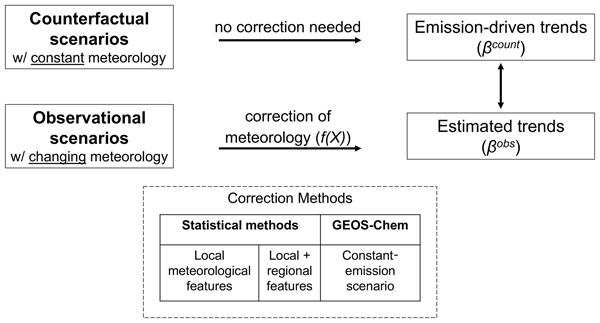
Evaluating impacts of emission changes on air quality requires accounting for meteorological variability. Many studies use simple regression methods to correct for meteorology, but little is known about their performance. Using cases in the US and China, we show that widely used regression models do not perform well and can lead to biased estimates of emission-driven trends. We propose a novel machine learning method with lower bias and provide recommendations to policymakers and researchers.
Shihan Sun, Amos P. K. Tai, David H. Y. Yung, Anthony Y. H. Wong, Jason A. Ducker, and Christopher D. Holmes
Biogeosciences, 19, 1753–1776, https://doi.org/10.5194/bg-19-1753-2022, https://doi.org/10.5194/bg-19-1753-2022, 2022
Short summary
Short summary
We developed and used a terrestrial biosphere model to compare and evaluate widely used empirical dry deposition schemes with different stomatal approaches and found that using photosynthesis-based stomatal approaches can reduce biases in modeled dry deposition velocities in current chemical transport models. Our study shows systematic errors in current dry deposition schemes and the importance of representing plant ecophysiological processes in models under a changing climate.
Anthony Y. H. Wong and Jeffrey A. Geddes
Atmos. Chem. Phys., 21, 16479–16497, https://doi.org/10.5194/acp-21-16479-2021, https://doi.org/10.5194/acp-21-16479-2021, 2021
Short summary
Short summary
Land cover change and land management are considered to have important and distinct impacts on air quality. Here we use remote sensing products and agricultural emission inventories to characterize contemporary global land cover and land management changes for chemical transport model simulations. We find that contemporary land system change has a significant impact on global air quality, with land management dominating the effects on PM and land cover change dominating the impacts on ozone.
Cited articles
Alizadeh, R., Allen, J. K., and Mistree, F.: Managing computational complexity using surrogate models: a critical review, Res. Eng. Design, 31, 275–298, https://doi.org/10.1007/s00163-020-00336-7, 2020.
Amann, M., Bertok, I., Borken-Kleefeld, J., Cofala, J., Heyes, C., Höglund-Isaksson, L., Klimont, Z., Nguyen, B., Posch, M., Rafaj, P., Sandler, R., Schöpp, W., Wagner, F., and Winiwarter, W.: Cost-effective control of air quality and greenhouse gases in Europe: Modeling and policy applications, Environ. Model. Softw., 26, 1489–1501, https://doi.org/10.1016/j.envsoft.2011.07.012, 2011.
Ansari, A. S. and Pandis, S. N.: Response of inorganic PM to precursor concentrations, Environ. Sci. Technol., 32, 2706–2714, https://doi.org/10.1021/es971130j, 1998.
Atkinson, W., Eastham, S. D., Chen, Y.-H. H., Morris, J., Paltsev, S., Schlosser, C. A., and Selin, N. E.: A tool for air pollution scenarios (TAPS v1.0) to enable global, long-term, and flexible study of climate and air quality policies, Geosci. Model Dev., 15, 7767–7789, https://doi.org/10.5194/gmd-15-7767-2022, 2022a.
Atkinson, W., Eastham, S. D., Henry Chen, Y.-H., Morris, J., Paltsev, S., Schlosser, C. A., and Selin, N. E.: Code and data used in “A Tool for Air Pollution Scenarios (TAPS v1.0) to enable global, long-term, and flexible study of climate and air quality policies” (1.0) [Data set], Zenodo [code and data set], https://doi.org/10.5281/zenodo.7158380, 2022b.
Bian, H., Chin, M., Hauglustaine, D. A., Schulz, M., Myhre, G., Bauer, S. E., Lund, M. T., Karydis, V. A., Kucsera, T. L., Pan, X., Pozzer, A., Skeie, R. B., Steenrod, S. D., Sudo, K., Tsigaridis, K., Tsimpidi, A. P., and Tsyro, S. G.: Investigation of global particulate nitrate from the AeroCom phase III experiment, Atmos. Chem. Phys., 17, 12911–12940, https://doi.org/10.5194/acp-17-12911-2017, 2017.
Boucher, O., Denvil, S., Levavasseur, G., Cozic, A., Caubel, A., Foujols, M.-A., Meurdesoif, Y., Cadule, P., Devilliers, M., Dupont, E., and Lurton, T.: IPCC DDC: IPSL IPSL-CM5A2-INCA model output prepared for CMIP6 ScenarioMIP (1), WDC Climate, https://doi.org/10.26050/WDCC/AR6.C6SPIPICI, 2023.
Brown-Steiner, B., Selin, N. E., Prinn, R. G., Monier, E., Tilmes, S., Emmons, L., and Garcia-Menendez, F.: Maximizing ozone signals among chemical, meteorological, and climatological variability, Atmos. Chem. Phys., 18, 8373–8388, https://doi.org/10.5194/acp-18-8373-2018, 2018.
Burnett, R., Chen, H., Szyszkowicz, M., Fann, N., Hubbell, B., Pope, C. A., Apte, J. S., Brauer, M., Cohen, A., Weichenthal, S., Coggins, J., Di, Q., Brunekreef, B., Frostad, J., Lim, S. S., Kan, H., Walker, K. D., Thurston, G. D., Hayes, R. B., Lim, C. C., Turner, M. C., Jerrett, M., Krewski, D., Gapstur, S. M., Diver, W. R., Ostro, B., Goldberg, D., Crouse, D. L., Martin, R. V., Peters, P., Pinault, L., Tjepkema, M., Van Donkelaar, A., Villeneuve, P. J., Miller, A. B., Yin, P., Zhou, M., Wang, L., Janssen, N. A. H., Marra, M., Atkinson, R. W., Tsang, H., Thach, T. Q., Cannon, J. B., Allen, R. T., Hart, J. E., Laden, F., Cesaroni, G., Forastiere, F., Weinmayr, G., Jaensch, A., Nagel, G., Concin, H., and Spadaro, J. V.: Global estimates of mortality associated with longterm exposure to outdoor fine particulate matter, P. Natl. Acad. Sci. USA, 115, 9592–9597, https://doi.org/10.1073/pnas.1803222115, 2018.
Camilleri, S. F., Montgomery, A., Visa, M. A., Schnell, J. L., Adelman, Z. E., Janssen, M., Grubert, E. A., Anenberg, S. C., and Horton, D. E.: Air quality, health and equity implications of electrifying heavy-duty vehicles, Nat. Sustain., 6, 1643–1653, https://doi.org/10.1038/s41893-023-01219-0, 2023.
Center For International Earth Science Information Network-CIESIN-Columbia University: Gridded Population of the World, Version 4 (GPWv4): National Identifier Grid, Revision 11, https://doi.org/10.7927/H4TD9VDP, 2018.
Chen, W., Lu, X., Yuan, D., Chen, Y., Li, Z., Huang, Y., Fung, T., Sun, H., and Fung, J. C. H.: Global PM 2.5 Prediction and Associated Mortality to 2100 under Different Climate Change Scenarios, Environ. Sci. Technol., 57, 10039–10052, https://doi.org/10.1021/acs.est.3c03804, 2023.
Chen, Y., Van Der A, R. J., Ding, J., Eskes, H., Williams, J. E., Theys, N., Tsikerdekis, A., and Levelt, P. F.: SO2 emissions derived from TROPOMI observations over India using a flux-divergence method with variable lifetimes, Atmos. Chem. Phys., 25, 1851–1868, https://doi.org/10.5194/acp-25-1851-2025, 2025.
Chen, Y.-H. H., Paltsev, S., Gurgel, A., Reilly, J. M., and Morris, J.: A Multisectoral Dynamic Model for Energy, Economic, and Climate Scenario Analysis, LCE, 13, 70–111, https://doi.org/10.4236/lce.2022.132005, 2022.
Colette, A., Rouïl, L., Meleux, F., Lemaire, V., and Raux, B.: Air Control Toolbox (ACT_v1.0): a flexible surrogate model to explore mitigation scenarios in air quality forecasts, Geosci. Model Dev., 15, 1441–1465, https://doi.org/10.5194/gmd-15-1441-2022, 2022.
Collins, W. D., Rasch, P. J., Boville, B. A., Hack, J. J., McCaa, J. R., Williamson, D. L., Briegleb, B. P., Bitz, C. M., Lin, S.-J., and Zhang, M.: The Formulation and Atmospheric Simulation of the Community Atmosphere Model Version 3 (CAM3), J. Climate, 19, 2144–2161, https://doi.org/10.1175/JCLI3760.1, 2006.
Collins, W. J., Lamarque, J.-F., Schulz, M., Boucher, O., Eyring, V., Hegglin, M. I., Maycock, A., Myhre, G., Prather, M., Shindell, D., and Smith, S. J.: AerChemMIP: quantifying the effects of chemistry and aerosols in CMIP6, Geosci. Model Dev., 10, 585–607, https://doi.org/10.5194/gmd-10-585-2017, 2017.
Conibear, L., Reddington, C. L., Silver, B. J., Chen, Y., Knote, C., Arnold, S. R., and Spracklen, D. V.: Statistical Emulation of Winter Ambient Fine Particulate Matter Concentrations From Emission Changes in China, GeoHealth, 5, e2021GH000391, https://doi.org/10.1029/2021GH000391, 2021.
Conibear, L., Reddington, C. L., Silver, B. J., Chen, Y., Knote, C., Arnold, S. R., and Spracklen, D. V.: Sensitivity of Air Pollution Exposure and Disease Burden to Emission Changes in China Using Machine Learning Emulation, GeoHealth, 6, e2021GH000570, https://doi.org/10.1029/2021GH000570, 2022.
Conover, W. J. and Iman, R. L.: Analysis of Covariance Using the Rank Transformation, Biometrics, 38, 715, https://doi.org/10.2307/2530051, 1982.
Consortium (EC-Earth): IPCC DDC: EC-Earth-Consortium EC-Earth3-AerChem model output prepared for CMIP6 AerChemMIP, https://doi.org/10.26050/WDCC/AR6.C6ACEEEEA, 2023.
Dammers, E., McLinden, C. A., Griffin, D., Shephard, M. W., Van Der Graaf, S., Lutsch, E., Schaap, M., Gainairu-Matz, Y., Fioletov, V., Van Damme, M., Whitburn, S., Clarisse, L., Cady-Pereira, K., Clerbaux, C., Coheur, P. F., and Erisman, J. W.: NH3 emissions from large point sources derived from CrIS and IASI satellite observations, Atmos. Chem. Phys., 19, 12261–12293, https://doi.org/10.5194/acp-19-12261-2019, 2019.
Döscher, R., Acosta, M., Alessandri, A., Anthoni, P., Arsouze, T., Bergman, T., Bernardello, R., Boussetta, S., Caron, L.-P., Carver, G., Castrillo, M., Catalano, F., Cvijanovic, I., Davini, P., Dekker, E., Doblas-Reyes, F. J., Docquier, D., Echevarria, P., Fladrich, U., Fuentes-Franco, R., Gröger, M., V. Hardenberg, J., Hieronymus, J., Karami, M. P., Keskinen, J.-P., Koenigk, T., Makkonen, R., Massonnet, F., Ménégoz, M., Miller, P. A., Moreno-Chamarro, E., Nieradzik, L., Van Noije, T., Nolan, P., O'Donnell, D., Ollinaho, P., Van Den Oord, G., Ortega, P., Prims, O. T., Ramos, A., Reerink, T., Rousset, C., Ruprich-Robert, Y., Le Sager, P., Schmith, T., Schrödner, R., Serva, F., Sicardi, V., Sloth Madsen, M., Smith, B., Tian, T., Tourigny, E., Uotila, P., Vancoppenolle, M., Wang, S., Wårlind, D., Willén, U., Wyser, K., Yang, S., Yepes-Arbós, X., and Zhang, Q.: The EC-Earth3 Earth system model for the Coupled Model Intercomparison Project 6, Geosci. Model Dev., 15, 2973–3020, https://doi.org/10.5194/gmd-15-2973-2022, 2022.
Dunne, J. P., Horowitz, L. W., Adcroft, A. J., Ginoux, P., Held, I. M., John, J. G., Krasting, J. P., Malyshev, S., Naik, V., Paulot, F., Shevliakova, E., Stock, C. A., Zadeh, N., Balaji, V., Blanton, C., Dunne, K. A., Dupuis, C., Durachta, J., Dussin, R., Gauthier, P. P. G., Griffies, S. M., Guo, H., Hallberg, R. W., Harrison, M., He, J., Hurlin, W., McHugh, C., Menzel, R., Milly, P. C. D., Nikonov, S., Paynter, D. J., Ploshay, J., Radhakrishnan, A., Rand, K., Reichl, B. G., Robinson, T., Schwarzkopf, D. M., Sentman, L. T., Underwood, S., Vahlenkamp, H., Winton, M., Wittenberg, A. T., Wyman, B., Zeng, Y., and Zhao, M.: The GFDL Earth System Model Version 4.1 (GFDL-ESM 4.1): Overall Coupled Model Description and Simulation Characteristics, J. Adv. Model. Earth Syst., 12, e2019MS002015, https://doi.org/10.1029/2019MS002015, 2020.
Eastham, S. D., Long, M. S., Keller, C. A., Lundgren, E., Yantosca, R. M., Zhuang, J., Li, C., Lee, C. J., Yannetti, M., Auer, B. M., Clune, T. L., Kouatchou, J., Putman, W. M., Thompson, M. A., Trayanov, A. L., Molod, A. M., Martin, R. V., and Jacob, D. J.: GEOS-Chem High Performance (GCHP v11-02c): a next-generation implementation of the GEOS-Chem chemical transport model for massively parallel applications, Geosci. Model Dev., 11, 2941–2953, https://doi.org/10.5194/gmd-11-2941-2018, 2018.
Eastham, S. D., Monier, E., Rothenberg, D., Paltsev, S., and Selin, N. E.: Rapid Estimation of Climate–Air Quality Interactions in Integrated Assessment Using a Response Surface Model, ACS Environ. Au, 3, 153–163, https://doi.org/10.1021/acsenvironau.2c00054, 2023.
Fioletov, V. E., McLinden, C. A., Krotkov, N., and Li, C.: Lifetimes and emissions of SO2 from point sources estimated from OMI, Geophys. Res. Lett., 42, 1969–1976, https://doi.org/10.1002/2015GL063148, 2015.
Fountoukis, C. and Nenes, A.: ISORROPIAII: A computationally efficient thermodynamic equilibrium model for K+–Ca2+–Mg2+–NH
Franco, B., Clarisse, L., Van Damme, M., Hadji-Lazaro, J., Clerbaux, C., and Coheur, P.-F.: Ethylene industrial emitters seen from space, Nat. Commun., 13, 6452, https://doi.org/10.1038/s41467-022-34098-8, 2022.
Fujimori, S., Hasegawa, T., Masui, T., Takahashi, K., Herran, D. S., Dai, H., Hijioka, Y., and Kainuma, M.: SSP3: AIM implementation of Shared Socioeconomic Pathways, Global Environ. Change, 42, 268–283, https://doi.org/10.1016/j.gloenvcha.2016.06.009, 2017.
GAINS Developer Team: GAINS 4.01 IAM model outputs, IIASA, https://gains.iiasa.ac.at/models (last access: 12 October 2021), 2021.
Galmarini, S., Koffi, B., Solazzo, E., Keating, T., Hogrefe, C., Schulz, M., Benedictow, A., Griesfeller, J. J., Janssens-Maenhout, G., Carmichael, G., Fu, J., and Dentener, F.: Technical note: Coordination and harmonization of the multi-scale, multi-model activities HTAP2, AQMEII3, and MICS-Asia3: simulations, emission inventories, boundary conditions, and model output formats, Atmos. Chem. Phys., 17, 1543–1555, https://doi.org/10.5194/acp-17-1543-2017, 2017.
Gao, C. Y., Heald, C. L., Katich, J. M., Luo, G., and Yu, F.: Remote Aerosol Simulated During the Atmospheric Tomography (ATom) Campaign and Implications for Aerosol Lifetime, J. Geophys. Res.-Atmos., 127, e2022JD036524, https://doi.org/10.1029/2022JD036524, 2022.
Garcia-Menendez, F., Saari, R. K., Monier, E., and Selin, N. E.: U.S. Air Quality and Health Benefits from Avoided Climate Change under Greenhouse Gas Mitigation, Environ. Sci. Technol., 49, 7580–7588, https://doi.org/10.1021/acs.est.5b01324, 2015.
Garcia-Menendez, F., Monier, E., and Selin, N. E.: The role of natural variability in projections of climate change impacts on U.S. ozone pollution, Geophys. Res. Lett., 44, 2911–2921, https://doi.org/10.1002/2016GL071565, 2017.
Giani, P., Fiore, A. M., Flierl, G., Ferrari, R., and Selin, N. E.: Origin and Limits of Invariant Warming Patterns in Climate Models, arXiv [preprint], https://doi.org/10.48550/ARXIV.2411.14183, 2024.
Gidden, M. J., Riahi, K., Smith, S. J., Fujimori, S., Luderer, G., Kriegler, E., Van Vuuren, D. P., Van Den Berg, M., Feng, L., Klein, D., Calvin, K., Doelman, J. C., Frank, S., Fricko, O., Harmsen, M., Hasegawa, T., Havlik, P., Hilaire, J., Hoesly, R., Horing, J., Popp, A., Stehfest, E., and Takahashi, K.: Global emissions pathways under different socioeconomic scenarios for use in CMIP6: a dataset of harmonized emissions trajectories through the end of the century, Geosci. Model Dev., 12, 1443–1475, https://doi.org/10.5194/gmd-12-1443-2019, 2019.
Gu, S., Guenther, A., and Faiola, C.: Effects of Anthropogenic and Biogenic Volatile Organic Compounds on Los Angeles Air Quality, Environ. Sci. Technol., 55, 12191–12201, https://doi.org/10.1021/acs.est.1c01481, 2021.
Guenther, A. B., Jiang, X., Heald, C. L., Sakulyanontvittaya, T., Duhl, T., Emmons, L. K., and Wang, X.: The model of emissions of gases and aerosols from nature version 2.1 (MEGAN2.1): An extended and updated framework for modeling biogenic emissions, Geosci. Model Dev., 5, 1471–1492, https://doi.org/10.5194/gmd-5-1471-2012, 2012.
Guivarch, C., Le Gallic, T., Bauer, N., Fragkos, P., Huppmann, D., Jaxa-Rozen, M., Keppo, I., Kriegler, E., Krisztin, T., Marangoni, G., Pye, S., Riahi, K., Schaeffer, R., Tavoni, M., Trutnevyte, E., Van Vuuren, D., and Wagner, F.: Using large ensembles of climate change mitigation scenarios for robust insights, Nat. Clim. Change, 12, 428–435, https://doi.org/10.1038/s41558-022-01349-x, 2022.
Hardacre, C., Mulcahy, J. P., Pope, R. J., Jones, C. G., Rumbold, S. T., Li, C., Johnson, C., and Turnock, S. T.: Evaluation of SO2 , SO
Herman, J. and Usher, W.: SALib: An open-source Python library for Sensitivity Analysis, JOSS, 2, 97, https://doi.org/10.21105/joss.00097, 2017.
Hoesly, R. M., Smith, S. J., Feng, L., Klimont, Z., Janssens-Maenhout, G., Pitkanen, T., Seibert, J. J., Vu, L., Andres, R. J., Bolt, R. M., Bond, T. C., Dawidowski, L., Kholod, N., Kurokawa, J., Li, M., Liu, L., Lu, Z., Moura, M. C. P., O'Rourke, P. R., and Zhang, Q.: Historical (1750–2014) anthropogenic emissions of reactive gases and aerosols from the Community Emissions Data System (CEDS), Geosci. Model Dev., 11, 369–408, https://doi.org/10.5194/gmd-11-369-2018, 2018.
Horowitz, L. W., Naik, V., Sentman, L., Paulot, F., Blanton, C., McHugh, C., Radhakrishnan, A., Rand, K., Vahlenkamp, H., Zadeh, N. T., Wilson, C., Ginoux, P., He, J., John, J. G., Lin, M., Paynter, D. J., Ploshay, J., Zhang, A., and Zeng, Y.: IPCC DDC: NOAA-GFDL GFDL-ESM4 model output prepared for CMIP6 AerChemMIP (1), WDC Climate, https://doi.org/10.26050/WDCC/AR6.C6ACNGGFE, 2023.
Huang, X., Srikrishnan, V., Lamontagne, J., Keller, K., and Peng, W.: Effects of global climate mitigation on regional air quality and health, Nat. Sustain., 6, 1054–1066, https://doi.org/10.1038/s41893-023-01133-5, 2023.
Hudman, R. C., Moore, N. E., Mebust, A. K., Martin, R. V., Russell, A. R., Valin, L. C., and Cohen, R. C.: Steps towards a mechanistic model of global soil nitric oxide emissions: Implementation and space based-constraints, Atmos. Chem. Phys., 12, 7779–7795, https://doi.org/10.5194/acp-12-7779-2012, 2012.
Iwanaga, T., Usher, W., and Herman, J.: Toward SALib 2.0: Advancing the accessibility and interpretability of global sensitivity analyses, SESMO, 4, 18155, https://doi.org/10.18174/sesmo.18155, 2022.
Jacob, D. J. and Winner, D. A.: Effect of climate change on air quality, Atmos. Environ., 43, 51–63, https://doi.org/10.1016/j.atmosenv.2008.09.051, 2009.
Jones, P. W.: First- and Second-Order Conservative Remapping Schemes for Grids in Spherical Coordinates, Mon. Weather Rev., 127, 2204–2210, https://doi.org/10.1175/1520-0493(1999)127<2204:FASOCR>2.0.CO;2, 1999.
Kawamiya, M., Hajima, T., Tachiiri, K., Watanabe, S., and Yokohata, T.: Two decades of Earth system modeling with an emphasis on Model for Interdisciplinary Research on Climate (MIROC), Prog. Earth Planet. Sci., 7, 64, https://doi.org/10.1186/s40645-020-00369-5, 2020.
Kelley, M., Schmidt, G. A., Nazarenko, L. S., Bauer, S. E., Ruedy, R., Russell, G. L., Ackerman, A. S., Aleinov, I., Bauer, M., Bleck, R., Canuto, V., Cesana, G., Cheng, Y., Clune, T. L., Cook, B. I., Cruz, C. A., Del Genio, A. D., Elsaesser, G. S., Faluvegi, G., Kiang, N. Y., Kim, D., Lacis, A. A., Leboissetier, A., LeGrande, A. N., Lo, K. K., Marshall, J., Matthews, E. E., McDermid, S., Mezuman, K., Miller, R. L., Murray, L. T., Oinas, V., Orbe, C., García-Pando, C. P., Perlwitz, J. P., Puma, M. J., Rind, D., Romanou, A., Shindell, D. T., Sun, S., Tausnev, N., Tsigaridis, K., Tselioudis, G., Weng, E., Wu, J., and Yao, M.: GISS-E2.1: Configurations and Climatology, J. Adv. Model. Earth Syst., 12, e2019MS002025, https://doi.org/10.1029/2019MS002025, 2020.
Khalil, M. A. K. and Rasmussen, R. A.: The global cycle of carbon monoxide: Trends and mass balance, Chemosphere, 20, 227–242, https://doi.org/10.1016/0045-6535(90)90098-E, 1990.
Kim, P. S., Jacob, D. J., Fisher, J. A., Travis, K., Yu, K., Zhu, L., Yantosca, R. M., Sulprizio, M. P., Jimenez, J. L., Campuzano-Jost, P., Froyd, K. D., Liao, J., Hair, J. W., Fenn, M. A., Butler, C. F., Wagner, N. L., Gordon, T. D., Welti, A., Wennberg, P. O., Crounse, J. D., St. Clair, J. M., Teng, A. P., Millet, D. B., Schwarz, J. P., Markovic, M. Z., and Perring, A. E.: Sources, seasonality, and trends of southeast US aerosol: an integrated analysis of surface, aircraft, and satellite observations with the GEOS-Chem chemical transport model, Atmos. Chem. Phys., 15, 10411–10433, https://doi.org/10.5194/acp-15-10411-2015, 2015.
Klimont, Z., Kupiainen, K., Heyes, C., Purohit, P., Cofala, J., Rafaj, P., Borken-Kleefeld, J., and Schöpp, W.: Global anthropogenic emissions of particulate matter including black carbon, Atmos. Chem. Phys., 17, 8681–8723, https://doi.org/10.5194/acp-17-8681-2017, 2017.
Lamontagne, J. R., Reed, P. M., Link, R., Calvin, K. V., Clarke, L. E., and Edmonds, J. A.: Large Ensemble Analytic Framework for Consequence-Driven Discovery of Climate Change Scenarios, Earth's Future, 6, 488–504, https://doi.org/10.1002/2017EF000701, 2018.
Lange, K., Richter, A., and Burrows, J. P.: Variability of nitrogen oxide emission fluxes and lifetimes estimated from Sentinel-5P TROPOMI observations, Atmos. Chem. Phys., 22, 2745–2767, https://doi.org/10.5194/acp-22-2745-2022, 2022.
Latimer, R. N. C. and Martin, R. V.: Interpretation of measured aerosol mass scattering efficiency over North America using a chemical transport model, Atmos. Chem. Phys., 19, 2635–2653, https://doi.org/10.5194/acp-19-2635-2019, 2019.
Lee, C., Martin, R. V., Van Donkelaar, A., Lee, H., Dickerson, R. R., Hains, J. C., Krotkov, N., Richter, A., Vinnikov, K., and Schwab, J. J.: SO2 emissions and lifetimes: Estimates from inverse modeling using in situ and global, space-based (SCIAMACHY and OMI) observations, J. Geophys. Res., 116, D06304, https://doi.org/10.1029/2010JD014758, 2011.
Li, C. and Cohen, R. C.: Space-Borne Estimation of Volcanic Sulfate Aerosol Lifetime, J. Geophys. Res.-Atmos., 126, e2020JD033883, https://doi.org/10.1029/2020JD033883, 2021.
Li, D., Jin, J., Wang, G., Pang, M., Zhang, W., and Liao, H.: A Transformer-based agent model of GEOS-Chem v14.2.2 for informative prediction of PM2.5 and O3 levels to future emission scenarios: TGEOS v1.0, Geosci. Model Dev., 19, 1703–1725, https://doi.org/10.5194/gmd-19-1703-2026, 2026.
Li, H., Yang, Y., Wang, H., Wang, P., Yue, X., and Liao, H.: Projected Aerosol Changes Driven by Emissions and Climate Change Using a Machine Learning Method, Environ. Sci. Technol., 56, 3884–3893, https://doi.org/10.1021/acs.est.1c04380, 2022.
Liang, C.-K., West, J. J., Silva, R. A., Bian, H., Chin, M., Davila, Y., Dentener, F. J., Emmons, L., Flemming, J., Folberth, G., Henze, D., Im, U., Jonson, J. E., Keating, T. J., Kucsera, T., Lenzen, A., Lin, M., Lund, M. T., Pan, X., Park, R. J., Pierce, R. B., Sekiya, T., Sudo, K., and Takemura, T.: HTAP2 multi-model estimates of premature human mortality due to intercontinental transport of air pollution and emission sectors, Atmos. Chem. Phys., 18, 10497–10520, https://doi.org/10.5194/acp-18-10497-2018, 2018.
Lund, M. T., Samset, B. H., Skeie, R. B., Watson-Parris, D., Katich, J. M., Schwarz, J. P., and Weinzierl, B.: Short Black Carbon lifetime inferred from a global set of aircraft observations, npj Clim. Atmos. Sci., 1, 31, https://doi.org/10.1038/s41612-018-0040-x, 2018.
Lütjens, B., Ferrari, R., Watson-Parris, D., and Selin, N. E.: The Impact of Internal Variability on Benchmarking Deep Learning Climate Emulators, J. Adv. Model. Earth Syst., 17, e2024MS004619, https://doi.org/10.1029/2024MS004619, 2025.
McKay, M. D., Beckman, R. J., and Conover, W. J.: Comparison of Three Methods for Selecting Values of Input Variables in the Analysis of Output from a Computer Code, Technometrics, 21, 239–245, https://doi.org/10.1080/00401706.1979.10489755, 1979.
Meinshausen, M., Nicholls, Z. R. J., Lewis, J., Gidden, M. J., Vogel, E., Freund, M., Beyerle, U., Gessner, C., Nauels, A., Bauer, N., Canadell, J. G., Daniel, J. S., John, A., Krummel, P. B., Luderer, G., Meinshausen, N., Montzka, S. A., Rayner, P. J., Reimann, S., Smith, S. J., Van Den Berg, M., Velders, G. J. M., Vollmer, M. K., and Wang, R. H. J.: The shared socio-economic pathway (SSP) greenhouse gas concentrations and their extensions to 2500, Geosci. Model Dev., 13, 3571–3605, https://doi.org/10.5194/gmd-13-3571-2020, 2020.
Meng, J., Martin, R. V., Ginoux, P., Hammer, M., Sulprizio, M. P., Ridley, D. A., and Van Donkelaar, A.: Grid-independent high-resolution dust emissions (v1.0) for chemical transport models: application to GEOS-Chem (12.5.0), Geosci. Model Dev., 14, 4249–4260, https://doi.org/10.5194/gmd-14-4249-2021, 2021.
Monier, E., Scott, J. R., Sokolov, A. P., Forest, C. E., and Schlosser, C. A.: An integrated assessment modeling framework for uncertainty studies in global and regional climate change: the MIT IGSM-CAM (version 1.0), Geosci. Model Dev., 6, 2063–2085, https://doi.org/10.5194/gmd-6-2063-2013, 2013.
Monier, E., Gao, X., Scott, J. R., Sokolov, A. P., and Schlosser, C. A.: A framework for modeling uncertainty in regional climate change, Climatic Change, 131, 51–66, https://doi.org/10.1007/s10584-014-1112-5, 2015.
Muller, H., Kramm, G., Meixner, F., Dollard, G. J., Fowler, D., and Possanzini, M.: Determination of HNO3 dry deposition by modified Bowen ratio and aerodynamic profile techniques, Tellus B, 45, 346, https://doi.org/10.3402/tellusb.v45i4.15735, 1993.
Murray, L. T., Jacob, D. J., Logan, J. A., Hudman, R. C., and Koshak, W. J.: Optimized regional and interannual variability of lightning in a global chemical transport model constrained by LIS/OTD satellite data, J. Geophys. Res., 117, 2012JD017934, https://doi.org/10.1029/2012JD017934, 2012.
NASA/GISS – NASA Goddard Institute For Space Studies: IPCC DDC: NASA-GISS GISS-E2.1G model output prepared for CMIP6 AerChemMIP (1), https://doi.org/10.26050/WDCC/AR6.C6ACGIGE1, 2023a.
NASA/GISS – NASA Goddard Institute For Space Studies: IPCC DDC: NASA-GISS GISS-E2.1G model output prepared for CMIP6 AerChemMIP ssp370-lowNTCF (1), https://doi.org/10.26050/WDCC/AR6.C6ACGIGE1SL, 2023b.
NASA/GISS – NASA Goddard Institute For Space Studies: IPCC DDC: NASA-GISS GISS-E2.1H model output prepared for CMIP6 CMIP (1), https://doi.org/10.26050/WDCC/AR6.C6CMGIGH1, 2023c.
O'Neill, B. C., Tebaldi, C., Van Vuuren, D. P., Eyring, V., Friedlingstein, P., Hurtt, G., Knutti, R., Kriegler, E., Lamarque, J.-F., Lowe, J., Meehl, G. A., Moss, R., Riahi, K., and Sanderson, B. M.: The Scenario Model Intercomparison Project (ScenarioMIP) for CMIP6, Geosci. Model Dev., 9, 3461–3482, https://doi.org/10.5194/gmd-9-3461-2016, 2016.
O'Neill, B. C., Carter, T. R., Ebi, K., Harrison, P. A., Kemp-Benedict, E., Kok, K., Kriegler, E., Preston, B. L., Riahi, K., Sillmann, J., Van Ruijven, B. J., Van Vuuren, D., Carlisle, D., Conde, C., Fuglestvedt, J., Green, C., Hasegawa, T., Leininger, J., Monteith, S., and Pichs-Madruga, R.: Achievements and needs for the climate change scenario framework, Nat. Clim. Change, 10, 1074–1084, https://doi.org/10.1038/s41558-020-00952-0, 2020.
Paltsev, S., Schlosser, C. A., Chen, H., Gao, X., Gurgel, A., Jacoby, H., Morris, J., Prinn, R. G., Reilly, J. M., Salunke, P., and Sokolov, A. P.: 2023 Global Change Outlook, MIT Joint Program on the Science and Policy of Global Change, https://cs3.mit.edu/publications/signature/2023-global-change-outlook (last access: 5 September 2025), 2023.
Paulot, F. and Jacob, D. J.: Hidden cost of U.S. agricultural exports: Particulate matter from ammonia emissions, Environ. Sci. Technol., 48, 903–908, https://doi.org/10.1021/es4034793, 2014.
Pedregosa, F., Varoquaux, G., Gramfort, A., Michel, V., Thirion, B., Grisel, O., Blondel, M., Prettenhofer, P., Weiss, R., Dubourg, V., Vanderplas, J., Passos, A., Cournapeau, D., Brucher, M., Perrot, M., and Duchesnay, É.: Scikit-learn: Machine learning in Python, J. Mach. Learn. Res., 12, 2825–2830, 2011.
Pienkosz, B. D., Saari, R. K., Monier, E., and Garcia-Menendez, F.: Natural Variability in Projections of Climate Change Impacts on Fine Particulate Matter Pollution, Earth's Future, 7, 762–770, https://doi.org/10.1029/2019EF001195, 2019.
Pisoni, E., Clappier, A., Degraeuwe, B., and Thunis, P.: Adding spatial flexibility to source-receptor relationships for air quality modeling, Environ. Model. Softw., 90, 68–77, https://doi.org/10.1016/j.envsoft.2017.01.001, 2017.
Pisoni, E., Albrecht, D., Mara, T. A., Rosati, R., Tarantola, S., and Thunis, P.: Application of uncertainty and sensitivity analysis to the air quality SHERPA modelling tool, Atmos. Environ., 183, 84–93, https://doi.org/10.1016/j.atmosenv.2018.04.006, 2018.
Possell, M. and Hewitt, C. N.: Isoprene emissions from plants are mediated by atmospheric CO2 concentrations, Global Change Biol., 17, 1595–1610, https://doi.org/10.1111/j.1365-2486.2010.02306.x, 2011.
Ran, L., Zhao, C. S., Xu, W. Y., Lu, X. Q., Han, M., Lin, W. L., Yan, P., Xu, X. B., Deng, Z. Z., Ma, N., Liu, P. F., Yu, J., Liang, W. D., and Chen, L. L.: VOC reactivity and its effect on ozone production during the HaChi summer campaign, Atmos. Chem. Phys., 11, 4657–4667, https://doi.org/10.5194/acp-11-4657-2011, 2011.
Rao, S., Klimont, Z., Smith, S. J., Van Dingenen, R., Dentener, F., Bouwman, L., Riahi, K., Amann, M., Bodirsky, B. L., Van Vuuren, D. P., Aleluia Reis, L., Calvin, K., Drouet, L., Fricko, O., Fujimori, S., Gernaat, D., Havlik, P., Harmsen, M., Hasegawa, T., Heyes, C., Hilaire, J., Luderer, G., Masui, T., Stehfest, E., Strefler, J., Van Der Sluis, S., and Tavoni, M.: Future air pollution in the Shared Socio-economic Pathways, Global Environ. Change, 42, 346–358, https://doi.org/10.1016/j.gloenvcha.2016.05.012, 2017.
Reis, L. A., Drouet, L., and Tavoni, M.: Internalising health-economic impacts of air pollution into climate policy: a global modelling study, Lancet Planet. Health, 6, e40–e48, https://doi.org/10.1016/S2542-5196(21)00259-X, 2022.
Reyes-Villegas, E., Lowe, D., Johnson, J. S., Carslaw, K. S., Darbyshire, E., Flynn, M., Allan, J. D., Coe, H., Chen, Y., Wild, O., Archer-Nicholls, S., Archibald, A., Singh, S., Shrivastava, M., Zaveri, R. A., Singh, V., Beig, G., Sokhi, R., and McFiggans, G.: Simulating organic aerosol in Delhi with WRF-Chem using the volatility-basis-set approach: exploring model uncertainty with a Gaussian process emulator, Atmos. Chem. Phys., 23, 5763–5782, https://doi.org/10.5194/acp-23-5763-2023, 2023.
Ryan, E. and Wild, O.: Calibrating a global atmospheric chemistry transport model using Gaussian process emulation and ground-level concentrations of ozone and carbon monoxide, Geosci. Model Dev., 14, 5373–5391, https://doi.org/10.5194/gmd-14-5373-2021, 2021.
Saari, R. K., Mei, Y., Monier, E., and Garcia-Menendez, F.: Effect of Health-Related Uncertainty and Natural Variability on Health Impacts and Cobenefits of Climate Policy, Environ. Sci. Technol., 53, 1098–1108, https://doi.org/10.1021/acs.est.8b05094, 2019.
Saltelli, A., Annoni, P., Azzini, I., Campolongo, F., Ratto, M., and Tarantola, S.: Variance based sensitivity analysis of model output. Design and estimator for the total sensitivity index, Comput. Phys. Commun., 181, 259–270, https://doi.org/10.1016/j.cpc.2009.09.018, 2010.
Sang, S., Chu, C., Zhang, T., Chen, H., and Yang, X.: The global burden of disease attributable to ambient fine particulate matter in 204 countries and territories, 1990–2019: A systematic analysis of the Global Burden of Disease Study 2019, Ecotoxicol. Environ. Safe., 238, 113588, https://doi.org/10.1016/j.ecoenv.2022.113588, 2022.
Schrader, F. and Brümmer, C.: Land Use Specific Ammonia Deposition Velocities: a Review of Recent Studies (2004–2013), Water Air Soil Pollut., 225, 2114, https://doi.org/10.1007/s11270-014-2114-7, 2014.
Sepulchre, P., Caubel, A., Ladant, J.-B., Bopp, L., Boucher, O., Braconnot, P., Brockmann, P., Cozic, A., Donnadieu, Y., Dufresne, J.-L., Estella-Perez, V., Ethé, C., Fluteau, F., Foujols, M.-A., Gastineau, G., Ghattas, J., Hauglustaine, D., Hourdin, F., Kageyama, M., Khodri, M., Marti, O., Meurdesoif, Y., Mignot, J., Sarr, A.-C., Servonnat, J., Swingedouw, D., Szopa, S., and Tardif, D.: IPSL-CM5A2 – an Earth system model designed for multi-millennial climate simulations, Geosci. Model Dev., 13, 3011–3053, https://doi.org/10.5194/gmd-13-3011-2020, 2020.
Sherwen, T., Schmidt, J. A., Evans, M. J., Carpenter, L. J., Großmann, K., Eastham, S. D., Jacob, D. J., Dix, B., Koenig, T. K., Sinreich, R., Ortega, I., Volkamer, R., Saiz-Lopez, A., Prados-Roman, C., Mahajan, A. S., and Ordóñez, C.: Global impacts of tropospheric halogens (Cl, Br, I) on oxidants and composition in GEOS-Chem, Atmos. Chem. Phys., 16, 12239–12271, https://doi.org/10.5194/acp-16-12239-2016, 2016.
Shindell, D. and Smith, C. J.: Climate and air-quality benefits of a realistic phase-out of fossil fuels, Nature, 573, 408–411, https://doi.org/10.1038/s41586-019-1554-z, 2019.
Smith, S. J., Klimont, Z., Drouet, L., Harmsen, M., Luderer, G., Riahi, K., Van Vuuren, D. P., and Weyant, J. P.: The Energy Modeling Forum (EMF)-30 study on short-lived climate forcers: introduction and overview, Climatic Change, 163, 1399–1408, https://doi.org/10.1007/s10584-020-02938-5, 2020.
Sobol', I. M.: Global sensitivity indices for nonlinear mathematical models and their Monte Carlo estimates, Math. Comput. Simul., 55, 271–280, https://doi.org/10.1016/S0378-4754(00)00270-6, 2001.
Sokolov, A., Kicklighter, D., Schlosser, A., Wang, C., Monier, E., Brown-Steiner, B., Prinn, R., Forest, C., Gao, X., Libardoni, A., and Eastham, S.: Description and Evaluation of the MIT Earth System Model (MESM), J. Adv. Model. Earth Syst., 10, 1759–1789, https://doi.org/10.1029/2018MS001277, 2018.
Stohl, A., Aamaas, B., Amann, M., Baker, L. H., Bellouin, N., Berntsen, T. K., Boucher, O., Cherian, R., Collins, W., Daskalakis, N., Dusinska, M., Eckhardt, S., Fuglestvedt, J. S., Harju, M., Heyes, C., Hodnebrog, Ø., Hao, J., Im, U., Kanakidou, M., Klimont, Z., Kupiainen, K., Law, K. S., Lund, M. T., Maas, R., MacIntosh, C. R., Myhre, G., Myriokefalitakis, S., Olivié, D., Quaas, J., Quennehen, B., Raut, J.-C., Rumbold, S. T., Samset, B. H., Schulz, M., Seland, Ø., Shine, K. P., Skeie, R. B., Wang, S., Yttri, K. E., and Zhu, T.: Evaluating the climate and air quality impacts of short-lived pollutants, Atmos. Chem. Phys., 15, 10529–10566, https://doi.org/10.5194/acp-15-10529-2015, 2015.
Tai, A. P. K., Mickley, L. J., Heald, C. L., and Wu, S.: Effect of CO2 inhibition on biogenic isoprene emission: Implications for air quality under 2000 to 2050 changes in climate, vegetation, and land use, Geophys. Res. Lett., 40, 3479–3483, https://doi.org/10.1002/grl.50650, 2013.
Tessum, C. W., Hill, J. D., and Marshall, J. D.: InMAP: A model for air pollution interventions, PLoS ONE, 12, e0176131, https://doi.org/10.1371/journal.pone.0176131, 2017.
Thakrar, S. K., Tessum, C. W., Apte, J. S., Balasubramanian, S., Millet, D. B., Pandis, S. N., Marshall, J. D., and Hill, J. D.: Global, high-resolution, reduced-complexity air quality modeling for PM2.5 using InMAP (Intervention Model for Air Pollution), PLoS ONE, 17, e0268714, https://doi.org/10.1371/journal.pone.0268714, 2022.
The International GEOS-Chem User Community: geoschem/gchp: GCHP 13.0.0 (13.0.0), Zenodo [code], https://doi.org/10.5281/zenodo.4618205, 2021.
Tiwari, V., Hanai, Y., and Masunaga, S.: Ambient levels of volatile organic compounds in the vicinity of petrochemical industrial area of Yokohama, Japan, Air Qual. Atmos. Health, 3, 65–75, https://doi.org/10.1007/s11869-009-0052-0, 2010.
Trentmann, J., Andreae, M. O., and Graf, H.: Chemical processes in a young biomass-burning plume, J. Geophys. Res., 108, 2003JD003732, https://doi.org/10.1029/2003JD003732, 2003.
Turnock, S. T., Allen, R. J., Andrews, M., Bauer, S. E., Deushi, M., Emmons, L., Good, P., Horowitz, L., John, J. G., Michou, M., Nabat, P., Naik, V., Neubauer, D., O'Connor, F. M., Olivié, D., Oshima, N., Schulz, M., Sellar, A., Shim, S., Takemura, T., Tilmes, S., Tsigaridis, K., Wu, T., and Zhang, J.: Historical and future changes in air pollutants from CMIP6 models, Atmos. Chem. Phys., 20, 14547–14579, https://doi.org/10.5194/acp-20-14547-2020, 2020.
United Nations: Transforming our world: the 2030 Agenda for Sustainable Development, https://sdgs.un.org/2030agenda (last access: 7 September 2025), 2015.
Vander Hoorn, S., Johnson, J. S., Murray, K., Smit, R., Heyworth, J., Lam, S., and Cope, M.: Emulation of a Chemical Transport Model to Assess Air Quality under Future Emission Scenarios for the Southwest of Western Australia, Atmosphere, 13, 2009, https://doi.org/10.3390/atmos13122009, 2022.
Van Der Werf, G. R., Randerson, J. T., Giglio, L., Van Leeuwen, T. T., Chen, Y., Rogers, B. M., Mu, M., Van Marle, M. J. E., Morton, D. C., Collatz, G. J., Yokelson, R. J., and Kasibhatla, P. S.: Global fire emissions estimates during 1997–2016, Earth Syst. Sci. Data, 9, 697–720, https://doi.org/10.5194/essd-9-697-2017, 2017.
Van Dingenen, R., Dentener, F., Crippa, M., Leitao, J., Marmer, E., Rao, S., Solazzo, E., and Valentini, L.: TM5-FASST: a global atmospheric source–receptor model for rapid impact analysis of emission changes on air quality and short-lived climate pollutants, Atmos. Chem. Phys., 18, 16173–16211, https://doi.org/10.5194/acp-18-16173-2018, 2018.
Watanabe, S., Hajima, T., Sudo, K., Abe, M., Arakawa, O., Ogochi, K., Arakawa, T., Tatebe, H., Ito, A., Ito, A., Komuro, Y., Nitta, T., Noguchi, M. A., Ogura, T., Ohgaito, R., Sekiguchi, M., Suzuki, T., Tachiiri, K., Takata, K., Takemura, T., Watanabe, M., Yamamoto, A., Yamazaki, D., Yoshimura, K., and Kawamiya, M.: IPCC DDC: MIROC MIROC-ES2H model output prepared for CMIP6 CMIP (1), https://doi.org/10.26050/WDCC/AR6.C6CMMIMIH, 2023.
WHO: WHO methods and data sources for country-level causes of death 2000–2016, https://terrance.who.int/mediacentre/data/ghe/GlobalCOD_method_2000_2016.pdf (last access: 16 January 2025), 2018.
Wild, O., Voulgarakis, A., O'Connor, F., Lamarque, J.-F., Ryan, E. M., and Lee, L.: Global sensitivity analysis of chemistry–climate model budgets of tropospheric ozone and OH: exploring model diversity, Atmos. Chem. Phys., 20, 4047–4058, https://doi.org/10.5194/acp-20-4047-2020, 2020.
Williams, C. and Rasmussen, C.: Gaussian processes for regression. Advances in neural information processing systems, MIT Press, https://proceedings.neurips.cc/paper_files/paper/1995/file/7cce53cf90577442771720a370c3c723-Paper.pdf (last access: 24 July 2024), 1995.
Wong, A.: ayhwong/GW-GPR: Initial version (V1.0), Zenodo [code], https://doi.org/10.5281/zenodo.19391330, 2026.
Wong, A. Y. H.: Models and Data for Reproducing the Result in “A Geographically Weighted Gaussian Process Regression Emulator of the GCHP 13.0.0 Global Air Quality Model, Zenodo [code and data set], https://doi.org/10.5281/ZENODO.15484655, 2025.
Short summary
We developed a fast and accurate computer tool that predicts how air pollution will change around the world under different climate and policy choices. Using machine learning and real model data, our tool can estimate changes in harmful fine particulate pollution in seconds instead of thousands of hours. This makes it easier for researchers and policymakers to explore future air quality and health impacts under a wide range of scenarios.
We developed a fast and accurate computer tool that predicts how air pollution will change...


