
Articles | Volume 19, issue 8
https://doi.org/10.5194/gmd-19-3285-2026
© Author(s) 2026. This work is distributed under
the Creative Commons Attribution 4.0 License.
the Creative Commons Attribution 4.0 License.
https://doi.org/10.5194/gmd-19-3285-2026
© Author(s) 2026. This work is distributed under
the Creative Commons Attribution 4.0 License.
the Creative Commons Attribution 4.0 License.
Development and technical paper
| 
24 Apr 2026
Development and technical paper |
| 24 Apr 2026
| 24 Apr 2026
A fast and physically grounded ocean model for GCMs: the Dynamical Slab Ocean Model of the Generic-PCM (rev. 3423)
Siddharth Bhatnagar
CORRESPONDING AUTHOR
Observatoire astronomique de l'Université de Genève, Versoix, Switzerland
Centre pour la vie dans l'Univers de l'Université de Genève, Genève, Switzerland
Group of Applied Physics and Institute for Environmental Sciences, University of Geneva, Geneva, Switzerland
Francis Codron
Laboratoire d'Océanographie et du Climat LOCEAN/IPSL, Sorbonne Université, CNRS, MNHN, IRD, 75005 Paris, France
Ehouarn Millour
Laboratoire de Météorologie Dynamique/IPSL, CNRS, Sorbonne Université, Ecole Normale Supérieure, PSL Research University, Ecole Polytechnique, 75005 Paris, France
Emeline Bolmont
Observatoire astronomique de l'Université de Genève, Versoix, Switzerland
Centre pour la vie dans l'Univers de l'Université de Genève, Genève, Switzerland
Maura Brunetti
Centre pour la vie dans l'Univers de l'Université de Genève, Genève, Switzerland
Group of Applied Physics and Institute for Environmental Sciences, University of Geneva, Geneva, Switzerland
Jérôme Kasparian
Centre pour la vie dans l'Univers de l'Université de Genève, Genève, Switzerland
Group of Applied Physics and Institute for Environmental Sciences, University of Geneva, Geneva, Switzerland
Martin Turbet
Laboratoire de Météorologie Dynamique/IPSL, CNRS, Sorbonne Université, Ecole Normale Supérieure, PSL Research University, Ecole Polytechnique, 75005 Paris, France
Laboratoire d'astrophysique de Bordeaux, Univ. Bordeaux, CNRS, B18N, Allée Geoffroy Saint-Hilaire, 33615 Pessac, France
Guillaume Chaverot
Centre pour la vie dans l'Univers de l'Université de Genève, Genève, Switzerland
Univ. Grenoble Alpes, CNRS, IPAG, 38000 Grenoble, France
Related authors
No articles found.
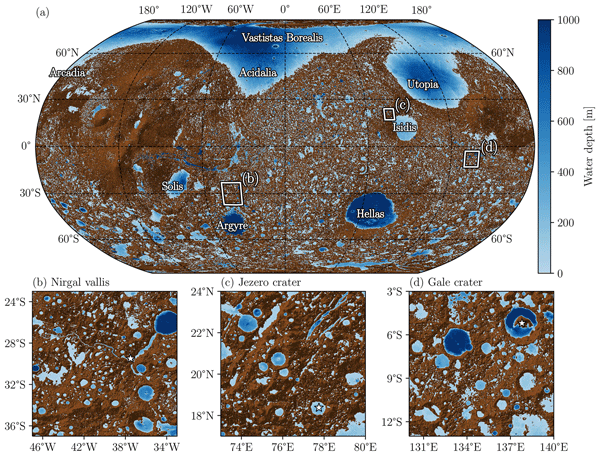
Alexandre Gauvain, François Forget, Martin Turbet, Jean-Baptiste Clément, Lucas Lange, and Romain Vandemeulebrouck
Geosci. Model Dev., 19, 6909–6940, https://doi.org/10.5194/gmd-19-6909-2026, https://doi.org/10.5194/gmd-19-6909-2026, 2026
Short summary
Short summary
In this paper, we present a global high-resolution hydrological model to investigate how water may have once flowed and accumulated on Mars. Using detailed topography, the model tracks how lakes and seas form, grow, merge, overflow, and dry out over time. It reveals how a vast northern ocean could emerge from smaller bodies of water. This approach links surface landforms to past climates, offering new perspectives on Mars' watery history and its potential habitability.
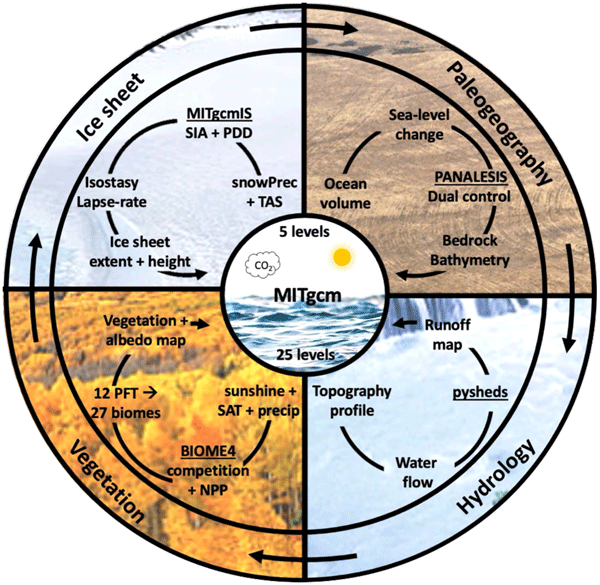
Laure Moinat, Florian Franziskakis, Christian Vérard, Daniel Nathan Goldberg, and Maura Brunetti
Geosci. Model Dev., 19, 4357–4384, https://doi.org/10.5194/gmd-19-4357-2026, https://doi.org/10.5194/gmd-19-4357-2026, 2026
Short summary
Short summary
We describe a new tool, BIG-MITgcm, that consistently reproduces the global-scale dynamics of the ocean, atmosphere, vegetation and ice on multimillennial timescales at a low computational cost. Evaluated against observations and state-of-the-art Earth system models, it includes asynchronous coupling to models of vegetation, hydrology and a newly developed global-scale ice sheet. Using arbitrary continental configurations, it enables studies of past and present climates on Earth or exoplanets.
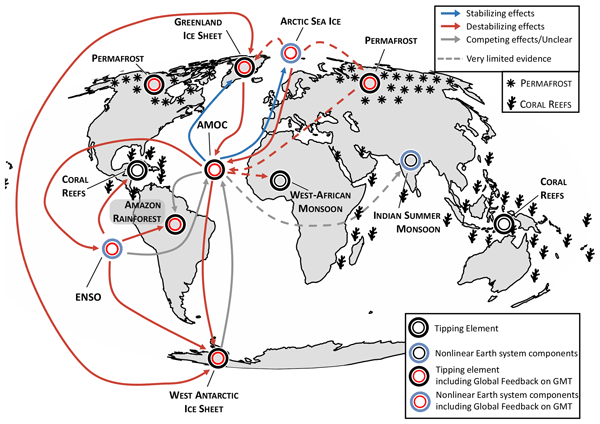
Nico Wunderling, Anna S. von der Heydt, Yevgeny Aksenov, Stephen Barker, Robbin Bastiaansen, Victor Brovkin, Maura Brunetti, Victor Couplet, Thomas Kleinen, Caroline H. Lear, Johannes Lohmann, Rosa Maria Roman-Cuesta, Sacha Sinet, Didier Swingedouw, Ricarda Winkelmann, Pallavi Anand, Jonathan Barichivich, Sebastian Bathiany, Mara Baudena, John T. Bruun, Cristiano M. Chiessi, Helen K. Coxall, David Docquier, Jonathan F. Donges, Swinda K. J. Falkena, Ann Kristin Klose, David Obura, Juan Rocha, Stefanie Rynders, Norman Julius Steinert, and Matteo Willeit
Earth Syst. Dynam., 15, 41–74, https://doi.org/10.5194/esd-15-41-2024, https://doi.org/10.5194/esd-15-41-2024, 2024
Short summary
Short summary
This paper maps out the state-of-the-art literature on interactions between tipping elements relevant for current global warming pathways. We find indications that many of the interactions between tipping elements are destabilizing. This means that tipping cascades cannot be ruled out on centennial to millennial timescales at global warming levels between 1.5 and 2.0 °C or on shorter timescales if global warming surpasses 2.0 °C.
Charline Ragon, Christian Vérard, Jérôme Kasparian, and Maura Brunetti
EGUsphere, https://doi.org/10.5194/egusphere-2023-1808, https://doi.org/10.5194/egusphere-2023-1808, 2023
Preprint archived
Short summary
Short summary
Deep-time climate simulations are challenging since sedimentary data are too sparse and uncertain to fully constrain initial and boundary conditions. By exploring a wide range of initial conditions, we find three alternative steady states with a temperature difference of around 10 °C in simulations using the Permian-Triassic paleogeography. This opens the possibility of explaining climatic variations in Early Triassic geological records through tipping mechanisms between steady states.
Cited articles
Adcroft, A., Campin, J.-M., Hill, C., and Marshall, J.: Implementation of an atmosphere–ocean general circulation model on the expanded spherical cube, Mon. Weather Rev., 132, 2845–2863, 2004. a
Anglada-Escudé, G., Amado, P. J., Barnes, J., Berdiñas, Z. M., Butler, R. P., Coleman, G. A., de La Cueva, I., Dreizler, S., Endl, M., Giesers, B., Jeffers, S. V., Jenkins, J. S., Jones, H. R. A., Kiraga, M., Kürster, M., López-González, M. J., Marvin, C. J., Morales, N., Morin, J., Nelson, R. P., Ortiz, J. L., Ofir, A., Paardekooper, S.-J., Reiners, A., Rodríguez, E., Rodríguez-López, C., Sarmiento, L. F., Strachan, J. P., Tsapras, Y., Tuomi, M., and Zechmeister, M.: A terrestrial planet candidate in a temperate orbit around Proxima Centauri, Nature, 536, 437–440, 2016. a
Batra, K. and Olson, S. L.: Climatic Effects of Ocean Salinity on M Dwarf Exoplanets, Astrophys. J. Lett., 971, https://doi.org/10.3847/2041-8213/ad63a5, 2024. a, b, c
Bhatnagar: Slab ocean model documentation, https://lmdz-forge.lmd.jussieu.fr/mediawiki/Planets/index.php/Slab_ocean_model (last access: 8 August 2025), 2025. a
Bhatnagar, S., Codron, F., Millour, E., Bolmont, E., Brunetti, M., Kasparian, J., Turbet, M., and Chaverot, G.: Dataset for “A Fast and Physically Grounded Ocean Model for GCMs: The Dynamical Slab Ocean Model of the Generic-PCM (rev. 3423)”, Zenodo [code and data set], https://doi.org/10.5281/zenodo.18771594, 2026a. a, b
Bhatnagar, S., Codron, F., Millour, E., Bolmont, E., Brunetti, M., Kasparian, J., Turbet, M., and Chaverot, G.: Dataset for “A Fast and Physically Grounded Ocean Model for GCMs: The Dynamical Slab Ocean Model of the Generic-PCM (rev. 3423)”, Zenodo [data set], https://doi.org/10.5281/zenodo.16417154, 2026b. a
Bolmont, E., Libert, A.-S., Leconte, J., and Selsis, F.: Habitability of planets on eccentric orbits: Limits of the mean flux approximation, Astron. Astrophys., 591, https://doi.org/10.1051/0004-6361/201628073, 2016. a, b
Bolmont, E., Sastre, M., Revol, A., Kervazo, M., and Tobie, G.: Estimation of the tidal heating in the TRAPPIST-1 planets. Influence of the internal structure, Astron. Astrophys., https://doi.org/10.1051/0004-6361/202554529, 2026. a
Boutle, I. A., Mayne, N. J., Drummond, B., Manners, J., Goyal, J., Lambert, F. H., Acreman, D. M., and Earnshaw, P. D.: Exploring the climate of Proxima b with the Met Office Unified Model, Astron. Astrophys., 601, https://doi.org/10.1051/0004-6361/201630020, 2017. a
Braam, M., Palmer, P. I., Decin, L., Mayne, N. J., Manners, J., and Rugheimer, S.: Earth-like Exoplanets in Spin–Orbit Resonances: Climate Dynamics, 3D Atmospheric Chemistry, and Observational Signatures, Planet. Sci. J., 6, https://doi.org/10.3847/PSJ/ad9565, 2025. a
Charnay, B., Forget, F., Wordsworth, R., Leconte, J., Millour, E., Codron, F., and Spiga, A.: Exploring the faint young Sun problem and the possible climates of the Archean Earth with a 3-D GCM, J. Geophys. Res.-Atmos., 118, 10414–10431, https://doi.org/10.1002/jgrd.50808, 2013. a, b, c, d, e, f, g, h, i, j, k, l, m, n, o, p, q, r, s, t, u, v
Checlair, J. H., Olson, S. L., Jansen, M. F., and Abbot, D. S.: No snowball on habitable tidally locked planets with a dynamic ocean, Astrophys. J. Lett., 884, https://doi.org/10.3847/2041-8213/ab487d, 2019. a
Cromwell, T.: Circulation in a meridional plane in the central equatorial Pacific, J. Mar. Res., 12, 196–213, 1953. a
Danabasoglu, G. and McWilliams, J. C.: Sensitivity of the global ocean circulation to parameterizations of mesoscale tracer transports, J. Climate, 8, 2967–2987, https://doi.org/10.1175/1520-0442(1995)008<2967:SOTGOC>2.0.CO;2, 1995. a
DeConto, R. M. and Pollard, D.: Rapid Cenozoic glaciation of Antarctica induced by declining atmospheric CO2, Nature, 421, 245–249, 2003. a
Di Paolo, M., Stevens, D. P., Joshi, M., and Hall, R. A.: Nonlinear and nonmonotonic effect of ocean tidal mixing on exoplanet climates and habitability, Astrophys. J. Lett., 982, https://doi.org/10.3847/2041-8213/adbca3, 2025. a
Dobos, V., Barr, A. C., and Kiss, L. L.: Tidal heating and the habitability of the TRAPPIST-1 exoplanets, Astron. Astrophys., 624, https://doi.org/10.1051/0004-6361/201834254, 2019. a
Dobrovolskis, A. R.: Spin states and climates of eccentric exoplanets, Icarus, 192, 1–23, 2007. a
Donnadieu, Y., Pierrehumbert, R., Jacob, R., and Fluteau, F.: Modelling the primary control of paleogeography on Cretaceous climate, Earth Planet. Sc. Lett., 248, 426–437, 2006. a
Dressing, C. D., Spiegel, D. S., Scharf, C. A., Menou, K., and Raymond, S. N.: Habitable climates: the influence of eccentricity, Astrophys. J., 721, 1295, https://doi.org/10.1088/0004-637X/721/2/1295, 2010. a
Driscoll, P. E. and Barnes, R.: Tidal heating of Earth-like exoplanets around M stars: thermal, magnetic, and orbital evolutions, Astrobiology, 15, 739–760, 2015. a
Edson, A., Lee, S., Bannon, P., Kasting, J. F., and Pollard, D.: Atmospheric circulations of terrestrial planets orbiting low-mass stars, Icarus, 212, 1–13, 2011. a
Fetterer, F., Knowles, K., Meier, W. N., Savoie, M., and Windnagel, A. K.: Sea Ice Index, Version 3, National Snow and Ice Data Center [data set], https://doi.org/10.7265/N5K072F8, 2017. a, b
Forget, F., Hourdin, F., Fournier, R., Hourdin, C., Talagrand, O., Collins, M., Lewis, S. R., Read, P. L., and Huot, J.-P.: Improved general circulation models of the Martian atmosphere from the surface to above 80 km, J. Geophys. Res.-Planets, 104, 24155–24175, 1999. a
Forget, F., Wordsworth, R., Millour, E., Madeleine, J.-B., Kerber, L., Leconte, J., Marcq, E., and Haberle, R. M.: 3D modelling of the early martian climate under a denser CO2 atmosphere: Temperatures and CO2 ice clouds, Icarus, 222, 81–99, 2013. a
Forget, G. and Ferreira, D.: Global ocean heat transport dominated by heat export from the tropical Pacific, Nat. Geosci., 12, 351–354, 2019. a
Fu, Q. and Liou, K.: On the correlated k-distribution method for radiative transfer in nonhomogeneous atmospheres, J. Atmos. Sci., 49, 2139–2156, 1992. a
Gardner, J. P., Mather, J. C., Clampin, M., Doyon, R., Greenhouse, M. A., Hammel, H. B., Hutchings, J. B., Jakobsen, P., Lilly, S. J., Long, K. S., Lunine, J. I., McCaughrean, M. J., Mountain, M., Nella, J., Rieke, G. H., Rieke, M. J., Rix, H.-W., Smith, E. P., Sonneborn, G., Stiavelli, M., Stockman, H. S., Windhorst, R. A., and Wright, G. S.: The james webb space telescope, Space Sci. Rev., 123, 485–606, 2006. a
Gaudi, B. S., Seager, S., Mennesson, B., et al.: The Habitable Exoplanet Observatory (HabEx) mission concept study final report, arXiv [preprint], https://doi.org/10.48550/arXiv.2001.06683, 2020. a
Generic-PCM-Team: Overview of the Generic PCM, https://lmdz-forge.lmd.jussieu.fr/mediawiki/Planets/index.php/Overview_of_the_Generic_PCM (last access: 8 August 2025), 2025. a
Generic-PCM-Team: The Generic-PCM model, http://svn.lmd.jussieu.fr/Planeto/trunk (last access: 8 August 2025), 2025. a
Gillon, M., Triaud, A. H., Demory, B.-O., Jehin, E., Agol, E., Deck, K. M., Lederer, S. M., De Wit, J., Burdanov, A., Ingalls, J. G., Bolmont, E., Leconte, J., Raymond, S. N., Selsis, F., Turbet, M., Barkaoui, K., Burgasser, A., Burleigh, M. R., Carey, S. J., Chaushev, A., Copperwheat, C. M., Delrez, L., Fernandes, C. S., Holdsworth, D. L., Kotze, E. J., Van Grootel, V., Almleaky, Y., Benkhaldoun, Z., Magain, P., and Queloz, D.: Seven temperate terrestrial planets around the nearby ultracool dwarf star TRAPPIST-1, Nature, 542, 456–460, 2017. a
Hourdin, F., Musat, I., Bony, S., Braconnot, P., Codron, F., Dufresne, J.-L., Fairhead, L., Filiberti, M.-A., Friedlingstein, P., Grandpeix, J.-Y., Krinner, G., Levan, P., Li, Z.-X., and Lott, F.: The LMDZ4 general circulation model: climate performance and sensitivity to parametrized physics with emphasis on tropical convection, Clim. Dynam., 27, 787–813, 2006. a, b
Hsu, T.-Y., Primeau, F., and Magnusdottir, G.: A hierarchy of global ocean models coupled to CESM1, J. Adv. Model. Earth Sy., 14, e2021MS002979, https://doi.org/10.1029/2021MS002979, 2022. a
Hu, Y. and Yang, J.: Role of ocean heat transport in climates of tidally locked exoplanets around M dwarf stars, P. Natl. Acad. Sci. USA, 111, 629–634, 2014. a
Kalnay, E., Kanamitsu, M., Kistler, R., Collins, W., Deaven, D., Gandin, L., Iredell, M., Saha, S., White, G., Woollen, J., Zhu, Y., Leetmaa, A., Reynolds, B., Chelliah, M., Ebisuzaki, W., Higgins, W., Janowiak, J., Mo, K. C., Ropelewski, C., Wang, J., Jenne, R., and Joseph, D.: The NCEP/NCAR 40-Year Reanalysis Project, B. Am. Meteorol. Soc., 77, 437–472, https://doi.org/10.1175/1520-0477(1996)077<0437:TNYRP>2.0.CO;2, 1996. a, b
Kara, A. B., Rochford, P. A., and Hurlburt, H. E.: Mixed layer depth variability over the global ocean, J. Geophys. Res.-Oceans, 108, https://doi.org/10.1029/2000JC000736, 2003. a
Kasting, J. F., Whitmire, D. P., and Reynolds, R. T.: Habitable zones around main sequence stars, Icarus, 101, 108–128, 1993. a
Katsaros, K. B., McMurdie, L. A., Lind, R. J., and DeVault, J. E.: Albedo of a water surface, spectral variation, effects of atmospheric transmittance, sun angle and wind speed, J. Geophys. Res.-Oceans, 90, 7313–7321, 1985. a
Kilic, C., Raible, C., and Stocker, T.: Multiple climate states of habitable exoplanets: The role of obliquity and irradiance, Astrophys. J., 844, 147, https://doi.org/10.3847/1538-4357/aa7a03, 2017. a
Kopparapu, R. K., Wolf, E. T., Haqq-Misra, J., Yang, J., Kasting, J. F., Meadows, V., Terrien, R., and Mahadevan, S.: The inner edge of the habitable zone for synchronously rotating planets around low-mass stars using general circulation models, Astrophys. J., 819, 84, https://doi.org/10.3847/0004-637X/819/1/84, 2016. a, b
Kopparapu, R. K., Wolf, E. T., Arney, G., Batalha, N. E., Haqq-Misra, J., Grimm, S. L., and Heng, K.: Habitable moist atmospheres on terrestrial planets near the inner edge of the habitable zone around M dwarfs, Astrophys. J., 845, https://doi.org/10.3847/1538-4357/aa7cf9, 2017. a
Kuzucan, A., Bolmont, E., Chaverot, G., Ferreira, J. Q., Ibelings, B. W., Bhatnagar, S., and McGinnis, D. F.: The Role of Atmospheric Composition in Defining the Habitable Zone Limits and Supporting E. coli Growth, Life, 15, https://doi.org/10.3390/life15010079, 2025. a
Lewis, J., Weaver, A., and Eby, M.: Snowball versus slushball Earth: Dynamic versus nondynamic sea ice?, J. Geophys. Res.-Oceans, 112, https://doi.org/10.1029/2006JC004037, 2007. a
Lovis, C., Blind, N., Chazelas, B., Shinde, M., Bugatti, M., Restori, N., Dinis, I., Genolet, L., Hughes, I., Sordet, M., Schnell, R., Rihs, S., Crausaz, A., Turbet, M., Billot, N., Fusco, T., Neichel, B., Sauvage, J.-F., Santos Diaz, P., Houelle, M., Blackman, J., Lanotte, A., Kühn, J., Hagelberg, J., Guyon, O., Martinez, P., Spang, A., Mordasini, C., Ehrenreich, D., Demory, B.-O., Bolmont, E.: RISTRETTO: reflected-light exoplanet spectroscopy at the diffraction limit of the VLT, in: Ground-based and Airborne Instrumentation for Astronomy X, SPIE, 13096, 412–417, 2024. a
Marshall, J. and Plumb, R. A.: Atmosphere, Ocean and Climate Dynamics: An Introductory Text, Academic Press, Amsterdam, ISBN 9780125586917, 2007. a
Marshall, J., Adcroft, A., Hill, C., Perelman, L., and Heisey, C.: A finite-volume, incompressible Navier Stokes model for studies of the ocean on parallel computers, J. Geophys. Res.-Oceans, 102, 5753–5766, 1997a. a
Marshall, J., Hill, C., Perelman, L., and Adcroft, A.: Hydrostatic, quasi-hydrostatic, and nonhydrostatic ocean modeling, J. Geophys. Res.-Oceans, 102, 5733–5752, 1997b. a
McCreary Jr, J. P., Kohler, K. E., Hood, R. R., Smith, S., Kindle, J., Fischer, A. S., and Weller, R. A.: Influences of diurnal and intraseasonal forcing on mixed-layer and biological variability in the central Arabian Sea, J. Geophys. Res.-Oceans, 106, 7139–7155, 2001. a
Olson, S., Jansen, M. F., Abbot, D. S., Halevy, I., and Goldblatt, C.: The effect of ocean salinity on climate and its implications for Earth's habitability, Geophys. Res. Lett., 49, e2021GL095748, https://doi.org/10.1029/2021GL095748, 2022. a, b
Olson, S. L., Jansen, M., and Abbot, D. S.: Oceanographic considerations for exoplanet life detection, Astrophys. J., 895, https://doi.org/10.3847/1538-4357/ab88c9, 2020. a, b
Palle, E., Biazzo, K., Bolmont, E., et al.: Ground-breaking exoplanet science with the ANDES spectrograph at the ELT, Experiment, Astron., 59, 1–84, 2025. a
Payne, R. E.: Albedo of the sea surface, J. Atmos. Sci., 29, 959–970, 1972. a
Pedersen, C. A., Roeckner, E., Lüthje, M., and Winther, J.-G.: A new sea ice albedo scheme including melt ponds for ECHAM5 general circulation model, J. Geophys. Res.-Atmos., 114, https://doi.org/10.1029/2008JD010440, 2009. a
Pegau, W. S. and Paulson, C. A.: The albedo of Arctic leads in summer, Ann. Glaciol., 33, 221–224, 2001. a
Pierrehumbert, R., Abbot, D. S., Voigt, A., and Koll, D.: Climate of the Neoproterozoic, Annu. Rev. Earth Pl. Sci., 39, 417–460, 2011. a
Pierrehumbert, R. T.: A palette of climates for Gliese 581g, Astrophys. J. Lett., 726, https://doi.org/10.1088/2041-8205/726/1/L8, 2010. a
Quanz, S. P., Ottiger, M., Fontanet, E., Kammerer, J., Menti, F., Dannert, F., Gheorghe, A., Absil, O., Airapetian, V. S., Alei, E.,, Allart, R., Angerhausen, D., Blumenthal, S., Buchhave, L. A., Cabrera, J., Carrión-González, Ó., Chauvin, G., Danchi, W. C., Dandumont, C., Defrére, D., Dorn, C., Ehrenreich, D., Ertel, S., Fridlund, M., García Muñoz, A., Gascón, C., Girard, J. H., Glauser, A., Grenfell, J. L., Guidi, G., Hagelberg, J., Helled, R., Ireland, M. J., Janson, M., Kopparapu, R. K., Korth, J., Kozakis, T., Kraus, S., Léger, A., Leedjärv, L., Lichtenberg, T., Lillo-Box, J., Linz, H., Liseau, R., Loicq, J., Mahendra, V., Malbet, F., Mathew, J., Mennesson, B., Meyer, M. R., Mishra, L., Molaverdikhani, K., Noack, L., Oza, A. V., Pallé, E., Parviainen, H., Quirrenbach, A., Rauer, H., Ribas, I., Rice, M., Romagnolo, A., Rugheimer, S., Schwieterman, E. W., Serabyn, E., Sharma, S., Stassun, K. G., Szulágyi, J., Wang, H. S., Wunderlich, F., Wyatt, M. C., and LIFE Collaboration: Large interferometer for exoplanets (life)-i. improved exoplanet detection yield estimates for a large mid-infrared space-interferometer mission, Astron. Astrophys., 664, https://doi.org/10.1051/0004-6361/202140366, 2022. a
Ragon, C., Vérard, C., Kasparian, J., and Brunetti, M.: Alternative climatic steady states near the Permian–Triassic Boundary, Sci. Rep., 14, 26136, https://doi.org/10.1038/s41598-024-76432-8, 2024. a
Ribas, I., Bolmont, E., Selsis, F., Reiners, A., Leconte, J., Raymond, S. N., Engle, S. G., Guinan, E. F., Morin, J., Turbet, M., Forget, F., and Anglada-Escudé, G.: The habitability of proxima centauri b-I. irradiation, rotation and volatile inventory from formation to the present, Astron. Astrophys., 596, A111, https://doi.org/10.1051/0004-6361/201629576, 2016. a, b
Rose, B. E. J.: Stable “Waterbelt” climates controlled by tropical ocean heat transport: A nonlinear coupled climate mechanism of relevance to Snowball Earth, J. Geophys. Res.-Atmos., 120, 1404–1423, https://doi.org/10.1002/2014JD022659, 2015. a
Rothman, L. S., Gordon, I. E., Babikov, Y., Barbe, A., Chris Benner, D., Bernath, P. F., Birk, M., Bizzocchi, L., Boudon, V., Brown, L. R., Campargue, A., Chance, K., Cohen, E. A., Coudert, L. H., Devi, V. M., Drouin, B. J., Fayt, A., Flaud, J.-M., Gamache, R. R., Harrison, J. J., Hartmann, J.-M., Hill, C., Hodges, J. T., Jacquemart, D., Jolly, A., Lamouroux, J., Le Roy, R. J., Li, G., Long, D. A., Lyulin, O. M., Mackie, C. J., Massie, S. T., Mikhailenko, S., Müller, H. S. P., Naumenko, O. V., Nikitin, A. V., Orphal, J., Perevalov, V., Perrin, A., Polovtseva, E. R., Richard, C., Smith, M. A. H., Starikova, E., Sung, K., Tashkun, S., Tennyson, J., Toon, G. C., Tyuterev, V. G., and Wagner, G.: The HITRAN2012 molecular spectroscopic database, J. Quant. Spectrosc. Ra., 130, 4–50, 2013. a
Schmidt, F., Way, M. J., Costard, F., Bouley, S., Séjourné, A., and Aleinov, I.: Circumpolar ocean stability on Mars 3 Gy ago, P. Natl. Acad. Sci. USA, 119, e2112930118, https://doi.org/10.1073/pnas.2112930118, 2022. a
Sergeev, D. E., Fauchez, T. J., Turbet, M., Boutle, I. A., Tsigaridis, K., Way, M. J., Wolf, E. T., Domagal-Goldman, S. D., Forget, F., Haqq-Misra, J., Kopparapu, R. K., Lambert, F. H., Manners, J., and Mayne, N. J.: The TRAPPIST-1 habitable atmosphere intercomparison (THAI). II. Moist cases – The two waterworlds, Planet. Sci. J., 3, 212, https://doi.org/10.3847/PSJ/ac6cf2, 2022a. a
Sergeev, D. E., Lewis, N. T., Lambert, F. H., Mayne, N. J., Boutle, I. A., Manners, J., and Kohary, K.: Bistability of the atmospheric circulation on TRAPPIST-1e, Planet. Sci. J., 3, 214, https://doi.org/10.3847/PSJ/ac83be, 2022b. a
Showman, A. P., Cho, J. Y., and Menou, K.: Atmospheric circulation of exoplanets, Exoplanets, 526, 471–516, 2010. a
Si, Y., Yang, J., and Liu, Y.: Planetary climate under extremely high vertical diffusivity, Astron. Astroph., 658, A33, https://doi.org/10.1051/0004-6361/202140778, 2022. a
Spiegel, D. S., Menou, K., and Scharf, C. A.: Habitable climates, Astrophys. J., 681, 1609, https://doi.org/10.1086/588089, 2008. a
Taniguchi, K., Kodama, T., Turbet, M., Chaverot, G., Millour, E., and Genda, H.: Atmospheric collapse and habitability on tidally locked exoplanets, Astrophys. J., 1000, 99, https://doi.org/10.3847/1538-4357/ae47f2, 2026. a
Trenberth, K. E. and Solomon, A.: The global heat balance: Heat transports in the atmosphere and ocean, Clim. Dynam., 10, 107–134, 1994. a
Tsigaridis, K., Ackerman, A. S., Aleinov, I., Chandler, M. A., Clune, T. L., Colose, C. M., Del Genio, A. D., Kelley, M., Kiang, N. Y., Leboissetier, A., Perlwitz, J. P., Ruedy, R. A., Russell, G. L., Sohl, L. E., Way, M. J., and Wolf, E. T.: ROCKE-3D 2.0: an updated general circulation model for simulating the climates of rocky planets, Geosci. Model Dev., 18, 5825–5871, https://doi.org/10.5194/gmd-18-5825-2025, 2025. a, b
Turbet, M. and Forget, F.: 3-D Global modelling of the early martian climate under a dense CO2+ H2 atmosphere and for a wide range of surface water inventories, arXiv [preprint], https://doi.org/10.48550/arXiv.2103.10301, 2021. a
Turbet, M., Leconte, J., Selsis, F., Bolmont, E., Forget, F., Ribas, I., Raymond, S. N., and Anglada-Escudé, G.: The habitability of Proxima Centauri b-II. Possible climates and observability, Astron. Astrophys., 596, https://doi.org/10.1051/0004-6361/201629577, 2016. a, b, c, d
Turbet, M., Bolmont, E., Leconte, J., Forget, F., Selsis, F., Tobie, G., Caldas, A., Naar, J., and Gillon, M.: Modeling climate diversity, tidal dynamics and the fate of volatiles on TRAPPIST-1 planets, Astron. Astrophy., 612, https://doi.org/10.1051/0004-6361/201731620, 2018. a, b
Turbet, M., Bolmont, E., Bourrier, V., Demory, B.-O., Leconte, J., Owen, J., and Wolf, E. T.: A review of possible planetary atmospheres in the TRAPPIST-1 system, Space Sci. Rev., 216, 1–48, 2020a. a
Turbet, M., Gillmann, C., Forget, F., Baudin, B., Palumbo, A., Head, J., and Karatekin, O.: The environmental effects of very large bolide impacts on early Mars explored with a hierarchy of numerical models, Icarus, 335, 113419, https://doi.org/10.1016/j.icarus.2019.113419, 2020b. a
Valente, E. F. and Correia, A. C.: Tidal excitation of the obliquity of Earth-like planets in the habitable zone of M-dwarf stars, Astron. Astrophy., 665, https://doi.org/10.1051/0004-6361/202244010, 2022. a
Voigt, A. and Abbot, D. S.: Sea-ice dynamics strongly promote Snowball Earth initiation and destabilize tropical sea-ice margins, Clim. Past, 8, 2079–2092, https://doi.org/10.5194/cp-8-2079-2012, 2012. a
Warren, S. G.: Impurities in snow: Effects on albedo and snowmelt, Ann. Glaciol., 5, 177–179, 1984. a
Warren, S. G. and Wiscombe, W. J.: A model for the spectral albedo of snow. II: Snow containing atmospheric aerosols, J. Atmos. Sci., 37, 2734–2745, 1980. a
Way, M. J. and Del Genio, A. D.: Venusian habitable climate scenarios: Modeling Venus through time and applications to slowly rotating Venus-like exoplanets, J. Geophys. Res.-Planets, 125, e2019JE006276, https://doi.org/10.1029/2019JE006276, 2020. a
Way, M. J., Del Genio, A. D., Kiang, N. Y., Sohl, L. E., Grinspoon, D. H., Aleinov, I., Kelley, M., and Clune, T.: Was Venus the first habitable world of our solar system?, Geophys. Res. Lett., 43, 8376–8383, 2016. a
Wolf, E. and Toon, O.: The evolution of habitable climates under the brightening Sun, J. Geophys. Res.-Atmos., 120, 5775–5794, 2015. a
Wolf, E. T., Shields, A. L., Kopparapu, R. K., Haqq-Misra, J., and Toon, O. B.: Constraints on climate and habitability for Earth-like exoplanets determined from a general circulation model, Astrophys. J., 837, https://doi.org/10.3847/1538-4357/aa5ffc, 2017. a
Wordsworth, R., Forget, F., Millour, E., Head, J., Madeleine, J.-B., and Charnay, B.: Global modelling of the early martian climate under a denser CO2 atmosphere: Water cycle and ice evolution, Icarus, 222, 1–19, 2013. a
Wordsworth, R. D., Forget, F., Selsis, F., Millour, E., Charnay, B., and Madeleine, J.-B.: Gliese 581d is the first discovered terrestrial-mass exoplanet in the habitable zone, Astrophys. J. Lett., 733, https://doi.org/10.1088/2041-8205/733/2/L48, 2011. a
Wu, X., Reed, K. A., Wolfe, C. L., Marques, G. M., Bachman, S. D., and Bryan, F. O.: Coupled aqua and ridge planets in the Community Earth System Model, J. Adv. Model. Earth Sy., 13, e2020MS002418, https://doi.org/10.1029/2020MS002418, 2021. a
Wyrtki, K.: Oceanography of the eastern equatorial Pacific Ocean, Oceanogr. Mar. Biol. Annu. Rev., 4, 33–68, 1966. a
Yang, J., Peltier, W. R., and Hu, Y.: The initiation of modern “soft Snowball” and “hard Snowball” climates in CCSM3. Part II: Climate dynamic feedbacks, J. Climate, 25, 2737–2754, 2012a. a
Yang, J., Peltier, W. R., and Hu, Y.: The initiation of modern “soft snowball” and “hard snowball” climates in CCSM3. Part I: The influences of solar luminosity, CO2 concentration, and the sea ice/snow albedo parameterization, J. Climate, 25, 2711–2736, 2012b. a
Yang, J., Abbot, D. S., Koll, D. D., Hu, Y., and Showman, A. P.: Ocean dynamics and the inner edge of the habitable zone for tidally locked terrestrial planets, Astrophys. J., 871, https://doi.org/10.3847/1538-4357/aaf1a8, 2019. a
Short summary
We present an efficient ocean model coupled to a 3-D climate model (the Generic-PCM) that captures key features of ocean heat transport, matching well the global heat flows of more complex models. It closely reproduces Earth’s sea surface temperatures and sea ice, while influencing atmospheric circulation consistently. Balancing speed and accuracy, the model is ideal for exoplanet and paleoclimate studies, where observations are limited and broad parameter exploration is necessary.
We present an efficient ocean model coupled to a 3-D climate model (the Generic-PCM) that...


