
the Creative Commons Attribution 4.0 License.
the Creative Commons Attribution 4.0 License.
 | 22 Apr 2026
CMIP7 data request: land and land ice priorities and opportunities
Gang Tang
Eleanor O'Rourke
Samar Minallah
Martim Mas e Braga
Sophie Nowicki
Robin S. Smith
David M. Lawrence
George C. Hurtt
Daniele Peano
Gesa Meyer
Birgit Hassler
Jiafu Mao
Yongkang Xue
Martin Juckes
The Land and Land Ice Theme in the Coupled Model Intercomparison Project Phase 7 (CMIP7) represents the current understanding of physical processes in land surface ecosystems, hydrology, cryosphere, and their physical interactions with other Earth system components. Simulations from Earth system models (ESMs) could provide crucial information for assessing planetary safety, such as critical tipping elements, and be used to inform climate risks for improving climate impact assessments and policy decisions. This paper presents a collaborative effort to identify scientific opportunities in the Land and Land Ice Theme of the CMIP7 Data Request. The proposed opportunities build upon advances in ESMs, including new freshwater system and land ice processes being included in CMIP7, as well as the scientific community's demand for high-frequency and sub-grid-scale land surface outputs. In total, 25 variable groups that contain 716 variables have been identified to be potentially available to the broad scientific audience for performing analysis in land–atmosphere coupling, hydrological processes and freshwater systems, glacier and ice sheet mass balance and their influence on the sea levels, land use, and plant phenology. Key reflections from this data request effort include advocacy for closer engagement between the user community and modeling groups, reduction in the technical barriers to tracking existing parameters and defining new variables, and more streamlined variable management. These will be essential to enhance the usability and reliability of CMIP7 outputs for climate and Earth system research and applications to a broad audience that relies on the CMIP7 endeavor.
- Article
(5524 KB) - Full-text XML
- BibTeX
- EndNote


Land and Land Ice (including glaciers, ice sheets, and ice shelves) processes are essential components in Earth system models (ESMs) to simulate and project future climate change and assess climate change impacts (Eyring et al., 2016; Lee et al., 2021). Key physical processes within the Land and Land Ice Theme include energy and hydrological interactions associated with land–atmosphere feedbacks, land use and land cover changes, vegetation, and cryosphere dynamics. Since the Coupled Model Intercomparison Project Phase 6 (CMIP6), grand challenges have emerged in Earth system modeling to integrate these processes and capture interactions within planetary boundaries (Richardson et al., 2023) and the potential tipping elements that could result in dangerously rapid or irreversible changes to the Earth system (Armstrong McKay et al., 2022). These have posed a higher requirement for improving ESMs with available observational data and improved understanding of Land and Land Ice processes. In this context, new “Opportunities” need to be identified for CMIP7 models to map variables that meet the needs of scientific analyses and societal use and impact assessments. Building upon the provisional planning of the Baseline Climate Variables (BCVs) of CMIP7 (Juckes et al., 2025), this paper develops a collection of harmonized variables within the Land and Land Ice Theme that are available for the Land and Land Ice communities to work with and tackle these challenges. Following CMIP6 definition, CMIP7 Data Request includes both output variables and their associated spatiotemporal constraints (Juckes et al., 2020).
Land–atmosphere (L–A) interactions represent a critical pathway through which land and land–ice processes regulate the climate system through surface-air energy and water exchanges. Enhanced understanding of L–A interactions at various spatiotemporal scales has the potential to improve Earth system simulations of climate extremes, such as heat extremes (Dirmeyer et al., 2021; Biess et al., 2024) and tropical extreme rainfall (Negrón-Juárez et al., 2024). These extreme events, including the intensification of subdaily wildfires due to meteorological dryness in the recent two decades (Balch et al., 2022; Luo et al., 2024a), have been reported to lead to significant societal consequences such as increased mortality from wildfire air pollution (Park et al., 2024) and threatened energy systems (Zhao et al., 2023). Since CMIP6, significant progress has been made in evaluating daily and subdaily precipitation against observational data (Norris et al., 2021; Wehner et al., 2021; Lei et al., 2022; Dong et al., 2023). However, the reliance on observation-based reanalysis datasets, which provide high-frequency data, has revealed that key L–A interactions, such as their role in regional monsoon systems (Chauhan et al., 2023) and climate extremes like drought progression (Herrera-Estrada et al., 2019; Wu and Dirmeyer, 2020; Schumacher et al., 2022; Yoon et al., 2023) and heatwaves (Chen et al., 2025), are still not well represented in models, partially due to insufficient temporal resolution. To bridge this gap, ESMs must incorporate high-frequency (e.g., 3-hourly) output for L–A metrics, ensuring robust comparisons with observation and reanalysis data and improving the representation of rapid land-surface feedbacks and extreme event development, such as the morning flux and afternoon rainfall (Findell et al., 2024).
Hydrological processes are central to land and land–ice dynamics, with water connecting all components of the Earth system. Accurate and comprehensive representation of hydrological processes in ESMs is essential for assessing the water cycle, freshwater systems, and associated feedbacks with the other components. Typical CMIP6 hydrological variables include surface water balance, such as precipitation, evapotranspiration, runoff, and soil moisture (Cook et al., 2020). With the past CMIP cycles, progress has been made to improve model representation of hydrological processes and highlight the need to advance the assessment of freshwater systems, including lakes (Minallah and Steiner, 2021; Briley et al., 2021; Notaro et al., 2022), artificial reservoirs (e.g., big dams, Vanderkelen et al., 2022), rivers (Lehner et al., 2019), estuaries (Sun et al., 2017; Vettoretti et al., 2024), groundwater (Wu et al., 2021), permafrost (Li et al., 2010; Koven et al., 2013; Wang et al., 2017; Burke et al., 2020), snowpack (Sun et al., 1999; Kouki et al., 2022; Zhang et al., 2022), and glaciers (Shrestha et al., 2015). It is thus essential to propose a comprehensive CMIP7 hydrological variable set, that allows for accurately assessing and predicting future changes in freshwater resources, water availability, and hydrometeorological extremes, and support hydrological modeling applications in ESM frameworks.
Glacier and ice sheet (including ice cap and floating shelf) processes, are essential for understanding land ice interactions with the atmosphere and ocean, making them a priority for CMIP7 Earth system modeling. Glaciers and ice sheets play a crucial role in sea-level rise, freshwater availability, and climate feedbacks (e.g., ice-albedo feedback), yet their future evolution with climate warming remains highly uncertain (Fox-Kemper et al., 2021). Mountain and polar glaciers, including those in Greenland and (sub-)Antarctica (RGI Consortium, 2023), were the primary contributors to 20th-century sea-level rise (Gregory et al., 2013; Oppenheimer et al., 2019) and are expected to remain dominant drivers in the 21st century (Fox-Kemper et al., 2021). They also sustain ecosystems (Drenkhan et al., 2023), regulate hydroclimates (Milner et al., 2017), and provide vital freshwater resources (Hock et al., 2019b; Huss and Hock, 2018). Their sensitivity to climate change makes them regional tipping elements, increasing risks of geohazards such as glacial lake outburst floods and avalanches (Wolken et al., 2021; Hock and Truffer, 2024). Ice sheet mass loss further accelerates sea-level rise, alters ocean circulation, and could trigger cascading Earth system tipping points (Golledge et al., 2019; Armstrong McKay et al., 2022). To enhance projections of cryosphere dynamics in ESMs, it is necessary to provide comprehensive variable groups in CMIP7 to assess the mass balance, contributions to sea-level rise, and ice-climate feedbacks of glaciers, ice sheets, and ice shelves. Leveraging CMIP7 data will enhance understanding of glacier and ice sheet responses to climate change, reducing uncertainties and strengthening global climate impact assessments.
Land-use change is a major driver of land–atmosphere and land–ice interactions, requiring improved representation in ESMs. Human land use and management have profoundly altered the Earth's surface, driving changes in climate (Li et al., 2022b), carbon dynamics (Hogan et al., 2025), water cycle (Sterling et al., 2013; Mao et al., 2015; te Wierik et al., 2021), and surface energy fluxes (Lawrence et al., 2022). As global demands continue to increase for resources such as food and energy, the expected intensification of land use will exert climatic and biogeochemical impacts. Within the context of CMIP6 and the Land Use Model Intercomparison Project (LUMIP, Lawrence et al., 2016), land use impacts on climate and biogeochemical cycling have been extensively assessed. Example studies that relied on the CMIP6-LUMIP simulations include quantification of the biophysical climate effects of land use and land cover change (LULCC) generally (Boysen et al., 2020; Tang et al., 2023; Luo et al., 2024b; Li et al., 2025a) and irrigation specifically (Al-Yaari et al., 2022), as well as an assessment of the role of agricultural processes, especially fertilization, in amplifying the annual cycle of land–atmosphere CO2 exchange (Lombardozzi et al., 2025). A major limitation in assessing the impacts of LULCC is the lack of sub-grid-scale modeled data that accurately reflect land surface heterogeneity, which is largely driven by human land transformations. Provision of this sub-grid information will allow for detailed ongoing assessment into the LULCC impacts on climate and the carbon cycle, even when only all-forcing historical runs are available.
Last but not least, vegetation on land is a key land process that influence the Earth system simulations through the cycles of energy (e.g., surface albedo), water, carbon, and nutrient cycles (e.g., nitrogen) and are thus crucial for CMIP7 ESM simulations. The variability in timing and duration of a plant's active season (i.e. phenology) influences the exchanges of energy, carbon, and water between land and atmosphere as observed in the last decades (e.g. Richardson et al., 2013; Keenan et al., 2014; Park et al., 2016). Similarly, vegetation greening unveils the relationship between land and atmosphere (e.g. Zhu et al., 2016; Munier et al., 2018; Winkler et al., 2021; Yu et al., 2021). Consequently, it is paramount to assess and understand the ability of ESMs to accurately reproduce the vegetation phenology and quantity. This evaluation can be performed using the Leaf Area Index (LAI) variable as done in previous studies (e.g. Murray-Tortarolo et al., 2013; Peano et al., 2021, 2025; Li et al., 2022a). However, ESMs estimate LAI through the Plant Functional Types (PFT) discretization, which differs in each model. For this reason, it is relevant to assess plant phenology at a standard vegetation type level to increase the understanding of model limitations (e.g. Li et al., 2024b).
This theme paper will focus on model output variables required for the physical Land and Land Ice analysis. Biogeochemical and nutrient interactions are generally out-of-scope and are included in the Earth system theme (see McPartland et al., 2026), except for the land use Opportunity due to the tight coupling between physical variables and biogeochemical fluxes. Full pressure-level atmospheric dynamics variables are included in the BCVs and Atmosphere theme. The CMIP experiment communities that are related to the data request from this theme include the High Resolution Model Intercomparison Project (HighResMIP, https://highresmip.org/, last access: 31 January 2026, Roberts et al., 2025), the Ice Sheet Model Intercomparison Project for CMIP7 (ISMIP7, https://www.ismip.org/, last access: 17 April 2026, Nowicki et al., 2024), the Land Use Model Intercomparison Project (LUMIP, https://www.cesm.ucar.edu/projects/cmip6/lumip, last access: 31 January 2026, Lawrence et al., 2016), the Snow Model Intercomparison Project (SnowMIP, https://www.wcrp-climate.org/modelling-wgcm-mip-catalogue/modelling-wgcm-mips-2/276-modelling-wgcm-catalogue-snowmip, last access: 31 January 2026, Krinner et al., 2018), the Irrigation Impacts Model Intercomparison Project (IRRMIP, https://hydr.vub.be/projects/irrmip, last access: 31 January 2026, Yao et al., 2025), the TIpping Point Model Intercomparison Project (TIPMIP, https://tipmip.org/, last access: 17 April 2026, Walton et al., 2025; Winkelmann et al., 2025), the Marine Ice Sheet Ocean Model Intercomparison Project (MISOMIP, https://misomip.github.io/, last access: 31 January 2026, De Rydt et al., 2024), the Glacier Model Intercomparison Project (GlacierMIP, https://climate-cryosphere.org/glaciermip/, last access: 31 January 2026, Hock et al., 2019a), and Paleoclimate Modeling Intercomparison Project (PMIP, https://pmip.lsce.ipsl.fr/, last access: 31 January 2026, Kageyama et al., 2018).
The Land and Land Ice Theme author team was recruited via an open call between 13 February and 8 March 024 (https://wcrp-cmip.org/cmip7-land-ice-call/, last access: 31 January 2026). Members were sought from across the Land and Land Ice communities to gather variable requirements for the CMIP7 Data Request (Mackallah et al., 2026). Applications were reviewed by LUMIP and ISMIP representatives alongside two members of the Data Request Task Team. A diverse final group of 21 committee members was chosen, including representatives from Climate and Cryosphere (CliC) project, Global Energy and Water Exchanges (GEWEX) program, PMIP, GlacierMIP, TIPMIP, Reduced Complexity Mode Intercomparison Project (RCMIP), the Fire Model Intercomparison Project (FireMIP), and the Global Climate Observing System-Terrestrial Observation Panel for Climate (GCOS-TOPC) with theme members spanning a range of geographical regions, career stages, and CMIP experiences, keeping in mind necessary expertise as well as geographic and gender diversity.
Many members of this team were not involved in previous data requests, but all were creators and/or users of past CMIP or land/ice sheet model data. Consequently, new ideas and opinions (see Sect. 4) are combined with user experiences from CMIP6 and earlier CMIP rounds of data requests to identify:
-
What was effective, e.g., the new Opportunities related to land ice as in the results.
-
What was not, e.g., variables proposed by Opportunities that are already included in the baseline climate variable (see Juckes et al., 2025).
-
Information about which variables were downloaded, e.g., download frequency available from Airtable (a cloud-based database platform that visualizes complex variables in spreadsheets), and which were used for major publications and assessment reports such as the United Nations Intergovernmental Panel on Climate Change (IPCC) Sixth Assessment Report (AR6).
Every member of the Land and Land Ice Theme was provided with a variable list that organized variables (as well as their downloading frequency in CMIP6) using several categories such as energy balance, water cycle, and land ice. This helped each Opportunity proposer to avoid redundancy with existing variables or variable groups.
The team first convened on 19 July 2024, with community engagement activities beginning in parallel with the first public consultation. Author team members were requested to utilize their networks as community representatives to gather scientific requirements for the Land and Land Ice Theme of the CMIP7 Data Request. Author team members used the Airtable cloud platform to propose the scientific Opportunities associated with the Land and Land Ice Theme. For each Opportunity, proposers had to define variable groups with different priorities which included variables with specific requirements for the variable dimensions (e.g., latitude, longitude, and pressure levels), spatial and temporal average approach, and other property information such as frequency (e.g., 3 h or daily). In the CMIP Data Request, variables are constructed by combining a “physical parameter” (with an attached Climate and Forecast, CF, standard name as in Hassell et al., 2017) with additional metadata to describe its spatial and temporal sampling (Mackallah et al., 2026). Opportunity proposers also had to propose a new physical parameter if a new variable did not have a CF standard name (i.e., a string that identifies a geophysical quantity in a data variable) via Github webpage (https://github.com/cf-convention/vocabularies/issues, last access: 31 January 2026).
In the first phase of consultation six Opportunities were submitted with the initial selection of variables and their technical definitions (Fig. 1). The author team met every two to three weeks to discuss the submitted Opportunities, identify any remaining gaps, integrate input from the wider community, highlight areas requiring cross thematic input and focus on variable group development and refinement.
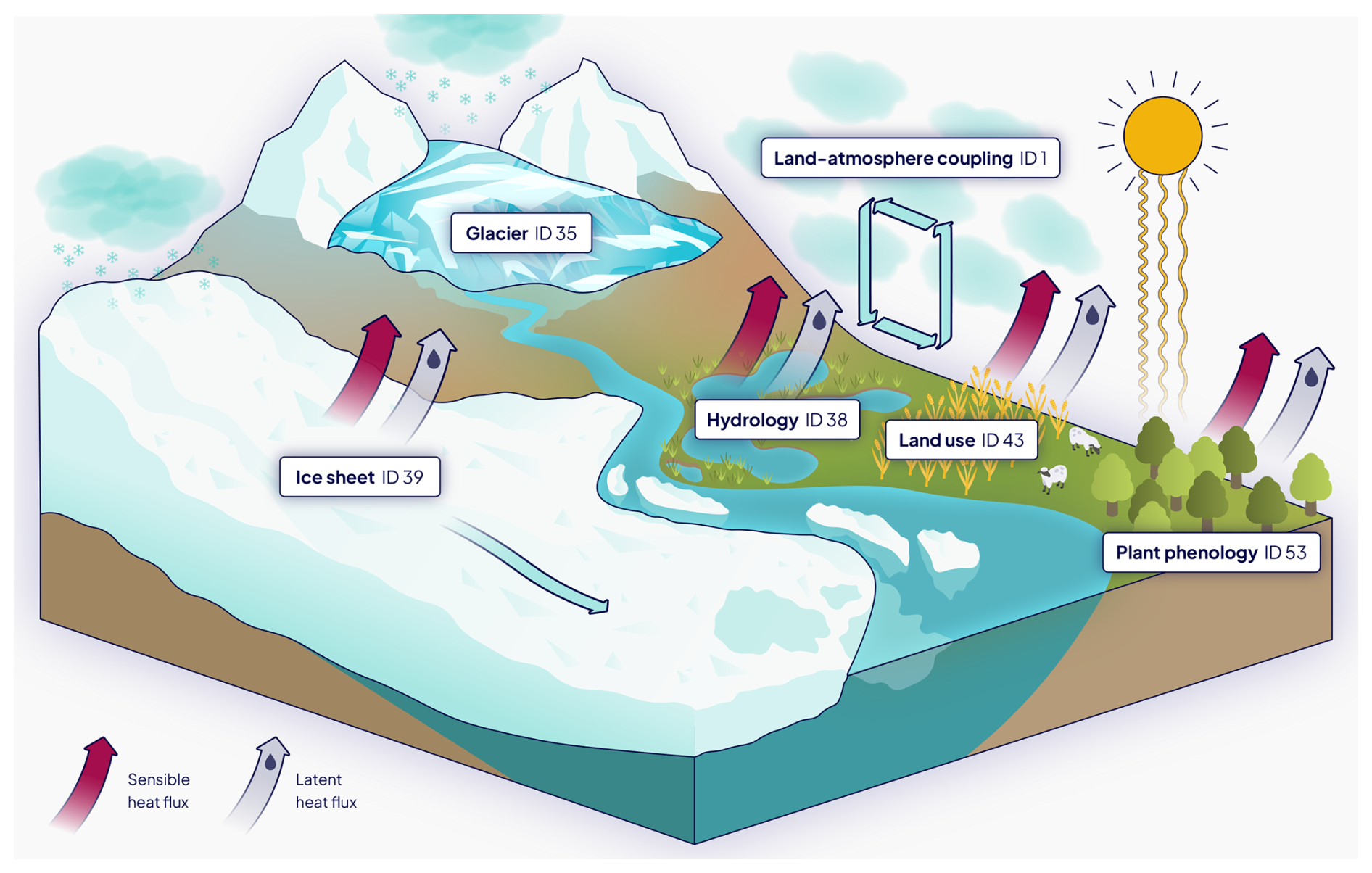
Figure 1Schematic diagram illustrating the Land and Land Ice Theme Opportunities. Land-atmosphere coupling Opportunity covers high-frequency (3 h) surface radiation, water, and energy fluxes. Hydrology Opportunity contains variables covering hydrological processes, water resources, and freshwater systems. Glacier and Ice sheet Opportunities cover the mass balance, energy, and water input to climate system. Land use and plant phenology Opportunities cover variables associated with sub-grid land use tiles and vegetation types, respectively. Figure originally published at Li et al. (2025b) (see https://doi.org/10.5281/zenodo.15681950).
A harmonization sprint, involving all thematic teams, was held in September 2024, which resulted in the merging of several Opportunities within and across themes, and designated a lead theme for each Opportunity. The Land and Land Ice Theme moved forward, leading six Opportunities (see Table 1) plus the Land and Land Ice relevant variables of the Rapid Evaluation Framework opportunity (full details on this Opportunity can be found in Dingley et al., 2026). Following the v1.0 release in November 2024 the team focused on finalizing variable groups, supporting processing of new variables, and contributing to cross-thematic meetings on topics including time subsets. Regular team meetings continued, focused on Opportunity or variable specific requirements. Team members engaged proactively across themes, particularly with the Earth System thematic author team through a dedicated liaison member.
Table 1The final list of Land and Land Ice Theme Opportunities. The Opportunity ID indicates the identifier of each Land and Land Ice Theme Opportunity in the full CMIP7 Data Request content release of v1.2.
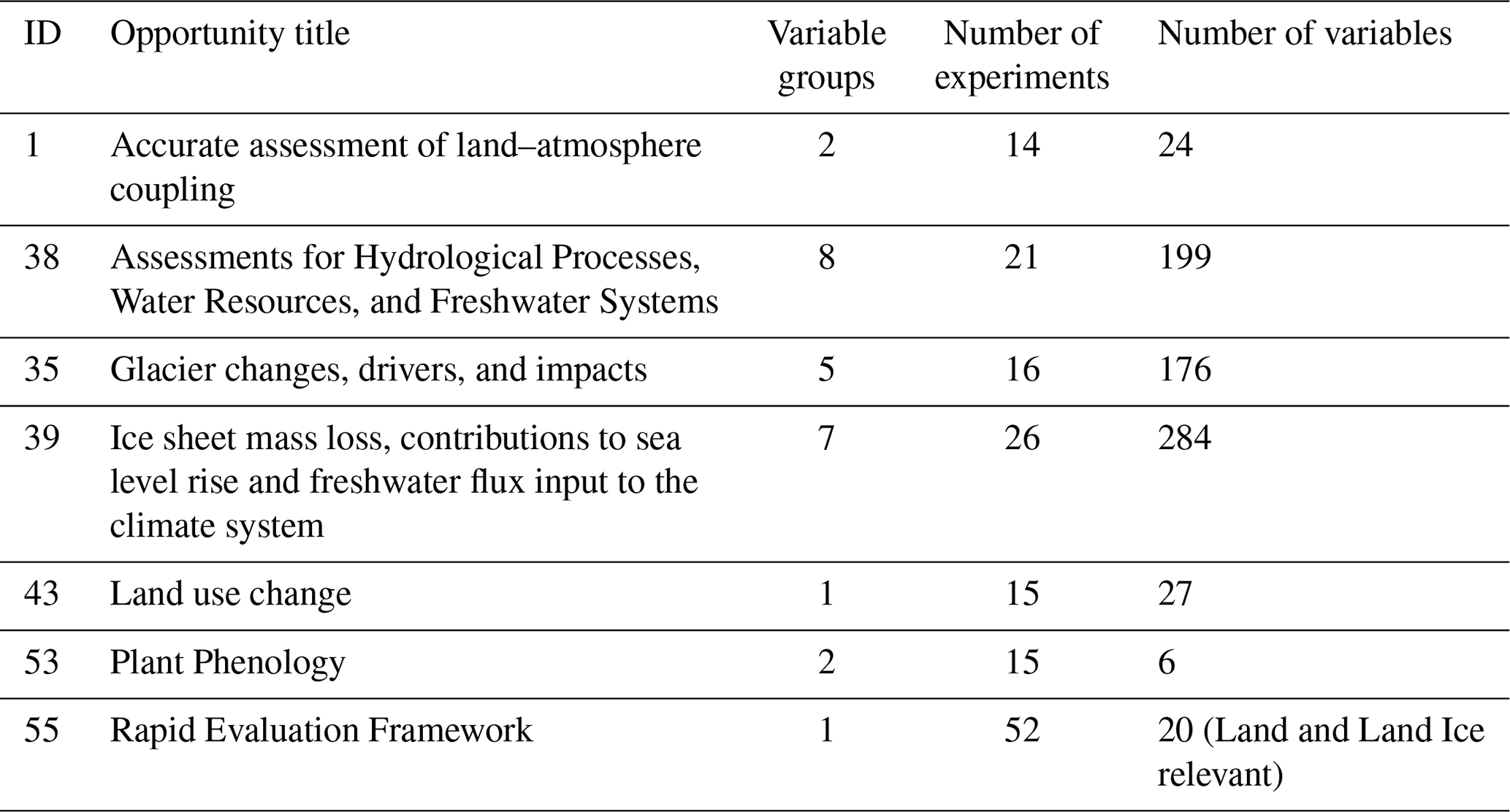
Collaborative spreadsheets were utilized to gather input between meetings with some members of the team interacting directly with the Airtable online database from a very early stage with IPO support and Data Request Task Team liaison members updating the Airtable records as needed. A systematic variable review was conducted during the Data Request's Phase 2 and Phase 3 public consultation periods to address comments, rectify errors and highlight remaining outstanding issues to the team. Author team members also contributed to cross-thematic meetings focused on issues such as consistent use of time subsets, ensemble sizes, or prioritization of variable groups within Opportunities. By the end of the data request efforts, a total of 25 variable groups that contain 716 variables had been identified (Table 1).
Given the important role of these land and land ice processes in ESM simulations in CMIP7, the Land and Land Ice Theme proposed the following scientific questions that could be addressed by the CMIP7 Data Request. These variables proposed by the Opportunities in Table 1 could be used by the Land and Land Ice Theme communities to analyze and comprehensively advance the understanding of the Earth planetary boundary. Specifically, the proposed Opportunities aim to address:
-
How do high-frequency land–atmosphere coupling processes influence surface energy fluxes and water movement through the soil–plant–atmosphere continuum and how does this imply for the dynamics of climate extremes, and how can improved model simulations reduce diurnal and long-term uncertainties in these interactions?
-
How do hydrological processes influence water availability, distribution, and feedback mechanisms across different Earth system components?
-
How do past, present, and future changes in mountain and polar glaciers influence sea-level rise, regional hydroclimates, freshwater resources, and geohazards under different climate scenarios?
-
How will the Greenland and Antarctic ice sheets evolve under future climate scenarios, will they act as tipping points in the Earth system, and how does their mass loss contribute to sea level rise, and impact on ocean circulation?
-
How do LULCC, including land management practices, impact climate, biogeochemical cycles, and surface fluxes and stocks of carbon and water, as well as energy fluxes? Furthermore, in what ways can these changes contribute to climate change mitigation?
-
How do vegetation type and daily frequency data reveal the seasonality and long-term trends of plant phenology that influence terrestrial carbon, energy, and water fluxes, and how can improved modeling of phenological processes enhance ESM simulations of land–atmosphere interactions?
4.1 Accurate assessment of land–atmosphere coupling (ID 1)
Land and atmosphere are closely coupled due to the surface soil and vegetation status providing critical boundary conditions for the surface energy flux, such as the latent and sensible heat fluxes. Changes of these surface energy and water fluxes will interact with and feedback to the atmospheric thermodynamics and circulation, which influence surface air temperature, humidity, and precipitation. Previous studies have shown that critical land–atmosphere coupling process, such as dynamics in evaporative fraction (i.e., the ratio of latent heat flux to the total turbulent heat fluxes) will influence the rainfall at sub-daily (e.g., Findell et al., 2011), seasonal (e.g., Koster et al., 2004; Seneviratne et al., 2006), and annual timescales (Li et al., 2022b). Despite the current CMIP6 monthly output of surface energy and water fluxes, soil, and vegetation variables, 3-hourly output in land–atmosphere coupling is urgently needed for the next-generation of global ESMs, which will provide the opportunity of being compared to the observation-based reanalysis data and flux towers (Findell et al., 2024). High-frequency land–atmosphere data are valuable to understand, and accurately model, key processes related to short-period (e.g., diurnal scale) and high intensity climate extremes such as heatwaves, droughts, and the onset of rainfall.
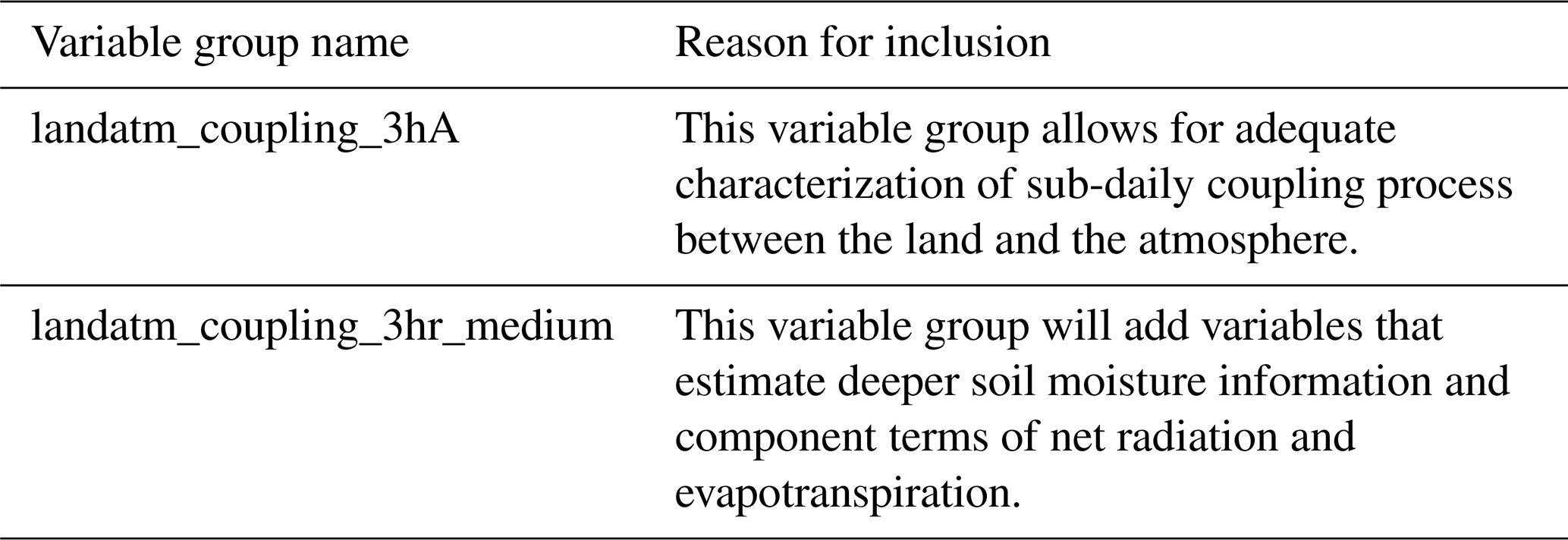
This Opportunity will provide 3-hourly data of critical variables in land–atmosphere coupling from the surface to specified lower-tropospheric pressure levels (Table 2). Critical local land–atmosphere coupling metrics can be computed based on variables from the group landatm_coupling_3hA, such as the use of mixing diagrams (Santanello et al., 2009, 2011), two-legged metrics (Seo and Dirmeyer, 2022), and the triggering feedback strength (Findell et al., 2015). In another group with medium priority, high-frequency (i.e., 3 hourly) variables include solar radiation, partitioning of vegetation water fluxes (e.g., transpiration), soil moisture at different depths, and the pressure-level atmospheric variables (e.g., eastward wind). These variables will significantly enhance the exploration of mechanisms through which soil and vegetation influence the surface energy balance and affect the local atmospheric state. The variables in this Opportunity can also be used to evaluate ESM simulations using the high-frequency observational data (Findell et al., 2024).
Table 2Variable groups needed for ID 1 Accurate assessment of land–atmosphere coupling.
Two time subsets of 20 year simulations of historical and future scenarios have been requested. This is because previous studies suggest that a minimum of 10 years of data are required for robust statistical analysis (Findell et al., 2015). These two sets of high-frequency model output in land–atmosphere coupling will provide opportunities for model evaluations using direct observations from field campaigns and measurements from reanalysis data. The multi-model intercomparisons enabled by these variables will demonstrate the modeling uncertainties in land–atmosphere coupling processes and be informative for the other MIPs that include land–atmosphere processes (e.g., HighResMIP). Lastly, this Opportunity will help to identify sources of process uncertainty, leading toward solutions for improvement of sub-daily soil and vegetation processes in the models.
4.2 Assessments for hydrological processes, water resources, and freshwater systems (ID 38)
Water is the essential element linking all Earth system components – the atmosphere, hydrosphere, biosphere, geosphere, and cryosphere. Therefore, accurate representation of hydrological processes in ESMs is important to assess the distribution and availability of freshwater resources and the feedback mechanisms between water, energy, and biogeochemical cycles (Clark et al., 2015). Climate change has significant and far-reaching impacts on water resources and freshwater systems, affecting their availability, quality, and distribution across the globe (Huntington, 2005). Changing temperatures and precipitation patterns, hydroclimatic shifts, and increasing risks of extreme events (floods and droughts) pose major challenges for ecosystems, agriculture, human health, and food and water security (Konapala et al., 2020).
Table 3Variable groups needed for ID 38 Assessments for Hydrological Processes, Water Resources, and Freshwater Systems.
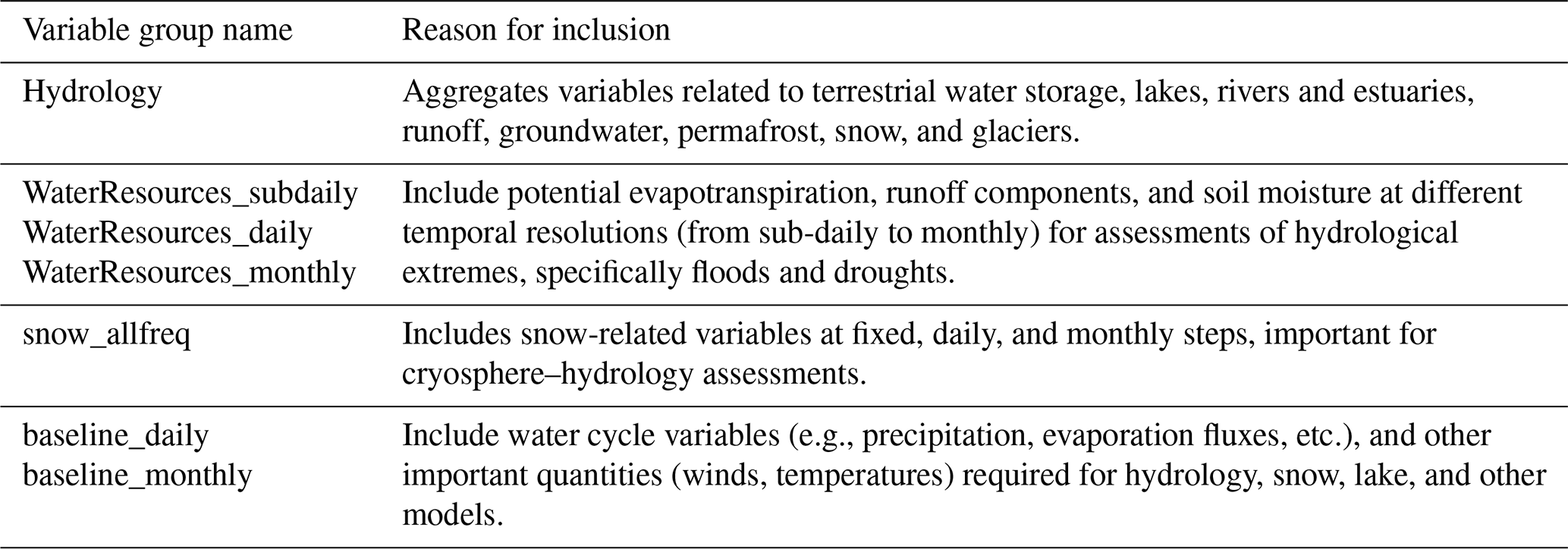
This Opportunity is aimed at leveraging CMIP data for assessments, projections, and predictions of hydrological processes, water resources, and freshwater systems, including rivers and estuaries, lakes and inland water bodies, groundwater, snowpack, permafrost, and glaciers. The variables identified in this Opportunity are of interest to a large number of hydrological applications, including (1) comprehensive assessments of regional hydroclimates and their past, present, and future states, (2) assessments on the usability of Earth system models for water resources applications, (3) evaluating whether these processes/systems are adequately represented in the modelling frameworks, (4) offering opportunities for model intercomparisons across these topics (e.g., SnowMIP, IRRMIP, etc.), (5) providing input for hydrology, lake, snow, and other models, and (6) climate impact assessments of freshwater resources and water availability (Table 3).
The main variable group for this Opportunity is hydrology which includes variables related to (1) lakes and inland water bodies (sea/lake surface water temperatures, lake fraction, lake depth, etc.) that are used in assessments of lake–atmosphere interactions and usability of CMIP models for large lakes (Minallah and Steiner, 2021; Briley et al., 2021; Notaro et al., 2022), (2) runoff to assess model hydrological sensitivity and improve streamflow projections (Lehner et al., 2019), (3) snow water equivalent and soil moisture to assess terrestrial water storage (Wu et al., 2021), and (4) permafrost and snow to study their sensitivity to climate change (Koven et al., 2013; Burke et al., 2020; Kouki et al., 2022; Zhang et al., 2022). Additionally, water budget variables (evaporative fluxes, soil moisture, runoff, potential evapotranspiration) are important for assessments of water availability and security, hydrometeorological extremes, and for hydrological simulations using watershed models.
4.3 Glacier changes, drivers, and impacts (ID 35)
This Opportunity aims at glaciological assessments across timescales in the past, present, and future. Glaciers here are defined as mountain and polar glaciers, including peripheral glaciers in Greenland and (sub-)Antarctica that are decoupled from the ice sheets, as identified in the Randolph Glacier Inventory (RGI Consortium, 2023). These glaciers were considered the primary contributors to 20th-century sea level rise from the cryosphere (Gregory et al., 2013; Oppenheimer et al., 2019). Based on the future scenarios in the IPCC AR6, glaciers are expected to remain the primary drivers of sea-level rise during the 21st century, in most scenarios exceeding the contributions from the two ice sheets (Fox-Kemper et al., 2021). Additionally, they have significance in sustaining ecosystems and modulating regional hydroclimates (Milner et al., 2017). They are a substantial freshwater resource, especially in mountainous regions where glaciers are important for water and food security for a large population (Hock et al., 2019b; Huss and Hock, 2018). Through feedback in the mass balance response to climate change, glaciers are regional-scale tipping elements in the Earth system (Abrams et al., 2023; Davies et al., 2024) and are a driving factor in related geohazards, including glacial lake outburst floods, slope failures, avalanches, and ice falls (Wolken et al., 2021; Hock and Truffer, 2024).
Table 4Variable groups needed for ID 35 Glacier changes, drivers, and impacts.
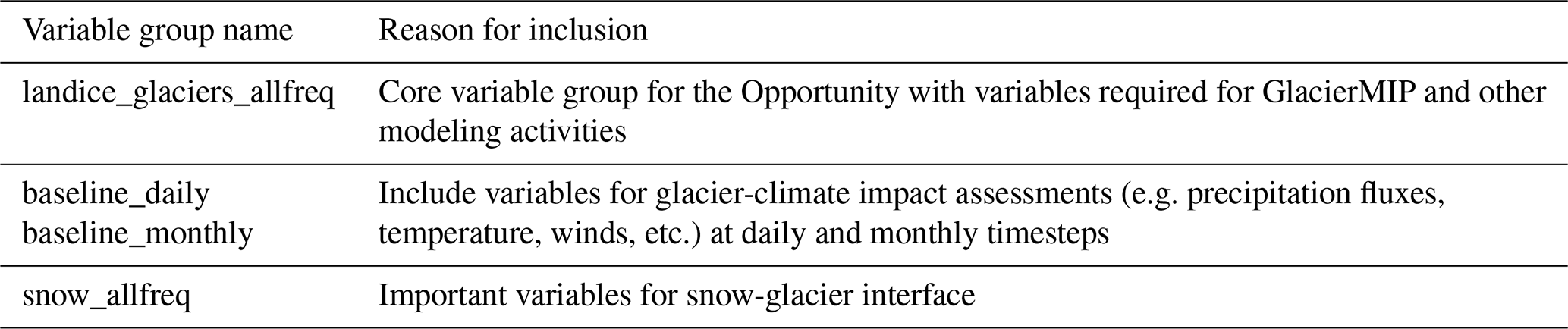
The variables requested for this Opportunity are critical as inputs for the glacier modelling community and to study the impacts of climate change on glaciers and glacier changes on other Earth system components (Table 4). The Glacier Model Intercomparison Project (GlacierMIP, Hock et al., 2019a) aims to advance our understanding of these impacts and reduce uncertainties in glacier projections through a coordinated intercomparison effort of global-scale glacier models. The results from the first two phases of GlacierMIP have informed the IPCC Special Report on the Cryosphere and the Oceans in a Warming Climate (IPCC, 2019; Hock et al., 2019b) and IPCC AR6 report (Marzeion et al., 2020). The core variable group for this Opportunity is landice_glaciers_allfreq, which requests variables at daily and monthly temporal resolutions necessary for glacial mass balance computations, including temperature, precipitation fluxes, and energy budget quantities. Additional applications of this Opportunity are related to mountain cryosphere, glacio-hydrology, and local to regional-scale geohazards associated with glacier changes under different scenarios. For accurate partitioning between glacier-melt, snowmelt, and baseflow contributions to runoff in land and hydrological models at sub-seasonal to seasonal timescales, variables from terrestrial hydrology and snow processes at daily resolutions are also requested (snow_allfreq). Variable groups baseline_fixed, baseline_daily, and baseline_monthly host other key variables relevant for these assessments, including land cover types, surface elevation, winds, and heat fluxes.
4.4 Ice sheet mass loss, contributions to sea level rise and freshwater flux input to the climate system (ID 39)
The mass loss from the ice sheets of Greenland and Antarctica is a key contributor to future sea level rise, and their freshwater input to the climate system provides an important forcing for ocean circulation and carbon and heat uptake. Sea level rise affects every landmass on Earth and is one of the most challenging aspects of climate change to mitigate or reverse. Ice sheets have also been theorized to be a key tipping element in the Earth system, with the potential for irreversible changes in this century which may trigger a cascade of other tipping elements around the globe. Characterizing and understanding the future evolution of the ice sheets and their interactions with the global climate system thus has the potential for huge societal impact. There are many aspects of modelling and projecting large scale ice sheet change that are not yet understood sufficiently, so it is important to leverage the broad spectrum of information in CMIP7 to add to our ability to understand and project how ice sheets may change in the future.
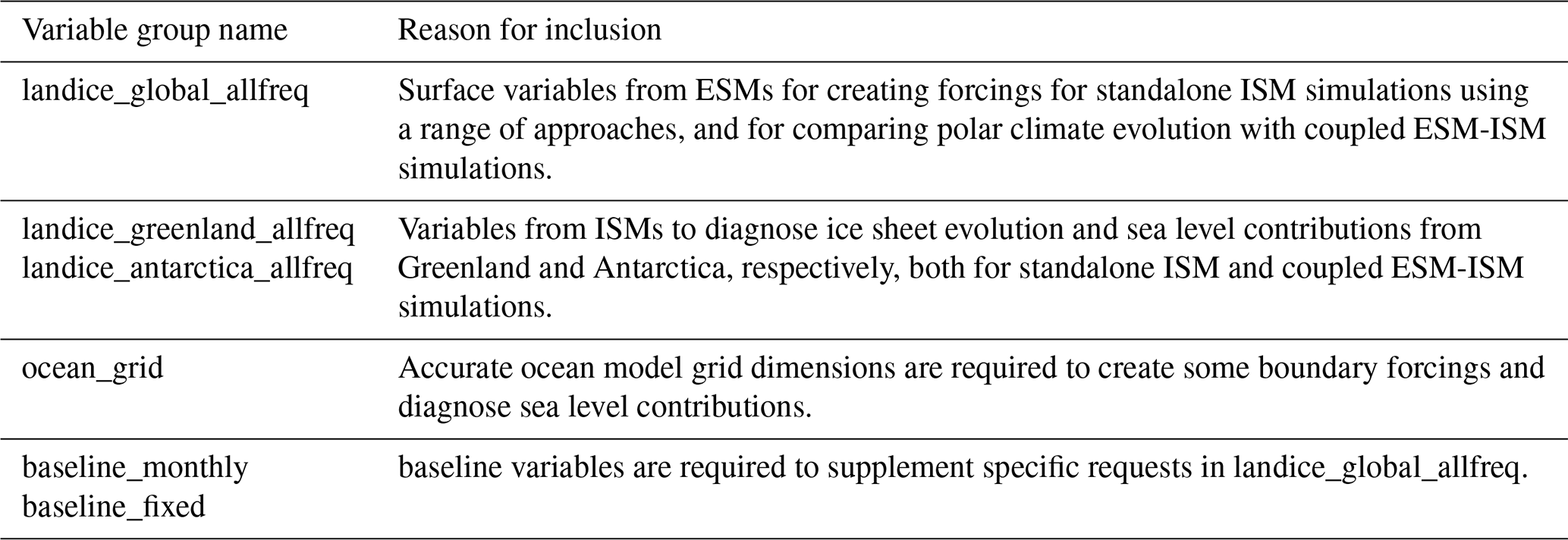
For CMIP6, ISMIP6 (Nowicki et al., 2016, 2020) requested land ice data for the first time within CMIP for key variables needed to capture the glaciated/ice sheet realms of the Greenland and Antarctic ice sheets. Variables requested in this Opportunity build upon the ISMIP6 data request and will primarily be used to create boundary conditions for a large ensemble of historical and scenario simulations conducted by standalone Ice Sheet Models (ISMs) coordinated by ISMIP7 (Table 5). Not only will these variables be used to generate traditional surface mass balance and ice shelf basal melt boundary conditions at the high spatial resolutions required for ice sheet modeling, but they will also be used to allow the influence of changing climate on calving, ice shelf damage and collapse to be taken into account. Some ESMs in CMIP7 will conduct novel simulations with interactive ice sheets (i.e., in a coupled setup), and the variables in this Opportunity are also specified to allow the influence of such coupling on climate evolution and sea-level projections to be assessed. The combined output from standalone ISM and coupled ESM simulations will allow the ice-sheet contributions to sea level rise implied by the ScenarioMIP protocols to be projected, along with their model and scenario uncertainties. In addition to ISMIP7, other MIPs concerned with ice sheet behavior, primarily SOFIA (Southern Ocean Freshwater Input from Antarctica; Swart et al., 2023), TIPMIP (Winkelmann et al., 2025) and MISOMIP (De Rydt et al., 2024), may use these variables.
Table 5Variable groups needed for ID 39 Ice sheet mass loss, contributions to sea level rise and freshwater flux input to the climate system.
4.5 Land use change (ID 43)
Human land-use activities have resulted in large changes to the Earth's surface, with resulting implications for climate. In the future, land-use activities are likely to expand and intensify further to meet growing demands for food, fiber, and energy. LUMIP aims to further advance understanding of the impacts of LULCC on climate, specifically addressing the following questions. (1) What are the effects of LULCC on climate and biogeochemical cycling (past–future)? (2) What are the impacts of land management on surface fluxes of carbon, water, and energy, and are there regional land-management strategies that can help mitigate climate change? These questions are particularly relevant in investigations of low emission scenarios, which typically rely on significant land-based mitigation to achieve climate targets.
The unique variable group requested for this Opportunity is the “landuse” variable group (Table 6), which requests a subset of key biogeophysical and biogeochemical variables for five land use tiles (defined below). This variable group addresses the challenges of analyzing the effects of LULCC on physical and biogeochemical states of land and their interactions with the atmosphere. The underlying rationale for this request is that informative sub-grid-scale data reflecting the strong heterogeneity of the land surface, which is significantly driven by human transformation of the land and is already calculated by land models, is not routinely archived. For CMIP6, LUMIP (Lawrence et al., 2016) requested sub-grid data for the first time within CMIP for key biogeophysical and biogeochemical variables. This subgrid output was utilized in several LUMIP studies (e.g., Tang et al., 2023). Reporting data by land use tile enables assessment of land-use carbon fluxes, including not only analysis of differences in fluxes between land-use and no land-use experiments, but also within a single land-use experiment, utilizing bookkeeping approaches (Houghton et al., 2012) that allow a more direct comparison of observed and modeled carbon inventories.

For the Land Use Opportunity, the sub-grid data request is for five land-use categories: (1) primary land (including bare ground and vegetated wetlands), (2) secondary land, (3) cropland, (4) pastureland, and (5) urban. Other sub-grid land surface categories such as lakes, rivers, and glaciers are excluded from this request. This set of land-use sub-grid reporting units closely corresponds to land-use categories that will be in the historical land-use reconstructions and future scenarios provided by the Land Use Harmonization forcing product (LUH3, updated from LUH2 – Hurtt et al., 2020). Primary (i.e., natural vegetation never affected by LULCC activity) and secondary (i.e., natural vegetation that has previously been harvested or abandoned agricultural land with potential to regrow) are separated (they were combined in CMIP6 Data Request) to capture the unique behavior of the next generation of land models that distinguish between these two land types. This variable group is requested for historical and scenario simulations and for any specific Land Use Model Intercomparison Project (LUMIP) simulations.
4.6 Plant phenology (ID 53)
Accurately modelling plant phenology seasonality and long-term trends in Earth system models is essential for effectively simulating and understanding terrestrial ecosystem fluxes of carbon, energy, and water with the atmosphere. In this framework, the “plant phenology” Opportunity aims to expand the data available for assessing these relations (Table 7). For this reason, a set of variables is requested at vegetation type level and daily frequency, high enough to capture the observed and expected changes in phenophases timings (e.g. Park et al., 2016). The vegetation type (vegtype) coordinate was already available in CMIP6 and associated with the landCoverFrac variable. In the CMIP6 definition, the vegtype coordinate is a model-dependent dimension. In CMIP7, the vegtype coordinate, instead, requests values for seven specific vegetation categories (namely broadleaf_deciduous_trees, broadleaf_evergreen_trees, needleleaf_deciduous_trees, needleleaf_evergreen_tree, natural_grasses, crops, and shrubs) to enhance the comparability among models and processes understanding (e.g. Li et al., 2024b).

The Plant Phenology Opportunity proposes two variable groups. The high-priority variable group (plant_phenology_high) contains the three principal variables used in evaluating the plant phenology: laiVgt, gppVgt, and LandCoverFrac. LAI is one of the main variables used to estimate the timing of phenophases (e.g. Jolly et al., 2005; Richardson et al., 2012; Anav et al., 2013; Murray-Tortarolo et al., 2013; Peano et al., 2019, 2021, 2025; Song et al., 2021; Li et al., 2022a, 2023b), while Gross Primary Production (GPP) estimates the exchange of carbon between land and atmosphere and provide another metric to evaluate the relation between vegetation and climate (e.g. Marsh et al., 2025). The landCoverFrac variable, instead, provides the relative influence of each vegetation type on the total grid cell. These primary variables allow us to link the biases in productivity with changes in phenology (e.g. Li et al., 2024a). The secondary variables (plant_phenology_medium variable group) provide single components of land–atmosphere carbon fluxes at the vegtype level, namely Net Primary Productivity (nppVgt), Heterotrophic Respiration (rhVgt), and Autotrophic Respiration (raVgt). This allows a deeper investigation of sources of biases in the land–atmosphere carbon fluxes. This Opportunity applies to historical, land-hist, and scenario simulations. The historical and land-hist simulations provide a benchmark to evaluate the model plant phenology biases (e.g. Peano et al., 2021, 2025) while scenarios supply future changes.
4.7 Rapid Evaluation Framework (REF) (ID 55)
The CMIP Rapid Evaluation Framework (Hoffman et al., 2025) was created to evaluate and benchmark the newly available CMIP7 Assessment Fast Track simulations as soon as they are uploaded to ESGF with metrics and diagnostics that are available through different open-source evaluation and benchmarking tools. This Opportunity contains the set of variables that are needed for the planned diagnostics and metrics for the REF (CMIP Model Benchmarking Task Team, 2024) (Table 8). The suggested metrics/diagnostics for the REF to be available for all CMIP7 Assessment Fast Track experiments are in the first instance very basic evaluations and are not expected to require very specific variables. The exact selection of variables was also made consistent with the model evaluation diagnostics in Chap. 3 of the latest IPCC report (Eyring et al., 2021). Due to the fixed timeline for the CMIP7 Assessment Fast Track simulations, there is only a short time period for the technical implementation of the REF, and therefore the available metrics and diagnostics in this first version of the REF will be limited to a temporal resolution of monthly mean data and about five metrics/diagnostics per realm based on a community selection. The realms were chosen specifically to be consistent with the realms used for the data request. Find more information about the REF Opportunity in Dingley et al. (2026).
Table 8Variable groups needed for ID 55 Rapid Evaluation Framework.

5.1 Prioritisation process and updates on CMIP7
The Land and Land Ice Theme author team is comprised of members directly from modelling centers and leads of several model intercomparison projects. Therefore, the prioritization process is straightforward as most of the Opportunity proposers had experience of generating a comprehensive variable list within the Land and Land Ice Theme. Specific prioritization processes such as Accurate assessment of land–atmosphere coupling (ID 1) follows a recent peer-reviewed article that highlights the high-frequency land–atmosphere interaction variables (Findell et al., 2024). This Opportunity also contains the low-troposphere atmospheric variables that were reviewed by the Atmosphere Author Team (see more details in Appendix A). Another example that shows the cross-theme collaboration is the Assessments for Hydrological Processes, Water Resources, and Freshwater Systems (ID 38). The Land and Land Ice Theme author team worked with the Impacts & Adaptation team and Earth System team to decide to merge Water Security and Freshwater Ecosystem Services (ID 67) into ID 38 to focus on the water resources. ID 38 is fundamental since this Opportunity contains comprehensive hydrological variables on land. Other Opportunities such as, Glacier changes, drivers, and impacts (ID 35), Ice sheet mass loss, contributions to sea level rise and freshwater flux input to the climate system (ID 39), Land use change (ID 43), and Plant phenology (ID 53), were proposed from either modeling centres or the leadership team from corresponding MIPs and thus were quickly accepted by the cross-theme review.
For CMIP7, these new Opportunities will support a more comprehensive integration of Land and Land Ice Theme components, enable the identification of new feedback loops associated with improved Land and Land Ice processes, and provide critical surface boundary conditions for other Themes included in the CMIP7 Data Request. During the time of CMIP6, processes linked to land ice were firstly introduced to CMIP ESMs (Nowicki et al., 2016), which have been widely applied to studies that focus on important aspects in the Earth climate system such as the change in the Antarctic Ice Sheet (Stokes et al., 2022) and global sea-level rise (Edwards et al., 2021) under future climate scenarios. Similarly, studies that apply land use experiments from the CMIP6-LUMIP experiments (e.g., Li et al., 2022b) also serve as a benchmark to keep improving processes on the land surface, which include energy, water, carbon, and other biogeochemical cycles. In CMIP7 these separate processes will be integrated together and new opportunities such as TIPMIP will offer chances to identify new feedback loops. For example, glacier melting-induced changes in the ocean circulation over the Atlantic may generate climate teleconnections on the climate system in the Amazonian rainforest (Van Westen et al., 2024), which could be compared among CMIP7 ESMs by including the full feedback loop of considering the climate warming on ice sheet changes. Studies on these climate change feedbacks and their interactions with land use changes may become feasible with improved Land and Land Ice processes in CMIP7.
5.2 Key reflections and challenges from the CMIP7 data request process
The CMIP7 Land and Land Ice Data Request differs fundamentally from that of CMIP6 in its scientific focus, variable design, and technical implementation, reflecting both evolving scientific priorities and lessons learned from CMIP6. In CMIP6, the land data request defined a centralized and comprehensive set of variables spanning a wide range of land processes, with increasing process complexity driven by CMIP6-endorsed MIPs (Juckes et al., 2020). While scientifically valuable, this large variable list contributed to the increased burden on modelling centres (O'Rourke, 2023) against the tight timelines of IPCC Assessment Report 6 (Dunne et al., 2025).
By contrast, the CMIP7 Land and Land Ice Data Request adopts a more community-engaged and opportunity-driven approach. Scientifically, the focus has shifted from broad process completeness (Eyring et al., 2016) toward emergent and societally relevant topics, including land-related dangerous weather patterns, carbon-cycle management, tipping points, and coupled land–ice interactions (Dunne et al., 2025). This shift is enabled by the increased maturity of land and land ice process representation, diagnostics, and evaluation, which now supports investigation of full Earth system feedbacks rather than isolated components.
Correspondingly, variable design in CMIP7 moves away from a single centralized definition toward a structure informed by community input, CMIP6 user experience, expert judgement, and variable downloading frequency (see Sect. 2). This innovative approach aims to balance scientific objectives with feasibility and usability, reducing unnecessary burden while targeting variables that best support priority science questions. Technically, while CMIP7 continues to rely on NetCDF CF metadata conventions, it introduces the interactive and cloud-based Airtable platform that enable timely community feedback, clarification, and correction of variables–an innovation not available in CMIP6. Together, these changes reflect a deliberate and systematic evolution in how Land and Land-Ice Data Request moves from CMIP6 to CMIP7.
The CMIP7 Data Request has seen significant improvements over the CMIP6 era, particularly in process organization and community engagement. However, challenges remain regarding the detailed variable requests. For instance, two key Opportunities within the Land and Land Ice Theme – the accurate assessment of land–atmosphere coupling (ID 1) and the evaluation of hydrological processes, water resources, and freshwater systems (ID 38) – require variables with sub-daily resolution. This inherently demands increased data storage capacity, an updated framework for reliable data sharing, and robust data validation before publication. Additionally, the land-use change (ID 43) and plant phenology (ID 53) Opportunities requires sub-grid information, necessitating more sophisticated model outputs. These requirements may discourage modeling groups from contributing to certain Opportunities. However, at this stage in the data request process – before modeling centers determine which variables they will provide for CMIP7 – it remains uncertain how widely these Opportunities will be adopted. A balance must be struck between scientific needs, which should have already been addressed in the public consultation process, and the level of detail that can realistically be achieved. Moving forward, prior to finalizing the list of Opportunities, more intensive direct consultations between Opportunity leads and modeling groups may be necessary to ensure the effective implementation of CMIP7.
Another critical consideration is the quality control of requested data, which may need to be specified before finalizing the data request. For example, a recent study on land carbon and nitrogen mass conservation based on CMIP6 data (Tang et al., 2025a) reports significant mass imbalances arising solely from the C4MIP-requested variables. The primary causes include misinterpretation of the data request by ESM teams (e.g., incomplete data submissions) and the lack of a harmonized variable request across different MIP activities, leading to overlapping variables.
In the CMIP7 Data Request, issues with variables having similar definitions persist. For example, overlaps exist between variables requested under the land-use change Opportunity (ID 43) and the carbon cycle Opportunity (ID 15), potentially perpetuating the mass conservation issues observed in CMIP6. This problem is now recognized by data users, particularly those in the simple climate model (emulator) community, as emulator development relies heavily on the quality of ESM outputs (Tang et al., 2025b, 2026). While some community-led initiatives aim to streamline data reporting from ESM teams to broaden data applications (Tang et al., 2025a), such efforts are not yet integrated into the CMIP7 Data Request process.
The challenge lies in the substantial effort required to harmonize the outputs that ESMs can produce, the variables expected by different MIP Opportunities, and the overlapping variables of interest across these Opportunities. While this may be considered less critical than addressing the scientific questions that are the primary focus of the current data request, data quality is fundamental to robust analysis. A unified data request within the Land and Land Ice Theme would greatly enhance both data reporting and usage in the future, making it an issue worth greater attention moving forward. We understand that a “unified” or “harmonized” data request requires input not only from the CMIP7 Data Request Task Team (for reviewing the opportunities), but also from the MIPs (for updating the variable groups), the modeling centers (regarding which variables can realistically be produced in their models), and the data users (regarding the challenges they face when using the data). Achieving this is different from the CMIP6 Data Request (Juckes et al., 2020) that aimed to provide a comprehensive variable set and will require a detailed Theme-related review of the requested variables and feedback from all these parties. This represents a considerable amount of work and has, so far, been partially implemented in the current CMIP7 Data Request process. However, given its importance to the entire climate modeling and data production workflow, we argue that establishing a robust feedback and refinement loop for variables should be a high priority in the near future, probably from the CMIP level rather than simply from the Data Request Task Team.
While this paper focuses on scientific Opportunities and Priorities in Data Request activities for the CMIP7 Land and Land Ice Theme, we recognize the rapidly growing use of data-driven approaches (e.g., artificial intelligence and machine learning) in land surface and cryosphere modeling research. For instance, such approaches have been applied to process emulation (e.g., for parameter optimization; Li et al., 2023a), uncertainty reduction (e.g., Yuan et al., 2022), and impact-relevant analyses (e.g., examples in Ruane et al., 2025). Opportunity-oriented variables in the CMIP7 Data Request would better support these applications by providing more specific targets for data-driven methods. Broader considerations related to data formatting, metadata standards, and computational frameworks for data-driven workflows are addressed at the CMIP7 program level and in cross-cutting infrastructure discussions.
5.3 Outstanding gaps in Earth system processes
Despite advances in ESM simulations and the expanding suite of variables available in CMIP7, several critical gaps remain in the representation of land and land ice processes. One major area requiring further development is plant hydraulics, which governs water movement through the soil–plant–atmosphere continuum. While many land models include simplified representations of soil moisture and transpiration, they often lack explicit simulations of plant stem and leaf water potentials – key physiological metrics that influence drought responses and plant mortality (Xu et al., 2016; Kennedy et al., 2019; Li et al., 2021; Yao et al., 2024). Observational datasets such as the sap flow from the SAPFLUXNET exist to evaluate these processes (Poyatos et al., 2021), but their incorporation into ESM diagnostics remains limited partially due to the scientific challenge to perform comprehensive and rigorous data-model integration. It also depends on whether the significance of these water-related processes is identified for various scientific modeling purposes (e.g., moisture conditions for fuels in fire modeling in ESMs). Improved integration of plant hydraulics into ESMs would enable better assessments of hydrological shifts, aiding in the prediction of drought-induced forest dieback and its cascading effects on carbon, water, and energy cycles.
As land models increasingly integrate demographic vegetation capabilities (Fisher et al., 2018; Koven et al., 2020), a more refined set of diagnostics is needed to capture complex vegetation dynamics, including competition, mortality, and recovery processes. However, many land models within ESMs still lack explicit representations of key biophysical mechanisms regulating vegetation structure and function, including hydraulic limits on water transport, physical constraints on tree stability, and temperature-dependent physiological thresholds. Moreover, standardized benchmarks for key biophysical outputs – such as canopy structure, vegetation height, leaf area dynamics, and surface roughness – remain underdeveloped, hindering model validation against remote sensing and field observations. Without these advancements, ESMs may struggle to accurately simulate vegetation-climate feedbacks, particularly under future climate stressors.
Similarly, land ice processes remain underrepresented, particularly in the coupling between dynamic ice sheets, atmospheric processes, and ice-ocean interactions. Current models often exclude or simplify key mechanisms such as ocean cavities below ice shelves, subglacial freshwater fluxes, and the role of aerosol deposition in modulating ice sheet albedo and melt. The omission of these processes limits the accuracy of sea-level rise projections and ice-ocean feedbacks, which are critical for understanding long-term climate stability.
Additionally, groundwater systems remain a weakly integrated component in ESMs, despite their significant role in modulating soil moisture, runoff, and terrestrial water storage. Improved representation of groundwater dynamics is necessary to better capture long-term drought resilience, subsurface hydrological feedbacks, and interactions between deep water storage and surface climate variability. Similarly, accounting for the terrain characteristics is important to accurately represent terrestrial processes and quantify energy and water budgets (Clark et al., 2015; Fan et al., 2019). However, ESMs typically run at resolutions of around 100 km, which prevents the capture of detailed topographic and landscape effects. This results in large uncertainties in simulating the hydrological and radiative processes, and assessing their spatiotemporal variability in mountainous regions and complex terrains that are characterized by prominent topographic variations in surface elevation, steepness (slope), and the orientation of the land surface (aspect).
Beyond the traditional land, hydrology, and cryosphere components, solid Earth processes are another frontier in Earth system modeling that require greater attention. Processes such as isostatic adjustments (Whitehouse, 2018), geothermal heat fluxes (Lösing et al., 2020), and tectonic activity influence surface deformation, hydrological pathways (Michalek et al., 2023), and even cryosphere stability (Albrecht et al., 2024), yet they remain largely excluded from ESM frameworks. The potential climate implications of these interactions – including their role in modulating geohazards, altering water systems, and influencing permafrost and ice sheet dynamics – underscore the need for a more integrated Earth system perspective. As CMIP7 advances, addressing these gaps will be essential to improving climate projections, refining impact assessments, and reducing uncertainties in future Earth system responses.
In this paper, we present the progress and evolution of the CMIP7 Data Request concerning land and land ice processes. Driven by a transparent and community-engaged approach, the updated request in the Land and Land Ice Theme includes six refined Opportunities addressing distinct scientific questions. These Opportunities – focusing on land–atmosphere coupling, glacier changes, freshwater processes, ice sheet loss and sea level rise, land use change, and plant phenology – reflect the urgent needs of various research communities. This work serves as a valuable resource for modeling groups, guiding potential modifications or enhancements to their output to better align with evolving scientific priorities.
While the scientific significance of these data request Opportunities is fundamental, effective variable management (e.g., removal of duplicates, harmonization of similar variables through improved definitions), robust data validation (e.g., mass conservation check), and efficient data distribution are equally critical. The primary goal of the data request, and of modeling groups producing data, is to facilitate downstream analysis. In this context, CMIP7 Data Request in Land and Land Ice reflects community efforts to facilitate maximum consistency between requested variables and model outputs.
Looking ahead, modeling groups – who best understand the capabilities of their models – are expected to weigh in more on basis of the current community-engaged approach for future data requests. Additionally, a comprehensive review of both existing and newly requested variables should be conducted before finalizing the next-generation data request. This review should extend beyond individual themes or Opportunities to encompass the entire variable space, considering the complex interactions within the climate system. Furthermore, community tools such as ESMValTool (i.e., a community diagnostic and performance metrics tool for ESM evaluation, Righi et al., 2020) should be developed or updated to support the harmonization of variables within the whole Earth system and improve data consistency.
Following the first consultation phase, the submitted Opportunities related to the Land and Land Ice Theme were reviewed during author team meetings and assessed for their scientific value, clarity and selection of variables. If deemed appropriate, Opportunities were accepted, otherwise they were rejected or possibly merged with other Opportunities. Potential gaps and the creation of variable groups were also identified in those meetings, discussed with the proposer and relevant communities, and brought to the attention of cross thematic theme coordinators if Opportunities were relevant to other themes and required their input. Comments from other themes or the public consultation were addressed, and following the cross-thematic harmonization sprint some Opportunities with overlapping interests were merged.
Table A1The Opportunities led by the Land and Land Ice Theme as well as key decisions for each Opportunity are listed in the following table.
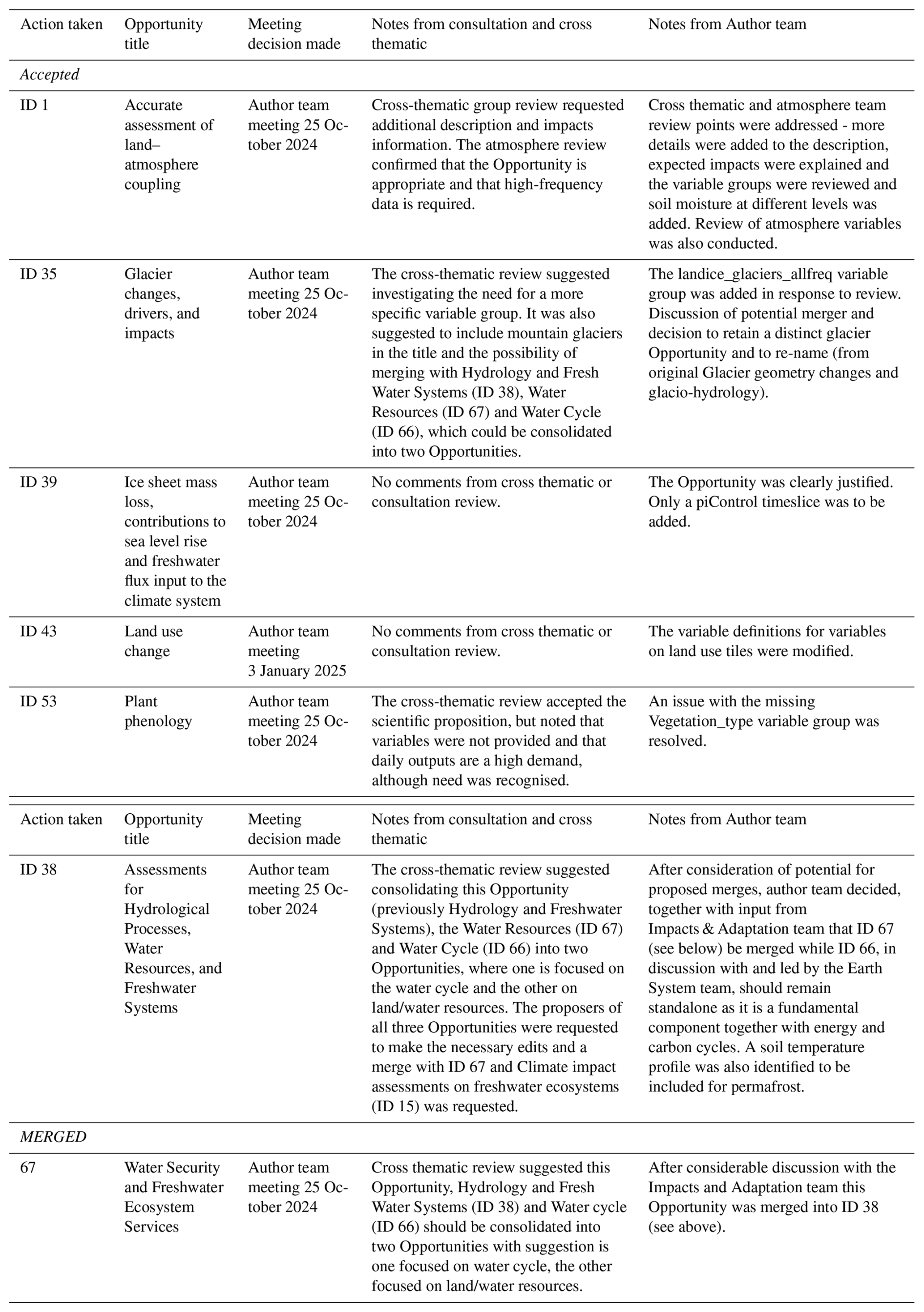
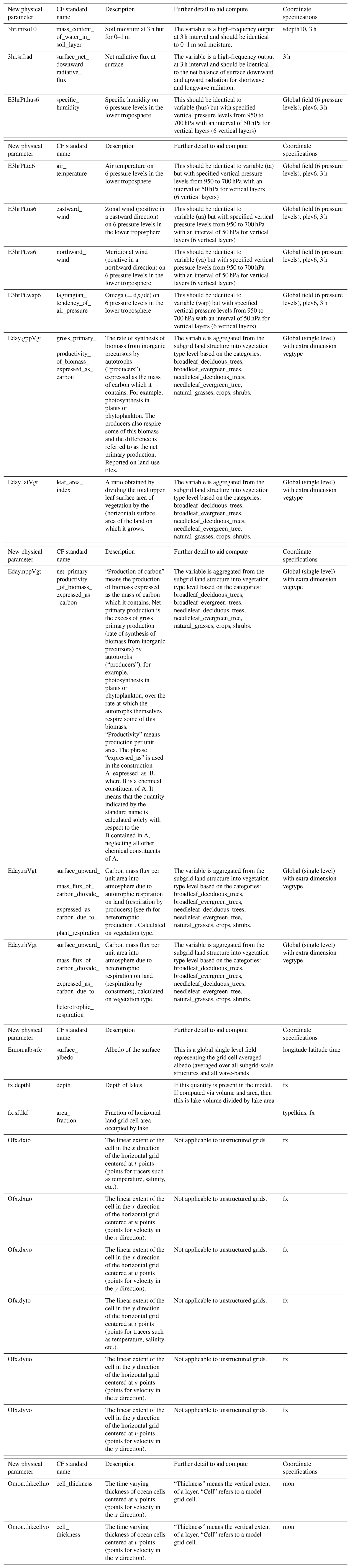
Table B1Variables that are newly introduced in CMIP7 related to Land and Land Ice Theme Opportunities are listed below. Details about the coordinate specifications regarding the time and spatial requirements for the variable's outputs can be seen in the release v1.2 of the CMIP7 Data Request (https://wcrp-cmip.org/cmip7-data-request-v1-2/, last access: 1 April 2025).
The variables and their metadata included latest CMIP7 Assessment Fast Track Data Request can be accessed at https://doi.org/10.5281/zenodo.17986580 (Data Request Task Team, 2025d). At the time of this publication, the latest major release is v1.2 (Data Request Task Team, 2025b; accessed at https://doi.org/10.5281/zenodo.15116894), and the latest minor release is v1.2.1 (Data Request Task Team, 2025c; accessed at https://doi.org/10.5281/zenodo.15288187). Previous versions include v1.0beta (Data Request Task Team, 2024a; accessed at https://doi.org/10.5281/zenodo.14832540), v1.0 (Data Request Task Team, 2024b), and v1.1 (Data Request Task Team, 2025a; accessed at https://doi.org/10.5281/zenodo.14774071).
YL and GT led the conceptualization, investigation, methodology, supervision and visualization with data curation, methodology and visualization contributions from SM, SN, RSS, DML, DP and EOR. YL and GT led the writing of this manuscript with contributions from all authors. EOR provided resources and project administration support.
At least one of the (co-)authors is a member of the editorial board of Geoscientific Model Development. The peer-review process was guided by an independent editor, and the authors also have no other competing interests to declare.
Publisher's note: Copernicus Publications remains neutral with regard to jurisdictional claims made in the text, published maps, institutional affiliations, or any other geographical representation in this paper. The authors bear the ultimate responsibility for providing appropriate place names. Views expressed in the text are those of the authors and do not necessarily reflect the views of the publisher.
The Land and Land Ice Theme author team acknowledge the valuable contributions from a widespread scientific community and public who participated in the CMIP7 Data Request effort and public consulting processes. We thank the Land and Land Ice Theme Committee members, including Fang Li, Ben Marzeion, and Manmeet Singh. We also thank James Anstey, Beth Dingley, Bo Huang, Sifan Koriche, and Alex Ruane for their helpful comments on the draft.
Yue Li acknowledges support from the UCLA Society of Hellman Fellows award and W. M. Keck Foundation. Gang Tang acknowledges support from the Guest Program at the Max Planck Institute for Biogeochemistry (MPI-BGC), as well as the Science Abroad Travelling Scholarships and the School of Geography, Earth and Atmospheric Sciences Graduate Researcher Travelling Funds from The University of Melbourne. The CMIP IPO (EOR) is hosted by the European Space Agency, with staff provided on contract by HE Space Operations Ltd. Samar Minallah and David M. Lawrence are supported by the NSF National Center for Atmospheric Research (NCAR), which is a major facility sponsored by the US National Science Foundation under Cooperative Agreement No. 1852977. George C. Hurtt acknowledges support from NASA CMS 80NSSC25K7221 and NASA EIS 80NSSC22K1733. Martim Mas e Braga has been supported by the British Antarctic Survey, Natural Environment Research Council (NERC), Polar Science for a Sustainable Planet programme. Sophie Nowicki was supported by the NASA Sea Level Change Team and MAP programs. Robin S. Smith was supported by the UK Natural Environment Research Council through the TerraFIRMA: Future Impacts, Risks and Mitigation Actions in a changing Earth System project, Grant reference NE/W004895/1. The work of Birgit Hassler was supported by the European Union's Horizon 2020 research and innovation program (grant no. 101003536; ESM2025 – Earth System Models for the Future). Jiafu Mao was supported by the Reducing Uncertainties in Biogeochemical Interactions through Synthesis and Computing Scientific Focus Area (RUBISCO SFA) project funded through the Earth and Environmental Systems Sciences Division of the Biological and Environmental Research Office in the US Department of Energy (DOE) Office of Science. Oak Ridge National Laboratory (ORNL) is supported by the Office of Science of the DOE under Contract No. DE-AC05-00OR22725.
This paper was edited by Lele Shu and reviewed by Qing Bao and Mousong Wu.
Abrams, J. F., Lade, S. J., Donges, J. F., and Buxton, J. E.: Section 2: Tipping Points Impacts, in: The Global Tipping Points Report 2023., edited by: Lenton, T. M., Armstrong McKay, D. I., Loriani, S., Abrams, J. F., Lade, S. J., Donges, J. F., Milkoreit, M., Powell, T., Smith, S. R., Zimm, C., Buxton, J. E., Laybourn, L., Ghadiali, A., and Dyke, G., University of Exeter, Exeter, UK, https://report-2023.global-tipping-points.org/summary-report/narrative-summary/ (last access: 17 April 2026), 2023.
Albrecht, T., Bagge, M., and Klemann, V.: Feedback mechanisms controlling Antarctic glacial-cycle dynamics simulated with a coupled ice sheet–solid Earth model, The Cryosphere, 18, 4233–4255, https://doi.org/10.5194/tc-18-4233-2024, 2024.
Al-Yaari, A., Ducharne, A., Thiery, W., Cheruy, F., and Lawrence, D.: The role of irrigation expansion on historical climate change: Insights from CMIP6, Earth's Future, 10, e2022EF002859, https://doi.org/10.1029/2022EF002859, 2022.
Anav, A., Friedlingstein, P., Kidston, M., Bopp, L., Ciais, P., Cox, P., Jones, C., Jung, M., Myneni, R., and Zhu, Z.: Evaluating the land and ocean components of the global carbon cycle in the CMIP5 Earth System models, J. Climate, 26, 6801–6843, https://doi.org/10.1175/jcli-d-12-00417.1, 2013.
Armstrong McKay, D. I., Staal, A., Abrams, J. F., Winkelmann, R., Sakschewski, B., Loriani, S., Fetzer, I., Cornell, S. E., Rockström, J., and Lenton, T. M.: Exceeding 1.5 °C global warming could trigger multiple climate tipping points, Science, 377, eabn7950, https://doi.org/10.1126/science.abn7950, 2022.
Balch, J. K., Abatzoglou, J. T., Joseph, M. B., Koontz, M. J., Mahood, A. L., McGlinchy, J., Cattau, M. E., and Williams, A. P.: Warming weakens the night-time barrier to global fire, Nature, 602, 442–448, https://doi.org/10.1038/s41586-021-04325-1, 2022.
Biess, B., Gudmundsson, L., and Seneviratne, S. I.: Assessing global and regional trends in spatially co-occurring hot or wet annual maxima under climate change, Earth's Future, 12, e2023EF004114, https://doi.org/10.1029/2023EF004114, 2024.
Boysen, L. R., Brovkin, V., Pongratz, J., Lawrence, D. M., Lawrence, P., Vuichard, N., Peylin, P., Liddicoat, S., Hajima, T., Zhang, Y., Rocher, M., Delire, C., Séférian, R., Arora, V. K., Nieradzik, L., Anthoni, P., Thiery, W., Laguë, M. M., Lawrence, D., and Lo, M.-H.: Global climate response to idealized deforestation in CMIP6 models, Biogeosciences, 17, 5615–5638, https://doi.org/10.5194/bg-17-5615-2020, 2020.
Briley, L., Rood, R., and Notaro, M.: Large lakes in climate models: A Great Lakes case study on the usability of CMIP5, J. Great Lakes Res., 47, https://doi.org/10.1016/j.jglr.2021.01.010, 2021.
Burke, E. J., Zhang, Y., and Krinner, G.: Evaluating permafrost physics in the Coupled Model Intercomparison Project 6 (CMIP6) models and their sensitivity to climate change, The Cryosphere, 14, 3155–3174, https://doi.org/10.5194/tc-14-3155-2020, 2020.
Chauhan, T., Devanand, A., Roxy, M. K., Ashok, K., and Ghosh, S.: River interlinking alters land–atmosphere feedback and changes the Indian summer monsoon, Nat. Commun., 14, 5928, https://doi.org/10.1038/s41467-023-41668-x, 2023.
Chen, X., Wang, J., Pan, F., Song, Y., Liang, J., Huang, N., Jiang, K., Gao, R., Men, J., Bi, P., Zhang, F., Huang, Z., Huang, B., and Pan, Z.: Land-atmosphere feedback exacerbated the mega heatwave and drought over the Yangtze River Basin of China during summer 2022, Agr. Forest Meteorol., 361, 110321, https://doi.org/10.1016/j.agrformet.2024.110321, 2025.
Clark, M. P., Fan, Y., Lawrence, D. M., Adam, J. C., Bolster, D., Gochis, D. J., Hooper, R. P., Kumar, M., Leung, L. R., Mackay, D. S., Maxwell, R. M., Shen, C., Swenson, S. C., and Zeng, X.: Improving the representation of hydrologic processes in Earth System Models, Water Resour. Res., 51, 5929–5956, https://doi.org/10.1002/2015wr017096, 2015.
CMIP Model Benchmarking Task Team: CMIP AR7 Fast Track Diagnostics list for the Rapid Evaluation Framework, Zenodo [data set], https://doi.org/10.5281/zenodo.14284375, 2024.
Cook, B. I., Mankin, J. S., Marvel, K., Williams, A. P., Smerdon, J. E., and Anchukaiti, K. J.: Twenty-first Century drought projections in the CMIP6 forcing scenarios, Earth's Future, 8, e2019EF001461, https://doi.org/10.1029/2019EF001461, 2020.
Davies, B., McNabb, R., Bendle, J., Carrivick, J., Ely, J., Holt, T., Markle, B., McNeil, C., Nicholson, L., and Pelto, M.: Accelerating glacier volume loss on Juneau Icefield driven by hypsometry and melt-accelerating feedbacks, Nat. Commun., 15, 5099, https://doi.org/10.1038/s41467-024-49269-y, 2024.
Data Request Task Team: CMIP-Data-Request/CMIP7_DReq_Content: Data request content for v1.0beta (released 21 Oct 2024) (v1.0beta), Zenodo [code], https://doi.org/10.5281/zenodo.14832540, 2024a.
Data Request Task Team: CMIP-Data-Request/CMIP7_DReq_Content: Data request content for v1.0 (released 22 Nov 2024) (v1.0), Zenodo [code], https://doi.org/10.5281/zenodo.14832541, 2024b.
Data Request Task Team: CMIP-Data-Request/CMIP7_DReq_Content: Data request content for v1.1 (released 30 Jan 2025) (v1.1), Zenodo [code], https://doi.org/10.5281/zenodo.14774071, 2025a.
Data Request Task Team: CMIP-Data-Request/CMIP7_DReq_Content: Data request content for v1.2 (released 1 Apr 2025) (v1.2), Zenodo [code], https://doi.org/10.5281/zenodo.15116894, 2025b.
Data Request Task Team: CMIP-Data-Request/CMIP7_DReq_Content: Data request content for v1.2.1 (released 26 Apr 2025) (v1.2.1), Zenodo [code], https://doi.org/10.5281/zenodo.15288187, 2025c.
Data Request Task Team: CMIP-Data-Request/CMIP7_DReq_Content: Data request content for v1.2.2.3 (released 19 Dec 2025) (v1.2.2.3), Zenodo [data set], https://doi.org/10.5281/zenodo.17986580, 2025d.
De Rydt, J., Jourdain, N. C., Nakayama, Y., van Caspel, M., Timmermann, R., Mathiot, P., Asay-Davis, X. S., Seroussi, H., Dutrieux, P., Galton-Fenzi, B., Holland, D., and Reese, R.: Experimental design for the Marine Ice Sheet–Ocean Model Intercomparison Project – phase 2 (MISOMIP2), Geosci. Model Dev., 17, 7105–7139, https://doi.org/10.5194/gmd-17-7105-2024, 2024.
Dingley, B., Anstey, J. A., Abalos, M., Abraham, C., Bergman, T., Bock, L., Fiddes, S., Hassler, B., Kramer, R. J., Luo, F., O'Connor, F. M., Šácha, P., Simpson, I. R., Wilcox, L. J., and Zelinka, M. D.: CMIP7 Data Request: atmosphere priorities and opportunities, Geosci. Model Dev., 19, 2945–2984, https://doi.org/10.5194/gmd-19-2945-2026, 2026.
Dirmeyer, P., Balsamo, G., Blyth, E, Morrison, R., and Cooper, H.: Land-Atmosphere Interactions Exacerbated the Drought and Heatwave Over Northern Europe During Summer 2018, AGU Adv., 2, https://doi.org/10.1029/2020AV000283, 2021.
Dong, W., Krasting, J. P., and Guo, H.: Analysis of precipitation diurnal cycle and variance in multiple observations, CMIP6 models, and a series of GFDL-AM4.0 simulations, J. Climate, 36, 8637–8655, https://doi.org/10.1175/JCLI-D-23-0268.1, 2023.
Drenkhan, F., Buytaert, W., Mackay, J. D., Barrand, N. E., Hannah, D. M., and Huggel, C.: Looking beyond glaciers to understand mountain water security, Nat. Sustain., 6, 130–138, https://doi.org/10.1038/s41893-022-00996-4, 2023.
Dunne, J. P., Hewitt, H. T., Arblaster, J. M., Bonou, F., Boucher, O., Cavazos, T., Dingley, B., Durack, P. J., Hassler, B., Juckes, M., Miyakawa, T., Mizielinski, M., Naik, V., Nicholls, Z., O'Rourke, E., Pincus, R., Sanderson, B. M., Simpson, I. R., and Taylor, K. E.: An evolving Coupled Model Intercomparison Project phase 7 (CMIP7) and Fast Track in support of future climate assessment, Geosci. Model Dev., 18, 6671–6700, https://doi.org/10.5194/gmd-18-6671-2025, 2025.
Edwards, T. L., Nowicki, S., Marzeion, B., Hock, R., Goelzer, H., Seroussi, H., Jourdain, N. C., Slater, D. A., Turner, F. E., Smith, C. J., McKenna, C. M., Simon, E., Abe-Ouchi, A., Gregory, J. M., Larour, E., Lipscomb, W. H., Payne, A. J., Shepherd, A., Agosta, C., Alexander, P., Albrecht, T., Anderson, B., Asay-Davis, X., Aschwanden, A., Barthel, A., Bliss, A., Calov, R., Chambers, C., Champollion, N., Choi, Y., Cullather, R., Cuzzone, J., Dumas, C., Felikson, D., Fettweis, X., Fujita, K., Galton-Fenzi, B. K., Gladstone, R., Golledge, N. R., Greve, R., Hattermann, T., Hoffman, M. J., Humbert, A., Huss, M., Huybrechts, P., Immerzeel, W., Kleiner, T., Kraaijenbrink, P., Clec'h, S. L., Lee, V., Leguy, G. R., Little, C. M., Lowry, D. P., Malles, J.-H., Martin, D. F., Maussion, F., Morlighem, M., O'Neill, J. F., Nias, I., Pattyn, F., Pelle, T., Price, S. F., Quiquet, A., Radić, V., Reese, R., Rounce, D. R., Rückamp, M., Sakai, A., Shafer, C., Schlegel, N.-J., Shannon, S., Smith, R. S., Straneo, F., Sun, S., Tarasov, L., Trusel, L. D., Van Breedam, J., Van De Wal, R., Van Den Broeke, M., Winkelmann, R., Zekollari, H., Zhao, C., Zhang, T., and Zwinger, T.: Projected land ice contributions to twenty-first-century sea level rise, Nature, 593, 74–82, https://doi.org/10.1038/s41586-021-03302-y, 2021.
Eyring, V., Bony, S., Meehl, G. A., Senior, C. A., Stevens, B., Stouffer, R. J., and Taylor, K. E.: Overview of the Coupled Model Intercomparison Project Phase 6 (CMIP6) experimental design and organization, Geosci. Model Dev., 9, 1937–1958, https://doi.org/10.5194/gmd-9-1937-2016, 2016.
Eyring, V., Gillett, N. P., Achuta Rao, K. M., Barimalala, R., Barreiro Parrillo, M., Bellouin, N., Cassou, C., Durack, P. J., Kosaka, Y., McGregor, S., Min, S., Morgenstern, O., and Sun, Y. Human Influence on the Climate System, in: Climate Change 2021: The Physical Science Basis, Contribution of Working Group I to the Sixth Assessment Report of the Intergovernmental Panel on Climate Change, edited by: Masson-Delmotte, V., Zhai, P., Pirani, A., Connors, S. L., Péan, C., Berger, S., Caud, N., Chen, Y., Goldfarb, L., Gomis, M. I., Huang, M., Leitzell, K., Lonnoy, E., Matthews, J. B. R., Maycock, T. K., Waterfield, T., Yelekçi, O., Yu, R., and Zhou, B., Cambridge University Press, Cambridge, UK and New York, NY, USA, 423–552, https://doi.org/10.1017/9781009157896.005, 2021.
Fan, Y., Clark, M., Lawrence, D. M., Swenson, S., Band, L. E., Brantley, S. L., Brooks, P. D., Dietrich, D. E., Flores, A., Grant, G., Kirchner, J. W., Mackay, D. S., McDonnell, J. J., Milly, P. C. D., Sullivan, P. L., Tague, C., Ajami, H., Chaney, N., Hartmann, A., Hazenberg, P., McNamara, J., Pelletier, J., Perket, J., Rouholahnejad-Freund, E., Wagener, T., Zeng, X., Beighley, E., Buzan, J., Huang, M., Livneh, B., Mohanty, B. P., Nijssen, B., Safeeq, M., Shen, C., van Verseveld, W., Volk, J., and Yamazaki, D.: Hillslope hydrology in global change research and Earth system modeling, Water Resour. Res., 55, 1737–1772, https://doi.org/10.1029/2018WR023903, 2019.
Findell, K., Gentine, P., Lintner, B., and Guillod, B.: Data Length Requirements for Observational Estimates of Land-Atmosphere Coupling Strength, J. Hydrometeorol., 16, 150406064716003, https://doi.org/10.1175/JHM-D-14-0131.1, 2015.
Findell, K. L., Gentine, P., Lintner, B. R., and Kerr, C.: Probability of afternoon precipitation in eastern United States and Mexico enhanced by high evaporation, Nat. Geosci., 4, 434–439, 2011.
Findell, K. L., Yin, Z., Seo, E., Dirmeyer, P. A., Arnold, N. P., Chaney, N., Fowler, M. D., Huang, M., Lawrence, D. M., Ma, P.-L., and Santanello Jr., J. A.: Accurate assessment of land–atmosphere coupling in climate models requires high-frequency data output, Geosci. Model Dev., 17, 1869–1883, https://doi.org/10.5194/gmd-17-1869-2024, 2024.
Fisher, R. A., Koven, C. D., Anderegg, W. R. L., Bradley, O. C., Dietze, M. C., Farrior, C. E., Holm, J. A., Hurtt, G. C., Knox, R. G., Lawrence, P. J., Lichstein, J. W., Longo, M., Matheny, A. M., Medvigy, D., Muller-Landau, H. C., Powell, T. L., Serbin, S. P., Sato, H., Shuman, J. K., Smith, B., Trugman, A. T., Viskari, T., Verbeeck, H., Weng, E., Xu, C., Xu, X., Zhang, T., and Moorcroft, P. R.: Vegetation demographics in Earth System Models: A review of progress and priorities, Global Change Biol., 24, 35–54, https://doi.org/10.1111/gcb.13910, 2018.
Fox-Kemper, B., Hewitt, H. T., Xiao, C., Aðalgeirsdóttir, G., Drijfhout, S. S., Edwards, T. L., Golledge, N. R., Hemer, M., Kopp, R. E., Krinner, G., Mix, A., Notz, D., Nowicki, S., Nurhati, I. S., Ruiz, L., Sallée, J.-B., Slangen, A. B. A., and Yu, Y.: Ocean, Cryosphere and Sea Level Change, in: Climate Change 2021: The Physical Science Basis, Contribution of Working Group I to the Sixth Assessment Report of the Intergovernmental Panel on Climate Change, edited by: Masson-Delmotte, V., Zhai, P., Pirani, A., Connors, S. L., Péan, C., Berger, S., Caud, N., Chen, Y., Goldfarb, L., Gomis, M. I., Huang, M., Leitzell, K., Lonnoy, E., Matthews, J. B. R., Maycock, T. K., Waterfield, T., Yelekçi, O., Yu, R., and Zhou, B., Cambridge University Press, Cambridge, UK and New York, NY, USA, 1211–1362, https://doi.org/10.1017/9781009157896.011, 2021.
Golledge, N. R., Keller, E. D., Gomez, N., Naughten, K. A., Bernales, J., Trusel, L. D., and Edwards, T. L.: Global environmental consequences of twenty-first-century ice-sheet melt, Nature, 566, 65–72, https://doi.org/10.1038/s41586-019-0889-9, 2019.
Gregory, J. M., White, N. J., Church, J. A., Bierkens, M. F. P., Box, J. E., van den Broeke, M. R., Cogley, J. G., Fettweis, X., Hanna, E., Huybrechts, P., Konikow, L. F., Leclercq, P. W., Marzeion, B., Oerlemans, J., Tamisiea, M. E., Wada, Y., Wake, L. M., and van de Wal, R. S. W.: Twentieth-Century Global-Mean Sea Level Rise: Is the Whole Greater than the Sum of the Parts?, J. Climate, 26, 4476–4499, https://doi.org/10.1175/JCLI-D-12-00319.1, 2013.
Hassell, D., Gregory, J., Blower, J., Lawrence, B. N., and Taylor, K. E.: A data model of the Climate and Forecast metadata conventions (CF-1.6) with a software implementation (cf-python v2.1). Geosci. Model Dev., 10, 4619–4646, https://doi.org/10.5194/gmd-10-4619-2017, 2017.
Herrera-Estrada, J. E., Martinez, J. A., Dominguez, F., Findell, K. L., Wood, E. F., and Sheffield, J.: Reduced Moisture Transport Linked to Drought Propagation Across North America, Geophys. Res. Lett., 46, 5243–5253, https://doi.org/10.1029/2019GL082475, 2019.
Hock, R. and Truffer, M.: Glacier hazards: Will they change in the future?, Arct. Antarct. Alp. Res., 56, https://doi.org/10.1080/15230430.2024.2335991, 2024.
Hock, R., Bliss, A., Marzeion, B., Giesen, R. H., Hirabayashi, Y., Huss, M., Radić, V., and Slangen, A. B.: GlacierMIP – A model intercomparison of global-scale glacier mass-balance models and projections, J. Glaciol., 65, 453–467, https://doi.org/10.1017/jog.2019.22, 2019a.
Hock, R., Rasul, G., Adler, C., Cáceres, B., Gruber, S., Hirabayashi, Y., Jackson, M., Kääb, A., Kang, S., Kutuzov, S., Milner, A., Molau, U., Morin, S., Orlove, B., and Steltzer, H.: High Mountain Areas, in: IPCC Special Report on the Ocean and Cryosphere in a Changing Climate, edited by: Pörtner, H.-O., Roberts, D. C., Masson-Delmotte, V., Zhai, P., Tignor, M., Poloczanska, E., Mintenbeck, K., Alegría, A., Nicolai, M., Okem, A., Petzold, J., Rama, B., and Weyer, N. M., Cambridge University Press, Cambridge, UK and New York, NY, USA, 131–202, https://doi.org/10.1017/9781009157964.004, 2019b.
Hoffman, F. M., Hassler, B., Swaminathan, R., Lewis, J., Andela, B., Collier, N., Hegedűs, D., Lee, J., Pascoe, C., Pflüger, M., Stockhause, M., Ullrich, P., Xu, M., Bock, L., Chun, F., Gier, B. K., Kelley, D. I., Lauer, A., Lenhardt, J., Schlund, M., Sreeush, M. G., Weigel, K., Blockley, E., Beadling, R., Beucher, R., Dugassa, D. D., Lembo, V., Lu, J., Brands, S., Tjiputra, J., Malinina, E., Mederios, B., Scoccimarro, E., Walton, J., Kershaw, P., Marquez, A. L., Roberts, M. J., O'Rourke, E., Dingley, E., Turner, B., Hewitt, H., and Dunne, J. P.: Rapid Evaluation Framework for the CMIP7 Assessment Fast Track, EGUsphere [preprint], https://doi.org/10.5194/egusphere-2025-2685, 2025.
Hogan, J., Lichstein, J., Helmer, E., Craig, M., Fricke, E., Henrich, V., Kannenberg, S. A., Koven, C. D., Goldewjik, K. K., Lapola, D. M., Li, Y., Malhi, Y., Quinn, J., Roe, S., Terrer, C., Vilanova, E., Walker, A. P., Zhu, K., and Ellis, E. C.: Anthromes and forest carbon responses to global change, Plants People Planet, 7, 1027–1042, https://doi.org/10.1002/ppp3.10609, 2025.
Houghton, R. A., House, J. I., Pongratz, J., van der Werf, G. R., DeFries, R. S., Hansen, M. C., Le Quéré, C., and Ramankutty, N.: Carbon emissions from land use and land-cover change, Biogeosciences, 9, 5125–5142, https://doi.org/10.5194/bg-9-5125-2012, 2012.
Huntington, T. G.: Evidence for intensification of the global water cycle: Review and synthesis, J. Hydrol., 319, 83–95, https://doi.org/10.1016/j.jhydrol.2005.07.003, 2005.
Hurtt, G. C., Chini, L., Sahajpal, R., Frolking, S., Bodirsky, B. L., Calvin, K., Doelman, J. C., Fisk, J., Fujimori, S., Klein Goldewijk, K., Hasegawa, T., Havlik, P., Heinimann, A., Humpenöder, F., Jungclaus, J., Kaplan, J. O., Kennedy, J., Krisztin, T., Lawrence, D., Lawrence, P., Ma, L., Mertz, O., Pongratz, J., Popp, A., Poulter, B., Riahi, K., Shevliakova, E., Stehfest, E., Thornton, P., Tubiello, F. N., van Vuuren, D. P., and Zhang, X.: Harmonization of global land use change and management for the period 850–2100 (LUH2) for CMIP6, Geosci. Model Dev., 13, 5425–5464, https://doi.org/10.5194/gmd-13-5425-2020, 2020.
Huss, M. and Hock, R.: Global-scale hydrological response to future glacier mass loss, Nat. Clim. Change, 8, 135–140, https://doi.org/10.1038/s41558-017-0049-x, 2018.
IPCC: IPCC Special Report on the Ocean and Cryosphere in a Changing Climate, edited bu: Pörtner, H.-O., Roberts, D. C., Masson-Delmotte, V., Zhai, P., Tignor, M., Poloczanska, E., Mintenbeck, K., Alegría, A., Nicolai, M., Okem, A., Petzold, J., Rama, B., and Weyer, N. M., Cambridge University Press, Cambridge, UK and New York, NY, USA, 755 pp., https://doi.org/10.1017/9781009157964, 2019.
Jolly, W. M., Nemani, R., and Running, S. W.: A generalized, bioclimatic index to predict foliar phenology in response to climate, Global Change Biol., 11, 619–632, https://doi.org/10.1111/j.1365-2486.2005.00930.x, 2005.
Juckes, M., Taylor, K. E., Durack, P. J., Lawrence, B., Mizielinski, M. S., Pamment, A., Peterschmitt, J. Y., Rixen, M., and Sénési, S.: The CMIP6 data request (DREQ, version 01.00.31), Geosci. Model Dev., 13, 201–224, https://doi.org/10.5194/gmd-13-201-2020, 2020.
Juckes, M., Taylor, K. E., Antonio, F., Brayshaw, D., Buontempo, C., Cao, J., Durack, P. J., Kawamiya, M., Kim, H., Lovato, T., Mackallah, C., Mizielinski, M., Nuzzo, A., Stockhause, M., Visioni, D., Walton, J., Turner, B., O'Rourke, E., and Dingley, B.: Baseline Climate Variables for Earth System Modelling, Geosci. Model Dev., 18, 2639–2663, https://doi.org/10.5194/gmd-18-2639-2025, 2025.
Kageyama, M., Braconnot, P., Harrison, S. P., Haywood, A. M., Jungclaus, J. H., Otto-Bliesner, B. L., Peterschmitt, J.-Y., Abe-Ouchi, A., Albani, S., Bartlein, P. J., Brierley, C., Crucifix, M., Dolan, A., Fernandez-Donado, L., Fischer, H., Hopcroft, P. O., Ivanovic, R. F., Lambert, F., Lunt, D. J., Mahowald, N. M., Peltier, W. R., Phipps, S. J., Roche, D. M., Schmidt, G. A., Tarasov, L., Valdes, P. J., Zhang, Q., and Zhou, T.: The PMIP4 contribution to CMIP6 – Part 1: Overview and over-arching analysis plan, Geosci. Model Dev., 11, 1033–1057, https://doi.org/10.5194/gmd-11-1033-2018, 2018.
Keenan, T. F., Gray, J., Friedl, M. A., Toomey, M., Bohrer, G., Hollinger, D. Y., Munger, J. W., O'Keefe, J., Schmid, H. P., Wing, I. S., Yang, B., and Richardson, A. D.: Net carbon uptake has increased through warming-induced changes in temperate forest phenology, Nat. Clim. Change, 4, 598–604, https://doi.org/10.1038/NCLIMATE2253, 2014.
Kennedy, D., Swenson, S., Oleson, K. W., Lawrence, D. M., Fisher, R., Lola da Costa, A. C., and Gentine, P.: Implementing plant hydraulics in the Community Land Model, version 5, J. Adv. Model. Earth Syst., 11, 485–513, https://doi.org/10.1029/2018MS001500, 2019.
Konapala, G., Mishra, A. K., Wada, Y., and Mann, M. E.: Climate change will affect global water availability through compounding changes in seasonal precipitation and evaporation, Nat. Commun., 11, https://doi.org/10.1038/s41467-020-16757-w, 2020.
Koster, R. D., Dirmeyer, P. A., Guo, Z., Bonan, G., Chan, E., Cox, P., Gordon, C. T., Kanae, S., Kowalczyk, E., Lawrence, D., Liu, P., Lu, C. H., Malyshev, S., McAvaney, B., Mitchell, K., Mocko, D., Oki, T., Oleson, K., Pitman, A., Sud, Y. C., Taylor, C. M., Verseghy, D., Vasic, R., Xue, Y., and Yamada, T.: Regions of strong coupling between soil moisture and precipitation, Science, 305, 1138–1140, https://doi.org/10.1126/science.1100217, 2004.
Kouki, K., Räisänen, P., Luojus, K., Luomaranta, A., and Riihelä, A.: Evaluation of Northern Hemisphere snow water equivalent in CMIP6 models during 1982–2014, The Cryosphere, 16, 1007–1030, https://doi.org/10.5194/tc-16-1007-2022, 2022.
Koven, C. D., Riley, W. J., and Stern, A.: Analysis of Permafrost Thermal Dynamics and Response to Climate Change in the CMIP5 Earth System Models, J. Climate, 26, 1877–1900, https://doi.org/10.1175/JCLI-D-12-00228.1, 2013.
Koven, C. D., Knox, R. G., Fisher, R. A., Chambers, J. Q., Christoffersen, B. O., Davies, S. J., Detto, M., Dietze, M. C., Faybishenko, B., Holm, J., Huang, M., Kovenock, M., Kueppers, L. M., Lemieux, G., Massoud, E., McDowell, N. G., Muller-Landau, H. C., Needham, J. F., Norby, R. J., Powell, T., Rogers, A., Serbin, S. P., Shuman, J. K., Swann, A. L. S., Varadharajan, C., Walker, A. P., Wright, S. J., and Xu, C.: Benchmarking and parameter sensitivity of physiological and vegetation dynamics using the Functionally Assembled Terrestrial Ecosystem Simulator (FATES) at Barro Colorado Island, Panama, Biogeosciences, 17, 3017–3044, https://doi.org/10.5194/bg-17-3017-2020, 2020.
Krinner, G., Derksen, C., Essery, R., Flanner, M., Hagemann, S., Clark, M., Hall, A., Rott, H., Brutel-Vuilmet, C., Kim, H., Ménard, C. B., Mudryk, L., Thackeray, C., Wang, L., Arduini, G., Balsamo, G., Bartlett, P., Boike, J., Boone, A., Chéruy, F., Colin, J., Cuntz, M., Dai, Y., Decharme, B., Derry, J., Ducharne, A., Dutra, E., Fang, X., Fierz, C., Ghattas, J., Gusev, Y., Haverd, V., Kontu, A., Lafaysse, M., Law, R., Lawrence, D., Li, W., Marke, T., Marks, D., Ménégoz, M., Nasonova, O., Nitta, T., Niwano, M., Pomeroy, J., Raleigh, M. S., Schaedler, G., Semenov, V., Smirnova, T. G., Stacke, T., Strasser, U., Svenson, S., Turkov, D., Wang, T., Wever, N., Yuan, H., Zhou, W., and Zhu, D.: ESM-SnowMIP: assessing snow models and quantifying snow-related climate feedbacks, Geosci. Model Dev., 11, 5027–5049, https://doi.org/10.5194/gmd-11-5027-2018, 2018.
Lawrence, D., Coe, M., Walker, W., Verchot, L., and Vandecar, K.: The Unseen Effects of Deforestation: Biophysical Effects on Climate, Front. Forests Global Change, 5, https://doi.org/10.3389/ffgc.2022.756115, 2022.
Lawrence, D. M., Hurtt, G. C., Arneth, A., Brovkin, V., Calvin, K. V., Jones, A. D., Jones, C. D., Lawrence, P. J., de Noblet-Ducoudré, N., Pongratz, J., Seneviratne, S. I., and Shevliakova, E.: The Land Use Model Intercomparison Project (LUMIP) contribution to CMIP6: rationale and experimental design, Geosci. Model Dev., 9, 2973–2998, https://doi.org/10.5194/gmd-9-2973-2016, 2016.
Lee, J.-Y., Marotzke, J., Bala, G., Cao, L., Corti, S., Dunne, J. P., Engelbrecht, F., Fischer, E., Fyfe, J. C., Jones, C., Maycock, A., Mutemi, J., Ndiaye, O., Panickal, S., and Zhou, T.: Future Global Climate: Scenario-Based Projections and Near-Term Information, in: Climate Change 2021: The Physical Science Basis, Contribution of Working Group I to the Sixth Assessment Report of the Intergovernmental Panel on Climate Change, edited by: Masson-Delmotte, V., Zhai, P., Pirani, A., Connors, S. L., Péan, C., Berger, S., Caud, N., Chen, Y., Goldfarb, L., Gomis, M. I., Huang, M., Leitzell, K., Lonnoy, E., Matthews, J. B. R., Maycock, T. K., Waterfield, T., Yelekçi, O., Yu, R., and Zhou, B., Cambridge University Press, Cambridge, UK and New York, NY, USA, 553–672, https://doi.org/10.1017/9781009157896.006, 2021.
Lehner, F., Wood, A. W., Vano, J. A., Lawrence, D. M., Clark, M. P., and Mankin, J. S.: The potential to reduce uncertainty in regional runoff projections from climate models, Nat. Clim. Change, 9, 926–933, https://doi.org/10.1038/s41558-019-0639-x, 2019.
Lei, M., Li, J., Zhang, L., Deng, C., Li, Y., and He, J.: Inconsistent frequency trends between hourly and daily precipitation during warm season in mainland of China, Geophys. Res. Lett., 49, https://doi.org/10.1029/2022GL100277, 2022.
Li, L., Yang, Z.-L., Matheny, A. M., Zheng, H., Swenson, S. C., Lawrence, D. M., Barlage, M., Yan, B., McDowell, N. G., and Leung, L. R.: Representation of plant hydraulics in the Noah-MP land surface model: Model development and multiscale evaluation, J. Adv. Model. Earth Syst., 13, e2020MS002214, https://doi.org/10.1029/2020MS002214, 2021.
Li, L., Fang, Y., Zheng, Z., Shi, M., Longo, M., Koven, C. D., Holm, J. A., Fisher, R. A., McDowell, N. G., Chambers, J., and Leung, L. R.: A machine learning approach targeting parameter estimation for plant functional type coexistence modeling using ELM-FATES (v2.0), Geosci. Model Dev., 16, 4017–4040, https://doi.org/10.5194/gmd-16-4017-2023, 2023a.
Li, Q., Sun, S., and Xue, Y.: Analyses and development of a hierarchy of frozen soil models for cold region study, J. Geophys. Res.-Atmos., 115, D03107, https://doi.org/10.1029/2009JD012530, 2010.
Li, X., Melaas, E., Carrillo, C. M., Ault, T., Richardson, A. D., Lawrence, P., Friedlingstein, M. A., Seyednasrollah, B., Lawrence, D. M., and Young, A. M.: A comparison of land surface phenology in the Northern Hemisphere derived from satellite remote sensing and the Community Land Model, J. Hydrometeorol., 23, 859–873, https://doi.org/10.1175/JHM-D-21-0169.1, 2022a.
Li, X., Ault, T., Evans, C. P., Lehner, F., Carrillo, C. M., Donnelly, A., Crimmins, T., Gallinat, A. S., and Schwartz, M. D.: Diverging Northern Hemisphere Trends in meteorological versus ecological Indicators of spring onset in CMIP6, Geophys. Res. Lett., 50, https://doi.org/10.1029/2023gl102833, 2023b.
Li, X., Ault, T., Richardson, A. D., Frolking, S., Herrera, D. A., Friedl, M. A., Carrillo, C. M., and Evans, C. P.: Northern hemisphere land–atmosphere feedback from prescribed plant phenology in CESM, J. Climate, https://doi.org/10.1175/jcli-d-23-0179.1, in press, 2024a.
Li, X., Carrillo, C. M., Ault, T., Richardson, A. D., Friedl, M. A., and Frolking, S.: Evaluation of leaf phenology of different vegetation types from local to hemispheric scale in CLM, J. Geophys. Res.-Biogeo., 129, https://doi.org/10.1029/2024jg008261, 2024b.
Li, Y., Brando, P. M., Morton, D. C., Lawrence, D. M., Yang, H., and Randerson, J. T.: Deforestation-induced climate change reduces carbon storage in remaining tropical forests, Nat. Commun., 13, 1964, https://doi.org/10.1038/s41467-022-29601-0, 2022b.
Li, Y., Huang, B., Tan, C., Zhang, X., Cherubini, F., and Rust, H. W.: Investigating the global and regional response of drought to idealized deforestation using multiple global climate models, Hydrol. Earth Syst. Sci., 29, 1637–1658, https://doi.org/10.5194/hess-29-1637-2025, 2025a.
Li, Y., Tang, G., Nowicki, S., Smith R. S., Minallah, S., and CMIP Data Request Land and Land-ice Author Team members: Schematic Diagram Illustrating the Land and Land Ice Theme Opportunities in CMIP7 Assessment Fast Track Data Request, Zenodo [data set], https://doi.org/10.5281/zenodo.15681951, 2025b.
Lombardozzi, D. L., Wieder, W. R., Keppel-Aleks, G., Lai, J., Luo, Z., Sun, Y., Simpson, I. R., Lawrence, D. M., Bonan, G. B., Lin, X., Koven, C. D., Friedlingstein, P., and Lindsay, K.: Agricultural fertilization significantly enhances amplitude of land–atmosphere CO2 exchange, Nat. Commun., 16, 1742, https://doi.org/10.1038/s41467-025-56730-z, 2025.
Lösing, M., Ebbing, J., and Szwillus, W.: Geothermal Heat Flux in Antarctica: Assessing Models and Observations by Bayesian Inversion, Front. Earth Sci., 8, 105, https://doi.org/10.3389/feart.2020.00105, 2020.
Luo, K., Wang, X., de Jong, M., and Flannigan, M.: Drought triggers and sustains overnight fires in North America, Nature, 627, 321–327, https://doi.org/10.1038/s41586-024-07028-5, 2024a.
Luo, X., Ge, J., Cao, Y., Liu, Y., Yang, L., Wang, S., and Guo, W.: Local and nonlocal biophysical effects of historical land use and land cover changes in CMIP6 models and the intermodel uncertainty, Earth's Future, 12, e2023EF004220, https://doi.org/10.1029/2023EF004220, 2024b.
Mackallah, C., Juckes, M., Anstey, J., Dingley, B., Pascoe, C., Rigoudy, G., Moine, M.-P., Lovato, T., Pamment, A., Schupfner, M., Kawamiya, M., Bergman, T., Koven, C., O'Rourke, E., Turner, B., Ellis, D., and Mizielinski, M.: CMIP7 Data Request: co-created guidance for the production of CMIP7 data [v1.2.2.3], EGUsphere [preprint], https://doi.org/10.5194/egusphere-2026-1641, 2026.
Mao, J., Fu, W., Shi, X., Ricciuto, D. M., Fisher, J. B., Dickinson, R. E., Wei, Y., Shem, W., Piao, S., Wang, K., and Schwalm, C. R.,: Disentangling climatic and anthropogenic controls on global terrestrial evapotranspiration trends, Environ. Res. Lett., 10, 094008, https://doi.org/10.1088/1748-9326/10/9/094008, 2015.
Marsh, H., Jin, H., Duan, Z., Holst, J., Eklundh, L., and Zhang, W.: Plant Phenology Index leveraging over conventional vegetation indices to establish a new remote sensing benchmark of GPP for northern ecosystems, Int. J. Appl. Earth Obs. Geoinf., 136, 104289, https://doi.org/10.1016/j.jag.2024.104289, 2025.
Marzeion, B., Hock, R., Anderson, B., Bliss, A., Champollion, N., Fujita, K., Huss, M., Immerzeel, W., Kraaijenbrink, P., Malles, J.-H., Maussion, F., Radic, V., Rounce, D. R., Sakai, A., Shannon, S., van de Wal, R., and Zekollari, H.: Partitioning the Uncertainty of Ensemble Projections of Global Glacier Mass Change, Earth's Future, 12, e2019EF001470, https://doi.org/10.1029/2019EF001470, 2020.
McPartland, M. Y., Lovato, T., Koven, C., Wilson, J. D., Turner, B., Petrik, C. M., Licón-Saláiz, J., Li, F., Lhardy, F., Clement Kinney, J., Kawamiya, M., Hassler, B., Gillett, N. P., Fall, C. M. N., Danek, C., Brierley, C. M., Bastos, A., and Andrews, O.: CMIP7 data request: Earth system priorities and opportunities, Geosci. Model Dev., 19, 2849–2880, https://doi.org/10.5194/gmd-19-2849-2026, 2026.
Michalek, A. T., Villarini, G., and Husic, A.: Climate change projected to impact structural hillslope connectivity at the global scale, Nat. Commun., 14, 6788, https://doi.org/10.1038/s41467-023-42384-2, 2023.
Milner, A. M., Khamis, K., Battin, T. J., Brittain, J. E., Barrand, N. E., Füreder, L., Cauvy-Fraunié, S., Gíslason, G. M., Jacobsen, D., Hannah, D. M., Hodson, A. J., Hood, E., Lencioni, V., Ólafsson, J. S., Robinson, C. T., Tranter, M., and Brown, L. E.: Glacier shrinkage driving global changes in downstream systems, P. Natl. Acad. Sci. USA, 114, 9770–9778, https://doi.org/10.1073/pnas.1619807114, 2017.
Minallah, S. and Steiner, A. L.: Analysis of the Atmospheric Water Cycle for the Laurentian Great Lakes Region Using CMIP6 Models, J. Climate, 34, 4693–4710, https://doi.org/10.1175/JCLI-D-20-0751.1, 2021.
Munier, S., Carrer, D., Planque, C., Camacho, F., Albergel, C., and Calvet, J.-C.: Satellite Leaf Area Index: Global Scale Analysis of the Tendencies Per Vegetation Type Over the Last 17 Years, Remote Sens., 10, 424, https://doi.org/10.3390/rs10030424, 2018.
Murray-Tortarolo, G., Anav, A., Friedlingstein, P., Sitch, S., Piao, S., Zhu, Z., Poulter, B., Zaehle, S., Ahlström, A., Lomas, M., Levis, S., Viovy, N., and Zeng, N.: Evaluation of land surface models in reproducing satellite-derived LAI over the high-latitude northern hemisphere. Part I: uncoupled DGVMs, Remote Sens., 5, 4819–4838, https://doi.org/10.3390/rs5104819, 2013.
Negrón-Juárez, R., Wehner, M., Dias, M., Ullrich, P., Chambers, J., and Riley, W.: Coupled model intercomparison project phase 6 (CMIP6) high resolution model intercomparison project (HighResMIP) bias in extreme rainfall drives underestimation of amazonian precipitation, Environ. Res. Commun., 6, https://doi.org/10.1088/2515-7620/ad6ff9, 2024.
Norris, J., Hall, A., Neelin,, J., Thackeray, C., and Chen, D.: Evaluation of the Tail of the Probability Distribution of Daily and Subdaily Precipitation in CMIP6 Models, J. Climate, 34, 1–61, https://doi.org/10.1175/JCLI-D-20-0182.1, 2021.
Notaro, M., Jorns, J., and Briley, L.: Representation of Lake–Atmosphere Interactions and Lake-Effect Snowfall in the Laurentian Great Lakes Basin among HighResMIP Global Climate Models, J. Atmos. Sci., 79, 1325–1347, https://doi.org/10.1175/JAS-D-21-0249.1, 2022.
Nowicki, S., Goelzer, H., Seroussi, H., Payne, A. J., Lipscomb, W. H., Abe-Ouchi, A., Agosta, C., Alexander, P., Asay-Davis, X. S., Barthel, A., Bracegirdle, T. J., Cullather, R., Felikson, D., Fettweis, X., Gregory, J. M., Hattermann, T., Jourdain, N. C., Kuipers Munneke, P., Larour, E., Little, C. M., Morlighem, M., Nias, I., Shepherd, A., Simon, E., Slater, D., Smith, R. S., Straneo, F., Trusel, L. D., van den Broeke, M. R., and van de Wal, R.: Experimental protocol for sea level projections from ISMIP6 stand-alone ice sheet models, The Cryosphere, 14, 2331–2368, https://doi.org/10.5194/tc-14-2331-2020, 2020.
Nowicki, S., Payne, A. J., Seroussi, H. L., Goelzer, H., Asay-Davis, X., Smith, R. S., and Csatho, B. M.: Preparing for the Ice Sheet Model Intercomparison Project for CMIP7 (ISMIP7), AGU Fall Meeting Abstracts, 38, C31D-038, 2024.
Nowicki, S. M. J., Payne, A., Larour, E., Seroussi, H., Goelzer, H., Lipscomb, W., Gregory, J., Abe-Ouchi, A., and Shepherd, A.: Ice Sheet Model Intercomparison Project (ISMIP6) contribution to CMIP6, Geosci. Model Dev., 9, 4521–4545, https://doi.org/10.5194/gmd-9-4521-2016, 2016.
Oppenheimer, M., Glavovic, B. C., Hinkel, J., van de Wal, R., Magnan, A. K., Abd-Elgawad, A., Cai, R., Cifuentes-Jara, M., DeConto, R. M., Ghosh, T., Hay, J., Isla, F., Marzeion, B., Meyssignac, B., and Sebesvari, Z.: Sea Level Rise and Implications for Low-Lying Islands, Coasts and Communities, in: IPCC Special Report on the Ocean and Cryosphere in a Changing Climate, edited by: Pörtner, H.-O., Roberts, D. C., Masson-Delmotte, V., Zhai, P., Tignor, M., Poloczanska, E., Mintenbeck, K., Alegría, A., Nicolai, M., Okem, A., Petzold, J., Rama, B., and Weyer, N. M., Cambridge University Press, Cambridge, UK and New York, NY, USA, 321–445, https://doi.org/10.1017/9781009157964.006, 2019.
O'Rourke, E.: CMIP6 Community Survey Results, Zenodo, https://doi.org/10.5281/zenodo.8113057, 2023.
Park, T., Ganguly, S., Tømmervik, H., Euskirchen, E. S., Høgda, K.-A., Karlsen, S. R., Brovkin, V., Nemani, R. R., and Myneni, R. B.: Changes in growing season duration and productivity of northern vegetation inferred from long-term remote sensing data, Environ. Res. Lett., 11, 084001, https://doi.org/10.1088/1748-9326/11/8/084001, 2016.
Park, C. Y., Takahashi, K., Fujimori, S., Jansakoo, T., Burton, C., Huang, H., Kou-Giesbrecht, S., Reyer, C. P. O., Mengel, M., Burke, E., Li, F., Hantson, S., Takakura, J., Lee, D. K., and Hasegawa, T.: Attributing human mortality from fire PM2.5 to climate change, Nat. Clim. Change, 14, 1193–1200, https://doi.org/10.1038/s41558-024-02149-1, 2024.
Peano, D., Materia, S., Collalti, A., Alessandri, A., Anav, A., Bombelli, A., and Gualdi, S: Global variability of simulated and observed vegetation growing season, J. Geophys. Res.-Biogeo., 124, 3569–3587, https://doi.org/10.1029/2018JG004881, 2019.
Peano, D., Hemming, D., Materia, S., Delire, C., Fan, Y., Joetzjer, E., Lee, H., Nabel, J. E. M. S., Park, T., Peylin, P., Wårlind, D., Wiltshire, A., and Zaehle, S.: Plant phenology evaluation of CRESCENDO land surface models – Part 1: Start and end of the growing season, Biogeosciences, 18, 2405–2428, https://doi.org/10.5194/bg-18-2405-2021, 2021.
Peano, D., Hemming, D., Delire, C., Fan, Y., Lee, H., Materia, S., Nabel, J. E. M. S., Park, T., Wårlind, D., Wiltshire, A., and Zaehle, S.: Plant phenology evaluation of CRESCENDO land surface models using satellite-derived Leaf Area Index – Part 2: Seasonal trough, peak, and amplitude, Biogeosciences, 22, 7117–7135, https://doi.org/10.5194/bg-22-7117-2025, 2025.
Poyatos, R., Granda, V., Flo, V., Adams, M. A., Adorján, B., Aguadé, D., Aidar, M. P. M., Allen, S., Alvarado-Barrientos, M. S., Anderson-Teixeira, K. J., Aparecido, L. M., Arain, M. A., Aranda, I., Asbjornsen, H., Baxter, R., Beamesderfer, E., Berry, Z. C., Berveiller, D., Blakely, B., Boggs, J., Bohrer, G., Bolstad, P. V., Bonal, D., Bracho, R., Brito, P., Brodeur, J., Casanoves, F., Chave, J., Chen, H., Cisneros, C., Clark, K., Cremonese, E., Dang, H., David, J. S., David, T. S., Delpierre, N., Desai, A. R., Do, F. C., Dohnal, M., Domec, J.-C., Dzikiti, S., Edgar, C., Eichstaedt, R., El-Madany, T. S., Elbers, J., Eller, C. B., Euskirchen, E. S., Ewers, B., Fonti, P., Forner, A., Forrester, D. I., Freitas, H. C., Galvagno, M., Garcia-Tejera, O., Ghimire, C. P., Gimeno, T. E., Grace, J., Granier, A., Griebel, A., Guangyu, Y., Gush, M. B., Hanson, P. J., Hasselquist, N. J., Heinrich, I., Hernandez-Santana, V., Herrmann, V., Hölttä, T., Holwerda, F., Irvine, J., Isarangkool Na Ayutthaya, S., Jarvis, P. G., Jochheim, H., Joly, C. A., Kaplick, J., Kim, H. S., Klemedtsson, L., Kropp, H., Lagergren, F., Lane, P., Lang, P., Lapenas, A., Lechuga, V., Lee, M., Leuschner, C., Limousin, J.-M., Linares, J. C., Linderson, M.-L., Lindroth, A., Llorens, P., López-Bernal, Á., Loranty, M. M., Lüttschwager, D., Macinnis-Ng, C., Maréchaux, I., Martin, T. A., Matheny, A., McDowell, N., McMahon, S., Meir, P., Mészáros, I., Migliavacca, M., Mitchell, P., Mölder, M., Montagnani, L., Moore, G. W., Nakada, R., Niu, F., Nolan, R. H., Norby, R., Novick, K., Oberhuber, W., Obojes, N., Oishi, A. C., Oliveira, R. S., Oren, R., Ourcival, J.-M., Paljakka, T., Perez-Priego, O., Peri, P. L., Peters, R. L., Pfautsch, S., Pockman, W. T., Preisler, Y., Rascher, K., Robinson, G., Rocha, H., Rocheteau, A., Röll, A., Rosado, B. H. P., Rowland, L., Rubtsov, A. V., Sabaté, S., Salmon, Y., Salomón, R. L., Sánchez-Costa, E., Schäfer, K. V. R., Schuldt, B., Shashkin, A., Stahl, C., Stojanović, M., Suárez, J. C., Sun, G., Szatniewska, J., Tatarinov, F., Tesař, M., Thomas, F. M., Tor-ngern, P., Urban, J., Valladares, F., van der Tol, C., van Meerveld, I., Varlagin, A., Voigt, H., Warren, J., Werner, C., Werner, W., Wieser, G., Wingate, L., Wullschleger, S., Yi, K., Zweifel, R., Steppe, K., Mencuccini, M., and Martínez-Vilalta, J.: Global transpiration data from sap flow measurements: the SAPFLUXNET database, Earth Syst. Sci. Data, 13, 2607–2649, https://doi.org/10.5194/essd-13-2607-2021, 2021.
RGI Consortium: Randolph Glacier Inventory – A Dataset of Global Glacier Outlines, Version 7.0, NSIDC: National Snow and Ice Data Center [data set], https://doi.org/10.5067/f6jmovy5navz, 2023.
Richardson, A. D., Anderson, R. S., Arain, M. A., Barr, A. G., Bohrer, G., Chen, G., Chen, J. M., Ciais, P., Davis, K. J., Desai, A. R., Dietze, M. C., Dragoni, D., Garrity, S. R., Gough, C. M., Grant, R., Hollinger, D. Y., Margolis, H. A., McCaughey, H., Migliavacca, M., Monson, R. K., Munger, J. W., Poulter, B., Raczka, B. M., Ricciuto, D. M., Sahoo, A. K., Schaefer, K., Tian, H., Vargas, R., Verbeeck, H., Xiao, J., and Xue, Y.: Terrestrial biosphere models need better representation of vegetation phenology: results from the North American Carbon Program Site Synthesis, Global Change Biol., 18, 566–584, https://doi.org/10.1111/j.1365-2486.2011.02562.x, 2012.
Richardson, A. D., Keenan, T. F., Migliavacca, M., Ryu, Y., Sonnentag, O., and Toomey, M.: Climate change, phenology, and phenological control of vegetation feedbacks to the climate system, Agr. Forest Meteorol., 169, 156–173, https://doi.org/10.1016/j.agrformet.2012.09.012, 2013.
Richardson, K., Steffen, W., Lucht, W., Bendtsen, J., Cornell, S. E., Donges, J. F., Drüke, M., Fetzer, I., Bala, G., Von Bloh, W., and Feulner, G.: Earth beyond six of nine planetary boundaries, Sci. Adv., 9, eadh2458, https://doi.org/10.1126/sciadv.adh2458, 2023.
Righi, M., Andela, B., Eyring, V., Lauer, A., Predoi, V., Schlund, M., Vegas-Regidor, J., Bock, L., Brötz, B., de Mora, L., and Diblen, F.: Earth System model evaluation tool (ESMValTool) v2.0 – technical overview, Geosci. Model Dev., 13, 1179–1199, https://doi.org/10.5194/gmd-13-1179-2020, 2020.
Roberts, M. J., Reed, K. A., Bao, Q., Barsugli, J. J., Camargo, S. J., Caron, L.-P., Chang, P., Chen, C.-T., Christensen, H. M., Danabasoglu, G., Frenger, I., Fučkar, N. S., ul Hasson, S., Hewitt, H. T., Huang, H., Kim, D., Kodama, C., Lai, M., Leung, L.-Y. R., Mizuta, R., Nobre, P., Ortega, P., Paquin, D., Roberts, C. D., Scoccimarro, E., Seddon, J., Treguier, A. M., Tu, C.-Y., Ullrich, P. A., Vidale, P. L., Wehner, M. F., Zarzycki, C. M., Zhang, B., Zhang, W., and Zhao, M.: High-Resolution Model Intercomparison Project phase 2 (HighResMIP2) towards CMIP7, Geosci. Model Dev., 18, 1307–1332, https://doi.org/10.5194/gmd-18-1307-2025, 2025.
Ruane, A. C., Pascoe, C. L., Teichmann, C., Brayshaw, D. J., Buontempo, C., Diouf, I., Fernandez, J., Gonzalez, P. L. M., Hassler, B., Hernaman, V., Im, U., Iovino, D., Juckes, M., Lake, I. L., Lam, T., Lin, X., Mao, J., Nazarian, N., Parey, S., Roy, I., Tseng, W.-L., Turner, B., Wiebe, A., Zhao, L., and Zurell, D.: CMIP7 data request: impacts and adaptation priorities and opportunities, Geosci. Model Dev., 18, 9497–9540, https://doi.org/10.5194/gmd-18-9497-2025, 2025.
Santanello, J. A., Peters-Lidard, C. D., Kumar, S. V., Alonge, C., and Tao, W.-K.: A modeling and observational framework for diagnosing local Land–Atmosphere coupling on diurnal time scales, J. Hydrometeorol., 10, 577–599, https://doi.org/10.1175/2009jhm1066.1, 2009.
Santanello, J. A., Peters-Lidard, C. D., and Kumar, S. V.: Diagnosing the sensitivity of local Land–Atmosphere coupling via the soil Moisture–Boundary layer interaction, J. Hydrometeorol., 12, 766–786, https://doi.org/10.1175/jhm-d-10-05014.1, 2011.
Schumacher, D. L., Keune, J., Dirmeyer, P., and Miralles, D.: Drought self-propagation in drylands due to land–atmosphere feedbacks, Nat. Geosci., 15, 262–268, https://doi.org/10.1038/s41561-022-00912-7, 2022.
Seneviratne, S. I., Lüthi, D., Litschi, M., and Schär, C.: Land-atmosphere coupling and climate change in Europe, Nature, 443, 205–209, https://doi.org/10.1038/nature05095, 2006.
Seo, E. and Dirmeyer, P. A.: Understanding the diurnal cycle of land–atmosphere interactions from flux site observations, Hydrol. Earth Syst. Sci., 26, 5411–5429, https://doi.org/10.5194/hess-26-5411-2022, 2022.
Shrestha, M., Koike, T., Hirabayashi, Y., Xue, Y., Wang, L., Rasul, G., and Ahmad, B.: Integrated simulation of snow and glacier melt in water and energy balance-based, distributed hydrological modeling framework at Hunza River Basin of Pakistan Karakoram region, J. Geophys. Res.-Atmos., 120, 4889–4919, https://doi.org/10.1002/2014jd022666, 2015.
Song, X., Wang, D.-Y., Li, F., and Zeng, X.-D.: Evaluating the performance of CMIP6 Earth system models in simulating global vegetation structure and distribution, Adv. Clim. Change Res., 12, 584–595, https://doi.org/10.1016/j.accre.2021.06.008, 2021.
Sterling, S., Ducharne, A., and Polcher, J.: The impact of global land-cover change on the terrestrial water cycle, Nat. Clim. Change, 3, 385–390, https://doi.org/10.1038/nclimate1690, 2013.
Stokes, C. R., Abram, N. J., Bentley, M. J., Edwards, T. L., England, M. H., Foppert, A., Jamieson, S. S. R., Jones, R. S., King, M. A., Lenaerts, J. T. M., Medley, B., Miles, B. W. J., Paxman, G. J. G., Ritz, C., Van De Flierdt, T., and Whitehouse, P. L.: Response of the East Antarctic Ice Sheet to past and future climate change, Nature, 608, 275–286, https://doi.org/10.1038/s41586-022-04946-0, 2022.
Sun, Q., Whitney, M. M., Bryan, F. O., and Tseng, Y.-H.: A box model for representing estuarine physical processes in Earth system models, Ocean Model., 112, 139–153, https://doi.org/10.1016/j.ocemod.2017.03.004, 2017.
Sun, S., Jin, J., and Xue, Y.: A simplified layer snow model for global and regional studies, J. Geophys. Res.-Atmos., 104, 19587–19597, 1999.
Swart, N. C., Martin, T., Beadling, R., Chen, J.-J., Danek, C., England, M. H., Farneti, R., Griffies, S. M., Hattermann, T., Hauck, J., Haumann, F. A., Jüling, A., Li, Q., Marshall, J., Muilwijk, M., Pauling, A. G., Purich, A., Smith, I. J., and Thomas, M.: The Southern Ocean Freshwater Input from Antarctica (SOFIA) Initiative: scientific objectives and experimental design, Geosci. Model Dev., 16, 7289–7309, https://doi.org/10.5194/gmd-16-7289-2023, 2023.
Tang, G., Nicholls, Z., Jones, C., Gasser, T., Norton, A., Ziehn, T., Romero-Prieto, A., and Meinshausen, M.: Investigating carbon and nitrogen conservation in reported CMIP6 Earth system model data, Geosci. Model Dev., 18, 2111–2136, https://doi.org/10.5194/gmd-18-2111-2025, 2025a.
Tang, G., Nicholls, Z., Norton, A., Zaehle, S., and Meinshausen, M.: Synthesizing global carbon–nitrogen coupling effects – the MAGICC coupled carbon–nitrogen cycle model v1.0, Geosci. Model Dev., 18, 2193–2230, https://doi.org/10.5194/gmd-18-2193-2025, 2025b.
Tang, G., Zaehle, S., Nicholls, Z., Norton, A., Ziehn, T., and Meinshausen, M.: Understanding the drivers of carbon–nitrogen cycle variability in CMIP6 ESMs with MAGICC CNit v2.0: Model and calibration updates, J. Adv. Model. Earth Syst., 18, e2025MS005270, https://doi.org/10.1029/2025MS005270, 2026.
Tang, T., Lee, X., Zhang, K., Cai, L., Lawrence, D. M., and Shevliakova, E.: Biophysical Impact of Land-Use and Land-Cover Change on Subgrid Temperature in CMIP6 Models, J. Hydrometeorol., 24, 373–388, https://doi.org/10.1175/JHM-D-22-0073.1, 2023.
te Wierik, S. A., Cammeraat, E. L., Gupta, J., and Artzy-Randrup, Y. A.: Reviewing the impact of land use and land-use change on moisture recycling and precipitation patterns, Water Resour. Res., 57, e2020WR029234, https://doi.org/10.1029/2020WR029234, 2021.
Vanderkelen, I., Gharari, S., Mizukami, N., Clark, M. P., Lawrence, D. M., Swenson, S., Pokhrel, Y., Hanasaki, N., van Griensven, A., and Thiery, W.: Evaluating a reservoir parametrization in the vector-based global routing model mizuRoute (v2.0.1) for Earth system model coupling, Geosci. Model Dev., 15, 4163–4192, https://doi.org/10.5194/gmd-15-4163-2022, 2022.
Van Westen, R. M., Kliphuis, M., and Dijkstra, H. A.: Physics-based early warning signal shows that AMOC is on tipping course, Sci. Adv., 10, https://doi.org/10.1126/sciadv.adk1189, 2024.
Vettoretti, G., Nuterman, R., and Jochum, M.: Impacts of Parameterizing Estuary Mixing on the Large-Scale Circulations in the Community Earth System Model, J. Climate, 37, 4461–4479, https://doi.org/10.1175/JCLI-D-23-0365.1, 2024.
Walton, J., Swaminathan, R., Jones, C., Dittus, A., Liddicoat, S., Rumbold, S., and Smith, R.: Assessing the Realism of the TIPMIP ESM idealized Experiment Protocol, EGU General Assembly 2025, Vienna, Austria, 27 April–2 May 2025, EGU25-4403, https://doi.org/10.5194/egusphere-egu25-4403, 2025.
Wang, L., Zhou, J., Qi, J., Sun, L., Yang, K., Tian, L., Lin, Y., Liu, W., Shrestha, M., Xue, Y., Koike, T., Ma, Y., Li, X., Chen, Y., Chen, D., Piao, S., and Lu, H.: Development of a land surface model with coupled snow and frozen soil physics, Water Resour. Res., 53, 5085–5103, https://doi.org/10.1002/2017wr020451, 2017.
Wehner, M., Lee, J., Risser, M., Ullrich, P., Gleckler, P., and Collins, W. D.: Evaluation of extreme sub-daily precipitation in high-resolution global climate model simulations, Philos. Trans. A Math. Phys. Eng. Sci., 379, 20190545, https://doi.org/10.1098/rsta.2019.0545, 2021.
Whitehouse, P. L.: Glacial isostatic adjustment modelling: historical perspectives, recent advances, and future directions, Earth Surf. Dynam., 6, 401–429, https://doi.org/10.5194/esurf-6-401-2018, 2018.
Winkelmann, R., Dennis, D. P., Donges, J. F., Loriani, S., Klose, A. K., Abrams, J. F., Alvarez-Solas, J., Albrecht, T., Armstrong McKay, D., Bathiany, S., Blasco Navarro, J., Brovkin, V., Burke, E., Danabasoglu, G., Donner, R. V., Drüke, M., Georgievski, G., Goelzer, H., Harper, A. B., Hegerl, G., Hirota, M., Hu, A., Jackson, L. C., Jones, C., Kim, H., Koenigk, T., Lawrence, P., Lenton, T. M., Liddy, H., Licón-Saláiz, J., Menthon, M., Montoya, M., Nitzbon, J., Nowicki, S., Otto-Bliesner, B., Pausata, F., Rahmstorf, S., Ramin, K., Robinson, A., Rockström, J., Romanou, A., Sakschewski, B., Schädel, C., Sherwood, S., Smith, R. S., Steinert, N. J., Swingedouw, D., Willeit, M., Weijer, W., Wood, R., Wyser, K., and Yang, S.: The Tipping Points Modelling Intercomparison Project (TIPMIP): Assessing tipping point risks in the Earth system, EGUsphere [preprint], https://doi.org/10.5194/egusphere-2025-1899, 2025.
Winkler, A. J., Myneni, R. B., Hannart, A., Sitch, S., Haverd, V., Lombardozzi, D., Arora, V. K., Pongratz, J., Nabel, J. E. M. S., Goll, D. S., Kato, E., Tian, H., Arneth, A., Friedlingstein, P., Jain, A. K., Zaehle, S., and Brovkin, V.: Slowdown of the greening trend in natural vegetation with further rise in atmospheric CO2, Biogeosciences, 18, 4985–5010, https://doi.org/10.5194/bg-18-4985-2021, 2021.
Wolken, G. J., Liljedahl, A. K., Brubaker, M., Coe, J. A., Fiske, G., Hvidtfeldt Christiansen, H., Jacquemart, M., Jones, B. M., Kääb, A., Løvholt, F., Natali, S., Rudy, A. C. A., and Streletskiy, D.: Glacier and Permafrost Hazards, NOAA, https://doi.org/10.25923/v40r-0956, 2021.
Wu, J. and Dirmeyer, P. A.: Drought Demise Attribution Over CONUS, J. Geophys. Res.-Atmos., 125, e2019JD031255, https://doi.org/10.1029/2019jd031255, 2020.
Wu, R., Lo, M., and Scanlon, B. R.: The Annual Cycle of Terrestrial Water Storage Anomalies in CMIP6 Models Evaluated against GRACE Data, J. Climate, 34, 8205–8217, https://doi.org/10.1175/JCLI-D-21-0021.1, 2021.
Xu, X., Medvigy, D., Powers, J. S., Becknell, J. M., and Guan, K.: Diversity in plant hydraulic traits explains seasonal and inter-annual variations of vegetation dynamics in seasonally dry tropical forests, New Phytol., 212, 80–95, https://doi.org/10.1111/nph.14009, 2016.
Yao, Y., Ciais, P., Joetzjer, E., Hong, S., Li, W., Zhu, L., and Viovy, N.: Future drought-induced tree mortality risk in Amazon rainforest, Earth's Future, 12, e2023EF003740, https://doi.org/10.1029/2023EF003740, 2024.
Yao, Y., Ducharne, A., Cook, B. I., De Hertog, S. J., Aas, K. S., Arboleda-Obando, P. F., Buzan, J., Colin, J., Costantini, M., Decharme, B., Lawrence, D. M., Lawrence, P., Leung, L. R., Lo, M.-H., Devaraju, N., Wieder, W. R., Wu, R.-J., Zhou, T., Jägermeyr, J., McDermid, S., Pokhrel, Y., Elling, M., Hanasaki, N., Muñoz, P., Nazarenko, L. S., Otta, K., Satoh, Y., Yokohata, T., Jin, L., Wang, X., Mishra, V., Ghosh, S., and Thiery, W.: Impacts of irrigation expansion on moist-heat stress based on IRRMIP results, Nat. Commun., 16, https://doi.org/10.1038/s41467-025-56356-1, 2025.
Yoon, D., Kang, T., Cha, D.-H., Song, C. K., Lee, M. I., Min, K. H., Kim, J., Chun, J. A., and Seo, E.: Role of land–atmosphere interaction in the 2016 Northeast Asia heat wave: Impact of soil moisture initialization, J. Geophys. Res.-Atmos., 128, e2022JD037718, https://doi.org/10.1029/2022JD037718, 2023.
Yu, L., Xue, Y., and Diallo, I.: Vegetation greening in China and its effect on summer regional climate, Sci. Bull., 66, 13–17, https://doi.org/10.1016/j.scib.2020.09.003, 2021.
Yuan, K., Zhu, Q., Riley, W. J., Li, F., and Wu, H.: Understanding and reducing the uncertainties of land surface energy flux partitioning within CMIP6 land models, Agr. Forest Meteorol., 319, 108920, https://doi.org/10.1016/j.agrformet.2022.108920, 2022.
Zhang, H., Zhang, F., Zhang, G., and Yan, W.: Why do CMIP6 models fail to simulate snow depth in terms of temporal change and high mountain snow of China skillfully?, Geophys. Res. Lett., 49, e2022GL098888, https://doi.org/10.1029/2022GL098888, 2022.
Zhao, W., Zhu, B., Davis, S. J., Ciais, P., Hong, C., Liu, Z., and Gentine, P.: Reliance on fossil fuels increases during extreme temperature events in the continental United States, Commun. Earth Environ., 4, 473, https://doi.org/10.1038/s43247-023-01147-z, 2023.
Zhu, Z., Piao, S., Myneni, R. B., Huang, M., Zeng, Z., Canadell, J. G., Ciais, P., Sitch, S., Friedlingstein, P., Arneth, A., and Cao, C.: Greening of the Earth and its drivers, Nat. Clim. Change, 6, 791–795, https://doi.org/10.1038/nclimate3004, 2016.
- Abstract
- Introduction
- Approach and methodology
- Information management and decision making
- Results: content included in the CMIP7 data request
- Discussion
- Conclusions
- Appendix A: Opportunity processing
- Appendix B: New variable description
- Code and data availability
- Author contributions
- Competing interests
- Disclaimer
- Acknowledgements
- Financial support
- Review statement
- References
- Abstract
- Introduction
- Approach and methodology
- Information management and decision making
- Results: content included in the CMIP7 data request
- Discussion
- Conclusions
- Appendix A: Opportunity processing
- Appendix B: New variable description
- Code and data availability
- Author contributions
- Competing interests
- Disclaimer
- Acknowledgements
- Financial support
- Review statement
- References