Articles | Volume 19, issue 8
https://doi.org/10.5194/gmd-19-3035-2026
© Author(s) 2026. This work is distributed under
the Creative Commons Attribution 4.0 License.
https://doi.org/10.5194/gmd-19-3035-2026
© Author(s) 2026. This work is distributed under
the Creative Commons Attribution 4.0 License.
The Community Fire Behavior model for coupled fire–atmosphere modeling: implementation in the Unified Forecast System
Pedro A. Jiménez y Muñoz
CORRESPONDING AUTHOR
NSF National Center for Atmospheric Research, 3090 Center Green Drive, Boulder, CO 80301, USA
Maria Frediani
NSF National Center for Atmospheric Research, 3090 Center Green Drive, Boulder, CO 80301, USA
Masih Eghdami
NSF National Center for Atmospheric Research, 3090 Center Green Drive, Boulder, CO 80301, USA
Daniel Rosen
NSF National Center for Atmospheric Research, 3090 Center Green Drive, Boulder, CO 80301, USA
Michael Kavulich
NSF National Center for Atmospheric Research, 3090 Center Green Drive, Boulder, CO 80301, USA
Timothy W. Juliano
NSF National Center for Atmospheric Research, 3090 Center Green Drive, Boulder, CO 80301, USA
AiDASH, 575 High Street, Palo Alto, CA 94301, USA
Related authors
No articles found.
Peyman Abbaszadeh, Fadji Zaouna Maina, Chen Yang, Dan Rosen, Sujay Kumar, Matthew Rodell, and Reed Maxwell
Hydrol. Earth Syst. Sci., 29, 5429–5452, https://doi.org/10.5194/hess-29-5429-2025, https://doi.org/10.5194/hess-29-5429-2025, 2025
Short summary
Short summary
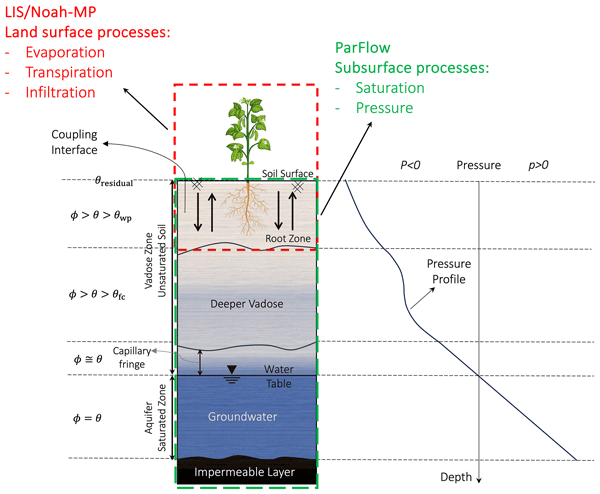
To manage Earth's water resources effectively amid climate change, it is crucial to understand both surface and groundwater processes. We developed a new modeling system that combines two advanced tools, ParFlow and LIS (Land Information System)/Noah-MP, to better simulate both land surface and groundwater interactions. By testing this integrated model in the Upper Colorado River Basin, we found it improves predictions of hydrologic processes, especially in complex terrains.
Robert S. Arthur, Alex Rybchuk, Timothy W. Juliano, Gabriel Rios, Sonia Wharton, Julie K. Lundquist, and Jerome D. Fast
Wind Energ. Sci., 10, 1187–1209, https://doi.org/10.5194/wes-10-1187-2025, https://doi.org/10.5194/wes-10-1187-2025, 2025
Short summary
Short summary
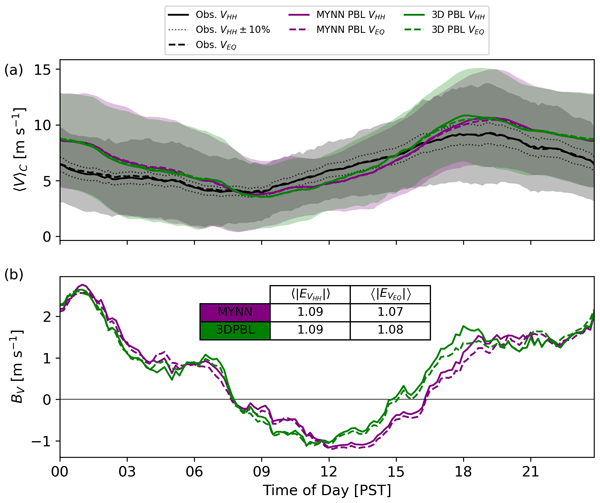
This paper evaluates a new model configuration for wind energy forecasting in complex terrain. We compare model results to observations in the Altamont Pass (California, USA), where wind channeling through a mountain gap leads to increased energy production. We demonstrate that the new model configuration performs similarly to a more established approach, with some evidence of improved wind speed predictions, and provide guidance for future model testing.
Nathan J. Agarwal, Julie K. Lundquist, Timothy W. Juliano, and Alex Rybchuk
Wind Energ. Sci. Discuss., https://doi.org/10.5194/wes-2025-16, https://doi.org/10.5194/wes-2025-16, 2025
Preprint under review for WES
Short summary
Short summary
Models of wind behavior inform offshore wind farm site investment decisions. Here we compare a newly-developed model to another, historically-used, model based on how these models represent winds and turbulence at two North Sea sites. The best model depends on the site. While the older model performs best at the site above a wind farm, the newer model performs best at the site that is at the same altitude as the wind farm. We support using the new model to represent winds at the turbine level.
Ye Liu, Timothy W. Juliano, Raghavendra Krishnamurthy, Brian J. Gaudet, and Jungmin Lee
Wind Energ. Sci., 10, 483–495, https://doi.org/10.5194/wes-10-483-2025, https://doi.org/10.5194/wes-10-483-2025, 2025
Short summary
Short summary
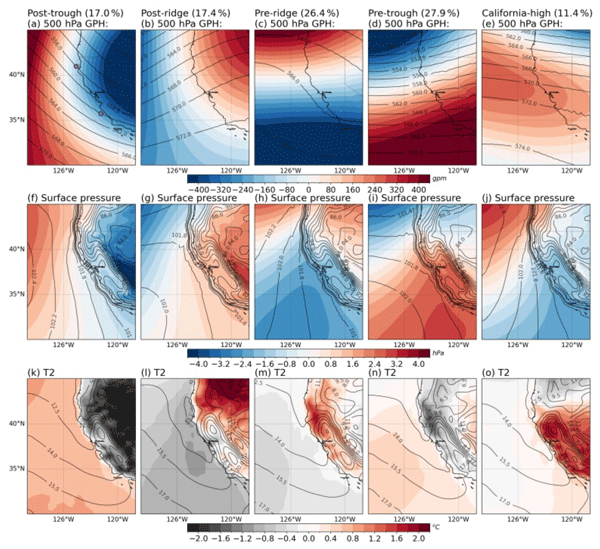
Our study reveals how different weather patterns influence wind conditions off the US West Coast. We identified key weather patterns affecting wind speeds at potential wind farm sites using advanced machine learning. This research helps improve weather prediction models, making wind energy production more reliable and efficient.
Timothy W. Juliano, Fernando Szasdi-Bardales, Neil P. Lareau, Kasra Shamsaei, Branko Kosović, Negar Elhami-Khorasani, Eric P. James, and Hamed Ebrahimian
Nat. Hazards Earth Syst. Sci., 24, 47–52, https://doi.org/10.5194/nhess-24-47-2024, https://doi.org/10.5194/nhess-24-47-2024, 2024
Short summary
Short summary
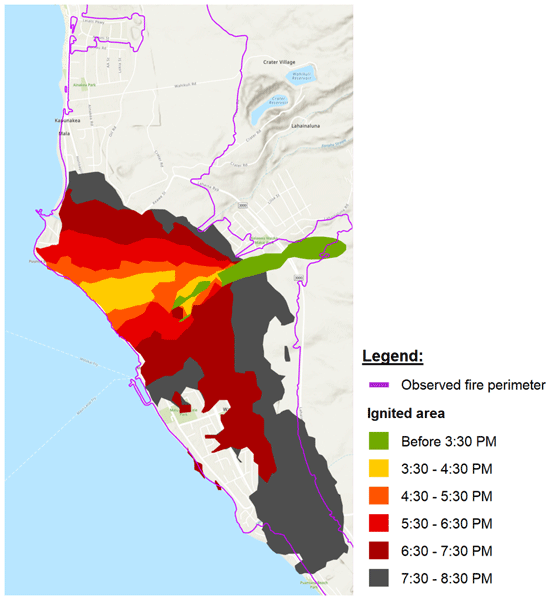
Following the destructive Lahaina Fire in Hawaii, our team has modeled the wind and fire spread processes to understand the drivers of this devastating event. The simulation results show that extreme winds with high variability, a fire ignition close to the community, and construction characteristics led to continued fire spread in multiple directions. Our results suggest that available modeling capabilities can provide vital information to guide decision-making during wildfire events.
Tasnim Zaman, Timothy Juliano, Pat Hawbecker, and Marina Astitha
Wind Energ. Sci. Discuss., https://doi.org/10.5194/wes-2023-148, https://doi.org/10.5194/wes-2023-148, 2024
Preprint withdrawn
Short summary
Short summary
We suggest a model configuration to predict offshore wind speed and wind power density in the Northeast US. We focused on wind droughts, long periods of low wind speed that affect the reliability of wind power generation. We show that wind prediction depends primarily on the initial and boundary conditions, and that it is important to evaluate the connection of wind speed to wind power generation, to select the best model configuration.
Sue Ellen Haupt, Branko Kosović, Larry K. Berg, Colleen M. Kaul, Matthew Churchfield, Jeffrey Mirocha, Dries Allaerts, Thomas Brummet, Shannon Davis, Amy DeCastro, Susan Dettling, Caroline Draxl, David John Gagne, Patrick Hawbecker, Pankaj Jha, Timothy Juliano, William Lassman, Eliot Quon, Raj K. Rai, Michael Robinson, William Shaw, and Regis Thedin
Wind Energ. Sci., 8, 1251–1275, https://doi.org/10.5194/wes-8-1251-2023, https://doi.org/10.5194/wes-8-1251-2023, 2023
Short summary
Short summary
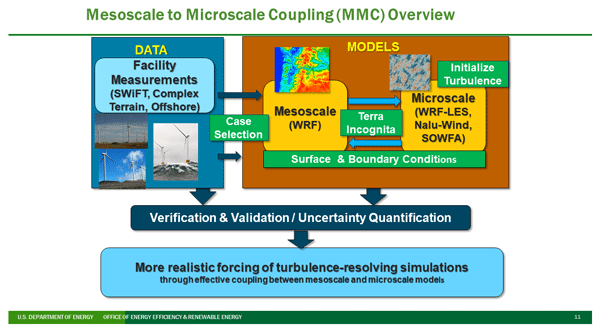
The Mesoscale to Microscale Coupling team, part of the U.S. Department of Energy Atmosphere to Electrons (A2e) initiative, has studied various important challenges related to coupling mesoscale models to microscale models. Lessons learned and discerned best practices are described in the context of the cases studied for the purpose of enabling further deployment of wind energy. It also points to code, assessment tools, and data for testing the methods.
Alex Rybchuk, Timothy W. Juliano, Julie K. Lundquist, David Rosencrans, Nicola Bodini, and Mike Optis
Wind Energ. Sci., 7, 2085–2098, https://doi.org/10.5194/wes-7-2085-2022, https://doi.org/10.5194/wes-7-2085-2022, 2022
Short summary
Short summary
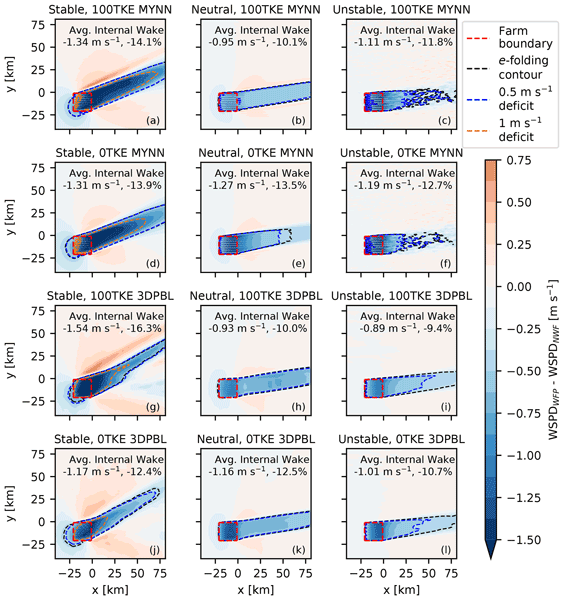
Numerical weather prediction models are used to predict how wind turbines will interact with the atmosphere. Here, we characterize the uncertainty associated with the choice of turbulence parameterization on modeled wakes. We find that simulated wind speed deficits in turbine wakes can be significantly sensitive to the choice of turbulence parameterization. As such, predictions of future generated power are also sensitive to turbulence parameterization choice.
Cited articles
Anderson, H. E.: Aids to determining fuel models for estimating fire behavior, General Technical Report INT-122, USDA Forest Service, Intermountaion Forest and Range Experiment Station, Ogden, Utah 84401, https://doi.org/10.2737/INT-GTR-122, 1982. a, b, c
Andrews, P. L.: The Rothermel surface fire spread model and associated developments: A comprehensive explanation, General Technical Report RMRS-GTR-371, US Department of Agriculture, Forest Service, Rocky Mountain Research Station, Fort Collins, CO, USA, https://doi.org/10.2737/RMRS-GTR-371, 2018. a
Balaji, V., Boville, B., Cheung, S., Clune, T., Collins, N., Craig, T., Cruz, C., da Silva, A., DeLuca, C., de Fainchtein, R., Dunlap, R., Eaton, B., Goldhaber, S., Hallberg, B., Henderson, T., Hill, C., Iredell, M., Jacob, J., Jacob, R., Jones, P., Kauffman, B., Kluzek, E., Koziol, B., Larson, J., Li, P., Liu, F., Michalakes, J., Montuoro, R., Murphy, S., Neckels, D., Kuinghttons, R. O., Oehmke, B., Panaccione, C., Rosen, D., Rosinski, J., Rothstein, M., Sacks, B., Saint, K., Sawyer, W., Schwab, E., Smithline, S., Spector, W., Stark, D., Suarez, M., Swift, S., Theurich, G., Trayanov, A., Vasquez, S., Wolfe, J., Yang, W., Young, M., and Zaslavsky, L.: ESMF Reference Manual for Fortran, Tech. Rep. Version 8.6.0, Earth System Modeling Framework, 2023. a
Bauer, T. P., Holtermann, P., Heinold, B., Radtke, H., Knoth, O., and Klingbeil, K.: ICONGETM v1.0 – flexible NUOPC-driven two-way coupling via ESMF exchange grids between the unstructured-grid atmosphere model ICON and the structured-grid coastal ocean model GETM, Geosci. Model Dev., 14, 4843–4863, https://doi.org/10.5194/gmd-14-4843-2021, 2021. a
Benjamin, S., Weygandt, S., Brown, J., Hu, M., Alexander, C., Smirnova, T., Olson, J., James, E., Dowell, D., Grell, G., Lin, H., Peckham, S., Smith, T., Moninger, W., Kenyon, J., and Manikin, G.: A North American hourly assimilation and model forecast cycle: The Rapid Refresh, Mon. Weather Rev., 144, 1669–1694, https://doi.org/10.1175/MWR-D-15-0242.1, 2016. a
Benjamin, S. G., Grell, G. A., Brown, J. M., and Smirnova, T. G.: Mesoscale weather prediction with the RUC hybrid isentropic-terrain-following coordinate model, Mon. Weather Rev., 132, 473–494, https://doi.org/10.1175/1520-0493(2004)132<0473:MWPWTR>2.0.CO;2, 2004. a
Clark, T. L., Coen, J. L., and Latham, D.: Description of a coupled atmosphere-fire model, International Journal of Wildland Fire, 13, 49–63, https://doi.org/10.1071/WF03043, 2004. a, b
Coen, J.: Modeling Wildland Fires: A Description of the Coupled Atmosphere-Wildland Fire Environment Model (CAWFE), Tech. rep., NCAR Technical Note NCAR/TN-500+STR., Boulder, CO, https://doi.org/10.5065/D6K64G2G, 2013. a, b
Coen, J. L., Cameron, M., Michalakes, J., Patton, E. G., Riggan, P. J., and Yedinak, K. M.: WRF-Fire: coupled weather-wildland fire modeling with the Weather Research and Forecasting model, J. Appl. Meteor. Climatol., 52, 16–38, https://doi.org/10.1175/JAMC-D-12-023.1, 2013. a, b
Dahl, N., Xue, H., Hu, X., and Xue, M.: Coupled fire–atmosphere modeling of wildland fire spread using DEVS-FIRE and ARPS, Nat. Hazards, 77, 1013–1035, https://doi.org/10.1007/s11069-015-1640-y, 2015. a
DeCastro, A. L., Juliano, T. W., Kosovic, B., Ebrahimian, H., and Balch, J. K.: A Computationally Efficient Method for Updating Fuel Inputs for Wildfire Behavior Models Using Sentinel Imagery and Random Forest Classification, Remote Sens., 14, 1447, https://doi.org/10.3390/rs14061447, 2022. a
Dowell, D., Alexander, C., James, E., Weygandt, S., Benjamin, S., Manikin, G., Blake, T., Brown, J., Olson, J., Hu, M., Smirnova, T., Ladwig, T., Kenyon, J., Ahmadov, R., Turner, D. D., Duda, J., and Alcott, T.: The High-Resolution Rapid Refresh (HRRR): An hourly updating convection-allowing forecast model. Part I: Motivation and system description, Weather Forecast., 37, 1371–1395, https://doi.org/10.1175/WAF-D-21-0151.1, 2022. a
Eghdami, M., Jiménez y Muñoz, P. A., and DeCastro, A.: Sensitivity to the representation of wind for wildfire rate of spread: Case Studies with the Community Fire Behavior Model, Fire, 8, 135, https://doi.org/10.3390/fire8040135, 2025. a
Filippi, J.-B., Bosseur, F., Pialar, X., Santoni, P.-A., Strada, S., and Mari, C.: Simulation of coupled fire/atmosphere interactions with MesoNH-ForeFire models, J. Combust., 2011, 540390, https://doi.org/10.1155/2011/540390, 2011. a
Heinzeller, D., Bernardet, L., Firl, G., Zhang, M., Sun, X., and Ek, M.: The Common Community Physics Package (CCPP) Framework v6, Geosci. Model Dev., 16, 2235–2259, https://doi.org/10.5194/gmd-16-2235-2023, 2023. a
Iacono, M. J., S., J., Delamere, Mlawer, E. J., Shephard, M. W., Clough, S. A., and Collins, W. D.: Radiative forcing by long-lived greenhouse gases: Calculations with the AER radiative transfer models, J. Geophys. Res., 113, D13103, https://doi.org/10.1029/2008JD009944, 2008. a
Jiménez, P. A., Munoz-Esparza, D., and Kosovic, B.: A high resolution coupled fireatmosphere system to minimize the impacts of wildland fires: Applications to the chimney Tops II wildland event, Atmosphere, 9, 197, https://doi.org/10.3390/atmos9050197, 2018. a
Jimenez y Munoz, P. A., Eghdami, M., Juliano, T., Frediani, M., and Rosen, D.: NCAR/fire_behavior: v0.2.0+ (v0.2.0+), Zenodo [code], https://doi.org/10.5281/zenodo.13357368, 2026. a
Kochanski, A. K., Clough, K., Farguell, A., Mallia, D. V., Mandel, J., and Hilburn, K.: Analysis of methods for assimilating fire perimeters into a coupled fire–atmosphere model., Front. For. Glob. Change, 6, 1203578, https://doi.org/10.3389/ffgc.2023.1203578, 2023. a
Mallet, V., Reyes, D., and Fendell, E.: Modeling wildland fire propagation with level set methods, Comput. Math. Appl., 57, 1089–1101, https://doi.org/10.1016/j.camwa.2008.10.089, 2009. a
Mandel, J., Amram, S., Beezley, J. D., Kelman, G., Kochanski, A. K., Kondratenko, V. Y., Lynn, B. H., Regev, B., and Vejmelka, M.: Recent advances and applications of WRF–SFIRE, Nat. Hazards Earth Syst. Sci., 14, 2829–2845, https://doi.org/10.5194/nhess-14-2829-2014, 2014. a, b
Olson, J. B., Kenyon, J. S., Djalalova, I., Bianco, L., Turner, D. D., Pichugina, Y., Choukulkar, A., Toy, M. D., Brown, J. M., Angevine, J., Akish, E., Jimenez, J.-W. B. P. A., Kosovic, B., Lundquist, K. A., Draxl, C., Lundquist, J. K., McCaa, J., McCaffrey, K., Lantz, K., Long, C., Wilczack, J., Banta, R., Marquis, M., Redfern, S., Berg, L. K., Shaw, W., and Cline, J.: Improving wind energy forecasting through numerical weather prediction model development, B. Am. Meteorol. Soc., 100, 2201–2220, https://doi.org/10.1175/BAMS-D-18-0040.1, 2019. a
Olson, J. B., Smirnova, T., Kenyon, J. S., Turner, D. D., Brown, J. M., Zheng, W., and Green, B. W.: A description of the MYNN surface layer scheme, NOAA Technical Memorandum OAR GSL-67 26, Global Systems Division Laboratory, Boulder, Colorado, USA, https://doi.org/10.25923/f6a8-bc75, 2021. a
Peace, M., Charney, J., and Bally, J.: Lessons Learned from Coupled Fire–Atmosphere Research and Implications for Operational Fire Prediction and Meteorological Products Provided by the Bureau of Meteorology to Australian Fire Agencies, Atmosphere, 11, 1380, https://doi.org/10.3390/atmos11121380, 2020. a
Scott, J. H. and Burgan, R. E.: Standard fire behavior models: A comprehensive set for use with Rothermel's surface fire spread model, Gen. Tech. Rep. RMRS-GTR-153, USDA Forest Service, Rocky Mountain Research Station, 240 West Prospect Road, Fort Collins, Colorado, 80526, https://doi.org/10.2737/RMRS-GTR-153, 2005. a, b
Skamarock, W. C., Klemp, J. B., Dudhia, J., Gill, D. O., Liu, Z., Berner, J., Wang, W., Powers, J. G., Duda, M. G., Barker, D. M., and Huang, X.-Y.: A description of the advanced research WRF Version 4, Tech. Rep. NCAR/TN-556+STR, NCAR, https://doi.org/10.5065/1dfh-6p97, 2021. a
Sullivan, A. L.: Wildland surface fire spread modelling, 1990-2007. 1: Physical and quasi-physical models, International Journal of Wildland Fire, 18, 349–368, https://doi.org/10.1071/WF06143, 2009a. a
Sullivan, A. L.: Wildland surface fire spread modelling, 1990-2007. 2: empireical and quasi-empirical models, International Journal of Wildland Fire, 18, 369–386, https://doi.org/10.1071/WF06142, 2009b. a
Sullivan, A. L.: Wildland surface fire spread modelling, 1990-2007. 3: Simulation and mathematical analogue models, International Journal of Wildland Fire, 18, 387–403, https://doi.org/10.1071/WF06144, 2009c. a
Sun, R., Subramanian, A. C., Miller, A. J., Mazloff, M. R., Hoteit, I., and Cornuelle, B. D.: SKRIPS v1.0: a regional coupled ocean–atmosphere modeling framework (MITgcm–WRF) using ESMF/NUOPC, description and preliminary results for the Red Sea, Geosci. Model Dev., 12, 4221–4244, https://doi.org/10.5194/gmd-12-4221-2019, 2019. a
Sussman, M., Smereka, P., and Osher, S.: A level set approach for computing solutions to incompressible two-phase flow, J. Comput. Phys., 114, 146–159, https://doi.org/10.1006/jcph.1994.1155, 1994. a
Theurich, G., DeLuca, C., Campbell, T., Liu, F., Saint, K., Vertenstein, M., Chen, J., Oehmke, R., Doyle, J., Whitcomb, T., Wallcraft, A., Iredell, M., Black, T., Silva, A. M. D., Clune, T., Ferraro, R., Li, P., Kelley, M., Aleinov, I., Balaji, V., Zadeh, N., Jacob, R., Kirtman, B., Giraldo, F., McCarren, D., Sandgathe, S., Peckham, S., and Dunlap IV, R.: The Earth system prediction suite: Toward a coordinated U.S. modeling capability, B. Am. Meteorol. Soc., 97, 1229–1247, https://doi.org/10.1175/BAMS-D-14-00164.1, 2016. a
Thompson, G., Field, P. R., Rasmussen, R. M., and Hall, W. D.: Explicit forecasts of winter precipitation using an improved bulk microphysics scheme. Part II: Implementation of a new snow parameterization, Mon. Weather Rev., 136, 5095–5115, https://doi.org/10.1175/2008MWR2387.1, 2008. a
Turney, F. A., Saide, P. E., Jiménez, P. A., Munoz-Esparza, D., Hyer, E. J., Peterson, D. A., Frediani, M. E., Juliano, T. W., DeCastro, A. L., Kosovic, B., Ye, X., and Thapa, L. H.: Sensitivity of burned area and fire radiative power predictions to containment efforts, fuel density, and fuel moisture content using WRF-Fire, J. Geophys. Res., 128, e2023JD038873, https://doi.org/10.1029/2023JD038873, 2023. a
Wilks, D. S.: Statistical Methods in the Atmospheric Sciences, Academic Press, https://doi.org/10.1016/C2017-0-03921-6, 2011. a, b
Wyngaard, J.: Toward numerical modeling in the “Terra Incognita”, J. Atmos. Sci., 22, 1816–1826, https://doi.org/10.1175/1520-0469(2004)061<1816:TNMITT>2.0.CO;2, 2004. a
Short summary
We present the Community Fire Behavior model (CFBM) a fire behavior model designed to facilitate coupling to atmospheric models. We describe its implementation in the Unified Forecast System (UFS). Simulations of the Cameron Peak fire allowed us to verify our implementation. Our vision is to foster collaborative development in fire behavior modeling with the ultimate goal of increasing our fundamental understanding of fire science and minimizing the adverse impacts of wildland fires.
We present the Community Fire Behavior model (CFBM) a fire behavior model designed to facilitate...