Articles | Volume 19, issue 7
https://doi.org/10.5194/gmd-19-2903-2026
Model description paper
 | 
16 Apr 2026
Model description paper |  | 16 Apr 2026

MinSIA v1: a lightweight and efficient implementation of the shallow ice approximation

Stefan Hergarten

Related authors

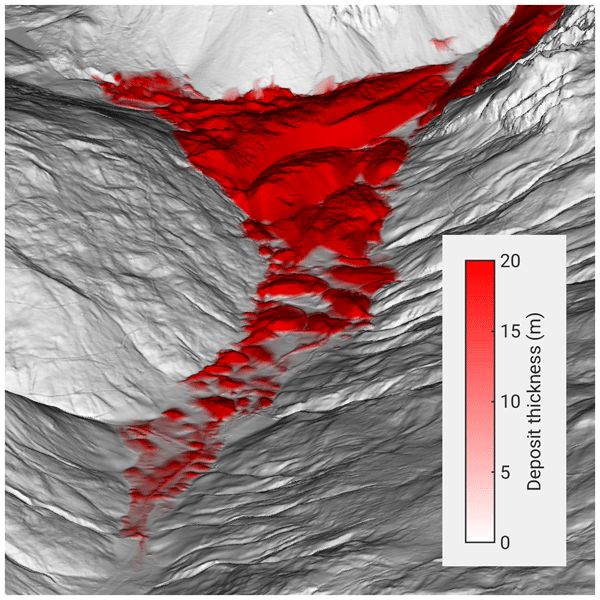
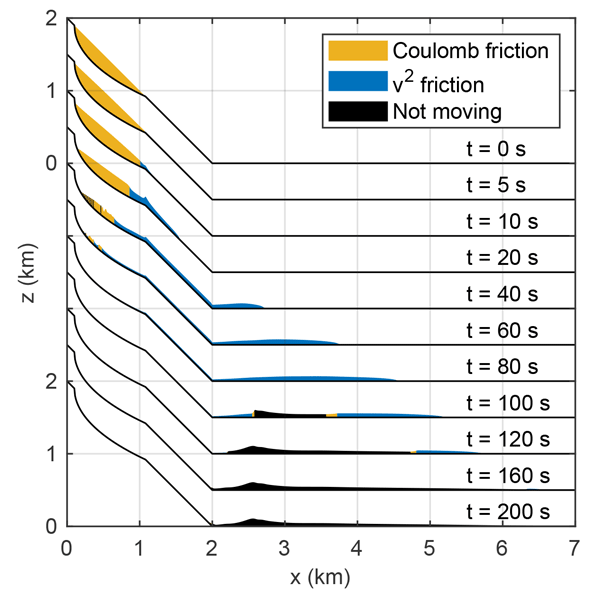
ISeeSnow v1.0 – a pilot study for snow avalanche model intercomparison of thickness-integrated shallow flow approaches and beyond
Anna Wirbel, Felix Oesterle, Guillaume Chambon, Thierry Faug, Johan Gaume, Julia Glaus, Stefan Hergarten, Dieter Issler, Yoichi Ito, Marco Martini, Martin Mergili, Matthias Rauter, Jörg Robl, Giorgio Rosatti, Kae Tsunematsu, Christian Tollinger, Hervé Vicari, Daniel Zugliani, and Jan-Thomas Fischer
EGUsphere, https://doi.org/10.5194/egusphere-2025-6053,https://doi.org/10.5194/egusphere-2025-6053, 2026
This preprint is open for discussion and under review for Geoscientific Model Development (GMD).
Short summary
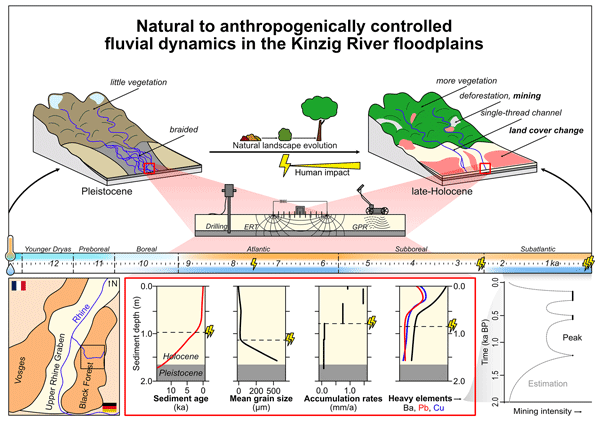
Silts with a human touch: the shift from natural to anthropogenically controlled fluvial dynamics in the Kinzig River floodplains, southwestern Germany
Charlotte E. Engelmann, Frank Preusser, Alexander Fülling, Jakob Wilk, Elisabeth Eiche, Dennis Quandt, Stefan Hergarten, and Jan H. Blöthe
E&G Quaternary Sci. J., 74, 235–262, https://doi.org/10.5194/egqsj-74-235-2025,https://doi.org/10.5194/egqsj-74-235-2025, 2025
Short summary
Brief Communication: Investigating the invisible subsurface stormflow process through a thorough and systematic study across sites and scales
Theresa Blume, Peter Chifflard, Stefan Achleitner, Andreas Hartmann, Stefan Hergarten, Luisa Hopp, Bernhard Kohl, Florian Leese, Ilja van Meerveld, Christian Reinhardt-Imjela, and Markus Weiler
EGUsphere, https://doi.org/10.5194/egusphere-2025-4424,https://doi.org/10.5194/egusphere-2025-4424, 2025
Short summary
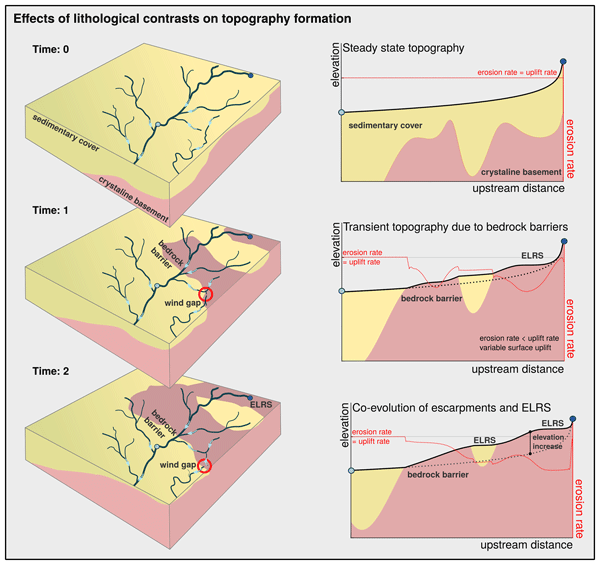
Old orogen–young topography: lithological contrasts controlling erosion and relief formation in the Bohemian Massif
Jörg Robl, Fabian Dremel, Kurt Stüwe, Stefan Hergarten, Christoph von Hagke, and Derek Fabel
Earth Surf. Dynam., 13, 745–770, https://doi.org/10.5194/esurf-13-745-2025,https://doi.org/10.5194/esurf-13-745-2025, 2025
Short summary
A simple model for faceted topographies at normal faults based on an extended stream-power law
Stefan Hergarten
Earth Surf. Dynam., 12, 1315–1327, https://doi.org/10.5194/esurf-12-1315-2024,https://doi.org/10.5194/esurf-12-1315-2024, 2024
Short summary

Cited articles

Bindschadler, R.: The importance of pressurized subglacial water in separation and sliding at the glacier bed, J. Glaciol., 29, 9–19, https://doi.org/10.3189/S0022143000005104, 1983. a, b
Braun, J., Zwartz, D., and Tomkin, J. H.: A new surface-processes model combining glacial and fluvial erosion, Ann. Glaciol., 28, 282–290, https://doi.org/10.3189/172756499781821797, 1999. a, b, c
Bueler, E.: Stable finite volume element schemes for the shallow-ice approximation, J. Glaciol., 62, 230–242, https://doi.org/10.1017/jog.2015.3, 2016. a
Bueler, E.: Performance analysis of high-resolution ice-sheet simulations, J. Glaciol., 69, 930–935, https://doi.org/10.1017/jog.2022.113, 2023. a
Bueler, E. and Brown, J.: Shallow shelf approximation as a “sliding law” in a thermomechanically coupled ice sheet model, J. Geophys. Res.-Earth, 114, F03008, https://doi.org/10.1029/2008JF001179, 2009. a
Download
Short summary
Numerical glacier and ice-sheet models have been widely used in the context of climate change and landform evolution. While simulations of ice flow were numerically expensive for a long time, their performance has recently been boosted to an unprecedented level by machine learning techniques. This paper aims at keeping classical numerics competitive by introducing a novel numerical scheme, which allows for simulations at spatial resolutions of 25 m or even finer on standard desktop PCs.
Share