
Articles | Volume 19, issue 1
https://doi.org/10.5194/gmd-19-289-2026
© Author(s) 2026. This work is distributed under
the Creative Commons Attribution 4.0 License.
the Creative Commons Attribution 4.0 License.
https://doi.org/10.5194/gmd-19-289-2026
© Author(s) 2026. This work is distributed under
the Creative Commons Attribution 4.0 License.
the Creative Commons Attribution 4.0 License.
Model description paper
| 
08 Jan 2026
Model description paper |
| 08 Jan 2026
| 08 Jan 2026
Modeling supercritical CO2 flow and mineralization in reactive host rocks with PFLOTRAN v7.0

Earth Systems Science Division, Pacific Northwest National Laboratory, Richland, WA, USA
ResFrac Corporation, Denver, CO, USA
Katherine A. Muller
Earth Systems Science Division, Pacific Northwest National Laboratory, Richland, WA, USA
Glenn Hammond
Earth Systems Science Division, Pacific Northwest National Laboratory, Richland, WA, USA
Xiaoliang He
Earth Systems Science Division, Pacific Northwest National Laboratory, Richland, WA, USA
Peter Lichtner
The University of New Mexico, Albuquerque, NM, USA
Related authors
Ethan W. Conley, Jennifer M. Frederick, A. Christian Stanciu, Robert E. Abbott, Michael G. Baker, David Fukuyama, and Michael A. Nole
EGUsphere, https://doi.org/10.5194/egusphere-2025-5529, https://doi.org/10.5194/egusphere-2025-5529, 2026
Short summary
Short summary
This study uses eighteen thermodynamic simulations along a seafloor fiber-optic cable transect offshore Oliktok Point, Alaska, to refine the extent of submarine permafrost on the U.S. Beaufort Shelf. Results suggest prior geophysical estimates may have been conservative and that permafrost may extend farther offshore. Previously identified deep high-resistivity zones likely indicate trapped hydrocarbons, and modeled temperatures support calibration of Distributed Temperature Sensing data.
Michael Nole, Jonah Bartrand, Fawz Naim, and Glenn Hammond
Geosci. Model Dev., 18, 1413–1425, https://doi.org/10.5194/gmd-18-1413-2025, https://doi.org/10.5194/gmd-18-1413-2025, 2025
Short summary
Short summary
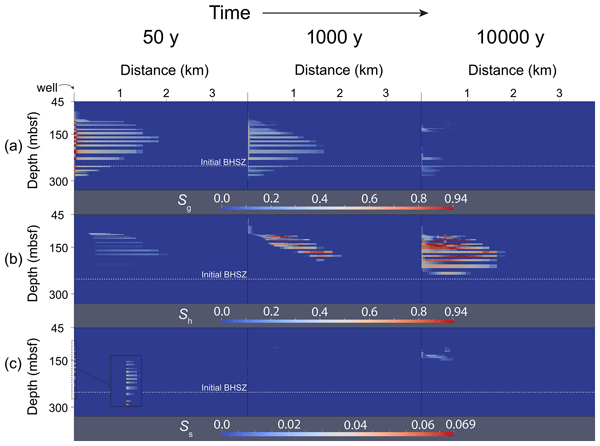
Safe carbon dioxide (CO2) storage is likely to be critical for mitigating some of the most severe effects of climate change. We present a simulation framework for modeling CO2 storage beneath the seafloor, where CO2 can form a solid. This can aid in permanent CO2 storage for long periods of time. Our models show what a commercial-scale CO2 injection would look like in a marine environment. We discuss what would need to be considered when designing a subsea CO2 injection.
Ethan W. Conley, Jennifer M. Frederick, A. Christian Stanciu, Robert E. Abbott, Michael G. Baker, David Fukuyama, and Michael A. Nole
EGUsphere, https://doi.org/10.5194/egusphere-2025-5529, https://doi.org/10.5194/egusphere-2025-5529, 2026
Short summary
Short summary
This study uses eighteen thermodynamic simulations along a seafloor fiber-optic cable transect offshore Oliktok Point, Alaska, to refine the extent of submarine permafrost on the U.S. Beaufort Shelf. Results suggest prior geophysical estimates may have been conservative and that permafrost may extend farther offshore. Previously identified deep high-resistivity zones likely indicate trapped hydrocarbons, and modeled temperatures support calibration of Distributed Temperature Sensing data.
Sergi Molins, Benjamin J. Andre, Jeffrey N. Johnson, Glenn E. Hammond, Benjamin N. Sulman, Konstantin Lipnikov, Marcus S. Day, James J. Beisman, Daniil Svyatsky, Hang Deng, Peter C. Lichtner, Carl I. Steefel, and J. David Moulton
Geosci. Model Dev., 18, 3241–3263, https://doi.org/10.5194/gmd-18-3241-2025, https://doi.org/10.5194/gmd-18-3241-2025, 2025
Short summary
Short summary
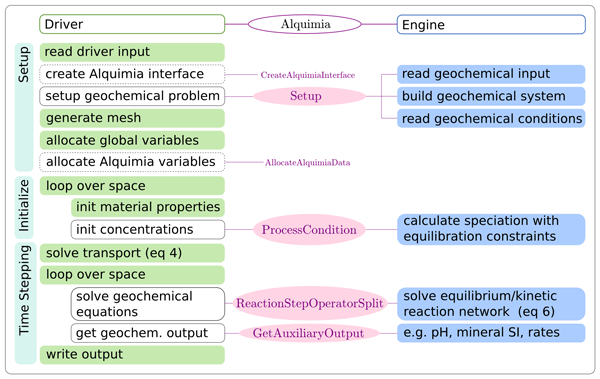
Developing scientific software and making sure it functions properly requires a significant effort. As we advance our understanding of natural systems, however, there is the need to develop yet more complex models and codes. In this work, we present a piece of software that facilitates this work, specifically with regard to reactive processes. Existing tried-and-true codes are made available via this new interface, freeing up resources to focus on the new aspects of the problems at hand.
Michael Nole, Jonah Bartrand, Fawz Naim, and Glenn Hammond
Geosci. Model Dev., 18, 1413–1425, https://doi.org/10.5194/gmd-18-1413-2025, https://doi.org/10.5194/gmd-18-1413-2025, 2025
Short summary
Short summary
Safe carbon dioxide (CO2) storage is likely to be critical for mitigating some of the most severe effects of climate change. We present a simulation framework for modeling CO2 storage beneath the seafloor, where CO2 can form a solid. This can aid in permanent CO2 storage for long periods of time. Our models show what a commercial-scale CO2 injection would look like in a marine environment. We discuss what would need to be considered when designing a subsea CO2 injection.
Katherine A. Muller, Peishi Jiang, Glenn Hammond, Tasneem Ahmadullah, Hyun-Seob Song, Ravi Kukkadapu, Nicholas Ward, Madison Bowe, Rosalie K. Chu, Qian Zhao, Vanessa A. Garayburu-Caruso, Alan Roebuck, and Xingyuan Chen
Geosci. Model Dev., 17, 8955–8968, https://doi.org/10.5194/gmd-17-8955-2024, https://doi.org/10.5194/gmd-17-8955-2024, 2024
Short summary
Short summary
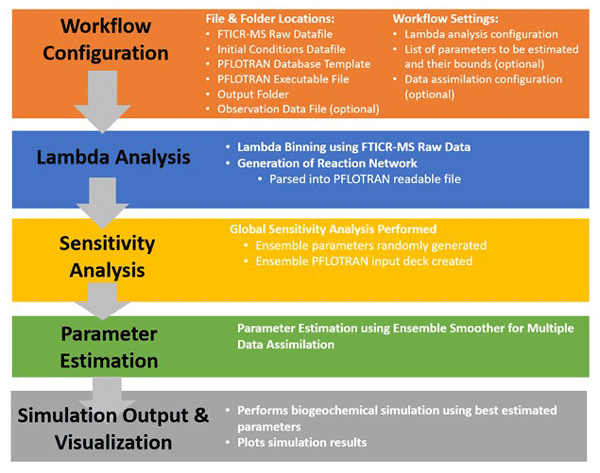
The new Lambda-PFLOTRAN workflow incorporates organic matter chemistry into reaction networks to simulate aerobic respiration and biogeochemistry. Lambda-PFLOTRAN is a Python-based workflow in a Jupyter notebook interface that digests raw organic matter chemistry data via Fourier transform ion cyclotron resonance mass spectrometry, develops a representative reaction network, and completes a biogeochemical simulation with the open-source, parallel-reactive-flow, and transport code PFLOTRAN.
Piyoosh Jaysaval, Glenn E. Hammond, and Timothy C. Johnson
Geosci. Model Dev., 16, 961–976, https://doi.org/10.5194/gmd-16-961-2023, https://doi.org/10.5194/gmd-16-961-2023, 2023
Short summary
Short summary
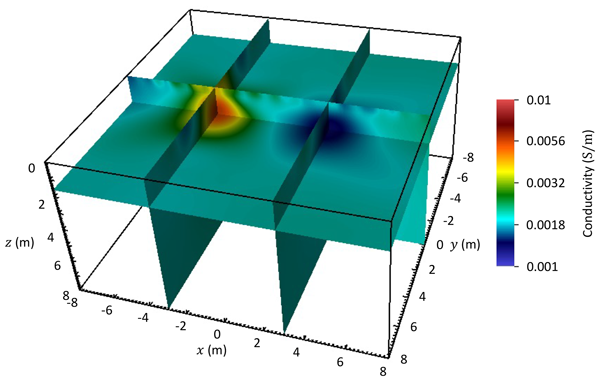
We present a robust and highly scalable implementation of numerical forward modeling and inversion algorithms for geophysical electrical resistivity tomography data. The implementation is publicly available and developed within the framework of PFLOTRAN (http://www.pflotran.org), an open-source, state-of-the-art massively parallel subsurface flow and transport simulation code. The paper details all the theoretical and implementation aspects of the new capabilities along with test examples.

Glenn E. Hammond
Geosci. Model Dev., 15, 1659–1676, https://doi.org/10.5194/gmd-15-1659-2022, https://doi.org/10.5194/gmd-15-1659-2022, 2022
Short summary
Short summary
This paper describes a simplified interface for implementing and testing new chemical reactions within the reactive transport simulator PFLOTRAN. The paper describes the interface, providing example code for the interface. The paper includes several chemical reactions implemented through the interface.
Cited articles
Alendal, G. and Drange, H.: Two-phase, near-field modeling of purposefully released CO2 in the ocean, Journal of Geophysical Research: Oceans, 106, 1085–1096, 2001. a
Bartlett, R.: Solution mining: Leaching and fluid recovery of materials, Routledge, https://doi.org/10.4324/9780203357613, 2013. a
Bashir, A., Ali, M., Patil, S., Aljawad, M. S., Mahmoud, M., Al-Shehri, D., Hoteit, H., and Kamal, M. S.: Comprehensive review of CO2 geological storage: Exploring principles, mechanisms, and prospects, Earth-Science Reviews, 249, 104672, https://doi.org/10.1016/j.earscirev.2023.104672, 2024. a
Belgodere, C., Dubessy, J., Vautrin, D., Caumon, M.-C., Sterpenich, J., Pironon, J., Robert, P., Randi, A., and Birat, J.-P.: Experimental determination of CO2 diffusion coefficient in aqueous solutions under pressure at room temperature via Raman spectroscopy: impact of salinity (NaCl), Journal of Raman Spectroscopy, 46, 1025–1032, 2015. a
Bromley, L. A.: Thermodynamic properties of strong electrolytes in aqueous solutions, AIChE Journal, 19, 313–320, 1973. a
Cadogan, S. P., Maitland, G. C., and Trusler, J. M.: Diffusion coefficients of CO2 and N2 in water at temperatures between 298.15 K and 423.15 K at pressures up to 45 MPa, Journal of Chemical & Engineering Data, 59, 519–525, 2014. a
Fayer, M. J. and Simmons, C. S.: Modified soil water retention functions for all matric suctions, Water Resources Research, 31, 1233–1238, 1995. a
Fenghour, A., Wakeham, W. A., and Vesovic, V.: The viscosity of carbon dioxide, Journal of Physical and Chemical Reference Data, 27, 31–44, 1998. a
Haas, J. L.: Physical properties of the coexisting phases and thermochemical properties of the H_2O component in boiling NaCl solution, Geol. Surv. Bull., A, 1421, 73, https://pubs.usgs.gov/bul/1421a/report.pdf (last access: 18 December 2025), 1976. a
Harvey, O. R., Qafoku, N. P., Cantrell, K. J., Lee, G., Amonette, J. E., and Brown, C. F.: Geochemical implications of gas leakage associated with geologic CO2 storage: A qualitative review, Environmental Science & Technology, 47, 23–36, 2013. a
Kaluarachchi, J. J. and Parker, J.: Multiphase flow with a simplified model for oil entrapment, Transport in Porous Media, 7, 1–14, 1992. a
Lichtner, P. C.: Continuum model for simultaneous chemical reactions and mass transport in hydrothermal systems, Geochimica et Cosmochimica Acta, 49, 779–800, https://doi.org/10.1016/0016-7037(85)90172-3, 1985. a
Matter, J. M., Broecker, W. S., Gislason, S. R., Gunnlaugsson, E., Oelkers, E. H., Stute, M., Sigurdardóttir, H., Stefansson, A., Alfreðsson, H. A., Aradóttir, E. S., and Axelsson, G.: The CarbFix Pilot Project–storing carbon dioxide in basalt, Energy Procedia, 4, 5579–5585, 2011. a
Michaelides, E.: Thermodynamic properties of geothermal fluids, Trans.-Geotherm. Resour. Counc. (United States), 5, 361–364, 1981. a
Millington, R. and Quirk, J.: Permeability of porous media, Nature, 183, 387–388, 1959. a
Nitao, J. J.: Numerical modeling of the thermal and hydrological environment around a nuclear waste package using the equivalent continuum approximation: horizontal emplacement, Tech. rep., Lawrence Livermore National Lab., https://inis.iaea.org/records/x2yc8-b8g13/files/20038045.pdf (last access: 18 December 2025), 1988. a
Nole, M., Bartrand, J., Naim, F., and Hammond, G.: Modeling commercial-scale CO2 storage in the gas hydrate stability zone with PFLOTRAN v6.0, Geosci. Model Dev., 18, 1413–1425, https://doi.org/10.5194/gmd-18-1413-2025, 2025a. a
Nole, M., Muller, K., Hammond, G., He, X., and Lichtner, P.: Modeling Supercritical CO2 Flow and Mineralization in Reactive Host Rocks with PFLOTRAN v7.0: Data, Zenodo [data set], https://doi.org/10.5281/zenodo.14969297, 2025b. a, b, c, d
Nordbotten, J. M., Ferno, M. A., Flemisch, B., Kovscek, A. R., and Lie, K.-A.: The 11th Society of Petroleum Engineers Comparative Solution Project: Problem Definition, SPE Journal, 29, 2507–2524, 2024. a
Nordbotten, J. M., Fernø, M. A., Flemisch, B., Kovscek, A. R., Lie, K.-A., Both, J. W., Møyner, O., Sandve, T. H., Ahusborde, E., Bauer, S., Chen, Z., Class, H., Di, C., Ding, D., Element, D., Flauraud, E., Franc, J., Gasanzade, F., Ghomian, Y., Giddins, M. A., Green, C., Fernandes, B. R., Hadjisotiriou, G., Hammond, G., Huang, H., Kachuma, D., Kern, M., Koch, T., Krishnamurthy, P., Lye, K. O., Landa-Marbán, D., Nole, M., Orsini, P., Ruby, N., Salinas, P., Sayyafzadeh, M., Torben, J., Turner, A., Voskov, D. V., Wendel, K., and Youssef, A. A.: Benchmarking CO2 storage simulations: Results from the 11th Society of Petroleum Engineers Comparative Solution Project, International Journal of Greenhouse Gas Control, 148, 104519, https://doi.org/10.1016/j.ijggc.2025.104519, 2025. a
Parker, J. and Lenhard, R.: A model for hysteretic constitutive relations governing multiphase flow: 1. Saturation-pressure relations, Water Resources Research, 23, 2187–2196, 1987. a
Patankar, S.: Numerical heat transfer and fluid flow, CRC Press, https://doi.org/10.1201/9781482234213, 2018. a
Paul, M. J., Park, H. D., Nole, M., and Painter, S. L.: Modeling Geologic Waste Repository Systems Below Residual Saturation, Nuclear Technology, 210, 1578–1592, https://doi.org/10.1080/00295450.2023.2262294, 2024. a
Peaceman, D. W.: Interpretation of well-block pressures in numerical reservoir simulation (includes associated paper 6988), Society of Petroleum Engineers Journal, 18, 183–194, 1978. a
Peaceman, D. W.: Interpretation of well-block pressures in numerical reservoir simulation with nonsquare grid blocks and anisotropic permeability, Society of Petroleum Engineers Journal, 23, 531–543, 1983. a
Pogge von Strandmann, P. A., Burton, K. W., Snæbjörnsdóttir, S. O., Sigfússon, B., Aradóttir, E. S., Gunnarsson, I., Alfredsson, H. A., Mesfin, K. G., Oelkers, E. H., and Gislason, S. R.: Rapid CO2 mineralisation into calcite at the CarbFix storage site quantified using calcium isotopes, Nature Communications, 10, 1983, https://doi.org/10.1038/s41467-019-10003-8, 2019. a
Pruess, K.: On production behavior of enhanced geothermal systems with CO2 as working fluid, Energy Conversion and Management, 49, 1446–1454, 2008. a
Pruess, K., Oldenburg, C. M., and Moridis, G.: TOUGH2 user's guide version 2, Lawrence Berkeley National Laboratory, https://escholarship.org/uc/item/4df6700h (last access: 18 December 2025), 1999. a
Pruess, K., Garcia, J., Kovscek, T., Oldenburg, C., Rutqvist, J., Steefel, C., and Xu, T.: Intercomparison of numerical simulation codes for geologic disposal of CO2, Tech. rep., Lawrence Berkeley National Laboratory, LBNL-51813, Berkeley, California, https://escholarship.org/uc/item/0kv4m82z (last access: 18 December 2025), 2002. a, b, c, d, e
Raza, A., Glatz, G., Gholami, R., Mahmoud, M., and Alafnan, S.: Carbon mineralization and geological storage of CO2 in basalt: Mechanisms and technical challenges, Earth-Science Reviews, 229, 104036, https://doi.org/10.1016/j.earscirev.2022.104036, 2022. a
Sambo, C., Liu, N., Shaibu, R., Ahmed, A. A., and Hashish, R. G.: A technical review of CO2 for enhanced oil recovery in unconventional oil reservoirs, Geoenergy Science and Engineering, 221, 111185, https://doi.org/10.1016/j.petrol.2022.111185, 2023. a
Shu, J.: Comparison of various techniques for computing well index, Master’s Report, Stanford University, https://stacks.stanford.edu/file/druid:xk906gg6034/Shu05.pdf (last access: 18 December 2025), 2005. a
Spycher, N. and Pruess, K.: A phase-partitioning model for CO 2–brine mixtures at elevated temperatures and pressures: application to CO 2-enhanced geothermal systems, Transport in Porous Media, 82, 173–196, 2010. a
Spycher, N., Pruess, K., and Ennis-King, J.: CO2-H2O mixtures in the geological sequestration of CO2. I. Assessment and calculation of mutual solubilities from 12 to 100 C and up to 600 bar, Geochimica et Cosmochimica Acta, 67, 3015–3031, 2003. a
Stanfield, C. H., Miller, Q. R., Battu, A. K., Lahiri, N., Nagurney, A. B., Cao, R., Nienhuis, E. T., DePaolo, D. J., Latta, D. E., and Schaef, H. T.: Carbon Mineralization and Critical Mineral Resource Evaluation Pathways for Mafic–Ultramafic Assets, ACS Earth and Space Chemistry, https://doi.org/10.1021/acsearthspacechem.4c00005, 2024. a
Verma, A. and Pruess, K.: Thermohydrological conditions and silica redistribution near high-level nuclear wastes emplaced in saturated geological formations, Journal of Geophysical Research: Solid Earth, 93, 1159–1173, 1988. a
Webb, S. W.: A simple extension of two-phase characteristic curves to include the dry region, Water Resources Research, 36, 1425–1430, 2000. a
White, M. D., Bacon, D. H., McGrail, B. P., Watson, D. J., White, S. K., and Zhang, Z.: STOMP subsurface transport over multiple phases: STOMP-CO2 and STOMP-CO2e guide: version 1.0, Tech. rep., Pacific Northwest National Lab.(PNNL), Richland, WA (United States), https://doi.org/10.2172/1059044, 2012. a, b
White, M. D., Bacon, D. H., White, S. K., and Zhang, Z.: Fully coupled well models for fluid injection and production, Energy Procedia, 37, 3960–3970, 2013. a
Wu, Y. and Li, P.: The potential of coupled carbon storage and geothermal extraction in a CO2-enhanced geothermal system: a review, Geothermal Energy, 8, 19, https://doi.org/10.1186/s40517-020-00173-w, 2020. a
Short summary
Subsurface injection of carbon dioxide (CO2) can be used for a variety of purposes including geologic carbon storage and enhanced oil recovery. Recently, CO2 injection into reactive host rocks has been explored as a way to transform CO2 into dense solid minerals. We present a simulation framework for modeling flow of CO2 due to injection and subsequent reactions that take place to mineralize CO2.
Subsurface injection of carbon dioxide (CO2) can be used for a variety of purposes including...


