
Articles | Volume 19, issue 7
https://doi.org/10.5194/gmd-19-2799-2026
© Author(s) 2026. This work is distributed under
the Creative Commons Attribution 4.0 License.
the Creative Commons Attribution 4.0 License.
https://doi.org/10.5194/gmd-19-2799-2026
© Author(s) 2026. This work is distributed under
the Creative Commons Attribution 4.0 License.
the Creative Commons Attribution 4.0 License.
Model description paper
| 
13 Apr 2026
Model description paper |
| 13 Apr 2026
| 13 Apr 2026
High-performance coupled surface-subsurface flow simulation with SERGHEI-SWE-RE
Na Zheng
College of Civil Engineering, Tongji University, Shanghai, China

College of Civil Engineering, Tongji University, Shanghai, China
Shanghai Key Laboratory of Urban Regeneration and Spatial Optimization Technology, Shanghai, China
Gregor Rickert
Institute of Geoecology, Technische Universität Braunschweig, Brunswick, Germany
Mario Morales-Hernández
Fluid Mechanics, I3A, Universidad de Zaragoza, Zaragoza, Spain
Ilhan Özgen-Xian
Institute of Geoecology, Technische Universität Braunschweig, Brunswick, Germany
Leichtweiß-Institute for Hydraulic Engineering and Water Resources, Technische Universität Braunschweig, Brunswick, Germany
Daniel Caviedes-Voullième
Simulation and Data Lab Terrestrial Systems, Jülich Supercomputing Centre, Forschungszentrum Jülich, Jülich, Germany
Institute of Bio- and Geosciences Agrosphere (IBG-3), Forschungszentrum Jülich, Jülich, Germany
Related authors
Zhi Li, Gregor Rickert, Na Zheng, Zhibo Zhang, Ilhan Özgen-Xian, and Daniel Caviedes-Voullième
Geosci. Model Dev., 18, 547–562, https://doi.org/10.5194/gmd-18-547-2025, https://doi.org/10.5194/gmd-18-547-2025, 2025
Short summary
Short summary
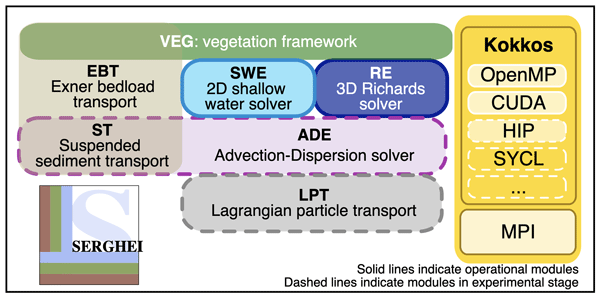
We introduce SERGHEI-RE, a 3D subsurface flow simulator with performance-portable parallel computing capabilities. SERGHEI-RE performs effectively on various computational devices: from personal computers to advanced clusters. It allows users to solve flow equations with multiple numerical schemes, making it adaptable to various hydrological scenarios. Testing results show its accuracy and performance, confirming that SERGHEI-RE is a powerful tool for hydrological research.
Lucas Mondon, Nicolas Martin-StPaul, Gregor Rickert, Isabelle Maréchaux, Arsène Druel, Quentin Chaffaut, Damien Jougnot, Nicolas Delpierre, Marc Pessel, Ilhan Özgen-Xian, Hervé Cochard, and Simon D. Carrière
EGUsphere, https://doi.org/10.5194/egusphere-2026-5115, https://doi.org/10.5194/egusphere-2026-5115, 2026
This preprint is open for discussion and under review for Biogeosciences (BG).
Short summary
Short summary
By calibrating a plant hydraulic model with fine-root distribution, we show that root distribution is a key determinant of drought resistance, with an influence comparable to other hydraulic traits. A “rare-root strategy” emerges as a balanced solution between accessing and conserving deep water reserves.
Shahin Khosh Bin Ghomash and Daniel Caviedes-Voullième
EGUsphere, https://doi.org/10.5194/egusphere-2026-3652, https://doi.org/10.5194/egusphere-2026-3652, 2026
This preprint is open for discussion and under review for Natural Hazards and Earth System Sciences (NHESS).
Short summary
Short summary
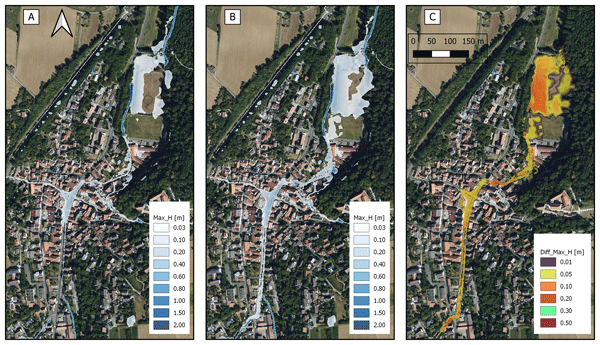
Forecasting river floods has long required chaining two separate computer models: one converting rainfall into river flow, another simulating the flooding. We tested whether a single high-resolution physics-based model, driven directly by rainfall, can replace this chain. Applied to the catastrophic 2021 Ahr valley flood, it reproduced the observed flood extent and water depths accurately across an entire catchment, fast enough on supercomputers for early warning.
Leon Frederik De Vos, Karan Mahajan, Daniel Caviedes-Voullième, and Nils Rüther
Nat. Hazards Earth Syst. Sci., 26, 2319–2352, https://doi.org/10.5194/nhess-26-2319-2026, https://doi.org/10.5194/nhess-26-2319-2026, 2026
Short summary
Short summary
In this study, we assess the impact of culvert blockages on flash flood dynamics. Applying the 2D Shallow Water Equations, we model multiple flash flood and blockage scenarios within a steep catchment in central Germany. The results emphasize the need for accurate culvert representation in hydrodynamic models and demonstrate how scenario-based blockage modeling can support the identification of critical infrastructure and the development of targeted mitigation measures.
Stefan Poll, Paul Rigor, Slavko Brdar, Ha Thi Minh Ho-Hagemann, Carl Hartick, Marco van Hulten, Ana Gonzalez-Nicolas, Johannes Keller, Daniel Caviedes-Voullieme, Harrie-Jan Hendricks-Franssen, Klaus Goergen, and Stefan Kollet
EGUsphere, https://doi.org/10.5194/egusphere-2025-5468, https://doi.org/10.5194/egusphere-2025-5468, 2025
This preprint is open for discussion and under review for Natural Hazards and Earth System Sciences (NHESS).
Short summary
Short summary
This paper presents TSMP2, a new version of an regional Earth system model that allows to simulate and analyze the complex interactions within terrestrial ecosystems from groundwater to atmosphere. TSMP2 links an atmospheric, a land surface model and an hydrological model through an external coupler and is fully open-source. We describe the TSMP2 model system, present the impact of coupling approaches, and outline our development strategy along with technical and performance aspects.
Pablo Vallés, Mario Morales-Hernández, Volker Roeber, Pilar García-Navarro, and Daniel Caviedes-Voullième
Geosci. Model Dev., 18, 7399–7416, https://doi.org/10.5194/gmd-18-7399-2025, https://doi.org/10.5194/gmd-18-7399-2025, 2025
Short summary
Short summary
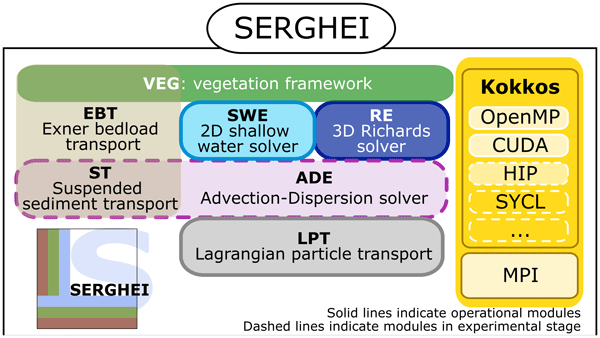
This study presents a computational model for passive particle transport in water. The particles' trajectories depend on advection and turbulence, represented by a random-walk model. Three numerical methods are compared to estimate their trajectory, evaluating accuracy and computational cost. Tests show that the Euler method offers the best balance. Finally, a rainfall event in a catchment is simulated to validate the model's performance over irregular terrain.
Zhi Li, Gregor Rickert, Na Zheng, Zhibo Zhang, Ilhan Özgen-Xian, and Daniel Caviedes-Voullième
Geosci. Model Dev., 18, 547–562, https://doi.org/10.5194/gmd-18-547-2025, https://doi.org/10.5194/gmd-18-547-2025, 2025
Short summary
Short summary
We introduce SERGHEI-RE, a 3D subsurface flow simulator with performance-portable parallel computing capabilities. SERGHEI-RE performs effectively on various computational devices: from personal computers to advanced clusters. It allows users to solve flow equations with multiple numerical schemes, making it adaptable to various hydrological scenarios. Testing results show its accuracy and performance, confirming that SERGHEI-RE is a powerful tool for hydrological research.
Zhi Li, Hanqi Li, Zhibo Zhang, Chaomeng Dai, and Simin Jiang
Nat. Hazards Earth Syst. Sci., 24, 3977–3990, https://doi.org/10.5194/nhess-24-3977-2024, https://doi.org/10.5194/nhess-24-3977-2024, 2024
Short summary
Short summary
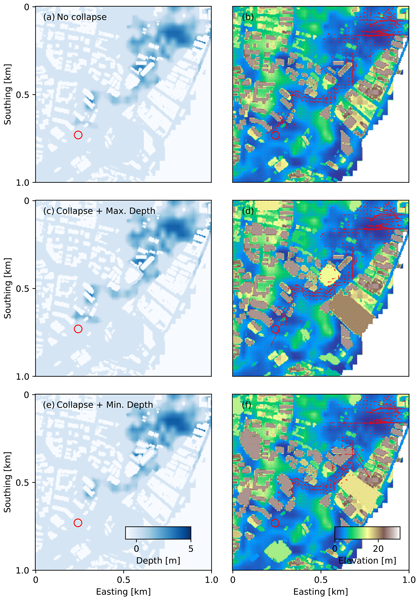
This study used advanced computer simulations to investigate how earthquake-induced building collapse affects flooding of the metro stations in Shanghai. Results show that the influences of building collapse on rainfall-driven and river-driven floods are different because these two types of floods have different origination and propagation mechanisms.
Shahin Khosh Bin Ghomash, Heiko Apel, and Daniel Caviedes-Voullième
Nat. Hazards Earth Syst. Sci., 24, 2857–2874, https://doi.org/10.5194/nhess-24-2857-2024, https://doi.org/10.5194/nhess-24-2857-2024, 2024
Short summary
Short summary
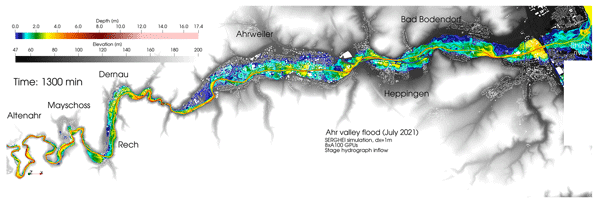
Early warning is essential to minimise the impact of flash floods. We explore the use of highly detailed flood models to simulate the 2021 flood event in the lower Ahr valley (Germany). Using very high-resolution models resolving individual streets and buildings, we produce detailed, quantitative, and actionable information for early flood warning systems. Using state-of-the-art computational technology, these models can guarantee very fast forecasts which allow for sufficient time to respond.
Denise Degen, Daniel Caviedes Voullième, Susanne Buiter, Harrie-Jan Hendricks Franssen, Harry Vereecken, Ana González-Nicolás, and Florian Wellmann
Geosci. Model Dev., 16, 7375–7409, https://doi.org/10.5194/gmd-16-7375-2023, https://doi.org/10.5194/gmd-16-7375-2023, 2023
Short summary
Short summary
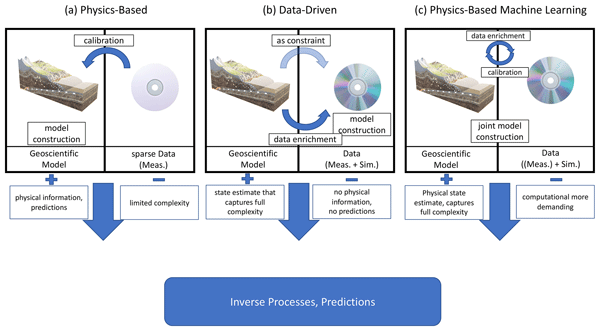
In geosciences, we often use simulations based on physical laws. These simulations can be computationally expensive, which is a problem if simulations must be performed many times (e.g., to add error bounds). We show how a novel machine learning method helps to reduce simulation time. In comparison to other approaches, which typically only look at the output of a simulation, the method considers physical laws in the simulation itself. The method provides reliable results faster than standard.
Zbigniew P. Piotrowski, Jaro Hokkanen, Daniel Caviedes-Voullieme, Olaf Stein, and Stefan Kollet
EGUsphere, https://doi.org/10.5194/egusphere-2023-1079, https://doi.org/10.5194/egusphere-2023-1079, 2023
Preprint withdrawn
Short summary
Short summary
The computer programs capable of simulation of Earth system components evolve, adapting new fundamental science concepts and more observational data on more and more powerful computer hardware. Adaptation of a large scientific program to a new type of hardware is costly. In this work we propose cheap and simple but effective strategy that enable computation using graphic processing units, based on automated program code modification. This results in better resolution and/or longer predictions.
Daniel Caviedes-Voullième, Mario Morales-Hernández, Matthew R. Norman, and Ilhan Özgen-Xian
Geosci. Model Dev., 16, 977–1008, https://doi.org/10.5194/gmd-16-977-2023, https://doi.org/10.5194/gmd-16-977-2023, 2023
Short summary
Short summary
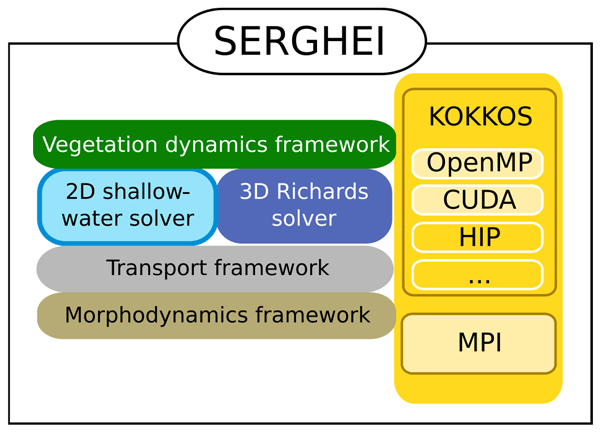
This paper introduces the SERGHEI framework and a solver for shallow-water problems. Such models, often used for surface flow and flood modelling, are computationally intense. In recent years the trends to increase computational power have changed, requiring models to adapt to new hardware and new software paradigms. SERGHEI addresses these challenges, allowing surface flow simulation to be enabled on the newest and upcoming consumer hardware and supercomputers very efficiently.
Cited articles
Ala-aho, P., Rossi, P. M., Isokangas, E., and Kløve, B.: Fully integrated surface–subsurface flow modelling of groundwater–lake interaction in an esker aquifer: Model verification with stable isotopes and airborne thermal imaging, J. Hydrol., 522, 391–406, https://doi.org/10.1016/j.jhydrol.2014.12.054, 2015. a
Aliyari, F., Bailey, R. T., Tasdighi, A., Dozier, A., Arabi, M., and Zeiler, K.: Coupled SWAT-MODFLOW model for large-scale mixed agro-urban river basins, Environ. Model. Softw., 115, 200–210, https://doi.org/10.1016/j.envsoft.2019.02.014, 2019. a
Autio, A., Ala-Aho, P., Rossi, P. M., Ronkanen, A.-K., Aurela, M., Lohila, A., Korpelainen, P., Kumpula, T., Klöve, B., and Marttila, H.: Groundwater exfiltration pattern determination in the sub-arctic catchment using thermal imaging, stable water isotopes and fully-integrated groundwater-surface water modelling, J. Hydrol., 626, 130342, https://doi.org/10.1016/j.jhydrol.2023.130342, 2023. a
Beegum, S., Simunek, J., Szymkiewicz, A., Sudheer, K. P., and Nambi, I. M.: Updating the coupling algorithm between HYDRUS and MODFLOW in the HYDRUS package for MODFLOW, Vadose Zone J., 17, https://doi.org/10.2136/vzj2018.02.0034, 2018. a, b
Bhanja, S. N., Coon, E. T., Lu, D., and Painter, S. L.: Evaluation of distributed process-based hydrologic model performance using only a priori information to define model inputs, J. Hydrol., 618, 129176, https://doi.org/10.1016/j.jhydrol.2023.129176, 2023. a
Brandhorst, N., Erdal, D., and Neuweiler, I.: Coupling saturated and unsaturated flow: comparing the iterative and the non-iterative approach, Hydrol. Earth Syst. Sci., 25, 4041–4059, https://doi.org/10.5194/hess-25-4041-2021, 2021. a, b
Brunner, P. and Simmons, C. T.: HydroGeoSphere: A fully integrated, physically based hydrological model, Groundwater., 50, 170–176, https://doi.org/10.1111/j.1745-6584.2011.00882.x, 2012. a
Camporese, M., Paniconi, C., Putti, M., and Orlandini, S.: Surface-subsurface flow modeling with path-based runoff routing, boundary condition-based coupling, and assimilation of multisource observation data, Water Resour. Res., 46, https://doi.org/10.1029/2008WR007536, 2010. a
Casulli, V.: A coupled surface-subsurface model for hydrostatic flows under saturated and unsaturated conditions, Int. J. Numer. Meth. Fluids, 85, 449–464, https://doi.org/10.1002/fld.4389, 2017. a
Caviedes-Voullième, D., Fernández-Pato, J., and Hinz, C.: Performance assessment of 2D Zero-Inertia and Shallow Water models for simulating rainfall-runoff processes, J. Hydrol., 584, 124663, https://doi.org/10.1016/j.jhydrol.2020.124663, 2020. a
Caviedes-Voulliéme, D., Morales-Hernandez, M., Norman, M. R., and Oezgen-Xian, I.: SERGHEI (SERGHEI-SWE) v1.0: a performance-portable high-performance parallel-computing shallow-water solver for hydrology and environmental hydraulics, Geosci. Model Dev., 16, 977–1008, https://doi.org/10.5194/gmd-16-977-2023, 2023. a, b, c, d
Chen, L., Simunck, J., Bradford, S. A., Ajami, H., and Meles, M. B.: A computationally efficient hydrologic modeling framework to simulate surface-subsurface hydrological processes at the hillslope scale, J. Hydrol., 614, https://doi.org/10.1016/j.jhydrol.2022.128539, 2022. a
Coon, E. T., Moulton, J. D., Kikinzon, E., Berndt, M., Manzini, G., Garimella, R., Lipnikov, K., and Painter, S. L.: Coupling surface flow and subsurface flow in complex soil structures using mimetic finite differences, Adv. Water Resour., 144, 103701, https://doi.org/10.1016/j.advwatres.2020.103701, 2020. a, b
Crompton, O., Katul, G. G., and Thompson, S.: Resistance Formulations in Shallow Overland Flow Along a Hillslope Covered With Patchy Vegetation, Water Resour. Res., 56, https://doi.org/10.1029/2020wr027194, 2020. a
Daneshmand, H., Alaghmand, S., Camporese, M., Talei, A., and Daly, E.: Water and salt balance modelling of intermittent catchments using a physically-based integrated model, J. Hydrol., 568, 1017–1030, https://doi.org/10.1016/j.jhydrol.2018.11.035, 2019. a
de Almeida, G. A. M. and Bates, P.: Applicability of the local inertial approximation of the shallow water equations to flood modeling, Water Resour. Res., 49, 4833–4844, https://doi.org/10.1002/wrcr.20366, 2013. a
Delfs, J.-O., Blumensaat, F., Wang, W., Krebs, P., and Kolditz, O.: Coupling hydrogeological with surface runoff model in a Poltva case study in Western Ukraine, Environ. Earth Sci., 65, 1439–1457, https://doi.org/10.1007/s12665-011-1285-4, 2012. a
Dennedy-Frank, P. J.: Including the subsurface in ecosystem services, Nat. Sustain., 2, 443–444, https://doi.org/10.1038/s41893-019-0312-4, 2019. a
de Rooij, R.: New insights into the differences between the dual node approach and the common node approach for coupling surface–subsurface flow, Hydrol. Earth Syst. Sci., 21, 5709–5724, https://doi.org/10.5194/hess-21-5709-2017, 2017. a
Edwards, H. C., Trott, C. R., and Sunderland, D.: Kokkos: Enabling manycore performance portability through polymorphic memory access patterns, J. Parallel Distr. Com., 74, 3202–3216, https://doi.org/10.1016/j.jpdc.2014.07.003, 2014. a
Fang, J., Huang, C., Tang, T., and Wang, Z.: Parallel programming models for heterogeneous many-cores: a comprehensive survey, CCF Trans. HPC, 2, 382–400, https://doi.org/10.1007/s42514-020-00039-4, 2020. a
Fatichi, S., Vivoni, E. R., Ogden, F. L., Ivanov, V. Y., Mirus, B., Gochis, D., Downer, C. W., Camporese, M., Davison, J. H., Ebel, B. A., Jones, N., Kim, J., Mascaro, G., Niswonger, R., Restrepo, P., Rigon, R., Shen, C., Sulis, M., and Tarboton, D.: An overview of current applications, challenges, and future trends in distributed process-based models in hydrology, J. Hydrol., 537, 45–60, https://doi.org/10.1016/j.jhydrol.2016.03.026, 2016. a
Forrester, M. M. and Maxwell, R. M.: Impact of lateral groundwater flow and subsurface lower boundary conditions on atmospheric boundary layer development over complex terrain, J. Hydrometeorol., 21, 1133–1160, https://doi.org/10.1175/JHM-D-19-0029.1, 2020. a
Freeze, R. and Harlan, R.: Blueprint for a physically-based, digitally-simulated hydrologic response model, J. Hydrol., 9, 237–258, https://doi.org/10.1016/0022-1694(69)90020-1, 1969. a
Furman, A.: Modeling coupled surface-subsurface flow processes: A review, Vadose Zone J., 7, 741–756, https://doi.org/10.2136/vzj2007.0065, 2008. a, b
Furnari, L., De Rango, A., Senatore, A., and Mendicino, G.: HydroCAL: A novel integrated surface-subsurface hydrological model based on the Cellular Automata paradigm, Adv. Water Resour., 185, https://doi.org/10.1016/j.advwatres.2024.104623, 2024. a
Gilbert, J. M. and Maxwell, R. M.: Examining regional groundwater-surface water dynamics using an integrated hydrologic model of the San Joaquin River basin, Hydrol. Earth Syst. Sci., 21, 923–947, https://doi.org/10.5194/hess-21-923-2017, 2017. a
Guimond, J. A. and Michael, H. A.: Effects of marsh migration on flooding, saltwater intrusion, and crop yield in coastal agricultural land subject to storm surge inundation, Water Resour. Res., 57, e2020WR028326, https://doi.org/10.1029/2020WR028326, 2021. a
Gunduz, O. and Aral, M. M.: River networks and groundwater flow: a simultaneous solution of a coupled system, J. Hydrol., 301, 216–234, https://doi.org/10.1016/j.jhydrol.2004.06.034, 2005. a
Haque, A., Salama, A., Lo, K., and Wu, P.: Surface and groundwater interactions: A review of coupling strategies in detailed domain models, Hydrology, 8, https://doi.org/10.3390/hydrology8010035, 2021. a
Hein, A., Condon, L., and Maxwell, R.: Evaluating the relative importance of precipitation, temperature and land-cover change in the hydrologic response to extreme meteorological drought conditions over the North American High Plains, Hydrol. Earth Syst. Sci., 23, 1931–1950, https://doi.org/10.5194/hess-23-1931-2019, 2019. a
Hokkanen, J., Kollet, S., Kraus, J., Herten, A., Hrywniak, M., and Pleiter, D.: Leveraging HPC accelerator architectures with modern techniques – hydrologic modeling on GPUs with ParFlow, Comput. Geosci., 25, 1579–1590, https://doi.org/10.1007/s10596-021-10051-4, 2021. a
Huang, G. and Yeh, G.-T.: Comparative study of coupling approaches for surface water and subsurface interactions, J. Hydrol. Eng.-ASCE, 14, 453–462, https://doi.org/10.1061/(ASCE)HE.1943-5584.0000017, 2009. a, b
Hussain, F.: A systematic review on integrated surface-subsurface modeling using watershed WASH123D model, Model. Earth Syst. Environ., 8, 1481–1504, https://doi.org/10.1007/s40808-021-01203-7, 2022. a
Hutton, E. W. H., Piper, M. D., and Tucker, G. E.: The Basic Model Interface 2.0: A standard interface for coupling numerical models in the geosciences, J. Open Sour. Softw., 5, 2317, https://doi.org/10.21105/joss.02317, 2020. a
Jan, A., Coon, E. T., and Painter, S. L.: Evaluating integrated surface/subsurface permafrost thermal hydrology models in ATS (v0.88) against observations from a polygonal tundra site, Geosci. Model Dev., 13, 2259–2276, https://doi.org/10.5194/gmd-13-2259-2020, 2020. a
Kim, J., Warnock, A., Ivanov, V. Y., and Katopodes, N. D.: Coupled modeling of hydrologic and hydrodynamic processes including overland and channel flow, Adv. Water Resour., 37, 104–126, https://doi.org/10.1016/j.advwatres.2011.11.009, 2012. a
Kollet, S., Sulis, M., Maxwell, R. M., Paniconi, C., Putti, M., Bertoldi, G., Coon, E. T., Cordano, E., Endrizzi, S., Kikinzon, E., Mouche, E., Mügler, C., Park, Y.-J., Refsgaard, J. C., Stisen, S., and Sudicky, E.: The integrated hydrologic model intercomparison project, IH-MIP2: A second set of benchmark results to diagnose integrated hydrology and feedbacks, Water Resour. Res., 53, 867–890, https://doi.org/10.1002/2016WR019191, 2017. a, b, c, d, e, f, g
Kollet, S. J. and Maxwell, R. M.: Integrated surface–groundwater flow modeling: A free-surface overland flow boundary condition in a parallel groundwater flow model, Adv. Water Resour., 29, 945–958, https://doi.org/10.1016/j.advwatres.2005.08.006, 2006. a, b
Kong, J., Xin, P., Song, Z.-y., and Li, L.: A new model for coupling surface and subsurface water flows: With an application to a lagoon, J. Hydrol., 390, 116–120, https://doi.org/10.1016/j.jhydrol.2010.06.028, 2010. a
Krabbenhøft, K.: An alternative to primary variable switching in saturated–unsaturated flow computations, Adv. Water Resour., 30, 483–492, https://doi.org/10.1016/j.advwatres.2006.04.009, 2007. a
Kuffour, B. N. O., Engdahl, N. B., Woodward, C. S., Condon, L. E., Kollet, S., and Maxwell, R. M.: Simulating coupled surface–subsurface flows with ParFlow v3.5.0: capabilities, applications, and ongoing development of an open-source, massively parallel, integrated hydrologic model, Geosci. Model Dev., 13, 1373–1397, https://doi.org/10.5194/gmd-13-1373-2020, 2020. a
Le, P. V., Kumar, P., Valocchi, A. J., and Dang, H.-V.: GPU-based high-performance computing for integrated surface–sub-surface flow modeling, Environ. Model. Softw., 73, 1–13, https://doi.org/10.1016/j.envsoft.2015.07.015, 2015. a
Li, Z.: Source Code and Test cases for SERGHEI-SWE-RE, Zenodo [code], https://doi.org/10.5281/zenodo.17217612, 2025. a
Li, Z. and Hodges, B. R.: Model instability and channel connectivity for 2D coastal marsh simulations, Environ. Fluid Mech., 19, 1309–1338, https://doi.org/10.1007/s10652-018-9623-7, 2019. a
Li, Z. and Hodges, B. R.: Revisiting surface-subsurface exchange at intertidal zone with a coupled 2D hydrodynamic and 3D variably-saturated groundwater model, Water, 13, https://doi.org/10.3390/w13070902, 2021. a, b
Li, Z., Hodges, B. R., and Shen, X.: Modeling hypersalinity caused by evaporation and surface–subsurface exchange in a coastal marsh, J. Hydrol., 618, 129268, https://doi.org/10.1016/j.jhydrol.2023.129268, 2023. a, b, c, d
Li, Z., Caviedes-Voullième, D., Özgen Xian, I., Jiang, S., and Zheng, N.: A comparison of numerical schemes for the GPU-accelerated simulation of variably-saturated groundwater flow, Environ. Model. Softw., 171, 105900, https://doi.org/10.1016/j.envsoft.2023.105900, 2024. a
Li, Z., Rickert, G., Zheng, N., Zhang, Z., Özgen-Xian, I., and Caviedes-Voullième, D.: SERGHEI v2.0: introducing a performance-portable, high-performance three-dimensional variably-saturated subsurface flow solver (SERGHEI-RE), Geosci. Model Dev., 18, 547–562, https://doi.org/10.5194/gmd-18-547-2025, 2025. a, b, c, d, e, f, g, h
Liggett, J. E., Knowling, M. J., Werner, A. D., and Simmons, C. T.: On the implementation of the surface conductance approach using a block-centred surface–subsurface hydrology model, J. Hydrol., 496, 1–8, https://doi.org/10.1016/j.jhydrol.2013.05.008, 2013. a
Ma, L., He, C., Bian, H., and Sheng, L.: MIKE SHE modeling of ecohydrological processes: Merits, applications, and challenges, Ecol. Eng., 96, 137–149, https://doi.org/10.1016/j.ecoleng.2016.01.008, 2016. a
Mao, W., Zhu, Y., Ye, M., Zhang, X., Wu, J., and Yang, J.: A new quasi-3-D model with a dual iterative coupling scheme for simulating unsaturated-saturated water flow and solute transport at a regional scale, J. Hydrol., 602, 126780, https://doi.org/10.1016/j.jhydrol.2021.126780, 2021. a
Maxwell, R. M., Putti, M., Meyerhoff, S., Delfs, J.-O., Ferguson, I. M., Ivanov, V., Kim, J., Kolditz, O., Kollet, S. J., Kumar, M., Lopez, S., Niu, J., Paniconi, C., Park, Y.-J., Phanikumar, M. S., Shen, C., Sudicky, E. A., and Sulis, M.: Surface-subsurface model intercomparison: A first set of benchmark results to diagnose integrated hydrology and feedbacks, Water Resour. Res., 50, 1531–1549, https://doi.org/10.1002/2013WR013725, 2014. a, b
Morales-Hernández, M., Sharif, M. B., Kalyanapu, A., Ghafoor, S., Dullo, T., Gangrade, S., Kao, S.-C., Norman, M., and Evans, K.: TRITON: A Multi-GPU open source 2D hydrodynamic flood model, Environ. Model. Softw., 141, 105034, https://doi.org/10.1016/j.envsoft.2021.105034, 2021. a
Morita, M. and Yen, B. C.: Modeling of conjunctive two-dimensional surface-three-dimensional subsurface flows, J. Hydraul. Eng.-ASCE, 128, 184–200, https://doi.org/10.1061/(ASCE)0733-9429(2002)128:2(184), 2002. a, b
Mualem, Y.: A new model for predicting the hydraulic conductivity of unsaturated porous media, Water Resour. Res., 12, 513–522, https://doi.org/10.1029/WR012i003p00513, 1976. a
Naz, B. S., Sharples, W., Ma, Y., Goergen, K., and Kollet, S.: Continental-scale evaluation of a fully distributed coupled land surface and groundwater model, ParFlow-CLM (v3.6.0), over Europe, Geosci. Model Dev., 16, 1617–1639, https://doi.org/10.5194/gmd-16-1617-2023, 2023. a
Nixdorf, E., Sun, Y., Lin, M., and Kolditz, O.: Development and application of a novel method for regional assessment of groundwater contamination risk in the Songhua River Basin, Sci. Total Environ., 605-606, 598–609, https://doi.org/10.1016/j.scitotenv.2017.06.126, 2017. a
Ntona, M. M., Busico, G., Mastrocicco, M., and Kazakis, N.: Modeling groundwater and surface water interaction: An overview of current status and future challenges, Sci. Total Environ., 846, 157355, https://doi.org/10.1016/j.scitotenv.2022.157355, 2022. a
Paldor, A., Stark, N., Florence, M., Raubenheimer, B., Elgar, S., Housego, R., Frederiks, R. S., and Michael, H. A.: Coastal topography and hydrogeology control critical groundwater gradients and potential beach surface instability during storm surges, Hydrol. Earth Syst. Sci., 26, 5987–6002, https://doi.org/10.5194/hess-26-5987-2022, 2022. a
Paniconi, C. and Putti, M.: Physically based modeling in catchment hydrology at 50: Survey and outlook, Water Resour. Res., 51, 7090–7129, https://doi.org/10.1002/2015WR017780, 2015. a
Peckham, S. D., Hutton, E. W., and Norris, B.: A component-based approach to integrated modeling in the geosciences: The design of CSDMS, Comput. Geosci., 53, 3–12, https://doi.org/10.1016/j.cageo.2012.04.002, 2013. a
Persaud, E., Levison, J., MacRitchie, S., Berg, S. J., Erler, A. R., Parker, B., and Sudicky, E.: Integrated modelling to assess climate change impacts on groundwater and surface water in the Great Lakes Basin using diverse climate forcing, J. Hydrol., 584, 124682, https://doi.org/10.1016/j.jhydrol.2020.124682, 2020. a
Richards, L. A.: Capillary conduction of liquids through porous mediums, J. Appl. Phys., 1, 318–333, https://doi.org/10.1063/1.1745010, 1931. a
Saadi, M., Furusho-Percot, C., Belleflamme, A., Chen, J.-Y., Trömel, S., and Kollet, S.: How uncertain are precipitation and peak flow estimates for the July 2021 flooding event?, Nat. Hazards Earth Syst. Sci., 23, 159–177, https://doi.org/10.5194/nhess-23-159-2023, 2023. a
Schüller, V., Birken, P., and Dedner, A.: Convergence properties of iteratively coupled surface-subsurface models, Int. J. Geomath., 16, https://doi.org/10.1007/s13137-025-00265-4, 2025. a
Shu, L., Chen, H., Meng, X., Chang, Y., Hu, L., Wang, W., Shu, L., Yu, X., Duffy, C., Yao, Y., and Zheng, D.: A review of integrated surface-subsurface numerical hydrological models, Sci. China Earth Sci., 67, 1459–1479, https://doi.org/10.1007/s11430-022-1312-7, 2024. a, b, c, d
Tang, Q., Delottier, H., Kurtz, W., Nerger, L., Schilling, O. S., and Brunner, P.: HGS-PDAF (version 1.0): a modular data assimilation framework for an integrated surface and subsurface hydrological model, Geosci. Model Dev., 17, 3559–3578, https://doi.org/10.5194/gmd-17-3559-2024, 2024. a
Tubini, N. and Rigon, R.: Implementing the Water, HEat and Transport model in GEOframe (WHETGEO-1D v.1.0): algorithms, informatics, design patterns, open science features, and 1D deployment, Geosci. Model Dev., 15, 75–104, https://doi.org/10.5194/gmd-15-75-2022, 2022. a, b
VanderKwaak, J. E. and Loague, K.: Hydrologic-Response simulations for the R-5 catchment with a comprehensive physics-based model, Water Resour. Res., 37, 999–1013, https://doi.org/10.1029/2000WR900272, 2001. a
van Genuchten, M. T.: A closed-form equation for predicting the hydraulic conductivity of unsaturated soils, Soil Sci. Soc. Am. J., 44, 892–898, https://doi.org/10.2136/sssaj1980.03615995004400050002x, 1980. a
Wu, R., Chen, X., Hammond, G., Bisht, G., Song, X., Huang, M., Niu, G.-Y., and Ferre, T.: Coupling surface flow with high-performance subsurface reactive flow and transport code PFLOTRAN, Environ. Model. Softw., 137, 104959, https://doi.org/10.1016/j.envsoft.2021.104959, 2021. a
Xiao, K., Li, H., Wilson, A. M., Xia, Y., Wan, L., Zheng, C., Ma, Q., Wang, C., Wang, X., and Jiang, X.: Tidal groundwater flow and its ecological effects in a brackish marsh at the mouth of a large sub-tropical river, J. Hydrol., 555, 198–212, https://doi.org/10.1016/j.jhydrol.2017.10.025, 2017. a
Yang, J., Graf, T., Herold, M., and Ptak, T.: Modelling the effects of tides and storm surges on coastal aquifers using a coupled surface–subsurface approach, J. Contam. Hydrol., 149, 61–75, https://doi.org/10.1016/j.jconhyd.2013.03.002, 2013. a
Yeh, G. T., Cheng, H. P., Cheng, J. R. C., and Lin, J. H.: A numerical model to simulate water flow and contaminant and sediment transport in watershed systems of 1-D stream-river network, 2-D overland regime, and 3-D subsurface media (WASH123D: version 1.0), Technical Report CHL-98-19, Waterways Experiment Station, US Army Corps of Engineers, Vicksburg, https://www.researchgate.net/publication/277767258_A_Numerical _Model_Simulating_Water_Flow_and_Contaminant_and_ Sediment_Transport_in_WAterSHed_Systems_of_1-D_Stream-River_Network_2-D_Overland_Regime_and_3-D_Subsurface_Media_WASH123D_Version_10 (last access: 11 April 2026), 1998. a
Zhang, L., Li, X., Han, J., Lin, J., Dai, Y., and Liu, P.: Identification of surface water – groundwater nitrate governing factors in Jianghuai hilly area based on coupled SWAT-MODFLOW-RT3D modeling approach, Sci. Total Environ., 912, 168830, https://doi.org/10.1016/j.scitotenv.2023.168830, 2024. a
Zhang, Y., Li, W., Sun, G., Miao, G., Noormets, A., Emanuel, R., and King, J. S.: Understanding coastal wetland hydrology with a new regional-scale, process-based hydrological model, Hydrol. Process., 32, 3158–3173, https://doi.org/10.1002/hyp.13247, 2018. a
Short summary
This study introduces a computer model that simulates water flow both on the land surface and underground, and their interaction. The model can run efficiently on many kinds of computers, and its design lets each part update at its own pace to save time. In the tests performed, the model's results matched those from well-known tools in the field. Overall, the model offers a fast, flexible, and scalable way to study combined surface and groundwater behavior.
This study introduces a computer model that simulates water flow both on the land surface and...


