
Articles | Volume 19, issue 1
https://doi.org/10.5194/gmd-19-261-2026
© Author(s) 2026. This work is distributed under
the Creative Commons Attribution 4.0 License.
the Creative Commons Attribution 4.0 License.
https://doi.org/10.5194/gmd-19-261-2026
© Author(s) 2026. This work is distributed under
the Creative Commons Attribution 4.0 License.
the Creative Commons Attribution 4.0 License.
Model description paper
| 
08 Jan 2026
Model description paper |
| 08 Jan 2026
| 08 Jan 2026
SWIIFT v0.10: a numerical model of wave-induced sea ice breakup with an energy criterion
Nicolas Guillaume Alexandre Mokus
CORRESPONDING AUTHOR

Univ. Grenoble Alpes, Univ. Savoie Mont Blanc, CNRS, IRD, Grenoble INP, ISTerre, Grenoble, France
Véronique Dansereau
Univ. Grenoble Alpes, Univ. Savoie Mont Blanc, CNRS, IRD, Grenoble INP, ISTerre, Grenoble, France
Univ. Grenoble Alpes, CNRS, IRD, Grenoble INP, IGE, 38000 Grenoble, France
Guillaume Boutin
Nansen Environmental and Remote Sensing Center, Bergen, Norway
Jean-Pierre Auclair
Univ. Grenoble Alpes, Univ. Savoie Mont Blanc, CNRS, IRD, Grenoble INP, ISTerre, Grenoble, France
now at: Department of Chemical and Environmental Engineering, Technical University of Cartagena, 30203 Cartagena, Spain
Alexandre Tlili
Univ. Grenoble Alpes, Univ. Savoie Mont Blanc, CNRS, IRD, Grenoble INP, ISTerre, Grenoble, France
now at: Université Paris–Saclay, CNRS, CEA, Service de Physique de l'État Condensé, 91191 Gif-sur-Yvette, France
Related authors
Hooshmand Zandi, Ludovic Métivier, Romain Brossier, Sebastien Kuchly, Vasco Zanchi, Nicolas Mokus, Véronique Dansereau, Antonin Eddi, Stéphane Perrard, Dany Dumont, and Ludovic Moreau
EGUsphere, https://doi.org/10.5194/egusphere-2026-2519, https://doi.org/10.5194/egusphere-2026-2519, 2026
Short summary
Short summary
Sea ice is declining quickly, yet its thickness varies over short distances and is hard to measure with satellites. We developed a way to map thickness in detail from vibrations that travel through the ice. Using data from two field sites, we estimated thickness along many paths and combined them into continuous maps. Our results show that this approach captures fine-scale changes, offering a practical tool to better track ice conditions for climate studies, ecosystems, and safe human activities
Sébastien Kuchly, Baptiste Auvity, Nicolas Mokus, Matilde Bureau, Paul Nicot, Amaury Fourgeaud, Véronique Dansereau, Antonin Eddi, Stéphane Perrard, Dany Dumont, and Ludovic Moreau
The Cryosphere, 19, 6927–6941, https://doi.org/10.5194/tc-19-6927-2025, https://doi.org/10.5194/tc-19-6927-2025, 2025
Short summary
Short summary
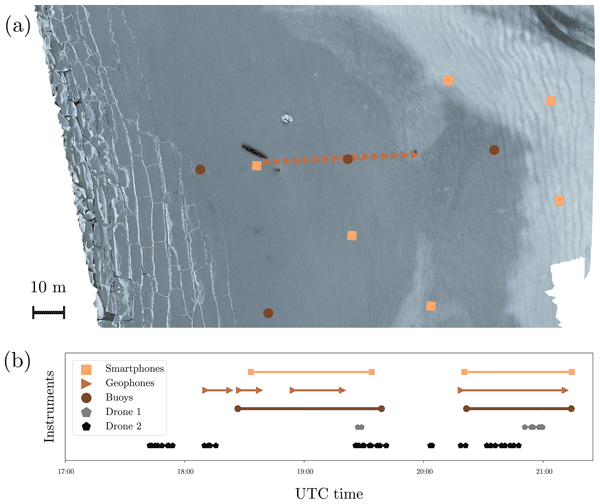
During February and March 2024, we realized a multi-instrument field campaign in the St. Lawrence Estuary, to capture swell-driven sea ice fragmentation. The dataset combines geophones, wave buoys, smartphones, and video recordings with drones, to study wave-ice interactions under natural conditions. It enables analysis of ice thickness, wave properties, and ice motion. Preliminary results show strong consistency across instruments, offering a valuable resource to improve sea ice models.
Nicolas Guillaume Alexandre Mokus and Fabien Montiel
The Cryosphere, 16, 4447–4472, https://doi.org/10.5194/tc-16-4447-2022, https://doi.org/10.5194/tc-16-4447-2022, 2022
Short summary
Short summary
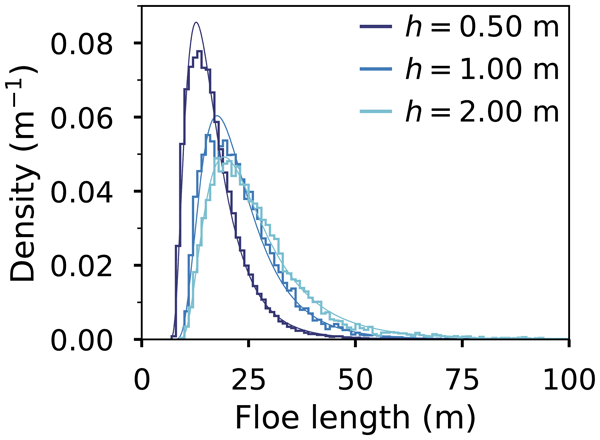
On the fringes of polar oceans, sea ice is easily broken by waves. As small pieces of ice, or floes, are more easily melted by the warming waters than a continuous ice cover, it is important to incorporate these floe sizes in climate models. These models simulate climate evolution at the century scale and are built by combining specialised modules. We study the statistical distribution of floe sizes under the impact of waves to better understand how to connect sea ice modules to wave modules.
Jonathan Winfield Rheinlænder, Einar Örn Ólason, Céline Heuzé, and Guillaume Boutin
EGUsphere, https://doi.org/10.5194/egusphere-2026-5106, https://doi.org/10.5194/egusphere-2026-5106, 2026
This preprint is open for discussion and under review for The Cryosphere (TC).
Short summary
Short summary
Polynyas are "holes" in the sea-ice cover where large amounts of new ice form, but they are not represented in climate models. We used a novel sea-ice model, compared against satellite data, to study Arctic polynya activity over 18 winters. We found that polynyas account for up to 11 % of total winter ice production in the Arctic, despite only covering a small area. Our results suggest that earlier satellite estimates may have been too high.
Lexi Arlen, Earle Wilson, Véronique Dansereau, Ching-Yao Lai, and Yue Meng
EGUsphere, https://doi.org/10.5194/egusphere-2026-3166, https://doi.org/10.5194/egusphere-2026-3166, 2026
Short summary
Short summary
Sea ice deforms discretely, through fracturing and collisions, yet it is often modeled as a continuous fluid. To capture discrete processes missed by continuum models, we built a simple model representing the ice pack as disks connected by breakable bonds. With fewer parameters and computational resources, our simple model reproduced some key dynamics simulated in higher-complexity models. This tool can be used by the community as a complement to higher-complexity modeling efforts.
Einar Ólason, Guillaume Boutin, Timothy Williams, Anton Korosov, Heather Regan, Jonathan Rheinlænder, Pierre Rampal, Daniela Flocco, Abdoulaye Samaké, Richard Davy, Timothy Spain, and Sean Chua
Geosci. Model Dev., 19, 6467–6496, https://doi.org/10.5194/gmd-19-6467-2026, https://doi.org/10.5194/gmd-19-6467-2026, 2026
Short summary
Short summary
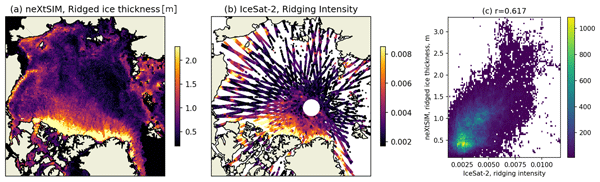
This paper introduces a new version of the neXtSIM sea-ice model. NeXtSIM is unique among sea-ice models in how it represents sea-ice dynamics, focusing on features such as cracks and ridges and how these impact interactions between the atmosphere and ocean where sea ice is present. The new version introduces some physical parameterisations and model options detailed and explained in the paper. Following the paper's publication, the neXtSIM code will be released publicly for the first time.
Hooshmand Zandi, Ludovic Métivier, Romain Brossier, Sebastien Kuchly, Vasco Zanchi, Nicolas Mokus, Véronique Dansereau, Antonin Eddi, Stéphane Perrard, Dany Dumont, and Ludovic Moreau
EGUsphere, https://doi.org/10.5194/egusphere-2026-2519, https://doi.org/10.5194/egusphere-2026-2519, 2026
Short summary
Short summary
Sea ice is declining quickly, yet its thickness varies over short distances and is hard to measure with satellites. We developed a way to map thickness in detail from vibrations that travel through the ice. Using data from two field sites, we estimated thickness along many paths and combined them into continuous maps. Our results show that this approach captures fine-scale changes, offering a practical tool to better track ice conditions for climate studies, ecosystems, and safe human activities
Aikaterini Tavri, Chris Horvat, Brodie Pearson, Guillaume Boutin, Anne Hansen, and Ara Lee
The Cryosphere, 20, 3073–3089, https://doi.org/10.5194/tc-20-3073-2026, https://doi.org/10.5194/tc-20-3073-2026, 2026
Short summary
Short summary
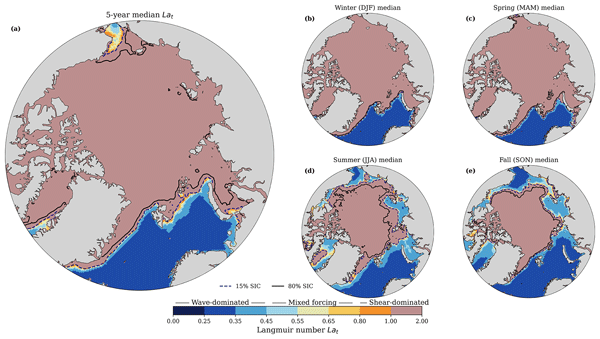
In the Arctic, declining sea ice allows waves to penetrate farther into ice-covered regions, altering ocean–atmosphere exchanges of heat and momentum. Wave–wind interactions can enhance upper-ocean mixing and influence heat storage, but this process is poorly understood in sea ice. Using a coupled wave–sea ice model, we show that such mixing is intermittent and localized, yet likely to become more important as Arctic sea ice continues to decline.
Valentin Ludwig, Caroline Ribere, Sara Fleury, Christian Haas, Michel Tsamados, Mahmoud El Hajj, Jerome Bouffard, Michele Scagliola, Marion Bocquet, Eric de Boisseson, Vincent Boulenger, Guillaume Boutin, Laurence Connor, Léo Edel, Stefan Hendricks, Ferran Hernández Macià, Marcus Huntemann, Lars Kaleschke, Frank Kauker, Jack Landy, Tom Megain, Alek Petty, Till Soya Rasmussen, Mads Hvid Ribergaard, Robert Ricker, Axel Schweiger, Hoyeon Shi, Xiangshan Tian-Kunze, Donghui Yi, and Alessandro Di Bella
EGUsphere, https://doi.org/10.5194/egusphere-2025-6201, https://doi.org/10.5194/egusphere-2025-6201, 2026
Short summary
Short summary
Our paper compares Arctic sea-ice thickness datasets from models, reanalyses, satellite-only, and multi-product sources. We validate them against Beaufort Sea reference data, compare large-scale products, and analyse time series. Cross-product biases range from 0.2–0.4 m, RMSDs from 0.4–0.9 m, and correlations from 0.5–0.8. We find no 2010–2023 trend, but 1995–2023 thinning of ~ 0.5 m in November and ~ 0.3 m in March.
Sébastien Kuchly, Baptiste Auvity, Nicolas Mokus, Matilde Bureau, Paul Nicot, Amaury Fourgeaud, Véronique Dansereau, Antonin Eddi, Stéphane Perrard, Dany Dumont, and Ludovic Moreau
The Cryosphere, 19, 6927–6941, https://doi.org/10.5194/tc-19-6927-2025, https://doi.org/10.5194/tc-19-6927-2025, 2025
Short summary
Short summary
During February and March 2024, we realized a multi-instrument field campaign in the St. Lawrence Estuary, to capture swell-driven sea ice fragmentation. The dataset combines geophones, wave buoys, smartphones, and video recordings with drones, to study wave-ice interactions under natural conditions. It enables analysis of ice thickness, wave properties, and ice motion. Preliminary results show strong consistency across instruments, offering a valuable resource to improve sea ice models.
Laurent Brodeau, Pierre Rampal, Einar Ólason, and Véronique Dansereau
Geosci. Model Dev., 17, 6051–6082, https://doi.org/10.5194/gmd-17-6051-2024, https://doi.org/10.5194/gmd-17-6051-2024, 2024
Short summary
Short summary
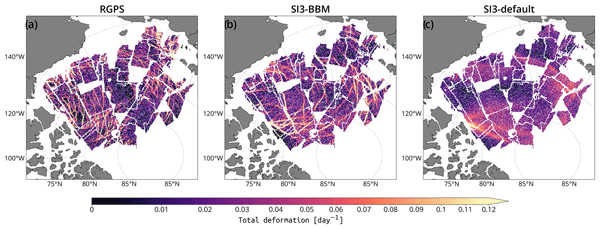
A new brittle sea ice rheology, BBM, has been implemented into the sea ice component of NEMO. We describe how a new spatial discretization framework was introduced to achieve this. A set of idealized and realistic ocean and sea ice simulations of the Arctic have been performed using BBM and the standard viscous–plastic rheology of NEMO. When compared to satellite data, our simulations show that our implementation of BBM leads to a fairly good representation of sea ice deformations.
Yumeng Chen, Polly Smith, Alberto Carrassi, Ivo Pasmans, Laurent Bertino, Marc Bocquet, Tobias Sebastian Finn, Pierre Rampal, and Véronique Dansereau
The Cryosphere, 18, 2381–2406, https://doi.org/10.5194/tc-18-2381-2024, https://doi.org/10.5194/tc-18-2381-2024, 2024
Short summary
Short summary
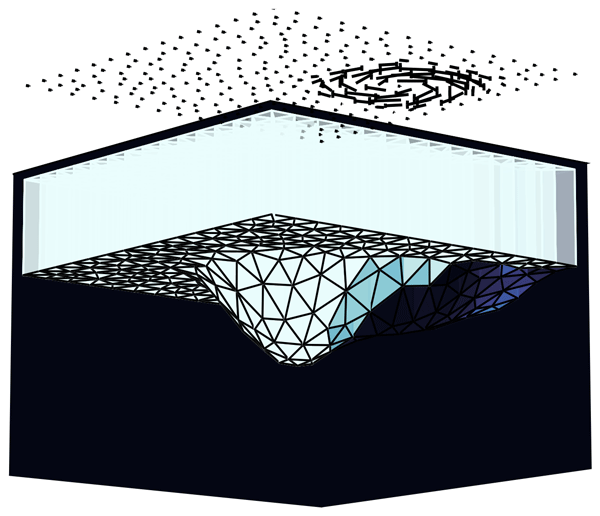
We explore multivariate state and parameter estimation using a data assimilation approach through idealised simulations in a dynamics-only sea-ice model based on novel rheology. We identify various potential issues that can arise in complex operational sea-ice models when model parameters are estimated. Even though further investigation will be needed for such complex sea-ice models, we show possibilities of improving the observed and the unobserved model state forecast and parameter accuracy.
Charlotte Durand, Tobias Sebastian Finn, Alban Farchi, Marc Bocquet, Guillaume Boutin, and Einar Ólason
The Cryosphere, 18, 1791–1815, https://doi.org/10.5194/tc-18-1791-2024, https://doi.org/10.5194/tc-18-1791-2024, 2024
Short summary
Short summary
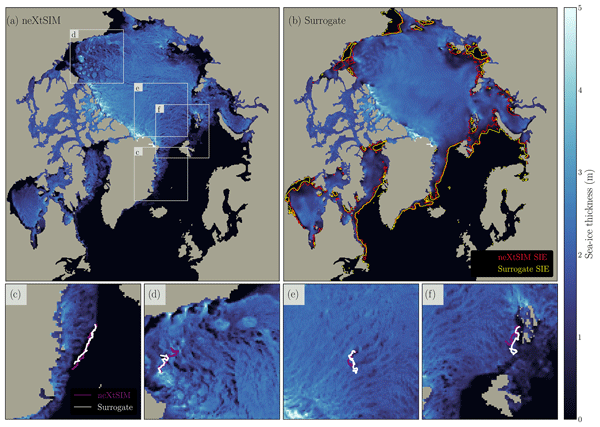
This paper focuses on predicting Arctic-wide sea-ice thickness using surrogate modeling with deep learning. The model has a predictive power of 12 h up to 6 months. For this forecast horizon, persistence and daily climatology are systematically outperformed, a result of learned thermodynamics and advection. Consequently, surrogate modeling with deep learning proves to be effective at capturing the complex behavior of sea ice.
Tobias Sebastian Finn, Charlotte Durand, Alban Farchi, Marc Bocquet, Yumeng Chen, Alberto Carrassi, and Véronique Dansereau
The Cryosphere, 17, 2965–2991, https://doi.org/10.5194/tc-17-2965-2023, https://doi.org/10.5194/tc-17-2965-2023, 2023
Short summary
Short summary
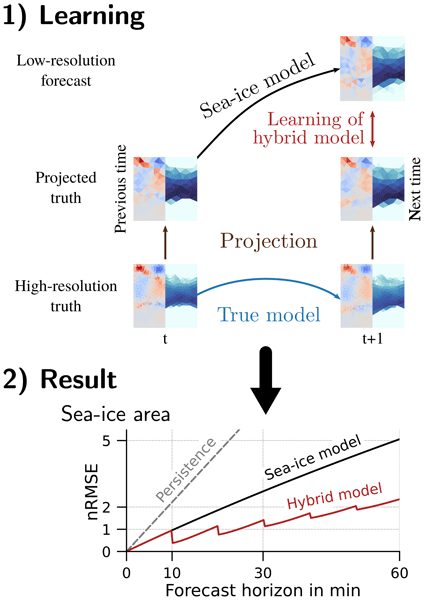
We combine deep learning with a regional sea-ice model to correct model errors in the sea-ice dynamics of low-resolution forecasts towards high-resolution simulations. The combined model improves the forecast by up to 75 % and thereby surpasses the performance of persistence. As the error connection can additionally be used to analyse the shortcomings of the forecasts, this study highlights the potential of combined modelling for short-term sea-ice forecasting.
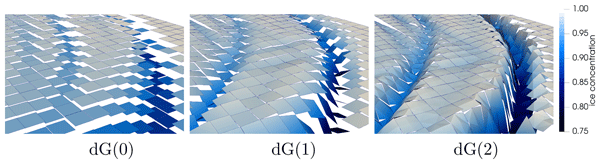
Thomas Richter, Véronique Dansereau, Christian Lessig, and Piotr Minakowski
Geosci. Model Dev., 16, 3907–3926, https://doi.org/10.5194/gmd-16-3907-2023, https://doi.org/10.5194/gmd-16-3907-2023, 2023
Short summary
Short summary
Sea ice covers not only the pole regions but affects the weather and climate globally. For example, its white surface reflects more sunlight than land. The oceans around the poles are therefore kept cool, which affects the circulation in the oceans worldwide. Simulating the behavior and changes in sea ice on a computer is, however, very difficult. We propose a new computer simulation that better models how cracks in the ice change over time and show this by comparing to other simulations.
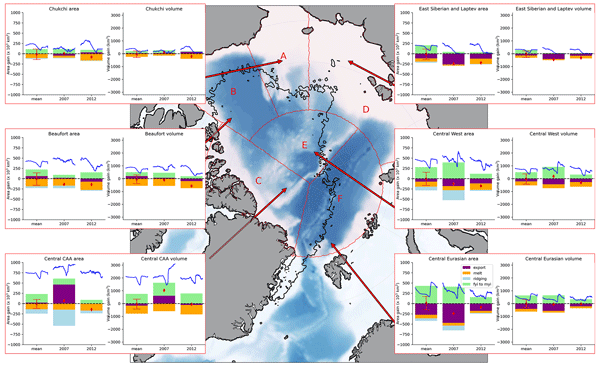
Heather Regan, Pierre Rampal, Einar Ólason, Guillaume Boutin, and Anton Korosov
The Cryosphere, 17, 1873–1893, https://doi.org/10.5194/tc-17-1873-2023, https://doi.org/10.5194/tc-17-1873-2023, 2023
Short summary
Short summary
Multiyear ice (MYI), sea ice that survives the summer, is more resistant to changes than younger ice in the Arctic, so it is a good indicator of sea ice resilience. We use a model with a new way of tracking MYI to assess the contribution of different processes affecting MYI. We find two important years for MYI decline: 2007, when dynamics are important, and 2012, when melt is important. These affect MYI volume and area in different ways, which is important for the interpretation of observations.
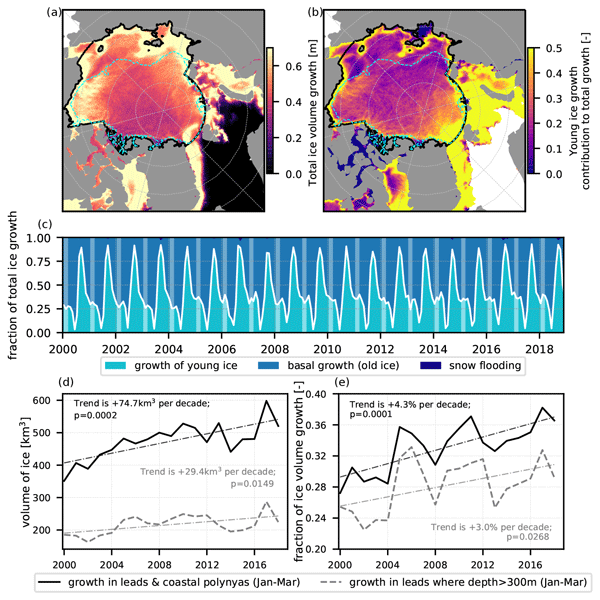
Guillaume Boutin, Einar Ólason, Pierre Rampal, Heather Regan, Camille Lique, Claude Talandier, Laurent Brodeau, and Robert Ricker
The Cryosphere, 17, 617–638, https://doi.org/10.5194/tc-17-617-2023, https://doi.org/10.5194/tc-17-617-2023, 2023
Short summary
Short summary
Sea ice cover in the Arctic is full of cracks, which we call leads. We suspect that these leads play a role for atmosphere–ocean interactions in polar regions, but their importance remains challenging to estimate. We use a new ocean–sea ice model with an original way of representing sea ice dynamics to estimate their impact on winter sea ice production. This model successfully represents sea ice evolution from 2000 to 2018, and we find that about 30 % of ice production takes place in leads.
Nicolas Guillaume Alexandre Mokus and Fabien Montiel
The Cryosphere, 16, 4447–4472, https://doi.org/10.5194/tc-16-4447-2022, https://doi.org/10.5194/tc-16-4447-2022, 2022
Short summary
Short summary
On the fringes of polar oceans, sea ice is easily broken by waves. As small pieces of ice, or floes, are more easily melted by the warming waters than a continuous ice cover, it is important to incorporate these floe sizes in climate models. These models simulate climate evolution at the century scale and are built by combining specialised modules. We study the statistical distribution of floe sizes under the impact of waves to better understand how to connect sea ice modules to wave modules.
Cited articles
Alberello, A., Bennetts, L., Heil, P., Eayrs, C., Vichi, M., MacHutchon, K., Onorato, M., and Toffoli, A.: Drift of Pancake Ice Floes in the Winter Antarctic Marginal Ice Zone During Polar Cyclones, Journal of Geophysical Research: Oceans, 125, https://doi.org/10.1029/2019jc015418, 2020. a
Ardhuin, F., Otero, M., Merrifield, S., Grouazel, A., and Terrill, E.: Ice breakup controls dissipation of wind waves across Southern Ocean Sea Ice, Geophysical Research Letters, 47, e2020GL087699, https://doi.org/10.1029/2020GL087699, 2020. a
Asplin, M. G., Galley, R., Barber, D. G., and Prinsenberg, S.: Fracture of summer perennial sea ice by ocean swell as a result of Arctic storms, Journal of Geophysical Research: Oceans, 117, https://doi.org/10.1029/2011JC007221, 2012. a
Auclair, J.-P., Dumont, D., Lemieux, J.-F., and Ritchie, H.: A model study of convergent dynamics in the marginal ice zone, Philosophical Transactions of the Royal Society A: Mathematical, Physical and Engineering Sciences, 380, 20210261, https://doi.org/10.1098/rsta.2021.0261, 2022. a
Balasoiu, D.: Modélisation et simulation du comportement mécanique de floes de glace, PhD thesis, Université Grenoble Alpes, https://theses.hal.science/tel-03116132/ (last access: 4 December 2025), 2020. a
Bateson, A. W., Feltham, D. L., Schröder, D., Hosekova, L., Ridley, J. K., and Aksenov, Y.: Impact of sea ice floe size distribution on seasonal fragmentation and melt of Arctic sea ice, The Cryosphere, 14, 403–428, https://doi.org/10.5194/tc-14-403-2020, 2020. a
Blanchard-Wrigglesworth, E., Donohoe, A., Roach, L. A., DuVivier, A., and Bitz, C. M.: High-Frequency Sea Ice Variability in Observations and Models, Geophysical Research Letters, 48, e2020GL092356, https://doi.org/10.1029/2020GL092356, 2021. a
Blanchard-Wrigglesworth, E., Webster, M., Boisvert, L., Parker, C., and Horvat, C.: Record Arctic Cyclone of January 2022: Characteristics, Impacts, and Predictability, Journal of Geophysical Research: Atmospheres, 127, e2022JD037161, https://doi.org/10.1029/2022JD037161, 2022. a
Cavallo, S. M., Frank, M. C., and Bitz, C. M.: Sea ice loss in association with Arctic cyclones, Communications Earth & Environment, 6, https://doi.org/10.1038/s43247-025-02022-9, 2025. a
Collins, C. O., Rogers, W. E., Marchenko, A., and Babanin, A. V.: In situ measurements of an energetic wave event in the Arctic marginal ice zone: Largest Waves Measured in Arctic Ice, Geophysical Research Letters, 42, 1863–1870, https://doi.org/10.1002/2015GL063063, 2015. a
Dempsey, J., Adamson, R., and Mulmule, S.: Scale effects on the in-situ tensile strength and fracture of ice. Part II: First-year sea ice at Resolute, N.W.T., International Journal of Fracture, 95, 347–366, https://doi.org/10.1023/a:1018650303385, 1999. a
Dempsey, J. P.: The Fracture Toughness of Ice, in: Ice-Structure Interaction, edited by: Jones, S., Tillotson, J., McKenna, R. F., and Jordaan, I. J., Springer Berlin Heidelberg, Berlin, Heidelberg, 109–145, ISBN 978-3-642-84100-2, 1991. a
Dolatshah, A., Nelli, F., Bennetts, L. G., Alberello, A., Meylan, M. H., Monty, J. P., and Toffoli, A.: Letter: Hydroelastic interactions between water waves and floating freshwater ice, Physics of Fluids, 30, 091702, https://doi.org/10.1063/1.5050262, 2018. a
Dumas-Lefebvre, E. and Dumont, D.: Aerial observations of sea ice breakup by ship waves, The Cryosphere, 17, 827–842, https://doi.org/10.5194/tc-17-827-2023, 2023. a, b
Dumont, D.: Marginal ice zone dynamics: history, definitions and research perspectives, Philosophical Transactions of the Royal Society A, 380, 20210253, https://doi.org/10.1098/rsta.2021.0253, 2022. a
Fox, C. and Squire, V. A.: Strain in shore fast ice due to incoming ocean waves and swell, Journal of Geophysical Research: Oceans, 96, 4531–4547, https://doi.org/10.1029/90JC02270, 1991. a, b
Francfort, G.: Variational fracture: twenty years after, International Journal of Fracture, 1–11, https://doi.org/10.1007/s10704-020-00508-5, 2021. a
Francfort, G. and Marigo, J.-J.: Revisiting brittle fracture as an energy minimization problem, Journal of the Mechanics and Physics of Solids, 46, 1319–1342, https://doi.org/10.1016/S0022-5096(98)00034-9, 1998. a, b
Gharamti, I., Dempsey, J., Polojärvi, A., and Tuhkuri, J.: Fracture energy of columnar freshwater ice: Influence of loading type, loading rate and size, Materialia, 20, 101188, https://doi.org/10.1016/j.mtla.2021.101188, 2021a. a
Gharamti, I. E., Dempsey, J. P., Polojärvi, A., and Tuhkuri, J.: Creep and fracture of warm columnar freshwater ice, The Cryosphere, 15, 2401–2413, https://doi.org/10.5194/tc-15-2401-2021, 2021b. a
He, K., Ni, B., Xu, X., Wei, H., and Xue, Y.: Numerical simulation on the breakup of an ice sheet induced by regular incident waves, Applied Ocean Research, 120, 103024, https://doi.org/10.1016/j.apor.2021.103024, 2022. a
Herman, A.: Wave-induced stress and breaking of sea ice in a coupled hydrodynamic discrete-element wave–ice model, The Cryosphere, 11, 2711–2725, https://doi.org/10.5194/tc-11-2711-2017, 2017. a
Herman, A., Evers, K.-U., and Reimer, N.: Floe-size distributions in laboratory ice broken by waves, The Cryosphere, 12, 685–699, https://doi.org/10.5194/tc-12-685-2018, 2018. a
Horvat, C.: Floes, the marginal ice zone and coupled wave-sea-ice feedbacks, Philosophical Transactions of the Royal Society A, 380, 20210252, https://doi.org/10.1098/rsta.2021.0252, 2022. a
Horvat, C., Tziperman, E., and Campin, J.-M.: Interaction of sea ice floe size, ocean eddies and sea ice melting, Geophysical Research Letters, 43, 8083–8090, https://doi.org/10.1002/2016GL069742, 2016. a
Kohout, A., Williams, M., Toyota, T., Lieser, J., and Hutchings, J.: In situ observations of wave-induced sea ice breakup, Deep Sea Research Part II: Topical Studies in Oceanography, 131, 22–27, https://doi.org/10.1016/j.dsr2.2015.06.010, 2016. a
Kuchly, S., Auvity, B., Mokus, N., Bureau, M., Nicot, P., Fourgeaud, A., Dansereau, V., Eddi, A., Perrard, S., Dumont, D., and Moreau, L.: An integrated multi-instrument methodology for studying marginal ice zone dynamics and wave-ice interactions, EGUsphere [preprint], https://doi.org/10.5194/egusphere-2025-3304, 2025. a
Langhorne, P. J., Squire, V. A., Fox, C., and Haskell, T. G.: Break-up of sea ice by ocean waves, Annals of Glaciology, 27, 438–442, 1998. a
Meylan, M., Bennetts, L., Cavaliere, C., Alberello, A., and Toffoli, A.: Experimental and theoretical models of wave-induced flexure of a sea ice floe, Physics of Fluids, 27, 041704, https://doi.org/10.1063/1.4916573, 2015. a
Mokus, N. G. A.: Fracture of a 600-m floe by a polychromatic wave forcing, TIB [video], https://doi.org/10.5446/71776, 2025a. a, b
Mokus, N. G. A.: sasip-climate/ff1d-ftsw-pub: ff1d-ftsw-pub v1.0.1, Zenodo [data set], https://doi.org/10.5281/zenodo.15230102, 2025b. a
Mokus, N. G. A.: sasip-climate/ff1d-ftsw-pub-ice: v1.0.0, Zenodo [code], https://doi.org/10.5281/zenodo.15528650, 2025c. a
Mokus, N. G. A.: sasip-climate/swiift: v0.7.0, Zenodo [code], https://doi.org/10.5281/zenodo.15528673, 2025d. a
Montiel, F. and Squire, V. A.: Modelling wave-induced sea ice break-up in the marginal ice zone, Proceedings of the Royal Society A: Mathematical, Physical and Engineering Sciences, 473, 20170258, https://doi.org/10.1098/rspa.2017.0258, 2017. a, b
Moreau, L., Boué, P., Serripierri, A., Weiss, J., Hollis, D., Pondaven, I., Vial, B., Garambois, S., Larose, É., Helmstetter, A., Stehly, L., Hillers, G., and Gilbert, O.: Sea Ice Thickness and Elastic Properties From the Analysis of Multimodal Guided Wave Propagation Measured With a Passive Seismic Array, Journal of Geophysical Research: Oceans, 125, e2019JC015709, https://doi.org/10.1029/2019JC015709, 2020a. a
Moreau, L., Weiss, J., and Marsan, D.: Accurate Estimations of Sea‐Ice Thickness and Elastic Properties From Seismic Noise Recorded With a Minimal Number of Geophones: From Thin Landfast Ice to Thick Pack Ice, Journal of Geophysical Research: Oceans, 125, https://doi.org/10.1029/2020jc016492, 2020b. a
Mulmule, S. and Dempsey, J. P.: A viscoelastic fictitious crack model for the fracture of sea ice, Mechanics of Time-Dependent Materials, 1, 331–356, 1997. a
Passerotti, G., Bennetts, L. G., von Bock und Polach, F., Alberello, A., Puolakka, O., Dolatshah, A., Monbaliu, J., and Toffoli, A.: Interactions between irregular wave fields and sea ice: A physical model for wave attenuation and ice breakup in an ice tank, Journal of Physical Oceanography, 52, 1431–1446, 2022. a, b
Raphael, M. N., Maierhofer, T. J., Fogt, R. L., Hobbs, W. R., and Handcock, M. S.: A twenty-first century structural change in Antarctica’s sea ice system, Communications Earth & Environment, 6, https://doi.org/10.1038/s43247-025-02107-5, 2025. a
Ren, H., Zhang, C., and Zhao, X.: Numerical simulations on the fracture of a sea ice floe induced by waves, Applied Ocean Research, 108, 102527, https://doi.org/10.1016/j.apor.2021.102527, 2021. a, b
Roach, L. A., Bitz, C. M., Horvat, C., and Dean, S. M.: Advances in modeling interactions between sea ice and ocean surface waves, Journal of Advances in Modeling Earth Systems, 11, 4167–4181, https://doi.org/10.1029/2019MS001836, 2019. a
Roach, L. A., Smith, M. M., Herman, A., and Ringeisen, D.: Physics of the Seasonal Sea Ice Zone, Annual Review of Marine Science, 17, 355–379, https://doi.org/10.1146/annurev-marine-121422-015323, 2025. a
Saddier, L., Palotai, A., Aksil, M., Tsamados, M., and Berhanu, M.: Breaking of a floating particle raft by water waves, Physical Review Fluids, 9, https://doi.org/10.1103/physrevfluids.9.094302, 2024. a, b
Schulson, E. M. and Duval, P.: Creep and Fracture of Ice, Cambridge University Press, ISBN 9780511581397, https://doi.org/10.1017/cbo9780511581397, 2009. a, b
Smith, M., Stammerjohn, S., Persson, O., Rainville, L., Liu, G., Perrie, W., Robertson, R., Jackson, J., and Thomson, J.: Episodic Reversal of Autumn Ice Advance Caused by Release of Ocean Heat in the Beaufort Sea, Journal of Geophysical Research: Oceans, 123, 3164–3185, https://doi.org/10.1002/2018JC013764, 2018. a
Squire, V. A.: Ocean Wave Interactions with Sea Ice: A Reappraisal, Annual Review of Fluid Mechanics, 52, 37–60, https://doi.org/10.1146/annurev-fluid-010719-060301, 2020. a
Stroeve, J. and Notz, D.: Changing state of Arctic sea ice across all seasons, Environmental Research Letters, 13, 103001, https://doi.org/10.1088/1748-9326/aade56, 2018. a
Stroeve, J. C., Serreze, M. C., Holland, M. M., Kay, J. E., Malanik, J., and Barrett, A. P.: The Arctic's rapidly shrinking sea ice cover: a research synthesis, Climatic change, 110, 1005, https://doi.org/10.1007/s10584-011-0101-1, 2012. a
Sutherland, G., Rabault, J., Christensen, K. H., and Jensen, A.: A two layer model for wave dissipation in sea ice, Applied Ocean Research, 88, 111–118, https://doi.org/10.1016/j.apor.2019.03.023, 2019. a
Sutherland, P. and Dumont, D.: Marginal ice zone thickness and extent due to wave radiation stress, Journal of Physical Oceanography, 48, 1885–1901, 2018. a
Thomson, J.: Wave propagation in the marginal ice zone: connections and feedback mechanisms within the air–ice–ocean system, Philosophical Transactions of the Royal Society A, 380, 20210251, https://doi.org/10.1098/rsta.2021.0251, 2022. a, b
Thomson, J. and Rogers, W. E.: Swell and sea in the emerging Arctic Ocean, Geophysical Research Letters, 41, 3136–3140, https://doi.org/10.1002/2014GL059983, 2014. a, b
Timco, G. W. and Weeks, W. F.: A review of the engineering properties of sea ice, Cold Regions Science and Technology, 60, 107–129, https://doi.org/10.1016/j.coldregions.2009.10.003, 2010. a
Toyota, T., Arihara, Y., Waseda, T., Ito, M., and Nishioka, J.: Melting processes of the marginal ice zone inferred from floe size distributions measured with a drone in the southern Sea of Okhotsk, Polar Science, 101215, https://doi.org/10.1016/j.polar.2025.101215, 2025. a
Virtanen, P., Gommers, R., Oliphant, T. E., Haberland, M., Reddy, T., Cournapeau, D., Burovski, E., Peterson, P., Weckesser, W., Bright, J., van der Walt, S. J., Brett, M., Wilson, J., Millman, K. J., Mayorov, N., Nelson, A. R. J., Jones, E., Kern, R., Larson, E., Carey, C. J., Polat, İ., Feng, Y., Moore, E. W., VanderPlas, J., Laxalde, D., Perktold, J., Cimrman, R., Henriksen, I., Quintero, E. A., Harris, C. R., Archibald, A. M., Ribeiro, A. H., Pedregosa, F., van Mulbregt, P., and SciPy 1.0 Contributors: SciPy 1.0: Fundamental Algorithms for Scientific Computing in Python, Nature Methods, 17, 261–272, https://doi.org/10.1038/s41592-019-0686-2, 2020. a, b, c
Voermans, J. J., Rabault, J., Filchuk, K., Ryzhov, I., Heil, P., Marchenko, A., Collins III, C. O., Dabboor, M., Sutherland, G., and Babanin, A. V.: Experimental evidence for a universal threshold characterizing wave-induced sea ice break-up, The Cryosphere, 14, 4265–4278, https://doi.org/10.5194/tc-14-4265-2020, 2020. a, b, c, d
Watkins, D. M., Bliss, A. C., Hutchings, J. K., and Wilhelmus, M. M.: Evidence of Abrupt Transitions Between Sea Ice Dynamical Regimes in the East Greenland Marginal Ice Zone, Geophysical Research Letters, 50, https://doi.org/10.1029/2023gl103558, 2023. a
Wei, M. and Dai, F.: Laboratory-scale mixed-mode I/II fracture tests on columnar saline ice, Theoretical and Applied Fracture Mechanics, 114, 102982, https://doi.org/10.1016/j.tafmec.2021.102982, 2021. a
Williams, T. D., Rampal, P., and Bouillon, S.: Wave–ice interactions in the neXtSIM sea-ice model, The Cryosphere, 11, 2117–2135, https://doi.org/10.5194/tc-11-2117-2017, 2017. a
Womack, A., Vichi, M., Alberello, A., and Toffoli, A.: Atmospheric drivers of a winter-to-spring Lagrangian sea-ice drift in the Eastern Antarctic marginal ice zone, Journal of Glaciology, 1–15, https://doi.org/10.1017/jog.2022.14, 2022. a
Yang, C.-Y., Liu, J., and Chen, D.: Understanding the influence of ocean waves on Arctic sea ice simulation: a modeling study with an atmosphere–ocean–wave–sea ice coupled model, The Cryosphere, 18, 1215–1239, https://doi.org/10.5194/tc-18-1215-2024, 2024. a
Yu, J., Rogers, W. E., and Wang, D. W.: A new method for parameterization of wave dissipation by sea ice, Cold Regions Science and Technology, 199, 103582, https://doi.org/10.1016/j.coldregions.2022.103582, 2022. a
Zhang, C. and Zhao, X.: Theoretical model for predicting the break-up of ice covers due to wave–ice interaction, Applied Ocean Research, 112, 102614, https://doi.org/10.1016/j.apor.2021.102614, 2021. a
Short summary
Arctic sea ice recedes, and is thus more exposed to waves, which can fracture continuous pack ice into smaller floes. These are more mobile and easier to melt. Ice fracture itself is not well understood, because of harsh field conditions. We propose a novel criterion parametrising this process, and incorporate it into a numerical model that simulates wave propagation. This criterion can be compared to existing ones. We relate our results to lab experiments, and find qualitative agreement.
Arctic sea ice recedes, and is thus more exposed to waves, which can fracture continuous pack...


