
Articles | Volume 19, issue 7
https://doi.org/10.5194/gmd-19-2593-2026
© Author(s) 2026. This work is distributed under
the Creative Commons Attribution 4.0 License.
the Creative Commons Attribution 4.0 License.
https://doi.org/10.5194/gmd-19-2593-2026
© Author(s) 2026. This work is distributed under
the Creative Commons Attribution 4.0 License.
the Creative Commons Attribution 4.0 License.
Model description paper
| 
07 Apr 2026
Model description paper |
| 07 Apr 2026
| 07 Apr 2026
DEEP-SEAM: an explainable semi-supervised deep learning framework for mineral prospectivity mapping
Zijing Luo
CORRESPONDING AUTHOR

School of Resources and Environment, Henan Polytechnic University, Jiaozuo, 454003, Henan, China
EarthByte Group, School of Geosciences, The University of Sydney, Sydney, Australia
Ehsan Farahbakhsh
EarthByte Group, School of Geosciences, The University of Sydney, Sydney, Australia
Stephen Hore
Geological Survey of South Australia, Adelaide, Australia
R. Dietmar Müller
EarthByte Group, School of Geosciences, The University of Sydney, Sydney, Australia
Related authors
No articles found.
R. Dietmar Müller, John Cannon, Simon Williams, Adriana Dutkiewicz, and Nicky Wright
EGUsphere, https://doi.org/10.5194/egusphere-2026-3680, https://doi.org/10.5194/egusphere-2026-3680, 2026
This preprint is open for discussion and under review for Geoscientific Model Development (GMD).
Short summary
Short summary
PyBacktrack 1.5 is free software that helps researchers reconstruct how deep oceans and continental margins were in the past. It combines information on seafloor age, sediments and Earth movements, and can create maps or analyse individual drill sites and wells. The update makes the tool easier to install and use, supporting studies of how ocean basins and landscapes changed through time.
R. Dietmar Müller, Nicolas Flament, John Cannon, Michael G. Tetley, Simon E. Williams, Xianzhi Cao, Ömer F. Bodur, Sabin Zahirovic, and Andrew Merdith
Solid Earth, 13, 1127–1159, https://doi.org/10.5194/se-13-1127-2022, https://doi.org/10.5194/se-13-1127-2022, 2022
Short summary
Short summary
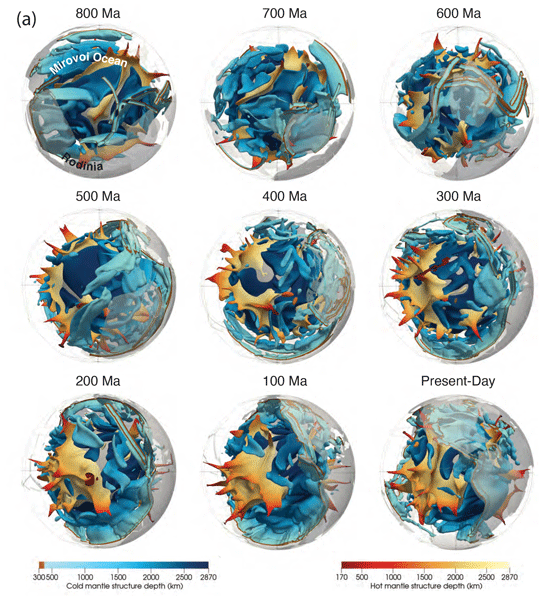
We have built a community model for the evolution of the Earth's plate–mantle system. Created with open-source software and an open-access plate model, it covers the last billion years, including the formation, breakup, and dispersal of two supercontinents, as well as the creation and destruction of numerous ocean basins. The model allows us to
seeinto the Earth in 4D and helps us unravel the connections between surface tectonics and the
beating heartof the Earth, its convecting mantle.
Cited articles
Alley, N. F. and Hore, S. B.: Early Cretaceous sediments reveal a story of prolonged cold climate, glaciations, oscillating sea level and tectonic changes, Geological Survey of South Australia Bulletin 57, Department for Energy and Mining, South Australia, Adelaide, https://catalog.sarig.sa.gov.au/document/2023d008243 (last access: 27 March 2026), 2022.
Alonso, E., Sherman, A. M., Wallington, T. J., Everson, M. P., Field, F. R., Roth, R., and Kirchain, R. E.: Evaluating Rare Earth Element Availability: A Case with Revolutionary Demand from Clean Technologies, Environ. Sci. Technol., 46, 3406–3414, https://doi.org/10.1021/es203518d, 2012.
Alper, O. C., Doğan, H., and Öztürk, H.: Gear pitting fault detection: Leveraging anomaly detection methods, in: IEEE 2023 14th International Conference on Electrical and Electronics Engineering (ELECO), 1–5, https://doi.org/10.1109/ELECO60389.2023.10416063, 2023.
Austin, J. and Foss, C.: Rich, attractive and extremely dense: A geophysical review of Australian IOCGs, ASEG Extend. Abstr., 2012, 1–4, https://doi.org/10.1071/ASEG2012ab278, 2012.
Baldi, P., Brunak, S., Chauvin, Y., Andersen, C. A. F., and Nielsen, H.: Assessing the accuracy of prediction algorithms for classification: an overview, Bioinformatics, 16, 412–424, https://doi.org/10.1093/bioinformatics/16.5.412, 2000.
Bedini, E.: Mineral mapping in the Kap Simpson complex, central East Greenland, using HyMap and ASTER remote sensing data, Adv. Space Res., 47, 60–73, https://doi.org/10.1016/j.asr.2010.08.021, 2011.
Bergen, K. J., Johnson, P. A., de Hoop, M. V., and Beroza, G. C.: Machine learning for data-driven discovery in solid Earth geoscience, Science, 363, eaau0323, https://doi.org/10.1126/science.aau0323, 2019.
Bogacz, W. V.: The tectogenetic explanation of the uranium potential of the Paralana Mineral System in the Mt Painter Inlier, northwest margin of the Curnamona Craton, South Australia, Abstracts for the September 2006 Conference, GA Record 2006/21, https://www.ga.gov.au/bigobj/GA8853.pdf (last access: 27 March 2026), 2006.
Breiman, L.: Random Forests, Mach. Learn., 45, 5–32, https://doi.org/10.1023/A:1010933404324, 2001.
Brewer, A. M.: Annual Report Exploration Licence 480 (Gunsight) for period May 25, 1979 to May 24, 1980. Marathon Petroleum Australia Ltd. Department of Mines and Energy, South Australia Open File Envelope 3536, unpublished, 1980.
Brown, W. M., Gedeon, T. D., Groves, D. I., and Barnes, R. G.: Artificial neural networks: A new method for mineral prospectivity mapping, Aust. J. Earth Sci., 47, 757–770, https://doi.org/10.1046/j.1440-0952.2000.00807.x, 2000.
Bustillo Revuelta, M.: Mineral Resource Exploration, in: Mineral Resources: From Exploration to Sustainability Assessment, edited by: Bustillo Revuelta, M., Springer International Publishing, Cham, 121–222, https://doi.org/10.1007/978-3-319-58760-8_3, 2018.
Carranza, E. J. M.: Controls on mineral deposit occurrence inferred from analysis of their spatial pattern and spatial association with geological features, Ore Geol. Rev., 35, 383–400, https://doi.org/10.1016/j.oregeorev.2009.01.001, 2009.
Carranza, E. J. M., Hale, M., and Faassen, C.: Selection of coherent deposit-type locations and their application in data-driven mineral prospectivity mapping, Ore Geol. Rev., 33, 536–558, https://doi.org/10.1016/j.oregeorev.2007.07.001, 2008.
Chen, Y. and Wu, W.: Mapping mineral prospectivity using an extreme learning machine regression, Ore Geol. Rev., 80, 200–213, https://doi.org/10.1016/j.oregeorev.2016.06.033, 2017.
Cheng, Q.: Mapping singularities with stream sediment geochemical data for prediction of undiscovered mineral deposits in Gejiu, Yunnan Province, China, Ore Geol. Rev., 32, 314–324, https://doi.org/10.1016/j.oregeorev.2006.10.002, 2007.
Cheng, Q.: Singularity theory and methods for mapping geochemical anomalies caused by buried sources and for predicting undiscovered mineral deposits in covered areas, J. Geochem. Explor., 122, 55–70, https://doi.org/10.1016/j.gexplo.2012.07.007, 2012.
Cheng, Q. and Zhao, P.: Singularity theories and methods for characterizing mineralization processes and mapping geo-anomalies for mineral deposit prediction, Geosci. Front., 2, 67–79, https://doi.org/10.1016/j.gsf.2010.12.003, 2011.
Cohen, J.: A Coefficient of Agreement for Nominal Scales, Educ. Psycholog. Meas., 20, 37–46, https://doi.org/10.1177/001316446002000104, 1960.
Connelly, N. G., Damhus, T., Hartshorn, R. M., and Hutton, A. T. (Eds.): Nomenclature of Inorganic Chemistry: IUPAC Recommendations 2005, Royal Society of Chemistry, https://publications.iupac.org/books/rbook/Red_Book_2005.pdf (last access: 27 March 2026), 2005.
Curewitz, D. and Karson, J. A.: Structural settings of hydrothermal outflow: Fracture permeability maintained by fault propagation and interaction, J. Volcanol. Geoth. Res., 79, 149–168, https://doi.org/10.1016/S0377-0273(97)00027-9, 1997.
Dhurandhar, A. P. and Saxena, D. N.: Intergrated Airborne Gammaray Spectral and Satellite Data Analysis for U and REE Mineralisation – A Case Sudy from North Sagobandh Area, District Sonbhadra, Uttar Pradesh, India, J. Indian Soc. Remote Sens., 27, 43–57, https://doi.org/10.1007/BF02990774, 1999.
Drenth, B. J.: Geophysical expression of a buried niobium and rare earth element deposit: The Elk Creek carbonatite, Nebraska, USA, Interpretation, 2, SJ23–SJ33, https://doi.org/10.1190/INT-2014-0002.1, 2014.
Drexel, J. F. and Major, R. B.: Mount Painter uranium – rare earth deposits. in: Geology of the mineral deposits of Australia and Papua New Guinea, Monograph Series 14, edited by: Hughes, F. E., AusIMM– Australasian Institute of Mining and Metallurgy, 993–998, https://www.ausimm.com/publications/monograph/monograph-14—geology-of-the-mineral-deposits-of-australia (last access: 27 March 2026), 1990.
Dusabemariya, C., Qian, W., Bagaragaza, R., Faruwa, A. R., and Ali, M.: Some experiences of resistivity and induced polarization methods on the exploration of sulfide: A review, J. Geosci. Environ. Protect., 8, 68–92, https://doi.org/10.4236/gep.2020.811004, 2020.
Dushyantha, N., Batapola, N., Ilankoon, I. M. S. K., Rohitha, S., Premasiri, R., Abeysinghe, B., Ratnayake, N., and Dissanayake, K.: The story of rare earth elements (REEs): Occurrences, global distribution, genesis, geology, mineralogy and global production, Ore Geol. Rev., 122, 103521, https://doi.org/10.1016/j.oregeorev.2020.103521, 2020.
Edgecombe, D.: Preliminary discussion on field trip to the Mt. Neil – Parabarana area, Period 3rd June to 11th June 1998, Open File Envelope 9205, Goldstream Mining N. L. Department of Mines and Energy, South Australia unpublished, 1998.
Egozcue, J. J., Pawlowsky-Glahn, V., Mateu-Figueras, G., and Barceló-Vidal, C.: Isometric Logratio Transformations for Compositional Data Analysis, Math. Geol., 35, 279–300, https://doi.org/10.1023/A:1023818214614, 2003.
Elburg, M. A., Andersen, T., Bons, P. D., Simonsen, S. L., and Weisheit, A.: New constraints on Phanerozoic magmatic and hydrothermal events in the Mt Painter Province, South Australia, Gondwana Res., 24, 700–712, https://doi.org/10.1016/j.gr.2012.12.017, 2013.
Exoil: Exploration Department of Mines and Energy, South Australia Open File Envelope 3633, unpublished, 1970.
Farahbakhsh, E., Maughan, J., and Müller, R. D.: Prospectivity modelling of critical mineral deposits using a generative adversarial network with oversampling and positive-unlabelled bagging, Ore Geol. Rev., 162, 105665, https://doi.org/10.1016/j.oregeorev.2023.105665, 2023.
Fawcett, T.: An introduction to ROC analysis, Pattern Recognition Letters, 27, 861–874, https://doi.org/10.1016/j.patrec.2005.10.010, 2006.
Filzmoser, P., Hron, K., and Reimann, C.: Principal component analysis for compositional data with outliers, Environmetrics, 20, 621–632, https://doi.org/10.1002/env.966, 2009.
Gao, F., Li, J., Cheng, R., Zhou, Y., and Ye, Y.: Connet: Deep semi-supervised anomaly detection based on sparse positive samples. IEEE Access, 9, 67249–67258, https://doi.org/10.1109/ACCESS.2021.3077014, 2021.
Goldfarb, R. J. and Groves, D. I.: Orogenic gold: Common or evolving fluid and metal sources through time, Lithos, 233, 2–26, https://doi.org/10.1016/j.lithos.2015.07.011, 2015.
Goodenough, K. M., Wall, F., and Merriman, D.: The Rare Earth Elements: Demand, Global Resources, and Challenges for Resourcing Future Generations, Nat. Resour. Res., 27, 201–216, https://doi.org/10.1007/s11053-017-9336-5, 2018.
Goodenough, K. M., Deady, E. A., Beard, C. D., Broom-Fendley, S., Elliott, H. A. L., van den Berg, F., and Öztürk, H.: Carbonatites and Alkaline Igneous Rocks in Post-Collisional Settings: Storehouses of Rare Earth Elements, J. Earth Sci., 32, 1332–1358, https://doi.org/10.1007/s12583-021-1500-5, 2021.
Granek, J. and Haber, E.: Data mining for real mining: A robust algorithm for prospectivity mapping with uncertainties, in: Proceedings of the 2015 SIAM International Conference on Data Mining (SDM), Society for Industrial and Applied Mathematics, 145–153, https://doi.org/10.1137/1.9781611974010.17, 2015.
Grunsky, E. C. and de Caritat, P.: State-of-the-art analysis of geochemical data for mineral exploration, Geochemistry: Explor. Environ. Anal., 20, 217–232, https://doi.org/10.1144/geochem2019-031, 2019.
Guth, P. L., Van Niekerk, A., Grohmann, C. H., Muller, J.-P., Hawker, L., Florinsky, I. V., Gesch, D., Reuter, H. I., Herrera-Cruz, V., Riazanoff, S., López-Vázquez, C., Carabajal, C. C., Albinet, C., and Strobl, P.: Digital Elevation Models: Terminology and Definitions, Remote Sens., 13, 3581, https://doi.org/10.3390/rs13183581, 2021.
Hauke, J. and Kossowski, T.: Comparison of Values of Pearson's and Spearman's Correlation Coefficients on the Same Sets of Data, Quaestion. Geogr., 30, 87–93, https://doi.org/10.2478/v10117-011-0021-1, 2011.
Hoatson, D. M., Jaireth, S., and Miezitis, Y.: The major rare-earth-element deposits of Australia: geological setting, exploration, and resources, Geoscience Australia, https://www.ga.gov.au/bigobj/GA19659.pdf (last access: 27 March 2026), 2011.
Hore, S. B.: Mount Painter region, South Australia 1:100 000 Geological Atlas Special Series Map, DIGIMAP 00005, GSSA – Geological Survey of South Australia, Adelaide, https://dsd-gdp.s3.amazonaws.com/2037106/DIGIMAP00005.zip (last access: 27 March 2026), 2015.
Hore, S. B., Hill, S. M., Reid, A., Wade, B., Alley, N. F., and Mason, D. R.: U–Pb geochronology reveals evidence of a Late Devonian hydrothermal event, and protracted hydrothermal–epithermal system, within the Mount Painter Inlier, northern Flinders Ranges, South Australia, Aust. J. Earth Sci., 67, 1009–1044, https://doi.org/10.1080/08120099.2020.1793383, 2020a.
Hore, S. B., Hill, S. M., and Alley, N. F.: Early Cretaceous glacial environment and paleosurface evolution within the Mount Painter Inlier area, northern Flinders Ranges, South Australia. South Australia, Aust. J. Earth Sci., 67, 1117–1160, https://doi.org/10.1080/08120099.2020.1730963, 2020b.
Hronsky, J. M. and Kreuzer, O. P.: Applying spatial prospectivity mapping to exploration targeting: Fundamental practical issues and suggested solutions for the future, Ore Geol. Rev., 107, 647–653, https://doi.org/10.1016/j.oregeorev.2019.03.016, 2019.
Jagodzinski, E. and Fricke, C. E.: Compilation of new SHRIMP U-Pb geochronological data for the southern Curnamona Province, South Australia, https://catalog.sarig.sa.gov.au/dataset/d20010225/resource/0e05937a-0dc4-4ecb-9b36-35d59b4a7976 (last access: 27 March 2026), 2010.
Jaireth, S., Hoatson, D. M., and Miezitis, Y.: Geological setting and resources of the major rare-earth-element deposits in Australia, Ore Geol. Rev., 62, 72–128, https://doi.org/10.1016/j.oregeorev.2014.02.008, 2014.
Jowitt, S. M., Medlin, C. C., and Cas, R. A. F.: The rare earth element (REE) mineralisation potential of highly fractionated rhyolites: A potential low-grade, bulk tonnage source of critical metals, Ore Geol. Rev.,, 86, 548–562, https://doi.org/10.1016/j.oregeorev.2017.02.027, 2017.
Katona, L. F.: Gridding of South Australian Ground Gravity Data, using the Supervised Variable Density Method, Report Book 2017/00012, Department of the Premier and Cabinet, South Australia, Adelaide, https://catalog.sarig.sa.gov.au/document/d20011685 (last access: 27 March 2026), 2017.
Khoshnoodi, K., Yazdi, M., Behzadi, M., and Gannadi-Maragheh, M.: Using of ASTER, ETM+ and gamma spectrometry airborne data to find the relationship between the distribution of alkali metasomatism and REE mineralization in the Bafq area, Central Iran, J. Sci. Islam. Republ. Iran, 27, 65–77, 2016.
Kovacs, I.: Origin of the South Australian Heat Flow Anomaly, in: An excursion guide to the Flinders Ranges, South Australia, edited by: Aikman, A., Lilly, K., Celerier, J., Kovacs, I., and Estermann, G., J. Virtual Explor., 20, 14, https://doi.org/10.3809/jvirtex.2005.00137, 2005.
LeCun, Y., Bengio, Y., and Hinton, G.: Deep learning, Nature, 521, 436–444, https://doi.org/10.1038/nature14539, 2015.
Leevy, J. L., Khoshgoftaar, T. M., Bauder, R. A., and Seliya, N.: A survey on addressing high-class imbalance in big data, J. Big Data, 5, 42, https://doi.org/10.1186/s40537-018-0151-6, 2018.
Leroy, J. L. and Turpin, L.: REE, Th and U behaviour during hydrothermal and supergene processes in a granitic environment, Chem. Geol., 68, 239–251, https://doi.org/10.1016/0009-2541(88)90024-1, 1988.
Li, T., Zuo, R., Xiong, Y., and Peng, Y.: Random-drop data augmentation of deep convolutional neural network for mineral prospectivity mapping.,Nat. Resour. Res., 30, 27–38, https://doi.org/10.1007/s11053-020-09742-z, 2021.
Liu, B., Lee, W. S., Yu, P. S., and Li, X.: Partially supervised classification of text documents, in: ICML 02(485), 387–394, https://www.cs.uic.edu/~liub/S-EM/unlabelled.pdf (last access: 27 March 2026), 2002.
Liu, B., Dai, Y., Li, X., Lee, W. S., and Yu, P. S.: November. Building text classifiers using positive and unlabeled examples, in: Third IEEE international conference on data mining, 179–186, https://doi.org/10.1109/ICDM.2003.1250918, 2003.
Long, K. R., Van Gosen, B. S., Foley, N. K., and Cordier, D.: The Principal Rare Earth Elements Deposits of the United States: A Summary of Domestic Deposits and a Global Perspective, in: Non-Renewable Resource Issues: Geoscientific and Societal Challenges, edited by: Sinding-Larsen, R. and Wellmer, F.-W., Springer Netherlands, Dordrecht, 131–155, https://doi.org/10.1007/978-90-481-8679-2_7, 2012.
Lottermoser, B. G.: Rare earth elements and hydrothermal ore formation processes, Ore Geol. Rev., 7, 25–41, https://doi.org/10.1016/0169-1368(92)90017-F, 1992.
Lundberg, S. M. and Lee, S.-I.: A Unified Approach to Interpreting Model Predictions, in: Advances in Neural Information Processing Systems, arXiv [preprint], https://doi.org/10.48550/arXiv.1705.07874, 2017.
Luo, Z., Zuo, R., Xiong, Y., and Zhou, B.: Metallogenic-factor variational autoencoder for geochemical anomaly detection by ad-hoc and post-hoc interpretability algorithms, Nat. Resour. Res., 32, 835–853, https://doi.org/10.1007/s11053-023-10200-9, 2023.
Luo, Z., Farahbakhsh, E., Müller, R. D., and Zuo, R.: Multivariate statistical analysis and bespoke deviation network modeling for geochemical anomaly detection of rare earth elements, Appl. Geochem., 174, 106146, https://doi.org/10.1016/j.apgeochem.2024.106146, 2024.
Luo, Z., Farahbakhsh, E., Hore, S., and Müller, R. D.: An explainable semi-supervised deep learning framework for mineral prospectivity mapping: DEEP-SEAM v1.0, Zenodo [code], https://doi.org/10.5281/zenodo.17098677, 2025a.
Luo, Z., Farahbakhsh, E., Hore, S., and Müller, R. D.: An explainable semi-supervised deep learning framework for mineral prospectivity mapping, GitHub [code], https://github.com/EarthByte/MPM_Curnamona_REE (last access: 27 March 2026), 2025b.
Marshall, N. J.: Geochemical Exploration Studies in the Mt. Painter Province, South Australia Open File Envelope 3536, Department of Mines and Energy, unpublished, 1979.
McCafferty, A. E., Phillips, J. D., and Driscoll, R. L.: Magnetic and gravity gradiometry framework for Mesoproterozoic iron oxide-apatite and iron oxide-copper-gold deposits, southeast Missouri, Econ. Geol., 111, 1859–1882, https://doi.org/10.2113/econgeo.111.8.1859, 2016.
McCuaig, T. C. and Hronsky, J. M. A.: The Mineral System Concept: The Key to Exploration Targeting, in: Building Exploration Capability for the 21st Century, vol. 18, edited by: Kelley, K. D. and Golden, H. C., Society of Economic Geologists, https://doi.org/10.5382/SP.18.08, 2014.
McPhee, K. A., Hodkinson, I. P., and Mackie, A. M.: Report for Exploration Licence 871 (Gunsight) for 6 Month Period Ending 28 February, 1982, Open File Envelope 3536, Department of Mines and Energy, South Australia, unpublished, 1982.
Mou, N., Carranza, E. J. M., Wang, G., and Sun, X.: A Framework for Data-Driven Mineral Prospectivity Mapping with Interpretable Machine Learning and Modulated Predictive Modeling, Nat. Resour. Res., 32, 2439–2462, https://doi.org/10.1007/s11053-023-10272-7, 2023.
Mou, N., Carranza, E. J. M., Xue, J., Zhang, S., Wang, G., Song, H., Chen, Y., and Ren, X.: Interpretable machine learning for mineral prospectivity mapping in the Qulong–Jiama district, Tibet, China, Ore Geol. Rev., 106659, https://doi.org/10.1016/j.oregeorev.2025.106659, 2025.
Neumann, N., Sandiford, M., and Foden, J.: Regional geochemistry and continental heat flow: implications for the origin of the South Australian heat flow anomaly, Earth Planet. Sc. Lett., 183, 107–120, https://doi.org/10.1016/S0012-821X(00)00268-5, 2000.
Newton, W., Daly, S., Robertson, S., Preiss, W., Conor, C., and Burtt, A.: Overview of geology and mineralisation in South Australia, ASEG Extend. Abstr., 2003, 1–18, https://doi.org/10.1071/ASEGSpec12_01, 2003.
Nguyen, G., Dlugolinsky, S., Bobák, M., Tran, V., López García, Á., Heredia, I., Malík, P., and Hluchý, L.: Machine Learning and Deep Learning frameworks and libraries for large-scale data mining: a survey, Artif. Intel. Rev., 52, 77–124, https://doi.org/10.1007/s10462-018-09679-z, 2019.
Nykänen, V., Lahti, I., Niiranen, T., and Korhonen, K.: Receiver operating characteristics (ROC) as validation tool for prospectivity models – A magmatic Ni–Cu case study from the Central Lapland Greenstone Belt, Northern Finland, Ore Geol. Rev., 71, 853–860, https://doi.org/10.1016/j.oregeorev.2014.09.007, 2015.
Pang, G., Shen, C., and van den Hengel, A.: Deep Anomaly Detection with Deviation Networks, in: Proceedings of the 25th ACM SIGKDD International Conference on Knowledge Discovery & Data Mining, New York, NY, USA, 353–362, https://doi.org/10.1145/3292500.3330871, 2019.
Pang, G., Shen, C., Jin, H., and van den Hengel, A.: Deep weakly-supervised anomaly detection. in: Proceedings of the 29th ACM SIGKDD International Conference on Knowledge Discovery & Data Mining, New York, NY, USA, 1795–1807, https://doi.org/10.1145/3580305.3599302, 2023.
Pitcairn, I. K., Teagle, D. A., Craw, D., Olivo, G. R., Kerrich, R., and Brewer, T. S.: Sources of metals and fluids in orogenic gold deposits: insights from the Otago and Alpine Schists, New Zealand, Econ. Geol., 101, 1525–1546, https://doi.org/10.2113/gsecongeo.101.8.1525, 2006.
Pour, A. B. and Hashim, M.: Identification of hydrothermal alteration minerals for exploring of porphyry copper deposit using ASTER data, SE Iran, J. Asian Earth Sci., 42, 1309–1323, https://doi.org/10.1016/j.jseaes.2011.07.017, 2011.
Preiss, W. V.: The Adelaide Geosyncline of South Australia and its significance in Neoproterozoic continental reconstruction, Precamb. Res., 100, 21–63, https://doi.org/10.1016/S0301-9268(99)00068-6, 2000.
Reed, G. and Keeping, T.: 2021 State TMI grid merge, Report Book 2024/00017, Department for Energy and Mining, South Australia, Adelaide, https://catalog.sarig.sa.gov.au/document/mesac1793 (last access: 27 March 2026), 2025a.
Reed, G. and Keeping, T.: 2025 State radiometric grid merge, Report Book 2025/00021, Department for Energy and Mining, South Australia, Adelaide, https://catalog.sarig.sa.gov.au/document/mesac1866 (last access: 27 March 2026), 2025b.
Reynolds, J. M.: An Introduction to Applied and Environmental Geophysics, John Wiley & Sons, 1249 pp., ISBN 9781119957140, 2011.
Ribeiro, M. T., Singh, S., and Guestrin, C.: “Why Should I Trust You?”: Explaining the Predictions of Any Classifier, in: Proceedings of the 22nd ACM SIGKDD International Conference on Knowledge Discovery and Data Mining, New York, NY, USA, 1135–1144, https://doi.org/10.1145/2939672.2939778, 2016.
Robertson, R. S., Preiss, W. V., Crooks, A. F., Hill, P. W., and Sheard, M. J.: Review of the Proterozoic geology and mineral potential of the Curnamona Province in South Australia, AGSO J. Aust. Geol. Geophys., 17, 169–182, 1998.
Robertson, R. S., Conor, C. H. H., Preiss, W. V., Crooks, A. F., and Sheard, M. J.: Curnamona Province, in: South Australia mineral explorers guide, 2n Edn., South Australia, Mineral Exploration Data Package 11, chap. 3, edited by: Cooper, B. J. and McGeough, M. A., Department of Primary Industries and Resources, https://catalog.sarig.sa.gov.au/document/mesac19670 (last access: 27 March 2026), 2006.
Rodriguez-Galiano, V., Sanchez-Castillo, M., Chica-Olmo, M., and Chica-Rivas, M.: Machine learning predictive models for mineral prospectivity: An evaluation of neural networks, random forest, regression trees and support vector machines, Ore Geol. Rev., 71, 804–818, https://doi.org/10.1016/j.oregeorev.2015.01.001, 2015.
Ruff, L., Vandermeulen, R. A., Görnitz, N., Binder, A., Müller, E., Müller, K. R., and Kloft, M.: Deep semi-supervised anomaly detection, arxiv [preprint], arxiv:1906.02694, https://doi.org/10.48550/arXiv.1906.02694, 2019.
Rutherford, L., Hand, M., and Barovich, K.: Timing of Proterozoic metamorphism in the southern Curnamona Province: implications for tectonic models and continental reconstructions, Aust. J. Earth Sci., 54, 65–81, https://doi.org/10.1080/08120090600981459, 2007.
Sandiford, M., McLaren, S. and Neumann, N.: Long-term thermal consequences of the redistribution of heat-producing elements associated with large-scale granitic complexes, J. Metamorph. Geol., 20, 87–98, https://doi.org/10.1046/j.0263-4929.2001.00359.x, 2002.
Shah, A. K., Taylor, R. D., Walsh, G. J., and Phillips, J. D.: Integrated geophysical imaging of rare earth element-bearing iron oxide-apatite deposits in the Eastern Adirondack Highlands, New York, Geophysics, 86, B37–B54, https://doi.org/10.1190/geo2019-0783.1, 2021.
Sharma, P. V.: Magnetic method applied to mineral exploration, Ore Geol. Rev., 2, 323–357, https://doi.org/10.1016/0169-1368(87)90010-2, 1987.
Sheard, M. J.: Explanatory Notes for CALLABONNA 1:250 000 Geological Map, sheet SH54-6, Report Book 2009/01, South Australia, Department of Primary Industries and Resources, https://catalog.sarig.sa.gov.au/document/d20010138 (last access: 27 March 2026), 2009.
Sheard, M. J., Fanning, C. M., and Flint, R. B.: Geochronology and definition of Mesoproterozoic volcanics and granitoids of the Mount Babbage Inlier, South Australia, Quarterly Geological Notes 123, South Australia, Geological Survey, 18–32, https://catalog.sarig.sa.gov.au/document/2018d037573 (last access: 27 March 2026), 1992.
Shrikumar, A., Greenside, P., and Kundaje, A.: Learning Important Features Through Propagating Activation Differences, in: Proceedings of the 34th International Conference on Machine Learning, International Conference on Machine Learning, 3145–3153, 2017.
Sillitoe, R. H.: Porphyry copper systems, Econ. Geol., 105, 3–41, https://doi.org/10.2113/gsecongeo.105.1.3, 2010.
Simandl, G. J. and Paradis, S.: Carbonatites: related ore deposits, resources, footprint, and exploration methods, Appl. Earth Sci., 127, 123–152, https://doi.org/10.1080/25726838.2018.1516935, 2018.
Singer, D. A.: Basic concepts in three-part quantitative assessments of undiscovered mineral resources, Nat. Resour. Res., 2, 69–81, https://doi.org/10.1007/BF02272804, 1993.
Singer, D. A. and Kouda, R.: Application of a feedforward neural network in the search for Kuroko deposits in the Hokuroku district, Japan, Math. Geol., 28, 1017–1023, https://doi.org/10.1007/BF02068587, 1996.
Smith, M. P., Moore, K., Kavecsánszki, D., Finch, A. A., Kynicky, J., and Wall, F.: From mantle to critical zone: A review of large and giant sized deposits of the rare earth elements, Geosci. Front., 7, 315–334, https://doi.org/10.1016/j.gsf.2015.12.006, 2016.
Spandler, C., Slezak, P., and Nazari-Dehkordi, T.: Tectonic significance of Australian rare earth element deposits, Earth-Sci. Rev., 207, 103219, https://doi.org/10.1016/j.earscirev.2020.103219, 2020.
Sullivan, C. J., Broadhurst, E., and Sprigg, R. C.: Reports on individual uranium occurrences, in: Report on investigation of uranium deposits at Mount Painter, South Australia [during the period] June 1944 to September 1945, Part III(3), Report Book 40/1, edited by: Newman, J. M., Rivett, D., and Dickinson, S. B., South Australia Department of Mines, Adelaide, 124–168, https://catalog.sarig.sa.gov.au/document/rb4000001 (last access: 27 March 2026), 1945.
Sun, K., Chen, Y., Geng, G., Lu, Z., Zhang, W., Song, Z., Guan, J., Zhao, Y., and Zhang, Z.: A Review of Mineral Prospectivity Mapping Using Deep Learning, Minerals, 14, https://doi.org/10.3390/min14101021, 2024.
Sun, T., Li, H., Wu, K., Chen, F., Zhu, Z., and Hu, Z.: Data-driven predictive modelling of mineral prospectivity using machine learning and deep learning methods: A case study from Southern Jiangxi Province, China, Minerals, 10, 102, https://doi.org/10.3390/min10020102, 2020.
Taylor, C. D., Zierenberg, R. A., Goldfarb, R. J., Kilburn, J. E., Seal, R. R., Kleinkopf, M. D., and Du Bray, E. A.: Volcanic-associated massive sulfide deposits, Open-File Report 95-831, United States Geological Survey, America, https://pubs.usgs.gov/of/1995/ofr-95-0831/CHAP16.pdf (last access: 27 March 2026), 1995.
Teale, G. S.: Wattleowie Rare Earth Prospect, E. L. 480, Northern Flinders Ranges, South Australia, Open File Envelope 3536, Department of Mines, South Australia, unpublished, 1981.
Teale, G. S.: Geology of the Mount Painter and Mount Babbage Inliers (Mesoproterozoic), in: Volume 1, The Precambrian, Bulletin 54, edtited by: Drexel, J. F., Preiss, W. V., and Parker, A. J., The geology of South Australia, South Australia, Geological Survey, Adelaide, 149–156, https://catalog.sarig.sa.gov.au/document/2018d037831 (last access: 27 March 2026), 1993.
Teale, G. S.: Exploration Licence 2173, “Arkaroola”, Report on Geological Reconnaissance Work for Goldstream Mining N. L. Department of Mines and Energy, South Australia Open File Envelope 9205, unpublished, 1995.
Thomas, M. d., Ford, K. l., and Keating, P.: Review paper: Exploration geophysics for intrusion-hosted rare metals, Geophys. Prospect., 64, 1275–1304, https://doi.org/10.1111/1365-2478.12352, 2016.
Tukey, J. W.: Exploratory data analysis, Pearson, London, UK, ISBN 9780134995458, 1977.
Van Rijsbergen, C. J.: Foundation of evaluation, J. Doc., 30, 365–373, 1974.
VanTrump, G. and Miesch, A. T.: The U.S. geological survey rass-statpac system for management and statistical reduction of geochemical data, Comput. Geosci., 3, 475–488, https://doi.org/10.1016/0098-3004(77)90025-5, 1977.
Walters, A. and Lusty, P.: Rare earth elements, British Geological Survey, 54 pp., https://nora.nerc.ac.uk/id/eprint/17448/1/Rare_Earth_Elements_profile[1].pdf (last access: 27 March 2026), 2011.
White, A. J.: Granites and Uranium Mineralisation in the Mount Painter Complex Northern Flinders Ranges, Open File Envelope 12288, PIRSA, Adelaide, unpublished, 2005.
Whitehead, S.: The Mineralology of some Mt. Painter Breccias, Report MP2714/76, AMDEL Petrological, unpublished, 1976.
Williams, H. A., Betts, P. G., and Ailleres, L.: Constrained 3D modeling of the Mesoproterozoic Benagerie Volcanics, Australia, Phys. Earth Planet. Inter., 173, 233–253, https://doi.org/10.1016/j.pepi.2009.01.002, 2009.
Wülser, P. A.: Uranium metallogeny in the North Flinders Ranges region of South Australia, PhD thesis, University of Adelaide, Adelaide, 250 pp., https://digital.library.adelaide.edu.au/items/e3a2b832-4f02-4d7a-b1f6-899d63d98cb5 (last access: 27 March 2026), 2009.
Wülser, P. A., Brugger, J., Foden, J., and Pfeifer, H. R.: The Sandstone-Hosted Beverley Uranium Deposit, Lake Frome Basin, South Australia:Mineralogy, Geochemistry, and a Time-Constrained Model for Its Genesis, Econ. Geol., 106, 835–867, https://doi.org/10.2113/econgeo.106.5.835, 2011.
Xiong, Y., Zuo, R., and Carranza, E. J. M.: Mapping mineral prospectivity through big data analytics and a deep learning algorithm, Ore Geol. Rev., 102, 811–817, https://doi.org/10.1016/j.oregeorev.2018.10.006, 2018.
Xu, S., Hu, X., Carranza, E. J. M., and Wang, G.: Multi-parameter analysis of local singularity mapping and its application to identify geochemical anomalies in the Xishan Gold Deposit, North China, Nat. Resour. Res., 29, 3425–3442, https://doi.org/10.1007/s11053-020-09669-5, 2020.
Yang, F., Zuo, R., and Kreuzer, O. P.: Artificial intelligence for mineral exploration: A review and perspectives on future directions from data science, Earth Sci. Rev., 258, 104941, https://doi.org/10.1016/j.earscirev.2024.104941, 2024.
Yang, N., Zhang, Z., Yang, J., and Hong, Z.: Applications of data augmentation in mineral prospectivity prediction based on convolutional neural networks, Comput. Geosci., 161, 105075, https://doi.org/10.1016/j.cageo.2022.105075, 2022.
Zhang, Y. L., Li, L., Zhou, J., Li, X., and Zhou, Z. H.: Anomaly detection with partially observed anomalies, in: Companion Proceedings of the The Web Conference 2018, 639–646, https://doi.org/10.1145/3184558.3186580, 2018.
Zhao, P. and Chen, Y.: Digital geosciences and quantitative mineral exploration, J. Earth Sci., 32, 269–275, https://doi.org/10.1007/s12583-021-1440-0, 2021.
Zhao, P. D.: “Three Component” quantitative resource prediction and assessment: theory and practice of digital mineral prospecting, J. Earth Sci., 27, 139–148, 2002.
Zheng, H., Sun, D., Han, X., Zhang, X., and Zhao, Y.: Research on Network Security Intrusion Detection Based on Devnet, in: Proceedings of the 3rd International Conference on Signal Processing, Computer Networks and Communications, 251–256, https://doi.org/10.1145/3712335.3712379, 2024.
Zhou, B., Li, Z., Zhao, Y., Zhang, C., and Wei, Y.: Rare Earth Elements supply vs. clean energy technologies: new problems to be solve, Gospodarka Surowcami Mineralnymi, 32, 29–44, https://doi.org/10.1515/gospo-2016-0039, 2016.
Zivak, D.: Rare Earth Element (REE) potential of the Curnamona Province, South Australia, Report Book 2024/00037, Department for Energy and Mining, South Australia, Adelaide, https://catalog.sarig.sa.gov.au/document/mesac2#:~:text=This report provides a review of the major,systems association to better assess the REE potential (last access: 27 March 2026), 2024.
Zuo, R.: Geodata Science-Based Mineral Prospectivity Mapping: A Review, Nat. Resour. Res., 29, 3415–3424, https://doi.org/10.1007/s11053-020-09700-9, 2020.
Zuo, R.: Key technology for intelligent mineral prospectivity map: Challenges and solutions, Sci. China Earth Sci., 68, 2976–2991, https://doi.org/10.1007/s11430-025-1622-1, 2025.
Zuo, R. and Carranza, E. J. M.: Support vector machine: A tool for mapping mineral prospectivity, Comput. Geosci., 37, 1967–1975, https://doi.org/10.1016/j.cageo.2010.09.014, 2011.
Zuo, R. and Xu, Y.: Graph deep learning model for mapping mineral prospectivity, Math. Geosci., 55, 1–21, https://doi.org/10.1007/s11004-022-10015-z, 2023.
Zuo, R., Kreuzer, O. P., Wang, J., Xiong, Y., Zhang, Z., and Wang, Z.: Uncertainties in GIS-Based Mineral Prospectivity Mapping: Key Types, Potential Impacts and Possible Solutions, Nat. Resour. Res., 30, 3059–3079, https://doi.org/10.1007/s11053-021-09871-z, 2021.
Zuo, R., Luo, Z., Xiong, Y., and Yin, B.: A Geologically Constrained Variational Autoencoder for Mineral Prospectivity Mapping, Nat. Resour. Res., 31, 1121–1133, https://doi.org/10.1007/s11053-022-10050-x, 2022.
Zuo, R., Xiong, Y., Wang, Z., Wang, J., and Kreuzer, O. P.: A New Generation of Artificial Intelligence Algorithms for Mineral Prospectivity Mapping, Nat. Resour. Res., 32, 1859–1869, https://doi.org/10.1007/s11053-023-10237-w, 2023.
Zuo, R., Cheng, Q., Xu, Y., Yang, F., Xiong, Y., Wang, Z., and Kreuzer, O. P.: Explainable artificial intelligence models for mineral prospectivity mapping, Sci. China Earth Sci., 67, 2864–2875, https://doi.org/10.1007/s11430-024-1309-9, 2024.
Zuo, R., Yang, F., Cheng, Q., and Kreuzer, O. P.: A novel data-knowledge dual-driven model coupling artificial intelligence with a mineral systems approach for mineral prospectivity map, Geology, 53, 284–288, https://doi.org/10.1130/G52970.1, 2025.
Short summary
By combining multi-source data with advanced processing techniques, our deep learning model effectively identifies mineralisation patterns despite extremely limited deposit samples, analyses data and validates the geological relevance of its decisions through explainability analysis, providing a universally reliable solution for artificial intelligence-assisted mineral prospectivity mapping.
By combining multi-source data with advanced processing techniques, our deep learning model...


