Articles | Volume 19, issue 6
https://doi.org/10.5194/gmd-19-2461-2026
© Author(s) 2026. This work is distributed under
the Creative Commons Attribution 4.0 License.
https://doi.org/10.5194/gmd-19-2461-2026
© Author(s) 2026. This work is distributed under
the Creative Commons Attribution 4.0 License.
The microbial community model MCoM 1.0: a scalable framework for modelling phototroph–heterotrophic interactions in diverse microbial communities
Institute for Chemistry and Biology of the Marine Environment (ICBM), Carl von Ossietzky Universität Oldenburg, Oldenburg, Germany
Michael J. Follows
Department of Earth, Atmospheric and Planetary Sciences, Massachusetts Institute of Technology, Cambridge, MA, United States
Jason G. Bragg
Research Centre for Ecosystem Resilience, Botanic Gardens of Sydney, Sydney, New South Wales, 2000, Australia
Sinikka T. Lennartz
Institute for Chemistry and Biology of the Marine Environment (ICBM), Carl von Ossietzky Universität Oldenburg, Oldenburg, Germany
Related authors
No articles found.
Alexandra E. Jones-Kellett and Michael J. Follows
Ocean Sci., 21, 1141–1166, https://doi.org/10.5194/os-21-1141-2025, https://doi.org/10.5194/os-21-1141-2025, 2025
Short summary
Short summary
Eddies are rotating ocean vortices up to hundreds of kilometers in diameter that stimulate phytoplankton blooms. We used satellite data and simulations of currents to examine the effect of eddy trapping strength on phytoplankton concentration in the open North Pacific Ocean. Coherent eddies trap phytoplankton, while "leaky" ones have lower concentrations because they mix with surrounding waters. However, contrary to previous theory, eddy-trapped blooms are more prominent in southern latitudes.
Alexandra E. Jones-Kellett and Michael J. Follows
Earth Syst. Sci. Data, 16, 1475–1501, https://doi.org/10.5194/essd-16-1475-2024, https://doi.org/10.5194/essd-16-1475-2024, 2024
Short summary
Short summary
Ocean eddies can limit horizontal mixing, potentially isolating phytoplankton populations and affecting their concentration. We used two decades of satellite data and computer simulations to identify and track eddy-trapping boundaries in the Pacific Ocean for application in phytoplankton research. Although some eddies trap water masses for months, many continuously mix with surrounding waters. A case study shows how eddy trapping can enhance the signature of a phytoplankton bloom.
Marc von Hobe, Christoph Brühl, Sinikka T. Lennartz, Mary E. Whelan, and Aleya Kaushik
Atmos. Chem. Phys., 23, 6591–6598, https://doi.org/10.5194/acp-23-6591-2023, https://doi.org/10.5194/acp-23-6591-2023, 2023
Short summary
Short summary
Carbonyl sulfide plays a role in the climate system as a greenhouse gas and as the major non-volcanic precursor of particles reflecting sunlight. Here, we comment on a proposal to increase the number of particles by emitting extra carbonyl sulfide at the surface. We show that the balance between aerosol cooling and greenhouse gas warming may not be as favorable as suggested and also that much of the carbonyl sulfide emissions will actually be taken up by the biosphere and the oceans.
Camille Abadie, Fabienne Maignan, Marine Remaud, Jérôme Ogée, J. Elliott Campbell, Mary E. Whelan, Florian Kitz, Felix M. Spielmann, Georg Wohlfahrt, Richard Wehr, Wu Sun, Nina Raoult, Ulli Seibt, Didier Hauglustaine, Sinikka T. Lennartz, Sauveur Belviso, David Montagne, and Philippe Peylin
Biogeosciences, 19, 2427–2463, https://doi.org/10.5194/bg-19-2427-2022, https://doi.org/10.5194/bg-19-2427-2022, 2022
Short summary
Short summary
A better constraint of the components of the carbonyl sulfide (COS) global budget is needed to exploit its potential as a proxy of gross primary productivity. In this study, we compare two representations of oxic soil COS fluxes, and we develop an approach to represent anoxic soil COS fluxes in a land surface model. We show the importance of atmospheric COS concentration variations on oxic soil COS fluxes and provide new estimates for oxic and anoxic soil contributions to the COS global budget.
Marine Remaud, Frédéric Chevallier, Fabienne Maignan, Sauveur Belviso, Antoine Berchet, Alexandra Parouffe, Camille Abadie, Cédric Bacour, Sinikka Lennartz, and Philippe Peylin
Atmos. Chem. Phys., 22, 2525–2552, https://doi.org/10.5194/acp-22-2525-2022, https://doi.org/10.5194/acp-22-2525-2022, 2022
Short summary
Short summary
Carbonyl sulfide (COS) has been recognized as a promising indicator of the plant gross primary production (GPP). Here, we assimilate both COS and CO2 measurements into an atmospheric transport model to obtain information on GPP, plant respiration and COS budget. A possible scenario for the period 2008–2019 leads to a global COS biospheric sink of 800 GgS yr−1 and higher oceanic emissions between 400 and 600 GgS yr−1.
Stefanie Kremser, Mike Harvey, Peter Kuma, Sean Hartery, Alexia Saint-Macary, John McGregor, Alex Schuddeboom, Marc von Hobe, Sinikka T. Lennartz, Alex Geddes, Richard Querel, Adrian McDonald, Maija Peltola, Karine Sellegri, Israel Silber, Cliff S. Law, Connor J. Flynn, Andrew Marriner, Thomas C. J. Hill, Paul J. DeMott, Carson C. Hume, Graeme Plank, Geoffrey Graham, and Simon Parsons
Earth Syst. Sci. Data, 13, 3115–3153, https://doi.org/10.5194/essd-13-3115-2021, https://doi.org/10.5194/essd-13-3115-2021, 2021
Short summary
Short summary
Aerosol–cloud interactions over the Southern Ocean are poorly understood and remain a major source of uncertainty in climate models. This study presents ship-borne measurements, collected during a 6-week voyage into the Southern Ocean in 2018, that are an important supplement to satellite-based measurements. For example, these measurements include data on low-level clouds and aerosol composition in the marine boundary layer, which can be used in climate model evaluation efforts.
Sinikka T. Lennartz, Michael Gauss, Marc von Hobe, and Christa A. Marandino
Earth Syst. Sci. Data, 13, 2095–2110, https://doi.org/10.5194/essd-13-2095-2021, https://doi.org/10.5194/essd-13-2095-2021, 2021
Short summary
Short summary
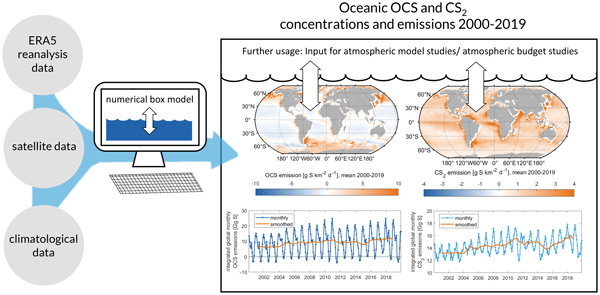
This study provides a marine emission inventory for the sulphur gases carbonyl sulphide (OCS) and carbon disulphide (CS2), derived from a numerical model of the surface ocean at monthly resolution for the period 2000–2019. Comparison with a database of seaborne observations reveals very good agreement for OCS. Interannual variability in both gases seems to be mainly driven by the amount of chromophoric dissolved organic matter present in surface water.
Cited articles
Amin, S. A., Hmelo, L. R., van Tol, H. M., Durham, B. P., Carlson, L. T., Heal, K. R., Morales, R. L., Berthiaume, C. T., Parker, M. S., Djunaedi, B., Ingalls, A. E., Parsek, M. R., Moran, M. A., and Armbrust, E. V.: Interaction and signalling between a cosmopolitan phytoplankton and associated bacteria, Nature, 522, 98–101, https://doi.org/10.1038/nature14488, 2015. a
Becker, J. W., Berube, P. M., Follett, C. L., Waterbury, J. B., Chisholm, S. W., DeLong, E. F., and Repeta, D. J.: Closely related phytoplankton species produce similar suites of dissolved organic matter, Frontiers in Microbiology, 5, https://doi.org/10.3389/fmicb.2014.00111, 2014. a
Bouman, H., Platt, T., Sathyendranath, S., and Stuart, V.: Dependence of light-saturated photosynthesis on temperature and community structure, Deep Sea Research Part I: Oceanographic Research Papers, 52, 1284–1299, https://doi.org/10.1016/j.dsr.2005.01.008, 2005. a
Brandt, B. W., Kelpin, F. D., van Leeuwen, I. M., and Kooijman, S. A.: Modelling Microbial Adaptation to Changing Availability of Substrates, Water Research, 38, 1003–1013, https://doi.org/10.1016/j.watres.2003.09.037, 2004. a
Buchan, A., LeCleir, G. R., Gulvik, C. A., and González, J. M.: Master Recyclers: Features and Functions of Bacteria Associated with Phytoplankton Blooms, Nature Reviews Microbiology, 12, 686–698, https://doi.org/10.1038/nrmicro3326, 2014. a
Cirri, E. and Pohnert, G.: Algae-bacteria interactions that balance the planktonic microbiome, New Phytologist, 223, 100–106, https://doi.org/10.1111/nph.15765, 2019. a
Coles, J. F. and Jones, R. C.: Effect of temperature on photosynthesis-light response and growth of four phytoplankton species isolated from a tidal freshwater river, Journal of Phycology, 36, 7–16, https://doi.org/10.1046/j.1529-8817.2000.98219.x, 2000. a
Coyne, K. J., Wang, Y., and Johnson, G.: Algicidal Bacteria: A Review of Current Knowledge and Applications to Control Harmful Algal Blooms, Frontiers in Microbiology, 13, https://doi.org/10.3389/fmicb.2022.871177, 2022. a
De Mazancourt, C. and Schwartz, M. W.: A resource ratio theory of cooperation, Ecology Letters, 13, 349–359, https://doi.org/10.1111/j.1461-0248.2009.01431.x, 2010. a
Elovaara, S., Eronen-Rasimus, E., Asmala, E., Tamelander, T., and Kaartokallio, H.: Contrasting patterns of carbon cycling and dissolved organic matter processing in two phytoplankton–bacteria communities, Biogeosciences, 18, 6589–6616, https://doi.org/10.5194/bg-18-6589-2021, 2021. a
Friedrichs, M. A. M., Dusenberry, J. A., Anderson, L. A., Armstrong, R. A., Chai, F., Christian, J. R., Doney, S. C., Dunne, J., Fujii, M., Hood, R., McGillicuddy, D. J., Moore, J. K., Schartau, M., Spitz, Y. H., and Wiggert, J. D.: Assessment of skill and portability in regional marine biogeochemical models: Role of multiple planktonic groups, Journal of Geophysical Research: Oceans, 112, https://doi.org/10.1029/2006jc003852, 2007. a
Garcia, S. L., Buck, M., Hamilton, J. J., Wurzbacher, C., Grossart, H.-P., McMahon, K. D., and Eiler, A.: Model Communities Hint at Promiscuous Metabolic Linkages between Ubiquitous Free-Living Freshwater Bacteria, mSphere, 3, https://doi.org/10.1128/msphere.00202-18, 2018. a
Godwin, C. M. and Cotner, J. B.: Stoichiometric flexibility in diverse aquatic heterotrophic bacteria is coupled to differences in cellular phosphorus quotas, Frontiers in Microbiology, 6, https://doi.org/10.3389/fmicb.2015.00159, 2015. a
Huisman, J. and Weissing, F. J.: Biodiversity of Plankton by Species Oscillations and Chaos, Nature, 402, 407–410, https://doi.org/10.1038/46540, 1999. a
Kazamia, E., Sutak, R., Paz-Yepes, J., Dorrell, R. G., Vieira, F. R. J., Mach, J., Morrissey, J., Leon, S., Lam, F., Pelletier, E., Camadro, J.-M., Bowler, C., and Lesuisse, E.: Endocytosis-mediated siderophore uptake as a strategy for Fe acquisition in diatoms, Science Advances, 4, eaar4536, https://doi.org/10.1126/sciadv.aar4536, 2018. a
Koffel, T., Daufresne, T., and Klausmeier, C. A.: From Competition to Facilitation and Mutualism: A General Theory of the Niche, Ecological Monographs, 91, https://doi.org/10.1002/ecm.1458, 2021. a
Kost, C., Patil, K. R., Friedman, J., Garcia, S. L., and Ralser, M.: Metabolic exchanges are ubiquitous in natural microbial communities, Nature Microbiology, 8, 2244–2252, https://doi.org/10.1038/s41564-023-01511-x, 2023. a, b, c
Kremling, A., Geiselmann, J., Ropers, D., and de Jong, H.: An Ensemble of Mathematical Models Showing Diauxic Growth Behaviour, BMC Systems Biology, 12, 82, https://doi.org/10.1186/s12918-018-0604-8, 2018. a
Lücken, L. and Blasius, B.: A Network-Based Analysis of Bacterial Growth on Substrate Mixtures Uncovers Glucose Inhibition in Phaeobacter Inhibens, Scientific Reports, 16, 1289, https://doi.org/10.1038/s41598-025-33583-6, 2026. a
Lücken, L., Lennartz, S., Follows, M., and Bragg, J.: bgc-mod/MCoM: MCoM v1.0.0, Zenodo [code], https://doi.org/10.5281/zenodo.19108362, 2026. a, b
Maldonado, M. T. and Price, N. M.: Utilization of iron bound to strong organic ligands by plankton communities in the subarctic Pacific Ocean, Deep Sea Research Part II: Topical Studies in Oceanography, 46, 2447–2473, 1999. a
Marsland, R., Cui, W., Goldford, J., and Mehta, P.: The Community Simulator: A Python Package for Microbial Ecology, PLOS ONE, 15, e0230430, https://doi.org/10.1371/journal.pone.0230430, 2020. a
May, R. M. and Leonard, W. J.: Nonlinear Aspects of Competition Between Three Species, SIAM Journal on Applied Mathematics, 29, 243–253, https://doi.org/10.1137/0129022, 1975. a
Mentges, A., Feenders, C., Deutsch, C., Blasius, B., and Dittmar, T.: Long-Term Stability of Marine Dissolved Organic Carbon Emerges from a Neutral Network of Compounds and Microbes, Scientific Reports, 9, 17780, https://doi.org/10.1038/s41598-019-54290-z, 2019. a
Meyer, N., Bigalke, A., Kaulfuß, A., and Pohnert, G.: Strategies and ecological roles of algicidal bacteria, FEMS Microbiology Reviews, 41, 880–899, https://doi.org/10.1093/femsre/fux029, 2017. a
Morris, J. J., Rose, A. L., and Lu, Z.: Reactive oxygen species in the world ocean and their impacts on marine ecosystems, Redox Biology, 52, 102285, https://doi.org/10.1016/j.redox.2022.102285, 2022. a
Mühlenbruch, M., Grossart, H., Eigemann, F., and Voss, M.: Mini-review: Phytoplankton-derived polysaccharides in the marine environment and their interactions with heterotrophic bacteria, Environmental Microbiology, 20, 2671–2685, https://doi.org/10.1111/1462-2920.14302, 2018. a
Myklestad, S. M.: Dissolved Organic Carbon from Phytoplankton, vol. 5D, Springer-Verlag, Berlin/Heidelberg, pp. 111–148, https://doi.org/10.1007/10683826_5, 2000. a, b, c
Platt, T., Gallegos, C. L., and Harrison, W. G.: Photoinhibition of Photosynthesis in Natural Assemblages of Marine Phytoplankton, Journal of Marine Research, 38, 687–701, 1980. a
Ramanan, R., Kim, B.-H., Cho, D.-H., Oh, H.-M., and Kim, H.-S.: Algae–bacteria interactions: evolution, ecology and emerging applications, Biotechnology Advances, 34, 14–29, 2016. a
Saad, E. M., Longo, A. F., Chambers, L. R., Huang, R., Benitez-Nelson, C., Dyhrman, S. T., Diaz, J. M., Tang, Y., and Ingall, E. D.: Understanding marine dissolved organic matter production: Compositional insights from axenic cultures of Thalassiosira pseudonana, Limnology and Oceanography, 61, 2222–2233, https://doi.org/10.1002/lno.10367, 2016. a, b
Sarmento, H., Romera-Castillo, C., Lindh, M., Pinhassi, J., Sala, M. M., Gasol, J. M., Marrase, C., and Taylor, G. T.: Phytoplankton species-specific release of dissolved free amino acids and their selective consumption by bacteria, Limnology and Oceanography, 58, 1123–1135, https://doi.org/10.4319/lo.2013.58.3.1123, 2013. a, b
Séférian, R., Berthet, S., Yool, A., Palmiéri, J., Bopp, L., Tagliabue, A., Kwiatkowski, L., Aumont, O., Christian, J., Dunne, J., Gehlen, M., Ilyina, T., John, J. G., Li, H., Long, M. C., Luo, J. Y., Nakano, H., Romanou, A., Schwinger, J., Stock, C., Santana-Falcón, Y., Takano, Y., Tjiputra, J., Tsujino, H., Watanabe, M., Wu, T., Wu, F., and Yamamoto, A.: Tracking Improvement in Simulated Marine Biogeochemistry Between CMIP5 and CMIP6, Current Climate Change Reports, 6, 95–119, https://doi.org/10.1007/s40641-020-00160-0, 2020. a
Seyedsayamdost, M. R., Case, R. J., Kolter, R., and Clardy, J.: The Jekyll-and-Hyde Chemistry of Phaeobacter Gallaeciensis, Nature Chemistry, 3, 331, 2011. a
Sultana, S., Bruns, S., Wilkes, H., Simon, M., and Wienhausen, G.: Vitamin B12 Is Not Shared by All Marine Prototrophic Bacteria with Their Environment, The ISME Journal, 17, 836–845, https://doi.org/10.1038/s41396-023-01391-3, 2023. a
Tagliabue, A.: `Oceans Are Hugely Complex': Modelling Marine Microbes Is Key to Climate Forecasts, Nature, 623, 250–252, https://doi.org/10.1038/d41586-023-03425-4, 2023. a
Tanioka, T. and Matsumoto, K.: A meta-analysis on environmental drivers of marine phytoplankton C : N : P, Biogeosciences, 17, 2939–2954, https://doi.org/10.5194/bg-17-2939-2020, 2020. a
Teeling, H., Fuchs, B. M., Becher, D., Klockow, C., Gardebrecht, A., Bennke, C. M., Kassabgy, M., Huang, S., Mann, A. J., Waldmann, J., Weber, M., Klindworth, A., Otto, A., Lange, J., Bernhardt, J., Reinsch, C., Hecker, M., Peplies, J., Bockelmann, F. D., Callies, U., Gerdts, G., Wichels, A., Wiltshire, K. H., Glöckner, F. O., Schweder, T., and Amann, R.: Substrate-Controlled Succession of Marine Bacterioplankton Populations Induced by a Phytoplankton Bloom, Science, 336, 608–611, https://doi.org/10.1126/science.1218344, 2012. a
Thornton, D. C.: Dissolved organic matter (DOM) release by phytoplankton in the contemporary and future ocean, European Journal of Phycology, 49, 20–46, https://doi.org/10.1080/09670262.2013.875596, 2014. a, b, c
Trautwein, K., Feenders, C., Hulsch, R., Ruppersberg, H. S., Strijkstra, A., Kant, M., Vagts, J., Wünsch, D., Michalke, B., Maczka, M., Schulz, S., Hillebrand, H., Blasius, B., and Rabus, R.: Non-Redfield, Nutrient Synergy and Flexible Internal Elemental Stoichiometry in a Marine Bacterium, FEMS Microbiology Ecology, 93, https://doi.org/10.1093/femsec/fix059, 2017. a
Virtanen, P., Gommers, R., Oliphant, T. E., Haberland, M., Reddy, T., Cournapeau, D., Burovski, E., Peterson, P., Weckesser, W., Bright, J., van der Walt, S. J., Brett, M., Wilson, J., Millman, K. J., Mayorov, N., Nelson, A. R. J., Jones, E., Kern, R., Larson, E., Carey, C. J., Polat, I., Feng, Y., Moore, E. W., VanderPlas, J., Laxalde, D., Perktold, J., Cimrman, R., Henriksen, I., Quintero, E. A., Harris, C. R., Archibald, A. M., Ribeiro, A. H., Pedregosa, F., van Mulbregt, P., and SciPy 1.0 Contributors: SciPy 1.0: Fundamental Algorithms for Scientific Computing in Python, Nature Methods, 17, 261–272, https://doi.org/10.1038/s41592-019-0686-2, zSCC: 0000014, 2020. a, b
Wu, Z., Dutkiewicz, S., Jahn, O., Sher, D., White, A., and Follows, M. J.: Modeling Photosynthesis and Exudation in Subtropical Oceans, Global Biogeochemical Cycles, 35, e2021GB006941, https://doi.org/10.1029/2021GB006941, 2021. a
Zakem, E. J., Cael, B. B., and Levine, N. M.: A Unified Theory for Organic Matter Accumulation, Proceedings of the National Academy of Sciences, 118, e2016896118, https://doi.org/10.1073/pnas.2016896118, 2021. a
Short summary
The Microbial Community Model (MCoM) is a flexible biogeochemical modeling framework which resolves a rich set of interactions between photosynthetic and heterotrophic microbes, including cross-feeding, metabolite exchange, and nutrient recycling. As such, it allows to assess community-level effects on elemental turnover emerging from microbial interactions. Its scalability allows to represent both simple pairwise interactions and large, diverse communities.
The Microbial Community Model (MCoM) is a flexible biogeochemical modeling framework which...