
Articles | Volume 19, issue 4
https://doi.org/10.5194/gmd-19-1749-2026
© Author(s) 2026. This work is distributed under
the Creative Commons Attribution 4.0 License.
the Creative Commons Attribution 4.0 License.
https://doi.org/10.5194/gmd-19-1749-2026
© Author(s) 2026. This work is distributed under
the Creative Commons Attribution 4.0 License.
the Creative Commons Attribution 4.0 License.
Model description paper
| 
02 Mar 2026
Model description paper |
| 02 Mar 2026
| 02 Mar 2026
Improved bathymetry estimates beneath Amundsen Sea ice shelves using a Markov Chain Monte Carlo gravity inversion (GravMCMC, version 1)

Department of Geological Sciences, University of Florida, 241 Williamson Hall, Gainesville, FL 32611, USA
Emma J. MacKie
Department of Geological Sciences, University of Florida, 241 Williamson Hall, Gainesville, FL 32611, USA
Lijing Wang
Department of Earth Sciences, University of Connecticut, Beach Hall Room 207, 354 Mansfield Road – Unit 1045, Storrs, CT 06269, USA
Atsuhiro Muto
Department of Earth and Environmental Science, Temple University, 1901 N. 13th Street, Philadelphia, PA 19122, USA
Niya Shao
Department of Geological Sciences, University of Florida, 241 Williamson Hall, Gainesville, FL 32611, USA
Related authors
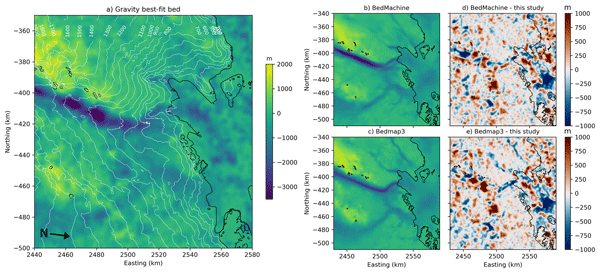
Mareen Lösing, Alan Aitken, Michael Field, Emma MacKie, and Lu Li
The Cryosphere, 20, 5629–5652, https://doi.org/10.5194/tc-20-5629-2026, https://doi.org/10.5194/tc-20-5629-2026, 2026
Short summary
Short summary
Subglacial topography controls how Antarctic ice flows towards the ocean and responds to climate change. In the Denman–Shackleton region, deep valleys connect the ice-sheet interior to the coast. Denman Glacier occupies one of the deepest and could contribute significantly to sea-level rise. Combining new ground-based gravity measurements with airborne data and statistical modelling reveals a more complex landscape than existing maps and a potential vulnerability to unstable retreat.
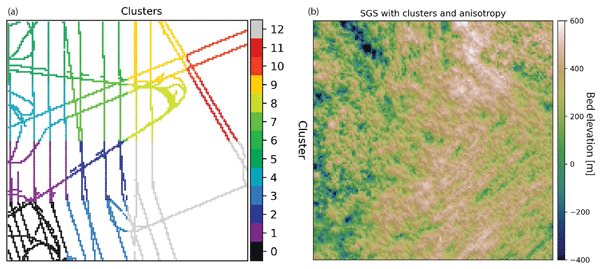
Emma J. MacKie, Michael Field, Lijing Wang, Zhen Yin, Nathan Schoedl, Matthew Hibbs, and Allan Zhang
Geosci. Model Dev., 16, 3765–3783, https://doi.org/10.5194/gmd-16-3765-2023, https://doi.org/10.5194/gmd-16-3765-2023, 2023
Short summary
Short summary
Earth scientists often have to fill in spatial gaps in measurements. This gap-filling or interpolation can be accomplished with geostatistical methods, where the statistical relationships between measurements are used to inform how these gaps should be filled. Despite the broad utility of these methods, there are few freely available geostatistical software applications. We present GStatSim, a Python package for performing different geostatistical interpolation methods.
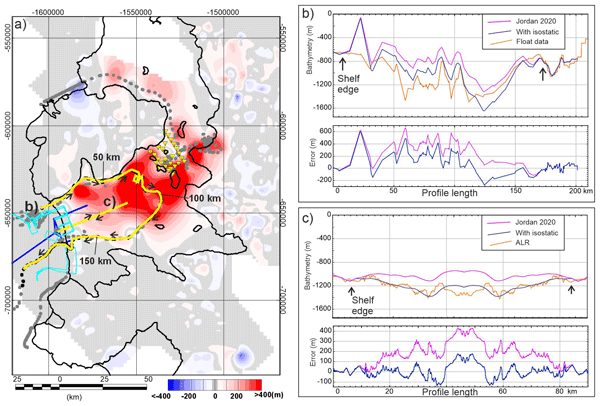
Tom A. Jordan, Karen J. Heywood, Anna Wåhlin, Rob A. Hall, Atsuhiro Muto, Pierre Dutrieux, Kelly Hogan, James Girton, Karen E. Alley, and Erin Pettit
Solid Earth, 17, 1187–1199, https://doi.org/10.5194/se-17-1187-2026, https://doi.org/10.5194/se-17-1187-2026, 2026
Short summary
Short summary
The shape of the water filled cavity hidden beneath ice shelves is extremely important, but hard to measure. Gravity data collected from aircraft can be used to predict the shape. However, in the Dotson Crosson ice shelves in West Antarctica, new direct observations from autonomous platforms sent beneath the ice, and seismic observations from the ice surface showed gravity models were systematically too shallow. We explain why and provide a solution applicable her and in other ice shelves.
Mareen Lösing, Alan Aitken, Michael Field, Emma MacKie, and Lu Li
The Cryosphere, 20, 5629–5652, https://doi.org/10.5194/tc-20-5629-2026, https://doi.org/10.5194/tc-20-5629-2026, 2026
Short summary
Short summary
Subglacial topography controls how Antarctic ice flows towards the ocean and responds to climate change. In the Denman–Shackleton region, deep valleys connect the ice-sheet interior to the coast. Denman Glacier occupies one of the deepest and could contribute significantly to sea-level rise. Combining new ground-based gravity measurements with airborne data and statistical modelling reveals a more complex landscape than existing maps and a potential vulnerability to unstable retreat.
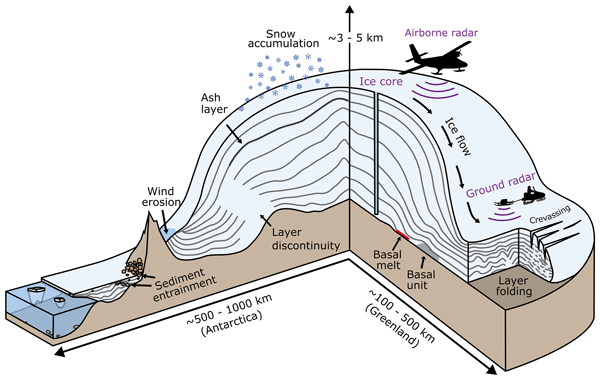
Robert G. Bingham, Julien A. Bodart, Marie G. P. Cavitte, Ailsa Chung, Rebecca J. Sanderson, Johannes C. R. Sutter, Olaf Eisen, Nanna B. Karlsson, Joseph A. MacGregor, Neil Ross, Duncan A. Young, David W. Ashmore, Andreas Born, Winnie Chu, Xiangbin Cui, Reinhard Drews, Steven Franke, Vikram Goel, John W. Goodge, A. Clara J. Henry, Antoine Hermant, Benjamin H. Hills, Nicholas Holschuh, Michelle R. Koutnik, Gwendolyn J.-M. C. Leysinger Vieli, Emma J. MacKie, Elisa Mantelli, Carlos Martín, Felix S. L. Ng, Falk M. Oraschewski, Felipe Napoleoni, Frédéric Parrenin, Sergey V. Popov, Therese Rieckh, Rebecca Schlegel, Dustin M. Schroeder, Martin J. Siegert, Xueyuan Tang, Thomas O. Teisberg, Kate Winter, Shuai Yan, Harry Davis, Christine F. Dow, Tyler J. Fudge, Tom A. Jordan, Bernd Kulessa, Kenichi Matsuoka, Clara J. Nyqvist, Maryam Rahnemoonfar, Matthew R. Siegfried, Shivangini Singh, Vjeran Višnjević, Rodrigo Zamora, and Alexandra Zuhr
The Cryosphere, 19, 4611–4655, https://doi.org/10.5194/tc-19-4611-2025, https://doi.org/10.5194/tc-19-4611-2025, 2025
Short summary
Short summary
The ice sheets covering Antarctica have built up over millenia through successive snowfall events which become buried and preserved as internal surfaces of equal age detectable with ice-penetrating radar. This paper describes an international initiative working together on these archival data to build a comprehensive 3-D picture of how old the ice is everywhere across Antarctica and how this is being used to reconstruct past and to predict future ice and climate behaviour.
Nanna B. Karlsson, Dustin M. Schroeder, Louise Sandberg Sørensen, Winnie Chu, Jørgen Dall, Natalia H. Andersen, Reese Dobson, Emma J. Mackie, Simon J. Köhn, Jillian E. Steinmetz, Angelo S. Tarzona, Thomas O. Teisberg, and Niels Skou
Earth Syst. Sci. Data, 16, 3333–3344, https://doi.org/10.5194/essd-16-3333-2024, https://doi.org/10.5194/essd-16-3333-2024, 2024
Short summary
Short summary
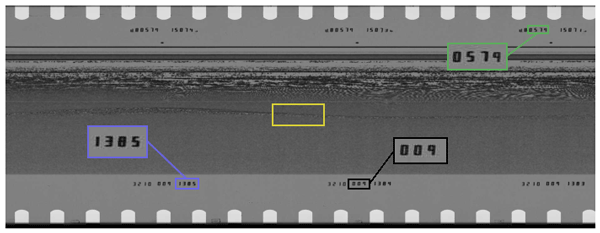
In the 1970s, more than 177 000 km of observations were acquired from airborne radar over the Greenland ice sheet. The radar data contain information on not only the thickness of the ice, but also the properties of the ice itself. This information was recorded on film rolls and subsequently stored. In this study, we document the digitization of these film rolls that shed new and unprecedented detailed light on the Greenland ice sheet 50 years ago.
Alice C. Frémand, Peter Fretwell, Julien A. Bodart, Hamish D. Pritchard, Alan Aitken, Jonathan L. Bamber, Robin Bell, Cesidio Bianchi, Robert G. Bingham, Donald D. Blankenship, Gino Casassa, Ginny Catania, Knut Christianson, Howard Conway, Hugh F. J. Corr, Xiangbin Cui, Detlef Damaske, Volkmar Damm, Reinhard Drews, Graeme Eagles, Olaf Eisen, Hannes Eisermann, Fausto Ferraccioli, Elena Field, René Forsberg, Steven Franke, Shuji Fujita, Yonggyu Gim, Vikram Goel, Siva Prasad Gogineni, Jamin Greenbaum, Benjamin Hills, Richard C. A. Hindmarsh, Andrew O. Hoffman, Per Holmlund, Nicholas Holschuh, John W. Holt, Annika N. Horlings, Angelika Humbert, Robert W. Jacobel, Daniela Jansen, Adrian Jenkins, Wilfried Jokat, Tom Jordan, Edward King, Jack Kohler, William Krabill, Mette Kusk Gillespie, Kirsty Langley, Joohan Lee, German Leitchenkov, Carlton Leuschen, Bruce Luyendyk, Joseph MacGregor, Emma MacKie, Kenichi Matsuoka, Mathieu Morlighem, Jérémie Mouginot, Frank O. Nitsche, Yoshifumi Nogi, Ole A. Nost, John Paden, Frank Pattyn, Sergey V. Popov, Eric Rignot, David M. Rippin, Andrés Rivera, Jason Roberts, Neil Ross, Anotonia Ruppel, Dustin M. Schroeder, Martin J. Siegert, Andrew M. Smith, Daniel Steinhage, Michael Studinger, Bo Sun, Ignazio Tabacco, Kirsty Tinto, Stefano Urbini, David Vaughan, Brian C. Welch, Douglas S. Wilson, Duncan A. Young, and Achille Zirizzotti
Earth Syst. Sci. Data, 15, 2695–2710, https://doi.org/10.5194/essd-15-2695-2023, https://doi.org/10.5194/essd-15-2695-2023, 2023
Short summary
Short summary
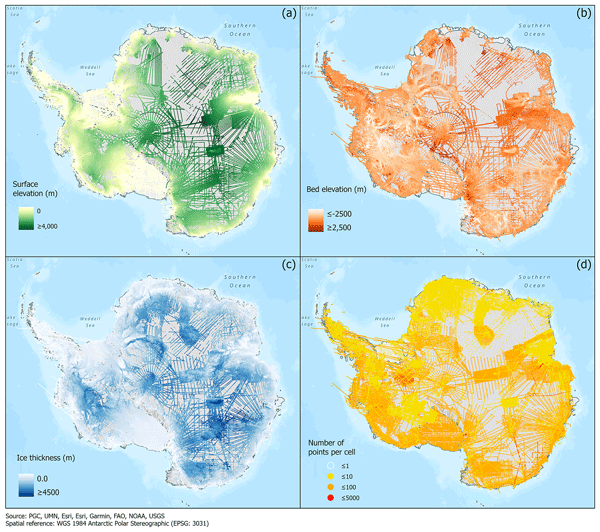
This paper presents the release of over 60 years of ice thickness, bed elevation, and surface elevation data acquired over Antarctica by the international community. These data are a crucial component of the Antarctic Bedmap initiative which aims to produce a new map and datasets of Antarctic ice thickness and bed topography for the international glaciology and geophysical community.
Emma J. MacKie, Michael Field, Lijing Wang, Zhen Yin, Nathan Schoedl, Matthew Hibbs, and Allan Zhang
Geosci. Model Dev., 16, 3765–3783, https://doi.org/10.5194/gmd-16-3765-2023, https://doi.org/10.5194/gmd-16-3765-2023, 2023
Short summary
Short summary
Earth scientists often have to fill in spatial gaps in measurements. This gap-filling or interpolation can be accomplished with geostatistical methods, where the statistical relationships between measurements are used to inform how these gaps should be filled. Despite the broad utility of these methods, there are few freely available geostatistical software applications. We present GStatSim, a Python package for performing different geostatistical interpolation methods.
Marion A. McKenzie, Lauren E. Miller, Jacob S. Slawson, Emma J. MacKie, and Shujie Wang
The Cryosphere, 17, 2477–2486, https://doi.org/10.5194/tc-17-2477-2023, https://doi.org/10.5194/tc-17-2477-2023, 2023
Short summary
Short summary
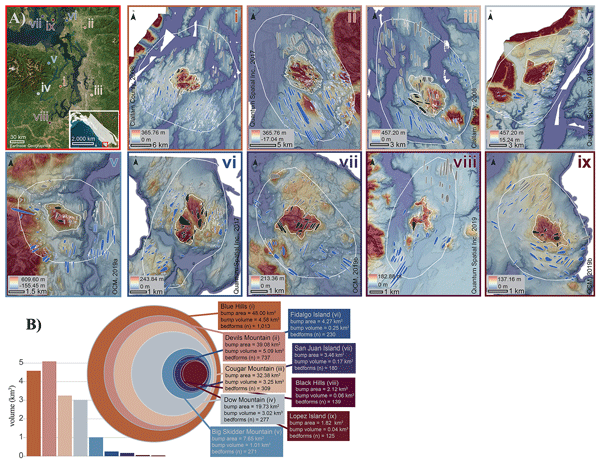
Topographic highs (“bumps”) across glaciated landscapes have the potential to affect glacial ice. Bumps in the deglaciated Puget Lowland are assessed for streamlined glacial features to provide insight on ice–bed interactions. We identify a general threshold in which bumps significantly disrupt ice flow and sedimentary processes in this location. However, not all bumps have the same degree of impact. The system assessed here has relevance to parts of the Greenland Ice Sheet and Thwaites Glacier.

Zhen Yin, Chen Zuo, Emma J. MacKie, and Jef Caers
Geosci. Model Dev., 15, 1477–1497, https://doi.org/10.5194/gmd-15-1477-2022, https://doi.org/10.5194/gmd-15-1477-2022, 2022
Short summary
Short summary
We provide a multiple-point geostatistics approach to probabilistically learn from training images to fill large-scale irregular geophysical data gaps. With a repository of global topographic training images, our approach models high-resolution basal topography and quantifies the geospatial uncertainty. It generated high-resolution topographic realizations to investigate the impact of basal topographic uncertainty on critical subglacial hydrological flow patterns associated with ice velocity.
Christian T. Wild, Karen E. Alley, Atsuhiro Muto, Martin Truffer, Ted A. Scambos, and Erin C. Pettit
The Cryosphere, 16, 397–417, https://doi.org/10.5194/tc-16-397-2022, https://doi.org/10.5194/tc-16-397-2022, 2022
Short summary
Short summary
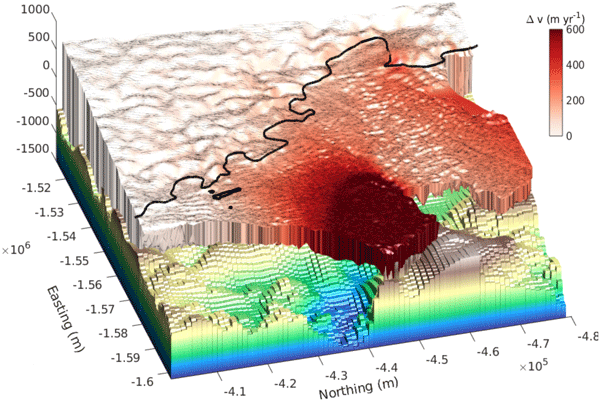
Thwaites Glacier has the potential to significantly raise Antarctica's contribution to global sea-level rise by the end of this century. Here, we use satellite measurements of surface elevation to show that its floating part is close to losing contact with an underwater ridge that currently acts to stabilize. We then use computer models of ice flow to simulate the predicted unpinning, which show that accelerated ice discharge into the ocean follows the breakup of the floating part.
Karen E. Alley, Christian T. Wild, Adrian Luckman, Ted A. Scambos, Martin Truffer, Erin C. Pettit, Atsuhiro Muto, Bruce Wallin, Marin Klinger, Tyler Sutterley, Sarah F. Child, Cyrus Hulen, Jan T. M. Lenaerts, Michelle Maclennan, Eric Keenan, and Devon Dunmire
The Cryosphere, 15, 5187–5203, https://doi.org/10.5194/tc-15-5187-2021, https://doi.org/10.5194/tc-15-5187-2021, 2021
Short summary
Short summary
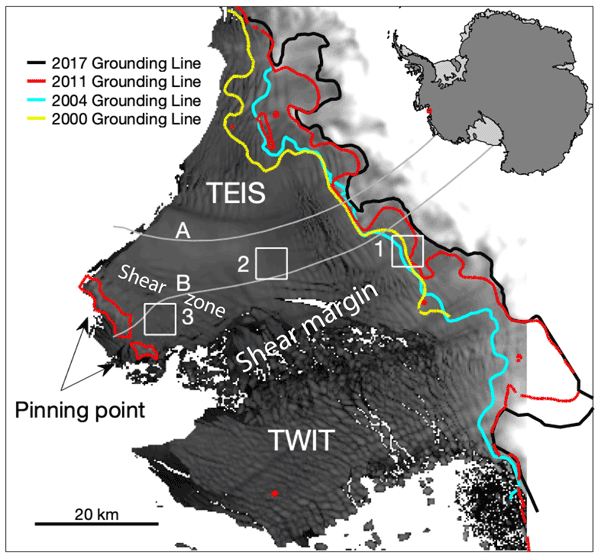
We present a 20-year, satellite-based record of velocity and thickness change on the Thwaites Eastern Ice Shelf (TEIS), the largest remaining floating extension of Thwaites Glacier (TG). TG holds the single greatest control on sea-level rise over the next few centuries, so it is important to understand changes on the TEIS, which controls much of TG's flow into the ocean. Our results suggest that the TEIS is progressively destabilizing and is likely to disintegrate over the next few decades.
Cited articles
An, L., Rignot, E., Millan, R., Tinto, K., and Willis, J.: Bathymetry of Northwest Greenland Using “Ocean Melting Greenland” (OMG) High-Resolution Airborne Gravity and Other Data, Remote Sens., 11, 131, https://doi.org/10.3390/rs11020131, 2019. a, b, c
Blakely, R. J.: Potential Theory in Gravity and Magnetic Applications, in: 1st Edn., Cambridge University Press, ISBN 978-0-521-41508-8, https://doi.org/10.1017/CBO9780511549816, 1995. a, b, c, d
Boghosian, A., Tinto, K., Cochran, J. R., Porter, D., Elieff, S., Burton, B. L., and Bell, R. E.: Resolving bathymetry from airborne gravity along Greenland fjords, J. Geophys. Res.-Solid, 120, 8516–8533, https://doi.org/10.1002/2015JB012129, 2015. a
Brisbourne, A. M., Smith, A. M., King, E. C., Nicholls, K. W., Holland, P. R., and Makinson, K.: Seabed topography beneath Larsen C Ice Shelf from seismic soundings, The Cryosphere, 8, 1–13, https://doi.org/10.5194/tc-8-1-2014, 2014. a, b
Burgard, C., Jourdain, N. C., Mathiot, P., Smith, R. S., Schäfer, R., Caillet, J., Finn, T. S., and Johnson, J. E.: Emulating Present and Future Simulations of Melt Rates at the Base of Antarctic Ice Shelves With Neural Networks, J. Adv. Model. Earth Syst., 15, e2023MS003829, https://doi.org/10.1029/2023MS003829, 2023. a
Charrassin, R., Millan, R., Rignot, E., and Scheinert, M.: Bathymetry of the Antarctic continental shelf and ice shelf cavities from circumpolar gravity anomalies and other data, Sci. Rep., 15, 1214, https://doi.org/10.1038/s41598-024-81599-1, 2025. a, b, c, d
Docquier, D., Pollard, D., and Pattyn, F.: Thwaites Glacier grounding-line retreat: influence of width and buttressing parameterizations, J. Glaciol., 60, 305–313, https://doi.org/10.3189/2014JoG13J117, 2014. a
Fatiando A Terra Project, Esteban, F. D., Li, L., Oliveira Jr., V. C., Pesce, A., Shea, N., Soler, S. R., Tankersley, M., and Uieda, L.: Harmonica v0.6.0: Forward modeling, inversion, and processing gravity and magnetic data, Zenodo [code and data set], https://doi.org/10.5281/ZENODO.3628741, 2023. a, b, c, d
Favier, L., Gagliardini, O., Durand, G., and Zwinger, T.: A three-dimensional full Stokes model of the grounding line dynamics: effect of a pinning point beneath the ice shelf, The Cryosphere, 6, 101–112, https://doi.org/10.5194/tc-6-101-2012, 2012. a
Field, M.: Stochastic Sub-ice-shelf Bathymetry for Thwaites, Crosson, and Dotson Ice Shelves, Zenodo [code and data set] https://doi.org/10.5281/zenodo.15258019, 2025 (code also available at: https://github.com/mjfield2/stochastic_bathymetry, last access: 25 February 2026). a
Fu, J. and Gómez-Hernández, J. J.: Preserving spatial structure for inverse stochastic simulation using blocking Markov chain Monte Carlo method, Inverse Probl. Sci. Eng., 16, 865–884, https://doi.org/10.1080/17415970802015781, 2008. a, b
Fu, J. and Gómez-Hernández, J. J.: A Blocking Markov Chain Monte Carlo Method for Inverse Stochastic Hydrogeological Modeling, Math. Geosci., 41, 105–128, https://doi.org/10.1007/s11004-008-9206-0, 2009. a
Geyer, C.: Introduction to Markov Chain Monte Carlo, in: Handbook of Markov Chain Monte Carlo, vol. 20116022, edited by: Brooks, S., Gelman, A., Jones, G., and Meng, X.-L., Chapman and Hall/CRC, ISBN 978-1-4200-7941-8, https://doi.org/10.1201/b10905-2, 2011. a, b
Ghalenoei, E., Dettmer, J., Ali, M. Y., and Kim, J. W.: Gravity and magnetic joint inversion for basement and salt structures with the reversible-jump algorithm, Geophys. J. Int., 227, 746–758, https://doi.org/10.1093/gji/ggab251, 2021. a
Grana, D., Azevedo, L., de Figueiredo, L., Connolly, P., and Mukerji, T.: Probabilistic inversion of seismic data for reservoir petrophysical characterization: Review and examples, Geophysics, 87, M199–M216, https://doi.org/10.1190/geo2021-0776.1, 2022. a
Hansen, T. M., Cordua, K. S., and Mosegaard, K.: Inverse problems with non-trivial priors: efficient solution through sequential Gibbs sampling, Comput. Geosci., 16, 593–611, https://doi.org/10.1007/s10596-011-9271-1, 2012. a
Haran, T., Klinger, M., Bohlander, J., Fahnestock, M., Painter, T., and Scambos, T.: MEaSUREs MODIS Mosaic of Antarctica 2014 (MOA2014) Image Map (Version 1), NSIDC [data set], https://doi.org/10.5067/RNF17BP824UM, 2017. a, b
Hastings, W. K.: Monte Carlo Sampling Methods Using Markov Chains and Their Applications, Biometrika, 57, 97–109, https://doi.org/10.2307/2334940, 1970. a
Hodgson, D. A., Jordan, T. A., De Rydt, J., Fretwell, P. T., Seddon, S. A., Becker, D., Hogan, K. A., Smith, A. M., and Vaughan, D. G.: Past and future dynamics of the Brunt Ice Shelf from seabed bathymetry and ice shelf geometry, The Cryosphere, 13, 545–556, https://doi.org/10.5194/tc-13-545-2019, 2019. a
Hogan, K. A., Larter, R. D., Graham, A. G. C., Arthern, R., Kirkham, J. D., Totten, R. L., Jordan, T. A., Clark, R., Fitzgerald, V., Wåhlin, A. K., Anderson, J. B., Hillenbrand, C.-D., Nitsche, F. O., Simkins, L., Smith, J. A., Gohl, K., Arndt, J. E., Hong, J., and Wellner, J.: Revealing the former bed of Thwaites Glacier using sea-floor bathymetry: implications for warm-water routing and bed controls on ice flow and buttressing, The Cryosphere, 14, 2883–2908, https://doi.org/10.5194/tc-14-2883-2020, 2020. a
Hunter, J. D.: Matplotlib: A 2D Graphics Environment, Comput. Sci. Eng., 9, 90–95, https://doi.org/10.1109/MCSE.2007.55, 2007. a
Ingber, L.: Very fast simulated re-annealing, Math. Comput. Model., 12, 967–973, https://doi.org/10.1016/0895-7177(89)90202-1, 1989. a
Jenkins, A., Dutrieux, P., Jacobs, S., Steig, E. J., and Gudmundsson, G. H.: Decadal Ocean Forcing and Antarctic Ice Sheet Response: Lessons from the Amundsen Sea, Oceanography, 29, 106–117, https://doi.org/10.5670/oceanog.2016.103, 2016. a
Jordan, T., Robinson, C., Porter, D., Locke, C., and Tinto, K.: Processed line aerogravity data over the Thwaites Glacier region (2018/19 season) (Version 1.0), UK Polar Data Centre, Natural Environment Research Council, UK Research & Innovation [data set], https://doi.org/10.5285/B9B28A35-8620-4182-BF9C-638800B6679B, 2020a. a
Jordan, T. A., Porter, D., Tinto, K., Millan, R., Muto, A., Hogan, K., Larter, R. D., Graham, A. G. C., and Paden, J. D.: New gravity-derived bathymetry for the Thwaites, Crosson, and Dotson ice shelves revealing two ice shelf populations, The Cryosphere, 14, 2869–2882, https://doi.org/10.5194/tc-14-2869-2020, 2020b. a, b, c, d, e, f, g, h, i, j, k
Liang, Z., Wellmann, F., and Ghattas, O.: Uncertainty quantification of geologic model parameters in 3D gravity inversion by Hessian-informed Markov chain Monte Carlo, Geophysics, 88, G1–G18, https://doi.org/10.1190/geo2021-0728.1, 2022. a
MacKie, E. J., Schroeder, D. M., Caers, J., Siegfried, M. R., and Scheidt, C.: Antarctic Topographic Realizations and Geostatistical Modeling Used to Map Subglacial Lakes, J. Geophys. Res.-Earth, 125, e2019JF005420, https://doi.org/10.1029/2019JF005420, 2020. a
MacKie, E. J., Schroeder, D. M., Zuo, C., Yin, Z., and Caers, J.: Stochastic modeling of subglacial topography exposes uncertainty in water routing at Jakobshavn Glacier, J. Glaciol., 67, 75–83, https://doi.org/10.1017/jog.2020.84, 2021. a, b
MacKie, E. J., Field, M., Wang, L., Yin, Z., Schoedl, N., Hibbs, M., and Zhang, A.: GStatSim V1.0: a Python package for geostatistical interpolation and conditional simulation, Geosci. Model Dev., 16, 3765–3783, https://doi.org/10.5194/gmd-16-3765-2023, 2023. a, b
Mälicke, M.: SciKit-GStat 1.0: a SciPy-flavored geostatistical variogram estimation toolbox written in Python, Geosci. Model Dev., 15, 2505–2532, https://doi.org/10.5194/gmd-15-2505-2022, 2022. a
Mälicke, M., Hugonnet, R., Schneider, H. D., Müller, S., Möller, E., and d. Wauw, J. V.: mmaelicke/scikit-gstat: A scipy flavoured geostatistical variogram analysis toolbox, Zenodo [code], https://doi.org/10.5281/zenodo.5970098, 2022. a
Mariethoz, G., Renard, P., and Caers, J.: Bayesian inverse problem and optimization with iterative spatial resampling, Water Resour. Res., 46, https://doi.org/10.1029/2010WR009274, 2010. a
Milillo, P., Rignot, E., Rizzoli, P., Scheuchl, B., Mouginot, J., Bueso-Bello, J., and Prats-Iraola, P.: Heterogeneous retreat and ice melt of Thwaites Glacier, West Antarctica, Sci. Adv., 5, eaau3433, https://doi.org/10.1126/sciadv.aau3433, 2019. a
Millan, R., Rignot, E., Bernier, V., Morlighem, M., and Dutrieux, P.: Bathymetry of the Amundsen Sea Embayment sector of West Antarctica from Operation IceBridge gravity and other data, Geophys. Res. Lett., 44, 1360–1368, https://doi.org/10.1002/2016GL072071, 2017. a, b, c
Morlighem, M.: MEaSUREs BedMachine Antarctica (Version 3), NSIDC [data set], https://doi.org/10.5067/FPSU0V1MWUB6, 2022. a
Morlighem, M., Rignot, E., Binder, T., Blankenship, D., Drews, R., Eagles, G., Eisen, O., Ferraccioli, F., Forsberg, R., Fretwell, P., Goel, V., Greenbaum, J. S., Gudmundsson, H., Guo, J., Helm, V., Hofstede, C., Howat, I., Humbert, A., Jokat, W., Karlsson, N. B., Lee, W. S., Matsuoka, K., Millan, R., Mouginot, J., Paden, J., Pattyn, F., Roberts, J., Rosier, S., Ruppel, A., Seroussi, H., Smith, E. C., Steinhage, D., Sun, B., v. d. Broeke, M. R., v. Ommen, T. D., v. Wessem, M., and Young, D. A.: Deep glacial troughs and stabilizing ridges unveiled beneath the margins of the Antarctic ice sheet, Nat. Geosci., 13, 132–137, https://doi.org/10.1038/s41561-019-0510-8, 2020. a, b
Mosegaard, K. and Tarantola, A.: Monte Carlo sampling of solutions to inverse problems, J. Geophys. Res.-Solid, 100, 12431–12447, https://doi.org/10.1029/94JB03097, 1995. a
Mouginot, J., Rignot, E., and Scheuchl, B.: Sustained increase in ice discharge from the Amundsen Sea Embayment, West Antarctica, from 1973 to 2013, Geophys. Res. Lett., 41, 1576–1584, https://doi.org/10.1002/2013GL059069, 2014. a
Mouginot, J., Rignot, E., and Scheuchl, B.: Continent-Wide, Interferometric SAR Phase, Mapping of Antarctic Ice Velocity, Geophys. Res. Lett., 46, 9710–9718, https://doi.org/10.1029/2019GL083826, 2019a. a
Mouginot, J., Rignot, E., and Scheuchl, B.: MEaSUREs Phase-Based Antarctica Ice Velocity Map (Version 1), NSIDC [data set], https://doi.org/10.5067/PZ3NJ5RXRH10, 2019b. a
Müller, S. and Schüler, L.: GeoStat-Framework/GSTools: v1.5.0 `Nifty Neon', Zenodo [code] https://doi.org/10.5281/zenodo.8044720, 2023. a
Müller, S., Schüler, L., Zech, A., and Heße, F.: GSTools v1.3: a toolbox for geostatistical modelling in Python, Geosci. Model Dev., 15, 3161–3182, https://doi.org/10.5194/gmd-15-3161-2022, 2022. a
Muto, A., Peters, L. E., Gohl, K., Sasgen, I., Alley, R. B., Anandakrishnan, S., and Riverman, K. L.: Subglacial bathymetry and sediment distribution beneath Pine Island Glacier ice shelf modeled using aerogravity and in situ geophysical data: New results, Earth Planet. Sc. Lett., 433, 63–75, https://doi.org/10.1016/j.epsl.2015.10.037, 2016. a, b
Muto, A., Alley, K., Pettit, E. C., Pomraning, D., Roccaro, A., Scambos, T., Truffer, M., Wallin, B., and Wild, C.: Sub-ice-shelf seafloor elevation derived from point-source active-seismic data on Thwaites Eastern Ice Shelf and Dotson Ice Shelf, December 2019 and January 2020, USAP-DC [data set], https://doi.org/10.15784/601827, 2024. a, b, c
Nagy, D., Papp, G., and Benedek, J.: The gravitational potential and its derivatives for the prism, J. Geod., 74, 552–560, https://doi.org/10.1007/s001900000116, 2000. a
Oliveira Jr., V. C. and Barbosa, V. C.: 3-D radial gravity gradient inversion, Geophys. J. Int., 195, 883–902, https://doi.org/10.1093/gji/ggt307, 2013. a
Paoletti, V., Fedi, M., Italiano, F., Florio, G., and Ialongo, S.: Inversion of gravity gradient tensor data: does it provide better resolution?, Geophys. J. Int., 205, 192–202, https://doi.org/10.1093/gji/ggw003, 2016. a
Reuschen, S., Jobst, F., and Nowak, W.: Efficient Discretization-Independent Bayesian Inversion of High-Dimensional Multi-Gaussian Priors Using a Hybrid MCMC, Water Resour. Res., 57, e2021WR030051, https://doi.org/10.1029/2021WR030051, 2021. a
Rignot, E., Mouginot, J., Morlighem, M., Seroussi, H., and Scheuchl, B.: Widespread, rapid grounding line retreat of Pine Island, Thwaites, Smith, and Kohler glaciers, West Antarctica, from 1992 to 2011, Geophys. Res. Lett., 41, 3502–3509, https://doi.org/10.1002/2014GL060140, 2014. a, b
Rignot, E., Mouginot, J., and Scheuchl, B.: MEaSUREs Grounding Zone of the Antarctic Ice Sheet (Version 1), NSIDC [data set], https://doi.org/10.5067/HGLT8XB480E4, 2023. a, b
Rignot, E., Ciracì, E., Scheuchl, B., Tolpekin, V., Wollersheim, M., and Dow, C.: Widespread seawater intrusions beneath the grounded ice of Thwaites Glacier, West Antarctica, P. Natl. Acad. Sci. USA, 121, e2404766121, https://doi.org/10.1073/pnas.2404766121, 2024. a
Rocarro, A.: Seismic spot soundings reveal deep bathymetry and thick water column between Crosson and Dotson ice shelves, west Antarctica, PhD thesis, Temple University Libraries, 106 pp., https://scholarshare.temple.edu/handle/20.500.12613/4736 (last access: 25 October 2024), 2020. a
Rosenthal, J. S.: Optimal Proposal Distributions and Adaptive MCMC, in: Handbook of Markov Chain Monte Carlo, Chapman and Hall/CRC, 20 pp., ISBN 978-0-429-13850-8, 2011. a
Rosier, S. H. R., Bull, C. Y. S., Woo, W. L., and Gudmundsson, G. H.: Predicting ocean-induced ice-shelf melt rates using deep learning, The Cryosphere, 17, 499–518, https://doi.org/10.5194/tc-17-499-2023, 2023. a
Roy, L., Sen, M. K., Blankenship, D. D., Stoffa, P. L., and Richter, T. G.: Inversion and uncertainty estimation of gravity data using simulated annealing: An application over Lake Vostok, East Antarctica, Geophysics, 70, J1–J12, https://doi.org/10.1190/1.1852777, 2005. a
Sander, S., Argyle, M., Elieff, S., Ferguson, S., Lavoie, V., and Sander, L.: The AIRGrav airborne gravity system, in: Airborne Gravity 2004 – Australian Society of Exploration Geophysicists Workshop, Geoscience Australia, 49–53, https://www.ga.gov.au/bigobj/GA16642.pdf (last access: 20 May 2024), 2004. a
Scambos, T., Haran, T., Fahnestock, M., Painter, T., and Bohlander, J.: MODIS-based Mosaic of Antarctica (MOA) data sets: Continent-wide surface morphology and snow grain size, Remote Sens. Environ., 111, 242–257, https://doi.org/10.1016/j.rse.2006.12.020, 2007. a
Scambos, T., Bell, R., Alley, R., Anandakrishnan, S., Bromwich, D., Brunt, K., Christianson, K., Creyts, T., Das, S., DeConto, R., Dutrieux, P., Fricker, H., Holland, D., MacGregor, J., Medley, B., Nicolas, J., Pollard, D., Siegfried, M., Smith, A., Steig, E., Trusel, L., Vaughan, D., and Yager, P.: How much, how fast?: A science review and outlook for research on the instability of Antarctica's Thwaites Glacier in the 21st century, Global Planet. Change, 153, 16–34, https://doi.org/10.1016/j.gloplacha.2017.04.008, 2017. a
Scheinert, M., Ferraccioli, F., Schwabe, J., Bell, R., Studinger, M., Damaske, D., Jokat, W., Aleshkova, N., Jordan, T., Leitchenkov, G., Blankenship, D. D., Damiani, T. M., Young, D., Cochran, J. R., and Richter, T. D.: New Antarctic gravity anomaly grid for enhanced geodetic and geophysical studies in Antarctica, Geophys. Res. Lett., 43, 600–610, https://doi.org/10.1002/2015GL067439, 2016. a
Schmidt, B. E., Washam, P., Davis, P. E. D., Nicholls, K. W., Holland, D. M., Lawrence, J. D., Riverman, K. L., Smith, J. A., Spears, A., Dichek, D. J. G., Mullen, A. D., Clyne, E., Yeager, B., Anker, P., Meister, M. R., Hurwitz, B. C., Quartini, E. S., Bryson, F. E., Basinski-Ferris, A., Thomas, C., Wake, J., Vaughan, D. G., Anandakrishnan, S., Rignot, E., Paden, J., and Makinson, K.: Heterogeneous melting near the Thwaites Glacier grounding line, Nature, 614, 471–478, https://doi.org/10.1038/s41586-022-05691-0, 2023. a, b
Schroeder, D. M.: Paths forward in radioglaciology, Ann. Glaciol., 63, 13–17, https://doi.org/10.1017/aog.2023.3, 2023. a
Sen, M. K. and Stoffa, P. L.: Global Optimization Methods in Geophysical Inversion, in: 2nd Edn., Cambridge University Press, ISBN 978-0-511-99757-0, https://doi.org/10.1017/CBO9780511997570, 2013. a
Seroussi, H., Nakayama, Y., Larour, E., Menemenlis, D., Morlighem, M., Rignot, E., and Khazendar, A.: Continued retreat of Thwaites Glacier, West Antarctica, controlled by bed topography and ocean circulation, Geophys. Res. Lett., 44, 6191–6199, https://doi.org/10.1002/2017GL072910, 2017. a
Soler, S. R. and Uieda, L.: Gradient-boosted equivalent sources, Geophys. J. Int., 227, 1768–1783, https://doi.org/10.1093/gji/ggab297, 2021. a
Steig, E. J., Ding, Q., Battisti, D. S., and Jenkins, A.: Tropical forcing of Circumpolar Deep Water Inflow and outlet glacier thinning in the Amundsen Sea Embayment, West Antarctica, Ann. Glaciol., 53, 19–28, https://doi.org/10.3189/2012AoG60A110, 2012. a, b
The Matplotlib Development Team: Matplotlib: Visualization with Python, Zenodo [code], https://doi.org/10.5281/zenodo.14464227, 2024. a
Tierney, L.: Markov Chains for Exploring Posterior Distributions, Ann. Stat., 22, https://doi.org/10.1214/aos/1176325750, 1994. a
Tinto, K. J., Bell, R. E., Cochran, J. R., and Münchow, A.: Bathymetry in Petermann fjord from Operation IceBridge aerogravity, Earth Planet. Sc. Lett., 422, 58–66, https://doi.org/10.1016/j.epsl.2015.04.009, 2015. a
Uieda, L.: Verde: Processing and gridding spatial data using Green's functions, J. Open Sour. Softw., 3, 957, https://doi.org/10.21105/joss.00957, 2018. a, b, c
Wang, L., Peeters, L., MacKie, E. J., Yin, Z., and Caers, J.: Unraveling the uncertainty of geological interfaces through data-knowledge-driven trend surface analysis, Comput. Geosci., 178, 105419, https://doi.org/10.1016/j.cageo.2023.105419, 2023. a
Wei, X., Sun, J., and Sen, M.: 3D Monte Carlo geometry inversion using gravity data, Geophysics, 89, G29–G44, https://doi.org/10.1190/geo2023-0498.1, 2024. a
Wernecke, A., Edwards, T. L., Holden, P. B., Edwards, N. R., and Cornford, S. L.: Quantifying the Impact of Bedrock Topography Uncertainty in Pine Island Glacier Projections for This Century, Geophys. Res. Lett., 49, e2021GL096589, https://doi.org/10.1029/2021GL096589, 2022. a
Yang, J., Luo, Z., Tu, L., Li, S., Guo, J., and Fan, D.: On the Feasibility of Seafloor Topography Estimation from Airborne Gravity Gradients: Performance Analysis Using Real Data, Remote Sens., 12, 4092, https://doi.org/10.3390/rs12244092, 2020. a
Short summary
Ice shelves are thinning and losing mass in West Antarctica because of interaction with warm water. The topography of the bedrock beneath the ice shelves is difficult to measure but important for understanding how quickly the ice shelves will melt. This study uses gravity data to infer the bedrock topography beneath the ice shelves. We use statistical methods to create an ensemble of bathymetry models that sample the uncertainty of the assumptions in the problem.
Ice shelves are thinning and losing mass in West Antarctica because of interaction with warm...


