
Articles | Volume 19, issue 3
https://doi.org/10.5194/gmd-19-1337-2026
© Author(s) 2026. This work is distributed under
the Creative Commons Attribution 4.0 License.
the Creative Commons Attribution 4.0 License.
https://doi.org/10.5194/gmd-19-1337-2026
© Author(s) 2026. This work is distributed under
the Creative Commons Attribution 4.0 License.
the Creative Commons Attribution 4.0 License.
Model description paper
| Highlight paper
| 
12 Feb 2026
Model description paper | Highlight paper |
| 12 Feb 2026
| 12 Feb 2026
NorESM2–DIAM: a coupled model for investigating global and regional climate-economy interactions

Department of Geosciences, University of Oslo, Oslo, Norway
Anthony A. Smith Jr.
Department of Economics, Yale University, New Haven, CT, United States of America
National Bureau of Economic Research, Cambridge, MA, United States of America
Henri Cornec
Department of Economics, Yale University, New Haven, CT, United States of America
Trude Storelvmo
Department of Geosciences, University of Oslo, Oslo, Norway
Nord University Business School, Bodø, Norway
Related authors
No articles found.
Ragnhild Bieltvedt Skeie, Terje K. Berntsen, Ada Gjermundsen, Ragnar Bang Huseby, Gunnar Myhre, Dirk Olivié, and Trude Storelvmo
EGUsphere, https://doi.org/10.5194/egusphere-2026-4634, https://doi.org/10.5194/egusphere-2026-4634, 2026
This preprint is open for discussion and under review for Earth System Dynamics (ESD).
Short summary
Short summary
Climate sensitivity is a key quantity in climate science. We tested an observation-based method for estimating climate sensitivity by replacing observations with historical climate model simulations. Estimates varied substantially among simulations of the same model where only the initial conditions differed. Since the historical climate is only one realization of the Earth’s climate, this highlights that natural variability is an important source of uncertainty in observation-based estimates.
Nina Elisabeth Larsgård, Tim Carlsen, Robert Oscar David, Filip Severin von der Lippe, Alfons Schwarzenboek, Harald Sodemann, and Trude Storelvmo
EGUsphere, https://doi.org/10.5194/egusphere-2026-1650, https://doi.org/10.5194/egusphere-2026-1650, 2026
Short summary
Short summary
In-situ data from multiple research flights are combined to investigate the cloud evolution of Arctic marine cold air outbreaks during the ISLAS2022 campaign. We observe a cloud development similar to what other studies have shown: More liquid at cloud top close to the sea ice, and increased glaciation as clouds mature and deepen. This composite approach can be used by the community to further understand mCAO cloud evolution with increased confidence compared to single-flight analysis.
Filip Severin von der Lippe, Tim Carlsen, Trude Storelvmo, and Robert Oscar David
Atmos. Chem. Phys., 26, 1565–1585, https://doi.org/10.5194/acp-26-1565-2026, https://doi.org/10.5194/acp-26-1565-2026, 2026
Short summary
Short summary
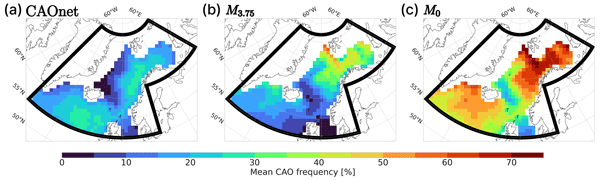
This paper investigates how clouds associated with Arctic marine cold air outbreaks (CAOs) respond to climate change. By utilizing machine learning methods and remote sensing data from the past 25 years, the study identifies trends indicating a shortening of the CAO season. This has implications for the Arctic energy balance, underscoring the importance of further investigating these clouds to understand the trajectory of future Arctic climate.
Ove W. Haugvaldstad, Dirk Olivié, Trude Storelvmo, and Michael Schulz
Atmos. Chem. Phys., 25, 13199–13219, https://doi.org/10.5194/acp-25-13199-2025, https://doi.org/10.5194/acp-25-13199-2025, 2025
Short summary
Short summary
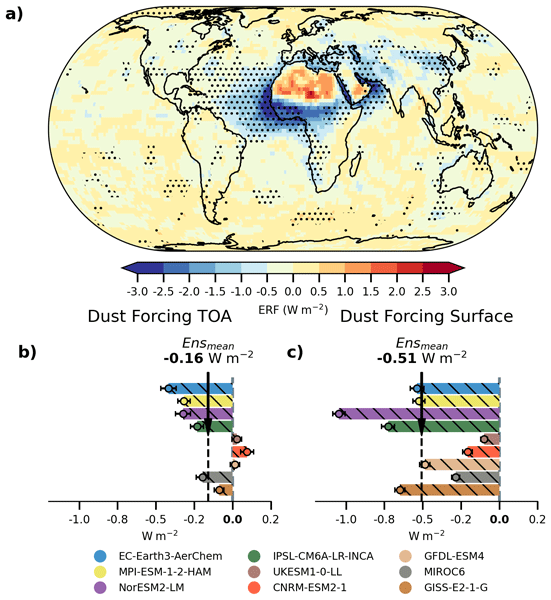
Our study examines what would happen if desert dust in the atmosphere doubled, motivated by dust sedimentation records showing a large increase in dust levels since industrialization began. Using climate model simulations, we assess how more dust affects Earth's energy balance and rainfall. We found that models disagree on whether more dust overall cools or warms the planet. Additionally, more dust tends to reduce rainfall because it absorbs radiation and encourages the formation of ice clouds.
Lise Seland Graff, Jerry Tjiputra, Ada Gjermundsen, Andreas Born, Jens Boldingh Debernard, Heiko Goelzer, Yan-Chun He, Petra Margaretha Langebroek, Aleksi Nummelin, Dirk Olivié, Øyvind Seland, Trude Storelvmo, Mats Bentsen, Chuncheng Guo, Andrea Rosendahl, Dandan Tao, Thomas Toniazzo, Camille Li, Stephen Outten, and Michael Schulz
Earth Syst. Dynam., 16, 1671–1698, https://doi.org/10.5194/esd-16-1671-2025, https://doi.org/10.5194/esd-16-1671-2025, 2025
Short summary
Short summary
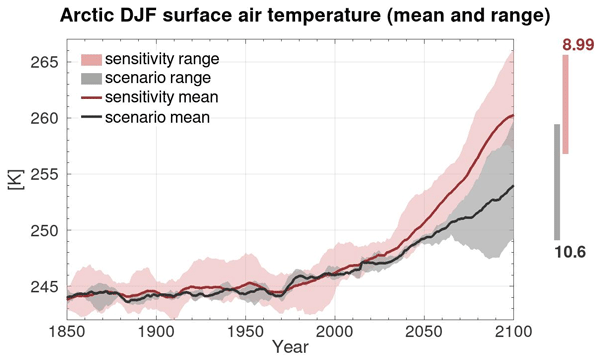
The magnitude of future Arctic amplification is highly uncertain. Using the Norwegian Earth System Model, we explore the effect of improving the representation of clouds, ocean eddies, the Greenland ice sheet, sea ice, and ozone on the projected Arctic winter warming in a coordinated experiment set. These improvements all lead to enhanced projected Arctic warming, with the largest changes found in the sea ice retreat regions and the largest uncertainty found on the Atlantic side.
Tómas Zoëga, Trude Storelvmo, and Kirstin Krüger
Atmos. Chem. Phys., 25, 2989–3010, https://doi.org/10.5194/acp-25-2989-2025, https://doi.org/10.5194/acp-25-2989-2025, 2025
Short summary
Short summary
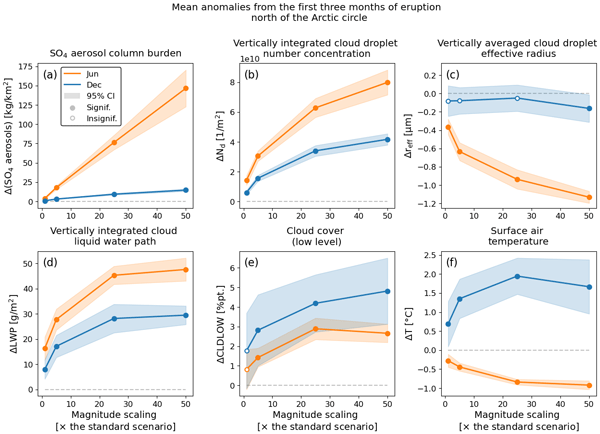
We use an Earth system model to systematically investigate the climate response to high-latitude effusive volcanic eruptions as a function of eruption season and size, with a focus on the Arctic. We find that different seasons strongly modulate the climate response, with Arctic surface warming observed in winter and cooling in summer. Additionally, as eruptions increase in terms of sulfur dioxide emissions, the climate response becomes increasingly insensitive to variations in emission strength.
Astrid B. Gjelsvik, Robert O. David, Tim Carlsen, Franziska Hellmuth, Stefan Hofer, Zachary McGraw, Harald Sodemann, and Trude Storelvmo
Atmos. Chem. Phys., 25, 1617–1637, https://doi.org/10.5194/acp-25-1617-2025, https://doi.org/10.5194/acp-25-1617-2025, 2025
Short summary
Short summary
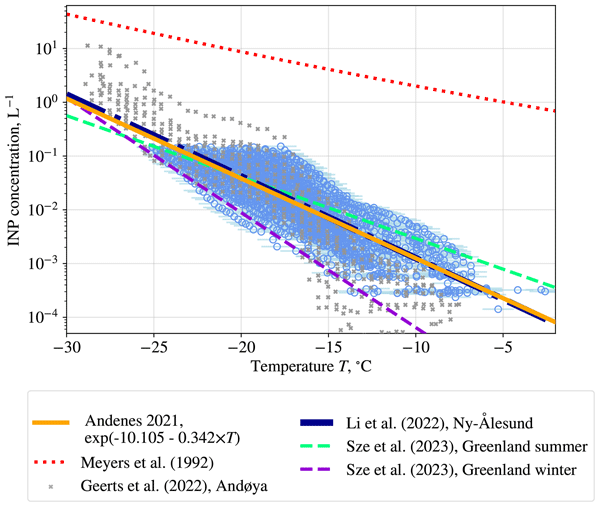
Ice formation in clouds has a substantial impact on radiation and precipitation and must be realistically simulated in order to understand present and future Arctic climate. Rare aerosols known as ice-nucleating particles can play an important role in cloud ice formation, but their representation in global climate models is not well suited for the Arctic. In this study, the simulation of cloud phase is improved when the representation of these particles is constrained by Arctic observations.
Franziska Hellmuth, Tim Carlsen, Anne Sophie Daloz, Robert Oscar David, Haochi Che, and Trude Storelvmo
Atmos. Chem. Phys., 25, 1353–1383, https://doi.org/10.5194/acp-25-1353-2025, https://doi.org/10.5194/acp-25-1353-2025, 2025
Short summary
Short summary
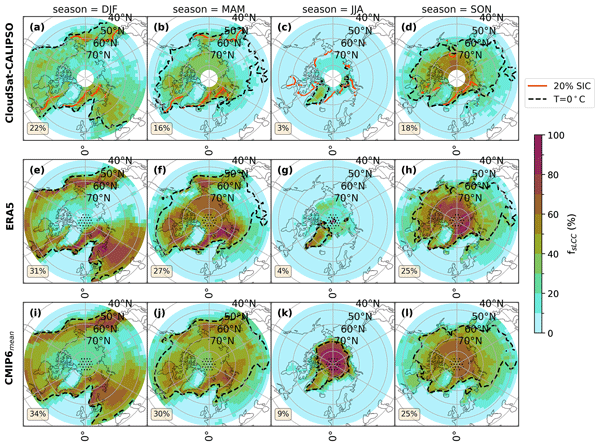
This article compares the occurrence of supercooled liquid-containing clouds (sLCCs) and their link to surface snowfall in CloudSat–CALIPSO, ERA5, and the CMIP6 models. Significant discrepancies were found, with ERA5 and CMIP6 consistently overestimating sLCC and snowfall frequency. This bias is likely due to cloud microphysics parameterization. This conclusion has implications for accurately representing cloud phase and snowfall in future climate projections.
Ragnhild Bieltvedt Skeie, Magne Aldrin, Terje K. Berntsen, Marit Holden, Ragnar Bang Huseby, Gunnar Myhre, and Trude Storelvmo
Earth Syst. Dynam., 15, 1435–1458, https://doi.org/10.5194/esd-15-1435-2024, https://doi.org/10.5194/esd-15-1435-2024, 2024
Short summary
Short summary
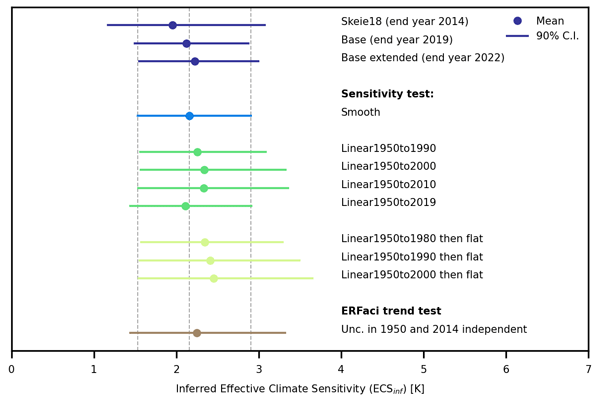
Climate sensitivity and aerosol forcing are central quantities in climate science that are uncertain and contribute to the spread in climate projections. To constrain them, we use observations of temperature and ocean heat content as well as prior knowledge of radiative forcings over the industrialized period. The estimates are sensitive to how aerosol cooling evolved over the latter part of the 20th century, and a strong aerosol forcing trend in the 1960s–1970s is not supported by our analysis.
Britta Schäfer, Robert Oscar David, Paraskevi Georgakaki, Julie Thérèse Pasquier, Georgia Sotiropoulou, and Trude Storelvmo
Atmos. Chem. Phys., 24, 7179–7202, https://doi.org/10.5194/acp-24-7179-2024, https://doi.org/10.5194/acp-24-7179-2024, 2024
Short summary
Short summary
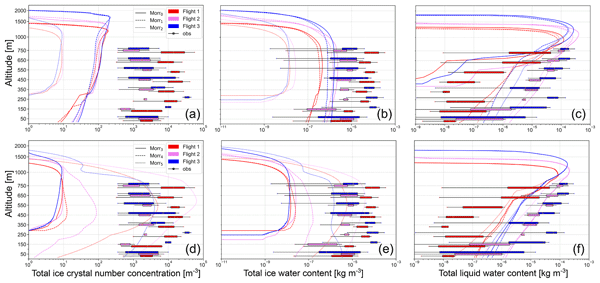
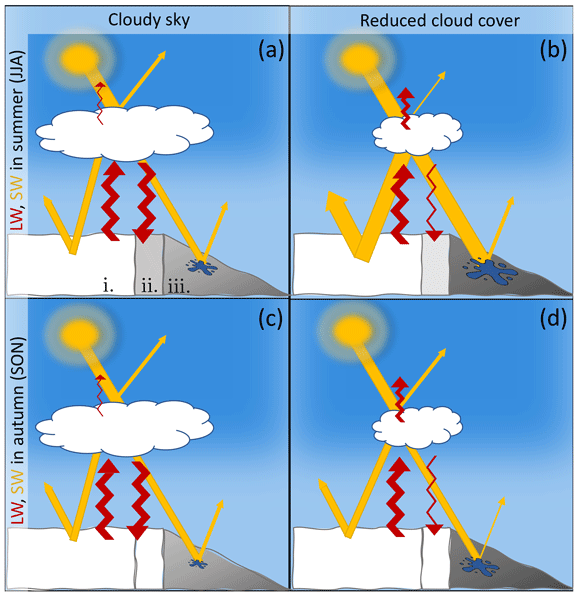
Mixed-phase clouds, i.e., clouds consisting of ice and supercooled water, are very common in the Arctic. However, how these clouds form is often not correctly represented in standard weather models. We show that both ice crystal concentrations in the cloud and precipitation from the cloud can be improved in the model when aerosol concentrations are prescribed from observations and when more processes for ice multiplication, i.e., the production of new ice particles from existing ice, are added.
Idunn Aamnes Mostue, Stefan Hofer, Trude Storelvmo, and Xavier Fettweis
The Cryosphere, 18, 475–488, https://doi.org/10.5194/tc-18-475-2024, https://doi.org/10.5194/tc-18-475-2024, 2024
Short summary
Short summary
The latest generation of climate models (Coupled Model Intercomparison Project Phase 6 – CMIP6) warm more over Greenland and the Arctic and thus also project a larger mass loss from the Greenland Ice Sheet (GrIS) compared to the previous generation of climate models (CMIP5). Our work suggests for the first time that part of the greater mass loss in CMIP6 over the GrIS is driven by a difference in the surface mass balance sensitivity from a change in cloud representation in the CMIP6 models.
Casey J. Wall, Trude Storelvmo, and Anna Possner
Atmos. Chem. Phys., 23, 13125–13141, https://doi.org/10.5194/acp-23-13125-2023, https://doi.org/10.5194/acp-23-13125-2023, 2023
Short summary
Short summary
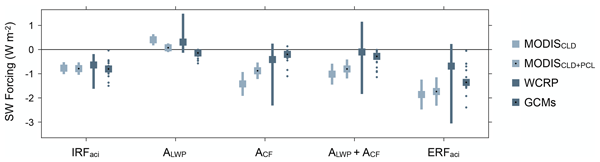
Interactions between aerosol pollution and liquid clouds are one of the largest sources of uncertainty in the effective radiative forcing of climate over the industrial era. We use global satellite observations to decompose the forcing into components from changes in cloud-droplet number concentration, cloud water content, and cloud amount. Our results reduce uncertainty in these forcing components and clarify their relative importance.
Andrew Gettelman, Hugh Morrison, Trude Eidhammer, Katherine Thayer-Calder, Jian Sun, Richard Forbes, Zachary McGraw, Jiang Zhu, Trude Storelvmo, and John Dennis
Geosci. Model Dev., 16, 1735–1754, https://doi.org/10.5194/gmd-16-1735-2023, https://doi.org/10.5194/gmd-16-1735-2023, 2023
Short summary
Short summary
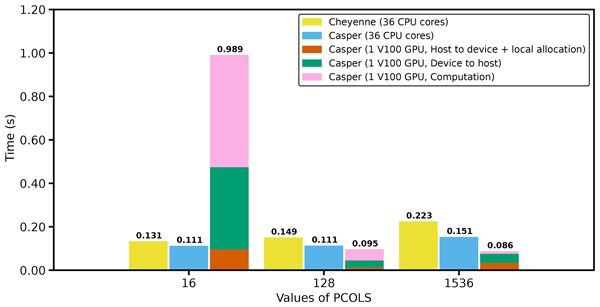
Clouds are a critical part of weather and climate prediction. In this work, we document updates and corrections to the description of clouds used in several Earth system models. These updates include the ability to run the scheme on graphics processing units (GPUs), changes to the numerical description of precipitation, and a correction to the ice number. There are big improvements in the computational performance that can be achieved with GPU acceleration.
Britta Schäfer, Tim Carlsen, Ingrid Hanssen, Michael Gausa, and Trude Storelvmo
Atmos. Chem. Phys., 22, 9537–9551, https://doi.org/10.5194/acp-22-9537-2022, https://doi.org/10.5194/acp-22-9537-2022, 2022
Short summary
Short summary
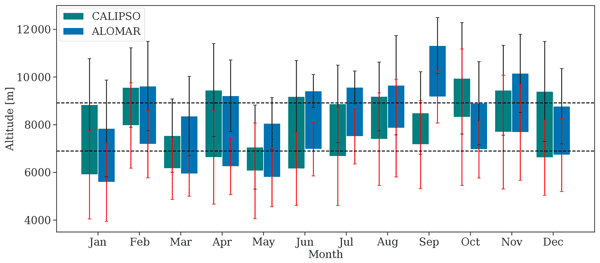
Cloud properties are important for the surface radiation budget. This study presents cold-cloud observations based on lidar measurements from the Norwegian Arctic between 2011 and 2017. Using statistical assessments and case studies, we give an overview of the macro- and microphysical properties of these clouds and demonstrate the capabilities of long-term cloud observations in the Norwegian Arctic from the ground-based lidar at Andenes.
Sorin Nicolae Vâjâiac, Andreea Calcan, Robert Oscar David, Denisa-Elena Moacă, Gabriela Iorga, Trude Storelvmo, Viorel Vulturescu, and Valeriu Filip
Atmos. Meas. Tech., 14, 6777–6794, https://doi.org/10.5194/amt-14-6777-2021, https://doi.org/10.5194/amt-14-6777-2021, 2021
Short summary
Short summary
Warm clouds (with liquid droplets) play an important role in modulating the amount of incoming solar radiation to Earth’s surface and thus the climate. The most efficient way to study them is by in situ optical measurements. This paper proposes a new methodology for providing more detailed and reliable structural analyses of warm clouds through post-flight processing of collected data. The impact fine aerosol incorporation in water droplets might have on such measurements is also discussed.
Cited articles
Barrage, L. and Nordhaus, W.: Policies, projections, and the social cost of carbon: Results from the DICE-2023 model, Proceedings of the National Academy of Sciences, 121, e2312030121, https://doi.org/10.1073/pnas.2312030121, 2024. a
Bilal, A. and Rossi-Hansberg, E.: Anticipating Climate Change Across the United States, https://doi.org/10.3386/w31323, 2023. a
Bjordal, J.: NorESM2 restart files to be used for NorESM2-DIAM, Zenodo [data set], https://doi.org/10.5281/zenodo.17856602, 2025. a
Bjordal, J., Storelvmo, T., and Smith Jr., A. A.: Quantifying uncertainty about global and regional economic impacts of climate change, Environmental Research Letters, https://doi.org/10.1088/1748-9326/ac8ab1, 2022. a, b, c
Bjordal, J., Cornec, H., and Smith Jr., A. A.: NorESM2-DIAM, Zenodo [code], https://doi.org/10.5281/zenodo.17986166, 2025. a
Brock, W., Engström, G., and Xepapadeas, A.: Spatial climate-economic models in the design of optimal climate policies across locations, European Economic Review, 69, 78–103, https://doi.org/10.1016/j.euroecorev.2013.02.008, 2014. a
Burke, M., Hsiang, S. M., and Miguel, E.: Global non-linear effect of temperature on economic production, Nature, 527, 235, https://doi.org/10.1038/nature15725, 2015. a
Callahan, C. W. and Mankin, J. S.: Globally unequal effect of extreme heat on economic growth, Science Advances, 8, https://doi.org/10.1126/sciadv.add3726, 2022. a
Calvin, K. and Bond-Lamberty, B.: Integrated human-earth system modeling–state of the science and future directions, Environmental Research Letters, 13, 063006, https://doi.org/10.1088/1748-9326/aac642, 2018. a, b
Canadell, J. G., Scheel Monteiro, P., Costa, M. H., Cotrim da Cunha, L., Cox, P. M., Eliseev, A. V., Henson, S., Ishii, M., Jaccard, S., Koven, C., Lohila, A., Patra, P. K., Piao, S., Rogelj, J., Syampungani, S., Zaehle, S., and Zickfeld, K.: Global carbon and other biogeochemical cycles and feedbacks, in: Climate Change 2021: The Physical Science Basis. Contribution of Working Group I to the Sixth Assessment Report of the Intergovernmental Panel on Climate Change, edited by: Masson-Delmotte, V., Zhai, P., Pirani, A., Connors, S. L., Péan, C., Berger, S., Caud, N., Chen, Y., Goldfarb, L., Gomis, M. I., Huang, M., Leitzell, K., Lonnoy, E., Matthews, J. B. R., Maycock, T. K., Waterfield, T., Yelekçi, O., Yu, R., and Zhou, B., Cambridge University Press, https://doi.org/10.1017/9781009157896.007, 2021. a
Caselli, F. and Feyrer, J.: The Marginal Product of Capital*, The Quarterly Journal of Economics, 122, 535–568, https://doi.org/10.1162/qjec.122.2.535, 2007. a
Collins, W. D., Craig, A. P., Truesdale, J. E., Di Vittorio, A. V., Jones, A. D., Bond-Lamberty, B., Calvin, K. V., Edmonds, J. A., Kim, S. H., Thomson, A. M., Patel, P., Zhou, Y., Mao, J., Shi, X., Thornton, P. E., Chini, L. P., and Hurtt, G. C.: The integrated Earth system model version 1: formulation and functionality, Geosci. Model Dev., 8, 2203–2219, https://doi.org/10.5194/gmd-8-2203-2015, 2015. a, b
Cruz, J.-L. and Rossi-Hansberg, E.: The Economic Geography of Global Warming, The Review of Economic Studies, 91, 899–939, https://doi.org/10.1093/restud/rdad042, 2024. a, b
Danabasoglu, G., Lamarque, J.-F., Bacmeister, J., Bailey, D. A., DuVivier, A. K., Edwards, J., Emmons, L. K., Fasullo, J., Garcia, R., Gettelman, A., Hannay, C., Holland, M. M., Large, W. G., Lauritzen, P. H., Lawrence, D. M., Lenaerts, J. T. M., Lindsay, K., Lipscomb, W. H., Mills, M. J., Neale, R., Oleson, K. W., Otto-Bliesner, B., Phillips, A. S., Sacks, W., Tilmes, S., Kampenhout, L., Vertenstein, M., Bertini, A., Dennis, J., Deser, C., Fischer, C., Fox-Kemper, B., Kay, J. E., Kinnison, D., Kushner, P. J., Larson, V. E., Long, M. C., Mickelson, S., Moore, J. K., Nienhouse, E., Polvani, L., Rasch, P. J., and Strand, W. G.: The Community Earth System Model Version 2 (CESM2), Journal of Advances in Modeling Earth Systems, 12, https://doi.org/10.1029/2019ms001916, 2020. a, b
Dell, M., Jones, B. F., and Olken, B. A.: Temperature Shocks and Economic Growth: Evidence from the Last Half Century, American Economic Journal: Macroeconomics, 4, 66–95, https://doi.org/10.1257/mac.4.3.66, 2012. a
Dell, M., Jones, B. F., and Olken, B. A.: What Do We Learn from the Weather? The New Climate-Economy Literature, Journal of Economic Literature, 52, 740–798, https://doi.org/10.1257/jel.52.3.740, 2014. a
Desmet, K. and Rossi-Hansberg, E.: On the spatial economic impact of global warming, Journal of Urban Economics, 88, 16–37, https://doi.org/10.1016/j.jue.2015.04.004, 2015. a
Di Vittorio, A. V., Sinha, E., Hao, D., Singh, B., Calvin, K. V., Shippert, T., Patel, P., and Bond-Lamberty, B.: E3SM-GCAM: A Synchronously Coupled Human Component in the E3SM Earth System Model Enables Novel Human-Earth Feedback Research, Journal of Advances in Modeling Earth Systems, 17, https://doi.org/10.1029/2024MS004806, 2025. a
Dietz, S., van der Ploeg, F., Rezai, A., and Venmans, F.: Are Economists Getting Climate Dynamics Right and Does It Matter?, Journal of the Association of Environmental and Resource Economists, 8, 895–921, https://doi.org/10.1086/713977, 2021. a
Eyring, V., Bony, S., Meehl, G. A., Senior, C. A., Stevens, B., Stouffer, R. J., and Taylor, K. E.: Overview of the Coupled Model Intercomparison Project Phase 6 (CMIP6) experimental design and organization, Geosci. Model Dev., 9, 1937–1958, https://doi.org/10.5194/gmd-9-1937-2016, 2016. a, b, c, d, e, f
Forster, P., Storelvmo, T., Armour, K., Collins, W., Dufresne, J.-L., Frame, D., Lunt, D., Mauritsen, T., Palmer, M., Watanabe, M., Wild, M., and Zhang, H.: The Earth’s energy budget, climate feedbacks, and climate sensitivity, in: Climate Change 2021: The Physical Science Basis. Contribution of Working Group I to the Sixth Assessment Report of the Intergovernmental Panel on Climate Change, edited by: Masson-Delmotte, V., Zhai, P., Pirani, A., Connors, S. L., Péan, C., Berger, S., Caud, N., Chen, Y., Goldfarb, L., Gomis, M. I., Huang, M., Leitzell, K., Lonnoy, E., Matthews, J. B. R., Maycock, T. K., Waterfield, T., Yelekçi, O., Yu, R., and Zhou, B., Cambridge University Press, https://doi.org/10.1017/9781009157896.009, 2021. a
Frame, D. J., Rosier, S. M., Noy, I., Harrington, L. J., Carey-Smith, T., Sparrow, S. N., Stone, D. A., and Dean, S. M.: Climate change attribution and the economic costs of extreme weather events: a study on damages from extreme rainfall and drought, Climatic Change, 162, 781–797, https://doi.org/10.1007/s10584-020-02729-y, 2020. a
Fried, S.: Seawalls and Stilts: A Quantitative Macro Study of Climate Adaptation, The Review of Economic Studies, 89, 3303–3344, https://doi.org/10.1093/restud/rdab099, 2022. a
Goodess, C. M., Hanson, C., Hulme, M., and Osborn, T. J.: Representing Climate and Extreme Weather Events in Integrated Assessment Models: A Review of Existing Methods and Options for Development, Integrated Assessment, 4, 145–171, https://doi.org/10.1076/iaij.4.3.145.23772, 2003. a
Harremoës, P. and Turner, R.: Methods for integrated assessment, Regional Environmental Change, 2, 57–65, https://doi.org/10.1007/s101130100027, 2001. a
Howard, P. H. and Sterner, T.: Few and Not So Far Between: A Meta-analysis of Climate Damage Estimates, Environmental and Resource Economics, 68, 197–225, https://doi.org/10.1007/s10640-017-0166-z, 2017. a
Hsiang, S., Kopp, R., Jina, A., Rising, J., Delgado, M., Mohan, S., Rasmussen, D. J., Muir-Wood, R., Wilson, P., Oppenheimer, M., Larsen, K., and Houser, T.: Estimating economic damage from climate change in the United States, Science, 356, 1362–1369, https://doi.org/10.1126/science.aal4369, 2017. a
Keen, S., Lenton, T. M., Godin, A., Yilmaz, D., Grasselli, M., and Garrett, T. J.: Economists' erroneous estimates of damages from climate change, arXiv [econ, q-fin], https://doi.org/10.48550/arXiv.2108.07847, 2021. a
Kikstra, J., Waidelich, P., Rising, J., Yumashev, D., Hope, C., and Brierley, C.: The social cost of carbon dioxide under climate-economy feedbacks and temperature variability, Environ. Res. Lett., https://doi.org/10.1088/1748-9326/ac1d0b, 2021. a
Kirkevåg, A., Grini, A., Olivié, D., Seland, Ø., Alterskjær, K., Hummel, M., Karset, I. H. H., Lewinschal, A., Liu, X., Makkonen, R., Bethke, I., Griesfeller, J., Schulz, M., and Iversen, T.: A production-tagged aerosol module for Earth system models, OsloAero5.3 – extensions and updates for CAM5.3-Oslo, Geosci. Model Dev., 11, 3945–3982, https://doi.org/10.5194/gmd-11-3945-2018, 2018. a
Kotlikoff, L., Kubler, F., Polbin, A., and Scheidegger, S.: Can today's and tomorrow's world uniformly gain from carbon taxation?, European Economic Review, 168, 104819, https://doi.org/10.1016/j.euroecorev.2024.104819, 2024. a
Kotz, M., Wenz, L., Stechemesser, A., Kalkuhl, M., and Levermann, A.: Day-to-day temperature variability reduces economic growth, Nature Climate Change, 11, 319–325, https://doi.org/10.1038/s41558-020-00985-5, 2021. a
Kotz, M., Levermann, A., and Wenz, L.: The economic commitment of climate change, Nature, 628, 551–557, https://doi.org/10.1038/s41586-024-07219-0, 2024. a, b
Kriegler, E., Edmonds, J., Hallegatte, S., Ebi, K. L., Kram, T., Riahi, K., Winkler, H., and van Vuuren, D. P.: A new scenario framework for climate change research: the concept of shared climate policy assumptions, Climatic Change, 122, 401–414, https://doi.org/10.1007/s10584-013-0971-5, 2014. a
Kubler, F.: International Welfare Gains from Sharing Climate-Risk, https://doi.org/10.2139/ssrn.4561236, 2023. a
Lawrence, D. M., Fisher, R. A., Koven, C. D., Oleson, K. W., Swenson, S. C., Bonan, G., Collier, N., Ghimire, B., van Kampenhout, L., Kennedy, D., Kluzek, E., Lawrence, P. J., Li, F., Li, H., Lombardozzi, D., Riley, W. J., Sacks, W. J., Shi, M., Vertenstein, M., Wieder, W. R., Xu, C., Ali, A. A., Badger, A. M., Bisht, G., van den Broeke, M., Brunke, M. A., Burns, S. P., Buzan, J., Clark, M., Craig, A., Dahlin, K., Drewniak, B., Fisher, J. B., Flanner, M., Fox, A. M., Gentine, P., Hoffman, F., Keppel-Aleks, G., Knox, R., Kumar, S., Lenaerts, J., Leung, L. R., Lipscomb, W. H., Lu, Y., Pandey, A., Pelletier, J. D., Perket, J., Randerson, J. T., Ricciuto, D. M., Sanderson, B. M., Slater, A., Subin, Z. M., Tang, J., Thomas, R. Q., Val Martin, M., and Zeng, X.: The Community Land Model Version 5: Description of New Features, Benchmarking, and Impact of Forcing Uncertainty, Journal of Advances in Modeling Earth Systems, 11, 4245–4287, https://doi.org/10.1029/2018MS001583, 2019. a, b
Leduc, M., Matthews, H. D., and de Elía, R.: Regional estimates of the transient climate response to cumulative CO2 emissions, Nature Climate Change, 6, 474–478, https://doi.org/10.1038/nclimate2913, 2016. a
Matthews, H. D., Gillett, N. P., Stott, P. A., and Zickfeld, K.: The proportionality of global warming to cumulative carbon emissions, Nature, 459, 829–832, https://doi.org/10.1038/nature08047, 2009. a
Meredith, M., Sommerkorn, M., Cassotta, S., Derksen, C., Ekaykin, A., Hollowed, A., Kofinas, G., Mackintosh, A., Melbourne-Thomas, J., Muelbert, M., Ottersen, G., Pritchard, H., and Schuur, E.: Polar regions, in: IPCC special report on the ocean and cryosphere in a changing climate, edited by: Pörtner, H.-O., Roberts, D., Masson-Delmotte, V., Zhai, P., Tignor, M., Poloczanska, E., Mintenbeck, K., Alegría, A., Nicolai, M., Okem, A., Petzold, J., Rama, B., and Weyer, N., Cambridge University Press, Cambridge, UK and New York, NY, USA, 203–320, https://doi.org/10.1017/9781009157964.005, 2019. a
Moore, F. C., Rising, J., Lollo, N., Springer, C., Vasquez, V., Dolginow, A., Hope, C., and Anthoff, D.: Mimi-PAGE, an open-source implementation of the PAGE09 integrated assessment model, Scientific Data, 5, 180187, https://doi.org/10.1038/sdata.2018.187, 2018. a
Moss, R. H., Edmonds, J.A., Hibbard, K. A., Manning, M. R., Rose, S. K., van Vuuren, D. P., Carter, T. R., Emori, S., Kainuma, M., Kram, T., Meehl, G. A., Mitchell, J. F. B., Nakicenovic, N., Riahi, K., Smith, S. J., Stouffer, R. J., Thomson, A. M., Weyant, J. P., and Wilbanks, T. J.: The next generation of scenarios for climate change research and assessment, Nature, 463, 747, https://doi.org/10.1038/nature08823, 2010. a
Nordhaus, W. D.: A Sketch of the Economics of the Greenhouse Effect, The American Economic Review, 81, 146–150, 1991. a
Nordhaus, W. D.: An optimal transition path for controlling greenhouse gases, Science, 258, 1315–1319, https://doi.org/10.1126/science.258.5086.1315, 1992. a, b
Nordhaus, W. D.: Economic aspects of global warming in a post-Copenhagen environment, Proceedings of the National Academy of Sciences, 107, 11721–11726, https://doi.org/10.1073/pnas.1005985107, 2010. a
Nordhaus, W. D., Azam, Q., Corderi, D., Hood, K., Victor, N. M., Mohammed, M., Miltner, A., and Weiss, J.: The G-Econ database on gridded output: methods and data, Yale University, New Haven, 6, https://gecon.yale.edu/sites/default/files/files/gecon_data_20051206_1.pdf (last access: 2 February 2026), 2006. a
NorESM Climate Modeling Consortium: NorESM2 inputdata used by NorESM2-DIAM, Zenodo [data set], https://doi.org/10.5281/zenodo.17865023, 2025. a
O'Neill, B. C., Kriegler, E., Ebi, K. L., Kemp-Benedict, E., Riahi, K., Rothman, D. S., van Ruijven, B. J., van Vuuren, D. P., Birkmann, J., Kok, K., Levy, M., and Solecki, W.: The roads ahead: Narratives for shared socioeconomic pathways describing world futures in the 21st century, Global Environmental Change, 42, 169–180, https://doi.org/10.1016/j.gloenvcha.2015.01.004, 2017. a
Rennert, K., Errickson, F., Prest, B. C., Rennels, L., Newell, R. G., Pizer, W., Kingdon, C., Wingenroth, J., Cooke, R., Parthum, B., Smith, D., Cromar, K., Diaz, D., Moore, F. C., Müller, U. K., Plevin, R. J., Raftery, A. E., Ševčíková, H., Sheets, H., Stock, J. H., Tan, T., Watson, M., Wong, T. E., and Anthoff, D.: Comprehensive Evidence Implies a Higher Social Cost of CO2, Nature, 1–3, https://doi.org/10.1038/s41586-022-05224-9, 2022. a
Riahi, K., Van Vuuren, D. P., Kriegler, E., Edmonds, J., O’neill, B. C., Fujimori, S., Bauer, N., Calvin, K., Dellink, R., Fricko, O., Lutz, W., Popp, A., Cuaresma, J. C., KC, S., Leimbach, M., Jiang, L., Kram, T., Rao, S., Emmerling, J., Ebi, K., Hasegawa, T., Havlik, P., Humpenöder, F., Da Silva, L. A., Smith, S., Stehfest, E., Bosetti, V., Eom, J., Gernaat, D., Masui, T., Rogelj, J., Strefler, J., Drouet, L., Krey, V., Luderer,G., Harmsen, M., Takahashi, K., Baumstark, L., Doelman, J. C., Kainuma, M., Klimont, Z., Marangoni, G., Lotze-Campen, H., Obersteinera, M., Tabeau, A., and Tavoni, M.: The shared socioeconomic pathways and their energy, land use, and greenhouse gas emissions implications: an overview, Global Environmental Change, 42, 153–168, https://doi.org/10.1016/j.gloenvcha.2016.05.009, 2017. a, b
Ritchie, H. and Rosado, P.: Energy mix, Our World in Data, https://ourworldindata.org/energy-mix (last access: 10 February 2026), 2020. a
Rudik, I., Lyn, G., Tan, W., and Ortiz-Bobea, A.: The Economic Effects of Climate Change in Dynamic Spatial Equilibrium, https://doi.org/10.31235/osf.io/usghb, 2021. a
Schneider, S. H.: Integrated assessment modeling of global climate change: Transparent rational tool for policy making or opaque screen hiding value-laden assumptions?, Environmental Modeling and Assessment, 2, 229–249, https://doi.org/10.1023/a:1019090117643, 1997. a
Schwinger, J., Goris, N., Tjiputra, J. F., Kriest, I., Bentsen, M., Bethke, I., Ilicak, M., Assmann, K. M., and Heinze, C.: Evaluation of NorESM-OC (versions 1 and 1.2), the ocean carbon-cycle stand-alone configuration of the Norwegian Earth System Model (NorESM1), Geosci. Model Dev., 9, 2589–2622, https://doi.org/10.5194/gmd-9-2589-2016, 2016. a
Seland, Ø., Bentsen, M., Olivié, D., Toniazzo, T., Gjermundsen, A., Graff, L. S., Debernard, J. B., Gupta, A. K., He, Y.-C., Kirkevåg, A., Schwinger, J., Tjiputra, J., Aas, K. S., Bethke, I., Fan, Y., Griesfeller, J., Grini, A., Guo, C., Ilicak, M., Karset, I. H. H., Landgren, O., Liakka, J., Moseid, K. O., Nummelin, A., Spensberger, C., Tang, H., Zhang, Z., Heinze, C., Iversen, T., and Schulz, M.: Overview of the Norwegian Earth System Model (NorESM2) and key climate response of CMIP6 DECK, historical, and scenario simulations, Geosci. Model Dev., 13, 6165–6200, https://doi.org/10.5194/gmd-13-6165-2020, 2020. a, b, c, d, e, f
Seland, Ø., Bentsen, M., Olivié, D., Toniazzo, T., Gjermundsen, A., Graff, L. S., Debernard, J. B., Gupta, A. K., He, Y., Kirkevåg, A., Schwinger, J., Tjiputra, J., Aas, K. S., Bethke, I., Fan, Y., Gao, S., Griesfeller, J., Grini, A., Guo, C., Ilicak, M., Karset, I. H. H., Landgren, O., Liakka, J., Moree, A., Moseid, K., Nummelin, A., Spensberger, C., Tang, H., Zhang, Z., Heinze, C., Iversen, T., Schulz, M., Vertenstein, M., Goldhaber, S., and Debolskiy, M.: NorESM2 source code as used for CMIP6 simulations (includes additional experimental setups, extended model documentation, corrections in atmosphere diagnostics, additional capabilities in BLOM/iHAMOCC, and technical modifications), Zenodo [code], https://doi.org/10.5281/zenodo.17865358, 2025. a
Taylor, K. E., Stouffer, R. J., and Meehl, G. A.: An overview of CMIP5 and the experiment design, Bulletin of the American Meteorological Society, 93, 485–498, https://doi.org/10.1175/BAMS-D-11-00094.1, 2012. a
Thornton, P. E., Calvin, K., Jones, A. D., Di Vittorio, A. V., Bond-Lamberty, B., Chini, L., Shi, X., Mao, J., Collins, W. D., Edmonds, J., Thomson, A., Truesdale, J., Craig, A., Branstetter, M. L., and Hurtt, G.: Biospheric feedback effects in a synchronously coupled model of human and Earth systems, Nature Climate Change, 7, 496–500, https://doi.org/10.1038/nclimate3310, 2017. a
Tjiputra, J. F., Schwinger, J., Bentsen, M., Morée, A. L., Gao, S., Bethke, I., Heinze, C., Goris, N., Gupta, A., He, Y.-C., Olivié, D., Seland, Ø., and Schulz, M.: Ocean biogeochemistry in the Norwegian Earth System Model version 2 (NorESM2), Geosci. Model Dev., 13, 2393–2431, https://doi.org/10.5194/gmd-13-2393-2020, 2020. a, b, c
Toniazzo, T., Bentsen, M., Craig, C., Eaton, B. E., Edwards, J., Goldhaber, S., Jablonowski, C., and Lauritzen, P. H.: Enforcing conservation of axial angular momentum in the atmospheric general circulation model CAM6, Geosci. Model Dev., 13, 685–705, https://doi.org/10.5194/gmd-13-685-2020, 2020. a
United Nations, Department of Economic and Social Affairs, Population Division: World population prospects 2024, online edition, https://population.un.org/wpp/ (last access: 13 August 2025), 2024. a
van Vuuren, D. P., Lowe, J., Stehfest, E., Gohar, L., Hof, A. F., Hope, C., Warren, R., Meinshausen, M., and Plattner, G.-K.: How well do integrated assessment models simulate climate change?, Climatic Change, 104, 255–285, https://doi.org/10.1007/s10584-009-9764-2, 2011. a, b, c
van Vuuren, D. P., Bayer, L. B., Chuwah, C., Ganzeveld, L., Hazeleger, W., van den Hurk, B., Van Noije, T., O'Neill, B., and Strengers, B. J.: A comprehensive view on climate change: coupling of earth system and integrated assessment models, Environmental Research Letters, 7, 024012, https://doi.org/10.1088/1748-9326/7/2/024012, 2012. a, b
van Vuuren, D. P., Kriegler, E., O’Neill, B. C., Ebi, K. L., Riahi, K., Carter, T. R., Edmonds, J., Hallegatte, S., Kram, T., Mathur, R., and Winkler, H.: A new scenario framework for climate change research: scenario matrix architecture, Climatic Change, 122, 373–386, https://doi.org/10.1007/s10584-013-0906-1, 2014. a
Waidelich, P., Batibeniz, F., Rising, J., Kikstra, J. S., and Seneviratne, S. I.: Climate damage projections beyond annual temperature, Nature Climate Change, 1–8, https://doi.org/10.1038/s41558-024-01990-8, 2024. a, b
Weyant, J.: Some Contributions of Integrated Assessment Models of Global Climate Change, Review of Environmental Economics and Policy, 11, 115–137, https://doi.org/10.1093/reep/rew018, 2017. a
Editorial statement
Earth System Models are highly sophisticated computer models of the physical, chemical and biological processes that make up our planet. They are a key tool in predicting the climate change. Integrated Assessment Models tie physical changes in the climate to economic and social effects. Traditionally, Earth System Models (ESM) and Integrated Assessment Models (IAM) are loosely coupled through a static, unidirectional, asynchronous way. The work presented by this paper develops a novel framework that couples an ESM and a spatially disaggregated IAM in a dynamic, bidirectonal and synchronous way. This work represents a significant advance towards tight, bi-directional coupling between the Earth and Human systems. The tools developed here provide a blueprint for future studies seeking to identify precisely who is affected, where, and when by climate change—an essential step toward designing politically feasible and effective policies.
Earth System Models are highly sophisticated computer models of the physical, chemical and...
Short summary
We introduce NorESM2-DIAM (Norwegian Earth System Model version 2-Disaggregated Integrated Assessment Model), a first-of-its-kind tool linking a climate model with a high-resolution economic model to study how climate change, internal variability, and economic activity interact across the world. The model reveals strong regional differences and large annual swings in economic impacts, offers insights for climate policy discussions, and provides a strong foundation for future model development.
We introduce NorESM2-DIAM (Norwegian Earth System Model version 2-Disaggregated Integrated...


