
Articles | Volume 19, issue 3
https://doi.org/10.5194/gmd-19-1321-2026
© Author(s) 2026. This work is distributed under
the Creative Commons Attribution 4.0 License.
the Creative Commons Attribution 4.0 License.
https://doi.org/10.5194/gmd-19-1321-2026
© Author(s) 2026. This work is distributed under
the Creative Commons Attribution 4.0 License.
the Creative Commons Attribution 4.0 License.
Development and technical paper
| 
12 Feb 2026
Development and technical paper |
| 12 Feb 2026
| 12 Feb 2026
A simple step heating approach for wall surface temperature estimation in the SOlar and LongWave Environmental Irradiance Geometry (SOLWEIG) model
Nils Wallenberg
CORRESPONDING AUTHOR
Department of Earth Sciences, University of Gothenburg, Gothenburg, Medicinaregatan 7B, 413 90 Göteborg, Sweden
Björn Holmer
Department of Earth Sciences, University of Gothenburg, Gothenburg, Medicinaregatan 7B, 413 90 Göteborg, Sweden
Fredrik Lindberg
Department of Earth Sciences, University of Gothenburg, Gothenburg, Medicinaregatan 7B, 413 90 Göteborg, Sweden
Jessika Lönn
Department of Earth Sciences, University of Gothenburg, Gothenburg, Medicinaregatan 7B, 413 90 Göteborg, Sweden
Erik Maesel
Department of Earth Sciences, University of Gothenburg, Gothenburg, Medicinaregatan 7B, 413 90 Göteborg, Sweden
David Rayner
Swedish National Data Service, University of Gothenburg, Gothenburg, Medicinaregatan 18A, 413 90 Göteborg, Sweden
Related authors
Nils Wallenberg, Fredrik Lindberg, and David Rayner
Geosci. Model Dev., 15, 1107–1128, https://doi.org/10.5194/gmd-15-1107-2022, https://doi.org/10.5194/gmd-15-1107-2022, 2022
Short summary
Short summary
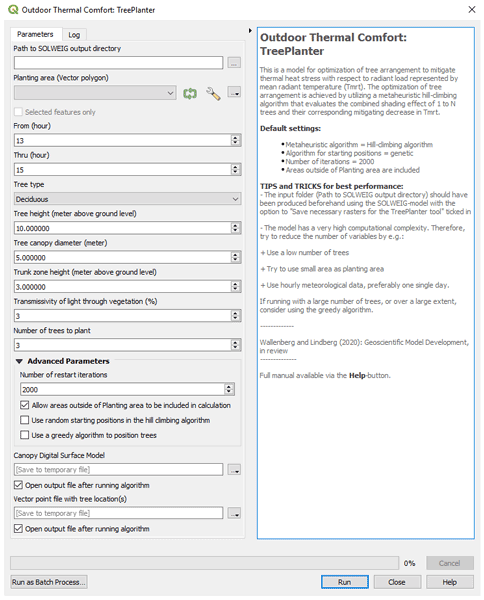
Exposure to solar radiation on clear and warm days can lead to heat stress and thermal discomfort. This can be alleviated by planting trees providing shade in particularly warm areas. Here, we use a model to locate trees and optimize their blocking of solar radiation. Our results show that locations can differ depending, e.g., tree size (juvenile or mature) and number of trees that are positioned simultaneously. The model is available as a tool for accessibility by researchers and others.
Cas Renette, Mats Olvmo, Sofia Thorsson, Björn Holmer, and Heather Reese
The Cryosphere, 18, 5465–5480, https://doi.org/10.5194/tc-18-5465-2024, https://doi.org/10.5194/tc-18-5465-2024, 2024
Short summary
Short summary
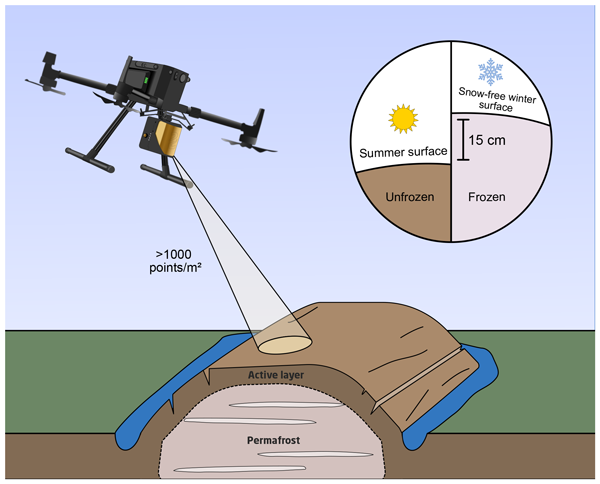
We used a drone to monitor seasonal changes in the height of subarctic permafrost mounds (palsas). With five drone flights in 1 year, we found a seasonal fluctuation of ca. 15 cm as a result of freeze–thaw cycles. On one mound, a large area sank down between each flight as a result of permafrost thaw. The approach of using repeated high-resolution scans from such a drone is unique for such environments and highlights its effectiveness in capturing the subtle dynamics of permafrost landscapes.
Nils Wallenberg, Fredrik Lindberg, and David Rayner
Geosci. Model Dev., 15, 1107–1128, https://doi.org/10.5194/gmd-15-1107-2022, https://doi.org/10.5194/gmd-15-1107-2022, 2022
Short summary
Short summary
Exposure to solar radiation on clear and warm days can lead to heat stress and thermal discomfort. This can be alleviated by planting trees providing shade in particularly warm areas. Here, we use a model to locate trees and optimize their blocking of solar radiation. Our results show that locations can differ depending, e.g., tree size (juvenile or mature) and number of trees that are positioned simultaneously. The model is available as a tool for accessibility by researchers and others.
Cited articles
Adilkhanova, I., Santamouris, M., and Yun, G. Y.: Coupling urban climate modeling and city-scale building energy simulations with the statistical analysis: Climate and energy implications of high albedo materials in Seoul, Energy Build., 290, https://doi.org/10.1016/j.enbuild.2023.113092, 2023.
Ali-Toudert, F. and Mayer, H.: Numerical study on the effects of aspect ratio and orientation of an urban street canyon on outdoor thermal comfort in hot an dry climate, Building and Environment, 41, 94–108, https://doi.org/10.1016/j.buildenv.2005.01.013, 2005.
Apogee Instruments: Infrared radiometers SI-100 Series, SIF-100 Series, SI-400 Series, SIL-100 Series, and SIL-400 Series, Apogee Instruments, Logan, UT, https://www.apogeeinstruments.com/content/SI-100-400-spec-sheet.pdf (last access: 27 January 2026), 2024a.
Apogee Instruments: Owner's Manual, Infrared Radiometer, Models SI-111, SI-121, SI-131, and SI-1H1, Rev: 11-June-2024, Apogee Instruments, Inc., 721 West 1800 North, Logan, Utah 84321, USA, https://www.apogeeinstruments.com/content/SI-100-manual.pdf (last access: 27 January 2026), 2024b.
Arnfield, A. J.: Two decades of urban climate research: A review of turbulence, exchanges of energy and water, and the urban heat island, Int. J. Climatol., 23, 1–26, https://doi.org/10.1002/joc.859, 2003.
Bäcklin, O., Lindberg, F., Thorsson, S., Rayner, D., and Wallenberg, N.: Outdoor heat stress at preschools during an extreme summer in Gothenburg, Sweden – Prescohool teachers' experiences contextualized by radiation modelling, Sustain. Cities Soc., 75, 103324, https://doi.org/10.1016/j.scs.2021.103324, 2021.
Battista, G., de Lieto Vollaro, E., Ocłoń, P., and de Lieto Vollaro, R.: Effects of urban heat island mitigation strategies in an urban square: A numerical modelling and experimental investigation, Energy Build., 282, https://doi.org/10.1016/j.enbuild.2023.112809, 2023.
Blazejczyk, K., Broede, P., Fiala, D., Havenith, G., Holmér, I., Jendritzky, G., Kampmann, B., and Kunert, A.: Principles of the new universal thermal comfort index (UTCI) and its application to bioclimatic research in European scale, Misc. Geogr., 14, 91–102, https://doi.org/10.2478/mgrsd-2010-0009, 2010.
Bogren, J., Gustavsson, T., Karlsson, M., and Postgård, U.: The impact of screening on road surface temperature, Meteorol. Appl., 7, 97–104, https://doi.org/10.1017/S135048270000150X, 2000.
Boué, C. and Fournier, D.: Infrared thermography measurements of the thermal parameters (effusivity, diffusivity and conductivity) of materials, Quant. InfraRed Thermog. J., 6, 175–188, https://doi.org/10.3166/qirt.6.175-188, 2009.
Broadbent, A. M., Coutts, A. M., Nice, K. A., Demuzere, M., Krayenhoff, E. S., Tapper, N. J., and Wouters, H.: The Air-temperature Response to Green/blue-infrastructure Evaluation Tool (TARGET v1.0): an efficient and user-friendly model of city cooling, Geosci. Model Dev., 12, 785–803, https://doi.org/10.5194/gmd-12-785-2019, 2019.
Bruse, M. and Fleer, H.: Simulating surface–plant–air interactions inside urban environments with a three-dimensional numerical model, Environ. Model. Softw., 13, 373–384, https://doi.org/10.1016/S1364-8152(98)00042-5, 1998.
Cape, J. A. and Lehman, G. W.: Temperature and Finite Pulse-Time Effects in the Flash Method for Measuring Thermal Diffusivity, J. Appl. Phys., 34, 1909–1913, https://doi.org/10.1063/1.1729711, 1963.
Celniker, C., Chen, S. A., Meier, A., and Levinson, R.: Targeting buildings for energy-saving cool-wall retrofits: a case study at the University of California, Davis, Energy Build., 249, 111014, https://doi.org/10.1016/j.enbuild.2021.111014, 2021.
CIBSE: Guide A Environmental design, Chartered Institution of Building Services Engineers, UK, ISBN 9781906846541, 2015.
Di Napoli, C., Hogan, R. J., and Pappenberger, F.: Mean radiant temperature from global-scale numerical weather prediction models, Int. J. Biometeorol., 64, 1233–1245, https://doi.org/10.1007/s00484-020-01900-5, 2020.
Erell, E., Pearlmutter, D., Boneh, D., and Kutiel, P. B.: Effect of high-albedo materials on pedestrian heat stress in urban street canyons, Urban Climate, 10, 367–386, https://doi.org/10.1016/j.uclim.2013.10.005, 2014.
Gál, C. V. and Kántor, N.: Modeling mean radiant temperature in outdoor spaces, A comparative numerical simulation and validation study, Urban Climate, 32, 100571, https://doi.org/10.1016/j.uclim.2019.100571, 2020.
Hénon, A., Mestayer, P. G., Lagouarde, J.-P., and Voogt, J. A.: An urban neighborhood temperature and energy study from the CAPITOUL experiment with the SOLENE model, Theor. Appl. Climatol., 110, 177–196, https://doi.org/10.1007/s00704-012-0615-0, 2012.
Höppe, P.: A new procedure to determine the mean radiant temperature outdoors, Wetter Leben, 44, 147–151, 1992.
Höppe, P.: The physiological equivalent temperature – a universal index for the biometeorological assessment of the thermal environment, Int. J. Biometeorol., 43, 71–75, https://doi.org/10.1007/s004840050118, 1999.
Johnson, G. T., Oke, T. R., Lyons, T. J., Steyn, D. G., Watson, I. D., and Voogt, J. A.: Simulation of surface urban heat islands under “ideal” conditions at night part 1: theory and tests against field data, Boundary-Layer Meteorol., 56, 275–294, https://doi.org/10.1007/BF00119211, 1991.
Kantor, N., Gal, C. V., Gulyas, A., and Unger, J.: The impact of façade orientation and woody vegetation on summertime heat stress patterns in a central European square: comparison of radiation measurements and simulations, Adv. Meteorol. 2018, 2650642, https://doi.org/10.1155/2018/2650642, 2018.
Kim, Y. and Ham, Y.: Spatio-temporal heat risk analysis in construction: Digital twin-enabled monitoring, Automation in Construction, 168, 105805, https://doi.org/10.1016/j.autcon.2024.105805, 2024.
Krayenhoff, E. S. and Voogt, J. A.: A microscale three-dimensional urban energy balance model for studying surface temperatures, Boundary-Layer Meteorol., 123, 433–461, https://doi.org/10.1007/s10546-006-9153-6, 2007.
Lau, K. K., Lindberg, F., Rayner, D., and Thorsson, S: The effect of urban geometry on mean radiant temperature under future climate change: A study of three European cities, Int. J. Biometeorol., 59, 799–814, https://doi.org/10.1007/s00484-014-0898-1, 2015.
Lee, H., Park, S., and Mayer, H.: Approach for the vertical wind speed profile implemented in the UTCI basics blocks UTCI applications at the urban pedestrian level, Int. J. Biometeorol. 69, 567–580, https://doi.org/10.1007/s00484-024-02835-x, 2025.
Lindberg, F. and Grimmond, C. S. B.: Nature of vegetation and building morphology characteristics across a city: influence on shadow patterns and mean radiant temperature in London, Urban Ecosyst., 14, 617–634, https://doi.org/10.1007/s11252-011-0184-5, 2011a.
Lindberg, F. and Grimmond, C. S. B.: The influence of vegetation and building morphology on shadow patterns and mean radiant temperature in urban areas: Model development and evaluation, Theor. Appl. Climatol., 105, 311–323, https://doi.org/10.1007/s00704-010-0382-8, 2011b.
Lindberg, F., Holmer, B., and Thorsson, S.: SOLWEIG 1.0 – modelling spatial variations of 3D radiation fluxes and mean radiant temperature in complex urban settings, Int. J. Biometeorol., 52, 697–713, https://doi.org/10.1007/s00484-008-0162-7, 2008.
Lindberg, F., Holmer, B., Thorsson, S., and Rayner, D.: Characteristics of the mean radiant temperature in high latitude cities – implications for sensitive climate planning applications, Int. J. Biometeorol., 58, 613–627, https://doi.org/10.1007/s00484-013-0638-y, 2014.
Lindberg, F., Onomura, S., and Grimmond, C. S. B.: Influence of ground surface characteristics on the mean radiant temperature in urban areas, Int. J. Biometeorol., 60, 1439–1452, https://doi.org/10.1007/s00484-016-1135-x, 2016.
Lindberg, F., Grimmond, C. S. B., Gabey, A., Huang, B., Kent, C. W., Sun, T., Theeuwes, N., Järvi, L., Ward, H., Capel-Timms, I., Chang, Y. V., Jonsson, P., Krave, N., Liu, D., Meyer, D., Olofson, F., Tan, J. G., Wästberg, D., Xue, L., and Zhang, Z.: Urban Multi-Scale Environmental Predictor (UMEP): An integrated tool for city-based climate services, Environ. Modell. Softw., 99, 70–87, https://doi.org/10.1016/j.envsoft.2017.09.020, 2018.
Maronga, B., Banzhaf, S., Burmeister, C., Esch, T., Forkel, R., Fröhlich, D., Fuka, V., Gehrke, K. F., Geletič, J., Giersch, S., Gronemeier, T., Groß, G., Heldens, W., Hellsten, A., Hoffmann, F., Inagaki, A., Kadasch, E., Kanani-Sühring, F., Ketelsen, K., Khan, B. A., Knigge, C., Knoop, H., Krč, P., Kurppa, M., Maamari, H., Matzarakis, A., Mauder, M., Pallasch, M., Pavlik, D., Pfafferott, J., Resler, J., Rissmann, S., Russo, E., Salim, M., Schrempf, M., Schwenkel, J., Seckmeyer, G., Schubert, S., Sühring, M., von Tils, R., Vollmer, L., Ward, S., Witha, B., Wurps, H., Zeidler, J., and Raasch, S.: Overview of the PALM model system 6.0, Geosci. Model Dev., 13, 1335–1372, https://doi.org/10.5194/gmd-13-1335-2020, 2020.
Matzarakis, A., Rutz, F., and Mayer, H.: Modelling radiation fluxes in simple and complex environments – application of the RayMan model, Int. J. Biometeorol., 51, 323–334, https://doi.org/10.1007/s00484-006-0061-8, 2007.
Matzarakis, A., Rutz, F., and Mayer, H.: Modelling radiation fluxes in simple and complex environments: basics of the RayMan model, Int. J. Biometeorol., 54, 131–139, https://doi.org/10.1007/s00484-009-0261-0, 2010.
Mayer, H. and Höppe, P.: Thermal comfort of man in different urban environments. Theor. Appl. Climatol., 38, 43–49, https://doi.org/10.1007/BF00866252, 1987.
Muniz-Gäal, L. P., Pezzuto, C. C., Carvalho, M. F. H. D., and Mota, L. T. M.: Urban geometry and the microclimate of street canyons in tropical climate, Build. Environ., 169, https://doi.org/10.1016/j.buildenv.2019.106547, 2020.
Nasrollahi, N., Namazi, Y., and Taleghani, M.: The effect of urban shading and canyon geometry on outdoor thermal comfort in hot climates: A case study of Ahvaz, Iran, Sustain. Cities Soc., 65, https://doi.org/10.1016/j.scs.2020.102638, 2021.
Oke, T. R., Mills, G., Christen, A., and Voogt, J. A.: Energy Balance, in: Urban Climates, Cambridge University Press, 156–196, ISBN 9781139016476, https://doi.org/10.1017/9781139016476.007, 2017.
Parker, W. J., Jenkins, R. J., Butler, C. P., and Abbott, G. L.: Flash Method for Determining Thermal Diffusivity, Heat Capacity and Thermal Conductivity, J. Appl. Phys., 32, 1679–1684, https://doi.org/10.1063/1.1728417, 1961.
Philipp, A., Eichinger, J. F., Aydin, R. C., Georgiadis, A., Cyron, C. J., and Retsch, M.: The accuracy of laser flash analysis explored by finite element method and numerical fitting, Heat and Mass Transfer, 56, 811–823, https://doi.org/10.1007/s00231-019-02742-7, 2020.
Prata, A. J.: A new long-wave formula for estimating downward clear-sky radiation at the surface, Q. J. R. Meteorol. Soc., 122, 1127–1151, https://doi.org/10.1002/qj.49712253306, 1996.
Ratti, C. and Richens, P.: Raster analysis of urban form, Environ. Plann. B: Urban Ana. City Sci., 31, 297–309, https://doi.org/10.1068/b2665, 2004.
Resler, J., Krč, P., Belda, M., Juruš, P., Benešová, N., Lopata, J., Vlček, O., Damašková, D., Eben, K., Derbek, P., Maronga, B., and Kanani-Sühring, F.: PALM-USM v1.0: A new urban surface model integrated into the PALM large-eddy simulation model, Geosci. Model Dev., 10, 3635–3659, https://doi.org/10.5194/gmd-10-3635-2017, 2017.
Resler, J., Eben, K., Geletič, J., Krč, P., Rosecký, M., Sühring, M., Belda, M., Fuka, V., Halenka, T., Huszár, P., Karlický, J., Benešová, N., Ďoubalová, J., Honzáková, K., Keder, J., Nápravníková, Š., and Vlček, O.: Validation of the PALM model system 6.0 in a real urban environment: a case study in Dejvice, Prague, the Czech Republic, Geosci. Model Dev., 14, 4797–4842, https://doi.org/10.5194/gmd-14-4797-2021, 2021.
Santamouris, M. and Yun, G. Y.: Recent development and research priorities on cool and super cool materials to mitigate urban heat island, Renew. Energy, 161, 792–807, https://doi.org/10.1016/j.renene.2020.07.109, 2020.
Schibuola, L. and Tambani, C.: A monthly performance comparison of green infrastructures enhancing urban outdoor thermal comfort, Energy Build., 273, https://doi.org/10.1016/j.enbuild.2022.112368, 2022.
Simon, H.: Modeling urban microclimate: Development, implementation and evaluation of new and improved calculation methods for the urban microclimate model ENVI-met, Dissertation zur Erlangung des Grades “Doktor der Naturwissenschaften” im Promotionsfach Geographie am Fachbereich Chemie, Pharmazie und Geowissenschaften der Johannes Gutenberg-Universität Mainz, Mainz, März, https://doi.org/10.25358/openscience-4042, 2016.
Stache, E., Schilperoort, B., Ottelé, M., and Jonkers, H. M.: Comparative analysis in thermal behaviour of common urban building materials and vegetation and consequences for urban heat island effect, Build. Environ., 213, https://doi.org/10.1016/j.buildenv.2021.108489, 2022.
Sullivan, C., Kaszynski, A., and Panetta, J.: PyVista: 3D plotting and mesh analysis through a streamlined interface for the Visualization Toolkit (VTK), J. Open Source Softw., 4, 1450, https://doi.org/10.21105/joss.01450, 2019.
Thom, J., Coutts, A. M., Broadbent, A. M., and Tapper, N. J.: The influence of increasing tree cover on mean radiant temperature across a mixed development suburb in Adelaide, Australia, Urban Forest. Urban Green., 20, 233–242, https://doi.org/10.1016/j.ufug.2016.08.016, 2016.
Thorsson, S., Lindberg, F., Eliasson, I., and Holmer, B.: Different methods for estimating the mean radiant temperature in an outdoor urban setting, Int. J. Climatol., 27, 1983–1993, https://doi.org/10.1002/joc.1537, 2007.
Tinytag: Tinytag Plus 2 Dual Channel Temperature/Relative Humidity (−25 to +85 C/0 to 100% RH), TGP-4500, Data sheet, Issue 13, Gemini Data Loggers, https://assets.geminidataloggers.com/pdfs/original/3751-tgp-4500.pdf (last access: 27 January 2026), 2019.
Wallenberg, N., Lindberg, F., Holmer, B., and Thorsson, S.: The influence of anisotropic diffuse shortwave radiation on mean radiant temperature in outdoor urban environments, Urban Climate, 31, 100589, https://doi.org/10.1016/j.uclim.2020.100589, 2020.
Wallenberg, N., Holmer, B., Lindberg, F., and Rayner, D.: An anisotropic parameterization scheme for longwave irradiance and its impact on radiant load in urban outdoor settings, Int. J. Biometeorol., 67, 633–647, https://doi.org/10.1007/s00484-023-02441-3, 2023a.
Wallenberg, N., Lindberg, F., Thorsson, S., Jungmalm, J., Fröberg, A., Raustorp, A., and Rayner, D.: The effects of warm weather on children's outdoor heat stress and physical activity in a preschool yard in Gothenburg, Sweden, Int. J. Biometeorol., 67, 1927–1940, https://doi.org/10.1007/s00484-023-02551-y, 2023b.
Wallenberg, N., Lindberg, F., Holmer, B., and Lönn, J.: SOLWEIG v2025 as part of UMEP-processing, Zenodo [code], https://doi.org/10.5281/zenodo.15309383, 2025a.
Wallenberg, N., Lindberg, F., Holmer, B., and Lönn, J.: SOLWEIG v2025 test dataset, Zenodo [data set], https://doi.org/10.5281/zenodo.15309444, 2025b.
Xi, C., Ren, C., Wang, J., Feng, Z., and Cao, S.: Impacts of urban-scale building height diversity on urban climates: A case study of Nanjing, China, Energy Build., 251, https://doi.org/10.1016/j.enbuild.2021.111350, 2021.
Xue, J., Liu, X., Lian, Y., and Taylor, R.: The Effects of a Finite Pulse Time in the Flash Thermal Diffusivity Method, Int. J. Thermophys., 14, 123–133, https://doi.org/10.1007/BF00522666, 1993.
Short summary
This work presents a method to calculate wall surface temperatures in complex urban areas using a step heating equation based on air temperature and net radiation at the wall surface. Our results show that the step heating approach is fast and accurate, comparable to other more complex methods. This method can potentially be applied in different areas of interest where wall surface temperatures are important, e.g. modeling of outdoor thermal comfort, building energy and urban energy balance.
This work presents a method to calculate wall surface temperatures in complex urban areas using...


