
Articles | Volume 19, issue 3
https://doi.org/10.5194/gmd-19-1193-2026
© Author(s) 2026. This work is distributed under
the Creative Commons Attribution 4.0 License.
the Creative Commons Attribution 4.0 License.
https://doi.org/10.5194/gmd-19-1193-2026
© Author(s) 2026. This work is distributed under
the Creative Commons Attribution 4.0 License.
the Creative Commons Attribution 4.0 License.
Model evaluation paper
| 
09 Feb 2026
Model evaluation paper |
| 09 Feb 2026
| 09 Feb 2026
Runoff evaluation in an Earth System Land Model for permafrost regions in Alaska
Xiang Huang
CORRESPONDING AUTHOR
Earth and Environmental Science Division, Los Alamos National Laboratory, Los Alamos, NM, USA
now at: Department of Earth and Environmental Sciences, University of Waterloo, Waterloo, ON, Canada
Yu Zhang
Earth and Environmental Science Division, Los Alamos National Laboratory, Los Alamos, NM, USA
Environmental Sciences Division, Oak Ridge National Laboratory, Oak Ridge, TN, USA
Charles J. Abolt
Earth and Environmental Science Division, Los Alamos National Laboratory, Los Alamos, NM, USA
Science and Analytics Team, The Freshwater Trust, Portland, OR, USA
Ryan L. Crumley
Earth and Environmental Science Division, Los Alamos National Laboratory, Los Alamos, NM, USA
Cansu Demir
Earth and Environmental Science Division, Los Alamos National Laboratory, Los Alamos, NM, USA
Richard P. Fiorella
Earth and Environmental Science Division, Los Alamos National Laboratory, Los Alamos, NM, USA
Bob Busey
University of Alaska Fairbanks, Fairbanks, AK, USA
Bob Bolton
Environmental Sciences Division, Oak Ridge National Laboratory, Oak Ridge, TN, USA
Scott L. Painter
Environmental Sciences Division, Oak Ridge National Laboratory, Oak Ridge, TN, USA
Earth and Environmental Science Division, Los Alamos National Laboratory, Los Alamos, NM, USA
Analytics, Intelligence, and Technology Division, Los Alamos National Laboratory, Los Alamos, NM, USA
Related authors
No articles found.
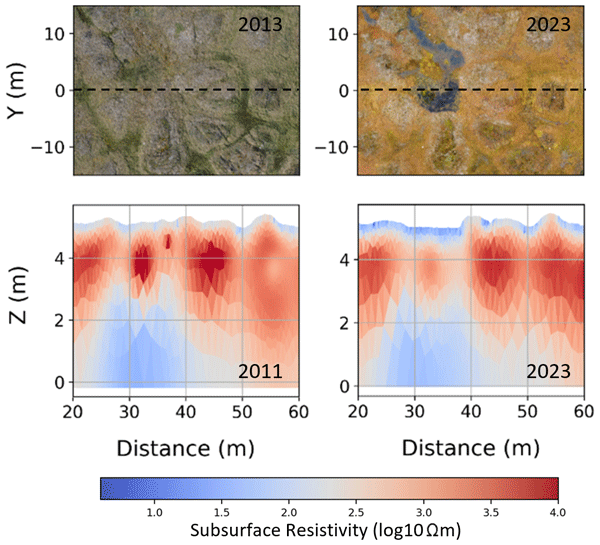
Jonathan A. Bachman, John Lamb, Craig Ulrich, Neslihan Taş, and Baptiste Dafflon
The Cryosphere, 19, 5499–5508, https://doi.org/10.5194/tc-19-5499-2025, https://doi.org/10.5194/tc-19-5499-2025, 2025
Short summary
Short summary
We studied how Arctic landscapes change as the ground thaws by comparing measurements taken ten years apart. We found that some areas sank and new ponds formed, with different patterns depending on the shape of the land. These changes affect how water and carbon flow and cycle through the environment. The results help understand how and where the Arctic is shifting, and highlight the need for repeated observations to track long-term changes.
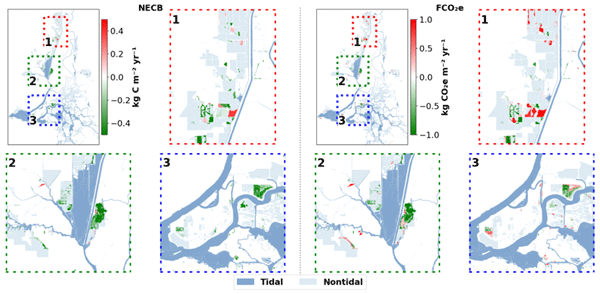
Ashley Brereton, Zelalem A. Mekonnen, Bhavna Arora, William J. Riley, Kunxiaojia Yuan, Yi Xu, Yu Zhang, Qing Zhu, Tyler L. Anthony, and Adina Paytan
Geosci. Model Dev., 18, 8157–8173, https://doi.org/10.5194/gmd-18-8157-2025, https://doi.org/10.5194/gmd-18-8157-2025, 2025
Short summary
Short summary
Wetlands absorb carbon dioxide (CO2), helping slow climate change, but they also release methane, a potent warming gas. We developed a collection of AI-based models to estimate magnitudes of CO2 and methane exchanged between the land and the atmosphere, for wetlands on a regional scale. This approach helps to inform land-use planning, restoration, and greenhouse gas accounting, while also creating a foundation for future advancements in prediction accuracy.
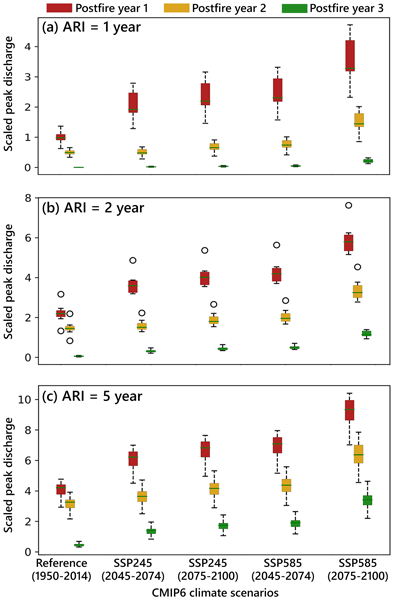
Tao Liu, Luke A. McGuire, Ann M. Youberg, Charles J. Abolt, and Adam L. Atchley
Nat. Hazards Earth Syst. Sci., 25, 4135–4151, https://doi.org/10.5194/nhess-25-4135-2025, https://doi.org/10.5194/nhess-25-4135-2025, 2025
Short summary
Short summary
Wildfires increase flood risk by making it harder for soil to absorb water. We studied how this risk changes over time as the landscape recovers and how it will be affected by more intense rainfall due to climate change. Using a computer model of a burned watershed in Arizona, we found that while the soil's ability to soak up water recovers over a few years, future rainfall is predicted to be so intense that the period of high flood danger will last longer, making severe floods much more common.
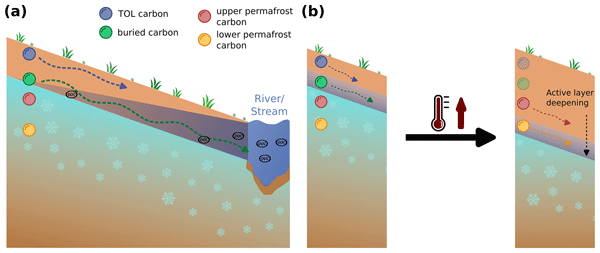
Alexandra Hamm, Erik Schytt Mannerfelt, Aaron A. Mohammed, Scott L. Painter, Ethan T. Coon, and Andrew Frampton
The Cryosphere, 19, 3693–3724, https://doi.org/10.5194/tc-19-3693-2025, https://doi.org/10.5194/tc-19-3693-2025, 2025
Short summary
Short summary
The fate of thawing permafrost carbon is essential for understanding the permafrost–climate feedback and projections of future climate. Here we study transport of organic carbon by groundwater in the active layer of a hillslope model. We find that carbon transport velocities and microbial mineralization rates are strongly dependent on liquid saturation in the seasonally thawed active layer. In a warming climate, the rate at which permafrost thaws determines how fast carbon can be transported.

James Stegen, Amy J. Burgin, Michelle H. Busch, Joshua B. Fisher, Joshua Ladau, Jenna Abrahamson, Lauren Kinsman-Costello, Li Li, Xingyuan Chen, Thibault Datry, Nate McDowell, Corianne Tatariw, Anna Braswell, Jillian M. Deines, Julia A. Guimond, Peter Regier, Kenton Rod, Edward K. P. Bam, Etienne Fluet-Chouinard, Inke Forbrich, Kristin L. Jaeger, Teri O'Meara, Tim Scheibe, Erin Seybold, Jon N. Sweetman, Jianqiu Zheng, Daniel C. Allen, Elizabeth Herndon, Beth A. Middleton, Scott Painter, Kevin Roche, Julianne Scamardo, Ross Vander Vorste, Kristin Boye, Ellen Wohl, Margaret Zimmer, Kelly Hondula, Maggi Laan, Anna Marshall, and Kaizad F. Patel
Biogeosciences, 22, 995–1034, https://doi.org/10.5194/bg-22-995-2025, https://doi.org/10.5194/bg-22-995-2025, 2025
Short summary
Short summary
The loss and gain of surface water (variable inundation) are common processes across Earth. Global change shifts variable inundation dynamics, highlighting a need for unified understanding that transcends individual variably inundated ecosystems (VIEs). We review the literature, highlight challenges, and emphasize opportunities to generate transferable knowledge by viewing VIEs through a common lens. We aim to inspire the emergence of a cross-VIE community based on a proposed continuum approach.
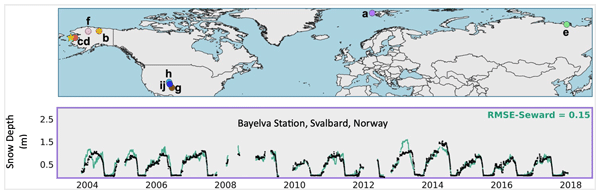
Claire L. Bachand, Chen Wang, Baptiste Dafflon, Lauren N. Thomas, Ian Shirley, Sarah Maebius, Colleen M. Iversen, and Katrina E. Bennett
The Cryosphere, 19, 393–400, https://doi.org/10.5194/tc-19-393-2025, https://doi.org/10.5194/tc-19-393-2025, 2025
Short summary
Short summary
Temporally continuous snow depth estimates are important for understanding changing snow patterns and impacts on frozen ground in the Arctic. In this work, we developed an approach to predict snow depth from variability in snow–ground interface temperature using small temperature sensors that are cheap and easy to deploy. This new technique enables spatially distributed and temporally continuous snowpack monitoring that has not previously been possible.
Kavya Sivaraj, Kurt Solander, Charles Abolt, and Elizabeth Hunke
EGUsphere, https://doi.org/10.5194/egusphere-2024-3315, https://doi.org/10.5194/egusphere-2024-3315, 2024
Short summary
Short summary
Melt ponds are seasonal water bodies whose presence affect the rate of Arctic sea ice loss by increasing the absorption of solar radiation. Despite their importance, large-scale observational datasets of Melt Pond Fraction (MPF) are inadequate due to low-resolution sensors and spectral misclassifications caused by different ice types. Our novel ML-based workflow overcomes these limitations by leveraging morphological operators, resulting in an improved Sentinel-2-based mean MPF of 11% from 20%.
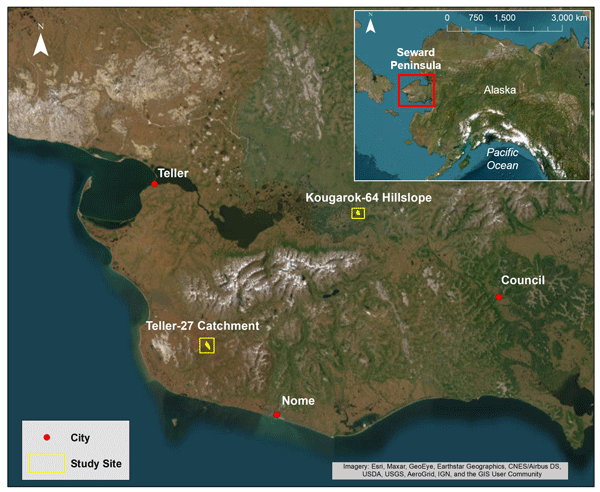
Nathan Alec Conroy, Jeffrey M. Heikoop, Emma Lathrop, Dea Musa, Brent D. Newman, Chonggang Xu, Rachael E. McCaully, Carli A. Arendt, Verity G. Salmon, Amy Breen, Vladimir Romanovsky, Katrina E. Bennett, Cathy J. Wilson, and Stan D. Wullschleger
The Cryosphere, 17, 3987–4006, https://doi.org/10.5194/tc-17-3987-2023, https://doi.org/10.5194/tc-17-3987-2023, 2023
Short summary
Short summary
This study combines field observations, non-parametric statistical analyses, and thermodynamic modeling to characterize the environmental causes of the spatial variability in soil pore water solute concentrations across two Arctic catchments with varying extents of permafrost. Vegetation type, soil moisture and redox conditions, weathering and hydrologic transport, and mineral solubility were all found to be the primary drivers of the existing spatial variability of some soil pore water solutes.
Ian Shirley, Sebastian Uhlemann, John Peterson, Katrina Bennett, Susan S. Hubbard, and Baptiste Dafflon
EGUsphere, https://doi.org/10.5194/egusphere-2023-968, https://doi.org/10.5194/egusphere-2023-968, 2023
Preprint archived
Short summary
Short summary
Snow depth has a strong impact on soil temperatures and carbon cycling in the arctic. Because of this, we want to understand why snow is deeper in some places than others. Using cameras mounted on a drone, we mapped snow depth, vegetation height, and elevation across a watershed in Alaska. In this paper, we develop novel techniques using image processing and machine learning to characterize the influence of topography and shrubs on snow depth in the watershed.
Xiang Huang, Charles J. Abolt, and Katrina E. Bennett
The Cryosphere Discuss., https://doi.org/10.5194/tc-2023-8, https://doi.org/10.5194/tc-2023-8, 2023
Manuscript not accepted for further review
Short summary
Short summary
Near-surface humidity is a sensitive parameter for predicting snow depth. Greater values of the relative humidity are obtained if the saturation vapor pressure was calculated with over-ice correction compared to without during the winter. During the summer thawing period, the choice of whether or not to employ an over-ice correction corresponds to significant variability in simulated thaw depths.

Bo Gao and Ethan T. Coon
The Cryosphere, 16, 4141–4162, https://doi.org/10.5194/tc-16-4141-2022, https://doi.org/10.5194/tc-16-4141-2022, 2022
Short summary
Short summary
Representing water at constant density, neglecting cryosuction, and neglecting heat advection are three commonly applied but not validated simplifications in permafrost models to reduce computation complexity at field scale. We investigated this problem numerically by Advanced Terrestrial Simulator and found that neglecting cryosuction can cause significant bias (10%–60%), constant density primarily affects predicting water saturation, and ignoring heat advection has the least impact.
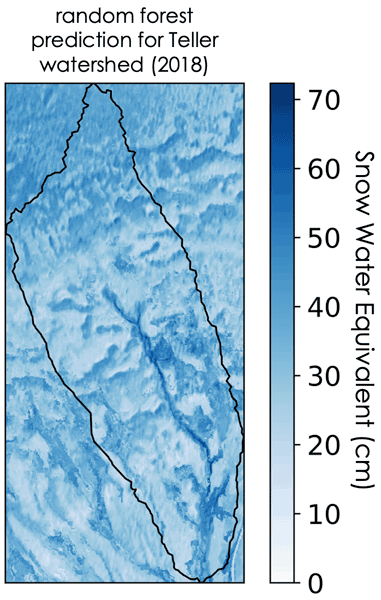
Katrina E. Bennett, Greta Miller, Robert Busey, Min Chen, Emma R. Lathrop, Julian B. Dann, Mara Nutt, Ryan Crumley, Shannon L. Dillard, Baptiste Dafflon, Jitendra Kumar, W. Robert Bolton, Cathy J. Wilson, Colleen M. Iversen, and Stan D. Wullschleger
The Cryosphere, 16, 3269–3293, https://doi.org/10.5194/tc-16-3269-2022, https://doi.org/10.5194/tc-16-3269-2022, 2022
Short summary
Short summary
In the Arctic and sub-Arctic, climate shifts are changing ecosystems, resulting in alterations in snow, shrubs, and permafrost. Thicker snow under shrubs can lead to warmer permafrost because deeper snow will insulate the ground from the cold winter. In this paper, we use modeling to characterize snow to better understand the drivers of snow distribution. Eventually, this work will be used to improve models used to study future changes in Arctic and sub-Arctic snow patterns.
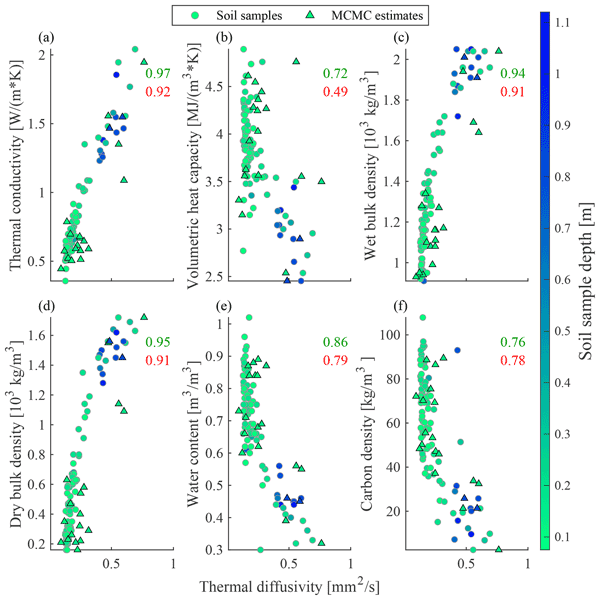
Carlotta Brunetti, John Lamb, Stijn Wielandt, Sebastian Uhlemann, Ian Shirley, Patrick McClure, and Baptiste Dafflon
Earth Surf. Dynam., 10, 687–704, https://doi.org/10.5194/esurf-10-687-2022, https://doi.org/10.5194/esurf-10-687-2022, 2022
Short summary
Short summary
This paper proposes a method to estimate thermal diffusivity and its uncertainty over time, at numerous locations and at an unprecedented vertical spatial resolution from soil temperature time series. We validate and apply this method to synthetic and field case studies. The improved quantification of soil thermal properties is a cornerstone for advancing the indirect estimation of the fraction of soil components needed to predict subsurface storage and fluxes of water, carbon, and nutrients.
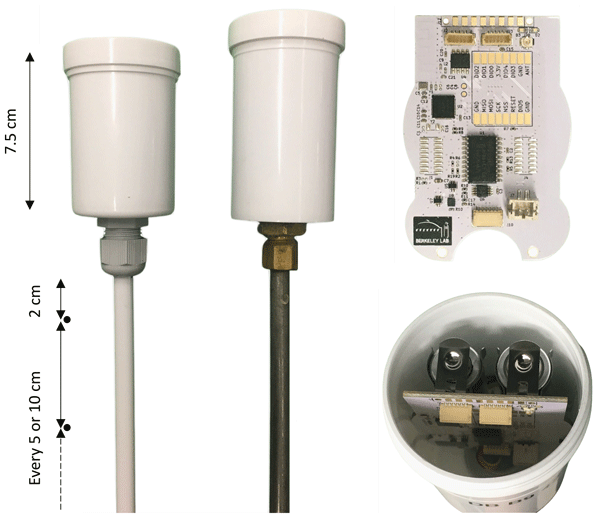
Baptiste Dafflon, Stijn Wielandt, John Lamb, Patrick McClure, Ian Shirley, Sebastian Uhlemann, Chen Wang, Sylvain Fiolleau, Carlotta Brunetti, Franklin H. Akins, John Fitzpatrick, Samuel Pullman, Robert Busey, Craig Ulrich, John Peterson, and Susan S. Hubbard
The Cryosphere, 16, 719–736, https://doi.org/10.5194/tc-16-719-2022, https://doi.org/10.5194/tc-16-719-2022, 2022
Short summary
Short summary
This study presents the development and validation of a novel acquisition system for measuring finely resolved depth profiles of soil and snow temperature at multiple locations. Results indicate that the system reliably captures the dynamics in snow thickness, as well as soil freezing and thawing depth, enabling advances in understanding the intensity and timing in surface processes and their impact on subsurface thermohydrological regimes.
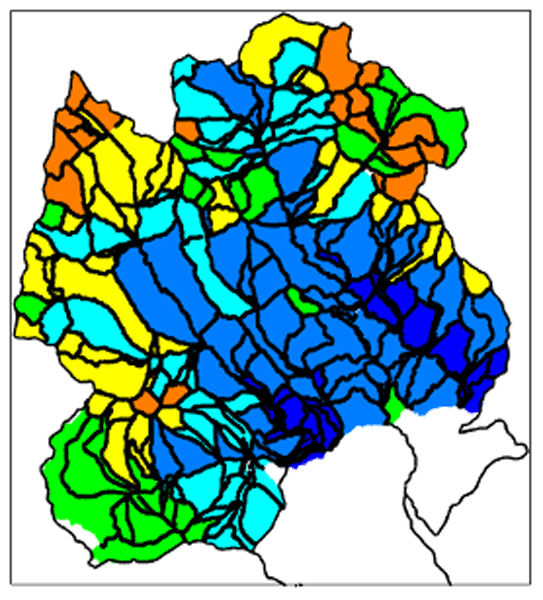
Haruko M. Wainwright, Sebastian Uhlemann, Maya Franklin, Nicola Falco, Nicholas J. Bouskill, Michelle E. Newcomer, Baptiste Dafflon, Erica R. Siirila-Woodburn, Burke J. Minsley, Kenneth H. Williams, and Susan S. Hubbard
Hydrol. Earth Syst. Sci., 26, 429–444, https://doi.org/10.5194/hess-26-429-2022, https://doi.org/10.5194/hess-26-429-2022, 2022
Short summary
Short summary
This paper has developed a tractable approach for characterizing watershed heterogeneity and its relationship with key functions such as ecosystem sensitivity to droughts and nitrogen export. We have applied clustering methods to classify hillslopes into
watershed zonesthat have distinct distributions of bedrock-to-canopy properties as well as key functions. This is a powerful approach for guiding watershed experiments and sampling as well as informing hydrological and biogeochemical models.
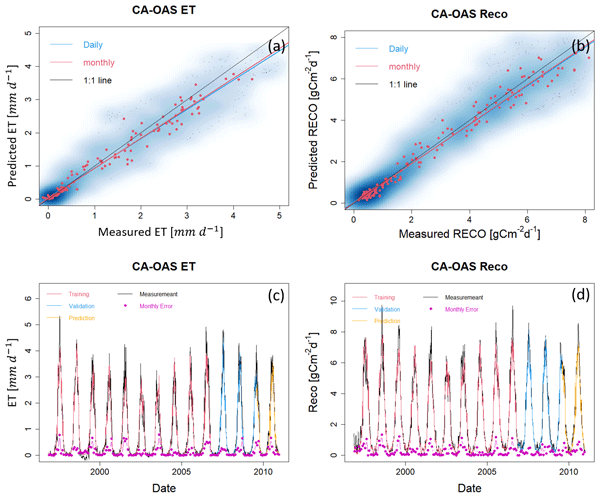
Jiancong Chen, Baptiste Dafflon, Anh Phuong Tran, Nicola Falco, and Susan S. Hubbard
Hydrol. Earth Syst. Sci., 25, 6041–6066, https://doi.org/10.5194/hess-25-6041-2021, https://doi.org/10.5194/hess-25-6041-2021, 2021
Short summary
Short summary
The novel hybrid predictive modeling (HPM) approach uses a long short-term memory recurrent neural network to estimate evapotranspiration (ET) and ecosystem respiration (Reco) with only meteorological and remote-sensing inputs. We developed four use cases to demonstrate the applicability of HPM. The results indicate HPM is capable of providing ET and Reco estimations in challenging mountainous systems and enhances our understanding of watershed dynamics at sparsely monitored watersheds.
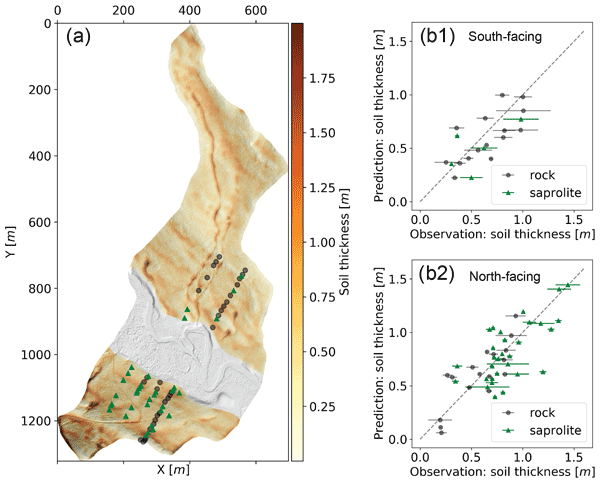
Qina Yan, Haruko Wainwright, Baptiste Dafflon, Sebastian Uhlemann, Carl I. Steefel, Nicola Falco, Jeffrey Kwang, and Susan S. Hubbard
Earth Surf. Dynam., 9, 1347–1361, https://doi.org/10.5194/esurf-9-1347-2021, https://doi.org/10.5194/esurf-9-1347-2021, 2021
Short summary
Short summary
We develop a hybrid model to estimate the spatial distribution of the thickness of the soil layer, which also provides estimations of soil transport and soil production rates. We apply this model to two examples of hillslopes in the East River watershed in Colorado and validate the model. The results show that the north-facing (NF) hillslope has a deeper soil layer than the south-facing (SF) hillslope and that the hybrid model provides better accuracy than a machine-learning model.
Ryan L. Crumley, David F. Hill, Katreen Wikstrom Jones, Gabriel J. Wolken, Anthony A. Arendt, Christina M. Aragon, Christopher Cosgrove, and Community Snow Observations Participants
Hydrol. Earth Syst. Sci., 25, 4651–4680, https://doi.org/10.5194/hess-25-4651-2021, https://doi.org/10.5194/hess-25-4651-2021, 2021
Short summary
Short summary
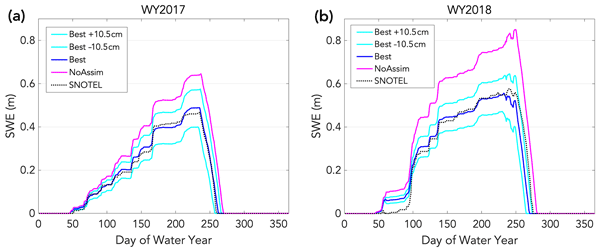
In this study, we use a new snow data set collected by participants in the Community Snow Observations project in coastal Alaska to improve snow depth and snow water equivalence simulations from a snow process model. We validate our simulations with multiple datasets, taking advantage of snow telemetry (SNOTEL), snow depth and snow water equivalence, and remote sensing measurements. Our results demonstrate that assimilating citizen science snow depth measurements can improve model performance.
Dylan R. Harp, Vitaly Zlotnik, Charles J. Abolt, Bob Busey, Sofia T. Avendaño, Brent D. Newman, Adam L. Atchley, Elchin Jafarov, Cathy J. Wilson, and Katrina E. Bennett
The Cryosphere, 15, 4005–4029, https://doi.org/10.5194/tc-15-4005-2021, https://doi.org/10.5194/tc-15-4005-2021, 2021
Short summary
Short summary
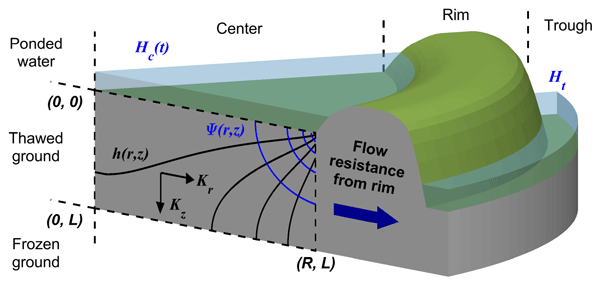
Polygon-shaped landforms present in relatively flat Arctic tundra result in complex landscape-scale water drainage. The drainage pathways and the time to transition from inundated conditions to drained have important implications for heat and carbon transport. Using fundamental hydrologic principles, we investigate the drainage pathways and timing of individual polygons, providing insights into the effects of polygon geometry and preferential flow direction on drainage pathways and timing.
Cited articles
Abolt, C. J., Young, M. H., Atchley, A. L., Harp, D. R., and Coon, E. T.: Feedbacks between surface deformation and permafrost degradation in ice wedge polygons, Arctic Coastal Plain, Alaska, Journal of Geophysical Research: Earth Surface, 125, e2019JF005349, https://doi.org/10.1029/2019JF005349, 2020.
Abolt, C. J., Atchley, A. L., Harp, D. R., Jorgenson, M. T., Witharana, C., Bolton, W. R., Schwenk, J., Rettelbach, T., Grosse, G., Boike, J., Nitze, I., Liljedahl, A. K., Rumpca, C. T., Wilson, C. J., and Bennett, K. E.: Topography controls variability in circumpolar permafrost thaw pond expansion, Journal of Geophysical Research: Earth Surface, 129, e2024JF007675, https://doi.org/10.1029/2024JF007675, 2024.
Abdelhamed, M. S., Razavi, S., Elshamy, M. E., and Wheater, H. S.: Assessment of a hydrologic-land surface model to simulate thermo-hydrologic evolution of permafrost regions, Journal of Hydrology, 645, 132161, https://doi.org/10.1016/j.jhydrol.2024.132161, 2024.
Atchley, A. L., Painter, S. L., Harp, D. R., Coon, E. T., Wilson, C. J., Liljedahl, A. K., and Romanovsky, V. E.: Using field observations to inform thermal hydrology models of permafrost dynamics with ATS (v0.83), Geoscientific Model Development, 8, 2701–2722, https://doi.org/10.5194/gmd-8-2701-2015, 2015.
Bennett, K. E., Miller, G., Busey, R., Chen, M., Lathrop, E. R., Dann, J. B., Nutt, M., Crumley, R., Dillard, S. L., Dafflon, B., Kumar, J., Bolton, W. R., Wilson, C. J., Iversen, C. M., and Wullschleger, S. D.: Spatial patterns of snow distribution in the sub-Arctic, The Cryosphere, 16, 3269–3293, https://doi.org/10.5194/tc-16-3269-2022, 2022.
Bennett, K. E., Schwenk, J., Bachand, C., Gasarch, E., Stachelek, J., Bolton, W. R., and Rowland, J. C.: Recent streamflow trends across permafrost basins of North America, Frontiers in Water, 5, 1099660, https://doi.org/10.3389/frwa.2023.1099660, 2023.
Beer, C.: Permafrost sub-grid heterogeneity of soil properties key for 3-D soil processes and future climate projections, Frontiers in Earth Science, 4, https://doi.org/10.3389/feart.2016.00081, 2016.
Beven, K. J. and Kirkby, M. J.: A physically based, variable contributing area model of basin hydrology, Hydrological Sciences Journal, 24, 43–69, 1979.
Bisht, G., Riley, W. J., Hammond, G. E., and Lorenzetti, D. M.: Development and evaluation of a variably saturated flow model in the global E3SM Land Model (ELM) version 1.0, Geoscientific Model Development, 11, 4085–4102, https://doi.org/10.5194/gmd-11-4085-2018, 2018.
Boone, A., Habets, F., Noilhan, J., Clark, D., Dirmeyer, P., Fox, S., Gusev, Y., Haddeland, I., Koster, R., Lohmann, D., Mahanama, S., Mitchell, K., Nasonova, O., Niu, G.-Y., Pitman, A., Polcher, J., Shmakin, A. B., Tanaka, K., van den Hurk, B., Vérant, S., Verseghy, D., Viterbo, P., and Yang, Z. L.: The Rhone-aggregation land surface scheme intercomparison project: An overview, Journal of Climate, 17, 187–208, 2004.
Busey, B., Wales, N., Newman, B., Wilson, C., and Bolton, B.: Surface Water: Stage, Temperature and Discharge, Teller Road Mile Marker 27, Seward Peninsula, Alaska, beginning 2016 (No. NGA185). Next-Generation Ecosystem Experiments (NGEE) Arctic, ESS-DIVE repository [data set], https://doi.org/10.5440/1618330, 2019.
Bring, A., Fedorova, I., Dibike, Y., Hinzman, L., Mård, J., Mernild, S. H., Prowse, T., Semenova, O., Stuefer, S., and Woo, M. K.: Arctic terrestrial hydrology: A synthesis of processes, regional effects, and research challenges, Journal of Geophysical Research: Biogeosciences, 121, 621–649, 2016.
Clark, M. P., Fan, Y., Lawrence, D. M., Adam, J. C., Bolster, D., Gochis, D. J., Hooper, R. P., Kumar, M., Ruby Leung, L., Scott Mackay, D., Maxwell, R. M., Shen, C., Swenson, S. C., and Zeng, X.: Improving the representation of hydrologic processes in Earth System Models, Water Resources Research, 51, 5929–5956, 2015.
Clark, M. P., Bierkens, M. F. P., Samaniego, L., Woods, R. A., Uijlenhoet, R., Bennett, K. E., Pauwels, V. R. N., Cai, X., Wood, A. W., and Peters-Lidard, C. D.: The evolution of process-based hydrologic models: historical challenges and the collective quest for physical realism, Hydrol. Earth Syst. Sci., 21, 3427–3440, https://doi.org/10.5194/hess-21-3427-2017, 2017.
Collier, N., Hoffman, F. M., Lawrence, D. M., Keppel-Aleks, G., Koven, C. D., Riley, W. J., Mu, M., and Randerson, J. T.: The International Land Model Benchmarking (ILAMB) system: design, theory, and implementation, Journal of Advances in Modeling Earth Systems, 10, 2731–2754, 2018.
Coon, E. T., Moulton, J. D., Kikinzon, E., Berndt, M., Manzini, G., Garimella, R., Lipnikov, K., and Painter, S. L.: Coupling surface flow and subsurface flow in complex soil structures using mimetic finite differences, Advances in Water Resources, 144, 103701, https://doi.org/10.1016/j.advwatres.2020.103701, 2020.
Coon, E., Berndt, M., Jan, A., Svyatsky, D., Atchley, A., Kikinzon, E., Harp, D., Manzini, G., Shelef, E., Lipnikov, K., Garimella, R., Xu, C., Moulton, D., Karra, S., Painter, S., Jafarov, E., and Molins, S.: Advanced Terrestrial Simulator (ATS) v1.2.0 (1.2.0), Zenodo [code], https://doi.org/10.5281/zenodo.6679807, 2022.
Decharme, B., Martin, E., and Faroux, S.: Reconciling soil thermal and hydrological lower boundary conditions in land surface models, Journal of Geophysical Research: Atmospheres, 118, 7819–7834, 2013.
E3SM Project (DOE): Energy Exascale Earth System Model v3.0.0, DOE [software], https://doi.org/10.11578/E3SM/dc.20240301.3, 2024.
Fan, Y., Clark, M., Lawrence, D. M., Swenson, S., Band, L. E., Brantley, S. L., Brooks, P. D., Dietrich, W. E., Flores, A., Grant, G., Kirchner, J. W., Mackay, D. S., McDonnell, J. J., Milly, P. C. D., Sullivan, P. L. Tague, C., Ajami, H., Chaney, N., Hartmann, A., Hazenberg, P., McNamara, J., Pelletier, J., Perket, J., Rouholahnejad-Freund, E., Wagener, T., Zeng, X., Beighley, E., Buzan, J., Huang, M., Livneh, B., Mohanty, B. P., Nijssen, B., Safeeq, M., Shen, C., van Verseveld, W., Volk, J., and Yamazaki, D.: Hillslope hydrology in global change research and earth system modelling, Water Resources Research, 55, 1737–1772, 2019.
Gao, B. and Coon, E. T.: Evaluating simplifications of subsurface process representations for field-scale permafrost hydrology models, The Cryosphere, 16, 4141–4162, https://doi.org/10.5194/tc-16-4141-2022, 2022.
Guo, L., Wang, G., Song, C., Sun, S., Li, J., Li, K., Huang, P., and Ma, J.: Hydrological changes caused by integrated warming, wetting, and greening in permafrost regions of the Qinghai-Tibetan Plateau, Water Resources Research, 61, e2024WR038465, https://doi.org/10.1029/2024WR038465, 2025.
Hamm, A. and Frampton, A.: Impact of lateral groundwater flow on hydrothermal conditions of the active layer in a high-Arctic hillslope setting, The Cryosphere, 15, 4853–4871, https://doi.org/10.5194/tc-15-4853-2021, 2021.
Hao, D., Bisht, G., Huang, M., Ma, P. L., Tesfa, T., Lee, W. L., Gu, Y., and Leung, L. R.: Impacts of sub-grid topographic representations on surface energy balance and boundary conditions in the E3SM land model: A case study in Sierra Nevada, Journal of Advances in Modeling Earth Systems, 14, e2021MS002862, https://doi.org/10.1029/2021MS002862, 2022.
Harp, D. R., Atchley, A. L., Painter, S. L., Coon, E. T., Wilson, C. J., Romanovsky, V. E., and Rowland, J. C.: Effect of soil property uncertainties on permafrost thaw projections: a calibration-constrained analysis, The Cryosphere, 10, 341–358, https://doi.org/10.5194/tc-10-341-2016, 2016.
Hinzman, A. M., Sjöberg, Y., Lyon, S., Schaap, P., and van der Velde, Y.: Using a mechanistic model to explain the rising non-linearity in storage discharge relationships as the extent of permafrost decreases in Arctic catchments, Journal of Hydrology, 612, 128162, https://doi.org/10.1016/j.jhydrol.2022.128162, 2022.
Holmes, R. M., Coe, M. T., Fiske, G. J., Gurtovaya, T., McClelland, J. W., Shiklomanov, A. I., Spencer, R. G. M., Tank, S. E., and Zhulidov, A. V.: Climate change impacts on the hydrology and biogeochemistry of Arctic rivers, Climatic change and global warming of inland waters, 26 pp., https://doi.org/10.1002/9781118470596, 2013.
Hou, Y., Guo, H., Yang, Y., and Liu, W.: Global evaluation of runoff simulation from climate, hydrological and land surface models, Water Resources Research, 59, e2021WR031817, https://doi.org/10.1029/2021WR031817, 2023.
Huang, X. and Rudolph, D. L.: Numerical study of coupled water and vapor flow, heat transfer, and solute transport in variably-saturated deformable soil during freeze-thaw cycles, Water Resources Research, 59, e2022WR032146, https://doi.org/10.1029/2022WR032146, 2023.
Huang, X., Rudolph, D. L., and Glass, B.: A coupled thermal-hydraulic-mechanical approach to modeling the impact of roadbed frost loading on water main failure, Water Resources Research, 58, e2021WR030933, https://doi.org/10.1029/2021WR030933, 2022.
Huang, X., Abolt, C. J., and Bennett, K. E.: How does humidity data impact land surface modeling of hydrothermal regimes at a permafrost site in Utqiaġvik, Alaska?, Science of the Total Environment, 912, 168697, https://doi.org/10.1016/j.scitotenv.2023.168697, 2024.
Huang, X., Demir, C., Gao, B., Zhang, Y., Abolt, C., Crumley, R., Fiorella, R., Busey, B., Bolton, B., Painter, S., and Bennett, K. E.: Data Files for Runoff Evaluation in an Earth System Land Model for Permafrost Regions. Next-Generation Ecosystem Experiments (NGEE) Arctic, ESS-DIVE repository [data set], https://doi.org/10.15485/2550570, 2025.
Jafarov, E. E., Coon, E. T., Harp, D. R., Wilson, C. J., Painter, S. L., Atchley, A. L., and Romanovsky, V. E.: Modeling the role of preferential snow accumulation in through talik development and hillslope groundwater flow in a transitional permafrost landscape, Environmental Research Letters, 13, 105006, https://doi.org/10.1088/1748-9326/aadd30, 2018.
Jan, A. and Painter, S. L.: Permafrost thermal conditions are sensitive to shifts in snow timing, Environmental Research Letters, 15, 084026, https://doi.org/10.1088/1748-9326/ab8ec4, 2020.
Jan, A., Coon, E. T., and Painter, S. L.: Evaluating integrated surface/subsurface permafrost thermal hydrology models in ATS (v0.88) against observations from a polygonal tundra site, Geoscientific Model Development, 13, 2259–2276, https://doi.org/10.5194/gmd-13-2259-2020, 2020.
Kuchment, L. S., Gelfan, A. N., and Demidov, V. N.: A distributed model of runoff generation in the permafrost regions, Journal of Hydrology, 240, 1–22, 2000.
Lackner, G., Domine, F., Nadeau, D. F., Lafaysse, M., and Dumont, M.: Snow properties at the forest–tundra ecotone: predominance of water vapor fluxes even in deep, moderately cold snowpacks, The Cryosphere, 16, 3357–3373, https://doi.org/10.5194/tc-16-3357-2022, 2022.
Lawrence, D. M. and Swenson, S. C.: Improving terrestrial hydrologic process representation in Earth System Models: Accounting for slope, aspect, and lateral water transfer through representative hillslopes, in: AGU Fall Meeting Abstracts, Vol. 2024, H13R-03, https://agu.confex.com/agu/agu24/meetingapp.cgi/Paper/1685795 (last access: 30 September 2025), 2024.
Lawrence, D. M., Hurtt, G. C., Arneth, A., Brovkin, V., Calvin, K. V., Jones, A. D., Jones, C. D., Lawrence, P. J., de Noblet-Ducoudré, N., Pongratz, J., Seneviratne, S. I., and Shevliakova, E.: The Land Use Model Intercomparison Project (LUMIP) contribution to CMIP6: rationale and experimental design, Geoscientific Model Development, 9, 2973–2998, https://doi.org/10.5194/gmd-9-2973-2016, 2016.
Lawrence, D. M., Fisher, R. A., Koven, C. D., Oleson, K. W., Swenson, S. C., Bonan, G., Collier, N., Ghimire, B., van Kampenhout, L., Kennedy, D., Kluzek, E., Lawrence, P. J., Li, F., Li, Vertenstein, M., Wieder, W. R., Xu, C. G., Ali, A. A., Badger, A. M., Bisht, G., van den Broeke, M., Brunke, M. A., Burns, S. P., Buzan, J., Clark, M., Craig, A., Dahlin, K., Drewniak, B., Fisher, J. B., Flanner, M., Fox, A. M., Gentine, P., Hoffman, F., Keppel-Aleks, G., Knox, R., Kumar, S., Lenaerts, J., Leung, L. R., Lipscomb, W. H., Lu, Y. Q., Pandey, A., Pelletier, J. D., Perket, J., Randerson, J. T., Ricciuto, D. M., Sanderson, B. M., Slater, A., Subin, Z. M., Tang, J. Y., Thomas, R. Q., Martin, M. V., and Zeng, X. B.: The Community Land Model Version 5: Description of New Features, Benchmarking, and Impact of Forcing Uncertainty, Journal of Advances in Modeling Earth Systems, 11, 4245–4287, 2019.
Léger, E., Dafflon, B., Robert, Y., Ulrich, C., Peterson, J. E., Biraud, S. C., Romanovsky, V. E., and Hubbard, S. S.: A distributed temperature profiling method for assessing spatial variability in ground temperatures in a discontinuous permafrost region of Alaska, The Cryosphere, 13, 2853–2867, https://doi.org/10.5194/tc-13-2853-2019, 2019.
Liang, X. and Xie, Z.: A new surface runoff parameterization with subgrid-scale soil heterogeneity for land surface models, Advances in Water Resources, 24, 1173–1193, 2001.
Liao, C., Leung, L. R., Fang, Y., Tesfa, T., and Negron-Juarez, R.: Representing lateral groundwater flow from land to river in Earth system models, Geoscientific Model Development, 18, 4601–4624, https://doi.org/10.5194/gmd-18-4601-2025, 2025.
Li, H., Huang, M., Wigmosta, M. S., Ke, Y., Coleman, A. M., Leung, L. R., Wang, A., and Ricciuto, D. M.: Evaluating runoff simulations from the Community Land Model 4.0 using observations from flux towers and a mountainous watershed, Journal of Geophysical Research: Atmospheres, 116, https://doi.org/10.1029/2011JD016276, 2011.
Li, H., Wigmosta, M. S., Wu, H., Huang, M., Ke, Y., Coleman, A. M., and Leung, L. R.: A physically based runoff routing model for land surface and Earth system models, Journal of Hydrometeorology, 14, 808–828, 2013.
Li, J., Gan, Y., Zhang, G., Gou, J., Lu, X., and Miao, C.: Quantifying the interactions of Noah-MP land surface processes on the simulated runoff over the Tibetan Plateau, Journal of Geophysical Research: Atmospheres, 129, e2023JD040343, https://doi.org/10.1029/2023JD040343, 2024.
Liljedahl, A. K., Boike, J., Daanen, R. P., Fedorov, A. N., Frost, G. V., Grosse, G., Hinzman, L. D., Iijma, Y., Jorgenson, J. C., Matveyeva, N., Necsoiu, M., Raynolds, M. K., Romanovsky, V. E., Schulla, J., Tape, K. D., Walker, D. A., Wilson, C. J., Yabuki, H., and Zona, D.: Pan-Arctic ice-wedge degradation in warming permafrost and its influence on tundra hydrology, Nature Geoscience, 9, 312–318, 2016.
Lique, C., Holland, M. M., Dibike, Y. B., Lawrence, D. M., and Screen, J. A.: Modeling the Arctic freshwater system and its integration in the global system: Lessons learned and future challenges, Journal of Geophysical Research: Biogeosciences, 121, 540–566, 2016.
Maxwell, R. M., Putti, M., Meyerhoff, S., Delfs, J.-O., Ferguson, I. M., Ivanov, V., Kim, J., Kolditz, O., Kollet, S. J., Kumar, M., Lopez, S., Niu, J., Paniconi, C., Park, Y.-J., Phanikumar, M. S., Shen, C., Sudicky, E. A., and Sulis, M.: Surface-subsurface model intercomparison: A first set of benchmark results to diagnose integrated hydrology and feedbacks, Water Resources Research, 50, 1531–1549, 2014.
Moriasi, D. N., Arnold, J. G., Van Liew, M. W., Bingner, R. L., Harmel, R. D., and Veith, T. L.: Model evaluation guidelines for systematic quantification of accuracy in watershed simulations, Transactions of the ASABE, 50, 885–900, 2007.
Muñoz-Sabater, J., Dutra, E., Agustí-Panareda, A., Albergel, C., Arduini, G., Balsamo, G., Boussetta, S., Choulga, M., Harrigan, S., Hersbach, H., Martens, B., Miralles, D. G., Piles, M., Rodríguez-Fernández, N. J., Zsoter, E., Buontempo, C., and Thépaut, J.-N.: ERA5-Land: a state-of-the-art global reanalysis dataset for land applications, Earth System Science Data, 13, 4349–4383, https://doi.org/10.5194/essd-13-4349-2021, 2021.
Musselman, K. N., Clark, M. P., Liu, C., Ikeda, K., and Rasmussen, R.: Slower snowmelt in a warmer world, Nature Climate Change, 7, 214–219, 2017.
Mwanthi, A. M., Mutemi, J. N., Dyer, E., James, R., Opijah, F. J., Webb, T., Mutua, F., Washington, R., Senior, C., Segele, Z., and Artan, G.: Representation of land–atmosphere coupling processes over Africa in coupled model intercomparison project Phase 6, Climate Dynamics, 62, 8389–8401, 2024.
Niu, G. Y., Yang, Z. L., Dickinson, R. E., and Gulden, L. E.: A simple TOPMODEL-based runoff parameterization (SIMTOP) for use in global climate models, Journal of Geophysical Research: Atmospheres, 110, 1–15, 2005.
Niu, G. Y., Yang, Z. L., Dickinson, R. E., Gulden, L. E., and Su, H.: Development of a simple groundwater model for use in climate models and evaluation with Gravity Recovery and Climate Experiment data, Journal of Geophysical Research: Atmospheres, 112, 1–14, 2007.
O'Connor, M. T., Cardenas, M. B., Ferencz, S. B., Wu, Y., Neilson, B. T., Chen, J., and Kling, G. W.: Empirical models for predicting water and heat flow properties of permafrost soils, Geophysical Research Letters, 47, e2020GL087646, https://doi.org/10.1029/2020GL087646, 2020.
Oleson, K. W., Lawrence, D. M., Bonan, G. B., Fisher, R. A., Lawrence, P. J., and Muszala, S. P.: Technical description of version 4.5 of the Community Land Model (CLM), Technical description of version 4.5 of the Community Land Model (CLM) (2013) NCAR/TN-503+ STR, 503, https://doi.org/10.5065/D6RR1W7M, 2013.
Painter, S. L., Coon, E. T., Atchley, A. L., Berndt, M., Garimella, R., Moulton, J. D., Wilson, C. J., and Wilson, C. J.: Integrated surface/subsurface permafrost thermal hydrology: Model formulation and proof-of-concept simulations, Water Resources Research, 52, 6062–6077, 2016.
Painter, S. L., Coon, E. T., Khattak, A. J., and Jastrow, J. D.: Drying of tundra landscapes will limit subsidence-induced acceleration of permafrost thaw, Proceedings of the National Academy of Sciences, 120, e2212171120, https://doi.org/10.1073/pnas.2212171120, 2023.
Schädel, C., Rogers, B. M., Lawrence, D. M., Koven, C. D., Brovkin, V., Burke, E. J., Genet, H., Huntzinger, D. N., Jafarov, E., McGuire, A. D., Riley, W. J., and Natali, S. M.: Earth system models must include permafrost carbon processes, Nature Climate Change, 14, 114–116, 2024.
Shi, X., Wang, Y., Mao, J., Thornton, P. E., Riccuito, D. M., Hoffman, F. M., and Hao, Y.: Quantifying the long-term changes of terrestrial water storage and their driving factors, Journal of Hydrology, 635, 131096, https://doi.org/10.1016/j.jhydrol.2024.131096, 2024.
Shirley, I., Uhlemann, S., Peterson, J., Bennett, K., Hubbard, S. S., and Dafflon, B.: Disentangling the impacts of microtopography and shrub distribution on snow depth in a subarctic watershed: Toward a predictive understanding of snow spatial variability, Journal of Geophysical Research: Biogeosciences, 130, e2024JG008604, https://doi.org/10.1029/2024JG008604, 2025.
Sinha, E., Calvin, K. V., Bond-Lamberty, B., Drewniak, B. A., Ricciuto, D. M., Sargsyan, K., Cheng, Y., Carl Bernacchi, C., and Moore, C. E.: Modeling perennial bioenergy crops in the E3SM land model (ELMv2), Journal of Advances in Modeling Earth Systems, 15, e2022MS003171, https://doi.org/10.1029/2022MS003171, 2023.
Sjöberg, Y., Coon, E., K. Sannel, A. B., Pannetier, R., Harp, D., Frampton, A., Painter, S. C., and Lyon, S. W.: Thermal effects of groundwater flow through subarctic fens: A case study based on field observations and numerical modelling, Water Resources Research, 52, 1591–1606, 2016.
Swenson, S. C., Lawrence, D. M., and Lee, H.: Improved simulation of the terrestrial hydrological cycle in permafrost regions by the Community Land Model, Journal of Advances in Modeling Earth Systems, 4, 1–15, 2012.
Swenson, S. C., Clark, M., Fan, Y., Lawrence, D. M., and Perket, J.: Representing intrahillslope lateral subsurface flow in the community land model, Journal of Advances in Modeling Earth Systems, 11, 4044–4065, 2019.
Tao, J., Riley, W. J., and Zhu, Q.: Evaluating the impact of peat soils and snow schemes on simulated active layer thickness at pan-Arctic permafrost sites, Environmental Research Letters, 19, 054027, https://doi.org/10.1088/1748-9326/ad38ce, 2024.
Tesfa, T. K. and Leung, L.-Y. R.: Exploring new topography-based subgrid spatial structures for improving land surface modeling, Geoscientific Model Development, 10, 873–888, https://doi.org/10.5194/gmd-10-873-2017, 2017.
Thaler, E. A., Uhleman, S., Rowland, J. C., Schwenk, J., Wang, C., Dafflon, B., and Bennett, K. E.: High-Resolution Maps of Near-Surface Permafrost for Three Watersheds on the Seward Peninsula, Alaska Derived From Machine Learning, Earth and Space Science, 10, e2023EA003015, https://doi.org/10.1029/2023EA003015, 2023.
Thornton, M. M., Wei, Y., Thornton, P. E., Shrestha, R., Kao, S., and Wilson, B. E.: Daymet: Station-Level Inputs and Cross Validation Result for North America, Version 4, Oak Ridge, Tennessee, USA, ORNL DAAC [data set], https://doi.org/10.3334/ORNLDAAC/1850, 2020.
Thornton, P. E. and Rosenbloom, N. A.: Ecosystem model spin-up: Estimating steady state conditions in a coupled terrestrial carbon and nitrogen cycle model, Ecological Modelling, 189, 25–48, 2005.
Vereecken, H., Amelung, W., Bauke, S. L., Bogena, H., Brüggemann, N., Montzka, C., Vanderborght, J., Bechtold, M., Blöschl, G., Carminati, A., Javaux, M., Konings, A. G., Kusche, J., Neuweiler, I., Or, D., Steele-Dunne, S., Verhoef, A., Young, M., and Zhang, Y.: Soil hydrology in the Earth system, Nature Reviews Earth & Environment, 3, 573–587, 2022.
Walvoord, M. A. and Kurylyk, B. L.: Hydrologic impacts of thawing permafrost – A review, Vadose Zone Journal, 15, https://doi.org/10.2136/vzj2016.01.0010, 2016.
Wang, C., Shirley, I., Wielandt, S., Lamb, J., Uhlemann, S., Breen, A., Busey, R. C., Bolton, W. R., Hubbard, S., and Dafflon, B.: Local-scale heterogeneity of soil thermal dynamics and controlling factors in a discontinuous permafrost region, Environmental Research Letters, 19, 034030, https://doi.org/10.1088/1748-9326/ad27bb, 2024.
Würzer, S., Jonas, T., Wever, N., and Lehning, M.: Influence of initial snowpack properties on runoff formation during rain-on-snow events, Journal of Hydrometeorology, 17, 1801–1815, 2016.
Xie, H.-Y., Jiang, X.-W., Tan, S.-C., Wan, L., Wang, X.-S., Liang, S.-H., and Zeng, Y.: Interaction of soil water and groundwater during the freezing–thawing cycle: field observations and numerical modeling, Hydrology and Earth System Sciences, 25, 4243–4257, https://doi.org/10.5194/hess-25-4243-2021, 2021.
Xu, D., Bisht, G., Sargsyan, K., Liao, C., and Leung, L. R.: Using a surrogate-assisted Bayesian framework to calibrate the runoff-generation scheme in the Energy Exascale Earth System Model (E3SM) v1, Geoscientific Model Development, 15, 5021–5043, https://doi.org/10.5194/gmd-15-5021-2022, 2022.
Xu, D., Bisht, G., Tan, Z., Liao, C., Zhou, T., Li, H.-Y., and Leung, L. R.: Disentangling the hydrological and hydraulic controls on streamflow variability in Energy Exascale Earth System Model (E3SM) V2 – a case study in the Pantanal region, Geoscientific Model Development, 17, 1197–1215, https://doi.org/10.5194/gmd-17-1197-2024, 2024.
Yang, D. and Kane, D. L. (Eds.): Arctic hydrology, permafrost and ecosystems, Springer Nature, https://doi.org/10.1007/978-3-030-50930-9, 2020.
Yang, J., Zhang, R., Li, X., Wang, X., Dyck, M., Wang, L., Wu, Q., and He, H.: Soil property changes following a thaw-induced mass movement event in the permafrost region of the Qinghai–Tibetan Plateau, Catena, 252, 108850, https://doi.org/10.1016/j.catena.2025.108850, 2025.
Zhang, T., Barry, R. G., Knowles, K., Heginbottom, J. A., and Brown, J.: Statistics and characteristics of permafrost and ground-ice distribution in the Northern Hemisphere, Polar Geography, 23, 132–154, 1999.
Zhang, Y., Carey, S. K., and Quinton, W. L.: Evaluation of the algorithms and parameterizations for ground thawing and freezing simulation in permafrost regions, Journal of Geophysical Research: Atmospheres, 115, D22107, https://doi.org/10.1029/2007JD009343, 2010.
Zhang, Y., Jafarov, E., Piliouras, A., Jones, B., Rowland, J. C., and Moulton, J. D.: The thermal response of permafrost to coastal floodplain flooding, Environmental Research Letters, 18, 035004, https://doi.org/10.1088/1748-9326/acba32, 2023.
Zhao, W. and Li, A.: A review on land surface processes modelling over complex terrain, Advances in Meteorology, 2015, 607181, https://doi.org/10.1155/2015/607181, 2015.
Zheng, D., Van Der Velde, R., Su, Z., Wen, J., and Wang, X.: Assessment of Noah land surface model with various runoff parameterizations over a Tibetan River, Journal of Geophysical Research: Atmospheres, 122, 1488–1504, 2017.
Short summary
Predicting hydrological runoff in Arctic permafrost regions is difficult due to limited observations and complex terrain. We used a detailed physics-based model simulations to improve runoff estimates in a Earth system land model. Our method improved runoff accuracy and worked well across two different Arctic regions. This helps make runoff parameterization schemes more reliable for understanding water flow in permafrost areas under a changing climate.
Predicting hydrological runoff in Arctic permafrost regions is difficult due to limited...


