
Articles | Volume 19, issue 22
https://doi.org/10.5194/gmd-19-11265-2026
© Author(s) 2026. This work is distributed under
the Creative Commons Attribution 4.0 License.
https://doi.org/10.5194/gmd-19-11265-2026
© Author(s) 2026. This work is distributed under
the Creative Commons Attribution 4.0 License.
Development and technical paper
| 
25 Nov 2026
Development and technical paper |
| 25 Nov 2026
Compression Safeguards: building trust into lossy data compression

INAR, University of Helsinki, Helsinki, Finland
Robert Underwood
Argonne National Laboratory, Lemont, IL, United States of America
Consortium for Advanced Science and Engineering, University of Chicago, Chicago, IL, United States of America
Clément Bouvier
INAR, University of Helsinki, Helsinki, Finland
Daniel Köhler
INAR, University of Helsinki, Helsinki, Finland
Tim Reichelt
Atmospheric, Oceanic and Planetary Physics, University of Oxford, Oxford, United Kingdom
Peter Dueben
European Centre for Medium-Range Weather Forecasts, Bonn, Germany
Sara Faghih-Naini
European Centre for Medium-Range Weather Forecasts, Bonn, Germany
Heikki Järvinen
INAR, University of Helsinki, Helsinki, Finland
Milan Klöwer
Atmospheric, Oceanic and Planetary Physics, University of Oxford, Oxford, United Kingdom
Related authors
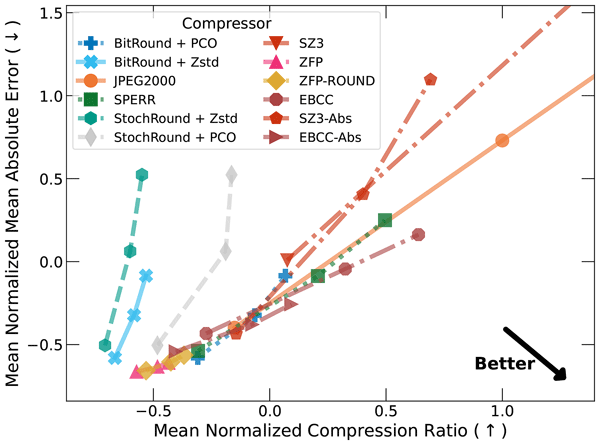
Tim Reichelt, Juniper Tyree, Milan Klöwer, Peter Dueben, Bryan N. Lawrence, Allison H. Baker, Sara Faghih-Naini, Torsten Hoefler, and Philip Stier
Geosci. Model Dev., 19, 5933–5960, https://doi.org/10.5194/gmd-19-5933-2026, https://doi.org/10.5194/gmd-19-5933-2026, 2026
Short summary
Short summary
The growing size of datasets used in climate science makes it difficult to store, analyze, and distribute dataset. Lossy compression algorithms can significantly reduce the disk space required to store datasets, but it can be difficult to understand and compare the behavior of different compression algorithms. ClimateBenchPress provides a benchmark to standardize comparisons between lossy compression algorithms and guide development of novel algorithms specifically targeted towards climate data.
Heikki Järvinen, Jouni Räisänen, Lauri Tuppi, Clément Bouvier, Antonio Sanchez-Benitez, Juniper Tyree, Antti Toropainen, Paolo Davini, Francisco Doblas-Reyes, Thomas Jung, Daniel Klocke, Jenni Kontkanen, Sebastian Milinski, Matteo Nurisso, Himansu Kesari Pradhan, and Irina Sandu
EGUsphere, https://doi.org/10.5194/egusphere-2026-3364, https://doi.org/10.5194/egusphere-2026-3364, 2026
Short summary
Short summary
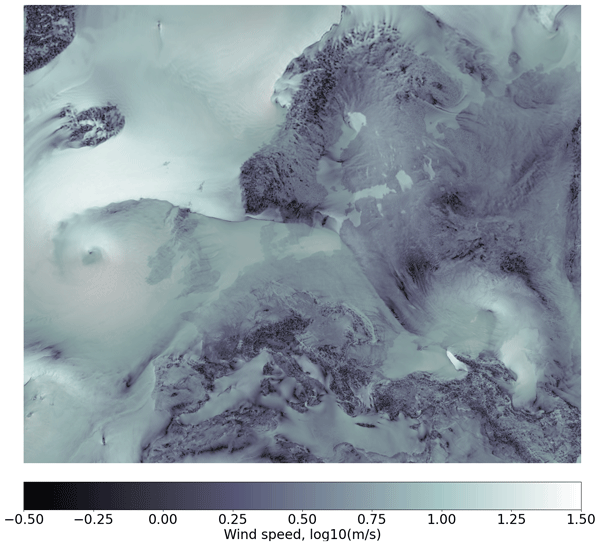
There is rich process-level variability present in the new-generation kilometre-scale climate simulations. The EU’s Climate Change Adaptation Digital Twin (Climate DT) integrates global Earth observing systems and observation modelling capabilities – until now common only in weather prediction – into operational climate simulation workflow. This provides a novel framework for precise evaluation of fine-scale details of simulation data and informing adaptation decisions at local (city) scales.
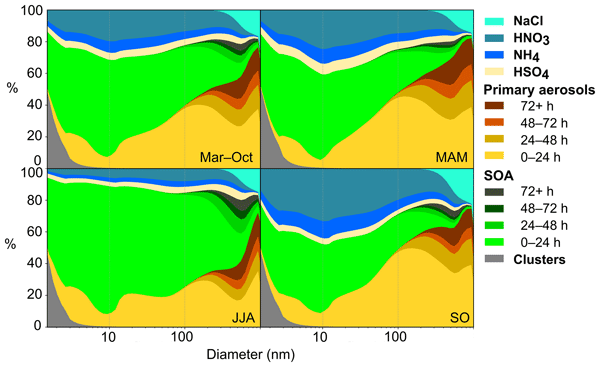
Petri Clusius, Metin Baykara, Carlton Xavier, Putian Zhou, Juniper Tyree, Benjamin Foreback, Mikko Äijälä, Frans Graeffe, Tuukka Petäjä, Markku Kulmala, Pauli Paasonen, Paul I. Palmer, and Michael Boy
Atmos. Chem. Phys., 26, 1967–1992, https://doi.org/10.5194/acp-26-1967-2026, https://doi.org/10.5194/acp-26-1967-2026, 2026
Short summary
Short summary
Cloud condensation nuclei are necessary to form clouds, and their size distribution affects cloud properties and therefore Earth’s energy budget. This study modelled the origins of cloud condensation nuclei at SMEAR II, Hyytiälä, Finland, and found that primary emissions and new particle formation separately contribute to more than half of the condensation nuclei, but they suppress each other, leading to current concentrations. Largest condensation nuclei originated mostly from emissions.
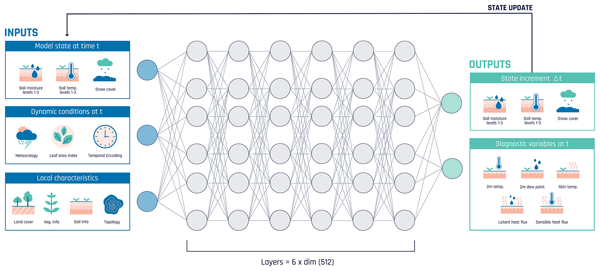
Nina Raoult, Ewan Pinnington, Mario Santa Cruz, Florian Pinault, Baudouin Raoult, Natalie Zelenka, Gabriele Arduini, Gianpaolo Balsamo, Souhail Boussetta, Matthew Chantry, Patricia de Rosnay, Peter Dueben, and Christoph Rüdiger
Geosci. Model Dev., 19, 10763–10793, https://doi.org/10.5194/gmd-19-10763-2026, https://doi.org/10.5194/gmd-19-10763-2026, 2026
Short summary
Short summary
The land surface shapes our weather and climate by controlling how heat and water move between the ground and the air, so the models representing it matter enormously. But they are costly to run and carry built-in errors. We built a faster artificial-intelligence version of one, then used real measurements from sites worldwide to correct some of these errors. The result stays reliable over years and better captures these heat and water exchanges; a quicker, more accurate tool for forecasting.
Tim Reichelt, Juniper Tyree, Milan Klöwer, Peter Dueben, Bryan N. Lawrence, Allison H. Baker, Sara Faghih-Naini, Torsten Hoefler, and Philip Stier
Geosci. Model Dev., 19, 5933–5960, https://doi.org/10.5194/gmd-19-5933-2026, https://doi.org/10.5194/gmd-19-5933-2026, 2026
Short summary
Short summary
The growing size of datasets used in climate science makes it difficult to store, analyze, and distribute dataset. Lossy compression algorithms can significantly reduce the disk space required to store datasets, but it can be difficult to understand and compare the behavior of different compression algorithms. ClimateBenchPress provides a benchmark to standardize comparisons between lossy compression algorithms and guide development of novel algorithms specifically targeted towards climate data.
Heikki Järvinen, Jouni Räisänen, Lauri Tuppi, Clément Bouvier, Antonio Sanchez-Benitez, Juniper Tyree, Antti Toropainen, Paolo Davini, Francisco Doblas-Reyes, Thomas Jung, Daniel Klocke, Jenni Kontkanen, Sebastian Milinski, Matteo Nurisso, Himansu Kesari Pradhan, and Irina Sandu
EGUsphere, https://doi.org/10.5194/egusphere-2026-3364, https://doi.org/10.5194/egusphere-2026-3364, 2026
Short summary
Short summary
There is rich process-level variability present in the new-generation kilometre-scale climate simulations. The EU’s Climate Change Adaptation Digital Twin (Climate DT) integrates global Earth observing systems and observation modelling capabilities – until now common only in weather prediction – into operational climate simulation workflow. This provides a novel framework for precise evaluation of fine-scale details of simulation data and informing adaptation decisions at local (city) scales.
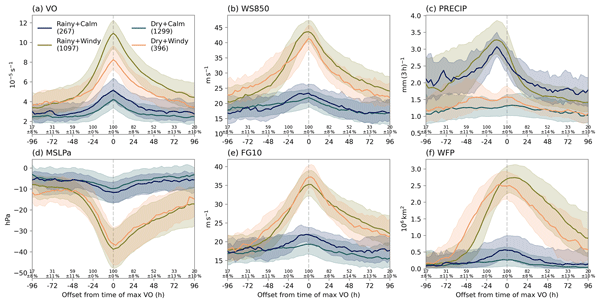
Joona Cornér, Clément Bouvier, and Victoria A. Sinclair
Weather Clim. Dynam., 7, 873–893, https://doi.org/10.5194/wcd-7-873-2026, https://doi.org/10.5194/wcd-7-873-2026, 2026
Short summary
Short summary
Understanding the intensification of extratropical cyclones (ETCs) is important from weather forecasting and climate perspectives due to their societal impacts and major role in mid-latitude weather. Here we show that precursors to ETC intensification at genesis time show physically meaningful controls on the final maximum ETC intensity. However, to understand in detail the processes leading to differences in intensity between ETCs, one should study the evolution of multiple ETC precursors.
Francisco J. Doblas-Reyes, Jenni Kontkanen, Irina Sandu, Mario Acosta, Mohammed Hussam Al Turjmam, Ivan Alsina-Ferrer, Miguel Andrés-Martínez, Costanza Anerdi, Leo Arriola, Marvin Axness, Marc Batlle Martín, Peter Bauer, Tobias Becker, Daniel Beltrán, Sebastian Beyer, Hendryk Bockelmann, Pierre-Antoine Bretonnière, Sebastien Cabaniols, Silvia Caprioli, Miguel Castrillo, Aparna Chandrasekar, Suvarchal Cheedela, Victor Correal, Emanuele Danovaro, Paolo Davini, Jussi Enkovaara, Claudia Frauen, Barbara Früh, Aina Gaya Àvila, Paolo Ghinassi, Rohit Ghosh, Supriyo Ghosh, Iker González, Katherine Grayson, Matthew Griffith, Ioan Hadade, Christopher Haine, Carl Hartick, Utz-Uwe Haus, Shane Hearne, Heikki Järvinen, Bernat Jiménez, Amal John, Marlin Juchem, Thomas Jung, Jessica Kegel, Matthias Kelbling, Kai Keller, Bruno Kinoshita, Theresa Kiszler, Daniel Klocke, Lukas Kluft, Nikolay Koldunov, Tobias Kölling, Joonas Kolstela, Luis Kornblueh, Sergey Kosukhin, Aleksander Lacima-Nadolnik, Jeisson Javier Leal Rojas, Jonni Lehtiranta, Tuomas Lunttila, Anna Luoma, Pekka Manninen, Alexey Medvedev, Sebastian Milinski, Ali Mohammed, Sebastian Müller, Devaraju Naryanappa, Natalia Nazarova, Sami Niemelä, Bimochan Niraula, Henrik Nortamo, Aleksi Nummelin, Matteo Nurisso, Pablo Ortega, Stella Paronuzzi, Xabier Pedruzo-Bagazgoitia, Charles Pelletier, Carlos Peña, Suraj Polade, Himansu Kesari Pradhan, Rommel Quintanilla, Tiago Quintino, Thomas Rackow, Jouni Räisänen, Maqsood Mubarak Rajput, René Redler, Balthasar Reuter, Nuno Rocha Monteiro, Francesc Roura-Adserias, Silva Ruppert, Susan Sayed, Reiner Schnur, Tanvi Sharma, Dmitry Sidorenko, Outi Sievi-Korte, Albert Soret, Christian Steger, Bjorn Stevens, Jan Streffing, Jaleena Sunny, Luiggi Tenorio, Stephan Thober, Ulf Tigerstedt, Oriol Tinto, Juha Tonttila, Heikki Tuomenvirta, Lauri Tuppi, Ginka Van Thielen, Emanuele Vitali, Jost von Hardenberg, Ingo Wagner, Nils Wedi, Jan Wehner, Sven Willner, Xavier Yepes-Arbós, Florian Ziemen, and Janos Zimmermann
Geosci. Model Dev., 19, 2821–2848, https://doi.org/10.5194/gmd-19-2821-2026, https://doi.org/10.5194/gmd-19-2821-2026, 2026
Short summary
Short summary
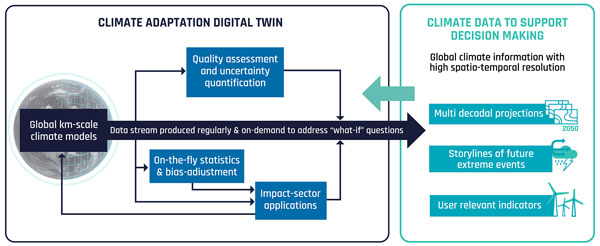
The Climate Change Adaptation Digital Twin (Climate DT) pioneers the operationalisation of global climate projections. It produces global simulations with local granularity for adaptation decision-making. Applications are embedded to generate tailored indicators. A unified workflow orchestrates all components in several supercomputers. Data management ensures consistency and streaming enables real-time use. It is a complementary innovation to initiatives like CMIP, CORDEX, and climate services.
Petri Clusius, Metin Baykara, Carlton Xavier, Putian Zhou, Juniper Tyree, Benjamin Foreback, Mikko Äijälä, Frans Graeffe, Tuukka Petäjä, Markku Kulmala, Pauli Paasonen, Paul I. Palmer, and Michael Boy
Atmos. Chem. Phys., 26, 1967–1992, https://doi.org/10.5194/acp-26-1967-2026, https://doi.org/10.5194/acp-26-1967-2026, 2026
Short summary
Short summary
Cloud condensation nuclei are necessary to form clouds, and their size distribution affects cloud properties and therefore Earth’s energy budget. This study modelled the origins of cloud condensation nuclei at SMEAR II, Hyytiälä, Finland, and found that primary emissions and new particle formation separately contribute to more than half of the condensation nuclei, but they suppress each other, leading to current concentrations. Largest condensation nuclei originated mostly from emissions.
Sara Tahvonen, Daniel Köhler, Petri Räisänen, and Victoria A. Sinclair
Weather Clim. Dynam., 6, 1299–1317, https://doi.org/10.5194/wcd-6-1299-2025, https://doi.org/10.5194/wcd-6-1299-2025, 2025
Short summary
Short summary
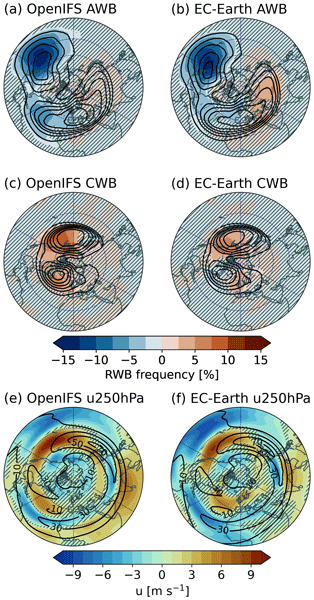
Rossby wave breaking (RWB) influences weather at a large scale and can contribute to extreme weather events, but it is not known if climate change will have an effect on where and how often RWB occurs. We investigate how extreme sea ice loss and warming of the sea surface effect RWB. Our results show that sea surface temperatures significantly change local RWB frequencies and the closely related upper atmospheric jet streams, but that sea ice changes have no noticeable effect in our experiments.
Hans Segura, Xabier Pedruzo-Bagazgoitia, Philipp Weiss, Sebastian K. Müller, Thomas Rackow, Junhong Lee, Edgar Dolores-Tesillos, Imme Benedict, Matthias Aengenheyster, Razvan Aguridan, Gabriele Arduini, Alexander J. Baker, Jiawei Bao, Swantje Bastin, Eulàlia Baulenas, Tobias Becker, Sebastian Beyer, Hendryk Bockelmann, Nils Brüggemann, Lukas Brunner, Suvarchal K. Cheedela, Sushant Das, Jasper Denissen, Ian Dragaud, Piotr Dziekan, Madeleine Ekblom, Jan Frederik Engels, Monika Esch, Richard Forbes, Claudia Frauen, Lilli Freischem, Diego García-Maroto, Philipp Geier, Paul Gierz, Álvaro González-Cervera, Katherine Grayson, Matthew Griffith, Oliver Gutjahr, Helmuth Haak, Ioan Hadade, Kerstin Haslehner, Shabeh ul Hasson, Jan Hegewald, Lukas Kluft, Aleksei Koldunov, Nikolay Koldunov, Tobias Kölling, Shunya Koseki, Sergey Kosukhin, Josh Kousal, Peter Kuma, Arjun U. Kumar, Rumeng Li, Nicolas Maury, Maximilian Meindl, Sebastian Milinski, Kristian Mogensen, Bimochan Niraula, Jakub Nowak, Divya Sri Praturi, Ulrike Proske, Dian Putrasahan, René Redler, David Santuy, Domokos Sármány, Reiner Schnur, Patrick Scholz, Dmitry Sidorenko, Dorian Spät, Birgit Sützl, Daisuke Takasuka, Adrian Tompkins, Alejandro Uribe, Mirco Valentini, Menno Veerman, Aiko Voigt, Sarah Warnau, Fabian Wachsmann, Marta Wacławczyk, Nils Wedi, Karl-Hermann Wieners, Jonathan Wille, Marius Winkler, Yuting Wu, Florian Ziemen, Janos Zimmermann, Frida A.-M. Bender, Dragana Bojovic, Sandrine Bony, Simona Bordoni, Patrice Brehmer, Marcus Dengler, Emanuel Dutra, Saliou Faye, Erich Fischer, Chiel van Heerwaarden, Cathy Hohenegger, Heikki Järvinen, Markus Jochum, Thomas Jung, Johann H. Jungclaus, Noel S. Keenlyside, Daniel Klocke, Heike Konow, Martina Klose, Szymon Malinowski, Olivia Martius, Thorsten Mauritsen, Juan Pedro Mellado, Theresa Mieslinger, Elsa Mohino, Hanna Pawłowska, Karsten Peters-von Gehlen, Abdoulaye Sarré, Pajam Sobhani, Philip Stier, Lauri Tuppi, Pier Luigi Vidale, Irina Sandu, and Bjorn Stevens
Geosci. Model Dev., 18, 7735–7761, https://doi.org/10.5194/gmd-18-7735-2025, https://doi.org/10.5194/gmd-18-7735-2025, 2025
Short summary
Short summary
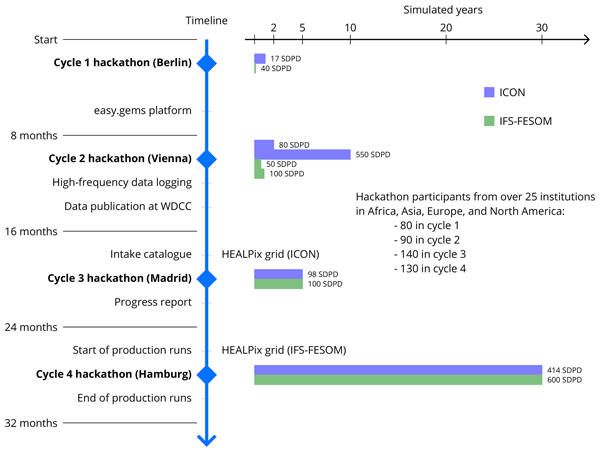
The Next Generation of Earth Modeling Systems project (nextGEMS) developed two Earth system models that use horizontal grid spacing of 10 km and finer, giving more fidelity to the representation of local phenomena, globally. In its fourth cycle, nextGEMS simulated the Earth System climate over the 2020–2049 period under the SSP3-7.0 scenario. Here, we provide an overview of nextGEMS, insights into the model development, and the realism of multi-decadal, kilometer-scale simulations.
Maksym Vasiuta, Angel Navarro Trastoy, Sanam Motlaghzadeh, Lauri Tuppi, Torsten Mayer-Gürr, and Heikki Järvinen
Geosci. Model Dev., 18, 5015–5030, https://doi.org/10.5194/gmd-18-5015-2025, https://doi.org/10.5194/gmd-18-5015-2025, 2025
Short summary
Short summary
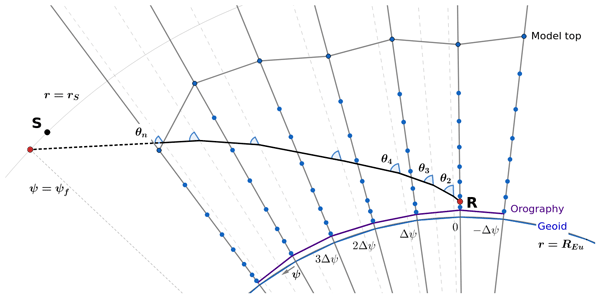
Propagation of electromagnetic signals in Earth's neutral atmosphere inflicts errors in space geodetic observations. To model these errors accurately, it is necessary to use a signal tracing algorithm which is informed of the state of the atmosphere. We developed such an algorithm and tested it by processing Global Navigation Satellite System network observations. Our algorithm's main advantage is lossless utilization of atmospheric information provided by numerical weather prediction models.
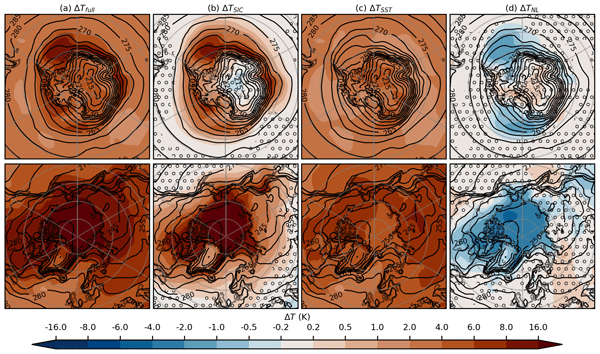
Tuomas Naakka, Daniel Köhler, Kalle Nordling, Petri Räisänen, Marianne Tronstad Lund, Risto Makkonen, Joonas Merikanto, Bjørn H. Samset, Victoria A. Sinclair, Jennie L. Thomas, and Annica M. L. Ekman
Atmos. Chem. Phys., 25, 8127–8145, https://doi.org/10.5194/acp-25-8127-2025, https://doi.org/10.5194/acp-25-8127-2025, 2025
Short summary
Short summary
The effects of warmer sea surface temperatures and decreasing sea ice cover on polar climates have been studied using four climate models with identical prescribed changes in sea surface temperatures and sea ice cover. The models predict similar changes in air temperature and precipitation in the polar regions in a warmer climate with less sea ice. However, the models disagree on how the atmospheric circulation, i.e. the large-scale winds, will change with warmer temperatures and less sea ice.
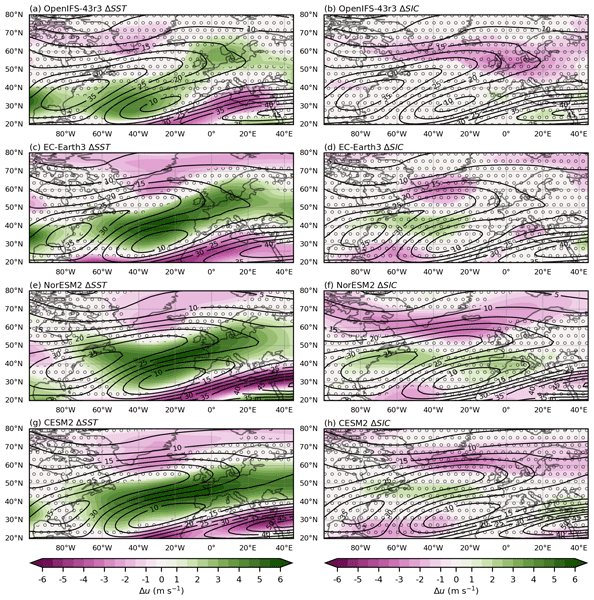
Daniel Köhler, Petri Räisänen, Tuomas Naakka, Kalle Nordling, and Victoria A. Sinclair
Weather Clim. Dynam., 6, 669–694, https://doi.org/10.5194/wcd-6-669-2025, https://doi.org/10.5194/wcd-6-669-2025, 2025
Short summary
Short summary
We study the impacts of globally increasing sea surface temperatures and sea ice loss on the atmosphere in wintertime. In future climates, the jet stream shifts southward over the North Atlantic and extends further over Europe. Increasing sea surface temperatures drives these changes. The region of high activity of low-pressure systems is projected to move east towards Europe. Future increasing sea surface temperatures and sea ice loss contribute with similar magnitude to the eastward shift.
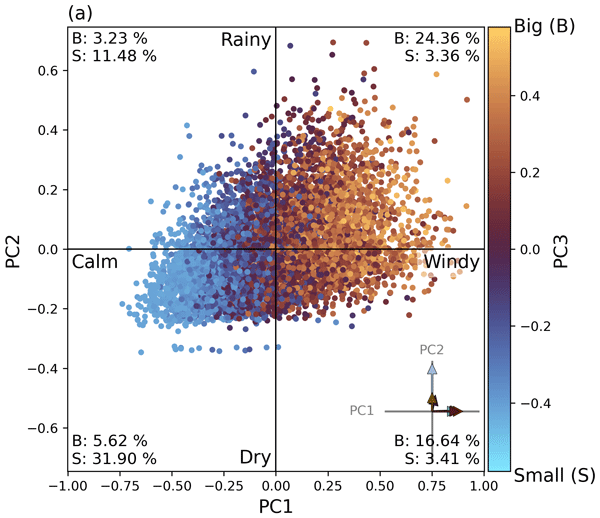
Joona Cornér, Clément Bouvier, Benjamin Doiteau, Florian Pantillon, and Victoria A. Sinclair
Nat. Hazards Earth Syst. Sci., 25, 207–229, https://doi.org/10.5194/nhess-25-207-2025, https://doi.org/10.5194/nhess-25-207-2025, 2025
Short summary
Short summary
Classification reduces the considerable variability between extratropical cyclones (ETCs) and thus simplifies studying their representation in climate models and changes in the future climate. In this paper we present an objective classification of ETCs using measures of ETC intensity. This is motivated by the aim of finding a set of ETC intensity measures which together comprehensively describe both the dynamical and impact-relevant nature of ETC intensity.
Thomas Rackow, Xabier Pedruzo-Bagazgoitia, Tobias Becker, Sebastian Milinski, Irina Sandu, Razvan Aguridan, Peter Bechtold, Sebastian Beyer, Jean Bidlot, Souhail Boussetta, Willem Deconinck, Michail Diamantakis, Peter Dueben, Emanuel Dutra, Richard Forbes, Rohit Ghosh, Helge F. Goessling, Ioan Hadade, Jan Hegewald, Thomas Jung, Sarah Keeley, Lukas Kluft, Nikolay Koldunov, Aleksei Koldunov, Tobias Kölling, Josh Kousal, Christian Kühnlein, Pedro Maciel, Kristian Mogensen, Tiago Quintino, Inna Polichtchouk, Balthasar Reuter, Domokos Sármány, Patrick Scholz, Dmitry Sidorenko, Jan Streffing, Birgit Sützl, Daisuke Takasuka, Steffen Tietsche, Mirco Valentini, Benoît Vannière, Nils Wedi, Lorenzo Zampieri, and Florian Ziemen
Geosci. Model Dev., 18, 33–69, https://doi.org/10.5194/gmd-18-33-2025, https://doi.org/10.5194/gmd-18-33-2025, 2025
Short summary
Short summary
Detailed global climate model simulations have been created based on a numerical weather prediction model, offering more accurate spatial detail down to the scale of individual cities ("kilometre-scale") and a better understanding of climate phenomena such as atmospheric storms, whirls in the ocean, and cracks in sea ice. The new model aims to provide globally consistent information on local climate change with greater precision, benefiting environmental planning and local impact modelling.
Daniel Köhler, Philipp Reutter, and Peter Spichtinger
Atmos. Chem. Phys., 24, 10055–10072, https://doi.org/10.5194/acp-24-10055-2024, https://doi.org/10.5194/acp-24-10055-2024, 2024
Short summary
Short summary
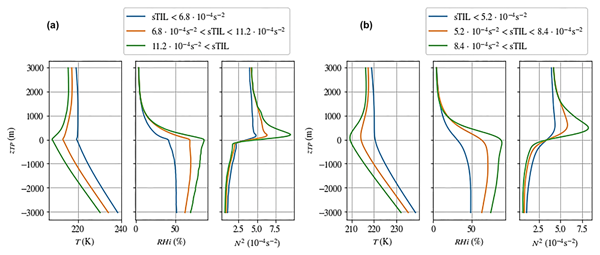
In this work, the influence of humidity on the properties of the tropopause is studied. The tropopause is the interface between the troposphere and the stratosphere and represents a barrier for the transport of air masses between the troposphere and the stratosphere. We consider not only the tropopause itself, but also a layer around it called the tropopause inversion layer (TIL). It is shown that the moister the underlying atmosphere is, the more this layer acts as a barrier.
Bjorn Stevens, Stefan Adami, Tariq Ali, Hartwig Anzt, Zafer Aslan, Sabine Attinger, Jaana Bäck, Johanna Baehr, Peter Bauer, Natacha Bernier, Bob Bishop, Hendryk Bockelmann, Sandrine Bony, Guy Brasseur, David N. Bresch, Sean Breyer, Gilbert Brunet, Pier Luigi Buttigieg, Junji Cao, Christelle Castet, Yafang Cheng, Ayantika Dey Choudhury, Deborah Coen, Susanne Crewell, Atish Dabholkar, Qing Dai, Francisco Doblas-Reyes, Dale Durran, Ayoub El Gaidi, Charlie Ewen, Eleftheria Exarchou, Veronika Eyring, Florencia Falkinhoff, David Farrell, Piers M. Forster, Ariane Frassoni, Claudia Frauen, Oliver Fuhrer, Shahzad Gani, Edwin Gerber, Debra Goldfarb, Jens Grieger, Nicolas Gruber, Wilco Hazeleger, Rolf Herken, Chris Hewitt, Torsten Hoefler, Huang-Hsiung Hsu, Daniela Jacob, Alexandra Jahn, Christian Jakob, Thomas Jung, Christopher Kadow, In-Sik Kang, Sarah Kang, Karthik Kashinath, Katharina Kleinen-von Königslöw, Daniel Klocke, Uta Kloenne, Milan Klöwer, Chihiro Kodama, Stefan Kollet, Tobias Kölling, Jenni Kontkanen, Steve Kopp, Michal Koran, Markku Kulmala, Hanna Lappalainen, Fakhria Latifi, Bryan Lawrence, June Yi Lee, Quentin Lejeun, Christian Lessig, Chao Li, Thomas Lippert, Jürg Luterbacher, Pekka Manninen, Jochem Marotzke, Satoshi Matsouoka, Charlotte Merchant, Peter Messmer, Gero Michel, Kristel Michielsen, Tomoki Miyakawa, Jens Müller, Ramsha Munir, Sandeep Narayanasetti, Ousmane Ndiaye, Carlos Nobre, Achim Oberg, Riko Oki, Tuba Özkan-Haller, Tim Palmer, Stan Posey, Andreas Prein, Odessa Primus, Mike Pritchard, Julie Pullen, Dian Putrasahan, Johannes Quaas, Krishnan Raghavan, Venkatachalam Ramaswamy, Markus Rapp, Florian Rauser, Markus Reichstein, Aromar Revi, Sonakshi Saluja, Masaki Satoh, Vera Schemann, Sebastian Schemm, Christina Schnadt Poberaj, Thomas Schulthess, Cath Senior, Jagadish Shukla, Manmeet Singh, Julia Slingo, Adam Sobel, Silvina Solman, Jenna Spitzer, Philip Stier, Thomas Stocker, Sarah Strock, Hang Su, Petteri Taalas, John Taylor, Susann Tegtmeier, Georg Teutsch, Adrian Tompkins, Uwe Ulbrich, Pier-Luigi Vidale, Chien-Ming Wu, Hao Xu, Najibullah Zaki, Laure Zanna, Tianjun Zhou, and Florian Ziemen
Earth Syst. Sci. Data, 16, 2113–2122, https://doi.org/10.5194/essd-16-2113-2024, https://doi.org/10.5194/essd-16-2113-2024, 2024
Short summary
Short summary
To manage Earth in the Anthropocene, new tools, new institutions, and new forms of international cooperation will be required. Earth Virtualization Engines is proposed as an international federation of centers of excellence to empower all people to respond to the immense and urgent challenges posed by climate change.
Clément Bouvier, Daan van den Broek, Madeleine Ekblom, and Victoria A. Sinclair
Geosci. Model Dev., 17, 2961–2986, https://doi.org/10.5194/gmd-17-2961-2024, https://doi.org/10.5194/gmd-17-2961-2024, 2024
Short summary
Short summary
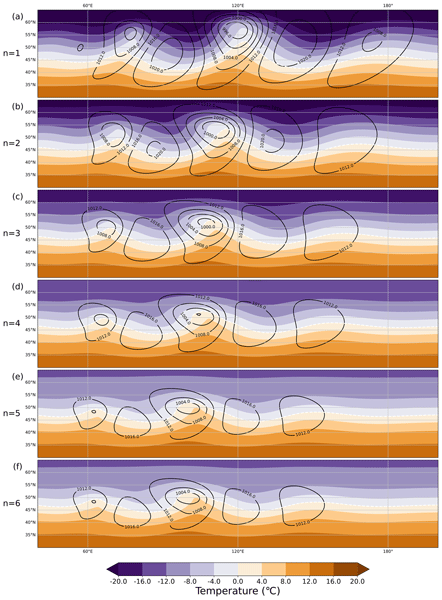
An analytical initial background state has been developed for moist baroclinic wave simulation on an aquaplanet and implemented into OpenIFS. Seven parameters can be controlled, which are used to generate the background states and the development of baroclinic waves. The meteorological and numerical stability has been assessed. Resulting baroclinic waves have proven to be realistic and sensitive to the jet's width.
Tom Kimpson, Margarita Choulga, Matthew Chantry, Gianpaolo Balsamo, Souhail Boussetta, Peter Dueben, and Tim Palmer
Hydrol. Earth Syst. Sci., 27, 4661–4685, https://doi.org/10.5194/hess-27-4661-2023, https://doi.org/10.5194/hess-27-4661-2023, 2023
Short summary
Short summary
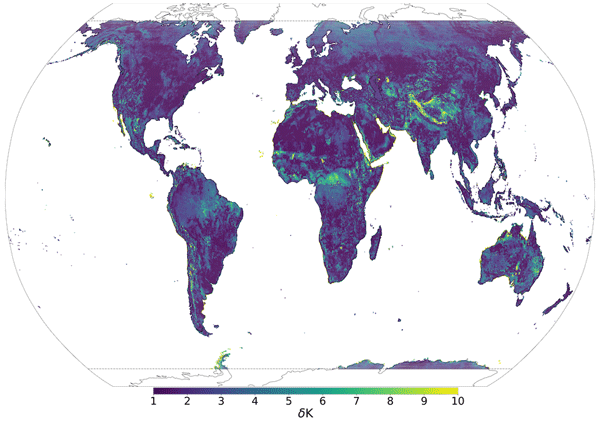
Lakes play an important role when we try to explain and predict the weather. More accurate and up-to-date description of lakes all around the world for numerical models is a continuous task. However, it is difficult to assess the impact of updated lake description within a weather prediction system. In this work, we develop a method to quickly and automatically define how, where, and when updated lake description affects weather prediction.

Angel Navarro Trastoy, Sebastian Strasser, Lauri Tuppi, Maksym Vasiuta, Markku Poutanen, Torsten Mayer-Gürr, and Heikki Järvinen
Geosci. Model Dev., 15, 2763–2771, https://doi.org/10.5194/gmd-15-2763-2022, https://doi.org/10.5194/gmd-15-2763-2022, 2022
Short summary
Short summary
Production of satellite products relies on information from different centers. By coupling a weather model and an orbit determination solver we eliminate the dependence on one of the centers. The coupling has proven to be possible in the first stage, where no formatting has been applied to any of the models involved. This opens a window for further development and improvement to a coupling that has proven to be as good as the predecessor model.
Cited articles
Agarwal, T., Di, S., Liang, X., Su, Z., Li, Y., Gopalakrishnan, G., Guo, H., and Cappello, F.: TopoSZp: Lightweight Topology-Aware Error-controlled Compression for Scientific Data, arXiv [preprint], https://doi.org/10.48550/ARXIV.2602.17552, 2026. a
Ainsworth, M., Tugluk, O., Whitney, B., and Klasky, S.: Multilevel Techniques for Compression and Reduction of Scientific Data-Quantitative Control of Accuracy in Derived Quantities, SIAM J. Sci. Comput., 41, A2146–A2171, https://doi.org/10.1137/18M1208885, 2019. a
Alted, F.: c-blosc: Meta-compresion and advantages over other existing compressors, GitHub repository [code], https://github.com/Blosc/c-blosc/commit/f445706cda788b5ac52a9b5a334368cc69a06c53 (last access: 20 November 2026), 2010. a
Amici, A.: CFGRIB: easy and efficient GRIB file access in xarray, https://www.ecmwf.int/en/elibrary/80908-cfgrib-easy-and-efficient-grib-file-access-xarray (last access: 20 November 2026), 2018. a
Andersson, A., Graw, K., Schröder, M., Fennig, K., Liman, J., Bakan, S., Raphoe, N., Hollmann, R., and Klepp, C.: Hamburg Ocean Atmosphere Parameters and Fluxes from Satellite Data – HOAPS4.0, Copernicus Climate Change Service (C3S) Climate Data Store (CDS) [data set], https://doi.org/10.24381/cds.92db7fef, 2021. a
Baker, A. H.: On Preserving Scientific Integrity for Climate Model Data in the HPC Era, Compu. Sci. Eng., 23, 16–24, https://doi.org/10.1109/MCSE.2021.3119509, 2021. a
Baker, A. H., Xu, H., Dennis, J. M., Levy, M. N., Nychka, D., Mickelson, S. A., Edwards, J., Vertenstein, M., and Wegener, A.: A methodology for evaluating the impact of data compression on climate simulation data, in: Proceedings of the 23rd International Symposium on High-Performance Parallel and Distributed Computing, HPDC '14, Association for Computing Machinery, New York, NY, USA, 203–214, ISBN 9781450327497, https://doi.org/10.1145/2600212.2600217, 2014. a, b, c, d
Baker, A. H., Hammerling, D. M., Mickelson, S. A., Xu, H., Stolpe, M. B., Naveau, P., Sanderson, B., Ebert-Uphoff, I., Samarasinghe, S., De Simone, F., Carbone, F., Gencarelli, C. N., Dennis, J. M., Kay, J. E., and Lindstrom, P.: Evaluating lossy data compression on climate simulation data within a large ensemble, Geosci. Model Dev., 9, 4381–4403, https://doi.org/10.5194/gmd-9-4381-2016, 2016. a, b, c, d
Baker, A. H., Xu, H., Hammerling, D. M., Li, S., and Clyne, J. P.: Toward a Multi-method Approach: Lossy Data Compression for Climate Simulation Data, in: High Performance Computing, edited by: Kunkel, J. M., Yokota, R., Taufer, M., and Shalf, J., Springer International Publishing, Cham, 30–42, ISBN 978-3-319-67630-2, https://doi.org/10.1007/978-3-319-67630-2_3, 2017. a, b
Ballester-Ripoll, R., Lindstrom, P., and Pajarola, R.: TTHRESH: Tensor Compression for Multidimensional Visual Data, IEEE T. Vis. Comput. Gr., 26, 2891–2903, https://doi.org/10.1109/TVCG.2019.2904063, 2020. a
Banerjee, T., Choi, J., Lee, J., Gong, Q., Wang, R., Klasky, S., Rangarajan, A., and Ranka, S.: An Algorithmic and Software Pipeline for Very Large Scale Scientific Data Compression with Error Guarantees, in: 2022 IEEE 29th International Conference on High Performance Computing, Data, and Analytics (HiPC), 226–235, https://doi.org/10.1109/HiPC56025.2022.00039, 2022. a
Cappello, F., Underwood, R., Alexeev, Y., Baker, A., Bozdağ, E., Burtscher, M., Chard, K., Di, S., Felker, K. G., O'Grady, P. C., Guo, H., Huang, Y., Jiang, P., Jin, S., Johansson, P., Li, S., Liang, X., Lindahl, E., Lindstrom, P., Lukić, Z., Lundborg, M., Lykov, D., Nagaso, M., Sato, K., Singh, A., Son, S. W., Song, S., Tang, W., Tao, D., Tian, J., Yoshii, K., and Zhao, K.: What to Support When You're Compressing: The State of Practice Gaps and Opportunities for Scientific Data Compression, in: Proceedings of the International Conference for High Performance Computing, Networking, Storage and Analysis, SC '25, Association for Computing Machinery, New York, NY, USA, 1966–1979, ISBN 9798400714665, https://doi.org/10.1145/3712285.3759856, 2025. a, b, c, d, e, f
Christopoulos, C. A., Ebrahimi, T., and Skodras, A. N.: JPEG2000: the new still picture compression standard, in: Proceedings of the 2000 ACM Workshops on Multimedia, MULTIMEDIA '00, Association for Computing Machinery, New York, NY, USA, 45–49, ISBN 1581133111, https://doi.org/10.1145/357744.357757, 2000. a
Collet, Y.: Zstandard Compression and the “application/zstd” Media Type, https://doi.org/10.17487/rfc8878, 2021. a, b, c
Copernicus Climate Change Service: Monthly and 6-hourly total column water vapour over ocean from 1988 to 2020 derived from satellite observations, Copernicus Climate Change Service (C3S) Climate Data Store (CDS) [data set], https://doi.org/10.24381/cds.92db7fef, 2022. a
Copernicus Climate Change Service, Climate Data Store: Fire danger indices historical data from the Copernicus Emergency Management Service, Copernicus Climate Change Service (C3S) Climate Data Store (CDS) [data set], https://doi.org/10.24381/cds.0e89c522, 2019. a
Delaunay, X., Courtois, A., and Gouillon, F.: Evaluation of lossless and lossy algorithms for the compression of scientific datasets in netCDF-4 or HDF5 files, Geosci. Model Dev., 12, 4099–4113, https://doi.org/10.5194/gmd-12-4099-2019, 2019. a, b
Di, S. and Cappello, F.: Fast Error-Bounded Lossy HPC Data Compression with SZ, in: 2016 IEEE International Parallel and Distributed Processing Symposium (IPDPS), 730–739, https://doi.org/10.1109/IPDPS.2016.11, 2016. a, b
Di, S., Liu, J., Zhao, K., Liang, X., Underwood, R., Zhang, Z., Shah, M., Huang, Y., Huang, J., Yu, X., Ren, C., Guo, H., Wilkins, G., Tao, D., Tian, J., Jin, S., Jian, Z., Wang, D., Rahman, M. H., Zhang, B., Song, S., Calhoun, J. C., Li, G., Yoshii, K., Alharthi, K. A., and Cappello, F.: A Survey on Error-Bounded Lossy Compression for Scientific Datasets, arXiv [preprint], https://doi.org/10.48550/ARXIV.2404.02840, 2024. a
Diffenderfer, J., Fox, A. L., Hittinger, J. A., Sanders, G., and Lindstrom, P. G.: Error Analysis of ZFP Compression for Floating-Point Data, SIAM J. Sci. Comput., 41, A1867–A1898, https://doi.org/10.1137/18M1168832, 2019. a, b
Eaton, B., Gregory, J., Drach, B., Taylor, K., Hankin, S., Caron, J., Signell, R., Bentley, P., Rappa, G., Höck, H., Pamment, A., Juckes, M., Raspaud, M., Blower, J., Horne, R., Whiteaker, T., Blodgett, D., Zender, C., Lee, D., Hassell, D., Snow, A. D., Kölling, T., Allured, D., Jelenak, A., Soerensen, A. M., Gaultier, L., Herlédan, S., Manzano, F., Bärring, L., Barker, C., and Bartholomew, S. L.: NetCDF Climate and Forecast (CF) Metadata Conventions, Zenodo, https://doi.org/10.5281/ZENODO.14274886, 2024. a
ECMWF: ECMWF's vision for Big Data, AI and cloud computing, https://climate.copernicus.eu/sites/default/files/2019-11/Martin%20Palkovic.pdf (last access: 23 December 2025), 2019. a
Flajolet, P., Éric Fusy, Gandouet, O., and Meunier, F.: HyperLogLog: the analysis of a near-optimal cardinality estimation algorithm, Discrete Mathematics & Theoretical Computer Science, DMTCS Proceedings vol. AH, 2007 Conference on Analysis of Algorithms (AofA 07), 10, https://doi.org/10.46298/dmtcs.3545, 2007. a
Fornberg, B.: Generation of finite difference formulas on arbitrarily spaced grids, Math. Comput., 51, 699–706, https://doi.org/10.1090/s0025-5718-1988-0935077-0, 1988. a
Fox, A., Diffenderfer, J., Hittinger, J., Sanders, G., and Lindstrom, P.: Stability Analysis of Inline ZFP Compression for Floating-Point Data in Iterative Methods, SIAM J. Sci. Comput., 42, A2701–A2730, https://doi.org/10.1137/19M126904X, 2020. a
Gorski, N., Liang, X., Guo, H., Yan, L., and Wang, B.: A General Framework for Augmenting Lossy Compressors With Topological Guarantees, IEEE T. Vis. Comput. Gr., 31, 3693–3705, https://doi.org/10.1109/TVCG.2025.3567054, 2025. a
Hadade, I., Klocke, D., Enkovaara, J., Lunttila, T., Rackow, T., Engels, J. F., Frauen, C., Redler, R., Kontkanen, J., Jung, T., Sein, D., Sandu, I., Reuter, B., Wedi, N., Milinski, S., Doblas-Reyes, F., Castrillo, M., Acosta, M., Girona, S., and Manninen, P.: Destination Earth: The Climate Change Adaptation Digital Twin, in: Proceedings of the International Conference for High Performance Computing, Networking, Storage and Analysis, SC '25, Association for Computing Machinery, New York, NY, USA, 99–110, ISBN 9798400714665, https://doi.org/10.1145/3712285.3771790, 2025. a, b
Hammerling, D. M., Baker, A. H., Pinard, A., and Lindstrom, P.: A Collaborative Effort to Improve Lossy Compression Methods for Climate Data, in: 2019 IEEE/ACM 5th International Workshop on Data Analysis and Reduction for Big Scientific Data (DRBSD-5), 16–22, https://doi.org/10.1109/DRBSD-549595.2019.00008, 2019. a, b
Han, T., Du, D., Chen, Z., Guo, S., Ouyang, W., and Bai, L.: CRA5 a high-fidelity compressed reanalysis atmospheric dataset for weather and climate research, Sci. Data, https://doi.org/10.1038/s41597-026-07381-2, 2026. a, b, c
Harris, C. R., Millman, K. J., van der Walt, S. J., Gommers, R., Virtanen, P., Cournapeau, D., Wieser, E., Taylor, J., Berg, S., Smith, N. J., Kern, R., Picus, M., Hoyer, S., van Kerkwijk, M. H., Brett, M., Haldane, A., del Río, J. F., Wiebe, M., Peterson, P., Gérard-Marchant, P., Sheppard, K., Reddy, T., Weckesser, W., Abbasi, H., Gohlke, C., and Oliphant, T. E.: Array programming with NumPy, Nature, 585, 357–362, https://doi.org/10.1038/s41586-020-2649-2, 2020. a
Hart, D.: Cheyenne and Beyond: NCAR’s Research Computing and Storage Roadmap to 2022, https://www.cisl.ucar.edu/sites/default/files/2021-10/Hart.pdf (last access: 14 July 2026), 2017. a
Hassell, D. and Cimadevilla Alvarez, E.: cmip7repack: Repack CMIP7 netCDF-4 datasets, Zenodo [code], https://doi.org/10.5281/zenodo.18849756, 2026. a
Hersbach, H., Bell, B., Berrisford, P., Biavati, G., Horányi, A., Muñoz Sabater, J., Nicolas, J., Peubey, C., Radu, R., Rozum, I., Schepers, D., Simmons, A., Soci, C., Dee, D., and Thépaut, J.-N.: ERA5 hourly data on pressure levels from 1940 to present, Copernicus Climate Change Service (C3S) Climate Data Store (CDS) [data set], https://doi.org/10.24381/cds.bd0915c6, 2018a. a, b
Hersbach, H., Bell, B., Berrisford, P., Biavati, G., Horányi, A., Muñoz Sabater, J., Nicolas, J., Peubey, C., Radu, R., Rozum, I., Schepers, D., Simmons, A., Soci, C., Dee, D., and Thépaut, J.-N.: ERA5 hourly data on single levels from 1940 to present, Copernicus Climate Change Service (C3S) Climate Data Store (CDS) [data set], https://doi.org/10.24381/cds.adbb2d47, 2018b. a
Hersbach, H., Bell, B., Berrisford, P., Hirahara, S., Horányi, A., Muñoz-Sabater, J., Nicolas, J., Peubey, C., Radu, R., Schepers, D., Simmons, A., Soci, C., Abdalla, S., Abellan, X., Balsamo, G., Bechtold, P., Biavati, G., Bidlot, J., Bonavita, M., De Chiara, G., Dahlgren, P., Dee, D., Diamantakis, M., Dragani, R., Flemming, J., Forbes, R., Fuentes, M., Geer, A., Haimberger, L., Healy, S., Hogan, R. J., Hólm, E., Janisková, M., Keeley, S., Laloyaux, P., Lopez, P., Lupu, C., Radnoti, G., de Rosnay, P., Rozum, I., Vamborg, F., Villaume, S., and Thépaut, J.-N.: The ERA5 global reanalysis, Q. J. Roy. Meteor. Soc., 146, 1999–2049, https://doi.org/10.1002/qj.3803, 2020. a
Hoyer, S. and Hamman, J.: xarray: N-D labeled arrays and datasets in Python, J. Open Res. Softw., 5, https://doi.org/10.5334/jors.148, 2017. a, b, c
Huang, H., Castruccio, S., Baker, A. H., and Genton, M. G.: Rejoinder on “Saving Storage in Climate Ensembles: A Model-Based Stochastic Approach”, J. Agric. Biol. Envir. S., 28, 370–374, https://doi.org/10.1007/s13253-023-00542-5, 2023. a, b
Huang, L. and Hoefler, T.: Compressing Multidimensional Weather and Climate Data into Neural Networks, arXiv [preprint], https://doi.org/10.48550/arXiv.2210.12538, 2023. a, b
IEEE: IEEE Standard for Floating-Point Arithmetic, IEEE Std 754-2008, 1–70, https://doi.org/10.1109/IEEESTD.2008.4610935, 2008. a
Intergovernmental Panel on Climate Change (IPCC): Summary for Policymakers, Cambridge University Press, 3–32, https://doi.org/10.1017/9781009157896, 2023. a
Jian, Z., Di, S., Liu, J., Zhao, K., Liang, X., Xu, H., Underwood, R., Wu, S., Huang, J., Chen, Z., and Cappello, F.: CliZ: Optimizing Lossy Compression for Climate Datasets with Adaptive Fine-tuned Data Prediction, in: 2024 IEEE International Parallel and Distributed Processing Symposium (IPDPS), 417–429, https://doi.org/10.1109/IPDPS57955.2024.00044, 2024. a
Jiao, P., Di, S., Guo, H., Zhao, K., Tian, J., Tao, D., Liang, X., and Cappello, F.: Toward Quantity-of-Interest Preserving Lossy Compression for Scientific Data, Proc. VLDB Endow., 16, 697–710, https://doi.org/10.14778/3574245.3574255, 2022. a, b
Klocke, D., Frauen, C., Engels, J. F., Alexeev, D., Redler, R., Schnur, R., Haak, H., Kornblueh, L., Brüggemann, N., Chegini, F., Römmer, M., Hoffmann, L., Griessbach, S., Bode, M., Coles, J., Gila, M., Sawyer, W., Calotoiu, A., Budanaz, Y., Mazumder, P., Copik, M., Weber, B., Herten, A., Bockelmann, H., Hoefler, T., Hohenegger, C., and Stevens, B.: Computing the Full Earth System at 1 km Resolution, in: Proceedings of the International Conference for High Performance Computing, Networking, Storage and Analysis, SC '25, Association for Computing Machinery, New York, NY, USA, 125–136, ISBN 9798400714665, https://doi.org/10.1145/3712285.3771789, 2025. a
Klöwer, M., Razinger, M., Dominguez, J. J., Düben, P. D., and Palmer, T. N.: Compressing atmospheric data into its real information content, Nat. Comput. Sci., 1, 713–724, https://doi.org/10.1038/s43588-021-00156-2, 2021. a
Kouznetsov, R.: A note on precision-preserving compression of scientific data, Geosci. Model Dev., 14, 377–389, https://doi.org/10.5194/gmd-14-377-2021, 2021. a
Kunkel, J. M., Kuhn, M., and Ludwig, T.: Exascale storage systems: an analytical study of expenses, Supercomput. Front. Innov., 1, 116–134, https://doi.org/10.14529/jsfi140106, 2014. a
Lawrence Livermore National Laboratory: zfp and Derivatives, https://computing.llnl.gov/projects/zfp/zfp-and-derivatives (last access: 16 June 2026), 2024. a
Li, S.: H5Z-SPERR, GitHub Repository [code], https://github.com/NCAR/H5Z-SPERR, (last access: 16 June 2026), 2026. a
Li, Y., Xia, M., Liang, X., Wang, B., Underwood, R., Di, S., Sharma, H., Beniwal, D., Cappello, F., and Guo, H.: pMSz: A Distributed Parallel Algorithm for Correcting Extrema and Morse Smale Segmentations in Lossy Compression, arXiv [preprint], https://doi.org/10.48550/arXiv.2601.01787, 2026. a, b, c, d
Liang, X., Di, S., Tao, D., Chen, Z., and Cappello, F.: An Efficient Transformation Scheme for Lossy Data Compression with Point-Wise Relative Error Bound, in: 2018 IEEE International Conference on Cluster Computing (CLUSTER), 179–189, https://doi.org/10.1109/CLUSTER.2018.00036, 2018. a
Liang, X., Whitney, B., Chen, J., Wan, L., Liu, Q., Tao, D., Kress, J., Pugmire, D., Wolf, M., Podhorszki, N., and Klasky, S.: MGARD+: Optimizing Multilevel Methods for Error-Bounded Scientific Data Reduction, IEEE T. Comput., 71, 1522–1536, https://doi.org/10.1109/TC.2021.3092201, 2022. a, b, c
Liang, X., Zhao, K., Di, S., Li, S., Underwood, R., Gok, A. M., Tian, J., Deng, J., Calhoun, J. C., Tao, D., Chen, Z., and Cappello, F.: SZ3: A Modular Framework for Composing Prediction-Based Error-Bounded Lossy Compressors, IEEE T. Big Data, 9, 485–498, https://doi.org/10.1109/TBDATA.2022.3201176, 2023. a, b, c, d, e, f, g, h, i, j
Lindstrom, P.: Fixed-Rate Compressed Floating-Point Arrays, IEEE T. Vis. Comput. Gr., 20, 2674–2683, https://doi.org/10.1109/TVCG.2014.2346458, 2014. a, b, c
Lindstrom, P.: Supporting Special Values in ZFP, Tech. rep., Office of Scientific and Technical Information (OSTI), https://doi.org/10.2172/2998448, 2025. a
Lindstrom, P., Hittinger, J., Diffenderfer, J., Fox, A., Osei-Kuffuor, D., and Banks, J.: ZFP: A compressed array representation for numerical computations, Int. J. High Perform. C., 39, 104–122, https://doi.org/10.1177/10943420241284023, 2025. a
Liu, J., Di, S., Zhao, K., Liang, X., Jin, S., Jian, Z., Huang, J., Wu, S., Chen, Z., and Cappello, F.: High-performance Effective Scientific Error-bounded Lossy Compression with Auto-tuned Multi-component Interpolation, Proc. ACM Manag. Data, 2, https://doi.org/10.1145/3639259, 2024. a, b, c
Magri, V. A. P. and Lindstrom, P.: A General Framework for Progressive Data Compression and Retrieval, IEEE T. Vis. Comput. Gr., 30, 1358–1368, https://doi.org/10.1109/TVCG.2023.3327186, 2024. a
Meurer, A., Reines, A., Gommers, R., Fang, Y.-L. L., Kirkham, J., Barber, M., Hoyer, S., Müller, A., Zha, S., Shanabrook, S., Gacha, S. J., Lezcano-Casado, M., Fan, T. J., Reddy, T., Passos, A., Kwon, H., Oliphant, T., and Standards, C. f. P. D. A.: Python Array API Standard: Toward Array Interoperability in the Scientific Python Ecosystem, Scipy 2023, https://doi.org/10.25080/gerudo-f2bc6f59-001, 2023. a
Miles, A., jakirkham, Hamman, J., Orfanos, D. P., Bussonnier, M., Stansby, D., Moore, J., Bennett, D., Augspurger, T., Rzepka, N., Verma, S., Bourbeau, J., Fulton, A., Cherian, D., Abernathey, R., Lee, G., Kristensen, M. R. B., Spitz, H., Patel, Z., Chopra, S., Rocklin, M., Jones, M., AWA, A. B., Nunez-Iglesias, J., Durant, M., de Andrade, E. S., Schut, V., and raphael dussin: zarr-developers/zarr-python: v3.0.0, Zenodo [code], https://doi.org/10.5281/ZENODO.14622720, 2025. a
Mirowski, P., Warde-Farley, D., Rosca, M., Grimes, M. K., Hasson, Y., Kim, H., Rey, M., Osindero, S., Ravuri, S., and Mohamed, S.: Neural Compression of Atmospheric States, arXiv [preprint], https://doi.org/10.48550/arXiv.2407.11666, 2024. a, b
Moran, P. A. P.: Notes on Continuous Stochastic Phenomena, Biometrika, 37, 17, https://doi.org/10.2307/2332142, 1950. a
Okuta, R., Unno, Y., Nishino, D., Hido, S., and Loomis, C.: CuPy: A NumPy-Compatible Library for NVIDIA GPU Calculations, in: Proceedings of Workshop on Machine Learning Systems (LearningSys) in The Thirty-first Annual Conference on Neural Information Processing Systems (NIPS), http://learningsys.org/nips17/assets/papers/paper_16.pdf (last access: 20 November 2026), 2017. a
Peters-von Gehlen, K., Tyree, J., Faghih-Naini, S., Dueben, P., Squar, J., and Fuchs, A.: Lossy Data Compression Exploration in an Online Laboratory and the Link to HPC Design Decisions, Zenodo, https://doi.org/10.5281/ZENODO.15401734, 2025. a
Pinard, A., Baker, A., and Hammerling, D.: Examining Variations in the Optimal Compression Level of Spatiotemporal Datasets Determined Using the Data Structural Similarity Index Measure (DSSIM), Tech. rep., NSF National Center for Atmospheric Research, https://doi.org/10.5065/4Q49-T141, 2021a. a
Pinard, A., Baker, A., and Hammerling, D.: A Statistical Approach to Obtaining a Data Structural Similarity Index Cutoff Threshold, Tech. rep., NSF National Center for Atmospheric Research, https://doi.org/10.5065/JC2R-5289, 2021b. a
Pinard, A., Baker, A., Banihirwe, A., and Levy, M.: NCAR/ldcpy: v0.20, Zenodo [code], https://doi.org/10.5281/zenodo.15133604, 2025. a, b
Poppick, A., Nardi, J., Feldman, N., Baker, A. H., Pinard, A., and Hammerling, D. M.: A statistical analysis of lossily compressed climate model data, Comput. Geosci., 145, 104599, https://doi.org/10.1016/j.cageo.2020.104599, 2020. a
Rackow, T., Pedruzo-Bagazgoitia, X., Becker, T., Milinski, S., Sandu, I., Aguridan, R., Bechtold, P., Beyer, S., Bidlot, J., Boussetta, S., Deconinck, W., Diamantakis, M., Dueben, P., Dutra, E., Forbes, R., Ghosh, R., Goessling, H. F., Hadade, I., Hegewald, J., Jung, T., Keeley, S., Kluft, L., Koldunov, N., Koldunov, A., Kölling, T., Kousal, J., Kühnlein, C., Maciel, P., Mogensen, K., Quintino, T., Polichtchouk, I., Reuter, B., Sármány, D., Scholz, P., Sidorenko, D., Streffing, J., Sützl, B., Takasuka, D., Tietsche, S., Valentini, M., Vannière, B., Wedi, N., Zampieri, L., and Ziemen, F.: Multi-year simulations at kilometre scale with the Integrated Forecasting System coupled to FESOM2.5 and NEMOv3.4, Geosci. Model Dev., 18, 33–69, https://doi.org/10.5194/gmd-18-33-2025, 2025. a
Reich, G. and Heathcote, J.: Analysis of Generation Loss for Wavelet-Based Compression, SMPTE Motion Imaging Journal, 131, 34–42, https://doi.org/10.5594/JMI.2022.3173625, 2022. a
Reichelt, T. and Tyree, J.: ClimateBenchPress compressor, Zenodo [code], https://doi.org/10.5281/zenodo.21393343, 2026. a
Reichelt, T., Tyree, J., Klöwer, M., Dueben, P., Lawrence, B. N., Baker, A. H., Faghih-Naini, S., Hoefler, T., and Stier, P.: ClimateBenchPress (v1.0): a benchmark for lossy compression of climate data, Geosci. Model Dev., 19, 5933–5960, https://doi.org/10.5194/gmd-19-5933-2026, 2026. a, b, c, d, e, f, g, h, i, j, k, l, m, n, o, p
Santoalla, D. V. and Najm, S.: ecCodes, https://www.ecmwf.int/en/elibrary/80526-eccodes (last access: 20 November 2026), 2017. a
Sather, H., Pinard, A., Baker, A. H., and Hammerling, D. M.: What can real information content tell us about compressing climate model data?, in: 2022 IEEE/ACM 8th International Workshop on Data Analysis and Reduction for Big Scientific Data (DRBSD), 29–36, https://doi.org/10.1109/DRBSD56682.2022.00009, 2022. a
Segura, H., Pedruzo-Bagazgoitia, X., Weiss, P., Müller, S. K., Rackow, T., Lee, J., Dolores-Tesillos, E., Benedict, I., Aengenheyster, M., Aguridan, R., Arduini, G., Baker, A. J., Bao, J., Bastin, S., Baulenas, E., Becker, T., Beyer, S., Bockelmann, H., Brüggemann, N., Brunner, L., Cheedela, S. K., Das, S., Denissen, J., Dragaud, I., Dziekan, P., Ekblom, M., Engels, J. F., Esch, M., Forbes, R., Frauen, C., Freischem, L., García-Maroto, D., Geier, P., Gierz, P., González-Cervera, Á., Grayson, K., Griffith, M., Gutjahr, O., Haak, H., Hadade, I., Haslehner, K., ul Hasson, S., Hegewald, J., Kluft, L., Koldunov, A., Koldunov, N., Kölling, T., Koseki, S., Kosukhin, S., Kousal, J., Kuma, P., Kumar, A. U., Li, R., Maury, N., Meindl, M., Milinski, S., Mogensen, K., Niraula, B., Nowak, J., Praturi, D. S., Proske, U., Putrasahan, D., Redler, R., Santuy, D., Sármány, D., Schnur, R., Scholz, P., Sidorenko, D., Spät, D., Sützl, B., Takasuka, D., Tompkins, A., Uribe, A., Valentini, M., Veerman, M., Voigt, A., Warnau, S., Wachsmann, F., Wacławczyk, M., Wedi, N., Wieners, K.-H., Wille, J., Winkler, M., Wu, Y., Ziemen, F., Zimmermann, J., Bender, F. A.-M., Bojovic, D., Bony, S., Bordoni, S., Brehmer, P., Dengler, M., Dutra, E., Faye, S., Fischer, E., van Heerwaarden, C., Hohenegger, C., Järvinen, H., Jochum, M., Jung, T., Jungclaus, J. H., Keenlyside, N. S., Klocke, D., Konow, H., Klose, M., Malinowski, S., Martius, O., Mauritsen, T., Mellado, J. P., Mieslinger, T., Mohino, E., Pawłowska, H., Peters-von Gehlen, K., Sarré, A., Sobhani, P., Stier, P., Tuppi, L., Vidale, P. L., Sandu, I., and Stevens, B.: nextGEMS: entering the era of kilometer-scale Earth system modeling, Geosci. Model Dev., 18, 7735–7761, https://doi.org/10.5194/gmd-18-7735-2025, 2025. a
Seitola, T., Mikkola, V., Silen, J., and Järvinen, H.: Random projections in reducing the dimensionality of climate simulation data, Tellus A, 66, 25274, https://doi.org/10.3402/tellusa.v66.25274, 2014. a
Soler, M., Plainchault, M., Conche, B., and Tierny, J.: Topologically Controlled Lossy Compression, in: 2018 IEEE Pacific Visualization Symposium (PacificVis), 46–55, https://doi.org/10.1109/PacificVis.2018.00015, 2018. a
Stevens, B., Satoh, M., Auger, L., Biercamp, J., Bretherton, C. S., Chen, X., Düben, P., Judt, F., Khairoutdinov, M., Klocke, D., Kodama, C., Kornblueh, L., Lin, S.-J., Neumann, P., Putman, W. M., Röber, N., Shibuya, R., Vanniere, B., Vidale, P. L., Wedi, N., and Zhou, L.: DYAMOND: the DYnamics of the Atmospheric general circulation Modeled On Non-hydrostatic Domains, Prog. Earth Pl. Sci., 6, https://doi.org/10.1186/s40645-019-0304-z, 2019. a
Tao, D., Di, S., Chen, Z., and Cappello, F.: Significantly Improving Lossy Compression for Scientific Data Sets Based on Multidimensional Prediction and Error-Controlled Quantization, in: 2017 IEEE International Parallel and Distributed Processing Symposium (IPDPS), 1129–1139, https://doi.org/10.1109/IPDPS.2017.115, 2017. a
The HDF Group: Hierarchical Data Format, version 5, Zenodo [code], https://doi.org/10.5281/zenodo.17808614, 2025. a
Tintó Prims, O., Redl, R., Rautenhaus, M., Selz, T., Matsunobu, T., Modali, K. R., and Craig, G.: The effect of lossy compression of numerical weather prediction data on data analysis: a case study using enstools-compression 2023.11, Geosci. Model Dev., 17, 8909–8925, https://doi.org/10.5194/gmd-17-8909-2024, 2024. a, b
Tyree, J.: #91: Fix NaN handling in the linear quantizer, GitHub Pull Request, https://github.com/szcompressor/SZ3/pull/91 (last access: 16 June 2026), 2025. a
Tyree, J.: numcodecs-wasm, GitHub repository [code], https://github.com/juntyr/numcodecs-rs/tree/main/py/numcodecs-wasm (last access: 20 November 2026), 2026. a
Tyree, J., Underwood, R., Bouvier, C., Köhler, D., Reichelt, T., Dueben, P., Faghih-Naini, S., Järvinen, H., and Klöwer, M.: Safe, Trusted, and Fearless lossy compression with Compression Safeguards, ReadTheDocs, https://compression-safeguards.readthedocs.io/ (last access: 16 June 2026), 2026a. a, b, c
Tyree, J., Underwood, R., Bouvier, C., Köhler, D., Reichelt, T., Dueben, P., Faghih-Naini, S., Järvinen, H., and Klöwer, M.: Safe, Trusted, and Fearless lossy compression with Compression Safeguards – How to safeguard ...?, ReadTheDocs, https://compression-safeguards.readthedocs.io/en/1.0.0rc1.post1/#how-to-safeguard (last access: 29 October 2026), 2026b. a
Tyree, J., Underwood, R., Bouvier, C., Köhler, D., Reichelt, T., Dueben, P., Faghih-Naini, S., Järvinen, H., and Klöwer, M.: compression-safeguards /examples/data, GitHub Repository [code], https://github.com/juntyr/compression-safeguards/tree/1.0.0rc1.post1/examples/data (last access: 29 October 2026), 2026d. a
Tyree, J., Underwood, R., Bouvier, C., Köhler, D., Reichelt, T., Dueben, P., Faghih-Naini, S., Järvinen, H., and Klöwer, M.: compression-safeguards /examples, GitHub Repository [code], https://github.com/juntyr/compression-safeguards/tree/1.0.0rc1.post1/examples (last access: 29 October 2026), 2026e. a
Tyree, J., Underwood, R., Bouvier, C., Köhler, D., Reichelt, T., Dueben, P., Faghih-Naini, S., Järvinen, H., and Klöwer, M.: compression-safeguards, PyPi, https://pypi.org/project/compression-safeguards/ (last access: 16 June 2026), 2026f. a
Tyree, J., Underwood, R., Bouvier, C., Köhler, D., Reichelt, T., Dueben, P., Faghih-Naini, S., Järvinen, H., and Klöwer, M.: compression-safeguards, Zenodo [code], https://doi.org/10.5281/zenodo.23776642, 2026g. a, b
Tyree, J., Underwood, R., Bouvier, C., Köhler, D., Reichelt, T., Dueben, P., Faghih-Naini, S., Järvinen, H., and Klöwer, M.: numcodecs-safeguards, PyPi, https://pypi.org/project/numcodecs-safeguards/ (last access: 16 June 2026), 2026h. a
Tyree, J., Underwood, R., Bouvier, C., Köhler, D., Reichelt, T., Dueben, P., Faghih-Naini, S., Järvinen, H., and Klöwer, M.: xarray-safeguards, PyPi, https://pypi.org/project/xarray-safeguards/(last access: 16 June 2026), 2026i. a
Underwood, R., Di, S., Calhoun, J. C., and Cappello, F.: FRaZ: A Generic High-Fidelity Fixed-Ratio Lossy Compression Framework for Scientific Floating-point Data, in: 2020 IEEE International Parallel and Distributed Processing Symposium (IPDPS), 567–577, https://doi.org/10.1109/IPDPS47924.2020.00065, 2020. a
Underwood, R., Malvoso, V., Calhoun, J. C., Di, S., and Cappello, F.: Productive and Performant Generic Lossy Data Compression with LibPressio, in: 2021 7th International Workshop on Data Analysis and Reduction for Big Scientific Data (DRBSD-7), IEEE, 1–10, https://doi.org/10.1109/DRBSD754563.2021.00005, 2021. a, b, c, d
Yan, L., Liang, X., Guo, H., and Wang, B.: TopoSZ: Preserving Topology in Error-Bounded Lossy Compression, IEEE T. Vis. Comput. Gr., 30, 1302–1312, https://doi.org/10.1109/TVCG.2023.3326920, 2024. a
Zhao, K., Di, S., Lian, X., Li, S., Tao, D., Bessac, J., Chen, Z., and Cappello, F.: SDRBench: Scientific Data Reduction Benchmark for Lossy Compressors, in: 2020 IEEE International Conference on Big Data (Big Data), 2716–2724, https://doi.org/10.1109/BigData50022.2020.9378449, 2020. a
Zhao, K., Di, S., Dmitriev, M., Tonellot, T.-L. D., Chen, Z., and Cappello, F.: Optimizing Error-Bounded Lossy Compression for Scientific Data by Dynamic Spline Interpolation, in: 2021 IEEE 37th International Conference on Data Engineering (ICDE), 1643–1654, https://doi.org/10.1109/ICDE51399.2021.00145, 2021. a, b, c
Short summary
Many scientists use computers to simulate our world. This is producing too much data. Data can be made smaller using lossy compression. But many scientists fear losing important details and avoid it.
We created Compression Safeguards to protect scientists and make lossy compression safe. First, scientists say what’s important in their data. Then the Safeguards correct the compressed data so that nothing important is lost. We test many examples: Safeguards protect but make the data less smaller.
Many scientists use computers to simulate our world. This is producing too much data. Data can...


Altmetrics
Final-revised paper
Preprint