
Articles | Volume 19, issue 22
https://doi.org/10.5194/gmd-19-10957-2026
© Author(s) 2026. This work is distributed under
the Creative Commons Attribution 4.0 License.
the Creative Commons Attribution 4.0 License.
https://doi.org/10.5194/gmd-19-10957-2026
© Author(s) 2026. This work is distributed under
the Creative Commons Attribution 4.0 License.
the Creative Commons Attribution 4.0 License.
Development and technical paper
| 
17 Nov 2026
Development and technical paper |
| 17 Nov 2026
| 17 Nov 2026
The ocean–atmosphere turbulent flux algorithm in E3SMv2 does not always converge to unique and physical solutions: analysis and potential remedy
Justin Dong
CORRESPONDING AUTHOR

Center for Applied Scientific Computing, Lawrence Livermore National Laboratory, Livermore, CA, USA
Michael A. Brunke
Department of Hydrology and Atmospheric Sciences, University of Arizona, Tucson, AZ, USA
Xubin Zeng
Department of Hydrology and Atmospheric Sciences, University of Arizona, Tucson, AZ, USA
Carol S. Woodward
Center for Applied Scientific Computing, Lawrence Livermore National Laboratory, Livermore, CA, USA
Integrated Discovery Sciences Directorate, Pacific Northwest National Laboratory, Richland, WA, USA
Christopher J. Vogl
Center for Applied Scientific Computing, Lawrence Livermore National Laboratory, Livermore, CA, USA
Related authors
No articles found.
Jerome D. Fast, Balwinder Singh, Oscar Diaz-Ibarra, Jeff Johnson, Chandru Dhandapani, Brian Gaudet, Taufiq Hassan, Meng Huang, Jaelyn Litzinger, James Overfelt, Kyle Pressel, Michael Schmidt, Shuaiqi Tang, Adam C. Varble, Hui Wan, Mingxuan Wu, Kai Zhang, and Po-Lun Ma
EGUsphere, https://doi.org/10.5194/egusphere-2026-1538, https://doi.org/10.5194/egusphere-2026-1538, 2026
Short summary
Short summary
We ported a prognostic representation of aerosols to C++ and integrated it into an Earth system model that runs on powerful GPU supercomputers. The code conversion approach keeps the same detailed physics as the Fortran version, was carefully tested, and results show that new code produces aerosol simulations consistent with real‑world data over the central U.S. in spring 2016. Future work will optimize the code for GPUs so to reduce the overall computational time.
Soodabeh Namdari, Sanja Dmitrovic, Gao Chen, Yonghoon Choi, Ewan Crosbie, Joshua P. DiGangi, Glenn S. Diskin, Richard A. Ferrare, Johnathan W. Hair, Simon Kirschler, John B. Nowak, Kenneth L. Thornhill, Christiane Voigt, Holger Vömel, Xubin Zeng, and Armin Sorooshian
Atmos. Meas. Tech., 18, 4325–4345, https://doi.org/10.5194/amt-18-4325-2025, https://doi.org/10.5194/amt-18-4325-2025, 2025
Short summary
Short summary
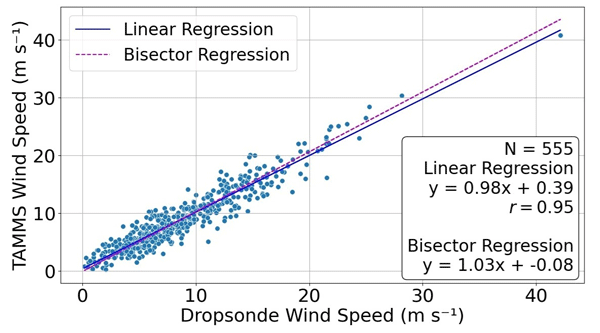
We conducted this study to assess the accuracy of airborne measurements of wind, temperature, and humidity, essential for understanding atmospheric processes. Using data from NASA's ACTIVATE campaign, we compared measurements from the Turbulent Air Motion Measurement System (TAMMS) and diode laser hygrometer (DLH) aboard a Falcon aircraft with dropsondes from a King Air, matching data points based on location and time using statistical methods. The study showed strong agreement, confirming the reliability of these methods for advancing climate models.
Hui Wan, Abhishek Yenpure, Berk Geveci, Richard C. Easter, Philip J. Rasch, Kai Zhang, and Xubin Zeng
Geosci. Model Dev., 18, 5655–5680, https://doi.org/10.5194/gmd-18-5655-2025, https://doi.org/10.5194/gmd-18-5655-2025, 2025
Short summary
Short summary
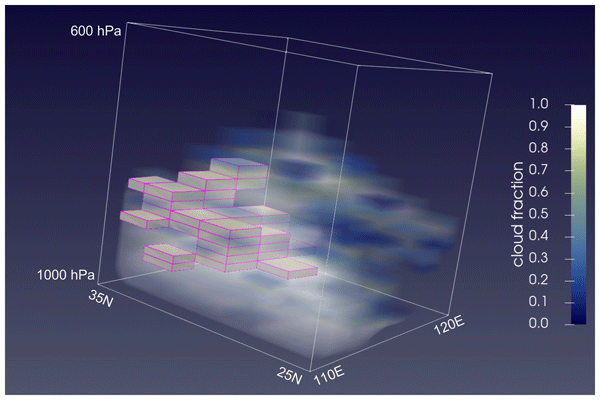
In the Energy Exascale Earth System Model version 2 (E3SMv2) and many other global models, the simulated anthropogenic aerosol effective radiative forcing is sensitive to the presence of clouds with very low droplet number concentrations. Numerical experiments presented in this paper indicate that mid- and high-latitude low-level stratus occurring under weak turbulence is a key cloud regime for investigating the causes of these very low cloud droplet number concentrations in E3SMv2.
Shuaiqi Tang, Hailong Wang, Xiang-Yu Li, Jingyi Chen, Armin Sorooshian, Xubin Zeng, Ewan Crosbie, Kenneth L. Thornhill, Luke D. Ziemba, and Christiane Voigt
Atmos. Chem. Phys., 24, 10073–10092, https://doi.org/10.5194/acp-24-10073-2024, https://doi.org/10.5194/acp-24-10073-2024, 2024
Short summary
Short summary
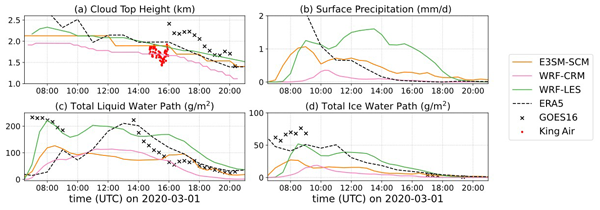
We examined marine boundary layer clouds and their interactions with aerosols in the E3SM single-column model (SCM) for a case study. The SCM shows good agreement when simulating the clouds with high-resolution models. It reproduces the relationship between cloud droplet and aerosol particle number concentrations as produced in global models. However, the relationship between cloud liquid water and droplet number concentration is different, warranting further investigation.
Bo-Wen Shen, Roger Pielke Sr., and Xubin Zeng
EGUsphere, https://doi.org/10.13140/RG.2.2.32941.15849, https://doi.org/10.13140/RG.2.2.32941.15849, 2024
Preprint archived
Short summary
Short summary
Our reanalysis does not support the claim that Lorenz’s and Lilly’s formulas are mathematically or physically comparable. No common factor of 2^{−2/3} can be robustly determined from Lorenz's data, disproving the assumption that the saturation time difference and turnover time are linearly proportional over wave modes. These issues, along with the highly simplified features of the Lorenz 1969 model, indicate that an upper bound for the predictability limit has not been robustly determined.
Sanja Dmitrovic, Johnathan W. Hair, Brian L. Collister, Ewan Crosbie, Marta A. Fenn, Richard A. Ferrare, David B. Harper, Chris A. Hostetler, Yongxiang Hu, John A. Reagan, Claire E. Robinson, Shane T. Seaman, Taylor J. Shingler, Kenneth L. Thornhill, Holger Vömel, Xubin Zeng, and Armin Sorooshian
Atmos. Meas. Tech., 17, 3515–3532, https://doi.org/10.5194/amt-17-3515-2024, https://doi.org/10.5194/amt-17-3515-2024, 2024
Short summary
Short summary
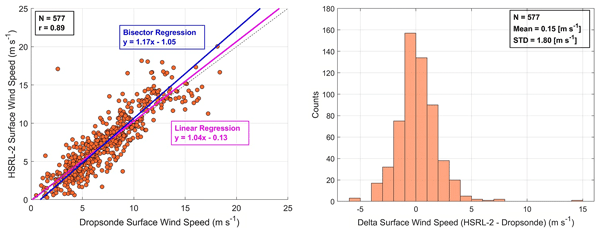
This study introduces and evaluates a new ocean surface wind speed product from the NASA Langley Research Center (LARC) airborne High-Spectral-Resolution Lidar – Generation 2 (HSRL-2) during the NASA ACTIVATE mission. We show that HSRL-2 surface wind speed data are accurate when compared to ground-truth dropsonde measurements. Therefore, the HSRL-2 instrument is able obtain accurate, high-resolution surface wind speed data in airborne field campaigns.
Nenghan Wan, Xiaomao Lin, Roger A. Pielke Sr., Xubin Zeng, and Amanda M. Nelson
Hydrol. Earth Syst. Sci., 28, 2123–2137, https://doi.org/10.5194/hess-28-2123-2024, https://doi.org/10.5194/hess-28-2123-2024, 2024
Short summary
Short summary
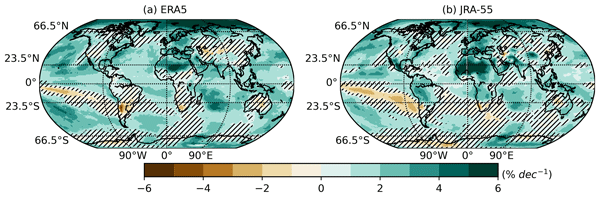
Global warming occurs at a rate of 0.21 K per decade, resulting in about 9.5 % K−1 of water vapor response to temperature from 1993 to 2021. Terrestrial areas experienced greater warming than the ocean, with a ratio of 2 : 1. The total precipitable water change in response to surface temperature changes showed a variation around 6 % K−1–8 % K−1 in the 15–55° N latitude band. Further studies are needed to identify the mechanisms leading to different water vapor responses.
Leong Wai Siu, Joseph S. Schlosser, David Painemal, Brian Cairns, Marta A. Fenn, Richard A. Ferrare, Johnathan W. Hair, Chris A. Hostetler, Longlei Li, Mary M. Kleb, Amy Jo Scarino, Taylor J. Shingler, Armin Sorooshian, Snorre A. Stamnes, and Xubin Zeng
Atmos. Meas. Tech., 17, 2739–2759, https://doi.org/10.5194/amt-17-2739-2024, https://doi.org/10.5194/amt-17-2739-2024, 2024
Short summary
Short summary
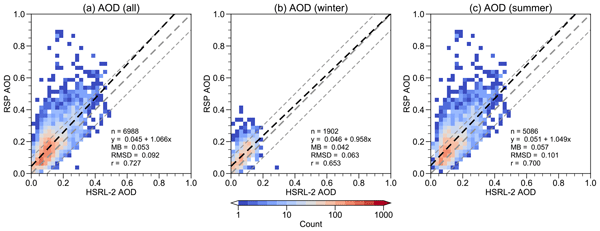
An unprecedented 3-year aerosol dataset was collected from a recent NASA field campaign over the western North Atlantic Ocean, which offers a special opportunity to evaluate two state-of-the-art remote sensing instruments, one lidar and the other polarimeter, on the same aircraft. Special attention has been paid to validate aerosol optical depth data and their uncertainties when no reference dataset is available. Physical reasons for the disagreement between two instruments are discussed.
Yu Yao, Po-Lun Ma, Yi Qin, Matthew W. Christensen, Hui Wan, Kai Zhang, Balwinder Singh, Meng Huang, and Mikhail Ovchinnikov
EGUsphere, https://doi.org/10.5194/egusphere-2024-523, https://doi.org/10.5194/egusphere-2024-523, 2024
Preprint withdrawn
Short summary
Short summary
Giant aerosols have substantial effects on warm rain formation. However, it remains challenging to quantify the impact of giant particles at global scale. In this work, we applied earth system model to investigate its impacts by implementing new giant aerosol treatments to consider its physical process. We found this approach substantially affect liquid cloud and improved model's precipitation response to aerosols. Our findings demonstrate the significant impact of giant aerosols on climate.
Hui Wan, Kai Zhang, Christopher J. Vogl, Carol S. Woodward, Richard C. Easter, Philip J. Rasch, Yan Feng, and Hailong Wang
Geosci. Model Dev., 17, 1387–1407, https://doi.org/10.5194/gmd-17-1387-2024, https://doi.org/10.5194/gmd-17-1387-2024, 2024
Short summary
Short summary
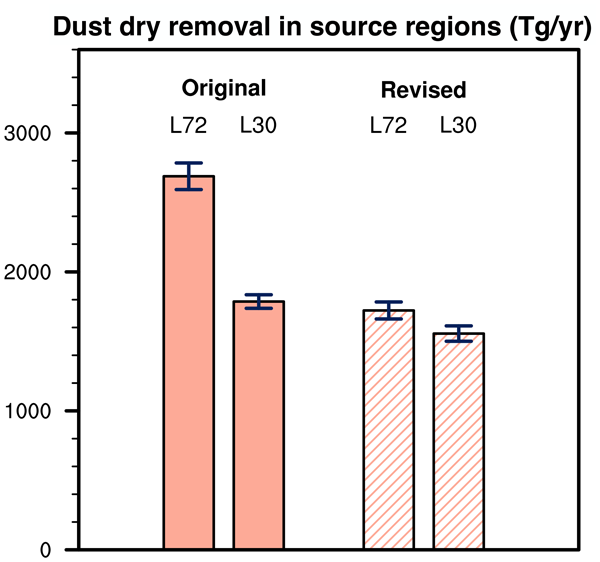
Sophisticated numerical models of the Earth's atmosphere include representations of many physical and chemical processes. In numerical simulations, these processes need to be calculated in a certain sequence. This study reveals the weaknesses of the sequence of calculations used for aerosol processes in a global atmosphere model. A revision of the sequence is proposed and its impacts on the simulated global aerosol climatology are evaluated.

Christopher J. Vogl, Hui Wan, Carol S. Woodward, and Quan M. Bui
Geosci. Model Dev., 17, 1409–1428, https://doi.org/10.5194/gmd-17-1409-2024, https://doi.org/10.5194/gmd-17-1409-2024, 2024
Short summary
Short summary
Generally speaking, accurate climate simulation requires an accurate evolution of the underlying mathematical equations on large computers. The equations are typically formulated and evolved in process groups. Process coupling refers to how the evolution of each group is combined with that of other groups to evolve the full set of equations for the whole atmosphere. This work presents a mathematical framework to evaluate methods without the need to first implement the methods.
Armin Sorooshian, Mikhail D. Alexandrov, Adam D. Bell, Ryan Bennett, Grace Betito, Sharon P. Burton, Megan E. Buzanowicz, Brian Cairns, Eduard V. Chemyakin, Gao Chen, Yonghoon Choi, Brian L. Collister, Anthony L. Cook, Andrea F. Corral, Ewan C. Crosbie, Bastiaan van Diedenhoven, Joshua P. DiGangi, Glenn S. Diskin, Sanja Dmitrovic, Eva-Lou Edwards, Marta A. Fenn, Richard A. Ferrare, David van Gilst, Johnathan W. Hair, David B. Harper, Miguel Ricardo A. Hilario, Chris A. Hostetler, Nathan Jester, Michael Jones, Simon Kirschler, Mary M. Kleb, John M. Kusterer, Sean Leavor, Joseph W. Lee, Hongyu Liu, Kayla McCauley, Richard H. Moore, Joseph Nied, Anthony Notari, John B. Nowak, David Painemal, Kasey E. Phillips, Claire E. Robinson, Amy Jo Scarino, Joseph S. Schlosser, Shane T. Seaman, Chellappan Seethala, Taylor J. Shingler, Michael A. Shook, Kenneth A. Sinclair, William L. Smith Jr., Douglas A. Spangenberg, Snorre A. Stamnes, Kenneth L. Thornhill, Christiane Voigt, Holger Vömel, Andrzej P. Wasilewski, Hailong Wang, Edward L. Winstead, Kira Zeider, Xubin Zeng, Bo Zhang, Luke D. Ziemba, and Paquita Zuidema
Earth Syst. Sci. Data, 15, 3419–3472, https://doi.org/10.5194/essd-15-3419-2023, https://doi.org/10.5194/essd-15-3419-2023, 2023
Short summary
Short summary
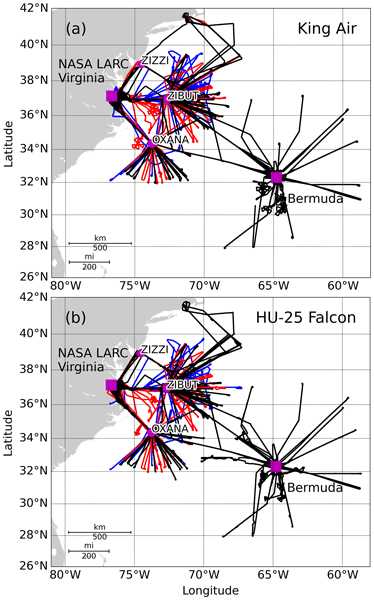
The NASA Aerosol Cloud meTeorology Interactions oVer the western ATlantic Experiment (ACTIVATE) produced a unique dataset for research into aerosol–cloud–meteorology interactions. HU-25 Falcon and King Air aircraft conducted systematic and spatially coordinated flights over the northwest Atlantic Ocean. This paper describes the ACTIVATE flight strategy, instrument and complementary dataset products, data access and usage details, and data application notes.

Shixuan Zhang, Kai Zhang, Hui Wan, and Jian Sun
Geosci. Model Dev., 15, 6787–6816, https://doi.org/10.5194/gmd-15-6787-2022, https://doi.org/10.5194/gmd-15-6787-2022, 2022
Short summary
Short summary
This study investigates the nudging implementation in the EAMv1 model. We find that (1) revising the sequence of calculations and using higher-frequency constraining data to improve the performance of a simulation nudged to EAMv1’s own meteorology, (2) using the relocated nudging tendency and 3-hourly ERA5 reanalysis to obtain a better agreement between nudged simulations and observations, and (3) using wind-only nudging are recommended for the estimates of global mean aerosol effects.
Kai Zhang, Wentao Zhang, Hui Wan, Philip J. Rasch, Steven J. Ghan, Richard C. Easter, Xiangjun Shi, Yong Wang, Hailong Wang, Po-Lun Ma, Shixuan Zhang, Jian Sun, Susannah M. Burrows, Manish Shrivastava, Balwinder Singh, Yun Qian, Xiaohong Liu, Jean-Christophe Golaz, Qi Tang, Xue Zheng, Shaocheng Xie, Wuyin Lin, Yan Feng, Minghuai Wang, Jin-Ho Yoon, and L. Ruby Leung
Atmos. Chem. Phys., 22, 9129–9160, https://doi.org/10.5194/acp-22-9129-2022, https://doi.org/10.5194/acp-22-9129-2022, 2022
Short summary
Short summary
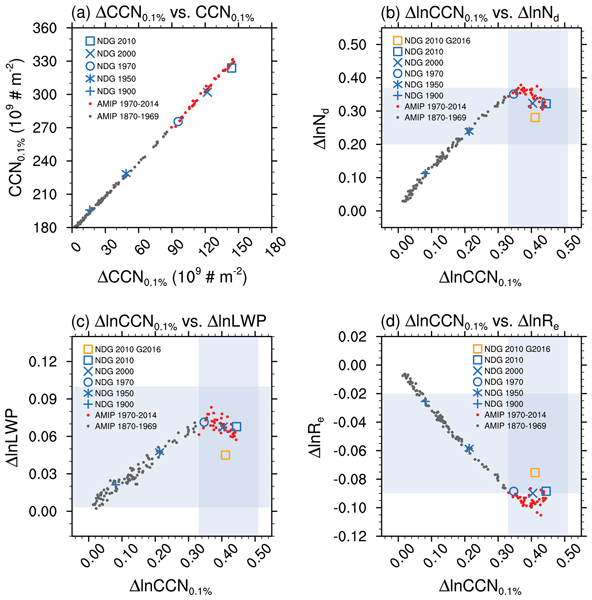
Here we analyze the effective aerosol forcing simulated by E3SM version 1 using both century-long free-running and short nudged simulations. The aerosol forcing in E3SMv1 is relatively large compared to other models, mainly due to the large indirect aerosol effect. Aerosol-induced changes in liquid and ice cloud properties in E3SMv1 have a strong correlation. The aerosol forcing estimates in E3SMv1 are sensitive to the parameterization changes in both liquid and ice cloud processes.

Hui Wan, Kai Zhang, Philip J. Rasch, Vincent E. Larson, Xubin Zeng, Shixuan Zhang, and Ross Dixon
Geosci. Model Dev., 15, 3205–3231, https://doi.org/10.5194/gmd-15-3205-2022, https://doi.org/10.5194/gmd-15-3205-2022, 2022
Short summary
Short summary
This paper describes a tool embedded in a global climate model for sampling atmospheric conditions and monitoring physical processes as a numerical simulation is being carried out. The tool facilitates process-level model evaluation by allowing the users to select a wide range of quantities and processes to monitor at run time without having to do tedious ad hoc coding.
Po-Lun Ma, Bryce E. Harrop, Vincent E. Larson, Richard B. Neale, Andrew Gettelman, Hugh Morrison, Hailong Wang, Kai Zhang, Stephen A. Klein, Mark D. Zelinka, Yuying Zhang, Yun Qian, Jin-Ho Yoon, Christopher R. Jones, Meng Huang, Sheng-Lun Tai, Balwinder Singh, Peter A. Bogenschutz, Xue Zheng, Wuyin Lin, Johannes Quaas, Hélène Chepfer, Michael A. Brunke, Xubin Zeng, Johannes Mülmenstädt, Samson Hagos, Zhibo Zhang, Hua Song, Xiaohong Liu, Michael S. Pritchard, Hui Wan, Jingyu Wang, Qi Tang, Peter M. Caldwell, Jiwen Fan, Larry K. Berg, Jerome D. Fast, Mark A. Taylor, Jean-Christophe Golaz, Shaocheng Xie, Philip J. Rasch, and L. Ruby Leung
Geosci. Model Dev., 15, 2881–2916, https://doi.org/10.5194/gmd-15-2881-2022, https://doi.org/10.5194/gmd-15-2881-2022, 2022
Short summary
Short summary
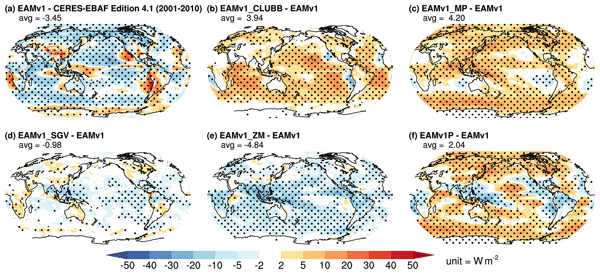
An alternative set of parameters for E3SM Atmospheric Model version 1 has been developed based on a tuning strategy that focuses on clouds. When clouds in every regime are improved, other aspects of the model are also improved, even though they are not the direct targets for calibration. The recalibrated model shows a lower sensitivity to anthropogenic aerosols and surface warming, suggesting potential improvements to the simulated climate in the past and future.
Cited articles
Anderson, D. G.: Iterative procedures for nonlinear integral equations, J. ACM, 12, 547–560, 1965. a
Banach, S.: Sur les opérations dans les ensembles abstraits et leur application aux équations intégrales, Fund. Math., 3, 133–181, https://doi.org/10.4064/fm-3-1-133-181, 1922. a
Beljaars, A. C. M.: The parametrization of surface fluxes in large-scale models under free convection, Q. J. Roy. Meteor. Soc., 121, 255–270, https://doi.org/10.1002/qj.49712152203, 1995. a, b
Bentsen, M., Bethke, I., Debernard, J. B., Iversen, T., Kirkevåg, A., Seland, Ø., Drange, H., Roelandt, C., Seierstad, I. A., Hoose, C., and Kristjánsson, J. E.: The Norwegian Earth System Model, NorESM1-M – Part 1: Description and basic evaluation of the physical climate, Geosci. Model Dev., 6, 687–720, https://doi.org/10.5194/gmd-6-687-2013, 2013. a
Brodeau, L., Barnier, B., Gulev, S. K., and Woods, C.: Climatologically Significant Effects of Some Approximations in the Bulk Parameterizations of Turbulent Air–Sea Fluxes, J. Phys. Oceanogr., 47, 5–28, https://doi.org/10.1175/JPO-D-16-0169.1, 2017. a
Brunke, M. A., Zeng, X., and Anderson, S.: Uncertainties in sea surface turbulent flux algorithms and data sets, J. Geophys. Res.-Oceans, 107, 5–1–5–21, https://doi.org/10.1029/2001JC000992, 2002. a
Brunke, M. A., Fairall, C. W., Zeng, X., Eymard, L., and Curry, J. A.: Which Bulk Aerodynamic Algorithms are Least Problematic in Computing Ocean Surface Turbulent Fluxes?, J. Climate, 16, 619–635, https://doi.org/10.1175/1520-0442(2003)016<0619:WBAAAL>2.0.CO;2, 2003. a, b, c
Cassano, J. J., DuVivier, A., Roberts, A., Abel, M. R., Seefeldt, M., Brunke, M., Craig, A., Fisel, B., Gutowski, W., Hamman, J., Higgins, M., Maslowski, W., Nijssen, B., Osinski, R., and Zeng, X.: Development of the Regional Arctic System Model (RASM): Near-Surface Atmospheric Climate Sensitivity, J. Climate, 30, 5729–5753, https://doi.org/10.1175/JCLI-D-15-0775.1, 2017. a
Chang, H.-R. and Grossman, R. L.: Evaluation of bulk surface flux algorithms for light wind conditions using data from the Coupled Ocean-Atmosphere Response Experiment (COARE), Q. J. Roy. Meteor. Soc., 125, 1551–1588, https://doi.org/10.1002/qj.49712555705, 1999. a
Chow, S.-N. and Hale, J. K.: Methods of bifurcation theory, vol. 251, Springer Science & Business Media, https://doi.org/10.1007/978-1-4613-8159-4, 2012. a
Danabasoglu, G., Lamarque, J.-F., Bacmeister, J., Bailey, D. A., DuVivier, A. K., Edwards, J., Emmons, L. K., Fasullo, J., Garcia, R., Gettelman, A., Hannay, C., Holland, M. M., Large, W. G., Lauritzen, P. H., Lawrence, D. M., Lenaerts, J. T. M., Lindsay, K., Lipscomb, W. H., Mills, M. J., Neale, R., Oleson, K. W., Otto-Bliesner, B., Phillips, A. S., Sacks, W., Tilmes, S., van Kampenhout, L., Vertenstein, M., Bertini, A., Dennis, J., Deser, C., Fischer, C., Fox-Kemper, B., Kay, J. E., Kinnison, D., Kushner, P. J., Larson, V. E., Long, M. C., Mickelson, S., Moore, J. K., Nienhouse, E., Polvani, L., Rasch, P. J., and Strand, W. G.: The Community Earth System Model Version 2 (CESM2), J. Adv. Model. Earth Sy., 12, e2019MS001916, https://doi.org/10.1029/2019MS001916, 2020. a
Dong, J.: PAESCAL-SciDAC5/E3SM-fork: Ocean atmosphere turbulent flux revisions v2 (ocean_atm_flux_paper_v2), Zenodo [code], https://doi.org/10.5281/zenodo.21325962, 2026. a
Dong, J., Brunke, M. A., Zeng, X., Woodward, C. S., Vogl, C. J., and Wan, H.: E3SMv2 offline analysis of ocean-atmosphere turbulent flux parameterization, Zenodo [data set], https://doi.org/10.5281/zenodo.21333050, 2026a. a
Dong, J., Brunke, M. A., Zeng, X., Woodward, C. S., Wan, H., and Vogl, C. J.: E3SMv2 climatology and time series output for analysis of ocean-atmosphere turbulent flux parameterization (pt 1), Zenodo [data set], https://doi.org/10.5281/zenodo.21833782, 2026b. a
Dong, J., Brunke, M. A., Zeng, X., Woodward, C. S., Wan, H., and Vogl, C. J.: E3SMv2 climatology and time series output for analysis of ocean-atmosphere turbulent flux parameterization (pt 2), Zenodo [data set], https://doi.org/10.5281/zenodo.21834625, 2026c. a
Dong, J., Brunke, M. A., Zeng, X., Woodward, C. S., Wan, H., and Vogl, C. J.: E3SMv2 climatology and time series output for analysis of ocean-atmosphere turbulent flux parameterization (pt 3), Zenodo [data set], https://doi.org/10.5281/zenodo.21841362, 2026d. a
ECMWF: IFS Documentation CY50R1 – Part 4: Physical Processes, ECMWF, https://doi.org/10.21957/49928f2338, 2026. a
Fairall, C. W., Bradley, E. F., Hare, J. E., Grachev, A. A., and Edson, J. B.: Bulk Parameterization of Air–Sea Fluxes: Updates and Verification for the COARE Algorithm, J. Climate, 16, 571–591, https://doi.org/10.1175/1520-0442(2003)016<0571:BPOASF>2.0.CO;2, 2003. a, b, c, d
Gardner, D. J., Reynolds, D. R., Woodward, C. S., and Balos, C. J.: Enabling new flexibility in the SUNDIALS suite of nonlinear and differential/algebraic equation solvers, ACM T. Math. Softw., 48, 1–24, https://doi.org/10.1145/3539801, 2022. a
Golaz, J.-C., Van Roekel, L. P., Zheng, X., Roberts, A. F., Wolfe, J. D., Lin, W., Bradley, A. M., Tang, Q., Maltrud, M. E., Forsyth, R. M., Zhang, C., Zhou, T., Zhang, K., Zender, C. S., Wu, M., Wang, H., Turner, A. K., Singh, B., Richter, J. H., Qin, Y., Petersen, M. R., Mametjanov, A., Ma, P.-L., Larson, V. E., Krishna, J., Keen, N. D., Jeffery, N., Hunke, E. C., Hannah, W. M., Guba, O., Griffin, B. M., Feng, Y., Engwirda, D., Di Vittorio, A. V., Dang, C., Conlon, L. M., Chen, C.-C.-J., Brunke, M. A., Bisht, G., Benedict, J. J., Asay-Davis, X. S., Zhang, Y., Zhang, M., Zeng, X., Xie, S., Wolfram, P. J., Vo, T., Veneziani, M., Tesfa, T. K., Sreepathi, S., Salinger, A. G., Reeves Eyre, J. E. J., Prather, M. J., Mahajan, S., Li, Q., Jones, P. W., Jacob, R. L., Huebler, G. W., Huang, X., Hillman, B. R., Harrop, B. E., Foucar, J. G., Fang, Y., Comeau, D. S., Caldwell, P. M., Bartoletti, T., Balaguru, K., Taylor, M. A., McCoy, R. B., Leung, L. R., and Bader, D. C.: The DOE E3SM Model Version 2: Overview of the Physical Model and Initial Model Evaluation, J. Adv. Model. Earth Sy., 14, e2022MS003156, https://doi.org/10.1029/2022MS003156, 2022. a, b, c
Hannah, W. M., Bradley, A. M., Guba, O., Tang, Q., Golaz, J.-C., and Wolfe, J.: Separating Physics and Dynamics Grids for Improved Computational Efficiency in Spectral Element Earth System Models, J. Adv. Model. Earth Sy, 13, e2020MS002419, https://doi.org/10.1029/2020MS002419, 2021. a
Harrop, B. E., Ma, P.-L., Rasch, P. J., Neale, R. B., and Hannay, C.: The Role of Convective Gustiness in Reducing Seasonal Precipitation Biases in the Tropical West Pacific, J. Adv. Model. Earth Sy., 10, 961–970, https://doi.org/10.1002/2017MS001157, 2018. a
Hartung, K., Svensson, G., Struthers, H., Deppenmeier, A.-L., and Hazeleger, W.: An EC-Earth coupled atmosphere–ocean single-column model (AOSCM.v1_EC-Earth3) for studying coupled marine and polar processes, Geosci. Model Dev., 11, 4117–4137, https://doi.org/10.5194/gmd-11-4117-2018, 2018. a
Hindmarsh, A. C., Brown, P. N., Grant, K. E., Lee, S. L., Serban, R., Shumaker, D. E., and Woodward, C. S.: SUNDIALS: Suite of nonlinear and differential/algebraic equation solvers, ACM T. Math. Softw., 31, 363–396, https://doi.org/10.1145/1089014.1089020, 2005. a
Hurrell, J. W., Holland, M. M., Gent, P. R., Ghan, S., Kay, J. E., Kushner, P. J., Lamarque, J.-F., Large, W. G., Lawrence, D., Lindsay, K., Lipscomb, W. H., Long, M. C., Mahowald, N., Marsh, D. R., Neale, R. B., Rasch, P., Vavrus, S., Vertenstein, M., Bader, D., Collins, W. D., Hack, J. J., Kiehl, J., and Marshall, S.: The Community Earth System Model: A Framework for Collaborative Research, B. Am. Meteorol. Soc., 94, 1339–1360, https://doi.org/10.1175/BAMS-D-12-00121.1, 2013. a
Kara, A. B., Rochford, P. A., and Hurlburt, H. E.: Efficient and Accurate Bulk Parameterizations of Air–Sea Fluxes for Use in General Circulation Models, J. Atmos. Ocean. Tech., 17, 1421–1438, https://doi.org/10.1175/1520-0426(2000)017<1421:EAABPO>2.0.CO;2, 2000. a, b
Kara, A. B., Hurlburt, H. E., and Wallcraft, A. J.: Stability-Dependent Exchange Coefficients for Air–Sea Fluxes, J. Atmos. Ocean. Tech, 22, 1080–1094, https://doi.org/10.1175/JTECH1747.1, 2005. a, b
Kawai, H., Yoshida, K., Koshiro, T., and Yukimoto, S.: Importance of Minor-Looking Treatments in Global Climate Models, J. Adv. Model. Earth Sy., 14, e2022MS003128, https://doi.org/10.1029/2022MS003128, 2022. a
Large, W. B.: Surface Fluxes for Practitioners of Global Ocean Data Assimilation, Springer Netherlands, Dordrecht, 229–270, ISBN 978-1-4020-4028-3, https://doi.org/10.1007/1-4020-4028-8_9, 2006. a, b, c, d
Large, W. G. and Caron, J. M.: Diurnal cycling of sea surface temperature, salinity, and current in the CESM coupled climate model, J. Geophys. Res.-Oceans, 120, 3711–3729, https://doi.org/10.1002/2014JC010691, 2015. a
Lee, W.-L., Wang, Y.-C., Shiu, C.-J., Tsai, I., Tu, C.-Y., Lan, Y.-Y., Chen, J.-P., Pan, H.-L., and Hsu, H.-H.: Taiwan Earth System Model Version 1: description and evaluation of mean state, Geosci. Model Dev., 13, 3887–3904, https://doi.org/10.5194/gmd-13-3887-2020, 2020. a
Louis, J.-F.: A parameteric model of vertical eddy fluxes in the atmosphere, Bound.-Lay. Meteorol., 17, 187–202, https://doi.org/10.1007/BF00117978, 1979. a
Lovato, T., Peano, D., Butenschön, M., Materia, S., Iovino, D., Scoccimarro, E., Fogli, P. G., Cherchi, A., Bellucci, A., Gualdi, S., Masina, S., and Navarra, A.: CMIP6 Simulations With the CMCC Earth System Model (CMCC-ESM2), J. Adv. Model. Earth Sy., 14, e2021MS002814, https://doi.org/10.1029/2021MS002814, 2022. a
Ma, P.-L., Harrop, B. E., Larson, V. E., Neale, R. B., Gettelman, A., Morrison, H., Wang, H., Zhang, K., Klein, S. A., Zelinka, M. D., Zhang, Y., Qian, Y., Yoon, J.-H., Jones, C. R., Huang, M., Tai, S.-L., Singh, B., Bogenschutz, P. A., Zheng, X., Lin, W., Quaas, J., Chepfer, H., Brunke, M. A., Zeng, X., Mülmenstädt, J., Hagos, S., Zhang, Z., Song, H., Liu, X., Pritchard, M. S., Wan, H., Wang, J., Tang, Q., Caldwell, P. M., Fan, J., Berg, L. K., Fast, J. D., Taylor, M. A., Golaz, J.-C., Xie, S., Rasch, P. J., and Leung, L. R.: Better calibration of cloud parameterizations and subgrid effects increases the fidelity of the E3SM Atmosphere Model version 1, Geosci. Model Dev., 15, 2881–2916, https://doi.org/10.5194/gmd-15-2881-2022, 2022. a
Monin, A. S. and Obukhov, A. M.: Basic laws of turbulent mixing in the surface layer of the atmosphere, Contrib. Geophys. Inst. Acad. Sci. USSR, 24, 163–187, 1954. a
Morrison, H. and Gettelman, A.: A New Two-Moment Bulk Stratiform Cloud Microphysics Scheme in the Community Atmosphere Model, Version 3 (CAM3). Part I: Description and Numerical Tests, J. Climate, 21, 3642–3659, https://doi.org/10.1175/2008JCLI2105.1, 2008. a
Neale, R. B., Gettelman, A., Park, S., Chen, C.-C., Lauritzen, P. H., Williamson, D. L., Conley, A. J., Kinnison, D. E., Marsh, D., Smith, A. K., Vitt, F. M., García, R. R., Lamarque, J.-F., Mills, M. J., Tilmes, S., Morrison, H., Cameron-Smith, P., Collins, W. D., Iacono, M. J., Easter, M. C., Liu, X., Ghan, S. J., Rasch, P. J., and Taylor, M. A.: Description of the NCAR Community Atmosphere Model (CAM 5.0), Tech. rep., National Center for Atmospheric Research, https://doi.org/10.5065/wgtk-4g06, 2012. a
Obukhov, A. M.: Turbulence in an atmosphere with a non-uniform temperature, Bounda.-Lay. Meteorol., 2, 7–29, https://doi.org/10.1007/BF00718085, 1971. a
Ortega, J. M. and Rockoff, M. L.: Nonlinear difference equations and Gauss-Seidel type iterative methods, SIAM J. Numer. Anal., 3, 497–513, 1966. a
Pelletier, C., Lemarié, F., and Blayo, E.: Sensitivity analysis and metamodels for the bulk parametrization of turbulent air–sea fluxes, Q. J. Roy. Meteor. Soc., 144, 658–669, https://doi.org/10.1002/qj.3233, 2018. a
Rasch, P. J., Xie, S., Ma, P.-L., Lin, W., Wang, H., Tang, Q., Burrows, S. M., Caldwell, P., Zhang, K., Easter, R. C., Cameron-Smith, P., Singh, B., Wan, H., Golaz, J.-C., Harrop, B. E., Roesler, E., Bacmeister, J., Larson, V. E., Evans, K. J., Qian, Y., Taylor, M., Leung, L. R., Zhang, Y., Brent, L., Branstetter, M., Hannay, C., Mahajan, S., Mametjanov, A., Neale, R., Richter, J. H., Yoon, J.-H., Zender, C. S., Bader, D., Flanner, M., Foucar, J. G., Jacob, R., Keen, N., Klein, S. A., Liu, X., Salinger, A., Shrivastava, M., and Yang, Y.: An Overview of the Atmospheric Component of the Energy Exascale Earth System Model, J. Adv. Model. Earth Sy., 11, 2377–2411, https://doi.org/10.1029/2019MS001629, 2019. a
Reeves Eyre, J. E. J., Zeng, X., and Zhang, K.: Ocean Surface Flux Algorithm Effects on Earth System Model Energy and Water Cycles, Front. Mar.e Sci., 8, https://doi.org/10.3389/fmars.2021.642804, 2021. a
Santos, S. P., Caldwell, P. M., and Bretherton, C. S.: Numerically Relevant Timescales in the MG2 Microphysics Model, J. Adv. Model. Earth Sy., 12, e2019MS001972, https://doi.org/10.1029/2019MS001972, 2020. a
Schüller, V., Lemarié, F., Birken, P., and Blayo, E.: Quantifying coupling errors in atmosphere-ocean-sea ice models: A study of iterative and non-iterative approaches in the EC-Earth AOSCM, Geosci. Model Dev., 18, 9167–9187, https://doi.org/10.5194/gmd-18-9167-2025, 2025. a
Torres, O., Braconnot, P., Hourdin, F., Roehrig, R., Marti, O., Belamari, S., and Lefebvre, M.-P.: Competition Between Atmospheric and Surface Parameterizations for the Control of Air-Sea Latent Heat Fluxes in Two Single-Column Models, Geophys. Res. Lett., 46, 7780–7789, https://doi.org/10.1029/2019GL082720, 2019. a
Wan, H., Rasch, P. J., Taylor, M. A., and Jablonowski, C.: Short-term time step convergence in a climate model, J. Adv. Model. Earth Sy., 7, 215–225, https://doi.org/10.1002/2014MS000368, 2015. a
Wan, H., Zhang, S., Rasch, P. J., Larson, V. E., Zeng, X., and Yan, H.: Quantifying and attributing time step sensitivities in present-day climate simulations conducted with EAMv1, Geosci. Model Dev., 14, 1921–1948, https://doi.org/10.5194/gmd-14-1921-2021, 2021. a
Wan, H., Zhang, K., Rasch, P. J., Larson, V. E., Zeng, X., Zhang, S., and Dixon, R.: CondiDiag1.0: a flexible online diagnostic tool for conditional sampling and budget analysis in the E3SM atmosphere model (EAM), Geosci. Model Dev., 15, 3205–3231, https://doi.org/10.5194/gmd-15-3205-2022, 2022. a
Wan, H., Zhang, K., Vogl, C. J., Woodward, C. S., Easter, R. C., Rasch, P. J., Feng, Y., and Wang, H.: Numerical coupling of aerosol emissions, dry removal, and turbulent mixing in the E3SM Atmosphere Model version 1 (EAMv1) – Part 1: Dust budget analyses and the impacts of a revised coupling scheme, Geosci. Model Dev., 17, 1387–1407, https://doi.org/10.5194/gmd-17-1387-2024, 2024. a
Xie, S., Lin, W., Rasch, P. J., Ma, P.-L., Neale, R., Larson, V. E., Qian, Y., Bogenschutz, P. A., Caldwell, P., Cameron-Smith, P., Golaz, J.-C., Mahajan, S., Singh, B., Tang, Q., Wang, H., Yoon, J.-H., Zhang, K., and Zhang, Y.: Understanding Cloud and Convective Characteristics in Version 1 of the E3SM Atmosphere Model, J. Adv. Model. Earth Sy., 10, 2618–2644, https://doi.org/10.1029/2018MS001350, 2018. a
Xie, S., Terai, C. R., Wang, H., Tang, Q., Fan, J., Burrows, S. M., Lin, W., Wu, M., Song, X., Zhang, Y., et al.: The Energy Exascale Earth System Model Version 3. Part I: Overview of the Atmospheric Component, Authorea [preprint], https://doi.org/10.22541/essoar.174456922.21825772/v1, 2025. a
Zhang, S., Vogl, C. J., Larson, V. E., Bui, Q. M., Wan, H., Rasch, P. J., and Woodward, C. S.: Removing Numerical Pathologies in a Turbulence Parameterization Through Convergence Testing, J. Adv. Model. Earth Sy., 15, e2023MS003633, https://doi.org/10.1029/2023MS003633, 2023. a, b
Zwiers, F. W. and von Storch, H.: Taking Serial Correlation into Account in Tests of the Mean, J. Climate, 8, 336–351, https://doi.org/10.1175/1520-0442(1995)008<0336:TSCIAI>2.0.CO;2, 1995. a
Short summary
Accurately computing ocean–atmosphere turbulent fluxes, which measure the transfer of momentum, heat, and water between the Earth and its oceans, in Earth system models is important for overall model accuracy. Under certain meteorological conditions, the set of equations utilized in many Earth system models to parameterize these fluxes can have no solution or more than one solution. Modifying the equations to address these issues leads to substantial changes to the simulated turbulent fluxes.
Accurately computing ocean–atmosphere turbulent fluxes, which measure the transfer of momentum,...


Altmetrics
Final-revised paper
Preprint